ECONOMIC AND MANAGEMENT SCIENCES
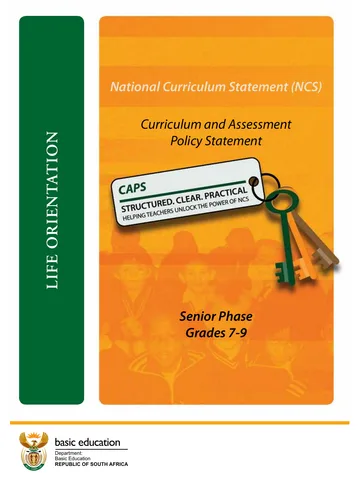
National Curriculum Statement (NCS)
Curriculum and Assessment
Policy Statement
Senior Phase
Grades 7-9
Skip to contentCAPS document
CAPS SP EMS WEB
Grades 7, 8, 9 Unknown CAPS document (English), 38 pages. Read online or get the free PDF download.
Unknown · Grades 7, 8, 9 · English. CAPS document, 38 pages. Read online or download the PDF.
- Subject
- Unknown
- Grade
- Grades 7, 8, 9
- Language
- English
- Document type
- CAPS document
- Curriculum
- CAPS
- Pages
- 38
- File size
- 440.9 KB
Loading document…
Loading document…
1 of 38
Document textSearch extracted text and jump to a page.
Curriculum and Assessment Policy Statement
GRADES 7-9
ECONOMIC AND MANAGEMENT SCIENCES
CAPS
ECONOMIC AND MANAGEMENT SCIENCES GRADES 7-9
DISCLAIMER
In view of the stringent time requirements encountered by the Department of Basic Education to effect the necessary editorial changes and layout
to the Curriculum and Assessment Policy Statements and the supplementary policy documents, possible errors may occur in the said documents
placed on the official departmental websites.
There may also be vernacular inconsistencies in the language documents at Home-, First and Second Additional Language levels which have been
translated in the various African Languages. Please note that the content of the documents translated and versioned in the African Languages are
correct as they are based on the English generic language documents at all three language levels to be implemented in all four school phases.
If any editorial, layout or vernacular inconsistencies are detected, the user is kindly requested to bring this to the attention of the Department of
Basic Education.
E-mail: capslangcomments@dbe.gov.za or fax (012) 328 9828
Department of Basic Education
222 Struben Street
Private Bag X895
Pretoria 0001
South Africa
Tel: +27 12 357 3000
Fax: +27 12 323 0601
120 Plein Street Private Bag X9023
Cape Town 8000
South Africa
Tel: +27 21 465 1701
Fax: +27 21 461 8110
Website: http://www.education.gov.za
© 2011 Department of Basic Education
Isbn: 978-1-4315-0530-2
Design and Layout by: Ndabase Printing Solution
Printed by: Government Printing Works
2 CURRICULUM AND ASSESSMENT POLICY STATEMENT (CAPS)
ECONOMIC AND MANAGEMENT SCIENCES GRADES 7-9
FOREWORD by the minister
Our national curriculum is the culmination of our efforts over a period of seventeen
years to transform the curriculum bequeathed to us by apartheid. From the start of
democracy we have built our curriculum on the values that inspired our Constitution
(Act 108 of 1996). The Preamble to the Constitution states that the aims of the
Constitution are to:
• heal the divisions of the past and establish a society based on democratic
values, social justice and fundamental human rights;
• improve the quality of life of all citizens and free the potential of each person;
• lay the foundations for a democratic and open society in which government is
based on the will of the people and every citizen is equally protected by law;
and
• build a united and democratic South Africa able to take its rightful place as a sovereign state in the family of
nations.
Education and the curriculum have an important role to play in realising these aims.
In 1997 we introduced outcomes-based education to overcome the curricular divisions of the past, but the experience
of implementation prompted a review in 2000. This led to the first curriculum revision: the Revised National Curriculum
Statement Grades R-9 and the National Curriculum Statement Grades 10-12 (2002).
Ongoing implementation challenges resulted in another review in 2009 and we revised the Revised National
Curriculum Statement (2002) and the National Curriculum Statement Grades 10-12 to produce this document.
From 2012 the two National Curriculum Statements, for Grades R-9 and Grades 10-12 respectively, are combined
in a single document and will simply be known as the National Curriculum Statement Grades R-12. The National
Curriculum Statement for Grades R-12 builds on the previous curriculum but also updates it and aims to provide
clearer specification of what is to be taught and learnt on a term-by-term basis.
The National Curriculum Statement Grades R-12 represents a policy statement for learning and teaching in South
African schools and comprises of the following:
(a) Curriculum and Assessment Policy Statements (CAPS) for all approved subjects listed in this document;
(b) National policy pertaining to the programme and promotion requirements of the National Curriculum Statement
Grades R-12; and
(c) National Protocol for Assessment Grades R-12.
MRS ANGIE MOTSHEKGA, MP
MINISTER OF BASIC EDUCATION
CAPS
ECONOMIC AND MANAGEMENT SCIENCES GRADES 7-9
CURRICULUM AND ASSESSMENT POLICY STATEMENT (CAPS)
ECONOMIC AND MANAGEMENT SCIENCES GRADES 7-9
CONTENTS
Section 1: INTRODUCTION TO THE Curriculum and Assessment Policy Statement..... 3
1.1 Background...................................................................................................................................................... 3
1.2 Overview........................................................................................................................................................... 3
1.3 General aims of the South African Curriculum............................................................................................. 4
1.4 Time Allocation. ............................................................................................................................................... 6
1.4.1 Foundation Phase.................................................................................................................................... 6
1.4.2 Intermediate Phase.................................................................................................................................. 6
1.4.3 Senior Phase........................................................................................................................................... 7
1.4.4 Grades 10-12........................................................................................................................................... 7
SECTION 2: ECONOMIC AND MANAGEMENT SCIENCES.................................................................... 8
2.1 What is Economic and Management Sciences?........................................................................................... 8
2.2 Overview of content......................................................................................................................................... 9
2.3 Time allocation of Economic and Management Sciences in the curriculum........................................... 10
2.4 Teaching and learning materials required for Economic and Management Sciences............................ 10
SECTION 3 TERM PLANS........................................................................................................................11
3.1 Overview of topics......................................................................................................................................... 11
3.2 Annual teaching plan..................................................................................................................................... 12
GRADE7, TERM 1........................................................................................................................................... 12
GRADE7, TERM 2........................................................................................................................................... 13
GRADE7, TERM 3........................................................................................................................................... 14
GRADE7, TERM 4........................................................................................................................................... 15
GRADE8, TERM 1........................................................................................................................................... 16
GRADE8, TERM 2........................................................................................................................................... 17
GRADE8, TERM 3........................................................................................................................................... 18
GRADE8, TERM 4........................................................................................................................................... 19
GRADE9, TERM 1........................................................................................................................................... 20
GRADE9, TERM 2........................................................................................................................................... 21
GRADE9, TERM 3........................................................................................................................................... 22
GRADE9, TERM 4........................................................................................................................................... 23
CAPS 1
ECONOMIC AND MANAGEMENT SCIENCES GRADES 7-9
SECTION 4 ASSESSMENT IN ECONOMIC AND MANAGEMENT SCIENCES..................................... 24
4.1 Introduction................................................................................................................................................... 24
4.2 Informal assessment or daily assessment ................................................................................................ 24
4.3 Formal assessment . .................................................................................................................................... 25
4.3.1 Summary of formal assessments expected in Grades 7 to 9 .............................................................. 25
4.3.2 Formal assessment requirements for Economic and Management Sciences...................................... 25
4.4 Programme of Assessment . ....................................................................................................................... 28
4.5 Recording and reporting.............................................................................................................................. 30
4.6 Moderation of assessment........................................................................................................................... 31
4.7 General ........................................................................................................................................................... 31
2 CURRICULUM AND ASSESSMENT POLICY STATEMENT (CAPS)
ECONOMIC AND MANAGEMENT SCIENCES GRADES 7-9
Section 1: INTRODUCTION TO THE Curriculum and
Assessment Policy Statement
1.1 Background
The National Curriculum Statement Grades R-12 (NCS) stipulates policy on curriculum and assessment in the
schooling sector.
To improve implementation, the National Curriculum Statement was amended, with the amendments coming into
effect in January 2012. A single comprehensive Curriculum and Assessment Policy document was developed for
each subject to replace Subject Statements, Learning Programme Guidelines and Subject Assessment Guidelines
in Grades R-12.
1.2 Overview
(a) The National Curriculum Statement Grades R-12 (January 2012) represents a policy statement for learning
and teaching in South African schools and comprises the following:
(i) Curriculum and Assessment Policy Statements for each approved school subject;
(ii) The policy document, National policy pertaining to the programme and promotion requirements of the
National Curriculum Statement Grades R-12; and
(iii) The policy document, National Protocol for Assessment Grades R-12 (January 2012).
(b) The National Curriculum Statement Grades R-12 (January 2012) replaces the two current national curricula
statements, namely the
(i) Revised National Curriculum Statement Grades R-9, Government Gazette No. 23406 of 31 May 2002,
and
(ii) National Curriculum Statement Grades 10-12 Government Gazettes, No. 25545 of 6 October 2003 and
No. 27594 of 17 May 2005.
(c) The national curriculum statements contemplated in subparagraphs b(i) and (ii) comprise the following policy
documents which will be incrementally repealed by the National Curriculum Statement Grades R-12 (January
2012) during the period 2012-2014:
(i) The Learning Area/Subject Statements, Learning Programme Guidelines and Subject Assessment
Guidelines for Grades R-9 and Grades 10-12;
(ii) The policy document, National Policy on assessment and qualifications for schools in the General
Education and Training Band, promulgated in Government Notice No. 124 in Government Gazette No.
29626 of 12 February 2007;
(iii) The policy document, the National Senior Certificate: A qualification at Level 4 on the National
Qualifications Framework (NQF), promulgated in Government Gazette No.27819 of 20 July 2005;
CAPS 3
ECONOMIC AND MANAGEMENT SCIENCES GRADES 7-9
(iv) The policy document, An addendum to the policy document, the National Senior Certificate: A
qualification at Level 4 on the National Qualifications Framework (NQF), regarding learners with special
needs, published in Government Gazette, No.29466 of 11 December 2006, is incorporated in the policy
document, National policy pertaining to the programme and promotion requirements of the National
Curriculum Statement Grades R-12; and
(v) The policy document, An addendum to the policy document, the National Senior Certificate: A
qualification at Level 4 on the National Qualifications Framework (NQF), regarding the National Protocol
for Assessment (Grades R-12), promulgated in Government Notice No.1267 in Government Gazette
No. 29467 of 11 December 2006.
(d) The policy document, National policy pertaining to the programme and promotion requirements of the
National Curriculum Statement Grades R-12, and the sections on the Curriculum and Assessment Policy as
contemplated in Chapters 2, 3 and 4 of this document constitute the norms and standards of the National
Curriculum Statement Grades R-12. It will therefore, in terms of section 6A of the South African Schools Act,
1996 (Act No. 84 of 1996,) form the basis for the Minister of Basic Education to determine minimum outcomes
and standards, as well as the processes and procedures for the assessment of learner achievement to be
applicable to public and independent schools.
1.3 General aims of the South African Curriculum
(a) The National Curriculum Statement Grades R-12 gives expression to the knowledge, skills and values worth
learning in South African schools. This curriculum aims to ensure that children acquire and apply knowledge
and skills in ways that are meaningful to their own lives. In this regard, the curriculum promotes knowledge in
local contexts, while being sensitive to global imperatives.
(b) The National Curriculum Statement Grades R-12 serves the purposes of:
• equipping learners, irrespective of their socio-economic background, race, gender, physical ability or
intellectual ability, with the knowledge, skills and values necessary for self-fulfilment, and meaningful
participation in society as citizens of a free country;
• providing access to higher education;
• facilitating the transition of learners from education institutions to the workplace; and
• providing employers with a sufficient profile of a learner’s competences.
(c) The National Curriculum Statement Grades R-12 is based on the following principles:
• Social transformation: ensuring that the educational imbalances of the past are redressed, and that equal
educational opportunities are provided for all sections of the population;
• Active and critical learning: encouraging an active and critical approach to learning, rather than rote and
uncritical learning of given truths;
• High knowledge and high skills: the minimum standards of knowledge and skills to be achieved at each
grade are specified and set high, achievable standards in all subjects;
• Progression: content and context of each grade shows progression from simple to complex;
4 CURRICULUM AND ASSESSMENT POLICY STATEMENT (CAPS)
ECONOMIC AND MANAGEMENT SCIENCES GRADES 7-9
• Human rights, inclusivity, environmental and social justice: infusing the principles and practices of social and
environmental justice and human rights as defined in the Constitution of the Republic of South Africa. The
National Curriculum Statement Grades R-12 is sensitive to issues of diversity such as poverty, inequality,
race, gender, language, age, disability and other factors;
• Valuing indigenous knowledge systems: acknowledging the rich history and heritage of this country as
important contributors to nurturing the values contained in the Constitution; and
• Credibility, quality and efficiency: providing an education that is comparable in quality, breadth and depth to
those of other countries.
(d) The National Curriculum Statement Grades R-12 aims to produce learners that are able to:
• identify and solve problems and make decisions using critical and creative thinking;
• work effectively as individuals and with others as members of a team;
• organise and manage themselves and their activities responsibly and effectively;
• collect, analyse, organise and critically evaluate information;
• communicate effectively using visual, symbolic and/or language skills in various modes;
• use science and technology effectively and critically showing responsibility towards the environment and
the health of others; and
• demonstrate an understanding of the world as a set of related systems by recognising that problem solving
contexts do not exist in isolation.
(e) Inclusivity should become a central part of the organisation, planning and teaching at each school. This can
only happen if all teachers have a sound understanding of how to recognise and address barriers to learning,
and how to plan for diversity.
The key to managing inclusivity is ensuring that barriers are identified and addressed by all the relevant support
structures within the school community, including teachers, District-Based Support Teams, Institutional-Level
Support Teams, parents and Special Schools as Resource Centres. To address barriers in the classroom,
teachers should use various curriculum differentiation strategies such as those included in the Department of
Basic Education’s Guidelines for Inclusive Teaching and Learning (2010).
CAPS 5
ECONOMIC AND MANAGEMENT SCIENCES GRADES 7-9
1.4 Time Allocation
1.4.1 Foundation Phase
(a) The instructional time in the Foundation Phase is as follows:
GRADE R GRADES 1-2 GRADE 3
SUBJECT
(HOURS) (HOURS) (HOURS)
Home Language 10 8/7 8/7
First Additional Language 2/3 3/4
Mathematics 7 7 7
Life Skills 6 6 7
• Beginning Knowledge (1) (1) (2)
• Creative Arts
(2) (2) (2)
• Physical Education
(2) (2) (2)
• Personal and Social Well-being
(1) (1) (1)
TOTAL 23 23 25
(b) Instructional time for Grades R, 1 and 2 is 23 hours and for Grade 3 is 25 hours.
(c) Ten hours are allocated for languages in Grades R-2 and 11 hours in Grade 3. A maximum of 8 hours and a
minimum of 7 hours are allocated for Home Language and a minimum of 2 hours and a maximum of 3 hours for
Additional Language in Grades 1-2. In Grade 3 a maximum of 8 hours and a minimum of 7 hours are allocated
for Home Language and a minimum of 3 hours and a maximum of 4 hours for First Additional Language.
(d) In Life Skills Beginning Knowledge is allocated 1 hour in Grades R – 2 and 2 hours as indicated by the hours
in brackets for Grade 3.
1.4.2 Intermediate Phase
(a) The instructional time in the Intermediate Phase is as follows:
SUBJECT HOURS
Home Language 6
First Additional Language 5
Mathematics 6
Natural Sciences and Technology 3, 5
Social Sciences 3
Life Skills 4
• Creative Arts (1, 5)
• Physical Education
(1)
• Personal and Social Well-being
(1, 5)
TOTAL 27, 5
6 CURRICULUM AND ASSESSMENT POLICY STATEMENT (CAPS)
ECONOMIC AND MANAGEMENT SCIENCES GRADES 7-9
1.4.3 Senior Phase
(a) The instructional time in the Senior Phase is as follows:
SUBJECT HOURS
Home Language 5
First Additional Language 4
Mathematics 4, 5
Natural Sciences 3
Social Sciences 3
Technology 2
Economic Management Sciences 2
Life Orientation 2
Creative Arts 2
TOTAL 27, 5
1.4.4 Grades 10-12
(a) The instructional time in Grades 10-12 is as follows:
Subject Time allocation per week (hours)
Home Language 4.5
First Additional Language 4.5
Mathematics 4.5
Life Orientation 2
A minimum of any three subjects selected from Group B 12 (3x4h)
Annexure B, Tables B1-B8 of the policy document, National policy
pertaining to the programme and promotion requirements of
the National Curriculum Statement Grades R-12, subject to the
provisos stipulated in paragraph 28 of the said policy document.
TOTAL 27, 5
The allocated time per week may be utilised only for the minimum required NCS subjects as specified above,
and may not be used for any additional subjects added to the list of minimum subjects. Should a learner wish
to offer additional subjects, additional time must be allocated for the offering of these subjects.
CAPS 7
ECONOMIC AND MANAGEMENT SCIENCES GRADES 7-9
SECTION 2: ECONOMIC AND MANAGEMENT SCIENCES
2.1 What is Economic and Management Sciences?
The subject Economic and Management Sciences deals with the efficient and effective use of different types of
private, public or collective resources to satisfy people’s needs and wants. It reflects critically on the impact of
resource exploitation on the environment and on people. It also deals with effective management of scarce resources
in order to maximise profit.
Economic and Management Sciences is a practical subject that equips learners with real-life skills for personal
development and the development of the community. The tasks set should contribute to personal development and
should promote the idea of sustainable economic growth and the development of the community.
The table below indicates the main topics in the Economic and Management Sciences curriculum.
Weighting of curriculum and Economic and Management Sciences topics
Weighting of the
Topic
curriculum
The economy 1. History of money
(weighting of 30%) 2. Need and wants
3. Goods and services
4. Inequality and poverty
5. The production process
6. Government
7. The National Budget
8. Standard of living
9. Markets
10. Economic systems
11. The circular flow
12. Price theory
13.Trade unions
Financial literacy 1. Savings
(weighting of 40%) 2. Budgets
3. Income and expenditure
4. Accounting concepts
5. Accounting cycle
6. Source documents
7. Financial management and keeping of records
8 CURRICULUM AND ASSESSMENT POLICY STATEMENT (CAPS)
ECONOMIC AND MANAGEMENT SCIENCES GRADES 7-9
Weighting of the
Topic
curriculum
Entrepreneurship 1. Entrepreneurial skills and knowledge
(weighting of 30%) 2. Businesses
3. Factors of production
4. Forms of ownership
5. Sectors of the economy
6. Levels and functions of management
7. Functions of a business
8. Business plan
2.2 Overview of content
An overview of the content of this subject entails the following:
• the needs and wants of different communities in societies;
• the nature, processes and production of goods and services, and business activities within the different
sectors;
• financial management, accounting as a tool for management of a business, and record keeping;
• the influence of demand and supply, and pricing;
• the flow of money, goods and services between households, business and government, and the rights and
responsibilities of the different role players in the economy;
• the way in which to achieve sustainable growth, reduce poverty and distribute wealth fairly, while still
pursuing profitability;
• entrepreneurial skills and knowledge needed to manage self and the environment effectively;
• basic aspects of leadership and management;
• the role of savings in sustainable economic growth and development;
• trade unions and their influence in the economy;
• the importance of using resources sustainably, effectively and efficiently; and
• functioning of both formal and informal businesses.
CAPS 9
ECONOMIC AND MANAGEMENT SCIENCES GRADES 7-9
2.3 Time allocation of Economic and Management Sciences in the curriculum
The teaching time for Economic and Management Sciences is two hours per week. As this subject involves the
development of accounting skills of learners in Grades 8 and 9, one hour per week must be used for financial literacy
in terms of the Annual Teaching Plan.
2.4 Teaching and learning materials required for Economic and Management
Sciences
1. Each learner should have
a. a textbook; and
b. a calculator.
2. Learners in Grades 8 and 9 should each have one Cash Journal exercise book, one General Ledger exercise
book and a normal exercise book.
3. Grade 7 learners should have a normal exercise book.
4. Teachers should have a textbook with a teacher guide.
10 CURRICULUM AND ASSESSMENT POLICY STATEMENT (CAPS)
ECONOMIC AND MANAGEMENT SCIENCES GRADES 7-9
SECTION 3: TERM PLANS
3.1 Overview of topics
Topic Grade Content
The economy 7 History of money; needs and wants; goods and services; the production process; and
inequality and poverty
8 Government; the National Budget; standard of living; and markets
9 Economic systems; the circular flow; price theory; and trade unions
Financial literacy 7 Savings; budgets, income and expenses; and accounting concepts
8 Accounting concepts; accounting cycle; source documents; Cash Receipts Journal
and Cash Payments Journal of a service business; effects of cash transactions on the
accounting equation; General Ledger and Trial Balance
9 Cash Receipts Journal and Cash Payment Journal of a sole trader; posting to the
General Ledger; preparing a Trial Balance; recording transactions in the Debtors Journal,
Creditors Journal; posting to the Debtors Ledger and Creditors Ledger
Entrepreneurship 7 The entrepreneur; starting a business; businesses; and an Entrepreneur’s Day
8 Factors of production; forms of ownership; levels of management; and functions of
management
9 Sectors of the economy; functions of a business; and a business plan
CAPS 11
ECONOMIC AND MANAGEMENT SCIENCES GRADES 7-9
3.2 Annual teaching plan
GRADE 7, TERM 1
Week
(2 hours per Topic Content
week)
Weeks The economy: Traditional societies; bartering; promissory notes; coins; paper money; electronic
History of money banking; the role of money
1–3
Weeks The economy: Basic needs of individuals, families, communities and countries; primary and
Needs and wants secondary needs; unlimited wants; limited resources to satisfy needs and wants
4–5
The economy: Goods and services; examples of goods and services; producers and
Weeks
consumers; the role of households as producers and consumers; using goods
Goods and services and services efficiently and effectively; how to recycle and reuse goods to satisfy
6–7
needs and wants
Entrepreneurship: Formal and informal businesses; types of businesses (trading, manufacturing
Weeks and service) that are both formal and informal; advantages and disadvantages
Businesses of formal and informal businesses; the role of formal and informal businesses as
8 – 10 producers and consumers; the effect of natural disasters and health epidemics
on formal and informal businesses
Notes:
1. Formal assessment for term 1 consists of two tasks: an assignment (40%) and a controlled
test (60%).
2. The controlled test must include all topics covered in term 1.
3. It is compulsory to complete all the topics as indicated in the teaching plan.
4. When teaching these topics, the context of the school should be considered.
12 CURRICULUM AND ASSESSMENT POLICY STATEMENT (CAPS)
ECONOMIC AND MANAGEMENT SCIENCES GRADES 7-9
GRADE 7, TERM 2
Week
(2 hours Topic Content
per week)
Revision Revise the work covered in the first term; give learners an overview of what will be taught
Week 1
during the second term
Financial Capital; assets; liability; income; expenses; profit; losses; budgets; savings; banking;
Weeks literacy: financial records; transactions
2–3 Accounting
concepts
Financial Personal income; personal expenses; types of personal income; personal statement of
Weeks literacy: net worth; types of income that businesses receive; types of expenses that businesses
have; savings and investments in businesses
4–6 Income and
expenses
Financial Definition of a budget; income; expenditure; a personal budget; business budget
Weeks
literacy:
7–8
Budgets
Weeks Mid-year Mid-year examination must be based on the work covered in terms 1 and 2
examination
9 – 10
Notes:
1. Formal assessment for term 2 consists of two tasks: a case study (40%) and a mid-year examination (60%).
2. The mid-year examination must include all topics covered in term 1 and term 2.
3. It is compulsory to complete all the topics as indicated in the teaching plan.
4. When teaching these topics, the context of the school should be considered.
CAPS 13
ECONOMIC AND MANAGEMENT SCIENCES GRADES 7-9
GRADE 7, TERM 3
Week
(2 hours Topic Content
per week)
Revision Revise the work covered in the second term; give learners an overview of what
Week 1
will be taught during the third term
Weeks Entrepreneurship: Definition of an entrepreneur; characteristics of an entrepreneur; skills of an
entrepreneur; entrepreneurial actions of buying, selling, producing and making a
2–3 The entrepreneur profit
Entrepreneurship: Needs and wants of consumers; analysis of strengths, weaknesses,
Weeks opportunities, threats (SWOT); setting goals; achieving goals; the concept of
Starting a business advertising; media used in advertising; principles of advertising; budget for
4–5 Entrepreneur’s Day; use of recycled material; simple cost calculation – variable
cost, fixed cost, selling price
Weeks Entrepreneurship: Hosting of Entrepreneur’s Day; income and expenditure statement
6–7 Entrepreneur’s Day
Weeks The economy: Causes of socio-economic imbalances; inequality in South Africa; education
and skills to fight inequality and injustice; urban and rural challenges; creating
8 – 10 Inequality and poverty sustainable job opportunities
Notes:
1. Formal assessment for term 3 consists of two tasks: a project (40%) and a controlled test (60%).
2. The controlled test must include all topics covered in term 3.
3. It is compulsory to complete all the topics as indicated in the teaching plan.
4. When teaching these topics, the context of the school should be considered.
14 CURRICULUM AND ASSESSMENT POLICY STATEMENT (CAPS)
ECONOMIC AND MANAGEMENT SCIENCES GRADES 7-9
GRADE 7, TERM 4
Week
(2 hours per Topic Content
week)
Revise the work covered in the third term; give learners an overview of what will be
Week 1 Revision
taught during the fourth term
The economy: Definition of production; inputs and outputs; sustainable use of resources; meaning of
Weeks economic growth; meaning of productivity; the effect of productivity on the economic
The production
2–4 growth; technology in the production process; contribution of technology to improving
process
productivity and economic growth
Financial Personal savings; purpose of savings; history of banks; the role of banks; services
Weeks offered by banks; opening a savings account at a bank; community savings
literacy:
5–7 schemes; financial organisations; financial institutions and organisations promoting
Savings entrepreneurship
Weeks Examination Revise the work covered throughout the year; study techniques; examination writing
preparations skills
8–9
Week 10 End-of-year examination
Notes:
1. Formal assessment for term 4 consists of an end-of-year examination.
2. The end-of-year examination must include all topics covered in term 1, term 2, term 3 and term 4.
3. It is compulsory to complete all the topics as indicated in the teaching plan.
4. When teaching these topics, the context of the school should be considered.
SBA Examination
Term 1: 100
Term 2: 100 Written examination: 150
Term 3: 100
Convert to 40% Convert to 60%
Year mark: sba + end-of-year examination = 100%
CAPS 15
ECONOMIC AND MANAGEMENT SCIENCES GRADES 7-9
GRADE 8, TERM 1
Week
(2 hours Topic Content
per week)
Revision Revise Grade 7 work; give learners an overview of what will be taught during the first
Week 1
term
The economy: Meaning of government; different levels of government; roles of the different levels
Weeks of government in respect of households in the use of resources and services (both
Government as consumer and producer); roles of the different levels of government in respect of
2–3
businesses in the use of resources and services (both as consumer and producer)
Weeks The economy: Government revenue: direct tax, indirect tax; government expenditure on services such
as education, health, housing, social grants, transport, security, etc.; the influence of
4–5 National Budget the National Budget on growth and redressing of economic inequalities
The economy: Lifestyles; self-sufficient societies; modern societies; rural societies; impact of
Week 6 development on the environment; unemployment; productive use of resources to
Standard of living
promote a healthy environment
Weeks Financial literacy: Sole trader; debit; credit; capital; owner’s equity; income; expenses; profit; losses;
transactions; liability; assets; banking; cash receipts; cash payments; subsidiary
Accounting
7–8 journals; accounting equation: assets = owner’s equity + liability (A = OE + L)
concepts
Weeks Financial literacy: Receipts; deposit slips; cash register slips (till slips); cheques; cheque counter foils;
bank statements; cash invoices
9 – 10 Source documents
Notes:
1. Formal assessment for term 1 consists of two tasks: a data response (40%) and a controlled test (60%).
2. The controlled test must include all topics covered in term 1.
3. It is compulsory to complete all the topics as indicated in the teaching plan.
4. When teaching these topics, the context of the school should be considered.
16 CURRICULUM AND ASSESSMENT POLICY STATEMENT (CAPS)
ECONOMIC AND MANAGEMENT SCIENCES GRADES 7-9
GRADE 8, TERM 2
Week
Topic Content
(2 hours per week)
Revision Revise the work covered in the first term; give learners an overview of
Week 1
what will be taught during the second term
Financial literacy: Transactions; source documents; subsidiary journals; General Ledger;
Weeks Trial Balance; Income Statement; Balance Sheet; introduction of the
Overview of the
2–3 Cash Journals of a service business – their purpose and importance
accounting cycle
Weeks Financial literacy: Concept of a Cash Receipts Journal (CRJ) of a service business; formats
and uses of the columns in the CRJ; source documents used to complete
4, 5, 6, 7, 8 Cash Receipts Journal
the CRJ; entering of cash transactions in the CRJ; closing off the CRJ;
(services)
(1 hour per week on effect of cash transactions on the accounting equation
Accounting)
Weeks Entrepreneurship: Capital – borrowed and own capital; labour – unskilled, semi-skilled and
skilled labour; role of workers in the business; fair employment practices;
4, 5, 6 Factors of production
natural resources; entrepreneurship; remuneration of the factors of
(1 hour per week on production
Entrepreneurship)
Weeks The economy: Types of markets – goods and services market; factor market (labour and
financial markets)
7, 8 Markets
(1 hour per week on
The economy)
Weeks Mid-year examination Mid-year examination must be based on work covered in terms 1 and 2
9 – 10
Notes:
1. Formal assessment for term 2 consists of two tasks: a project (40%) and a mid-year examination (60%).
2. The mid-year examination must include all topics covered in term 1 and term 2.
3. It is compulsory to complete all the topics as indicated in the teaching plan.
4. When teaching these topics, the context of the school should be considered.
CAPS 17
ECONOMIC AND MANAGEMENT SCIENCES GRADES 7-9
GRADE 8, TERM 3
Week
Topic Content
(2 hours per week)
Revision Revise the work covered in the second term; give learners an overview
Week 1
of what will be taught during the third term
Weeks Financial literacy: Entering of cash transactions in the Cash Receipts Journal (CRJ);
closing off of the CRJ; effect of cash transactions on the accounting
Cash Receipts Journal
2–3 equation
(service)
Weeks Financial literacy: Concept of a Cash Payments Journal (CPJ) of a service business;
formats and uses of the columns in the CPJ; source documents used
Cash Payments Journal
4, 5, 6, 7, 8, 9, 10 to complete a CPJ; entering of cash transactions in the CPJ; closing
(service)
off of the CPJ; effect of cash transactions on the accounting equation;
(1 hour per week on entering combined transactions in the CRJ and CPJ; closing off of CRJ
Accounting) and CPJ; effect of cash transactions on the accounting equation
Weeks Entrepreneurship: Sole traders; partnerships; close corporations; private and public
companies; characteristics; advantages and disadvantages; their role in
4, 5, 6, 7, 8, 9, 10 Forms of ownership sustainable job creation; role in sustainable use of natural resources
(1 hour per week on
Entrepreneurship)
Notes:
1. Formal assessment for term 3 consists of two tasks: a case study (40%) and a controlled test (60%).
2. The controlled test must include all topics covered in term 3.
3. It is compulsory to complete all the topics as indicated in the teaching plan.
4. When teaching these topics, the context of the school should be considered.
18 CURRICULUM AND ASSESSMENT POLICY STATEMENT (CAPS)
ECONOMIC AND MANAGEMENT SCIENCES GRADES 7-9
GRADE 8, TERM 4
Week
Topic Content
(2 hours per week)
Revision Revise the work covered in the third term; give learners an overview of
Week 1
what will be taught during the fourth term
Weeks Entrepreneurship: Different levels of management; management tasks such as
2, 3, 4, 5, 6 planning, organising, leading, and controlling; characteristics of good
Levels and functions of management; different styles of management – autocratic style,
(1 hour per week on permissive or free-reign style (laissez-fair), democratic or participatory
management
Entrepreneurship) style
Weeks Financial literacy: The double entry-principle; the “T” accounts; format of the General
Ledger; sections within the General Ledger; opening accounts in the
2, 3, 4, 5, 6, 7, 8, 9 General Ledger and trial General Ledger; posting/recording of transactions from the CRJ and
balance (service) CPJ of the service business to the General Ledger, balancing of the
(1 hour per week on General Ledger; preparing of a Trial Balance of a service business
Accounting)
Weeks 7, 8, 9 Examination Revise work covered throughout the year; study techniques;
preparations examination writing skills
(1 hour per week
on examination
preparations)
Week 10 End-of-year examinations
Notes:
1. Formal assessment for term 4 consists of an end-of-year examination.
2. The end-of-year examination must include all topics covered in term 1, term 2, term 3 and term 4.
3. It is compulsory to complete all the topics as indicated in the teaching plan.
4. When teaching these topics, the context of the school should be considered.
Sba Examination
Term 1: 100
Term 2: 100 Written examination: 150
Term 3: 100
Convert to 40% Convert to 60%
Year mark: sba + end-of-year examination = 100%
CAPS 19
ECONOMIC AND MANAGEMENT SCIENCES GRADES 7-9
GRADE 9, TERM 1
Week
(2 hours per Topic Content
week)
Revision Revise Grade 8 work; give learners an overview of what will be taught
Week 1
during the first term
Weeks Financial literacy: Cash transactions of a trading business; effect of cash transactions on
the accounting equation
2, 3, 4 Cash Receipts Journal and
Cash Payments Journal
(1 hour per week (sole trader)
for Accounting)
Weeks The economy: The three major economic systems: a planned economy, market
economy and mixed economy; origin of each system; advantages
2, 3, 4 Economic systems and disadvantages of each economic system; characteristics of each
(1 hour per week economic system; the global economy
for The economy)
Weeks Financial literacy: Posting of cash transactions of a trading business from Cash Receipts
Journal (CRJ) and Cash Payments Journal (CPJ) to General Ledger;
5, 6, 7, 8, 9, 10 General Ledger and trial
preparing of a trial balance of a trading business
balance (sole trader)
(1 hour per week
for Accounting)
Weeks The economy: The participants in the circular flow of a closed economy; flow of goods
and services, money and factors of production in the circular flow of a
5, 6, 7, 8, 9, 10 The circular flow closed economy; illustrate by using a flow diagram
(1 hour per week
for The economy)
Notes:
1. Formal assessment for term 1 consists of two tasks: an assignment (40%) and a controlled test (60%).
2. The controlled test must include all topics covered in term 1.
3. It is compulsory to complete all the topics as indicated in the teaching plan.
4. When teaching these topics, the context of the school should be considered.
20 CURRICULUM AND ASSESSMENT POLICY STATEMENT (CAPS)
ECONOMIC AND MANAGEMENT SCIENCES GRADES 7-9
GRADE 9, TERM 2
Week
(2 hours per Topic Content
week)
Revision Revise the work covered in the first term; give learners an overview of
Week 1
what will be taught during the second term
Weeks Financial literacy: Credit sales; debtors; National Credit Act; debtors allowance;
accounting cycle; recording of transactions to Debtors Journal (DJ);
2, 3, 4, 5, 6, 7 Credit transactions – debtors
Debtors Allowance Journal (DAJ); recording of receipts from debtors in
(1 hour per week the Cash Receipts Journal (CRJ)
for Accounting)
Weeks The economy: Law of demand, demand schedule and graphical illustration of the
demand curve; law of supply, supply schedule and graphical illustration
2, 3, 4, 5, 6, 7 Price theory of the supply curve; equilibrium price and quantity; change in quantity
demanded; change in quantity supplied; increase and decrease in
(1 hour per week demand; increase and decrease in supply; graphical illustration of the
for The economy) change in demand and the change in supply
Entrepreneurship: The primary sector, the secondary sector, the tertiary sector; types of
businesses found in the three sectors; the interrelationship of the three
Weeks 8 – 9 Sectors of the economy sectors; sustainable use of resources in the three sectors; the role of
the three sectors in the economy; types of skills required in each sector
Week 10 Mid-year examination Mid-year examination must be based on work covered in terms 1 and 2
Notes:
1. Formal assessment for term 2 consists of two tasks: a class test or data response (40%) and a mid-year
examination (60%).
2. The mid-year examination must include all topics covered in term 1 and term 2.
3. It is compulsory to complete all the topics as indicated in the teaching plan.
4. When teaching these topics, the context of the school should be considered.
CAPS 21
ECONOMIC AND MANAGEMENT SCIENCES GRADES 7-9
GRADE 9, TERM 3
Week
Topic Content
(2 hours per week)
Revision Revise the work covered in the second term; give learners an overview
Week 1
of what will be taught during the third term
Weeks The economy: Concept of trade unions; brief historical development of trade unions;
the roles and responsibilities of trade unions in South Africa; effect of
2, 3, 4, 5 Trade unions trade unions in businesses; contribution of trade unions to sustainable
(1 hour per week for growth and development
The economy)
Weeks Financial literacy: Posting to the Debtors Ledger and General Ledger; effect of credit
transactions on the accounting equation
2, 3, 4, 5 Credit transactions –
debtors
(1 hour per week for
Accounting)
Weeks Financial literacy: Creditors; creditors allowance; accounting cycle; recording of
transactions in the Creditors Journal (CJ) and Creditors Allowance
6, 7, 8 Credit transactions –
Journal (CAJ)
creditors
(1 hour per week for
Accounting)
Weeks Entrepreneurship: Functions of a business: administration, purchasing, marketing,
finances, public relations, human resources, production, general
6, 7, 8 Functions of a business
management, and risk management; characteristics of the business
(1 hour per week for functions; role and importance of the business functions
Entrepreneurship)
Financial literacy: Recording of payments to creditors in the Cash Payments Journal
Weeks 9 – 10 (CPJ); posting to the Creditors Ledger and General Ledger; effect of
Credit transactions –
credit transactions on the accounting equation
creditors
Notes:
1. Formal assessment for term 3 consists of two tasks: a project (40%) and a controlled test (60%).
2. The controlled test must include all topics covered in term 3.
3. It is compulsory to complete all the topics as indicated in the teaching plan.
4. When teaching these topics, the context of the school should be considered.
22 CURRICULUM AND ASSESSMENT POLICY STATEMENT (CAPS)
ECONOMIC AND MANAGEMENT SCIENCES GRADES 7-9
GRADE 9, TERM 4
Week
Topic Content
(2 hours per week)
Revision Revise the work covered in the third term; give learners an overview of
Week 1
what will be taught during the fourth term
Weeks Financial literacy: Recording of cash and credit transactions of a sole trader in the
subsidiary journals; posting to the Debtors Journal (DJ), Debtors
2, 3, 4, 5, 6, 7 Transactions – cash and
Allowance Journal (DAJ), Creditors Journal (CJ), Creditors Allowance
credit
(1 hour per week for Journal (CAJ) and General Ledger; preparing of a trial balance
Financial literacy)
Entrepreneurship: Concept of a business plan; components of a business plan; format of
a business plan [the front cover, table of contents, description of the
Weeks Business plan product or services offered by the business, goals of the business, the
business owner, production plan, marketing plan, management plan,
2, 3, 4, 5, 6, 7
SWOT (strengths, weaknesses, opportunities, threats) analysis and
(1 hour per week for conclusion]; financial plan (fixed and variable costs, break-even points,
Entrepreneurship) mark-up on sales, profit percentage)
Weeks Examination Revise work covered throughout the year; study techniques;
preparation examination writing skills
8–9
Week 10 End-of-year examination
Notes:
1. Formal assessment for term 4 consists of an end-of-year examination.
2. The end-of-year examination must include all topics covered in term 1, term 2, term 3 and term 4.
3. It is compulsory to complete all the topics as indicated in the teaching plan.
4. When teaching these topics, the context of the school should be considered.
SBA Examination
Term 1: 100
Term 2: 100 Written examination: 150
Term 3: 100
Convert to 40% Convert to 60%
Year mark: SBA + end-of-year examination = 100%
CAPS 23
ECONOMIC AND MANAGEMENT SCIENCES GRADES 7-9
SECTION 4: ASSESSMENT IN ECONOMIC AND MANAGEMENT
SCIENCES
4.1 Introduction
Assessment is a continuous planned process of identifying, gathering and interpreting information about the
performance of learners, using various forms of assessment. It involves four steps: generating and collecting
evidence of achievement; evaluating this evidence; recording the findings; and using this information to understand
and thereby assist the learner’s development in order to improve the process of learning and teaching.
Assessment is integral to teaching and learning. Assessment informs teachers about learners’ specific needs. It
provides teachers with feedback that enables them to adjust their teaching strategies. Assessment also provides
learners with feedback, allowing them to monitor their own achievement. Assessment that takes note of learners’
needs is called “assessment for learning” (informal assessment). Assessment for learning is developmental. It helps
learners improve and progress by informing them of their strengths and weaknesses. When the focus of assessment
is on the results of learning, assessment is referred to as “assessment of learning” (formal assessment). Assessment
of learning usually takes place at the end of a period of work, such as a topic, term or year. Assessment of learning
is typically used for promotion and certification purposes. Both assessment for learning and assessment of learning
strategies should be used during the school year.
Assessment in Economic and Management Sciences focuses on the knowledge, skills and values inherent in the
activities of production, consumption, exchange and making meaningful and informed financial decisions in economic
and social environments.
Economic and Management Sciences covers valuable skills such as economic, entrepreneurship, financial and
managerial skills that prepare learners for success in different economic and business environments. Teachers must
consider all these skills when planning teaching, learning and assessment activities.
4.2 Informal assessment or daily assessment
Assessment for learning has the purpose of continuously collecting information on learners’ achievement, which can
be used to improve their learning.
Informal assessment is a daily monitoring of learners’ progress. This is done through observations, discussions,
practical demonstrations, learner-teacher conferences, informal classroom interactions, etc. Informal assessment
may be as simple as stopping during the lesson to observe learners or to discuss with learners how their learning
is progressing. Informal assessment should be used to provide feedback to the learners and to inform planning for
teaching, it does not need to be recorded. It should not be seen as separate from learning activities taking place in the
classroom. Learners or teachers can mark these assessment tasks and give feedback to learners, thereby improving
teaching and learning.
Self-assessment and peer assessment actively involve learners in assessment. This is important, as it allows learners
to learn from and reflect on their own performance. The results of the informal daily assessment tasks are not formally
recorded, unless the teacher wishes to do so. The results of daily assessment tasks are not taken into account for
promotion and certification purposes.
24 CURRICULUM AND ASSESSMENT POLICY STATEMENT (CAPS)
ECONOMIC AND MANAGEMENT SCIENCES GRADES 7-9
4.3 Formal assessment
All assessment tasks that make up a formal programme of assessment for the year are regarded as formal
assessment. The teacher marks and records all formal assessment tasks formally for progression and certification
purposes. All formal assessment tasks are subject to moderation for the purpose of quality assurance, thus ensuring
that appropriate standards are maintained.
Formal assessment provides teachers with a systematic way of evaluating how well learners are progressing in
a grade and in a particular subject. Examples of formal assessments include tests, examinations, practical tasks,
projects, oral presentations, demonstrations, performances, etc. Formal assessment tasks form part of a year long
formal Programme of Assessment in each grade and subject.
4.3.1 Summary of formal assessments expected in Grades 7 to 9
Formal assessment task requirement for Economic and Management Sciences are as follows:
Grade Formal assessments SBA (40%) Final examination (60%) Total
• 2 formal assessments
• 1 formal assessment –
project
Refer to Programme of Refer to Programme of
7 • 2 tests 100
Assessment Assessment
• Mid-year examination
• End-of-year
examination
• 2 formal assessments
• 1 formal assessment –
project
Refer to Programme of Refer to Programme of
8 • 2 tests 100
Assessment Assessment
• Mid-year examination
• End-of-year
examination
• 2 formal assessments
• 1 formal assessment –
project
Refer to Programme of Refer to Programme of
9 • 2 tests 100
Assessment Assessment
• Mid-year examination
• End-of-year
examination
4.3.2 Formal assessment requirements for Economic and Management Sciences
Formal assessment for the Senior Phase comprises three formal assessment tasks, two tests, and two examinations.
The total number of formal assessment tasks per year for the Senior Phase is seven. Learners are required to do two
formal assessment tasks per term in the first, second and third term and one formal task in the fourth term. Of the two
formal assessment tasks per term, one assessment task must be a test or an examination.
CAPS 25
ECONOMIC AND MANAGEMENT SCIENCES GRADES 7-9
(a) Tasks
Tasks should cover the content and concepts according to the Annual Teaching Plan. They should include a variety
of activities and strategies that assess knowledge and skills. Some examples of formal assessment strategies are
listed below. These assessment strategies may form the focus of specific tasks or they may be used together as part
of a task.
In Economic and Management Sciences, the following forms of assessment are preferred, although they are not the
only ones that you may use:
• projects;
• tests (both class tests and controlled tests);
• data responses;
• examinations;
• oral presentations;
• case studies;
• assignments; and
• posters.
When scheduling a task, the resource needs of a task must be considered. For example, you may want to schedule a
task on the National Budget at the time when the Minister of Finance makes his presentation. Alternatively, you may
want to link tasks to other significant or special days and events. You should allow time for research, if necessary –
perhaps during holidays or long weekends – so that all learners can go to a library or interview people, or do whatever
the task requires.
(b) Tests and examinations
• Test should be written in terms 1 and 3, a mid-year examination in term 2, and an end-of-year examination in
term 4.
• Tests should cover the work completed in that particular term. The mid-year examination should cover work
completed in terms 1 and 2, and the end-of-year examination should be based on the whole year’s work.
• In term 2, the mid-year examination must cover work done in terms 1 and 2. In term 4, the final examination
should cover work done throughout the whole year.
• A test should be 60 minutes long.
• Tests and examinations may include a variety of assessment styles such as multiple-choice questions, one-
line answers, true-and-false questions, filling in the missing word, written paragraphs, labelling diagrams and
doing calculations.
• Tests and examinations must be completed under strictly controlled conditions.
• The end-of-year examination for Grades 7 and 8 is set, marked and moderated internally.
• The end-of-year examination for Grade 9 is set externally, and marked and moderated internally.
26 CURRICULUM AND ASSESSMENT POLICY STATEMENT (CAPS)
ECONOMIC AND MANAGEMENT SCIENCES GRADES 7-9
Tests and examinations must cater for a range of cognitive levels. The following is the suggested weighting for the
Senior Phase:
Cognitive levels Activity Percentage of task
Assessing knowledge and
Lower order 30%
remembering
Assessing understanding and
Middle order 40%
application
Higher order Analysing, evaluating and creating 30%
The end-of-year examinations must be structured according to the suggested format below. It is recommended that
the control tests during the year be structured as far as possible according to the end-of-year examinations. This will
not only help learners to gain confidence, but will also help them to develop and consolidate test or examination writ-
ing skills and techniques needed to successfully complete future tests or examination papers.
Grade 7
Section A: 40 marks
Section B: 30 marks Section C: 50 marks Section D: 30 marks
(20X2=40)
Covers all the topics Topic: The Economy Topic: Financial Literacy Topic: Entrepreneurship
Types of questions to include Include two to three Include two to three Include two to three
in this section: questions on the content questions on the content questions on the content
as per the Annual Teaching as per the Annual Teaching as per the Annual Teaching
1. Multiple Choice Plan. Plan. Plan.
2. Fill in the missing word Each question can have Each question can have Each question can have
3. True or False sub questions relating to the sub questions relating to the sub questions relating to the
content being assessed. content being assessed. content being assessed.
4. Matching column A to
column B The allocation of marks do The allocation of marks The allocation of marks
not have to be distributed do not have to be evenly do not have to be evenly
5. Underline the correct word evenly amongst the distributed amongst the distributed amongst the
questions as long as the questions as long as the questions as long as the
Use a combination of any total adds up to 30 marks. total adds up to 50 marks. total adds up to 30 marks.
four types for example:
Types of questions that can Types of questions that can Types of questions that can
1. Multiple Choice (5) be included in this section: be included in this section: be included in this section:
2. True or False (5) 1. Short answer questions 1. Short answer questions 1. Short answer questions
3. Underline the correct 2. Paragraph type questions 2. Paragraph type questions 2. Paragraph type questions
word (5)
3. Diagrams 3. Case studies 3. Case studies
4. Match column A to
column B (5) 4. Cartoons 4. Scenarios 4. Scenarios
Award 2 marks for each 5. Graphs 5. Diagrams
correct answer: 6. Case studies 6.Cartoons
Total Marks 20 x 2 = 40
Note
Total marks for the end-of-year examination for Grade 7 is 150 marks.
Information provided in the texts for case studies and scenarios must be relevant, current, age-appropriate and
learner-friendly.
Use a variation of the types of questions selected from each section.
CAPS 27
ECONOMIC AND MANAGEMENT SCIENCES GRADES 7-9
Grade 8 and 9
Section A: 60 marks
Section B: 40marks Section C: 60 marks Section D: 40 marks
(30X2=60)
Covers all the topics Topic: The Economy Topic: Financial Literacy Topic: Entrepreneurship
Types of questions to include Include two to three Include two to three Include two to three
in this section: questions on the content questions on the content questions on the content
as per the Annual Teaching as per the Annual Teaching as per the Annual Teaching
1. Multiple Choice Plan. Plan. Plan.
2. Fill in the missing word Each question can have Each question can have Each question can have
3. True or False sub questions relating to the sub questions relating to the sub questions relating to the
content being assessed. content being assessed. content being assessed.
4. Matching column A to
column B The allocation of marks do The allocation of marks The allocation of marks
not have to be distributed do not have to be evenly do not have to be evenly
5. Underline the correct word evenly amongst the distributed amongst the distributed amongst the
questions as long as the questions as long as the questions as long as the
Use a combination of any total adds up to 40 marks. total adds up to 60 marks. total adds up to 40 marks.
four types for example:
Types of questions that can Types of questions that can Types of questions that can
1. Multiple Choice (10) be included in this section: be included in this section: be included in this section:
2. True or False (5) 1. Short answer questions 1. Short answer questions 1. Short answer questions
4. Match column A to 2. Paragraph type questions 2. Paragraph type questions 2. Paragraph type questions
column B (10)
3. Diagrams 3. Case studies pertaining 3. Case studies
5. Fill in the missing word (5) to the practical recording
4. Cartoons 4. Scenarios
Award 2 marks for each of cash/credit transactions
5. Graphs in subsidiary journals, 5. Diagrams
correct answer:
posting to the General
Total Marks 30 x 2 = 60 6. Case studies Ledger and preparing a 6. Cartoons
Trial Balance
Note
Total marks for the end-of-year examination for Grade 8 and 9 is 200 marks.
Information provided in the texts for case studies and scenarios must be relevant, current, age-appropriate and
learner-friendly.
Use a variation of the types of questions selected from each section.
4.4 Programme of Assessment
The Programme of Assessment is designed to spread formal assessment tasks in all subjects in a school throughout
a term. For promotion purposes, the year mark (School-Based Assessment – SBA) is added to the end-of-year
examination mark.
The total mark for each grade in the Senior Phase is weighted as follows:
• year mark (SBA mark) 40% – terms 1 to 3; and
• fourth term examination mark 60%.
28 CURRICULUM AND ASSESSMENT POLICY STATEMENT (CAPS)
ECONOMIC AND MANAGEMENT SCIENCES GRADES 7-9
Economic and Management Sciences, Grade 7
Programme of Assessment
Term 1 Term 2 Term 3 Term 4
Controlled test Controlled test
Mid-year Final
Assignment Case study Project
Form of
assessment
examination examination
Tool(s) of Rubric/ Rubric/ Rubric/
Memo Memo Memo Memo
assessment memo memo checklist
TOTAL 50 150
MARKS 30 marks 50 marks 30 marks 75 marks 100 marks
marks marks
Date of
completion Week 5 Week 10 Week 6 Week 9 Week 6 Week 10 Week 10
Time
60 minutes 60 minutes 90 minutes 120 minutes
allocation
Economic and Management Sciences, Grade 8
Programme of Assessment
Term 1 Term 2 Term 3 Term 4
Form of
Data response Controlled test Controlled test
Mid-year Final
Case study
assessment
Project
examination examination
Tool(s) of Rubric/ Rubric/ Rubric/
assessment Memo Memo Memo Memo
memo checklist memo
TOTAL 150
MARKS 30 marks 50 marks 50 marks 75 marks 30 marks 100 marks
marks
Date of
Week 5 Week 10 Week 6 Week 9 Week 7 Week 10 Week 10
completion
Time
60 minutes 60 minutes 60 minutes 120 minutes
allocation
CAPS 29
ECONOMIC AND MANAGEMENT SCIENCES GRADES 7-9
Economic and Management Sciences, Grade 9 –
Programme of Assessment
Term 1 Term 2 Term 3 Term 4
Form of
Mid-year Final
Assignment
Class test /
Controlled Controlled
assessment
Data Project
test response examination test examination
Tool(s) of
Rubric/ Rubric/
assessment Memo Memo Memo Memo Memo
memo memo
TOTAL 200
MARKS 50 marks 100 marks 50 marks 100 marks 50 marks 100 marks
marks
Date of
Week 5 Week 10 Week 7 Week 9 Week 5 Week 10 Week 10
completion
Time
60 minutes 60 minutes 60 minutes 120 minutes
allocation
The forms of assessment indicated in the Programme of Assessment above may be substituted for any other form of
assessment, with the exception of controlled tests and the final examination.
4.5 Recording and reporting
Recording is a process by which the teacher documents the level of a learner’s performance in a specific assessment
task. It indicates learner progress towards the achievement of the knowledge as prescribed in the National Curriculum
and Assessment Policy Statement. Records of learner performance should provide evidence of the learner’s
conceptual progression within a grade and her or his readiness to progress or be promoted to the next grade.
Records of learner performance should also be used to verify the progress made by teachers and learners in the
teaching and learning process.
Reporting is a process of communicating learner performance to learners, parents, schools, and other stakeholders.
Learner performance can be reported in a number of ways. These include report cards, parents’ meetings, school
visitation days, parent-teacher conferences, phone calls, letters, class or school newsletters, etc. Marks in all subjects
must be recorded in percentages. Seven levels of competence have been described for each subject listed for
Grades R – 12. The various achievement levels and their corresponding percentage bands are shown in the table
on the next page .
30 CURRICULUM AND ASSESSMENT POLICY STATEMENT (CAPS)
ECONOMIC AND MANAGEMENT SCIENCES GRADES 7-9
CODES AND PERCENTAGES FOR RECORDING AND REPORTING
Rating code Description of competence Percentage
7 Outstanding achievement 80 – 100
6 Meritorious achievement 70 – 79
5 Substantial achievement 60 – 69
4 Adequate achievement 50 – 59
3 Moderate achievement 40 – 49
2 Elementary achievement 30 – 39
1 Not achieved 0 – 29
Note: The seven-point scale should have clear descriptors that give detailed information for each level. Teachers
will record actual marks against the task by using a record sheet and report percentages against the subject on the
learners’ report cards.
4.6 Moderation of assessment
Moderation refers to the process that ensures that the assessment tasks are fair, valid and reliable. Moderation
should be implemented at school, district, provincial and national levels. Comprehensive and appropriate moderation
practices must be in place for the quality assurance of all subject assessments.
4.6.1 Formal assessment
• Grades 7 and 8 tasks are moderated internally. The subject advisor must moderate a sample of these tasks
during school visits to verify the standard of internal moderation.
• Provincial subject advisors must moderate Grade 9 tasks and the provincial department of education will
monitor the process.
4.7 General
This document should be read in conjunction with:
4.7.1 National policy pertaining to the programme and promotion requirements of the National Curriculum Statement
Grades R – 12; and
4.7.2 The policy document, National Protocol for Assessment Grades R – 12.
CAPS 31
ECONOMIC AND MANAGEMENT SCIENCES GRADES 7-9
32 CURRICULUM AND ASSESSMENT POLICY STATEMENT (CAPS)
Study this subject
Notes, quizzes and topic questions for Grade 7 Unknown.
Recommended for this subject
More papers and memos for this grade and subject.