
Downloaded from hlayiso.com
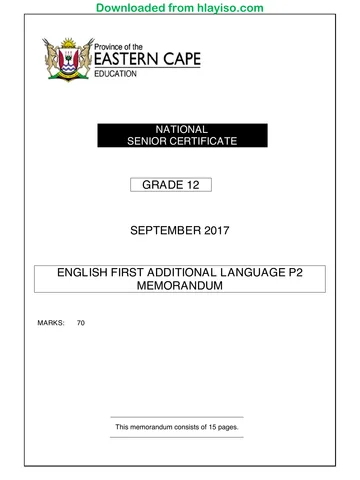
NATIONAL
SENIOR CERTIFICATE
GRADE 12
SEPTEMBER 2017
ENGLISH FIRST ADDITIONAL LANGUAGE P2
MARKS: 70
TIME: 2 hours
*ENGFA2*
This question paper consists of 28 pages.
You're offline
Skip to contentQuestion paper 
View all



Engfal P2 Gr12 QP Sept2017_hlayiso.com_.pdf
English Fal · Grade 12 · EC Prelim · 2017. Question paper, 32 pages. Read online or download the PDF.
- Subject
- English Fal
- Grade
- Grade 12
- Document type
- Question paper
- Year
- 2017
- Exam period
- EC Prelim
- Paper
- 2
- Pages
- 32
- File size
- 1.1 MB
Loading document…
Loading document…
1 of 32
Document textSearch extracted text and jump to a page.
Downloaded from hlayiso.com
2 ENGLISH FIRST ADDITIONAL LANGUAGE P2 (EC/SEPTEMBER 2017)
INSTRUCTIONS AND INFORMATION
Read these instructions carefully before you begin to answer the questions.
1. Do NOT attempt to read the entire question paper. Consult the TABLE OF
CONTENTS on the next page and mark the numbers of the questions set
on texts you have studied this year. Read these questions and choose the
ones you wish to answer.
2. This question paper consists of FOUR sections:
SECTION A: Novel (35)
SECTION B: Drama (35)
SECTION C: Short Stories (35)
SECTION D: Poetry (35)
3. Answer questions from TWO sections, as follows:
SECTION A: NOVEL
Answer the question on the novel you have studied.
SECTION B: DRAMA
Answer the question on the drama you have studied.
SECTION C: SHORT STORIES
Answer the questions set on BOTH short stories.
SECTION D: POETRY
Answer the questions set on BOTH poems.
Use the checklist on page 4 to assist you.
4. Follow the instructions at the beginning of each section carefully.
5. Number the answers correctly according to the numbering system used in
this question paper.
6. Start EACH section on a NEW page.
7. Spend approximately 60 minutes on each section.
8. Write neatly and legibly.
Copyright reserved Please turn over
Downloaded from hlayiso.com
(EC/SEPTEMBER 2017) ENGLISH FIRST ADDITIONAL LANGUAGE P2 3
TABLE OF CONTENTS
SECTION A: NOVEL
Answer ANY ONE question on the novel you have studied.
QUESTION QUESTION MARKS PAGE
1. The Strange Case of Dr Jekyll
and Mr Hyde Contextual question 35 5
OR
2. Cry, The Beloved Country Contextual question 35 8
SECTION B: DRAMA
Answer ANY ONE question on the drama you have studied.
3. The Tragedy of Macbeth Contextual question 35 12
OR
4. My Children, my Africa Contextual question 35 17
SECTION C: SHORT STORIES
Answer questions set on BOTH short stories.
5.1 ‘The Doll’s House’ Contextual question 17 21
AND
5.2 ‘A Chip of Glass Ruby’ Contextual question 18 23
SECTION D: POETRY
Answer the questions set on BOTH poems.
6.1 ‘Still I Rise’ Contextual question 18 25
AND
6.2 ‘Sonnet 18’ Contextual question 17 27
Copyright reserved Please turn over
Downloaded from hlayiso.com
4 ENGLISH FIRST ADDITIONAL LANGUAGE P2 (EC/SEPTEMBER 2017)
CHECKLIST
Use the checklist provided below to assist you to see whether you have answered
the required number of questions.
NOTE:
Answer questions from ANY TWO sections.
Tick () the sections you have answered.
SECTION QUESTION NO. OF TICK
NUMBERS QUESTIONS
TO ANSWER ()
Novel
A: 1–2 1
(Contextual)
B: Drama
3–4 1
(Contextual)
D
Short Stories
C: 5 1
(Contextual)
D: Poetry 6 1
NOTE: Ensure that you have answered questions on TWO sections only.
Copyright reserved Please turn over
Downloaded from hlayiso.com
(EC/SEPTEMBER 2017) ENGLISH FIRST ADDITIONAL LANGUAGE P2 5
SECTION A: NOVEL
In this section, there are contextual questions on the following novels:
THE STRANGE CASE OF DR JEKYLL AND MR HYDE by Robert Louis
Stevenson
CRY THE BELOVED COUNTRY by Alan Paton
Answer ONE question from this section on the novel you have studied.
QUESTION 1: THE STRANGE CASE OF DR JEKYLL AND MR HYDE
Read BOTH extracts from the novel and answer the questions set on each. The
number of marks allocated to each question serves as a guide to the expected
length of your answer.
NOTE: Answer questions in your own words unless you are asked to quote.
Answer the questions set on BOTH extracts, i.e. QUESTION 1.1 and
QUESTION 1.2.
1.1 EXTRACT A
[Utterson set off to Dr Lanyon’s house.]
The solemn butler knew and welcomed him; he was subjected to
no stage of delay, but ushered direct from the door to the dining-
room where Dr Lanyon sat alone over his wine. This was a hearty,
healthy, dapper, red-faced gentleman, with a shock of hair
prematurely white, and a boisterous and decided manner. 5
At sight of Mr Utterson, he sprang up from his chair and welcomed
him with both hands. The geniality, as was the way of the man, was
somewhat theatrical to the eye; but it reposed on genuine feeling.
For these two were old friends, old mates both at school and
college, both thorough respecters of themselves who thoroughly 10
enjoyed each other’s company. After a little rambling talk, the
lawyer led up to the subject which so disagreeably pre-occupied
his mind. ‘I suppose, Lanyon,’ said he ‘you and I must be the two
oldest friends that Henry Jekyll has?’
‘I wish the friends were younger,’ chuckled Dr Lanyon. 15
‘But I suppose we are. And what of that? I see little of him now.’
Indeed?’ said Utterson. ‘I thought you had a bond of common
interest.’ ‘We had,’ was the reply.
‘But it is more than ten years since Henry Jekyll became too fanciful
for me.’ 20
He began to go wrong, wrong in mind; and though of course I
continue to take an interest in him for old sake’s sake, as they say,
I see and I have seen devilish little of the man.
[Search for Mr Hyde]
Copyright reserved Please turn over
Downloaded from hlayiso.com
6 ENGLISH FIRST ADDITIONAL LANGUAGE P2 (EC/SEPTEMBER 2017)
1.1.1 Choose a description from COLUMN B that matches the name in
COLUMN A. Write only the letter (A‒E) next to the question number
(1.1.1 (a)–(1.1.1 (d)) in the ANSWER BOOK.
COLUMN A COLUMN B
(a) Henry Jekyll A Utterson’s clerk and confidant
(b) Gabriel Utterson B Known for his decency and
charitable works
(c) Mr Enfield C A member of parliament
(d) Sir Danvers Carew D He goes for walks on Sundays
with Utterson
E A lawyer, and trusted friend of
Henry Jekyll
(4 x 1) (4)
1.1.2 Refer to lines 1–3 (‘The solemn butler ... the dining-room …’)
Using you OWN words, explain why it is obvious that Utterson is
familiar to the butler. (2)
1.1.3 State the reason for Utterson’s visit to Doctor Lanyon. (2)
1.1.4 Quote FIVE CONSECUTIVE words to prove that Dr Lanyon is not
old enough to have grey hair. (1)
1.1.5 Refer to line 6. (‘he sprang up … with both hands.’)
Choose the correct answer to complete the following sentence.
Write only the letter (A–D) next to question number (1.1.5 (a)) in the
ANSWER BOOK.
(a) Dr Lanyon sprang up from his chair because he was …
A elated to see Utterson.
B guilty of murdering Dr Jekyll.
C expecting a patient.
D angry to be disturbed. (1)
(b) Write down ONE act of Dr Lanyon that will support your
answer in 1.1.5 (a). (1)
1.1.6 Quote a sentence from the extract to prove that the following
statement is TRUE.
The gentlemen had trivial discussions before they got into the
reason for Utterson’s visit. (1)
Copyright reserved Please turn over
Downloaded from hlayiso.com
(EC/SEPTEMBER 2017) ENGLISH FIRST ADDITIONAL LANGUAGE P2 7
1.1.7 Refer to lines 19–20. (‘But it is … fanciful for me.’)
From your knowledge of the novel, why has Dr Jekyll become ‘too
fanciful’ for Dr Lanyon? (2)
1.1.8 Do you think Utterson has the right to be concerned about Dr Jekyll?
Discuss your view. (3)
AND
EXTRACT B
1.2 [Utterson accompanies Poole to Jekyll’s house.]
It was a wild, cold, seasonable night of March, with a pale moon, lying on her
back as though the wind had tilted her, and a flying wrack of the most
diaphanous and lawny texture. The wind made talking difficult, and flecked the
blood into the face. It seemed to have swept the streets unusually bare of
passengers, besides; for Mr Utterson thought he had never seen that part 5
of London so deserted. He could have wished it otherwise; never in his life
had he been conscious of so sharp a wish to see and touch his fellow-
creatures; for, struggle as he might, there was borne in upon his mind a
crushing anticipation of calamity. The square, when they got there, was all full
of wind and dust, and the thin trees in the garden were lashing 10
themselves along the railing. Poole, who had kept all the way a pace or two
ahead, now pulled up in the middle of the pavement, and, in spite of the biting
weather, took off his hat and mopped his brow with a red pocket-handkerchief.
But for all the hurry of his coming, these were not the dews of exertion that he
wiped away, but the moisture of some strangling anguish; for his face was
white, and his voice when he spoke, harsh and broken.
[The last night]
1.2.1 How is Poole related to Dr Jekyll? (1)
1.2.2 Refer to lines 1–5. (It was a … of passengers besides.)
In your OWN words describe how the weather contributes to
Utterson’s premonition for disaster. (3)
1.2.3 Refer to lines 8–9. (‘there was borne … anticipation of calamity.’)
(a) Explain why Utterson feels ‘a crushing anticipation of calamity’. (2)
(b) Write down TWO things that made him feel like this. (2)
1.2.4 Write THREE character traits of Dr Jekyll. (3)
1.2.5 Identify and discuss ONE theme evident in this extract. (3)
1.2.6 Discuss how the author creates an atmosphere of horror in this
passage. (4)
[35]
OR
Copyright reserved Please turn over
Downloaded from hlayiso.com
8 ENGLISH FIRST ADDITIONAL LANGUAGE P2 (EC/SEPTEMBER 2017)
QUESTION 2: CRY, THE BELOVED COUNTRY
Read the following extracts from the novel and answer the questions set on each.
The number of marks allocated to each question serves as a guide to the
expected length of your answer.
NOTE: Answer questions in your own words unless you are asked to quote.
Answer the questions set on BOTH extracts, i.e. QUESTION 2.1 and
QUESTION 2.2.
EXTRACT C
2.1 [The priest is offered a room in Mrs Lithebe’s house.]
I have a place for you to sleep, my friend, in the house of an old
woman, a Mrs Lithebe, who is a good member of our church. She is
an Msutu, but she speaks Zulu well. She will think it an honour to
have a priest in the house. It is cheap, only three shillings a week, and
you can have your meals there with the people of the Mission. 5
Now there is the bell. Would you like to wash your hands?
They washed their hands in a modern place, with white, basin, and
water cold and hot, and towels worn but very white, and a modern
lavatory too. When you were finished, you pressed a little rod, and
the water rushed in as though something was broken. It would 10
have frightened you if you had not heard of such things before.
They went into a room where a table was laid and there he met many
priests, both white and black, and they sat down after grace and ate
together. He was a bit nervous of the many plates and knives and
forks, but watched what others did, and used the things likewise. 15
He sat next to a young rosy-cheeked priest from England, who asked
him where he came from, and what it was like there. And another
black priest cried out – I am also from Ixopo. My father and mother
are still alive there, in the valley of the Lufafa.
How is it there? 20
[Chapter 5]
Copyright reserved Please turn over
Downloaded from hlayiso.com
(EC/SEPTEMBER 2017) ENGLISH FIRST ADDITIONAL LANGUAGE P2 9
2.1.1 Choose a description from COLUMN B that matches the name
in COLUMN A. Write only the letter (A–E) next to the question
number (2.1.1 (a)–2.1.1 (d)) in the ANSWER BOOK.
COLUMN A COLUMN B
(a) Stephen Kumalo A killed Arthur Jarvis
(b) Absolom B ignorant of the injustices in
South Africa
(c) James Jarvis C humble minister of the
Anglican Church
(d) John Kumalo D representing good moral
values and Christian ethics
E a politician who enjoys the
spotlight
(4 x 1) (4)
2.1.2 Refer to line 1. (‘I have a … you to sleep’)
(a) What is the name of the priest who is going to reside in the
house? (1)
(b) Why has he come to Johannesburg? (1)
2.1.3 State TWO character traits of Mrs Lithebe. (2)
2.1.4 Give a reason from the text to show that the priest comes from a
disadvantaged area. (1)
2.1.5 Refer to lines 13–14. (‘many priests, both … and ate together.’)
Explain why it was a strange situation considering that the novel
was written during the apartheid era. (1)
2.1.6 Write down THREE CONSECUTIVE WORDS to prove that
foreign priests also stayed in Mrs Lithebe’s house. (1)
2.1.7 How does the description of Ixopo contribute to the fact that its
people go to Johannesburg? (3)
2.1.8 Refer to the novel as a whole.
Can Stephen Khumalo be admired? Discuss your view. (4)
AND
Copyright reserved Please turn over
Downloaded from hlayiso.com
10 ENGLISH FIRST ADDITIONAL LANGUAGE P2 (EC/SEPTEMBER 2017)
EXTRACT D
2.2 [Shanty town.]
The white men come to Shanty Town. They take photographs of us, and
moving photographs for the pictures. They come and wonder what they
can do, there are so many of us. What will the poor devils do in the rain?
What will the poor devils do in the winter? Men come, and machines
come, and they start building rough 5
houses for us. That Dubula is a clever man, this is what he said they
would do. And no sooner do they begin to build for us, than there come
in the night other black people, from Pimville and Alexandra and
Sophiatown, and they too put up their houses of sack and grass and iron
and poles. And the white men come again, but 10
this time it is anger, not pity. The police come and drive the people away.
And some that they drive away are from Orlando itself. They go back to
the houses that they left, but of some the rooms are already taken, and
some will not have them anymore. You need not to be ashamed that
you live in Shanty Town. It is in the papers, and that 15
is my husband standing by the house. A man here has a paper from
Durban, and my husband is there too, standing by the house. You
can give your address as Shanty Town, Shanty Town alone, everyone
knows where it is, and give the number that the committee has given
you. 20
[Chapter 9]
2.2.1 In line 1, the words Shanty Town would mean a/an …
A rural town.
B fancy city.
C squatter camp.
D estate. (1)
2.2.2 Refer to lines 10–11. (‘And the white … anger, not pity.’)
(a) Why do the white men have ‘pity’ the first time they come to
Shanty Town? (1)
(b) What is the reason for their anger when they return to Shanty
Town? (2)
(c) Explain the situation regarding housing as it was happening at
the time. Mention TWO points. (2)
Copyright reserved Please turn over
Downloaded from hlayiso.com
(EC/SEPTEMBER 2017) ENGLISH FIRST ADDITIONAL LANGUAGE P2 11
2.2.3 Compare the characters of Stephen Khumalo and John Khumalo
after John leaves Ixopo. Mention TWO points for each character. (4)
2.2.4 Quote a sentence from the extract to prove that the following
statement is TRUE:
White people built houses of bad quality for the people in Shanty
Town. (1)
2.2.5 Identify and discuss ONE theme evident in this extract. (3)
2.2.6 Do you think the people from Ndotsheni who left for Johannesburg
made a wise decision? Discuss your view. (3)
[35]
OR
Copyright reserved Please turn over
Downloaded from hlayiso.com
12 ENGLISH FIRST ADDITIONAL LANGUAGE P2 (EC/SEPTEMBER 2017)
SECTION B: DRAMA
In this section, there are contextual questions on the following plays:
MACBETH by William Shakespeare
MY CHILDREN, MY AFRICA by Athol Fugard
Answer ONE question from this section on the play you have studied.
QUESTION 3
EXTRACT E
MACBETH
Read the following extracts from the play and answer the questions set on each.
The number of marks allocated to each question serves as a guide to the expected
length of your answer.
NOTE: Answer questions in your own words unless you are asked to quote.
Answer the questions set on BOTH extracts, i.e. QUESTION 4.1 and
QUESTION 4.2.
3.1 [Enter MACBETH and BANQUO: Encounter with the witches.]
MACBETH
So foul and fair a day I have not seen.
BANQUO
How far is it call'd to Forres? — What are these
So withered and so wild in their attire,
That look not like the inhabitants o' the earth,
And yet are on't? Live you? or are you aught 5
That man may question? You seem to understand me,
By each at once her choppy finger laying
Upon her skinny lips: you should be women,
And yet your beards forbid me to interpret
That you are so. 10
MACBETH
Speak, if you can: what are you?
First Witch
All hail, Macbeth! hail to thee, Thane of Glamis!
Second Witch
All hail, Macbeth, hail to thee, Thane of Cawdor!
Third Witch
All hail, Macbeth, thou shalt be king hereafter!
BANQUO
Good sir, why do you start, and seem to fear 15
Things that do sound so fair? — I'th’ the name of truth
Are ye fantastical, or that indeed
Which outwardly ye show? My noble partner
You greet with present grace and great prediction
Of noble having and of royal hope, 20
Copyright reserved Please turn over
Downloaded from hlayiso.com
(EC/SEPTEMBER 2017) ENGLISH FIRST ADDITIONAL LANGUAGE P2 13
That he seems rapt withal. To me you speak not.
If you can look into the seeds of time,
And say which grain will grow and which will not,
Speak then to me, who neither beg nor fear
Your favours nor your hate. 25
First Witch
Hail!
Second Witch
Hail!
Third Witch
Hail!
First Witch
Lesser than Macbeth, and greater.
Second Witch
Not so happy, yet much happier. 30
Third Witch
Thou shalt get kings, though thou be none:
So all hail, Macbeth and Banquo!
First Witch
Banquo and Macbeth, all hail!
[Act 1, Scene 3]
3.1.1 Choose a description from COLUMN B that matches the name in
COLUMN A. Write only the letter (A–E) next to the question
number (4.1.1 (a)–4.1.1 (d)) in the ANSWER BOOK.
COLUMN A COLUMN B
(a) Macbeth A Thane of Fife
(b) Macduff B too trusting
(c) Banquo C has better judgement than his
father
(d) Malcolm D brave, noble and honest
E challenges the witches to
speak but is startled by their
predictions
(4 x 1) (4)
3.1.2 How could Banquo identify the women to be witches? (2)
3.1.3 In the context of the play, explain the meaning of:
‘Thou shalt get kings, though thou be none:’ (line 31) (2)
3.1.4 Explain how the words ‘my noble partner’ (line 18) become ironic
later in the play. (2)
Copyright reserved Please turn over
Downloaded from hlayiso.com
14 ENGLISH FIRST ADDITIONAL LANGUAGE P2 (EC/SEPTEMBER 2017)
3.1.5 Explain why the following statement is FALSE.
Banquo was overjoyed when Ross and Angus greeted Macbeth as
the Thane of Cawdor. (2)
3.1.6 Identify and discuss the theme of appearance and reality which is
evident in the extract. (3)
3.1.7 Can the witches be blamed for the tragedy in this drama?
Discuss your views. (3)
AND
EXTRACT F
3.2 [Banquo expresses suspicion of Macbeth.]
(Enter BANQUO)
BANQUO
Thou hast it now: king, Cawdor, Glamis, all,
As the weird women promised, and, I fear,
Thou play'dst most foully for't: yet it was said
It should not stand in thy posterity,
But that myself should be the root and father 5
Of many kings. If there come truth from them—
As upon thee, Macbeth, their speeches shine—
Why, by the verities on thee made good,
May they not be my oracles as well,
And set me up in hope? But hush! no more.
(Sennet sounded. Enter MACBETH, as king, LADY MACBETH,
as queen, LENNOX, ROSS, Lords, Ladies, and Attendants) 10
MACBETH
Here's our chief guest.
LADY MACBETH
If he had been forgotten,
It had been as a gap in our great feast,
And all-thing unbecoming.
MACBETH
To-night we hold a solemn supper sir,
And I'll request your presence. 15
Copyright reserved Please turn over
Downloaded from hlayiso.com
(EC/SEPTEMBER 2017) ENGLISH FIRST ADDITIONAL LANGUAGE P2 15
BANQUO
Let your highness
Command upon me; to the which my duties
Are with a most indissoluble tie
For ever knit.
MACBETH
Ride you this afternoon?
BANQUO
Ay, my good lord
MACBETH
We should have else desired your good advice,
Which still hath been both grave and prosperous,
In this day's council; but we'll take to-morrow.
Is't far you ride? 20
BANQUO
As far, my lord, as will fill up the time
'Twixt this and supper: go not my horse the better,
I must become a borrower of the night
For a dark hour or twain.
MACBETH
Fail not our feast. 25
BANQUO
My lord, I will not
MACBETH
We hear, our bloody cousins are bestow'd
In England and in Ireland, not confessing
Their cruel parricide, filling their hearers
With strange invention: but of that to-morrow,
30
When therewithal we shall have cause of state
Craving us jointly. Hie you to horse: adieu,
Till you return at night. Goes Fleance with you?
BANQUO
Ay, my good lord: our time does call upon’s.
[Act 3, Scene 1]
3.2.1 Who are the ‘weird women’ (line 3)? (1)
3.2.2 If you were the stage director of this play, what tone of voice
would you tell Lady Macbeth to use when saying lines 12–14, (‘If
he had been forgotten … And all-thing unbecoming.’)? (1)
3.2.3 From the extract, what do you learn about the character of
Banquo? (2)
Copyright reserved Please turn over
Downloaded from hlayiso.com
16 ENGLISH FIRST ADDITIONAL LANGUAGE P2 (EC/SEPTEMBER 2017)
3.2.4 Choose the correct answer to complete the following sentence.
Write only the letter (A–D) and the question number (3.2.4) in the
ANSWER BOOK.
At the beginning of the extract Banquo is speaking his thoughts
aloud. If this happens in the play, it is called …
A the dialogue.
B a monologue.
C a soliloquy.
D an action. (1)
3.2.5 Refer to line 11. (‘Sennet sounded’).
Why is it important that the sennet is sounded at this point in the
extract? (1)
3.2.6 How is Macbeth different in character to Banquo? Mention TWO
points. (2)
3.2.7 Refer to lines 26–27. (‘We hear, our … Ireland, not confessing’)
From your knowledge of the drama, briefly explain who the
‘bloody cousins’ are and what are they suppose to ‘confess’. (3)
3.2.8 Discuss the symbol of vision and hallucination as it appears in this
drama. (2)
3.2.9 Refer to the drama as a whole. Do you think this drama is still
relevant today? (4)
[35]
OR
Copyright reserved Please turn over
Downloaded from hlayiso.com
(EC/SEPTEMBER 2017) ENGLISH FIRST ADDITIONAL LANGUAGE P2 17
QUESTION 4: MY CHILDREN, MY AFRICA
Read the following extracts from the play and answer the questions set on each.
The number of marks allocated to each question serves as a guide to the expected
length of your answer.
NOTE: Answer questions in your own words unless you are asked to quote.
Answer the questions set on BOTH extracts, i.e. QUESTION 5.1 and
QUESTION 5.2.
4.1 EXTRACT G
[Thami and Isabel in the classroom at Zolile High School.]
THAMI: Yes that’s the one. For nearly two years I’ve sat there ... being
educated!
ISABEL: (Reading names carved into the wood of the desk): John, Bobby,
Zola, Bo …Boni …
THAMI: Bonisile.
ISABEL: Where is your name?
THAMI: You won’t find it there. I don’t want to leave any part of me in this
classroom. 5
ISABEL: That sounds heavy.
THAMI: It’s been heavy. You’ve got no problems with it, hey.
ISABEL: With school? No not really. Couple of teachers have tried their best
to spoil it for me, but they haven’t succeeded. I’ve had a pretty good
time in fact. I think I might even end up with the old cliché …you 10
know, school years, best years, happiest years … whatever it is
they say.
THAMI: No, I won’t be saying that.
ISABEL: That surprises me.
THAMI: Why?
ISABEL: Ja, come on, wouldn’t you be if I said it? You’re obviously clever.
I’ll bet you sail through your exams.
THAMI: It’s not as simple as just passing exams, Isabel. School doesn’t
mean the same to us that it does to you.
ISABEL: Go on. 15
THAMI: I used to like it. Junior school? You should have seen me. I
wanted to have school on Saturdays and Sundays as well. Yes, I
did. Other boys wanted to kill me. I hated holidays.
ISABEL: So what happened?
THAMI: I changed. 20
ISABEL: Ja, I’m listening.
THAMI: (A shrug) That’s all. I changed. Things changed. Everything
changed.
ISABEL: (Realising she is not going to get any more out of him.): Only five
months ago.
THAMI: I’m counting.
[Act 1, Scene 1]
Copyright reserved Please turn over
Downloaded from hlayiso.com
18 ENGLISH FIRST ADDITIONAL LANGUAGE P2 (EC/SEPTEMBER 2017)
4.1.1 Choose a description from COLUMN B that matches the word in
COLUMN A. Write only the letter (A–E) next to the question number
(4.1.1 (a)–4.1.1 (d)) in the ANSWER BOOK.
COLUMN A COLUMN B
(a) Karoo A a religious movement
(b) Location B a semi-desert plateau in South Africa
(c) Confucius C a conference
(d) Zionist D a township on the outskirts of a town
E a Chinese philosopher
(4 x 1) (4)
4.1.2 Explain why the following statement is FALSE.
Isabel’s worst time of her life was at school. (1)
4.1.3 If you were the stage director of this play, what would you tell Isabel
to do in the stage direction given in lines 3–4 (‘Reading names carved
into the wood of the desk’)? Give a reason for your answer. (2)
4.1.4 Identify Thami’s tone in lines 20‒22. (‘I changed. Ja … changed.
Everything changed.) (1)
4.1.5 Explain the difference and similarities in Thami and Isabel’s life.
Mention TWO points for each. (4)
4.1.6 With reference to the rest of the scene, discuss how Isabel portrays
the typical student of an affluent, white school. (2)
4.1.7 Thami decides to join the protest at school. Do you think that he
makes a good decision? Discuss your views. (4)
Copyright reserved Please turn over
Downloaded from hlayiso.com
(EC/SEPTEMBER 2017) ENGLISH FIRST ADDITIONAL LANGUAGE P2 19
EXTRACT H
4.2 [Thami and Isabel arguing.]
ISABEL: And they are going to decide whether we can or can’t be friends!
THAMI: I was right. You don’t understand what’s going on.
ISABEL: And you’re certainly not helping me to.
THAMI: (Trying) Visiting you like this is dangerous. People talk. Your maid
has seen me. She could mention, just innocently but to the 5
wrong person, that Thami Mbikwana is visiting and having tea with
the white people she works for.
ISABEL: And of course that is such a big crime!
THAMI: In the eyes of the location … yes! My world is also changing, Isabel.
I’m breaking the boycott by being here. The Comrades don’t want 10
any mixing with whites. They have ordered that contact must be
kept to the minimum
ISABEL: And you go along with that?
THAMI: Yes.
ISABEL: Happilly! 15
THAMI: (Goaded by her lack of understanding.): Yes! I go along happily
with that!!
ISABEL: Man Thami, this great Beginning of yours sound like … (shakes
her head) … I don’t know. Other people deciding who can and
who can’t be your friends, what you must do and what you can’t do. 20
Is this the Freedom you’ve been talking to me about? That you’re
going to fight for?
(Mr M enters quietly. His stillness is a disturbing contrast to the
bustle and energy we have come to associate with him.)
MR. M Don’t let me interrupt you. Please carry on. 25
(To Thami): I’m most interested in your reply to that question.
(Pause) I think he has forgotten what it was, Isabel. Ask him again.
[Act 2, Scene 1]
4.2.1 Refer to line 1, (‘And they are going to decide whether we can or can’t
be friends!’)
(a) Who are the ‘they’ that Isabel is referring to? (1)
(b) What tone is evident in Isabel’s voice? Give a reason for your
answer. (1)
4.2.2 Explain why Thami is in danger at this point in the drama. (2)
Copyright reserved Please turn over
Downloaded from hlayiso.com
20 ENGLISH FIRST ADDITIONAL LANGUAGE P2 (EC/SEPTEMBER 2017)
4.2.3 Choose the correct answer to complete the following sentence. Write
only the letter (A–D) next to the question number (4.2.3) in the
ANSWER BOOK.
Thami’s visits to Isabel can cause him to be seen as a …
A hero.
B traitor.
C comrade.
D beggar. (1)
4.2.4 Explain the meaning of the stage direction in line 16. (‘Goaded by her
lack of understanding.’) (1)
4.2.5 Mr M. is mentioned in line 25‒27. (‘Don’t let me … Ask him again.’)
(a) What is the connection between Mr M and Thami and Isabel? (2)
(b) Explain Mr M’s state of mind in these lines. (2)
4.2.6 Identify and discuss ONE theme that is evident in this extract. (3)
4.2.7 Refer to the drama as a whole. Do you think this drama is still relevant
today? Discuss your views. (4)
TOTAL SECTION B: 35
Copyright reserved Please turn over
Downloaded from hlayiso.com
(EC/SEPTEMBER 2017) ENGLISH FIRST ADDITIONAL LANGUAGE P2 21
SECTION C: SHORT STORIES
In this section, questions have been set on the following stories:
THE DOLL’S HOUSE by Katherine Mansfield
A CHIP OF GLASS RUBY by Nadine Gordimer
QUESTION 5: THE DOLL’S HOUSE
Read the following extracts from the short stories and answer the questions set on
each. The number of marks allocated to each question serves as a guide to the
expected length of your answer.
NOTE: Answer questions in your own words unless you are asked to quote.
Answer the questions set on BOTH extracts, i.e. ‘QUESTION 6.1 and
QUESTION 6.2.
EXTRACT I
5.1 [The invitation to the girls from school to view the doll house.]
‘And I’m to choose who’s to come and see it first. Mother said I might.’
For it had been arranged that while the doll’s house stood in the courtyard
they might ask the girls at school, two at a time, to come and look. Not to
stay to tea, of course, or to come traipsing through the house. But just to
stand quietly in the courtyard while Isabel pointed out the beauties, and
Lottie and 5
Kezia looked pleased …
But hurry as they might, by the time they had reached the tarred palings of
the boys’ playground the bell had begun to jangle. They only just had time
to whip off their hats and fall in line before the roll was called. Never mind.
Isabel tried to make up for it by looking very important and mysterious and 10
by whispering behind her hand to the girls near her, ‘Got something to tell
you at playtime.’
Playtime came and Isabel was surrounded. The girls of her class nearly
fought to put their arms round her, to walk with her, to beam flatteringly, to
be her special friend. She held quite a court under the huge pine trees at 15
the side of the playground. Nudging, giggling together, the little girls
pressed up close. And the only two who stayed outside the ring were the
two who were always outside, the little Kelveys. They knew better than to
come anywhere near the Burnells.
For the fact was, the school the Burnell children went to was not at all the 20
kind of place their parents would have chosen if there had been any choice.
But there was none.
Copyright reserved Please turn over
Downloaded from hlayiso.com
22 ENGLISH FIRST ADDITIONAL LANGUAGE P2 (EC/SEPTEMBER 2017)
5.1.1 Choose a description from COLUMN B that matches a name in
COLUMN A. Write down only the letter (A–E) next to the question
number (5.1.1(a)–5.1.1(d)).
COLUMN A COLUMN B
(a) Mrs Hay A Her age gives her better privileges
than her sisters
(b) Isabel B She has no respect for the less
fortunate
(c) Aunt Beryl C She always holds her sister’s skirt
(d) Else D She gives the Burnell girls a doll
house
E She challenges class distinction
(4 x 1) (4)
5.1.2 Refer to line 1. (‘And I am … who’s to come’)
(a) Who does the pronoun ‘I refer to? (1)
(b) Explain why this person is given the right to choose. (1)
(c) In your OWN words explain what effect this may have on her
siblings. (1)
5.1.3 Refer to lines 3‒5. (‘Not to stay … in the courtyard’)
Briefly discuss how the Burnell’s are portrayed in these lines. (3)
5.1.4 State TWO SIMILARITIES between Kezia Burnell and Else Kelvey. (2)
5.1.5 Explain why the following statement is FALSE.
The doll house had to stand in the courtyard so that people can view
it better. (1)
5.1.6 Briefly discuss the theme of class distinction as it appears in the
extract. (2)
5.1.7 Is Kezia Burnell a sympathetic character? Discuss your view. (3)
AND
Copyright reserved Please turn over
Downloaded from hlayiso.com
(EC/SEPTEMBER 2017) ENGLISH FIRST ADDITIONAL LANGUAGE P2 23
A CHIP OF GLASS RUBY
EXTRACT J
5.2 [Jimmy and Girlie try to track down Ms Bamjee.]
The house was quiet. The children kept to their lairs, crowded on the
beds with the doors shut. He sat and looked at the sideboard, where the
plastic carnations and the mat with the picture of the Taj Mahal were in
place. For the first few weeks he never spoke of her. There was the
feeling, in the house, that he had wept and raged at her, that 5
boulders of reproach had thundered down upon her absence, and yet he
had said not one word. He had not been to inquire where she was;
Jimmy and Girlie had gone to Mohammed Ebrahim, the lawyer, and
when he found out that their mother had been taken – when she was
arrested, at least – to a prison in the next town, they had stood about 10
outside the big prison door for hours while they waited to be told where
she had been moved from there. At last they had discovered that she
was fifty miles away, in Pretoria. Jimmy asked Bamjee for five shillings
to help Girlie pay the train fare to Pretoria, once she had been
interviewed by the police and had been given a permit to visit her 15
mother; he put three two-shilling pieces on the table for Jimmy to pick
up, and the boy, looking at him keenly, did not know whether the extra
shilling meant anything, or whether it was merely that Bamjee had no
change.
It was only when relations and neighbours came to the house that 20
Bamjee would suddenly begin to talk. He had never been so expansive
in his life as he was in the company of these visitors, many of them come
on a polite call rather in the nature of a visit of condolence.
5.2.1 Refer to lines 1 and 2. ('The children kept … the doors shut.’)
(a) How many bedrooms did the Bamjees’ house have? (1)
(b) How many people resided in the house? (1)
(c) What did this kind of house symbolise during the apartheid
era? (1)
5.2.2 Refer to lines 9–10. (‘he found out … the next town’)
Write down THREE reasons why Mrs Bamjee was arrested and sent
to prison. (3)
Copyright reserved Please turn over
Downloaded from hlayiso.com
24 ENGLISH FIRST ADDITIONAL LANGUAGE P2 (EC/SEPTEMBER 2017)
5.2.3 Choose the correct answer to complete the following sentence. Write
only the letter (A‒D) and the question number (5.2.3) in the
ANSWER BOOK.
After Mrs Bamjee’s imprisonment ... took care of the family.
A Jimmy
B Mr Peterson
C Yusuf Bamjee
D Girlie (1)
5.2.4 Write TWO character traits of Mrs Bamjee. (2)
5.2.5 Explain both the LITERAL and FIGURATIVE meaning of the title of
this short story. (2)
5.2.6 How does the character of Mr Bamjee change at the end of the short
story? (2)
5.2.7 Do you feel sorry for Mr Bamjee and his children in this extract?
Discuss your view. (4)
[35]
TOTAL SECTION C: 35
Copyright reserved Please turn over
Downloaded from hlayiso.com
(EC/SEPTEMBER 2017) ENGLISH FIRST ADDITIONAL LANGUAGE P2 25
SECTION D: POETRY
In this section, questions have been set on the following poems:
STILL I RISE by Maya Angelou.
SONNET 18 by William Shakespeare.
NOTE: Answer the questions set on BOTH poems, i.e. QUESTION 6.1 and 6.2.
QUESTION 6
6.1 Read the poem carefully and then answer the questions which follow. The
number of marks allocated to each question serves as a guide to the
expected length of your answer.
Still I rise
You may write me down in history
With your bitter, twisted lies,
You may tread me in the very dirt
But still, like dust, I’ll rise.
Does my sassiness upset you?
Why are you beset with gloom?
‘Cause I walk like I’ve got oil wells
Pumping in my living room.
Just like moons and like suns,
With the certainty of tides,
Just like hopes springing high,
Still I’ll rise
Did you want to see me broken?
Bowed head and lowered eyes?
Shoulders falling down like teardrops,
Weakened by my soulful cries?
Does my haughtiness offend you?
Don’t you take it awful hard
‘Cause I laugh like I’ve got gold mines
Diggin’ in my own backyard.
You may shoot me with your words,
You may cut me with your eyes,
You may kill me with your hatefulness,
But still, like air, I’ll rise.
Does my sexiness upset you?
Does it come as a surprise?
That I dance like I’ve got diamonds
At the meeting of my thighs?
Copyright reserved Please turn over
Downloaded from hlayiso.com
26 ENGLISH FIRST ADDITIONAL LANGUAGE P2 (EC/SEPTEMBER 2017)
Out of the huts of history’s shame
I rise
Up from a past that’s rooted in pain
I rise
I’m a black ocean, leaping and wide,
Welling and swelling I bear in the tide.
Leaving behind nights of terror and fear
I rise
Into a daybreak that’s wondrously clear
I rise
Bringing the gifts that my ancestors gave,
I am the dream and the hope of the slave.
I rise
I rise
I rise.
6.1.1 Refer to stanza 1.
(a) Choose the correct answer to complete the following sentence.
Write only the question number (6.1.2) and the letter (A–D) in
the ANSWER BOOK.
This type of poem is a …
A ballad.
B lyric.
C ode.
D lament. (1)
(b) Who is the second-person pronoun ‘you’ referring to? (1)
(c) Identify the figure of speech in line 4. (‘But still, like dust, I’ll
rise.) (1)
(d) Explain how the poet uses this comparison to help the reader
understand the urge to ‘rise’. (2)
6.1.2 What characteristics of the poet are revealed in stanza 2? (2)
6.1.3 Refer to stanza 3.
(a) Identify the tone used in this stanza. (1)
(b) How suitable is the simile in this stanza? (2)
6.1.4 Explain why the poet repeats, ‘I rise’ throughout the poem? (2)
6.1.5 Discuss the theme of determination as it appears in the poem. (3)
6.1.6 Why has Maya Angelou written this poem? Discuss your views. (3)
Copyright reserved Please turn over
Downloaded from hlayiso.com
(EC/SEPTEMBER 2017) ENGLISH FIRST ADDITIONAL LANGUAGE P2 27
AND
6.2 Read the following poem and then answer them questions set on it.
Sonnet 18
Shall I compare thee to a summer’s day?
Thou art more lovely and more temperate.
Rough winds do shake the darling buds of May,
And summer’s lease hath all too short a date.
Sometime too hot the eye of heaven shines, 5
And often is his gold complexion dimmed;
And every fair from fair sometime declines,
By chance or nature’s changing course untrimmed.
But thy eternal summer shall not fade,
Nor lose possession of that fair thou ow’st, 10
Nor shall Death brag thou wand’rest in his shade,
When in eternal lines to time thou grow’st.
So long as men can breathe or eyes can see,
So long lives this, and this gives life to thee.
6.2.1 Refer to the structure of the poem.
(a) Identify the type of sonnet. (1)
(b) Explain the structure of this sonnet. (2)
6.2.2 (a) Identify the figure of speech in line 3.
(‘Rough winds do … buds of May,’). (1)
(b) Explain the contrast between the lover and the wind. (2)
6.2.3 Refer to lines 5‒6. (‘Sometimes too hot … gold complexion dimmed;’).
Using your own words explain these lines. (2)
6.2.4 Refer to lines 9–10. (‘But thy eternal … fair thou lowest.’)
Choose the correct answer to complete the following sentence. Write
only the letter (A‒D) next to the question number (6.2.4) in the
ANSWER BOOK.
In these lines the speaker suggests that his lover’s beauty is …
A everlasting.
B disgusting.
C fading.
D declining. (1)
Copyright reserved Please turn over
Downloaded from hlayiso.com
28 ENGLISH FIRST ADDITIONAL LANGUAGE P2 (EC/SEPTEMBER 2017)
6.2.5 Refer to lines 11–12. (‘Nor shall death … time thou grows’t’).
(a) Why is the speaker confident that death will not claim his
beloved’s beauty? (1)
(b) Explain the use of personification in line 11. (2)
6.2.6 Using your OWN words, explain the last two lines of the poem. (2)
6.2.7 How believable is this poem? Discuss your view. (3)
[35]
TOTAL SECTION D: 35
GRAND TOTAL: 70
Copyright reserved Please turn over
Downloaded from hlayiso.com
Downloaded from hlayiso.com
Downloaded from hlayiso.com
Downloaded from hlayiso.com
Recommended for this subject
Published documents with matching subject and grade metadata.
Question paper
ENGLISH FAL P3 GR12 QP SEPT 2025_watermark.pdf
Question paper
English FAL P2 May-June 2025.pdf
Question paper
English FAL P3 May-June 2025.pdf
Question paper
ENGLISH FAL P1 QP GR12 SEPT 2024_hlayiso.com_.pdf
Question paper
English FAL P2 Nov 2024.pdf
Question paper
English FAL P2 Nov 2024 MG.pdf
Related documents
Matched using subject, grade, language, document type and exam metadata.
Memorandum
Engfal P2 Gr12 Memo Sept2017_hlayiso.com_.pdf
Question paper
Engfap1 Sept2017 QP_hlayiso.com_.pdf
Question paper
Engfal P3 Gr12 QP Sept2017 Final_hlayiso.com_.pdf
Question paper
English FAL P2 Feb-March 2017_hlayiso.com_.pdf
Question paper
English FAL P3 May-June 2017_hlayiso.com_.pdf
Question paper
English FAL P1 Feb-March 2017_hlayiso.com_.pdf
More from Grade 12 English Fal
Explore more published documents in this catalogue.
Memorandum
ENGLISH FAL P1 MEMO GR12 SEPT 2025_watermark.pdf
Memorandum
ENGLISH FAL P2 MEMO GR12 SEPT 2025_watermark.pdf
Memorandum
English P1 (FAL) June 2025 Possible Answers.pdf
Memorandum
ENGLISH FAL P3 GR12 MEMO SEPTEMBER 2023_hlayiso.com_.pdf
Question paper
ENGLISH FAL P3 GR12 QP SEPT2023_hlayiso.com_.pdf
Question paper