
Downloaded from hlayiso.com
GRAAD 12
NATIONAL
SENIOR CERTIFICATE
GRADE 12
ENGLISH HOME LANGUAGE P1
FEBRUARY/MARCH 2013
MEMORANDUM
MARKS: 70
This memorandum consists of 9 pages.
Copyright reserved Please turn over
Skip to contentMemorandum 
View all
English Hl Grade 12 Paper 1 NSC Supplementary 2012 Memo (English)
Grade 12 English Hl Paper 1 memorandum from the NSC Supplementary 2012 (English), 9 pages. Read online or get the free PDF download, question paper linked when available.
English Hl · Grade 12 · NSC Supplementary · 2012 · English. Memorandum, 9 pages. Read online or download the PDF.
- Subject
- English Hl
- Grade
- Grade 12
- Language
- English
- Document type
- Memorandum
- Year
- 2012
- Exam period
- NSC Supplementary
- Paper
- 1
- Curriculum
- CAPS
- Pages
- 9
- File size
- 321.9 KB
Loading document…
Loading document…
1 of 9
Document textSearch extracted text and jump to a page.
Downloaded from hlayiso.com
English Home Language/P1 2 DBE/Feb.–Mar. 2013
NSC – Memorandum
NOTE:
• This marking memorandum is intended as a guide for markers.
• It is by no means prescriptive or exhaustive.
• Candidates' responses should be considered on merit.
• Answers should be assessed holistically and points awarded, where
applicable, in terms of decisions taken at the standardisation meeting.
• The memorandum will be discussed before the commencement of marking.
INSTRUCTIONS TO MARKERS
Marking the comprehension:
• Incorrect spelling in one-word answers should not be marked wrong, unless the
spelling changes the meaning of the word.
• Incorrect spelling and language errors in longer responses should not be
penalised, because the focus is on understanding.
• For open-ended questions, no marks should be awarded for YES/NO or
I AGREE/I DISAGREE. The reason/substantiation/motivation is what should be
considered.
• For TRUE/FALSE or FACT/OPINION questions, the mark should be split, i.e.
award 1 mark for TRUE/FALSE or FACT/OPINION and a mark for the
reason/substantiation/motivation/quotation. The mark for the reason/
substantiation/motivation/quotation should only be awarded if the TRUE/FALSE
or FACT/OPINION part of the question is correct. One cannot award a mark for
substantiation or an interpretation (TRUE/FALSE or FACT/OPINION) that was
wrong in the first place.
• For questions which require quotations from the text, do not penalise candidates
for omitting the quotation marks or for an incorrect spelling within the quotation.
• When one-word answers are required and the candidate gives a whole sentence,
mark correct provided that the correct word is underlined/highlighted.
• When two/three facts/points are required and a range is given, mark only the first
two/three.
• If a candidate uses words from a language other than the one being examined,
disregard those words, and if the answer still makes sense, do not penalise.
However, if a word from another language is used in a text and required in an
answer, this will be acceptable.
• Accept dialectal variations.
• For multiple-choice questions, accept BOTH the letter corresponding with the
correct answer AND the answer written out in full.
Copyright reserved Please turn over
Downloaded from hlayiso.com
English Home Language/P1 3 DBE/Feb.–Mar. 2013
NSC – Memorandum
SECTION A: COMPREHENSION
QUESTION 1: READING FOR MEANING AND UNDERSTANDING
1.1 The controversy is around how to prevent poaching, which is contributing to
the decrease in the number of rhinos. (2)
1.2 Poaching has increased dramatically, which leads to dwindling rhino
numbers, with the result that they could become extinct. (2)
1.3 The poaching had become uncontrollable and there was a need for greater
force in fighting it. (2)
1.4 Rudimentary weapons can wreak havoc with everyday/easily accessible
objects.
[Accept other valid responses.] (2)
1.5 Trophy hunting: a big-game hunter exhibits the head of his kill as a 'trophy'/
It is his sport/hobby. (1)
Pseudo-trophy hunting: someone who uses the guise of trophy hunting to
harvest the rhino's horn for profit. (1) (2)
1.6 Valid
Conservation is extremely expensive; when people are hungry they are not
concerned with conservation. Those employed to combat poaching are
sometimes involved in the criminal activity themselves ('undermined by
corruption').
OR
Invalid
Environmental issues should be prioritised, not detracted from. Game parks
generate tourism which creates jobs in the tourism sector, etc.
[Mark globally. Credit well-substantiated responses.] (2)
1.7 South Africa's unique selling point is wildlife. Exporting live rhinos suggests
that we are prepared to sacrifice that which could be most beneficial to us.
[Mark globally. Credit well-substantiated responses.] (2)
1.8 A Vietnamese hunters: They pretend to be trophy hunters while their
objective is exploiting our natural heritage for their own selfish gain.
B CITES: This body allows trophy hunting, which is often a means to
acquiring rhino horn (paragraph 4). By banning the legal trade in rhino horn,
CITES causes illegal hunting (paragraph 8).
C The South African population: They have scant regard for conservation
issues and are often involved in corrupt activities, e.g. poaching for their own
gain.
Copyright reserved Please turn over
Downloaded from hlayiso.com
English Home Language/P1 4 DBE/Feb.–Mar. 2013
NSC – Memorandum
D Chinese importers: They imported live rhinos under the pretext of using
them for educational purposes, but were actually shaving their horns for
commercial gain.
[No marks to be awarded for the identification of a role-player. Credit well-
substantiated responses.] (2)
1.9 The phrase 'it would not be an auction' implies that rhinos would not be
regarded as mere objects for the highest bidder. The writer is justifying a
policy that some would deem immoral. It suggests his concern for the plight
of the rhino, which could be questioned in the light of his arguments. (3)
1.10 Yes.
Using existing stocks (from dead rhinos) would be more humane. It would be
a pragmatic measure that would reduce poaching. Regulations in place would
deter poachers and smugglers. Supply would then meet the demand.
OR
No.
Illegal activities are not thwarted by regulation. The greedy poacher is only
aware of an immediate reward. South African authorities should be protecting
the rhino at all costs instead of satisfying the market for rhino horn.
[Mark globally. Credit well-substantiated responses] (3)
1.11 The baby rhino is used to evoke sympathy – the reader's concern about the
diminishing numbers of the rhino population is aroused. The baby rhino
represents the future generation – needs to be protected from poachers.
[Mark globally. Credit well-substantiated responses.] (2)
1.12 This information is included to remind readers of the stark reality of the rapid
decline of the rhino. It makes a plea to the public to take note of how serious
rhino poaching is in South Africa alone. (2)
1.13 Text A: The style is matter-of-fact, argumentative and clinical. The writer uses
statistics to substantiate his arguments. Diction is formal. Examples cited are
illustrative.
Text B: The style is emotive. The word 'Baby' evokes sympathy and hope for
the survival of rhinos in future. 'Run Baby Run' gives a human touch.
[For full marks, candidates should refer to both texts. Credit well-substantiated
responses.] (4)
TOTAL SECTION A: 30
Copyright reserved Please turn over
Downloaded from hlayiso.com
English Home Language/P1 5 DBE/Feb.–Mar. 2013
NSC – Memorandum
SECTION B: SUMMARY
QUESTION 2: SUMMARISING IN YOUR OWN WORDS
Use the following main points that the candidate should include in the summary, as a
guideline.
(Any 7 valid points are to be credited in either paragraph-form or point-form.)
POINT FORM
• Friends provide us with necessary human interaction.
• Friends provide us with necessary closeness and friendships.
• They share our happy and our difficult moments.
• Friends are a reflection of who we are (our mirrors).
• Friends are those with whom we can share our ideas.
• We should select friends who reflect our own positive lifestyles.
• They set trends for our behaviour.
• Friends who influence us positively could keep us motivated.
• As long as we tolerate mediocrity in our friends, we will carry on being satisfied
with mediocrity in our own lives.
• Friends could have a conscious or an unconscious influence.
• Some friends might not share our visions, in which case they should not be
allowed to hinder our personal growth.
PARAGRAPH FORM
NOTE: What follows is merely an example. It is not prescriptive and must be used very
carefully.
Friends provide us with necessary human interaction, closeness and friendships. They
share our happy as well as our difficult moments. It is important that friends could have
both conscious and unconscious influences on us. In fact, they are a reflection of who
we are (our mirrors) as well as people with whom we can share our ideas. We should
therefore select friends who reflect our own positive lifestyles; otherwise, we could be
adversely influenced, whereas we desire to be positively influenced. Some friends
might not share our visions, in which case they should not be allowed to hinder our
personal growth. We must face the fact that, as long as we tolerate mediocrity in our
friends, we will carry on being satisfied with mediocrity in our own lives.
Copyright reserved Please turn over
Downloaded from hlayiso.com
English Home Language/P1 6 DBE/Feb.–Mar. 2013
NSC – Memorandum
Marking the summary:
The summary should be marked as follows:
• Mark allocation:
o 7 marks for 7 points (1 mark per main point)
o 3 marks for language
o Total marks: 10
• Distribution of language marks:
o 1–3 points correct: award 1 mark
o 4–5 points correct: award 2 marks
o 6–7 points correct: award 3 marks
NOTE:
• Format:
Even if the summary is presented in the incorrect format, it must be assessed.
• Word Count:
o Markers are required to verify the number of words used.
o Do not deduct any marks if the candidate fails to indicate the number of
words used or if the number of words used is indicated incorrectly.
o If the word limit is exceeded, read up to a maximum of 5 words above the
stipulated upper limit and ignore the rest of the summary.
o Summaries that are short but contain all the required main points should not
be penalised.
TOTAL SECTION B: 10
Copyright reserved Please turn over
Downloaded from hlayiso.com
English Home Language/P1 7 DBE/Feb.–Mar. 2013
NSC – Memorandum
SECTION C: LANGUAGE IN CONTEXT
QUESTION 3: ANALYSING ADVERTISING
3.1 The signatures emphasise the collaboration between Chevron and UNAIDS./
Creates trust and credibility./Signifies authority, validating the advertisement. (2)
3.2 The tone is assertive and confident. This gives extra force to the statement of
intent to fight hard against AIDS. (2)
3.3 Yes. The child without a mother figure appears more vulnerable. She could
be a victim of AIDS, which has claimed her mother's life. The image of the
child evokes sadness.
OR
No. If the mother were included in the image, it would add credibility to
Chevron's cause. It would capture the idea that AIDS affects all ages.
[Credit well-substantiated responses.] (3)
3.4 The large print helps to assert confidence that the campaign against AIDS will
succeed. The phrasing, 'is going to lose' is unequivocal – there is absolute
certainty about the outcome of the battle.
[Credit well-substantiated responses.] (3)
[10]
Copyright reserved Please turn over
Downloaded from hlayiso.com
English Home Language/P1 8 DBE/Feb.–Mar. 2013
NSC – Memorandum
QUESTION 4: UNDERSTANDING OTHER ASPECTS OF THE MEDIA
4.1 The father looks baffled by his son's clothing, because it seems really strange
to wear torn clothes as fashion items. The son is at ease and good-humoured
because he is rather amused by his father's old-fashioned reaction. (2)
4.2 The son explains that 'experts' who have 'professional training' are the ones
who mutilate jeans. The father would have expected the destructiveness to be
done by clumsy amateurs/the son himself/inexpert and unprofessional people. (3)
4.3 The mother is sitting calmly and continues reading/with her activity. She is
unperturbed by the idea of slashing jeans. The father is
bemused/fazed/puzzled by the differences between what the generations
regard as normal.
[Credit well-substantiated responses.] (2)
4.4 Yes.
In frames 1 and 2, the dog reacts in tandem with the father. This reinforces
the reader's sense of the father's reactions. In Frame 3, she snoozes/relaxes,
suggesting that all is well and normal, even if the generations have different
practices.
OR
No.
The dog plays too minor a role. She is silent and small. The important ideas
are conveyed through dialogue and comparative human expressions.
OR
A mixed/equivocal response that concedes a small degree of effectiveness. (3)
[10]
Copyright reserved Please turn over
Downloaded from hlayiso.com
English Home Language/P1 9 DBE/March 2013
NSC – Memorandum
QUESTION 5: USING LANGUAGE CORRECTLY
5.1 phenomena (1)
5.2 customary/customised/customized (1)
5.3 Perhaps it shouldn't be offensive to you or me. (1)
5.4 Therefore they are often baffled by the close physical contact.
OR
Therefore they are often confused by the close physical contact. (1)
5.5 Parents say, 'Teenagers seem to have very few rules governing bodily
touch.'(1)
AND
'Parents,' say teenagers, 'seem to have very few rules governing bodily
touch.' (1)
[½ mark: Understanding of concept in each case.
½ mark: Correct use of punctuation in each case.] (2)
5.6 A small minority of learners has also objected to ... (1)
5.7 Hugging has been banned by some schools (1), while prescriptive rules have
been imposed by others (1). (2)
5.8 Good, old-fashioned physical contact with their friends is most desirable. (1)
[10]
TOTAL SECTION C: 30
GRAND TOTAL: 70
Copyright reserved
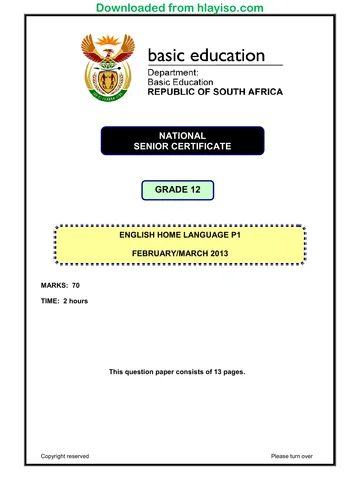
Matching paper and memo
The question paper, memo or addendum that belongs with this document.
Study this subject
Revise the topics in this paper, then practise them question by question.
- Grade 12 English Hl notes
CAPS revision notes with worked examples.
- English Hl questions by topic
Past exam questions sorted by CAPS topic, with memos where available.
- All Grade 12 English Hl past papers
Past papers by year, with memos where available.
- Grade 12 past papers
More English Hl and other subjects in this collection.
Recommended for this subject
More papers and memos for this grade and subject.
Memorandum
English Hl Grade 12 Paper 3 KZN Mock 2025 Memo (English)
Memorandum
English Hl Grade 12 P1 Eastern Cape Prelim 2024 Memo (English)
Memorandum
English Hl Grade 12 Paper 1 Eastern Cape Mock 2021 Memo
Memorandum
English Hl Grade 12 Paper 2 Eastern Cape Mock 2020 Memo (English)
Memorandum
English Hl Grade 12 Paper 3 Eastern Cape Mock 2020 Memo (English)
Memorandum
English Hl Grade 12 Paper 1 NSC November 2020 Memo (English)
Related documents
Memorandum
English Hl Grade 12 Paper 3 NSC Supplementary 2012 Memo (English)
Question paper
English Hl Grade 12 P2 NSC Supplementary 2012 QP (Eng)
Question paper
English Hl Grade 12 P2 NSC Supplementary 2012 QP (Eng)
Question paper
English Hl Grade 12 P1 NSC Supplementary 2014 QP (Eng)
Memorandum
English Hl Grade 12 Paper 3 NSC June 2012 Memo (English)
Memorandum
English Hl Grade 12 Paper 3 NSC November 2012 Memo (English)
More from Grade 12 English Hl
Question paper
English Hl Grade 12 P2 Eastern Cape Mock 2025 QP (Eng)
Question paper
English Hl Grade 12 P1 Gauteng June 2025 Question Paper (English)
Question paper
English Hl Grade 12 P2 KZN Mock 2025 Question Paper (English)
Question paper
English Hl Grade 12 P3 KZN Mock 2025 Question Paper (English)
Question paper
English Hl Grade 12 P1 NSC June 2025 Question Paper (English)
Question paper