
Downloaded from hlayiso.com
GRAAD 12
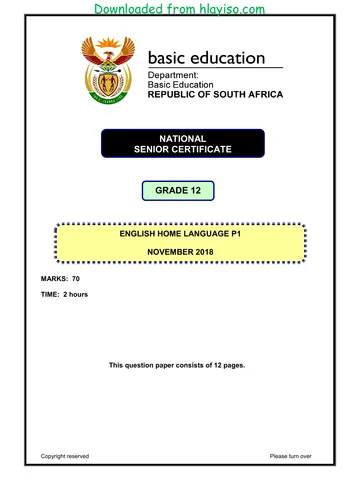
NATIONAL
SENIOR CERTIFICATE
GRADE 12
ENGLISH HOME LANGUAGE P1
NOVEMBER 2018
MARKING GUIDELINES
MARKS: 70
These marking guidelines consist of 9 pages.
Copyright reserved Please turn over
Skip to contentMemorandum 
View all
English Hl Grade 12 Paper 1 NSC November 2018 Memo (English)
Grade 12 English Hl Paper 1 memorandum from the NSC November Exam 2018 (English), 9 pages. Read online or get the free PDF download, question paper linked when available.
English Hl · Grade 12 · NSC November Exam · 2018 · English. Memorandum, 9 pages. Read online or download the PDF.
- Subject
- English Hl
- Grade
- Grade 12
- Language
- English
- Document type
- Memorandum
- Year
- 2018
- Exam period
- NSC November Exam
- Paper
- 1
- Curriculum
- CAPS
- Pages
- 9
- File size
- 344.8 KB
Loading document…
Loading document…
1 of 9
Document textSearch extracted text and jump to a page.
Downloaded from hlayiso.com
English Home Language/P1 2 DBE/November 2018
NSC – Marking Guidelines
NOTE:
• These marking guidelines are intended as a guide for markers.
• The guidelines are by no means prescriptive or exhaustive.
• Candidates' responses should be considered on merit.
• Answers should be assessed holistically and points awarded where
applicable in terms of decisions taken at the standardisation meeting.
• The marking guidelines will be discussed before the commencement
of marking.
INSTRUCTIONS TO MARKERS
Marking the comprehension:
• Because the focus is on understanding, incorrect spelling and language errors in
longer responses should not be penalised unless such errors change the
meaning/understanding. (Errors must still be indicated.)
• If a candidate uses words from a language other than the one being examined,
disregard those words, and if the answer still makes sense, do not penalise.
However, if a word from another language is used in a text and required in an
answer, this will be acceptable.
• For open-ended questions, no marks should be awarded for YES/NO or
I AGREE/I DISAGREE. The reason/substantiation/motivation is what should be
considered.
• No marks should be awarded for TRUE/FALSE or FACT/OPINION. The
reason/substantiation/motivation is what should be considered.
• When one-word answers are required and the candidate gives a whole sentence,
mark correct provided that the correct word is underlined/highlighted.
• When two/three facts/points are required and a range is given, mark only the first
two/three.
• Accept dialectal variations.
• For multiple-choice questions, accept BOTH the letter corresponding to the
correct answer AND/OR the answer written out in full.
Copyright reserved Please turn over
Downloaded from hlayiso.com
English Home Language/P1 3 DBE/November 2018
NSC – Marking Guidelines
SECTION A: COMPREHENSION
QUESTION 1: READING FOR MEANING AND UNDERSTANDING
1.1 He is disgusted by/pities the flashy/obscene displays of wealth by spoilt
teenagers.
[Award only 1 mark for ‘lifting’.] (2)
1.2 The possessions seem to own the person, who has been 'dwarfed'; the youth
have become less human, 'dehumanised' by their possessions, as ownership
has been reversed.
[Award 2 marks for any TWO ideas.] (2)
1.3 It is ironic that while these young people intend flaunting their abundant
possessions, they actually reveal how empty their lives are. (2)
1.4 The writer wishes to provide convincing evidence to support his view/to
validate his argument. (2)
1.5 A negative connotation is attached to the word 'consumers', who are viewed
as those who purchase goods without discernment. They are self-absorbed
individuals ('more competitive and more selfish') who do not engage with
others and lack 'social responsibility'. 'Citizens' carries a positive connotation;
they would be discerning and add value to society.
[Award 3 marks only if both concepts have been addressed.] (3)
1.6 The research findings are contrary to what people generally believe:
materialism is associated with happiness. In fact, materialism is shown to be
the enemy of fulfilment./It is paradoxical that people turn to consumerism to
fill their loneliness yet this consumerism makes them more lonely and
isolated./Paradoxically, a consumer journal publishes negative viewpoints on
consumerism.
[Award 3 marks only if the paradox is well-discussed.]
[Award only 1 mark for ‘lifting’.] (3)
1.7 The writer uses various stylistic techniques to strengthen his argument that
materialism gives rise to a cycle of destruction.
• The writer uses metaphorical expressions/hyperbole such as 'self-
mutilation' and 'smashed' to highlight the destructive nature of an
obsession with possessions.
• The satirical remark, 'a Rolex short of contentment', graphically illustrates
the insatiable nature of materialism.
• The writer inserts a short exclamation 'There is no end to it!' to emphasise
his exasperation with endless consumerism.
• Strong emotive words, e.g. 'distressed', 'forces' and 'smashes' effectively
convey a sense of destruction.
• Conversational style/use of personal pronouns creates a bond of
confidence between the writer and the reader.
[Award 3 marks for any TWO techniques well-discussed.]
[Award a maximum of 1 mark for an identification of TWO techniques.]
[Credit valid alternative responses.] (3)
Copyright reserved Please turn over
Downloaded from hlayiso.com
English Home Language/P1 4 DBE/November 2018
NSC – Marking Guidelines
1.8 YES
The writer summarises the adverse impact of materialism, by referring to his
initial image of 'deluded' youth, and expanding his focus to broader society.
The reader is drawn into the argument through the use of first person
pronouns. The writer contends that every member of society falls prey to the
destructive cycle of materialism.
OR
NO
[A 'NO' response is unlikely. However, credit responses on merit.]
[Credit valid alternative responses.] (3)
1.9 The viewer on the left is disgusted by what he is viewing: he views the
characters in the film as shameful criminals. He embodies the morally correct
reaction to what he is viewing. The viewer on the right is enthusiastic and
engaged, showing how susceptible he is to a lavish lifestyle.
[Award 3 marks only if attitudes of both characters are discussed.]
[Credit valid alternative responses.] (3)
1.10 The cartoonist is critical of the public's gullibility and lack of discernment.
Some of the people are satirically portrayed as being devoid of the ability to
think critically. The film industry has undue influence on social conscience.
[Award 3 marks only if a critical discussion is included.]
[Credit valid alternative responses.] (3)
1.11 Text B portrays the manner in which our morals are compromised by the
created images of materialism. The opulent lifestyle of villains is seen as
desirable. The headline of Text A refers to the effect of a materialistic society:
moral decay erodes our humanity via the imagination ('eats us from the inside
out'). The possessions idolised by the Rich Kids of Instagram are similar to
the desired lifestyle depicted in Text B. In both texts, materialism is
acceptable when it is glamorised. Both the writer and the cartoonist
disapprove of our mindless acceptance of materialism.
[Award 4 marks only if both paragraph 1 of Text A and Text B are discussed.]
[Credit valid alternative responses.] (4)
TOTAL SECTION A: 30
Copyright reserved Please turn over
Downloaded from hlayiso.com
English Home Language/P1 5 DBE/November 2018
NSC – Marking Guidelines
SECTION B: SUMMARY
QUESTION 2: SUMMARISING IN YOUR OWN WORDS
Use the following main points that the candidate should include in the summary as a
guideline.
Any 7 valid points are to be credited in paragraph-form.
(Sentences and/or sentence fragments must be coherent.)
NO. QUOTATIONS NO. POINTS
1 'When we read comics featuring 1 While reading about superheroes,
superheroes, particularly as children develop reading skills.
children, we develop our ... reading
ability'
2 'These comics likely influence our 2 Their behaviour and outlook on life are
behaviour, ... and attitudes.' influenced.
3 'Pretend play based on the concept 3 Children acquire language competence
of superheroes helps children learn through participating in imaginary games.
language’
4 ‘we develop our emotions’/’allows 4 Youngsters pretending to be
the expression of emotions, both superheroes learn to verbalise all
negative and positive.' emotions.
5 'Children can use superheroes and 5 Children learn from superheroes how to
supervillains to form various weigh up situations and think before they
perspectives on a situation and test act.
the consequences of actions.'
6 ‘we develop our ... morals’/'provide 6 Children can role-play in larger-than-life
the exaggerated opportunity to play scenarios to discern right from wrong.
out moralistic and ethical dilemmas
for both children and adults.'/'use
their moral compass, so to speak,
before making big decisions.'
7 'superheroes likely feed straight into 7 Boys gain confidence in taking control of
boys' tendency to control or "master" circumstances.
the world.'
8 'children are given the opportunity to 8 They can witness how superheroes
observe how their favourite role extricate themselves from daunting
model problem-solves through circumstances./Children learn to make
ethically sticky situations.' difficult decisions.
9 ‘These comics likely influence our ... 9 Superheroes who display socially
leadership ability’/'Teenagers use acceptable behaviour and integrity are
villains as avoidance role models, good role-models for children
while imitating superheroes who
display pro-social behaviour,
leadership and a variety of positive
attitudes.'
10 ‘unwillingness to be a bystander’/'it 10 Altruism is reinforced by the example set
could be argued that learning to help by superheroes.
others occurs through the models of
superheroes.'
Copyright reserved Please turn over
Downloaded from hlayiso.com
English Home Language/P1 6 DBE/November 2018
NSC – Marking Guidelines
PARAGRAPH-FORM
NOTE: What follows is merely an example. It is not prescriptive and must be used very
carefully.
Children develop reading skills, emotional intelligence and principles when they read
about superheroes: their behaviour, leadership skills and outlook are influenced.
Furthermore, youngsters imitating superheroes learn to verbalise a range of feelings.
Children learn from superheroes and supervillains how to weigh up situations before
acting. Moreover, children can role-play in larger-than-life scenarios to discern right from
wrong and gain confidence in taking control of circumstances. They can witness the
manner in which superheroes extricate themselves from daunting circumstances. In
conclusion, superheroes with integrity are good role-models and reinforce altruism.
(89 words)
Marking the summary:
Marking is on the basis of the inclusion of valid material and the exclusion of invalid
material.
The summary should be marked as follows:
• Mark allocation:
o 7 marks for 7 points (1 mark per main point)
o 3 marks for language
o Total marks: 10
• Distribution of language marks when candidate has not quoted verbatim:
o 1–3 points correct: award 1 mark
o 4–5 points correct: award 2 marks
o 6–7 points correct: award 3 marks
• Distribution of language marks when candidate has quoted verbatim:
o 6–7 quotations: award no language mark
o 1–5 quotations: award 1 language mark
NOTE:
• Word Count:
o Markers are required to verify the number of words used.
o Do not deduct any marks if the candidate fails to indicate the number of
words used or if the number of words used is indicated incorrectly. If the word
limit is exceeded, read up to the last sentence above the stipulated upper
limit and ignore the rest of the summary.
TOTAL SECTION B: 10
Copyright reserved Please turn over
Downloaded from hlayiso.com
English Home Language/P1 7 DBE/November 2018
NSC – Marking Guidelines
SECTION C: LANGUAGE STRUCTURES AND CONVENTIONS
Marking Section C:
• Spelling:
o One-word answers must be marked correct even if the spelling is incorrect,
unless the error changes the meaning of the word.
o In full-sentence answers, incorrect spelling should be penalised if the error is
in the language structure being tested.
o Where an abbreviation is tested, the answer must be punctuated correctly.
• Sentence structures must be grammatically correct and given in full sentences/as
per instruction.
• For multiple-choice questions, accept BOTH the letter corresponding to the correct
answer AND/OR the answer written out in full as correct.
QUESTION 3: ANALYSING ADVERTISING
3.1 The advertiser is addressing the need for this generation to conserve energy
so that the next generation can continue to experience the benefits of
electricity./The advertiser is warning of impending doom if the current
wasteful practices continue. (2)
3.2 The repetition of the pronouns drives the point home that the company and
the readers are jointly responsible for the solution.
The personal pronouns convey a direct, personal appeal to the reader. (1) (2)
3.3 The image portrays a young child, snugly reading a book in bed. This is in
sharp contrast to the text, which comments on Shell's activities in the Arctic
as a 'nightmare'. In the context of the advertisement, the image conveys a
false sense of security regarding children's future in the light of Shell's
activities in search of oil. The décor in the room depicts nature and threatened
species, while the light connotes elucidation of a serious issue.
[Award 3 marks for a well-developed response.]
[Credit valid alternative responses.] (3)
3.4 Text D is more informative/inspirational: it provides details that illustrate the
company's social conscience. The advertisement elaborates on the
company's attempts to preserve energy for future use and points out that
global co-operation has been achieved. The domestic setting shows a
personal concern. The blurred image reinforces the fear that the future will be
bleak if we fail to harness all possible sources of renewable energy.
Text E is more cautionary and emotive, e.g. 'STUFF OF NIGHTMARES'.
Greenpeace satirises Shell's approach and critically comments on Shell's
practices in the Arctic, endangering nature. Greenpeace has mimicked and
presented a parody of the Shell visual.
[Award 3 marks only if both texts are discussed.] (3)
[10]
Copyright reserved Please turn over
Downloaded from hlayiso.com
English Home Language/P1 8 DBE/November 2018
NSC – Marking Guidelines
QUESTION 4: UNDERSTANDING OTHER ASPECTS OF THE MEDIA
4.1 The boy is concentrating on his drawing./The reader is invited into his thought
processes./It forces the reader to focus on the boy.
[Award 2 marks for any single idea.]
[Credit valid alternative responses.] (2)
4.2 In FRAME 4, the boy outlines the reason for his drawing willingly/in a matter-
of-fact manner. In FRAME 7, his response is hesitant and evasive/reluctant.
[Credit answers that view responses as similar, since the boy is evasive in
both frames, e.g. his reference to 'SOMEONE IN OUR FAMILY' in FRAME 4.]
[Award 2 marks only if candidates refer to both frames.] (2)
4.3 • In FRAMES 7, 8 and 9, the girl's stern, domineering attitude is depicted
through her scowl, pursed lips and clenched jaw. Her facial expression
remains angry throughout.
• In FRAME 8, the positioning of the two characters portray the girl’s
overbearing nature. She is menacingly close to her brother, intimidating
him.
• In FRAMES 8 and 9, the absence of speech bubbles emphasises her
pent-up rage.
• In FRAME 9, the large bold font/onomatopoeia/exclamation
mark/body language/movement lines highlight the girl's aggression.
She has literally overthrown her brother.
[Award 3 marks for TWO techniques, well-developed.]
[Award no more than 1 mark for an identification of TWO techniques.] (3)
4.4 The cartoonist has given prominence to/creates an interest in the ultimate
message of the cartoon by placing it first/inverting the order of the frames,
effectively highlighting the price to be paid for truth. FRAME 1 is the
consequence of the events in the cartoon. It precedes the flashback that
commences in FRAME 2. The boy is depicted as a victim of violence,
illustrated by the ice-pack on his head/sling on his arm/plasters on his face.
[Credit candidates who refer to the boy's artwork being reduced to
snippets/recreated.]
[Award 3 marks only if a critical comment is made.] (3)
[10]
Copyright reserved Please turn over
Downloaded from hlayiso.com
English Home Language/P1 9 DBE/November 2018
NSC – Marking Guidelines
QUESTION 5: USING LANGUAGE CORRECTLY
5.1 ; (semi-colon)
OR
: (colon) (1)
5.2 I was overwhelmed.
[Accept valid alternatives.]
[Formal standard English must be used. Past tense must be used.] (1)
5.3 He was taken hostage for almost five years, most of which he spent in
isolation, chained, with no stimulation – not even natural light.
OR
He spent almost five years in isolation, chained, with no stimulation – not
even natural light – after/when he had been taken hostage.
OR
After/When he had been taken hostage, he spent almost five years in
isolation, chained, with no stimulation – not even natural light.
[Credit valid alternative responses.] (1)
5.4 He laughed because he had no shoes on when he was released./
Conjunction 'as' indicates reason.
OR
He laughed while he was being released./Conjunction 'as' indicates time.
[Credit responses that make reference to the ambiguity created by the
pronoun, ‘he’.] (2)
5.5 Waite said (that) he had no regrets, self-pity or sentimentality./Waite said
(that) he did not have any regrets, self-pity or sentimentality./Waite said (that)
there should be no regrets, no self-pity, no sentimentality.
[No part-marks to be awarded; the full response must be correct.] (1)
5.6 C – Abstract noun (1)
5.7 causes – cause (1)
5.8 infers – confers
[Credit valid synonyms for ‘confers’.] (1)
5.9 Either 'indifferently' or 'apathetic' must be omitted. (1)
[10]
TOTAL SECTION C: 30
GRAND TOTAL: 70
Copyright reserved
Matching paper and memo
The question paper, memo or addendum that belongs with this document.
Study this subject
Revise the topics in this paper, then practise them question by question.
- Grade 12 English Hl notes
CAPS revision notes with worked examples.
- English Hl questions by topic
Past exam questions sorted by CAPS topic, with memos where available.
- All Grade 12 English Hl past papers
Past papers by year, with memos where available.
- Grade 12 past papers
More English Hl and other subjects in this collection.
Recommended for this subject
More papers and memos for this grade and subject.
Memorandum
English Hl Grade 12 Paper 3 KZN Mock 2025 Memo (English)
Memorandum
English Hl Grade 12 P1 Eastern Cape Prelim 2024 Memo (English)
Memorandum
English Hl Grade 12 Paper 1 Eastern Cape Mock 2021 Memo
Memorandum
English Hl Grade 12 Paper 2 Eastern Cape Mock 2020 Memo (English)
Memorandum
English Hl Grade 12 Paper 3 Eastern Cape Mock 2020 Memo (English)
Memorandum
English Hl Grade 12 Paper 1 NSC November 2020 Memo (English)
Related documents
Memorandum
English Hl Grade 12 Paper 3 NSC November 2018 Memo (English)
Memorandum
English Hl Grade 12 Paper 1 Eastern Cape Mock 2018 Memo (English)
Memorandum
English Hl Grade 12 Paper 1 NSC June 2018 Memo (English)
Memorandum
English Hl Grade 12 Paper 1 NSC November 2016 Memo (English)
Memorandum
English Hl Grade 12 Paper 1 NSC November 2013 Memo (English)
Question paper
English Hl Grade 12 P3 NSC November 2018 Question Paper (English)
More from Grade 12 English Hl
Question paper
English Hl Grade 12 P2 Eastern Cape Mock 2025 QP (Eng)
Question paper
English Hl Grade 12 P1 Gauteng June 2025 Question Paper (English)
Question paper
English Hl Grade 12 P2 KZN Mock 2025 Question Paper (English)
Question paper
English Hl Grade 12 P3 KZN Mock 2025 Question Paper (English)
Question paper
English Hl Grade 12 P1 NSC June 2025 Question Paper (English)
Question paper