
Downloaded from hlayiso.com
\\) GAUTENG PROVINCE
Czy 2? \\ Department: Education
CyZ-~z) REPUBLIC OF SOUTH AFRICA
SENIOR CERTIFICATE EXAMINATION !
ENGLISH FIRST LANGUAGE
SECOND PAPER: LITERATURE
HG
2012
ENGLISH FIRST LANG HG: Paper 2
1041
IAAT TINE: 3 oure
10412
X@5
TOI
MARKS: 100
This paper consists of 24 pages.
peer eT
Copyright reserved FIDO 00 Please tum over
Skip to contentQuestion paper 

View all

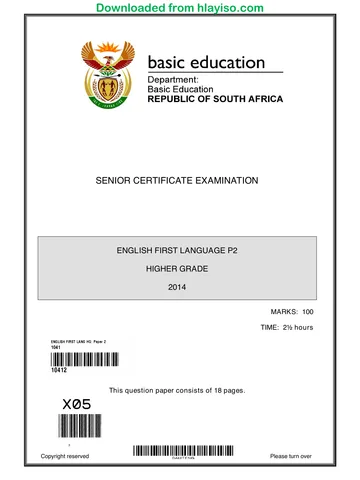
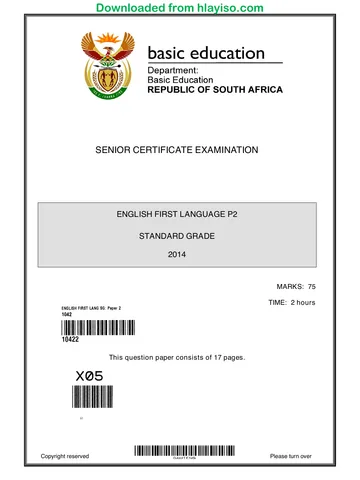
English Hl Grade 12 P2 NSC June 2012 Question Paper (English)
Grade 12 English Hl Paper 2 question paper from the NSC June 2012 (English), 24 pages. Read online or get the free PDF download, memo linked when available.
English Hl · Grade 12 · NSC June · 2012 · English. Question paper, 24 pages. Read online or download the PDF.
- Subject
- English Hl
- Grade
- Grade 12
- Language
- English
- Document type
- Question paper
- Year
- 2012
- Exam period
- NSC June
- Paper
- 2
- Curriculum
- CAPS
- Pages
- 24
- File size
- 2.0 MB
Loading document…
Loading document…
1 of 24
Document textSearch extracted text and jump to a page.
Downloaded from hlayiso.com
ENGLISH FIRST LANGUAGE HG 2
(Second Paper) 10412/12
GAUTENG DEPARTMENT OF EDUCATION
SENIOR CERTIFICATE EXAMINATION
ENGLISH FIRST LANGUAGE HG
(Second Paper: Literature)
TIME: 3 hours
MARKS: 100
INSTRUCTIONS :
Answer FIVE questions as follows :
SECTION A : POETRY
South African Poetry: Answer Question 1 OR Question 2
AND
Prescribed Poetry: Answer any TWO from Question 3, Question 4, Question 5 and Question 6.
Answer ONE from EACH of the following sections:
SECTION B: SHAKESPEARE
SECTION C: NOVEL
N.B. Your answers to Section B (Shakespeare) and Section C (Novel) MUST comprise
ONE ESSAY and ONE CONTEXTUAL answer.
e Do not attempt to read through the whole paper. Consult the Table of Contents and mark
the numbers of the questions set on work you have studied.
e Your literature essay should not exceed 500 words.
e In contextual questions, the number of marks allocated to each sub-section should be a
guide to the number of lines required to answer the questions.
e The examiners will assess your answers on the understanding of, and insight into, the given
texts and will also assess the competence with which your answers are expressed.
Please remember to number your answers in exact agreement with the question numbers.
It is in your own interest to write legibly and to present your work neatly.
P.T.O.
Downloaded from hlayiso.com
ENGLISH FIRST LANGUAGE HG 3
(Second Paper) 10412/12
TABLE OF CONTENTS:
Candidates must answer THREE questions from Section A and ONE question each
from Sections B and C.
A total of FIVE questions for 100 marks must be answered.
SECTION A: POETRY (Answer Question 1 OR Question 2, AND any TWO from
Question 3, 4, 5 and 6.) [40]
Question 1: General South African poetry (Contextual) 10 marks
OR
Question 2 : General South African poetry (Essay) 10 marks
AND
(TWO questions from prescribed poetry)
Question 3 : Prescribed poetry 15 marks
Question 4 : Prescribed poetry 15 marks
Question 5 : Prescribed poetry 15 marks
Question 6 : Prescribed Poetry 15 marks
SECTION B: SHAKESPEARE (Answer ONE question) [30]
Question 7: Macbeth Essay 30 marks
Question 8: Macbeth Contextual 30 marks
Question 9: Julius Caesar Essay 30 marks
Question 10 : Julius Caesar Contextual 30 marks
SECTION C: NOVEL (Answer ONE question) [30]
Question 11: A Tale of Two Cities | (Charles Dickens) Essay 30 marks
Question 12: A Tale of Two Cities (Charles Dickens) Contextual 30 marks
Question 13: July’s People (Nadine Gordimer) Essay 30 marks
Question 14: July’s People (Nadine Gordimer) Contextual 30 marks
Question 15: Maru (Bessie Head) Essay 30 marks
Question 16: Maru (Bessie Head) Contextual 30 marks
Question 17: Nineteen Eighty-Four (George Orwell) Essay 30 marks
Question 18: Nineteen Eighty-Four (George Orwell) Contextual 30 marks
TOTAL: 100 marks
CHECKLIST
Question 1 OR 2
Questions 3, 4, 5, 6 Choose TWO
Questions 7-10 Choose ONE
Questions 11-18 Choose ONE
You must have ONE contextual and ONE essay.
P.T.O.
Downloaded from hlayiso.com
SECTION A
POETRY
Answer Question 1 OR Question 2.
AND
ENGLISH FIRST LANGUAGE HG
(Second Paper)
10412/12
Any TWO questions from Questions 3, 4, 5 and 6
QUESTION 1
UNSEEN POEM — SOUTH AFRICAN POETRY
CONTEXTUAL
Read the poem carefully, and then answer the questions that follow.
From: One Day — Amy Williams
This is an apple-crisp,
juicy sort of day
when song-snatches
come quicker-than-quarrels
to mind 5
and tumble out,
like eager children
on
a
slide 10
they collide.
Oh, this is a daisy-chain
ringlet sort of day
when i could climb
the oak tree 15
if you would lift me
and forget quite
that at 16
it’s just not done!
Butterflies are 20
confetti-
like,
falling,
mid-air stalling
and like my spirits 25
rippling upwards.
P.T.O.
Downloaded from hlayiso.com
ENGLISH FIRST LANGUAGE HG
(Second Paper) 10412/12
1.1 Identify and explain the effectiveness of the figure of speech in lines 1 and 2.
_) Comment on the structure (form) of lines 8 to 10.
1.3 What does the lower case (small letter) “i” add to the poem?
1.4 Use your own words to describe the image portrayed in lines 21 to 24.
7 Consider the word “rippling” in line 26. How does the poet feel? Explain your
answer.
QUESTION 2
OR
SOUTH AFRICAN POETRY (MINI-ESSAY)
Read the poem carefully, then answer the question that follows.
From: One Day — Amy Williams
This is a dragon-kite
flying sort of day,
when the orange, pink
and yellow
cellophane-thin thing 5
will bluewards wing
if you hold the tail
while i run,
and remember to
let go 10
and
ribbon-
rumpled,
crackling
and ripped aluminium-foil 15
it might fall
like my spirits
when i recall
you’re not here yet.
In a mini-essay of no more than 200 words, analyse how the poet uses imagery,
diction, tone and structure to convey her message about youth. Do NOT count your
words.
AND
(3)
(2)
(1)
(2)
(2)
[10]
[10]
P.T.O.
Downloaded from hlayiso.com
(Second Paper)
ENGLISH FIRST LANGUAGE HG
10412/12
QUESTIONS 3, 4,56
PRESCRIBED POETRY
Answer any TWO questions from this section.
QUESTION 3
Read the poem and then answer the questions that follow.
Do not go gentle into that good night —- Dylan Thomas
Do not go gentle into that good night,
Old age should burn and rave at close of day;
Rage, rage against the dying of the light.
Though wise men at their end know dark is right,
Because their words had forked no lightning they 5
Do not go gentle into that good night.
Good men, the last wave by, crying how bright
Their frail deeds might have danced in a green bay,
Rage, rage against the dying of the light.
Wild men who caught and sang the sun in flight, 10
And learn, too late, they grieved it on its way,
Do not go gentle into that good night.
Grave men, near death, who see with blinding sight
Blind eyes could blaze like meteors and be gay,
Rage, rage against the dying of the light. 15
And you, my father, there on that sad height,
Curse, bless, me now with your fierce tears, | pray.
Do not go gentle into that good night.
Rage, rage against the dying of the light.
3.1 In your own words, explain what Thomas feels “old age” should do in
lines 1 and 2.
oe Why does the poet mention four contrasting types of personalities?
3.3 Given Thomas's feeling about ‘the good night’, what is contradictory in his use
of the word ‘good’?
3.4 What figure of speech does he use for “death” throughout this poem?
3.5 Explain the pun in “Grave men” in line 13.
(2)
(2)
(2)
(1)
(2)
P.T.O.
Downloaded from hlayiso.com
ENGLISH FIRST LANGUAGE HG
7
(Second Paper) 10412/12
3.6 How and why does the poet slow down the pace in the final stanza? (3)
3.7 oy What is Thomas’s tone in this poem? (1)
3.7.2 How is this tone achieved? (2)
[15]
OR
QUESTION 4
Read the poem carefully and then answer the question which follows.
Mending Wall — Robert Frost
Something there is that doesn't love a wall,
That sends the frozen-ground-swell under it,
And spills the upper boulders in the sun;
And makes gaps even two can pass abreast.
The work of hunters is another thing: 5
| have come after them and made repair
Where they have left not one stone on a stone,
But they would have the rabbit out of hiding,
To please the yelping dogs. The gaps | mean,
No one has seen them made or heard them made, 10
But at spring mending-time we find them there.
| let my neighbour know beyond the hill;
And on a day we meet to walk the line
And set the wall between us once again.
We keep the wall between us as we go. 15
To each the boulders that have fallen to each.
And some are loaves and some so nearly balls
We have to use a spell to make them balance:
‘Stay where you are until our backs are turned!"
We wear our fingers rough with handling them. 20
Oh, just another kind of outdoor game,
One on a side. It comes to little more:
There where it is we do not need the wall:
He is all pine and | am apple orchard.
My apple trees will never get across 25
And eat the cones under his pines, | tell him.
He only says, 'Good fences make good neighbours.’
Spring is the mischief in me, and | wonder
If | could put a notion in his head:
P.T.O.
Downloaded from hlayiso.com
(Second Paper)
ENGLISH FIRST LANGUAGE HG
10412/12
‘Why do they make good neighbours? Isn't it 30
Where there are cows? But here there are no cows.
Before | built a wall I'd ask to know
What | was walling in or walling out,
And to whom | was like to give offence.
Something there is that doesn't love a wall, 35
That wants it down. | could say 'Elves' to him,
But it's not elves exactly, and I'd rather
He said it for himself. | see him there
Bringing a stone grasped firmly by the top
In each hand, like an old-stone savage armed. 40
He moves in darkness as it seems to me,
Not of woods only and the shade of trees.
He will not go behind his father's saying,
And he likes having thought of it so well
He says again, "Good fences make good neighbours." 45
Write a mini-essay of approximately 200 words in which you discuss how Frost uses
symbols, imagery, diction, tone and repetition to show how futile and unnatural the
barriers are that people erect between themselves. Do NOT count your words.
OR
QUESTION 5
Read the poem below and then answer the questions that follow .
Death be not Proud — John Donne
Death, be not proud, though some have called thee
Mighty and dreadful, for thou are not so;
For those, whom thou think'st thou dost overthrow,
Die not, poor Death, nor yet canst thou kill me.
From rest and sleep, which but thy pictures be, 5
Much pleasure; then from thee much more must flow,
And soonest our best men with thee do go,
Rest of their bones, and soul's delivery.
Thou art slave to fate, chance, kings, and desperate men,
And dost with poison, war, and sickness dwell, 10
And poppy or charms can make us sleep as well
And better than thy stroke; why swell'st thou then?
One short sleep past, we wake eternally,
And death shall be no more; Death, thou shalt die.
[15]
P.T.O.
Downloaded from hlayiso.com
ENGLISH FIRST LANGUAGE HG
(Second Paper) 10412/12 9
5.1 What kind of sonnet is this? Explain. (3)
5.2 Explain the paradox in line 4. (3)
| Besides the logic Donne applies for death not to be proud, mention two
reasons he gives for people not to fear death. (2)
5.4 5.4.1 What figure of speech is used in line 5? (1)
5.4.2 Why are “rest and sleep” better than death? (2)
5.5 Identify the tone in the last two lines of the poem. (1)
5.6 Why does Donne use colloquial language and not formal language when
addressing death? (3)
[15]
OR
QUESTION 6
Carefully read the poem and answer the questions which follow.
On His Blindness — John Milton
When I consider how my light is spent
Ere half my days in this dark world and wide,
And that one talent which is death to hide
Lodg'd with me useless, though my soul more bent
To serve therewith my Maker, and present 6)
My true account, lest He returning chide,
"Doth God exact day-labour, light denied?"
| fondly ask. But Patience, to prevent
That murmur, soon replies: "God doth not need
Either man's work or his own gifts: who best 10
Bear his mild yoke, they serve him best. His state
Is kingly; thousands at his bidding speed
And post o'er land and ocean without rest;
They also serve who only stand and wait."
P.T.O.
6.1
6.2
6.3
6.4
6.5
6.6
Downloaded from hlayiso.com
ENGLISH FIRST LANGUAGE HG
Explain each of your choices.
In your own words, say what Milton is asking in line 7.
acceptance? Give a reason for your answer.
word ‘stand’?
What is the theme of the poem?
10
(Second Paper) 10412/12
Quote two words which indicate there is no cure for Milton’s blindness.
(4)
(2)
At what point in the poem does the note of despair change to one of hope and
(2)
How would the meaning of line 14 change if the word ‘sit’ was to replace the
(2)
(2)
Explain how the structure of this sonnet makes it undeniably an Italian sonnet. (3)
[15]
TOTAL SECTION A: 40
P.T.O.
Downloaded from hlayiso.com
ENGLISH FIRST LANGUAGE HG 14
(Second Paper) 10412/12
SECTION B
SHAKESPEARE
Answer ONE question from this section.
MACBETH — WILLIAM SHAKESPEARE
QUESTION 7: ESSAY
Macbeth and Lady Macbeth switch roles as the play progresses. In an essay of not
more than 500 words, (2 — 2% pages) discuss the validity of the above statement.
Do NOT count your words.
OR
QUESTION 8: CONTEXTUAL
Read both extracts carefully and answer the questions that follow.
TEXT A
Lady Macbeth: That which hath made them drunk hath made me bold;
What hath quench’d them hath given me fire.
Hark! — Peace!
It was the owl that shriek’d, the fatal bellman,
Which gives the stern’st good-night. He is about it: 5
The doors are open, and the surfeited grooms
Do mock their charge with snores; | have drugg’d their possets,
That death and nature do contend about them,
Whether they live or die.
Macbeth : (Within) Who's there? — what, ho! 10
Lady Macbeth: Alack! | am afraid they have awak’d,
And ‘tis not done: The attempt, and not the deed,
Confounds us. Hark! | laid their daggers ready,
He could not miss ‘em. Had he not resembled
My father as he slept, | had done’t. My husband! 15
Re-enter Macbeth
Macbeth: | have done the deed. Didst thou not hear a noise?
Lady Macbeth: | heard the owl scream and the crickets cry.
P.T.O.
8.1
8.2
8.3
8.4
8.5
8.6
TEXT B
Downloaded from hlayiso.com
ENGLISH FIRST LANGUAGE HG
To whom is Lady Macbeth referring in line 1?
earlier scene.
Identify and explain the effectiveness of the figure of speech in line 5.
Refer to line 5. What is “He ...about’?
nature” here, bearing in mind Macbeth’s present actions.
12
(Second Paper) 10412/12
(1)
Critically assess what line 2 tells the audience about Lady Macbeth’s
character? In your answer you must refer to her claim to Macbeth in an
(3)
(3)
(2)
Refer to line 8. Comment on the significance of the reference to “death and
(3)
How does Shakespeare create tension in the last two lines of the passage? (3)
AND
Lady Macbeth: | pray you, speak not; he grows worse and worse;
Lennox
Question enrages him. At once, good night.
Stand not upon the order of your going,
But go at once.
: Goodnight, and better health 5
Attend his majesty!
Lady Macbeth: A kind good-night to all.
[Exeunt Lords and Attendants]
Macbeth: It will have blood, they say; blood will have blood.
Stones have been known to move, and trees to speak; 10
Augurs, and understood relations have
By maggot-pies, and choughs, and rooks, brought forth
The secret’st man of blood ... What is the night?
Lady Macbeth: Almost at odds with morning, which is which.
Macbeth: How say’st thou, that Macduff denies his person 15
At our great bidding?
Lady Macbeth: Did you send to him, sir?
Macbeth: | hear it by the way. But I will send.
There’s not a one of them but in his house
| keep a servant fee’d ... | will to-morrow 20
(And betimes | will) to the Weird Sisters:
More shall they speak; for now | am bent to know,
By the worst means, the worst. For mine own good
All causes shall give way. | am in blood
Stepped in so far, that, should | wade no more, 25
Returning were as tedious as go o’er.
P.T.O.
8.7
8.8
8.9
8.10
8.11
8.12
Downloaded from hlayiso.com
ENGLISH FIRST LANGUAGE HG
“he grows worse and worse”.
has Macbeth finally realised?
forth”? (line 12) Use your own words to explain.
Comment on why Macbeth mentions Macduff at this point in the play.
the tension?
JULIUS CAESAR — WILLIAM SHAKESPEARE
QUESTION 9: ESSAY
In an essay of no more than 500 words (2 — 2% pages) give an account of the
meeting of the conspirators at the house of Brutus and show how this episode
reveals the strengths and weaknesses of Brutus. Do NOT count your words.
(Second Paper) 10412/12 3
Refer to line 1. Place this extract in context to explain why Lady Macbeth says e
Refer to line 9. (“It will have blood, they say; blood will have blood”.) What Q
Symbolically, what have the “maggot-pies and choughs and rooks brought oO
(2)
How does Macbeth’s intention to go to the “Weird Sisters” (line 21) increase 6)
Identify and explain the effectiveness of the figure of speech in lines 24 to 26. al
OR
[30]
OR
P.T.O.
Downloaded from hlayiso.com
ENGLISH FIRST LANGUAGE HG
(Second Paper)
10412/12
14
QUESTION 10 : CONTEXTUAL
Read the following passage and then answer the questions that follow.
TEXT A
Marullus:
Wherefore rejoice? What conquest brings he home?
What tributaries follow him to Rome
To grace in captive bonds his chariot wheels?
You blocks, you stones, you worse than senseless things!
O, you hard hearts, you cruel men of Rome,
Knew you not Pompey? Many a time and oft
Have you climbed up to walls and battlements,
To towers and windows, yea to chimney-tops,
Your infants in your arms, and there have sat
The livelong day with patient expectation
To see great Pompey pass the streets of Rome.
And when you saw his chariot but appear,
Have you not made an universal shout,
That Tiber trembled underneath her banks
To hear the replication of your sounds
Made in her concave shores?
And do you now put on your best attire?
And do you now cull out a holiday?
And do you now strew flowers in his way
That comes in triumph over Pomepy’s blood?
Be gone!
Run to your houses, fall upon your knees,
Pray to the gods to intermit the plague
That needs must light on this ingratitude.
10
15
20
10.1. What is Marullus’ attitude towards the populace? Explain with reference to the
text.
10.2 | Say what this speech reveals about Marullus’ personality.
10.3. For what reason does Marullus use so many rhetorical questions (questions
that imply but do not require an answer) when speaking to the crowd?
10.4 What theme does Marullus’ speech establish early in the play?
10.5 Why does Shakespeare open the play in this manner?
AND
(2)
(3)
(2)
(2)
(2)
P.T.O.
Downloaded from hlayiso.com
ENGLISH FIRST LANGUAGE HG
15
(Second Paper) 10412/12
TEXT B
Fifth Plebian : Marked ye his words? He would not take the crown,
Therefore ‘tis certain he was not ambitious.
First Plebian : If it be found so, some will dear abide it.
Fourth Plebian: Poor soul, his eyes are red as fire with weeping.
Third Plebian : There’s not a nobler man in Rome than Antony. 5
Fifth Plebian : Now mark him: he begins again to speak.
Antony : But yesterday the word of Caesar might
Have stood against the world. Now lies he there,
And none so poor to do him reverence.
O masters, if | were disposed to stir 10
Your hearts and minds to mutiny and rage,
| should do Brutus wrong, and Cassius wrong,
Who, you all know, are honourable men.
| will not do them wrong. | rather choose
To wrong the dead, to wrong myself and you, 15
Than | will wrong such honourable men.
But here’s a parchment with the seal of Caesar.
| found it in his closet. ‘Tis his will.
Let but the commons hear this testament —
Which, pardon me, | do not mean to read — 20
And they would go and kiss dead Caesar’s wounds,
And dip their napkins in his sacred blood,
Yea, beg a hair of him for memory,
And, dying, mention it within their wills,
Bequeathing it as a rich legacy 25
Unto their issue.
10.6 By using ‘O masters’ when addressing the crowd, what impression is Antony
hoping to create? (2)
10.7 Discuss ‘sacred’ in line 22 as used here with reference to:
10.7.1 one of the themes of the play (2)
10.7.2 the concerns of the conspirators (2)
10.8 Comment on the tone of ‘And none so poor to do him reverence’. (2)
10.9 Brutus assumed the crowd was on his side when he spoke to them before
allowing Antony to take over. How does Antony stir up the emotions of the
crowd and win them over to his way of thinking? (5)
10.10 How does the mob’s behaviour here differ from its behaviour after Marullus’
speech at the beginning of the play? (4)
10.11. Why is Antony allowed to bury Caesar in spite of Cassius’ suspicions and
fears? (2)
[30]
TOTAL SECTIONB: 30
P.T.O.
Downloaded from hlayiso.com
ENGLISH FIRST LANGUAGE HG
16
(Second Paper) 10412/12
SECTION C
NOVEL
Answer ONE question from this section.
A TALE OF TWO CITIES — Charles Dickens
QUESTION 11: ESSAY
In an essay of approximately 500 words (2 — 2% pages) discuss why the central issue
in this novel is the choice between revenge and reconciliation. Do NOT count your
words. [30]
OR
QUESTION 12: CONTEXTUAL
Read the following extracts and answer the questions which follow.
TEXTA
‘My wife,’ said Defarge aloud, addressing Madame Defarge; ‘I have travelled certain leagues with this
good mender of roads, called Jacques. | met him — by accident a day and half’s journey out of Paris.
He is a good child, this mender of roads, called Jacques. Give him to drink, my wife!’
Asecond man got up and went out. Madame Defarge set wine before the mender of roads called
Jacques ... A third man got up and went out. 5
Defarge refreshed himself with a draught of wine —but, he took less than was given to the stranger, as
being himself a man to whom it was no rarity - and stood waiting until the countryman had made his
breakfast. He looked at no one present, and no one now looked at him; not even Madame Defarge,
who had taken up her knitting, and was at work.
‘Have you finished your repast, friend?’ he asked, in due season. 10
‘Yes, thank you.’
‘Come, then! You shall see the apartment that | told you you could occupy. It will suit you to a marvel.’
Out of the wine-shop into the street, out of the street into a court-yard, out of the court-yard up a steep
staircase, out of the staircase into a garret, - formerly the garret where a white-haired man sat
on a low bench, stooping forward and very busy, making shoes. 15
12.1. Why does Defarge pointedly tell his wife that the newcomer’s name is
Jacques? (2)
12.2 12.2.1 What role does the mender of roads play in the novel? (2)
12.2.2 Explain Dickens’s reasons for giving this type of character
importance in the novel. (3)
12.3. What is the significance of Madam Defarge’s knitting? (3)
12.4 12.4.1 Say what news Defarge has brought for the men in the wine shop. (2)
12.4.2 What long term impact does his news have on these men? (2)
P.T.O.
Downloaded from hlayiso.com
ENGLISH FIRST LANGUAGE HG 47
(Second Paper) 10412/12
TEXT B
‘It is best,’ he said, finally resolved, ‘that these people should know there is such a man as | here.’
And he turned his face towards Saint Antoine.
As Carton walked in, took his seat and asked (in very indifferent French) for a small measure of wine,
Madame Defarge cast a careless glance at him, and then a keener, and then a keener, and then
advanced to him herself, and asked him what it was he had ordered. 5
He repeated what he had already said.
‘English?’ asked Madame Defarge, inquisitively raising her dark eyebrows.
After looking at her, as if the sound of even a single French word were slow to express itself to him,
he answered, in his former strong foreign accent, ‘Yes, madame, yes. | am English!’
Madame Defarge returned to her counter to get the wine, and, as he took up a Jacobin journal 10
and feigned to pore over it puzzling out its meaning, he heard her say, “I swear to you, like Evrémonde!’
... Jacques Three pacifically remarked, ‘He is so much in your mind, see you, madame.’ The amiable
Vengeance added, with a laugh, ‘Yes, my faith! And you are looking forward with so much pleasure
to seeing him once more tomorrow!’
Carton followed the lines and words of his paper, with a slow forefinger, and with a studious and 15
absorbed face. They were all leaning their arms on the counter close together, speaking low. After a
silence of a few moments, during which they all looked towards him without disturbing his outward
attention from the Jacobin editor, they resumed their conversation.
‘It is true what madame says,’ observed Jacques Three. ‘Why stop? There is great force in that.
Why stop?’ 20
‘Well, well,’ reasoned Defarge, ‘but one must stop somewhere. After all, the question is still where?’
‘At extermination,’ said madame.
‘Magnificent’ croaked Jacques Three. The Vengeance, also, highly approved.
‘Extermination is good doctrine, my wife,’ said Defarge, rather troubled; ‘in general, | say
nothing against it. But this Doctor has suffered much; you have seen him to-day; you have observed 25
his face when the paper was read.’
12.5 Why does Carton feel it is important that “these people” (line 1) should know
that he is in Paris? (3)
12.6 Explain why Dickens places brackets around the words “in very indifferent
French’ (line 3). (2)
12.7. Considering his behaviour here in Paris, what do we learn about the kind of
man Sydney Carton really is? Identify two qualities and explain them, with
reference to the text. (4)
12.8 What is the reason for the meeting which takes place in the wine shop
between the Defarges, Jaques Three and the Vengeance? (4)
12.9 Explain why Madam Defarge’s desire for the extermination of the
Evremondes is ironical in the end. (3)
[30]
OR
P.T.O.
Downloaded from hlayiso.com
ENGLISH FIRST LANGUAGE HG
(Second Paper)
10412/12
18
JULY’S PEOPLE — Nadine Gordimer
QUESTION 13: ESSAY
The most revealing aspect of the novel July’s People is how Gordimer’s characters
fall into selfishness and greed, and act largely in their own interests.
Do you agree with the above statement? Support your answer with reference to the
novel. Your essay must not be more than 500 words in length (2 — 2% pages).
Do NOT count your words.
QUESTION 14: CONTEXTUAL
OR
Read both extracts, and then answer the questions that follow.
TEXT A
[30]
You like to have some cup of tea? —
July bent at the doorway and began that day for them as his kind has always done for their kind.
The knock on the door. Seven o'clock. In governors’ residences, commercial hotel rooms, shift
bosses’ company bungalows, master bedrooms en suite — the tea-tray in black hands smelling of
Lifebuoy soap.
The knock on the door.
no door, an aperture in thick mud walls, and the sack that hung over it looped back for air, sometime
during the short night. Bam, /’m stifling; her voice raising him from the dead, he staggering up from his
exhausted sleep.
No knock; but July, their servant, their host, bringing two pink glass cups of tea and a small tin
of condensed milk, jaggedly-opened, specially for them, with a spoon in it.
- No milk for me. -
- Or me, thanks. —
The black man looked over to the three sleeping children bedded-down on seats taken from the
vehicle. He smiled confirmation: - They all right. —
- Yes, all right. - As he dipped out under the doorway:
- Thank you, July, thank you very much. —
10
15
P.T.O.
Downloaded from hlayiso.com
ENGLISH FIRST LANGUAGE HG 19
(Second Paper) 10412/12
14.1. Refer to lines 1-2: ‘You like to have ...for their kind.’
14.1.1 Who is July addressing in line 1? (2)
14.1.2 The author refers to ‘his kind’ and ‘their kind’ in line 2. Explain
what you understand by the terms ‘his kind’ and ‘their kind’. (2)
14.2 Refer to the following :
‘The knock on the door.’ (line 3)
‘The knock on the door’ (line 6)
‘no door’ (line 7)
‘No knock’ (line 10)
What is the author emphasising by the repetition of the words ‘knock’ and
‘door’ in the above lines? Explain your answer fully. (4)
14.3. Study lines 8-9: ‘Bam, I’m stifling; her voice raising him from the dead, he
staggering up from his exhausted sleep.’
Discuss the reason for Bam’s exhaustion. (3)
14.4 In this extract, July is depicted as a perfect host. Do you agree? Provide
reasons for your answer. (3)
14.5 July continues to be the perfect host to the Smales family. In your view, is
this statement accurate? Justify your response. (3)
TEXT B
- You say | can come inside? — He used to have the habit of knocking at a door, asking. The master
he say | can come in?, and they had tried to train him to drop the ‘master’ for the ubiquitously
respectful ‘sir. He had an armful of wood under a torn fertilizer bag; of course (and he was right) it
would not have occurred to them to bring some wood into shelter when the rain began. — You make
small fire inside today, s’coming little bit cold. - Royce was coughing himself awake. — Yes, you 5
see - The child’s gaze came to consciousness on him, restfully, confident. He had dropped his
city plastic raincoat and was the familiar figure bending about some task, khaki-trousered backside
higher than felted black head — he began at once to lay a hearth-fire.
Bam had not greeted him. Maureen was unbelieving to see on the white man’s face the old, sardonic,
controlled challenge of the patron. — And where were you yesterday? What's the story? — 10
July went on doing what he was expert at. The snap of twigs, the shuffle of a single paper fist
uncrumpling itself (no cupboard full of old newspapers, here, everything that was worth nothing must
be used sparingly), a word or two to keep Royce in bed - Little while, it’s coming nice and warm, you
coming nice by the fire. —
- We were very worried. — Her implication was the flattery, ‘about you’. 15
- Where did you go? — Bam giving the man every chance to give a satisfactory account of himself.
P.T.O.
Downloaded from hlayiso.com
ENGLISH FIRST LANGUAGE HG 20
(Second Paper) 10412/12
14.6 What evidence is there in this extract to suggest that the protagonist (July)
has become increasingly confident? (2)
14.7. Refer to lines 9 — 10. ‘Bam had not...What’s the story?-’
Explain why Maureen is shocked at Bam’s behaviour towards July. (2)
14.8 ‘And where were you yesterday? What's the story?-’ (line 10)
14.8.1 Identify Bam’s tone in these questions. : (1)
14.8.2 Explain fully why Bam uses this tone. (2)
14.9 Refer to line 15: -We were very worried.-Her implication was the flattery,
‘about you’.
In your opinion, were Maureen and Bam specifically worried about July?
Substantiate your answer. (3)
14.10 From this extract, it seems that Maureen has a good relationship with July. In
the light of later events in the novel, do you agree with this statement? Justify
your response. (3)
[30]
OR
MARU - Bessie Head
QUESTION 15: ESSAY
In the novel Maru, Bessie Head reveals not only her hatred and dislike of racism
through the experiences of the younger Margaret Cadmore, she also shows us that
racism can be defeated.
In an essay of not more than 500 words in length (2 — 2% pages), discuss to what
extent you consider this statement to be accurate. Do NOT count your words.
[30]
OR
P.T.O.
Downloaded from hlayiso.com
ENGLISH FIRST LANGUAGE HG 21
(Second Paper) 10412/12
QUESTION 16: CONTEXTUAL
Read both extracts, and then answer the questions that follow.
TEXTA
Her dislike of the nurses flowed out of her observation of the dead woman. As she walked into the
hospital, energetically demanding the body, two nurses conducted her to a small back room where
the slop pails were kept. There on the stone floor lay the dead woman, still in the loose shift dress,
more soiled than ever from the birth of the child. There was horror mingled with her hysterical
shouting, only she no longer cared to lecture human prejudice directly. 5
“Why the damn, blasted hell haven't you washed the body for burial?” she shrieked.
She was plump. Her mouth was shaped as though she was permanently laughing but she wore tinted
glasses and, combined with the shouting, appeared fierce. The nurses jumped in alarm and rushed
for pails and soap and water. It was only when they washed the body that they exposed their
prejudice, and the reason why the body was not on a stretcher but on the stone floor. From habit 10
she whipped out her sketch pad, then paused. The sketch would not come so rapidly. It was a
mixture of peace and astonishment in the expression of the dead woman, but so abrupt that she still
had her faint eyebrows raised in query. What suffering had preceded death? And what had death
offered to surprise her so? She had even started to laugh.
Quite unconscious of the oddness of her behaviour, Margaret Cadmore walked to several angles 15
of the room, studying the dead woman's expression. The note she scrawled at last said: ‘She looks
like a Goddess.”
16.1 Explain fully why Margaret Cadmore was called to the hospital by the
supervisor. (2)
16.2 Discuss the reason for Margaret Cadmore’s dislike of the nurses. (2)
16.3 By referring to this extract as a whole, explain what is revealed about the
attitude of the nurses towards the dead woman. (2)
16.4 Comment on Margaret Cadmore’s character as conveyed in this extract. (3)
16.5 Refer to line 11: ‘The sketch would not come so rapidly.’
16.5.1 Explain why Margaret finds it difficult to sketch the body of the
dead woman. (2)
16.5.2 Critically analyse why Margaret Cadmore writes: ‘She looks like a
Goddess’ (lines 16-17) at the bottom of the sketch. (3)
cee es What does Margaret Cadmore do with the dead woman’s baby? (1)
16.6.2 Explain the reason for this decision. (2)
16.6.3 From your knowledge of later events in the novel, do you think that
Margaret Cadmore had made a good decision? Justify your
answer. (3)
P.T.O.
Downloaded from hlayiso.com
ENGLISH FIRST LANGUAGE HG 22
(Second Paper) 10412/12
TEXT B
“| saw my colleague enter the office not so long ago,” she said. “It made me curious.”
“Moleka loaned her a bed,” he said. “Il made her return it.”
She put the tray down on the table so roughly that a little of the milk in the jug splashed up into her
face.
“Why”? she asked sharply. 5
“| did it to quieten the village,” he said. “People expect a Masarwa revolution, because of Moleka’s
behaviour on Sunday.”
“There’s no such thing as Masarwa,” she said, a sudden shrill edge in her voice. “There are only
people.’
“Oh,” he said sarcastically. “You think you have found a bit of humanity and can lecture to me?” 10
“Have you ever tried sleeping on the hard floor?” she asked, also curling her lips in sarcasm.
16.7 Whois the ‘her’ referred to in line 2? (1)
16.8 Briefly explain what Maru has done to upset his sister. (2)
16.9 Refer to line 6: ‘People expect a Masarwa revolution.’
16.9.1 What does Maru imply when he speaks of a Masarwa revolution? (2)
16.9.2 Why could there be a Masarwa revolution? (2)
16.10 Comment on the irony of Maru’s actions in this extract in the light of later
events in the novel. (3)
[30]
OR
NINETEEN EIGHTY-FOUR —- GEORGE ORWELL
QUESTION 17: ESSAY
While Winston is doing the Physical Jerks, he thinks, “... where did that knowledge
come from? Only in his own consciousness ...”
In an essay of no more than 500 words (2 — 2% pages), discuss how the Party
controls the “consciousness” of the citizens of Oceania. You should refer to the
concepts of Thought Control, the Thought Police, Newspeak and the mutability of the
past. Do NOT count your words.
OR
P.T.O.
Downloaded from hlayiso.com
ENGLISH FIRST LANGUAGE HG
(Second Paper) 10412/12
23
QUESTION 18: CONTEXTUAL
Read both extracts carefully and answer the questions that follow.
TEXTA
People were leaping up and down in their places and shouting at the tops of their voices in an effort to
drown the maddening bleating voice that came from the screen. The little sandy-haired woman had
turned bright pink, and her mouth was opening and shutting like that of a landed fish. Even O’Brien’s
heavy face was flushed. He was sitting very straight in his chair, his powerful chest swelling and
quivering as though he were standing up to the assault of a wave. The dark-haired girl
behind Winston had begun crying out ‘Swine! Swine! Swine!’ and suddenly she picked up a heavy
Newspeak dictionary and flung it at the screen. It struck Goldstein’s nose and bounced off; the voice
continued inexorably. In a lucid moment Winston found that he was shouting with the others and
kicking his heel violently against the rung of his chair. The horrible thing about the Two Minutes Hate
was not that one was obliged to act a part, but, on the contrary, that it was impossible to avoid
joining in. Within thirty seconds any pretence was always unnecessary. A hideous ecstasy of fear
and vindictiveness, a desire to kill, to torture, to smash faces in with a sledge-hammer, seemed to
flow through the whole group of people like an electric current, turning one even against one’s will into
a grimacing, screaming lunatic. And yet the rage that one felt was an abstract, undirected emotion
which could be switched from one object to another like the flame of a blowlamp.
10
15
18.1 18.1.1 What event is taking place in this extract?
18.1.2 Why does the Party hold such events?
18.2 18.2.1 Critically discuss the significance of the physical description of the
woman in lines 2 to 3.
18.2.2 Why does Orwell not give her a name?
18.3 18.3.1 Why is Julia described as the “dark-haired girl” in line 5?
18.3.2 How can her actions in this passage be considered ironic, bearing
in mind her behaviour later on in the novel?
18.4 — Identify and explain the effectiveness of the figure of speech in line 15.
AND
(1)
(3)
(3)
(1)
(1)
(3)
(3)
P.T.O.
Downloaded from hlayiso.com
ENGLISH FIRST LANGUAGE HG 24
(Second Paper) 10412/12
TEXT B
His frog-like face grew calmer, and even took on a slightly sanctimonious expression. ‘Thoughtcrime
is a dreadful thing, old man,’ he said sententiously. ‘It’s insidious. It can get hold of you without your
even knowing it. Do you know how it got hold of me? In my sleep! Yes, that’s a fact. There | was,
working away, trying to do my bit — never knew | had any bad stuff in my mind at all. And then |
started talking in my sleep. Do you know what they heard me saying?’ 5
He sank his voice, like someone who is obliged for medical reasons to utter an obscenity.
“Down with Big Brother!” Yes, | said that! Said it over and over again, it seems. Between you and
me, old man, I’m glad they got me before it went any further. Do you know what I’m going to say to
them when | go up before the tribunal? “Thank you,” I’m going to say, “thank you for saving me before
it was too late.” 10
18.5 Parsons’ face grows “calmer” (line1). What is ironic about this? (2)
18.6 18.6.1 Explain what Thoughtcrime is. (2)
18.6.2 What Thoughtcrime has Parsons committed and why is it
ridiculous? (2)
18.7. In your own words, write a brief character sketch of Parsons. Justify your
statements by referring to the passage. (4)
18.8 How does the Party strip Winston of his humanity? You must only refer to the
passage above. (2)
18.9 Explain the social comment Orwell is making in this passage. (3)
[30]
TOTAL FOR SECTIONC: 30
TOTAL: 100
END
Study this subject
Revise the topics in this paper, then practise them question by question.
- Grade 12 English Hl notes
CAPS revision notes with worked examples.
- English Hl questions by topic
Past exam questions sorted by CAPS topic, with memos where available.
- All Grade 12 English Hl past papers
Past papers by year, with memos where available.
- Grade 12 past papers
More English Hl and other subjects in this collection.
Recommended for this subject
More papers and memos for this grade and subject.
Question paper
English Hl Grade 12 P2 Eastern Cape Mock 2025 QP (Eng)
Question paper
English Hl Grade 12 P1 Gauteng June 2025 Question Paper (English)
Question paper
English Hl Grade 12 P2 KZN Mock 2025 Question Paper (English)
Question paper
English Hl Grade 12 P3 KZN Mock 2025 Question Paper (English)
Question paper
English Hl Grade 12 P1 NSC June 2025 Question Paper (English)
Question paper
English Hl Grade 12 P2 NSC June 2025 Question Paper (English)
Related documents
Question paper
English Hl Grade 12 P3 NSC June 2012 Question Paper (English)
Question paper
English Hl Grade 12 P2 NSC Supplementary 2012 QP (Eng)
Question paper
English Hl Grade 12 P2 NSC Supplementary 2012 QP (Eng)
Question paper
English Hl Grade 12 P2 NSC June 2014 Question Paper (English)
Question paper
English Hl Grade 12 P2 NSC June 2014 Question Paper (English)
Memorandum
English Hl Grade 12 Paper 3 NSC June 2012 Memo (English)
More from Grade 12 English Hl
Memorandum
English Hl Grade 12 Paper 3 KZN Mock 2025 Memo (English)
Memorandum
English Hl Grade 12 P1 Eastern Cape Prelim 2024 Memo (English)
Question paper
English Hl Grade 12 P2 November 2024 NSC Question Paper (English)
Question paper
English Hl Grade 12 P1 November 2024 NSC MG Question Paper (Eng)
Question paper
English Hl Grade 12 P2 November 2024 NSC MG Question Paper (Eng)
Question paper