
PROVINCIAL ASSESSMENT
GRADE 10
LIFE SCIENCES
JUNE 2024
MARKS: 150
TIME: 2½ hours
This question paper consists of 16 pages.
Copyright reserved Please turn over
You're offline
Skip to contentQuestion paper 
%20March%202023%20Question%20Paper_hlayiso.com_--9b729444-9226-4075-9f8a-8379a2d74f1e/v1-d9ba15da7eada13bdf42/card.webp)
%20March%202023%20Quetion%20Paper_hlayiso.com_--9cf54c56-545e-4df2-b305-f131d9ce929a/v1-b982e6c966deed75d563/card.webp)
%20March%202023%20Question%20Paper--3500bfb1-6847-4c2a-aaae-4f964b34bc5d/v1-9f4a21c632592c12a02c/card.webp)

View all
NW 10 LIFE SCIENCES QP JUNE 2024
Life Sciences · Grade 10 · North West June Exam · 2024. Question paper, 16 pages. Read online or download the PDF.
- Subject
- Life Sciences
- Grade
- Grade 10
- Document type
- Question paper
- Year
- 2024
- Exam period
- North West June Exam
- Pages
- 16
- File size
- 917.0 KB
Loading document…
Loading document…
1 of 16
Document textSearch extracted text and jump to a page.
Life Sciences 2 NW/June 2024
Grade 10
INSTRUCTIONS AND INFORMATION
Read the following instructions carefully before answering the questions.
1. Answer ALL the questions.
2. Write ALL the answers in your ANSWER BOOK.
3. Start the answers to each question at the top of a NEW page.
4. Number the answers correctly according to the numbering system used in this
question paper.
5. Present your answers according to the instructions of each question.
6. Do ALL drawings in pencil and label them in blue or black ink.
7. Draw diagrams, tables or flow charts only when asked to do so.
8. The diagrams in this question paper are NOT necessarily drawn to scale.
9. Do NOT use graph paper.
10. You may use a non-programmable calculator, protractor and a compass
where necessary.
11. Write neatly and legibly.
Copyright reserved Please turn over
Life Sciences 3 NW/June 2024
Grade 10
SECTION A
QUESTION 1
1.1 Various options are provided as possible answers to the following questions.
Choose the correct answer and write only the letter (A-D) next to the question
numbers (1.1.1 to 1.1.10) in the ANSWER BOOK, e.g. 1.1.11 D.
1.1.1 Proteins differ from carbohydrates and fats in that they all …
A are fairly large molecules.
B contain the element nitrogen.
C occur only in animal cytoplasm.
D function as enzymes.
1.1.2 The reagent used to test for the presence of proteins is …
A iodine solution.
B alcohol.
C Benedict’s solution.
D Biuret reagent.
1.1.3 If a cell divides by mitosis, how many cells will there be after three
divisions?
A 3 cells
B 4 cells
C 8 cells
D 16 cells
1.1.4 Cells in the leaf that do not contain chloroplasts.
A Guard cells
B Sclerenchyma cells
C Palisade cells
D Parenchyma cells
Copyright reserved Please turn over
Life Sciences 4 NW/June 2024
Grade 10
1.1.5 Which type of cell does not play a role in strength and support?
A Xylem vessel
B Collenchyma
C Companion cells
D Xylem tracheids
1.1.6 The growth tip of the root of a plant consists mainly of …
A companion cells.
B epidermal cells.
C meristematic tissue.
D conducting tissue.
1.1.7 Contains the genetic information of an organism
A Chloroplast
B Mitochondrion
C Nucleus
D Centrosome
1.1.8 A compound only found in plants cells.
A Cellulose
B Glucose
C Lipids
D Water
1.1.9 The organelle that plays a role in cell division is …
A vacuole.
B centrosome.
C chloroplast.
D ribosomes.
Copyright reserved Please turn over
Life Sciences 5 NW/June 2024
Grade 10
1.1.10 Component of the blood that destroys the bacteria.
A Red blood corpuscles
B Platelets
C White blood cells
D Plasma (10 x 2) (20)
1.2 Give the correct biological term for each of the following descriptions.
Write only the term next to the question number (1.2.1 to 1.2.5) in the ANSWER
BOOK.
1.2.1 The vitamin that prevents night blindness
1.2.2 Organelle in animal cells that contain digestive enzymes
1.2.3 The red pigment found in erythrocytes
1.2.4 The bond between two amino acids
1.2.5 The collective name for the bone tissue and blood tissue (5 x 1) (5)
1.3 Indicate whether each of the statements in COLUMN I apply to A ONLY,
B ONLY, BOTH A AND B or NONE of the items in COLUMN II. Write A only,
B only, both A and B, or none next to the question number (1.3.1 to 1.3.3)
in the ANSWER BOOK.
COLUMN I COLUMN II
1.3.1 Organisms without a true A. Prokaryote
nucleus B. Eukaryote
1.3.2 Pore on a leaf that allows A. Stroma
for gaseous exchange B. Stoma
1.3.3 Type of reaction when a A. Anabolic
complex molecule is built B. Catabolic
up
(3 x 2) (6)
Copyright reserved Please turn over
Life Sciences 6 NW/June 2024
Grade 10
1.4 The diagram below shows enzyme activity.
1.4.1 Write down the LETTER that represent an enzyme (1)
1.4.2 Give a reason for your answer in 1.4.1 (1)
1.4.3 Name the substance labelled C (1)
1.4.4 Explain how part labelled B is affected by increasing pH. (3)
1.4.5 State ONE importance of enzymes in living organisms (1)
1.4.6 Mention the mechanism represented by the above diagram and describe
how it explains the functioning of enzyme. (5)
(12)
Copyright reserved Please turn over
Life Sciences 7 NW/June 2024
Grade 10
1.5
Some washing powders are described as having ‘biological’ action because
they contain enzymes. These powders are particularly useful for removing stains
such as blood, egg, chocolate and gravy. The manufactures suggest that such
washing powders are most effective in lukewarm water, rather than cold or
boiling water.
1.5.1 Give a reason why the biological washing powders are more effective
to remove the stains mentioned above, than ordinary washing powders. (1)
1.5.2 At which temperature (in oC) would you say the lukewarm water must be for
the best results? (1)
1.5.3 Explain why manufacturers suggest that biological washing powders
are less effective at high temperatures. (2)
1.5.4 Suggest ONE reason why biological washing powders are more
economical than ordinary washing powders. (1)
1.5.5 What is meant by term optimum temperature? (2)
(7)
TOTAL SECTION A: 50
Copyright reserved Please turn over
Life Sciences 8 NW/June 2024
Grade 10
SECTION B
QUESTION 2
2.1 The diagram below shows a cell during a cell division.
1
2
3
2.1.1 Provide the labels for parts 1, 2 and 3 (3)
2.1.2 How many chromosomes are shown in the diagram above? (1)
2.1.3 How many chromosomes would be found in the daughter cells at the end
of cell division of the cell above? (1)
2.1.4 Mention TWO ways in which mitosis is biological significant. (2)
2.1.5 Make a neat labelled diagram of a cell with FOUR (4) chromosomes
during metaphase of mitosis. (4)
(11)
Copyright reserved Please turn over
Life Sciences 9 NW/June 2024
Grade 10
2.2 Read the following extract about cancer.
CANCER- MITOSIS GONE WRONG
Colorectal cancer, also called colon cancer or large bowel cancer, includes
cancerous growths in the colon, rectum and appendix. Colorectal cancer is the
type of cancer that affects the colon (large intestine) and rectum.
With 655 000 deaths worldwide per year, it is the third most common form of
cancer and the second leading cause of cancer-related deaths in the Western
world. These mushroom-shaped growths are usually benign, but some may
develop into cancer over time. The majority of the time, the diagnosis of localized
colon cancer is through a colonoscopy. Therapy is usually through surgery, which
in many cases is followed by chemotherapy.
2.2.1 What is meant by colorectal cancer? (1)
2.2.2 Explain the statement that cancer is ‘mitosis gone wrong’. (2)
2.2.3 State TWO ways on how can cancer be treated. (2)
(5)
2.3 The root of an onion is rapidly growing part of the onion. Many cells will be in
different stages of mitosis. A sample of an onion tip was stained and studied
under a microscope.
The various phases of mitosis were identified and number of cells counted in
each phase. The results are shown in the table below.
Number of cells
1 2 3 Total
Interphase 47 49 58 154
Prophase 5 7 18 30
Metaphase 2 4 1 7
Anaphase 10 10 2 22
Telophase 4 4 4 12
2.3.1 Which phase produced:
(a) Highest number of cells (1)
(b) Lowest number of cells (1)
2.3.2 Calculate the percentage increase between cell 1 and cell 3 of cells
produced during interphase. (3)
Copyright reserved Please turn over
Life Sciences 10 NW/June 2024
Grade 10
2.3.3 Briefly describe what happens during the Prophase stage of mitosis. (4)
2.3.4 Draw a bar graph to represent the total number of cells in each phase of
the cell cycle. (6)
(15)
2.4 The diagram below represents a cell of a living organism.
2.4.1 Does this cell represent a plant or animal cell? (1)
2.4.2 Give TWO visible reasons for your answer in QUESTION 2.4.1 (2)
2.4.3 Write down only the LETTER of the part that is associated with the:
(a) Process of cellular respiration (1)
(b) Transmission of hereditary characteristics (1)
(5)
2.5 The vacuole is membrane bound organelle and plays an important role in plant
cells.
2.5.1 Name the membrane surrounding a vacuole. (1)
2.5.2 Mention TWO functions of the vacuole in plant cells. (2)
(3)
2.6 Tabulate THREE differences between plant and animal cells. (7)
Copyright reserved Please turn over
Life Sciences 11 NW/June 2024
Grade 10
2.7 Study the data in the following table and answer the questions that follow.
Comparison of the composition of the types of blood cells per mm3 blood
Types of blood cells Number of blood cells per mm3
blood in three people
Nceba Zhandalee Vastheek
Erythrocytes 8 350 000 2 200 500 6 000 500
(red blood cells)
Leucocytes 580 6 950 5 300
(white blood cells)
Thrombocytes 247 500 258 000 175
(blood platelets)
2.7.1 Identify the person:
(a) Who is most immune to disease (1)
(b) Who suffers from haemophilia (blood cannot clot) (1)
2.7.2 Explain the function of an erythrocyte (2)
(4)
TOTAL QUESTION 2: [50]
Copyright reserved Please turn over
Life Sciences 12 NW/June 2024
Grade 10
QUESTION 3
3.1 The graphs below shows the transpiration rates in different environmental
conditions.
3.1.1 Define the term transpiration. (2)
3.1.2 From the graph A, describe the relationship between temperature and the
rate of transpiration. (2)
3.1.3 Explain the shape of the graph at X, in graph C. (2)
3.1.4 Explain how night time affects transpiration in plants. (2)
(8)
3.2 A scientist wanted to investigate whether light is required for the germination of seeds.
She filled two plant pots of the same size with equal amounts of soil. Pot 1 was labelled
‘LIGHT’ and pot 2 ‘DARK’. Five lettuce seeds were planted in each of the pots. Both
plants were given sufficient water.
Pot 1 was put in direct sunlight. A cardboard box was placed over Pot 2 and no light was
allowed to enter.
3.2.1 Identify the:
(a) Independent variable (1)
(b) Dependent variable (1)
3.2.2 List TWO variables that were kept constant. (2)
3.2.3 Suggest ONE way in which the reliability of the experiment could be
improved. (1)
(5)
Copyright reserved Please turn over
Life Sciences 13 NW/June 2024
Grade 10
3.3 The diagram below shows the movement of water across the plant tissues.
3.3.1 Give labels for parts numbered 1, 4 and 5. (3)
3.3.2 Explain the process of water absorption from X through the root. (6)
3.3.3 Explain the difference in water potential between the root hair and ground
water to make water uptake possible. (2)
3.3.4 Name THREE forces responsible for the movement of water through the
tissue indicated by number 4. (3)
(14)
Copyright reserved Please turn over
Life Sciences 14 NW/June 2024
Grade 10
3.4 The diagrams below shows different animal tissues.
3.4.1 Identify the animal tissue labelled:
(a) A (1)
(b) C (1)
3.4.2 Identify part:
(a) 1 (1)
(b) 2 (1)
3.4.3 Tissue B is made up of specialized cells. Give the name of the specialized
cells (1)
3.4.4 Write down the LETTER of the tissue that:
(a) Is found in the walls of the digestive system, respiratory system and
reproductive system. (1)
(b) Is found in the heart and make up the walls of the heart. (1)
3.4.5 State the function of the tissue labelled E. (1)
(8)
Copyright reserved Please turn over
Life Sciences 15 NW/June 2024
Grade 10
3.5 A group of Grade 10 learners set up the apparatus shown below to investigate the effect of
temperature on the rate of transpiration. This investigation was done three times.
3.5.1 Identify the apparatus shown above. (1)
3.5.2 Explain why the leafy shoot should be cut underwater. (2)
3.5.3 Explain the purpose of the air bubble. (2)
3.5.4 What is the purpose of the water in the reservoir? (1)
3.5.5 State TWO precautions you would take to ensure reliable results. (2)
(8)
Copyright reserved Please turn over
Life Sciences 16 NW/June 2024
Grade 10
3.6 A learner carried out three food tests on samples of peanuts, apple and potato.
The following table shows the results of the tests that were carried out.
On the table, a tick () shows a positive result and a cross (x) shows a negative results.
TEST CHEMICAL/ PEANUT APPLE POTATO
REAGENT
P Iodine solution
Q Fehling’s A and B OR
Benedict’s solution X X
R Ether OR alcohol X X
3.6.1 Which type of food test was carried out at:
(a) P (1)
(b) Q (1)
(c) R (1)
3.6.2 What colour change would the learner observe at the end of testing:
(a) An apple sample in test Q? (1)
(b) A potato sample in test P? (1)
3.6.3 If a protein test was done on peanuts:
(a) Name the reagent/ chemical used to test it. (1)
(b) What colour would the learner observe in a positive test? (1)
(7)
TOTAL QUESTION 3: [50]
TOTAL SECTION B: 100
GRAND TOTAL: 150
Copyright reserved
Recommended for this subject
Published documents with matching subject and grade metadata.
Question paper
LIFE SCIENCES MG JUNE 2024
Question paper
Gr10 Life Sciences QP P1 ENG
Question paper
NW GR 10 LIFE SCIENCES MG ENG P2
Question paper
Gr 10 Life Science (Afrikaans) March 2023 Question Paper hlayiso.com
Question paper
Gr 10 Life Science (English) March 2023 Quetion Paper hlayiso.com
Question paper
Gr 10 Life Science (Afrikaans) March 2023 Question Paper
Related documents
Matched using subject, grade, language, document type and exam metadata.
Question paper and memo
EC Life Sciences Grade10 June 2024 QP and Memo hlayiso.com
Question paper and memo
KZN Life Sciences Grade 10 June 2024 QP and Memo hlayiso.com
Question paper and memo
KZN Life Sciences Grade 10 March 2024 QP and Memo hlayiso.com
Question paper and memo
LP Life Sciences Grade 10 June 2024 QP and Memo hlayiso.com
Question paper
LIFE SCIENCES P1 GR10 QP NOV2020 Afrikaans hlayiso.com
Question paper
LIFE SCIENCES P1 GR10 QP NOV2020 English hlayiso.com
More from Grade 10 Life Sciences
Explore more published documents in this catalogue.
Study guide
Gr10 Lewenswetenskappe OG studyguide LR hlayiso.com
Study guide
Gr10 Life Sciences TG studyguide LR hlayiso.com
Question paper and memo
KZN Life Sciences Grade 10 March 2026 QP and Memo
Annual teaching plan
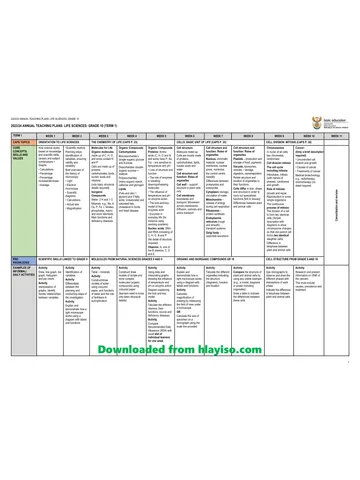
Gr 10 Life Sci ATP 2023 24
Question paper and memo
EC Life Sciences Grade 10 June 2025 QP and Memo
Question paper and memo