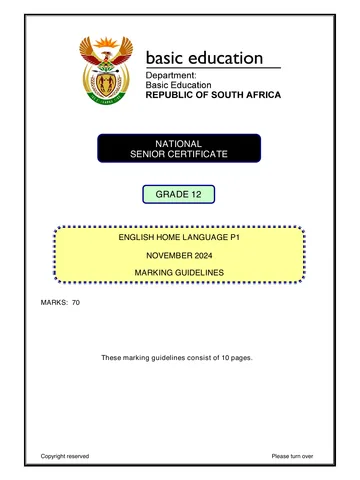
NATIONAL
SENIOR CERTIFICATE
GRADE 12
ENGLISH HOME LANGUAGE P2
NOVEMBER 2025
MARKING GUIDELINES
MARKS: 80
These marking guidelines consist of 27 pages.
Copyright reserved Please turn over
You're offline
Skip to contentQuestion paper 
%20June%202025%20Question%20Paper--4c96bc0d-19f6-44d5-82f0-24a5d433d889/v1-ddfd4554a073ecf1b6b6/card.webp)
View all
English HL P2 Nov 2025 MG
English Hl · Grade 12 · NSC November Exam · 2025 · English. Question paper, 27 pages. Read online or download the PDF.
- Subject
- English Hl
- Grade
- Grade 12
- Language
- English
- Document type
- Question paper
- Year
- 2025
- Exam period
- NSC November Exam
- Paper
- 2
- Pages
- 27
- File size
- 691.4 KB
Loading document…
Loading document…
1 of 27
Document textSearch extracted text and jump to a page.
English Home Language/P2 2 DBE/November 2025
NSC – Marking Guidelines
NOTE TO MARKERS
• These marking guidelines are intended as a guide for markers.
• The marking guidelines will be discussed with the marking panel before marking
commences at the marking centre.
• Candidates' responses must be considered on their merits.
INSTRUCTIONS
1. Wherever a candidate has answered more than the required number of questions,
mark only the first answer/response. (The candidate may NOT answer the essay
and the contextual question on the same genre.)
2. If a candidate has answered all four questions in SECTION A (prescribed poems),
mark only the first two.
3. If a candidate has answered two contextual or two essay questions in SECTIONS B
and C, mark the first one and ignore the second. If a candidate has answered all four
questions (novel) and/or all six questions (drama), mark only the first answer in each
section, provided that one contextual and one essay have been answered.
4. If a candidate gives two answers where the first is wrong and the next one correct,
mark the first answer and ignore the next.
5. If answers are incorrectly numbered, mark according to the marking guidelines.
6. If a spelling error affects the meaning, mark incorrect. If it does not affect the meaning,
mark correct.
7. Essay questions: If the essay is shorter than the required word count, do not penalise,
because the candidate has already penalised himself/herself. If the essay is too long,
assess on merit and discuss with senior markers.
8. Contextual questions: If the candidate does not use inverted commas when asked to
quote, do not penalise.
9. For open-ended questions, no marks should be awarded for YES/NO or I
AGREE/DISAGREE. The reason/substantiation/motivation/justification is what
should be considered.
10. No marks should be awarded for TRUE/FALSE or FACT/OPINION. The
reason/substantiation/motivation/justification is what should be marked.
11. Answers to contextual questions must be assessed holistically in the light of the
discussion during the standardisation of the marking guidelines.
Copyright reserved Please turn over
English Home Language/P2 3 DBE/November 2025
NSC – Marking Guidelines
SECTION A: POETRY
PRESCRIBED POETRY
QUESTION 1: POETRY – ESSAY QUESTION
'SOLITUDE' – Ella Wheeler Wilcox
• Use the following points, among others, as a guideline to marking this question.
Responses might differ, depending on the candidate's sensitivity to and understanding of
the poem.
• Refer to page 26 for the rubric to assess this question.
• The poem explores the paradox of human connection, which is conditional and fleeting,
and individual isolation.
• The title speaks to the nature of solitude, suggesting that even when surrounded by
others, isolation remains an inevitable part of human life.
• The focus shifts from collective joy to individual sorrow, illustrating that sorrow is
something one must face alone, regardless of external circumstances.
• The contrast between laughter and weeping demonstrates how joy can invite connection,
but sorrow and personal grief remain a solitary experience. People gravitate towards
other people who are joyful and full of positive energy.
• Personifying the earth as having 'trouble enough of its own' implies that the earth/people
have a lack of capacity to share others' sorrow; the world is indifferent and continues
regardless of human emotions.
• Singing brings a response from 'the hills', reinforcing that joy is acknowledged, while
sighing (a symbol for sorrow) is ignored. This indifference suggests that personal grief is
often disregarded/dismissed.
• Human relationships are presented as superficial: people only stay close ('seek you')
when things are going well, but are absent ('turn and go') when it comes to supporting
others in difficult times.
• The reference to people wanting 'full measure of all your pleasure' but not needing others'
'woe' critiques the superficial nature of human interaction and how people often only want
the best from others while offering little in return during times of hardship.
• The speaker considers the connection between one's outlook on life ('Be glad'; 'Be sad')
and the friends one attracts: no one wants the burden of someone else's unhappiness if
it can be avoided.
• The image of feasting and fasting illustrates the contrast between shared celebration and
personal deprivation; people are drawn to pleasure but not to pain.
• The final image of facing a solitary passage through the 'narrow aisles of pain' highlights
the inevitable: everyone must face dying alone.
• People are portrayed as indifferent and self-absorbed, leaving individuals to be self-
reliant and responsible for their own happiness and well-being.
• Structurally, each stanza consists of a contrasting pair of actions. By alternating between
the communal experience of joy and the isolating nature of sorrow, the speaker suggests
that no matter how much one interacts with the world, certain experiences are reserved
for the individual to experience alone. The indented lines draw attention to the isolating
aspects of human existence. Rhythm and rhyme contribute to the mood and tone of the
poem.
• The tone is reflective/contemplative/melancholic. The speaker comes to a
resigned/sombre realisation that sorrow is an inescapable personal journey.
• Candidates might refer to the tone as critical/satirical as the poem exposes the
shallowness and selfishness of people's response to the pain and suffering of others.
[Credit valid alternative responses.] [10]
Copyright reserved Please turn over
English Home Language/P2 4 DBE/November 2025
NSC – Marking Guidelines
QUESTION 2: POETRY – CONTEXTUAL QUESTION
'IT IS A BEAUTEOUS EVENING, CALM AND FREE' – William Wordsworth
2.1 The word 'tranquillity' refers to the calmness and peacefulness of the evening.
Nature is harmonious/serene as reflected in the stillness of the sea and setting
sun. Time seems to have slowed down, creating a quiet, meditative setting.
[Award 2 marks for two distinct points.] (2)
2.2 Nuns' devotion to and worship of God consume them. They are quiet and
adoring while reflecting at evening prayers and it is this quality that the speaker
associates with his awe for the beauty of nature at this time of day. Just as a
nun feels the presence of God, so too does the speaker as he appreciates the
wonders of nature that surround him.
[Award 2 marks for two distinct points.] (2)
2.3 2.3.1 Personification (1)
2.3.2 The image of the sea alludes to God's presence in nature. The ebb and
flow of the tides is indicative of his involvement in all living things. The
sound of the waves is compared to 'thunder', which suggests God's
power, while the vastness of the ocean implies God's constant
presence/omnipotence. The comparison effectively demonstrates the
characteristics of a 'mighty' God, who is ever-present, everlasting and
all powerful.
[Award 2 marks for a discussion of the effectiveness of the image.] (2)
2.4 The speaker realises that, unlike his conscious awareness ('solemn thought')
of God's presence in nature, his daughter is instinctively in tune with God. By
virtue of her being a child, she is naturally close ('dear') to God. She does not
appear to be amazed ('appear untouched') by the extraordinary scenery/the
beauty of nature because feeling close to God is an everyday experience for
her. Her child-like innocence signals her constant connection to, and
appreciation of the power of nature and, therefore, God. He acknowledges that
children have direct access to God (‘inner shrine’), unlike adults ('God being
with thee when we know it not'), and are naturally reverent (‘worshipp’st at the
temple’). ‘Abraham’s bosom’ implies she is always in a state of blessedness.
He longs for the same natural and spiritual connection.
[Award 1 mark for the diction and 2 marks for the critical discussion.] (3)
[10]
Copyright reserved Please turn over
English Home Language/P2 5 DBE/November 2025
NSC – Marking Guidelines
QUESTION 3: POETRY – CONTEXTUAL QUESTION
'POEM OF RETURN' – Jofre Rocha
3.1 The word, 'return' in the title suggests that the speaker is homesick and
determined/anxious/eager/desperate/longing to return to his home country./
The poem is a reflection on the loneliness of his exile/on his expectations for
his homecoming./He feels guilty at leaving the country during its fight for
freedom.
[Award 1 mark for a feeling and 1 mark for the reason/s.] (2)
3.2 The repetition of the phrase, 'Bring me' emphasises what the speaker actually
wants rather than praise and recognition. His guilt at not being present during
the struggle drives him to acknowledge the pain, suffering and deprivation
experienced by those who remained.
[Award 2 marks for two distinct points.] (2)
3.3 3.3.1 Metaphor (1)
3.3.2 The men's 'anger' transforms into a snake. This effectively conveys the
danger that their deaths will generate. Just as a snake is poisonous,
their deaths will spark anger in those left behind and will serve as
inspiration to continue the struggle for freedom. The 'thread of anger'
connects them to the fighters who will demand justice on their behalf.
[Award 2 marks for a discussion of the effectiveness of the image.] (2)
3.4 Initially an imperative tone is created when the speaker issues the command:
'do not bring me flowers' and repeats his assertion of what he actually wants.
The tone changes to melancholic/sad/regretful as the speaker recognises the
'mourning', suffering and loss endured by his compatriots while he is in exile.
The tone then shifts to one of defiance/anger, reflected in the description of
the fallen 'heroes', ominously suggesting the threat of an imminent uprising.
[Award 2 marks for two examples of the changing tone and 1 mark for the
critical discussion.] (3)
[10]
Copyright reserved Please turn over
English Home Language/P2 6 DBE/November 2025
NSC – Marking Guidelines
QUESTION 4: POETRY – CONTEXTUAL QUESTION
'THIS WINTER COMING' – Karen Press
4.1 The word 'shroud' suggests that the rain clouds in the sky are
widespread/cover a vast area/hiding the light/making visibility poor. The sky is
dark/ominous/heavy/oppressive and appears to envelop the earth.
[Credit candidates who allude to the political climate.]
[Award 2 marks for two distinct points.] (2)
4.2 The repetition highlights the ominous nature of the coming storm. It
emphasises the fact that the storm should be feared as it promises to be
devastating. It also implies that everyone will be affected and that people who
are not yet frightened should be. There is a pervasive feeling of fear conveyed
by the question.
[Credit candidates who allude to the political climate.]
[Award 2 marks for two distinct points.] (2)
4.3 4.3.1 Metaphor/Hyperbole (1)
4.3.2 The 'bare bodies' of the children are compared to a 'raging fire'
indicating how their anger is fuelling the resistance to oppression. This
response is motivated by years of suffering and the deaths of their
peers. Despite their vulnerable and hopeless state, the children
willingly sacrifice their lives to fight apartheid. The image is effective
because it vividly conveys the loss of their innocence as well as the
horror and tragedy of these oppressive conditions.
[Award 2 marks for a discussion of the effectiveness of the image.] (2)
4.4 There is a tone of utter despair/sorrow/sadness/despondency in the third
stanza. It depicts the harsh realities of life as the women are 'sad' and the
children are 'crying'. The wretched state in which the oppressed exist is
underscored by the world being 'so hungry'. A hopeless tone is created by
referring to 'slow steps' and 'tide of sadness'. The word, 'tolling' introduces an
ominous/foreboding tone because of its association with death ('drown'); this
is emphasised by the imperative, 'will'.
Candidates might refer to a bitter/resentful tone reflected in 'madam's house is
clean', while the poor face harsh living conditions.
[Award 1 mark for the diction, 1 mark for the tone and 1 mark for the critical
discussion.] (3)
[10]
Copyright reserved Please turn over
English Home Language/P2 7 DBE/November 2025
NSC – Marking Guidelines
UNSEEN POETRY (COMPULSORY)
QUESTION 5: CONTEXTUAL QUESTION
'THE TREES' – Philip Larkin
5.1 The phrase, 'relax and spread' suggests that the buds are opening up to reveal
their new growth. It conveys a sense of ease and natural progression as the
buds unfold into leaves. The buds might be described as blooming/blossoming
out of their tightly-bound nodule into fully unfurled leaves.
[Award 2 marks for two distinct points.] (2)
5.2 The speaker's attitude towards the trees might be envious/indignant/
disgruntled/resentful/admiring as they seem to be superior in that they are able
to renew themselves whilst man grows older. The trees are able to hide the
effect of ageing whilst man is not.
[Award 1 mark for attitude and 1 mark for an explanation thereof.] (2)
5.3 5.3.1 Metaphor/Personification (1)
5.3.2 The trees' growth is a continuous cycle of strenuous work,suggested
by 'unresting' and 'thresh'. The trees are compared to castles as they
grow thick/strong/imposing; they are fortified through their perennial
cycle of growth. The image is effective as it evokes a vivid image of the
trees' majestic and unceasing ('unresting') growth, causing the trees to
become thicker and stronger each year. It emphasises the continuous
cycle of renewal for the trees/nature and their resilience to withstand
the destructive effects of time.
[Award 2 marks for a discussion of the effectiveness of the image.] (2)
5.4 5.4.1 Positive/Optimistic/Encouraging/Hopeful (1)
5.4.2 The repetition of 'afresh' reinforces the idea of the resilience of all living
things in contrast to their short lives. The natural world, despite death,
accepts renewal, as every end is an opportunity to begin again.
[Award 2 marks only if there is a critical discussion.] (2)
[10]
TOTAL SECTION A: 30
Copyright reserved Please turn over
English Home Language/P2 8 DBE/November 2025
NSC – Marking Guidelines
SECTION B: NOVEL
QUESTION 6: THE PICTURE OF DORIAN GRAY – ESSAY QUESTION
• Below is the basis for answering this essay. Use the following as a guideline only.
However, also allow for answers that are different, original and show evidence of critical
thought and interpretation.
• A range of examples should be used by the candidates to support their arguments.
• Refer to page 27 for the rubric to assess this question.
VALID
• Dorian's changing nature is intricately linked to his descent into decadence and moral
corruption, resulting from his indulging his vices.
• His initial innocence and impressionability leave him susceptible to Lord Henry's
influence, resulting in Dorian adopting a hedonistic worldview.
• Dorian's desire to keep up appearances in Victorian society aligns him with aestheticism,
eliciting a shallow/superficial/meaningless existence.
• His desire for eternal youth results in his making a wish to remain young while the portrait
ages. This is indicative of his vanity and self-importance, whilst the ageing portrait
symbolises his internal corruption.
• Dorian's callousness and lack of empathy leads to Sibyl Vane's tragic suicide. He
realises here that his wish has been granted, marking his first step into depravity.
• Initially, he is captivated by the portrait's ability to bear the consequences of his actions,
allowing his indulgence in a hedonistic lifestyle without visible repercussions. However,
the vileness of the portrait alerts Dorian to his increasing degeneration, intensifying his
paranoia.
• His efforts to hide the portrait symbolise his attempt to conceal his moral corruption from
both the world and himself.
• Despite his indulgences, Dorian's beauty remains unchanged, masking his internal
corruption. This allows him to spiral further into degeneration without being discovered.
• Despite moments of regret, Dorian's moral weaknesses pull him back into a hedonistic
lifestyle. His actions become more egregious, leading to a life of debauchery, corruption,
and murder. Each act of indulgence and moral transgression alters his nature, making
him more detached from reality and lacking any guilt or remorse.
• The lack of consequences and punishment leads to Dorian acting with impunity and
causing the deaths of Basil Hallward, Alan Campbell, and James Vane.
• His murder of Basil and his flagrant disregard for the suffering he causes others
demonstrates the depth of his corruption.
• Dorian's destruction of the portrait is an immature attempt to undo the damage to his
soul. His resulting accidental death illustrates that his moral weaknesses have led to his
irreversible transformation and tragic end.
INVALID
• Dorian's nature does not fundamentally change: external influences, such as Lord
Henry's manipulation and Basil Hallward's portrait, merely reveal his latent moral
weaknesses.
• Dorian's experiencing moments of regret and self-reflection suggest that his nature
retains some capacity for moral awareness. Similarly, his destruction of the portrait is
an attempt to seek redemption; this challenges the notion that his nature has
fundamentally changed.
[Credit valid alternative/mixed responses.] [25]
Copyright reserved Please turn over
English Home Language/P2 9 DBE/November 2025
NSC – Marking Guidelines
QUESTION 7: THE PICTURE OF DORIAN GRAY – CONTEXTUAL QUESTION
7.1 Having met Dorian at a party, Basil is captivated by his beauty and innocence.
Basil is inspired and paints the portrait as an artistic tribute.
[Award 2 marks for two distinct points.] (2)
7.2 Sibyl's beauty attracts Dorian and causes him to idealise and idolise her but,
when her acting falters due to the genuine love she feels, he cruelly rejects her
leading her to commit suicide. Her physical beauty becomes a curse, as it binds
her fate to Dorian's superficial desires.
[Award 2 marks for two distinct points.] (2)
7.3 The word 'lad' implies Dorian's youthful innocence and immaturity. While he has
not yet been corrupted by Lord Henry's influence, the word is a reminder that
he is impressionable and naïve.
[Award 2 marks for two distinct points.] (2)
7.4 Basil believes Dorian to be pure and he fears that a person from the lower class
will cause a stain on Dorian's reputation and character. However, it is Dorian
who proves to be the 'vile creature' who destroys Sibyl.
OR
It is also ironic that Basil is worried about Sibyl being a bad influence on Dorian,
as it is his own portrait (a symbol of Dorian's soul), and Lord Henry's enticing
theories of hedonism and aestheticism that are the catalyst for Dorian's
ruination.
OR
It is also ironic because it is not an external influence but rather Dorian's own
decision-making that results in his descending into a perpetual cycle of vile
degradation, ruining his own soul, morals and intellect.
[Award 3 marks for a clear discussion of any ONE of these examples of irony.] (3)
7.5 In this extract, Basil is portrayed as cautious, caring and protective. His
concern for Dorian's well-being and his disapproval of Dorian's engagement to
an unknown fiancée reflect his moral and intellectual values. Basil's reliance on
Lord Henry's opinion indicates his respect for Henry's judgement, despite their
differing views. In not forgiving Dorian for telling Lord Henry and not him about
his engagement, Basil displays his petulant/sulky nature. Basil is hurt as his
devotion for Dorian is not reciprocated, leading to his feeling neglected, jealous
and envious of the growing bond between Dorian and Lord Henry.
[Credit valid alternative responses.]
[Award 3 marks for two ideas well discussed.] (3)
Copyright reserved Please turn over
English Home Language/P2 10 DBE/November 2025
NSC – Marking Guidelines
7.6 Before going to Paris, Basil visits Dorian to confront him about the rumours he
has heard about Dorian. In a fit of rage, Dorian murders Basil. Afterwards,
Dorian realises he will need help disposing of the body and he writes a letter to
Alan Campbell. The following morning, he sends his valet to deliver this letter.
[Award 2 marks for two distinct points.] (2)
7.7 This phrase highlights Dorian's loss of freedom. His beauty remains, but he is
trapped by his own sins and paranoia. Dorian, despite his outward beauty, feels
trapped by his own actions and the consequences of his hedonistic lifestyle.
The image objectifies Dorian, highlighting the contrast between his appearance
and his inner turmoil.
[Award 2 marks for two distinct points.] (2)
7.8 The reader might feel revulsion for Dorian because he is trying to avoid the
consequences of his actions. Dorian's depravity is at its lowest point and the
reader might feel that Dorian deserves to feel guilty, agitated and horrified. His
actions, such as murdering Basil and corrupting and ruining the lives of many
other people, and his lack of accountability for his moral decay might elicit
disgust.
OR
The reader might feel pity for Dorian. He fears what the consequences of his
actions might be and this overwhelms and immobilises him. He is petrified at
the thought that his future might be ruined as a result of his rash actions.
[Credit valid alternative/mixed responses.]
[Award 1 mark for attitude and 2 marks for a well-developed discussion thereof.] (3)
7.9 Alan Campbell is introduced as a former friend of Dorian Gray. He is a talented
chemist and musician, known for his scientific acumen and artistic sensibilities.
However, his association with Dorian has spoiled his reputation. As a result of
the souring relationship with Dorian, Alan becomes withdrawn/reclusive and
dour. He gives up his music to focus on scientific study. Alan is forced to
compromise his morals under the duress of blackmail, leading to his profound
internal conflict. The weight of his crime causes him to commit suicide. Alan's
change emphasises the corrupting influence Dorian has on those around him.
[Credit valid alternative responses.]
[Award 3 marks only if a cogent comment is made.] (3)
Copyright reserved Please turn over
English Home Language/P2 11 DBE/November 2025
NSC – Marking Guidelines
7.10 AGREE
Dorian's self-absorbed nature leads to his living a life of hedonism. He makes
immoral choices and is responsible for the 'horror' he now faces. His potential
for moral degradation is evident in his early interactions with Basil and Lord
Henry. His making the wish, rejecting Sibyl, using the Yellow Book as a guide
to living his life and murdering Basil are done on his own volition. Dorian refuses
to take responsibility for any of his wrong doings such as visiting opium dens
and brothels, and getting into fights, merely wishing to conceal anything in his
life that is ugly. He refuses to listen to reason and completely ignores the pangs
of guilt and remorse as a sign to change his behaviour. His attempt to destroy
the portrait inadvertently leads to his death.
OR
DISAGREE
Basil plays a role in influencing Dorian as it is he who paints the portrait that
awakens Dorian's revelation of his own beauty. The portrait aids in the tragedy
that occurs as it grants Dorian external youth and beauty, allowing him to live
free from the consequences of a life of sin and crime. Lord Henry also plays a
significant role in influencing Dorian. His introducing Dorian to the world of
aestheticism and hedonism is the catalyst for Dorian's obsession with youth
and beauty. It is Lord Henry who encourages Dorian to view Sibyl's suicide as
a dramatic finale and it is he who gifts Dorian the Yellow Book. It is these
external influences that are responsible for the horror which confronts him.
[Credit valid alternative/mixed responses.]
[Award 3 marks only if there is a critical discussion.] (3)
[25]
Copyright reserved Please turn over
English Home Language/P2 12 DBE/November 2025
NSC – Marking Guidelines
LIFE OF PI – Yann Martel
QUESTION 8: LIFE OF PI – ESSAY QUESTION
• Below is the basis for answering this essay. Use the following as a guideline only.
However, also allow for answers that are different, original and show evidence of critical
thought and interpretation.
• A range of examples should be used by the candidates to support their arguments.
• Refer to page 27 for the rubric to assess this question.
VALID
• Pi's unorthodox approach to life provides him with the tools to survive hardship, both
while growing up in Pondicherry and while stranded at sea.
• Pi is able to combine faith and rationality, and to find unique strategies to overcome the
challenges he faces. This is indicative of his ability to go beyond traditional ways of
thinking.
• Pi's practising of multiple religions is unusual. He is flexible, open-minded, and willing
to consider different interpretations of existence and embrace the world with
compassion and hope. He thinks differently and is prepared to defend his position when
confronted by his parents and his three religious leaders.
• His pluralistic faith provides him with comfort and guidance during his months at sea.
His spiritual flexibility gives him the strength and resilience he needs to endure his
isolation and despair.
• Pi is a non-conformist who is able to triumph over adversity.
• The manner in which he addresses the teasing he endures because of his name, and
takes on an alternative identity, is clever and resourceful. These qualities assist him in
finding ways to survive on the lifeboat – his building the lifeboat, using the turtle shell
as a shield and his training Richard Parker are examples of his innovative approach. Pi
sees solutions when others see problems.
• Pi's knowledge of animal behaviour assists him in asserting himself with Richard
Parker; their co-existence on the lifeboat is integral to Pi's physical and spiritual survival
as it gives Pi purpose and companionship. This helps him maintain his sanity during his
time at sea. Instead of being afraid, he embraces his role as Richard Parker's caretaker.
This unusual bond teaches him to be patient and calm in the face of danger.
• He prioritises survival and the search for meaning over adhering strictly to societal
norms, for example, his forfeiting his vegetarianism on the lifeboat. Pi's willingness to
think outside the box empowers him to discover significance in a world full of
uncertainties.
• In the human story, Pi's creation of Richard Parker as his alter ego is an unusual coping
mechanism. He is able to distance himself from the more brutal realities of his ordeal.
This allows him to transcend his circumstances by taking control of the emotional
aspect of living in such an extreme situation. He gains perspective and resilience.
• His ability to see the horror of his circumstances as a test of his faith allows him to find
purpose in his ordeal.
• Pi emerges from his ordeal as a survivor who thrives on creativity, faith and adaptability.
[A cogent 'Invalid' response is unlikely. However, treat all responses on their merit.]
[Credit valid alternative/mixed responses.] [25]
Copyright reserved Please turn over
English Home Language/P2 13 DBE/November 2025
NSC – Marking Guidelines
QUESTION 9: LIFE OF PI – CONTEXTUAL QUESTION
9.1 Pi has just written his new name, Pi Patel, on the blackboard. The silence reflects
the teacher's, and his classmates’, surprise at Pi's boldness/audacity and
determination.
[Award 2 marks for two distinct points.] (2)
9.2 As a close family friend, Mamaji ('Uncle' Francis Adirubasamy) was tasked with
naming the new baby. His love for swimming and his appreciation of the Piscine
Molitor, a beautiful swimming pool in Paris, inspired him to choose this name.
He wanted to name Pi after a place that brought him so much joy, as a way to
honour the child.
[Award 2 marks for two distinct reasons.] (2)
9.3 This exchange showcases the sibling competition and friendship between the
brothers. Although Ravi often teases Pi, it is light-hearted and not malicious.
Beneath the ridicule lies a brotherly love and respect.
[Award 2 marks for two distinct points.] (2)
9.4 Pi's stunt shows how committed he is to taking control of his situation. He is trying
to break free from the teasing linked to his given name by reshaping his identity.
His actions are brave and assertive. This act of standing up for himself displays
his cleverness, creativity, and skill in handling tough situations. His ingenuity and
resolve demonstrate his ability to overcome obstacles.
[Award 3 marks for two ideas well discussed.] (3)
9.5 Pi relies on repetition to build a sense of order and routine on the lifeboat; this is
crucial for his survival, both physically and mentally. His understanding of the
importance of repetition in training animals allows him to maintain control of
Richard Parker; this allows them to co-exist on the lifeboat. Pi establishes a daily
practice of checking his supplies, fishing and cleaning the lifeboat, and also
engages in religious rituals like prayer to support his spiritual and emotional
health. This repetition keeps him focused, disciplined, and optimistic.
[Award 3 marks for two ideas well discussed.] (3)
9.6 Pi and Richard Parker have found an island covered in algae and filled with
meerkats. Using the resources available on the island, they have satisfied their
hunger and thirst. Pi and Richard Parker spend their days exploring the island.
One day, while exploring, Pi comes to the realisation that the apparently idyllic
island is actually acidic and carnivorous.
[Award 2 marks for two distinct points.] (2)
Copyright reserved Please turn over
English Home Language/P2 14 DBE/November 2025
NSC – Marking Guidelines
9.7 Pi is concerned about Richard Parker's well-being and does not want to leave
him on the island. However, when they finally find land and are safe, Richard
Parker abandons Pi without so much as a backward glance.
Candidates might refer to the human story, indicating that abandoning Richard
Parker, at this point, is not an option for Pi because that would mean abandoning
himself. However, later he must abandon his alter ego to re-enter civilisation.
[Award 2 marks for a clear understanding of irony.] (2)
9.8 The reader might feel empathy/pity/sympathy for Pi. His questioning reflects his
growing despair. After everything that he has endured, he now appears to be
losing hope. Pi recognises that the likelihood of being rescued is diminishing and
there is a slow realisation that he may never fulfil his dreams. He feels
despondent and overwhelmingly alone.
[Credit valid alternative responses.]
[Award 1 mark for the reader's response and 2 marks for a discussion thereof.] (3)
9.9 In the animal story, Richard Parker aids Pi's survival by giving him a purpose and
will to live. Pi needs to stay alive to ensure that Richard Parker is looked after.
Richard Parker offers Pi companionship, which prevents Pi from falling into
despair. Their interaction is indicative of how survival is dependent on connection
with others.
In the human story, Richard Parker represents Pi's primal instincts and will to
survive. As Richard Parker, Pi is able to commit acts of savagery that are
necessary for him to live. By choosing not to leave the tiger behind, Pi shows
that he is aware that he still needs that part of himself to survive. The invention
of Richard Parker allows Pi to hold onto his humanity and moral principles.
[Candidates may receive full credit even if they refer to only one of the stories.]
[Award 3 marks only if a cogent comment is made.]
(3)
9.10 AGREE
Faith is crucial to Pi's identity, providing him with hope and a reason to keep
living. Pi's pluralistic faith shows his open-mindedness and his search for deeper
meaning. His values are rooted in his faith. Pi's unwavering faith is a source of
solace and strength, enabling him to endure his traumatic experience. Instead
of succumbing to 'spiritual death' on the algae island, he relies on his faith to
guide him to an understanding of the world. Pi practises his religious rituals while
on the lifeboat as a means of maintaining his connection to God. His faith in
science and problem-solving guide him to finding solutions to the challenges
faced on the lifeboat, such as the lack of fresh water. On the island, he is able
to make scientific deductions in order to survive.
[A cogent 'Disagree' response is unlikely. However, treat all responses on their
merits.]
[Award 3 marks only if there is a critical discussion.] (3)
[25]
TOTAL SECTION B: 25
Copyright reserved Please turn over
English Home Language/P2 15 DBE/November 2025
NSC – Marking Guidelines
SECTION C: DRAMA
HAMLET – William Shakespeare
QUESTION 10: HAMLET – ESSAY QUESTION
• Below is the basis for answering this essay. Use the following as a guideline only.
However, also allow for answers that are different, original and show evidence of
critical thought and interpretation.
• A range of examples should be used by the candidates to support their arguments.
• Refer to page 27 for the rubric to assess this question.
• Claudius's murder of King Hamlet sets the stage for deception and disguise
throughout the play.
• Claudius uses his charm to win Gertrude's affections and gain her hand in marriage
and he deceives the court by presenting himself as a loving stepfather and competent
ruler to maintain power.
• Claudius plots against Hamlet: he uses Polonius, Ophelia, and Rosencrantz and
Guildenstern to spy on him; sends Hamlet to England under the guise of protecting
him while intending to have him killed; and sets up a supposedly friendly duel
between Hamlet and Laertes, who will fight with a poisoned sword.
• The ghost of King Hamlet instructs Hamlet to avenge his murder. Hamlet feigns
madness to conceal his true intentions and verify the Ghost's accusation.
• His act of insanity ('antic disposition') deceives people, leaving them unsure of his
motives, while granting him a strategic advantage, but it also causes collateral
damage, including Ophelia's descent into madness and ultimately her death.
• Hamlet stages The Mousetrap to expose Claudius's guilt, using performance as a
form of disguise.
• Polonius disguises his true intention of empowering himself by pretending to act in
the best interest of the court. He uses his daughter as a tool to gather information so
that he can ingratiate himself with Claudius. His obsession with espionage leads to
his death when Hamlet kills him while he hides behind the arras.
• Rosencrantz and Guildenstern betray their friendship with Hamlet by pretending to
be concerned friends; instead, they gather information for Claudius, hoping to win the
favour of the king. Their lack of awareness about the real reason for their escorting
Hamlet to England illustrates how they are also deceived by Claudius.
• Laertes colludes with Claudius to kill Hamlet. Laertes's use of a poisoned sword
demonstrates his willingness to deceive for personal vengeance. He also hides his
true intentions of revenge behind a façade of reconciliation during the duel with
Hamlet. His eventual confession redeems him, but only after the deception has led
to multiple deaths.
• Ophelia's inability to navigate the deception around her contributes to her tragic fate.
She becomes a pawn in Polonius's and Claudius's schemes to uncover Hamlet's
motives.
• While not actively deceitful, Gertrude is manipulated by Claudius and remains
unaware of his true nature until the end. Her marriage to Claudius creates an image
of loyalty that Hamlet perceives as a betrayal.
• Horatio remains honest and loyal throughout, serving as a moral contrast to the deceit
of others. His reliability makes him the ideal person to recount the truth of the events
after the tragic conclusion.
[Credit valid alternative/mixed responses.] [25]
Copyright reserved Please turn over
English Home Language/P2 16 DBE/November 2025
NSC – Marking Guidelines
QUESTION 11: HAMLET – CONTEXTUAL QUESTION
11.1 King Hamlet has died/been murdered and his brother, Claudius, has been
appointed as the new king of Denmark. Claudius and King Hamlet's widow,
Gertrude, have subsequently married.
[Award 2 marks for two distinct points.] (2)
11.2 The guards are on edge because the ghost of the old king has appeared to
them on two occasions. He is dressed in war clothes/armour and does not
speak a word to them. He disappears when approached or questioned, leaving
the guards confused and uneasy. They are also anxious as they are aware
that Denmark appears to be preparing for war.
[Award 2 marks for two distinct points.] (2)
11.3 This statement demonstrates Bernado's allegiance to the current king and his
wish for the king's long reign. However, Claudius is not deserving of such
loyalty and his reign will be cut short when Hamlet takes his revenge.
[Award 2 marks for a clear understanding of irony.] (2)
11.4 Surrounded by dishonesty, Hamlet struggles to uncover the truth about his
father's death. He values honesty but realises he will need to use deceit to
confirm the ghost's claims. Claudius, Polonius, and Rosencrantz and
Guildenstern use manipulation and lies to pursue their ambitions/serve their
own interests; however, they all meet their untimely deaths. Ophelia and
Gertrude, caught in a web of lies, also suffer tragic fates. The play
demonstrates that dishonesty leads to destruction and while the pursuit of truth
may be difficult/challenging, it is necessary for justice to prevail.
[Credit valid alternative responses.]
[Award 3 marks only if the significance is well discussed.] (3)
11.5 Horatio's scepticism is evident in his not immediately believing the guards'
claims about the ghost. He wants to see the ghost for himself as he is
rational/logical. The guards value and trust Horatio's opinion because he is well
educated and respected.
[Award 3 marks for two ideas well discussed.] (3)
11.6 Hamlet has arranged for The Mousetrap, a play mimicking the circumstances
surrounding King Hamlet's murder, to be presented to Claudius and the Royal
Court. Hamlet plans to use the play to confirm the ghost's story and he has
asked Horatio to observe Claudius's reaction. While watching the play,
Claudius becomes agitated, stops the play and storms out.
[Award 2 marks for two distinct points.] (2)
Copyright reserved Please turn over
English Home Language/P2 17 DBE/November 2025
NSC – Marking Guidelines
11.7 Gertrude wants to speak to Hamlet to discover the truth behind his strange
behaviour and because Polonius has convinced her to let him spy on Hamlet,
as he is still trying to prove his theory that Hamlet's unstable mental state is
due to heartbreak.
[Award 2 marks for two distinct points.] (2)
11.8 Hamlet is enraged by his mother's hasty marriage and is 'cruel' when
addressing her. He wants to obey the ghost's instruction and not cause her
physical harm; this suggests that he has some sympathy for Gertrude. Hamlet
knows that he is expected to love and respect his mother; however, he is
disgusted and disappointed in her 'frailty'. He is determined to confront her as
he wants her to confess and take accountability for her actions.
[Credit valid alternative responses.]
[Award 1 mark for attitude and 2 marks for a cogent comment.] (3)
11.9 Hamlet might use an excited/determined tone. He might beckon the
musicians/jump up and down or wave his arms. He feels vindicated, as he now
knows that Claudius is guilty and he is in a celebratory mood.
[Credit valid alternative responses.]
[The candidate's response should be convincing in context.]
[Award 3 marks only if the candidate refers to body language and tone, and
includes a motivation.] (3)
11.10 When Hamlet is instructed to seek revenge by the ghost, he is hesitant
because this request is in conflict with his values. Hamlet knows that as a son,
he is duty-bound to honour his father's request for revenge. However, he is
also aware this act could damn him. His decision to 'put on an antic disposition'
and to stage The Mousetrap is part of his plan to test the veracity of the Ghost's
claim, therefore ensuring that his actions are honourable. Hamlet's sense of
justice does not allow him to act without definitive evidence. Initially, Hamlet's
inner conflict leads to inaction, but he acts impulsively later in the play when he
rashly kills Polonius and accepts the duel with Laertes. For most of the play
Hamlet struggles with the morality of revenge and feels conflicted about his
fate. However, when he returns from England, he is determined to kill Claudius
and restore his country.
[Credit valid alternative responses.]
[Award 3 marks only if a critical discussion is included.] (3)
[25]
Copyright reserved Please turn over
English Home Language/P2 18 DBE/November 2025
NSC – Marking Guidelines
OTHELLO – William Shakespeare
QUESTION 12: OTHELLO – ESSAY QUESTION
• Below is the basis for answering this essay. Use the following as a guideline only.
However, also allow for answers that are different, original and show evidence of
critical thought and interpretation.
• A range of examples should be used by the candidates to support their arguments.
• Refer to page 27 for the rubric to assess this question.
• Through the manipulation of truth and the use of false appearances, characters such
as Iago, Othello, and Desdemona navigate a web of lies that ultimately leads to
destruction.
• Iago uses deception and disguise as a strategy to achieve his goals. From the outset,
Iago presents himself as Othello's loyal ancient/ensign, yet he is secretly plotting to
ruin Othello's life. His deceptive nature is revealed through his ability to manipulate
the perceptions of those around him, often using language to disguise his true
intentions.
• Iago feigns honesty and loyalty, calling himself 'honest Iago', while secretly sowing
the seeds of doubt and jealousy in Othello's mind.
• He deceives Roderigo by pretending to be his friend and advisor, while in reality, he
is using Roderigo's infatuation with Desdemona to further his own plans.
• Iago's true intention of destroying Cassio is hidden by the supposed friendship and
support he offers Cassio.
• Othello's status as a respected general in the Venetian army disguises his feelings of
inadequacy. His identifying as an outsider and his insecurities about his race and
status make him vulnerable to the deceptive words of Iago.
• Othello falls victim to Iago's deception and disguise. Othello's trust in Iago blinds him
to the truth, and he becomes increasingly consumed by jealousy and suspicion.
• Iago's insinuations about Desdemona's infidelity, combined with the 'evidence' that
Iago fabricates, convince Othello to believe in a reality that is not based on truth but
on the deceptive manipulations of his ensign.
• In this way, Othello becomes both a victim of disguise and a perpetrator of deception,
as he ultimately deceives himself into believing the lies about his wife. He also
deceives himself into thinking that his actions are justified.
• Iago's manipulations are so effective that it leads to Othello's murder of Desdemona
and his own tragic downfall.
• Although Desdemona does not actively use deception, she becomes a victim of
disguise and false appearances. Desdemona's innocence and loyalty to Othello are
overshadowed by the false perception of her infidelity created by Iago's scheming.
Iago uses her lost handkerchief to deceive Othello into believing that she has
betrayed him.
• Desdemona's lack of awareness of the deceit surrounding her illustrates her
vulnerability in a world where appearances are often more powerful than reality; her
loyalty to Cassio is twisted into a guise of betrayal. She is unable to defend herself
against Othello's accusations because of Iago's successful manipulation of her
husband's thoughts. She is the tragic victim of the deception that Iago orchestrates.
• Emilia is deceptive when she denies any knowledge of Desdemona's missing
handkerchief. However, her deception is countered by her revealing the truth about
Iago.
[Credit valid alternative/mixed responses.] [25]
Copyright reserved Please turn over
English Home Language/P2 19 DBE/November 2025
NSC – Marking Guidelines
QUESTION 13: OTHELLO – CONTEXTUAL QUESTION
13.1 Brabantio, Desdemona's father, has been informed by Iago and Roderigo that
his daughter has married Othello. Roderigo leads Brabantio and his officers to
the inn where Othello and Desdemona are staying.
[Award 2 marks for two distinct points.] (2)
13.2 It is clear that Brabantio is racist/prejudiced as he does not believe that Othello
is capable of winning Desdemona's heart through normal means. He implies
that Othello must have used unnatural means ('enchanted'/'magic') to gain
Desdemona's affection.
[Award 1 mark for attitude and 1 mark for an explanation thereof.] (2)
13.3 The Duke's messengers have been sent to find Othello because there is an
urgent military matter that requires his presence. Othello is a respected military
leader, and the Duke requires him to lead the Venetian army in a battle against
the Turks.
[Award 2 marks for two distinct points.] (2)
13.4 Othello might hold his hand up to stop the guards/stand tall/gaze steadily at
Brabantio/hold his hands in a questioning gesture/glance or gesture towards
the Duke's messengers. His tone might be calm and placating/composed/
authoritative. He responds in a controlled/measured manner, displaying
respect for Brabantio while trying to resolve the situation diplomatically without
escalating the tension.
[Credit valid alternative responses.]
[The candidate's response should be convincing in context.]
[Award 3 marks only if the candidate refers to body language and tone, and
includes a motivation.] (3)
13.5 At this point in the play, the reader might view Desdemona as a pure, innocent
maiden. She is portrayed as naive and under some form of external control,
rather than as someone capable of making her own decisions.
However, she is also portrayed as someone who is strong-willed and
independent/defiant as she shunned the 'wealthy curled darlings' who were
eager to woo her, choosing rather an outsider like Othello.
[Credit mixed responses.]
[Award 3 marks for two ideas well discussed.] (3)
Copyright reserved Please turn over
English Home Language/P2 20 DBE/November 2025
NSC – Marking Guidelines
13.6 Iago has successfully manipulated Othello into believing that Desdemona has
been unfaithful to him with Cassio. In a fit of jealousy, Othello has just decided
to murder Desdemona. Meanwhile, Iago has orchestrated a confrontation
between Cassio and Roderigo which was unsuccessful. Instead, Cassio
wounds Roderigo, following which Iago wounds Cassio.
[Award 2 marks for two distinct points.] (2)
13.7 Gratiano and Lodovico are in Cyprus on state business as representatives of
the Duke. Lodovico has been sent to recall Othello to Venice as the threat of
war has subsided. Gratiano is Desdemona's uncle who also brings news of
Brabantio's death.
[Award 2 marks for two distinct points.] (2)
13.8 The irony in Cassio's appeal lies in the fact that he is calling for help after being
wounded, but the person he is calling to is Iago, who is the one responsible for
orchestrating this violence. Cassio's faith in Iago is still intact at this point, since
he is unaware that Iago has been working against him all along. This
demonstrates the extent of Iago's manipulation: Cassio, who has no reason to
distrust Iago, is in need of help from the very person who has betrayed him.
[Award 3 marks for a clear understanding of irony.] (3)
13.9 Bianca's comment suggests that the appearance of honesty is more important
than actual honesty. It is the reputation Iago has for honesty that allows him to
carry out his nefarious plans to destroy Othello. He deceives people into
trusting him and relying on him for good advice. He takes advantage of
Desdemona's honest nature, knowing that she will not suspect his motives in
encouraging her to act on Cassio's behalf. Othello's belief in Desdemona's
honesty is shattered by Iago's deception; he is determined to rid society of
disingenuous people, like his wife and Cassio. Emilia's dishonesty regarding
the whereabouts of the handkerchief inadvertently gives Iago the 'ocular proof'
that Othello has demanded of his wife's infidelity. Both Emilia and Desdemona
suffer the consequences of this lie. Honesty is in short supply and it is those
who are honest who are the victims of others' dishonesty and manipulation.
[Credit valid alternative responses.]
[Award 3 marks only if a cogent comment is made.] (3)
Copyright reserved Please turn over
English Home Language/P2 21 DBE/November 2025
NSC – Marking Guidelines
13.10 VALID
This assessment encapsulates Iago's corrupt and villainous nature. His actions
reveal his malevolent intent and lack of any moral compass. His scheming
against Othello, Cassio, and Desdemona, driven by jealousy, personal
grievance, and a thirst for power, is evidence of his villainy. Iago shows no
remorse, and his actions harm others. Iago's manipulation of Roderigo, his
betrayal of Othello's trust, and his cold-blooded orchestration of violence are
all actions that could be seen as damning. Describing Iago as an 'inhuman dog'
captures his evil and dehumanising behaviour.
[A cogent 'Invalid' response is unlikely. However, treat all responses on their
merits.]
[Credit valid alternative responses.]
[Award 3 marks only if a critical discussion is included.] (3)
[25]
Copyright reserved Please turn over
English Home Language/P2 22 DBE/November 2025
NSC – Marking Guidelines
THE CRUCIBLE – Arthur Miller
QUESTION 14: THE CRUCIBLE – ESSAY QUESTION
• Below is the basis for answering this essay. Use the following as a guideline only.
However, also allow for answers that are different, original and show evidence of critical
thought and interpretation.
• A range of examples should be used by the candidates to support their arguments.
• Refer to page 27 for the rubric to assess this question.
• While Salem is governed by a strict religious code that seems to be followed by
everyone, there is an undercurrent of deceit, characterised by grudges and judgemental
behaviour.
• Abigail presents herself as an innocent young woman but she has had an affair with
John Proctor and indulges in forbidden behaviour in the forest. She manipulates the
other girls into breaking the rules and they all lie to protect themselves from punishment
when they are caught by Parris.
• Parris deceives the villagers into thinking he is a God-fearing man when actually, he is
spiritually lacking. He lies about the girls' activities in the forest to protect his reputation
and position, and he disguises his vindictive nature as a concern for justice.
• Tituba eagerly assumes the persona, given to her by the girls and Reverend Hale, of
being bewitched to save herself. This deception is the catalyst to many innocent people
being named as witches.
• The villagers are deceived into thinking that the girls are genuinely saving them from
witchcraft. The girls' status is elevated and Abigail is viewed as saintly.
• Abigail's pretending to see the spirits of so-called witches, and to have been stabbed
by Elizabeth's spirit is part of her manipulation of the court, and her desire to see
Elizabeth dead.
• A further example of Abigail’s deceit is her stealing her uncle's money and running
away.
• Mary Warren oscillates between the truth and deception: despite wanting to reveal the
truth of the girls' deception, she is forced to maintain the lie when Abigail threatens her
in court.
• John Proctor perpetrates deception when he is not open about his affair with Abigail.
This allows Abigail to maintain her innocent image.
• Elizabeth deceives the court when she lies to protect her husband's reputation.
• The court, while believing it is upholding justice, actually encourages the false
confessions of the girls and other community members. Danforth and Hathorne hold
their reputations as more important than justice, sentencing many innocent victims to
the gallows.
• Danforth is disingenuous as he allows the trials to continue in spite of his realisation
that the court is being misled. This facilitates further disorder and injustice.
• Putnam appears to support Parris in his desire to investigate the claims of witchcraft
but this hides his disdain for Parris as minister. He later manipulates the courts for his
own personal gain by encouraging his daughter, Ruth to call out the names of those
whose land he wants to appropriate.
• Reverend Hale is one of the few characters who is not deceptive. He denounces the
court, refusing to be part of the deception that the girls and the court are perpetuating.
When he returns to Salem, he encourages the accused to lie and deceive the court into
accepting their confessions; he views this deception as justified.
[Credit valid alternative/mixed responses.] [25]
Copyright reserved Please turn over
English Home Language/P2 23 DBE/November 2025
NSC – Marking Guidelines
QUESTION 15: THE CRUCIBLE – CONTEXTUAL
15.1 The girls have been discovered dancing in the forest by Reverend Parris. Betty
has been pretending to be unconscious to avoid punishment. Parris is upset
as his household is now the centre of rumours of witchcraft and he has sent
for Reverend Hale to investigate. Subsequently, Abigail is confronted by Parris
about what has transpired in the forest. The girls have gathered at the Parris
home to discuss their fear of what might happen to them.
[Award 2 marks for two distinct points.] (2)
15.2 Abigail wants to kill Elizabeth because Elizabeth dismissed her after
discovering the affair she was having with John. By getting rid of Elizabeth,
Abigail believes that she will win John back and become the next Goody
Proctor. In addition, Abigail is angry because she believes that Elizabeth has
been tarnishing her name in the village.
[Award 2 marks for two distinct points.] (2)
15.3 Mary Warren has replaced Abigail as the servant in the Proctor home after
Abigail's dismissal. She is expected to assist Elizabeth with the household
chores.
[Award 2 marks for two distinct points.] (2)
15.4 Dishonesty lies at the centre of many interactions between characters. In these
lines, Betty points out Abigail's dishonesty. Abigail leads the girls in their lying
about dancing in the forest to avoid being punished. They also deflect being
named as witches by accusing innocent people of witchcraft. These lies
empower them and elevate their status. Many of the villagers lie for personal
gain, specifically to gain land. Mrs Putnam lies about Rebecca being involved
in the death of her babies, resulting in Rebecca's death. John's affair is a form
of dishonesty which leads to his honest wife, Elizabeth, lying in an attempt to
save his reputation. John redeems himself when he refuses to make a false
confession. Danforth claims that his justice is even-handed/impartial, yet after
realising that the court is being misled, he continues to prosecute innocent
people. Ultimately, dishonest characters create victims of the honest people in
Salem.
[Credit valid alternative responses.]
[Award 3 marks for two ideas well discussed.] (3)
15.5 These lines indicate Abigail's threatening/vicious/vengeful nature. She is
determined to stop the girls from revealing the truth as she wants to avoid
punishment at all costs. Her aggression is an act of self-preservation. Her
references to 'a pointy reckoning' and her parents' deaths are intimidatory
tactics to ensure that she maintains control over them. Abigail's powerful
personality influences these impressionable young girls.
[Award 3 marks for two ideas well discussed.] (3)
Copyright reserved Please turn over
English Home Language/P2 24 DBE/November 2025
NSC – Marking Guidelines
15.6 John Proctor has been arrested for his refusal to confess to witchcraft. Many
innocent people have already been executed and the villagers are starting to
doubt the integrity of the court. Danforth is anxious to save his and the court's
reputation by convincing John to confess. Hale has returned after denouncing
the court and he is trying to convince the innocent to confess to save their lives.
Elizabeth is allowed to meet with John in the hope that she will persuade him
to confess.
[Award 2 marks for two distinct points.] (2)
15.7 Danforth professes to want the truth from the accused. However, it is his
handling of the trials that has created a climate in which the girls' lies flourish.
He is more concerned about his, and the court's, reputation than the truth. He
is aware that the accusations of witchcraft are false, yet he is not prepared to
listen to any evidence that may exonerate the accused.
[Award 2 marks for a clear understanding of irony.] (2)
15.8 Rebecca is comforting John by stating that only God's judgement is of any
value. She sets a strong example of encouragement for John as she bravely
accepts her punishment and heads for the gallows, causing John to follow suit.
This is typical of her as she is a God-fearing/pious woman who sincerely
practises Christian values and, as such, is respected and trusted among the
villagers. She is presented as the wise voice of reason in Salem. Her integrity
remains untouched and acts as a moral compass for others.
[Award 3 marks for a cogent comment.] (3)
15.9 Danforth might stand up straight or have an open arm gesture pointing into the
distance as he shouts out his decision. His tone might be angry/contemptuous/
vindictive/condescending/disapproving/dismissive as he calls for the execution
of the accused. He has realised that his hold on the trial is diminishing and he
is making a last-ditch attempt to exert his authority.
[Credit valid alternative responses.]
[The candidate's response should be convincing in context.]
[Award 3 marks only if the candidate refers to body language and tone, and
includes a motivation.] (3)
Copyright reserved Please turn over
English Home Language/P2 25 DBE/November 2025
NSC – Marking Guidelines
15.10 John's affair with Abigail is in conflict with his own morals and values. His
actions leave him feeling ashamed and hypocritical. He initially remains silent
about this affair as he values his name/standing in society. He later reveals the
truth in an attempt to save Elizabeth and the other innocent victims of the girls'
accusations. His refusal to sign the confession and his willingness to sacrifice
himself reflect his determination to save his family from disrepute. This act
redeems him and restores his honour.
[Credit valid alternative responses.]
[Award 3 marks only if there is a critical discussion.] (3)
[25]
TOTAL SECTION C: 25
GRAND TOTAL: 80
Copyright reserved Please turn over
English Home Language/P2 26 DBE/November 2025
NSC – Marking Guidelines
SECTION A: Assessment rubric for literary essay: Poetry (10 Marks)
Criteria Exceptional Skilful Moderate Elementary Inadequate
CONTENT 5–6 4 3 2 0–1
-In-depth interpretation of -Shows understanding -Fair interpretation of topic -Unsatisfactory -No understanding of
6 MARKS topic and has interpreted topic -Some good points in interpretation of topic the topic
-Range of striking well support of topic -Hardly any points in -No reference to the
Interpretation of topic. arguments; extensively -Fairly detailed response -Some arguments support of topic poem
Depth of argument, supported from poem -Sound arguments given, supported, but evidence is -Inadequate -Learner has not
justification and grasp of -Excellent understanding but not all of them as not always convincing understanding of come to grips with
text. of genre and poem well motivated as they -Basic understanding of genre and poem genre and poem
could be genre and poem
-Understanding of genre
and poem
STRUCTURE AND 4 3 2 1 0–1
LANGUAGE -Coherent structure -Clear structure and -Some evidence of -Structure shows -Poorly structured
-Arguments well-structured logical flow of argument structure faulty planning -Serious language
4 MARKS and clearly developed -Flow of argument can -Essay lacks a well- -Arguments not errors and incorrect
-Language, tone and style be followed structured flow of logic logically arranged style
Structure, logical flow mature, impressive, correct -Language, tone and and coherence -Language errors
and presentation. -Virtually error-free grammar, style largely correct -Language errors minor; evident
Language, tone and spelling and punctuation tone and style mostly -Inappropriate tone
style used in the essay appropriate and style
NOTE: If a candidate has ignored the content completely and written a creative response instead, award a 0 mark for both Content and Structure and
Language.
Copyright reserved Please turn over
English Home Language/P2 27 DBE/November 2025
NSC – Marking Guidelines
SECTIONS B AND C: Assessment rubric for literary essay: Novel and Drama (25 Marks)
Criteria Exceptional Skilful Moderate Elementary Inadequate
CONTENT 12–15 9–11 6–8 4–5 0–3
-Outstanding response: 14-15 -Shows understanding and -Mediocre interpretation of -Scant interpretation -Very little understanding
15 MARKS -Excellent response: 12-13 has interpreted topic well topic; not all aspects of topic; hardly any of the topic
-In-depth interpretation of topic -Fairly detailed explored in detail aspects explored in -Weak attempt to answer
Interpretation of topic. -Range of striking arguments response -Some good points in detail the question.
Depth of argument, extensively supported from text -Some sound arguments support of topic -Few points in support -Arguments not
justification and grasp -Excellent understanding of given, but not all of them -Some arguments of topic convincing
of text. genre and text as well motivated as they supported, but evidence is -Very little relevant -Learner has not come to
could be not always convincing argument grips with genre or text
-Understanding of genre -Partial understanding of -Little understanding
and text evident genre and text of genre and text
STRUCTURE AND 8–10 6–7 4–5 2–3 0–1
LANGUAGE -Coherent structure -Clear structure and logical -Some evidence of -Structure shows -Lack of planned
-Excellent introduction and flow of argument structure faulty planning. structure impedes flow of
10 MARKS conclusion -Introduction and -Logic and coherence -Arguments not argument
-Arguments well-structured and conclusion and other apparent, but flawed logically arranged -Language errors and
Structure, logical flow clearly developed paragraphs coherently -Some language errors; -Language errors incorrect style make this
and presentation. -Language, tone and style organised tone and style mostly evident. an unsuccessful piece of
Language, tone and mature, impressive, correct -Logical flow of argument appropriate -Inappropriate tone writing
style used in the -Language, tone and style -Paragraphing mostly and style -Inappropriate tone and
essay largely correct correct -Paragraphing faulty style
-Paragraphing faulty
MARK RANGE 20–25 15–19 10–14 5–9 0–4
NOTE: If a candidate has ignored the content completely and written a creative response instead, award a 0 mark for both Content and Structure and
Language.
There must not be more than two categories' variation between the Structure and Language mark and the Content mark.
Copyright reserved
Recommended for this subject
Published documents with matching subject and grade metadata.
Question paper
ENGLISH HL P2 QP GR12 SEPT 2025
Question paper
English P1 (HL) June 2025 Question Paper
Question paper
English Grade 12 NSC HL P2 QP September 2025 KZN
Question paper
English Grade 12 NSC HL P3 QP September 2025 KZN
Question paper
English HL P1 May June 2025
Question paper
English HL P2 May June 2025
Related documents
Matched using subject, grade, language, document type and exam metadata.
_hlayiso.com_--129c7ad7-0fd8-4ed7-bb02-58189bc93d02/v1-835da5cbb9332e12b7cd/card.webp)
More from Grade 12 English Hl
Explore more published documents in this catalogue.