
Downloaded from hlayiso.com
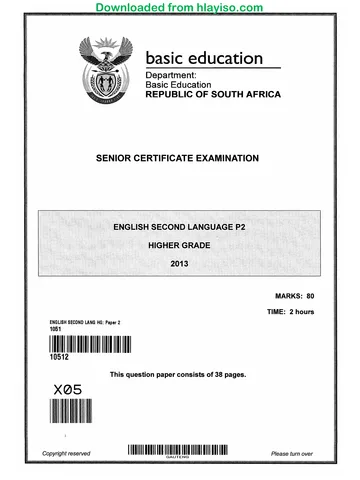
basic education
Department:
Basic Education
REPUBLIC OF SOUTH AFRICA
SENIOR CERTIFICATE EXAMINATION
ENGLISH SECOND LANGUAGE P2
STANDARD GRADE
2013
MARKS: 80
TIME: 2 hours
ENGLISH SECOND LANG SG: Paper 2
1052
IAT
This question paper consists of 35 pages.
X05
TAI
GAUTENG Please turn over
Copyright reserved
Skip to contentQuestion paper 


%20SG%202013%20Memo_hlayiso.com_--dcfa54ed-5df9-420f-8dd3-25f17089cdc7/v1-37f2bdc770cd315896a8/card.webp)
View all

%202025%20Possible%20Answers--e788f5ed-7e2b-45ba-8864-092a7ea79589/v1-9216dd73c0b50db80d06/card.webp)

English Fal Grade 12 P2 NSC June 2013 Question Paper (English)
Grade 12 English Fal Paper 2 question paper from the NSC June 2013 (English), 35 pages. Read online or get the free PDF download, memo linked when available.
English Fal · Grade 12 · NSC June · 2013 · English. Question paper, 35 pages. Read online or download the PDF.
- Subject
- English Fal
- Grade
- Grade 12
- Language
- English
- Document type
- Question paper
- Year
- 2013
- Exam period
- NSC June
- Paper
- 2
- Curriculum
- CAPS
- Pages
- 35
- File size
- 3.2 MB
Loading document…
Loading document…
1 of 35
Document textSearch extracted text and jump to a page.
Downloaded from hlayiso.com
English Second Language/SG/P2 2 DBE/2013
SCE
INSTRUCTIONS AND INFORMATION
ie
2.
Answer TWO sections only.
Answer TWO questions each from SECTIONS A and D and/or ONE question
each from SECTIONS B and C.
Number your answers correctly according to the numbering system used in
this question paper.
Pay careful attention to language and spelling.
Use your OWN words when you answer the questions. Do not QUOTE unless
asked to do so.
Write neatly and clearly.
Cooaned TU CL eee
Downloaded from hlayiso.com
English Second Language/SG/P2 3 DBE/2013
SCE
TABLE OF CONTENTS
SECTION A: POETRY
Poems are taken from various anthologies.
Answer ANY TWO questions.
QUESTION NO. POET/AUTHOR MARKS PAGE NO.
1. Onhis blindness John Milton 20 4
2. Death be not proud | John Donne | 20 5
3. Cheetah | Charles Eglington | 20 7
4. The birth of Shaka [_Mbuyiseni Oswald Mtshali_| 20 9
SECTION B: NOVEL
Answer ANY ONE question.
5. Animal Farm | George Orwell | 40 11
6. _ Lord of the Flies | William Golding l 40 14
SECTION C: DRAMA
Answer ANY ONE question.
7. Nothing but the truth | John Kani 40 19
8. | Romeo and Juliet | __ William Shakespeare L 40 23
SECTION D: SHORT STORIES
Answer ANY TWO questions.
9. _ The Sisters | Pauline Smith | 20 28
10. The Soft Voice of the Nadine Gordimer 20 30
Serpent
11. The Necklace | _Guyde Maupassant __| 20 32
12. The Coffee-cart Girl | Es'kia Mphahlele | 20 34
Coprintesoned NA
Please turn over
Downloaded from hlayiso.com
English Second Language/SG/P2 4 DBE/2013
SCE
SECTION A: POETRY
Study the poems and then answer the questions that follow.
QUESTION 1
1
10
ON HIS BLINDNESS -— John Milton
(written around 1644)
When | consider how my light is spent,
Ere half my days, in this dark world and wide,
And that one Talent which is death to hide,
Lodged with me useless, though my Soul more bent
To serve therewith my Maker, and present
My true account, lest He returning chide.
‘Doth God exact day-labour, light denied?"
| fondly ask. But Patience, to prevent
That murmur, soon replies, 'God doth not need
Either man's work or his own gifts. Who best
Bear his mild yoke, they serve him best. His State
Is Kingly: thousands at his bidding speed
And post o'er Land and Ocean without rest;
They also serve who only stand and wait.
1.1
1.2
1.3
1.4
1.5
Conroe JANATA UI) #9524 oe
In line 1, ‘light’ is a METAPHOR for ...
A a dark world.
B an enlightened world.
Cc the poet's eyesight.
D the poet's blindness.
In line 2, 'Ere half my days' refers to ...
A his lack of commitment.
B half of his expected lifespan.
Cc his entire life.
D his life expectancy.
Indicate whether the following statement is TRUE or FALSE. Quote NO
more than FIVE words to prove your answer.
When the poet hides his ‘one Talent’ (line 3), God will forgive him.
Write down a word that has the same meaning as 'Lodged' (line 4).
What does the word 'therewith' (line 5) refer to?
(1)
(1)
(2)
(1)
(2)
Downloaded from hlayiso.com
English Second Language/SG/P2 5 DBE/2013
SCE
1.6 The OCTAVE (lines 1-8) describes the poet's ...
A anger and frustration.
B resignation and obedience.
Cc loss of hope.
D calm acceptance. (1)
1.7 Quote an example of ALLITERATION from the OCTAVE. (2)
1.8 | Whatis the poet afraid of when God returns to the earth? (1)
1.9 Read line 7. Complete the following sentence by filling in the missing
words. Write only the word(s). You may NOT use the words from the
poem:
The poet asks if God still expects a (1.9.1) ... ... ... (2) now that he has
lost his (1.9.2) ... (1). (3)
1.10 Quote a line that says that God is not dependent on man. (2)
1.11. Explain the METAPHOR contained in line 11. (2)
1.12 Whom does the word 'They' (line 14) refer to? (2)
[20]
OR
QUESTION 2
1
10
DEATH BE NOT PROUD - John Donne
(written around 1609)
Death be not proud, though some have called thee
Mighty and dreadful, for thou art not so,
For those, whom thou think'st thou dost overthrow,
Die not, poor Death, nor yet canst thou kill me.
From rest and sleep, which but thy pictures be,
Much pleasure, then from thee much more must flow,
And soonest our best men with thee do go,
Rest of their bones, and souls' delivery.
Thou art slave to Fate, Chance, kings, and desperate men,
And dost with poison, war, and sickness dwell.
And poppy or charms can make us sleep as well,
And better than thy stroke; why swell'st thou then?
One short sleep past, we wake eternally,
And Death shall be no more; Death, thou shalt die.
Conroaned AAA EMA mn
Downloaded from hlayiso.com
English Second Language/SG/P2 6 DBE/2013
SCE
2.1 ‘Death, be not proud’ in line 1 is an example of ...
A apostrophe.
B hyperbole.
Cc inversion.
D metonymy. (1)
2.2 Give a synonym for ‘dreadful’ in line 2. (1)
2.3. Indicate whether the following statement is TRUE or FALSE. Do NOT
quote more than SIX words to prove your answer.
Death defeats man. (2)
2.4 By addressing Death as ‘poor Death' (line 4), the poet shows his ... for
death.
A admiration
B contempt
Cc respect
D fear (1)
2.5 Quote a line to prove that good men die young. (2)
2.6 What are the rewards of the good men when they die? (2)
2.7 In the SESTET the poet says Death cannot act on its own. Name THREE
ways in which men can lose their lives.
Remember to use your own words. (3)
2.8 | What does the word 'charms' (line 11) refer to? (1)
2.9 ‘thy stroke’ (line 12) is a METAPHOR for ...
A the devil.
B drugs.
Cc death.
D God. (1)
2.10 Refer to line 13 and explain what happens to man. (2)
2.11. How can death ‘die' (line 14)? (2)
2.12 Rewrite 'And Death shall be no more' (line 14) in your own words. (2)
[20]
OR
ities UAV AMATO ATO A A Please turn over
Downloaded from hlayiso.com
English Second Language/SG/P2 L
SCE
QUESTION 3
1
10
15
20
25
CHEETAH - Charles Eglington
(written around 1609)
Indolent and kitten-eyed,
This is the bushveld's innocent
The stealthy leopard parodied
With grinning, gangling pup-content.
Slouching through the tawny grass
Or loose-limbed lolling in the shade,
Purring for the sun to pass
And build a twilight barricade
Around the vast arena where;
In scattered herds, his grazing prey
Do not suspect in what wild fear
They'll join with him in fatal play;
Till hunger draws slack sinews tight
And vibrant as a hunter's bow;
Then, like a fleck of mottled light,
He slides across the still plateau.
A tremor rakes the herds: they scent
The pungent breeze of his advance;
Heads rear and jerk in vigilant
Compliance with the game of chance
In which, of thousands, only one
Is centred in the cheetah's eye;
They wheel and then stampede, for none
Knows which it is that has to die.
His stealth and swiftness fling a noose
And as his loping strides begin
To blur with speed, he ropes the loose
Buck on the red horizon in.
3.1
When the cheetah is referred to as ‘indolent’ (line 1), itis ...
vUOW>
dangerous.
lazy.
incapable.
indifferent.
Copy esoned A 010
DBE/2013
(1)
Please turn over
Downloaded from hlayiso.com
English Second Language/SG/P2 8 DBE/2013
SCE
3.2 'kitten-eyed' (line 1) is an example of ...
A personification.
B a metaphor.
Cc a simile.
D metonomy. (1)
3.3. Quote ONE word that means the same as ‘secretive’. (1)
3.4. Explain the METAPHOR contained in line 4. (3)
3.5 What colour is 'tawny' (line 5)? (1)
3.6 What does the cheetah do when it is 'lolling in the shade' (line 6)? (2)
3.7 At what time of day does the cheetah prefer to hunt? Remember to use
your own words. (1)
3.8 Indicate whether the following statement is TRUE or FALSE and quote
TWO words to prove your answer.
The cheetah sets up a stage to hunt his prey. (2)
3.9 Which WORD in the poem indicates that what looks like a game between
the cheetah and his prey will have deadly consequences? (1)
3.10 Quote an example of a SIMILE. (2)
3.11. When do the herds start to panic? (2)
3.12 Quote ONE word to show that the herds start to panic. (1)
3.13. Who or what is the cheetah compared to in the last stanza?
Give a reason for your answer. (2)
[20]
Ti Tacs EAU UATE EA A A Pease tum over
Downloaded from hlayiso.com
English Second Language/SG/P2 9
SCE
QUESTION 4
1
10
15
20
25
THE BIRTH OF SHAKA - Mbuyiseni Oswald Mtshali
(first published in 1971)
His baby cry
was of a cub
tearing the neck
of the lioness
because he was fatherless.
The gods
boiled his blood
in a clay pot of passion
to course in his veins.
His heart was shaped into an ox shield
to foil every foe.
Ancestors forged
his muscles into
thongs as tough
as wattle bark
and nerves
as sharp as
syringa thorns.
His eyes were lanterns
that shone from the dark valleys of Zululand
to see white swallows
coming across the sea.
His cry to two assassin brothers:
‘Lo! you can kill me
but you'll never rule this land!’
41
4.2
What is a ‘cub’ (line 2) in this context?
DBE/2013
(2)
Comparing Shaka to a cub in stanza 1, the poet sees him as a
symbol of ...
A weakness because of his youth.
B great strength and ferocity.
Cc great arrogance.
D cowardice because he is still young.
Cope reseed ANI 0 A
(1)
Please turn over
Downloaded from hlayiso.com
English Second Language/SG/P2 10 DBE/2013
SCE
4.3 Refer to stanza 2.
4.3.1 Quote an example of ALLITERATION. (2)
4.3.2 The poet uses this ALLITERATION to emphasise ...
A how evil the gods are.
B an African spirit.
Cc Shaka's power and strength.
D Shaka's family bond. (1)
4.4 Quote ONE word from the poem that means ‘to run strongly’ or 'to flow’. (1)
4.5 | What would Shaka do if he would ‘foil every foe' (line 11)? (2)
4.6 — Refer to lines12—14. What did the ancestors of Shaka do for him? (3)
4.7. What are 'thongs' (line 14)? (2)
4.8 | Quote NO more than SEVEN words to prove that Shaka was totally alert. (2)
4.9 'His eyes were lanterns ...' (line 19) is an example of a METAPHOR. This
shows that Shaka ...
A had eyes that shone brightly.
B could see what would happen in the future.
Cc had limited vision.
D could only see his people. (1)
4.10 Who are the ‘white swallows’ in line 21? (2)
4.11. Who killed Shaka? (1)
[20]
TOTAL SECTION A: 40
Conriresoned NA A
Please turn over
Downloaded from hlayiso.com
English Second Language/SG/P2 11 DBE/2013
SCE
SECTION B: NOVEL
QUESTION 5: ANIMAL FARM - George Orwell
Read the extracts below and then answer the questions that follow.
EXTRACT A
Their most faithful disciples were the two cart-horses, Boxer and Clover. These 1
two had great difficulty in thinking anything out for themselves, but having once
accepted the pigs as their teachers, they absorbed everything that they were told,
and passed it on to the other animals by simple arguments. They were unfailing
in their attendance at the secret meetings in the barn, and led the singing of 5
‘Beasts of England’, with which the meetings always ended.
Now, as it turned out, the Rebellion was achieved much earlier and more
easily than anyone had expected. In past years Mr Jones, although a hard
master, had been a capable farmer, but of late he had fallen on evil days. He had
become much disheartened after losing money in a lawsuit, and had taken to 10
drinking more than was good for him. For whole days at a time he would lounge
in his Windsor chair in the kitchen, reading the newspapers, drinking, and
occasionally feeding Moses on bits of bread soaked in beer. His men were idle
and dishonest, the fields were full of weeds, the buildings wanted roofing, the
hedges were neglected, and the animals were underfed. 15
5.1. 5.1.1 Choose the correct answer.
The word ‘disciples’ in line 1 means ...
A assistants
B slaves
Cc followers
D helpers (1)
5.1.2 What evidence is provided in the text to prove that they were ‘faithful
disciples‘? Name TWO things. (2)
5.2 What qualities in humans do the cart-horses represent? (2)
5.3 State whether the following statements are TRUE or False. Give a reason
for your answer.
5.3.1 Clover and Boxer are intelligent animals. (2)
5.3.2 Mr Jones had always been cruel to the animals. (2)
5.4 Ina brief paragraph, explain what the effect of alcohol abuse by Mr Jones
and the pigs has been on the farm and the animals. (3)
AND
Cope rosored JANATA ANIM) 952 ver
Downloaded from hlayiso.com
English Second Language/SG/P2 12 DBE/2013
SCE
EXTRACT B
When the animals had assembled in the big barn, Snowball stood up and, though 1
occasionally interrupted by bleating from the sheep, set forth his reasons for
advocating the building of the windmill. Then Napoleon stood up to reply. He said
very quietly that the windmill was nonsense and that he advised nobody to vote
for it, and promptly sat down again; he had spoken for barely 30 seconds, and 5
seemed almost indifferent as to the effect he produced. At this Snowball sprang
to his feet, and shouting down the sheep, who had begun bleating again, broke
into a passionate appeal in favour of the windmill. Until now the animals had been
about equally divided in their sympathies, but in a moment Snowball's eloquence
had carried them away. In glowing sentences he painted a picture of Animal Farm 10
as it might be when sordid labour was lifted from the animals' backs. His
imagination had now run far beyond chaff-cutters and turnip slicers. Electricity, he
said, could operate threshing machines, ploughs, harrows, rollers and reapers
and binders, besides supplying every stall with its own electric light, hot and cold
water, and an electric heater. By the time he had finished speaking, there was no 15
doubt as to which way the vote would go. But just at this moment Napoleon stood
up and, casting a peculiar sidelong look at Snowball, uttered a high-pitched
whimper of a kind no one had ever heard him utter before.
5.5 Explain why the sheep keep interrupting Snowball when he speaks. (2)
5.6 In ashort paragraph, explain why you think either Snowball or Napoleon is
the best candidate for the leadership of animal farm. You may refer to the
extract above as well as to any other part of the novel. (4)
5.7 Complete the following paragraph by using the words provided in the list
below. Write only the word(s) next to the question number (5.7.1—5.7.5).
Snowball's speech is very (5.7.1) ... because he uses strong (5.7.2) ...
language to convince the animals that they will all (5.7.3) ... from building
the windmill. He uses positive connotations of a farm where all the animals
will live a life of (5.7.4) ..., free from any (5.7.5) ... and hard work.
| suffering; luxury; emotive; __ successful; _ benefit | 6
5.8 Refer to lines 3-6.
Give a reason why Napoleon seems to be almost indifferent as to the
effect he produces. (2)
5.9 Refer to lines 16-18.
5.9.1 What happens after Napoleon has uttered this whimper? (2)
5.9.2 How do the other animals respond to what happens in
QUESTION 5.9.1? (2)
5.9.3 What is revealed about Napoleon's leadership style from what
happens here? (1)
AND
Cop esoned JANINE AN, #952 4 oe
Downloaded from hlayiso.com
English Second Language/SG/P2 13 DBE/2013
SCE
EXTRACT C
‘We must get help at once," said Clover. 'Run, somebody, and tell Squealer what 1
has happened.'
All the other animals immediately raced back to the farmhouse to give Squealer
the news. Only Clover remained, and Benjamin, who lay down at Boxer's side,
and, without speaking, kept the flies off him with his long tail. After about a 5
quarter of an hour Squealer appeared, full of sympathy and concern. He said that
Comrade Napoleon had learned with the very deepest distress of this misfortune
to one of the most loyal workers on the farm, and was already making
arrangements to send Boxer to be treated in the hospital at Willingdon. The
animals felt a little uneasy at this. Except for Mollie and Snowball, no other animal 10
had ever left the farm, and they did not like to think of their sick comrade in the
hands of human beings. However, Squealer easily convinced them that the
veterinary surgeon in Willingdon could treat Boxer's case more satisfactorily than
could be done on the farm. And about half an hour later, when Boxer had
somewhat recovered, he was with difficulty got on to his feet, and managed to 15
limp back to his stall, where Clover and Benjamin had prepared a good bed of
straw for him.
5.10 In your own words, explain what has happened to Boxer. (2)
5.11 The animals immediately run to inform Squealer of what has happened
but Squealer only arrives after fifteen minutes.
What does this reveal about Squealer's concern for Boxer? (1)
| Provide evidence from the text to prove that Clover and Benjamin are
Boxer's friends. Name TWO things. (2)
5.13 In your own words, explain why the animals feel uncomfortable about
Boxer being sent to the hospital. (2)
5.14 Boxer is not really being sent to the veterinary hospital.
5.14.1 Where is he actually being sent to? (1)
5.14.2 Do you feel sorry for Boxer? Explain your opinion. (2)
[40]
OR
Conran roared LANA VAIN
Downloaded from hlayiso.com
English Second Language/SG/P2 14 DBE/2013
SCE
QUESTION 6: LORD OF THE FLIES — William Golding
Read the following extracts and answer the questions that follow.
EXTRACT A
Ralph raised his head off his forearms.
‘That was no good.’
Roger spat efficiently into the hot dust.
‘What d'you mean?’
‘There wasn't any smoke. Only flame.’
Piggy had settled himself in a coign between two rocks,
and sat with the conch on his knees.
'We haven't made a fire,' he said, ‘what's any use. We
couldn't keep a fire like that going, not if we tried.'
‘A fat lot you tried,’ said Jack contemptuously. ‘You
just sat.'
'We used his specs,' said Simon, smearing a black cheek
with his forearm. 'He helped that way.'
‘| got the conch,' said Piggy indignantly. "You let me
speak!"
‘The conch doesn't count on top of the mountain,' said
Jack, 'so you shut up.'
‘I got the conch in my hand.’
‘Put on green branches,' said Maurice. ‘That's the best
way to make smoke.'
‘I got the conch —'
Jack turned fiercely.
‘You shut up!’
Piggy wilted. Ralph took the conch from him and looked
round the circle of boys.
‘We've got to have special people for looking after the
fire. Any day there may be a ship out there’ — he waved his
arm at the taut wire of the horizon — and if we have a
signal going they'll come and take us off. And another thing.
We ought to have more rules. Where the conch is, that's a
meeting. The same up here as down there.’
They assented. Piggy opened his mouth to speak, caught
Jack's eye and shut it again. Jack held out his hands for the
conch and stood up, holding the delicate thing carefully
in his sooty hands.
[Chapter 2]
10
15
20
25
30
35
6.1. Where are the boys?
6.2 6.2.1 Which group will look after the fire?
6.2.2. Who is their leader?
Conyntesened LANNE) 956
(1)
(1)
(1)
Downloaded from hlayiso.com
English Second Language/SG/P2 15 DBE/2013
SCE
6.3. Choose a description from COLUMN B that matches a name in
6.4
6.5
6.6
Cores AAC NMA = em cr
COLUMN A. Write only the letter (A-E) next to the question number
(6.3.1-6.3.5) in the ANSWER BOOK.
COLUMN A COLUMN B
6.3.1 Ralph A violent
6.3.2 _ Jack B pure goodness
6.3.3 Simon Cc intellectual
6.3.4 Piggy D a secret, quiet boy
6.3.5 Roger E kind
(6x1)
Why is it so important to keep the fire burning at all times? Complete the
sentence by filling in the missing words.
They must keep the fire burning at all times so that passing (6.4.1) ...
might see the (6.4.2) ... and they will be (6.4.3) ... and go home.
Choose the correct answer.
What is the symbolism of the conch?
A Authority/democracy/the right to speak
B Intelligence/cleverness/insight
Cc Violence/murder/aggression
D Religion/church/beliefs
The fire that the boys started soon peters out (dies down) with tragic
consequences.
6.6.1 What happens?
6.6.2 Who has most probably died in the fire?
6.6.3 Choose the correct answer.
What do the snakes/creepers that the boys are so afraid of
represent?
A Evil
B Destruction
Cc Death
D Night
AND
(5)
(3)
(2)
(2)
(1)
(1)
Downloaded from hlayiso.com
English Second Language/SG/P2 16 DBE/2013
SCE
EXTRACT B
The figure fell and crumpled among the blue flowers of the mountain-side, 1
but now there was a gentle breeze at this height too and the parachute flopped
and banged and pulled. So the figure, with feet that dragged behind it, slid up
the mountain. Yard by yard, puff by puff, the breeze hauled the figure through
the blue flowers, over the boulders and red stones, till it lay huddled among the 5
shattered rocks of the mountain-top. Here the breeze was fitful and allowed the
strings of the parachute to tangle and festoon: and the figure sat, its helmeted
head between its knees, held by a complication of lines. When the breeze blew
the lines would strain taut and some accident of this pull lifted the head and
chest upright so that the figure seemed to peer across the brow of the 10
mountain. Then, each time the wind dropped, the lines would slacken and the
figure bow forward again, sinking its head between its knees. So as the stars
moved across the sky, the figure sat on the mountain-top and bowed and sank
and bowed again.
[Chapter 6]
6.7. What sign does the outside world send to the boys? (1)
6.8 Who later discovers the figure on the mountain-top? (2)
6.9 Read Lines 5-14.
Complete the following sentence by using the correct word provided in the
list below.
| moves; breathes; laughs |
When the wind blows, the figure ... (1)
6.10 The figure lands close to where the fire normally is.
6.10.1 How does this affect the boys' plan and therefore their immediate
future? (2)
6.10.2 How do Jack and Ralph differ in their views on the importance of
the fire? (2)
6.11 Just before the figure appears on the island Ralph asks for a sign from the
adult world, as he feels that adults are necessary.
6.11.1 Why are adults necessary on the island? (1)
6.11.2 Do you think that adults would have prevented the uncivilised
behaviour of the boys? Discuss your views. (2)
AND
Coosa AA HAAN, mv
Downloaded from hlayiso.com
English Second Language/SG/P2 17 DBE/2013
SCE
EXTRACT C
Wave after wave, Ralph followed the rise and fall until 1
something of the remoteness of the sea numbed his brain. Then
gradually the almost infinite size of this water forced
itself on his attention. This was the divider, the barrier. On
the other side of the island, swathed at midday with mirage, 5
defended by the shield of the quiet lagoon, one might dream
of rescue; but here, faced by the brute obtuseness of the
ocean, the miles of division, one was clamped down, one
was helpless, one was condemned, one was —
Simon was speaking almost in his ear. Ralph found that 10
he had rock painfully gripped in both hands, found his body
arched, the muscles of his neck stiff, his mouth strained open.
‘You'll get back to where you came from.'
Simon nodded as he spoke. He was kneeling on one knee,
looking down from a higher rock which he held with both 15
hands; his other leg stretched down to Ralph's level.
Ralph was puzzled and searched Simon's face for a clue.
'It's so big, | mean —
Simon nodded.
‘All the same. You'll get back all right. | think so, any- 20
way.’
Some of the strain had gone from Ralph's body. He
glanced at the sea and then smiled bitterly at Simon.
‘Got a ship in your pocket?’
Simon grinned and shook his head. 25
‘How do you know, then?'
When Simon was still silent Ralph said curtly, 'You're
Batty’.
Simon shook his head violently till the coarse black hair
flew backwards and forwards across his face. 30
‘No, I'm not. | just think you'll get back all right.'
For a moment nothing more was said. And then they
suddenly smiled at each other.
[Chapter 7]
6.12 What separates them from home? (1)
6.13 How does the Ralph whom we meet here, differ from the Ralph in
Chapter 1? (2)
6.14 Choose the correct answer.
Which old childhood habit has Ralph picked up again?
A The jerking movement of his hands
B Biting his nails
Cc Yawning all the time
D Pulling out his hair (2)
Csi ti Head FOIA AO IA A A Pease lurn over
Downloaded from hlayiso.com
English Second Language/SG/P2 18 DBE/2013
SCE
6.15 Earlier when all the boys try to figure out who, what or where the beast is,
6.16
6.17
Simon says, ‘I don't believe in the beast’. What insight does Simon have
that he tries to explain to the boys? (2)
At the end of the novel when all the boys are rescued, Simon is not
rescued. Why not? (3)
The following two statements are FALSE. Give a reason why.
6.17.1 Piggy is a hard worker. (1)
6.17.2 Jack and Ralph build the shelters. (1)
[40]
TOTAL SECTIONB: 40
Corson A AAU mr
Downloaded from hlayiso.com
English Second Language/SG/P2 19 DBE/2013
SCE
SECTION C: DRAMA
QUESTION 7: NOTHING BUT THE TRUTH — John Kani
Read the following extracts from the play and answer the questions set on each. The
number of marks allocated to each question serves as a guide to the expected length
of your answer.
[Sipho and Mandisa are arguing about her father]
EXTRACT A
SIPHO: The teargas did not affect us at all. Rev. Haya said a prayer and | buried my 1
father. | alone filled the grave with the soil, planted the cross with his name, date of
birth and date of death. Lala ngoxolo mfo wase MaCireni. | then said a little prayer and
said goodbye to my father. | apologised for the chaos. | was very angry at Themba for
doing that to my father. 5
MANDISA: This is absolute crap! | am not going to listen to this!
SIPHO: For once do as | ask. Shut up! And you say | was jealous of him! For what!
For being an activist. Yes! A political activist who never threw one stone at the police,
who never blew up any police station. Themba could talk. He was always amongst the
speakers, at the Great Centenary Hall, at the Don Qege Stadium. He always said what 10
the people wanted to hear. Calling for stay aways when himself was unemployed.
No, let me put it this way, when he himself never had a job in his life. He supported the
students’ school boycott when he did not have a child at school. Called for consumer
boycotts when he knew who bought the food he ate. An executive member of the
Workers' Executive Committee. How? | do not know since he never had a job. 15
Proposed rent boycotts when he did not have a house. He stayed with me in my
house. Themba went to these gatherings because they were his hunting ground for
other people's wives. Oh he was famous for that! There was not a single woman who
had not slept with comrade Themba. Wives, girlfriends, Themba made no distinction.
| always worried that someone, some husband or boyfriend, was going to kill Themba 20
even before the security police could. That is why | still blame him for the death of my
son.
MANDISA: That's the most despicable thing to say of your own brother. He loved
Luvuyo.
7.1 Complete the following sentences by using the words provided in the list
below. Write only the question number (7.1.1-7.1.4) and the correct
word.
stranger; the ministers; political; church; the pensioners;
the comrades; twelve; anorphan; twenty
(7.1.1) ... turned my father's funeral into a (7.1.2) ... rally. There were
(7.1.3) ... speakers. One after the other, talking about Themba's father.
| sat there like a (7.1.4) ... | paid for the coffin. | paid for all the funeral
arrangements. (4)
CTU iI Ho EIU IA Please lurn over
Downloaded from hlayiso.com
English Second Language/SG/P2 20 DBE/2013
SCE
7.2 Why did Sipho have to fill the grave alone? (2)
7.3 What was the reason, according to Sipho, that Themba went to these
tallies? In your answer name ONE relevant character trait of Themba. (2)
7.4 Indicate whether the following statement is TRUE or FALSE and give a
reason for your answer.
Sipho told Mandisa how much he loved Themba, and praised his courage
and commitment to the struggle. (2)
7.5 Identify the figure of speech used in the following quotation, by choosing the
correct option from the list.
‘A political activist who never threw one stone at the police, who never blew
up any police station’ is an example of ...
A irony.
B simile.
Cc metaphor.
D personification. (1)
7.6 Themba was a famous activist and Sipho suggests that the security police
were about to kill him. State the tone of voice used here, and explain why
this particular tone of voice is used. (2)
7.7 Sipho's description of Themba's activism highlights how the two
brothers got on with each other. Discuss Sipho and Themba's relationship
when they were:
7.7.1 Children (1)
Ce Young adults (1)
7.7.3. Adults (1)
7.8 Quote ONE word from the extract that has the same meaning as
‘cruel/mean'. (1)
AND
Corso HAPs vr
Downloaded from hlayiso.com
English Second Language/SG/P2 21 DBE/2013
SCE
EXTRACT B
MANDISA: It is divine! Now | know | must see Nandipa! Turn around. Wow! | don't 1
know what to say. It's stunning!
THANDO: This is the only one of her creations | could afford. There were many others
there that just blew my mind.
MANDISA: You must come with me. | insist. 5
THANDO: My father ... | don't think he would agree.
MANDISA: Your father can take care of himself. Can't he? What will happen if Mpho
decides to marry you? Are you going to say 'No, | can't leave my father alone’? Grow
up Thando! If he can't make it alone, that's not your problem. It's his, not yours.
THANDO: Look, | want to go. 10
MANDISA: So you are coming with me?
THANDO: Yes ... yes!
MANDISA: Thando, | have an even better idea. The schools are closed. Aren't they?
THANDO: For another three weeks.
Sipho enters the kitchen unnoticed. 15
MANDISA: Come with me to London. We will go together to the London Fashion
Week. My father always said he wished you could come to London.
THANDO: | am so excited, and confused at the same time. What about Mpho?
MANDISA: It is only for three weeks Thando! One week in Johannesburg and two
weeks in London. That can't change his mind about you, if he really loves you. 20
THANDO: | know that. Mpho is not a problem. | am not sure that my father would agree.
MANDISA: To Hell with your father! It's your life! If Mpho doesn't mind, why do you care
about your father. Tell him you are going with me to London for two weeks. It's not like
you are going forever! Even if you were it would still be your decision.
7.9 How do we know that Mandisa is not only here to bury her father, but that
she is also here on business? (2)
7.10 What is Nandipa's line of work?
A Medicine
B Clothing design
c Education
D Technology (1)
7.11 Thando is an educator but she also volunteers as ... at the TRC hearings.
A translator
B teacher
Cc trainer
D caterer (1)
Conroe JANA UAU IAIN, 956 oer
Downloaded from hlayiso.com
English Second Language/SG/P2 22 DBE/2013
SCE
7.12 Indicate whether the following statement is TRUE or FALSE, considering
the play as a whole.
Mandisa is correct in concluding that Thando believes that her father is her
responsibility. (2)
7.13 What makes Sipho think that Mandisa wants to steal Thando away from
him? (2)
7.14 Comment on the difference between Thando and Mandisa's characters. (2)
AND
EXTRACT C
MANDISA: So give it up and live! You are not dead yet. Let Thando live too! She cannot 1
spend the rest of her life looking after you. Let her go. Let her marry Mpho.
THANDO: Shut up Mandisa!
MANDISA: Let her come with me to Johannesburg and London. You are not too old to
find someone, someone to love, like you loved Thando's mother. 5
THANDO: That's enough!
MANDISA: No Thando, my father was right.
SIPHO: Let me tell you about your father.
THANDO: Stop it Mandisa.
MANDISA: No, no, no. | want to know what he has to say about my father. 10
THANDO: Shut up, Mandisa!
MANDISA: My father was cremated last week. | brought his ashes to be buried next to
his parents. If uncle Sipho does not want to do that | am not going to beg him. | will ask
somebody to show me where his parents are buried and | will scatter the ashes between
them and go home. My father was right. Uncle Sipho was jealous because my father 15
was a hero of the struggle.
SIPHO: If your father was a hero of the struggle why did he not come back when the
exiles came back? Why was he not part of the Kempton Park delegation that negotiated
with the apartheid government? Did he ever tell you why he could not come back?
MANDISA: He was not well. He wanted to be well first, then he would come back. He 20
did not want to come back a sick man.
SIPHO: He preferred to come back a dead man in that thing. How convenient.
7.15 Mandisa tells Sipho ‘to give it up and live! You are not dead yet.' Mandisa
is forced to say this because Sipho refuses to ...
A let go of the past hurts.
B go out of the house.
Cc let Thando marry Mpho.
D bury Themba. (1)
7.16 Refer to lines 4-5. Consider the question and discuss your view.
Do you think Sipho would fall in love again? (2)
Contre CA LMA,
Downloaded from hlayiso.com
English Second Language/SG/P2 23 DBE/2013
SCE
7.17 \s Sipho really jealous of Themba? Explain why Mandisa thinks that he is. (2)
7.18 What prevented Themba from being part of the Kempton Park delegation? (2)
7.19 What is the tone and mood of this whole conversation? (2)
7.20 Quote a sentence which indicates that Themba chose the easy way out of
his problems with Sipho. (2)
7.21. Give ONE word for ‘that thing’ Sipho refers to in line 22 and explain why he
does not call it by its real name. (2)
[40]
OR
QUESTION 8: ROMEO AND JULIET — William Shakespeare
Read the following extracts and then answer all the questions. Use your own
words unless you are asked to quote.
EXTRACT A
Enter Nurse hastily
NURSE
Madam! 1
JULIET
Nurse?
NURSE
Your lady mother is coming to your chamber.
The day is broke. Be wary. Look about.
Exit Nurse
JULIET
Then window, let day in, and let life out. 5
ROMEO
Farewell, farewell! One kiss, and I'll descend.
He goes down
JULIET
Art thou gone so, love-lord, aye husband-friend?
| must hear from thee every day in the hour,
For in a minute there are many days.
O by this count | shall be much in years 10
Ere | again behold my Romeo.
ROMEO
Farewell!
| will omit no opportunity
That may convey my greetings, love, to thee.
JULIET
O, thinkest thou we shall ever meet again? 15
ROMEO
| doubt it not; and all these woes shall serve
For sweet discourses in our times to come.
Conran reser TN ac
Downloaded from hlayiso.com
English Second Language/SG/P2 24 DBE/2013
SCE
JULIET
O God, | have an ill-divining soul!
Methinks | see thee, now thou art so low,
As one dead in the bottom of a tomb. 20
Either my eyesight fails, or thou lookest pale.
ROMEO
And trust me, love, in my eye so do you.
Dry sorrow drinks our blood. Adieu, adieu!
Exit Romeo
JULIET
O Fortune, Fortune! All men call thee fickle.
If thou art fickle, what dost thou with him faa)
That is renowned for faith? Be fickle, Fortune,
For then, | hope ,thou wilt not keep him long,
But send him back.
She goes down from the window
Enter Juliet's mother
8.1 Romeo is on his way to ...
A Friar Laurence's cell.
B Mantua.
Cc Verona.
D Juliet's chamber. (1)
8.2 The nurse comes to Juliet to ... her.
A warn
B advise
Cc mock
D reprimand (1)
8.3 Refer to line 5: 'Then window, let day in, and let life out.'
Explain this FIGURE OF SPEECH in your own words. (2)
8.4 Quote ONE word from the extract that has the same meaning as 'to see’. (1)
8.5 Refer to lines 13-14. What does Romeo say he will do? (2)
8.6 Indicate whether the following statement is TRUE or FALSE and quote to
prove your answer.
Juliet has a premonition that something terrible will happen. (2)
8.7 Explain 'Dry sorrow drinks our blood’ (line 23) in your own words. (2)
8.8 What does Juliet ask of Fortune (line 24-28)? (2)
AND
Conytesoned JANICE ANIA #956 er
Downloaded from hlayiso.com
English Second Language/SG/P2 25 DBE/2013
SCE
EXTRACT B
LADY CAPULET
Good night. 1
Go thee to bed, and rest, for thou hast need.
Exeunt Lady Capulet and Nurse
JULIET
Farewell! God knows when we shall meet again.
| have a faint cold fear thrills through my veins
That almost freezes up the heat of life. 5
I'll call them back again to comfort me.
Nurse! — What should she do here?
My dismal scene | needs must act alone.
Come, vial.
What if this mixture do not work at all? 10
Shall | be married then tomorrow morning?
No, no! This shall forbid it. Lie thou there.
She lays down a knife
What if it be a poison which the Friar
Subtly hath ministered to have me dead,
Lest in this marriage he should be dishonoured 15
Because he married me before to Romeo?
| fear it is. And yet methinks it should not,
For he hath still been tried a holy man.
How if, when | am laid into the tomb,
| wake before the time that Romeo 20
Come to redeem me? There's a fearful point!
Shall | not then be stifled in the vault,
To whose foul mouth no healthsome air breathes in,
And there die strangled ere my Romeo comes?
Or, if | live, is it not very like 25
The horrible conceit of death and night,
Together with the terror of the place —
As in a vault, an ancient receptacle
Where for this many hundred years the bones
Of all my buried ancestors are packed; 30
Where bloody Tybalt, yet but green in earth,
Lies festering in his shroud; where, as they say,
At some hours in the night spirits resort —
8.9 Refer to line 2: ‘for thou hast need.' Why, according to Lady Capulet, does
Juliet need to rest? (2)
8.10 Indicate whether the following statement is TRUE or FALSE and quote
NOT more than SEVEN words to prove your answer.
Juliet's fear is compared to a deathly cold. (2)
8.11 Quote a line to prove that Juliet does not want to be alone. (1)
Conon sored LALIT NINN) 8524 oe
Downloaded from hlayiso.com
English Second Language/SG/P2 26
SCE
8.12 What is a ‘vial’ (line 9)?
8.13 Why would the Friar perhaps want to kill Juliet?
8.14 Describe THREE things Juliet is afraid of.
8.15 Briefly explain how Tybalt meets his death.
AND
EXTRACT C
PAGE
He came with flowers to strew his lady's grave, 1
And bid me stand aloof, and so | did.
Anon comes one with light to open the tomb,
And by and by my master drew on him.
And then | ran away to call the Watch. 5
PRINCE
This letter doth make good the Friar's words.
Their course of love, the tidings of her death.
And here he writes that he did buy a poison
Of a poor ‘pothecary, and therewithal
Came to this vault to die, and lie with Juliet. 10
Where be these enemies? Capulet, Montague,
See what a scourge is lain upon your hate,
That heaven finds means to kill your joys with love.
And |, for winking at your discords too,
Have lost a brace of kinsmen. All are punished. 15
CAPULET
O brother Montague, give me thy hand.
This is my daughter's jointure, for no more
Can | demand.
MONTAGUE
But I can give thee more.
For | will raise her statue in pure gold, 20
That whiles Verona by that name is known,
There shall no figure at such rate be set
As that of true and faithful Juliet.
CAPULET
As rich shall Romeo's by his lady's lie,
Poor sacrifices of our enmity! 25
PRINCE
A glooming peace this morning with it brings,
The sun for sorrow will not show his head.
Go hence, to have more talk of these sad things,
Some shall be pardoned, and some punished.
For never was a story of more woe 30
Than this of Juliet and her Romeo.
Exeunt
Connon AN A
DBE/2013
(1)
(2)
(3)
(2)
Please turn over
Downloaded from hlayiso.com
English Second Language/SG/P2 27 DBE/2013
SCE
8.16 Who is the 'one' (line 3) the Page refers to? (1)
8.17 Briefly describe what happens to the master. (2)
8.18 Quote a line to prove that the Friar has told the truth. (1)
8.19 A'pothecary' (line 9) isa...
A pharmacist.
B doctor.
Cc priest.
D politician. (1)
8.20 What has the Prince lost as a result of the feud? (1)
8.21 What do the two fathers, Capulet and Montague, promise to do? (2)
8.22 Refer to line 20. Why is it significant that the statue will be made of gold? (2)
8.23 Indicate whether the following statement is TRUE or FALSE and quote
NO more than FIVE words to prove your answer. (2)
Romeo and Juliet are victims of hatred between the two families.
8.24 Refer to line 27. What does the Prince say about nature? (2)
[40]
TOTAL SECTIONC: 40
cea FATTO A hail
Downloaded from hlayiso.com
English Second Language/SG/P2 28 DBE/2013
SCE
SECTION D: SHORT STORIES
QUESTION 9: THE SISTERS
Read the following extracts from the short story and answer the questions set on
each. The number of marks allocated to each question serves as a guide to the
expected length of your answer.
EXTRACT A
Marta was the eldest of my father's children, and she was sixteen years old when 1
our mother died and our father lost the last of his water-cases to old Jan
Redlinghuis of Bitterwater. It was the water-case that killed my mother. Many,
many times she cried to my father to give in to old Jan Redlinghuis whose water-
rights had been fixed by law long before my father built his water-furrow from the 5
Ghamka river. But my father could not rest.
If he could but get a fair share of the river-water for his furrow, he would say, his
farm of Zeekoegatt would be as rich as the farm of Bitterwater and we should then
have a town-house in Platkops dorp and my mother should wear a black cashmere
dress all the days of her life. My father could not see that my mother did not care 10
about the black cashmere dress or the town-house in Platkops dorp. My mother
was a very gentle woman with a disease of the heart, and all she cared about was
to have peace in the house and her children happy around her. And for so long as
my father was at law about his water-rights there could be no peace on all the farm
of Zeekoegatt. With each new water-case came more bitterness and sorrow to us 15
all. Even between my parents at last came bitterness and sorrow.
9.1 Burget de Jager fought for his fair share of the river-water for his furrow.
9.1.1 Give ONE reason why you think this man is fighting a losing battle. (2)
9.1.2 Quote 13 consecutive words that indicate that he was only motivated
by envy. (1)
9.1.3 Name TWO tragic events that this fight caused in his family. (2)
AND
Conran JANA UA AN, #956 oe
Downloaded from hlayiso.com
English Second Language/SG/P2 29 DBE/2013
SCE
EXTRACT B
Marta lay where they had put her on old Redlinghuis's great wooden bed, and only 1
twice did she speak. Once she said:
'He was not always mad, Sukey my darling, and who am | that | should judge him?'
And again she said: 'See how it is, my darling! In a little while | shall be with our
mother. So it is that God has helped me." 5
At sun-down Marta died, and when they ran to tell Jan Redlinghuis they could not
find him. All that night they looked for him, and the next day also. We buried Marta
in my mother's grave at Zeekoegatt ... And still they could not find Redlinghuis. Six
days they looked for him, and at last they found his body in the mountains. God
knows what madness had driven old Jan Redlinghuis to the mountains when his 10
wife lay dying, but there it was they found him, and at Bitterwater he was buried.
That night my father came to me and said: 'It is true what you said to me Sukey. It
is blood that | have led on my lands to water them, and this night will | close the
furrow that | built from the Ghamka river. God forgive me, | will do it.’
It was in my heart to say to him: 'The blood is already so deep in the lands that 15
nothing we can do will now wash it out.' But | did not say this. | don't know how it
was, but there came before me the still, sad face of my sister Marta, and it was as
if she herself answered for me.
9.2 What does Marta mean when she says 'In a little while | shall be with our
mother’? (2)
9.3. Even though Marta was abused by old Jan Redlinghuis, she refused to ...
him.
A report
B judge
Cc leave
D hate (1)
9.4 How does this young woman find herself in this abusive relationship? (2)
9.5 Sukey prays that if there is a God, he should intervene and help her sister.
Write down FOUR things that could be interpreted as God's intervention,
choosing from the following list:
Mad Jan Redlinghuis found dead
De Jager closing the furrows of water
Marrying old Jan Redlinghuis
Marta dying in her bed
Her father asking for God's forgiveness
Bringing clean water to Zeekoegatt
Marta riding in a cart (4)
Conrosoned LANAI UANU Iter
Downloaded from hlayiso.com
English Second Language/SG/P2 30 DBE/2013
SCE
9.6 Choose from the list the LEAST APPROPRIATE title for this story:
A Sweet water
B Dead river
G Bitter water (2)
D Dry river
9.7 Quote a line that has the same meaning as 'your apology is too late, the
damage is already done’. (2)
9.8 What is the difference in character between Marta and Sukey? (2)
[20]
OR
QUESTION 10: THE SOFT VOICE OF THE SERPENT
Read the following extracts from the short story and answer the questions set on
each. The number of marks allocated to each question serves as a guide to the
expected length of your answer.
EXTRACT A
He read a lot, but his attention was arrested sometimes, quite suddenly and 1
compellingly, by the sunken place under the rug where his leg used to be. There
was his one leg, and next to it, the rug flapped loose. Then looking, he felt his leg
not there; he felt it go, slowly, from the toe to the thigh. He felt that he had no leg.
After a few minutes he went back to his book. He never let the realisation quite 5
teach him; he let himself realise it physically, but he never quite let it get at him. He
felt it pressing up, coming, coming, dark, crushing, ready to burst — but he always
turned away, just in time, back to his book. That was his system; that was the way
he was to do it. He would let it come near, irresistibly near, again and again, ready
to catch him alone in the garden. And again and again he would turn it back, justin 10
time. Slowly it would become a habit, with the reassuring strength of a habit. It
would become such a habit never to get to the point of realising it, that he never
would realise it. And one day he would find that he had achieved what he wanted:
he would feel as if he had always been like that.
Then the danger would be over, forever. 15
10.1 Quote a line that indicates that the young man is deliberately denying the
fact that he lost a leg. (2)
10.2 The man is using reading as a way of ...
A escape.
B acceptance.
Cc joy.
D learning. (1)
Co sen LAC ACH
Downloaded from hlayiso.com
English Second Language/SG/P2 31 DBE/2013
SCE
10.3 The young man is only 26 years old.
What is the significance of age in this story? (2)
10.4 Discuss the following statement and state the relevant theme:
‘he would feel as if he had always been like that' (2)
AND
EXTRACT B
| don't know,' he said, for being in the same boat absolved him from responsibility
or pity. 'Maybe he'll grow another one. Lizards grow new tails, if they lose them."
‘Oh, lizards,' she said. '— But not these. I'm afraid the cat'll get him.'
‘Get another little chair made for him and you can wheel him out here with me.'
"Yes, she laughed. ‘Only for him it would have to be a kind of little car, with wheels.’
‘Or maybe he could be taught to use crutches. I'm sure the farmers would like to know
that he was being kept active."
‘The poor old thing,’ she said, bending over the locust again. And reaching back
somewhere into an inquisitive childhood she picked up a thin wand of twig and
prodded the locust, very gently. 'Funny thing is, it's even the same leg, the left one.
‘She looked round at him and smiled. 'l know,' he nodded, laughing. ‘The two of us ...'
And then he shook his head and, smiling, said it again: ‘The two of us."
She was laughing and just then she flicked the twig more sharply than she meant to
and at the touch of it there was a sudden flurried papery whirr, and the locust flew
away. She stood there with the stick in her hand, half afraid of the creature again, and
appealed, unnerved as a child, 'What happened. What happened.’
There was a moment of silence.
‘Don't be a fool.' He said irritably.
They had forgotten that locusts can fly.
10.5 What do you understand by the term ‘in the same boat’ and how is it
relevant in this instance? (2)
10.6 Why does the young man think he is not required to feel pity for the locust? (2)
10.7 Briefly discuss how the wife felt when the locust flew away. Refer to
lines 15-16. (2)
10.8 Identify and explain the mixed feelings expressed in the extract. (2)
ae FUT AAA OCA Pease turn over
Downloaded from hlayiso.com
English Second Language/SG/P2 32 DBE/2013
SCE
10.9 Complete the following sentences by using the words provided in the list
below. Write only the words next to the question number (10.9.1-10.9.4).
bed; sofa; flies; moment; drove; wheelchair;
patient; visitor; conversation
The man tells the wife to get another (10.9.1) ... made for the new
(10.9.2) ... The man and the wife share a light-hearted (10.9.3) ... which is
short-lived then the locust (10.9.4) ... away. (4)
10.10 Would the farmers really be happy that the locust is kept active? (1)
[20]
OR
QUESTION 11: THE NECKLACE
Read each of the extracts carefully, and then answer the questions that follow.
EXTRACT A
The delighted exclamation: 'Ah! Hot-pot again! How lovely! It's the best dish in the world!'
She was dreaming of luxurious dinners with gleaming silver and tapestries peopling the
walls with classical figures and exotic birds in a fairy forest; she dreamt of exquisite dishes
served on valuable china and whispered compliments listened to with a sphinx-like smile,
while toying with the pink flesh of a trout or the wing of a hazel-hen.
She had a rich friend, who had been with her at convent school, but she did not like going to
see her now; the contrast was so painful when she went home. She spent whole days in
tears; misery, regrets, hopeless longings caused her such bitter distress.
One evening her husband came home with a broad smile on his face and a large envelope
in his hands: 'Look!' he cried. 'Here's something for you, dear!’
She tore open the envelope eagerly and pulled out a printed card with the words: 'The
Minister Of Public Instruction and Mme Georges Ramponneau request the honour of the
company of M and Mme Loisel at the Ministry on the evening of Monday, January 18".'
Instead of being delighted as her husband had hoped, she threw the invitation pettishly
down on the table, murmuring: 'What's the good of this to me?’
11.1. 'The delighted exclamation: "Ah! Hot-pot-again! How lovely! It's the best
dish in the world!" '
11.1.1. What is the difference between the attitudes of Mme Loisel and
her husband? (2)
11.1.2 What type of meal would Mme Loisel enjoy? (2)
11.1.3 Describe what hot-pot is. (1)
11.2 What is the difference between Mme Loise''s life and that of her friend? (2)
11.3 Quote a sentence that indicates that the days after her visit to her friend
were the worst. (1)
AND
Conese LAT NN) es
Downloaded from hlayiso.com
English Second Language/SG/P2 33 DBE/2013
SCE
EXTRACT B
First she looked at bracelets, then a pearl collar, then a Venetian cross in gold and 1
stones, a lovely piece of work. She tried the various ornaments in front of the glass,
unable to make up her mind to take them off and put them back; she kept asking:
‘Haven't you got anything else?’
"Yes, go on looking; | don't know what you like." 5
Suddenly she found a black satin case containing a magnificent diamond necklace,
and she wanted it so desperately that her heart began to thump. Her hands were
shaking as she picked it up. She put it round her throat over her high blouse and
stood in ecstasy before her reflection in the glass. Then she asked hesitantly, her
anxiety showing in her voice: 'Could you lend me that, just that, nothing else?’ 10
‘But of course!’
She threw her arms round her friend's neck and kissed her wildly.
11.4 Describe what is meant by 'Her hands were shaking as she picked it up’. (2)
11.5 How do we know that her friend is generous and accommodating? (1)
11.6 Comment on the character of Mme Loisel as portrayed by this
statement:
"... she kept asking: 'Haven't you got anything else?' " (2)
AND
EXTRACT C
She danced with inspired abandon, intoxicated with delight, thinking of nothing inthe 1
triumph of her beauty and the glory of her success; she was wrapped in a cloud of
happiness, the result of all the compliments, all the admiration, all these awakened
desires, that wonderful success so dear to very woman's heart.
She left about four in the morning. Her husband had been dozing since midnightina 5
small, empty drawing-room with three other gentlemen whose wives were also
enjoying themselves. He threw over her shoulders the wraps he had brought for
going home, her simple everyday coat, whose plainness clashed with the smartness
of her ball dress. She was conscious of this and wanted to hurry away, so as not to
be noticed by the ladies who were putting on expensive fur wraps. Loisel tried to stop 10
her: 'Wait a minute! You'll catch cold outside. I'll calla cab."
11.7 In spite of her glorious evening her poverty seem to follow her around.
In what way is this TRUE? (2)
11.8 Discuss this statement:
The act of denying her own circumstances cost her dearly. (2)
11.9 Discuss this statement:
The evening was a greater success for her than for her husband. (2)
11.10 Identify the figure of speech used in this quote:
‘she was wrapped in a cloud of happiness' (1)
[20]
OR
Corhosned TT ee
Downloaded from hlayiso.com
English Second Language/SG/P2 34 DBE/2013
SCE
QUESTION 12: THE COFFEE-CART GIRL
EXTRACT A
‘Signed off at the Metropolitan?' 1
'Hm.' His head drooped and she could read the rejection in the oily top of his cap.
‘Just from the insurance fund office.’
She pitied him inwardly; a sort of pity she had never before experienced for a strange
man. 'What to do now?" 5
‘Like most of us,' looking up straight into her eyes, ‘beat the road early mornings just
when the boss's breakfast is settling nicely in the stomach. No work, no government
papers, no papers, no work, then out of town,’
‘It's hard for everybody, | guess."
‘Ja. 10
‘know. When you feel hungry and don't have money, come past here and I'll give
you coffee and pancake."
‘Thanks, er - let me call you Pinkie, shall |?'
'Hm,' she nodded automatically.
He shook her hand. 'Grow as big as an elephant for your goodness, as we sayinour 15
idiom.' He shuffled off. For a long time, until he disappeared, she didn't take her eyes
off the stooping figure, which she felt might set any place on fire. Strange man, Pinkie
thought idly as she washed up ...
12.1 What is meant by ‘Signed off at the Metropolitan’? (2)
12.2 Give TWO reasons why Pinkie felt it was necessary to help China. (2)
12.3 Explain what the idiom in line 8 means. (2)
AND
EXTRACT B
‘All right, mister, let me choose." Pinkie picked up one article after another, inspected 1
it, and at last she selected a beautiful long bodkin, a brooch, and a pair of bangles.
Naidoo, the cheapjack, went off into rhapsodies again on Pinkie's looks when China
put the things on her himself, pinning the bodkin on her beret. He bought himself a
knife, dangling from a fashionable chain. They went back to the coffee-cart. _
From this day onwards, Naidoo became a frequent customer at Pinkie's coffee-cart.
He often praised her cakes and coffee. Twice at lunch-time China found him relating
some anecdotes which sent Pinkie off into peals of laughter.
‘Where you work, my prend?' asked Naidoo one day. He was one of the many
Indians who will say 'pore-pipty' for ‘four fifty’, ‘pier porms' for ‘five forms,' 'werry wital' 10
for 'very vital."
‘Shoe factory, Main street.'
‘Good pay?"
Corse LC ANNA A 0s
Downloaded from hlayiso.com
English Second Language/SG/P2 35 DBE/2013
SCE
12.4 According to the Oxford Dictionary the meaning of 'rhapsody' is:
‘excessive enthusiastic expression of feeling’
12.4.1. Write FOUR things that indicate that Naidoo is clearly attracted to
Pinkie. (4)
12.4.2 Would you say that China's feelings of jealousy were justified?
Discuss your point of view and give examples to that effect. (2)
AND
EXTRACT C
The following day China did not visit Pinkie; nor the next. He could not decide to go 1
there. Things were all in a barbed wire tangle in his mind. But see her he must, he
thought. He would just go and hug her; say nothing but just press her to himself
because he felt too mean even to tell her not to be afraid of him anymore.
The third day the law came. It stepped up the street in goose-march fashion. The 5
steel on its heels clanged on the pavement with an ominous echo. It gave commands
and everything came to an end at once. Black man's coffee-cart was not to operate
any more in the city. '... makes the city look ugly,’ the city fathers said.
12.5 Describe the TWO extreme contrasting feelings suffered by China. (2)
12.6 ‘The third day the law came.' This is an example of a metaphor.
The law stands for the ...
A priest.
B police.
Cc students.
D workers. (1)
12.7 Explain how the law affected China negatively. (2)
12.8 What figure of speech is found in lines 5-6? (1)
12.9 Explain this figure of speech in your own words. (2)
[20]
TOTAL SECTION D: 40
GRAND TOTAL: 80
ee CAUCE OO ACO
Matching paper and memo
The question paper, memo or addendum that belongs with this document.
Study this subject
Revise the topics in this paper, then practise them question by question.
- Grade 12 English Fal notes
CAPS revision notes with worked examples.
- English Fal questions by topic
Past exam questions sorted by CAPS topic, with memos where available.
- Grade 12 English Fal quizzes
Short topic quizzes with instant feedback.
- All Grade 12 English Fal past papers
Past papers by year, with memos where available.
- Grade 12 past papers
More English Fal and other subjects in this collection.
Recommended for this subject
More papers and memos for this grade and subject.
Question paper
English Fal Grade 12 P1 Eastern Cape Prelim 2024 QP (Eng)
Question paper
English Fal Grade 12 P2 November 2024 NSC Question Paper (Eng)
Question paper
English Fal Grade 12 P2 November 2024 NSC MG Question Paper (Eng)
Question paper
English Fal Grade 12 P3 Eastern Cape Mock 2023 QP (Eng)
Question paper
English Fal Grade 12 P1 NSC June 2023 Question Paper (English)
Question paper
English Fal Grade 12 P2 NSC November 2023 Question Paper (Eng)
Related documents
Question paper
English Fal Grade 12 P2 NSC June 2013 Question Paper (English)
Question paper
English Fal Grade 12 P3 NSC June 2013 Question Paper (English)
Memorandum
English Fal Grade 12 Paper 3 NSC June 2013 Memo (English)
Question paper
English Fal Grade 12 P1 Eastern Cape Mock 2013 QP (Eng)
Question paper
English Fal Grade 12 P3 NSC November 2013 Question Paper (Eng)
Question paper
English Fal Grade 12 P1 NSC Supplementary 2013 QP (Eng)
More from Grade 12 English Fal
Study guide
MTG English FAL P1
Memorandum
English Fal Grade 12 P1 Eastern Cape Mock 2025 Memo (English)
Memorandum
English Fal Grade 12 P2 Eastern Cape Mock 2025 Memo (English)
Memorandum
English Fal Grade 12 Paper 2 Gauteng Mock 2025 Memo (English)
Memorandum
English Fal Grade 12 P3 Eastern Cape Mock 2023 Memo (English)
Question paper