Downloaded from hlayiso.com
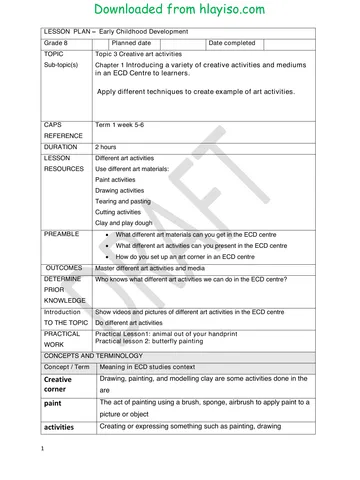
https://www.istockphoto.com/search/2/image?mediatype=illustration&phrase=daycare
Early Childhood Development
https://media.istockphoto.com/vectors/children-at-play-vector-
id1187871269?k=6&m=1187871269&s=612x612&w=0&h=SSPfSDQTthhLIs6zddoCxCga8aFzLZaMyYo2LIdCjyo=
Grade 8 Teacher’s Guide
1
Early Childhood Development Grade 8 Teachers Guide
Skip to contentPractical assessment task
GRADE 8 ECD TEACHERS GUIDE Jan 2022
Grade 8 Early Childhood Development practical assessment task from the 2022, 192 pages. Read online or get the free PDF download.
Early Childhood Development · Grade 8 · 2022. Practical assessment task, 192 pages. Read online or download the PDF.
- Subject
- Early Childhood Development
- Grade
- Grade 8
- Document type
- Practical assessment task
- Year
- 2022
- Curriculum
- CAPS
- Pages
- 192
- File size
- 9.5 MB
Loading document…
Loading document…
1 of 192
Document textSearch extracted text and jump to a page.
Downloaded from hlayiso.com
Contents
Contents ............................................................................................................................................................... 3
TOPIC 1: The ECD Learning Programme ............................................................................................................... 7
Topic 2: Healthy and safe environment ............................................................................................................. 32
Topic 3: Creative activities ................................................................................................................................. 46
Topic 4 Resources............................................................................................................................................... 60
Topic 5: Development of babies, toddlers and young children ......................................................................... 70
Topic 6: Caring for babies, toddlers, and young children .................................................................................. 85
Topic 7: Play in ECD .......................................................................................................................................... 102
Topic 8 Language use and communication skills ............................................................................................. 116
Topic 9 Diseases ............................................................................................................................................... 126
Topic 10: First aid ............................................................................................................................................. 138
Topic 11: Behaviour Management ................................................................................................................... 150
Topic 12. Diversity in the learning environment. .......................................................................................... 162
Topic 13 Mathematics in ECD .......................................................................................................................... 173
Bibliography .................................................................................................................................................... 191
2
Early Childhood Development Grade 8 Teachers Guide
Downloaded from hlayiso.com
Contents
Term Week Topic Chapter Unit
1 1 -2 1.The ECD Introduction to Early Setting up of an ECD
Learning Childhood Development centre
programme.
Planning and environment
which is conducive to a
learning environment
3-4 Healthy and Personal and Personal health and
safe environmental safety and hygiene
environment hygiene
5-6 Creative Introducing a variety of Master different art
Activities creative activities and activities and mediums
mediums in the ECD
centre
7-8 Introduction of different Development of durable
resources in ECD resources
Resources
2 1-2
The safe and correct
Caring for Providing safe ways of caring for baby’s
babies environment for the care physical needs.
Toddlers and of babies
young children
3
Areas of development
Development Developmental areas of
of babies babies, toddlers, and
toddlers / and young children
young children
3
Early Childhood Development Grade 8 Teachers Guide
Downloaded from hlayiso.com
Play in EC The value of play in ECD The variety of different
stimulation activities for
babies
3 1-2 Language use The Importance of good Language use through
and communication skills text
communication
skills
3-4 Diseases Importance of healthy Healthy and unwell child
living Healthy eating habits
5-6 First Aid Knowledge of most Dealing with different
common injuries and injuries in and outdoor
management of accidents
in an ECD centre Safety and precautions
7-8 Behaviour Behaviour management Behaviour problems
Management
4 1-2 Diversity Understand how to create Understanding diversity
and set up an inclusive
learning environment
3-4 Mathematics in Integration of mathematics The value Integration
ECD in different activities of mathematics
4
Early Childhood Development Grade 8 Teachers Guide
Downloaded from hlayiso.com
https://media.istockphoto.com/vectors/children-in-a-kinder-garden-vector-
id1068020110?k=6&m=1068020110&s=612x612&w=0&h=hdGxcTfK7XWSZLtBxRARFQs6BjObZMFMH
GBT5KVhVNY=
5
Early Childhood Development Grade 8 Teachers Guide
Downloaded from hlayiso.com
Term 1
Topics
1. The ECD learning programme
2. Healthy and safe environment
3. Creative Activities
4. Resources
6
Early Childhood Development Grade 8 Teachers Guide
Downloaded from hlayiso.com
TOPIC 1: The ECD Learning Programme https://www.powerstownet.com/wp-
content/uploads/2021/02/ot-assistant-classroom-
What is Early Childhood Development (ECD)? and-home-support.png
1.1.1 Early childhood development (ECD) refers to a
comprehensive approach to policies and
programmes for children from birth to nine years of
age with the active participation of their parents
and caregivers.
1.1.2 Its purpose is to protect the child’s rights to
develop his or her full cognitive, emotional, social
and physical potential.
1.1.3 (White paper 5 on Early Childhood Development
2001).
1.1.4 The vision of the South African Government for
Early Childhood Development is for to protect
children’s rights by providing environments and resources for the development of
a child’s full potential in all developmental aspects.
1.1.5 Policies and strategies were then developed by the Department of Basic
Education to support those who work with, babies, toddlers and young children to
develop programmes that are responsive to learning and development
1.2 What is The National Early Learning Standards(NELDS)
1.2.1 NELDS is meant to support the holistic developmental aspects of children from
birth to four in South Africa, by ensuring that the stated developmental
expectations in children (desired results) are achieved.
1.2.2 NELDS among others can be used for:
a) Supporting and improving curriculum development;
b) Evaluating early learning programmes; and
c) Developing school readiness tools.
1.3 What is The South African National Curriculum Framework for children? from
birth to four (NCF).
1.3.1 The NCF provides guidance for those developing programmes and working with
babies, toddlers and young children from birth to age four.
1.3.2 The document is aimed at adults working with children from birth to four and
includes:
a) Parents and caregivers;
b) Early childhood practitioners (in ECD centres, family and community support
services, child minders)
The National Curriculum Framework (NCF) is a comprehensive framework for ECD which
emanates from / was built on the NELDS and developed by the Department of basic
Education and partners in 2015, with input from the public
The NCF outlines the vision for all children, the underpinning principles and main areas of
development (competence) for babies, toddlers and young child lea cancel this part en from
Birth to Four
7
Early Childhood Development Grade 8 Teachers Guide
Downloaded from hlayiso.com
The NCF provide guidance for those working with children from birth to age 4 (training
organisations, universities, practitioners, parents and other care-givers) in developing
programmes to enhance and improve children’s learning experiences and development
1.4 Practitioner/educator and support staff.
1.4.1 The NCF is not a curriculum it is a framework which provides guidance on how to
develop a curriculum appropriate for babies and young children.
1.5 In ECD settings.
1.5.1 The Early Learning Development Areas (ELDAs)
1.5.2 The NCF has six ELDAs which help adults to organise development and learning
opportunities activities for babies, toddlers and young children.
1.5.3 Each of the ELDAs is closely related to the Desired Results identified in the
NELDS.
1.5.4 Although the ELDAs are dealt with separately in this document but, are integrated
during implementation.
1.5.5 The six ELDAs are as follows
https://www.123rf.com/clipart-vector/daycare_center.html
Well-being;
Identity and belonging;
Communication;
Exploring mathematics;
Creativity; and
Knowledge and understanding of the world.
1.5.6 The ELDAs are naturally combined in most routines and activities through their
aims
1.5.7 Examples of aims and activities in each ELDA.
a) Well- being
Children are well-nourished
Having good health
Being safe and secure
Developing physical abilities and interest in physical activities
4.Developing physical abilities and interest in physical activities
8
Early Childhood Development Grade 8 Teachers Guide
Downloaded from hlayiso.com
b) Identity and belonging
Are aware of themselves
Develop a strong sense of self care
Build a strong relationship with other children and adult
c) listening
Reading example picture books or labels of familiar objects
Singing and rhyming
d) Exploring mathematics
Number counting
Sorting, classifying,
Space, shapes and measurement.
e) Creativity
https://karenskidsstudio.com/products/creative-kids-clip-art
Solve problems by designing
Painting, singing and dancing
f) Knowledge and understanding of the world
Experimenting
Discovery
Exploring and investigation of immediate environment and beyond
1.5.8 Arrangement of ELDAs
When planning activities for babies, young children and toddlers it is very
important to understand how ELDAs are structured.
a) Each ELDA is structured in four functions which are as follows:
Aims for development and learning.
Developmental guidelines.
Example of activities for baby’s toddlers and young children.
Guidelines for assessment.
b) Important aspects of planning when using the NCF are:
age
9
Early Childhood Development Grade 8 Teachers Guide
Downloaded from hlayiso.com
categories of different age groups to ensure that developmentally appropriate
activities are planned for childr
c) The table below gives an outline of different activities.
https://www.gumtree.co.za/a-
Age Description Age category businesses-for-sale/margate/ecd-centre-
Beginning baby’s Birth -18 months for-sale/1006600736520912121453809
Moving on 18-36 months
Advancing further 36-4yrs
Towards Grade R 4-5 yrs.
1.6 QUALIFICATIONS REQUIRED IN THE ECD SECTOR
1.6.1 The Further Education and Training Certificate
1.6.2 Early Childhood Development, NQF Level 4, SAQA ID 58761 is a credit-bearing
1.6.3 National Qualification registered on the NQF (National Qualifications Framework)
and accredited by the quality assurance body Education, Training and Development
1.6.4 Practices Sector (ETDP SETA).
1.6.5 This qualification is equivalent to Grade 12 and allows ECD practitioners to teach
children from birth to four (4) and not Grade R
1.6.6 Minimum Admission Requirements
1.6.7 Minimum entry requirements for this qualification is Grade 9.
1.6.8 Higher Certificate in Early Childhood Care and Education Purpose (Hcert)
1.6.9 This is an entry-level qualification that is intended to provide learners with basic
introductory knowledge, cognitive and conceptual tools and practical techniques to
enable further study in ECD.
1.6.10 It aims to develop learners who are capable of applying such beginning knowledge
and competence as early childhood educators.
1.6.11 Graduates who successfully complete the HCert (ECCE) and who want to become
professionally qualified must enter and successfully complete the Diploma (Dip) in
ECCE or the Bachelor of Education (Bed) in ECCE.
1.6.12 Minimum Admission Requirements: A National Senior Certificate (NSC) or Senior
Certificate (SC) or a National Senior Certificate for Adults (NASCA) or a Level 4
National Certificate (Vocational) or an appropriate Level 4 Certificate in ECD
1.7 Time allocation Grade 8
2 Hours per week
https://thumbs.dreamst
ime.com/b/cute-little-
girl-learning-alphabet-
letters-play-speech-
therapist-child-building-
tower-colored-abc-
cubes-table-
104408521.jpg
10
Early Childhood Development Grade 8 Teachers Guide
Downloaded from hlayiso.com
1.8 Programme of assessment in early childhood development.
Grades Formal school-based End-of-year examinations
assessments
R -3 100%
4-6 60% 40%
Examination
Academic Grade 8-9 60% 40%
Occupational Year 60% 40%
1-4
25% Practical skill Term 1-3 (Nov QP 25%)
25% & PAT Term 1-4
25% Practical Lessons Term
(1-3)
10 and 11 25% 25%
Academic stream including a mid-year examination (Nov QP 50% & PAT 25%)
12 25% External examination: 75%
Academic stream including mid-year and a (PAT: 25% + NSC
trial examinations Nov QP 50%)
https://media.istockp
hoto.com/vectors/kin
dergarten-cartoon-
people-characters-
isolated-illustration-
vector-
id898376926?k=6&m
=898376926&s=612x6
12&w=0&h=s4iy
rQN6gTQCPEb6
PLlcuo7gn9iLjvS
11
Early Childhood Development Grade 8 Teachers Guide DwsV5NI2tSEM
=
Downloaded from hlayiso.com
Suggested Program of Assessment
Early Childhood development
Grade 8
Terms Content/ Practical Lessons and Worksheet/ PAT
concept/skill Activities
Test Practical assessment task
60% per term
Exam
If activities are used for
extra application to 40% per term
practical knowledge If activities are used
make sure the for contextual
weighting is knowledge make sure
50 % Practical lessons the weighting is
10% Activities.as a 35 % Theory test
practical 5% Activities as a test.
1 ECD learning Activity 1 Design and create
programme Create a cover page for Activity 2 finger puppets with a
your practical file. Activity 3 story to show case
Activity 4 Theory test
Name the different
play areas for an ECD
centre.
Practical lesson 1
Create a schematic
layout of the indoor
ECD centre.
1 Health and safe Practical lesson 2 Activity 2
environment
3 Poster of steps of Theory test.
washing hands.
1 Creative activities Activity 1 Theory test
12
Early Childhood Development Grade 8 Teachers Guide
Downloaded from hlayiso.com
Create 2 pictures by
using a template of your
hand.
Activity 2Identify and
make a list of
materials/mediums
that can be used in
an art corner
Practical Lesson 3
Create a butterfly by
using squish
painting.
Practical lesson 4
Create a picture
making use of shape
different shapes,.
1 Resources Activity 1 Theory test
Egg carton construction
Activity 2
Create a puzzle out of
waste material
Practical lesson 5
Create a poster of
different recycling
materials that can be
used in an ECD centre.
2 Development of Activity 2 Activity 1 Design and create
babies , toddlers hand puppet with a
and young Create a poster to Theory test story to show case
children. illustrate the different
types of developmental
stages.
2 Caring for babies, Activity 2 Activity 1
toddlers and
young children Theory test
13
Early Childhood Development Grade 8 Teachers Guide
Downloaded from hlayiso.com
Draw a blanket for a
baby boy or girl.
Practical lesson 1
Demonstrate how to
pick up, hold or wrap a
baby.
2 Play in ECD Activity 2.1 Make your Activity 1
own clay and model an
animal out of the clay. Theory test
Activity 2.2 Make your
own finger paint. Create
a family picture
Practical Lesson 3
Toilet roll craft.
3 Language use and Activity 2 Activity 1 Does a puppetry
communication Write an Alphabet in show use your finger
skills the correct grade 1 font. Theory test and hand puppets?
Practical lesson
Create and illustrate
baby books.
3 Diseases Activity 3 Activity 1
Make a pamphlet of the Theory test
different food groups.
Practical Lesson 2
Create a poster to
illustrate the different
nutritious food groups
that prevent diseases.
3 First aid Practical lesson 3 Theory test.
Create a first aid kit
with the content
3 Behaviour Activity 1 Theory test
problems Create a poster with
rules for an ECD centre
Activity 2 Create a
reward chart
4 Diversity in the Activity 1 Create a Theory test
learning poster to illustrate your
environment. religion.
14
Early Childhood Development Grade 8 Teachers Guide
Downloaded from hlayiso.com
4 Mathematics in Activity 1 Make a math Theory test PAT 2
ECD song poster for your Practical Skill test
ECD centre
Activity 2
Make a poster with
rhymes for ECD centre
4
SBA
Pat 1 Term 1-3 75 %/3
=25%
+
Pat 2Practical skill test
Term 4 test 25%
End of the year 60 % 40% 25%+25%
Total 100 % SBA TERM 1-3 =25% Term 1-4 25% 50%
1.8.2 CLARIFICATION ON ASSESSMENT PERIODS
a) Grade 8 Term assessment to consisting of work done in terms 1,2,3
1.8.3 Assessment criteria for ECD practical lessons and activities.
Assessment Criteria
Rating Competence Level
0-1 Unacceptable Does not meet the criteria
2 Poor :Meet some criteria
3 Average :Meets most criteria
4 Good :Meet the requirements
5 Excellent : Exceed all requirements
15
Early Childhood Development Grade 8 Teachers Guide
Downloaded from hlayiso.com
16
Early Childhood Development Grade 8 Teachers Guide
Downloaded from hlayiso.com
EARLY CHILDHOOD DEVELOPMENT
The ECD learning environment
Activity 1
Name__________________________ Date: ________________________
Create a cover page for a practical file.
This practical project is for your practical file which will contain examples of practical
assignments.
You need:
https://kidsclubdi
rectory.com/wp-
A cardboard file content/uploads/
Glue 2021/07/Collage-
Any waste material making-for-kids-
Fish-Collage-
Plastic to cover file School-Project.jpg
Instructions to the learner:
Create a cover page for your file by making a collage of a fish.
Make use of any type of off-cut paper.
Pare must be torn in pieces with fingers.
Be creative
Assessment Level
Appearance of activity 5
Make use of any type of off -cut – paper to colour the picture 5
Paper is torn into small pieces and paste neatly 5
Creativity 5
File is covered neatly and index is inserted. 5
25
Assessment Criteria
Rating Competence
0-1 Unacceptable: Does not meet the criteria
2 Poor : Meet some criteria
3 Average : Meets most criteria
4 Good : Meet the requirements
5 Excellent : Exceed all requirements
17
Early Childhood Development Grade 8 Teachers Guide
Downloaded from hlayiso.com
EARLY CHILDHOOD DEVELOPMENT
Activity 1.1
Explain the files to the learners
Each learner must have 2 ring binding files and a pack of plastic pocket files.
Example of a learner file Index
Index
1. Control Sheet Activity 1
2. Class rules Instruction to Learner:
3. Assessment - Cover and colour
3.1 Formal Assessment: your files.
a) Tests - Work neat
b) Exams - Be creative
3.2 Informal Assessment
a) Activity
4. General
A practical file consists of practical lessons and examples of the lesson done.
Example of a Learner practical file
Index
1. Control page
2. Practical Lessons divided in to terms 1-4
https://pna.co.za/products/stationery/lever-arch-or-2-ring-binder-files
18
Early Childhood Development Grade 8 Teachers Guide
Downloaded from hlayiso.com
Topic 1: The ECD Learning Programme
Chapter 1: Introduction to Early Childhood Development
Terminologies and career opportunities
https://png.pngtree.com/png-
clipart/20201208/original/pngtree-playing-baby-
clipart-png-image_5579323.jpg
1. Baby
An infant or small child from birth till age of one
2. Toddler
A young child aged one year to three years’ old
3. Pre- Schooler
A young child aged three years who does not attend formal school yet
4. Pre-Primary child JavaScript: void(0)
A young child the year before he/she starts formal school.
5. A child
A young boy or girl
6. Child Care Worker or Child minder
An untrained person in charge of someone else’s children in a Day Care Centre
7. Edu carer
A person in charge of a N3 certificate in Childcare or National certificate in Edu
care
8. Assistant Edu carer
A person who did a course in a period 3 weeks up to one year who can give
assistance with the care of children from birth to pre-school under supervision of
an Edu carer
9. Day Mother
The care of children away from their parents daily. This takes place in their own
homes and can also include school going child
19
Early Childhood Development Grade 8 Teachers Guide
Downloaded from hlayiso.com
10. Ad Hoc Care
Caring for children at places e.g.at the airport shopping, centres etc.
11. Day Care Centre
A building or premises for the protection and education of children
Some of the staff has training
12. Play group
A play group consists of six to twenty children in a church hall or any place in the
community where the children are kept busy through fun and play.
13. Nursery School
A building with a registration certificate, trained teachers who teach the children,
3 - 6 years old, according to an educational program.
14. Pre-Primary School
A school with a departmental program for pre-school children
15. After school centre
A centre which cares for pre-school and school going children after school till they
are picked up by their parents
https://encrypted-
tbn0.gstatic.com/images?q
=tbn:ANd9GcSgv8Ziido4Qr
B5T11hjcjzyj2cypjAmfFJLg
&usqp=CAU
Activity 2
Instructions to Learner:
Complete a worksheet.
20
Early Childhood Development Grade 8 Teachers Guide
Downloaded from hlayiso.com
EARLY CHILDHOOD DEVELOPMENT
Activity 2
Name: .............................................. Date: ............................................
A) Choose the correct answer from column B to match column A.
Write the correct answer of column B next to Column A in the answer column.
Column A Answer Column B
Baby a) Caring for kids at shopping centre
Edu carer b) An untrained person caring for kids
Toddler c) Birth to one year old
Child d) A child in the year before primary
school
Ad-hoc care e) School with registration certificate
Pre-schooler f) Centre caring for children after
school
Day mother g) Has a N3 certificate
Child minder h) Caring for children at your own
house
Nursery school i) One year to 3 years old
After Care j) Any young boy or girl
B) Make use of a magazine and look for a picture of each of the following:
A baby, A toddler and a young child.
21
Early Childhood Development Grade 8 Teachers Guide
Downloaded from hlayiso.com
EARLY CHILDHOOD DEVELOPMENT
Activity 2
C) Choose the correct answer from column B to match column A.
Write the correct answer of column B next to Column A in the answer column.
Column A Answer Column B
Baby k) Caring for kids at shopping centre
c
Edu carer l) An untrained person caring for kids
b
Toddler m) Birth to one year old
i
Child n) A child in the year before primary
j school
Ad-hoc care o) School with registration certificate
a
d
Pre-schooler p) Centre caring for children after
school
Day mother q) Has a N3 certificate
h
Child minder r) Caring for children at your own
g house
e
Nursery school s) One year to 3 years old
f
After Care t) Any young boy or girl
D) Make use of a magazine and look for a picture of each of the following:
A baby, A toddler and a young child.
22
Early Childhood Development Grade 8 Teachers Guide
Downloaded from hlayiso.com
Chapter 2 Setting up of an ECD centre
Terminology
indoor outdoor environment washable
storage safety fence gates
parking requirements facilities suitable
ventilation building regulations
1.1 The requirements for indoor ECD Centres:
1.1.1 Enough space
There must be enough space to accommodate all the children.
There must be enough space for a variety of materials and equipment.
The minimum floor surface per child is 3.5m².
1.1.2 Ventilation (Windows)
The room should not be too hot or too cold.
Windows should allow for sufficient light.
Children should be able to see out of the windows.
1.1.3 Walls, floors, and surfaces
All must be washable.
No wall-to-wall carpets.
https://www.cdc.gov/coronavirus/2019-
ncov/images/community/schools-
childcare/school-ventilation-students-
1.1.4 Storage facilities teachers.png
Should match the height of the children.
Must also be washable.
1.1.5 Toilet facilities
There should be potties and appropriate toilet and washable basins for children.
The size of the toilet will vary according to the size and age of the children.
If small toilets are unavailable, a wooden step can be used for smaller children.
23
Early Childhood Development Grade 8 Teachers Guide
Downloaded from hlayiso.com
Toilets should always be neat, attractive and clean.
Toilet must be near the playroom and the outdoor play area.
Ensure that there is enough toilet paper and soap throughout the day.
1.1.6 The various play areas
Book corner
Fantasy corner
Creative corner https://media.istockphoto.com/vectors/kindergarten-room-interior-vector-illustration-
Block corner vector-
id1019184186?k=6&m=1019184186&s=612x612&w=0&h=2Go8Au92Dhl740SNcBRcHpTo8
Display area YfyxmqxrJVlBhPzwlo=
1.2 The requirements of the outdoor facilities
1.2.1 The Structure must be according to the national building regulations
1.2.2 Safe and enclosed playing area
Ground must be covered with lawn (grass as far as possible).
Fencing a facility is very important.
A high safety fence might not look attractive, but it is effective in keeping
children in and undesirables out.
The fence should fasten securely at the gate.
There should be no sharp metal pieces or splintered wood that can hurt
children.
1.2.3 Suitable gates for safety
Gates must be of such a nature that children cannot open them.
Children should not be able to climb over the gates.
Sturdy child-proof gates are a necessity.
1.2.4 Separate parking area
Provision should be made for adequate parking space in front of the facility.
Activitity 4 Instruction to the learner
Activity 3
Name the 5 play areas you can have in a class
Complete a
and paste a picture or draw next to each one.
questionaire
24
Early Childhood Development Grade 8 Teachers Guide
Downloaded from hlayiso.com
The ECD learning programme
Activity 1
Name: _____________________ Date: ____________
Complete the following questions
1. What is the minimum floor space required per child? [1]
_______________________________________________________________
2. Why are windows important in the indoor area? [2]
_______________________________________________________________
_______________________________________________________________
3. How many toilets are required for every 10 children? [1]
________________________________________________________________
4. Name 4 different play areas in the indoor area. [4]
______________________________________________________________
______________________________________________________________
______________________________________________________________
______________________________________________________________
5. Name 3 safety criteria for security gates. [3]
_____________________________________________________________
_____________________________________________________________
_____________________________________________________________
6. Why is a high safety fence important? [2]
______________________________________________________________
______________________________________________________________
7. With what should the ground be covered within the outdoor play area?
__________________________________________________________ [1]
8. Name 3 requirements for a safe outdoor area. [3]
_____________________________________________________________
_____________________________________________________________
_____________________________________________________________
9. Name 3 requirements for the toilet facilities. [3]
_____________________________________________________________
_____________________________________________________________
_____________________________________________________________
/20
25
Early Childhood Development Grade 8 Teachers Guide
Downloaded from hlayiso.com
The ECD learning programme
Activity 1
Name: _____________________ Date: ____________
Complete the following questions
10. What is the minimum floor space required per child? [1]
The minimum floor surface per child is 3.5m².
11. Why are windows important in the indoor area? [2]
Any 2
The room should not be too hot or too cold.
Windows should allow for sufficient light.
Children should be able to see out the windows
12. How many toilets are required for every 10 children? [1]
At least one toilet for every ten children are needed.
13. Name 4 different play areas in the indoor area.’ [4]
Any 4
Book corner
Fantasy corner
Creative corner
Block corner
Display area
14. Name 3 safety criteria for security gates. [3]
Gates must be of such a nature that children cannot open them.
Children should not be able to climb over the gates.
Sturdy child-proof gates are a necessity
15. Why is a high safety fence important? [2]
A high safety fence might not look attractive, but it is effective in keeping children in
and undesirables out.
16. With what should the ground be covered within the outdoor play area? [1]
2. Ground must be covered with lawn (grass as far as possible).
17. Name 3 requirements for a safe outdoor area. [3]
Safe and enclosed playing area
Suitable gates for safety
Separate parking area
18. Name 3 requirements for the toilet facilities. [3]
Any 3
At least one toilet for every ten children is needed.
The size of the toilet will vary according the size and age of the children.
If small toilets are unavailable, a wooden step can be used for smaller children.
Toilets should always be neat, attractive and clean.
Must be near the playroom and the outdoor play area.
Ensure there is enough toilet paper and soap throughout the day. /20
26
Early Childhood Development Grade 8 Teachers Guide
Downloaded from hlayiso.com
The ECD learning programme
Activity 2
Name: ___________________________________ Date: ____________________
Name the 5 different play areas for a preschool
class.
You need:
magazines
Pritt
Scissors.
Instructions to the learner: https://media.istockphoto.com/vectors/class-with-golden-
materials-multicultural-boys-and-girls-learning-vector-
Name the 5 play areas you can have in a class, id1205337703?k=6&m=1205337703&s=612x612&w=0&h=
79FW4fm42e8LELHW4YI4SirtkOdu9hsK05QBEEOPxAM=
Paste or draw a picture next to each one.
Name of area Picture
Assessment Level
All areas are included 5
Suitable pictures are drawn or pasted. 5
10
Assessment Criteria
Rating Competence Level
0-1 Unacceptable Does not meet the criteria
2 Poor Meet some criteria
3 Average Meets most criteria
4 Good
Meet the requirements
5 Excellent Exceed all requirements
27
Early Childhood Development Grade 8 Teachers Guide
Downloaded from hlayiso.com
The ECD learning programme
Activity 2
Name: ___________________________________ Date: ____________________
Play areas in an ECD centre.
Name the 5 play areas for a preschool class.
You need:
magazines
Pritt
Scissors.
Instructions to the learner
https//media.istockphoto.com/vectors/class-with-golden-
Name the 5 play areas you can have in a class, materials-multicultural-boys-and-girls-learning-vector-
Paste or draw a picture next to each one. id1205337703?k=6&m=1205337703&s=612x612&w=0&h=7
9FW4fm42e8LELHW4YI4SirtkOdu9hsK05QBEEOPxAM=
Name of area Picture
https://thumbs.dreamst
ime.com/z/happy-
Book children-s-activity-
kindergarten-cute-kids-
playing-toy-group-
corner school-child-classroom-
education-vector-
139072151.jpg
https://i.pinimg.com/
Fantasy originals/68/fc/92/68f
c92955e1acbf7a2d613
a0232bf71f.jpg
corner
28
Early Childhood Development Grade 8 Teachers Guide
Downloaded from hlayiso.com
https://pocketofpresch
Creative ool.com/wp-
content/uploads/2016/
corner 07/Slide1.jpg
https://i.pinimg.com/
Block originals/5d/38/4d/5
d384db9938027b3dff
corner b5a71bd83ef16.png
Display https://schoolgirlstyle.c
om/2013/04/29/road-
trip/
area
Assessment Level
All areas are included 5
Suitable pictures are drawn or pasted. 5
10
Assessment Criteria
Rating Competence Level
0-1 Unacceptable: Does not meet the criteria
2 Poor Meet some criteria
3 Average Meets most criteria
4 Good :Meet the requirements
5 Excellent: Exceed all requirements
29
Early Childhood Development Grade 8 Teachers Guide
Downloaded from hlayiso.com
EARLY CHILDHOOD DEVELOPMENT
The ECD learning environment.
Practical Lesson 1
Name__________________________ Date: ________________________
Create a schematic layout of the indoor ECD centre
You need:
A 3 Paper
Glue
Colouring pencils
Pencil
Black permanent marker.
Any other waster material and art mediums
Instructions to the learner.
Create a layout of an indoor ECD centre.
Make use of any type of off-cuts and waste materials
Label each area
Be creative
https://za.pin
terest.com/pi
n/566679565
604814258/
30
Early Childhood Development Grade 8 Teachers Guide
Downloaded from hlayiso.com
Assessment Level
Appearance of activity 5
Make use of any type of off-cut waste material and 5
other art mediums.
All the areas are labelled 5
Creativity 5
Handed in on time 5
25
Assessment Criteria
Rating Competence
0-1 Unacceptable: Does not meet the criteria
2 Poor :Meet some criteria
3 Average :Meets most criteria
4 Good :Meet the requirements
5 Excellent :Exceed all requirements
https://i.pi
nimg.com/
originals/5
7/4a/ab/57
4aab34741
1170f2aa0
1bd7ba3f3
e5e.jpg
31
Early Childhood Development Grade 8 Teachers Guide
Downloaded from hlayiso.com
Topic 2: Healthy and safe environment
Topic 2 Healthy and
safe environment
The importance
Personal of personal
environmental Hygiene when
safety and working with
hygiene children
https://www.clipartmax.com/png/small/1-
15251_school-kids-art-class-clip-art-teacher-is-reading-a-
story.png
Chapter 1: Personal environmental safety and hygiene
Unit 1 The importance of personal hygiene when working with children.
Terminology
bath shower clean meal
jewelry hair germs exercise
balanced transmit blood ring
1.1 Personal Hygiene when working with children.
Take a daily bath or shower to ensure that you are always clean.
Keep fingernails always short, long nails can scratch a child.
Do not wear any rings or jewelry on your fingers and arms that can harm the
child. They can also transmit germs to children.
Wear gloves to protect your hands from blood and chemicals.
Wash your hair regularly, it should always look clean and shiny. If you have long
hair, it should be tied back, away from your face.
Wash your hands as often as possible. Dry hands
32
Early Childhood Development Grade 8 Teachers Guide
Downloaded from hlayiso.com
and put lotion on to prevent cracks which carry germs.
Always wear clean underwear and clothes.
Soiled clothes should immediately be changed for clean ones.
Put your hand in front of your mouth when sneezing.
Ensure that you get enough sleep at night. Working with children can be very
frustrating if you are tired and irritable and you will be more likely to ‘snap’.
Wear comfortable, low-heeled shoes as you will be on your feet most of the time.
Do enough exercise.
Make sure you eat a well- balanced meal daily to maintain your state of health.
If you are sick, consult a doctor, a sick person can’t take care of a child.
1.2 Personal Health and hygiene for the Edu carer.
1.2.1 Skin care
a) Take a daily bath or shower to ensure that you are always clean.
b) Wash your hands as often as possible.
c) Dry your hands and put lotion on to prevent cracks which carry germs.
d) Wear gloves to protect your hands from blood and chemicals.
e) Put your hand in front of your mouth when sneezing.
1.2.2 Hair and nail care
a) Wash your hair regularly, it should always look clean. If https://encrypted-
you have long hair, it should be tied back, away from tbn0.gstatic.com/images?q=tbn:ANd9GcQ
your face. 1BvOaTqNrB6BaHA-
Gvbk07wKGdwUCl7Wfj
b) Keep fingernails always short, long nails can scratch a
child.
c) Do not wear any jewellery on your fingers and arms as
that can harm the child and can also transmit germs to
children.
A&usqp=CAU
33
Early Childhood Development Grade 8 Teachers Guide
Downloaded from hlayiso.com
1.2.3 Teeth and oral hygiene.
a) Brush and floss your teeth at least twice a day.
b) Use a good quality toothbrush.
c) Use toothpaste containing fluoride.
d) Rinse your mouth after each meal
e) Limit the intake of sweets and snacks.
f) Use more dairy products.
g) Eat more hard fruits like apples.
h) Have a thorough dental check-up.
i) Contact your dentist immediately if you have toothache, loose teeth,
bleeding gums or persistent bad breath.
1.2.4 Clothing
a) Wear comfortable, low heeled shoes as you will be on your feet most of the time.
b) Walk barefoot when you can.
c) Always wear clean underwear and clothes. Soiled clothes should immediately be
changed for clean ones.
d) Wear a proper, supportive and fitting bra.
e) Light coloured clothes will make you feel cooler.
f) Avoid slip-on shoes or slippers.
1.2.5 Exercise
a) Exercise regularly.
b) Exercise will help you not to gain too much weight.
c) Walk for 30 minutes two to three times a week.
d) Drink a lot of water while exercising.
1.2.6 Rest
a) Ensure that you get enough sleep at night.
b) Have a warm drink before going to bed
c) Have a warm bath before bedtime to relax the body
d) Relax before bedtime, read a book, or listen to music
34
Early Childhood Development Grade 8 Teachers Guide
Downloaded from hlayiso.com
e) Working with children can be very frustrating. If you are tired and irritable you
will lose your temper more likely
Activity 1
Instruction to learner
Cut pictures to create an image of a healthy, clean, and comfortable
teacher.
Label the teacher.
Be creative and use your initiative
https://webstockreview.net/explore/african-clipart-teacher/
35
Early Childhood Development Grade 8 Teachers Guide
Downloaded from hlayiso.com
Healthy and safe environment
Activity 1
Name: ________________________ Date: _________________________
Create an image of a healthy clean and comfortable Edu carer
You need:
Make use of a magazine.
Colouring pencils
Pritt
Scissors
A4 Paper
Instructions to the learner:
Cut or draw pictures to create an image of a healthy, clean and comfortable
Edu carer
Be creative and use your own initiative
Label your picture
https://webstockreview.net/explore/african-clipart-teacher/
Assessment Criteria
Rating Competence Level
0-1 Unacceptable Does not meet the criteria
2 Poor Meet some criteria
3 Average Meets most criteria
4 Good Meet the requirements
5 Excellent Exceed all requirements
36
Early Childhood Development Grade 8 Teachers Guide
Downloaded from hlayiso.com
Healthy and safe environment
Activity 1
Name: ________________________ Date: _________________________
Create an image of a healthy clean and comfortable Edu carer and describe the
teacher
Healthy hair
Heallthy skin
Healthy teeth
Clean Body
Healthy nails
Healthy body
Comfortable
clothes
Comfortables
shoes
https://www.dreamstime.com/stock-illustration-woman-teacher-african-american-female-blackboard-image90004813
37
Early Childhood Development Grade 8 Teachers Guide
Downloaded from hlayiso.com
1.3. HOW TO WASH YOUR HANDS?
1.3.1 Techniques and steps when washing hands.
Use enough soap and water
Rub palm against palm
Place the palm of one hand over palm of other hand
Rub the back of your hands against your palm.
Interlace fingers.
Wash the thumb with other hand, then change around.
Rinse thoroughly
Dry hands with clean towel or paper.
https://www.dettolarabia.com/en/common-infections/healthy-hands/you-need-to-know-these-hand-washing-
steps-for-a-healthy-you
1.3.2 When you should wash your hands?
Whenever it is dirty
After being to the toilet
After blowing your nose, or the nose of a child
Before meals are prepared
Before giving food to children
Before making bottles
Before changing nappies
After changing of nappies
Before and after touching different babies
After being in contact with blood
38
Early Childhood Development Grade 8 Teachers Guide
Downloaded from hlayiso.com
Healthy and safe environment.
Activity 2
Name: ................................................... Date: .............................................
1. Why is it important to wash your hands regularly? (2)
1.1._________________________________________________________
1.2__________________________________________________________
2. Make use of the pictures below and indicate next to the numbers the
correct steps when washing hands. (8)
https://www.dettolarabia.com/en/common-infections/healthy-hands/you-need-to-know-these-hand-washing-
steps-for-a-healthy-you
2.1_________________________________________
2.2_________________________________________
2.3_________________________________________
2.4_________________________________________
2.5_________________________________________
2.6 ________________________________________
2.7_________________________________________
2.8_________________________________________
39
Early Childhood Development Grade 8 Teachers Guide
Downloaded from hlayiso.com
Healthy and safe environment.
Activity 2
Name: ................................................... Date: .............................................
1. Why is it important to wash your hands regularly? (2)
It helps to prevent you becoming ill.
It prevents the spreading of germs.
2. Make use of the pictures below and indicate next to the numbers the correct steps
when washing hands. (8)
https://www.dettolarabia.com/en/common-infections/healthy-hands/you-need-to-know-these-hand-washing-
steps-for-a-healthy-you
1) Use enough water
2) Use soap
3) Rub palm against palm
4) Place the palm of one hand over palm of other hand
5) Rub the back of your hands against your palm.
6) Interlace fingers.
7) Wash the thumb with other hand, then change around.
8) Rinse thorough
40
Early Childhood Development Grade 8 Teachers Guide
Downloaded from hlayiso.com
Healthy and safe environment
Activity 3
Name: ________________________ Date: _________________________
Steps of washing hands.
You need
Make use of a magazine.
Colouring pencils
Pritt
Scissors
A4 Paper
Instructions to the learner:
Develop a poster of the steps
of washing hands.
Be Creative
Use the correct grade 1 font
Draw or paste pictures.
Label them.
https://za.pinterest.com/pin/854276623059438199/
Assessment Level
Correct steps 5
Poster is eye catching and durable 5
10
Assessment Criteria
Rating Competence
0-1 Unacceptable
Does not meet the criteria
2 Poor
Meet some criteria
3 Average
Meets most criteria
4 Good
Meet the requirements
5 Excellent
Exceed all requirements
41
Early Childhood Development Grade 8 Teachers Guide
Downloaded from hlayiso.com
Healthy and safe environment
Practical lesson 2
Name: ________________________ Date: _________________________
Create a poster for your classroom to demonstrate the different steps of washing
hands. https://berwicklodgeps.vic.edu.au/wp-
content/uploads/2017/11/Washing-Hand.pdf
YOU NEED:
A 3 coloured carton
Colouring pencils
Pencil
Black coki
Any other art materials and mediums.
Instruction to the learner.
Create a poster to demonstrate different steps of washing hands
Use pictures and label it
It must be clear
It must be durable
Be Creative
Assessment Level
Appearance of activity 5
Make use of any type of art material or mediums 5
Pictures is ladled 5
Creativity: Colourful 5
All steps are demonstrated 5
25
Assessment Criteria
Rating Competence
0-1 Unacceptable
Does not meet the criteria
2 Poor
Meet some criteria
3 Average
Meets most criteria
4 Good
Meet the requirements
5 Excellent
Exceed all requirements
42
Early Childhood Development Grade 8 Teachers Guide
Downloaded from hlayiso.com
https://www.dettolarabia.com/en/common-infections/healthy-hands/you-need-to-know-these-hand-washing-steps-for-
a-healthy-you
Techniques and steps
Use enough water and soap
Rub palm against palm
Place the palm of one hand over palm of
other hand
Rub the back of your hands against your
palm.
Interlace fingers.
Wash the thumb with other hand, then
change around.
Rinse thoroughly
Dry Hands with a clean towel or paper.
43
Early Childhood Development Grade 8 Teachers Guide
Downloaded from hlayiso.com
1.4 Healthy eating
1.4.1 Dietary needs
Make sure you eat a well-balanced meal daily to maintain your state of health.
Be careful not to eat too much less nutritious food, or too much food
Avoid fried foods and extra fats
Avoid food rich in sugar and fats
Use salt sparingly because it stores water in the body
Drink 6-8 glasses of water per day
Eat enough proteins to build your body, 90 to 100 gram per day.
1.4.2 A balanced diet
a) A balanced diet is a diet which supplies all nutrients from the basic food
groups daily.
Fats and oil s
Proteins
Vitamins and minerals
Carbohydrates
https://cliparts.zone/food-pyramid-cliparts
44
Early Childhood Development Grade 8 Teachers Guide
Downloaded from hlayiso.com
b) The basic food groups are:
https://webstockreview.net/explore/f
oods-clipart-group/
Fats and oils
Function: Control body temperature
Sources: Animal and plant oils
Proteins
Function: Builds and repairs tissues
Sources: Meat, fish, chicken, eggs, ground nuts,
beans, milk, cheese etc.
Vitamins and minerals
Function: Protects against diseases
Sources: All fruit and vegetables
Carbohydrates
Function: Gives energy
Sources: Breads, Cereals
Water is essential drink 6-8 glasses water per day
https://www.pinclipart.com/pindetail/x
hhobb_clip-library-download-fila-
cartoon-child-children-line/
45
Early Childhood Development Grade 8 Teachers Guide
Downloaded from hlayiso.com
Topic 3: Creative activities
Apply
different
techniques to
create
examples of
art activities.
Creative
activities
Layout and
List of all
materials
used in an
art corner.
Unit 1: Master the different art activities and mediums
Terminology
creative corner paint activities cutting
imagination toilet rolls crayons pencils paper
1.1 Apply different techniques to create examples of art activities.
In the art corner you must provide for the following different art activities:
46
Early Childhood Development Grade 8 Teachers Guide
Downloaded from hlayiso.com
1.1.1Painting
The use of colour helps to simulate the imagination and develop
creativity.
a) Stages of painting
In the early stages one of two colours (red and blue) are sufficient.
Green, yellow, white and black can be added at a later stage.
b) Different paint activities
Block painting (use a sponge, stamp, cotton wool, cork, any fruit or
vegetables cut in halve.)
Butterfly painting (use a straw to blow pictures.)
Brush painting (start with the biggest paint brush and work towards a thinner
brush as the child’s skills develop.)
Roll-on paint
String-rope
Chenille sticks
Toothbrush (Splash paint with a toothbrush)
Finger paint (use hands and feet)
https://favpng.com/png_view/paint-brush-painting-palette-clip-art-
c) Material to paint on:
png/0fnvRSHa
Newspapers
Paper plates
Doilies
Paper towels
Paper bags
Toilet rolls
Egg boxes and packaging
Boxes
Paper.
47
Early Childhood Development Grade 8 Teachers Guide
Downloaded from hlayiso.com
1.1.2 Drawing
a) Stages of drawing
Early colouring is done on large sheets of paper with thick crayons.
b) Different drawing activities
Pencils (start with thick pencils)
Wax crayons (start with mega jumbo then jumbo to normal size)
Charcoal
https://favpng.com/png_view/paint-brush-painting-palette-clip-art-png/0fnvRSHa
Koki Pens
Colouring pencils
Glue
Oil pastels
c) Material to draw on
Paper
Black board
Mirrors
Tiles
Newspaper paper
1.1.3 Tearing and Pasting
Develops small muscles movement and creativity
a) Practical activity
Tear colour paper into small pieces and paste on colour book pictures
b) Material
https://www.hellowonderful.co/post/butterfly-paper-heart-craft/
Picture (colouring book)
Gum paper
Magazines
Glue
48
Early Childhood Development Grade 8 Teachers Guide
Downloaded from hlayiso.com
1.1.4 Cutting and Pasting
Cutting helps to strengthen the small muscles and improve eye-hand co-ordination.
a) Stages of cutting
Random snipping
Cutting on a broad/narrow straight line
Cutting on curved line
Cutting out art shape / picture
b) Different cutting / tearing activities
Cut out pictures
Cut out shape
Tear paper and paste
c) Material
Blunt nose scissors
Glue
Magazines
Photocopy picture / activities
1.1.5 Clay or Play dough
Use salt dough or clay
a) Different clay / dough activities
Cut shapes from dough
Roll clay to form shapes etc.
b) Material
Cooking cutters
Activity 1
Plastic knives
Roller pin Instruction to the learner:
Create a picture by using a
template of your hand
49
Early Childhood Development Grade 8 Teachers Guide
Downloaded from hlayiso.com
Creative Activities
Activity 1
Name: ________________________ Date: ________________________
Colouring techniques. Create two picture by using a template of your hand..
You Need :
4 White A4 papers.
Pencil
Coloring Crayons or pencils
Scissors
Plastic Eyes
Feathers
Glue
Paint/ paintbrushes
Any other art materials or mediums.
Instructions to the learner.
Trace your hand on a piece of paper,twice
Cut out both hads that you traced and colour or paint them.
Draw a background on your other 2 white papers.
Choose 2 of the following animals and complete your picture by using your hands
that is already cut out and coloured or painted.
(elephant, ghost, fish, chicken , flower)
Use the decorations that are given to you.
Be creative
Assessment Level
Appearance of activity 5
Colour techniques 5
Cutting techniques 5
Creativity: Colourful 5
Can you recognise any 2 of the animals. 5
25
Assessment Criteria
Rating Competence
0-1 Unacceptable Does not meet the criteria
2 Poor Meet some criteria
3 Average Meets most criteria
4 Good Meet the requirements
5 Excellent Exceed all requirements
50
Early Childhood Development Grade 8 Teachers Guide
Downloaded from hlayiso.com
1.1 Demonstrate and describe the layout of an art corner in an ECD centre
https://glittermeetsglue.com/virtual-bitmoji-classroom/
Art helps children learn about self-expression and creativity. Art projects are
also a good way for children to develop fine motor skills and improve their
hand-eye coordination.
2.2.1 Six steps to set up an art corner:
a) Decide on the size and location
The first step in setting up your art corner is to determine its size and location.
Place your art corner near a sink if possible - this will make hand washing and
clean up more easily.
Make sure your work table and floor are easy to clean.
b) Pick Appropriate Furniture
Easels and/or tables and chairs should be the appropriate height for the
children.
Tables and chairs should have an easy to clean work surface.
Storage cabinets must be in a safe place to store paints and other materials
kids
should not be able to access easily.
There should be a drying rack for paintings.
You can also use a bulletin board room divider to display children's artwork at
a height level they can easily see.
51
Early Childhood Development Grade 8 Teachers Guide
Downloaded from hlayiso.com
c) Facilitate Easy Clean Up with Splash Mats and Aprons
Use splash mats under easels and other furniture or place it on top of tables
to better protect surfaces.
Aprons are a must have. Be sure to choose aprons that are easy to clean
and are the correct size for the children in your care.
d) Find Convenient Art Storage Solutions
There are a variety of art supplies available, - art caddies, scissor racks, and
art tubs.
e) Choose a Variety of Art Materials and Tools
You should offer a variety of different art materials based on different levels
of ability in your classroom's art corner.
f) Label Your Art Corner for Example
https://www.teacherspayteachers.com/Product/Arts-and-Crafts-Labels-4240405
https://za.pinterest.com/pin/5222065192933139
97/
2.2.2 List all materials used in an art corner
a) Brushes, Crayons and Markers:
Brushes, crayons, and markers are important materials to have in any art
Remember that large easy-grip paint brushes are easier for younger children to grasp
and use
b) Chalk Materials:
Take art activities outside with fun chalk materials or use chalk on chalkboards indoors.
52
Early Childhood Development Grade 8 Teachers Guide
Downloaded from hlayiso.com
Children will love using sidewalk chalk and paint to create colourful work of art
c) Clay, Dough and Modelling Materials:
Children will have fun using their hands to make creative statues and models with
dough and modelling clay.
Be sure to facilitate their creativity with rollers, cutters, and texture kits.
d) Collage and Craft Materials:
Offer a variety of art supplies for any collage or craft projects, including craft sticks,
feathers, pipe cleaners, yarn, glitter, stencils, pom-poms, wiggly eyes, felt sheets, art
kits, and more.
e) Glue and Tape:
Help children keep their project together with tape, glue, and other adhesives.
You can also reduce the chance of a mess occurring by using washable glue or easy-
to-use glue sticks.
f) Paint and Paint Materials:
Stock your art corner with a variety of paints, including finger paint, glitter paint, and
watercolour paint among others.
Sponges, paint pots, and paint markers are also necessary paint supplies for art
corner.
g) Paper and Scissors:
Stimulate children's senses by giving them the chance to use paper in different
textures, colours, and sizes.
Also make sure the scissors available in your art corner are safety scissors that will
only cut paper.
h) Stampers and Stamp Pads:
Stampers and stamp pads are a quick and easy way to create art projects for kids.
A variety of stampers, including emotions, family, animals, letters, and family, animals,
letters, and numbers of stampers, help make stamp projects fun.
Activity 2
Instruction to the learner.
List different materials and mediums that can be used in an ECD centre.
Paste or draw a picture next toCreative Activities
your material and medium that you list.
Activity 2
53
Early Childhood Development Grade 8 Teachers Guide
Downloaded from hlayiso.com
Creative Activities
Activity 2
Name: ________________________ Date: _________________________
Identify and make a list of materials/mediums that can be used in an art corner.
You need:
Pencil
Colouring pencil
Glue
Magazines
Any other art material or medium.
Instruction to the learner
Name at least 10.
Paste or draw a picture next to each one you named.
Be creative
Assessment Level
Appearance of activity 5
Named at least ten art mediums/materials 5
Pictures match the mediums or materials mentioned 5
15
Assessment Criteria
Rating Competence
0-1 Unacceptable: Does not meet the criteria
2 Poor :Meet some criteria
3 Average :Meets most criteria
4 Good: Meet the requirements
5 Excellent :Exceed all requirements
54
Early Childhood Development Grade 8 Teachers Guide
Downloaded from hlayiso.com
Creative Activities
Activity 2
Name: ________________________ Date: _________________________
Instruction: Identify and make a list of materials/mediums that can be used in an art
corner. Name at least 10. Paste or draw a picture next to each one.
Art materials Art mediums
Scissors Paint
Glues Gum paper
Magazine Koki pens
Chenille sticks pencil
buttons clay
Coloured paper Play dough
News paper Colouring pencils
Plastic eyes Oil pastels
Beads cardboard
Finger paint Pieces of string
https://wikiclipart.com/craft-clip-art_27720/
55
Early Childhood Development Grade 8 Teachers Guide
Downloaded from hlayiso.com
EARLY CHILDHOOD DEVELOPMENT
Practical Lesson 3
Creative Activities
Name__________________________ Date: ________________________
Create a Butterfly from paper and paint using squish painting
YOU NEED:
A 4 paper
Black permanent marker
Paint
Paint brushes
Pipe cleaners
Scissors
Googly Eyes
Any other art materials and mediums.
Instruction to the learner.
Fold a paper double
Put paint only on the one side of the paper
Fold the Paper double again that the paint mix and is visible on the other side.
Open the paper
Cut a Butterfly from what you see
Attach feelers with pipe cleaners
Paste googly eyes.
Be Creative
Assessment Level
Appearance of activity 5
Make use of any type of art material or mediums 5
Paint is 5
Creativity. Colourful 5
Handed in on time 5
25
Assessment Criteria
Rating Competence
0-1 Unacceptable: Does not meet the criteria
2 Poor :Meet some criteria
3 Average :Meets most criteria
4 Good :Meet the requirements
5 Excellent : Exceed all requirements
56
Early Childhood Development Grade 8 Teachers Guide
Downloaded from hlayiso.com
https://onelittleproject.com/butterfly-squish-paintings/
https://www.youtube.com/watch?v=ozV4mlwPK68 (Watch a video)
57
Early Childhood Development Grade 8 Teachers Guide
Downloaded from hlayiso.com
EARLY CHILDHOOD DEVELOPMENT
Practical Lesson 4
Creative activities
Name__________________________ Date: ________________________
Create a picture making use of shape different shapes,.
You need:
A3 Cardboard
Different colour shapes cut out of cardboard or paper.
Scissors
Glue
Magazines
Any other art materials or mediums.
Instructions to the learner.
Create a picture by using different shapes
Be Creative
Assessment Level
Appearance of activity /Neatness 5
Handed in on time. 5
Background is completed 5
Colourful 5
More than one shape is used. 5
25
Assessment Criteria
Rating Competence
0-1 Unacceptable: Does not meet the criteria
2 Poor: Meet some criteria
3 Average : Meets most criteria
4 Good : Meet the requirements
5 Excellent : Exceed all requirements
58
Early Childhood Development Grade 8 Teachers Guide
Downloaded from hlayiso.com
https://www.firstpalette.com/images/craft-steps/manyshapespicture-step3a.jpg
https://i.ytimg.com/vi/lL8_eYFmPQ0/maxresdefault.jpgTopic 4: Resources
59
Early Childhood Development Grade 8 Teachers Guide
Downloaded from hlayiso.com
Topic 4 Resources
Resources in an ECD centre
Creating
Recycling resources for
ECD centres
Chapter 1 Resources in ECD
Terminology
Recycling resources Materials Cardboard buttons
Egg boxes Waste Natural safety
plastic
Unit 1 Development of durable resources
1.1 Discuss the concept of recycling:
1.1. 1 What is meant by recycling?
a) Recycling is the practice of reusing items that would otherwise be waste.
b) Recycle—don’t just toss everything in the trash.
c) Lots of things (like cans, bottles, paper, and cardboard) can be remade into either
the same kind of thing or new products.
d) Making new items from recycled ones also takes less energy and fewer
resources than making products from brand new materials.
e) Just about anything in your home (or office or school, etc.) that cannot be reused
CAN be recycled into something else.
f) You'd be amazed what can be done with a recycled product!
g) A recycled cool drink bottle can be made into T-shirts, combs, or hundreds of
other plastic goods that can be used for many years.
h) Even your brand-new computer case might be made from ordinary recycled
plastics. And paper products can take on different forms as well; an old phone
book or colouring book might become one of your schoolbooks or a notebook.
60
Early Childhood Development Grade 8 Teachers Guide
Downloaded from hlayiso.com
61
Early Childhood Development Grade 8 Teachers Guide
Downloaded from hlayiso.com
1.1.2 Materials that can be recycled.
a) Don't throw away anything that can be recycled!
b) Here is a list of things you may be able to recycle
c) Just ask your local recycling office (city, county, or state) about what can be
recycled.
d) A List of materials that can be recycled.
a) Paper and Cardboard
b) Cardboard boxes of all sizes https://www.riverwoodres.com/2018/02/new-recycling-list-published/
c) Aluminium and Tin Cans
d) Glass
e) Plastic (bottles and lids)
f) Egg boxes
g) Toilet rolls
h) Yoghurt cups
i) Wine sleeves
j) Offcuts of wood / material / leather
k) Cotton reels / cones
l) Ribbon
m) Sponges
n) Foam chips
o) Small stones
p) Buttons
q) Old car tyres
r) Orange/green fruit/vegetable bags
s) Shopping bags
t) String / rope
1.1.3 Where can you find resource materials that are safe?
a) Home
b) Businesses
c) Shops Activity 1. Activity 2
d) Hard ware stores
e) People doing needlework Instruction to the learner Instrction to the
f) Foam fabrics learner.
Construct an animal out
of an egg holder and Create a puzzle
1.1.4 Safety factors for resource
other waste materials. out of waste
materials
material and a
Paint must lead free.
picture out of a
Make sure objects are not swallowed
magazine
Use objects according to age group.
Tins and glass can cut fingers.
Toys must be durable and safe to play with.
62
Early Childhood Development Grade 8 Teachers Guide
Downloaded from hlayiso.com
Resources.
Activity 1
Name: ____________________ Date: _________________________
Egg Carton Construction
You need:
Egg carton, and any other waste materials you want to use.
Plastic eyes
Pipe cleaners
Paint / Paint brushes
Craft glue
Scissors.
Instruction to the learner:
Create any animal or figure from an egg carton and other recycled items.
Paint it to finish the animal that you’ve created.
Paste eyes and any other art medium you wan to use to finish your animal.
Be creative
Assessment Level
It is completed and handed in on time, 5
Animal is strong and durable 5
Animal is recognisable 5
Paint is neat and colourful 5
20
Assessment Criteria
Rating Competence
0-1 Unacceptable Does not meet the criteria
2 Poor Meet some criteria
3 Average Meets most criteria
4 Good Meet the requirements
5 Excellent Exceed all requirements
63
Early Childhood Development Grade 8 Teachers Guide
Downloaded from hlayiso.com
Examples of egg carton construction
https://www.parents.com/fun/arts-crafts/kid/creative-egg-carton- https://www.thecrafttrain.com/egg-carton-crafts-for-kids/
crafts/
https://www.parents.com/fun/arts-crafts/kid/creative-egg-carton-crafts/
64
Early Childhood Development Grade 8 Teachers Guide
Downloaded from hlayiso.com
Resources.
Activity 2
Name: ___________________ Date: ________________
Create a puzzle for pre-school children out of waste material.
You need:
Any boxes you can recycle.
Scissors
Glue
Magazine pictures or any other picture or drawing that is coloured in.
Ziploc bags
Instructions to the learner:
Use two pictures from magazines or drawings that are identical.
You can also let your teacher make you a copy.
Mount both pictures on cardboard
Draw your pattern on the back with a pencil
Keep the one as the example, and cut the other one in 2-6 pieces
Write your name on each piece
Keep it in a zip log bag.
Assessment Level
It is completed and handed in on time, 5
Puzzle is cut out neatly 5
Puzzle is strong and durable 5
15
Assessment Criteria
Rating Competence
0-1 Unacceptable Does not meet the criteria
2 Poor Meet some criteria
3 Average Meets most criteria
4 Good Meet the requirements
5 Excellent Exceed all requirements
65
Early Childhood Development Grade 8 Teachers Guide
Downloaded from hlayiso.com
https://www.youtube.com/watch?v=-TApV-VDkBY
Examples of self-made puzzles Youtube video
https://kidsactivitiesblog.com/64529/diy-toddler-puzzle-made-sibling/
https://www.thriftyfun.com/Homemade-Jigsaw-Puzzle-Ideas.html http://sonshinemumma.blogspot.com/2017/09/diy-jigsaw-puzzle-
two-piece-toddler.html
66
Early Childhood Development Grade 8 Teachers Guide
Downloaded from hlayiso.com
EARLY CHILDHOOD DEVELOPMENT
Practical Lesson 5
Resources
Name__________________________ Date: ________________________
Create a poster of different recycling materials you can be used in an ECD
centre.
YOU NEED:
A3 Cardboard
Different recycled materials that are safe and can be used in an ECD centre.
Scissors
Glue
Magazines
Any other art materials or mediums.
Instruction to the learner.
Illustrate on a poster the different recycling materials you can use in an ECD
centrum to create art activities.
Label them clearly
Be Creative
Assessment Level
Appearance of activity 5
Make use of any type of art material or mediums 5
All the materials listed is ladled 5
Creativity. Colourful 5
Completed and handed in on time 5
25
Assessment Criteria
Rating Competence
0-1 Unacceptable
Does not meet the criteria
2 Poor
Meet some criteria
3 Average
Meets most criteria
4 Good
Meet the requirements
5 Excellent
Exceed all requirements
67
Early Childhood Development Grade 8 Teachers Guide
Downloaded from hlayiso.com
List of different recycled materials to use in an ECD centre that are safe.
Cereal Boxes
Corks.
Milk Cartons and Plastic Bottles.
Catalogs,Magazines,and Newspaper. Newspaper Pirate Hat. ...
Toilet Paper and Paper Towel Rolls.
Jars, Lids, and Cans.
Egg Cartons.
Pieces of materals
Paper cups
buttons
https://www.pinterest.co.kr/pin/496592296393633901/
68
Early Childhood Development Grade 8 Teachers Guide
Downloaded from hlayiso.com
Term 2
Topics
1. Development of
babies, toddlers
and young
children
2. Caring for
babies toddlers
and young
children
3. Play in ECD
69
Early Childhood Development Grade 8 Teachers Guide
Downloaded from hlayiso.com
Topic 5: Development of babies, toddlers and young children
Physical
development
Developmental
Intellectual areas of
development babies Social
toddlers and development
young
children.
Emotional
development
Chapter 1: Areas of development
Terminology
Physical Emotional Social Intellectual Growth
Development Birth muscles relationship
1.1 Physical development: (body and muscles)
1.1.1 When talking about the physical development of babies, we are talking about how
their bodies develop and grow.
From Birth
a) Aware of own bodies
b) Sucks fingers
c) Waving and kicking with arms and legs
d) Reaching out to touch things with both
arms
e) Follows movement with their eyes
f) Raise and turn their heads
https://za.pinterest.com/pin/726205508659182701/
70
Early Childhood Development Grade 8 Teachers Guide
Downloaded from hlayiso.com
8 months
a) Sitting
b) Rolling over
c) Begins to crawl
d) Handle and move objects
e) Banging, shaking, squeezing, throwing
objects
f) Tasting objects
12 months
a) Pulling themselves up
b) Standing
c) Walking with some support
1.2 SOCIAL DEVELOPMENT: (relationship with people)
From Birth
https://www.istockphoto.com/illustrations/baby-
talking
a) Looks at a face
b) Follow movement
c) Response to touch and voice
d) Enjoy attention
4-8 months
https://www.istockphoto.com/illustrations/baby- a) Cooperate in being picked up
talking
b) React when attended
c) React when fed
d) Imitate some actions and sounds
71
Early Childhood Development Grade 8 Teachers Guide
Downloaded from hlayiso.com
12 months
a) Shows affection for people they know
https://sites.google.com/site/the8stagesofhu b) Unhappiness when being separated
mandevelopment/home/early-
childhood/social-emotional-development
c) Show an interest in other children
1.3 Emotional development
From birth
a) Calm themselves by sucking
b) Smiles
https://www.hiclipart.com/search?clipart=emotional+Devel
opment
4-8 month
a) Friendly with strangers
b) Curious, wanting to see, taste
and touch
c) Stops crying when you talk to
them
https://za.pinterest.com/pin/457748749598494711/
72
Early Childhood Development Grade 8 Teachers Guide
Downloaded from hlayiso.com
12 month
a) Achieving goals
b) Frustration and anger
c) Anxiety
https://www.canr.msu.edu/news/goals_of_misbehavior_pa
rt_1_attention
1.4 Intellectual development
From birth
a) Gets a fright when hearing sounds
b) Will notice their hands
https://www.dreamstime.com/illustration/baby-
milestones.html
5 Months
a) Develops full colour perception
b) Distance vision matures
c) Ability to track moving object
https://www.dreamstime.com/illustration/crawling-
kid.html
73
Early Childhood Development Grade 8 Teachers Guide
Downloaded from hlayiso.com
8-12 months
a) Imitate actions and sounds
b) Push away objects that are in the
way
https://www.enfagrow.com.sg/development/toddler/
milestones/brain-development-12-18-months
Activity 2
Activity 1
Instruction to the
Instruction to the
learner:
learner:
Create a poster to
Complete the
Explain stages of
questionaire
development
https://www.123rf.com/photo_114615889_stock-vector-set-of-child-care-and-development-icon-linear-infographic-of-baby-growth-from-
newborn-to-todler-with.html
74
Early Childhood Development Grade 8 Teachers Guide
Downloaded from hlayiso.com
EARLY CHILDHOOD DEVELOPMENT
Development of babies, toddlers, and young children
Activity 1
Name and Surname _______________________ Date: ___________
Question 1:
Write down developmental stages of a child illustrated in the table. (8)
Which developmental stage is
illustrated: explain them.
https://www.dreamstime.com/illustration/toddler.html
https://www.gograph.com/clipart/toddlers-looking-up66156819.html
https://www.shutterstock.com/search/toddler+play+clipart
https://line.17qq.com/articles/gbjoifhz.html
75
Early Childhood Development Grade 8 Teachers Guide
Downloaded from hlayiso.com
Question 2: Physical development
Complete the table.
From birth
8 months
12 months
Question 3: Under line correct answer.
1. Physical development is about the baby’s (body and muscle / relationship and
feelings).
2. Babies of 8 months (suck his fingers / begin to crawl).
3. Babies of 12 months (wave and kick arms and legs / pull themselves up and stand).
4. Babies begin following movement with their eyes (after birth / at 8 months).
5. Babies of 8 months (raise and turn their heads / bang, shake, squeeze and throw
objects)
76
Early Childhood Development Grade 8 Teachers Guide
Downloaded from hlayiso.com
Question 4: Say whether the following sentence are True or False.
1. Emotional development is the child’s feelings about other people. ___________
2. Children need to feel proud of what they achieve. ___________
3. They should feel confident about themselves. ___________
4. Babies will get excited when they stand by themselves for the 1st time. ___________
5. When their mothers look pleased when they achieve something, they will begin to
develop a sense of pride. ___________
6. Babies calm themselves by crying. ___________
7. Babies are curious by nature, wanting to see, taste and touch. ___________
8. Babies of 2 months will stop crying when you talk to them. ___________
9. Babies begin to get frustrated and angry at the age of 24 months. ___________
10. Babies at the age of 12 months achieve their goals and begin to feel a sense of pride
in him. ___________
Question 5: Fill in the missing words
2 Even though each child is different, all children have the same needs for
_______________________ and ___________________________.
3 A child needs to feel __________________________________ towards people.
4 A child needs to _______________________________________ with other people.
5 The baby learns from the way he is handled by his mother or his caretaker to ______
________________________________________________.
6 Babies of ___________ months look at faces and follow movements.
7 Babies will react by ____________________________ when he is touched and talked
to.
8 On 4-8 months’ baby begins to ____________________________________________.
9 At 12 months’ baby will show affection for people they __________________________
__________________________.
10 At 12 months’ baby show unhappiness when being
______________________________
__________________________.
11 At 12 months’ baby show interest in
__________________________________________.
77
Early Childhood Development Grade 8 Teachers Guide
Downloaded from hlayiso.com
Question 6: Intellectual development
Underline correct answers.
1. Intellectual development is the child’s (physical body / mental development).
2. It teaches children to (understand and deal with / manipulate) the world in which
they live.
3. Children learn best by (listening /playing).
4. While children play, they are (doing, discovering, exploring / waiting, listening, ignoring)
everything.
5. They learn about things and what they can do by (looking, touching, tasting / not
touching anything).
Age: What they can do:
From birth Sounds-
_______________________________________
Their hands-
_____________________________________
6 months Eyes-________________________________________
________________________________________
________________________________________
8-12 months Hands-
_________________________________________
_________________________________________
http://clipart-library.com/intellectual-development-cliparts.html
78
Early Childhood Development Grade 8 Teachers Guide
Downloaded from hlayiso.com
EARLY CHILDHOOD DEVELOPMENT
Development of babies, toddlers, and young children
Activity 1
Name and Surname _______________________ Date: ___________
Question 1:
Write the down development of child illustrated in the table. (8)
Illustration of development Which developmental stage is
illustrated: explain them?
Physical development: (body and
muscles) 12 months
a) Pulling themselves up
b) Standing
c) Walking with some support
SOCIAL DEVELOPMENT:
(relationship with people) 12
months
a) Shows affection for people
they know.
b) Unhappiness when being
separated.
https://www.gograph.com/clipart/toddlers-looking-up66156819.html
c) Show an interest in other
children.
Emotional development (4-8
Months)
a) Friendly with strangers
b) Curious, wanting to see, taste
and touch.
c) Stops crying when you talk to
https://www.shutterstock.com/search/toddler+play+clipart them.
Intellectual development (8-12
months)
a) Imitate actions and sounds.
b) Push away objects that are in
the way.
https://line.17qq.com/articles/gbjoifhz.html
79
Early Childhood Development Grade 8 Teachers Guide
Downloaded from hlayiso.com
Question 2: Physical development
Complete the table.
From birth
a) Aware of own bodies
b) Sucks fingers
c) Waving and kicking with arms and
legs
c) Reaching out to touch things with
both arms
e) Follows movement with their eyes
f) Raise and turn their heads
8 months ) Sitting
b) Rolling over
c) Begins to crawl
d) Handle and move objects
e) Banging, shaking, squeezing,
throwing objects
f) Tasting objects
12 months a) Pulling themselves up
b) Standing
c) Walking with some support
Question 3: Under line correct answer.
1. Physical development is about the baby’s (body and muscle / relationship and
feelings).
2. Babies of 8 months (suck his fingers / begin to crawl).
3. Babies of 12 months (wave and kick arms and legs / pull themselves up and stand).
4. Babies begin following movement with their eyes (after birth / at 8 months).
5. Babies of 8 months (raise and turn their heads / bang, shake, squeeze and throw
objects).
80
Early Childhood Development Grade 8 Teachers Guide
Downloaded from hlayiso.com
Question 4: Say whether the following sentence are True or False.
1. Emotional development is the child’s feelings about other people. _True__________
2. Children need to feel proud of what they achieve. __True_________
3. They should feel confident about themselves. _True__________
4. Babies will get excited when they stand by themselves for the 1st time.
_____true______
5. When their mothers look pleased when they achieve something, they will begin to
develop a sense of pride. _True__________
6. Babies calm themselves by crying. ___False________
7. Babies are curious by nature, wanting to see, taste and touch. ___true________
8. Babies of 2 months will stop crying when you talk to them. _False__________
9. Babies begin to get frustrated and angry at the age of 24 months.
_____False______
10. Babies at the age of 12 months achieve their goals and begin to feel a sense of pride
in him. ____True_______
Question 5: Fill in the missing words
1 Even though each child is different, all children have the same needs for
________love_______________ and _____________security______________.
2 A child needs to feel ________affection__________________________ towards
people.
3 A child needs to interact with other people.
4 The baby learns from the way he is handled by his mother or his caretaker to ____trust
people.
5 Babies of ____birth_______ months look at faces and follow movements.
6 Babies will react by smiling when he is touched and talked to.
7 On 4-8 months’ baby begins to be friendly to strangers_.
8 At 12 months’ baby will show affection for people they know.
9 At 12 months’ baby show unhappiness when being separated from parents.
10 At 12 months’ baby show interest in other children
Question 6: Intellectual development
Underline correct answers.
1. Intellectual development is the child’s (physical body / mental development).
2. It teaches children to (understand and deal with / manipulate) the world in which
they live.
81
Early Childhood Development Grade 8 Teachers Guide
Downloaded from hlayiso.com
3. Children learn best by (listening /playing).
4. While children play, they are (doing, discovering, exploring / waiting, listening, ignoring)
everything.
5. They learn about things and what they can do by (looking, touching, tasting / not
touching anything).
Age: What they can do:
From birth Sound: Gets a fright when hearing sounds
Their hands: Will notice their hands
_____________________________________
6 months Eyes-
Develops full colour perception.
Distance vision matures.
Ability to track moving object.
8-12 months Hands- Push away objects that are in the way
_________________________________________
https://za.pinterest.com/pin/457748749598494711/
82
Early Childhood Development Grade 8 Teachers Guide
Downloaded from hlayiso.com
EARLY CHILDHOOD DEVELOPMENT
Development of babies, toddlers and young children
Activity 2
Name and Surname _______________________ Date: ___________
Create a poster to illustrate the different types of developmental stages
YOU NEED:
A3 cardboard / or 4 A4 cardboards
Colouring pencils and crayons
Pencil
Magazines.
Black coki
Any other art materials and mediums.
Instruction to the learner.
Create a poster making use of different
pictures and drawings to illustrate the different types of developmental stages.
Emotional, Social, Physical and Intellectual.
Use the correct grade 1 font.
Add pictures and label it.
Assessment Level
Appearance of activity 5
All developmental stages were named 5
Pictures is according to the heading 5
15
Assessment Criteria
Rating Competence
0-1 Unacceptable
Does not meet the criteria
2 Poor
Meet some criteria
3 Average
Meets most criteria
4 Good
Meet the requirements
5 Excellent
Exceed all requirements
83
Early Childhood Development Grade 8 Teachers Guide
Downloaded from hlayiso.com
EARLY CHILDHOOD DEVELOPMENT
Development of babies, toddlers and young children
Activity 2
Name and Surname _______________________ Date: ___________
Create a poster to illustrate the different types of developmental stages Emotional,
Social, Physical and Intellectual.
YOU NEED:
A3 cardboard / or 4 A4 cardboards
Colouring pencils and crayons
Pencil
Magazines.
Black coki
Any other art materials and mediums.
Instruction to the learner.
Create a poster making use of different pictures and drawings to illustrate the
different types of developmental stages.
Use the correct grade 1 font.
Add pictures and label it.
Physical Development Social Development
https://za.pinterest.com/pin/369013763213404833/ https://webstockreview.net/pict/getfirst
Emotional Intellectual
http://clipart-library.com/social-development-cliparts.html http://clipart-library.com/intellectual-development-
cliparts.html
84
Early Childhood Development Grade 8 Teachers Guide
Downloaded from hlayiso.com
Topic 6: Caring for babies, toddlers, and young children
Chapter 1: Providing safe physical care for babies
Picking up of
Batihing a baby
a baby
•Bathing of a baby
•Picking up and and dressing of a
wrapping of a baby.
baby
https://www.dreamstime.com/illustratio
n/child-bathing.html
Unit 1: The safe and correct ways of caring for a baby’s physical needs.
Terminology
Picking Safety Hold Neck Support Cradle Breath Gently Dangerous Strong Week Security
1.1. Picking up a baby
A new baby is very delicate, but if you take care,
don’t frighten him, lift him gently, and confidently,
there is nothing to worry about.
Always ensure you support his neck,
Keep in mind that, although a baby will not break when you handle him, his
muscles and bones are very fragile and have not had time to develop and
become strong to withstand pressure or pulling.
One should therefore always remember to support the baby’s body and head
when handling him in any way.
NEVER pick up a baby by one arm only, or by arms altogether.
85
Early Childhood Development Grade 8 Teachers Guide
Downloaded from hlayiso.com
1.1.1 How to pick up a baby
Talk to the baby and touch him before picking him up.
Take hold of his feet gently, but firmly with one hand.
Bend over and raise the baby’s feet just high enough so
you can slide your other hand under his bottom and up
his spine to the back of his neck.
Spread your fingers to support the baby’s head and turn your arm so that your
other arm’s wrist and forearm support his back.
Spread your other hand under his bottom and lift him slowly, supporting him with
your arms and talking to him all the time.
Never pick up the baby suddenly and fast, he will be frightened.
Always handle the baby with care and love.
1.1.2 Be careful not to do the following
Never use jerky movements, use flowing movements.
Do not hold the baby when you are working or
carrying anything that is potentially dangerous.
Never hold the baby on your lap in a vehicle.
Ensure that a baby is buckled up in car seat when driving.
Do not through baby in the air playfully.
NEVER SHAKE a baby, not even when playing. They can develop
SHAKEN BABY SYNDROME. These injuries can lead to bruising, eye injuries
and even death.
1.2 How to hold a baby?
Always hold a baby in a way that is most comfortable for you.
Always ensure that the head is supported.
Always make sure your strongest hand is behind the baby’s neck, and your other
hand supports his back.
The baby will be content and happy if he is held close to your body.
A baby needs to feel warmth, gentleness, security and love.
Always try to be relaxed, a baby can sense when a person is calm, relaxed or tense.
This can be carried over to the baby, and the baby will be very unhappy or difficult.
If you need to bend down when holding a baby, you must bend your knees and not
bend forward.
86
Early Childhood Development Grade 8 Teachers Guide
Downloaded from hlayiso.com
1.2.1 Ways to hold a baby
(YouTube video) https://www.youtube.com/watch?v=pmJSKlMG5Bs
Baby held to the shoulder
Lift him gently to your shoulder,
while supporting his back.
Make sure his head doesn’t fall back.
Make sure he can see over your shoulder.
The head must be in a position that enables him to
breathe.
Baby cradled In the arms
Support the baby’s head at the crook of your left elbow, and your right hand is
under his bottom as you lift him.
This position makes it possible for the
baby to look at you while holding him.
One arm free
Support baby’s back and head
with your right hand.
He is held over your right hip, face up,
under your arm.
1.3Bathing of a baby
1.3. Importance of bathing a baby.
a) The baby needs an all over bath at the one end of the day a “top and tail” at the other
end.
b) A bath helps to relax the baby and make him feel comfortable if he is tired and difficult.
c) The evening is the best time to bath the baby, especially if the baby is already crawling.
d) It is also best to bath a baby before feeding time, and then he will feel comfortable and
relaxed when being fed, and should not be disturbed after he has been fed.
e) Bathing time has other values except for just hygiene purposes.
f) Bath time is also important for the contact between the mother and child.
g) This is also the time for the baby to get some exercise
while he is kicking and splashing in the water.
87
Early Childhood Development Grade 8 Teachers Guide
Downloaded from hlayiso.com
1.3.2 Requirements when bathing a baby.
a) A warm room
A baby loses body heat very quickly and can get cold, therefore the room must be
draught-free and warm.
Close all the windows and doors.
The room can be pre-heated with a heater if the room is very cold.
1.3.3 Equipment and items needed when bathing a baby,
A nappy bucket with a lid, if you make use of towelling nappies.
A bag to throw in a disposable nappy and cotton swabs.
A toy to keep the baby busy while undressing him.
Low chair
Bath on stand or bath fitted over normal bath.
Set of clean clothes
Towel, shampoo and soap
Cotton wool swabs in covered container
Small rubber mat
Baby brush and nail clipper
Baby powder
1.3.4 Safety aspects when bathing a baby https://www.123rf.com/photo_16638678_set-of-children-s-
things-for-bathing.html
a) Always keep the baby out of the draughts
b) Have a safety mat in the bath, it will prevent the baby from slipping
c) NEVER leave the baby alone, not even for one second
d) NEVER use too hot water – the baby can burn
e) Do not keep the baby in the bath too long, he can catch a cold
f) Never shake the baby powder, it can harm the baby when he inhales
g) Do not leave the baby on the wet towel
h) Don’t take the baby straight from the warm bathroom to another room
i) Always make sure your hands are clean before bathing the baby
j) Remove all jewellery
1.4 Three ways to bath a baby
88
Early Childhood Development Grade 8 Teachers Guide
Downloaded from hlayiso.com
ALWAYS REMEMBER TO COMMUNICATE WITH THE BABY ALL THE TIME WHILE
BEING HANDLED.
Speak in a clear voice, telling the baby what you are doing.
Point out objects, colour etc.
Make the baby happy and see bath time as a time of enjoyment.
https://webstockreview.net/explore/bath-
clipart-mother-baby/
1.4.1 The half-sitting method (very small baby)
1.4.2 The sitting method for a baby 6 months and older
1.4.3 Top and tail method
1.4.1 The half-sitting position
a) This position will be for a small baby
b) Wrap the baby securely in a towel, remove clothes, but nappy still on
c) First clean the face with a swab (cotton ball). Wipe each eye from the inside,
outwards
d) Wipe around the nose and ears. Dry the face with a clean towel
e) Hold the baby firmly under the neck and shoulders with your fingers gently over the
ears, tuck his legs and body firmly under your arm that you can hold his head over
the bath
f) Using your other hand to wet his hair. Put small amount of shampoo on his hair,
wash and rinse well.
g) Move back to working surface and gently rub the hair with the towel.
h) Unwrap the baby and remove the nappy
i) Clean the bottom with cotton wool or soft toilet paper
j) Soap the body all over and make sure you clean under the arms and the buttock.
Work quickly to ensure the baby doesn’t get cold.
k) Hold the baby very tight and secure, by putting one wrist and hand under his neck
and shoulders, and your hand gripping his upper arm, with your other hand grabbing
hold of his feet, lift the baby slowly into the half-sitting position into the bath.
l) Release his feet. Carefully rinse all the soap.
m) You can put a facecloth over the tummy to make him feel safe.
n) Let the baby kick and splash for a few minutes, this time will increase as he gets
older.
89
Early Childhood Development Grade 8 Teachers Guide
Downloaded from hlayiso.com
o) Lift the baby out of the bath and wrap in a https://welcomelittlestranger.wordpress.com/2012/06/23/that-
towel. Pat him dry, and remove the little-niggly-baby/
damped cloth.
p) Put nappy under the baby’s bottom,
apply ointment and dress the baby
1.4.2 The sitting method
a) The baby must be older than 6 months, and be able to sit by himself
b) Pick up the baby with an underarm grip
c) Have a safety mat ready and stand on knees next to the bath
d) Soap the body while baby is sitting in the
water
e) Allow plenty of playing time
f) Don’t let the baby stand up
g) Use a bath ring if the baby wants to play https://depositphotos.com/vector-images/baby-bathing.html
h) ALWAYS stay with the baby
i) Wet his hair while he lies on his back, support the head with your forearm and
shampoo with free hand.
j) Rinse the hair with a sponge or a cup https://www.123rf.com/photo_55425117_stock-
vector-mother-washing-baby-mother-baby-bathing-
k) Sit him up and wipe the face with a cloth washing-mother-s-day.html
l) Towel dry the hair
m) Towel dry the hair
n) Use under arm grip and lift him out of the water
1.4.3 The top and tail method
a) This is a way to bath WITHOUT putting him in the bath
b) Spread a towel on a working surface
c) Undress the baby to the nappy
d) Clean the face with cotton swabs/ wool or a cloth, dry immediately
e) Clean the hands, under the arms and neck, then dry properly Activity 2
f) Put on a clean vest Design and create
g) Remove nappy and clean bottom area thoroughly. Dry well a baby blanket .
h) Apply ointment in nappy area and put nappy on.
i) Then the rest of clothes.
90
Early Childhood Development Grade 8 Teachers Guide
Downloaded from hlayiso.com
1.4.4 Ways of dressing baby’s.
1.4.1 Dressing babies with Pullover garments
a) Gather the garment into a loop and slip it over the head.
b) Stretch the garment forward as you bring it down past the forehead and nose.
c) Put the baby's fist into the armhole and pull the arm through with your other hand.
d) Repeat with your other arm. https://www.123rf.com/clipart-
vector/baby_change_table.html?alttext=1&start=110
e) Speak or sing to your baby. &sti=nefjcga0orctayffdh|
1.4.2 Dressing babies with a Slipover gown or shirt
with a large neck
a) Gather the garment into a loop.
b) Place it around the baby's face like an oval frame.
c) Slip the garment down the back of the baby's
head.
d) Put the baby's fist into the armhole and pull it
through with your other hand.
e) Repeat with your other hand.
1.4.3 Dressing babies with an Open front shirt
a) Laying the baby face down.
b) This helps the baby to feel secure.
c) Open the shirt and lay it on the baby's back.
d) Gently turn the baby face up so that the shirt is
underneath.
e) Put the baby's arms through the sleeves.
1.4.4 Dressing babies with a One-piece garment with feet
Follow the same
a) Putting on this type of garment is easier when the zipper
steps for taking
or the snaps go from tuck to toes.
each kind of
b) Put on the bottom part of the garment first. garment off a baby
c) Roll the baby onto one side and pull the garment up just reverse the
under the baby's shoulders. order of the steps.
d) Roll the baby back onto the garment.
e) Gently pull the sleeves over the baby's arms
91
Early Childhood Development Grade 8 Teachers Guide
Downloaded from hlayiso.com
1.5 The changing of nappies. https://raisingchildren.net.au/for-professionals/aboriginal-torres-strait-
islanders-parents/health-daily-care/changing-a-kimbie-aboriginal-parents
1.5.1 Preparation when changing
nappies.
a) Get diapers ready.
b) Prepare the work surface.
c) You will need a wet washcloth.
d) You also need soft tissues or toilet paper, cotton wool and baby oil.
e) Never leave a baby alone on any raised surface. http://clipart-library.com/diaper-change-
cliparts.html
1.5.2 Positioning of the baby when changing nappies
a) Change your baby on a changing table or bed.
b) Keep one hand on your baby at all times.
c) Most changing tables have a strap you can use to secure your baby.
d) Don't leave your baby unattended for even a second.
e) Babies at any age can squirm off the table when you least expect it.
https://www.dreamstime.com/how-to-change-
1.5.3 How to clean a boy child? diaper-guide-young-mothers-how-to-change-diaper-
step-step-instruction-guide-young-mothers-to-learn-
how-to-image126433375
a) Pull down the front half of the dirty diaper.
b) Cover his penis with a clean cloth or
another
diaper so he doesn't pee on either of you.
1.5.4 Removing the diaper when changing nappies.
a) Clean the baby.
b) If the diaper is only wet, clean the baby with
cotton wool or a wet wipe and baby oil.
c) If the bay had a bowel movement, use soft
tissue or toilet paper.
d) Wash the baby with a washcloth.
e) Apply baby oil.
92
Early Childhood Development Grade 8 Teachers Guide
Downloaded from hlayiso.com
1.5.5 Putting on a clean diaper https://raisingchildren.net.au/for-
professionals/aboriginal-torres-strait-
islanders-parents/health-daily-
a) Hold the baby's ankles. care/changing-a-kimbie-aboriginal-
parents
b) Lift the body enough to slide the diaper under.
c) Be sure that the adhesive tabs are under the
baby.
d) Bring the diaper up between the baby's legs.
e) Use the adhesive tabs to fasten the diaper.
1.5.6 Disposing of used diapers
a) Cleanliness is very important.
b) Drop solid waste into a toilet.
c) Roll the diaper up and place it in a covered trash
container.
d) Never flush disposable nappies down a toilet.
1.5.7 Washing hands when changing nappies.
a) Wash your hands thoroughly with hot water and soap.
b) Use hand sanitizer if you can't get to a sink
https://www.eatrightpro.org/practice/practice-resources/international-nutrition-pilot-project/improving-hand-washing-practices-in-central-america
93
Early Childhood Development Grade 8 Teachers Guide
Downloaded from hlayiso.com
Caring for babies’ toddlers and young children.
Activity 1
Name: .......................................... Date: ......................................
Answer the following questions.
Question 1
Is the following statement true or false?
a) It is always important to support a baby’s neck. _________
b) A baby can support his neck when one month old _________
c) Picking up a baby by one arm is easy and safe. _________
d) Always talk to a baby. _________
Question 2
Name 3 things NOT to do when picking up a baby (3)
a) ……………………………………………………………………………………………
b) ………………………………………………………………………………………………
c) ………………………………………………………………………………………………
Question 3
Choose, and underline the correct answer from the words in brackets.
a) One should always hold a baby in a way that is comfortable for (4)
(yourself / the baby).
b) When a baby senses that the person holding him is tense, he will be very
(happy / unhappy).
c) When holding a baby to your shoulder, he must be able
(to see over your shoulder / breathe into your shoulder).
d) Always hold the baby with your (strong
e) / weak) arm.
Question 4
Choose pictures of the three different ways of holding a baby and label them.
(9)
a) Baby held to the shoulder.
b) Baby cradled in the arms
c) One arm free
94
Early Childhood Development Grade 8 Teachers Guide
Downloaded from hlayiso.com
Question 5
Complete the following sentences by filling in the missing words: (5)
a) The .............................................................. is the best time of the day to bath
the baby?
b) Bath time is very important for the ......................................... between
mother and child.
c) A baby gets exercise while he is ............................................ and
................................................................ in the water.
d) The room where you bath the baby must be ..................................free.
Question 6
Name EIGHT items needed for the bath of a baby. (8)
1) 5)
2) 6)
3) 7)
4) 8)
Question 7
NAME THREE different ways to bath a baby. (3)
a) ........................................................................................................
b) .........................................................................................................
c) .........................................................................................................
Question 8
Write down 4 steps to indicate SAFETY aspects when bathing a baby. (4)
a) ………………………………………………………………………………………..
b) ………………………………………………………………………………………..
c)………………………………………………………………………………………...
d)……………………………………………………………………………………….
95
Early Childhood Development Grade 8 Teachers Guide
Downloaded from hlayiso.com
EARLY CHILDHOOD DEVELOPMENT
Caring for babies’ toddlers and young children
Activity 1
Name: .......................................... Date: ......................................
Answer the following questions.
Question 1
Is the following statement true or false?
a) It is always important to support a baby’s neck. True
b) A baby can support his neck when one month old False
c) Picking up a baby by one arm is easy and safe. False
d) Always talk to a baby. True
Question 2
Name 3 things NOT to do when picking up a baby (3)
a) ……………………………………………………………………………………………
b) ………………………………………………………………………………………………
c) ………………………………………………………………………………………………
Any 3
Never use jerky movements, use flowing movements.
Do not hold the baby when you are working or carrying anything that is potentially
dangerous.
Never hold the baby on your lap in a vehicle.
Ensure that a baby is buckled up in car seat when driving.
Do not throw the baby in the air playfully.
NEVER SHAKE a baby, not even when playing. They can develop SHAKEN BABY
SYNDROME. These injuries can lead to bruising, eye injuries and even death.
Question 3
Choose, and underline the correct answer from the words in brackets.
a) One should always hold a baby in a way that is comfortable for (4)
(yourself / the baby).
b) When a baby senses that the person holding him is tense, he will be very
(happy / unhappy).
96
Early Childhood Development Grade 8 Teachers Guide
Downloaded from hlayiso.com
c) When holding a baby to your shoulder, he must be able
(to see over your shoulder / breathe into your shoulder).
d) Always hold the baby with your (strong
e) / weak) arm.
Question 4
Choose pictures of the three different ways of holding a baby and label them.
(9)
a) Baby held to the shoulder
.
b) Baby cradled in the arms
c) One arm free
97
Early Childhood Development Grade 8 Teachers Guide
Downloaded from hlayiso.com
Question 5
Complete the following sentences by filling in the missing words: (5)
b) The evening is the best time of the day to bath the baby.
b) Bath time is very important for the contact between mother and child.
c) A baby gets exercise while he is kicking and splashing in the water.
d) The room where you bath the baby must be drauht free.
Question 6
Name EIGHT items needed for the bath of a baby. (8)
a) A nappy bucket with a lid if you make use of towelling nappies.
b) A bag to throw in a disposable nappy and cotton swabs.
c) A toy to keep the baby busy while undressing him.
d) Low chair https://depositphotos.com/vector-images/baby-
e) Bath on stand or bath fitted over normal bath. bathing.html?qview=104529260
f) Set of clean clothes
g) Towel, shampoo, and soap
h) Cotton wool swabs in covered container
i) Small rubber mat
j) Baby brush and nail clipper
k) Baby powder
Question 7
Name three different ways to bath a baby. (3)
a) The half sitting method
b) The sitting method
c) Top and tail method.
Question 8
Write down 4 steps to indicate SAFETY aspects when bathing a baby. (4)
a) Always keep the baby out of the draughts
b) Have a safety mat in the bath, it will prevent the baby from slipping
c) NEVER leave the baby alone, not even for one second
d) NEVER use too hot water – the baby can burn
e) Do not keep the baby in the bath too long, he can catch a cold
f) Never shake the baby powder, it can harm the baby when he inhales
g) Do not leave the baby on the wet towel
h) Don’t take the baby straight from the warm bathroom to another room
i) Always make sure your hands are clean before bathing the baby
j) Remove all jewellery
98
Early Childhood Development Grade 8 Teachers Guide
Downloaded from hlayiso.com
EARLY CHILDHOOD DEVELOPMENT
Caring for babies’ toddlers and young children
Activity 2
Name: .......................................... Date: ......................................
Draw a baby blanket for a baby boy or girl.
Instructions to the learner
Draw a blanket on A4 paper for a boy or a girl
Name your list of materials needed to complete the blanket as well as
instructions.
You Need:
Make use of any medium
Colouring pencils, crayons, paint etc.
Paper
Assessment Level
Drawing is neat and complete 5
Creativity 5
All material is listed, and instructions is clear. 5
Handed in on time 5
Good indication if it for a boy or a girl. 5
15
Assessment Criteria
Rating Competence
0-1 Unacceptable
Does not meet the criteria
2 Poor
Meet some criteria
3 Average
Meets most criteria
4 Good
Meet the requirements
5 Excellent
Exceed all requirements
99
Early Childhood Development Grade 8 Teachers Guide
Downloaded from hlayiso.com
EARLY CHILDHOOD DEVELOPMENT
Caring for babies’ toddlers and young children
Practical Lesson 1
Name__________________________ Date: ________________________
Demonstrate how-to pick-up hold and wrap a baby
You Need:
A baby doll
Baby Blanket
Instructions to the learner.
DEMONSTRATE how you will pick up a baby and
Name three way to HOLD a baby
Follow the steps to Wrap the baby
Make use of a baby doll and blanket.
Make sure to follow safety
Assessment Level
Talk to the baby/ doll to make him/her comfortable and be 5
safe
Name three ways to hold the baby demonstrate them:
1. 5
2. 5
3 5
Correct steps were taking when wrapping the baby 5
25
Assessment Criteria
Rating Competence
0-1 Unacceptable
Does not meet the criteria
2 Poor
Meet some criteria
3 Average
Meets most criteria
4 Good
Meet the requirements
5 Excellent
Exceed all requirements
100
Early Childhood Development Grade 8 Teachers Guide
Downloaded from hlayiso.com
EARLY CHILDHOOD DEVELOPMENT
Caring for babies’ toddlers and young children
Practical Lesson 2
Name__________________________ Date: ________________________
Demonstrate how-to pick-up hold and wrap a baby
You Need:
A baby doll
Baby Blanket
Instructions to the learner.
DEMONSTRATE how you will pick up a baby and
Name three way to HOLD a baby
Follow the steps to Wrap the baby
Make use of a baby doll and blanket.
Make sure to follow safety
Assessment Level
Talk to the baby/ doll to make him/her comfortable and be 5
safe
Name three ways to hold the baby demonstrate them:
1. 5
2. 5
3 5
Correct steps were taking when wrapping the baby 5
25
Assessment Criteria
Rating Competence
0-1 Unacceptable: Does not meet the criteria
2 Poor : Meet some criteria
3 Average :Meets most criteria
4 Good :Meet the requirements
5 Excellent :Exceed all requirements
101
Early Childhood Development Grade 8 Teachers Guide
Downloaded from hlayiso.com
Topic 7: Play in ECD
Chapter 1 The value of play in ECD
Variety of different
stimulation activities for
Baby Gymnastics
babies.
Baby massaging Sensory play
Unit 1 The variety of different stimulation activities for babies.
1.1 Understand the skill and purpose of baby massaging
1.1. 1. The benefit of baby massaging
a) Baby massage is gentle, rhythmic stroking of your baby's body with your hands.
b) You can use oils or a moisturiser to help your hands to glide smoothly over your
baby's skin.
c) As part of your massage routine, you can gently manipulate your baby's ankles,
wrists, and fingers.
d) You can talk softly, hum or sing to your baby while you are massaging, which
may make it more reassuring for your baby.
e) Massage may help your baby to: https://raisingchildren.net.au/newborns/healt
h-daily-care/massage/baby-massage
develop mentally, socially, and physically
stay relaxed and not get upset
cry and fuss less
sleep better
1.1.2 Massaging babies arms and hands,
a) Take one of her arms in your hands and repeat the milking motion from her
armpit all the way to her wrist.
b) Then, take her hand and gently rotate her wrist a few times in each direction.
c) Switch arms and repeat.
d) Make tiny circles over the palm of each of her hands with your thumbs.
e) Gently take a finger between your thumb and forefinger and pull, letting her finger
slip through your grasp.
f) Repeat for all her fingers and both thumbs.
102
Early Childhood Development Grade 8 Teachers Guide
Downloaded from hlayiso.com
1.1.3 Massaging babies stomach and back
a) Place your hands together in prayer position over her heart.
b) Then, opening out your hands slowly, stroke outward and lightly flatten the palms
over her chest.
c) Repeat several times.
d) Place one hand flat across the top of her chest.
e) Stroke it gently down to her thighs.
f) Repeat the motion, alternating hands, several times.
g) Roll your baby onto her tummy. Using your fingertips, trace tiny circles on either side
of her spine from the neck down to the buttocks.
h) Finish with some long, firm strokes from her shoulders all the way to her feet.
1.1.4 Massaging babies legs and feet
a) Her legs are a good place to begin, as they're less sensitive than some parts of her
body.
b) Using a little oil, wrap your hands around one of her thighs and pull down, one hand
after the other, squeezing gently, as if you're "milking" her leg.
c) Switch legs and repeat
d) Take one foot and gently rotate it a few times in each direction, then stroke the top of
her foot from the ankle down to the toes.
e) Switch feet and repeat.
f) Use your thumbs to trace circles all over the bottom of each foot.
Activity 1. Instruction to the learner:
1. Practice with your classmates on a baby doll to massage a baby.
2. Complete the questions.
103
Early Childhood Development Grade 8 Teachers Guide
Downloaded from hlayiso.com
Play in ECD
Activity 1
Name: __________________ Date: _________________________
Instruction:
1. Make use of a baby doll to practice on how to massage a baby
2. Complete the following questions.
2.1 Describe in your own words the 8 steps of massaging a baby’s stomach and
back. (8)
a) __________________________________________________________________
b) __________________________________________________________________
c) __________________________________________________________________
d) __________________________________________________________________
e) __________________________________________________________________
f) __________________________________________________________________
g) __________________________________________________________________
h) __________________________________________________________________
https://www.netmums.com/local/l/baby-massage-bearsden
2.2 Complete massage may help your baby to:
________________________________
________________________________
________________________________
________________________________ (4)
2.3 Complete the following sentences on massaging baby’s legs and feet.
a) Her _________ are a good place to begin, as they're less _____________ than
some parts of her body.
b) Using a little _______, wrap your hands around one of her thighs and pull down, one
hand after the other, ___________gently, as if you're "milking" her leg.
c) Switch legs and _______________.
d) Take one _____________ and gently rotate it a few times in each direction, then
________ the top of her foot from the ankle down to the toes.
e) Switch feet and repeat.
f) Use your ___________ to trace circles all over the bottom of each foot. (8)
104
Early Childhood Development Grade 8 Teachers Guide
Downloaded from hlayiso.com
Play in ECD
Activity 1
Name: __________________ Date: _________________________
Instruction:
1, Make us of a baby doll to practice on how to massage a baby.
2. Complete the following questions.
2.1 Describe in your own words the 8 steps on massaging a baby’s stomach and back.
(8)
a) Place your hands together in prayer position over her heart.
b) Then, opening out your hands slowly, stroke outward and lightly flatten the palms
over her chest.
c) Repeat several times.
d) Place one hand flat across the top of her chest.
e) Stroke it gently down to her thighs. Repeat the motion, alternating hands, several
times.
f) Roll your baby onto her tummy.
g) Using your fingertips, trace tiny circles on either side of her spine from the neck
down to the buttocks.
h) Finish with some long, firm strokes from her shoulders all the way to her feet.
2.2 Complete the sentence. Massage may help your baby to: (4)
a) develop mentally, socially and physically
b) stay relaxed and not get upset
c) cry and fuss less
d) sleep better
2.3 Complete the following sentences of babies massaging legs and feet.
g) Her legs are a good place to begin, as they're less sensitive than some parts of her
body.
h) Using a little oil, wrap your hands around one of her thighs and pull down, one hand
after the other, squeezing gently, as if you're "milking" her leg.
i) Switch legs and repeat.
j) Take one foot and gently rotate it a few times in each direction, then stroke the top
of her foot from the ankle down to the toes.
k) Switch feet and repeat.
l) Use your thumbs to trace circles all over the bottom of each foot. (8)
105
Early Childhood Development Grade 8 Teachers Guide
Downloaded from hlayiso.com
2.4 Practical demonstration of baby gym
1.2.1 Arms and shoulders
a) Place a few favourite toys and books just out of her reach to encourage her to
reach out, stretch those arms and strengthen those muscles as she pushes up and
reaches out to get what she wants.
b) Place your finger in baby's hands and let him practice his grip.
c) He'll strengthen hand and arm muscles as he holds onto your fingers – try moving
your hands around so that he learns to hold on and follow.
d) You can also hold baby's little hands and gently move arms up, down and across
baby's chest.
1.2.2 Sit-Ups
a) While your baby is on her back, grasp her forearms and gently pull her toward you.
You can start doing sit-up exercises around 6 weeks; if she’s too young to support
her head, instead of pulling her by the forearms, place your arms behind her
shoulders with your hands behind her head to keep it from flopping back.
1.2.3 Cycling
a) Put your baby on his back and gently move his legs up and around, as if he were
pedalling a bicycle.
1.2.4 Marching
a) Waving your baby’s arms from side-to-side then up and down.
1.2.5 Rolling
a) Assisting your baby in rolling from front-to-back and back-to-front while he is flat on
his tummy by rolling him back-and-forth.
https://www.clipartof.com/portfolio/bnpdesignstudio/illustra
https://www.gograph.com/clipart/baby-girl-musical-gym-gg69699246.html tion/red-haired-caucasian-baby-boy-on-a-pillow-
1234929.html
106
Early Childhood Development Grade 8 Teachers Guide
Downloaded from hlayiso.com
1.3 Understanding the importance of sensory play
1.3.1 Practical examples of sensory play
a) Sensory play includes any activity that stimulates your young child's senses: touch,
smell, taste, movement, balance, sight, and hearing.
b) Sensory activities develop the children through playing to create, investigate and
explore.
c) Sensory play enhances learning through hands-on activities that stimulate the
child's senses.
d) This is a great way for children to explore the world they live in! ...
e) Sensory play supports language development, cognitive growth, fine and gross
motor skills, problem solving skills, and social interaction.
1.3.2 Five reasons why sensory play is beneficial:
a) Sensory play builds nerve connections in the brain’s pathways, which lead to the
child’s ability to complete more complex learning tasks.
b) Sensory play supports language development, cognitive growth, fine and gross
motor skills, problem solving skills, and social interaction.
c) This type of play helps in developing and improving memory.
d) Sensory play is great for calming an anxious or frustrated child. This helps children
learn sensory attributes (hot, cold, sticky, dry).
1.3.3 There are many sensory activities and they include cloud dough, play dough,
sensory tubs, water beads, and shaving cream.
Here is examples of more sensory activities:
a) Rubbery Goo looks and feels like basic play dough, but it is textured differently
b) Primary Colours Squishy Bag Experiment is a wonderful sensory experience for
children to see how colours mix and form other colours. Children use their hands to
blends and squish the different coloured paints together for form new colours
c) There are so many ways to colour rice.
d) You can colour it with food colouring.
107
Early Childhood Development Grade 8 Teachers Guide
Downloaded from hlayiso.com
e) A bucket filled with coloured spaghetti worms.
f) Sand Foam is perfect for sensory exploration. It is made up using only two
ingredients, sand and shaving cream
g) Playing with Jelly is a sensory activity for kids to explore through their senses the
many wonderful textures and qualities of jelly. For example, a jelly bath.
1.7.4 Sense of different textures:
For example, smooth, rough, hard and soft
https://za.pinterest.com/patpinciotti/texture-real-and-simulated/
Activity 2
Instruction to the learner
Choos one of the following sensory activities and follow the
instructions. :
Play in ECD
Play dough or Finger paint.
Activity 2
108
Early Childhood Development Grade 8 Teachers Guide
Downloaded from hlayiso.com
Play in ECD
Activity 2
Name: ____________________ Date: _________________________
Activity 2.1 https://www.thesprucecrafts.com/oven-flour-clay-recipe-1250343
Make your own Clay.
Ingredients:
500ml cake flour
500ml water
125ml salt
15ml Cream of tartar
15ml of sunflower oil
Any colour food colouring
Instructions:
Mix all the ingredients.
Cook over a low heat and keep on stirring until it does not stick.
Take of the heat. Knead the clay and put in some food colouring.
Knead until it is soft.
When it is cooled down, put it in a plastic bag in a fridge.
Model an animal out of clay
https://www.youtube.com/watch?v=WzzW9PgsFoY https://www.youtube.com/watch?v=kQXiNsHql_4
(Youtube video) (Youtube video)
109
Early Childhood Development Grade 8 Teachers Guide
Downloaded from hlayiso.com
Activity 2.2 https://www.howwemontessori.com/how-we-montessori/2018/09/diy-
natural-baby-finger-paints-.html
Make your own finger paint.
Ingredients:
1/2 cup of flour
1 cup water
Pinch of salt
Extra water
Food colouring or liquid water colours
Instructions to the learner:
Pour flour and water into a pot.
Stir the ingredients over a medium heat until it comes together like a smooth, thick
paste. The mixture will be lumpy along the way, but it all comes together.
When it starts to pull away from the pot, remove from the heat.
Add a pinch of salt. This helps keep the paint from spoiling if you don’t use it right
away.
To reach the desired consistency, slowly add cold water to the mixture. Add about 1/4
cup water to our paint.
Divide the paint into bowls
Squeeze food colouring or liquid watercolours into the flour mixture until you reach the
desired colour.
Store in a covered container in the fridge if you’re not planning to use this right away.
It will keep indefinitely,
Then create a simple picture on a piece of white A3 paper of your family or favourite
pets.
Use the paint you made.
Assessment Level
It is completed and handed in on time, 5
Clay is smooth and usable 5
Animal made out of clay is recognisable 5
Paint is smooth and easy to work with 5
Family picture is completed 5
25
Assessment Criteria
Rating Competence
0-1 Unacceptable Does not meet the criteria
2 Poor Meet some criteria
3 Average Meets most criteria
4 Good Meet the requirements
5 Excellent Exceed all requirements
110
Early Childhood Development Grade 8 Teachers Guide
Downloaded from hlayiso.com
https://marameoathome.wordpress.com/tag/finger-painting/
Play in ECD
Activity 2
Name: ____________________ Date: _________________________
Activity 2.1
Make your own Clay.
Examples of clay structures:
https://www.youtube.com/watch?v=IyivgVIwKGE YouTube video
111
Early Childhood Development Grade 8 Teachers Guide
Downloaded from hlayiso.com
Play in ECD
Activity 2
Name: ____________________ Date: _________________________
http://birthdaybumps.in/services/Artist/Clay-Modeling-
Activity 2.1 Clay-Art.html
Make your own Clay.
Examples of clay structures:
https://www.youtube.com/watch?v=IyivgVIwKGE Youtube video
Activity 2.2
Make your own finger paint. Then create a simple picture on a piece of white A3
paper of your family or favorite pets.
Examples of finger paint: https://childinsider.com/toddler-finger-paintings/
https://za.pinterest.com/pin/127367495698218646/
112
Early Childhood Development Grade 8 Teachers Guide
Downloaded from hlayiso.com
EARLY CHILDHOOD DEVELOPMENT
Practical Lesson 3
Play in ECD
Name__________________________ Date: ________________________
Toilet Roll Craft.
YOU NEED:
Toilet rolls
A 4 coloured paper
Black permanent marker
Paint
Paint brushes
Pipe cleaners
Scissors
Any other art materials and mediums.
Instruction to the learner.
Design any animal or figure from toilet rolls.
Use own initiative
Make use of any art mediums and materials. https://www.crazylaura.com/toilet-roll-craft-
Be creative. ideas/
Assessment Level
Appearance of activity 5
Make use of any type of art material or mediums 5
Paint is 5
Creativity. Colourful 5
Handed in on time 5
25
Assessment Criteria
Rating Competence
0-1 Unacceptable
Does not meet the criteria
2 Poor
Meet some criteria
3 Average
Meets most criteria
4 Good
Meet the requirements
5 Excellent
Exceed all requirements
113
Early Childhood Development Grade 8 Teachers Guide
Downloaded from hlayiso.com
Ideas for toilet roll construction
https://www.crazylaura.com/toilet-roll-craft-ideas/
114
Early Childhood Development Grade 8 Teachers Guide
Downloaded from hlayiso.com
Term 3
Topics
1. Language use and
communication skills.
2. Diseases
3. First Aid
4. Behaviour problems
115
Early Childhood Development Grade 8 Teachers Guide
Downloaded from hlayiso.com
Topic 8 Language use and communication skills
Language use through
text
Reading
Story time
Unit 1 The critical awareness of language use.
Terminology
Activity 1
Instruction to the learner
WORD GAME Which
word is spelled by the
letters
Write in the correct
grade 1 font.
116
Early Childhood Development Grade 8 Teachers Guide
Downloaded from hlayiso.com
Language use and communication skills.
Activity 1
Name: ____________________ Date: _________________________
Terminology
read books language talk
enjoy feelings knowledge memory
words story interesting repeat
WORD GAME
Which word is spelled by the letters below
Write each word in the correct grade 1 font.
https://line.17qq.com/articles/dhnonkgdv.html
1) gulangea ________________________________________
2) omrmey ________________________________________
3) eperat ________________________________________
4) gfeleins ________________________________________
5) delwegnok ________________________________________
6) oynej ________________________________________
7) sertinetgni ________________________________________
8) oysrt ________________________________________
117
Early Childhood Development Grade 8 Teachers Guide
Downloaded from hlayiso.com
Language use and communication skills.
Activity 2
Name: ____________________ Date: _________________________
Terminology
read books language talk
enjoy feelings knowledge memory
words story interesting repeat
https://line.17qq.com/articles/dhnonkgdv.html
WORD GAME
Which word is spelled by the letters below?
Writ each word in the correct grade 1 font.
http://clipart-library.com/word-game-cliparts.html
a) gulangea language
b) omrmey memory
c) eperat repeat
d) gfeleins feelings
e) delwegnok knowledge
f) oynej enjoy
g) sertinetgni interesting
h) oysrt story
118
Early Childhood Development Grade 8 Teachers Guide
Downloaded from hlayiso.com
1.1 How to teach your babies to speak?
1.1.1 Babies learn by repetition.
1.1.2 By repeating words, you’ll promote recognition.
1.1.3 Use exaggerated modulation in our speech.
1.1.4 Clear pronunciation of the words will teach the baby to pronounce the words
correctly.
1.1.5 Words are giving babies building blocks for conversation.
1.1.6 Babies imitate what you say and will repeat these sounds.
1.1.7 Point out objects and name and describe them.
1.1.8 Talk to your baby as much as possible in normal language.
1.1.9 Baby language will confuse the baby and will encourage the baby to pronounce
words incorrectly.
1.1.10 Toddlers learn language by hearing spoken words.
https://www.dreamstime.com/illustration/kids-communication.html
Activity 2
Instruction to learners
Write a word with each of letter of the alphabet in te correct font
and draw or paste a picture next to each word.
119
Early Childhood Development Grade 8 Teachers Guide
Downloaded from hlayiso.com
Language use and communication skills.
Activity 2
Name: ____________________ Date: _________________________
Write an Alphabet in the correct grade 1 font.
You need: https://www.englishforkidz.com/2020/04/worksheets-grade-
A 4 26 Cartons 1.html
Colouring pencils
Magazines
Pritt
Scissors
Black koki
Instruction:
Use a ruler and a pencil and draw a table on a carton for each letter like the table
below.
Write 3 words with each letter of the alphabet in the correct grade 1 font and draw or
paste a picture next to each word.
Write neatly.
Alphabet Letter and word. Picture
Assessment Level
Appearance of activity 5
Correct font is used in the alphabet 5
All the letters are completed 5
Pictures match the letters and the words. 5
Completed and handed in on time 5
25
Assessment Criteria
Rating Competence
0-1 Unacceptable: Does not meet the criteria
2 Poor: Meet some criteria
3 Average: Meets most criteria
4 Good: Meet the requirements
5 Excellent: Exceed all requirements
120
Early Childhood Development Grade 8 Teachers Guide
Downloaded from hlayiso.com
Language use and communication skills.
Activity 2
Name: ____________________ Date: _________________________
Write an Alphabet in the correct grade 1 font.
Needs: https://www.englishforkidz.com/2019/08/big-printable-alphabet-letters.html
A 4 26 Cartons
Colouring pencils
Magazines
Pritt
Scissors
Black koki
Instruction:
Use a ruler and a pencil and draw a table on a carton for each letter like the table
below.
Write 3 words with each letter of the alphabet in the correct grade 1 font and draw or
paste a picture next to each word.
Write neatly.
Alphabet Letters, words and pictures.
apple https://webstockreview.net/explore/ape-clipart/
http://clipart-library.com/clip-art/apple-clipart-transparent-4.htm ape
https://www.kindpng.com/imgv/iRwxiiJ_fist-thumb-arm-clip-art-upper-arm-clipart/
A a arm
Language use and communication skills.
121
Early Childhood Development Grade 8 Teachers Guide
Downloaded from hlayiso.com
1.2. The correct font for Grade 1
122
Early Childhood Development Grade 8 Teachers Guide
Downloaded from hlayiso.com
1.3 Choosing the appropriate books and stories.
1.3.1 Story time is one of the most enjoyable and valuable activities.
1.3.2 This is a time to relax and to share feelings and humour.
1.3.3 This is the most pleasurable way to develop a child’s language
skills:
a) Books are very important for babies’ development.
b) Babies develop their finger and hand muscles when they hold or page
books.
c) A baby learns to move their eyes from left to right as you point while reading.
d) Holding a baby on your lap, creates a bond between the mom and child.
e) Reading develops a positive feeling about books and stories.
f) One-year olds need short, simple books – only a few minutes.
g) They like rhyming books.
h) Some books have different textures on each page which can stimulate the
sense of touch.
i) Choose picture books with single words or simple sentences.
j) Pictures should be simple objects.
k) Pictures should be easy to recognize.
l) The books may be made of washable cloth or thick cardboard.
m) Pages need to be thick to allow for easier handling.
n) Covers and pages must be sturdy and strong.
o) The book’s binding should lay flat when the book is open.
A book for a baby
https://www.takealot.com/my-first-words-let-s-get-
talking/PLID35203018?gclid=Cj0KCQjwrsGCBhD1ARIsALILBYoKq6
cWsTkraxJuZYhTQPuXlPyzuGxRkAHE7tbLNbt36yEo1fDSiw8aAroY
EALw_wcB&gclsrc=aw.ds
https://www.takealot.com/my-first-words-let-s-get-
123 talking/PLID35203018?gclid=Cj0KCQjwrsGCBhD1ARIsALILBYoK
q6cWsTkraxJuZYhTQPuXlPyzuGxRkAHE7tbLNbt36yEo1fDSiw8a
Early Childhood Development Grade 8 Teachers Guide
AroYEALw_wcB&gclsrc=aw.ds
Downloaded from hlayiso.com
https://co.pinterest.com/pin/623818985858778428/
Hand-made books /Self help books
https://craftlearnandplay.com/learn-how-to-make-quiet-book-for-
babies/
1.4 The value of books and stories
Children learn new words and facts.
They expand their knowledge.
Books improve a child’s memory.
Books help children to improve their concentration.
Children learn to respect books.
Children learn that pictures have meaning.
Stories teach them how to deal with emotions.
Stories are relaxing and enjoyable.
https://www.dreamstime.com/illustration/boy-corner.html
.
124
Early Childhood Development Grade 8 Teachers Guide
Downloaded from hlayiso.com
EARLY CHILDHOOD DEVELOPMENT
Practical Lesson 1
Language use and communication skills.
Name__________________________ Date: ________________________
Create and illustrate baby books.
You need:
A4 cardboard
Different recycled materials that are safe and can be used in an ECD
Glue
Magazines
Any other art materials or mediums.
Instructions to the learner.
Choose a topic suitable for the child’s level e.g., animals, colours, etc.
The topic of the book can be linked to your theme.
Find interesting, colourful pictures to use.
Cut 4 – 6 cardboard pages of the same size.
Write simple descriptive words or sentences below each picture.
Use the correct writing style.
Bind the pages together.
Assessment Level
Appearance of activity: Cover page 5
Book is on the child’s level 5
Words match the picture 5
Creativity: Pictures are coloured and catch attention 5
Correct font is used 5
25
Assessment Criteria
Rating Competence
0-1 Unacceptable
Does not meet the criteria
2 Poor
Meet some criteria
3 Average
Meets most criteria
4 Good
Meet the requirements
5 Excellent
Exceed all requirements
125
Early Childhood Development Grade 8 Teachers Guide
Downloaded from hlayiso.com
Topic 9 Diseases
https://webstockreview.net/explore/
Diseases disease-clipart-childhood-illness/
Importance of The
healthy living importance of
healthy living
Chapter 1 The importance healthy living
Unit 1 Health and wellness.
TERMINOLOGY
healthy blood energy hair
protein vitamins starches muscles
tongue teeth skin nails
1. PHYSICAL SIGNS OF A HEALTHY CHILD
1) Appearance: Up and about, react quickly
2) Hair: Shiny and strong
3) Neck; No swelling
4) Face: Alert expression
5) Eyes: Shiny. No rings under the eyes.
6) Lips: Red, soft, and moist
7) Tongue: Red and rough without a coating
8) Teeth; White, healthy teeth and gums.
9) Skin: Soft, firm and healthy color
10)Nails: Firm and pink
11)Muscles: Good muscle tone
12)Blood circulation: Normal heart rate and blood pressure
13)Digestive system; Soft abdomen, healthy appetite, and digestion 14)
Nervous system: good concentration
15)Energy: Energetic and sleeps well
126
Early Childhood Development Grade 8 Teachers Guide
Downloaded from hlayiso.com
16)Mass; Normal for age, length, and build
1.1 Healthy eating habits
1.1.1 A healthy diet for children is important:
The food children eat can affect their whole lives.
It can affect the way they look, act, feel and work
Growing children need to have a diet with all the essential nutrients daily.
They need to have FIVE meals every day.
The meals must consist of food from each food group daily.
MAIN MEALS DAILY:
Breakfast
Morning snack
Lunch
Afternoon snack
Dinner
1.1.2 food groups
Non-Foods
Body Building food
Protection food
Energy food
http://clipart-library.com/images-of-food-groups.html
127
Early Childhood Development Grade 8 Teachers Guide
Downloaded from hlayiso.com
a) Non-foods
Non-foods are not in the three basic food groups, or part of a balanced
diet.
Non-foods are unhealthy.
Non- foods can be given for certain occasions but must be avoided as far
as possible.
Non-foods are:
- Sweets
- Cool drinks
- Salt
- Gravy
- Tea or coffee
http://clipart-library.com/junk-food-cliparts.html
b) Body building food
2 This food is ‘growing food’.
3 It is mainly proteins.
4 Body building food helps to repair the skin, bone and hair.
5 This food should be served for children at every meal.
6 This food comes from animal and plants e.g.:
- Milk
- Eggs
- Fish
- Meat
- Cheese
- Beans
- Soya
- Peas
https://webstockreview.net/explore/food-clipart-mineral/
128
Early Childhood Development Grade 8 Teachers Guide
Downloaded from hlayiso.com
c) Protection food
This is food with vitamins and minerals.
This food keeps the body healthy.
It protects the body from diseases e.g. flu.
It makes your hair shiny and strong.
Protection foods are found in fruit and vegetables:
FRUIT: VEGETABLES:
- Apples Cabbage
- Bananas Carrots
- Oranges Pumpkin
- Pears Beetroot
- Pineapple Tomatoes
d) Energy food
Children need energy food to function.
Include only one energy food in a meal.
Too much energy food can make a child fat.
Energy food are mainly starch food:
- Mealies
- Bread
- Rice potatoes
- Porridge
Activity 1 Instruction to the learner
a) Choose a picture of a
HEALTHY child from a
magazine.
b) Write EIGHT words next to the
picture why you think this child
is healthy
c) Complete the questionnaire
129
Early Childhood Development Grade 8 Teachers Guide
Downloaded from hlayiso.com
Diseases
Activity 1
Name: ......................................... Date: ..................................................
Question 1
Choose a picture of a HEALTHY child from a magazine.
Write eight words next to the picture to show why you think this child is healthy
Question 2
Complete the following questions.
Question 2.1 (6)
Match column A and B.
Choose the correct statement from column A to match column B
Column A Column B
a) Hair Normal heart rate …….
b) Eyes White and healthy …….
c) Tongue Shiny and strong …….
d) Nails Shiny, without rings …….
e) Blood circulation Firm and pink …….
f) Teeth Red, rough, no coating ……..
Question 2.2
Underline the correct word in brackets (5)
a) A healthy digestive system has a
(good digestion / bad appetite)
b) A healthy child has a (red, rough / pink, smooth) tongue.
c) The blood pressure of a healthy child should be
(low / high / normal)
d) Healthy nails have (white spots / firm, no spots)
e) An alert expression is a characteristic of a
(unhealthy / healthy) child
130
Early Childhood Development Grade 8 Teachers Guide
Downloaded from hlayiso.com
Question 2. 3 (6)
Write underneath each heading examples of characteristics of a healthy and an
unhealthy child
A healthy child:
_________________________________________________________________________
_________________________________________________________________________
_________________________________________________________________________
_________________________________________________________________________
_________________________________________________________________________
An unhealthy / sick child
_______________________________________________________________________________________
_______________________________________________________________________________________
_______________________________________________________________________________________
_______________________________________________________________________________________
_______________________________________________________________________________________
Question 2.4 (3)
“A healthy child is a happy child who enjoys life.”
Explain in your own words why you agree with this statement.
_______________________________________________________________________________________
_______________________________________________________________________________________
_______________________________________________________________________________________
_______________________________________________________________________________________
https://webstockreview.net/explore/disease-clipart-childhood-illness/
131
Early Childhood Development Grade 8 Teachers Guide
Downloaded from hlayiso.com
Diseases
Activity 1
Name: ......................................... Date: ..................................................
Question 1
Choose a picture of a HEALTHY child from a magazine.
Write eight words next to the picture to show why you think this child is healthy
1)Appearance: Up and about, react quickly
2) Hair: Shiny and strong
3) Neck; No swelling
4) Face: Alert expression
5) Eyes: Shiny. No rings under the eyes.
6) Lips: Red, soft, and moist
7) Tongue: Red and rough without a coating
8) Teeth; White, healthy teeth and gums.
9) Skin: Soft, firm, and healthy colour
10)Nails: Firm and pink
11)Muscles: Good muscle tone
Question 2
Complete the following questions.
Question 2.1 (6)
Match column A and B.
Choose the correct statement from column A to match column B
Column A Column B
a) Hair Normal heart rate. e
b) Eyes White and healthy f
c)Tongue Shiny and strong a
d)Nails Shiny, without rings b
e) Blood circulation Firm and pink d
132
Early Childhood Development Grade 8 Teachers Guide
Downloaded from hlayiso.com
f) Teeth Red, rough, no coating c
Question 2.2
Underline the correct word in brackets (5)
f) A healthy digestive system has a
(good digestion / bad appetite)
g) A healthy child has a (red, rough / pink, smooth) tongue.
h) The blood pressure of a healthy child should be
(low / high / normal)
i) Healthy nails have (white spots / firm, no spots)
j) An alert expression is a characteristic of a
(unhealthy / healthy) child
Question 2. 3 (6)
Write underneath each heading examples of characteristics of a healthy and an
unhealthy child.
Healthy
Happy, smiling, and energetic
An unhealthy / sick child:
Tired, Unhappy and neve smile.
Question 2.4 (3)
“A healthy child is a happy child who enjoys life.”
Explain in your own words why you agree with this statement
Learners can write their own words
A healthy child is never hungry
A healthy child appearance is good
A healthy child is full of energy.
133
Early Childhood Development Grade 8 Teachers Guide
Downloaded from hlayiso.com
Diseases
Activity 2
Name: ......................................... Date: ..................................................
Food groups
Use an A4 paper and divide it into the 4 blocks for each food group and paste
pictures of the different food groups in the correct space
Non Foods
Body Building
foods
Protection
Food
Energy food
Assessment Criteria
Rating Competence
0-1 Unacceptable
Does not meet the criteria
2 Poor
Meet some criteria
3 Average
Meets most criteria
4 Good
Meet the requirements
5 Excellent
Exceed all requirements
134
Early Childhood Development Grade 8 Teachers Guide
Downloaded from hlayiso.com
Diseases
Activity 2
Name: ......................................... Date: ..................................................
Use an A4 paper divide into the 4 blocks for each food group and paste pictures of
the different food groups in the correct space
Work neat.
Non-Foods - Sweets
- Cool drinks
- Salt
- Gravy
- Tea or Coffee
http://clipart-library.com/junk-food-
Body Building - Milk cliparts.html
foods - Eggs
- Fish
- Meat
- Cheese
- Beans
- Soya https://webstockreview.net/explore/nutrition-
- Peas
Protection Food FRUIT: clipart-body-building-food/
VEGETABLES
- Apples - Cabbage
- Bananas - Carrots
- Oranges - Pumpkin
- Pears - Beetroot
https://www.subpng.com/png-
Pineapple - Tomatoes 2edspg/
Energy food
- Mealies
- Bread
- Rice potatoes
- Porridge
- Samp
135
Early Childhood Development Grade 8 Teachers Guide
Downloaded from hlayiso.com
Importance of healthy living
Activity 3
Name: ......................................... Date: ..................................................
Pamphlet of different food groups
Instructions to the learner:
Create a pamphlet about the
different food groups
Use an A4 paper divide into 4
blocks for each food groups.
Paste at least 5 pictures and
label them.
Be creative.
You Need
A4 Paper
Pen
Pencil
Different art mediums
Magazines
Assessment Level
Appearance of pamphlets 5
Correct information is given 5
Correct grade 1 font is used. 5
15
Assessment Criteria
Rating Competence
0-1 Unacceptable
Does not meet the criteria
1 Poor
Meet some criteria
2 Average
Meets most criteria
3 Good
Meet the requirements
5 Excellent
Exceed all requirements
136
Early Childhood Development Grade 8 Teachers Guide
Downloaded from hlayiso.com
EARLY CHILDHOOD DEVELOPMENT
Practical Lesson 2
Diseases
Name__________________________ Date: ________________________
Create a poster to illustrate the different nutritious food groups that prevent
diseases
YOU NEED:
A3 cardboard
Different pictures drawn or cut
Glue
Magazines
Black permanent marker
Colour pencils
Any other art materials or
mediums.
Instruction to the learner.
Illustrate the causes on a A3
cardboard
Work neat. http://clipart-library.com/images-of-food-groups.html
Paste pictures and label it.
Be creative
Assessment Level
Appearance of activity: Neatness /Durability 5
Handed in on time 5
Words are highlighted by pictures. 5
Creativity: Pictures are coloured and catch attention 5
All food groups are mentioned 5
25
Assessment Criteria
Rating Competence
0-1 Unacceptable
Does not meet the criteria
2 Poor
Meet some criteria
3 Average
Meets most criteria
4 Good
Meet the requirements
5 Excellent
Exceed all requirements
137
Downloaded from hlayiso.com
Topic 10: First aid
Chapter 1 Knowledge of most common injuries and management of accident
in an ECD centre.
Calming an injured child.
Safety Knowlegde of most common Dealing with
precautions injuries and management of different injuries
accidents in a ECD centre. in and outdoor.
Handling of an
emergency scene
Terminology
injury bleeding gauze pad bandage
sterilised first aid kit alcohol swabs antiseptic
thermometer splints rehydrate choking
1 Dealing with different injuries in and outdoor
1.1 Bleeding
1.1.1 Always wear gloves when working with blood.
1.1.2 Apply direct firm pressure to the area for at least 10 minutes.
1.1.3 When applying pressure, use a clean sterilised gauze pad.
1.1.4 If possible, raise the bleeding wound higher than the heart.
1.1.5 Once bleeding has stopped, bandage gauze pad in position.
1.1.6 Obtain medical help if it’s a deep wound.
1.1.7 Do not give the child fluids to drink as they might need anaesthetic.
1.1.8 Treat the child for shock by covering him with a blanket.
1.1.9 Call the parents.
138
Downloaded from hlayiso.com
1.2 Nosebleeds
1.2.1 Reassure the child - he will be frightened.
1.2.2 Let him sit down and bend his head slightly forward.
1.2.3 Using your thumb and forefinger, pinch the soft part of the bridge of the nose
firmly for 10 minutes.
1.2.4 Have him breathe through his mouth?
1.2.5 Wash his face and hands.
1.2.6 Change his clothes if necessary.
1.2.7 The child should not blow or pick his nose afterwards.
1.2.8 Don’t allow him to run around, for at least one hour.
1.2.9 If the bleeding does not stop seek medical attention,
immediately.
1.3 Burns
1.3.1 If flames are present - wrap a non-synthetic blanket around the child or roll
him on the ground to put out the flames. https://www.clipartkey.com/view/iJJwJT_burns-first-
aid-cartoon/
1.3.2 Immerse bunt area in cool water.
1.3.3. Don’t apply any lotions or cream.
1.3.4 Don’t break the blisters.
1.3.5 Cover the area with a sterile sheet or cloth.
1.3.6 Treat the child for shock. Let him lie Down.
1.3.7 Get the child to the hospital.
1.4 Choking
1.4.1 Remove the object from the child’s mouth.
1.4.2 Make sure you don’t push it further down the throat.
1.4.3 Hold a baby with its head tilted down and smack firmly between the shoulder-
blades.
1.4.4 Let the toddler lie face down across your knees and pat firmly between the
shoulder blades.
1.4.5 Apply the Heimlich Manoeuvre for an older child.
1.4.6If unsuccessful, give mouth-to-mouth resuscitation.
Get immediate medical help.
139
Downloaded from hlayiso.com
1.5. Minor cuts and grazes
1.5.1 Clean grazes well but gently and apply a little mercurochrome.
1.5.2 Do not cover grazes.
https://za.pinterest.com/pin/536702480590899464/
1.5.3 Wash minor cuts with water.
1.5.4 Use a clean swab to dry.
1.5.5 If wound is bleeding, apply pressure.
1.5.6 Put a sterile gauze over the wound.
1.5.7 Press sides of wound together.
1.5.8 Seek medical attention.
1.5.9 Call the parents
2 Safety precautions
A first aid kit must be always available.
Make sure the first aid kit is stocked with all the equipment needed.
The first aid kit must always be locked and kept away from children.
A basic first aid kit must consist of the following equipment:
Alcohol pads or antiseptic pads http://clipart-library.com/first-aid-cliparts.html
Band-Aid (all sizes)
Cotton balls & Q-tips
Hot & cold packs
Medical tape
Saline spray
Sterile gauze rolls & pads
Triangular bandages
CPR mouthpiece
Safety pins
Scissors
Metal tweezers
Digital thermometer
Small plastic splints
Sterile eye pads
Bandages
Insect sting preparation (Calamine lotion) Activity 1
Burn shield Hydrogel spray
Rehydrate sachet Instruction to the learner
Paediatric rescue blanket
Antiseptic lotion 1. Study the first aid
Dettol kit and identify its
Medicine spoon & syringe contents.
Panado / pain syrup 2. Write Down the
Surgical gloves number of the
Mercurochrome picture that
resemble the word
in the table.
140
Downloaded from hlayiso.com
First Aid
Activity 1
Name: __________________________ Date: ________________________
FIRST AID KIT
Instruction:
Study the first aid kit and identify its contents.
Write down the number of the picture that resemble the word in the table.
9 1 First aid kit
Scissor
8 Ice pack
Cough medicine
Band-Aid
Tweezer
Pills
Gauze pads
Dressing plaster
7
2
6 5 4 3
141
Downloaded from hlayiso.com
First Aid
Activity 1
Name: __________________________ Date: ________________________
FIRST AID KIT
Instruction:
Study the first aid kit and identify its contents.
Write Down the number of the picture that resemble the word in the table.
142
Downloaded from hlayiso.com
9 1 First aid kit 9
Scissor 4
8
Ice pack 8
Cough medicine 1
Band-Aid 6
Tweezer 5
Pills 3
Gauze pads 2
7 Dressing plaster 7
2
6 5 4 3
2. Handling an emergency scene.
3.1 What to Do in a Medical Emergency
a) Wash your hands
b) Put on gloves
c) Do not move a student if he or she has a head, neck, or back injury, or is
having trouble breathing.
d) If there is a clear danger of further injury, then move the student carefully
to safety.
e) Do not deal with medical emergencies by yourself—get help!
f) While you give first aid, have someone else call for help
g) Notify the school nurse, if available.
143
Downloaded from hlayiso.com
h) Notify the student’s parent or legal guardian.
i) Do not delay emergency medical care because you can’t reach a parent
or legal guardian.
j) Use your best judgment.
3.2 Call for medical emergencies:
a) Severe allergic reaction (Anaphylaxis).
b) Choking or severe difficulty breathing.
c) Shock
d) Deep wound or part of the body that was crushed.
e) Bleeding that is difficult to control.
f) Back and neck injuries or broken bones.
g) Severe head injury.
h) Unconsciousness.
i) Seizure—if the student has never had a seizure before or if directed by
student’s Emergency Care Plan.
j) Serious burns.
k) Spill or release of hazardous chemicals.
3.3 Emergencies that can happen at an ECD centre.
a) Minor Bleeding from a Small Cut or Scrape:
Rinse the wound thoroughly with water to clean out dirt and debris.
Wash the wound with a mild soap and rinse well. ...
Cover the wound with a sterile adhesive bandage or sterile gauze and
adhesive tape.
If the bandage gets wet, remove it and apply a new one.
b) Nose bleeding
Gently pinch the soft part of the nose (just below the bony
ridge) with a tissue or clean washcloth.
Keep pressure on the nose for about 10 minutes; if you stop too soon,
bleeding may start again.
Let your child relax a while after a nosebleed?
Discourage nose-blowing, picking, or rubbing, and any rough play
c) Burn first aid
Stop the burning process.
Run cool water over the burn.
Do not use ice directly on the burn wound.
Do not apply home remedies/ointments.
Cover the burn with a clean bandage or cloth.
Take Ibuprofen or Acetaminophen for pain.
Seek medical attention if needed.
144
Downloaded from hlayiso.com
d) Choking
How to assist a child who is choking?
Give up to five back blows: hit them firmly on their back between the
shoulder blades. ...
Give up to five abdominal thrusts: hold the child around the waist and
pull inwards and upwards above their belly button. ...
Call for help if the blockage does not dislodge.
e) Cuts and scrapes: First aid
Wash your hands. This helps avoid infection.
Stop the bleeding.
Minor cuts and scrapes usually stop bleeding on their own. ...
Clean the wound.
Rinse the wound with water. ...
Apply an antibiotic or petroleum jelly. ...
Cover the wound. ...
Change the dressing. ...
Watch for signs of infection
Activity 2
Instruction to the learner.
List all the steps on a a4 paper you need to take
in an Emergency situation for an ECD centre.
145
Downloaded from hlayiso.com
First Aid
Activity 2
Name: __________________________ Date: ________________________
Steps to take during an Emergency situation at an ECD centre.
Needs:
A 4 Paper
Carton
Laminating pouch
Laminator.
Art mediums
Instruction
List all the steps on a a4 paper you need to take during an Emergency
situation for an ECD centre
Be creative
Each step must be clear.
Write on the lines to write neat and in the correct font.
https://cheqdin.com/writing-incident-reports-in-childcare/
146
Downloaded from hlayiso.com
First Aid
Activity 2
Name: __________________________ Date: ________________________
Steps to take during an Emergency situation at an ECD centre.
Needs:
A 4 Paper
Carton
Laminating pouch
Laminator.
Art mediums
Instruction
List all the steps on a a4 paper you need to take during an Emergency
situation for an ECD centre
Be creative
Each step must be clear.
Write on the lines to write neat and in the correct font.
What to Do in a Medical Emergency
a) Wash your hands
b) Put on gloves
c) Do not move a student if he or she has a head, neck, or
back injury, or is having trouble breathing.
d) If there is a clear danger of further injury, then move the
student carefully to safety.
e) Do not deal with medical emergencies by yourself—get
help!
f) While you give first aid, have someone else call for help
g) Notify the school nurse, if available.
h) Notify the student’s parent or legal guardian.
i) Do not delay emergency medical care because you can’t
reach a parent or legal guardian.
j) Use your best judgment.
147
Downloaded from hlayiso.com
EARLY CHILDHOOD DEVELOPMENT
Practical Lesson 3
First Aid
Name__________________________ Date: ________________________
Create a first aid kit with content. https://classroomclipart.com/clipart-
view/Clipart/Emergency/first-aid-kit-clipart-710_jpg.htm
YOU NEED:
A3 cardboard
Different pictures drawn or cut
Glue
Magazines
Black permanent marker
Colour pencils
Any other art materials or mediums.
Instruction to the learner.
Make your own first aid kit by using any type of material.
Also include the correct content by making use of pictures or used
examples.
Fold a blank sheet of paper in half.
On the inside, you will create your own first aid kit.
Include at least 10 items you might want to keep in the kit in case of an
emergency.
Label all items in your first aid kit and include a brief description of what
the item is and what it can be used for.
Assessment Level
Appearance of activity : Neatness 5
Choose appropriate First Aid items 5
All items were highlighted and labelled 5
Learner was creative. 5
Handed in on time 5
25
Assessment Criteria
Rating Competence
0-1 Unacceptable
Does not meet the criteria
2 Poor
Meet some criteria
3 Average
Meets most criteria
4 Good
Meet the requirements
5 Excellent
Exceed all requirements
148
loaded layiso.com
ccom - 457189752
Medium Oressing Eye wash Primary Care Leaflet Scissors Savion
Compresse de taille moyenne Collyre Fiches de premiers soins Ciseaux Gréme Antiseptique
S © a Ly
“Brave Little Star” Stickers Gauze Swabs (x5) Tweezers Microporous Tape Pack of Safety Pins
Autocollants Compresses de Gaze Pince 4 Epiler Sparedrap Chirurgical Epingles de Sireté
b/
Low Adherent Dressing Burn Gel (x2) Antiseptic Wipes (x3) Forehead Thermometer —_Pack of Plasters (x2)
Pansement non Adhérent Gel anti-brdlure Lingettes Antiseptiques Thermométre Pansements Adhésifs Tissés
/ &
149
Downloaded from hlayiso.com
Topic 11: Behaviour Management
Chapter 1 Behavioural management
Behavioural
management
Positive and negative
reinforcement
https://www.dreamstime.com/illustration/behavior.html
Terminology
Behaviour positive negative punishment
management reinforcement motivation
Response attention tempered
Unit 1 Positive and negative reinforcement
1.1 Positive reinforcement
1.1.1 What is positive reinforcement?
a) Positive reinforcement works by presenting a motivating/reinforcing stimulus
to the child after the desired behaviour is exhibited, making the behaviour
more likely to happen in the future.
1.1.2 The following are some examples of positive reinforcement:
150
Downloaded from hlayiso.com
a) A mother gives her son praise (reinforcing stimulus) for picking up his clothes.
(behaviour).
b) The little boy receives R5,00 (reinforcing stimulus) for every time he brings a
good report home. (behaviour).
c) An Edu carer gives the child candy (reinforcing stimulus) for cleaning up toys
(behaviour).
1.2 Negative reinforcement
1.2.1 What is negative reinforcement
a) Negative reinforcement occurs when a certain stimulus (usually an aversive
stimulus) is removed after a particular behaviour is exhibited.
b) The likelihood of the behaviour occurring again in the future is increased because
of removing/avoiding the negative consequence.
c) Negative reinforcement should not be thought of as a punishment procedure.
With negative reinforcement, you are increasing a behaviour, whereas with
punishment, you are decreasing a behaviour.
1.2.2 The following are some examples of negative reinforcement:
a) Bob cleans up his creative areas table (behaviour) to stop an Edu carer from
nagging (aversive stimulus).
b) Natalie can get up from the table (aversive stimulus) when she eats 2 bites of
her broccoli (behaviour).
c) Joe presses a button (behaviour) that turns off a loud alarm (aversive
stimulus)
Remember
When thinking about reinforcement, always remember
that the result is to try to increase the behaviour,
whereas punishment procedures are used to decrease
behaviour.
For positive reinforcement, think of it as adding
something positive to increase a response.
For negative reinforcement, think of it as taking
something negative away in order to increase a
response.
1.3 What is Punishment
a) When people hear that punishment procedures are being used, they typically
think of an aversive or harmful consequence.
b) This is not always the case as you can see below.
c) Punishment is a process by which a consequence immediately follows a
behaviour which decreases the future frequency of that behaviour.
151
Downloaded from hlayiso.com
d) Like reinforcement, a stimulus can be added (positive punishment) or
removed (negative punishment).
e) There are two types of punishment: positive and negative, and it can be
difficult to tell the difference between the two.
1.3.1 What is Positive Punishment?
a) Positive punishment works by presenting an aversive consequence after an
undesired behaviour is exhibited, making the behaviour less likely to happen
in the future.
b) The following are some examples of positive punishment:
A child picks his nose during class (behaviour) and the Edu cares
reprimands him (aversive stimulus) in front of his classmates.
A child touches a hot stove (behaviour) and feels pain (aversive
stimulus).
A person eats spoiled food (behaviour) and gets a bad taste in his/her
mouth (aversive stimulus).
1.3.2 What is Negative Punishment?
a) Negative punishment happens when a certain reinforcing stimulus
is removed after a particular undesired behaviour is exhibited, resulting in the
behaviour happening less often in the future.
b) The following are some examples of negative punishment:
A child kicks a peer (behaviour), and is removed from his/her favourite activity
(reinforcing stimulus removed)
A child yells out in class (behaviour), loses a token for good behaviour on
his/her token board (reinforcing stimulus removed) that could have later been
cashed in for a prize.
A child fights with her friend (behaviour) and has her favourite toy taken away
(reinforcing stimulus removed).
With punishment, always remember that the result is to try to decrease the
undesired behaviour.
Positive punishment involves adding an aversive consequence after an
undesired behaviour is emitted to decrease future responses.
Negative punishment includes taking away a certain reinforcing item after the
undesired behaviour happens to decrease future responses.
1.4 Positive Reinforcement for New-borns and Infants
a) New-borns and young infants develop a sense of security and trust when
parents or Edu carers are available to meet their physical needs in a timely
manner.
b) Infant cries are specifically geared to gain attention, so the infant is nourished
and kept safe.
c) Parents or Edu carers timely response to infants’ cries provides positive
reinforcement to the child needs, so security and trust can develop
appropriately.
152
Downloaded from hlayiso.com
d) Infants also respond positively to soothing voices, gentle touches, swaddling,
rocking, and other calming interactions.
e) For most parents or Edu carer, the question arises, “When can we take more
time to respond to infant’s needs?” or “At what age can we allow an infant to
self-soothe before we respond?”
f) This is basically asking at what point does our positive reinforcement begin
teaching the infant to cry inappropriately.
g) The answer – this depends upon each infant’s unique temperament and
development and the interaction between parent of Edu – carer and infants.
h) By nine months of age, most infants can begin to understand the concept of
“no”.
i) A Parent or Edu carer responses can be tempered to avoid providing positive
reinforcement for negative behaviours.
1.5 Positive Reinforcement with Kids
1.5.1 There are many ways to reinforce the behaviour and many rewards are
free or low-cost options.
1.5.2 Positive reinforcement doesn’t necessarily need to be a tangible
item.
Instead, you can positively reinforce a child’s behaviour by:
a) Giving a high five
b) Offering praise
c) Giving a hug or pat on the back
d) Giving a thumbs-up
e) Clapping and cheering
f) Telling another adult how proud you are of the child’s behaviour while
the child is listening.
1.5.3 You can also offer positive reinforcement by giving a child extra
privileges or tangible rewards
a) For example: If a child cleans without being asked, take him to the
playground as a reward. Then, he'll be motivated to clean again.
1.5.5 There are many different types of reward systems you can use as
positive reinforcement.
a) Younger children often do well with sticker charts .
1.5.6 Behaviours to Reinforce
a) Use positive reinforcement to encourage any behaviours that you want your
child to repeat.
b) Examples of behaviours to reinforce include https://webstockreview.net/explore/positive-clipart-
Using manners behavior-problem/
Playing quietly
Waiting patiently
Playing nicely with a sibling
Complying with a request right away
Putting in a lot of effort on a difficult task
Completing chores
Schedules of Reinforcement u
153
Downloaded from hlayiso.com
c) When your child is learning a new behaviour or working on a specific skill, it's
important to offer positive reinforcement on a consistent basis.
d) Would you go to work if you only got paid occasionally? You might give up at
some point because you'd decide your efforts aren't worthwhile. The same
can be said for your child.
e) If you only catch him being good once in a while or you only give him positive
reinforcement randomly, his behaviour won't change.
f) It doesn’t mean that you need to offer a child a reward every time he does
something positive.
g) You can set up a reward system where you provide immediate reinforcement
in the form of a sticker. Then, stickers can later be exchanged for bigger
rewards.
1.5.7 Avoid Accidental Positive Reinforcement
a) Sometimes Edu- carer accidentally reinforce negative behaviour.
b) One common way this happens is with attention. Attention can be very
reinforcing, even if it’s negative attention.
c) For example, a child who is purposely annoying his mother receives
reinforcement every time his mother says, “Stop that!” or “Don’t do
that.” Ignoring can be one of the best ways to respond to obnoxious
attention-seeking behaviour.
d) Another way in which Edu carers reinforce negative behaviour is by giving in.
e) If an Edu carer tells a child he can’t go outside, but then the child begs and
pleads until the Edu- carer gives in, the child’s whining has been positively
reinforced.
f) The child learned that whining helps him get what he wants and he’s likely to
whine again in the future.
g) Make sure that negative behaviour doesn't get reinforced.
h) When a child misbehaves follow through with a negative consequence, such
as a loss of privileges or logical consequences.
i) Be sure to identify the good behaviour that you want to reinforce.
j) You'll likely find that positive reinforcement works much better than
punishments.
Activity 1
Activity 2
Design and create a poster for an
ECD centre with rules Design and create a reward
chart.
154
Downloaded from hlayiso.com
Behaviour management
Activity 1
Name: __________________________ Date: ________________________
Create a poster with rules for an ECD centre
Needs:
https://za.pinterest.com/pin/5911043236956002/
A 4 Paper
Carton
Colouring pencils
Laminating pouch
Laminator.
Art mediums
Instruction
Create a poster with at least 5 rules for an ECD centre
Write in grade 1 font
Paste or draw a picture for each sentence
Be creative
Assessment Level
Appearance of activity: Cover page 5
Book is on the child’s level 5
Words match the picture 5
Creativity: Pictures are coloured and catch attention 5
Correct font is used 5
25
Assessment Criteria
Rating Competence
0-1 Unacceptable
Does not meet the criteria
2 Poor
Meet some criteria
3 Average
Meets most criteria
155
Downloaded from hlayiso.com
4 Good
Meet the requirements
5 Excellent
Exceed all requirements
Example of rules for an ECD centre
https://webstockreview.net/explore/rules-clipart-preschool-classroom-rule/
156
Downloaded from hlayiso.com
Classroom Rules Posters
157
Downloaded from hlayiso.com
Behaviour management
Activity 2
Name: __________________________ Date: ________________________
https://za.pinterest.com/pin/790874384550002674/
Create or illustrate a reward chart.
Needs:
A 4 Paper
Carton
Laminating pouch
Laminator.
Art mediums
Instruction
Create or illustrate a reward chart for children in an ECD centre
Be creative
Use grade 1 font
Work neat
Assessment Level
Appearance of activity: Cover page 5
Book is on the child’s level 5
Words match the picture 5
Creativity: Pictures are coloured and catch attention 5
Correct font is used 5
25
Assessment Criteria
Rating Competence
0-1 Unacceptable
Does not meet the criteria
2 Poor
Meet some criteria
3 Average
Meets most criteria
4 Good
Meet the requirements
5 Excellent
Exceed all requirements
158
Downloaded from hlayiso.com
Examples of reward charts
https://cliparts.zone/rewards-chart-cliparts
Reward chart
Name Sticker for positive behaviour Reward
Edward
Cindy
Thabo
Thandi
Sipho
159
Downloaded from hlayiso.com
160
Downloaded from hlayiso.com
Term 4
Topics
1. Diversity in the
learning environment
2. Mathematics in ECD
161
Downloaded from hlayiso.com
Topic 12. Diversity in the learning environment.
Chapter 1 Understand how to create and setup an inclusive learning environment
Culture
Diveristy in an
ECD centre Religion
Disability
TERMINOLOGY
Healthy Environment Anti-bias Respect Cultures
Religion Responsive Responsible Diversity Prejudice
Jewish Hindu Muslim Festivals Traditional
Unit 1 Understanding diversity
Anti-bias ECD educators are committed to the fact that every child deserves
to develop to his / her fullest potential.
Remember! You are the child’s first and most important teacher apart from
his/her mother. From the beginning of their life they are learning about their
culture and the world around them from the parent and other family and the
caregivers in the child’s life.
Children from as young as 2 - 3 years old become aware of ideas,
stereotypes, feelings about people and themselves.
A child’s interactions with parents, children, community, the media and
caregivers can shape their perception and judgement of others.
1.1 Create an inclusive learning environment.
1.1.1 We must introduce the children to the similarities and differences of all the
cultures in our rainbow country.
1.1.2 Although the cultural differences in urban regions are less noticeable than in
the rural areas, it remains strong in individual households where
parents/guardians still educate the child in the basic values of their culture.
1.1.3 We are going to pay attention to cultural differences in our country as noted in
162
Downloaded from hlayiso.com
our motto: “Unity in diversity”
1.1.4 In our classes we accommodate different cultures.
1.1.5 Pay attention to the following:
a) The different cultures of South Africa
b) We differ from each other even though we resemble each other by the way
we act
c) One culture is not better than the next, just different
d) It is these cultural varieties that make ours a rich, colourful nation
1.2 How to include diversity in the ECD centre
a) The children can make believe that they originate from another culture
b) Encourage them to gather specific information on a specific culture.
They must bring this “research-work” to school
c) Teach them to arrange the information under headings e.g. clothing, food,
language, festivities, religions, etc.
d) Ask a learner from a specific ethnic group to tell the children about his/her
culture
e) They can bring traditional clothes, food, photos, etc
f) Roll play a day in this culture - use two children, a boy and a girl
g) Start with waking up in the morning - combine this with counting. E.g. He/she
yawns 6 times (count out loudly), rubs his/her eyes 7 times, stretch 3 times,
etc.
h) What do the child see when he wakes up? A hut? A house? What does the
home look like?
i) Next the child dresses herself: children can bring beads, scarves, a black dot
on the forehead, etc. This helps with identification and roll play
j) Who is with the child in the hut/house? How do they greet each other? Teach
them to say good morning in the language of the culture group
k) Outside - the child tells what he/she see e.g. the ocean, buildings, mountains,
etc.
1,3 How to create an inclusive learning environment that includes children
with different religious beliefs?
Let’s learn about the different religions practiced in our country
2.4.1 African Traditional Religions:
a) These members believe in God who created heaven and earth.
b) Their ancestors are very important - the connection between the spiritual
world and believers.
c) Believers do not have a book to learn from but the rituals they perform
are important to the followers.
163
Downloaded from hlayiso.com
1.3.2 Buddhism:
a) The Buddha was the founder of Buddhism. He was born in India.
b) Buddhists believe that there is no God and that people themselves can
bring about their own freedom.
c) Buddha taught them to love one another and to be kind. Buddha means
“the enlightened one”
1.3.3 Christians:
a) Christians believe that God created the whole world.
b) They believe Jesus is the son of God and that he came down to earth.
c) He died on the cross and rose from the dead.
d) The Bible teaches that we must love God and our neighbours as
ourselves. They read the Bible and worship in a church on Sunday.
1.3.4 Hinduism:
a) Hinduism began in India.
b) Hindus believe that there is one God, Brahman, who is a spirit and who can
be seen in different forms or shapes.
c) They believe that no one should harm living creatures and that all animals
and birds should be loved. Most Hindus do not eat meat.
d) Most Hindus worship at home.
e) Hindu homes have a prayer place or shrine with statues and pictures of
gods and goddesses. Every day the members worship at their shrine.
f) Hindus also worship in a temple.
1.3.5 Judaism:
a) Jews believe in one God and show their love of God by obeying His laws.
b) They learn about God’s laws in the Tanakh and the Torah.
c) The Tanakh bring together all the books of this religion.
d) These are also the Old Testament of the Christian Bible.
e) The Torah is the five books of Moses.
f) It is one part of the Tanakh.
g) The synagogue is the building where the Jews worship.
h) It has an entrance hall with steps up to a gallery where the women and girls
sit. The men and boys sit downstairs.
i) Opposite the entrance is a cupboard containing the scrolls on which the
Torah is written?
j) The Torah is carried to a special reading desk and a part of it is read and
explained by the rabbi.
164
Downloaded from hlayiso.com
1.3.6 Islam:
a) Being a Muslim means being a follower of the religion of Islam.
b) They believe that they must follow the will of God. Muslims call God “Allah”.
c) The will of God is found in the Qur’an.
d) The prophet Mohammad was born in Mecca in Saudi Arabia.
e) Muslims are called to pray five times a day by a person called Bilal or
muezzin.
f) He stands on the balcony of a mosque’s tower or minaret. Muslims face
Mecca when they pray.
g) They remove their shoes; kneel down with their face to the ground. Women
pray separately.
1.4 Different religious symbols:
SYMBOLS:
https://www.shutterstock.com/search/religious+symbol
1.4 RELIGIOUS FESTIVALS, CELEBRATIONS AND OCCASIONS:
1.4.1 CHRISTIANITY: EASTER and CHRISTMAS
a) Easter starts with Good Friday when Christians remember that Jesus
was crucified
b) On Easter Sunday they celebrate the Resurrection - when Jesus rose
from the grave and came alive again.
c) Many Christians go to special church services on these days.
d) They give each other Easter eggs to remind them about the new life
that Jesus brought.
e) The hollow egg also reminds of the empty tomb (grave).
f) They eat hot cross buns, buns baked with a cross on to remember the
cross at the Crucifixion (when Jesus was crucified on the cross)
165
Downloaded from hlayiso.com
g) Christmas day - when Jesus descended from heaven to live on earth
amongst the people. On 25 December the birth of Christ is celebrated.
Gifts are exchanged, big meal are served and it is a joyous time of the
year. A time for giving.
1.4.2 BUDDHIST FESTIVALS: VESAC
a) Buddhists have many special or holy days.
b) An important one is Buddha Day when they celebrate the birth,
enlightenment and death of the Buddha.
c) On Vesak, the people go to the temple and offer food to the monks and
listen to a talk about dharma (the eternal law of the universe).
d) In the afternoon they give food to the poor.
1.4.3 AFRICAN RELIGION RITUALS:
a) The way in which rituals and customs are carried out in ATR differs
from one clan (a group of families) to another.
b) Ancestors play an important role here.
c) These rituals are performed when a child is born, a boy is initiated into
manhood, at marriage ceremonies and funerals.
d) Rituals are also held to ask ancestors for help or good fortune.
e) At most African ritual goats or cattle are slaughtered and the people
drink African beer made from grain.
1.4.4 HINDU: DIWALI
a) Diwali is the most important of all Hindu festivals.
b) Diwali means “row of lights”.
c) Throughout the festival there are rows of lamps in Hindu homes and
temples. The lamps give out rays of light which drive darkness out.
d) This symbolised good driving out evil.
e) During Diwali people give each other presents and share meals.
f) There is usually singing and dancing.
1.4.5 ISLAM: RAMADAN and ED
a) During the month of Ramadan (a month in the Muslim calendar) adult
Muslims do not eat or drink between dawn and sunset.
b) This is called fasting.
c) The prophet Muhammed broke his fast with a meal of dates and water,
so many Muslims still do this today.
d) They try not to do bad things during this month.
e) Each night they say special prayers.
f) At the end of Ramadan, they celebrate Eid-ul-Fitr. “Eid” means
festival”.
g) They thank Allah for the Qur’an, their sacred book and for helping them
during the fast.
h) They will ask Allah for forgiveness for any of their failures.
i) On Eid Muslims will visit friends and family and wear their best clothes.
166
Downloaded from hlayiso.com
j) The rich give to the poor to also enjoy the day.
k) They eat special food and the children are given presents of sweets
and new clothes.
l) They send Eid cards to friends wishing them happiness on Eid.
m) The Muslim wedding ceremony is called the Nikah and in the Mosque
the marriage certificate is signed.
1.4.6 JUDAISM: JEWISH PASSOVER
a) Once a year the Passover is celebrated.
b) This festival celebrates the Exodus. God used Moses to lead the
Israelites (Jews) out of Egypt to freedom.
c) They eat flat bread (they had no time to add yeast).
d) They eat bitter herbs to remind them of the bitter times they went
through:
Circumcision: Eight days after a Jewish boy is born, he is circumcised. This
happens at a religious ceremony and is performed by a mohel who is a
trained and registered circumciser.
Bar mitzvah: When the boy turns thirteen he becomes bar mitzvah. (son of
God). On the Sunday after his birthday he reads from the Torah (the five
books of the Hebrew Bible) in the Synagogue for the first time.
Bat mitzvah: When a girl is twelve years old she is considered bat mitzvah.
(daughter of the commandment). There is usually a party for family and
friends.
Rosh Hashanah (Jewish New Year) is a serious time when they look back on
the past year and is celebrated at the end of September or beginning of
October. Rosh Hashanah is the first day of the Ten Days of Atonement.
Yom Kippur is the last day. A serious day when Jews fast from sunset the
day before to after sunset on Yom Kippur. In the synagogue the rabbi read
from the Torah, the Jewish holy book. At the end of Yom Kippur, the families
get together to eat a light meal to break the fast.
1.5 How to deal with a multi religious groups in ECD:
1.5.1 Learn about their own background
1.5.2 Learn about the backgrounds of people different from them
1.5.3 See themselves, their families and community represented throughout the
centre
1.5.4 Continually be exposed to activities, materials and concrete experiences
that destroy stereotypes
1.5.5 Learn to enjoy, appreciate and seek out differences
1.5.6 Learn that harassment and intolerance is never acceptable
1.5.7 Discover that there are usually a wide variety of ways to solve a problem,
complete a task or answer a question.
1.5.8 Children learn through concrete experience.
1.5.9 They must learn about themselves through being exposed to people,
having role models in the centre and visiting people in the community who
are like them.
1.5.10 They must lean to be comfortable with people who are not like them.
Homogenous programs must find a way to expose the child to people who
167
Downloaded from hlayiso.com
are different.
1.5.11 If you have a bi-racial: black/white program the children must be able to
play with bi-racial puppets, dolls, toys, etc.
1.5.12 Children think in simple terms they tend to think in stereotype e.g., they
believe that women wear long hair and dresses and work in traditional
female occupations and men traditionally wear short hair and pants and
work in traditional male occupations (jobs).
1.5.13 Ways to accommodate diversity is by challenging young children’s
simple thinking skills:
a) Gender: boys can dress up in dresses and girls can be mathematicians
b) Religion: no one religion is superior or the “right” religion
c) Race ethnicity/culture: every child can become anything he/she wishes - an
Asian boy can become a tennis player; an African boy a scientist and a white
girl a doctor, etc
d) Language: they can learn to speak two or more languages it is an asset not a
deficit
e) Income/poverty: many famous people overcome poverty, neglect, and
different situations to become successful
1.6 Including diversity:
1.6.1 Field trips; visits from other schools.
1.6.2 Go out in the community, care for the community
1.6.3 Walk around in the neighbourhood
1.6.4 Visit parents’ workplaces, pair with senior centres
In conclusion we must help children to feel good about themselves, their
families, communities and expose them to differences, things that are
unfamiliar and experiences beyond their immediate lives.
Activity 1 Activity 1
Instruction the learner Instruction to
the learner:
Create a poster to illustrate
your religion celebration. Do a Discussion
on different
religions in the
class?
168
Downloaded from hlayiso.com
Diversity in the learning environment.
Activity 1
Name____________________________________ Date _________________
Create a poster to illustrate a religion celebration.
You Need:
A 3 paper
Colouring pencils
Magazines
Any other creative art and mediums.
Instructions to the learner.
Create a poster to illustrate your religion
celebration
The poster must include: Name
Date
Short summary of the celebration
Food
Pictures
Assessment Level
Appearance of the poster 5
All the information is includes 5
Words match the picture 5
Creativity: Pictures are coloured and catch attention 5
Correct font is used 5
25
Assessment Criteria
Rating Competence
0-1 Unacceptable
Does not meet the criteria
2 Poor
Meet some criteria
3 Average
Meets most criteria
4 Good
Meet the requirements
5 Excellent
Exceed all requirements
169
Downloaded from hlayiso.com
Example poster of a Christmas celebration
170
Downloaded from hlayiso.com
171
Downloaded from hlayiso.com
Diversity in the learning environment.
Activity 2
Name_________________________________ Date _________________
Different religions
Watch a you tube video and discuss different religions.
videoplayback.mp4
Needs
Your choice of religion
Clothes
Food
Pictures/ Audio visual aids.
Instruction
Come and explain your religion in class by using pictures and examples.
What is your religions name?
What is your symbol?
What is yours believes?
What clothes do you wear?
What festivals do you have? When?
What food you eat.? You can bring the food to class to share.
https://www.shutterstock.com/search/agnostic
172
Downloaded from hlayiso.com
Topic 13 Mathematics in ECD
Chapter 1 Integration in mathematical in different activities.
Unit 1 The value integration of mathematics.
The value of
integration of
mathematics.
Mathematics (maths) is an important part of learning for
all children in the early years and receiving a good grounding
in maths is an essential life skill. Numeracy, it helps with skills such
as problem solving, understanding, and using shapes and measure
and developing their own spatial awareness.
Math is an important part of learning for children in the early years
because its integrated curriculum allows children to
pursue learning in a holistic way, without the restrictions often
imposed by subject boundaries.
In early childhood programs it focuses upon the inter-relatedness
of all curricular areas in helping children acquire
basic learning tools.
Methods for quality maths instruction include using visuals, making
connections, using formative assessments, and teaching strategic
thinking.
Mathematical experiences for young children should build largely
upon their play and the natural relationships between learning and
life in their daily activities, interests, and questions.
173
Downloaded from hlayiso.com
1 Developing early mathematics and numeracy skills
Key points
a) Numeracy is the ability to apply maths concepts in all areas of life.
b) You can help children develop numeracy and maths skills through everyday
activities like counting, looking at shapes, and talking about sizes.
c) It’s good to build your child’s numeracy and maths skills through play.
d) For example, try singing number songs.
1.1 How does a child start to learn numeracy skills/ mathematical skills?
a) Children start learning numeracy skills from the time they’re born.
b) This learning happens from watching and experiencing numeracy in action,
especially in everyday play and activities. For example, it happens when you
encourage your child to:
count fingers, toes and toys
recognise numbers and shapes on objects like clocks and phones or in books
decide how many slices of apple she wants
1.2 Tips for building numeracy skills for babies.
Babies like hearing your voice and enjoys stories and songs with repetition,
rhyme and numbers.
a) Some things you might already be doing or could start doing with your baby to
build numeracy skills include:
reading stories with numbers – for example, ‘Goldilocks and the three bears’
playing counting games
singing number songs and rhymes
changing your tone of voice to describe concepts – for example, a big voice
to describe something big, or a little voice to describe something little.
(https://raisingchildren.net.au/babies/play-learning/learning-ideas/early-
numeracy) (References)
1.3 Baby gym in daily activities.
There are several baby and toddler gym activities you can do that are
fun and beneficial for a young body!
1.3.1 What are general benefits of baby gym?
a) Building on or improving their fine motor skills such as grasping, holding and
hand- eye coordination.
b) Develop their locomotor skills such as crawling, lifting, climbing, and sliding.
c) Strengthen baby’s neck, back and muscles by holding their head up and sitting
up straight.
d) Supports the development of good posture, strength and balance.
174
Downloaded from hlayiso.com
1.3.2 Upside Down activities in Baby gym
a) Most infants were upside down in the womb before being born, yet parents
are often scared to put their new-borns in the position.
b) For an infant, start with your baby laying in front of you on the floor.
c) Their head should be close to, or touching your knees.
d) Firmly grasp their thighs and lift them up slowly. Watch their face and try even
bringing them up for a kiss!
e) If they like that you can do the same with their ankles (yes – it is perfectly safe
to hang them from their ankles!).
1.3.3 Motor development activities in Baby Gym
a) Practicing fine and gross motor skills with babies are a fun way to interact
while setting up a solid foundation for them to progress on their own.
b) Baby exercises increase strength, awareness, and coordination to help them
move through milestones.
c) Get down on the floor with your infant!
d) Encourage them to reach for objects, or if they are scooting or crawling, play
chase with them, or “race” to a toy.
e) Play music or sing interactive songs and watch them move – they don’t need
to be mobile to “dance”!
1.3.4 Different gymnastics activities for babies
a) Tummy Time –
Enables a baby to strengthen their neck and back muscles, and teaches
them to hold their body weight with their arms.
Tummy Time helps them learn to kick, stretch, roll over, reach for things,
pull themselves up, and explore their surroundings.
Placing an object in front of the baby will encourage them to reach and
grasp which promotes fine motor skills.
b) Sitting and standing –
When the baby is able to support their head, they can practise sitting
and standing with your help.
Hold your baby’s hands and slowly pull them from lying down to a sitting
or standing position.
c) Baby Obstacle Course –
This activity enables the baby to crawl, climb and experience sensory
exploration.
The activity promotes the development of their fine and gross motor
skills, their balancing and their hand- eye coordination
d) Kicking Gym –
This activity would help develop a baby’s gross motor skills, muscle
and bone strength. The adult could hang a strong string
175
Downloaded from hlayiso.com
from two chairs and place objects like a rattle, hoop, teddy, balls and
light toys from a height
for the baby to reach out with hands and feet.
Activities to foster early maths learning
1.4.1 Sing Songs & Nursery Rhymes – The rhythm of music and rhyming of
nursery rhymes help baby to explore sound and timing that is an important concept
in early math skills. Even better: pick songs that incorporate counting or clap to the
beat.
1.4.2 Nest Objects – Give baby a nesting toy or just a bunch of measuring cups or
plastic containers that she can nest inside one another. Exploring different sized
objects in this way will help her learn the early math concept of size and dimension.
1.4.3 Use Maths “Language” in Everyday Life – It’s not as complicated as it
sounds. Use words like “up” and “down,” “one more” and “all gone,” “big” and “little”
to help your child build their own math understanding and language skills.
1.4.4 Explore Shapes – Point out and name shapes around you and your little one.
Make sure baby has a shape sorter or different shaped blocks for free play.
1.4.5 Try Sorting – Have your little one help sort toys by size or shape. Or maybe
start her out young with sorting laundry! (Hey, a mom can dream, right?!)
1.4.6 Count Often! – Count with your baby often. Throw counting into everyday
activities and make it fun with a learning toy. You can count toes and fingers, eyes
ears, mouth, hands and feet.
Activity 1
Instruction to the learner
Search for a math song on the internet and create
a poster for your ECD centre.
Be creative and use pictures
Use the correct grade 1 font
Activity 2
Instruction to the learner
Search for a math rhyme on the internet
and create a poster for your ECD centre.
Be creative and use pictures
Use the correct grade 1 font
176
Downloaded from hlayiso.com
Mathematical
Activity 1
Name_________________________________ Date _________________
Maths’s song poster for an ECD centre
https://k-3teacherresources.com/teaching-
Needs: resource/this-old-man-counting-song/
A 3 Cardboard
Colouring pencils
Pencil
Black permanent marker
Scissors
Magazines
Instruction to the learner
Search for a maths song
Make a poster with a maths song
Copy it on an A3 Cardboard in the correct font
Cut or draw pictures to decorate.
Assessment Level
Appearance of activity 5
Is the song suitable for young children toddlers and 5
babies
Words match the picture 5
Creativity: Pictures are coloured and catch attention 5
Correct font is used 5
25
Assessment Criteria
Rating Competence
0-1 Unacceptable
Does not meet the criteria
2 Poor
Meet some criteria
3 Average
Meets most criteria
4 Good
Meet the requirements
5 Excellent
Exceed all requirements
177
Downloaded from hlayiso.com
https://za.pinterest.com/pin/351280839656998714/
178
Downloaded from hlayiso.com
Mathematical
Activity 2
Name_________________________________ Date _________________
Math rhymes poster for an ECD centre https://www.teacherspayteachers.com/Brow
se/Searc
Needs:
A 3 Cardboard
Colouring pencils
Pencil
Black permanent marker
Scissors
Magazines
Instruction to the learner
Search for a math rhyme.
Copy it on an A3 Cardboard in
the correct font
Cut or draw pictures to decorate.
Assessment Level
Appearance of activity 5
Rhyme is suitable for babies, toddlers and young 5
children.
Words match the picture 5
Creativity: Pictures are coloured and catch attention 5
Correct font is used 5
25
Assessment Criteria
Rating Competence
0-1 Unacceptable
Does not meet the criteria
2 Poor
Meet some criteria
3 Average
Meets most criteria
4 Good
Meet the requirements
5 Excellent
Exceed all requirements
179
Downloaded from hlayiso.com
https://www.teacherspayteachers.com/Product/Math-Time-With-Songs-Poems-and-Nursery-RhymesCCSS-Combines-Literacy-
and-Math-448933
180
Downloaded from hlayiso.com
Appendix
1. PAT Practical assessment task.
181
Downloaded from hlayiso.com
Note to the teacher
Use an old box to create a Theatre for a puppetry show that they
can use to do the show.
Be creative
Show a you tube video of a puppetry show
https://www.youtube.com/watch?v=QJi7e0Y8JCA
182
Downloaded from hlayiso.com
https://www.familyholiday.net/14-easy-crafts-made-with-recycled-materials
EARLY CHILDHOOD DEVELOPMENT
Grade 8
Practical Assessment Task
Instruction
You are going to create a puppetry show for small children.
Create your own characters for your show as well as a story.
Be creative
1. Characteristics of
1.1 Hand puppets:
It is controlled by hand or hands
Hand puppets usually have no legs; when they do have legs, these hang
limply without being controlled.
A hand placed inside the head of the puppet controls its movements
183
Downloaded from hlayiso.com
1.2 Finger puppet:
It is only used by a finger
Finger puppet is similar to a hand puppet, but is much smaller and fits on
one finger, limiting its movements to the puppet's body.
In another variation, two fingers are inserted into the base of the puppet to
form legs, with the knuckles of the fingers suggesting the knees of
the character
2. How to create a finger or hand puppet?
Begin by finding your materials what your going to use
Create a Template for both your hand or finger puppet.
Stitch the Skin/ Add the Nose. ...
Finish Up the Face Parts
Ad some hair that suits your character.
Work on the body and ad some clothes.
3. Steps for writing your story
Keep the story short and simple
Start with an idea
Audience participation can be fun and engaging.
Build your own world
Set your characters, conflict and relationships.
Puppets tell stories. Stories don't tell puppets
184
Downloaded from hlayiso.com
4. What material do you need to create hand and finger puppets?
Any material that you want to use
Googly eyes
Needle
Thread
crocheting wool
Scissor
Glue
Pom poms
Fabric glue
Chenille sticks
Any other decoration you want to use
5. What aids do you need to create a puppet show?
Hand puppets of finger puppets that correlates with your story
Puppetry show case box
Story and any other aids you want to use.
6. What is the value of the puppetry show?
It stimulates a child’s imagination
Improve motor skills
Improve emotional, social, physical and intellectual development
Boosts confidence in speaking and reading
https://mrprintables.com/farm-animal-finger-puppets.html https://za.pinterest.com/pin/723812971345569072/
185
Downloaded from hlayiso.com
EARLY CHILDHOOD DEVELOPMENT
Grade 8
PAT TERM 1
Name__________________________ Date: ________________________
Design and create finger puppets with a story to show case
YOU NEED:
Any material that you want to use
Googly eyes
Needle
Thread
crocheting wool
Scissor
Glue
Pom poms
Fabric glue
Chenille sticks
Any other decoration you want to use
Instruction to the learner.
Design and create finger puppets with a story to do a puppetry show for
a baby and toddler.
Make sure it is durable and easy to play with.
Hand in both of your finger puppets and story.
Be Creative
Assessment Level
Appearance of the finger puppets 5
Make use of any type of art material or mediums and 5
resources
Story is handed in and correlates with finger puppets 5
Finger puppet is durable and easy to play with 5
Handed in on time 5
25
Assessment Criteria
Rating Competence
0-1 Unacceptable :Does not meet the criteria
2 Poor :Meet some criteria
3 Average :Meets most criteria
4 Good :Meet the requirements
5 Excellent :Exceed all requirements
186
Downloaded from hlayiso.com
EARLY CHILDHOOD DEVELOPMENT
Grade 8
PAT TERM 2
Name__________________________ Date: ________________________
Design and create hand puppet with a story to show case
YOU NEED:
Any material that you want to use
Googly eyes
Needle
Thread
crocheting wool
Scissor
Glue
Pom poms
Fabric glue
Chenille sticks
Any other decoration you want to use
Instruction to the learner.
Design a safe and create a hand puppet with a story to do a puppetry
play for a baby and toddler.
Make sure it is durable and easy to play with.
Hand in both of your story as well as the hand puppet.
Be Creative
Assessment Level
Appearance of hand puppet 5
Make use of any type of art material or mediums and 5
resources
Story is handed in and correlate with the hand puppet 5
Hand is durable and easy to play with 5
Handed in on time 5
25
Assessment Criteria
Rating Competence
0-1 Unacceptable : Does not meet the criteria
2 Poor
Meet some criteria
3 Average :Meets most criteria
4 Good :Meet the requirements
5 Excellent :Exceed all requirements
187
Downloaded from hlayiso.com
EARLY CHILDHOOD DEVELOPMENT
Grade 8
PAT TERM 3
Name__________________________ Date: ________________________
Does a puppetry show use your finger and hand puppets?
YOU NEED:
Hand puppets
A story
Instruction to the learner.
Does a puppetry show for your class?
Use various voice tones
Be Creative
Assessment Level
Appearance of puppetry show 5
Use different tones 5
Story was suited for the right age group 5
Self confidence 5
Handed in on time 5
25
Assessment Criteria
Rating Competence
0-1 Unacceptable :Does not meet the criteria
2 Poor :Meet some criteria
3 Average :Meets most criteria
4 Good :Meet the requirements
5 Excellent :Exceed all requirements
188
Downloaded from hlayiso.com
EARLY CHILDHOOD DEVELOPMENT
Grade 8
Practical Skill test
Name__________________________ Date: ________________________
Total 25
Complete the following questions
Question 1
Name 3 characteristics of hand puppet
a) __________________________________________________________
b) __________________________________________________________
c) __________________________________________________________
(3)
Question 2
Name 3 characteristics of finger puppet.
a) _________________________________________________________
b) _________________________________________________________
c) _________________________________________________________
(3)
Question 3
What is the value of a puppetry show
a) __________________________________________________________
b) __________________________________________________________
c) __________________________________________________________
d) __________________________________________________________
(4)
Question 4
What aids do you need to create a puppet show?
a) ________________________________________________________
b) ________________________________________________________
c) ________________________________________________________
d) ____________________________________________________(4)
189
Downloaded from hlayiso.com
Question 5
List the materials you can use to create a puppet show
a) _____________________________________________________
b) _____________________________________________________
c) _____________________________________________________
d) _____________________________________________________
e) _____________________________________________________
(5)
Question 6
Complete the following sentences on writing a story
a) Keep the __________________short and simple.
b) Start with an ________________________.
c) Audience participation can be ___________________ and engaging.
d) Build your own _______________________.
e) Set your characters, conflict and ___________________________.
f) __________________tell stories. Stories don't tell puppets
(6)
https://www.justmeasuringup.com/fall-popsicle-stick-puppets/
190
Downloaded from hlayiso.com
Bibliography
(1987). In R. F. H.M. Grobler, The Daycare Handbook. Kagiso
Education.
(1988). In K. v. Merwe, How Children Develop and Learn. ELRU.
(1998). In K. H. Liz Senior, Growing up with a smile. Smile
Education.
Dobson, J. (1997). Dr. In M. Paul C. Reisser, Baby and Childcare:
from birth through the teen years. Tyndale house Plublishers,
Inc.
dremete. (2021). Retrieved from https://prek-math-te.stanford.edu/
Green, C. (2006). Dr. In C. Green, New Toddler Taming. Vermilion
Londen.
https://www.shutterstock.com/image-vector/children-gathering-
plastic-bottles-recycling-322541210. (n.d.).
Jackson, D. (2001). In D. Jackson, Parenting with panache. Creda
Communications, Johannesburg.
raising children. (n.d.). Retrieved from
(https://raisingchildren.net.au/babies/play-learning/learning-
ideas/early-numeracy)
191
Downloaded from hlayiso.com
192
Study this subject
Notes, quizzes and topic questions for Grade 8 Early Childhood Development.
Recommended for this subject
More papers and memos for this grade and subject.