Downloaded from hlayiso.com
NATIONAL SENIOR CERTIFICATE EXAMINATION
NOVEMBER 2017
DESIGN: PAPER I
MARKING GUIDELINES
Time: 3 hours 100 marks
These marking guidelines are prepared for use by examiners and sub-examiners, all
of whom are required to attend a standardisation meeting to ensure that the
guidelines are consistently interpreted and applied in the marking of candidates'
scripts.
The IEB will not enter into any discussions or correspondence about any marking
guidelines. It is acknowledged that there may be different views about some
matters of emphasis or detail in the guidelines. It is also recognised that, without
the benefit of attendance at a standardisation meeting, there may be different
interpretations of the application of the marking guidelines.
INSTRUCTIONS TO MARKERS
Please mark clearly in RED pen. The Moderator will mark in GREEN.
Place a tick above each substantiated fact (not in the margin). This will enable the
Moderator to standardise effectively.
Please indicate marks per sub-question as an underlined number in the right hand
margin at the end of each sub-question.
Indicate total marks PER QUESTION at the end of the question as a circled total.
If candidates exceed the mark allocation, write MAX alongside the number (to ensure
checkers tally accurately).
Where a script has been marked, but the information is either irrelevant/does not
answer the question OR is over and above information required, please indicate that
marking has occurred in the margin as a squiggled line. This is to prevent remarking of
scripts – if a page is left totally blank, the checkers will presume it has not been
marked.
Enter marks/question/candidate on the data capture form prepared by the Examiner.
No candidate numbers are to be recorded, only the marks.
Please record relevant comments as to specific problems/credits to enable
constructive feedback.
IEB Copyright © 2017 PLEASE TURN OVER
Skip to contentMemorandum 
Design Grade 12 IEB Paper 1 2017 Memo
IEB Grade 12 Design Paper 1 memorandum from the 2017, 14 pages. Read online or get the free PDF download, question paper linked when available.
Publisher: IEB
Design · Grade 12 · 2017. Memorandum, 14 pages. Read online or download the PDF.
- Subject
- Design
- Grade
- Grade 12
- Document type
- Memorandum
- Year
- 2017
- Paper
- 1
- Publisher
- IEB
- Curriculum
- IEB
- Pages
- 14
- File size
- 1.2 MB
Loading document…
Loading document…
1 of 14
Document textSearch extracted text and jump to a page.
Downloaded from hlayiso.com
NATIONAL SENIOR CERTIFICATE: DESIGN: PAPER I – MARKING GUIDELINES Page 2 of 14
SECTION A DESIGN LITERACY – LANGUAGE OF DESIGN
QUESTION 1 THE PROCESS OF DESIGN
Cognitive skills MARKS LEVEL
HIGHER:
Analysis of LOWER: MIDDLE:
Analysis, Level of
question 1 Knowledge, Comprehension,
Synthesis, Difficulty
Recall Application
Evaluation
1.1 3 3 Easy
1.2 1 1 Moderate
1.3 2 2 Moderate
Weighting 3 50% 1 16,5 % 2 33,3 % 6
1.1 Candidates may provide variants of descriptions of the phases for A–C, for
instance:
Concept (generate ideas and possible solutions; accept brainstorming),
development (develop solutions/design) and production (build/manufacture/
prototype/construct/ realise solutions) phases.
1.2 People or users; clients; the target market engages the user, target market
and clients at various points during the Design Process.
Can also refer to material developers; self-reflection; researchers; co-
creation; interested and affected people; crowd economy; funders.
1.3 Feedback that is provided during the design process moves the designer
through different phases or returns back to previous phases. In Ontological
design, the design is not an independent entity, but bears the influence of
previous designs which shape the thinking of both the designer and user as
their experience shapes the formation of designs. They may have referred to
either of the arrows; must infer change, alteration or reflection.
IEB Copyright © 2017 PLEASE TURN OVER
Downloaded from hlayiso.com
NATIONAL SENIOR CERTIFICATE: DESIGN: PAPER I – MARKING GUIDELINES Page 3 of 14
QUESTION 2 DESIGN COMMUNICATION
Cognitive skills MARKS LEVEL
Analysis of LOWER: MIDDLE: HIGHER:
Level of
question 2 Knowledge, Comprehension, Analysis,
Difficulty
Recall Application Synthesis
2.1 1 1 2 Average
2.2 1 1 2 Average
2.3 1 A, 1S 2 Difficult
2.4 1 1 2 Difficult
Weighting 0 0% 3 38% 5 62% 8
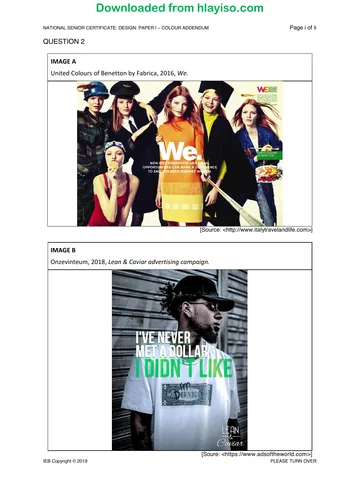
2.1 Candidates must refer to the features in the banner; they cannot generalise.
Identify: The butterfly in the hair/the pink shirt is stereotypically associated
with young girls.
The use of young girls – stereotypically associated with natural
beauty.
Generalised observations may lead to conclusions regarding stereotyping. Award
one mark here.
Reason: They are often used to quickly reference young girls in Western
visual language.
Young girls are often associated with purity, innocence and natural
beauty, in other words, with a good self-image. A young boy can
also be used as self-esteem applies to both genders.
2.2 Dove's corporate colour; it copies their packaging. White is associated with
purity. Blank canvas on which to place the message.
2.3 Typography emphasises the message. Three different fonts are used: Dove
corporate italic script (by Ian Brignell); a handwriting script that embodies the
word "movement" (angled/italicised in the opposite direction to Dove and
placed at an angle between Dove and self-esteem); a bold sans serif/slab
font similar to Arial "for Self-Esteem" implying stability.
Candidates must refer to specifics of how the typography catches the
reader's eye. NO GENERALISATIONS.
2.4 The symbolism of the billboard: The "bubble-blowing" is a child-like and fun-
filled, optimistic activity; the doves grow in scale implying building of self-
esteem; the use of blues/ various angles of the doves implies variety and
peacefulness/a flowing together.Black pride: elevating the life of previously
disadvantaged groups.
IEB Copyright © 2017 PLEASE TURN OVER
Downloaded from hlayiso.com
NATIONAL SENIOR CERTIFICATE: DESIGN: PAPER I – MARKING GUIDELINES Page 4 of 14
QUESTION 3 VISUAL ANALYSIS
Cognitive skills MARKS LEVEL
Analysis of LOWER: MIDDLE: HIGHER:
Level of
question 3 Knowledge, Comprehension, Analysis,
Difficulty
Recall Application Synthesis
3.1 2 2 Difficult
3.2 2 2 4 Difficult
3.3 1 1 2 Difficult
Weighting 0 0% 3 38% 5 62% 8
This question requires that candidates analyse one of the designs using the
headings provided. The analysis must convey a clear sense that the candidate
understands visual analysis. There cannot be any confusion between terms.
The use of design vocabulary is important in the answers to this question and a
suitable level of design-speak should be evidenced in the answer. However, it is
important that allowance be made for some variation in the analysis of the images.
There must be a relationship between the element and principle.
3.1 Element 3.2 Principle
(1 mark each) (1 mark per principle, 1 mark for
explanation) They can cite a
principle without being awarded a
mark for the explanation.
A choice from the elements Different principles need to be
provided. Analysis should used: Unity, Contrast,
consider the symbolic, emotional, Dominance/ Emphasis, Variety,
schematic or relationships of Repetition/Rhythm, Harmony,
elements. Balance, Gradation, Proportion,
Directional forces, Movement,
Form/texture/colour/space/ line Simplicity, Dissonance. If
contrast is used with the first
element, it cannot be repeated
with other elements.
Candidates may have missed the instruction to circle the image they will be
analysing. Look for indicators further down in the explanation.
A sample of possible responses could be as follows:
IMAGE B
3.1 3.2
3.1.1 The paper form is curved 3.2.1 The brooch plays with the
around the central petals in proportions of the two different
multiple transparent cups cup sizes, placing the smaller
mimicking natural forms. cup inside of the larger "petal"
group and inserting even
smaller organic forms into the
very central area of the brooch.
3.1.2 Lines of various thicknesses 3.2.2 The lines are arranged at
and lengths encapsulate/frames irregular intervals from behind
the central core of the brooch. the central core of the brooch
affecting the dispersion typical
of Radial Balance.
IEB Copyright © 2017 PLEASE TURN OVER
Downloaded from hlayiso.com
NATIONAL SENIOR CERTIFICATE: DESIGN: PAPER I – MARKING GUIDELINES Page 5 of 14
IMAGE C
3.1 3.2
3.1.1 A limited neutral colour palette 3.2.1 The contrast between the stark
of the faces against the white bright white of the background
background provides a warm foil and the nuances in colour of the
for the pop of red colour in the two faces creates a frame for
Coca Cola bottle. the bright colour of the miniature
bottle.
3.1.2 An intimate closed space is 3.2.2 The simplicity of the image is
created between the two faces, largely due to the dominant
as they lean in to each other placement of the triangle
and form the silhouette of a negative space, which frames
Coke bottle. the smaller coke bottle.
IMAGE D
3.1 3.2
3.1.1 The surface texture of the 3.2.1 Dominance is established by
cinema appears as if the cube is drawing the creases into a
wrapped in a scrunched metallic raised knot on the corner of the
material. The cube takes on the building. The position of the
appearance of a wrapped crease pulls the eye from the
present. straight clean lines of the other
box shapes to the complexity of
the cinema.
3.1.2 Implied lines are created by the 3.2.2 The Directional forces draw
edges of the surface material the gaze from the edge of cube,
creating highlights and where the surface knot pulls the
shadows. attention, or alternately
dissipates the gaze to the
corners of the building.
3.3 Possible answers on the Gestalt principles used to organise things into
unified wholes in IMAGE A or C could include:
Image A: Uniform connectedness: The flow of doves in increasing size
appears to be a stream blown through a bubble blower.
Proximity: The doves appear to be a stream flowing out of a
bubble maker because of the close proximity of the doves to one
another.
Image C: Figure-ground: The profile of the two faces forms the silhouette
of a coke bottle producing the secondary shape central to the
poster. A description of the foreground – background will be
awarded a mark.
Size relationship: The image is drawn together by using the
same familiar shape of the coke bottle in different sizes.
Continuation; Closure; Contiguity; Alignment; Pragnanz
IEB Copyright © 2017 PLEASE TURN OVER
Downloaded from hlayiso.com
NATIONAL SENIOR CERTIFICATE: DESIGN: PAPER I – MARKING GUIDELINES Page 6 of 14
QUESTION 4 BUSINESS AND DESIGN TERMINOLOGY
Cognitive skills MARKS LEVEL
Analysis of LOWER: MIDDLE: HIGHER:
Level of
question 4 Knowledge, Comprehension, Analysis,
Difficulty
Recall Application Synthesis
4.1.1 1 1 Average
4.1.2 1 1 Difficult
4.2.1 1 1 Average
4.2.2 2 2 Difficult
4.3 3 3 Average
Weighting 2 25% 5 62,5% 1 12,5% 8 0 0%
The answers given by candidates must be framed specifically within the context of
business. A clear understanding of the terminology must be demonstrated in the
answers. The candidate must explain how the given case study exemplifies the
term.
4.1.1 Brand philosophy is based on the thinking of a corporation; building identity
from the intangible values and attitudes held by the company.
4.1.2 MINI is about forging new paths, doing what others do not do; sharing
personal journeys. Alternate views of the rear of the MINI signify different
views held by the company. Rebellion; individuality – being different.
4.2.1 Visual merchandising involves the presenting of designs to show the
company in the best light: storefronts, signage layouts.
4.2.2 The storefront uses the visual language of clothing shops rather than
vehicles used for the MINI storefront. MINI does not show the cars in the
way everyone else does. They focus on developing unique identity to
emulate/match the unique stories of MINI owners.
4.3 Viral merchandising involves the use of social media to promote MINI:
techniques include the use of celebrity brand ambassadors, like Serena
Williams et al, via Twitter or Instagram feature in the #. Brand storytelling
connects MINI to significant successes and personal growth. Mini uses
experiences to engage with people and grabs attention with the non-
traditional ambient outdoor advertising.
No repeating of previous answers.
IEB Copyright © 2017 PLEASE TURN OVER
Downloaded from hlayiso.com
NATIONAL SENIOR CERTIFICATE: DESIGN: PAPER I – MARKING GUIDELINES Page 7 of 14
SECTION B DESIGN IN CONTEXT – HISTORICAL
Cognitive skills MARKS LEVEL
Analysis of LOWER: MIDDLE: HIGHER:
Level of
question 5 Knowledge, Comprehension, Analysis,
Difficulty
Recall Application Synthesis
Facts 6 3 (Comprehension) 9 Average
Analysis 9 9 Difficult
2 (Evaluation)
Context 3 7 Difficult
2 (Synthesis)
Terminology 3 3 Average
Structure 1 1 2 Easy
TOTAL 9 8 13 30
Weighting 9 30% 8 27% 13 43%
The marker should read through the essay, ticking relevant facts/terms/points/
analysis.
To enable accurate moderation, markers should place their ticks DIRECTLY
ABOVE/ON the fact/term/concept being awarded the mark and NOT in the
margin.
Thereafter, each tick given must be categorised by writing: F for facts, A for
analysis, C for context, T for terminology and S for structure next to the
relevant tick. Use the detailed explanation that follows.
At the end of the essay, the totals for F, A, C, T and S should be clearly noted.
It is possible that an essay has ONLY facts, but lacks context. If the candidate
receives 13 ticks for facts, write F 9 max and C 0.
Repeated information can be marked with an R.
If no marks can be awarded, a bracket can be drawn around the information
and marked as "seen" in the margin.
Substantiation of facts is essential.
Students cannot merely write a rehearsed essay on a movement.
Marks awarded in this compulsory essay are indicated and allocated according to
the following grid as outlined in the examination paper.
IEB Copyright © 2017 PLEASE TURN OVER
Downloaded from hlayiso.com
NATIONAL SENIOR CERTIFICATE: DESIGN: PAPER I – MARKING GUIDELINES Page 8 of 14
Maximum
Label Criteria
marks
ONE FACTUAL MARK should be awarded for each relevant and correctly
spelt designer (marks are awarded at the first mention; not subsequent
naming).
ONE FACTUAL MARK for each relevant and correctly spelt design work
that is an appropriate example to substantiate the answer.
Listing of designs should be avoided: a minimum of two designers/two
Facts
works; maximum of three designers/three works. (If other works are
F 9
discussed in detail, marks should be awarded under Analysis for the
discussion, but not for the name of the work.) NO LISTING.
ONE FACTUAL MARK should be awarded for each relevant and correct
date/fact regarding the design works/movements. NO LISTING OF DATES
OR PLACES.
Any extraneous facts outside the reference of the question should be
ignored.
ONE ANALYSIS MARK should be awarded for each relevant and correct
description, analysis and discussion of a design work/style.
Analysis
The purpose of analysis is to support the argument/discussion. This goes
A 9
beyond providing a mere analysis of elements and principles to looking at
how it shapes our understanding of the designs answering the question.
No marks should be awarded for invalidated value judgements.
ONE CONTEXT/ARGUMENT MARK should be awarded for each relevant
Context/Argument 3 argument 4 context
contextual factor informed by the specific question.
These factors can relate to the relevant political, social, cultural, economic
and environmental circumstances that had an impact on the designed
C products. Reference to the biographical details of designers is mostly 7
irrelevant, unless they apply to the designs themselves or to the specific
question.
Any extraneous context factors outside the reference of the question
should be ignored.
ONE TERMINOLOGY MARK should be awarded for each relevant and correct
Terminology
term used/relevant use and level of "design-speak".
The use of correct design terms, language and references will be an indicator
T 3
of the quality of the answers. The meaning of the term may be indicated in
brackets as a "footnote" to the discussion. Preferably located outside of the
visual analysis of designs unless this is unavoidable.
ONE STRUCTURE MARK to be awarded for an appropriate introduction,
AND/OR appropriate and relevant conclusion, clearly responding
Structure
to/addressing the issues being asked in the question. If the introduction does
NOT CLEARLY address the specific question, no mark is to be awarded.
S 2
ONE STRUCTURE MARK for an adequate length essay, ideally three and
half pages. The argument/discourse should flow logically and should be written
in full sentences with no point-form listing of facts. Headings may be used. DO
NOT MARK NEGATIVELY JUST BASED ON LENGTH.
TOTAL 30
IEB Copyright © 2017 PLEASE TURN OVER
Downloaded from hlayiso.com
NATIONAL SENIOR CERTIFICATE: DESIGN: PAPER I – MARKING GUIDELINES Page 9 of 14
QUESTION 5
Theme: Designs and people: reflecting societal values
Introduction:
Candidates select which Design movement/style has the clearest reflection of
societal values.
The connection between CONTEXT and DESIGN is essential.
For example:
Pop-luxe – embraces popular culture and focuses on creating lifestyle.
Anti-Design – contends with mainstream popular culture, designing impossible
designs to demonstrate the problems with the consumerist tendencies of culture.
Punk – shock to the establishment – challenge to status quo.
Memphis – new style; the shock factor grabbed attention because of low brow
"subject matter"; the use of kitsch; the combination of different materials – cheap
and expensive; the function of works is not as significant as its appearance
(Sottsass's Carlton bookcase); over-emphasis on decoration makes it difficult to
ignore designs; references to past and other figurative designs (Mendini's Proust
chair).
High-Tech – mirrors the fascination with technology and the new machine age,
creating expensive designs that focus on the increasing fascination with
developing new technology.
PoMo – superstardom is visible in the rise of known superstar designers.
Positive attitudes to life seen in the colourful graphics and quirky architecture.
Deconstruction – Civil Wars, Gulf War and 9/11 – the fragmentation of life is visible
in the deconstruction of designs.
IEB Copyright © 2017 PLEASE TURN OVER
Downloaded from hlayiso.com
NATIONAL SENIOR CERTIFICATE: DESIGN: PAPER I – MARKING GUIDELINES Page 10 of 14
SECTION C DESIGN IN CONTEXT – CONTEMPORARY
Learners need to answer TWO questions and may not repeat the same
information in different answers! Please check against other answers to ensure
no duplication of specific information has occurred. If a different aspect of a design
is discussed, it may be credited. Where "½ designer + ½ design" is required,
candidates must provide both to receive the full mark. If only ½ the answer is
provided, they receive "0". This applies to Questions 6.1, 6.2, 7.1, 7.2, 8.1 and 8.2.
6.1 - 8.2 Refers to case studies: candidates cannot be penalised for lack of
designer, but they need to substantiate (not listing of designer name and
design: a definition and link through the design case study.) Marks may be
awarded for explanations.
QUESTION 6
Cognitive skills MARKS LEVEL
Analysis of LOWER: MIDDLE: HIGHER:
Level of
question 6 Knowledge, Comprehension, Analysis,
Difficulty
Recall Application Synthesis
6.1 2 1 1 4 Difficult
6.2 2 1 1 4 Difficult
6.3 4 2 6 12 Moderate
Weighting 8 40% 4 20% 8 40% 20
6.1 Pre-cycling attempts to limit or reduce packaging, especially plastic. Product
Life-cycle considers the environmental impact and energy consumption of a
design throughout the various stages of its lifespan from raw material
harvesting, manufacture, transport, use and disposal. Leo Burnett's Just
campaign for WWF introduces consumers to both concepts by creating bio-
degradable packaging sporting the shape of the well-known bottles as a
cut-out feature on the packaging. These are filled with natural materials like
lemons and cinnamon, accompanied by information about the cleaning
products and then explaining how the environmental impact of the raw
materials is less than manufacturing chemical alternatives, thus addressing
the product life cycle.
6.2 Mutualism purports that mutual dependence is necessary for social well-
being. Hybridisation combines two or more fields of study or design
contexts into a design. Both seek to look at establishing the whole instead
of developing and maintain separate or individual strengths. BIG's
Serpentine Pavilion is both operating as a hybrid between furniture and
architecture, but was developed to allow the outside into the space and to
simultaneously be the gate to the Gallery. Amy Congdon's Biological
Atelier brings together various areas of study into her hybridised
materials.
6.3 The candidates should discuss one local and one international designer
(from the lists below) who work in an environmental context and exemplify
mindful living.
A description of their most suitable work;
An analysis of both designs; and
A discussion of how chosen designers can be called Ontological.
IEB Copyright © 2017 PLEASE TURN OVER
Downloaded from hlayiso.com
NATIONAL SENIOR CERTIFICATE: DESIGN: PAPER I – MARKING GUIDELINES Page 11 of 14
Example:
Local Int total
N Names of designers 1 1 2
F Titles and brief description of works 1 1 2
V Discussion of works/analysis of designs 3 3 6
R Relate these works to Ontological design 1 1 2
Local designers and designs
Touching the Earth Lightly Green Shack; Liter of light pavilion; Sea Shell
Showers/Fireproof Shack; Ayob's Lighthouse
Eco Design (Andy Horn) Jeffreys Bay Wind Farm Visitors centre; ORT
Narrative and Environmental Centre;
Twinstreams Environmental Centre
...XYZ Freeplay radio; socket; Microbial fuel cell;
Second-use packaging
Heath Nash Other People's Rubbish: Flowerball;
bottleball; TopMat
International designers and designs
Alexander Taylor Fold Light; Adidas Parley; Grip torch
Vincent Callebaut Tao Zhu Yin Yuan; The Gate Residence;
Lilypad
Iris van Herpen Synesthesia; Biopiracy; Quaquaversal;
Wilderness Embodied
Bouroullec brothers Serif TV/Treilles/Fontaine/Stampa chair/
cloud vases/Algue/felt, modular insulation
Wieden+Kennedy Dress Normal – Play your Stripes/Ballet
Font/the GRID (Nike); Nature City for MOMA
exhibition "Foreclosed: Reassembling the
American dream"
AND/OR
IEB Copyright © 2017 PLEASE TURN OVER
Downloaded from hlayiso.com
NATIONAL SENIOR CERTIFICATE: DESIGN: PAPER I – MARKING GUIDELINES Page 12 of 14
QUESTION 7 DESIGN IN A SOCIAL CONTEXT
Cognitive skills MARKS LEVEL
Analysis of LOWER: MIDDLE: HIGHER:
Level of
question 7 Knowledge, Comprehension, Analysis,
Difficulty
Recall Application Synthesis
7.1 2 1 1 4 Difficult
7.2 2 1 1 4 Difficult
Above
7.3 4 2 6 12
average
Weighting 8 40% 4 20% 8 40% 20
7.1 Social regeneration uses design to address social issues like crime through
design upliftment. In many areas, it is closely linked to the Housing crisis
and can be used alongside social regeneration. The 10 × 10 Housing
project, which was tackled by numerous architects like MMA, gave rise to
many projects that addressed both issues. Alejandro Aravena (Elemental)
created the Children's Bicentennial Park as part of a social regeneration
project.
7.2 Equitable access ensures that all people, irrespective of gender, race, class
or disability are able to enjoy the fruit of designs. As urbanisation increases,
transportation and urban mobility have become increasingly important for all
stakeholders to ensure city planning as the design of vehicles meet
sustainable goals. Thomas Heatherwick's Routemaster bus attempted to
address the transportation need but fell short on costs. Fuseproject
addresses equitable access through the OLPC project, which desires to see
access to knowledge available to third-world schools.
7.3 Candidates should identify two socially-conscious designers from the lists
below, one local and one international, who could be profiled.
Describe significant contributions they are making
– by referring to works they have produced.
Elaborate on their inclusion as Ontological designers.
Local designers and designs
Tsai Design Studio Safmarine-Vissershoek Primary School; Nested
bunk beds; Pony desk chair
Joe Public HIV Army or State of the Nation (Brothers for Life);
Project English or Project Space (One School at a
Time); Fonts for the Future
IDESO Mellow cabs; Mosquito repellent light; LifeQ;
Weather cloud
Monkeybiz (The Haas Afreaks (Mushrooms, creatures, couch);
Sisters)/The Haas Brothers
and Bronze Age Foundry
(R & Company)
Lovell Friedman Rock Girl Mitchell's Plain Hospital: "Healing the world, healing
the environment"; Garden of hope; Rock Girl bench;
We are still here; MyCiti Green Point Station mural
IEB Copyright © 2017 PLEASE TURN OVER
Downloaded from hlayiso.com
NATIONAL SENIOR CERTIFICATE: DESIGN: PAPER I – MARKING GUIDELINES Page 13 of 14
International designers and designs
Marco van Beers Intimate Design: The Tokens, the Necklace, The
heartbeat; Streetlife; Glow – brain pulse
Shigeru Ban Modular housing for Nepal Project ; Kobe Catholic
Church and refugee housing; Christchurch
Cathederal
Fuseproject Snoo; UP2rope; OLPC; See Well to Learn Better;
Vessyl
Benjamin Hubert (Layer) GO wheelchair, GO gloves, Bitossi Ceramiche, Pair
Chair
Bjarke Ingels (BIG) Mountain Dwellings/Sluishuis/Oslo Governmental
Quarters/Google North Bayshore/Spectrum Square/
Watch Flower; Serpentine Pavillion
Fabrica (post 1985) Be part of the Solution; Water Culture; HIV
campaigns; UnHate
Thomas Heatherwick Seed Cathedral/Nanyang Technological University
Learning Hub/Routemaster
Alejandro Aravena Quinta Monroy/UC Innovation Centre/Siamese
(Elemental) Towers
AND/OR
QUESTION 8 DESIGN IN A CULTURAL CONTEXT
Cognitive skills MARKS LEVEL
Analysis of LOWER: MIDDLE: HIGHER:
Level of
question 8 Knowledge, Comprehension, Analysis,
Difficulty
Recall Application Synthesis
8.1 2 1 1 4 Difficult
8.2 2 1 1 4 Difficult
Above
8.3 4 2 6 12
average
Weighting 8 40% 4 20% 8 40% 20
8.1 Homage is a show or demonstration of respect or dedication to someone or
something, sometimes by simple declaration but often by some more
oblique reference, artistic or poetic. Revivalism echoes or imitates previous
eras and may involve the desire to revive former practices or customs; to
look backwards for an aesthetic. Hella Jongerius pays homage to
traditional production methods through the Shippo ceramics or Beads and
Things. She also encourages traditional crafters to revive methods of
production that have been passed down through the generations
(revivalism).
8.2 Vernacular, in respect of design, refers to the visual language of a country
or locality, incorporating the patterns, colours, styling and methods of
building that set it apart from other areas. Archetypes are universal patterns
of theme or form resulting from innate biases or dispositions, often focused
on elevating a hero. Peter Mabeo uses the vernacular language of the local
crafting of Botswana in the styling and aesthetic of his furniture. The Kika
Stool bears a striking resemblance to traditional headrests Coca Cola
under David Butler use archetypes to build their brand; the 2016 "Unsung
Heroes"/Everyday Hero campaigns sought to find heroes within the
community.
IEB Copyright © 2017 PLEASE TURN OVER
Downloaded from hlayiso.com
NATIONAL SENIOR CERTIFICATE: DESIGN: PAPER I – MARKING GUIDELINES Page 14 of 14
8.3 Candidates need to discuss the work of TWO contemporary designers,
ONE local and ONE international who reflect our rapidly changing identity
through Ontological Design.
Name of designers
Titles of work
Discussion of works
Explanation of Ontological characteristics.
Local Int total
N Names of designers 1 1 2
F Titles and brief description of works 1 1 2
V Discussion of works/analysis of designs 3 3 6
R Relate these works to Ontological design 1 1 2
Local designers and designs
MaXhosa by Laduma Mntanom'Gquba/'Buyele'Mbo'; Amakrwala;
(Laduma Ngxokolo) 'My Heritage, My Inheritance' collections
IMISO: Andile Dyalvane and Scarified/Africasso/Handpinched
Zizipho Poswa collections
Peter Rich Mapungubwe Interpretation Centre;
Alexandria Heritage Centre; Makuleke
Cultural Project; The Earth Pavilion with
Michael Ramage
Atang Tshikare (Zabalazaa) Wall papered/Fold/Where we at? Benches/
We're right here
Haldane Martin Nandos Headoffice/Truth Coffeeshop; Zulu
Mama; Mad Giant Craft Beer; Solveig
Gloo (O&M) Eyes play tricks; Puma Social Club; FNB
Switch Campaign
Dokter and Misses Kassena server, Die Laaste Braai, Sun City
International designers and designs
Marcel Wanders Cyborg Wicker/Blue Ming/Grandfather clock
(Jardin d'Eden)
Timorous Beasties NetJets' Moth tailwrap; Indie Wood;
Glasgow Toiles; Darwin; Raeberry
Hella Jongerius Shippo plates; Beads and Pieces; Taking a
Stance; Four seasons
Neri Oxman Mushtari; Anthozoa with Iris van Herpen;
Silk Pavilion
Tord Boontje Come Rain Come Shine; Little field of
flowers; The Lacemaker; Table Stories
David Butler Unsung Heroes / Everyday Hero; the Coca
Cola movie; Ramadan cans
Jean Nouvel Qatar National Museum; Louvre Museum
Abu Dhabi; Imagine Institute; RBC Design
Center; Archipel Theatre
Total: 100 marks
IEB Copyright © 2017
Study this subject
Revise the topics in this paper, then practise them question by question.
- Grade 12 Design notes
CAPS revision notes with worked examples.
- Design questions by topic
Past exam questions sorted by CAPS topic, with memos where available.
- All Grade 12 Design past papers
Past papers by year, with memos where available.
- Grade 12 IEB past papers
More Design and other subjects in this collection.
Recommended for this subject
More papers and memos for this grade and subject.
MemorandumIEB
Design Grade 12 IEB Paper 1 2019 Memo
MemorandumIEB
Design Grade 12 IEB Paper 1 2018 Memo
AddendumIEB
Design Grade 12 IEB 2019 Addendum
Question paperIEB
Design Grade 12 IEB Paper 1 2019 Question Paper
Question paperIEB
Design Grade 12 IEB Paper 1 2018 Question Paper
AddendumIEB