
Downloaded from hlayiso.com
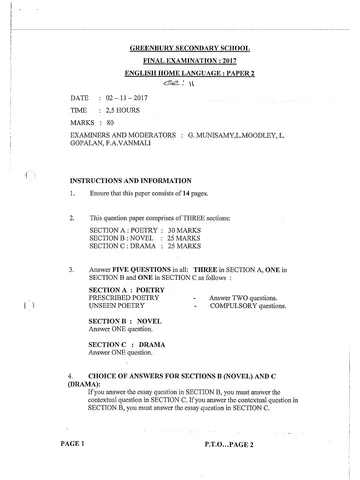
GREENBURY SECONDARY SCHOOL
FINAL EXAMINATION : 2017
ENGLISH HOME LANGUAGE : PAPER 2
AZ! \\
DATE : 02-11-2017
TIME : 2,5 HOURS
MARKS : 80
EXAMINERS AND MODERATORS : G. MUNISAMY,L.MOODLEY, L.
GOPALAN, F.A.VANMALI
INSTRUCTIONS AND INFORMATION
1 Ensure that this paper consists of 14 pages.
2. This question paper comprises of THREE sections:
SECTION A: POETRY : 30 MARKS
SECTION B: NOVEL : 25 MARKS
SECTION C: DRAMA : 25 MARKS
3. Answer FIVE QUESTIONS in all: THREE in SECTION A, ONE in
SECTION B and ONE in SECTION C as follows :
SECTION A : POETRY
PRESCRIBED POETRY - Answer TWO questions.
UNSEEN POETRY - COMPULSORY questions.
SECTION B : NOVEL
Answer ONE question.
SECTION C : DRAMA
Answer ONE question.
4. CHOICE OF ANSWERS FOR SECTIONS B (NOVEL) AND C
(DRAMA):
If you answer-the essay question in SECTION B, you must answer the
contextual question in SECTION C, If you answer the contextual question in
SECTION B, you must answer the essay question in SECTION C,
PAGE 1 P.T.O...PAGE 2
You're offline
Skip to contentQuestion paper and memo 



View all


ENG P2 Sept QP & Memo 2017 Gr11 hlayiso.com
English Hl · Grade 11 · September Test · 2017. Question paper and memorandum, 24 pages. Read online or download the PDF.
- Subject
- English Hl
- Grade
- Grade 11
- Document type
- Question paper and memo
- Year
- 2017
- Exam period
- September Test
- Paper
- 2
- Pages
- 24
- File size
- 1.7 MB
Loading document…
Loading document…
1 of 24
Document textSearch extracted text and jump to a page.
Downloaded from hlayiso.com a
5. LENGTH OF ANSWERS:
e The essay question on POETRY should be answered in about 250 -
300 words.
* Essay questions for NOVEL and DRAMA should be answered in 400
~ 450 words. ,
© The length of answers to contextual questions should be determined by
the mark:allocation. Aim for conciseness and relevance.
6. Carefully follow the instructions at the beginning of each section,
7. Number your answers according to the numbering system used in this paper. , C }
8. Start EACH section on a NEW page.
9. LEAVE A LINE between each answer.
10. SUGGESTED TIME MANAGEMENT:
* SECTION A : approximately 40 minutes,
« SECTIONB : approximately 55 minutes,
* SECTION C : approximately 55 minutes.
11. Write neatly and legibly with a dark blue pen.
PAGE 2
Downloaded from hlayiso.com
SECTION A: POETRY
{
r
PRESCRIBED POETRY
Answer any TWO of the following questions.
QUESTION 1: POETRY ~ ESSAY QUESTION
Read the poem below and answer the question that follows.
Let me not to the marriage of true minds — William Shakespeare
(Sonnet 116)
Let me not to the marriage of true minds
Admit impediments. Love is not love
Which alters when it alteration finds,
Or bends with the remover to remove:
O, no! it is an ever-fixed mark, 5
That looks on tempests and is never shaken;
It is the star to every wandering bark,
Whose worth’s unknown, although his height be taken.
Love’s not Time’s fool, though rosy lips and cheeks
Within his bending sickle’s compass come; 10
Love alters not with his brief hours and weeks,
But bears it out even to the edge of doom.
If this be error, and upon me prov’d,
I never writ, nor no man ever lov’d.
In “LET ME NOT TO THE MARRIAGE OF TRUE MINDS” the speaker claims that true love
lasts forever.
Critically discuss this statement by making close reference to diction, imagery and tone.
Your response should take the form of a well-constructed essay of 250-300 words (about ONE
page)
[10]
PAGE 3 P.T.O...PAGE 4
QUESTION 2: POETRY — CONTEXTUAL QUESTION
Read the poem below and then answer the questions that follow.
Decomposition — Zulfikar Ghose
Ihave a picture I took in Bombay
of a beggar asleep on the pavement:
grey-haired, wearing shorts and a dirty shirt,
his shadow thrown aside like a blanket.
His arms and legs could be cracks in the stone,
routes for the ants’ journeys, the flies’ descents.
Brain-washed by the sun into exhaustion,
he lies veined into stone, a fossil man.
Behind him, there is a crowd passingly
bemused by a pavement trickster and quite
indifferent to this very common sight
of an old man asleep on the pavement,
I thought it then a good composition
And glibly called it The Man in the Street,
Remarking how typical it was of
India that the man in the street lived there.
His head in the posture of one weeping
into a pillow chides me now for my
presumption at attempting to compose
art out of his hunger and solitude.
2.1 How does the word “shorts” (line 3) contribute to your understanding of the beggat’s
suffering?
10
15
20
2.2 Refer to line 11: “indifferent to this very common sight”
Explain what this description reveals about Bombay’s society.
2.3 Refer to line 8: “he lies veined into stone, a fossil man”
Comment on the appropriateness of “fossil man” in the context of the poem.
2.4 At the end, the speaker has a complete change of attitude.
Downloaded from hlayiso.com
@)
@ ©
(3)
Do you agree with this statement? Justify your response by referring to the diction in the last two
stanzas (lines 13 — 20).
PAGE 4
P.T.O...PAGE 5
(3)
{10]
Downloaded from hlayiso.com
QUESTION 3: POETRY - CONTEXTUAL QUESTION
t)
Read the poem below and then answer the questions that follow.
A woman is not a potted plant — Alice Walker
A woman is not a potted plant
her roots bound
to the confines
ofherhouse 4
a woman is not
a potted plant
her leaves trimmed
to the contours
of her sex q
a woman is not
a potted plant
her branches
espaliered
against the fences
ofherrace 16
her country
her mother
her man
her trained blossom
turning this way 2°
and
that
to follow
the sun
of whoever feeds 26
and waters
her
a woman
is wilderness
unbounded Bo
holding the future
between each breath
walking the earth
only because
she is free 3S
and not creeper vine
or tree
Nor even honeysuckle
ot bee, Bq
PAGES5 P.T.O...PAGE 6
Downloaded from hlayiso.com
3.1 Account for the structure of this poem? (2)
3,2 What does the word “contours” (line 8) mean in the context of stanza 2? (2)
3.3 Refer to lines 16 - 18: “‘ her country. ..her man”
Explain clearly why the poet makes specific mention of “country, mother, man” at this point in the
poem. (3)
3.4 Refer to lines 28 — 39: “a woman is wilderness...or bee.”
Critically discuss how the metaphors in these lines support the message of the poem? (3)
[10]
QUESTION 4: POETRY — CONTEXTUAL QUESTION
Read the poem below and then answer the questions that follow.
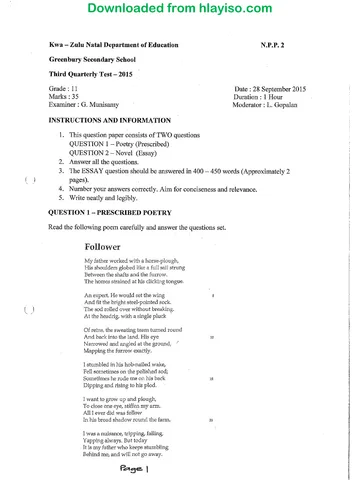
Follower — Seamus Heaney
My father worked with a horse-plough,
His shoulders globed like a full sail strung
Between the shafts and the furrow.
The horses strained at his clicking tongue,
An expert. He would set the wing 5
And fit the bright steel-pointed sock.
The sod rolled over without breaking,
At the headrig, with a single pluck
Of reins, the sweating team turned. round '
And back into the land. His eye 10
Narrowed and angled at the ground,
Mapping the furrow exactly.
I stumbled in his hob-nailed wake,
Fell sometimes on the polished sod;
Sometimes he rode me on his back 15
Dipping and rising to his plod.
I want to grow up and plough,
To close one eye, stiffen my arm.
All I ever did was follow
In his broad shadow round the farm. 20
I was a nuisance, tripping, falling,
Yapping always. But today
It is my father who keeps stumbling
Behind me, and will not go away.
PAGEG "pao. .PAGE 7
Downloaded from hlayiso.com
4.1 What does the word “expert” (line 5) suggest about the son’s feelings towards his father? (2)
4.2 Refer to lines 21 — 22: “I was a nuisance, tripping, falling, yapping always.”
Account for the inclusion of the list in the above lines. (2)
4.3 Refer to lines 20 — 21: “All I ever did was follow in his broad shadow.”
Comment on the appropriateness of the “shadow” image in the context of the poem, (3)
4.4 Refer to lines 22 — 24: “But today... .not go away.”
Discuss the irony in the above lines, (3)
[10]
UNSEEN POETRY (COMPULSORY)
QUESTION 5: CONTEXTUAL QUESTION
Read the poem below and then answer the questions that follow.
ALONE - Maya Angelou
Lying, thinking last night
How to find my soul a home
Where water is not thirsty
And bread is not stone
I came up with one thing 5
That nobody, but nobody
Can make it out here alone
There are millionaires
With money they can’t use
Their wives run around like banshees 10
Their children sing the biues
They’ ve got expensive doctors
To cure their hearts of stone.
But nobody
No, nobody 15
Can make it out here alone
Storm clouds are gathering
The wind is gonna blow
The race of man is suffering
And I can hear the roan 20
Cause nobody
But nobody
Can make it out here alone
GLOSSARY: banshee — female who wails to warn of death approaching
PAGE 7 oe P.T.O...PAGE 8
Downloaded from hlayiso.com
5.1 Account for the repetition of “nobody Can make it out here alone” in every stanza. (2)
5.2 What impression is created of “millionaires” in stanza 2? (2)
5.3 Refer to lines 3 — 4: “Where water is not thirsty And bread is not stone”
Explain clearly how these lines contribute to your understanding of the poet’s message. (3)
5.4 Refer to lines 17 — 18: “Storm clouds are gathering The wind is gonna blow”
Comment on the appropriateness of this image in the context of the poem, (3)
[10]
TOTAL - SECTION A: 30
PAGE 8
‘P.T.O...PAGE9 —
©
Downloaded from hlayiso.com
()
SECTION B: NOVEL - THINGS FALL APART — CHINUA ACHEBE
Answer EITHER QUESTION 6 (essay question) OR QUESTION 7 (contextual question).
QUESTION 6: THINGS FALL APART - ESSAY QUESTION
The missionaries are responsible for Okonkwo’s downfall.
Critically discuss the extent to which you agree with the above statement.
Your response should take the form of a well-constructed essay of 350-400 words
(1% - 2 pages). [25]
OR
QUESTION 7: THINGS FALL APART - CONTEXTUAL QUESTIONS
Read the extracts below and then answer the questions that foliow.
EXTRACT A
One of the men behind him cleared his throat. Ikemefuna {
looked back, and the man growled at him to go on and:not
stand looking back. The way he said it sent cold fear down
Ikemefuna’s back. His hands trembled vaguely on the black
pot he'carried, Why had Okonkwo withdrawn to the rear?
| Ikemefuna felt his legs melting under him. And he was _ |!
| afraid to look back. 7,
As the man who had cleared his throat drew up and raised
his matchet, Okonkwo looked away. He heard the blow.
“The pot fell and broke in the sand, He heard Ikemefuna cry,
“My father, they have killed me!” as he ran towards him.
Dazed with fear, Okonkwo drew his matchet and cut him
down. He was afraid of being thought weak. > i)
As soon as his father walked in, that night, Nwoye knew
that Ikemefuna had been killed, and something seemed to :
give way inside him, like the snapping of a tightened bow.
He did not cry. He just hung limp. WJ
PAGE 9 P.T.O...PAGE 10
Downloaded from hlayiso.com
7.1. Refer to lines 3-4: “.........it sent cold fear down Ikemefuna’s back.’
Outline the events that led to kemefuna’s death. (3)
7.2. Refer to line 10: ‘The pot fell and broke in the sand.’
In view of happenings later in the text, why is the above statement symbolic? —_(3)
7.3. Refer to lines 12-13: ‘Okonkwo looked away’ (line 9) yet, ‘drew his machet and cut
him down,’ (lines 12 — 13).
Comment on Okonkwo’s decision to participate in Ikemefuna’s death. (3)
7.4. _ Discuss the effectiveness of the figure of speech in line 15-16: ‘and something
seemed ... like the snapping of a tightened bow.” (3) ( J
7.5. The above extract highlights the writer’s disapproval of some tribal practices of the
Ibo society.
Do you agree with this point of view? Justify your answer by referring to the novel.
(3)
EXTRACT B Obierika, who had been gazing steadily at his friend’s 1
dangling body, turned suddenly to the District Commis- :
sionet and said fetociously: “That man was one of the !
greatest men in Umuofia. You drove him to kill himself; i
and now he will be buried like a dog...” He could not say |
any more, His voice trembled and choked his words. !
“Shut up!” shouted one of the messengers, quite
unnecessarily. &
“Take down the body,” the Commissioner ordered his } C
chief messenger, “and bring it and all these people to the !
court.” :
“Yes, sah,” the messenger said, saluting. |
The Commissioner went away, taking three or four of the i
soldiers with him. In the many years in which he had toiled i
to bring civilisation to different parts of Africa he had learnt 15}
a number of things. One of them was that a District |
Commissioner must never attend to such undignified details
as cutting down a hanged man from the tree. Such attention |
would give the natives a poor opinion of him. In the book
which he planned to write he would stress that point. As he |
walked back to the court he thought about that book. Every |
day brought him some new material. The story of this man i
who had killed a messenget and hanged himself would make i
interesting reading. One could almost write a whole chapter I
on him. Perhaps not a whole chaptet but a reasonable as
paragraph, at any rate. There was so much else to include,
and one must be firm in cutting out details. He had already
chosen the title of the book, after much thought: The
Pacification of the Primitive Tribes of the Lower Niger.
PAGE 10 P.T.O...PAGE 11 |
Downloaded from hlayiso.com
7.6. Refer to lines 1-6: ‘Obierika, who had...........His words.
!s Obierika’s tone in these lines consistent with his character?
Motivate your answer by providing evidence from the text. (3)
7.7, Refer to lines 4-5: ‘You drove him to kill himself: and now he will be buried
like a dog.’
Discuss the irony in the above lines. (3)
7.8. By referring to the novel as a whole, critically discuss the impact the white
man has on the Ibo people. (4)
TOTAL [25]
PAGE 11
PT.O..2PAGER
Downloaded from hlayiso.com
SECTION C; DRAMA
Answer EITHER QUESTION 8 (essay question) OR QUESTION 9 (contextual
QUESTION 8: MACBETH ~ ESSAY QUESTION
Macbeth is a weak, gullible man who destroys Scotland to satisfy his greedy desires.
Discuss the extent to which you agree with the above statement.
Your response should take the form of well-constructed essay of 350-400 words
(1.5-2 pages).
OR
QUESTION 9: MACBETH ~ CONTEXTUAL QUESTION
EXTRACT |
PAGE 12
BANQUO:
FIRST WITCH:
: SECOND WITCH:
THIRD WITCH:
FIRST WITCH:
SECOND WITCH:
‘THIRD WITCH: :
FIRST WITCH:
” Banquo and Macbeth, all hail.
MACBETH:
Good sir, why do you start and seem to fear ‘
Things that do sound so fair’?—1’th’name of truth
Are ye fantastical, or that indeed
Which outwardly ye show? My noble partner
You greet with present grace and great prediction §
Of noble having and of royal hope
That he seems rapt withal. To me you speak not,
If you ean look into the seeds of time
And say which grain will grow and which will not,
Speak then to me, who neither beg nor fear 10
Your favours nor your hate.
Hail.
Hail.
Hail
Lesser than Macbeth, and greater. 1s
Not so happy, yet much happier.
Thou shalt get kings, though thou be none.
So all hail Macbeth and Banquo
Stay.you imperfect speakers, Tell me more, ao
By Sinel’s death, ] know | am Thane of Glamis,
But how of Cawdor? The Thane of Cawdor lives
A prosperous gentleman, and to be king
Stands not within the prospect of belief,
No more than to be Cawdor, Say from whence az
You owe this strange intelligence, or why
Upon this blasted heath you stop our way
With such prophetic greeting? Speak, ] charge you.
P.T.O...PAGE 13
ae Downloaded from hlayiso.com
9.1 Refer to lines 1-2: “Good sir, why do you......sound so fair?” PAGE
| Comment on Macbeth’s reaction to the witches’ prediction. (3}
9.2 Refer to lines 10-14: “Speak then .... Your hate,’
| In your opinion, are the above lines typical of Banquo’s character?
Motivate your response. (3)
» 9.3 Refer to line 17: “Thou shalt get kings, though thou be none.”
Explain the effect the prediction regarding Banquo will have on Macbeth
later in the text. (3)
{ . 1 ow
\) 9.4 Refer to lines 22-25: “The Thane of Cawdor lives.....Cawdor
Discuss the irony in these lines. (3)
9.5 Explain the symbolic significance of ‘this blasted heath’ (line 27). (3)
AND
EXTRACT J :
LADY MACBETH:
Out, damned spot! Out, I say! One, two, Why then ’tis time to do’t. !
Hell is murky. Fie, my lord, fie, a soldier, and afeard? What need we
fear who knows it, when none can call our power to account? Yet
~ who would have thought the old man to have had so much blood in ;
( - ) him? iy
DOCTOR:
Do you mark that?
LADY MACBETH:
The Thane of Fife had a wife, Where is she now? What, will these
hands ne’er he clean? No more o’that, my lord, no more o’ that. You
mar all with this starting, -*
DOCTOR: 1o |
Go to, go to; you have known what you should not. : |
GENTLEWOMAN:
She has spoke what she should not, | am sure of that.
Heaven knows what she has known,
LADY MACBETH:
Here’s the smell of the blood still; all the perfumes of
Arabia will not sweeten this little hand..O, O, O.
PAGE 13 ~~” P\T.O...PAGE 14
Downloaded from hlayiso.com
PAGE
9.6 Refer to lines 1-5: “Out, damned spot.....much blood in him.”
Discuss how these lines reflect Lady Macbeth’s state of mind. (3)
9.7 Refer to lines 7: “The Thane of Fife had a wife. Where is she now?”
Explain the effect ‘The thane of Fife’s’ visit to England has on his family. (3)
9.8 To what extent is it justifiable for an audience to pity Lady Macbeth?
Use the above extract as a starting point to motivate your answer. (4)
[25]
FINAL TOTAL: 80
GREENBURY SECONDARY SCHOOL
cc DEPARTMENT OF LANGUAGES
“PAGE 14
Downloaded from hlayiso.com
SUGGESTED ANSWERS TENA ~— Ge: il
QUESTION ONE — LET ME NOT TO THE MARRIAGE
Essay must include but not be limited to the following points, (structure:-1)
Introduction
Statement of theme of the permanent/never-changing/eternal nature of love.
Diction — various words with strong connotations of permanence.
“marriage” ~ legally binding, permanent contract expecting commitment of forever. Also, a covenant
made in the presence of God.
“this minds” not a base/carnal relationship motivated by emotion/lust/hormones but one founded
on understanding.
“bends” lacks flexibility/ability to “alter”
“never shaken” — adverb never expresses
certainty in loves ability to remain unmoved.
Imagery — all point to ability to withstand.
“ever-fixed mark” hyperbole emphasizes permanence
“marriage of true minds” commitment of mind and spirit/soul in God’s presence,
“mark” ~ metaphor: permanent alludes to birthmark.
“looks on tempests” — personification: Power greater than nature’s forces thus not threatened.
Tone ~ focus on absolute certainty of love’s permanence
“Never” — certainty, “O, no!” joyous conviction emphasised by exclamation. Rhyming couplet —
dramatic, Bold statement challenging in its certainty.
QUESTION TWO
DECOMPOSITION
2.1 The beggar, in the deprivation caused by poverty, has also lost his dignity and self-respect as he
is forced to wear the clothes of a little boy and expose himself in public.
2.2 Poverty is a serious/widespread (“common”) problem in Bombay to the extent that people have
become desensitised (“indifferent”) to it. Bombay’s people appear to lack compassion in their failure
to acknowledge the suffering of a fellow human being.
2.3 This metaphor suggests that the beggar is not recognised as a living, breathing human being
worthy of attention. He has been reduced to no more than material/remains left over from the
dead. He is treated as if he is no more than an impression on the stone which effectively conveys the
main Idea of the loss of human dignity. IW + Trmage dleacuaseel + Ih apt In comnbert
2.4 Yes. “glibly” reflects the speaker’s uncaring attitude which is further conveyed by his description
of the scene as “typical” which is callous and insensitive. However, when he notices the “weeping”
which is an expression of pain and suffering, the speaker is filled with pity and feets guilty and
ashamed of his earlier attitude. He changes from a detached man, devoid of compassion who was
proudly focused on his own artistic ability to a connected, sensitive man who recognises the
suffering of a fellow human being. A KBR -emswee- musts 4yiobe, ane olecuss
too alhiow the Chrcncyer .
Downloaded from hlayiso.com
QUESTION THREE
A woman is not a potted plant
3.1 The structure clearly mirrors the message of the poem. The lines are arranged to present a visual
of a plant in a pot standing strong and sturdy. It’s lack of attachment and restriction is symbolised by
the varying line length and the random places at which the lines begin and control. This implies there
is no controlled pattern. The elongated appearance mimicks one’standing tall, implying a woman’s
pride in her freedom and independence which is the theme of the poem, ‘pours: (2)
(One point explained)
3.2 “contours” has the connotation of a woman’s feminine, sensual curves. It paints a picture of a
stereotypical female body which Is “trimmed” (shaped into “contours”) to meet the ideal. (2)
3.3 These are the common factors that restrict a woman. She is born into a “race” which through its
culture and values provide a standard to which she must aspire. Her mother who raises her, instills
in her the notion of womanhood and trains her to fulfill this traditional role. Her husband has
expectations of her as a wife and mother, from which she is not to deviate. (3)
Must explain all three — ‘race, mother, man’ — for three marks)
p
3.4 All of the metaphors convey the idea (theme) of a woman’s freedom of self, independence,
individuality and equality to man.
“wilderness” is the epitome of freedom because in this environment there are no rules, controls,
boundaries, fences — everything grows and lives without restrictions. There is no “trimming”
“ynbounded” means not tied/chained which means the absence of control/restrictions and the
freedom to choose.
“holding the future” gives woman control and power. It relates to her as mother ~ raising and
nurturing children whose ideas and values she influences thus being able to change the ideals
relating to womanhood.
“not creeper vine” she is unlike a vine which must be attached and dependent on other for its very
existence.
“honeysuckle” is a twining plant that coils around something in order to thrive. But a woman is “not
honeysuckle” because she can stand up on her own as an independent individual.
“pee” is an insect that cannot survive without plants from which it extracts honey. A woman
however can survive on her own — free of attachment/dependence.
Must explain any two and give the message. (441+1) (3)
QUESTION FOUR
FOLLOWER
4.1 Son admires his father’s skill and ability. Respects the knowledge he has gained from experience.
4.2 The list is included to support/emphasize the fact that he was a “nuisance” by showing the many
ways in which his presence was potentially inconvenient/annoying/bothersome.
Downloaded from hlayiso.com
4.3 The “shadow” image is appropriate on both a literal and metaphoric level. Firstly, the son as a
little boy literally followed his father around the farm and since the father is an adult man he would
have a “broad shadow” (big). Secondly, as a boy, he wanted to be as good as his “expert” father but
fails falls short so remains in the “shadow” of his father, Thirdly, he never matched his father — not
only in his skill and expertise, but also as a man because while the father displayed patience and
tolerance, the son is impatient and intolerant. The son remains in the “shadows” proving to be less
of aman than his father, Ymarkiecplary ahow + Ve aptmese
4.4 The central Idea of the poem is the nature of and relationship between the young and the old/a
father and son. This idea is explored through the diction and tone which reveal the speaker’s
extreme annoyance towards his father who is now old and “keeps stumbling” and “will not go
away”, This speaker is clearly impatient and considers the father a burden. Yet by his own admission,
he was a “nuisance” as a little boy but his father tolerated his incessant “vapping, tripping, falling”.
Raepouse wet show Che Yet, bude flare
QUESTION FIVE
ALONE ~ UNSEEN POEM
5.1 This is the theme of the poem/ the main idea. By repeating the speaker asserts her position
clearly and authoritatively. There is no room for doubt and the key message is reinforced. (2)
(One point explained)
5.2 Millionaires, despite having a great deal of money, are not happy because they can’t “use” their
money to get joy (“heart of stone”). They have become cold, unfeeling, indifferent towards others.
They neglect their wives and children resulting in them becoming miserable “banshees” or forced to
“sing the blues” which is an expression of pain and suffering. Millionaires are disconnected to such
an extent that they become sick/pained and need “expensive doctors” to give them a “cure”. They
acquire material luxury “with money” but are deprived souls with “hearts of stone”, (2)
(Any 2) 1+1
5.3 Water is drunk to quench a thirst but this water fails to do so. Furthermore, the water itself is
described as thirsty which is an ability it does not have. It suggests that something is seriously wrong
with the natural order. Bread, like water, is necessary to sustain life as it provides nutrients. To
reduce bread to stone implies its inability to provide what is necessary. This is akin to the one
“Alone” who without a connection to other people has nothing and becomes nothing because
“nobody can make it out there alone.” (3)
5.4 The image of a storm which causes chaos Is likened to the experience of loneliness. The absence
of people/connection in one’s life brings pain that destroys the soul (inner peace/sense of self) ina
similar manner as a “storm” and “wind” destroys everything in its path. This image conveys the idea
that without people life is a struggle/painful and “nobody can make it”. Just as “storm clouds” and
“winds” cause physical destruction and damage so too is one’s life miserable and unhappy when it is
devoid of human connection.
Downloaded from hlayiso.com
Suggested answers
Question 6 — Essay : Use DOE rubric
Essay can include following rubric:
-character of Okonkwo based on failure/character of father (Unoka) — Ibo society -
patriarchal -followed all customs/traditions
-Worked hard — great warrior/took titles/egwugwu/considered an elder ete.
- Man of Pride - 3 wives/ many children / many barns of yams — to prove manhood —
attitude of no compromise / headstrong (beats wives / rejection of Nwoye / participated in
the killing of Ikemefuna) ‘Man of action’
- his exile — attitude / his comparing of Umuofia to Mbanta regarding people
/customs/missionaries etc.
- His disappointment on returning to Umuofia (changes etc.) NO ACKNOWLEDGEMENT of his
return
- HUMILIATED BY HIS ARREST / TREATMENT / AS WELL AS THE REALISATION THAT THE TRIBE
DID NOT SUPPORT HIM — NOT PREPARED TO FIGHT FOR HONOUR / PRIDE
-the falling apart of the tribe ~ symbolic — Okonkwo could not accept change / the
disintegration of the tribe led to his downfall which ultimately led to his death SUICIDE
ALSO
- {bio society civilised in their own way ~ religious / justice/ trade etc. — the arrival of
the missionaries disrupts the way they lived their lives ...give eg.
~ Clansmen who converted had no respect for clansmen/elders/customs and tradition
~used their faith etc
CREDIT ANSWERS IN TERMS OF INTERPRETATION
Downloaded from hlayiso.com
SUGGESTED ANSWERS — CONTEXRUAL 07
7.1. After 3 years of living in Okonkwo’s household the Oracle of the Hills and Caves had
decided that tkemefuna should be killed (sacrificed) - Ogbeufi was sent to inform
Okonkwo. On the pretext of taking him home a group of men including Okonkwo were
taking him deep into the forest to kill him. Okonkwo dealt the final blow that ended
Ikemefunas life. (2 points x 1%)
Credit if learners incl. events leading to how he came to Umuofia
7.2. The falling and breaking of the pot to the ground is symbolic as there is the
complete breakdown of the tribe later in the novel. The tribe falls apart as the
missionaries have a huge impact on the lives of the people. The unity / oneness of the
tribe disintegrates. (2 points x 1%)
7.3. Okonkwo cared / loved Ikemefuna but did not believe in showing emotions — saw
this as a sign of weakness. He did not take Ogbuefi’s advice (not to participate in the
killing of Ikemefuna) as he did not want to be referred to as Agbala (woman). Okonkwo
was known as a fierce warriors successful etc/ a conformist / wanted the clans approval
(patriarchal) (2 points x 1%)
NEED TO SHOW HOW INDOCTRINATED OKONKWO WAS AND HOW DESPERATELY HE
SOUGHT SOCIETIES APPROVAL.
7.4, SIMILE
The feelings within him (tension, pain etc.) one being compared to a tightened bow
snapping.
Just as an arrow is able to reach the furthest possible point when released from a bow
so will Nwoye’s anger / rage etc. have far reaching consequences later, ie. Converting to
Christianity, joining the missionaries. (1~ fos, 2 - discussion)
7.5.Yes, Ikemefuna had done nothing wrong / was given to the tribe as part of a
compromise and 3 years later was killed / this was a inhumane act as he was an innocent
boy. Okonkwo to prove his manhood participates in the killing to satisfy tribal
expectations although he loved / cared for Ikemefuna.
-Obierika questioned the throwing away of twins in to the Evil Forest (innocent babies)
~ Patiarchal society / dominance over women
Downloaded from hlayiso.com
- Violence / bringing home of human heads etc.
Credit other eg. From text.
No — Credit reasonable eg. From text
(2 x well explained eg -_ 1%)
7.6. tone of anger / accusing
NoO......4..-Obierika was a well balanced personality. Was confident, stable and able to
distinguish right from wrong. The advice he gives Okonkwo about not participating in
Ikemefuna’s death is sensible. One does not see Obierika losing his temper or expressing
bitterness etc. He is warm / caring and sociable Loved people and happy to converse
with them.
(1 tone 2 for explanation)
7.7,.0konkwo had beena man who had upheld the tribal customs and traditions to the
extreme / he did not question any ruling of the tribe eg. His exile.
For a great man to be buried in this manner is something he would despise ie. By
strangers without the pomp and ceremony given to a great man. His life was for the
tribe that let him down in the end / by not standing by him to defend the tribal customs
and values. (2 x well explained points 1%)
7.8. The whites firstly came on the pretext of bringing religion and civilisation to the
tribe failing to understand that these tribes had their own religion, customs and
traditions that kept them together / as one. When these blacks started to convert /
accept the Christian faith this led to the break up / disintegration of the oneness of the
tribe.
These missionaries also brought trade but the tribe had their own way as well with
dealing with trade.They brought their own judicial system but theirs was corrupt and
prone to bribery eg. The land dispute/The tribe had the egwugwu’s who knew how to
solve disputes amicably / no bribery and corruption.
Positives of white people
- Reguing twins from Evil Forest
- Abbreceding the boltisho humew beu, LIke emehened
re — ee Nusoye Re aie
cxmned by te
oo Hhem FO
o ie mel contd sh Bue up ds
son wei) “fe ast af shite SOTO efe.
C
C#)
»
st Downloaded from hlayiso.com
| Co ner een a bas
si aetna arose lst
Janeen tenia STU
| Mawbetts reccet-tow te one of Sue bet expe) uD er ‘teak Toae sheng
icine “eeieshch nate | RR sl stale THEA Ge seveRiNeN aioe ketene soiurpennansmoan | srenkre site nities
Vote aree Rewe,' weered Biro fhe ouglite.. Teva out a trreab Machete 4 eee
bes in
. sxnansaivaranenencttans faa) (| barista ooureandaas assistant anes
bee menveil fotbrog te
5. of See ured. The, selec Hrents —Ca/
sei i ei DM VB es
NN * “
ae yuo eal weenelae ar lec us lt. iidad Tokcheg Wo > recerhsn col free. . _&)
aoe oe : . sssnossenete ais ee
| . a bey? Bere eres oP © tte wich kaa ache one) nek nee wreal es vretben
| | renter nen’ “Ben ele ee ee 1s clean treat hae Lo sens P wobec! by Fines
i agence because ew herrerueo Hoey a Ate essccabacl “aay eel. “Macbety
sutsnoaremnancacuar aera uss aarohaetartaae #0
Ie Wes cites Bauwdl | 4g “wnes wrens ee-el bey Hew: eats Baw eel mn
nena asain ee Ae ed
ene
a ee ea
his alee = Bouts about The ase Ra Reels as an aa tus erchra odo}
_keirevasminectrrsaantte oan aRietRONRCEIRIT AY sr sivarsrinknains ite esHnaetone ER i ars So oe MS An aM EEA eS IRAN NT 3
i"
53,3 Macbetia oul Keel esac Arbo Solcl Baca. “seul Aa Jie elew et ele &
. | Bow cleswenelast, ‘ta tae Creww . “Trect Mia rercyoy er
Smear ae ann acini a Js samp
mi
heard we oaboog oP Ria
Hence, Saas Neues and gucoeecel ¢ wd taal care Baw AD avatel uw
ont va H eA HREM EN AeA
where, tyes foveme mncalten Ht “a0.
ct proven jetpnotete reside ueh nen ates a tier onstnnasaaet dn sisal acenuinanrcacoe| ourisnotaornsiourmsnaasRteiea) oncabsetcimaiianinetic
enero satu era apenas AMADOU neta ssateottbhant sue sca 18 |
q
“18h Mock att is ethereal feat thes Teen ole Beoniclor has Lolccpect :
mss fi montanes Rerenelere SO Oieereneere star
i Seotl tevael eauel ie bewng prelpareet Re cleette . MY exc lets 1 ber
I Hre hbGes af ev reucbene ancl bdcowies ou beeches nacho cdechrwas Saath ue}
ee few crower rome cbroge wesent nel sof Pheri |
vt edanccneselpwminstatincunaicc iti abs HONOR astm A nnbbScasatinen Nelda sei nM MAGNO UnAR AOE
Tes heey is cw blac theb 1s barren . Sterley urker bf aue un brectiche,
1.3.57 °} J
eee oa se nriiteratemnnainneNmrsssenao sHshoaneKsnaTosmedosORIS latinns econo tas eee eee ae
Treeh tte salen gases ow this blace Ao meet Merebaetly uaolecectes
nea aneiacaninaninatosnianivsinenicnsaciannnsiasil
sawn kallancintracbuatn) ntnianinidtaet at Rin esa ROEM aeeinasrssnniaacciesnan artisan arosbisan Nii ete RRN RISER as a Ora
Uae Fecr ck leeraces 1% cones} plunge Ato Bie as darkusse cael
oie srsiemousounilinassians sietine
sates}
santa carvan (es aed
Fe Qenos The bof) ds suc gqaechve of oul oe oY place woRere) nélovingy
asus nbd Sea sg
beawhhal eu eoist Ounce) Macbeth aece| cable Vey -esvke-Rea wate Mines Gale, fer
. —- merle oma Jette k Da w | aud r Ire tow ahaviwe,
Downloaded from hlayiso.com ;
ewdlous Gan | 9 Ronen ve avi ke aud becomes bovreles onal. «Banalec! Frew
| boeeles Macloefty hag become meviralt. unehable . Mere, Sa Ae lini
Sa nese oka s
let hhovrars mal len fact Tae § claw ixeel she ob 7.418. Boneace, Lefer Ae yeQ
H are thou ait cwoubel be, peyeree wastenl soe beatr Sar ar brermandecsl
by the Tething oP Duncan Her meviel blnte Imaks ew Gan, New ee
Wea wynaned be coukeoh as He and Che andre Coe Koo cect Meaedbselty te val .
mn) i a
Pens Wot trey he’ fame * te ler a © Hell ig aces Slreg en
| Macelenlh hme < ne C Fong! avcly Ae Lon ees Meal acd vy th, jeberny Ho
Saber ued: te Bans ence" aued hebp cess te Wes beole Teo pemes (.
PM acalatt- Fen nel Sp etng brads ‘ects acer corenetLon Rast 4 CARAS
\e may febites seal © Bewocare Maced PF > »_ Meacbal at dredkdzes | revernene, bef
| lev tterey Morell WMuowenY rin f Saeed bce aotfes enol cate om
ay)
“y Seely Meacbalty’ lowed Beir husbonel and aoonbec| fa Aiki Kaa,
lean bebvows te: to becetag, Kung ef Seoklaned , 6Ge Trengat Mrab
bats t ber heat habe aud ae oe rote oP Sees Mees, lowe, “Tent.
a wanted Blossom eval conbine _toakeael , SQa, 20 oMenatiol Kew
Aber Hellerey Banca, Mackelty “heconaes ay blowal Pinas smennsber
iD eeener) stale ad weer! raat Ire ota Kove cemdmwef tect bevoarle
il Bon mo hay Maeda Serena, vod. Lana clots ao wilh ovds bre (
pe Downloaded from hlayiso.com
S “LOAESTER Answers
Cl eipe nin eS
Trait heres cd . Sayed Soot] mal Beal ibe edvefe Qees of Nenoay
ae, relamel ,
: a. Du, een huebect ene ees Are el Macbetty ‘ wontGet Ceres tin”
mieamene MecbaltrS . SS
2 at wily. wwebeties wv “witberce anced avilel 2. Thete bret Prong |
ns onal sennice © Meew us ey cue, fsa
< Tene 1 ofp Calaw's 5 Toave alt Cenroclen , keitng hewefte,. oI ao they
i} start? — Sucaaests Wheat has Prers lees Spit = te Bas wen tt
yen ne thd “
hens) of Scotter « Meobety 16 awang tte tres unnacture as 7
~d
© bat meg “te woe as sl our bem | the tastrements af. clarke ness
Hi
. tretf ag felis” cares net forbe inated a be wmplora thea “ates :
econ sa
reasons) vsisaitannsstvanetine staf net a cad
he Mee belt ig over exgeal ae tie meceane breeh obo, ey of Thane af
| Cawel de brent cane, berg, bute 1g sefesot “Greats des lecty Dances |
i Cum to teumeal ¢ leat is a se, > ow any A must Baul clecow 4er elee,
ecssees bey lous che sew Meleolay as lida been © tye Puce va
ao Crerleap”. “Thet Mee bette love bael evel bewbicus wD > Peace ny
; ee € black, ane dexfo cdescreg >
oe. hele Meclatt ie a mrasenve, e ow Meachahly & muy eareat
ir ant nen of recitinega? SO seceres et Bed Mach alte cxmbockeedins Wrecte bey
cleseces fo be heney?, butr Bava nature is © doo Rall of Tho mull, of bmn
[unc ness 2 Trot she calls “pow te evil 8 opucbs | ta wemeve ber —
Thumeanness ane penvertr omovence 5 Horeat sR men belebes Maclay
/ [by atbacluune Iie mambroocl ancl Fastin to love for bem nevenhe-tech
seurtenne secant mand saeainunetaineitsns hi siewnyf minsiousnnoeeirsoatnnninasraune stint shutnnininst niscrsceaimnucienn (apm nnn sonenttunbictsss tsi dnetntnnyinnamapaion
re Ae besgonel tere borenelas of mere rey — ee monnectodtely a |
a fT Duweaw se Machetes as erediions aes med, Wlet
c R. MacwbeltZ orbewabua, ex) unto ewels wt ig Renecllns
Maeebelty he ate Banecow ened g Gove swe Sie ae Aver besb
| Downloaded from nent, com a
sod (Dewn re? ™ acre Bex Pre. MHWL Fis andl | ge » Keorhe
“ea ronerces moms Buon fees NTO vee Pome ea THR MOEA AT MEST
eee
8 SRR RECN
sisanecrse SEES HONEA NNER RNET THOT
ro shes cto Buco is
eremcnersanenr nema vesranaprana eceares
He. eter fo Nell Pleaunce. becarng Baw reek He AobeRan
epeceeiopraacne
cance pms oeapt eee Seve ER MEY seen
4 ee “prurd ees. He ig aw ‘co carel —
Se em eISSN UNE O
& Kutless Crew? ou Bata Rech “cel ou: © beirvrevy seefabe?
S cmiresonerere
- Qo of mh As leoutey ep Bengal | COw) mo, aloe, 1 Fo poruhen er Ate reactive
aeassensrenurewerates
ee oe ee eee asinine eoreesetors
Ce
9, Mee beth, lett” Arnab. PRS innocents Prernfer beceruiae! whey Lek Mercclf
renderer Sitinascilas ia tacanemeiniy seamen canssnvewemreyfan) menvenrecpanveee
bre ues
moseve re
thee sua bbecl “Bases a vrexf atitenchin J nee estrone tov Fevsal . Toat Bar :
his oheck, kaw Mecol off 1s ev ih Gaieas of ky Segpend cho alace .
Rar
SENN caesneserterminecsnnnesetaan
eta) RABAT HA SK iy GAD vorclowus hes)
SN ASG OR TASTE
Ih Hasson aren oe tt 2 I RENCE UO TENN oRRRSTA = ne sree Sa ementHte utes
pes tereneaionermonsr an Dues ATTN rVPAC Na NE GE eg “crave RRR sctsnanin — ese a cs a
i
tee segs ameNBeEENN ese me ia
eM OP EYE RRNA RAMEN omentee saan rei — basemen
q - :
setae naman gene area EEE se Nonna neonate commas reycimen
q So Ene Mag ES RS ARR ES EROS PENT nese a
ql 2
rer rreorenanete c ssi sues mpnesmeersece te permuenvernseitaenbes 7 ee
omen PnP ese eens series sennetRcestet eee tia eS vite
POSS TERI EN RSENS HASH
esta usage
. mg
aT = seven
= i .
f ,
SHINE Creo . scent phoomnesie
sneer eemtenaes ones FON I AERA RR EARTH
HARSHA TRAST OTTO REARS ET oe se anew en
Recommended for this subject
Published documents with matching subject and grade metadata.
Question paper and memo
EHL Gr11 March 2022 QP and Memo hlayiso.com
Question paper and memo
ENG March QP & Memo 2017 Gr11 hlayiso.com
Question paper and memo
ENG P1 Sept QP & Memo 2017 Gr11
Question paper and memo
ENG P2 Sept QP & Memo 2017 Gr11
Question paper and memo
ENG P1 Sept QP & Memo 2017 Gr11 hlayiso.com
Question paper and memo
ENG March QP & Memo 2016 Gr11 hlayiso.com
Related documents
Matched using subject, grade, language, document type and exam metadata.
Memorandum
ENGHL P2 MEMO GR11 NOV 2017 hlayiso.com
Question paper
ENG HL P2 QP GR 11 NOV2017 hlayiso.com
Question paper and memo
ENG Sept QP & Memo 2016 Gr11 hlayiso.com
Question paper and memo
ENG Sept QP & Memo 2015 Gr11 hlayiso.com
Memorandum
ENGLISH HL P1 GR11 MEMO NOV2017 hlayiso.com
Memorandum
ENG HL P3 GR11 MEMO NOV2017 hlayiso.com
More from Grade 11 English Hl
Explore more published documents in this catalogue.
Annual teaching plan
Gr 11 English HL ATP 2023 24
Memorandum
ENGLISH HL P1 GR11 MEMO NOV2022 hlayiso.com
Memorandum
ENGLISH HL P2 MEMO GR11 NOV 2022 hlayiso.com
Memorandum
ENGHL P3 GR11 MEMO NOV 2022 hlayiso.com
Question paper
ENGLISH HL P1 GR11 QP NOV2022 hlayiso.com
Question paper