Downloaded from hlayiso.com
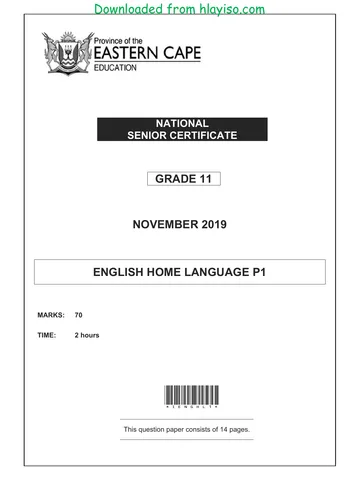
NATIONAL
SENIOR CERTIFICATE
GRADE 11
NOVEMBER 2019
ENGLISH HOME LANGUAGE P1
MARKING GUIDELINE
MARKS: 70
This marking guideline consists of 10 pages.
You're offline
Skip to contentMemorandum 
View all
ENGLISH HL P1 GR11 MEMO NOV2019 hlayiso.com
English Hl · Grade 11 · Eastern Cape November · 2019 · English. Memorandum, 10 pages. Read online or download the PDF.
- Subject
- English Hl
- Grade
- Grade 11
- Language
- English
- Document type
- Memorandum
- Year
- 2019
- Exam period
- Eastern Cape November
- Paper
- 1
- Pages
- 10
- File size
- 790.4 KB
Loading document…
Loading document…
1 of 10
Document textSearch extracted text and jump to a page.
Downloaded from hlayiso.com
2 ENGLISH HOME LANGUAGE P1 (EC/NOVEMBER 2019)
NOTE:
This marking guideline is intended as a guide for markers.
It is by no means prescriptive or exhaustive.
Candidates' responses should be considered on merit.
Answers should be assessed holistically and points awarded where
applicable. The marking guideline should be discussed before the
commencement of marking.
INSTRUCTIONS TO MARKERS
Marking the comprehension:
Because the focus is on understanding, incorrect spelling and language errors in
responses should not be penalised unless such errors change the
meaning/understanding. (Errors should still be indicated.)
If a candidate uses words from a language other than the one being examined,
disregard those words, and if the answer still makes sense, do not penalise.
However, if a word from another language is used in a text and required in an
answer, this will be acceptable.
For open-ended questions, no marks should be awarded for YES/NO or I
AGREE/I DISAGREE. The reason/substantiation/motivation is what should be
considered.
No marks should be awarded for TRUE/FALSE or FACT/OPINION. The
reason/substantiation/motivation/quotation is what should be considered.
For questions which require quotations from the text, do not penalise candidates for
omitting the quotation marks or for an incorrect spelling within the quotation.
When one-word answers are required and the candidate gives a whole sentence,
mark correct provided that the correct word is underlined/highlighted.
When two/three facts/points are required and a range is given, mark only the first
two/three.
Accept dialectical variations.
For multiple-choice questions, accept BOTH the letter corresponding to the correct
answer AND/OR the answer written out in full.
Copyright reserved Please turn over
Downloaded from hlayiso.com
(EC/NOVEMBER 2019) ENGLISH HOME LANGUAGE P1 3
SECTION A: COMPREHENSION
QUESTION 1: READING FOR MEANING AND UNDERSTANDING
QUESTIONS: TEXT A
1.1 We have to be honest with ourselves that most of us procrastinate at
times. (2)
1.2 Because our lives are so busy, there are more important/urgent priorities
that need to be taken care of first.
The thought of undertaking tasks is just too draining, so we avoid them. (2)
1.3 Debilitating procrastination hampers our actions/incapacitates us and
negatively influences our careers, our relationships and the quality of our
lives. (2)
1.4 It becomes a habit which we cannot break, which simply leads to more
procrastination/we are caught up in a dilemma which we cannot resolve. (2)
1.5 Procrastination is compared to being stopped by a paper wall – something
which should be easy to break through. However, we view this ‘wall’ as
something which is impenetrable, making it impossible for us to act and
increasing our frustration. (3)
1.6 Yes. People hate themselves for procrastinating (‘all of that self-loathing’)
and lose faith in themselves (‘I just can’t do it!’) (2)
1.7 It refers to the knowledge that procrastination is the avoidance of the stress
we associate with a task. (2)
1.8 We should develop a ‘self-awareness’ in that we ask ourselves why we
procrastinate/what scares us about performing a specific task/what is the
worst that can happen if we try doing that which scares us? If we could
answer these questions, we would realise that we do not need to fear
anything and that would eliminate procrastination. (2)
1.9 It is satisfaction that is more immediate. It is appropriate as it reinforces
how we attempt to achieve a temporary respite from stress but avoid the
actions that would lead to long-term satisfaction. (3)
1.10 The writer’s style is effective as it involves the reader/doesn’t judge, but
makes procrastination a common denominator among humans
(e.g. ‘our’).
The informal language doesn’t distance the reader (e.g. ‘Chalk it up’/
‘they’d’).
Colloquial expressions create humour (e.g. ‘a nice corner to scratch out a
few wall drawings’). (3)
Copyright reserved Please turn over
Downloaded from hlayiso.com
4 ENGLISH HOME LANGUAGE P1 (EC/NOVEMBER 2019)
1.11 The ‘old you’ would stick to old habits, which lead to anxiety/apprehension
and doubt in oneself, because one would simply revert to automatic
patterns if new challenges arise.
However, the ‘new you’ would be focused and unafraid; there would be a
willingness to establish and implement new thought/behavioural patterns,
because the prefrontal cortex has been activated.
[Award 3 marks only if candidate has clearly outlined the contrast.] (3)
1.12 Initially it appears as if TEXT B does not support the last paragraph of
TEXT A, because she says that making the decision to stop procrastinating
is a decision ruled by the heart, and not the brain.
However, at the end she says that the decision and the act of counting
backwards from five to zero activates the fast-acting part of the brain, which
is exactly what is depicted in TEXT B. In TEXT B the arrow shows how the
act of counting moves your conscious mind away from the slow-acting part
of the brain to the fast-acting part.
[Mark globally.]
[Award 4 marks only if candidate has referred to both TEXT A and TEXT B.] (4)
[A cogent ‘No’ response is unlikely. However, treat all responses on their
merits.]
TOTAL SECTION A: 30
Copyright reserved Please turn over
Downloaded from hlayiso.com
(EC/NOVEMBER 2019) ENGLISH HOME LANGUAGE P1 5
SECTION B: SUMMARY
QUESTION 2: SUMMARISING IN YOUR OWN WORDS
Use the following main points that the candidate should include in the summary as
a guideline.
Any SEVEN valid points are to be credited in paragraph form.
(Sentences and/or sentence fragments must be coherent.)
QUOTATIONS POINTS
1 ‘The more time adolescents 1 A lower self-esteem is directly related
are engaged with social media to how much time an adolescent
outlets, the lower their self- spends on social media.
esteem.’
2 ‘They develop poor sleep 2 Too much time on social media may
patterns’. result in compromised sleep patterns.
3 ‘increase their risk of sinking 3 Excessive involvement with social
into depression.’ media increases the risks of anxiety
and depression.
4 ‘The more emotionally invested 4 Teenagers experience increased
teenagers are, the more pressure to be accessible and
pressure they experience to be informed.
available and up-to-date at all
times.’
5 ‘The stress of these unrealistic 5 The unrealistic expectations of social
expectations often results in media result in nervous conditions and
anxiety and nervous disorders.’ anxiety.
6 ‘Cyberbullying has become a 6 Cyberbullying is on the increase.
concern for parents of
adolescents.’
7 ‘It is common for teens, 7 All teenagers, but girls in particular,
especially girls, to experience feel they have to be/look perfect on
pressure to appear “perfect” social media.
online.’
8 ‘Not meeting these invisible 8 If teenagers don’t conform to the
standards can cause self- expected standards, they start to doubt
loathing and self-doubt.’ and hate themselves.
9 ‘Social comparison, loneliness 9 If teenagers feel that they are not as
and jealousy can result when good as their friends on social media,
friends on social media they suffer from loneliness and
“appear” more popular and jealousy.
attractive or are on a
glamorous vacation, which can
trigger feelings of inadequacy.’
10 ‘Social media offers a safe 10 Sometimes, however, social media can
environment and support for be a teenager’s safe place of support.
teenagers, which they may
lack in traditional friendships.’
Copyright reserved Please turn over
Downloaded from hlayiso.com
6 ENGLISH HOME LANGUAGE P1 (EC/NOVEMBER 2019)
A lower self-esteem is directly related to the time adolescents spend on social
media. Too much time may compromise sleep and increase the risks of anxiety
and depression. Teenagers feel pressurised to be available and informed; girls,
especially, feel they have to appear perfect on social media. If they don’t, they
doubt and hate themselves, resulting in loneliness and jealousy. The unrealistic
expectations cause nervous conditions and increase anxiety. While cyberbullying
is on the increase, sometimes social media can provide marginalised adolescents
with safety and support. (86 words)
Marking the summary
Marking is on the basis of the inclusion of valid material and the exclusion of invalid
material.
Mark allocation:
o 7 marks for 7 points (1 mark per main point)
o 3 marks for language
o Total marks: 10
Distribution of language marks when candidate has not quoted verbatim:
o 1–3 points correct: award 1 mark
o 4–5 points correct: award 2 marks
o 6–7 points correct: award 3 marks
Distribution of language marks when candidate has quoted verbatim:
o 6–7 quotes: award no language mark
o 1–5 quotes: award 1 language mark
NOTE:
Format
Even if the summary is presented in the incorrect format, it must be assessed.
Word count:
Markers are required to verify the number of words used.
Do not deduct any marks if the candidate fails to indicate the number of words
used, or if the number of words used is indicated incorrectly. If the word limit is
exceeded, read up to the last sentence above the stipulated upper limit and
ignore the rest of the summary.
TOTAL SECTION B: 10
Copyright reserved Please turn over
Downloaded from hlayiso.com
(EC/NOVEMBER 2019) ENGLISH HOME LANGUAGE P1 7
SECTION C: LANGUAGE STRUCURES AND CONVENTIONS
Marking SECTION C:
Spelling:
o One-word answers must be marked correct even if the spelling is
incorrect, unless the error changes the meaning of the word.
o In full sentence answers, incorrect spelling should be penalised if the
error is in the language structure being tested.
o Where an abbreviation is tested, the answer must be punctuated
correctly.
Sentence structures must be grammatically correct and given in full
sentences or as per instruction.
For multiple-choice questions, accept BOTH the letter corresponding with the
correct answer AND/OR the answer written out in full as correct.
QUESTION 3: ANALYSING ADVERTISING
3.1 The impression is that the company is caring/concerned and invested in the
health of its consumers since it is promoting a product for people who are
health conscious.
‘Sugar in moderation is fine, too much isn’t good for anyone.’
‘We’ve reduced sugar across …’
‘… will be either reduced sugar or no sugar.’
[Award 2 marks only if candidate refers to both the impression created AND
the copy as justification.] (2)
3.2 Yes, it is effective. It focuses on the Coke with ice floating in it. The
bubbles make it look so refreshing that people will be tempted to buy the
product.
OR
No, it is not effective. The illustration is unclear. It does not show a
bottle/can of coke, which is ultimately the product they are advertising.
People will not be interested in an advertisement without a clear image of
the product being advertised.
[Use discretion.]
[Accept mixed responses.] (2)
Copyright reserved Please turn over
Downloaded from hlayiso.com
8 ENGLISH HOME LANGUAGE P1 (EC/NOVEMBER 2019)
3.3 The effective language usage is tantalising and invites the reader to enjoy
this unique experience with them.
The advertiser addresses the senses to entice the reader: ‘sunshine’,
‘tangy’, ‘tart’, ‘sweet’, ‘whiff’.
The imagery makes the product inviting/exciting: ‘like a burst of sunshine’;
‘like a delicious secret’; ‘like an instant whiff’; ‘a cool whiff of wind’, ‘a quick,
sharp jolt of tart’.
Descriptive words and playful use of words make the product appealing:
‘delicious’, ‘tingling’, ‘deliciously’, ‘happily’, ‘sugary-citrusy-sweetness’.
The advertiser involves the reader by asking: ‘Are you still with us?’ and
then assuming the affirmative by responding: ‘Great!’
The use of humour makes the product appear playful: ‘Tear off a piece of
this page and pop it into your mouth …’.
[Any TWO features should be discussed.]
[Award 3 marks only if a discussion of any two features AND a critical
comment are provided.] (3)
3.4 Text D
The advertisement is short and to the point, containing relatively few
words; it is, therefore, easy to understand.
The graphic provides an inviting image of the product.
The advertisement includes the reader by making the reduction in
sugar a collaborative affair: ‘we’re listening’, ‘ourwayforward.com.au’.
The advertisers focus on health awareness, thus inviting health-
conscious people to buy a product which has always been
notoriously unhealthy: ‘too much isn’t good for anyone’.
OR
Text E
The playful, vivid language is modern/exciting; it entices the reader
to anticipate tasting the product. [Any suitable example may be given
as evidence.]
The unusual suggestion at the end gives the advertisement an
element of fun: ‘enjoy a Fanta by tasting this ad!’
[Award 3 marks only if candidate has discussed which advertisement is
most effective and has provided examples to motivate his/her opinion.]
[Mark globally.]
[Accept mixed responses.] (3)
[10]
Copyright reserved Please turn over
Downloaded from hlayiso.com
(EC/NOVEMBER 2019) ENGLISH HOME LANGUAGE P1 9
QUESTION 4: UNDERSTANDING OTHER ASPECTS OF THE MEDIA
4.1 The world is a place in which people will do anything to be successful,
even if their actions harm other people. (2)
4.2 The quotation marks indicate that a morally acceptable thing is actually a
very subjective concept. (2)
4.3 Reaction: Calvin is shocked.
Visual clue: big eyes/open mouth/the plewds (drops of sweat) around
Calvin’s head/his outstretched hands.
Verbal clue: The word, ‘HEYY’ is written in a very large font/the exclamation
mark indicates that he is talking loudly.
[Candidate’s response must identify Calvin’s reaction and refer to TWO
DIFFERENT techniques to convey his shock.] (3)
4.4 Hobbes’s tone is mocking/ironic/sarcastic/patronising/condescending
which shows that his suspicions that Calvin will demand ethical behaviour
from everybody else, except himself, have been confirmed. He is pleased
to have exposed Calvin’s arrogance/hypocrisy and to have taught him a
lesson.
[Candidate must identify tone plus provide an explanation. ] (3)
[10]
Copyright reserved Please turn over
Downloaded from hlayiso.com
10 ENGLISH HOME LANGUAGE P1 (EC/NOVEMBER 2019)
QUESTION 5: USING LANGUAGE CORRECTLY
5.1 A – an initialism (1)
5.2 released – has released (1)
5.3 Technolegy – Technology (1)
5.4 No.
This sentence has only ONE finite verb: was chosen./
‘Jump-starting’ is a present participle, not a verb with a tense.
[Accept any suitable explanation which refers to one finite verb.] (1)
5.5 His first big break … (1)
5.6 Indicates the title of a song (“Happiness”). (1)
5.7 He launched his career with a remix of Hugh Masekela's 1972 hit,
“Stimela”. (1)
5.8 (Compound) adjective (1)
5.9 I don’t actually know how to explain … (1)
5.10 His second studio album titled, “Have Another One”, was released in the
same year. (1)
[10]
TOTAL SECTION C: 30
GRAND TOTAL: 70
Copyright reserved Please turn over
Verified matching documents
The question paper, memo or addendum that belongs with this document.
Recommended for this subject
Published documents with matching subject and grade metadata.
Related documents
Matched using subject, grade, language, document type and exam metadata.
Memorandum
ENGLISH HL P2 MEMO GR11 NOV 2019 hlayiso.com
Memorandum
English GR 11 HL MEMO Paper 1 hlayiso.com
Memorandum
ENGLISH HL P1 GR11 MEMO NOV2020 hlayiso.com
Memorandum
English HL P1 Memo hlayiso.com
Memorandum
ENGLISH HL P1 GR11 MEMO NOV2017 hlayiso.com
Memorandum
ENGLISH HL P1 GR11 MEMO NOV2015 hlayiso.com
More from Grade 11 English Hl
Explore more published documents in this catalogue.