
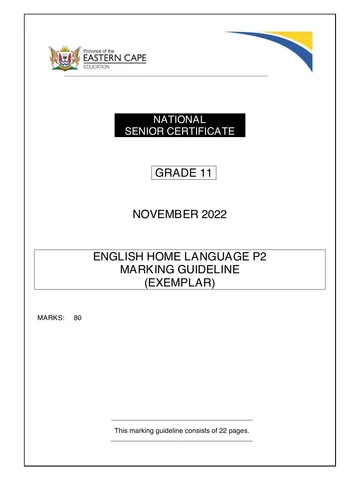
NATIONAL
SENIOR CERTIFICATE
GRADE 11
NOVEMBER 2022
ENGLISH HOME LANGUAGE P2
(EXEMPLAR)
MARKS: 80
TIME: 2½ hours
This question paper consists of 21 pages.
You're offline
Skip to contentQuestion paper 
View all
ENGLISH HL P2 QP GR11 NOV 2022
English Hl · Grade 11 · Exemplar November Exam · 2022 · English. Question paper, 21 pages. Read online or download the PDF.
- Subject
- English Hl
- Grade
- Grade 11
- Language
- English
- Document type
- Question paper
- Year
- 2022
- Exam period
- Exemplar November Exam
- Paper
- 2
- Pages
- 21
- File size
- 352.3 KB
Loading document…
Loading document…
1 of 21
Document textSearch extracted text and jump to a page.
2 ENGLISH HOME LANGUAGE P2 (EC/NOVEMBER 2022)
INSTRUCTIONS AND INFORMATION
1. Read these instructions carefully before you begin to answer the
questions.
2. Do not attempt to read the entire question paper. Consult the table of
contents on page 4 and mark the numbers of the questions set on texts you
have studied this year. Thereafter, read these questions and choose the
ones you wish to answer.
3. This question paper consists of THREE sections.
SECTION A: POETRY (30)
SECTION B: NOVEL (25)
SECTION C: DRAMA (25)
4. Answer FIVE questions in all: THREE in SECTION A, ONE in SECTION
B and ONE in SECTION C as follows:
SECTION A: POETRY
PRESCRIBED POETRY – Answer TWO questions.
UNSEEN POEM – COMPULSORY question
SECTION B: NOVEL
Answer ONE question.
SECTION C: DRAMA
Answer ONE question.
5. CHOICE OF ANSWERS FOR SECTIONS B (NOVEL) AND C (DRAMA):
• Answer questions ONLY on the novel and the drama you have studied.
• Answer ONE ESSAY QUESTION and ONE CONTEXTUAL
QUESTION. If you answer the essay question in SECTION B, you must
answer the contextual question in SECTION C.
If you answer the contextual question in SECTION B, you must answer
the essay question in SECTION C.
• Use the checklist to assist you.
6. LENGTH OF ANSWERS:
• The essay question on Poetry should be answered in about 200–250
words.
• Essay questions on the Novel and Drama sections should be answered
in 300–350 words.
• The length of answers to contextual questions should be determined by
the mark allocation. Candidates should aim for conciseness and
relevance.
7. Follow the instructions at the beginning of each section carefully.
Copyright reserved Please turn over
(EC/NOVEMBER 2022) ENGLISH HOME LANGUAGE P2 3
8. Number your answers correctly according to the numbering system used
in this question paper.
9. Start EACH section on a NEW page.
10. Suggested time management:
SECTION A: approximately 40 minutes
SECTION B: approximately 55 minutes
SECTION C: approximately 55 minutes
11. Write neatly and legibly.
Copyright reserved Please turn over
4 ENGLISH HOME LANGUAGE P2 (EC/NOVEMBER 2022)
TABLE OF CONTENTS
SECTION A: POETRY
Prescribed Poetry: Answer any TWO questions.
QUESTION NO. QUESTION MARKS PAGE NO.
1. The Woman – Kristina
10 6
Rungano Essay question
2. Mid-Term Break ̶ Seamus
10 7
Heaney Contextual question
3. Housing Targets ̶ Kelwyn
10 8
Sole Contextual question
4. The Child Who was Shot
Dead by Soldiers at 10 10
Nyanga-Ingrid Jonker Contextual question
AND
Unseen Poem: COMPULSORY question
5. I Dream a World ̶ Langston
10 11
Hughes Contextual question
SECTION B: NOVEL
Answer ONE question.*
6. Things fall Apart Essay question 25 12
OR
7. Things fall Apart Contextual question 25 12
OR
8. Tsotsi Essay question 25 14
OR
9. Tsotsi Contextual question 25 14
SECTION C: DRAMA
Answer ONE question.*
ANSWER ANY ONE OF THE FOLLOWING FOUR QUESTIONS.
10. Macbeth Essay question 25 16
OR
11. Macbeth Contextual question 25 16
OR
12. The Merchant of Venice Essay question 25 19
OR
13. The Merchant of Venice Contextual question 25 19
NOTE: In SECTIONS B and C, answer ONE ESSAY and ONE CONTEXTUAL
question.
You may NOT answer TWO essay questions or TWO contextual questions.
Copyright reserved Please turn over
(EC/NOVEMBER 2022) ENGLISH HOME LANGUAGE P2 5
CHECKLIST
Use this checklist to ensure that you have answered the correct number of questions.
SECTION QUESTION NO. OF QUESTIONS TICK (√)
NUMBERS TO ANSWER
A: POETRY
1–4 2
(Prescribed Poetry)
A: POETRY
5 1
(Unseen Poem)
B: NOVEL
6–9 1
(Essay or Contextual)
C: DRAMA
10–13 1
(Essay or Contextual)
NOTE: In SECTIONS B and C, answer ONE ESSAY and ONE CONTEXTUAL
question.
You may NOT answer TWO essay questions or TWO contextual questions.
Copyright reserved Please turn over
6 ENGLISH HOME LANGUAGE P2 (EC/NOVEMBER 2022)
SECTION A: POETRY
PRESCRIBED POETRY
Answer ANY TWO of the following questions.
QUESTION 1: POETRY – ESSAY QUESTION
Read the poem below and then answer the question that follows.
THE WOMAN – Kristina Rungano
1 A minute ago I came from the well
2 Where young women drew water like myself
3 My body was weary and my heart tired.
4 For a moment I watched the stream that rushed before me;
5 And thought how fresh the smell of flowers,
6 How young the grass around it.
7 And yet again I heard the sound of duty
8 Which ground on me – made me feel aged
9 As I bore the great big mud container on my head
10 Like a big painful umbrella.
11 Then I got home and cooked your meal
12 For you had been out drinking the pleasures of the flesh
13 While I toiled in the fields.
14 Under the angry vigilance of the sun
15 A labour shared only by the bearings of my womb.
16 I washed the dishes – yours –
17 And swept the room we shared
18 Before I set forth to prepare your bedding
19 In the finest corner of the hut
20 Which was bathed by the sweet smell of dung
21 I had this morning applied to the floors
22 Then you came in,
23 In your drunken lust
24 And you made your demands
25 When I explained how I was tired
26 And how I feared for the child – yours – I carried
27 You beat me and had your way
28 At that moment
29 You left me unhappy and bitter
30 And I hated you;
31 Yet tomorrow I shall again wake up to you
32 Milk the cow, plough the land and cook your food,
33 You shall again be my Lord
34 For isn’t it right that woman should obey,
35 Love, serve and honour her man?
36 For are you not the fruit of the land?
In a carefully planned essay, critically discuss how the poet uses diction, imagery
and structure to suggest the oppression faced by women in rural societies.
Your essay must be 200–250 words (about ONE page) in length. [10]
Copyright reserved Please turn over
(EC/NOVEMBER 2022) ENGLISH HOME LANGUAGE P2 7
OR
QUESTION 2: POETRY – CONTEXTUAL QUESTION
Read the poem below and then answer the questions that follow.
MID-TERM BREAK – Seamus Heaney
1 I sat all morning in the college sick bay
2 Counting bells knelling classes to a close.
3 At two o’clock our neighbours drove me home.
4 In the porch I met my father crying ̶
5 He has always taken funerals in his stride ̶
6 And Big Jim Evans saying it was a hard blow.
7 The baby cooed and laughed and rocked the pram
8 When I came in, and I was embarrassed
9 By old men standing up to shake my hand
10 And tell me they were “sorry for my trouble”;
11 Whispers informed strangers I was the eldest,
12 Away at school, as my mother held my hand
13 In hers and coughed out angry tearless sighs.
14 At ten o’clock the ambulance arrived
15 With the corpse, stanched and bandaged by the nurses
16 Next morning I went up into the room. Snowdrops
17 And candles soothed the bedside; I saw him
18 For the first time in six weeks. Paler now,
19 Wearing a poppy bruise on his left temple,
20 He lay in the four-foot box as in his cot.
21 No gaudy scars, the bumper knocked him clear.
22 A four foot box, a foot for every year.
2.1 How do lines 4–5 affect your feelings towards the father of the speaker? (2)
2.2 Comment on how line 15 indicates the speaker’s state of mind. (2)
2.3 Discuss the effectiveness of the use of the run-on-lines in the context of the
poem. (3)
2.4 Consider lines 16–22. How does the imagery in these lines contribute to the
mood in the poem? (3)
[10]
Copyright reserved Please turn over
8 ENGLISH HOME LANGUAGE P2 (EC/NOVEMBER 2022)
OR
QUESTION 3: POETRY – CONTEXTUAL QUESTION
Read the poem below and then answer the questions that follow.
HOUSING TARGETS – Kelwyn Sole
1 Somewhere in our past
2 we believed in the future
3 that a better world
4 would discover foundation
5 under our feet, and we
6 would be forever singing,
7 in its kitchen.
8 Bricks pile up in a field.
9 Whether they will be enough
10 no one knows. How
11 they fit together
12 is anyone’s guess.
13 Men with darkening skins
14 scribbled on by weather
15 wait for their instructions.
16 From time to time
17 limousines miraculously appear:
18 there is always a somebody
19 in a suit willing to smile
20 and shake their hands
21 who lays the first stone.
22 Then the camera lights
23 and racing engines
24 turn around, shrink back
25 from where they came.
26 Those left behind
27 stare at their own hands
28 afterwards, puzzled
29 at precisely what
30 has been transacted, why
31 they are still being offered
32 bonds
33 squint
34 between gnarled fingers
35 pace out the hopeful distances:
36 there will be a flower bowl
37 my bed is going here.
Copyright reserved Please turn over
(EC/NOVEMBER 2022) ENGLISH HOME LANGUAGE P2 9
38 As for now the doorknobs
39 have no doors.
40 Their widows peer out
41 at no sky
3.1 Consider stanza 3. What is suggested by the speaker through the use of
phrases like ‘no one knows’ and ‘anyone’s guess’? (2)
3.2 How is the reader’s sympathy evoked in stanza 9? Quote selectively in
support of your answer. (2)
3.3 Discuss the appropriateness of the pun used in line 4, in the context of the
poem as a whole. (3)
3.4 Lines 16–21 feature the appearance of a government official. Critically
discuss how the tone is achieved in these lines by referring directly to the
diction used. (3)
[10]
OR
Copyright reserved Please turn over
10 ENGLISH HOME LANGUAGE P2 (EC/NOVEMBER 2022)
QUESTION 4: PRESCRIBED POETRY – CONTEXTUAL QUESTION
Read the poem below and then answer the questions that follow.
THE CHILD WHO WAS SHOT DEAD BY SOLDIERS AT NYANGA – Ingrid
Jonker
(translated by Jack Cope and William Plomer)
1 The child is not dead
2 the child lifts his fists against his mother
3 who screams Afrika shouts the scent
4 of freedom and the veld
5 in the locations of the cordoned heart
6 The child lifts his fists against his father
7 in the march of the generations
8 who are shouting Afrika shout the scent
9 of righteousness and blood
10 in the streets of his warrior pride
11 The child is not dead
12 not at Langa not at Nyanga
13 not at Orlando not at Sharpville
14 not at the police station in Phillipi
15 where he lies with a bullet through his brain
16 The child is the shadow of the soldiers
17 on guard with rifles Saracens and batons
18 the child is present at all the gatherings and law-giving
19 the child peers through the house windows and into hearts
of mothers
20 the child who wanted just to play in the sun at Nyanga is
everywhere
21 the child grown to a man treks all over Africa
22 the child grown to a giant travels through the whole world
23 Without a pass
4.1 What attitude is shown by the child who ‘lifts his fists against his mother’
in line 2? (2)
4.2 Account for the poet’s repetition of ‘the child’ throughout the poem. (2)
4.3 Comment on the function of the juxtaposition in lines 16–18. Quote
selectively as part of your response. (3)
4.4 Although the poem is violent and threatening, it ends on a strikingly
positive note. Discuss how the tone is achieved in lines 20–23 with close
reference to the imagery used. (3)
[10]
AND
Copyright reserved Please turn over
(EC/NOVEMBER 2022) ENGLISH HOME LANGUAGE P2 11
UNSEEN POETRY (COMPULSORY)
QUESTION 5: UNSEEN POETRY – CONTEXTUAL QUESTION
Read the poem below and then answer the questions that follow.
I DREAM A WORLD – Langston Hughes
1 I dream a world where man
2 No other man will scorn
3 Where love will bless the earth
4 And peace its paths adorn
5 I dream a world where all
6 Will know sweet freedom’s way,
7 Where greed no longer saps the soul
8 Nor avarice blights our day
9 A world I dream where black and white,
10 Whatever race you be,
11 Will share the bounties of the earth
12 And every man is free,
13 Where wretchedness will hang its head
14 And joy, like a pearl,
15 Attends the needs of all mankind –
16 Of such I dream, my world!
5.1 What effect is created through the use of the adjectives ‘all’ and ‘every’ in
the poem? (2)
5.2 Refer to line 7. Explain the effect that greed could have on mankind. (2)
5.3 Refer to line 14. Discuss the effectiveness of the simile. (3)
5.4 How does the repetition of ‘I dream’ reinforce the tone of the poem? (3)
[10]
TOTAL SECTION A: 30
AND
Copyright reserved Please turn over
12 ENGLISH HOME LANGUAGE P2 (EC/NOVEMBER 2022)
SECTION B: NOVEL
Answer ONLY on the novel you have studied.
THINGS FALL APART – CHINUA ACHEBE
Answer EITHER QUESTION 6 (essay question) OR QUESTION 7 (contextual
question).
QUESTION 6: THINGS FALL APART – ESSAY QUESTION
Okonkwo’s tragedy is due to the influence of both internal and external forces.
In a carefully planned essay of 300–350 words (1–1 ½ pages) in length, discuss to
what extent this statement is accurate. [25]
OR
QUESTION 7: THINGS FALL APART – CONTEXTUAL QUESTION
Read the extracts below and then answer the questions that follow.
EXTRACT A
As soon as his father walked in, that night, Nwoye knew that Ikemefuna had been
killed, and something seemed to give way inside him, like the snapping of a
tightened bow. He did not cry. He just hung limp. He had the same kind of feeling
not long ago, during the last harvest season. Every child loved the harvest season.
Those who were big enough to carry even a few yams in a tiny basket went with 5
the grown-ups to the farm. And if they could not help in digging up yams, they
could gather firewood together for roasting the ones that would be eaten there on
the farm.
…
It was after such a day at the farm during the last harvest that Nwoye had felt for
the first time a snapping inside him like the one he now felt. They were returning 10
home with baskets of yams from a distant farm across the stream when they had
heard the voice of an infant crying in the thick forest. A sudden hush had fallen on
the women, who had been talking, and they had quickened their steps. Nwoye had
heard that twins were placed in earthenware pots and thrown away in the forest,
but he had never come across them. A vague chill had descended on him and his 15
head had seemed to swell, like a solitary walker at night who passes an evil spirit
on the way. Then something had given way inside him. It descended on him again,
this feeling, when his father walked in, that night after killing Ikemefuna.
[Chapter 7]
7.1 Why was Okonkwo involved in the killing of Ikemefuna? (3)
7.2 Consider lines 5–8. Discuss the symbolism and importance of the yam in
the Igbo culture. (3)
Copyright reserved Please turn over
(EC/NOVEMBER 2022) ENGLISH HOME LANGUAGE P2 13
7.3 Explain how this extract foreshadows a decision made by Nwoye later in
the novel. (3)
7.4 Consider lines 17–18. Discuss how the father-and-son relationship
between Okonkwo and Nwoye is influenced by Unoka’s character. (3)
AND
EXTRACT B
That night he collected his most valuable belongings into head loads. His wives
wept bitterly and their children wept with them without knowing why. Obierika
and half a dozen other friends came to help and to console him. They each made
nine or ten trips carrying Okonkwo’s yams to store in Obierika’s barn. And before
the cock crowed Okonkwo and his family were fleeing to his motherland. It was 5
a little village called Mbanta, just beyond the borders of Mbaino.
As soon as the day broke, a large crowd of men from Ezeudu’s quarter stormed
Okonkwo’s compound, dressed in garbs of war. They set fire to his houses,
demolished his red walls, killed his animals and destroyed his barn. It was the
justice of the earth goddess, and they were merely the messengers. They had 10
no hatred in their hearts against Okonkwo. His greatest friend, Obierika, was
among them. They were merely cleansing the land which Okonkwo had polluted
with the blood of a clansman.
Obierika was a man who thought about things. When the will of the goddess had
been done he sat down in his obi and mourned his friend’s calamity. Why should 15
a man suffer so grievously for an offence he had committed inadvertently? But
although he thought for a long time he found no answer. He was merely led into
greater complexities. He remembered his wife’s twin children, whom he had
thrown away. What crime have they committed? The Earth had decreed that
they were an offence on the land and must be destroyed. 20
[Chapter 13]
7.5 What events have led Okonkwo and his family to this moment described in
lines 1–3? (3)
7.6 Consider lines 14–19. How does Okonkwo’s character contrast with that of
Obierika’s? (3)
7.7 Refer to lines 9–11. Obierika and the other men exact the punishment of
the goddess without ill feelings towards Okonkwo. Why would they be
compelled to do the goddess’ bidding? (3)
7.8 Refer to both Extracts A and B. The harsh internal structures of the Igbo
contribute to its own end. Critically comment on how this is shown through
the suffering of Ikemefuna and Okonkwo. (4)
[25]
Copyright reserved Please turn over
14 ENGLISH HOME LANGUAGE P2 (EC/NOVEMBER 2022)
OR
TSOTSI – ATHOL FUGARD
Answer EITHER QUESTION 8 (essay question) OR QUESTION 9 (contextual
question).
QUESTION 8: TSOTSI – ESSAY QUESTION
‘Only light can drive out darkness’.
In a carefully planned essay of 300–350 words (1–1½ pages) in length, discuss
to what extent this statement is true of the protagonist, Tsotsi. [25]
OR
QUESTION 9: TSOTSI – CONTEXTUAL QUESTION
Read the extracts below and then answer the questions that follow.
EXTRACT C
He sat down with his back to a tree and no sooner was he comfortable than he
regretted it, because immediately the image of Boston rose up before him. I
shouldn’t have stopped here, he thought. I should have kept on until I could go
no more.
He was not that tired that he couldn’t have stood up. The ache in his legs was no 5
worse than a ten-day-old knife wound. He could have risen to his feet and carried
on to another place, another destiny, because the stars were busy that night. But
instead he chose to remain, and in remaining picked up the silken thread of the
chances that were to lead him in a strange way.
And so the image of Boston, considered, now that the violence was spent, without 10
the madness of hate. Boston! He, Tsotsi, had himself picked Boston from the
thousand lives that were adrift in the location streets. He had picked Boston
because he had a virtue, just as Die Aap had a virtue, which was strength,
inhuman strength, and Butcher with his virtue, which was the accuracy that had
earned him his name, an accuracy as reliable as the edge of a good knife. 15
Boston’s virtue being that he was clever. He was a lot of other things as well. He
was a coward, he was weak, he talked too much, he drank even more than he
talked. But more important than anything else ─ he was clever. He could think.
Boston had already proved himself, a hundred times over. In as many jobs his
cleverness had engineered success. The little details that got you caught, these 20
Boston thought about, in a panic of fear it was true, but he thought about them
and that was all that mattered.
It was simple and it would have worked for a long time if it had only stayed like
that. Where had it all gone wrong? It had gone wrong because Boston started
asking questions, even after he was warned. And Tsotsi had not known the 25
answers.
[Chapter 3]
Copyright reserved Please turn over
(EC/NOVEMBER 2022) ENGLISH HOME LANGUAGE P2 15
9.1 Refer to line 2. Why does the ‘image of Boston’ have such an effect on
Tsotsi? (3)
9.2 How does Tsotsi’s choice to ‘remain’ (lines 8–9) change the outcome of his
life? (3)
9.3 Consider lines 16–22. To what extent do you agree with Tsotsi’s assessment
of Boston’s character? (3)
9.4 ‘He, Tsotsi, had himself picked Boston from the thousand lives that were
adrift in the location streets’ (lines 11–12). How is the socio-political context
of the novel implied in these lines? (3)
9.5 Refer to lines 12–16. Why could Tsotsi’s treatment of virtue be considered
ironic? (3)
AND
EXTRACT D
David’s eyes grew round and vacant, stared at the darkness. A tiny sound. A thin
squeaking voice, struggled out: ‘David …’ it said. ‘David! But no more! He dead!
He dead too, like Willie, like Joji.’
‘I understand’, Petah said, ‘You will choose your name. You will choose when you
are ready.’ 5
So he went out with them the next day and scavenged. That same day an Indian
chased him away from his shop door, shouting and calling him a tsotsi. When they
went back to the river that night, they started again, trying names on him: Sam,
Willie, and now Simon, until he stopped them.
‘My name,’ he said, ‘is Tsotsi.’ 10
They crowded around him, laughing, and slapping him on the back.
‘Tsotsi!’ they cried, trying it out. He nodded his head.
He learnt all the lessons, he learnt them well. He never stopped learning, it
seemed. Because after the river gang ─broken up one night, by a police raid
─came other gangs of older boys, and harder, harsher lessons, and that simple 15
lesson of keeping his body alive another day. He learned to watch for the weakness
of sympathy or compassion for others weaker than yourself, like discovering how
never to feel the pain you inflicted. He had no use for memories. Anyway, he had
none.
[Chapter 9]
9.6 Briefly account for the events that led David to the river gang. (3)
9.7 David says ‘He dead’ (lines 2–3). Explain the full impact of this statement. (3)
9.8 Refer to both Extracts C and D. Critically comment on how the author
evokes the reader’s sympathy for Tsotsi. (4)
[25]
TOTAL SECTION B: 25
Copyright reserved Please turn over
16 ENGLISH HOME LANGUAGE P2 (EC/NOVEMBER 2022)
SECTION C: DRAMA
Answer ONLY on the drama you have studied.
MACBETH – WILLIAM SHAKESPEARE
Answer EITHER QUESTION 10 (essay question) OR QUESTION 11 (contextual
question).
QUESTION 10: MACBETH – ESSAY QUESTION
Macbeth’s decline to a man ‘supped full with horrors’ is due to the influences of
others on his character.
In a carefully planned essay of 300–350 words (1–1½ pages) in length, discuss to
what extent this is an accurate assessment of Macbeth’s downfall. [25]
OR
QUESTION 11: MACBETH – CONTEXTUAL QUESTION
Read the extracts below and answer the questions that follow.
EXTRACT E
LADY MACBETH Who was it, that thus cried? Why, worthy thane, 1
You do unbend your noble strength to think
So brain-sickly of things. Go get some water
And wash this filthy witness from your hand.
Why did you bring these daggers from the place? 5
They must lie there. Go carry them and smear
The sleepy grooms with blood.
MACBETH I’ll go no more.
I am afraid to think what I’ve done;
Look on’t again, I dare not. 10
LADY MACBETH Infirm of purpose!
Give me the daggers. The sleeping and the dead
Are but as pictures; ‘tis the eye of childhood
That fears a painted devil. If he do bleed,
I’ll gild the faces of the grooms withal, 15
For it must seem their guilt.
Knock within
Copyright reserved Please turn over
(EC/NOVEMBER 2022) ENGLISH HOME LANGUAGE P2 17
MACBETH Whence is that knocking?
How is’t with me, when every noise appals me?
What hands are here? Ha: they pluck out mine eyes.
Will all great Neptune’s ocean wash this blood 20
Clean from my hand? No: this my hand will rather
The multitudinous seas incarnadine,
Making the green one red.
Enter Lady Macbeth
LADY MACBETH My Hands are of your colour, but I shame
To wear a heart so white. 25
Knock within
I hear a knocking.
At the south entry. Retire we to our chamber;
A little water clears of this deed.
How easy is it then! …
[Act 2, Scene 2]
11.1 What are the influences that have led to Macbeth having a ‘filthy witness’
(line 4) on his hands? (3)
11.2 Account for Macbeth’s state of mind in lines 17–23. Quote to substantiate
your answer. (3)
11.3 Refer to lines 11–14. If you were the director of the play, how would you
instruct the actress playing the role of Lady Macbeth? Pay attention to body
language and tone and explain your answer. (3)
11.4 Consider line 28–29. How does Lady Macbeth’s attitude contrast with that
of Macbeth’s? (3)
AND
EXTRACT F
LADY MACBETH Come on. Gentle my lord,
Sleek o’er your rugged looks, be bright and jovial
Among your guests tonight.
MACBETH So shall I, love,
And so I pray be you. Let your remembrance 5
Apply to Banquo, present him with eminence
Both with eye and tongue; unsafe the while, that we
Must lave our honours in these flattering streams
And make our faces vizards to our hearts,
Disguising what they are. 10
Copyright reserved Please turn over
18 ENGLISH HOME LANGUAGE P2 (EC/NOVEMBER 2022)
LADY MACBETH You must leave this.
MACBETH O, full of scorpions is my mind, dear wife!
You know’st that Banquo and Fleance lives.
LADY MACBETH But in them Nature’s copy’s not eterne.
MACBETH There’s comfort yet, they are assailable; 15
Then be thou jocund: ere the bat hath flown
His cloister’d flight, ere to black Hecate’s summons
The shard-born beetle with his drowsy hums
Hath rung night’s yawning peal, there shall be done
A deed of dreadful note. 20
LADY MACBETH What’s to be done?
MACBETH Be innocent of the knowledge, dearest chuck,
Till thou applaud the deed. Come seeling night,
Scarf up the tender eye of pitiful day
And with thy bloody and invisible hand 25
Cancel and tear to pieces that great bond
Which keeps me pale. Light thickens,
And the crow makes wing to th’ rooky wood;
Good things of day begin to droop and drowse,
Whiles night’s black agents to their prey do rouse. 30
Thou marvelst at my words, but hold thee still;
Things bad begun, make strong themselves by ill.
[Act 3, Scene 2]
11.5 Lines 9–10 is a reference to an important theme in the play. Explain how
these lines emphasise the theme. (3)
11.6 Consider lines 12–13. Account for Macbeth’s fears being rooted in Banquo
and Fleance. (3)
11.7 Elaborate on Macbeth’s plans that he alludes to in line 15. (3)
11.8 Consider both EXTRACT E and EXTRACT F.
Critically discuss the distinct difference in Lady Macbeth’s character as
shown in these extracts. (4)
OR
Copyright reserved Please turn over
(EC/NOVEMBER 2022) ENGLISH HOME LANGUAGE P2 19
THE MERCHANT OF VENICE – WILLIAM SHAKESPEARE
Answer EITHER QUESTION 12 (essay question) OR QUESTION 13 (contextual
question).
QUESTION 12: THE MERCHANT OF VENICE – ESSAY QUESTION
Money, rather than characters, is what determines the outcome of the play.
In a carefully planned essay of 300–350 words (1–1½ pages) in length, discuss to
what extent you agree with this statement. [25]
OR
QUESTION 13: THE MERCHANT OF VENICE – CONTEXTUAL QUESTION
Read the extracts below and answer the questions that follow.
EXTRACT G
BASSANIO This were kindness.
SHYLOCK This kindness will I show:
Go with me to a notary, seal me there
Your single bond, and in a merry sport,
If you repay me not on such a day 5
In such a place, such sum or sums as are
Expressed in the condition, let the forfeit
Be nominated for an equal pound
Of your fair flesh, to be cut off and taken
In what part of your body pleaseth me. 10
ANTONIO Content in faith, I’ll seal to such a bond,
And say there is much kindness in the Jew.
BASSANIO You shall not seal to such a bond for me,
I’ll rather dwell in my necessity.
ANTONIO Why fear not man, I will not forfeit it; 15
Within these two months, that’s a month before
This bond expires, I do expect return
Of thrice three times the value of this bond.
SHYLOCK O father Abram, what these Christians are,
Whose own hard dealings teaches them suspect 20
The thoughts of others! Pray you tell me this;
If he should break his day what should I gain
By the exaction of the forfeiture?
A pound of man’s flesh taken from a man,
Is not so estimable, profitable neither, 25
As flesh of muttons, beefs, or goats. I say,
To buy his favour, I extend this friendship:
If he will take it, so; if not, adieu;
And, for my love, I pray you wrong me not.
[Act 1, Scene 3]
Copyright reserved Please turn over
20 ENGLISH HOME LANGUAGE P2 (EC/NOVEMBER 2022)
13.1 Explain what the ‘kindness’ (line 1) is that Bassanio mentions. (3)
13.2 What is ironic about Shylock’s reference to the bond as ‘a merry sport’
(line 4) if one considers what finally happens? (3)
13.3 Antonio immediately agrees to Shylock’s rather cruel bond conditions.
What does this tell you about his attitude towards Shylock and the bond? (3)
13.4 ‘You shall not seal to such a bond for me,’ (line 13)
What does Bassanio’s response reveal about his character? Mention two
things. (3)
13.5 ‘A pound of man’s flesh taken from a man,
Is not so estimable, profitable neither,’ (lines 24–25)
Do you think that Shylock is honest when he says that a pound of
Antonio’s flesh is ‘not …estimable, profitable’? Explain your answer. (3)
AND
EXTRACT H
SHYLOCK (aside) These be the Christian husbands! I have a daughter:
Would any of the stock of Barabas
Had been her husband, rather than a Christian!
We trifle time, I pray thee pursue sentence.
PORTIA A pound of that same merchant’s flesh is thine; 5
The court awards it, and the law doth give it.
SHYLOCK Most rightful judge!
PORTIA And you must cut this flesh from off his breast;
The law allows it, and the court awards it.
SHYLOCK Most learned judge! A sentence! Come, prepare! 10
[Act 4, Scene 1]
Copyright reserved Please turn over
(EC/NOVEMBER 2022) ENGLISH HOME LANGUAGE P2 21
13.6 Place the extract in context. (3)
13.7 Refer to lines 6 and 10. If you were the director of the play, how would you
instruct the actor playing the role of Shylock? Pay attention to body
language and tone and explain your answer. (3)
13.8 Compare Shylock’s attitude in Extract G to his attitude in Extract H. Explain
the reason(-s) for the change. (4)
[25]
TOTAL SECTION C: 25
GRAND TOTAL: 80
Copyright reserved Please turn over
Verified matching documents
The question paper, memo or addendum that belongs with this document.
Recommended for this subject
Published documents with matching subject and grade metadata.
Question paper
ENGLISH HL P1 GR11 QP NOV2022 hlayiso.com
Question paper
ENGLISH HL P2 QP GR11 NOV 2022 hlayiso.com
Question paper
ENGHL P3 GR11 QP NOV2022 hlayiso.com
Question paper
ENGLISH HL P1 GR11 QP NOV2022
Question paper
ENGHL P3 GR11 QP NOV2022
Question paper
ENG hlayiso.com .HL P1 GR11 NOV2020 hlayiso.com
Related documents
Matched using subject, grade, language, document type and exam metadata.
More from Grade 11 English Hl
Explore more published documents in this catalogue.
Annual teaching plan
Gr 11 English HL ATP 2023 24
Memorandum
ENGHL P3 GR11 MEMO NOV 2022 hlayiso.com
Question paper and memo
EHL Gr11 March 2022 QP and Memo hlayiso.com
Memorandum
ENGLISH HL P1 GR11 MEMO NOV2020 hlayiso.com
Memorandum
ENGHL P2 GR11 MEMO NOV2020 D hlayiso.com
Memorandum