
Copyright reserved
Please turn over
Mock
hlayiso mock exams
Practice Series:
Grade 11 Exam Preparation
WWW.HLAYISO.COM
NATIONAL
SENIOR CERTIFICATE
GRADE 11
ENGLISH HOME LANGUAGE P1
NOVEMBER EXAMINATION 2026 (MOCK)
MARKING GUIDELINES
MARKS: 70
These marking guidelines consist of 10 pages.
Skip to contentMemorandum 
View all
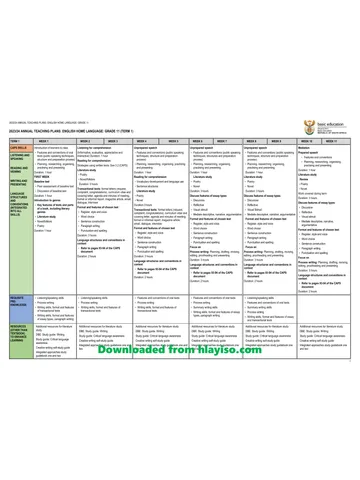
English HL Grade 11 P1 November Mock Exam 2 2026 Memo (English)
Grade 11 English HL Paper 1 memorandum from the November Mock Exam 2 2026 (English), 10 pages. Read online or get the free PDF download, question paper linked when available.
Publisher: Hlayiso
English HL · Grade 11 · November Mock Exam 2 · 2026. Memorandum, 10 pages. Read online or download the PDF.
- Subject
- English HL
- Grade
- Grade 11
- Language
- English
- Document type
- Memorandum
- Year
- 2026
- Exam period
- November Mock Exam 2
- Paper
- 1
- Publisher
- Hlayiso
- Curriculum
- CAPS
- Pages
- 10
- File size
- 157.4 KB
Loading document…
Loading document…
1 of 10
Document textSearch extracted text and jump to a page.
English Home Language/P1
2
NSC – Marking Guidelines
Hlayiso/Mock 2026
NOTE:
• These marking guidelines are intended as a guide for markers.
• They are by no means prescriptive or exhaustive.
• Candidates' responses should be considered on merit.
• Answers should be assessed holistically and marks awarded where applicable in terms
of decisions taken at the standardisation meeting.
• The marking guidelines will be discussed before the commencement of marking.
INSTRUCTIONS TO MARKERS
Marking the comprehension:
• Because the focus is on understanding, incorrect spelling and language errors in
longer responses should not be penalised unless such errors change the meaning/
understanding. (Errors must still be indicated.)
• If a candidate uses words from a language other than the one being examined, disregard
those words, and if the answer still makes sense, do not penalise. However, if a word from
another language is used in a text and required in an answer, this will be acceptable.
• For open-ended questions, no marks should be awarded for YES/NO or I AGREE/I
DISAGREE. The reason/substantiation/motivation is what should be considered.
• No marks should be awarded for TRUE/FALSE or FACT/OPINION. The reason/
substantiation/motivation is what should be considered.
• When one-word answers are required and the candidate gives a whole sentence, mark
correct provided that the correct word is underlined/highlighted.
• When two/three facts/points are required and a range is given, mark only the first two/
three.
• Accept dialectal variations.
• For multiple-choice questions, accept BOTH the letter corresponding to the correct
answer AND/OR the answer written out in full.
Copyright reserved
Please turn over
English Home Language/P1
3
NSC – Marking Guidelines
Hlayiso/Mock 2026
SECTION A: COMPREHENSION
QUESTION 1: READING FOR MEANING AND UNDERSTANDING
1.1
The title is unexpected/surprising/paradoxical because failure is usually
regarded as something negative, to be avoided or criticised, not 'praised'. (1) It
arouses the reader's curiosity: the reader wants to find out why anyone would
praise failure. (1)
(2)
1.2
She was ashamed/embarrassed of her poor mark (1) and believed that she
was the only learner who was struggling; she feared that she would be judged/
that others would think less of her/disappoint her mother. (1)
[Award only 1 mark for lifting ('I felt like a fraud').]
(2)
1.3
The writer compares failure to an infectious illness that people try to avoid and
that must be isolated ('quarantined') if one 'catches' it. (1) It is effective because
it shows how fearfully/irrationally society reacts to failure: people hide it and
keep away from it as if it were dangerous and shameful, instead of accepting it
as normal. (1)
[Credit valid alternative responses.]
(2)
1.4
B – suppresses.
(1)
1.5
Learners stop asking/answering questions in class (they do not put up their
hands). (1)
They avoid difficult subjects and choose 'safe' options instead of what interests
them. (1)
They become perfectionists, spending too long on work or never handing it in.
(1)
[Any TWO. Accept lifting for this question.]
(2)
1.6
It seems contradictory, because one would expect that NOT trying is a way of
avoiding failure. (1) However, a person who never attempts anything difficult
can never succeed or learn; avoiding the risk of failure guarantees that one will
not grow/achieve, which is itself a failure. (1)
(2)
Copyright reserved
Please turn over
English Home Language/P1
4
NSC – Marking Guidelines
Hlayiso/Mock 2026
1.7
VALID: A mistake shows a learner what he/she does not yet understand, so
it gives useful feedback ('information') about what to do next. The text states
that we remember a correct answer better after first getting it wrong. A mistake
is not a final judgement ('verdict') on a person's intelligence or worth; one bad
mark does not define who one is. This view encourages learners to analyse
their errors instead of hiding them, as Lerato eventually did.
OR
PARTLY VALID: Although mistakes can teach us, in reality marks DO act as
verdicts – a final examination result can decide whether one passes, gets a
bursary or is accepted at university. A learner may therefore find it hard to see
a mistake as 'only information'.
[Credit valid alternative/mixed responses. Award 3 marks for a critical
discussion that refers to the text. Award only 1 mark for a 'yes/no' with
weak motivation.]
(3)
1.8
The writer uses harsh/emotive/negative diction to show that young people are
treated cruelly and unfairly when they fail, e.g.:
'worst offenders' – suggests that schools and homes are guilty of a wrong/crime;
'Red ink bleeds' – suggests that marking wounds the learner/causes pain;
'humiliating' – suggests shame and embarrassment in front of others;
'crush' – suggests that learners' confidence is destroyed;
'punishment'/'lecture' – suggests that failure is treated as wrongdoing.
The contrast between 'resilient' and 'crush them for every stumble' highlights
the hypocrisy of adults.
[Award 1 mark for a valid comment on the effect of the diction and 1 mark
for each of TWO relevant examples that are discussed. A candidate who only
quotes examples without any comment may be awarded a maximum of 1 mark.]
(3)
1.9
TONE: cautionary/reassuring/firm/reasonable/balanced/qualifying (1)
The writer wants to prevent readers from misunderstanding the argument:
praising failure does not mean that laziness or not preparing is acceptable.
The tone shows that the writer is balanced and responsible, which makes the
argument more credible. (1)
[Award 1 mark for the tone and 1 mark for the explanation.]
(2)
1.10
The conclusion is effective. It returns to Lerato, who was introduced in
paragraph 1, giving the article a circular structure/unity. Her improvement from
31% to 58% shows that the writer's advice (examining mistakes and asking
for help) works in practice. Her decision to stick the failed test on her wall
reverses her earlier shame (she had hidden it), showing that failure can be a
source of motivation. The final lines, which state that failure is not the opposite
of success but 'part of the road', sum up the central argument in a memorable
metaphor and leave the reader with a positive message.
[Award 3 marks for a critical comment on at least TWO aspects of the
paragraph.]
(3)
Copyright reserved
Please turn over
English Home Language/P1
5
NSC – Marking Guidelines
Hlayiso/Mock 2026
1.11
In FRAME 1 she smiles broadly with her arms raised in delight/celebration,
whereas in FRAME 2 she frowns angrily with her hands on her hips
(aggressive, confrontational stance). (1) This change suggests that her
attitude towards failure has changed from patience, encouragement and pride
to impatience, anger and disappointment; she tolerates a toddler's 'failure' but
not a teenager's. (1)
(2)
1.12
The capital letters indicate that she is shouting/raising her voice. (1) The
combination of the question mark and exclamation mark ('?!') conveys her
shock/disbelief and anger at the mark; it is a rhetorical question rather than
a genuine enquiry, which suggests that she blames her daughter instead of
wanting to help. (1)
(2)
1.13
TEXT B strongly supports paragraphs 6 and 7. Like paragraph 6, FRAME 1
shows that adults are patient and encouraging when a toddler falls: the mother
cheers and says 'Try again!', echoing the words in paragraph 6 ('We clap,
we cheer … and say, "Try again!"'). FRAME 2 illustrates paragraph 7: the
same mother greets a disappointing mark with anger and a 'lecture', just as
the writer says that a disappointing report is met with a lecture or punishment.
The teenager's bowed head and hunched shoulders show how young people
are 'crushed' and made to feel ashamed. The contrast between the two frames
reflects the writer's point that 'somewhere between the first wobbly steps and
the first school report … that patience disappears'.
OR
TEXT B supports the text to a large extent, but it shows only parents, whereas
paragraph 7 also criticises schools (marks read out in class, red ink). The mark
of 48% is not a complete failure, which emphasises how unreasonable the
reaction is.
[Award 4 marks only if BOTH texts are referred to in a critical discussion. Award
a maximum of 2 marks if only one text is discussed. Credit valid alternative
responses.]
(4)
TOTAL SECTION A:
30
Copyright reserved
Please turn over
English Home Language/P1
6
NSC – Marking Guidelines
Hlayiso/Mock 2026
SECTION B: SUMMARY
QUESTION 2: SUMMARISING IN YOUR OWN WORDS
Use the following main points that the candidate should include in the summary as a guideline.
Any 7 valid points are to be credited in paragraph form. (Sentences and/or sentence fragments
must be coherent.)
NO.
QUOTATIONS
NO.
POINTS
1
'producing
a
single
pair
of
jeans
can
use
thousands of litres of water'
1
Clothing
production
uses
vast
amounts of water.
2
'the chemicals used to dye and treat fabric are
poured, untreated, into nearby rivers'
2
Dyes/chemicals
pollute
rivers,
harming fish and communities.
3
'they shed tiny plastic fibres … that eventually find
their way into the sea'
3
Synthetic
clothes
release
microplastics into the sea when
washed.
4
'mountains of clothing are thrown away every year
… dumped in landfill sites'
4
Discarded
clothing
is
seldom
recycled and fills landfills.
5
'it is burnt, releasing greenhouse gases into the
air'
5
Burning
clothing
releases
greenhouse gases.
6
'earn wages that are too low to live on'
6
Garment workers are paid very low
wages.
7
'Some work long hours in crowded, unsafe
buildings.'
7
Workers endure long hours in
unsafe conditions.
8
'many South African textile workers have lost their
jobs'
8
Cheap imports cause local job
losses.
9
'encouraging them to buy far more than they
need, sometimes on credit'
9
It encourages overspending and
debt among young people.
Also accept: synthetic fabrics are made from oil (a non-renewable resource); synthetic fabrics take
hundreds of years to break down (may be combined with point 4).
PARAGRAPH FORM
NOTE: What follows is merely an example. It is not prescriptive and must be used very
carefully.
Fast fashion wastes huge amounts of water, as cotton and denim production is extremely
water-intensive. Toxic dyes and chemicals are dumped into rivers, harming wildlife and
communities. Synthetic garments release microplastics into the ocean when washed.
Because clothes are discarded quickly and seldom recycled, they fill landfills, while burning
them releases greenhouse gases. Garment workers earn very low wages and often work
long hours in dangerous conditions. Cheap imports cost local textile workers their jobs, and
constant marketing pushes young people to overspend, sometimes falling into debt.
[87
words]
Copyright reserved
Please turn over
English Home Language/P1
7
NSC – Marking Guidelines
Hlayiso/Mock 2026
Marking the summary:
Marking is on the basis of the inclusion of valid material and the exclusion of invalid material.
The summary should be marked as follows:
• Mark allocation:
– 7 marks for 7 points (1 mark per main point)
– 3 marks for language
– Total marks: 10
• Distribution of language marks when candidate has not quoted verbatim:
– 1–3 points correct: award 1 mark
– 4–5 points correct: award 2 marks
– 6–7 points correct: award 3 marks
• Distribution of language marks when candidate has quoted verbatim:
– 6–7 quotations: award no language mark
– 4–5 quotations: award 1 language mark
– 2–3 quotations: award 2 language marks
NOTE:
• Word count: Markers are required to verify the number of words used.
• Do not deduct any marks if the candidate fails to indicate the number of words used or if
the number of words used is indicated incorrectly. If the word limit is exceeded, read up
to the last sentence above the stipulated upper limit and ignore the rest of the summary.
TOTAL SECTION B:
10
Copyright reserved
Please turn over
English Home Language/P1
8
NSC – Marking Guidelines
Hlayiso/Mock 2026
SECTION C: LANGUAGE IN CONTEXT
Marking SECTION C:
• Spelling: One-word answers must be marked correct even if the spelling is incorrect,
unless the error changes the meaning of the word. In full-sentence answers, incorrect
spelling should be penalised if the error is in the language structure being tested. Where
an abbreviation is tested, the answer must be punctuated correctly.
• Sentence structures must be grammatically correct and given in full sentences/as per
instruction.
• For multiple-choice questions, accept BOTH the letter corresponding to the correct
answer AND/OR the answer written out in full as correct.
QUESTION 3: ANALYSING ADVERTISING
3.1
The headline uses a (surprising/scientific-sounding) fact about the human body
(1) followed by a rhetorical question that implies that water is the only natural/
sensible drink; readers are made to feel that choosing water (and therefore a
water bottle such as HydroGo) is the healthy, logical choice. (1)
(2)
3.2
Technique (1) + example (1), e.g.:
Personal pronoun/direct address: 'the bottle that goes where you go'/'your
school bag'
Repetition/parallelism: 'Every refill … Every sip …'
Triad/listing: 'sharp, fresh and focused'
Alliteration: 'fresh and focused'/'refill revolution'
Imperative/call to action: 'Join the refill revolution today.'
Hyperbole/emotive language: 'revolution'
Rhyme: 'Refill, not landfill.'
Repetition/wordplay: 'goes where you go'
[Award 1 mark for the technique and 1 mark for a correct, matching example.
Accept any ONE. Do not credit examples from the headline.]
(2)
3.3
The can is made of sugar cubes, which shows visually that a soft drink is, in
effect, a container of sugar/consists largely of sugar. (1) This shocking/striking
image, together with the eight empty spoons beneath it, makes the hidden
amount of sugar visible and supports the headline's claim, persuading readers
to 'rethink' their drink and choose water. (1)
(2)
3.4
teaspoon(s)/teaspoonful(s)
(1)
3.5
TEXT D is more effective: it is a positive, attractive advertisement that gives
readers a practical way to drink more water. The sleek, modern bottle suggests
style and durability, and the appeal to convenience ('Leak-proof in your school
bag') and the environment ('Refill, not landfill') targets young, eco-conscious
readers.
OR
Copyright reserved
Please turn over
English Home Language/P1
9
NSC – Marking Guidelines
Hlayiso/Mock 2026
TEXT E is more effective: it uses shock tactics. The striking image of a can
made of sugar cubes and the eight spoons makes the danger of soft drinks
immediately visible. It gives facts and health consequences (tooth decay,
diabetes) and comes from a health organisation rather than from a company
trying to sell a product, which makes it more credible.
OR
TEXT D is less credible because its purpose is to sell a bottle, and the small
print ('When filled with cold water and kept closed') limits its claims.
[Award 3 marks for a critical discussion that refers to BOTH advertisements.
Award a maximum of 2 marks if only one advertisement is discussed. Credit
valid alternative responses.]
(3)
[10]
QUESTION 4: UNDERSTANDING OTHER ASPECTS OF THE MEDIA
4.1
Sizwe lies slouched on the couch and keeps staring at his phone without looking
up at his grandmother. (1) This reveals that he is lazy/indifferent/disrespectful/
uninterested: he does not take her request seriously and does not intend to
help. (1)
(2)
4.2
The ellipsis shows a pause in which Sizwe takes in his disappointment/disbelief
at how few people have watched his video.
(1)
4.3
In FRAME 1 Sizwe refuses to help his grandmother with the dishes, claiming
to be busy. (1) In FRAME 2 he washes the dishes and tells his viewers how
important it is to help at home – but only because he is filming himself for social
media/to gain views/attention, not because he genuinely wants to help Gogo.
(1)
(2)
4.4
Gogo asked Sizwe how she should (1) reply to all those (1) comments.
[Award 1 mark for the change of pronoun and verb ('she should/could/would
reply' OR 'how to reply') and 1 mark for 'those'. The sentence must not have
a question mark. Accept 'Gogo asked Sizwe, her boy, how …'. Also accept
'Gogo asked Sizwe how she could reply/how she replied/how to reply to all
those comments.' Withhold the second mark if 'these' is kept.]
(2)
Copyright reserved
Please turn over
English Home Language/P1
10
NSC – Marking Guidelines
Hlayiso/Mock 2026
4.5
Humour is created through irony and reversal of expectations: Sizwe, the young
'expert' on social media, refuses to help until a camera is on, and then his video
attracts only three views (FRAME 3), while his grandmother, whom one would
expect to know little about social media, becomes an instant hit with 1.2 million
views (FRAME 4). The visual contrast between Sizwe's slumped, frowning body
language and Gogo's joyful dancing with the mop adds to the humour. Her
innocent question about how to reply to the comments, while Sizwe stares
open-mouthed, completes the role reversal: she must now ask him for help
with the thing that he cares about most. The cartoon also gently satirises young
people who perform good deeds only for social-media approval.
[Award 3 marks only for a critical discussion that refers to at least TWO
elements (e.g. irony, reversal, visual cues, verbal cues). Credit valid alternative
responses.]
(3)
[10]
QUESTION 5: USING LANGUAGE CORRECTLY
5.1
The dash introduces a surprising/emphatic addition/afterthought; it creates a
pause that emphasises that she has achieved this without a coach.
(1)
5.2
She was taught the basic moves by her older brother (on a board made from
cardboard and bottle tops).
[Accept with or without the adverbial phrase.]
(1)
5.3
practises – practise
(The members of the club practise every afternoon …)
(1)
5.4
pacific – specific/particular
(1)
5.5
Sitting at the board, she no longer hears the noise of the taxi rank outside.
OR
When she sits at the board, the noise of the taxi rank outside disappears (for
her).
[Accept any grammatically correct sentence in which the participle relates to
Amahle.]
(1)
5.6
begining – beginning
(1)
5.7
C – complex sentence.
(1)
5.8
To learn the basic skills/procedures of a new activity or job/to learn how
something is done.
(1)
5.9
win
[Do not accept 'won', which is a verb and not a synonym of the noun 'victory'.]
(1)
5.10
decide
(1)
[10]
TOTAL SECTION C:
30
GRAND TOTAL:
70
Copyright reserved
Matching paper and memo
The question paper, memo or addendum that belongs with this document.
Study this subject
Revise the topics in this paper, then practise them question by question.
Recommended for this subject
More papers and memos for this grade and subject.
Memorandum
English HL Grade 11 Paper 1 November Mock 2026 Memo (English)
Memorandum
English HL Grade 11 Paper 2 November Mock 2026 Memo (English)
Memorandum
English HL Grade 11 Paper 3 November Mock 2026 Memo (English)
Memorandum
English HL Grade 11 P2 November Mock Exam 2 2026 Memo (English)
Memorandum
English HL Grade 11 P3 November Mock Exam 2 2026 Memo (English)
Memorandum
English Hl Grade 11 P1 Eastern Cape November 2022 Memo (English)
Related documents
Question paper
English HL Grade 11 P2 November Mock Exam 2 2026 QP (Eng)
Question paper
English HL Grade 11 P3 November Mock Exam 2 2026 QP (Eng)
Question paper
English HL Grade 11 P1 November Mock 2026 Question Paper (Eng)
Memorandum
English Hl Grade 11 Paper 1 Exemplar November 2022 Memo (English)
Memorandum
English Hl Grade 11 P1 Eastern Cape November 2020 Memo (English)
Memorandum
English Hl Grade 11 P1 National Exemplar November 2020 Memo (Eng)
More from Grade 11 English HL
Question paper
English HL Grade 11 P2 November Mock 2026 Question Paper (Eng)
Question paper
English HL Grade 11 P3 November Mock 2026 Question Paper (Eng)
Annual teaching plan
Gr 11 English HL ATP 2023 24
Memorandum
English Hl Grade 11 P2 Eastern Cape November 2022 Memo (English)
Memorandum
English Hl Grade 11 Paper 3 Eastern Cape November 2022 Memo
Question paper