
Copyright reserved
Please turn over
Mock
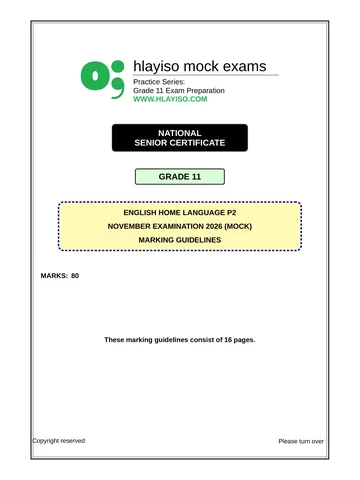
hlayiso mock exams
Practice Series:
Grade 11 Exam Preparation
WWW.HLAYISO.COM
NATIONAL
SENIOR CERTIFICATE
GRADE 11
ENGLISH HOME LANGUAGE P2
NOVEMBER EXAMINATION 2026 (MOCK)
MARKS: 80
TIME: 2½ hours
This question paper consists of 25 pages.
Skip to contentQuestion paper 
View all
English HL Grade 11 P2 November Mock Exam 2 2026 QP (Eng)
Grade 11 English HL Paper 2 question paper from the November Mock Exam 2 2026 (English), 25 pages. Read online or get the free PDF download, memo linked when available.
Publisher: Hlayiso
English HL · Grade 11 · November Mock Exam 2 · 2026. Question paper, 25 pages. Read online or download the PDF.
- Subject
- English HL
- Grade
- Grade 11
- Language
- English
- Document type
- Question paper
- Year
- 2026
- Exam period
- November Mock Exam 2
- Paper
- 2
- Publisher
- Hlayiso
- Curriculum
- CAPS
- Pages
- 25
- File size
- 187.0 KB
Loading document…
Loading document…
1 of 25
Document textSearch extracted text and jump to a page.
English Home Language/P2
2
NSC Mock
Hlayiso/Mock 2026
INSTRUCTIONS AND INFORMATION
1.
Read these instructions carefully before you begin to answer the questions.
2.
Do NOT attempt to read the entire question paper. Consult the table of contents on
page 3 and mark the numbers of the questions set on texts you have studied this year.
Thereafter, read these questions and choose the ones you wish to answer.
3.
This question paper consists of THREE sections:
SECTION A: Poetry (30)
SECTION B: Novel (25)
SECTION C: Drama (25)
4.
Answer FIVE questions in all: THREE in SECTION A, ONE in SECTION B and ONE in
SECTION C as follows:
SECTION A: POETRY
PRESCRIBED POETRY – Answer TWO questions.
UNSEEN POEM – COMPULSORY question
SECTION B: NOVEL
Answer ONE question.
SECTION C: DRAMA
Answer ONE question.
5.
CHOICE OF ANSWERS FOR SECTIONS B (NOVEL) AND C (DRAMA):
• Answer questions ONLY on the novel and the drama you have studied.
• Answer ONE ESSAY QUESTION and ONE CONTEXTUAL QUESTION. If you
answer the essay question in SECTION B, you must answer the contextual question
in SECTION C. If you answer the contextual question in SECTION B, you must
answer the essay question in SECTION C. Use the checklist to assist you.
6.
LENGTH OF ANSWERS:
• The essay question on Poetry should be answered in about 200–250 words.
• Essay questions on the Novel and Drama sections should be answered in 300–350
words.
• The length of answers to contextual questions should be determined by the mark
allocation. Candidates should aim for conciseness and relevance.
7.
Follow the instructions at the beginning of each section carefully.
8.
Number your answers correctly according to the numbering system used in this
question paper.
9.
Start EACH section on a NEW page.
10.
Suggested time management:
SECTION A: approximately 40 minutes
SECTION B: approximately 55 minutes
SECTION C: approximately 55 minutes
11.
Write neatly and legibly.
Copyright reserved
Please turn over
English Home Language/P2
3
NSC Mock
Hlayiso/Mock 2026
TABLE OF CONTENTS
SECTION A: POETRY
Prescribed Poetry: Answer ANY TWO questions.
QUESTION NO.
QUESTION
MARKS
PAGE
NO.
1. 'We Wear the Mask'
Essay question
10
5
2. 'Sonnet 130'
Contextual question
10
6
3. 'The Author to Her Book'
Contextual question
10
7
4.
'Composed
upon
Westminster
Bridge'
Contextual question
10
8
AND
Unseen Poetry: COMPULSORY question
5. 'Piano'
Contextual question
10
9
SECTION B: NOVEL
Answer ONE question.*
6. Dr Jekyll and Mr Hyde
Essay question
25
10
7. Dr Jekyll and Mr Hyde
Contextual question
25
11
8. Pride and Prejudice
Essay question
25
14
9. Pride and Prejudice
Contextual question
25
14
SECTION C: DRAMA
Answer ONE question.*
10. Macbeth
Essay question
25
17
11. Macbeth
Contextual question
25
17
12. The Merchant of Venice
Essay question
25
22
13. The Merchant of Venice
Contextual question
25
22
*NOTE:
In SECTIONS B and C, answer ONE ESSAY and ONE CONTEXTUAL question.
You may NOT answer TWO essay questions or TWO contextual questions.
NOTE ON THIS MOCK PAPER (Hlayiso): Grade 11 literature is prescribed per province and school,
so this paper uses only public-domain works. The novels and dramas are the same as in Mock
1, with new extracts and questions. The prescribed poems are 'We Wear the Mask' (P.L. Dunbar,
1895), 'Sonnet 130' (W. Shakespeare, 1609), 'The Author to Her Book' (Anne Bradstreet, 1678) and
'Composed upon Westminster Bridge' (W. Wordsworth, 1802), public-domain poems typical of Grade
11 Home Language study. The unseen poem is 'Piano' (D.H. Lawrence, 1918).
Copyright reserved
Please turn over
English Home Language/P2
4
NSC Mock
Hlayiso/Mock 2026
CHECKLIST
Use this checklist to ensure that you have answered the correct number of questions.
SECTION
QUESTION
NUMBERS
NO. OF
QUESTIONS TO
ANSWER
TICK (✓)
A: Poetry
(Prescribed Poetry)
1–4
2
A: Poetry
(Unseen Poem)
5
1
B: Novel
(Essay or Contextual)
6–9
1
C: Drama
(Essay or Contextual)
10–13
1
NOTE:
In SECTIONS B and C, ensure that you have answered ONE ESSAY and ONE
CONTEXTUAL question.
You may NOT answer TWO essay questions or TWO contextual questions.
Copyright reserved
Please turn over
English Home Language/P2
5
NSC Mock
Hlayiso/Mock 2026
SECTION A: POETRY
PRESCRIBED POETRY
Answer any TWO of the following questions.
QUESTION 1: POETRY – ESSAY QUESTION
Read the poem below and then answer the question that follows.
WE WEAR THE MASK – Paul Laurence Dunbar
1
We wear the mask that grins and lies,
2
It hides our cheeks and shades our eyes, –
3
This debt we pay to human guile;
4
With torn and bleeding hearts we smile,
5
And mouth with myriad subtleties.
6
Why should the world be over-wise,
7
In counting all our tears and sighs?
8
Nay, let them only see us, while
9
We wear the mask.
10
We smile, but, O great Christ, our cries
11
To thee from tortured souls arise.
12
We sing, but oh the clay is vile
13
Beneath our feet, and long the mile;
14
But let the world dream otherwise,
15
We wear the mask!
Glossary:
guile: cunning, deceit; myriad: countless; subtleties: fine, clever details; over-wise: too
knowing, too curious; clay: earth, the ground (also the human body)
Paul Laurence Dunbar, the son of formerly enslaved parents, wrote this poem in 1895, when
African Americans in the United States still faced harsh discrimination.
In a carefully planned essay, critically discuss how the poet uses imagery, diction and tone
to convey the suffering that is hidden behind the 'mask'.
Your essay must be 200–250 words (about ONE page) in length.
[10]
Copyright reserved
Please turn over
English Home Language/P2
6
NSC Mock
Hlayiso/Mock 2026
QUESTION 2: POETRY – CONTEXTUAL QUESTION
Read the poem below and then answer the questions that follow.
SONNET 130 – William Shakespeare
1
My mistress' eyes are nothing like the sun;
2
Coral is far more red than her lips' red;
3
If snow be white, why then her breasts are dun;
4
If hairs be wires, black wires grow on her head.
5
I have seen roses damasked, red and white,
6
But no such roses see I in her cheeks;
7
And in some perfumes is there more delight
8
Than in the breath that from my mistress reeks.
9
I love to hear her speak, yet well I know
10
That music hath a far more pleasing sound;
11
I grant I never saw a goddess go;
12
My mistress, when she walks, treads on the ground.
13
And yet, by heaven, I think my love as rare
14
As any she belied with false compare.
Glossary:
dun: dull greyish-brown; damasked: patterned or mingled (pink); reeks: is breathed
out, comes out; go: walk; rare: precious, special; belied: misrepresented, lied about; false compare:
exaggerated comparisons
2.1
Refer to lines 1–4: 'My mistress' eyes … on her head.'
Explain how the speaker's comparisons in these lines differ from those usually
found in love poetry of his time.
(2)
2.2
Refer to line 8: 'Than in the … my mistress reeks.'
Comment on the speaker's choice of the word 'reeks' in this line.
(2)
2.3
Refer to lines 11–12: 'I grant I … on the ground.'
Discuss the effectiveness of the contrast between the 'goddess' and the
'mistress' in these lines.
(3)
2.4
Refer to lines 13–14: 'And yet, by … with false compare.'
Critically discuss how the rhyming couplet changes the tone of the sonnet and
conveys its central message.
(3)
[10]
Copyright reserved
Please turn over
English Home Language/P2
7
NSC Mock
Hlayiso/Mock 2026
QUESTION 3: POETRY – CONTEXTUAL QUESTION
Read the poem below and then answer the questions that follow.
THE AUTHOR TO HER BOOK – Anne Bradstreet
1
Thou ill-formed offspring of my feeble brain,
2
Who after birth didst by my side remain,
3
Till snatched from thence by friends, less wise than true,
4
Who thee abroad, exposed to public view,
5
Made thee in rags, halting to th' press to trudge,
6
Where errors were not lessened (all may judge).
7
At thy return my blushing was not small,
8
My rambling brat (in print) should mother call,
9
I cast thee by as one unfit for light,
10
Thy visage was so irksome in my sight;
11
Yet being mine own, at length affection would
12
Thy blemishes amend, if so I could:
13
I washed thy face, but more defects I saw,
14
And rubbing off a spot still made a flaw.
15
I stretched thy joints to make thee even feet,
16
Yet still thou run'st more hobbling than is meet;
17
In better dress to trim thee was my mind,
18
But nought save homespun cloth i' th' house I find.
19
In this array 'mongst vulgars may'st thou roam.
20
In critic's hands beware thou dost not come,
21
And take thy way where yet thou art not known;
22
If for thy father asked, say thou hadst none;
23
And for thy mother, she alas is poor,
24
Which caused her thus to send thee out of door.
Glossary:
Bradstreet's first collection of poems was taken to England and printed in 1650 without
her knowledge; she wrote this poem while revising it for a second edition. halting: limping; press:
printing press; visage: face; irksome: annoying; even feet: regular rhythm (metrical feet); meet: proper;
homespun: simple, home-made; array: clothing; vulgars: ordinary people
3.1
Refer to lines 3–6: 'Till snatched from … (all may judge).'
Explain what these lines reveal about how the book came to be published.
(2)
3.2
Refer to lines 7–8: 'At thy return … should mother call'.
Account for the speaker's 'blushing' when the book returns to her.
(2)
3.3
Refer to lines 13–14: 'I washed thy … made a flaw.'
Discuss how the image in these lines conveys the speaker's frustration in
trying to improve her work.
(3)
3.4
Refer to lines 21–24: 'And take thy … out of door.'
Critically discuss the tone of the concluding lines and what they suggest about
the speaker's position as a woman writer.
(3)
[10]
Copyright reserved
Please turn over
English Home Language/P2
8
NSC Mock
Hlayiso/Mock 2026
QUESTION 4: POETRY – CONTEXTUAL QUESTION
Read the poem below and then answer the questions that follow.
COMPOSED UPON WESTMINSTER BRIDGE – William Wordsworth
1
Earth has not anything to show more fair:
2
Dull would he be of soul who could pass by
3
A sight so touching in its majesty:
4
This City now doth, like a garment, wear
5
The beauty of the morning; silent, bare,
6
Ships, towers, domes, theatres, and temples lie
7
Open unto the fields, and to the sky;
8
All bright and glittering in the smokeless air.
9
Never did sun more beautifully steep
10
In his first splendour, valley, rock, or hill;
11
Ne'er saw I, never felt, a calm so deep!
12
The river glideth at his own sweet will:
13
Dear God! the very houses seem asleep;
14
And all that mighty heart is lying still!
Glossary:
Wordsworth wrote this sonnet after crossing Westminster Bridge over the River Thames
in London early on the morning of 3 September 1802. Dull of soul: insensitive, lacking feeling; doth:
does; smokeless: (at this early hour) free of the smoke of household fires and factories; steep: soak,
bathe; splendour: brilliance; ne'er: never; glideth: glides, flows smoothly
4.1
Refer to lines 2–3: 'Dull would he … in its majesty'.
What do these lines suggest about the speaker's attitude towards anyone who
could ignore this sight?
(2)
4.2
Refer to lines 4–5: 'This City now … of the morning'.
Explain the comparison in these lines.
(2)
4.3
Refer to lines 9–10: 'Never did sun … rock, or hill'.
Discuss why the speaker's comparison of the city with natural scenery is
surprising and effective.
(3)
4.4
Refer to lines 12–14: 'The river glideth … is lying still!'
Critically discuss how the personification in the final lines and the speaker's
tone convey his response to the sleeping city.
(3)
[10]
Copyright reserved
Please turn over
English Home Language/P2
9
NSC Mock
Hlayiso/Mock 2026
UNSEEN POETRY (COMPULSORY)
QUESTION 5: POETRY – CONTEXTUAL QUESTION
Read the poem below and then answer the questions that follow.
PIANO – D.H. Lawrence
1
Softly, in the dusk, a woman is singing to me;
2
Taking me back down the vista of years, till I see
3
A child sitting under the piano, in the boom of the tingling strings
4
And pressing the small, poised feet of a mother who smiles as she sings.
5
In spite of myself, the insidious mastery of song
6
Betrays me back, till the heart of me weeps to belong
7
To the old Sunday evenings at home, with winter outside
8
And hymns in the cosy parlour, the tinkling piano our guide.
9
So now it is vain for the singer to burst into clamour
10
With the great black piano appassionato. The glamour
11
Of childish days is upon me, my manhood is cast
12
Down in the flood of remembrance, I weep like a child for the past.
Glossary:
vista: a long view; poised: balanced, steady; insidious: working secretly and gradually;
parlour: sitting room; vain: useless; clamour: loud noise; appassionato (Italian): played with great
passion; glamour: magic spell, enchantment
5.1
Refer to lines 1–2: 'Softly, in the … till I see'.
Explain how the woman's singing affects the speaker.
(2)
5.2
Refer to lines 5–6: 'In spite of … weeps to belong'.
Comment on the speaker's choice of the word 'insidious' to describe the power
of the song.
(2)
5.3
Refer to lines 7–8: 'To the old … piano our guide.'
Discuss how the imagery in these lines creates a mood of warmth and
security.
(3)
5.4
Refer to stanza 3 (lines 9–12).
Critically discuss how the diction in the final stanza conveys the speaker's
conflicting feelings about his memories of childhood.
(3)
[10]
TOTAL SECTION A:
30
Copyright reserved
Please turn over
English Home Language/P2
10
NSC Mock
Hlayiso/Mock 2026
SECTION B: NOVEL
Answer ONLY on the novel you have studied.
THE STRANGE CASE OF DR JEKYLL AND MR HYDE – Robert Louis Stevenson
Answer EITHER QUESTION 6 (essay question) OR QUESTION 7 (contextual question).
QUESTION 6: DR JEKYLL AND MR HYDE – ESSAY QUESTION
The respectable society of Victorian London, with its obsession with reputation and secrecy,
is as much to blame for the tragedy in the novel as Mr Hyde himself.
In a carefully planned essay of 300–350 words (1½–2 pages) in length, critically discuss to
what extent you agree with this statement.
[25]
Copyright reserved
Please turn over
English Home Language/P2
11
NSC Mock
Hlayiso/Mock 2026
QUESTION 7: DR JEKYLL AND MR HYDE – CONTEXTUAL QUESTION
Read the extracts below and then answer the questions that follow.
EXTRACT A
Nearly a year later, in the month of October, 18—, London was startled by a crime
of singular ferocity and rendered all the more notable by the high position of the
victim. The details were few and startling. A maid servant living alone in a house
not far from the river, had gone upstairs to bed about eleven. Although a fog
rolled over the city in the small hours, the early part of the night was cloudless,
5
and the lane, which the maid's window overlooked, was brilliantly lit by the full
moon. It seems she was romantically given, for she sat down upon her box, which
stood immediately under the window, and fell into a dream of musing. Never (she
used to say, with streaming tears, when she narrated that experience), never had
she felt more at peace with all men or thought more kindly of the world. And as 10
she so sat she became aware of an aged beautiful gentleman with white hair,
drawing near along the lane; and advancing to meet him, another and very small
gentleman, to whom at first she paid less attention. … the moon shone on his face
as he spoke, and the girl was pleased to watch it, it seemed to breathe such an
innocent and old-world kindness of disposition, yet with something high too, as of 15
a well-founded self-content. Presently her eye wandered to the other, and she was
surprised to recognise in him a certain Mr Hyde, who had once visited her master
and for whom she had conceived a dislike. He had in his hand a heavy cane, with
which he was trifling; but he answered never a word, and seemed to listen with an
ill-contained impatience. And then all of a sudden he broke out in a great flame 20
of anger, stamping with his foot, brandishing the cane, and carrying on (as the
maid described it) like a madman. The old gentleman took a step back, with the
air of one very much surprised and a trifle hurt; and at that Mr Hyde broke out
of all bounds and clubbed him to the earth. And next moment, with ape-like fury,
he was trampling his victim under foot and hailing down a storm of blows, under 25
which the bones were audibly shattered and the body jumped upon the roadway.
At the horror of these sights and sounds, the maid fainted.
It was two o'clock when she came to herself and called for the police. The murderer
was gone long ago; but there lay his victim in the middle of the lane, incredibly
mangled. The stick with which the deed had been done, although it was of some 30
rare and very tough and heavy wood, had broken in the middle under the stress
of this insensate cruelty; and one splintered half had rolled in the neighbouring
gutter – the other, without doubt, had been carried away by the murderer.
[Chapter 4: The Carew Murder Case]
Glossary:
singular: remarkable, unusual; romantically given: inclined to dreamy, sentimental
thoughts; musing: daydreaming; trifling: playing idly; insensate: senseless, unfeeling
7.1
What has Mr Utterson already learnt about Mr Hyde and his connection with
Dr Jekyll before the events described in this extract? Mention THREE points.
(3)
7.2
Refer to lines 4–10: 'Although a fog … of the world.'
Explain why the narrator describes the moonlit lane and the maid's peaceful
mood just before the murder.
(3)
Copyright reserved
Please turn over
English Home Language/P2
12
NSC Mock
Hlayiso/Mock 2026
7.3
Refer to lines 10–16: 'And as she … a well-founded self-content.'
Discuss how the contrast between the old gentleman (Sir Danvers Carew)
and Mr Hyde in this extract reflects an important theme in the novel.
(3)
7.4
Refer to lines 24–26: 'And next moment … upon the roadway.'
Comment on the effectiveness of the image 'ape-like fury' in the context of
the novel as a whole.
(3)
7.5
Refer to lines 28–33: 'It was two … by the murderer.'
Explain the significance of the broken stick for the development of the plot.
(3)
AND
Copyright reserved
Please turn over
English Home Language/P2
13
NSC Mock
Hlayiso/Mock 2026
EXTRACT B
'Jekyll,' cried Utterson, with a loud voice, 'I demand to see you.' He paused a
moment, but there came no reply. 'I give you fair warning, our suspicions are
aroused, and I must and shall see you,' he resumed; 'if not by fair means, then by
foul – if not of your consent, then by brute force!'
'Utterson,' said the voice, 'for God's sake, have mercy!'
5
'Ah, that's not Jekyll's voice – it's Hyde's!' cried Utterson. 'Down with the door,
Poole!'
Poole swung the axe over his shoulder; the blow shook the building, and the red
baize door leaped against the lock and hinges. A dismal screech, as of mere
animal terror, rang from the cabinet. Up went the axe again, and again the panels 10
crashed and the frame bounded; four times the blow fell; but the wood was tough
and the fittings were of excellent workmanship; and it was not until the fifth, that
the lock burst and the wreck of the door fell inwards on the carpet.
The besiegers, appalled by their own riot and the stillness that had succeeded,
stood back a little and peered in. There lay the cabinet before their eyes in the quiet 15
lamplight, a good fire glowing and chattering on the hearth, the kettle singing its
thin strain, a drawer or two open, papers neatly set forth on the business table,
and nearer the fire, the things laid out for tea; the quietest room, you would have
said, and, but for the glazed presses full of chemicals, the most commonplace that
night in London.
20
Right in the midst there lay the body of a man sorely contorted and still twitching.
They drew near on tiptoe, turned it on its back and beheld the face of Edward Hyde.
He was dressed in clothes far too large for him, clothes of the doctor's bigness;
the cords of his face still moved with a semblance of life, but life was quite gone;
and by the crushed phial in the hand and the strong smell of kernels that hung 25
upon the air, Utterson knew that he was looking on the body of a self-destroyer.
'We have come too late,' he said sternly, 'whether to save or punish. Hyde is gone
to his account; and it only remains for us to find the body of your master.'
[Chapter 8: The Last Night]
Glossary:
baize: thick woollen cloth used to cover doors; cabinet: Jekyll's private room above the
laboratory; presses: cupboards; phial: small glass bottle; kernels: the bitter-almond smell of the poison
prussic acid (cyanide); gone to his account: died and gone to face God's judgement
7.6
Account for the presence of Mr Utterson and Poole outside the door of the
cabinet on this night.
(3)
7.7
Refer to lines 14–20: 'The besiegers, appalled … night in London.'
Comment on the irony of the description of the cabinet.
(3)
7.8
Refer to both EXTRACT A and EXTRACT B.
Critically discuss how Hyde's behaviour in EXTRACT A contrasts with his final
moments in EXTRACT B, and what this contrast suggests about the fate of
evil in the novel.
(4)
[25]
Copyright reserved
Please turn over
English Home Language/P2
14
NSC Mock
Hlayiso/Mock 2026
PRIDE AND PREJUDICE – Jane Austen
Answer EITHER QUESTION 8 (essay question) OR QUESTION 9 (contextual question).
QUESTION 8: PRIDE AND PREJUDICE – ESSAY QUESTION
In Pride and Prejudice, Austen shows that a happy marriage must be based on love and
mutual respect rather than on money and social position.
In a carefully planned essay of 300–350 words (1½–2 pages) in length, critically discuss to
what extent this statement is true. Refer to at least THREE marriages or engagements in the
novel.
[25]
QUESTION 9: PRIDE AND PREJUDICE – CONTEXTUAL QUESTION
Read the extracts below and then answer the questions that follow.
EXTRACT C
Mr Bingley was good-looking and gentlemanlike: he had a pleasant countenance,
and easy, unaffected manners. … but his friend Mr Darcy soon drew the attention
of the room by his fine, tall person, handsome features, noble mien, and the report,
which was in general circulation within five minutes after his entrance, of his having
ten thousand a year. The gentlemen pronounced him to be a fine figure of a man,
5
the ladies declared he was much handsomer than Mr Bingley, and he was looked
at with great admiration for about half the evening, till his manners gave a disgust
which turned the tide of his popularity; for he was discovered to be proud, to
be above his company, and above being pleased; and not all his large estate
in Derbyshire could then save him from having a most forbidding, disagreeable 10
countenance, and being unworthy to be compared with his friend.
…
'Which do you mean?' and turning round, he looked for a moment at Elizabeth,
till, catching her eye, he withdrew his own, and coldly said, 'She is tolerable: but
not handsome enough to tempt me; and I am in no humour at present to give 15
consequence to young ladies who are slighted by other men. You had better return
to your partner and enjoy her smiles, for you are wasting your time with me.'
Mr Bingley followed his advice. Mr Darcy walked off; and Elizabeth remained with
no very cordial feelings towards him. She told the story, however, with great spirit
among her friends; for she had a lively, playful disposition, which delighted in 20
anything ridiculous.
[Chapter 3]
Glossary:
countenance: face, expression; mien: bearing, appearance; ten thousand a year: an
annual income of £10 000 (a very large fortune); give consequence to: pay attention to, honour
9.1
Place this extract in context.
(3)
9.2
Refer to lines 1–11: 'Mr Bingley was … with his friend.'
Discuss how the narrator uses irony in these lines to comment on the values
of Meryton society.
(3)
Copyright reserved
Please turn over
English Home Language/P2
15
NSC Mock
Hlayiso/Mock 2026
9.3
Refer to lines 14–16: 'She is tolerable … by other men.'
What do these words reveal about Darcy's character at this stage of the
novel?
(3)
9.4
Refer to lines 18–21: 'Mr Bingley followed … in anything ridiculous.'
What does Elizabeth's reaction reveal about her character? Substantiate your
answer.
(3)
AND
EXTRACT D
'Not so hasty, if you please. I have by no means done. To all the objections I have
already urged I have still another to add. I am no stranger to the particulars of your
youngest sister's infamous elopement. I know it all; that the young man's marrying
her was a patched-up business, at the expense of your father and uncles. And is
such a girl to be my nephew's sister? Is her husband, who is the son of his late
5
father's steward, to be his brother? Heaven and earth! – of what are you thinking?
Are the shades of Pemberley to be thus polluted?'
'You can now have nothing further to say,' she resentfully answered. 'You have
insulted me, in every possible method. I must beg to return to the house.'
…
10
'You are then resolved to have him?'
'I have said no such thing. I am only resolved to act in that manner, which will,
in my own opinion, constitute my happiness, without reference to you, or to any
person so wholly unconnected with me.'
'It is well. You refuse, then, to oblige me. You refuse to obey the claims of duty, 15
honour, and gratitude. You are determined to ruin him in the opinion of all his
friends, and make him the contempt of the world.'
'Neither duty, nor honour, nor gratitude,' replied Elizabeth, 'have any possible claim
on me, in the present instance. No principle of either would be violated by my
marriage with Mr Darcy. And with regard to the resentment of his family, or the 20
indignation of the world, if the former were excited by his marrying me, it would
not give me one moment's concern – and the world in general would have too
much sense to join in the scorn.'
[Chapter 56]
Glossary:
steward: the manager of a landowner's estate; shades: (here) the grounds and woods of
the estate; resolved: determined
9.5
Explain why Lady Catherine de Bourgh has come to Longbourn to speak to
Elizabeth.
(3)
9.6
Refer to lines 1–7: 'Not so hasty … to be thus polluted?'
Comment on the irony of Lady Catherine's attitude towards Lydia's marriage
in the light of what Darcy has done for the Bennet family.
(3)
Copyright reserved
Please turn over
English Home Language/P2
16
NSC Mock
Hlayiso/Mock 2026
9.7
Refer to lines 12–14: 'I have said … unconnected with me.'
What do these lines reveal about Elizabeth's values?
(3)
9.8
Refer to both EXTRACT C and EXTRACT D.
Critically discuss how Elizabeth's response to being insulted in EXTRACT C
differs from her response in EXTRACT D, and what this reveals about her
development in the novel.
(4)
[25]
TOTAL SECTION B:
25
Copyright reserved
Please turn over
English Home Language/P2
17
NSC Mock
Hlayiso/Mock 2026
SECTION C: DRAMA
Answer ONLY on the drama you have studied.
MACBETH – William Shakespeare
Answer EITHER QUESTION 10 (essay question) OR QUESTION 11 (contextual question).
QUESTION 10: MACBETH – ESSAY QUESTION
In Macbeth, the disruption of the natural order is shown to be the inevitable consequence of
regicide (the killing of a king).
In a carefully planned essay of 300–350 words (1½–2 pages) in length, critically discuss to
what extent you agree with this statement.
[25]
QUESTION 11: MACBETH – CONTEXTUAL QUESTION
Read the extracts below and then answer the questions that follow.
EXTRACT E
BANQUO
All's well.
I dreamt last night of the three Weird Sisters:
To you they have show'd some truth.
MACBETH
I think not of them:
Yet, when we can entreat an hour to serve,
5
We would spend it in some words upon that business,
If you would grant the time.
BANQUO
At your kind'st leisure.
MACBETH
If you shall cleave to my consent, when 'tis,
It shall make honour for you.
10
BANQUO
So I lose none
In seeking to augment it, but still keep
My bosom franchis'd, and allegiance clear,
I shall be counsell'd.
MACBETH
Good repose the while!
15
BANQUO
Thanks, sir: the like to you.
Exeunt Banquo and Fleance.
Copyright reserved
Please turn over
English Home Language/P2
18
NSC Mock
Hlayiso/Mock 2026
…
MACBETH
Is this a dagger which I see before me,
The handle toward my hand? Come, let me clutch thee: –
I have thee not, and yet I see thee still.
Art thou not, fatal vision, sensible
20
To feeling as to sight? or art thou but
A dagger of the mind, a false creation,
Proceeding from the heat-oppressed brain?
…
I see thee still;
25
And on thy blade and dudgeon, gouts of blood,
Which was not so before. – There's no such thing.
It is the bloody business which informs
Thus to mine eyes. – Now o'er the one half-world
Nature seems dead, and wicked dreams abuse
30
The curtain'd sleep. Witchcraft celebrates
Pale Hecate's off'rings; and wither'd murder,
Alarum'd by his sentinel, the wolf,
Whose howl's his watch, thus with his stealthy pace,
With Tarquin's ravishing strides, towards his design
35
Moves like a ghost.
…
A bell rings.
I go, and it is done. The bell invites me.
Hear it not, Duncan, for it is a knell
That summons thee to heaven or to hell.
[Act 2, Scene 1]
Glossary:
cleave to my consent: support me; franchis'd: free (from guilt); counsell'd: willing to listen;
sensible: able to be felt; dudgeon: handle of a dagger; gouts: drops; Hecate: goddess of witchcraft;
Tarquin: a Roman prince who committed a terrible crime at night; knell: the bell rung for a death
11.1
Place this extract in context.
(3)
11.2
Refer to lines 9–14: 'If you shall … shall be counsell'd.'
Explain what Macbeth is suggesting to Banquo and what Banquo's reply
reveals about Banquo's character.
(3)
11.3
Refer to lines 17–23: 'Is this a … the heat-oppressed brain?'
What does the vision of the dagger reveal about Macbeth's state of mind at
this point in the play?
(3)
11.4
Refer to lines 29–36: 'Now o'er the … Moves like a ghost.'
Discuss how the imagery in these lines creates an appropriate atmosphere
for the murder of Duncan.
(3)
Copyright reserved
Please turn over
English Home Language/P2
19
NSC Mock
Hlayiso/Mock 2026
11.5
Refer to lines 37–39: 'I go, and … or to hell.'
If you were the director of a production of Macbeth, how would you instruct
the actor playing Macbeth to deliver these lines? Pay attention to both tone
and body language. Motivate your instructions.
(3)
AND
Copyright reserved
Please turn over
English Home Language/P2
20
NSC Mock
Hlayiso/Mock 2026
EXTRACT F
DOCTOR
What is it she does now? Look how she rubs her hands.
GENTLEWOMAN
It is an accustomed action with her, to seem thus washing her hands. I have known
her continue in this a quarter of an hour.
LADY MACBETH
Yet here's a spot.
DOCTOR
Hark, she speaks. I will set down what comes from her, to satisfy my remembrance
5
the more strongly.
LADY MACBETH
Out, damned spot! out, I say! One; two. Why, then 'tis time to do't. Hell is murky!
Fie, my lord, fie! a soldier, and afeard? What need we fear who knows it, when
none can call our power to account? Yet who would have thought the old man to
have had so much blood in him?
10
DOCTOR
Do you mark that?
LADY MACBETH
The Thane of Fife had a wife. Where is she now? – What, will these hands ne'er
be clean? No more o' that, my lord, no more o' that: you mar all with this starting.
DOCTOR
Go to, go to. You have known what you should not.
GENTLEWOMAN
She has spoke what she should not, I am sure of that: heaven knows what she 15
has known.
LADY MACBETH
Here's the smell of the blood still: all the perfumes of Arabia will not sweeten this
little hand. Oh, oh, oh!
DOCTOR
What a sigh is there! The heart is sorely charged.
…
DOCTOR
This disease is beyond my practice: yet I have known those which have walked 20
in their sleep, who have died holily in their beds.
[Act 5, Scene 1]
Glossary:
murky: dark, gloomy; Thane of Fife: Macduff; starting: sudden fearful movements; sorely
charged: heavily burdened
11.6
Account for the presence of the Doctor and the Gentlewoman in this scene.
(3)
Copyright reserved
Please turn over
English Home Language/P2
21
NSC Mock
Hlayiso/Mock 2026
11.7
Refer to lines 17–18: 'Here's the smell … Oh, oh, oh!'
Explain the irony of these words when they are compared with what Lady
Macbeth says to Macbeth shortly after the murder of Duncan.
(3)
11.8
Refer to both EXTRACT E and EXTRACT F.
In both extracts a character sees or senses something that is not really there
(a dagger and a spot of blood). Critically discuss how these two visions show
the effect of guilt on Macbeth and Lady Macbeth at different stages of the play.
(4)
[25]
Copyright reserved
Please turn over
English Home Language/P2
22
NSC Mock
Hlayiso/Mock 2026
THE MERCHANT OF VENICE – William Shakespeare
Answer EITHER QUESTION 12 (essay question) OR QUESTION 13 (contextual question).
QUESTION 12: THE MERCHANT OF VENICE – ESSAY QUESTION
In The Merchant of Venice, love and friendship prove to be more powerful than money.
In a carefully planned essay of 300–350 words (1½–2 pages) in length, critically discuss to
what extent you agree with this statement.
[25]
QUESTION 13: THE MERCHANT OF VENICE – CONTEXTUAL QUESTION
Read the extracts below and then answer the questions that follow.
EXTRACT G
SHYLOCK
There I have another bad match, a bankrupt, a prodigal, who dare scarce show
his head on the Rialto, a beggar, that was used to come so smug upon the mart;
let him look to his bond. He was wont to call me usurer; let him look to his bond:
he was wont to lend money for a Christian courtesy; let him look to his bond.
SALARINO
Why, I am sure if he forfeit, thou wilt not take his flesh! What's that good for?
5
SHYLOCK
To bait fish withal; if it will feed nothing else, it will feed my revenge. He hath
disgraced me and hindered me half a million, laughed at my losses, mocked at
my gains, scorned my nation, thwarted my bargains, cooled my friends, heated
mine enemies. And what's his reason? I am a Jew. Hath not a Jew eyes? Hath
not a Jew hands, organs, dimensions, senses, affections, passions? Fed with the 10
same food, hurt with the same weapons, subject to the same diseases, healed
by the same means, warmed and cooled by the same winter and summer as a
Christian is? If you prick us, do we not bleed? If you tickle us, do we not laugh? If
you poison us, do we not die? And if you wrong us, shall we not revenge? If we are
like you in the rest, we will resemble you in that. If a Jew wrong a Christian, what 15
is his humility? Revenge. If a Christian wrong a Jew, what should his sufferance
be by Christian example? Why, revenge! The villainy you teach me I will execute,
and it shall go hard but I will better the instruction.
[Act 3, Scene 1]
Glossary:
prodigal: someone who wastes money; mart: market; wont: used to; usurer: moneylender
who charges interest; courtesy: favour (lending money without interest); withal: with; hindered: cost me
(in lost profit); sufferance: patient endurance
13.1
Place this extract in context.
(3)
13.2
Refer to lines 1–4: 'There I have … to his bond.'
Comment on the effect of the repetition of 'let him look to his bond' and what
it reveals about Shylock's state of mind.
(3)
13.3
Refer to lines 9–14: 'Hath not a … we not revenge?'
Discuss how Shylock uses rhetorical questions to make his argument
persuasive.
(3)
Copyright reserved
Please turn over
English Home Language/P2
23
NSC Mock
Hlayiso/Mock 2026
13.4
Refer to lines 17–18: 'The villainy you … better the instruction.'
Shylock threatens to 'better the instruction'. Critically discuss whether he
succeeds in doing so by the end of the trial.
(3)
AND
Copyright reserved
Please turn over
English Home Language/P2
24
NSC Mock
Hlayiso/Mock 2026
EXTRACT H
DUKE
We all expect a gentle answer, Jew.
SHYLOCK
I have possess'd your Grace of what I purpose,
And by our holy Sabbath have I sworn
To have the due and forfeit of my bond.
If you deny it, let the danger light
5
Upon your charter and your city's freedom!
You'll ask me why I rather choose to have
A weight of carrion flesh than to receive
Three thousand ducats. I'll not answer that,
But say it is my humour. Is it answer'd?
10
What if my house be troubled with a rat,
And I be pleas'd to give ten thousand ducats
To have it ban'd? What, are you answer'd yet?
…
So can I give no reason, nor I will not,
More than a lodg'd hate and a certain loathing
15
I bear Antonio, that I follow thus
A losing suit against him. Are you answer'd?
BASSANIO
This is no answer, thou unfeeling man,
To excuse the current of thy cruelty.
SHYLOCK
I am not bound to please thee with my answers.
20
Copyright reserved
Please turn over
English Home Language/P2
25
NSC Mock
Hlayiso/Mock 2026
BASSANIO
Do all men kill the things they do not love?
SHYLOCK
Hates any man the thing he would not kill?
BASSANIO
Every offence is not a hate at first.
SHYLOCK
What, wouldst thou have a serpent sting thee twice?
ANTONIO
I pray you, think you question with the Jew.
25
You may as well go stand upon the beach
And bid the main flood bate his usual height;
You may as well use question with the wolf,
Why he hath made the ewe bleat for the lamb;
You may as well forbid the mountain pines
30
To wag their high tops and to make no noise
When they are fretten with the gusts of heaven;
You may as well do anything most hard
As seek to soften that – than which what's harder? –
His Jewish heart.
35
[Act 4, Scene 1]
Glossary:
possess'd: informed; charter: the rights and freedoms granted to the city; carrion: dead,
rotting; humour: whim, mood; ban'd: poisoned; lodg'd: deep-rooted; main flood: the sea; bate: lower;
fretten: troubled, shaken
13.5
Refer to line 1: 'We all expect a gentle answer, Jew.'
Explain the pun on the word 'gentle' and why the Duke's appeal is unlikely to
succeed.
(3)
13.6
Refer to lines 7–13: 'You'll ask me … you answer'd yet?'
If you were the director of a production of The Merchant of Venice, how would
you instruct the actor playing Shylock to deliver these lines? Pay attention to
both tone and body language. Motivate your instructions.
(3)
13.7
Refer to lines 26–35: 'You may as … His Jewish heart.'
Discuss the effectiveness of the images Antonio uses to convey the futility of
trying to soften Shylock's heart.
(3)
13.8
Refer to both EXTRACT G and EXTRACT H.
Critically discuss how the reasons Shylock gives for wanting his bond in
EXTRACT G differ from the reasons he gives in court in EXTRACT H, and
what this difference suggests about him.
(4)
[25]
TOTAL SECTION C:
25
GRAND TOTAL:
80
Copyright reserved
Matching paper and memo
The question paper, memo or addendum that belongs with this document.
Study this subject
Revise the topics in this paper, then practise them question by question.
Recommended for this subject
More papers and memos for this grade and subject.
Question paper
English HL Grade 11 P1 November Mock 2026 Question Paper (Eng)
Question paper
English HL Grade 11 P2 November Mock 2026 Question Paper (Eng)
Question paper
English HL Grade 11 P3 November Mock 2026 Question Paper (Eng)
Question paper
English HL Grade 11 P1 November Mock Exam 2 2026 QP (Eng)
Question paper
English HL Grade 11 P3 November Mock Exam 2 2026 QP (Eng)
Question paper
English Hl Grade 11 P1 Eastern Cape November 2022 QP (Eng)
Related documents
Memorandum
English HL Grade 11 P1 November Mock Exam 2 2026 Memo (English)
Memorandum
English HL Grade 11 P3 November Mock Exam 2 2026 Memo (English)
Memorandum
English HL Grade 11 Paper 2 November Mock 2026 Memo (English)
Question paper
English Hl Grade 11 P2 Eastern Cape November 2022 QP (Eng)
Question paper
English Hl Grade 11 P2 Exemplar November 2022 QP (Eng)
Question paper
English Hl Grade 11 P2 Eastern Cape November 2019 QP (Eng)
More from Grade 11 English HL
Memorandum
English HL Grade 11 Paper 1 November Mock 2026 Memo (English)
Memorandum
English HL Grade 11 Paper 3 November Mock 2026 Memo (English)
Annual teaching plan
Gr 11 English HL ATP 2023 24
Memorandum
English Hl Grade 11 P1 Eastern Cape November 2022 Memo (English)
Memorandum
English Hl Grade 11 P2 Eastern Cape November 2022 Memo (English)
Memorandum