
Copyright reserved
Please turn over
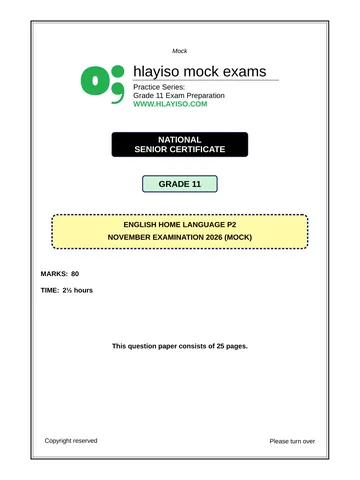
Mock
hlayiso mock exams
Practice Series:
Grade 11 Exam Preparation
WWW.HLAYISO.COM
NATIONAL
SENIOR CERTIFICATE
GRADE 11
ENGLISH HOME LANGUAGE P2
NOVEMBER EXAMINATION 2026 (MOCK)
MARKS: 80
TIME: 2½ hours
This question paper consists of 23 pages.
Skip to contentQuestion paper 
View all
English HL Grade 11 P2 November Mock 2026 Question Paper (Eng)
Grade 11 English HL Paper 2 question paper from the November Mock Exam 2026 (English), 23 pages. Read online or get the free PDF download, memo linked when available.
Publisher: Hlayiso
English HL · Grade 11 · November Mock Exam · 2026. Question paper, 23 pages. Read online or download the PDF.
- Subject
- English HL
- Grade
- Grade 11
- Language
- English
- Document type
- Question paper
- Year
- 2026
- Exam period
- November Mock Exam
- Paper
- 2
- Publisher
- Hlayiso
- Curriculum
- CAPS
- Pages
- 23
- File size
- 183.3 KB
Loading document…
Loading document…
1 of 23
Document textSearch extracted text and jump to a page.
English Home Language/P2
2
NSC Mock
Hlayiso/Mock 2026
INSTRUCTIONS AND INFORMATION
1.
Read these instructions carefully before you begin to answer the questions.
2.
Do NOT attempt to read the entire question paper. Consult the table of contents on
page 4 and mark the numbers of the questions set on texts you have studied this year.
Thereafter, read these questions and choose the ones you wish to answer.
3.
This question paper consists of THREE sections:
SECTION A: Poetry (30)
SECTION B: Novel (25)
SECTION C: Drama (25)
4.
Answer FIVE questions in all: THREE in SECTION A, ONE in SECTION B and ONE in
SECTION C as follows:
SECTION A: POETRY
PRESCRIBED POETRY – Answer TWO questions.
UNSEEN POEM – COMPULSORY question
SECTION B: NOVEL
Answer ONE question.
SECTION C: DRAMA
Answer ONE question.
5.
CHOICE OF ANSWERS FOR SECTIONS B (NOVEL) AND C (DRAMA):
• Answer questions ONLY on the novel and the drama you have studied.
• Answer ONE ESSAY QUESTION and ONE CONTEXTUAL QUESTION. If you
answer the essay question in SECTION B, you must answer the contextual question
in SECTION C. If you answer the contextual question in SECTION B, you must
answer the essay question in SECTION C. Use the checklist to assist you.
6.
LENGTH OF ANSWERS:
• The essay question on Poetry should be answered in about 200–250 words.
• Essay questions on the Novel and Drama sections should be answered in 300–350
words.
• The length of answers to contextual questions should be determined by the mark
allocation. Candidates should aim for conciseness and relevance.
7.
Follow the instructions at the beginning of each section carefully.
8.
Number your answers correctly according to the numbering system used in this
question paper.
9.
Start EACH section on a NEW page.
10.
Suggested time management:
SECTION A: approximately 40 minutes
SECTION B: approximately 55 minutes
SECTION C: approximately 55 minutes
11.
Write neatly and legibly.
Copyright reserved
Please turn over
English Home Language/P2
3
NSC Mock
Hlayiso/Mock 2026
NOTE ON THIS MOCK PAPER (Hlayiso): Grade 11 literature is prescribed per province and school,
so this mock uses only works in the public domain that are typical of the Grade 11 Home Language
lists: the poems 'Ozymandias' (P.B. Shelley, 1818), 'Dulce et Decorum Est' (Wilfred Owen; text of the
1920 first edition), 'Remember' (Christina Rossetti, 1862), 'Death, be not proud' (John Donne, Holy
Sonnet 10, modernised spelling) and, as the unseen poem, 'Sympathy' (Paul Laurence Dunbar,
1899); the novels The Strange Case of Dr Jekyll and Mr Hyde (R.L. Stevenson, 1886) and Pride
and Prejudice (Jane Austen, 1813); and the dramas Macbeth and The Merchant of Venice (William
Shakespeare). All extracts are reproduced from public-domain editions.
Copyright reserved
Please turn over
English Home Language/P2
4
NSC Mock
Hlayiso/Mock 2026
TABLE OF CONTENTS
SECTION A: POETRY
Prescribed Poetry: Answer ANY TWO questions.
QUESTION NO.
QUESTION
MARKS
PAGE
NO.
1. 'Ozymandias'
Essay question
10
6
2. 'Dulce et Decorum Est'
Contextual question
10
7
3. 'Remember'
Contextual question
10
8
4. 'Death, be not proud'
Contextual question
10
8
AND
Unseen Poetry: COMPULSORY question
5. 'Sympathy'
Contextual question
10
10
SECTION B: NOVEL
Answer ONE question.*
6. Dr Jekyll and Mr Hyde
Essay question
25
11
7. Dr Jekyll and Mr Hyde
Contextual question
25
11
8. Pride and Prejudice
Essay question
25
14
9. Pride and Prejudice
Contextual question
25
14
SECTION C: DRAMA
Answer ONE question.*
10. Macbeth
Essay question
25
16
11. Macbeth
Contextual question
25
16
12. The Merchant of Venice
Essay question
25
20
13. The Merchant of Venice
Contextual question
25
20
*NOTE:
In SECTIONS B and C, answer ONE ESSAY and ONE CONTEXTUAL question.
You may NOT answer TWO essay questions or TWO contextual questions.
Copyright reserved
Please turn over
English Home Language/P2
5
NSC Mock
Hlayiso/Mock 2026
CHECKLIST
Use this checklist to ensure that you have answered the correct number of questions.
SECTION
QUESTION
NUMBERS
NO. OF
QUESTIONS TO
ANSWER
TICK (✓)
A: Poetry
(Prescribed Poetry)
1–4
2
A: Poetry
(Unseen Poem)
5
1
B: Novel
(Essay or Contextual)
6–9
1
C: Drama
(Essay or Contextual)
10–13
1
NOTE:
In SECTIONS B and C, ensure that you have answered ONE ESSAY and ONE
CONTEXTUAL question.
You may NOT answer TWO essay questions or TWO contextual questions.
Copyright reserved
Please turn over
English Home Language/P2
6
NSC Mock
Hlayiso/Mock 2026
SECTION A: POETRY
PRESCRIBED POETRY
Answer any TWO of the following questions.
QUESTION 1: ESSAY QUESTION
Read the poem below and then answer the question that follows.
OZYMANDIAS – Percy Bysshe Shelley
1
I met a traveller from an antique land
2
Who said: Two vast and trunkless legs of stone
3
Stand in the desert … Near them, on the sand,
4
Half sunk, a shattered visage lies, whose frown,
5
And wrinkled lip, and sneer of cold command,
6
Tell that its sculptor well those passions read
7
Which yet survive, stamped on these lifeless things,
8
The hand that mocked them, and the heart that fed:
9
And on the pedestal these words appear:
10
'My name is Ozymandias, king of kings:
11
Look on my works, ye Mighty, and despair!'
12
Nothing beside remains. Round the decay
13
Of that colossal wreck, boundless and bare
14
The lone and level sands stretch far away.
Glossary:
antique: ancient; visage: face; Ozymandias: Greek name for the Egyptian pharaoh
Ramesses II
In 'Ozymandias', the poet shows that human power and pride are short-lived, while time and
nature endure.
With close reference to imagery, diction and tone, critically discuss the validity of the above
statement.
Your response should take the form of a well-constructed essay of 200–250 words (about
ONE page).
[10]
Copyright reserved
Please turn over
English Home Language/P2
7
NSC Mock
Hlayiso/Mock 2026
QUESTION 2: CONTEXTUAL QUESTION
Read the poem below and then answer the questions that follow.
DULCE ET DECORUM EST – Wilfred Owen
1
Bent double, like old beggars under sacks,
2
Knock-kneed, coughing like hags, we cursed through sludge,
3
Till on the haunting flares we turned our backs
4
And towards our distant rest began to trudge.
5
Men marched asleep. Many had lost their boots
6
But limped on, blood-shod. All went lame; all blind;
7
Drunk with fatigue; deaf even to the hoots
8
Of gas-shells dropping softly behind.
9
Gas! GAS! Quick, boys! – An ecstasy of fumbling
10
Fitting the clumsy helmets just in time,
11
But someone still was yelling out and stumbling
12
And flound'ring like a man in fire or lime. –
13
Dim, through the misty panes and thick green light,
14
As under a green sea, I saw him drowning.
15
In all my dreams before my helpless sight
16
He plunges at me, guttering, choking, drowning.
17
If in some smothering dreams you too could pace
18
Behind the wagon that we flung him in,
19
And watch the white eyes writhing in his face,
20
His hanging face, like a devil's sick of sin,
21
If you could hear, at every jolt, the blood
22
Come gargling from the froth-corrupted lungs,
23
Bitter as the cud
24
Of vile, incurable sores on innocent tongues, –
25
My friend, you would not tell with such high zest
26
To children ardent for some desperate glory,
27
The old Lie: Dulce et decorum est
28
Pro patria mori.
Glossary:
flares: bright lights fired into the night sky over the battlefield; lime: a chemical that burns
the skin; ardent: eager, passionate; Dulce et decorum est / Pro patria mori (Latin): 'It is sweet and fitting
to die for one's country'
2.1
Refer to lines 1–2: 'Bent double, like … cursed through sludge'.
What do these lines suggest about the condition of the soldiers?
(2)
2.2
Refer to line 9: 'Gas! GAS! Quick, boys!'
Account for the sudden change in the pace of the poem in this line.
(2)
2.3
Refer to lines 13–14: 'Dim, through the … saw him drowning.'
2.3.1
Identify the figure of speech in 'As under a green sea'.
(1)
2.3.2
Discuss the effectiveness of this image.
(2)
Copyright reserved
Please turn over
English Home Language/P2
8
NSC Mock
Hlayiso/Mock 2026
2.4
Refer to lines 25–28: 'My friend, you … Pro patria mori.'
Critically discuss how these lines convey the speaker's attitude towards war.
(3)
[10]
QUESTION 3: CONTEXTUAL QUESTION
Read the poem below and then answer the questions that follow.
REMEMBER – Christina Rossetti
1
Remember me when I am gone away,
2
Gone far away into the silent land;
3
When you can no more hold me by the hand,
4
Nor I half turn to go yet turning stay.
5
Remember me when no more day by day
6
You tell me of our future that you planned:
7
Only remember me; you understand
8
It will be late to counsel then or pray.
9
Yet if you should forget me for a while
10
And afterwards remember, do not grieve:
11
For if the darkness and corruption leave
12
A vestige of the thoughts that once I had,
13
Better by far you should forget and smile
14
Than that you should remember and be sad.
Glossary:
counsel: give advice; corruption: decay; vestige: a small trace
3.1
Refer to line 2: 'Gone far away into the silent land'.
Explain what the speaker means by 'the silent land'.
(2)
3.2
Refer to line 4: 'Nor I half turn to go yet turning stay.'
What does this line suggest about the relationship between the speaker and
the person she addresses?
(2)
3.3
Refer to lines 1, 5 and 7.
3.3.1
Identify the sound device that is used in these lines.
(1)
3.3.2
Discuss the effectiveness of this device in the octave (lines 1–8).
(2)
3.4
Refer to lines 9–14: 'Yet if you … and be sad.'
Critically discuss how the speaker's attitude changes in the sestet.
(3)
[10]
QUESTION 4: CONTEXTUAL QUESTION
Read the poem below and then answer the questions that follow.
Copyright reserved
Please turn over
English Home Language/P2
9
NSC Mock
Hlayiso/Mock 2026
DEATH, BE NOT PROUD (HOLY SONNET 10) – John Donne
1
Death, be not proud, though some have called thee
2
Mighty and dreadful, for thou art not so;
3
For those whom thou think'st thou dost overthrow
4
Die not, poor Death, nor yet canst thou kill me.
5
From rest and sleep, which but thy pictures be,
6
Much pleasure; then from thee much more must flow,
7
And soonest our best men with thee do go,
8
Rest of their bones, and soul's delivery.
9
Thou art slave to fate, chance, kings, and desperate men,
10
And dost with poison, war, and sickness dwell,
11
And poppy or charms can make us sleep as well
12
And better than thy stroke; why swell'st thou then?
13
One short sleep past, we wake eternally
14
And death shall be no more; Death, thou shalt die.
Glossary:
thy pictures: images or copies of you; delivery: release, freedom; poppy: opium, a drug
that causes sleep; swell'st: swell with pride
4.1
Refer to lines 1–2: 'Death, be not … art not so'.
Explain why the speaker addresses Death directly.
(2)
4.2
Refer to lines 5–6: 'From rest and … must flow'.
Explain the speaker's argument in these lines.
(2)
4.3
Refer to line 9: 'Thou art slave to fate, chance, kings, and desperate men'.
4.3.1
Identify the figure of speech in this line.
(1)
4.3.2
Discuss the effectiveness of this image in the context of the poem.
(2)
4.4
Refer to lines 13–14: 'One short sleep … thou shalt die.'
Critically discuss the effectiveness of these lines as a conclusion to the poem.
(3)
[10]
Copyright reserved
Please turn over
English Home Language/P2
10
NSC Mock
Hlayiso/Mock 2026
UNSEEN POETRY (COMPULSORY)
QUESTION 5: CONTEXTUAL QUESTION
Read the poem below and then answer the questions that follow.
SYMPATHY – Paul Laurence Dunbar
1
I know what the caged bird feels, alas!
2
When the sun is bright on the upland slopes;
3
When the wind stirs soft through the springing grass,
4
And the river flows like a stream of glass;
5
When the first bird sings and the first bud opes,
6
And the faint perfume from its chalice steals –
7
I know what the caged bird feels!
8
I know why the caged bird beats his wing
9
Till its blood is red on the cruel bars;
10
For he must fly back to his perch and cling
11
When he fain would be on the bough a-swing;
12
And a pain still throbs in the old, old scars
13
And they pulse again with a keener sting –
14
I know why he beats his wing!
15
I know why the caged bird sings, ah me,
16
When his wing is bruised and his bosom sore, –
17
When he beats his bars and he would be free;
18
It is not a carol of joy or glee,
19
But a prayer that he sends from his heart's deep core,
20
But a plea, that upward to Heaven he flings –
21
I know why the caged bird sings!
Glossary:
upland: high ground; opes: opens; chalice: cup (here, the cup-shaped flower); fain: gladly;
bosom: chest; carol: joyful song
5.1
Refer to lines 2–6: 'When the sun … its chalice steals'.
Explain why the speaker describes the beauty of nature in the first stanza.
(2)
5.2
Refer to lines 8–9: 'I know why … the cruel bars'.
5.2.1
Identify the figure of speech in 'the cruel bars'.
(1)
5.2.2
Discuss the effectiveness of this image.
(2)
5.3
Refer to lines 12–13: 'And a pain … a keener sting'.
What does the repetition of 'old' suggest about the bird's suffering?
(2)
5.4
Refer to stanza 3 (lines 15–21).
Critically discuss how the final stanza reveals the true meaning of the bird's
song and the speaker's identification with the caged bird.
(3)
[10]
TOTAL SECTION A:
30
Copyright reserved
Please turn over
English Home Language/P2
11
NSC Mock
Hlayiso/Mock 2026
SECTION B: NOVEL
Answer ONLY on the novel you have studied.
THE STRANGE CASE OF DR JEKYLL AND MR HYDE – Robert Louis Stevenson
Answer EITHER QUESTION 6 (essay question) OR QUESTION 7 (contextual question).
QUESTION 6: DR JEKYLL AND MR HYDE – ESSAY QUESTION
Dr Jekyll is destroyed not by his scientific experiment, but by his own hypocrisy and his desire
to escape the consequences of his actions.
With close reference to the novel, critically discuss the validity of the above statement.
Your response should take the form of a well-constructed essay of 300–350 words (1½–2
pages).
[25]
QUESTION 7: DR JEKYLL AND MR HYDE – CONTEXTUAL QUESTION
Read the extracts below and then answer the questions that follow.
EXTRACT A
'Well, it was this way,' returned Mr Enfield: 'I was coming home from some place at
the end of the world, about three o'clock of a black winter morning, and my way lay
through a part of town where there was literally nothing to be seen but lamps. …
All at once, I saw two figures: one a little man who was stumping along eastward
at a good walk, and the other a girl of maybe eight or ten who was running as
5
hard as she was able down a cross street. Well, sir, the two ran into one another
naturally enough at the corner; and then came the horrible part of the thing; for the
man trampled calmly over the child's body and left her screaming on the ground.
It sounds nothing to hear, but it was hellish to see. It wasn't like a man; it was
like some damned Juggernaut. I gave a few halloa, took to my heels, collared my 10
gentleman, and brought him back to where there was already quite a group about
the screaming child. He was perfectly cool and made no resistance, but gave me
one look, so ugly that it brought out the sweat on me like running. … I had taken
a loathing to my gentleman at first sight. So had the child's family, which was only
natural. But the doctor's case was what struck me. He was the usual cut and dry 15
apothecary, of no particular age and colour, with a strong Edinburgh accent and
about as emotional as a bagpipe. Well, sir, he was like the rest of us; every time
he looked at my prisoner, I saw that Sawbones turn sick and white with the desire
to kill him. … Well, we screwed him up to a hundred pounds for the child's family;
he would have clearly liked to stick out; but there was something about the lot of 20
us that meant mischief, and at last he struck. The next thing was to get the money;
and where do you think he carried us but to that place with the door? – whipped
out a key, went in, and presently came back with the matter of ten pounds in gold
and a cheque for the balance on Coutts's, drawn payable to bearer and signed
with a name that I can't mention, though it's one of the points of my story, but it 25
was a name at least very well known and often printed.'
[Chapter 1: Story of the Door]
Glossary:
Juggernaut: a huge, unstoppable force that crushes everything in its path; apothecary: a
pharmacist or doctor; Sawbones: slang for a doctor; Coutts's: a well-known London bank
Copyright reserved
Please turn over
English Home Language/P2
12
NSC Mock
Hlayiso/Mock 2026
7.1
Place this extract in context.
(2)
7.2
Refer to line 7: 'for the man … the child's body'.
What does the word 'calmly' reveal about the man (Mr Hyde)?
(2)
7.3
Refer to line 9: 'It wasn't like … some damned Juggernaut.'
Explain why Enfield compares the man to a Juggernaut.
(2)
7.4
Refer to lines 17–19: 'Well, sir, he … to kill him.'
Discuss the reaction that Hyde provokes in other people here and elsewhere
in the novel, and what this suggests about him.
(3)
7.5
Refer to lines 21–26: 'The next thing … and often printed.'
Discuss the significance of the cheque and the signature for the development
of the plot.
(3)
AND
Copyright reserved
Please turn over
English Home Language/P2
13
NSC Mock
Hlayiso/Mock 2026
EXTRACT B
Though so profound a double-dealer, I was in no sense a hypocrite; both sides
of me were in dead earnest; I was no more myself when I laid aside restraint and
plunged in shame, than when I laboured, in the eye of day, at the furtherance of
knowledge or the relief of sorrow and suffering. And it chanced that the direction of
my scientific studies, which led wholly towards the mystic and the transcendental,
5
reacted and shed a strong light on this consciousness of the perennial war among
my members. With every day, and from both sides of my intelligence, the moral
and the intellectual, I thus drew steadily nearer to that truth, by whose partial
discovery I have been doomed to such a dreadful shipwreck: that man is not
truly one, but truly two. … It was on the moral side, and in my own person, that I 10
learned to recognise the thorough and primitive duality of man; I saw that, of the
two natures that contended in the field of my consciousness, even if I could rightly
be said to be either, it was only because I was radically both; and from an early
date, even before the course of my scientific discoveries had begun to suggest the
most naked possibility of such a miracle, I had learned to dwell with pleasure, as a 15
beloved daydream, on the thought of the separation of these elements. If each, I
told myself, could be housed in separate identities, life would be relieved of all that
was unbearable; the unjust might go his way, delivered from the aspirations and
remorse of his more upright twin; and the just could walk steadfastly and securely
on his upward path, doing the good things in which he found his pleasure, and 20
no longer exposed to disgrace and penitence by the hands of this extraneous
evil. It was the curse of mankind that these incongruous faggots were thus bound
together – that in the agonised womb of consciousness, these polar twins should
be continuously struggling. How, then were they dissociated?
[Chapter 10: Henry Jekyll's Full Statement of the Case]
Glossary:
perennial: lasting for ever; extraneous: coming from outside; incongruous faggots:
unmatched bundles of sticks; dissociated: separated
7.6
Explain how Mr Utterson comes to read Jekyll's 'Full Statement of the Case'.
(2)
7.7
Refer to line 9: 'that man is not truly one, but truly two.'
Explain how this idea is central to the novel.
(2)
7.8
Refer to lines 23–24: 'that in the … be continuously struggling.'
Comment on the effectiveness of the image of 'polar twins' in these lines.
(3)
7.9
Refer to lines 16–22: 'If each, I … this extraneous evil.'
Discuss the irony of Jekyll's hopes in the light of what actually happens in the
novel.
(3)
7.10
Refer to lines 1–4: 'Though so profound … sorrow and suffering.'
Jekyll claims that he was 'in no sense a hypocrite'.
Based on your knowledge of the novel as a whole, critically discuss whether
you agree with Jekyll's view of himself.
(3)
[25]
Copyright reserved
Please turn over
English Home Language/P2
14
NSC Mock
Hlayiso/Mock 2026
PRIDE AND PREJUDICE – Jane Austen
Answer EITHER QUESTION 8 (essay question) OR QUESTION 9 (contextual question).
QUESTION 8: PRIDE AND PREJUDICE – ESSAY QUESTION
In Pride and Prejudice, Elizabeth Bennet's prejudice is a greater obstacle to her happiness
than Mr Darcy's pride.
With close reference to the novel, critically discuss the validity of the above statement.
Your response should take the form of a well-constructed essay of 300–350 words (1½–2
pages).
[25]
QUESTION 9: PRIDE AND PREJUDICE – CONTEXTUAL QUESTION
Read the extracts below and then answer the questions that follow.
EXTRACT C
After a silence of several minutes, he came towards her in an agitated manner,
and thus began: –
'In vain have I struggled. It will not do. My feelings will not be repressed. You must
allow me to tell you how ardently I admire and love you.'
Elizabeth's astonishment was beyond expression. She stared, coloured, doubted,
5
and was silent. This he considered sufficient encouragement, and the avowal of
all that he felt and had long felt for her immediately followed. He spoke well; but
there were feelings besides those of the heart to be detailed, and he was not more
eloquent on the subject of tenderness than of pride. His sense of her inferiority,
of its being a degradation, of the family obstacles which judgment had always 10
opposed to inclination, were dwelt on with a warmth which seemed due to the
consequence he was wounding, but was very unlikely to recommend his suit.
…
'In such cases as this, it is, I believe, the established mode to express a sense of
obligation for the sentiments avowed, however unequally they may be returned. 15
It is natural that obligation should be felt, and if I could feel gratitude, I would now
thank you. But I cannot – I have never desired your good opinion, and you have
certainly bestowed it most unwillingly.'
…
'… Had not my own feelings decided against you, had they been indifferent, or 20
had they even been favourable, do you think that any consideration would tempt
me to accept the man who has been the means of ruining, perhaps for ever, the
happiness of a most beloved sister?'
[Chapter 34]
Glossary:
avowal: open declaration; suit: proposal of marriage; mode: custom, way of doing things
9.1
Place this extract in context.
(2)
9.2
Refer to lines 3–4: 'In vain have … and love you.'
What do these words reveal about Darcy's feelings for Elizabeth?
(2)
Copyright reserved
Please turn over
English Home Language/P2
15
NSC Mock
Hlayiso/Mock 2026
9.3
Refer to lines 9–12: 'His sense of … recommend his suit.'
Discuss why Darcy's manner of proposing is unlikely to succeed.
(3)
9.4
Refer to lines 20–23.
Explain what Elizabeth accuses Darcy of doing to her 'most beloved sister'.
(2)
9.5
Refer to lines 14–18: 'In such cases … most unwillingly.'
If you were the director of a stage adaptation of the novel, how would you
instruct the actress playing Elizabeth to deliver these lines? Pay attention to
tone and body language. Motivate your instructions.
(3)
AND
EXTRACT D
She grew absolutely ashamed of herself. Of neither Darcy nor Wickham could she
think, without feeling that she had been blind, partial, prejudiced, absurd.
'How despicably have I acted!' she cried. 'I, who have prided myself on my
discernment! I, who have valued myself on my abilities! who have often disdained
the generous candour of my sister, and gratified my vanity in useless or blameless
5
distrust. How humiliating is this discovery! Yet, how just a humiliation! Had I been
in love, I could not have been more wretchedly blind. But vanity, not love, has been
my folly. Pleased with the preference of one, and offended by the neglect of the
other, on the very beginning of our acquaintance, I have courted prepossession
and ignorance, and driven reason away where either were concerned. Till this 10
moment, I never knew myself.'
[Chapter 36]
9.6
What has Elizabeth learnt about Mr Wickham shortly before this extract?
(2)
9.7
Refer to lines 1–2: 'She grew absolutely … prejudiced, absurd.'
Explain why Elizabeth feels 'ashamed of herself'.
(2)
9.8
Refer to line 7: 'But vanity, not … been my folly.'
Discuss how Elizabeth's vanity has influenced her judgement of Darcy and
Wickham.
(3)
9.9
Refer to line 10: 'Till this moment, I never knew myself.'
Comment on the significance of this realisation for Elizabeth's development
in the novel.
(3)
9.10
Elizabeth is not the only character who learns to see himself or herself more
clearly in the novel.
Critically discuss the extent to which Darcy also changes after the events of
EXTRACT C.
(3)
[25]
TOTAL SECTION B:
25
Copyright reserved
Please turn over
English Home Language/P2
16
NSC Mock
Hlayiso/Mock 2026
SECTION C: DRAMA
Answer ONLY on the drama you have studied.
MACBETH – William Shakespeare
Answer EITHER QUESTION 10 (essay question) OR QUESTION 11 (contextual question).
QUESTION 10: MACBETH – ESSAY QUESTION
Lady Macbeth is more responsible than Macbeth for the murder of Duncan and the tragedy
that follows.
Critically discuss the validity of the above statement in relation to the play.
Your response should take the form of a well-constructed essay of 300–350 words (1½–2
pages).
[25]
QUESTION 11: MACBETH – CONTEXTUAL QUESTION
Read the extracts below and then answer the questions that follow.
EXTRACT E
MACBETH
We will proceed no further in this business:
He hath honour'd me of late; and I have bought
Golden opinions from all sorts of people,
Which would be worn now in their newest gloss,
Not cast aside so soon.
5
LADY MACBETH
Was the hope drunk
Wherein you dress'd yourself? Hath it slept since?
And wakes it now, to look so green and pale
At what it did so freely? From this time
Such I account thy love. Art thou afeard
10
To be the same in thine own act and valour
As thou art in desire? Wouldst thou have that
Which thou esteem'st the ornament of life,
And live a coward in thine own esteem,
Letting 'I dare not' wait upon 'I would,'
15
Like the poor cat i' th' adage?
MACBETH
Pr'ythee, peace!
I dare do all that may become a man;
Who dares do more is none.
LADY MACBETH
What beast was't, then,
20
That made you break this enterprise to me?
When you durst do it, then you were a man;
And, to be more than what you were, you would
Be so much more the man. Nor time nor place
Did then adhere, and yet you would make both:
25
Copyright reserved
Please turn over
English Home Language/P2
17
NSC Mock
Hlayiso/Mock 2026
They have made themselves, and that their fitness now
Does unmake you. I have given suck, and know
How tender 'tis to love the babe that milks me:
I would, while it was smiling in my face,
Have pluck'd my nipple from his boneless gums
30
And dash'd the brains out, had I so sworn as you
Have done to this.
MACBETH
If we should fail?
LADY MACBETH
We fail?
But screw your courage to the sticking-place,
35
And we'll not fail.
[Act 1, Scene 7]
11.1
Describe what Macbeth has been considering in the soliloquy that comes
immediately before this extract.
(2)
11.2
Refer to lines 1–5: 'We will proceed … aside so soon.'
Explain the reason that Macbeth gives for deciding not to murder Duncan.
(2)
11.3
Refer to lines 6–9: 'Was the hope … so freely?'
Discuss how Lady Macbeth uses imagery to mock Macbeth's change of heart.
(3)
11.4
Refer to lines 20–24: 'What beast was't … more the man.'
Comment on how Lady Macbeth manipulates Macbeth in these lines.
(3)
11.5
Refer to lines 27–32: 'I have given … done to this.'
If you were the director of a production of Macbeth, how would you instruct the
actress playing Lady Macbeth to deliver these lines? Pay specific attention to
tone and body language. Motivate your instructions.
(3)
AND
Copyright reserved
Please turn over
English Home Language/P2
18
NSC Mock
Hlayiso/Mock 2026
EXTRACT F
MACBETH
I have almost forgot the taste of fears.
The time has been, my senses would have cool'd
To hear a night-shriek; and my fell of hair
Would at a dismal treatise rouse and stir
As life were in't. I have supp'd full with horrors;
5
Direness, familiar to my slaughterous thoughts,
Cannot once start me.
Enter Seyton.
Wherefore was that cry?
SEYTON
The Queen, my lord, is dead.
MACBETH
She should have died hereafter.
10
There would have been a time for such a word.
Tomorrow, and tomorrow, and tomorrow,
Creeps in this petty pace from day to day,
To the last syllable of recorded time;
And all our yesterdays have lighted fools
15
The way to dusty death. Out, out, brief candle!
Life's but a walking shadow; a poor player,
That struts and frets his hour upon the stage,
And then is heard no more: it is a tale
Told by an idiot, full of sound and fury,
20
Signifying nothing.
Copyright reserved
Please turn over
English Home Language/P2
19
NSC Mock
Hlayiso/Mock 2026
Enter a Messenger.
Thou com'st to use thy tongue; thy story quickly.
MESSENGER
Gracious my lord,
I should report that which I say I saw,
But know not how to do't.
25
MACBETH
Well, say, sir.
MESSENGER
As I did stand my watch upon the hill,
I look'd toward Birnam, and anon, methought,
The wood began to move.
…
MACBETH
I pull in resolution; and begin
30
To doubt th' equivocation of the fiend,
That lies like truth. 'Fear not, till Birnam wood
Do come to Dunsinane;' and now a wood
Comes toward Dunsinane.
[Act 5, Scene 5]
Glossary:
fell of hair: the hair on my skin; treatise: story; start: startle; equivocation: deliberately
misleading words with a double meaning
11.6
Explain what had happened to Lady Macbeth before her death.
(2)
11.7
Refer to lines 1–7: 'I have almost … once start me.'
What do these lines reveal about the change that has taken place in Macbeth
since the beginning of the play?
(2)
11.8
Refer to lines 17–21: 'Life's but a … Signifying nothing.'
Discuss how the imagery in these lines conveys Macbeth's view of life at this
point in the play.
(3)
11.9
Refer to lines 30–34: 'I pull in … toward Dunsinane.'
Explain how the witches' prophecy about Birnam wood is fulfilled.
(2)
11.10
Refer to EXTRACT E and EXTRACT F.
Critically discuss whether the audience is likely to feel any sympathy for
Macbeth at the end of the play.
(3)
[25]
Copyright reserved
Please turn over
English Home Language/P2
20
NSC Mock
Hlayiso/Mock 2026
THE MERCHANT OF VENICE – William Shakespeare
Answer EITHER QUESTION 12 (essay question) OR QUESTION 13 (contextual question).
QUESTION 12: THE MERCHANT OF VENICE – ESSAY QUESTION
Shylock is a man more sinned against than sinning.
Critically discuss the validity of the above statement in relation to the play.
Your response should take the form of a well-constructed essay of 300–350 words (1½–2
pages).
[25]
QUESTION 13: THE MERCHANT OF VENICE – CONTEXTUAL QUESTION
Read the extracts below and then answer the questions that follow.
EXTRACT G
SHYLOCK
Signior Antonio, many a time and oft
In the Rialto you have rated me
About my moneys and my usances.
Still have I borne it with a patient shrug,
(For suff'rance is the badge of all our tribe.)
5
You call me misbeliever, cut-throat dog,
And spet upon my Jewish gaberdine,
And all for use of that which is mine own.
Well then, it now appears you need my help.
Go to, then, you come to me, and you say
10
'Shylock, we would have moneys.' You say so:
You that did void your rheum upon my beard,
And foot me as you spurn a stranger cur
Over your threshold, moneys is your suit.
What should I say to you? Should I not say
15
'Hath a dog money? Is it possible
A cur can lend three thousand ducats?' …
ANTONIO
I am as like to call thee so again,
To spet on thee again, to spurn thee too.
If thou wilt lend this money, lend it not
20
As to thy friends, for when did friendship take
A breed for barren metal of his friend?
But lend it rather to thine enemy,
Who if he break, thou mayst with better face
Exact the penalty.
25
Copyright reserved
Please turn over
English Home Language/P2
21
NSC Mock
Hlayiso/Mock 2026
SHYLOCK
Why, look you how you storm!
I would be friends with you, and have your love,
Forget the shames that you have stain'd me with,
Supply your present wants, and take no doit
Of usance for my moneys, and you'll not hear me,
30
This is kind I offer.
…
SHYLOCK
Go with me to a notary, seal me there
Your single bond; and in a merry sport,
If you repay me not on such a day,
In such a place, such sum or sums as are
35
Express'd in the condition, let the forfeit
Be nominated for an equal pound
Of your fair flesh, to be cut off and taken
In what part of your body pleaseth me.
[Act 1, Scene 3]
Glossary:
rated: scolded; usances: interest charged on loans; gaberdine: long cloak; void your
rheum: spit; breed for barren metal: interest on money; doit: a coin of very small value
13.1
Explain why Antonio needs to borrow three thousand ducats from Shylock.
(2)
13.2
Refer to line 5: '(For suff'rance is the badge of all our tribe.)'
Explain what Shylock means by this line.
(2)
13.3
Refer to lines 6–14: 'You call me … is your suit.'
Discuss what these lines reveal about the way in which Shylock has been
treated in Venice.
(3)
13.4
Refer to lines 18–25: 'I am as … Exact the penalty.'
Comment on Antonio's attitude in these lines and on the dramatic irony of his
words.
(3)
13.5
Refer to lines 32–39: 'Go with me … part of your body pleaseth me.'
Explain the irony of Shylock's description of the bond as 'a merry sport'.
(2)
AND
Copyright reserved
Please turn over
English Home Language/P2
22
NSC Mock
Hlayiso/Mock 2026
EXTRACT H
PORTIA
Do you confess the bond?
ANTONIO
I do.
PORTIA
Then must the Jew be merciful.
SHYLOCK
On what compulsion must I? Tell me that.
PORTIA
The quality of mercy is not strain'd,
5
It droppeth as the gentle rain from heaven
Upon the place beneath. It is twice blest,
It blesseth him that gives and him that takes.
'Tis mightiest in the mightiest; it becomes
The throned monarch better than his crown.
10
His sceptre shows the force of temporal power,
The attribute to awe and majesty,
Wherein doth sit the dread and fear of kings;
But mercy is above this sceptred sway,
It is enthroned in the hearts of kings,
15
It is an attribute to God himself;
And earthly power doth then show likest God's
When mercy seasons justice. Therefore, Jew,
Though justice be thy plea, consider this,
That in the course of justice none of us
20
Should see salvation. We do pray for mercy,
And that same prayer doth teach us all to render
The deeds of mercy. I have spoke thus much
To mitigate the justice of thy plea,
Which if thou follow, this strict court of Venice
25
Must needs give sentence 'gainst the merchant there.
Copyright reserved
Please turn over
English Home Language/P2
23
NSC Mock
Hlayiso/Mock 2026
SHYLOCK
My deeds upon my head! I crave the law,
The penalty and forfeit of my bond.
PORTIA
Is he not able to discharge the money?
BASSANIO
Yes, here I tender it for him in the court,
30
Yea, twice the sum, if that will not suffice,
I will be bound to pay it ten times o'er
On forfeit of my hands, my head, my heart.
If this will not suffice, it must appear
That malice bears down truth. And I beseech you,
35
Wrest once the law to your authority.
To do a great right, do a little wrong,
And curb this cruel devil of his will.
PORTIA
It must not be, there is no power in Venice
Can alter a decree established;
40
'Twill be recorded for a precedent,
And many an error by the same example
Will rush into the state. It cannot be.
[Act 4, Scene 1]
Glossary:
strain'd: forced; temporal: earthly; render: give; wrest: twist, bend
13.6
Explain who Portia is pretending to be in this scene and why she is in disguise.
(2)
13.7
Refer to lines 5–7: 'The quality of … the place beneath.'
Discuss the effectiveness of the image of 'the gentle rain from heaven' in
conveying the nature of mercy.
(3)
13.8
Refer to line 27: 'My deeds upon my head! I crave the law'.
What does this line reveal about Shylock's state of mind?
(2)
13.9
Refer to lines 36–43: 'Wrest once the … It cannot be.'
Discuss the irony of Portia's insistence on the strict letter of the law in the light
of the outcome of the trial.
(3)
13.10
Portia urges Shylock to show mercy.
Critically discuss the extent to which Antonio and the Venetian court show
Shylock mercy by the end of the trial.
(3)
[25]
TOTAL SECTION C:
25
GRAND TOTAL:
80
Copyright reserved
Matching paper and memo
The question paper, memo or addendum that belongs with this document.
Study this subject
Revise the topics in this paper, then practise them question by question.
Recommended for this subject
More papers and memos for this grade and subject.
Question paper
English HL Grade 11 P1 November Mock 2026 Question Paper (Eng)
Question paper
English HL Grade 11 P3 November Mock 2026 Question Paper (Eng)
Question paper
English HL Grade 11 P1 November Mock Exam 2 2026 QP (Eng)
Question paper
English HL Grade 11 P2 November Mock Exam 2 2026 QP (Eng)
Question paper
English HL Grade 11 P3 November Mock Exam 2 2026 QP (Eng)
Question paper
English Hl Grade 11 P1 Eastern Cape November 2022 QP (Eng)
Related documents
Memorandum
English HL Grade 11 Paper 1 November Mock 2026 Memo (English)
Memorandum
English HL Grade 11 Paper 3 November Mock 2026 Memo (English)
Memorandum
English HL Grade 11 P2 November Mock Exam 2 2026 Memo (English)
Question paper
English Hl Grade 11 P2 Eastern Cape November 2022 QP (Eng)
Question paper
English Hl Grade 11 P2 Exemplar November 2022 QP (Eng)
Question paper
English Hl Grade 11 P2 Eastern Cape November 2019 QP (Eng)
More from Grade 11 English HL
Memorandum
English HL Grade 11 P1 November Mock Exam 2 2026 Memo (English)
Memorandum
English HL Grade 11 P3 November Mock Exam 2 2026 Memo (English)
Annual teaching plan
Gr 11 English HL ATP 2023 24
Memorandum
English Hl Grade 11 P1 Eastern Cape November 2022 Memo (English)
Memorandum
English Hl Grade 11 P2 Eastern Cape November 2022 Memo (English)
Memorandum