
Copyright reserved
Please turn over
hlayiso mock exams
Practice Series:
Grade 11 Exam Preparation
WWW.HLAYISO.COM
NATIONAL
SENIOR CERTIFICATE
GRADE 11
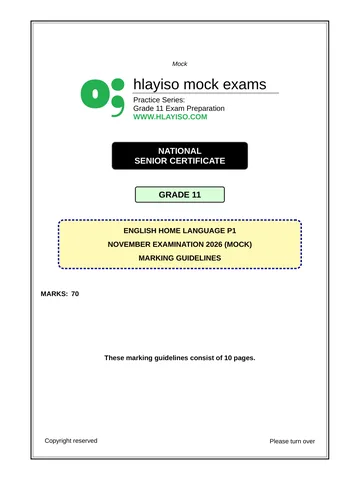
ENGLISH HOME LANGUAGE P1
NOVEMBER EXAMINATION 2026 (MOCK)
MARKING GUIDELINES
MARKS: 70
These marking guidelines consist of 10 pages.
Skip to contentMemorandum 
View all
English HL Grade 11 Paper 1 November Mock 2026 Memo (English)
Grade 11 English HL Paper 1 memorandum from the November Mock Exam 2026 (English), 10 pages. Read online or get the free PDF download, question paper linked when available.
Publisher: Hlayiso
English HL · Grade 11 · November Mock Exam · 2026. Memorandum, 10 pages. Read online or download the PDF.
- Subject
- English HL
- Grade
- Grade 11
- Language
- English
- Document type
- Memorandum
- Year
- 2026
- Exam period
- November Mock Exam
- Paper
- 1
- Publisher
- Hlayiso
- Curriculum
- CAPS
- Pages
- 10
- File size
- 153.5 KB
Loading document…
Loading document…
1 of 10
Document textSearch extracted text and jump to a page.
English Home Language/P1
2
NSC – Marking Guidelines
Hlayiso/Mock 2026
NOTE:
• These marking guidelines are intended as a guide for markers.
• They are by no means prescriptive or exhaustive.
• Candidates' responses should be considered on merit.
• Answers should be assessed holistically and marks awarded where applicable in terms
of decisions taken at the standardisation meeting.
• The marking guidelines will be discussed before the commencement of marking.
INSTRUCTIONS TO MARKERS
Marking the comprehension:
• Because the focus is on understanding, incorrect spelling and language errors in
longer responses should not be penalised unless such errors change the meaning/
understanding. (Errors must still be indicated.)
• If a candidate uses words from a language other than the one being examined, disregard
those words, and if the answer still makes sense, do not penalise. However, if a word from
another language is used in a text and required in an answer, this will be acceptable.
• For open-ended questions, no marks should be awarded for YES/NO or I AGREE/I
DISAGREE. The reason/substantiation/motivation is what should be considered.
• No marks should be awarded for TRUE/FALSE or FACT/OPINION. The reason/
substantiation/motivation is what should be considered.
• When one-word answers are required and the candidate gives a whole sentence, mark
correct provided that the correct word is underlined/highlighted.
• When two/three facts/points are required and a range is given, mark only the first two/
three.
• Accept dialectal variations.
• For multiple-choice questions, accept BOTH the letter corresponding to the correct
answer AND/OR the answer written out in full.
Copyright reserved
Please turn over
English Home Language/P1
3
NSC – Marking Guidelines
Hlayiso/Mock 2026
SECTION A: COMPREHENSION
QUESTION 1: READING FOR MEANING AND UNDERSTANDING
1.1
He is using/looking at his phone (a screen) in the dark/watching videos on his
phone instead of sleeping.
(1)
1.2
He is physically present in the classroom (1) but he is too tired to concentrate/
pay attention; his mind is foggy and he does not follow/absorb the lesson. (1)
(2)
1.3
C – ongoing.
(1)
1.4
During adolescence/puberty the body's internal clock changes (1) and the
hormone that causes sleepiness (melatonin) is released later at night than in
childhood, so the teenager's body is not yet ready for sleep; it is a biological
change, not a deliberate choice. (1)
[Award only 1 mark for lifting.]
(2)
1.5
The simile compares the notifications to an unwelcome visitor who repeatedly
knocks at the door at night. (1) It is effective because it conveys how intrusive/
disruptive and persistent the notifications are: they constantly disturb one's rest
and demand attention even when one does not want them. (1)
[Credit valid alternative responses.]
(2)
1.6
A badge of honour is usually awarded for a genuine achievement and is
something to be proud of. (1) It is ironic that learners are proud of exhaustion,
which is in fact harmful to their health and their schoolwork/makes them
perform worse. (1)
(2)
1.7
The view is valid. Sleep is essential for learning because it is during sleep that
the brain stores new information in long-term memory; without enough sleep,
a learner's concentration, memory and mood suffer, so the 'work' (studying) is
less effective. Sleep should therefore be planned as part of a study routine, not
treated as a reward.
OR
The view is partly valid. Although sleep is important, many learners have so
many responsibilities (chores, part-time jobs, extra classes) that they cannot
always prioritise sleep; the advice may be unrealistic for some.
[Credit valid alternative/mixed responses. Award 3 marks for a critical
discussion. Award only 1 mark for a 'yes/no' with weak motivation.]
(3)
1.8
During sleep, the brain processes and stores what was learnt during the day
in long-term memory. (1) A learner who does not sleep enough prevents this
process from happening, so the information that was studied is not retained/is
forgotten. (1)
(2)
1.9
YES: The solutions are realistic because most of them are free ('None of
these steps costs a cent') and within a teenager's control, e.g. setting a regular
bedtime, charging the phone outside the bedroom and reading before sleep.
Parents can easily support these habits.
Copyright reserved
Please turn over
English Home Language/P1
4
NSC – Marking Guidelines
Hlayiso/Mock 2026
OR
NO/PARTLY: Many South African teenagers share bedrooms or live in crowded
homes where noise, lighting and shared phones make a fixed routine difficult;
some must work, travel long distances or do chores late at night. Later school
starting times are unlikely in South Africa because of transport schedules and
parents' working hours.
[Credit valid alternative/mixed responses. Award 3 marks for a well-substantiated
response that refers to the text.]
(3)
1.10
The conclusion is effective. It returns to Ayanda, who was introduced in
paragraph 1, giving the article a circular structure (unity). His experience
shows that the advice works in practice: the change was difficult at first but
brought real benefits. The paradox 'By giving time to sleep, he has gained time'
is memorable and reinforces the central message. The final sentence, which
presents closing one's eyes as 'rebellious' in a world that 'never switches off',
challenges teenagers to resist the pressure of constant connection and ends
on a thought-provoking note.
[Award 3 marks for a critical comment on at least TWO aspects of the
paragraph.]
(3)
1.11
The phone is fully charged (100%) and rests on the bedside table, while the
teenager's 'battery' is almost empty (3%) and he looks exhausted/slumped with
half-closed eyes. (1) The contrast suggests that young people take better care
of their devices than of themselves: the phone is given eight hours to recharge,
while the teenager gives himself no rest. (1) The poster implies that a person,
like a phone, needs to 'charge' (sleep) regularly to function properly; the clock
(01:15) and the crossed-out 'Z z z' emphasise that he is losing sleep. (1)
[Award 3 marks for a discussion of the contrast linked to the message.]
(3)
1.12
'Power down' means to switch off one's devices (and oneself) at night/go to
sleep, (1) while 'power up' suggests being energised, recharged and ready to
perform the next day. The paradox suggests that one becomes stronger by
switching off. (1)
(2)
1.13
TEXT A is more persuasive: it is a detailed, logical argument that explains WHY
teenagers need sleep. It uses scientific facts (melatonin, memory), an expert's
opinion (Dr Mokoena) and the real-life example of Ayanda, whose success
makes the advice credible and relatable. It also offers practical solutions.
OR
TEXT B is more persuasive: it is short, visual and immediately understood by
teenagers. The striking image of the drained teenager next to a fully charged
phone makes the point instantly and memorably. It uses language (charging,
100%, power down) that young people relate to, and it gives clear, simple
instructions.
OR
Both texts are persuasive in different ways: TEXT A appeals to reason, while
TEXT B appeals to emotion and humour; they reinforce each other (e.g. both
Copyright reserved
Please turn over
English Home Language/P1
5
NSC – Marking Guidelines
Hlayiso/Mock 2026
advise charging the phone outside the bedroom).
[Award 4 marks only if BOTH texts are referred to in a critical discussion. Award
a maximum of 2 marks if only one text is discussed. Credit valid alternative
responses.]
(4)
TOTAL SECTION A:
30
Copyright reserved
Please turn over
English Home Language/P1
6
NSC – Marking Guidelines
Hlayiso/Mock 2026
SECTION B: SUMMARY
QUESTION 2: SUMMARISING IN YOUR OWN WORDS
Use the following main points that the candidate should include in the summary as a guideline.
Any 7 valid points are to be credited in paragraph form. (Sentences and/or sentence fragments
must be coherent.)
NO.
QUOTATIONS
NO.
POINTS
1
'your passwords, PINs and one-time pins (OTPs)
belong to you alone.'
1
Never
share
passwords/PINs/
OTPs.
2
'Create a strong, different password for each of
your accounts'
2
Use strong, unique passwords.
3
'switch on two-step verification'
3
Activate two-step verification.
4
'Scammers love urgency … offers that seem too
good to be true'
4
Be suspicious of urgent messages
and offers that are too good to be
true.
5
'Never click on links or download attachments in
messages that you were not expecting.'/'type the
official website address yourself.'
5
Do not click on unexpected links/
attachments;
type
official
web
addresses.
6
'phone that person to confirm that the request is
genuine'
6
Verify requests for money directly
with the person.
7
'Be careful, too, about how much you reveal
online.'/'Keep your profiles private'
7
Limit personal information shared
online/keep profiles private.
8
'keep the apps and software on your devices
updated'
8
Update
apps
and
software
regularly.
9
'Contact your bank immediately and report the
incident.'
9
Report
a
scam
to
the
bank
immediately.
PARAGRAPH FORM
NOTE: What follows is merely an example. It is not prescriptive and must be used very
carefully.
Never share passwords, PINs or OTPs with anyone. Create a strong, unique password for
every account and activate two-step verification. Be wary of urgent messages and offers
that seem too good to be true. Avoid clicking on links or opening unexpected attachments;
rather type official web addresses yourself. Confirm unusual requests for money by phoning
the person directly. Limit the personal information you share online, keep profiles private
and update your apps and software regularly. If scammed, contact your bank and report it
immediately.
[84 words]
Copyright reserved
Please turn over
English Home Language/P1
7
NSC – Marking Guidelines
Hlayiso/Mock 2026
Marking the summary:
Marking is on the basis of the inclusion of valid material and the exclusion of invalid material.
The summary should be marked as follows:
• Mark allocation:
– 7 marks for 7 points (1 mark per main point)
– 3 marks for language
– Total marks: 10
• Distribution of language marks when candidate has not quoted verbatim:
– 1–3 points correct: award 1 mark
– 4–5 points correct: award 2 marks
– 6–7 points correct: award 3 marks
• Distribution of language marks when candidate has quoted verbatim:
– 6–7 quotations: award no language mark
– 4–5 quotations: award 1 language mark
– 2–3 quotations: award 2 language marks
NOTE:
• Word count: Markers are required to verify the number of words used.
• Do not deduct any marks if the candidate fails to indicate the number of words used or if
the number of words used is indicated incorrectly. If the word limit is exceeded, read up
to the last sentence above the stipulated upper limit and ignore the rest of the summary.
TOTAL SECTION B:
10
Copyright reserved
Please turn over
English Home Language/P1
8
NSC – Marking Guidelines
Hlayiso/Mock 2026
SECTION C: LANGUAGE IN CONTEXT
Marking SECTION C:
• Spelling: One-word answers must be marked correct even if the spelling is incorrect,
unless the error changes the meaning of the word. In full-sentence answers, incorrect
spelling should be penalised if the error is in the language structure being tested. Where
an abbreviation is tested, the answer must be punctuated correctly.
• Sentence structures must be grammatically correct and given in full sentences/as per
instruction.
• For multiple-choice questions, accept BOTH the letter corresponding to the correct
answer AND/OR the answer written out in full as correct.
QUESTION 3: ANALYSING ADVERTISING
3.1
The headline appeals to learners (and their parents) who fear that power cuts/
load-shedding will harm their studies and results. (1) It reassures them that,
with this lamp, darkness need not affect their studies; the contrast between the
lights going 'out' and a future that does not suggests that the product protects
their success/future. (1)
(2)
3.2
'By nature' means that the lamp is powered by the sun/a natural, renewable
source of energy. (1) It also means that the lamp is 'naturally'/inherently better
or brighter than other products (and that the user becomes 'brighter'/cleverer
by studying). (1)
(2)
3.3
The neighbouring houses, seen through the window, are in darkness, which
shows that there is a power cut ('When the lights go out'). (1) In contrast, the
learner is reading comfortably in a pool of warm light, which supports the claim
that the lamp gives 'bright, eye-friendly light' and that the learner's 'future' is not
affected. (1) The small solar panel on the lamp's base reinforces the message
that it is powered by the sun and needs 'No wires' and has 'No bills'. (1)
[Award 3 marks for a discussion of at least TWO visual elements linked to the
written text.]
(3)
3.4
Repetition/anaphora/parallelism/tricolon (triad/rule of three)
[Accept any ONE.]
(1)
3.5
The small print reveals that the lamp will not always give the 'up to 8 hours' of
light promised in large print; on cloudy/rainy days it may give much less. (1)
Because the qualification is printed in tiny letters where readers are unlikely to
notice it, the advertisement may seem less honest/misleading, which lowers its
credibility. However, it could also be argued that including the disclaimer shows
honesty. (1)
[Credit valid alternative responses.]
(2)
[10]
Copyright reserved
Please turn over
English Home Language/P1
9
NSC – Marking Guidelines
Hlayiso/Mock 2026
QUESTION 4: UNDERSTANDING OTHER ASPECTS OF THE MEDIA
4.1
Thabo enthusiastically praises teamwork and appears eager to work with
others, (1) yet he does none of the work himself: he sleeps while his group
members complete the project. His words are ironic because he relies on the
'team' to achieve his 'dream' without contributing. (1)
(2)
4.2
Aisha and Kyle are shown sitting upright, surrounded by books and a laptop,
with drops of sweat flying from their heads, which shows that they are working
hard/under pressure. (1) Thabo, by contrast, is asleep with his head on the
table and 'Z z z' above him, which shows that he is lazy/not contributing at all.
(1)
(2)
4.3
Thabo only shows interest at the last minute (23:58), after the work has been
done. (1) He is lazy/insincere/self-centred/hypocritical: he claims to be 'SO
stressed' although he has made no effort, and he includes himself ('did we
finish') as if he has been part of the work. (1)
(2)
4.4
The capital letters emphasise 'WE' to show that Thabo deliberately/insistently
includes himself in the effort, ironically taking credit for work that he did not do.
(1)
4.5
The cartoonist succeeds. The humour lies in the irony between Thabo's words
('Teamwork makes the dream work!', 'WE worked really hard') and his actions
(sleeping in the library). The exaggerated contrast between his beaming,
open-mouthed confidence in FRAME 4 and the angry, folded-arm postures
of Aisha and Kyle makes readers laugh, but it also makes a serious point: in
group work, some members often do all the work while 'free-riders' share the
marks and the credit. Readers who have experienced this will recognise the
unfairness, so the cartoon encourages reflection on fairness, responsibility and
how group work is assessed.
[Award 3 marks only for a critical discussion that refers to both the humour and
the serious point. Credit valid alternative responses.]
(3)
[10]
QUESTION 5: USING LANGUAGE CORRECTLY
5.1
are – is
(Each of them is clutching a small blue library card.)
(1)
5.2
recieved – received
(1)
5.3
She said (that) she wanted (1) every child in that valley to fall in love with
reading. (1)
[Award 1 mark for 'wanted' and 1 mark for 'that valley' in a correctly constructed
sentence without quotation marks.]
(2)
5.4
What happened afterwards is well known/the rest of the story is obvious; this
was the beginning of something successful.
(1)
5.5
The colon introduces an explanation/elaboration/list (of how the books are
arranged on the shelves).
(1)
Copyright reserved
Please turn over
English Home Language/P1
10
NSC – Marking Guidelines
Hlayiso/Mock 2026
5.6
childrens' – children's
(1)
5.7
Torn books are repaired by volunteers every Friday.
(1)
5.8
more happier – happier
(1)
5.9
Adverb (of manner)
(1)
[10]
TOTAL SECTION C:
30
GRAND TOTAL:
70
Copyright reserved
Matching paper and memo
The question paper, memo or addendum that belongs with this document.
Study this subject
Revise the topics in this paper, then practise them question by question.
Recommended for this subject
More papers and memos for this grade and subject.
Memorandum
English HL Grade 11 Paper 2 November Mock 2026 Memo (English)
Memorandum
English HL Grade 11 Paper 3 November Mock 2026 Memo (English)
Memorandum
English HL Grade 11 P1 November Mock Exam 2 2026 Memo (English)
Memorandum
English HL Grade 11 P2 November Mock Exam 2 2026 Memo (English)
Memorandum
English HL Grade 11 P3 November Mock Exam 2 2026 Memo (English)
Memorandum
English Hl Grade 11 P1 Eastern Cape November 2022 Memo (English)
Related documents
Question paper
English HL Grade 11 P2 November Mock 2026 Question Paper (Eng)
Question paper
English HL Grade 11 P3 November Mock 2026 Question Paper (Eng)
Question paper
English HL Grade 11 P1 November Mock Exam 2 2026 QP (Eng)
Memorandum
English Hl Grade 11 Paper 1 Exemplar November 2022 Memo (English)
Memorandum
English Hl Grade 11 P1 Eastern Cape November 2020 Memo (English)
Memorandum
English Hl Grade 11 P1 National Exemplar November 2020 Memo (Eng)
More from Grade 11 English HL
Question paper
English HL Grade 11 P2 November Mock Exam 2 2026 QP (Eng)
Question paper
English HL Grade 11 P3 November Mock Exam 2 2026 QP (Eng)
Annual teaching plan
Gr 11 English HL ATP 2023 24
Memorandum
English Hl Grade 11 P2 Eastern Cape November 2022 Memo (English)
Memorandum
English Hl Grade 11 Paper 3 Eastern Cape November 2022 Memo
Question paper