
Copyright reserved
Please turn over
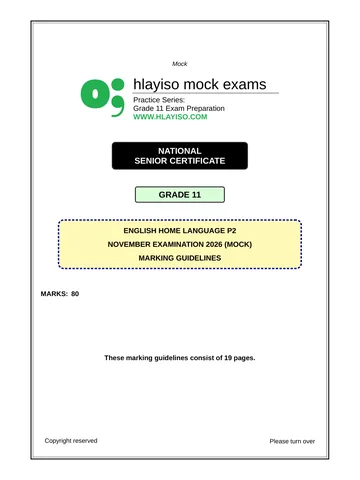
hlayiso mock exams
Practice Series:
Grade 11 Exam Preparation
WWW.HLAYISO.COM
NATIONAL
SENIOR CERTIFICATE
GRADE 11
ENGLISH HOME LANGUAGE P2
NOVEMBER EXAMINATION 2026 (MOCK)
MARKING GUIDELINES
MARKS: 80
These marking guidelines consist of 16 pages.
Skip to contentMemorandum 
View all
English HL Grade 11 Paper 2 November Mock 2026 Memo (English)
Grade 11 English HL Paper 2 memorandum from the November Mock Exam 2026 (English), 16 pages. Read online or get the free PDF download, question paper linked when available.
Publisher: Hlayiso
English HL · Grade 11 · November Mock Exam · 2026. Memorandum, 16 pages. Read online or download the PDF.
- Subject
- English HL
- Grade
- Grade 11
- Language
- English
- Document type
- Memorandum
- Year
- 2026
- Exam period
- November Mock Exam
- Paper
- 2
- Publisher
- Hlayiso
- Curriculum
- CAPS
- Pages
- 16
- File size
- 177.8 KB
Loading document…
Loading document…
1 of 16
Document textSearch extracted text and jump to a page.
English Home Language/P2
2
NSC – Marking Guidelines
Hlayiso/Mock 2026
NOTE TO MARKERS
• These marking guidelines are intended as a guide for markers.
• The marking guidelines will be discussed with the marking panel before marking
commences.
• Candidates' responses must be considered on their merits.
INSTRUCTIONS
1. Wherever a candidate has answered more than the required number of questions, mark
only the first answer/response. (The candidate may NOT answer the essay and the
contextual question on the same genre.)
2. If a candidate has answered all four questions in SECTION A (prescribed poems), mark
only the first two.
3. If a candidate has answered two contextual or two essay questions in SECTIONS B
and C, mark the first one and ignore the second. If a candidate has answered all four
questions (novel) and/or all four questions (drama), mark only the first answer in each
section, provided that one contextual and one essay have been answered.
4. If a candidate gives two answers where the first is wrong and the next one correct, mark
the first answer and ignore the next.
5. If answers are incorrectly numbered, mark according to the marking guidelines.
6. If a spelling error affects the meaning, mark incorrect. If it does not affect the meaning,
mark correct.
7. Essay questions: If the essay is shorter than the required word count, do not penalise,
because the candidate has already penalised himself/herself. If the essay is too long,
assess on merit and discuss with senior markers.
8. Contextual questions: If the candidate does not use inverted commas when asked to
quote, do not penalise.
9. For open-ended questions, no marks should be awarded for YES/NO or I AGREE/
DISAGREE.
The
reason/substantiation/motivation/justification
is
what
should
be
considered.
10. No marks should be awarded for TRUE/FALSE or FACT/OPINION. The reason/
substantiation/motivation/justification is what should be marked.
11. Answers to contextual questions must be assessed holistically in the light of the discussion
during the standardisation of the marking guidelines.
Copyright reserved
Please turn over
English Home Language/P2
3
NSC – Marking Guidelines
Hlayiso/Mock 2026
SECTION A: POETRY
PRESCRIBED POETRY
QUESTION 1: POETRY – ESSAY QUESTION
'OZYMANDIAS' – Percy Bysshe Shelley
• Use the following points, among others, as a guideline to marking this question. Responses
might differ, depending on the candidate's sensitivity to and understanding of the text.
• Refer to page 15 for the rubric to assess this question.
• The poem is framed as a second-hand report ('I met a traveller from an antique land'), which
distances the reader from the ruin and suggests that Ozymandias's greatness survives only
as a story told by strangers.
• Imagery of ruin and fragmentation: 'Two vast and trunkless legs of stone' and the 'shattered
visage' lying 'Half sunk' in the sand show that the once-mighty statue has been broken and
is being swallowed by the desert. The word 'vast' hints at the king's former ambition, yet
the legs support nothing.
• The 'frown', 'wrinkled lip' and 'sneer of cold command' convey the king's arrogance, cruelty
and tyranny. The sculptor 'well those passions read': the artist captured and mocked ('The
hand that mocked them') the king's pride, and it is the art, not the king's power, that survives
('Which yet survive').
• The inscription 'My name is Ozymandias, king of kings: / Look on my works, ye Mighty,
and despair!' is boastful and grandiose. Its meaning has become ironic: the 'works' have
vanished, so the 'Mighty' should despair, not because they cannot match him, but because
all power is equally temporary.
• The caesura and blunt statement 'Nothing beside remains.' marks a turn and emphasises
the emptiness that surrounds the ruin.
• Diction: 'colossal wreck', 'decay', 'boundless and bare', 'lone and level sands stretch far
away'. The alliteration (b, l, s sounds) and long vowels create an image of endless, empty
desert that outlasts the king: time and nature are vast and indifferent, while human pride
is small and short-lived.
• Tone: ironic/mocking/scornful towards the tyrant's pride; reflective/meditative/sombre
about the transience of human achievement.
• Candidates may agree fully or argue that the art (and the poem itself) also endures. [Credit
valid alternative responses.]
[10]
QUESTION 2: POETRY – CONTEXTUAL QUESTION
'DULCE ET DECORUM EST' – Wilfred Owen
2.1
The soldiers are physically broken/exhausted/ill: they are bent over like old
beggars carrying heavy sacks, knock-kneed and coughing like old women. (1)
Although they are young men, war has aged and degraded them; they struggle
('cursed', 'sludge') through mud in miserable conditions. (1)
(2)
2.2
The slow, weary pace of the first stanza changes suddenly to short, urgent
exclamations because of the gas attack. (1) The capital letters, exclamation
Copyright reserved
Please turn over
English Home Language/P2
4
NSC – Marking Guidelines
Hlayiso/Mock 2026
marks and broken phrases convey panic, fear and the shouts of the soldiers as
they rush to put on their gas masks. (1)
(2)
2.3
2.3.1
Simile
(1)
2.3.2
The speaker sees the dying soldier through the misty lenses of his
gas mask and the thick green cloud of gas, as if he were watching
someone underwater. (1) The image is effective because it conveys
the helplessness of the speaker (he can only watch) and the horror of
the soldier's death: he is 'drowning' on dry land as the gas fills his lungs.
(1)
(2)
2.4
The speaker directly addresses 'My friend' – those (such as patriotic writers/
propagandists) who glorify war. He states that if they had witnessed the horrific
death he has described, they would not 'tell with such high zest' to eager,
idealistic young people ('children ardent for some desperate glory') that it is
'sweet and fitting to die for one's country'. He calls this famous Latin saying
'The old Lie', which shows his bitterness, anger and disillusionment. The ending
exposes the gap between the noble myth of war and its brutal reality: war is not
glorious but horrifying and degrading.
[Award 3 marks for a critical discussion of the speaker's attitude, linked to the
lines.]
(3)
[10]
QUESTION 3: POETRY – CONTEXTUAL QUESTION
'REMEMBER' – Christina Rossetti
3.1
'The silent land' is a euphemism for death/the grave/the afterlife. (1) It suggests
a place from which the dead cannot speak or return, where communication with
loved ones is no longer possible. (1)
(2)
3.2
The relationship is close/loving/intimate: they hold hands and talk of a shared
future. (1) The image of the speaker half turning to leave but then staying
suggests that she finds it hard to part from her beloved; it may also hint at
her hesitation/uncertainty about the relationship (and a future marriage). (1)
(2)
3.3
3.3.1
Repetition (anaphora)
[Accept 'refrain'.]
(1)
3.3.2
The repeated plea 'Remember me' emphasises the speaker's deep
desire not to be forgotten after her death. (1) The insistent, almost
pleading repetition creates an urgent/emotional tone and reinforces the
central idea of memory in the octave. 'Only remember me' suggests that
remembrance is all that she asks, since prayers and advice will then
be too late. (1)
(2)
3.4
In the octave, the speaker insists that her beloved must remember her. The
sestet begins with 'Yet', which signals a turn (volta): she now unselfishly accepts
Copyright reserved
Please turn over
English Home Language/P2
5
NSC – Marking Guidelines
Hlayiso/Mock 2026
that he may forget her 'for a while' and asks him not to grieve if he does.
She concludes that it is 'Better by far' that he should 'forget and smile' than
'remember and be sad'. Her attitude changes from a selfish/needy desire to be
remembered to selfless love: his happiness matters more to her than her own
memory. The balanced final line ('forget and smile' / 'remember and be sad')
captures this mature acceptance.
[Award 3 marks for a critical discussion that refers to the change of attitude.]
(3)
[10]
QUESTION 4: POETRY – CONTEXTUAL QUESTION
'DEATH, BE NOT PROUD' – John Donne
4.1
By addressing Death directly as if it were a person (apostrophe/personification),
the speaker can confront and challenge it. (1) He diminishes Death's power by
speaking to it with authority and contempt/defiance, denying that it is 'Mighty
and dreadful'. (1)
(2)
4.2
Rest and sleep are merely images/copies ('pictures') of death, and they give
us much pleasure. (1) Therefore, death itself – the real thing – must bring even
more pleasure/peace; it should not be feared. (1)
(2)
4.3
4.3.1
Personification (metaphor)
[Accept apostrophe.]
(1)
4.3.2
Death is portrayed as a 'slave' who has no power of his own and must
obey fate, chance, kings and desperate men (e.g. murderers or those
who take their own lives). (1) The image is effective because it reverses
Death's usual image as a mighty ruler: Death is humiliated and shown
to be a servant, which supports the speaker's argument that Death has
no reason to be proud. (1)
(2)
4.4
The final couplet presents the speaker's Christian belief that death is merely
'One short sleep' after which the soul will 'wake eternally' in the afterlife. The
paradox 'Death, thou shalt die' is a powerful, triumphant conclusion: death itself
will be destroyed because, after the resurrection, there will be no more death.
The short, emphatic final clause and the direct address give the speaker the
final word and complete the argument begun in line 1 – Death is defeated. The
tone is confident/defiant/triumphant.
[Award 3 marks for a critical discussion of the effectiveness of the conclusion.]
(3)
[10]
Copyright reserved
Please turn over
English Home Language/P2
6
NSC – Marking Guidelines
Hlayiso/Mock 2026
UNSEEN POETRY (COMPULSORY)
QUESTION 5: POETRY – CONTEXTUAL QUESTION
'SYMPATHY' – Paul Laurence Dunbar
5.1
The beauty and freedom of nature (sunshine, wind, flowing river, singing birds,
opening buds) are what the caged bird can see/sense but cannot enjoy. (1)
The description emphasises, by contrast, the bird's longing and the cruelty of
its imprisonment, and helps the reader to share the speaker's 'sympathy'. (1)
(2)
5.2
5.2.1
Personification (transferred epithet)
(1)
5.2.2
The bars are given the human quality of cruelty, as though they
deliberately cause pain. (1) The image emphasises the suffering of
the bird, which beats its wings against the bars until they bleed, and
suggests that the cage – and those who built it – is the source of its
pain/oppression. (1)
(2)
5.3
The repetition of 'old' suggests that the bird has been injured many times over
a long period; its suffering is long-standing/repeated. (1) The old wounds are
reopened ('pulse again with a keener sting') each time it tries to escape, which
shows that its pain never heals. (1)
(2)
5.4
The final stanza reveals that the bird does not sing because it is happy: its
song is 'not a carol of joy or glee' but a 'prayer' and a 'plea' for freedom, sent
to Heaven from the depths of its heart. The bird sings despite being 'bruised'
and 'sore'. The repeated refrain 'I know' shows that the speaker understands
the bird's pain from his own experience: he, too, feels trapped/oppressed (the
poet was an African American writing after the abolition of slavery, when racial
oppression continued). The bird therefore becomes a symbol of all people
who are denied freedom and whose apparent cheerfulness hides suffering and
longing.
[Award 3 marks for a critical discussion of both the meaning of the song and the
speaker's identification with the bird. Do not require biographical knowledge.]
(3)
[10]
TOTAL SECTION A:
30
Copyright reserved
Please turn over
English Home Language/P2
7
NSC – Marking Guidelines
Hlayiso/Mock 2026
SECTION B: NOVEL
QUESTION 6: DR JEKYLL AND MR HYDE – ESSAY QUESTION
• Use the following points, among others, as a guideline to marking this question. Responses
might differ, depending on the candidate's sensitivity to and understanding of the text.
• Refer to page 16 for the rubric to assess this question.
• Jekyll is a respected, wealthy doctor who conceals a desire for undignified/disreputable
pleasures. Because he values his public reputation, he hides these 'faults' and becomes
a 'double-dealer', leading a secret life (hypocrisy).
• He creates the potion not to cure evil but to separate his two natures so that his darker self
can indulge in pleasure without damaging Jekyll's reputation or conscience. Hyde is thus
a means of escaping responsibility.
• Jekyll takes pleasure in being Hyde ('like a schoolboy'); he makes arrangements to protect
Hyde (a house in Soho, a bank account, a will in Hyde's favour), which shows that the
choice is deliberate.
• Hyde's crimes escalate from trampling the child to the brutal murder of Sir Danvers Carew.
Jekyll claims that Hyde 'alone' is guilty, refusing to accept that Hyde is part of himself.
• After the murder, Jekyll resolves to give up Hyde and returns to good works, but he
relapses: while sitting in Regent's Park and congratulating himself on his virtue, he
transforms involuntarily. His pride and indulgence weaken his resistance.
• The potion does play a part: the transformations become involuntary, Hyde grows stronger,
and the original salt was impure and cannot be replaced, so Jekyll is trapped as Hyde and
dies (Hyde takes his own life).
• Candidates may argue that the experiment was the direct cause of his death, but that
Jekyll's hypocrisy, pride and desire to avoid consequences drove him to use it and to
continue using it. [Credit valid alternative/mixed responses.]
[25]
QUESTION 7: DR JEKYLL AND MR HYDE – CONTEXTUAL QUESTION
7.1
Mr Utterson (a lawyer) and his distant kinsman, Mr Enfield, are on one of their
regular Sunday walks in London. (1) They pass a sinister, neglected door in a
by-street, and Enfield tells the story of the man (Hyde) who entered it. (1)
(2)
7.2
'Calmly' suggests that Hyde feels no guilt/remorse/pity; (1) he is cold-blooded/
callous/inhuman and indifferent to the suffering of a child. (1)
(2)
7.3
A Juggernaut is a massive, unstoppable force that crushes anything in its way.
(1) Enfield suggests that Hyde behaved like a mindless, inhuman machine/
monster rather than a man, crushing the child without hesitation or feeling. (1)
(2)
7.4
Hyde provokes instant loathing/disgust and even murderous hatred: even the
unemotional doctor wants to kill him. (1) Elsewhere, Utterson, Lanyon and
Poole also feel revulsion when they see him, and people struggle to describe
him, saying only that he gives an impression of deformity. (1) This suggests
Copyright reserved
Please turn over
English Home Language/P2
8
NSC – Marking Guidelines
Hlayiso/Mock 2026
that Hyde is pure evil, and that people instinctively recognise the evil in him
(perhaps also the evil within themselves). (1)
(3)
7.5
The cheque is signed with the name of a highly respectable man (Dr Jekyll),
and Hyde has a key to the door (the back entrance to Jekyll's laboratory). (1)
This raises the mystery of the novel: why would a respected gentleman pay
for Hyde? Enfield assumes that it is a case of blackmail. (1) The story alarms
Utterson, who already holds Jekyll's will leaving everything to Hyde, and he
begins to investigate the connection between the two men. (1)
(3)
7.6
After Poole and Utterson break down the door of the cabinet, they find
Hyde dead (he has poisoned himself) and Jekyll missing. (1) Utterson finds
documents addressed to him, including Jekyll's statement, which he reads
(after Lanyon's narrative) in his office. (1)
(2)
7.7
The novel is based on the idea that every human being has two natures:
good and evil. (1) Jekyll's experiment physically separates these two sides,
producing Hyde; the theme of duality is also reflected in the respectable surface
of Victorian London concealing a hidden, sinful underworld (e.g. the respectable
house and the shabby laboratory door). (1)
(2)
7.8
The 'polar twins' are the good and evil sides of human nature: they are as
opposite as the North and South poles, yet as closely bound as twins. (1) The
image of the 'agonised womb of consciousness' suggests that they are born
together and struggle painfully within the same mind. (1) The image is effective
because it conveys the inseparable and tormented nature of human duality,
and foreshadows Jekyll's failure to separate them. (1)
(3)
7.9
Jekyll hopes that, if his two natures are separated, each can live freely: the
evil self without remorse, and the good self without disgrace. (1) Ironically,
the separation does not purify Jekyll: Hyde is purely evil, but Jekyll remains
a mixture of good and evil, and his desire for Hyde's pleasures grows. (1)
Instead of being 'relieved' of what is unbearable, Jekyll loses control, Hyde
takes over, and Jekyll is destroyed by guilt and terror; the good side is not
freed but enslaved. (1)
(3)
7.10
DISAGREE: Jekyll is a hypocrite. He hides his indulgences behind a
respectable reputation and uses Hyde to commit acts without being held
accountable. He refers to Hyde's crimes as if someone else had committed
them and does not confess until he has no choice.
OR
AGREE/PARTIALLY AGREE: Jekyll is sincere in both roles: he genuinely does
good works and charity, and he genuinely desires pleasure; he does not pretend
to virtue he does not feel. He confesses fully in his statement.
[Credit valid alternative/mixed responses. Award 3 marks for a critical
discussion based on the novel as a whole.]
(3)
[25]
Copyright reserved
Please turn over
English Home Language/P2
9
NSC – Marking Guidelines
Hlayiso/Mock 2026
QUESTION 8: PRIDE AND PREJUDICE – ESSAY QUESTION
• Use the following points, among others, as a guideline to marking this question. Responses
might differ, depending on the candidate's sensitivity to and understanding of the text.
• Refer to page 16 for the rubric to assess this question.
• At the Meryton ball, Elizabeth overhears Darcy refuse to dance with her ('tolerable; but
not handsome enough to tempt me'). Her wounded vanity leads her to form an immediate
dislike of Darcy (first impressions – the novel's original title).
• Her prejudice makes her believe Wickham's false account of Darcy's treatment of him
without evidence. She is charmed by Wickham's manners and is quick to think the worst
of Darcy.
• When she learns from Colonel Fitzwilliam that Darcy separated Bingley from Jane, her
dislike deepens and she rejects Darcy's first proposal, accusing him of ruining Jane's
happiness and of cruelty to Wickham.
• Darcy's pride is also a serious obstacle: he looks down on the Bennets' lower social status
and vulgar relations, and he proposes in an insulting manner, dwelling on her 'inferiority'.
He also interferes in Bingley's relationship with Jane.
• Darcy's letter forces Elizabeth to re-examine her judgement; she realises that she has
been 'blind, partial, prejudiced, absurd' ('Till this moment, I never knew myself'). This is the
turning point.
• Both characters change: Darcy becomes more courteous (at Pemberley he is gracious to
the Gardiners) and secretly arranges Lydia's marriage to Wickham; Elizabeth recognises
his true worth. Their happiness comes only when both pride and prejudice are overcome.
• Candidates may argue that Darcy's pride is the greater obstacle, or that both are equally
responsible. [Credit valid alternative/mixed responses.]
[25]
QUESTION 9: PRIDE AND PREJUDICE – CONTEXTUAL QUESTION
9.1
Elizabeth is staying with Charlotte and Mr Collins at Hunsford parsonage in Kent
(near Rosings, the home of Lady Catherine de Bourgh). (1) She has stayed at
home alone, upset by Colonel Fitzwilliam's revelation that Darcy had separated
Bingley from Jane, when Darcy unexpectedly calls and proposes. (1)
(2)
9.2
Darcy is deeply/passionately in love with Elizabeth. (1) He has tried to
overcome his feelings ('In vain have I struggled'), suggesting that he regards
loving her as a weakness/against his better judgement, but his feelings have
overwhelmed him. (1)
(2)
9.3
Instead of speaking only of his love, Darcy dwells on her social 'inferiority', the
'degradation' of marrying her and the 'family obstacles' (her lower connections
and her family's poor behaviour). (1) This insults Elizabeth and her family and
reveals his pride and sense of social superiority. (1) He is confident of being
accepted, which makes his manner even more offensive to her; the narrator's
irony shows that his warmth on these subjects 'was very unlikely to recommend
his suit'. (1)
(3)
Copyright reserved
Please turn over
English Home Language/P2
10
NSC – Marking Guidelines
Hlayiso/Mock 2026
9.4
Elizabeth accuses Darcy of persuading his friend Bingley to leave Netherfield
and to give up his attachment to Jane, (1) thereby separating them and
destroying Jane's chance of happiness/marriage. (1)
(2)
9.5
Tone: cold/formal/controlled but angry/sarcastic/indignant. Elizabeth should
speak slowly and deliberately, with forced politeness, emphasising 'feel' and
'I cannot'.
Body language: she should sit/stand very upright, look Darcy directly in the eye,
with flushed cheeks and clenched hands, perhaps rising to her feet to show her
resistance.
Motivation: Elizabeth is offended by Darcy's insulting proposal but tries to
answer him 'with patience' and with the formality expected of the situation; her
controlled anger shows her dignity and independence.
[Award 3 marks only if tone and body language are both discussed and
motivated.]
(3)
9.6
From Darcy's letter, Elizabeth learns that Wickham wasted the money Darcy
gave him instead of the church living, (1) and that he tried to elope with Darcy's
fifteen-year-old sister, Georgiana, to obtain her fortune (and take revenge on
Darcy). (1)
(2)
9.7
She realises that she has judged both men unfairly: she believed Wickham's
lies and condemned Darcy without evidence. (1) She is ashamed because she
has always prided herself on her good judgement and discernment, which have
proved to be wrong. (1)
(2)
9.8
Elizabeth was flattered by Wickham's attention ('the preference of one') and
offended by Darcy's slight at the ball ('the neglect of the other'). (1) Her wounded
vanity made her eager to believe anything bad about Darcy and anything good
about Wickham, (1) so she ignored evidence and reason ('driven reason away');
her judgement was clouded by her own feelings, not by facts. (1)
(3)
9.9
This is the turning point of the novel/of Elizabeth's development. (1) She
recognises her own prejudice and vanity and gains self-knowledge. (1) This
humility makes it possible for her to see Darcy's true character, to change her
feelings towards him, and eventually to accept his second proposal. (1)
(3)
9.10
Darcy changes significantly. Elizabeth's rejection humbles him and makes him
aware of his arrogance. At Pemberley he is courteous and friendly to Elizabeth
and to her relatives, the Gardiners, whom he had previously regarded as
beneath him. He secretly arranges and pays for Lydia's marriage to Wickham
to save the Bennets' reputation, without seeking credit. He later admits that
Elizabeth taught him a lesson and that he was proud and selfish.
OR
Darcy's essential character does not change; his good qualities were always
present and only his manners change.
[Credit valid alternative/mixed responses. Award 3 marks for a critical
discussion.]
(3)
Copyright reserved
Please turn over
English Home Language/P2
11
NSC – Marking Guidelines
Hlayiso/Mock 2026
[25]
TOTAL SECTION B:
25
SECTION C: DRAMA
QUESTION 10: MACBETH – ESSAY QUESTION
• Use the following points, among others, as a guideline to marking this question. Responses
might differ, depending on the candidate's sensitivity to and understanding of the text.
• Refer to page 16 for the rubric to assess this question.
• Macbeth already has ambitious thoughts before Lady Macbeth intervenes: when the
witches greet him as future king, he immediately imagines murder ('why do I yield to that
suggestion'), and he writes to his wife about the prophecy.
• Lady Macbeth calls on evil spirits to 'unsex' her and fears that Macbeth is 'too full o' th'
milk of human kindness'. She plans the murder and persuades Macbeth when he wavers,
attacking his manhood and courage (Act 1, Scene 7).
• She drugs the grooms, returns the daggers and smears the grooms with blood, and covers
up Macbeth's guilt at the banquet. She is therefore an active accomplice in Duncan's
murder.
• However, Macbeth physically commits the murder. After that, he acts independently: he
plans Banquo's murder without her, orders the slaughter of Macduff's family and becomes
a tyrant. Lady Macbeth is excluded and loses influence ('Be innocent of the knowledge,
dearest chuck').
• Lady Macbeth is destroyed by guilt (sleepwalking, 'Out, damned spot') and dies (apparently
by suicide); Macbeth becomes hardened ('I have almost forgot the taste of fears').
• The witches' prophecies also influence events, but they do not force Macbeth to act.
• Candidates may argue that Macbeth is ultimately responsible because of his own 'vaulting
ambition' and choices. [Credit valid alternative/mixed responses.]
[25]
QUESTION 11: MACBETH – CONTEXTUAL QUESTION
11.1
Macbeth has been considering the consequences of murdering Duncan ('If it
were done when 'tis done'). (1) He lists the reasons against it: Duncan is his
king, kinsman and guest; Duncan is a virtuous king whose murder would cause
universal grief; and he has only 'vaulting ambition' to spur him on. (1)
(2)
11.2
Duncan has recently honoured him (made him Thane of Cawdor) (1) and he
has won the admiration/good opinion of people of all classes, which he wants
to enjoy while it is still new instead of throwing it away. (1)
(2)
11.3
Lady Macbeth asks whether the hope/ambition he 'dress'd' himself in was
'drunk', implying that his ambition was only drunken boasting. (1) She
personifies his hope as waking up hung-over, 'green and pale', and afraid of
what it had freely proposed. (1) The images ridicule Macbeth as cowardly and
inconsistent, shaming him into acting. (1)
(3)
Copyright reserved
Please turn over
English Home Language/P2
12
NSC – Marking Guidelines
Hlayiso/Mock 2026
11.4
Lady Macbeth attacks Macbeth's masculinity: she claims that he was a 'man'
when he first dared to suggest the murder and would be 'so much more the
man' if he carried it out. (1) She implies that refusing to kill Duncan is unmanly/
cowardly, (1) and she reminds him that he first proposed the plan, making him
feel he must keep his word. Her rhetorical question 'What beast was't, then'
mocks him. (1)
(3)
11.5
Tone: fierce/intense/vehement/cold and ruthless; she may begin softly and
tenderly ('How tender 'tis to love the babe') and become harsh and violent
('dash'd the brains out').
Body language: she could mime cradling a baby and then make a sudden
violent, throwing gesture; she should move close to Macbeth and glare at him/
grip his arm.
Motivation: the shocking image shows her determination and her willingness
to suppress all natural, maternal feeling; she wants to shame Macbeth into
keeping his 'oath'.
[Award 3 marks only if both tone and body language are discussed and
motivated.]
(3)
11.6
Lady Macbeth had been overwhelmed by guilt: she sleepwalked, continually
rubbing her hands as though washing off blood ('Out, damned spot'), and
revealing the murders. (1) The doctor could not cure her 'mind diseased'; it
is later suggested that she took her own life. (1)
(2)
11.7
At the beginning of the play, Macbeth was easily frightened (e.g. his hair stood
on end at the thought of murder; he was terrified after Duncan's murder and
at seeing Banquo's ghost). (1) Now he has become so used to horror and
bloodshed ('supp'd full with horrors') that nothing frightens him; he has become
hardened/desensitised/numb. (1)
(2)
11.8
Life is compared to a 'walking shadow' – something insubstantial and fleeting.
(1) It is also compared to a 'poor player' (actor) who struts and frets on stage
for a short time and is then forgotten, suggesting that life is a meaningless
performance. (1) Finally, life is 'a tale / Told by an idiot', full of noise and
emotion but 'Signifying nothing'. The imagery conveys Macbeth's despair/
nihilism: having lost his wife and his conscience, he sees life as pointless. (1)
(3)
11.9
The witches' apparition told Macbeth that he would never be defeated until
Birnam Wood came to Dunsinane, which he believed was impossible. (1)
Malcolm's army cut down branches from Birnam Wood to disguise their
numbers as they advanced, so that the wood appeared to 'move' towards
Dunsinane. (1)
(2)
11.10
YES: The audience may feel some sympathy because, in EXTRACT E,
Macbeth is shown to have a conscience and is manipulated by his wife. In
EXTRACT F, he is a lonely, tragic figure who has lost his wife and sees that his
life is empty; he recognises that he has been deceived by the witches, and he
dies bravely.
OR
Copyright reserved
Please turn over
English Home Language/P2
13
NSC – Marking Guidelines
Hlayiso/Mock 2026
NO: Macbeth has committed terrible crimes (the murders of Duncan, Banquo
and Macduff's family) and has become a tyrant; his indifference to his wife's
death shows how far he has fallen.
[Credit valid alternative/mixed responses. Award 3 marks only if both extracts
are referred to.]
(3)
[25]
QUESTION 12: THE MERCHANT OF VENICE – ESSAY QUESTION
• Use the following points, among others, as a guideline to marking this question. Responses
might differ, depending on the candidate's sensitivity to and understanding of the text.
• Refer to page 16 for the rubric to assess this question.
• Shylock suffers persistent abuse because he is Jewish and a moneylender: Antonio spits
on him, kicks him and calls him a dog in public, and openly says he will do so again.
• Venetian society treats him as an outsider; the Christian characters mock him (e.g. Solanio
and Salarino) and Gratiano insults him throughout the trial.
• His daughter Jessica elopes with Lorenzo (a Christian), stealing his money and jewels
(including his late wife Leah's ring), and the Christians rejoice at his loss. His 'Hath not a
Jew eyes?' speech shows his humanity and argues that his desire for revenge has been
taught by Christian behaviour.
• However, Shylock's actions are also cruel: he sets a bond that could kill Antonio, refuses
Bassanio's offer of double/three times the money, sharpens his knife in court and rejects
every plea for mercy. He seeks revenge rather than justice.
• He is defeated by Portia's interpretation of the law: he loses half his wealth, and the other
half is to be given to Lorenzo and Jessica; he is forced to convert to Christianity – a harsh
and humiliating punishment.
• Candidates may conclude that he is more sinned against, that he is equally a victim and a
villain, or that his cruelty outweighs his suffering. [Credit valid alternative/mixed responses.]
[25]
QUESTION 13: THE MERCHANT OF VENICE – CONTEXTUAL QUESTION
13.1
Antonio's friend Bassanio needs money to travel to Belmont in style to woo
the wealthy heiress, Portia. (1) Antonio's own wealth is tied up in his ships/
merchandise at sea, so he must borrow the money on his credit. (1)
(2)
13.2
Shylock means that the Jewish people have learnt to endure insults and
persecution patiently; (1) suffering is so common for them that it has become
their mark/symbol/'badge' of identity. (1)
(2)
13.3
Shylock has been publicly insulted and humiliated in the Rialto (business
centre) because of his religion and his business of lending money at interest.
(1) Antonio has called him an unbeliever and a 'cut-throat dog', spat on his
clothing and beard and kicked him like a stray dog. (1) The lines reveal the
deep religious prejudice/anti-Semitism of Venetian society, in which Jews were
Copyright reserved
Please turn over
English Home Language/P2
14
NSC – Marking Guidelines
Hlayiso/Mock 2026
treated as inferior outsiders; Shylock points out the hypocrisy of Antonio now
coming to him for money. (1)
(3)
13.4
Antonio is arrogant/contemptuous/defiant and unrepentant: he says he is likely
to spit on and kick Shylock again. (1) He insists that Shylock lend the money as
to an enemy, so that he can 'Exact the penalty' if Antonio fails to pay. (1) This is
dramatic irony because the audience later sees that Shylock does exactly that:
when Antonio's ships are reported lost, Shylock demands his pound of flesh,
and Antonio's life is in danger. (1)
(3)
13.5
Shylock pretends that the bond is a joke/a light-hearted game, suggesting
friendship and goodwill. (1) Ironically, the penalty – a pound of Antonio's flesh –
is deadly serious; Shylock later insists on it in order to take revenge/kill Antonio.
(1)
(2)
13.6
Portia is disguised as a young lawyer/doctor of law, Balthazar, sent by the
learned lawyer Bellario. (1) Women could not practise law, so she disguises
herself in order to defend Antonio and save the life of Bassanio's friend. (1)
(2)
13.7
Mercy is compared to gentle rain that falls naturally from heaven upon the earth.
(1) The image suggests that mercy cannot be forced ('not strain'd'); it is given
freely, (1) it comes from God, and, like rain that nourishes the earth, it brings
blessing both to the person who gives it and to the person who receives it. The
image is effective because it presents mercy as natural, divine and life-giving.
(1)
(3)
13.8
Shylock is determined/obstinate/vengeful; he is prepared to accept full
responsibility for his actions. (1) He rejects Portia's appeal and insists on
the strict letter of the law and the penalty of his bond; his hatred for Antonio
outweighs any appeal to mercy or reason. (1)
(2)
13.9
Portia refuses to bend the law even to save Antonio, insisting that no one
can alter an established decree. (1) Ironically, she later uses the same strict
interpretation of the law against Shylock: the bond allows him flesh but 'no jot
of blood', and he must take exactly one pound. (1) Shylock, who demanded the
letter of the law, is defeated by it; he then faces the law against an alien who
seeks the life of a citizen and loses his wealth. (1)
(3)
13.10
The Duke spares Shylock's life before he asks, and Antonio asks that Shylock
should keep half of his wealth (in trust for Jessica and Lorenzo). This could
be seen as mercy. However, the conditions are harsh: Shylock must leave his
property to the daughter who betrayed him and her Christian husband, and he
must convert to Christianity, which strips him of his religious identity. Shylock
leaves the court broken ('I am not well'). The Christians therefore fall short of
the mercy Portia describes.
[Credit valid alternative/mixed responses. Award 3 marks for a critical
discussion.]
(3)
[25]
TOTAL SECTION C:
25
GRAND TOTAL:
80
Copyright reserved
Please turn over
English Home Language/P2
15
NSC – Marking Guidelines
Hlayiso/Mock 2026
SECTION A: Assessment rubric for literary essay: Poetry (10 Marks)
Criteria
Exceptional
Skilful
Moderate
Elementary
Inadequate
CONTENT
6 MARKS
Interpretation of topic.
Depth of argument,
justification and grasp
of text.
5–6
– In-depth
interpretation of topic
– Range of striking
arguments; extensively
supported from poem
– Excellent
understanding of
genre and poem
4
– Shows
understanding and has
interpreted topic well
– Fairly detailed
response
– Sound arguments
given, but not all of
them as well motivated
as they could be
– Understanding of
genre and poem
3
– Fair interpretation of
topic
– Some good points in
support of topic
– Some arguments
supported, but
evidence is not always
convincing
– Basic understanding
of genre and poem
2
– Unsatisfactory
interpretation of topic
– Hardly any points in
support of topic
– Inadequate
understanding of
genre and poem
0–1
– No understanding of
the topic
– No reference to the
poem
– Learner has not
come to grips with
genre and poem
STRUCTURE AND
LANGUAGE
4 MARKS
Structure, logical flow
and presentation.
Language, tone and
style used in the essay.
4
– Coherent structure
– Arguments
well-structured and
clearly developed
– Language, tone and
style mature,
impressive, correct
– Virtually error-free
grammar, spelling and
punctuation
3
– Clear structure and
logical flow of
argument
– Flow of argument
can be followed
– Language, tone and
style largely correct
2
– Some evidence of
structure
– Essay lacks a
well-structured flow of
logic and coherence
– Language errors
minor; tone and style
mostly appropriate
1
– Structure shows
faulty planning
– Arguments not
logically arranged
– Language errors
evident
– Inappropriate tone
and style
0–1
– Poorly structured
– Serious language
errors and incorrect
style
NOTE: If a candidate has ignored the content completely and written a creative response instead, award a 0 mark for both Content and Structure
and Language.
Copyright reserved
Please turn over
English Home Language/P2
16
NSC – Marking Guidelines
Hlayiso/Mock 2026
SECTIONS B AND C: Assessment rubric for literary essay: Novel and Drama (25 Marks)
Criteria
Exceptional
Skilful
Moderate
Elementary
Inadequate
CONTENT
15 MARKS
Interpretation of topic.
Depth of argument,
justification and grasp
of text.
12–15
– Outstanding
response: 14–15
– Excellent response:
12–13
– In-depth
interpretation of topic
– Range of striking
arguments extensively
supported from text
– Excellent
understanding of
genre and text
9–11
– Shows
understanding and has
interpreted topic well
– Fairly detailed
response
– Some sound
arguments given, but
not all of them as well
motivated as they
could be
– Understanding of
genre and text evident
6–8
– Mediocre
interpretation of topic;
not all aspects
explored in detail
– Some good points in
support of topic
– Some arguments
supported, but
evidence is not always
convincing
– Partial understanding
of genre and text
4–5
– Scant interpretation
of topic; hardly any
aspects explored in
detail
– Few points in
support of topic
– Very little relevant
argument
– Little understanding
of genre and text
0–3
– Very little
understanding of the
topic
– Weak attempt to
answer the question
– Arguments not
convincing
– Learner has not
come to grips with
genre or text
STRUCTURE AND
LANGUAGE
10 MARKS
Structure, logical flow
and presentation.
Language, tone and
style used in the essay.
8–10
– Coherent structure
– Excellent
introduction and
conclusion
– Arguments
well-structured and
clearly developed
– Language, tone and
style mature,
impressive, correct
6–7
– Clear structure and
logical flow of
argument
– Introduction and
conclusion and other
paragraphs coherently
organised
– Logical flow of
argument
– Language, tone and
style largely correct
4–5
– Some evidence of
structure
– Logic and coherence
apparent, but flawed
– Some language
errors; tone and style
mostly appropriate
– Paragraphing mostly
correct
2–3
– Structure shows
faulty planning
– Arguments not
logically arranged
– Language errors
evident
– Inappropriate tone
and style
– Paragraphing faulty
0–1
– Lack of planned
structure impedes flow
of argument
– Language errors and
incorrect style make
this an unsuccessful
piece of writing
– Inappropriate tone
and style
– Paragraphing faulty
MARK RANGE
20–25
15–19
10–14
5–9
0–4
NOTE: If a candidate has ignored the content completely and written a creative response instead, award a 0 mark for both Content and Structure
and Language. There must not be more than two categories' variation between the Structure and Language mark and the Content mark.
Copyright reserved
Please turn over
Matching paper and memo
The question paper, memo or addendum that belongs with this document.
Study this subject
Revise the topics in this paper, then practise them question by question.
Recommended for this subject
More papers and memos for this grade and subject.
Memorandum
English HL Grade 11 Paper 1 November Mock 2026 Memo (English)
Memorandum
English HL Grade 11 Paper 3 November Mock 2026 Memo (English)
Memorandum
English HL Grade 11 P1 November Mock Exam 2 2026 Memo (English)
Memorandum
English HL Grade 11 P2 November Mock Exam 2 2026 Memo (English)
Memorandum
English HL Grade 11 P3 November Mock Exam 2 2026 Memo (English)
Memorandum
English Hl Grade 11 P1 Eastern Cape November 2022 Memo (English)
Related documents
Question paper
English HL Grade 11 P1 November Mock 2026 Question Paper (Eng)
Question paper
English HL Grade 11 P3 November Mock 2026 Question Paper (Eng)
Question paper
English HL Grade 11 P2 November Mock Exam 2 2026 QP (Eng)
Memorandum
English Hl Grade 11 P2 Eastern Cape November 2022 Memo (English)
Memorandum
English Hl Grade 11 Paper 2 Exemplar November 2022 Memo (English)
Memorandum
English Hl Grade 11 P2 Eastern Cape November 2019 Memo (English)
More from Grade 11 English HL
Question paper
English HL Grade 11 P1 November Mock Exam 2 2026 QP (Eng)
Question paper
English HL Grade 11 P3 November Mock Exam 2 2026 QP (Eng)
Annual teaching plan
Gr 11 English HL ATP 2023 24
Memorandum
English Hl Grade 11 Paper 3 Eastern Cape November 2022 Memo
Question paper
English Hl Grade 11 P1 Eastern Cape November 2022 QP (Eng)
Question paper