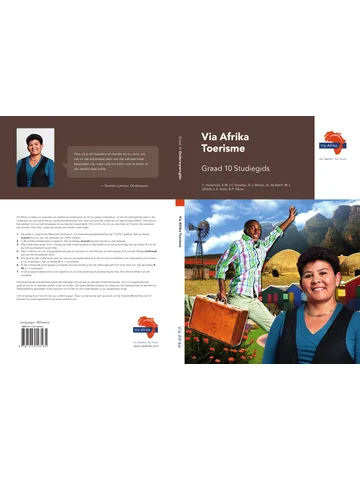
The picture on the cover of this book is inspired by
Grade 10 learner, Masande Seplan. This is his dream:
Via Afrika
Grade 10 Learner’s Book
I love studying Tourism because I’ve always wanted
to travel around the world to see different places,
Tourism
people and cultures. My dream is to become
the director of my own tourism business so I can
explore other countries and show our country
to visitors. I always study hard, because with an
Grade 10 Study Guide
education you can go anywhere.
T. Holomisa, E.M.J.C Schaller, D.J. Brown, B. de
Klerk, M.J. Ohloff, L.S. Kota, B.P. Nkosi
As South Africans we are very fortunate to live in such a beautiful
Via Afrika Tourism
country. South Africa is filled with amazing sights and our thriving
tourism sector is very important for our economy. This year you’ll
explore many interesting factors of the industry, such as modes of
transport, accommodation, tourist attractions and heritage sites,
people’s reasons for travelling, and the powerful role of foreign
currencies. You’ll look at the social and environmental impact of tourism
on South Africa, and you’ll get to know your country better than ever
before. Prepare for adventure.
Language: English
www.viaafrika.com
Skip to contentStudy guide
Gr10 Tourism TG studyguide LR
Grade 10 Tourism study guide, 104 pages. Read online or get the free PDF download.
Publisher: Via Afrika
Tourism · Grade 10. Study guide, 104 pages. Read online or download the PDF.
- Subject
- Tourism
- Grade
- Grade 10
- Document type
- Study guide
- Publisher
- Via Afrika
- Curriculum
- CAPS
- Pages
- 104
- File size
- 3.1 MB
Loading document…
Loading document…
1 of 104
Document textSearch extracted text and jump to a page.
P. Bean • M. Kleyn • E.L Llewellyn • T.R. Maliehe • A. Marx
Study Guide
Via Afrika
Tourism
Grade 10
ISBN: 978-1-41546-342-0
Contents
General Introduction........................................................................................... iii
Term 1 Tourism sectors.......................................................................................1
overview.............................................................................................................1
Questions..........................................................................................................21
Term 2 Map work and tour planning. .................................................................27
overview...........................................................................................................27
Questions..........................................................................................................33
Domestic, regional and international toursim. ......................................................37
overview...........................................................................................................37
Questions......................................................................................................... 39
Term 3 Tourist attractions in South Africa.......................................................... 43
overview.......................................................................................................... 43
Questions..........................................................................................................57
Sustainable and responsible tourism...................................................................61
overview...........................................................................................................61
Questions......................................................................................................... 66
Marketing......................................................................................................... 70
overview.......................................................................................................... 70
Questions..........................................................................................................72
Term 4 Culture and heritage..............................................................................75
overview...........................................................................................................75
Questions......................................................................................................... 80
Communication and customer care..................................................................... 82
overview.......................................................................................................... 82
Questions......................................................................................................... 86
Exam Paper 1..................................................................................................... 89
Answers............................................................................................................ 94
©Via Afrika » Tourism ii
Welcome to the Via Afrika Tourism Grade 10 Study Guide eBook. This eBook will help
you understand and master all the content and skills that you will need to meet the
requirements for the Grade 10 National Curriculum Assessment Policy Statement for
Tourism.
This Study Guide covers the following topics:
1 Tourism sectors
2 Map work and tour planning
3 Domestic, regional and international tourism
4 Tourist attractions
5 Sustainable and responsible tourism
6 Marketing
7 Culture and heritage
8 Communication and customer care
How to get the most from your Study Guide
Each topic is divided into:
●● an overview (graphic organiser)
●● summaries
●● questions and answers.
There is an example of a final examination paper with model answers.
The tourism industry in South Africa is changing all the time. Every day brings new
ideas. Our Learner’s Book and Study Guide eBook will provide you with excellent
resource material, but it is important for you to keep up to date by following new
developments in tourism in the media, such as on television, in newspapers, magazines
and on the internet.
Your ability to work in a team, find information and discuss and explain key concepts
will help to develop your competence in a very exciting career in Tourism!
©Via Afrika » Tourism iii
Term 1
Tourism sectors
Overview
topic Tourism
1 sectors
unit introduction to unit Types of tourists unit different modes of unit The hospitality
1 Tourism
2 and tourist profiles
3 transport
4 sector
1 What is tourism? 1 Types of tourists 1 Travelling by road 1 Different types of
2 Types of 2 Drawing up a 2 Travelling by air accommodation
destinations tourist profile establishments
3 Travelling by rail
3 Why do people 4 Travelling by water
travel?
5 Extraordinary modes of
4 What is a tourist? transport
6 Mode of transport to suit
the purpose of a trip
7 Advantages and
disadvantages
unit The south african unit accomidation unit in-room technology unit Food and beverage
5 grading system
6 establishment
terminology and
concepts
7 8 establishments
1 The Star Grading 1 Technology for 1 Types of
System information establishments
2 The role of the TGCSA 2 Technology for comfort
3 Benefits of the grading 3 Technology for
system entertainment
4 Procedure to follow to 4 Technology for safety
be graded 5 Technology for
5 Logos that may be environmental
displayed upon grading responsibility
6 Technology for work
unit The attraction unit structure of the unit structure of the unit payment methods
9 sector
10 south african
tourism industry:
the public sector
11 south african
tourism industry:
the private sector
12 in south africa
1 What are attractions? 1 The National 1 Product owners 1 Internet payments
2 Attraction sub-sectors Department of 2 Local communities 2 Automatic teller
Tourism (NDT) machine (ATM)
3 Types of tourist 3 NGOs, CBOs and
attractions 2 Other government professional payments
departments associations 3 Speed point
4 Primary and secondary
tourist attractions 3 State owned 4 The international machines
enterprises community 4 Credit cards
5 Attractions and their (parastatals)
appeal for particular 5 Debit cards
types of tourists 4 Partly state-owned
agencies 6 Cellphone payments
6 Activities offered at 7 Cheques
tourist attractions 5 Public entities
©Via Afrika » Tourism 1
Term 1
1 Introduction to tourism
1.1 What is tourism?
Tourism is the study of activities, services and industries that provide a travel
experience. It is made up of different sectors: tourist profiles, transport, hospitality,
support services and attractions.
1.1.1 The difference between inbound and outbound tourism
●● Inbound tourists travel into a country from another country.
●● Outbound tourists travel out of their home country to visit another country.
1.2 Types of destinations
●● Domestic tourism is people travelling within their own country.
●● Regional tourism is people travelling in a specific geographical area.
●● International tourism is people who travel outside their country of residence,
crossing an international border with passport control.
1.3 Why do people travel?
Tourists have different needs, preferences and expectations. Once people have satisfied
their basic needs (air, food, drink, shelter, warmth, sleep, protection, security, order,
law, limits, stability, family, affection, relationships, work) they seek to satisfy higher
level needs and wants. These include achievement, status, responsibility, reputation,
personal growth and fulfilment. Tourism can provide part of the satisfaction of these
higher needs and wants.
1.4 What is a tourist?
●● A tourist travels away from home for longer than a day, but less than a year.
●● An excursionist arrives at and departs from a destination on the same day.
2 Types of tourists and tourist profiles
2.1 Types of tourists
Tourists can be classified as follows:
●● Business and professional
●● Leisure and holiday
●● Visiting friends and relatives (VFR)
●● Youth travel (backpackers and gap year)
●● Adventure
●● Eco/environmental
●● Cultural
●● Religion
●● Sport and recreation
©Via Afrika » Tourism 2
Term 1
●● Special interest tourist (SIT)
●● Incentive
●● Health.
2.2 Drawing up a tourist profile
A tourist profile is a summary of what tourists want and expect. It contains the following
information:
●● Name
●● Nationality
●● Age
●● Contact details
●● Occupation
●● Needs and preferences (sport, education, etc.)
●● Specific requirements (accommodation, food, transport)
●● Arrival and departure dates.
3 Different modes of transport
3.1 Travelling by road
3.1.1 Cars
●● Sedan cars are used for private travel.
●● 4x4 vehicles are used off-road.
●● Cars can tow trailers or caravans.
●● Hired cars transport small groups or individuals.
3.1.2 Buses/coaches
●● They follow a set timetable and fixed routes.
●● Tour groups use chartered buses.
●● Greyhound and Intercape are coach companies.
●● The Baz Bus is for backpackers.
●● Shuttle buses provide transport to and from airports, harbours and terminals.
3.1.3 Taxis
●● Metered taxis charge rates for the distance travelled.
●● Mini buses don’t have timetables of fixed pick-up of drop-off points.
3.1.4 Motorbikes or motor cycles
●● Motorbikes are hired for self-drive trips.
3.2 Travelling by air
3.2.1 Aeroplanes
●● They are fast and expensive.
©Via Afrika » Tourism 3
Term 1
●● They fly between major centres.
●● Business executives and wealthy tourists charter smaller aircraft.
●● Helicopters can fly from small airfields. They are a popular way to view attractions.
They are expensive.
●● Microlights can only carry one or two people.
●● They appeal to adventure tourists.
3.3 Travelling by rail
●● Railway networks link major centres.
●● It is a good way to see the scenery.
3.3.1 Train services in South Africa
●● Shosholoza Meyl travel on city to city routes.
●● Metrorail is a commuter service.
●● The Gautrain is a rapid transit route linking OR Tambo International Airport with
Johannesburg and Pretoria. It is a bullet train.
●● The Blue Train is a luxury train. It runs weekly on the Cape Town-Pretoria route.
●● Rovos Rail is a privately run luxury service. It operates within South Africa and to
other countries.
●● Trams run on tracks laid down in streets. In South Africa they were replaced by bus
systems. There is one in Kimberley that takes tourists to the Big Hole.
3.4 Travelling by water
3.4.1 Luxury cruise liners
●● Tourists can embark and disembark at South African ports.
3.4.2 Boats
●● Boats are popular for harbour cruises, fishing trips and whale watching.
●● Yachts are used for private cruising.
3.5 Extraordinary modes of transport
●● Camels
●● Donkey carts
●● Hot air balloons
●● Bicycles.
3.6 Mode of transport to suit the purpose of a trip
The selection of transport depends on:
●● Transport available
●● Cost
●● Safety
●● Reliability
●● Flexibility of the schedule
©Via Afrika » Tourism 4
Term 1
●● Number of people
●● Distance and time
●● Personal preferences
●● Accessibility
●● Level of comfort required.
3.7 Advantages and disadvantages of different modes
of transport
Each mode of transport has advantages and disadvantages.
Mode Advantages Disadvantages
Convenient, quick, and comfortable; Long journeys can be tiring and can
cost effective for more than two passen- lead to driver fatigue and accidents; low
gers; flexible as the driver can decide on carrying capacity; toll fees on national
arrival and departure times, and stops roads increase the cost; road works
Road: Car along the way; you can get to your exact and congestion can cause delays and
destination; use of the vehicle at the increase the travel time; high cost of car
destination cuts further transport costs. maintenance.
Relatively cheap; high carrying capacity; Operate according to fixed schedules
relaxing as passengers do not have to and routes and thus are not flexible;
drive; adjustable seats and air-condi- passengers have to make their own way
Road: Bus or coach
tioning add to comfort; all major towns to and from the departure and arrival
and cities are accessible. points; congestion and road works could
cause delays.
Cater for commuters and long distance Drivers wait until the vehicle is full be-
(inter-city) travellers; relatively inexpen- fore departing, causing delays; drivers
sive; passengers can be dropped off at tend to overload, causing discomfort
their destination; routes include areas to passengers and often resulting in
Road: Minibus taxi not covered by other public transport accidents; potential poor maintenance
routes and are fairly regulated but not increases the possibility of accidents;
scheduled, so there is some flexibility. regular strike action disrupts the ser-
vice.
Fastest mode; safe; reliable; high carry- Not flexible as routes and timetables are
ing capacity; cabin crew look after pas- scheduled; restrictions on number and
sengers and serve refreshments; there weight of luggage items; airports are
are flights between all the main centres usually situated outside city limits so ad-
Air: Aeroplane and several smaller towns. ditional transport mode to/from airport
is needed; restricted seating space may
cause discomfort; international passen-
gers crossing time zones may experience
jet lag.
Relatively inexpensive and fast; stations Scheduled routes and timetables means
are usually situated in town and city that travel by rail is relatively inflexible;
Rail: Train centres; energy efficient; relaxing. commuter trains are often overcrowded
in peak periods which may cause dis-
comfort.
Reliable; relaxing; energy efficient; saf- Time consuming and so only suited to
est mode of transport; generous luggage passengers who have time to spend
allowance; relatively high fare includes travelling; passengers may experience
Water: Cruise liner accommodation, meals, use of all facili- sea-sickness; to the fare must be added
ties and entertainment. the cost of a second mode of transport
to/from point of embarkation and disem-
barkation.
©Via Afrika » Tourism 5
Term 1
4 The hospitality sector
Private and public hospitality sectors offer accommodation and meals for tourists.
●● Private sectors include:
●● B & Bs
●● Guest houses
●● Hotels
●● Backpackers
●● Restaurants.
●● Public sectors include establishments run by National Parks.
4.1 Different types of accommodation establishments
The type of establishment chosen is influenced by:
●● Type of accommodation required
●● Quality of accommodation required
●● Location desired
●● Availability of accommodation
●● Tourist budget.
4.1.1 Formal service accommodation
Required: Manager, receptionist, all meals and beverages, room service, valet service,
laundry service, shuttle service, wake-up calls, 24 hour security, private en suite rooms,
telephone, Internet, TV, tea and coffee making facilities, gym, swimming pool, gift and
speciality gift shops, conference room, parking.
4.1.2 Guest accommodation
Owner run, family atmosphere. Required: servicing of rooms, host or receptionist,
meals by arrangement, wake-up calls, laundry service, 24 hour security, private room,
telephone, TV, tea and coffee making facilities, linen, towels, parking.
4.1.3 Self catering accommodation
Costs less. Required: At least one bedroom, living and dining area, bathroom, cooking
or kitchen area, management available, cleaning service, linen, towels, cooking
equipment, TV, braai area.
4.1.4 Caravan and camping establishments
Inexpensive. Required: Caretaker must be available, electrical power, bathrooms, braai
areas, refuse removal, laundry room, shop, access to a telephone, running water for
sites, dishwashing facilities, wash lines, recreational facilities such as swimming pool.
©Via Afrika » Tourism 6
Term 1
4.1.5 Back-packers and hostels
For travellers with limited budget. Required: Single or dormitory rooms, linen, shared
living areas, tourist information brochures, reception area, public telephone, communal
bathrooms and relaxation area.
4.1.6 Game lodges
Privately owned, high standard of accommodation, situated in or close to game
reserves; services and facilities similar to small luxury hotel.
5 The South African grading system
The Tourist Grading Council of South Africa (TGCSA) is responsible for the grading and
quality assurance of accommodation establishments.
5.1 The Star Grading System
It evaluates or grades establishments and awards stars.
5.2 The role of the TGCSA
The council trains assessors, approves or rejects assessors’ findings, grades
establishments, supplies grading plaques, manages a customer feedback system to
maintain standards, does regular checks on establishments.
5.3 Benefits of the grading system
5.3.1 For tourists
They know what to expect and can make an informed selection of establishments. They
can use the customer feedback system.
5.3.2 For establishments
They are listed on the TGCSA website. They can advertise in the SAT booklet, grading is
good for business. They can use the grading stars in advertising.
5.4 Procedure to follow to be graded
The owner must:
●● Read and understand requirements
●● Choose an assessor from a list
●● Apply for grading
●● Make an appointment with assessor.
The assessor must:
●● Visit the establishment
●● Discuss assessment with owner
●● Give recommendations with photos to the TGCSA.
©Via Afrika » Tourism 7
Term 1
The TGCSA approves or rejects assessment. Owners can appeal if necessary. Grading is
valid for one year. The owner may buy a plaque to display star grading.
Owners of establishments must also:
●● Register with their province as a business
●● Obtain tax clearance
●● Have ID or work permit if not South African
●● Have public liability insurance
●● Have a liquor license if necessary
●● Have BEE compliance or an exemption certificate.
5.5 Logos that may be displayed upon grading
The grading plaque indicates the type of accommodation and its stars. It has a number
on it and a statement that gives the council the right to remove it if the establishment
does not maintain the grading requirements.
6 Accommodation establishment terminology
and concepts
This is a room suitable or spacious enough for two peo-
double room ple. It contains one double (or larger) bed, or two twin
beds, or two double (or larger) beds.
This is a room with two beds that accommodates two
twin room
people, either in two single beds or in two double beds.
This is a room with one double bed or two single beds for
family room
parents, and one or more beds for children.
Types of rooms
This may consist of two separate rooms, or one room
suites that has been divided into a separate living and sleeping
area.
This describes a bedroom with a private bathroom
en suite
attached to it.
This is a luxurious apartment found on the top floor of a
penthouse
hotel or block of flats.
per person Rate charged per person.
per person sharing Rate charged per person sharing.
The price covers accommodation, meals and any activi-
fully inclusive
ties on offer.
This is an additional charge for single occupancy of a
Pricing single supplement
double room.
pp per person
pps per person sharing
pppn per person per night
pppd per person per day
©Via Afrika » Tourism 8
Term 1
This light breakfast consists of bread rolls or sliced
Continental breakfast
bread/toast, with coffee or tea and often also fruit juice.
This full breakfast usually includes cereal, fruit, bever-
English breakfast ages, bacon and eggs, and often sausage, tomato and
mushrooms as well.
This is an informal way of serving a meal. The courses are
Types of meals buffet attractively displayed (usually on long tables) and guests
serve themselves. Waiters clear the used plates.
This is a meal where items are listed and priced on a
a la carte
menu, and ordered separately.
A service where a guest may order food and beverages to
room service
be delivered to the room.
7 In-room technology
Leisure guests expect to be entertained and business guests expect to conduct business
from their rooms.
7.1 Technology for information
Interactive TV allows guests to:
●● Access information about facilities and services
●● View menus
●● Access interactive maps
●● Check news, weather and investments
●● Access email
●● Programme a wake-up call
●● Request housekeeping, laundry service, maintenance.
7.2 Technology for comfort
●● Good lighting
●● Comfortable temperature
●● Soundproofing
●● Electronic toilets
●● Heated towel rails
●● Bathroom extractor fans
●● Sensor controlled taps and hand drying machines
●● Remote controlled TV, air conditioner, curtains
●● Mini-bar.
7.3 Technology for entertainment
An interactive TV allows:
●● TV programme guide and information
●● Satellite and international channels
©Via Afrika » Tourism 9
Term 1
●● Games, music, movies
●● Internet.
7.4 Technology for safety
●● Programmable electronic safe
●● Electronic door lock
●● Electronic door key
●● A sensor system that records the time people enter and leave the room.
7.5 Technology for environmental responsibility
●● An electronic key card to save electricity
●● Digitally controlled showers to ensure water temperature remains constant
●● Shower heads that use less water
●● Energy saving lights
●● Occupancy sensor lights.
7.6 Technology for work
●● Hot-spot Internet access
●● Wi-Fi networks
●● Interactive TV
●● International multi-power point/plug, leads and charger for electronic equipment
●● High speed Internet access (broadband)
●● Cordless or long cord telephone.
8 Food and beverage establishments
8.1 Types of establishments
8.1.1 Full service restaurants
●● Fine dining: formal menu, wide variety of food, more expensive
●● Family: informal, less expensive. Examples: Spur, Ocean Basket.
8.1.2 Coffee shops
●● Offer coffee, cakes
●● Can offer breakfast, lunch, other beverages (some offer wine and beer)
●● Inside and outside areas
●● Popular meeting places
●● Found in shopping malls, hotels, airports, tourist attraction sites.
8.1.3 Pubs/bars
●● Informal meal service with limited menu
●● Alcoholic and non-alcoholic drinks
●● Sometimes live entertainment
©Via Afrika » Tourism 10
Term 1
●● TV for sport viewing.
8.1.4 Ice cream stores
●● Speciality outlets
●● Sell soft serve, sorbet, frozen yogurt, ice cream
●● Located in malls, beachfronts and near entertainment areas
●● For leisure and family tourists.
8.1.5 Fast food and quick service
●● Food is prepared and served quickly
●● Examples: Nando’s, Wimpy, Kentucky Fried Chicken
●● Take-away food
●● Some have area to sit and eat
●● Appeal to limited budget.
8.1.6 Taverns and shebeens
●● In townships
●● Traditional African food
●● Alcoholic and non- alcoholic beverages (home brewed beer)
●● Meeting places
●● Gaining popularity with ‘adventurous’ tourists
●● Can experience local culture
●● Music or live entertainment.
8.1.7 Street stalls, kiosks and markets
●● Specific types of food
●● Can reflect cultural traditions
●● Stalls may be moved (not permanent) and be outdoors
●● Found at festivals and special events
●● Food can be prepared on site.
9 The attraction sector
9.1 What are attractions?
●● A place of interest
●● Visited for amusement, education, entertainment
●● Natural or constructed beauty
●● Cultural or historical significance
●● Main reason for tourism
●● Should be accessible.
©Via Afrika » Tourism 11
Term 1
9.2 Attraction sub-sectors
There are five sub-sectors.
9.2.1 Gaming and lotteries
Casinos offer games of chance (slot machines, card games), entertainment, restaurants,
hotels, children’s play areas, sporting activities.
9.2.2 Leisure
Resorts, sightseeing, walking, hiking, shopping, movies, beach activities, Theme parks
(Ratanga Junction, Marine world), whale watching, game viewing.
9.2.3 Conservation
Conserving and protecting our heritage and environment, wild life photography, plant
study, picnicking, archaeology.
9.2.4 Sport and recreation
Watching or participating in sport, sport photography, exercising. Examples: Comrades
Marathon, Billabong Pro-surfing, motor racing, mountain climbing.
9.2.5 Events and conferences
Meetings, incentives, conferences, exhibitions (MICE). Special events boost the
economy. Example: Grahamstown National Arts Festival.
9.3 Types of tourist attractions
9.3.1 Natural attractions
Geographical features (mountains), climatic conditions (snow), animals and plants,
scenic beauty sites. Example: Table Mountain.
9.3.2 Constructed attractions
Constructed or created, ancient or modern. Examples: religious buildings like churches,
museums and monuments, parks, historic city centres, zoos, aquariums, stadiums.
9.4 Primary and secondary tourist attractions
The interests and needs of a tourist determine whether an attraction is primary or
secondary.
9.4.1 Primary
This is the main reason for visiting a destination. It gives character and develops the
image of the destination.
©Via Afrika » Tourism 12
Term 1
9.4.2 Secondary
These are the attractions that tourists visit on the way to or from the primary attraction.
They improve overall attractiveness, increase amount of money spent and lengthen
visiting time.
9.5 Attractions and their appeal for particular types of tourists
Types of tourist
Attraction Appeal
attracted
scenic beauty, beaches,
Cape Town and the Cape leisure, adventure, SIT,
whale watching, Table
Peninsula backpacking
Mountain
award winning wines,
leisure, cultural, education,
The Winelands scenic beauty, and historic
SIT
towns
scenic beauty, flora, and
adventure opportunities like leisure, adventure, ecotour-
The Garden Route
bungee jumping and river ist, SIT
rafting
shopping, entertainment, business, shopping, cul-
Johannesburg
and township tours tural, SIT
the Big Five, 4x4 game adventure, ecotourist, cul-
Kruger National Park
drives, and walking safaris tural, SIT
beaches, the sea, surfing, leisure, adventure, sport,
Durban
and uShaka Marine World recreation
scenic beauty, and political ecotourist, cultural, educa-
Robben Island
history tion, SIT
township and cultural tours,
Soweto and historic sites and build- cultural, SIT, backpacking
ings
Blyde River Canyon and scenic beauty, and nature ecotourist, sport and recrea-
Nature Reserve hikes tional, health
beautiful beaches, scenic leisure, cultural, ecotourist,
The Wild Coast
beauty, Xhosa heritage adventure
9.6 Activities offered at tourist attractions
Attraction Activities
places of scenic hiking trails, camping, wildlife viewing, photography, rock climb-
beauty ing, abseiling, river rafting, bird watching
swimming, surfing, wind surfing, fishing, scuba diving, kite flying,
beaches
shell collecting, whale watching
shopping, sightseeing, photography, wine tasting on wine routes,
tourist routes
historical tours on historical routes
guided tours, viewing exhibitions, watching cultural activities like
cultural villages
clay pot making or woodcarving, participating in music and dance
theme parks rollercoaster rides, games, outdoor picnics
©Via Afrika » Tourism 13
Term 1
10 Structure of the South African tourism industry:
the public sector
●● NDT: National Department of Tourism
●● Provincial departments and authorities
●● Regional destination marketing organisations
●● DMO: District or Municipal Organisations
●● LTO: Local Tourism Organisations.
10.1 National Department of Tourism (NDT)
●● Vision: for the country to be recognised as a world leader in tourism excellence.
●● Mission: to promote responsible and sustainable tourism for the benefit of all South
Africans.
●● Develops performance plans and strategies.
10.1.1 Provincial tourism departments
●● In each province
●● Can be combined with other departments like conservation or economic
●● Promote tourism
●● Regulate tourist activities
Separate offices for each role.
10.1.2 Provincial tourism authorities
●● Include all the regulating offices run by tourism departments
●● Issue permits to tour operators and businesses: (hunting, whale watching permits,
etc.).
Provincial authorities and conservation permit offices
Gauteng Province:
Department of Agriculture and Environmental Affairs
http://www.gdard.gpg.gov.za/
KwaZulu Natal Province:
Department of Agriculture and Environmental Affairs
http://agriculture.kzntl.gov.za/
Limpopo Province:
Department of Economic Development, Environment & Tourism
http://www.limpopo.gov.za/prov_depts/econ_dev_environ_tourism.htm
Mpumalanga Province:
Department of Agriculture, Conservation and Environment
Northern Cape Province:
Department of Agriculture, Land Reform, Conservation and Environment
http://www.northern-cape.gov.za/departments/
North West Province:
Department of Agriculture, Conservation and Environment
http://www.nwpg.org.za/Agriculture/
Eastern Cape Province:
Department of Economic Development and Environmental Affairs, Eastern Cape
http://www.dedea.gov.za/
©Via Afrika » Tourism 14
Term 1
Western Cape Province:
Department of Environmental Affairs and Development Planning
http://www.capegateway.gov.za/eng/yourgovernment/gsc/406
10.1.3 Regional destination marketing organisations
●● Regions are areas in a country that have a particular climate, landscape and types of
attractions. Example: West Coast and Namaqualand for wild flowers in Spring.
●● Public and private sectors can combine to market a region. Example: the Convention
Bureau which markets Cape Town and the Western Cape.
●● The 2010 FIFA World Cup was a major event for marketing and for tourism.
10.1.4 District or Municipal Organisations (DMO)
●● Smaller areas than regions
●● Organisation based in a central town
●● Area around town called the municipality
●● District offices in most of the province towns.
10.1.5 Local Tourism Organisations (LTO)
●● The smallest organisations
●● Focus on specific areas
●● Promote local attractions and businesses.
10.2 Other government departments
Interact and cooperate with the NDT.
10.2.1 Department of Home Affairs (DHA)
●● Issues passports
●● Controls immigration
●● Plays a role in national security
●● Promotes good international relations.
10.2.2 The Department of International Relations and Co-operation (DIRC)
●● Co-ordinates South Africa’s international relations and foreign policies
●● Issues visas
●● Currently developing a Univisa to enable people to visit all countries in SADC
(Southern African Development Community)
●● Has assisted with the development of Transfrontier Parks (game reserves that extend
across borders).
10.2 3 Department of Trade and Industry (DTI)
●● Guides the government in developing economic policies
●● Works with the Department of Tourism
●● Promotes development of products for export and tourism
©Via Afrika » Tourism 15
Term 1
●● Assists South Africans to start or grow local business ventures
●● Supports establishment of small, medium and micro enterprises (SMMEs).
10.2.4 Statistics SA (StatsSA)
●● Conducts surveys
●● Publishes statistics and reports about South Africa
●● Statistics include arrivals and departures in South Africa, citizens travelling in South
Africa, forms of transport used, reasons for travelling, foreign visitors, destinations
and accommodation used.
10.2.5 Department of Sports and Recreation
●● Arranges international and local sporting events
●● Planning involves meetings by committees, like International Olympic Committee
(IOC).
10.2.6 Department of Transport
●● Develops objectives to benefit tourism
●● Objectives include competitive transport costs, improved access to transport,
improved safety and security
●● Runs the Passenger Rail Agency of South Africa (PRASA).
10.3 State owned enterprises (parastatals)
●● Owned by government
●● Run like businesses or companies
●● Aim to make profits
●● Examples: South African Airways (SAA), Transnet, Eskom.
10.4 Partly state-owned agencies
●● Partly owned by government
●● Shared between government and private sector companies
●● Managed like private businesses
●● The Tourism Enterprise Partnership (TEP) helps to develop small businesses in the
tourism industry.
●● The NDT provides its funding.
10.5 Public entities
●● Small government departments
●● One specific function
●● Examples: SANParks, South African Tourism, NGB (National Gambling Board),
SAHRA (South African Heritage Resources Agency), ACSA (Airports Company of
South Africa, CATHSSETA (Culture, Arts, Tourism, Hospitality, Sport).
©Via Afrika » Tourism 16
Term 1
11 Structure of the South African tourism industry:
the private sector
11.1 Product owners
A product owner is any business that makes a profit through tourism.
●● Tour operators
●● Travel agents
●● Conference organisers
●● Travel publications
●● Travel insurance companies
●● Souvenir shops
●● Restaurants.
11.2 Local communities
●● Businesses run by local communities
●● Some facilities, like campsites, are built by the community if they own the land
●● Businesses create jobs
●● Profits spent on improving facilities such as roads, schools and clinics.
11.3 NGOs, CBOs and professional associations
●● NGO - non-government organisations
●● CBO - community based organisations
●● They support tourism enterprises
●● Assist with training and funding
●● Link communities with tourism operators so communities can benefit
●● Professional associations help entrepreneurs get started
●● Help to regulate the tourism industry and how it is operated
●● Aim to improve service quality
●● Ensure that service excellence is maintained.
11.3.1 Tourism Associations
Association Logo Main function Service offered
The official control- Represents private
Tourism Business ling organisation for sector travel and tour-
Council of South Africa the travel and tour- ism in negotiations
(TBCSA) ism private sector in with the government
South Africa. and the public sector.
Ensures the quality Grades accommoda-
of accommodation tion establishments
Tourism Grading Council
and conference and conference venues
of South Africa (TGCSA)
TOURISM GRADING COUNCIL
OF SOUTH AFRICA
venues. by using a star grading
system.
©Via Afrika » Tourism 17
Term 1
Promotion of fair Has made Fair Trade
and sustainable Travel packages to
tourism development South Africa available
in South Africa so in Switzerland and
Fair Trade in Tourism SA
that as much of the other parts of Europe.
(FTTSA)
money generated by
tourism as possible
remains in the local
economy.
Checks on the stand- Offers a guarantee of
South African Tourism ard of the products quality service from
Services Association and services offered its members to tour-
(SATSA) to tourists by its ists coming to South
members. Africa.
Promotes the devel- Negotiates with the
Federated Hospitality opment and growth government as the offi-
Association of South of a sustainable cial voice of the private
Africa South African hospi- sector in the Southern
(FEDHASA) tality industry. African hospitality
industry.
Regulates the opera- Offers a guarantee of
tion of member travel quality service from its
Association of South agencies in South members to travel-
African Travel Agents Africa and provides lers booking trips and
(ASATA) support for those tours in South Africa.
agencies who are
members.
Maintains high Members are assisted
standards of its with international
South African Associa-
members for the con- marketing through the
tion for the Conference
ference and events association’s website.
Industry (SAACI)
industry in Southern
Africa.
Represents most of Promotes the associa-
Southern Africa’s tion’s activities and
South African Vehicle
vehicle rental com- shares information
Renting and Leasing As-
panies in the tourism about vehicles with its
sociation (SAVRALA)
sector. members.
To market South Represents member
South African Youth Africa globally as a operators and deals
Travel Confederation preferred youth tour- with their concerns
(SAYTC) ism destination. and interests through-
out South Africa.
11.4 The international community
11.4.1 Southern African Developing Communities (SADC)
Promotes sustainable economic growth and socio-economic development through:
●● Co-operation between member countries
●● Maintaining peace and security in the region
●● Helps the region by being competitive in world economy, a safer place to visit,
helping tourism industry to grow.
©Via Afrika » Tourism 18
Term 1
11.4.2 United Nations World Tourism Organisation (UNWTO)
●● Based in Madrid, Spain
●● Deals with tourism matters worldwide
●● Compiles rankings and publishes statistics on tourism
●● Represents public sector tourism bodies from most countries
●● Data published compares flow and growth of world tourism
●● Promotes responsible tourism
●● Aims to reduce poverty through sustainable tourism development.
11.4.3 World Travel and Tourism Council (WTTC)
●● Members are tourism business leaders all over the world
●● Works to increase awareness of travel and tourism as one of the world’s largest
industries.
11.4.4 World Wildlife Fund for Nature (WWF)
●● Established in 1961
●● Is one of the largest environmental organisations in the world
●● There are more than 1300 WWF conservation projects in the world.
●● Mission: to stop the degradation of the planet’s natural environment and to build a
future in which humans live in harmony with nature by:
●● Conserving biological diversity
●● Ensuring sustainable use of renewable natural resources
●● Promoting the reduction of pollution and wasteful consumption.
12 Payment methods in South Africa
●● Different ways in which tourists pay
●● Depends on the situation
●● Number of methods used depends on: facilities available, amount to be paid,
payment requirements of service provider, convenience and safety of method.
12.1 Internet payments
●● Can book and pay in advance
●● Both users (person paying and person receiving) must have Internet banking
accounts
●● Accounts can be opened online
●● Require security - PIN numbers and passwords
●● Advantages: Payer can make bookings and pay before departing; booking is assured;
can budget; spread payment over time.
●● Disadvantages: Payer must have access to Internet; banks can take two days to
transfer money if payer’s and receiver’s banks are different.
©Via Afrika » Tourism 19
Term 1
12.2 Automatic Teller Machine (ATM) payments
●● ATMs can be found outside banks, inside shops, in banking halls, shopping malls,
hotels and in most tourism areas
●● Does the work of a bank teller
●● Customers can withdraw, deposit, transfer money between accounts
●● Are relatively safe
●● Use a confidential PIN code
●● Machine keeps the card if the PIN is incorrectly typed in three times in a row
●● If card is kept by machine or stolen, bank must be notified immediately
●● Can do banking at all hours - open 24 hours.
12.3 Speed point machines
●● Used by most retailers
●● Client’s card is swiped through machine to register payment
●● Client keys in PIN
●● Client signs slip to agree to payment
●● Most machines are connected to till by cable
●● Can be portable
●● Portable machines enable client to keep card in sight so it is not copied or used for
fraud.
12.4 Credit cards
●● Most popular form of payment
●● Used to withdraw money
●● Used for direct payment
●● Used to hold a reservation
●● Used to guarantee payment
●● Advantages: Reasonably safe and convenient; have an electronic chip for security;
credit limit with required monthly payments
●● Disadvantages: Smaller businesses do not have credit card facilities; banks charge
service providers commission on transactions
●● Examples: Visa, MasterCard, Diner’s Club, American Express.
12.5 Debit cards
●● Can be used at speed points
●● Can be used at ATMs
●● No delay in drawing the money from payer’s account
●● If there are not enough funds the payment will not be allowed by bank (registers on
the speed point machine)
●● Very secure form of payment
●● Money is immediately taken out of account electronically (EFT).
©Via Afrika » Tourism 20
Term 1
12.6 Cell phone payments
●● Made in same way as Internet payment
●● Can be made from anywhere with cell phone reception.
12.7 Cheques
12.7.1 Personal cheques
●● Clients with cheque accounts are issued cheque books by bank
●● Used to make payments
●● Cheques must be signed by account holder to be valid
●● Used instead of cash
●● Some businesses do not accept cheques in case there is not enough money in the
client’s account and the cheque bounces.
12.7.2 Bank-guaranteed cheques
●● Payment of cheque is guaranteed by bank
●● Bank charges a fee
●● A bank-guaranteed cheque is more secure
●● The person who wants the cheque pays the bank the amount required on the
cheque, either in cash or deducted from their bank account. The cheque is then
issued.
Questions
Question 1: Multiple choice
Choose the correct answer. Only write the letter of the answer you select.
1.1 Inbound tourism is:
A tourists travel into a country from another country
B tourists travel out of their home country to visit another country
C people travel within their own country
D an excursion. (2)
1.2 Which category does NOT describe a type of tourist?
A leisure and holiday
B business
C adventure
D bicycles. (2)
1.3 Shosholoza Meyl is a mode of:
A rail transport
B air transport
C water transport
©Via Afrika » Tourism 21
Term 1
D road transport. (2)
1.4 Caravan and camping establishments require:
A room service
B braai areas
C shuttle service
D private en suite rooms. (2)
1.5 The type of establishment chosen by a tourist is influenced by:
A budget
B colour of the walls
C how efficient the transport is
D dishwashing facilities in a luxury lodge. (2)
1.6 Robben Island appeals to tourists interested in:
A culture and education
B games
C leisure
D sport. (2)
1.7 Provincial tourism authorities:
A issue permits to tour operators
B publish statistics
C issue passports and visas
D are run like a private sector business. (2)
1.8 If you pay using the Internet:
A you can book and pay in advance
B you can use an ATM
C you can use a cheque
D you can use a speed point. (2)
(16)
Question 2: True/False
Indicate whether the following statements are True or False. If the statement is False,
write down the correct statement.
2.1 When people travel within their own country it is called domestic tourism. (2)
2.2 When people travel in a specific geographical area it is called international
tourism. (2)
2.3 A tourist profile contains facts about a tourist. (2)
2.4 Accommodation is part of a tourist profile. (2)
2.5 A hot air balloon is an extraordinary mode of transport. (2)
2.6 Tourists can travel from Cape Town to Pretoria on a luxury cruise liner. (2)
2.7 A tourist with a very limited budget, like a backpacker, will charter a helicopter. (2)
©Via Afrika » Tourism 22
Term 1
2.8 A tourist who likes to travel comfortably will travel on a camel. (2)
2.9 Travelling by car is a flexible mode of transport. (2)
2.10 Self catering accommodation offers cooking facilities. (2)
2.11 Guest accommodation establishments offer linen and towels. (2)
2.12 Backpackers have shared living areas. (2)
2.13 The TGCSA is responsible for the grading and quality assurance of establish-
ments. (2)
2.14 The grading plaque indicates the type of accommodation and its stars. (2)
2.15 An en suite room does not have a bathroom. (2)
2.16 Guests can serve themselves at a buffet. (2)
2.17 Attractions are places of interest. (2)
2.18 You can watch cultural activities at a theme park. (2)
2.19 Parastatals are owned by the government. (2)
2.20 Parastatals are managed like private businesses. (2)
2.21 SANParks is an example of a public entity. (2)
2.22 DMOs and LTOs are part of the NDT. (2)
2.23 Local Tourism Organisations are not part of the public sector. (2)
2.24 A souvenir shop is a product owner. (2)
2.25 UNWTO deals with tourism matters worldwide. (2)
2.26 The WWF is the smallest environmental organisation in the world. (2)
2.27 Internet payments require PIN numbers and passwords. (2)
2.28 Cards are swiped in speed point machines. (2)
2.29 American Express is a type of credit card. (2)
2.30 Cheques are a form of cash. (2)
(60)
Question 3: Short answers
3.1 Name THREE disadvantages of bus or coach transport. (3)
3.2 Name FOUR advantages of travelling by rail. (4)
3.3. Name FOUR types of in-room technology. (4)
3.4 Name THREE types of food and beverage establishments. (3)
3.5 What is the difference between a primary and secondary tourist attraction? (2)
3.6 List THREE functions of the DTI. (3)
3.7 Which THREE objectives of the Department of Transport benefit tourism? (3)
3.8 Name TWO examples of product owners. (2)
3.9 How do communities benefit from NGOs and CBOs? (4)
3.10 What is the mission of the WWF? (2)
3.11 What are the disadvantages of a credit card? (2)
3.12 Where can a debit card be used? (2)
(34)
[110]
©Via Afrika » Tourism 23
Term 1
Answers
Question 1: Multiple choice
1.1 A ✓✓
1.2 D ✓✓
1.3 A ✓✓
1.4 B ✓✓
1.5 A ✓✓
1.6 A ✓✓
1.7 A ✓✓
1.8 A ✓✓
Question 2: True/False
2.1 True ✓✓
2.2 False. It is regional tourism. ✓✓
2.3 True ✓✓
2.4 True ✓✓
2.5 True ✓✓
2.6 False. Tourists can travel by road or rail. ✓✓
2.7 False. A backpacker with a limited budget cannot afford a helicopter. ✓✓
2.8 False. Camels are not comfortable to travel on. ✓✓
2.9 True ✓✓
2.10 True ✓✓
2.11 True ✓✓
2.12 True ✓✓
2.13 True ✓✓
2.14 True ✓✓
2.15 False. An en suite room does have a bathroom. ✓✓
2.16 True ✓✓
2.17 True ✓✓
2.18 False. You can watch cultural activities at a cultural village. ✓✓
2.19 True ✓✓
2.20 False. Partly state-owned agencies are managed like private businesses. ✓✓
2.21 True ✓✓
2.22 True ✓✓
2.23 False. LTOs are part of the public sector. ✓✓
2.24 True ✓✓
2.25 True ✓✓
©Via Afrika » Tourism 24
Term 1
2.26 False. The WWF is the largest environmental organisation in the world. ✓✓
2.27 True ✓✓
2.28 True ✓✓
2.29 True ✓✓
2.30 True ✓✓
Question 3: Short answers
3.1 Disadvantages of bus:
●● Their schedules and routes are not flexible. ✓
●● Passengers have to make their own way to and from departure and arrival
points. ✓
●● Congestion and road works can cause delays. ✓
3.2 Advantages of rail: (any four)
●● Inexpensive ✓
●● Fast ✓
●● Stations centrally situated ✓
●● Energy efficient ✓
●● Relaxing. ✓
3.3 In-room technology: (any four)
●● Information ✓
●● Comfort ✓
●● Safety ✓
●● Entertainment ✓
●● Environmental responsibility ✓
●● Work. ✓
3.4 Food establishments: (any three)
●● Full Service restaurants ✓
●● Coffee shops ✓
●● Pubs/bars ✓
●● Ice-cream stores ✓
●● Fast food and quick service ✓
●● Taverns and shebeens ✓
●● Street stalls, kiosks and markets. ✓
3.5 Primary and secondary attractions:
●● Primary attractions are the main reason for visiting the destination. ✓
●● Secondary attractions are those that tourists visit on their way to and from
the primary attraction. ✓
3.6 Functions of DTI: (any three)
●● Guides the government in developing economic policies ✓
●● Works with the Department of Tourism ✓
●● Promotes development of products ✓
●● Assists South Africans to start or grow local business ventures ✓
©Via Afrika » Tourism 25
Term 1
●● Supports establishment of small, medium and micro enterprises. ✓
3.7 Objectives of DoT:
●● Competitive transport costs ✓
●● Improved access to transport ✓
●● Improved safety and security. ✓
3.8 Product owners: (any two)
●● Tour operators ✓
●● Travel agents ✓
●● Conference organisers ✓
●● Travel publications ✓
●● Travel insurance companies ✓
●● Souvenir shops ✓
●● Restaurants. ✓
3.9 NGOs and CBOs:
●● Link communities with tourism operators ✓
●● Support tourism enterprises ✓
●● Assist with training ✓
●● Assist with funding. ✓
3.10 The mission of the WWF is to stop the degradation of the planet’s natural envi-
ronment and to build a future in which humans live in harmony with nature. ✓✓
3.11 Disadvantages of credit cards:
●● Smaller businesses do not have credit card facilities. ✓
●● Banks charge service providers commission on transactions. ✓
3.12 Debit cards:
●● Speed points ✓
●● ATMs. ✓
©Via Afrika » Tourism 26
Term 2
Map work and tour planning
Overview
topic Map work
1 and tour
planning
unit Map terminology unit Tourism maps unit Map of unit Map of the unit Distance
1 and map symbols
2 3 South Africa
4 world
5 indicators and
distance tables
1 Map symbols 1 Types of maps 1 The provinces and 1 Distance
2 Scale and their uses in their capitals indicators on
tourism 2 Neighbouring maps
3 Distance
indicators 2 Electronic maps SADC countries 2 Distance tables
4 Direction 3 Other Information 3 Major South 3 Travel time
5 Terminology Communication African map
relevant to time Technology (ICT) features
zones in tourism
1 Map terminology and map symbols
1.1 Map symbols
●● Symbols help interpret information.
●● Symbols are shown in a legend on a map.
●● Examples:
Seafront location Green surroundings
Car park availability Air-conditioned rooms
Centrally heated rooms Telephone in the rooms
Radio in the rooms Television in the rooms
Satellite TV in the rooms Mini-bar service in the rooms
Room service Restaurant
Bar service Lift
Outdoor swimming pool
Outdoor swimming pool
(heated)
©Via Afrika » Tourism 27
Term 2
Indoor swimming pool
Tennis
(heated)
Squash Mini golf
Fitness room Sauna
Water sports at or near hotel
Jacuzzi
establishment
Live band music entertain-
Conference room
ment
Baby sitting service available Doctor service available
Dry cleaning and/or laundry
Hair dressing salon
service
Facilities for the disabled
1.2 Scale
●● Scale represents ratio of distance on map to actual distance on ground
●● Ratio scale 1:50 000 means 1 cm on map = 50 000 cm = 0,5 km
●● Scale is used to calculate the distance between two points.
●● This is important for planning a tour or itinerary.
1.3 Distance indicators
●● They show the distance on the routes between towns.
1.4 Direction
●● Compass directions show the position of one place in relation to another.
●● There are sixteen compass points.
●● The four main cardinal points are N, S, E, W.
1.5 Terminology relevant to time zones
Travel agents must consider time differences when working out travel times for tourists
going to countries in different time zones.
1.5.1 Latitude and longitude
●● Longitude lines are at 15° intervals.
●● 0º line is called the Greenwich Meridian (runs through Greenwich, London UK).
●● It divides the Earth into two hemispheres: east and west.
●● Meridians run from N pole to S pole.
●● They divide the world into 24 time zones.
●● South Africa lies in the time zone 30º east of the Greenwich Meridian.
●● New York lies 75º west of the Greenwich Meridian.
©Via Afrika » Tourism 28
Term 2
●● Latitude lines run parallel to the Equator.
●● Equator is the 0° line of latitude.
●● Equator divides Earth into N and S hemispheres.
1.5.2 Grid references
●● They are used to locate a place or feature on a map.
●● A grid is a co-ordinate system.
●● It consists of vertical and horizontal lines on a map.
●● The most commonly used system is a numbered square grid.
●● It is often used on tourist maps.
●● Another method is points of intersection of lines of longitude and latitude, called
co-ordinates.
1.5.3 Universal Time Coordinate (UTC)
●● Each 15º of longitude = 1 hour of time.
●● It takes the Earth 24 hours to rotate from west to east through 360º.
●● 360º divided by 24 hours = 15º.
●● The time zone of a country is calculated in relation to the UTC (previously GMT).
●● UTC is based on the local standard time of the 0º meridian (Greenwich).
●● Midnight is 00:00 UTC and midday is 12:00 UTC.
●● Countries east of 0º have later times than UTC.
●● Cape Town is 2 hours ahead of London because it is ~30º E (2 ×15º = 30 º). Cape Town
is UTC + 2. So, if it is 12:00 in London it is 14:00 in Cape Town.
●● Countries west of 0º have times that are earlier than UTC.
●● So, if New York is 75º W (5 × 15º = 75 º), it is UTC -5, which is 5 hours earlier than
London. If it is 12:00 in London it is 07:00 in New York.
●● The time zone of a country is based on the line of longitude that runs more or less
through its centre.
●● South Africa Standard Time (SAST) is determined by the 30º line of longitude.
1.5.4 International Date Line (IDL)
●● The IDL is 180º longitude.
●● If you cross the IDL going towards the east, you gain or go forwards a day.
●● If you cross the IDL going towards the west, you lose or go back a day.
2 Tourism maps
2.1 Types of maps and their uses in tourism
2.1.1 General reference maps
●● Cover an area such as continent, country, region
●● Include maps on a specific theme, for instance, population or vegetation
©Via Afrika » Tourism 29
Term 2
●● Provide information on an area - roads, railway tracks, rivers, mountains, towns,
dams.
2.1.2 Road maps
●● Indicate roads that connect towns and cities
●● Indicate distances between towns
●● Useful for working out travelling time to destinations.
2.1.3 Street maps
●● Give details of town and city street plans
●● Show tourist attractions like parks and shopping centres.
2.1.4 Political maps
●● Show the location and borders of countries, states or provinces.
2.1.5 Physical maps
●● Show natural and constructed physical features of an area
●● Climatic regions, mountains, rivers, vegetation regions, dams
●● Have different colours: blue = water; green and yellow = low elevations; orange and
brown=high elevations.
2.1.6 Specialist maps
●● Show specific, specialised information
●● Climate, location of airports and railway lines
●● Geology, vegetation, rainfall.
2.1.7 Tourist information maps
●● Show specific information about an area
●● Show features like national parks, World Heritage sites, accommodation
establishments, restaurants, shops, natural, cultural and constructed attractions
●● Example: The South Africa National Parks map shows the location of national parks.
●● Tourist attraction maps focus on specific attractions in an area.
●● Example: the Kgalagadi Transfrontier Park map gives detailed information on the
layout of the park and facilities.
2.2 Electronic maps
●● Are available on computers and cell phones
●● Are copies of maps or interactive maps that you can navigate.
2.2.1 Global Positioning System (GPS)
●● It receives data from satellites and uses the data to generate maps showing latitude,
longitude and altitude.
©Via Afrika » Tourism 30
Term 2
●● GPS units can be attached to the centre of a car’s windscreen.
●● A destination is keyed in as an address or as co-ordinates.
●● Co-ordinates can be given in degrees, minutes and seconds or in decimal format.
●● Specific destination names can also be keyed in.
●● Advanced GPS systems can ‘speak’ directions.
●● Some cell phones have GPS.
2.2.2 Google Earth
●● An Internet tool
●● Can view satellite pictures of any place on Earth in 3D
●● Google Street View:
●● An application of Google Earth
●● Street level images
●● Used to take virtual walks, explore landmarks, find shops
●● Informs you of road names and their direction relative to your position
●● Can rotate the view for different angles
●● Tourists can preview a destination and compare places before making a decision.
●● Google Street maps:
●● An application of Google Earth
●● Offers street maps and route planners
●● Used to locate specific destinations.
2.3 Other Information Communication Technology (ICT)
in tourism
Communication devices: radio, TV, cell phones, computers, satellite systems:
●● Internet:
●● Provides up-to-date information
●● Service providers promote and sell products and services
●● Tourists can plan holidays.
●● Interactive maps:
●● On travel-related websites
●● Example: www.saexplorer.co.za
●● If you click on a province, then a town, then an attraction you can find specific
information.
3 Map of South Africa
3.1 The provinces and their capitals
●● Limpopo – Polokwane
●● North West – Mafikeng
●● Gauteng – Johannesburg
●● Mpumalanga – Nelspruit
©Via Afrika » Tourism 31
Term 2
●● Northern Cape – Kimberley
●● Western Cape – Cape Town
●● Eastern Cape – Bisho
●● Free State – Bloemfontein
●● KwaZulu-Natal - Pietermaritzburg
3.2 Neighbouring SADC countries
Namibia, Botswana, Zimbabwe, Lesotho, Mozambique and Swaziland
3.3 Major South African map features
Airports and harbours are gateways to the provinces.
●● Airports - International: OR Tambo International, Cape Town International, King
Shaka International. Domestic: Bloemfontein, East London, George, Kimberley, Port
Elizabeth, Pilanesberg, Upington, Lanseria
●● Harbours - Durban, Port Elizabeth (Algoa Bay), Ngqura (new harbour at Coega),
Cape Town, Mossel Bay, Simon’s Town, Port Nolloth, Hout Bay, Saldanha, Richards
Bay, Knysna
●● National highways - N1, N2, N3, N4, N5, N6, N7, etc.
●● Major railway lines: Rovas Rail, The Blue Train
●● Major mountains: Drakensberg, Magaliesberg, Table Mountain, Waterberg,
Soutpansberg, Pilanesberg
●● Major rivers and dams: Gariep (Orange) River, Limpopo River, Breede River, Tugela
River, Vaal Dam, Hartebeespoort Dam, Gariep Dam
●● World Heritage Sites (eight): Mapungubwe Cultural Landscape, Robben Island,
iSimangaliso Wetlands Park, Vredefort Dome, Cape Floral Region, Cradle of
Humankind, uKhahlamba Drakensberg Park, Richtersveld Cultural and Botanical
Landscape
●● National Parks: Addo, Agulhas, Augrabies Falls, Bontebok, Camdeboo, Garden
Route (Knysna, Tsitsikamma and Wilderness section), Golden Gate Highlands,
Karoo, Kruger National Park, Marakele, Mokala, Mountain Zebra, Namaqua, Table
Mountain, Tankwa Karoo, West Coast
●● Transfrontier Parks: Ai-Ai/Richtersveld TFP, Kgalagadi TFP, Great Limpopo
●● Transfrontier Conservation Areas: Limpopo-Shashe, Maloti-Drakensberg
●● Oceans: Atlantic Ocean, Indian Ocean
4 Map of the World
There are seven continents: Africa, Antarctica, Asia, Australasia, Europe, North
America, South America. There are some major islands, almost the size of continents:
Greenland, Madagascar.
©Via Afrika » Tourism 32
Term 2
5 Distance indicators and distance tables
●● Used for calculating distances between destinations
●● Help tourists work out how far they can travel in a day; how much time to drive,
spend at a destination or attraction.
5.1 Distance indicators on maps
●● Red or black numbers on roads shown on maps
●● Numbers show distances between towns.
5.2 Distance tables
●● Found in map books and brochures
●● Used to plan self-drive tours and routes
●● Used to work out distances between towns or cities
●● Are in rows and columns in table form.
5.3 Travel time
●● Driving time is calculated using the driving speed of average 100 km per hour.
●● The distance to cover is divided by speed to get travelling time.
●● Example: 581 km ÷ 100 km/hour = 5,81 hours
●● Driving time also depends on how many stops made, legal speed limit, road
conditions, weather conditions.
Questions
Question 1: Multiple choice
Choose the correct answer. Only write the letter of the answer you select.
1.1 Scale represents:
A ratio of distance on map to actual distance on ground
B shows the four cardinal points
C time differences
D a numbered square grid. (2)
1.2 GPS stands for:
A General Positioning System
B Global Position System
C General Position Systems
D Global Positioning System. (2)
(4)
©Via Afrika » Tourism 33
Term 2
Question 2: True/False
Indicate whether the following statements are True or False. If the statement is False,
write down the correct statement.
2.1 Longitude lines divide the world into 24 time zones. (2)
2.2 Longitude lines are at 15º intervals. (2)
2.3 UTC is based on the local standard time of the 0º Greenwich Meridian. (2)
2.4 If you travel east and cross the IDL you go back a day. (2)
2.5 South Africa has only four harbours. (2)
2.6 South Africa has nine time zones. (2)
2.7 There are four oceans around South Africa. (2)
2.8 Distance indicators are shown as numbers on a map. (2)
2.9 A tourist could use a distance table to plan a route. (2)
2.10 Driving time depends only on the weather. (2)
(20)
Question 3: Short answers
3.1 Give TWO examples of map symbols. (2)
3.2 What do political maps show? (2)
3.3 If a tourist wants specific information on an area, what kind of map would be
used? (2)
3.4 Name TWO types of electronic maps. (2)
3.5 Why is the Internet important for a tourist? (3)
3.6 Name South Africa’s NINE provinces and their capitals. (18)
3.7 What is the name of Johannesburg’s international airport? (1)
3.8 Name TWO South Africa World Heritage sites. (2)
3.9 What are tourism ‘gateways’ to the provinces ? (2)
3.10 Name the SEVEN continents. (7)
(40)
[65]
©Via Afrika » Tourism 34
Term 2
Answers
Question 1: Multiple choice
1.1 A ✓✓
1.2 D ✓✓
Question 2: True/False
2.1 True ✓✓
2.2 True ✓✓
2.3 True ✓✓
2.4 False. If you travel east you go forward and gain a day. ✓✓
2.5 False. It has many more harbours. ✓✓
2.6 False. It has only one time zone. ✓✓
2.7 False. There are only two oceans around South Africa. ✓✓
2.8 True ✓✓
2.9 True ✓✓
2.10 False. Driving time depends on how many stops are made, the legal speed limit,
road and weather conditions. ✓✓
Question 3: Short answers
3.1 Map symbols: (any two from Table of Map Symbols in Learner Book) ✓✓
3.2 Location and borders of countries, states or provinces ✓✓
3.3 A specialist map ✓✓
3.4 Electronic maps (any 2)
●● GPS ✓
●● Google Earth ✓
●● Google Street View ✓
●● Google Street Maps ✓
3.5 Internet
●● Provides up-to-date information. ✓
●● A tourist can plan holidays. ✓
●● Service providers promote and sell products and services. ✓
3.6 Provinces and capitals:
●● Limpopo – Polokwane ✓✓
●● North West – Mafikeng ✓✓
●● Gauteng – Johannesburg ✓✓
●● Mpumalanga – Nelspruit ✓✓
●● Northern Cape – Kimberley ✓✓
●● Western Cape – Cape Town ✓✓
●● Eastern Cape – Bisho ✓✓
©Via Afrika » Tourism 35
Term 2
●● Free State – Bloemfontein ✓✓
●● KwaZulu-Natal - Pietermaritzburg ✓✓
3.7 OR Tambo International Airport ✓
3.8 World Heritage Sites: (any two)
●● Mapungubwe Cultural Landscape ✓
●● Robben Island ✓
●● iSimangaliso Wetlands Park ✓
●● Vredefort Dome ✓
●● Cape Floral Region ✓
●● Cradle of Humankind ✓
●● uKhahlamba Drakensberg Park ✓
●● Richtersveld Cultural and Botanical Landscape ✓
3.9 Harbours and airports ✓✓
3.10 Continents
●● Africa ✓
●● Antarctica ✓
●● Asia ✓
●● Australasia ✓
●● Europe ✓
●● North America ✓
●● South America ✓
©Via Afrika » Tourism 36
Term 2
Domestic, regional and international
tourism
Overview
topic Domestic, regional
2 and international
tourism
unit What is domestic unit Domestic tourism
1 tourism?
2 statistics
1 Benefits of 1 Concepts
domestic tourism 2 Interpreting
for South Africa statistics
2 Promoting
domestic tourism
in South Africa
1 What is domestic tourism?
●● Domestic tourism is tourists who travel within their own country.
●● Domestic tourism has grown over the last twenty years - more South Africans are
travelling.
●● It is valuable to economy, and increases jobs and income.
●● Negative influences on domestic tourism are unemployment, high interest and
inflation rates, less available spending money, high cost of living, and the concept of
tourism being new to South African culture.
1.1 Benefits of domestic tourism for South Africa
1.1.1 Economy
●● Spend money in local areas
●● Income used for maintenance of facilities, services and infrastructure.
1.1.2 People
●● Labour intensive so creates jobs
●● Requires variety of skills
●● Creates and provides jobs
●● Creates opportunities for small businesses in local communities
●● Supports local business
©Via Afrika » Tourism 37
Term 2
●● People learn more about their own country and culture.
1.1.3 Environment
●● Creates awareness of natural and cultural environment
●● Creates awareness of conservation
●● Income helps pay towards conservation
●● Awareness of monitoring pollution.
1.2 Promoting domestic tourism in South Africa
Tourism can be grown by:
●● Encouraging tourism to all parts of South Africa
●● Marketing
●● Promoting short breaks and group travel
●● Improved advertising
●● Encouraging longer stays
●● Developing a holiday travel culture
●● Providing and publicising more attractions
●● Offering discounts and specials.
1.2.1 Sho’t Left Campaign
●● Campaign to promote domestic tourism
●● Comes from taxi language, meaning ‘I want to jump off just around the corner’.
●● Adapted to mean a short trip or quick getaway
●● Showcases South Africa as a fun, affordable destination
●● Targets the youth
●● Features entertainment, adventure, night life
●● Works with ASATA
●● Website: http://www4.southafrica.net/shotleft/
●● Travellers can book holidays on the site.
●● The Sho’t Left Enterprise Programme offers previously disadvantaged South Africans
opportunity to train as travel agents, selling domestic leisure packages.
2 Domestic tourism statistics
2.1 Concepts
●● Statistics - numerical data obtained from research
●● Statistics SA and SAT collect tourism data
●● Compile tables and graphs to illustrate findings
●● Intra-provincial travel
●● Travel within a province - about 60% of tourists
●● Inter-provincial travel (travel from one province to another) - about 40% of tourists
©Via Afrika » Tourism 38
Term 2
●● Gauteng and North West province have the most inter-provincial tourists.
2.2 Interpreting statistics
●● Reports prepared once data is collected
●● Help to identify travel patterns.
2.2.1 Statistics show
●● Purpose of trip:
●● Visit family and relatives
●● Holiday
●● Business
●● Religious events
●● Medical.
●● Seasonality:
●● Travel more at certain times of year
●● Mostly during school holidays.
●● Most visited provinces:
●● Major sources - Gauteng and KwaZulu-Natal
●● Major destinations - KwaZulu-Natal and Eastern Cape.
●● Length of stay in each province - 2009 statistics show:
●● Average domestic trip = 4,5 nights
●● Average business trip = 7 nights
●● Average holiday = 5 nights
Province Average nights per trip
Eastern Cape 4,5
Free State 4
Gauteng 3,6
KwaZulu-Natal 4,3
Limpopo 5,2
Mpumalanga 4,4
Northern Cape 5
North West 3,5
Western Cape 4,6
Average expenditure per tourist - R730 per trip in 2009
●● Activities - social activities, shopping, night life, nature-based are most popular.
Questions
Question 1: Multiple choice
Choose the correct answer. Only write the letter of the answer you select.
1.1 Domestic tourism is:
©Via Afrika » Tourism 39
Term 2
A People who locate to another town to live.
B Not valuable to the economy.
C Tourists who travel within their own country.
D Tourists who travel to another country. (2)
(2)
Question 2: True/False
Indicate whether the following statements are True or False. If the statement is False,
write down the correct statement.
2.1 Intra-provincial travel is travel within a province. (2)
2.2 Statistics help to identify travel patterns. (2)
2.3 Recreational activities are the most popular for tourists. (2)
2.4 The average business trip is 4,5 nights. (2)
2.5 Unemployment has a positive effect on domestic tourism. (2)
(10)
Question 3: Short answers
3.1 Name TWO benefits of domestic tourism. (2)
3.2 Name THREE ways to promote the growth of tourism. (3)
3.3 Give THREE facts about the Sho’t Left Campaign. (3)
(8)
[20]
©Via Afrika » Tourism 40
Term 2
Answers
Question 1: Multiple choice
1.1 C ✓✓
Question 2: True/False
2.1 True ✓✓
2.2 True ✓✓
2.3 True ✓✓
2.4 False. The average business trip is 7 nights. ✓✓
2.5 False. Unemployment has a negative effect on domestic tourism. ✓✓
Question 3: Short answers
3.1 Benefits of domestic tourism: (any two)
●● Tourism is labour intensive ✓
●● Requires variety of skills ✓
●● Creates and provides jobs ✓
●● Creates opportunities for small businesses in local communities ✓
●● Supports local business ✓
●● People learn more about own country and culture ✓
3.2 Tourism can be grown by: (any three)
●● Encouraging tourism to all parts of South Africa ✓
●● Marketing ✓
●● Promoting short breaks and group travel ✓
●● Improved advertising ✓
●● Encouraging longer stays ✓
●● Developing a holiday travel culture ✓
●● Providing and publicising more attractions ✓
●● Offering discounts and specials ✓
3.3 Sho’t Left Campaign (any three)
●● Campaign to promote domestic tourism ✓
●● Comes from taxi language, meaning ‘I want to jump off just around the
corner.’ ✓
●● Adapted to mean a short trip or quick getaway ✓
●● Showcases South Africa as a fun, affordable destination ✓
●● Targets the youth ✓
●● Features entertainment, adventure, night life ✓
●● Works with ASATA ✓
●● Travellers can book holidays on the site. ✓
©Via Afrika » Tourism 41
Term 2
●● The Sho’t Left Enterprise Programme: offers previously disadvantaged
S Africans opportunity to train as travel agents, selling domestic leisure
packages. ✓
©Via Afrika » Tourism 42
Term 3
Tourist attractions in South Africa
Overview
topic Tourist
1 attractions in
South Africa
unit Eastern Cape, unit KwaZulu-Natal unit Mpumalanga, unit Western Cape
1 Free State and
Gauteng 2 and Limpopo
3 Northern Cape
and North West 4
1 Eastern Cape 1 KwaZulu-Natal 1 Mpumalanga 1 Western Cape
2 Free State (KZN) 2 Northern Cape
3 Gauteng 2 Limpopo 3 North West
unit South African unit South African
5 fauna and flora
as a tourist
attaction
6
national parks
(SANParks)
1 Concepts 1 South African
2 Luxury private National Parks
game reserves 2 Transfrontier
3 Botanical Gardens Parks (TFP)
3 Transfrontier
Conservation
Areas (TFCA)
©Via Afrika » Tourism 43
Term 3
1 Eastern Cape, Free State and Gauteng
1.1 Eastern Cape
●● 800 km of coastline
●● Malaria-free game reserves.
1.1.1 Attractions
●● Addo Elephant National Park
●● Addo marine reserve
●● Activities in Addo: game drives, hiking, horse riding, bird watching, 4x4 trails
●● National Arts Festival in Grahamstown: largest arts festival in country, takes place in
June/July
●● Performances and activities at festival: dance, drama, music, art exhibitions,
lectures, opera, markets, excursions, walking tours
●● Great Fish River: Fish River canoe marathon in September/October
●● Bloukrans Bridge: 216 m high, over the Bloukrans River, in Tsitsikamma region of
Garden Route, on border of Eastern Cape and Western Cape, highest bridge in Africa,
third highest in world, largest single span concrete arch in world, highest bungee
jump in world.
©Via Afrika » Tourism 44
Term 3
1.2 Free State
●● The Free state is a rural province, with farmland, goldfields, widely dispersed towns.
1.2.1 Attractions
●● Vredefort Dome: near Parys, created by meteorite the size of Table Mountain 2 billion
years ago, oldest and largest meteorite impact site in world, original crater 380 km
wide and 16-18 km deep, World Heritage site
●● Activities in area: river rafting, abseiling, horse riding, mountain biking, hiking,
visits to Anglo-Boer war sites, ‘witblits’ distillery
●● Brandwag Rock in Golden Gate Highlands National Park
●● Golden Gate Highlands National Park: sandstone cliffs are golden coloured, has
some wild game and rare bearded vulture
●● Activities in park: game viewing, game drives, hiking, horse-riding, environmental
education courses, bowls, tennis, table tennis, snooker.
©Via Afrika » Tourism 45
Term 3
1.3 Gauteng
●● Gauteng is the commercial and industrial centre of the country.
1.3.1 Attractions
●● Cradle of Humankind: World Heritage Site, fossil hominid sites at Sterkfontein,
Swartkrans, Kromdraai
●● Important finds: ‘Mrs Ples’, the first hominid skull discovered, about 2,8 million
years old, ‘Little Foot’ 4 million year old ape-man skeleton
●● Activities in area: visiting scientific exhibition centre, tours to Sterkfontein caves
●● Apartheid museum: In Gold Reef City, opened in 2001, shows history of apartheid
from 1948 to 1994, 22 exhibition areas which include film footage, photographs and
artefacts, a symbol of hope
●● Gold Reef City: an old gold mine converted into a theme park
●● Activities in Gold Reef City: amusement park with Golden Loop roller coaster ride,
hotels, restaurants, shopping, casino, museums, children’s science museum, 3D
movie theatre, traditional African music and dance, tour the deepest gold mine and
see gold poured into ingots
●● Heritage of Soweto: meals and entertainment at shebeens.
©Via Afrika » Tourism 46
Term 3
2 KwaZulu-Natal and Limpopo
2.1 KwaZulu-Natal (KZN)
South Africa’s most popular domestic tourist destination, offering:
●● The warm Indian Ocean
●● Zulu Kingdom cultural heritage activities
●● Wildlife reserves
●● Battlefields
●● Mountain ranges.
2.1.1 Major attractions
●● iSimangaliso (Great St Lucia) Wetland Park: South Africa first World Heritage Site,
largest estuarine system in Africa, sub-tropical forests, coral reefs, coastal dunes,
long sandy beaches, swamps, papyrus and reed wetlands, lakes
●● Activities in iSimangaliso: fishing, snorkelling, diving, swimming, hiking, bird
watching, game viewing, horse riding
●● uKhahlamba/Drakensberg Park: South Africa’s highest mountain range,
outstanding natural beauty, caves, rock shelters, largest group of rock paintings in
Africa, World Heritage Site
●● Activities in park: rock climbing, hiking, 4x4 trails, horse trails, safaris, game
viewing, trout and fly fishing, water rafting, viewing rock paintings
●● Golden Mile / Marine Parade: runs the length of beachfront area in the city, includes
uShaka Marine World, amusements parks, Sun Coast Casino and Entertainment
World
©Via Afrika » Tourism 47
Term 3
●● Other activities along the parade: shopping, swimming, surfing, walking along
beach
●● uShaka Marine World: three main sections: Sea World (aquarium), Wet ‘n Wild
(adventure water park), Village Walk (shopping mall)
●● Comrades Marathon: world’s largest and oldest ultra-marathon, 90 km long, run
between Pietermaritzburg and Durban, direction of race alternates each year,
attracts local and international sport tourists
●● The Sardine Run: May/June/July, millions of sardines swim up KZN coast in search of
warmer waters, attracts other species like Cape Gannets, whales, sharks, dolphins.
This migration attracts SIT and education tourists.
2.2 Limpopo
●● Popular ecotourism destination
●● Rich historical and cultural heritage with many archaeological treasures
●● Known as province of myths and legends. Queen Modjadji, the Rain Queen, lived in
the Lobedu District. There is no queen at the moment as a successor has not been
named yet.
2.2.1 Major attractions
●● Stone Age and Iron Age relics of Makapansgat Valley
●● Mapungubwe Cultural Landscape: gold and ivory trading centre until AD 1300. Trade
took place with China, India and Egypt. Largest kingdom in South Africa until 14th
century. Iron Age civilisation, World Heritage Site. Activities: viewing game and
scenery
●● Modjadji Cycad Reserve: in Lebowa, oldest and largest cycad specimens on Earth.
Activities: hiking, bird watching, game viewing
©Via Afrika » Tourism 48
Term 3
●● Kruger National Park: largest game reserve in South Africa: more species of
mammals than any reserve in Africa, more than 500 species of birds, several
privately owned game reserves and lodges in the park
●● Activities in Kruger: game viewing, wildlife safari trips, bird watching, hiking,
camping
●● African Ivory Route: 3,6 million hectares of national parks, nature reserves and game
farms, 2000 km route, ecotourism destination, five cultural camps in villages
●● Activities along the route: Big Five game viewing, 4x4 trails, birding, abseiling,
horse and hiking trails. Traditional dance, music, storytelling and local food in the
traditional villages.
3 Mpumalanga, Northern Cape and North West
3.1 Mpumalanga
3.1.1 Attractions
●● Panorama Route: cultural heritage attractions and scenic landscapes
●● Pilgrims Rest: was a goldfield in the late 1800s, town now a national monument
●● Activities in area: hiking, trout fishing, mountain biking, gold panning
●● Bourke’s Luck Potholes: round formations caused by water erosion
●● Activities in area: hiking, picnics, museum visits, road stall shopping
●● Blyde River Canyon: Third largest in world, 25 000 ha, variety of wildlife, scenic
wonder
©Via Afrika » Tourism 49
Term 3
●● Activities in area: hot air ballooning, game drives, hiking, horse riding, mountain
biking, abseiling, river rafting, boat trips
●● God’s Window: panoramic view of Lowveld, look down into the indigenous
rainforest, canyons, rock formations, waterfalls. Hiking trails, look-out points.
3.2 Northern Cape
3.2.1 Attractions
●● The Big Hole and Mine Museum: 48 restored buildings showing what Kimberley
looked like during diamond rush. First diamond found in area, ‘Eureka’ (21,25
carats), can be seen here. Big Hole is the remains of old mine from late 1800s, largest
hand-dug hole in world, 1,6 km wide, 215 m deep
●● Activities: mine tour, exhibition centre, viewing platform
●● Witsand Nature Reserve: known as the ‘roaring’ sands, humming sound of sand
particles rubbing together in hot and dry weather, variety of wildlife
●● Activities: night drives to see porcupine, aardwolf, owls, Cape fox. day game drives,
4x4 routes, hiking, cycling trails, dune surfing
●● Namaqualand Floral beauty: best time - August, September. 3500 plant species, self-
drives or organised tours, photography
●● South African Large Telescope (SALT), Sutherland: largest telescope in Southern
Hemisphere, able to record stars and galaxies a billion times too small to see with
naked eye
●● Activities: tour of telescope, stargazing evenings.
©Via Afrika » Tourism 50
Term 3
3.3 North West
3.3.1 Attractions
●● Sun City and Lost City: called the ‘Las Vegas’ of South Africa, one of world’s largest
entertainment centres ,Lost City luxurious hotel
●● Activities: casino, golf course (annual Nedbank Golf Challenge), performances
at Superbowl (music concerts, beauty pageants), Valley of Waves: wave pool,
waterfalls, cascades, water slides
●● Lesedi cultural village: means ‘light’ in Sesotho, in the Cradle of Humankind, five
traditional villages representing Pedi, Zulu, Xhosa, Basotho, Ndebele cultures
●● Activities: stay overnight with village family, guided tours include traditional
singing, dancing storytelling, eat traditional African food, drink Lesedi beer called
‘mamba juice’
●● Pilanesberg Game Reserve: Big Five and other game, 350 bird species, large white
rhino population
●● Activities: game viewing, picnics, bird hides, environmental education centre,
accommodation
●● Aardklop Arts Festival: five day festival in September/October in Potchefstroom
●● Activities: theatre, music, art exhibitions, circus performances, poetry readings,
curio stalls
©Via Afrika » Tourism 51
Term 3
4 Western Cape
4.1 Western Cape
●● Second most popular destination, known for its biodiversity and ecotourism
attractions.
●● The Cape Floral Region: one of richest plant areas in world, World Heritage Site.
4.1 .1 Attractions
●● Table Mountain: world famous landmark, rich in fauna and flora, ghost frog and 200
plant species only found here
●● Activities: aerial cableway, cable cars have windows to give 360 degree views.
Hiking, abseiling, bird watching
●● Victoria and Alfred (V&A) Waterfront: surrounds commercial harbour, world class
hotels, Two Oceans Aquarium
●● Activities: shopping, restaurants, helicopter rides, boat trips, museums, galleries,
cinemas, free live entertainment amphitheatre
●● Robben Island: famous for prison of political prisoners, especially Nelson Mandela,
World Heritage Site, variety of plant and animal life, historic sites: Kramat Shrine for
Muslim pilgrimage, lepers’ graveyard, Robert Sobukwe House
●● Garden Route: scenic stretch from Mossel Bay to Storms River, passing through
seaside towns and famous Tsitsikamma Forest, historic and cultural attractions
●● Activities: whale and dolphin watching, hiking, wildlife safaris
●● Cape wine routes: some of most scenic in world, wine tourism one of fastest growing
industries. Four main regions: Breede River valley, Little Karoo, western coastal area,
Olifants River
©Via Afrika » Tourism 52
Term 3
●● Activities: wine tasting, cycle or walk through vineyards, restaurants, farm
accommodation
●● Cango Caves and ostrich farms: Cango Caves near Oudtshoorn, dripstone formations
●● Activities: guided tours, ostrich riding, ostrich races
●● Cape Argus Cycle Tour: annual 109 km cycle race in Cape Town in March. Most
scenic route, largest timed cycling event in world. Non-profit event: money goes to
charities
●● Klein Karoo National Arts festival: started as an Afrikaans festival in Oudtshoorn to
promote and preserve the Afrikaans culture. One of best attended cultural events.
Has grown and evolved to offer music productions and performances, lectures, art
exhibitions, handcrafted goods.
5 South African fauna and flora as a tourist attraction
5.1 Concepts
Four main categories:
Natural environment Man-made environment Physical environment Cultural environment
Natural environ- Man-made environ- Physical environ- Cultural environ-
ment – all the natural ment – everything ment – includes ment – all the
things, for example, that has been built or elements such as heritage, traditions,
the plants, animals, changed by humans, the rocks and soil, beliefs, and art
insects, birds and the things that do not the weather, and forms of the people
many more living occur there naturally, water resources living in an area.
things that occur for example, roads, in an area.
in a place. houses and dams.
5.2 Luxury private game reserves
5.2.1 Shamwari
●● In Eastern Cape, less than hour from Port Elizabeth
●● Seven luxury lodges, each with own guide
●● Born Free Big Cat Sanctuary cares for orphaned and injured lions
●● Big Five wildlife (lion, rhino, buffalo, elephant, leopard)
●● Offers field guide training courses and volunteer programme to work with rangers
●● Wedding and conference facilities, relaxation retreats.
©Via Afrika » Tourism 53
Term 3
5.2.2 Madikwe
●● In North West Province
●● Several thatched lodges
●● Own airstrip
●● Wedding and conference facilities
●● Big Five
●● Wilderness walking trails and bird watching.
5.2.3 Phinda
●● Northern KwaZulu-Natal
●● Seven different habitats
●● Big Five and 400 bird species
●● Six eco-lodges, each with own swimming pool
●● Game drives, guided walks, canoe trips on Mzinene River.
5.2.4 Sabi Sabi
●● Southern Kruger National Park
●● Big Five
●● Two bush camps, two lodges
●● Conference, wedding facilities and spa
●● Photography courses, themed dinners, tours to local Shangaan communities
●● The Elefun centre offers arts, crafts and junior ranger programme for children.
5.3 Botanical Gardens
●● Plants are grown for display and scientific study.
●● The South African National Biodiversity Institute (SANBI) runs the botanical gardens
in South Africa.
●● All gardens run conservation programmes and environmental education
programmes.
5.3.1 Kirstenbosch Botanical Gardens
●● SE slopes of Table Mountain, Cape Town, Western Cape
●● Indigenous plants and threatened species
●● Information centre, restaurants, curio shop
●● Wheelchair-friendly
●● Art exhibitions, craft markets, outdoor music concerts.
5.3.2 Walter Sizulu Botanical Gardens
●● Roodepoort, Gauteng
●● Variety of habitats
●● Savannah and grassland species, and small mammal species
●● Picnic spots, bird hide
●● Information centre, restaurant and functions venue.
©Via Afrika » Tourism 54
Term 3
5.3.3 Free State National Botanical Gardens
●● Outside Bloemfontein, Free State
●● Grassland and woodland plants, birds and small mammals
●● Ancient fossilized tree
●● Education centre, function venue, guided tours.
6 South African National Parks (SANParks)
●● Wild animals in natural habitat
●● Appeals to eco-tourists, SIT and leisure tourists
●● Promotes the protection of environment.
6.1 South African National Parks
●● (More notes on Parks under province attractions)
●● Kruger National Park: largest game reserve in South Africa, 2 million hectares, in
Mpumalanga and Limpopo
●● More than 140 mammal species, Big Five, over 300 species of trees, 500 bird
species (including endangered ground hornbill)
●● Addo Elephant National Park: third largest park in South Africa
●● Includes the Bird and St. Croix Island groups (marine protected area)
●● World’s largest breeding population of Cape Gannet and second largest for
endangered African Penguin
●● Augrabies Falls National Park: 55 000 ha , on banks of Gariep (Orange) River
●● Waterfall is 56 m high, called the ‘Place of Great Noise’ (Khoi name)
●● Variety of succulents, game and birds. Rare animals: Broadley’s flat lizard,
klipspringer, black eagle, African fish eagles, kokerboom (quiver trees)
●● Bontebok National Park: part of Cape Floral Kingdom, a World Heritage Site
●● Conservation of endangered fynbos, coastal Renosterveld and bontebok
(population now over 3000), also other game and birds
●● Golden Gate Highland National Park: a vulture ‘restaurant’ where vultures are fed.
Rare Bearded vulture and Bald ibis
●● Bird hide, hiking trail, some game
●● Garden Route National Park: Wilderness and Tsitsikamma National Parks and
Knysna Lakes
●● Indigenous forest, fynbos, water birds in the wetlands and endangered Knysna
seahorse
●● Mountain Zebra National Park: established to protect the Cape mountain zebra from
extinction, now 300 in park. Other mammals, including cheetah and black rhino
●● Namaqua National Park: unique flora, known for its fields of daisies and wild
flowers in spring. More than 3500 plant species, 1000 are endemic (found only in
area), also klipspringer and quiver tree
©Via Afrika » Tourism 55
Term 3
●● Table Mountain National Park: 25000 ha, part of Cape Floral Region World Heritage
Site. Endemic species: ghost frog, Table Mountain Beauty (butterfly), silver trees,
fynbos, some mammals, birds. Good lookout points for whales
●● West Coast National Park: famous wetland area protecting migrating waders, also
has breeding grounds for Cape gannet, African oyster catcher, flamingos.
6.2 Transfrontier Parks (TFP)
6.2.1 /Ai-/Ais / Richtersveld Transfrontier Park
●● The Richtersveld, /Ai/Ais and Fish River Canyon parks joined together in 2003
●● SANP and local Nama people jointly manage area
●● Park protects: cultural heritage and traditional lifestyle of Nama, rock hyrax
(dassie), jackal buzzard, Hartmann’s Mountain zebra, the ‘halfmens’ tree. Also has
reptiles, mammals, birds, succulents and plant species.
6.2.2 Kgalagadi Transfrontier Park
●● Kalahari Gemsbok in South Africa and Gemsbok Park in Botswana joined together in
2000
●● Africa’s first Transfrontier Park
●● 38 000 km², managed by both countries
●● Unusual animals protected: black-maned lion, sociable weaver that builds huge
nests in trees, the pygmy falcon which is the smallest falcon in Africa
●● Has other wildlife including predators.
6.2.3 Great Limpopo Transfrontier Park
●● Proposed park will link South Africa, Mozambique and Zimbabwe
●● Threatened species include: wild dog, black and white rhino
●● Rare antelope: roan, sable, tsessebe
●● 49 fish species include rare aquarium fish: spotted killifish, notho killifish, lungfish.
6.3 Transfrontier Conservation Areas (TFCA)
6.3.1 Limpopo/Shashe
●● Proposed area straddles South Africa, Botswana, Zimbabwe (includes Mapungubwe
National Park)
●● Plants include baobab trees and mlala palms
●● Game and bird species.
6.3.2 Maloti-Drakensberg
●● Situated in Lesotho and South Africa
●● 119 threatened plant and animal species: Drakensberg cycad, orchids, Bearded and
Cape vultures
●● San rock paintings, 4000 years old.
©Via Afrika » Tourism 56
Term 3
Questions
Question 1: Multiple choice
Choose the correct answer. Only write the letter of the answer you select.
1.1 The Bloukrans bridge is in the:
A Free State
B Western Cape
C Eastern Cape
D Gauteng. (2)
1.2 The Vredefort Dome is:
A the impact site of a huge meteorite
B a mountain
C formed from golden coloured sandstone cliffs
D The Cradle of Humankind. (2)
(4)
Question 2: True/False
Indicate whether the following statements are True or False. If the statement is False,
write down the correct statement.
2.1 Addo Elephant National Park is in the Eastern Cape. (2)
2.2 The Sterkfontein caves are in Gauteng. (2)
2.3 Gold Reef City is a theme park. (2)
2.4 The Golden Mile is in Gauteng. (2)
2.5 The Modjadji Cycad Reserve is a World Heritage site. (2)
(10)
Question 3: Short answers
3.1 Give THREE facts about uKhahlamba/Drakensberg Park. (3)
3.2 Name FOUR major attractions of Limpopo Province. (4)
3.3 What is the name of the old gold mining town that is a national monument? (2)
3.4 Explain the reason for the name ‘God’s Window’. (2)
3.5 Name THREE attractions of the Northern Cape and give an activity for each one.
(6)
3.6 Where is the Pilanesberg Game Reserve? (1)
3.7 Where is the Cape Floral Region and give two facts about it. (3)
3.8 Name FIVE major attractions of the Western Cape. (5)
3.9 Name TWO luxury private game reserves and their locations. (4)
3.10 What is the attraction of Botanical Gardens for tourists? (3)
3.11 What does SANParks stand for? (1)
©Via Afrika » Tourism 57
Term 3
3.12 What is the Namaqua National Park famous for? (2)
3.13 What are Transfrontier Parks, name ONE and give its location. (4)
3.14 Name TWO Transfrontier Conservation Areas. (2)
(42)
[56]
©Via Afrika » Tourism 58
Term 3
Answers
Question 1: Multiple choice
1.1 C ✓✓
1.2 A ✓✓
Question 2: True/False
2.1 True ✓✓
2.2 True ✓✓
2.3 True ✓✓
2.4 False. The Golden Mile is in Durban ✓✓
2.5 False. The Modjadji Cycad Reserve is not a World Heritage Site ✓✓
Question 3: Short answers
3.1 uKhahlamba/Drakensberg Park: (any three)
●● South Africa’s highest mountain range ✓
●● outstanding natural beauty ✓
●● caves, rock shelters ✓
●● largest group of rock paintings in Africa ✓
●● World Heritage Site ✓
3.2 Limpopo Province: (any four)
●● Stone Age and Iron Age relics ✓
●● Mapungubwe Cultural Landscape ✓
●● Modjadji Cycad Reserve ✓
●● Kruger National Park ✓
●● African Ivory Route ✓
3.3 Pilgrim’s Rest ✓✓
3.4 It has a panoramic view of the Lowveld and you can look down into the indi-
genous rain forest. ✓✓
3.5 Northern Cape (any three attractions and activities)
●● The Big Hole and Mine Museum ✓
Activities: mine tour, exhibition centre, viewing platform ✓
●● Witsand Nature Reserve ✓
Activities: night drives to see porcupine, aardwolf, owls, Cape fox. Day game
drives, 4x4 routes, hiking, cycling trails, dune surfing ✓
●● Namaqualand Floral beauty ✓
Activities: self drives, organised tours, photography ✓
●● South African Large Telescope (SALT), Sutherland ✓
Activities: tour of telescope, stargazing evenings ✓
3.6 North West Province ✓
©Via Afrika » Tourism 59
Term 3
3.7 Western Cape: It is the richest plant area in the world and a World Heritage Site.
✓✓✓
3.8 Western Cape: (any five)
●● Table Mountain ✓
●● V & A Waterfront ✓
●● Robben Island ✓
●● Garden Route ✓
●● Cape Wine Routes ✓
●● Cango Caves and Ostrich Farms ✓
●● Cape Argus Cycle Tour ✓
●● Klein Karoo National Arts Festival ✓
3.9 Luxury game reserves: (any two)
●● Shamwari - Eastern Cape ✓✓
●● Madikwe - Northwest ✓✓
●● Phinda - KwaZulu ✓✓
●● Sabi Sabi - Kruger National Park ✓✓
3.10 Botanical gardens:
●● Scientific study ✓
●● Educational ✓
●● Aesthetics ✓
3.11 South African National Parks ✓
3.12 The fields of daisies and wild flowers in spring ✓✓
3.13 Transfrontier park: (2 marks for definition, 1 for name, 1 for correct location)
Transfrontier Parks are parks that are joined together crossing over the borders
of different countries. ✓✓
●● Ai-/Ais / Richtersveld Transfrontier Park - Northern Cape ✓✓
●● Kgalagadi Transfrontier Park - Northern Cape ✓✓
●● Great Limpopo Transfrontier Park - Limpopo ✓✓
3.14 Transfrontier Consertation Areas
●● Limpopo-Shashe ✓
●● Maloti-Drakensberg ✓
©Via Afrika » Tourism 60
Term 3
Sustainable and responsible tourism
Overview
topic Sustainable
2 and responsible
tourism
unit Sustainable unit Responsible unit Global warming
1 tourism
2 tourism
3
1 The need for sustain- 1 What is responsible 1 Concepts
able practices in tourist behaviour 2 Causes of global
tourism businesses towards the warming
2 The three pillars of environment?
3 Consequences of
sustainalbe tourism 2 Rules for tourist climate change on
behaviour in the the tourism industry
natural environment 4 How accommodation
3 Good environmental establishments can
practices minimise their carbon
footprint through
4 The benefits of
green tourism
good environmental practices
practices for the
tourism industry 5 How tourists can
minimise their carbon
footprints
1 Sustainable tourism
●● Sustainable tourism aims to protect and preserve resources for future generations.
●● It is concerned with the well-being of environment, people and economy.
●● All tourism stakeholders have a responsibility to protect resources.
1.1 The need for sustainable practices in tourism businesses
●● Government and tourism businesses must have policies and practices that benefit
stakeholders.
●● Management of tourism should reduce negative and increase positive impacts of
tourism.
●● This ensures sustainable tourism.
1.2 The three pillars of sustainable tourism
●● There are three categories of impact: environmental (planet), social (people),
economic (profit).
1.2.1 Environmental impacts (planet)
Tourism = increase of people= increase in use of resources = impact on environment.
©Via Afrika » Tourism 61
Term 3
●● Negative impacts:
●● Air pollution: gases from cars, planes, buses
●● Noise pollution: planes, vehicles, loud music
●● Visual pollution: unsightly buildings
●● Solid waste and litter: packaging of products
●● Liquid waste: chemicals in waste water and sewage
●● Fauna and flora degradation: soil erosion, removal of plants, interaction with
animals (feeding baboons)
●● Pressure on resources: for instance, use of water
●● Loss of natural habitat: construction on undeveloped land
●● Congestion: traffic, crowded beaches, shopping malls
●● Vandalism: damage of attractions: removal of objects or graffiti.
●● Positive impacts:
●● Conservation: aided by tourist generated income
●● Biodiversity: healthy environments attract animals and plant growth
●● Improvement of built environment: facilities and CBD (central business district)
projects
●● Environmental management systems: protection of environment promotion
●● The three Rs: reduce, re-use, recycle.
1.2.2 Social impacts (people)
Tourists = interaction = impact on communities. Tourism businesses need to work with
communities in planning and decision-making.
●● Negative impacts:
●● Increase in crime and violence
●● Cultural changes: adopting tourist dress and behaviour
●● Tourist generated income may not go back into community
●● Tensions between tourists and locals: competing for resources, behaviour
misunderstandings, locals denied access to culturally significant places,
disrespect of privacy, invasion of sacred sites, exploitation of cultural ceremonies
●● Negative behaviour: disrespect, drunkenness.
●● Positive impacts:
●● Awareness of traditions, cultures, art forms
●● Creates understanding of cultures
●● Communities absorb new ideas, interests and values
●● Cultural heritage preserved
●● Tourist generated income: used for maintenance of sites and museums
●● Cultural pride promoted
●● Businesses promote education and community development.
©Via Afrika » Tourism 62
Term 3
1.2.3 Economic impacts (profit)
Positive impacts Negative impacts
• Tourism is an income generator. Tourists spend • Inflation: Prices of goods and services increase
money in the community. because there is more demand.
• Tourism creates employment. Tourism busi- • Leakage: The owners of tourism businesses
nesses need staff. may take the profits out of the area. Also, if
• Tourism affects the balance of payments. Tour- goods and services are imported, it leads to
ists bring money into the country or region. money flowing out of the area.
• Tourism generates investment. Both the private • External costs: Things like electricity supply
sector and public sector invest money in the and waste removal are additional costs that
development and promotion of tourism. increase as a result of tourism.
• Overdependence on tourism: Countries,
regions, or communities can rely too much on
tourism. If tourism decreases, the economy
may not have other industries to rely on for
income.
Tourism businesses can reduce negative impacts by:
●● Employing locals
●● Buying from local suppliers
●● Supporting local entrepreneurs
●● Including local content in products
●● Promoting local arts and crafts.
2 Responsible Tourism
2.1 What is responsible tourist behaviour towards the
environment?
●● Tourists are stakeholders in the tourism industry - important role.
●● They can limit the negative impact on environment by considering effects of travel,
and by choosing products and services that promote sustainable tourism.
2.2 Rules for tourist behaviour in natural environment
●● ‘Leave nothing but footprints.’
●● Take away rubbish.
●● Do not remove anything (shells, flowers, etc.).
●● Do not harm or kill any living thing.
2.3 Good environmental practices
2.3.1 Litter control
●● Rubbish bins at tourist sites and attractions. Bins clearly visible.
●● Separate bins for recycling.
●● Recycling company to collect.
©Via Afrika » Tourism 63
Term 3
2.3.2 Conserving energy
●● Switch off electrical appliances when not in use.
●● Using public transport, walking, cycling.
●● Switch off vehicle engines when stopping for a length of time.
2.3.3 Conserving water
●● Shower instead of bath.
●● Re-use towels - not fresh every day.
●● Use refillable water containers.
●● Tap water instead of bottled when suitable
●● Turn off taps properly.
2.3.4 Conserving other scarce resources
●● Don’t buy endangered species products.
●● Don’t support restaurants that serve endangered species.
●● Support businesses that support conservation.
2.4 The benefits of good environmental practices for the tourism
industry
●● Ensures the conservation of attractions
●● Limits the impact of human activities on natural and man-made environments.
3 Global warming and the tourism industry
3.1 Concepts
3.1.1 Global warming
●● Average temperatures on Earth are rising.
●● This is caused by increase in pollution.
●● Greenhouse gas pollutants: carbon dioxide (CO2) accumulate in atmosphere and trap
heat.
●● Sources of gases are exhaust fumes, coal-fired power plants, wood fires, oil or gas
heaters.
●● Melting polar ice and glaciers are causing a rise in sea level, resulting in coastal
flooding.
●● Change in atmosphere = change in climate: heavier rainfall, more snow, storms, heat
waves, drought.
●● Unstable weather affects travel: planes unable to take off, roads close because of
snow or flooding.
●● Weather at destination could be not as expected.
©Via Afrika » Tourism 64
Term 3
3.1.2 Carbon footprint
Carbon footprint = amount of tons of CO2 emitted (average South Africa household emits
12,81 tons per year).
3.1.3 Green tourism practices
These are actions that reduce the environmental impact of tourism businesses.
3.2 Causes of global warming
●● Gases released into the atmosphere form a layer like a blanket and trap heat.
●● The heat cannot escape into space.
●● Earth’s temperature is raised.
●● Deforestation: plants absorb CO2 and produce oxygen.
●● Fewer plants = less oxygen = more CO2.
●● Trees are 50% carbon.
●● When trees are burned, CO2 is released.
●● Deforestation = 25% of human CO2 emissions = CO2 produced by USA, the world’s
largest polluter.
3.3 Consequences of climate change on the tourism industry
●● Some coastal destinations could be flooded.
●● Seasons are affected. Example: if less rain falls during winter in Namaqualand,
fewer wild flowers will bloom in Spring, so fewer tourists will be attracted to area.
●● There is now an emissions tax payable when buying a vehicle.
●● Additional airport departure tax called environmental tax.
●● Animals and plants affected: can result in some becoming extinct, so will affect
national parks.
3.4 How accommodation establishments can minimise their
carbon footprint through green tourism practices
Save electricity: In South Africa we burn coal to generate electricity. This releases
large volumes of carbon dioxide into the atmosphere. By saving electricity
accommodation establishments can help to reduce these emissions. They can save
electricity by:
using long lasting energy efficient light bulbs
using electrical appliances, such as air-conditioners, only when really necessary,
and making sure they are switched off when not in use
ensuring that all electrical appliances are in good working order (for example, that
refrigerator and oven doors seal properly so that energy is not lost or wasted)
buying efficient electrical appliances
using alternative sources of electricity where possible, for example solar panels or
solar geysers
encouraging guests and staff to use hot water sparingly.
©Via Afrika » Tourism 65
Term 3
Reduce, reuse, and recycle: if products are reduced, reused, and recycled, factories
will be required to produce fewer products and this will result in less carbon dioxide
being released into the air. Accommodation establishments can assist by:
reducing electricity use
reusing items where possible, rather than throwing them away, for example, food
and beverage containers
sorting items that are thrown away into different bins, (for example, glass, plastic,
paper) so that they can be collected for recycling.
3.5 How tourists can minimise their carbon footprint
When planning When selecting At the
holidays transport accommodation
establishment
take fewer and longer
travel by train and other
holidays
public transport where use as little electricity as
take holidays closer to
possible possible (switch off appli-
home
book direct flights to avoid ances and lights when you
use tourism service provid-
transfers don’t need them)
ers that are committed
where possible, use public use warm water sparingly
to reducing their carbon
transport at their destina- use laundry services spar-
footprint
tions ingly
support tree planting and
conservation projects
Questions
Question 1: Multiple choice
Choose the correct answer. Only write the letter of the answer you select.
1.1 Rules for tourist behaviour in the environment:
A Leave litter lying around.
B ‘Leave nothing but footprints.’
C Pick flowers.
D Harm plants and animals. (2)
(2)
Question 2: True/False
Indicate whether the following statements are True or False. If the statement is False,
write down the correct statement.
2.1 Conserve water by bathing. (2)
2.2 Tourists should buy endangered species products. (2)
2.3 Global warming is caused by an increase in pollution. (2)
2.4 Carbon footprint = amount of tons of CO2 emitted. (2)
2.5 Green Tourism practices are actions that increase the environmental impact of
tourism businesses. (2)
2.6 Planting trees causes global warming. (2)
©Via Afrika » Tourism 66
Term 3
2.7 The emissions tax is a consequence of climate change. (2)
(14)
Question 3: Short answers
3.1
What is the aim of sustainable tourism? (2)
3.2
What are the THREE pillars of sustainable tourism? (6)
Name FIVE negative environmental impacts of tourism.
3.3 (5)
3.4
Name FOUR positive social impacts of tourism. (4)
3.5
How can tourism businesses reduce negative economic impacts of tourism? (4)
3.6
Name THREE ways in which accommodation establishments can reduce their
carbon footprint. (3)
(24)
[40]
©Via Afrika » Tourism 67
Term 3
Answers
Question 1: Multiple choice
1.1 B ✓✓
Question 2: True/False
2.1 False. Conserve water by showering. ✓✓
2.2 False. Do not buy endangered species products. ✓✓
2.3 True ✓✓
2.4 True ✓✓
2.5 False. Are actions that reduce the environmental impact of tourism businesses.
✓✓
2.6 False. Cutting down trees causes global warming. ✓✓
2.7 True ✓✓
Question 3: Short answers
3.1 To protect and preserve resources for future generations ✓✓
3.2 Three pillars:
●● Environmental (planet) ✓✓
●● Social (people) ✓✓
●● Economic (profit) ✓✓
3.3 Negative impacts: (any five)
●● Air pollution ✓
●● Noise pollution ✓
●● Visual pollution ✓
●● Solid waste and litter ✓
●● Liquid waste ✓
●● Fauna and flora degradation ✓
●● Pressure on resources ✓
●● Loss of natural habitat ✓
●● Congestion ✓
●● Vandalism. ✓
3.4 Positive social impacts: (any four)
●● Awareness of traditions, cultures, art forms ✓
●● Creates understanding of cultures ✓
●● Communities absorb new ideas, interests and values ✓
●● Cultural heritage preserved ✓
●● Tourist generated income used for maintenance of sites and museums ✓
●● Cultural pride promoted ✓
●● Businesses promote education and community development. ✓
3.5 Tourism businesses can reduce negative impacts by: (any four)
©Via Afrika » Tourism 68
Term 3
●● Employing locals ✓
●● Buying from local suppliers ✓
●● Supporting local entrepreneurs ✓
●● Including local content in products ✓
●● Promoting local arts and crafts. ✓
3.6 Reduce carbon footprint: (any three)
●● Use energy efficient bulbs. ✓
●● Use electrical appliances only when necessary. ✓
●● Ensure all appliances are in good working order. ✓
●● Buy efficient appliances. ✓
●● Use alternative sources of electricity like solar panels and solar geysers. ✓
●● Reduce, re-use, recycle. ✓
©Via Afrika » Tourism 69
Term 3
Marketing
Overview
topic Marketing
3
unit Marketing of
1 tourism products,
services and sites
1 Concepts
2 The purpose for
marketing tourism
products and
services
3 Market research
1 Marketing of tourism products, services and sites
1.1 Concepts
●● Marketing is what organisations do to place their products and services in the hands
of the target market.
●● To do this the needs and wants of customers need to be identified.
●● Products are holiday packages, accommodation, cruises, flights and tours.
●● Services are bookings and reservations.
●● Tourism products, services and destinations compete for business.
●● Market share is the portion of the market controlled by a company or product.
Example: In July to September 2010, 48% of international tourists visited Gauteng.
So Gauteng had the largest market share of in-bound tourism.
●● Market share information is useful for comparing business with competitors.
●● Competitive edge is offering customers something unique or special. Example: The
Green Cab taxi company offers environmentally friendly transport.
●● The target market is made up of market segments.
●● Core markets are market segments that provide the most business.
●● Niche markets are special interest groups (SIT - special interest tourism).
1.2 The purpose for marketing tourism products and services
Marketing aims:
●● to identify needs of target market
©Via Afrika » Tourism 70
Term 3
●● to develop products and services to meet the needs
●● to set an affordable and competitive price
●● to consider which channels will be used to buy the product: internet, magazines,
travel agencies
●● to inform the target markets of products and services
●● to ensure providers support products and services
●● to determine the competitive edge
●● business budgets determine target markets. Example: an adventure activity business
will target a younger age group market segment.
1.3 Market research
Market research is finding information to make good marketing decisions.
1.3.1 The process of market research
The potential customer Competition
How big is the potential market? What products or services do they offer?
What are their needs and wants? What prices do they charge?
What are they willing to pay for the What is their market share?
service or product?
What is the best way to reach them?
(for example, TV, radio, or Internet)
What is the best way to get the product
or service to them?
The broader target market Financing
(overall market)
What market segments are there in the What will the marketing activities, for exam-
overall market? ple, advertising, cost?
What is the size of the different market Are there any support organisations, for ex-
segments? ample, South African Tourism or the Tourism
What is the tourism business’ mar- Enterprise Programme, that could provide
ket share? additional funds or marketing support?
●● There are five elements (the five Ps) that form the foundation of a business’s
marketing efforts.
●● They are the marketing mix: product, promotion, price, place, people.
©Via Afrika » Tourism 71
Term 3
Element Description Example
The service or product that the Tours, accommodation, trans-
Product
tourism business offers. port.
The price of a tour, a hotel room,
Price The cost of the product or service.
or airline ticket.
Tourists could buy tourism prod-
How the product or service will ucts through a travel agency, via
Place
reach the target market. the Internet, or directly from the
company.
The communication about products Advertising, sales promotions,
Promotion and services of the tourism busi- sponsorships and public rela-
ness to potential customers. tions.
Providing good customer service
An air hostess serving passen-
People and ensuring staff are well trained
gers or a receptionist at a hotel.
and able to provide the service.
1.3.2 Resources required for market research
●● Outsourcing: market research companies are called in to do research.
●● In-house research: business conducts own research.
●● Co-operative research: organisations jointly do research. Saves money as costs are
shared.
1.3.3 Managing market research
●● Research plan: time frame with target dates and implementation dates.
●● Must be completed before information becomes outdated.
Questions
Question 1: Multiple choice
Choose the correct answer. Only write the letter of the answer you select.
1.1
Core markets are:
A SIT
B Market segments that provide the most business
C Offering customers something unique or special
D Services. (2)
(2)
Question 2: True/False
Indicate whether the following statements are True or False. If the statement is False,
write down the correct statement.
2.1 Outsourcing is when a business conducts its own research. (2)
2.2 A research plan can be completed at any time. (2)
(4)
©Via Afrika » Tourism 72
Term 3
Question 3: Short answers
3.1 What is the purpose of marketing tourism products and services? (3)
3.2 What are the FIVE elements of the marketing mix? (5)
(8)
[14]
©Via Afrika » Tourism 73
Term 3
Answers
Question 1: Multiple choice
1.1 B ✓✓
Question 2: True/False
2.1 False. Outsourcing is when market research companies are called in to do
research. ✓✓
2.2 False. A research plan must be completed before data becomes outdated. ✓✓
Question 3: Short answers
3.1 Purpose of marketing: (any 3)
●● To identify needs of target market ✓
●● To develop products and services to meet the needs ✓
●● To set an affordable and competitive price ✓
●● To consider which channels will be used to buy the product ✓
●● To inform the target markets of products and services ✓
●● To ensure providers support products and services ✓
●● To determine the competitive edge. ✓
3.2 Product ✓, promotion ✓, price ✓, place ✓, people ✓
©Via Afrika » Tourism 74
Term 4
Culture and heritage
Overview
Culture and
1 heritage
unit Culture and unit Heritage sites
1 heritage
2
1 What is culture? 1 Criteria for selecting a
2 Elements of heritage site
culture 2 Types of heritage sites
3 What is heritage? 3 Categories of heritage
2 Importance and sites
value of conserving 3 The heritage plaque
heritage 4 Examples of local
heritage sites
1 Culture and heritage
●● Culture forms the basis of a country’s national identity.
●● Things that have survived from our past form part of our heritage. Examples:
archaeological sites, oral tradition.
●● Both culture and heritage are promoted as tourism products.
1.1 What is culture?
●● Culture consists of the values, attitudes, beliefs and practices of a particular group
of people.
●● This includes living and non-living things inherited from past.
●● Living culture is intangible culture, passed on through people (home language,
traditions).
●● Non-living culture is tangible culture, physical things preserved by society.
1.1.1 Common beliefs about culture
●● It is based on symbols, verbal or non-verbal, for instance, language, wedding rings.
●● It is learned and passed on through generations, for instance, lobola - bride price.
●● It is shared and consists in practices shared by community, for instance, bridal
showers.
●● It is dynamic and it can change, for instance, lobola used to be paid with cattle, now
with money.
©Via Afrika » Tourism 75
Term 4
1.1.2 Cultural diversity
●● Diversity refers to different cultures in a region - the ‘Rainbow Nation’.
●● Immigrant settlers brought different cultures with them.
●● Main influences are African, European, Asian in origin.
●● South Africa has four major population groups, eleven languages.
●● Arts and craft forms: beadwork, pottery, knitting.
●● Music and dance forms: Kwaito, Afro-fusion.
●● Cuisine: frikkadelle, koeksisters, umvubo.
●● Festivals: Indian Diwali, Mangaung African festival, Cape Town Jazz Festival.
1.2 Elements of culture
●● Literature and story-telling: poetry, recitation, novels
●● Architecture and interiors: Cape Dutch thatched and gabled houses, rural thatched
mud huts
●● Arts and crafts: the creative spirit of a culture, San rock engravings and paintings,
art in galleries
●● Cuisine: influenced by African, European, Asian cultures: Xhosa Umngqusho (samp
and beans), Cape Malay babotie (spiced mince dish), South Africa braaivleis (meat
cooked on open fire)
●● Music and dance: Gumboot, Indlamu, Volkspele, kwela, choral (Soweto Gospel
Choir).
1.3 What is heritage?
●● Heritage is inherited from families and society and passed on to future generations.
●● Heritage resources are tangible or intangible.
●● Examples: objects (furniture), structures (buildings), items of special significance
(rare plants.)
●● National Heritage Resources Act (NHRA) is a law that protects our heritage.
●● Our heritage is a ‘national estate’, belongs to South Africa as a country. Anything
part of the estate may not be removed without special permission (this includes
ancestral graves, historical settlements and buildings, art and military objects,
archaeological artefacts, fossils and meteorites).
1.4 Importance and value of conserving heritage
●● Social value: sites are visited for education, entertainment and appreciation of
beauty. Encourages community ownership and builds unity.
●● Economic value: sites provide employment and generate income.
●● Environmental value: laws protect and safeguard the environment of sites.
●● Important for country: Heritage Day: 24 September, the country celebrates its
heritage and cultural diversity.
©Via Afrika » Tourism 76
Term 4
2 Heritage sites
●● A heritage site is a place that is protected because of its importance for heritage.
●● UNESCO (United Nations Educational, Scientific and Cultural Organisation),
encourages cultural and heritage sites around the world.
●● The NHRA (National Heritage Resources Act), is the law that identifies, protects and
manages South Africa’s heritage.
2.1 Criteria for selecting a heritage site
South African Heritage Resources Agency (SAHRA) has a set of criteria to determine the
significance of a site.
●● It is important to the community or pattern of local history, for example, an old
community hall building.
●● It contains rare or endangered features of the natural or cultural heritage. For
example, the King Protea, our national flower, is a protected plant species.
●● It gives important information that will help us to understand our natural or cultural
heritage. For example, caves are natural features that were used as places of safety
by the San, and the paintings in these caves give us information on the way of life
and culture of the San.
●● It shows great creative or technical achievement of a particular period, for example,
the architecture used in the Union Buildings in Pretoria.
●● It has a strong or special association with a particular community or cultural group
for social, cultural, or spiritual reasons. For example, the Voortrekker Monument
was built to honour the Great Trek and thus has a special association for the
Afrikaans culture.
●● It has a strong or special association with the life or work of a person, group, or
organisation important in the history of the local area, for example, the Nelson
Mandela Museum in Mthatha in the Eastern Cape.
●● It relates to the history of slavery in the local area, for example, the grave of Sarah
Baartman in Hankey in the Eastern Cape. Sarah worked as a slave in Cape Town and
was later sold and shown at exhibitions in Europe.
●● It has a beauty valued by a community or cultural group, for example, the Cape
Floral Region in the Western Cape, which is known for its rich and diverse plant life.
2.2 Types of heritage sites
There are three types of heritage site: cultural, natural, mixed cultural and natural exit.
2.2.1 Cultural
●● Contain elements of history, religion, art architecture, archaeology or way of life of a
cultural group (archaeology, monuments, villages, graves).
●● Living heritage: story-telling.
©Via Afrika » Tourism 77
Term 4
2.2.2 Natural
●● Valued for natural beauty, scientific or educational significance.
●● Forests, coastal areas, wetlands, waterfalls, caves, mountains (Vredefort Dome,
Sterkfontein caves, Hole in the Wall in Eastern Cape).
2.2.3 Mixed natural and cultural
●● Natural places that also have a cultural significance: for instance, the Drakensberg
Mountains.
2.3 Categories of heritage sites
●● Categorised according to importance to world.
●● Four categories: World, National, Provincial, Local.
Categorisation of heritage sites
World Heritage Sites are sites that • iSimangaliso Wetland Park (1999)
have great value to the whole world. • Robben Island (1999)
There are eight World Heritage Sites in
• Cradle of Humankind (1999)
South Africa.
• uKhahlamba-Drakensberg Park (2000)
• Mapungubwe Cultural Landscape (2003)
• Cape Floral Region (2004)
• Vredefort Dome (2005)
• Richtersveld Cultural and Botanical Landscape (2007)
National Heritage Sites are significant • Hector Peterson Memorial in Soweto, Gauteng
to people in the whole country. These • Taung Heritage Site, North West
sites are usually a source of national
• Sarah Baartman’s grave in Hankey, Eastern Cape
pride. They are Grade 1 Sites.
• Makapane’s Valley in Mokopane, Limpopo
Provincial Heritage Sites have special • Hole in the Wall, Eastern Cape
significance to people living within • Modjadji Cycad Forest, Limpopo
a province. They are Grade 2 Sites.
• Voortrekker Monument, Gauteng
These are managed by provincial
governments. • Pilgrim’s Rest, Mpumalanga
• Table Mountain, Western Cape
• Pilanesburg National Park, North West
• Battlefields in KwaZulu-Natal
Local Heritage Sites are sites of sig- • old buildings with cultural significance
nificance to local people. For a site to • traditional huts
be declared a heritage site, the local
• trees that have cultural significance
community has to agree on the signifi-
cance of the site. These are Grade 3 • a grave of someone who was important to the local area
Sites. Local authorities and munici- • rock art which is older than 100 years
palities are responsible for identifying • features, structures, and artefacts older than 75 years, as-
and managing these sites. sociated with military history
2.4 The heritage plaque
A plaque is a plate of metal, stone, or wood fixed to a wall. A heritage plaque is an
ornamental plate given to a site that has been given National Heritage Status to
commemorate the opening of the site. Heritage plaques are usually unveiled during
the official opening of National Heritage Sites. They usually carry a message in memory
©Via Afrika » Tourism 78
Term 4
of the event. For example, the Nelson Mandela Museum in Mthatha has been given a
plaque in memory of Nelson Mandela, to whom the museum is dedicated. The South
African Heritage Resources Agency awards plaques to heritage sites.
2.5 Examples of local heritage sites
2.5.1 The Sunland Big Baobab
●● Location: Sunland Farm, Modjadji Kloof, Limpopo
●● Type: Natural
●● Category: Local
●● The Big Baobab is radiocarbon dated to be 6 000 years old. This makes it older than
the Pyramids of Giza.
●● The tree is the widest of its species in the world.
●● The tree has beautiful blossoms in spring
●● The tree is home to a variety of bird life including two pairs of owls.
●● Locals and visitors are fascinated by the pub inside the tree: In 1993 the Van Heerden
family bought the farm Sunland, where the tree is found. They cleared the hollow
inside the tree and built a railway sleeper pub inside it. This bar and wine cellar can
hold about 60 people. The pub has become famous all over the world.
2.5.2 The Nelson Mandela Museum
●● Type: Cultural
●● Category: Local
●● Location: Three separate sites in Eastern Cape
●● The Bhunga Building in Mthatha exhibits gifts that Nelson Mandela has received
from all over the world. (Mandela was South Africa’s first democratically elected
President.)
●● Mvezo village, where Nelson Mandela was born in 1918.
●● Qunu Village, where Nelson Mandela grew up as a young boy.
●● It is a living museum.
●● The museum allows visitors to walk in the footsteps of the famous Nobel Peace Prize
Laureate, Nelson Rolihlahla Mandela.
●● It inspires people.
●● It signifies Mandela’s love for children and his family.
●● It signifies Mandela’s respect for tradition.
●● It exhibits memorabilia, family photographs, paintings, and priceless gifts which
Mandela received from many different countries.
©Via Afrika » Tourism 79
Term 4
Questions
Question 1: Multiple choice
Choose the correct answer. Only write the letter of the answer you select.
1.1 The NHRA is:
A a category of heritage site.
B a law that protects our heritage
C a plaque
D a monument. (2)
(2)
Question 2: True/False
Indicate whether the following statements are True or False. If the statement is False,
write down the correct statement.
2.1 Robben Island is a World Heritage Site. (2)
2.2 National heritage sites are Grade 3 Sites. (2)
2.3 The Battlefields in KwaZulu-Natal are World Heritage Sites. (2)
2.4 A heritage plaque never carries a message. (2)
2.5 Qunu Village is a living museum. (2)
(10)
Question 3: Short answers
3.1 What are the main influences of cultural diversity and give THREE examples. (6)
3.2 Name FOUR elements of culture. (4)
3.3 What is the definition of heritage? (3)
3.4 What are the THREE values of heritage conservation? (3)
3.5 Name FOUR criteria for selecting a heritage site. (4)
(20)
[32]
©Via Afrika » Tourism 80
Term 4
Answers
Question 1: Multiple choice
1.1 B ✓✓
Question 2: True/False
2.1 True
2.2 False: National Heritage sites are Grade 1 sites ✓✓
2.3 False: The battlefields are Provincial Heritage Sites ✓✓
2.4 False: A heritage plaque usually carries a message ✓✓
2.5 True ✓✓
Question 3: Short answers
3.1 Main influences: (any three)
●● African, European, Asian influences ✓✓
●● In South Africa: four major population groups, eleven languages ✓✓
●● Art and craft forms: beadwork, pottery, knitting ✓✓
●● Music and dance forms: Kwaito, Afro-fusion ✓✓
●● Cuisine: frikkadelle, koeksisters, umvubo ✓✓
●● Festivals: Indian Diwali, Mangaung African festival, C.T Jazz Festival ✓✓
3.2 Elements of culture: (any four)
●● Literature and story-telling✓
●● Architecture and interiors ✓
●● Arts and crafts ✓
●● Cuisine ✓
●● Music and dance ✓
3.3 Heritage consists of things that have survived from our past and form the basis of
a country’s national identity. ✓✓✓
3.4 Social ✓, economic ✓ and environmental ✓
3.5 Criteria for heritage sites: (any four)
●● Rare or endangered features ✓
●● Important information for understanding our heritage ✓
●● Creative or technical achievement of a particular period ✓
●● Special association with a particular community or cultural group ✓
●● Special association with the life or work of a person, group or organisation ✓
●● History of slavery ✓
●● Aesthetic value ✓
©Via Afrika » Tourism 81
Term 4
Communication and customer care
Overview
topic Communication
2 and customer
care
unit Communication unit Verbal and unit Service
1 technology
2 written
communication 3 excellence
1 Landline and 1 Written 1 What is service
cellphones communication excellence?
2 Fax machines 2 Verbal 2 Importance and
communication value of providing
3 Photocopying
quality service
machines 3 Tourism road and
information signs 3 Advantages of
4 Printers
excellent service
5 Computers delivery
4 Consequences of
poor service delivery
5 Recommendations
for the improvement
of service delivery
1 Communication technology
●● The tourism industry is a high-tech industry.
●● Communication technology is used for arranging trips, making bookings.
●● Equipment: computers, printers, fax machines, photocopiers, telephones.
1.1 Landline and cell phones
●● Landline communication is used inside an office, connected to a telephone line.
●● A switchboard connects a group of telephones. Calls are redirected via a receptionist
to an extension number.
●● Cell phones are also called mobile phones.
●● Can phone from anywhere at any time.
●● Can send a short, written message (SMS).
●● Good for reminders, confirming reservations or promoting special offers.
●● Instant, easy, worldwide.
●● Disadvantages: Networks may fail, can be expensive, not always available, poor
telecommunication skills = poor service image, receiver may not be available.
1.2 Fax machines
●● Speedy transmission of communication on paper, from one machine to another,
anywhere in the world.
©Via Afrika » Tourism 82
Term 4
●● Use a telephone line.
●● A fax cover letter or sheet gives details of sender and receiver, is first page of the
document.
●● Instant, machines can also print, scan, copy, worldwide communication.
●● Disadvantages: Cannot function without power, both parties must have a machine,
require additional phone line, expensive to repair, copies not always good quality.
1.3 Photocopying machines
●● Used to make exact copies of documents.
●● Example: Itinerary of tour is drawn up on a computer, printed then photocopied for
the tourists.
●● Simple to use.
●● Makes many copies, fast.
●● Disadvantages: Expensive to buy and maintain, chemicals expensive, misuse
(unnecessary copies made), take up lots of office space.
1.4 Printers
●● An electronic device connected to a computer.
●● Accepts information from the computer and transfers it to paper.
●● Can print in black and colour.
●● Vary in size, speed and cost.
●● Saves information for storage. Colour prints, light, small.
●● Disadvantages: Wastes paper through unnecessary prints, ink expensive, can be
time consuming because ink needs time to dry.
1.5 Computers
Main functions in tourism industry:
●● Store information, make bookings and reservations, generate correspondence.
●● Computers are linked to one another by a network.
●● Network users share information.
●● Internet is a network, information can travel all over the world.
●● Used to advertise, provide information on attractions, destinations, products and
services of tourism businesses.
●● Tourists can arrange entire trips using Internet.
●● Internet provides information, saves time, provides documents, saves office space.
●● Disadvantages: Needs power, software upgrades expensive, viruses are harmful,
expensive.
1.5.1 Emails (electronic mail)
●● A computerised postal system.
●● Sent from one computer to another anywhere in the world in seconds.
●● Can attach documents, send messages, fast, cheap, simple to use, private.
©Via Afrika » Tourism 83
Term 4
●● Disadvantages: Must have Internet, need addresses, viruses can be transmitted.
1.5.2 Video conferencing
●● Long distance communication.
●● Required: Computer, webcam, microphone, Internet connection.
●● Users can see and hear in real-time.
●● Examples: Skype, video phones.
●● Teleconferencing: Can only hear not see each other.
●● People in different locations can interact, visual material shared, cuts down travel
expenses.
●● Disadvantages: Expensive, impersonal, needs technical efficiency, time differences.
2 Verbal and written communication
The communication process:
●● Sender: the tour guide or booking agent.
●● Coding: verbal or non-verbal.
●● Message: meaning of words.
●● Code analysing: understanding the message and language.
●● Receiver: tourist or tourist’s agent.
●● Feedback: response.
2.1 Written communication
●● Tourists often require written information.
●● Forms of written communication: Email, websites, SMS messaging, social networks
(like Facebook), faxes, memos, surveys, questionnaires.
Communication must be professional and email must use correct ‘netiquette’.
2.2 Verbal communication
Verbal communication is most effective when giving information, providing clear
messages and correcting misunderstandings.
Types of communication
• This is communication between two people.
• Communication is direct when the sender and the receiver have eye
contact.
Interpersonal communication
• Feedback is received immediately.
• Communication is indirect when a travel agent talks to the tourist
over the telephone.
• This is communication between people that work together, for exam-
ple, at a daily meeting that a hotel manager has with hotel staff.
Small group communication
• Communication is direct because the sender and receivers have eye
contact and feedback is received immediately.
©Via Afrika » Tourism 84
Term 4
• This type of communication occurs in public places.
• An announcement made in an airport departure hall regarding a
flight delay is an example of indirect communication. There is no way
Public communication of replying or interacting.
• An air hostess asking passengers what they would like to drink dur-
ing a flight is an example of direct communication. Interaction takes
place.
• This involves sending messages to a large audience. An example is
TV travel program about a holiday destination.
Mass communication • Communication is indirect because the person watching the program
cannot respond immediately to the person presenting the travel
program. Any feedback that may occur is delayed.
2.2.2 Face-to-face
●● Spoken words, voice tone, body language.
2.2.3 Telephonic communication: landlines and cell phones
Receiving and making calls.
●● Promptness: answer a call within 5-10 seconds (3 rings).
●● Politeness: never be rude.
●● Preparation: know what you are going to say.
●● Professionalism: know your job.
2.3 Tourism road and information signs
●● Non-verbal communication.
●● Tourist road signs have white words on a brown background.
3 Service excellence
3.1 What is service excellence?
●● The ability of a business to meet needs and wants of customers.
●● Helping customers with the process of purchase.
●● Keeping customers satisfied.
●● Dealing with customers in a thoughtful, efficient and appropriate way.
3.2 Importance and value of providing quality service
●● Good service attracts customers, which increases profits, which could result in
increased salaries.
●● Improves image and competitiveness of company.
●● Results in good relationship between customer and company.
●● Intangible: politeness, product knowledge, interest.
●● Includes service provider: receptionist is part of service.
●● Variation in service: good/bad.
●● Cannot be stored.
©Via Afrika » Tourism 85
Term 4
3.3 Advantages of excellent service delivery
●● Satisfied customers, increased profits, lower marketing costs, competitive
advantage, satisfied employees.
●● Fast results, easy to use, personal attention.
●● Tourists are likely to return and tell other people.
●● Increase in number of tourists.
●● More money is spent, which will increase GDP (gross domestic product).
●● Creates more job opportunities.
3.4 Consequences of poor service delivery
●● Loss of customers.
●● Less profit.
●● Increase in marketing costs for advertising.
●● Money spent on staff training.
●● Poor company image.
●● Unhappy employees who might look for work elsewhere.
●● Leads to high staff turnover.
3.5 Recommendations for the improvement of service delivery
●● Outgoing, friendly employees.
●● Customer service training.
●● Good decisions made by employees = confidence = satisfied management.
●● Customer feedback.
●● Encourage future purchases with vouchers.
Questions
Question 1: Multiple choice
Choose the correct answer. Only write the letter of the answer you select.
1.1
Faxes and memos are:
A Forms of verbal communication
B Forms of written communication
C Face-to-face communication
D Interpersonal communication. (2)
(2)
Question 2: True/False
Indicate whether the following statements are True or False. If the statement is False,
write down the correct statement.
2.1 Good service delivery gives a business competitive advantage. (2)
©Via Afrika » Tourism 86
Term 4
2.2
Poor service delivery increases profits. (2)
2.3
Unhappy employees improve service delivery. (2)
2.4
SMS messaging is a form of written communication. (2)
2.5
Tourism road and information signs have brown words on a white background.
(2)
(10)
Question 3: Short answers
3.1 Name FOUR types of verbal communication and give an example for each type.
(8)
3.2 Name the four ‘Ps’ of telephonic communication. (4)
3.3 Give THREE examples of communication technology and an advantage of each
type. (6)
3.4 Why is it important to provide good customer service? (4)
(22)
[34]
©Via Afrika » Tourism 87
Term 4
Answers
Question 1: Multiple choice
1.1 B ✓✓
Question 3: True/False
2.1 True ✓✓
2.2 False: Poor service delivery decreases profits. ✓✓
2.3 False: Happy, outgoing, friendly employees improve service delivery. ✓✓
2.4 True ✓✓
2.5 False: White words on a brown background. ✓✓
Question 3: Short answers
3.1 Verbal communication: (any four)
●● Telephonic - landline ✓✓
●● Face to face - spoken words between people ✓✓
●● Interpersonal - communication between two people ✓✓
●● Small group - daily meeting ✓✓
●● Public communication - airport announcements ✓✓
3.2 Promptness ✓, politeness ✓, preparation ✓ and professionalism ✓
3.3 Communication technology: (any three)
●● Landline and cell phones - Instant, easy, worldwide ✓✓
●● Fax machines - Instant, worldwide communication, can print, scan, fax and
copy. ✓✓
●● Photocopy machines - Makes many copies fast. ✓✓
●● Printers - Light and uses small amount of office space. Makes colour prints.
✓✓
●● Email - Can attach documents, send messages, fast, cheap, simple to use and
private. ✓✓
●● Video and tele conferencing - People in different locations can interact.
Visual material is shared. Cuts down travel expenses. ✓✓
3.4 Good service: (any two)
●● Good service attracts customers which increases profits. ✓✓
●● Improves image and competitiveness of company. ✓✓
●● Results in good relationships between customer and company. ✓✓
©Via Afrika » Tourism 88
Paper 1
Exam Papers
Model examination paper
Time: 3 hours Marks: 200
Instructions and information
1 This question paper consists of six sections (A-F).
2 All questions are compulsory.
3 Read the questions and instructions carefully.
4 Make sure your work is neat and legible.
SECTION A
Question 1: Multiple choice questions
Choose the correct answer and write only the letter (A-D) next to the question number on your answer
sheet.
1.1 Outbound tourism is:
A Tourists travel into a country from another country.
B Tourists travel out of their home country to visit another country.
C People travel within their own country.
D An excursion. (1)
1.2 Self-catering establishments require:
A Room service.
B Cooking areas.
C Shuttle service.
D Shared bathrooms. (1)
1.3 Cultural villages appeal to tourists interested in:
A Culture and education.
B Games.
C Leisure.
D Sport. (1)
1.4 A grid reference:
A Ratio of distance on map to actual distance on ground.
B Shows the four cardinal points.
C Time differences.
D Position on a numbered square grid. (1)
1.5 Domestic tourism:
A People who locate to another town to live.
B Not valuable to the economy.
C Tourists who travel within their own country.
D Tourists who travel to another country. (1)
1.6 The Vredefort Dome is:
A In the Free State and Gauteng.
B In the Western Cape and the Free State.
C In the Eastern Cape and the Western Cape.
D In Gauteng and North West. (1)
©Via Afrika » Tourism 89
Paper 1
Exam Papers
1.7 The three pillars of sustainable tourism are:
A Pollution, people, profit.
B Planet, people, profit.
C Pressure on resources, planet, profit.
D Packaging, people, planet. (1)
1.8 Niche markets are:
A SIT.
B Market segments that provide the most business.
C Offer customers something unique or special.
D Services. (1)
1.9 A grade 1 heritage site is:
A A category of heritage site.
B A law that protects our heritage.
C A plaque.
D A monument. (1)
1.10 Emails are:
A Forms of verbal communication.
B Forms of written communication.
C Face-to-face communication.
D Interpersonal communication. (1)
(10)
Question 2: Missing words questions
Complete the following sentences by filling in the missing word(s) next to the question number on your
answer sheet.
2.1 Travelling by road, rail, air and … are the four main modes of transport. (1)
2.2 The star grading system … establishments. (1)
2.3 Business guests expect to conduct business from their rooms using … technology. (1)
2.4 Scenic beauty sites are ... attractions. (1)
2.5 A parastatal is a ... enterprise. (1)
(5)
Question 3: True/False questions
Indicate whether the following statements are True or False. If the statement is False, write down the cor-
rect statement.
3.1 Latitude lines are at 15º intervals. (1)
3.2 There are four main regions in Europe. (1)
3.3 The Cradle of Humankind is in Gauteng. (1)
3.4 Market Share is the portion of the market controlled by a company or product. (1)
3.5 Non-living culture is intangible. (1)
(5)
Question 4: Matching terms
Match the following terms from the list below, with the correct description.
©Via Afrika » Tourism 90
Paper 1
Exam Papers
Latitude, Physical maps, GPS, World Heritage Sites, Gateways
4.1 Receives data from satellites. (1)
4.2 Mapungubwe Cultural Landscape, Robben Island, Cape Floral Region. (1)
4.3 Imaginary lines that run parallel to the equator. (1)
4.4 Harbours and airports. (1)
4.5 Show natural and man-made physical features of an area. (1)
(5)
Question 5: Matching locations
Match the following provinces from the list below, with the correct attraction.
Eastern Cape, Western Cape, Limpopo, Mpumalanga, Northern Cape
5.1 God’s Window (1)
5.2 Great Fish River (1)
5.3 SALT (1)
5.4 Cango Caves (1)
5.5 African Ivory Route (1)
(5)
[30]
SECTION B
Question 6: Short answer questions
6.1 Name the type of tourism involved in each of the following:
6.1.1 John, from Durban, travels to New York as an exchange student. (1)
6.1.2 The Jones family from Durban travels to Kimberley for the weekend. (1)
6.1.3 A Japanese tour group arrives in South Africa for a two week tour. (1)
6.1.4 The President of South Africa travels to Zambia and Tanzania. (1)
6.1.5 Aimee from South Africa visits her grandmother in Zimbabwe. (1)
6.2 Name FIVE types of tourists. (5)
6.3 List FIVE points a tourist must consider before choosing a mode of transport for a four day trip to
the Addo Elephant National Park. (5)
6.4 The services and facilities that accommodation establishments offer are important aspects in en-
suring that guests are happy. Suggest FIVE facilities an international leisure tourist would expect
to find at a game lodge. (5)
6.5 List the benefits of grading for accommodation establishments and tourists. (5)
6.6 ‘Green hotels’ are those with a strong environmental responsibility programme, Suggest, and
explain, suitable in-room technology for such a programme. (5)
6.7 Name two tourist attractions in Durban, their appeal and what type of tourist they attract. (5)
6.8 In what way do government departments like the Department of Economic Development and the
Department of Trade and Industry, help grow the tourism industry? (3)
6.9 What does UNWTO stand for and what does it aim to do? (2)
(40)
©Via Afrika » Tourism 91
Paper 1
Exam Papers
Question 7: Scenario-based questions
Read through the following scenarios and suggest what type of map, or maps, will be suitable for each.
Give a reason for your choice.
7.1 A tourist is planning a self-drive tour to visit a number of National Parks in South Africa and
wants to plot the route. (5)
7.2 A group of tourists want to find out what attractions there are within walking distance of their
accommodation. (5)
7.3 A tourist will be visiting a specific tourist attraction and would like to know what activities there
are for children. (5)
7.4 A tourist would like to visit the major cities in South Africa and would like to fly to each one. (5)
7.5 A tourist is visiting a destination for the first time and would like to find out what the area around
the accommodation and attraction areas look like in reality. (5)
(25)
Question 8: Short answer questions
Name the province and attraction that would interest the following tourists in Limpopo and KwaZulu-
Natal.
8.1 An adventure tourist interested in rock paintings. (2)
8.2 An archaeologist interested in South Africa’s oldest town. (2)
8.3 An international tourist who wants to visit the first World Heritage Site in South Africa. (2)
8.4 An ecotourist who want to experience the largest game reserve in South Africa. (2)
8.5 A sport tourist who wants to test her endurance in long distance running. (2)
8.6 A student who wants to see the oldest and largest cycad specimen in the world. (2)
8.7 An ecotourist who wants to follow a route that covers mountains, national parks, and coastal
nature reserves. (2)
8.8 A tourist who wants to experience an annual migration of sea animals. (2)
8.9 A tourist who would like to see an aquarium complex. (2)
8.10 An anthropologist interested in myths and legends. (2)
8.11 In which provinces and at what attractions, would tourists be able to view The Big Five game
animals? (5)
8.12 Explain the meaning of the following:
8.12.1 Eco-tourist (5)
8.12.2 Transfrontier Conservation Area (5)
8.12.3 The Big Five (5)
8.12.4 Fauna and flora (5)
8.12.5 Biodiversity (5)
8.13 What is a Transfrontier park and which four other African countries have formed Transfrontier
Parks with South Africa? (5)
(35)
©Via Afrika » Tourism 92
Paper 1
Exam Papers
Question 9: Source-based questions
Read the following paragraph and answer the questions that follow.
A game lodge recruits and trains employees from the adjacent rural villages. The compa-
ny also invests in local community projects so that the financial benefits of their tourism
business are shared by the communities. One such community development project is
the Environmental Education Centre. This is a community-run project that is supported
by the game lodge. The centre serves as a multifunctional environmental education cen-
tre which promotes local knowledge, culture and rural tourism to the area. Local environ-
mental conservation practices are also encouraged through training workshops.
9.1 What is the lodge doing to address the economic, social, and environmental impacts of tourism?
(3)
9.2 In what ways is the game lodge supporting the promotion of a local tourism culture? (2)
9.3 Explain the term ‘sustainable tourism’. (4)
9.4 Name THREE good environmental practices and how they benefit the tourism industry. (6)
9.5 Suggest FIVE ways in which accommodation establishments can reduce their carbon footprint. (5)
9.6 Suggest FIVE ways in which tourists can reduce their carbon footprint. (5)
(25)
Question 10: Short answer questions
Give the tourism marketing terms for each of the descriptions below.
10.1 Offering customers something unique or special. (2)
10.2 The five elements (the five Ps) that form the foundation of a business’ marketing efforts. (2)
10.3 Special interest groups. (2)
10.4 Everything an organisation does to place their products and services in the hands of the target
market. (2)
10.5 A time frame with target dates and implementation dates. (2)
10.6 What is the difference between culture and heritage? (6)
10.7 What is cultural diversity? Give two examples of influences on culture. (4)
10.8 Name the THREE values of heritage conservation. (4)
10.9 Name the FOUR categories of heritage sites. Give an example of each one and state which prov-
ince it is in. (12)
(35)
[160]
SECTION C
Question 11: Short essay question
Discuss the importance and value of providing good service delivery and its advantages for SA and the
tourism industry. (10)
[10]
Total: 200
©Via Afrika » Tourism 93
Paper 1
Answers to exam papers
Time: 3 hours Marks: 200
SECTION A
Question 1:Multiple choice questions
1.1 B✓
1.2 B✓
1.3 A✓
1.4 D✓
1.5 C✓
1.6 A✓
1.7 B✓
1.8 A✓
1.9 A✓
1.10 B✓
(10)
Question 2: Missing words questions
2.1 Water ✓
2.2 Evaluates or grades ✓
2.3 In-room ✓
2.4 Natural ✓
2.5 State-owned ✓
(5)
Question 3: True/False questions
3.1 False. Longitude lines are at 15º intervals. ✓
3.2 True ✓
3.3 True ✓
3.4 True ✓
3.5 False. Non-living culture is tangible. ✓
(5)
Question 4: Matching terms
4.1 GPS ✓
4.2 World Heritage Sites ✓
4.3 Latitude ✓
4.4 Gateways ✓
4.5 Physical maps ✓
(5)
©Via Afrika » Tourism 94
Paper 1
Answers to exam papers
Question 5: Matching locations
5.1 Mpumalanga ✓
5.2 Eastern Cape ✓
5.3 Northern Cape ✓
5.4 Western Cape ✓
5.5 Limpopo ✓
(5)
[30]
SECTION B
Question 6: Short answer questions
6.1.1 International ✓
6.1.2 Domestic ✓
6.1.3 International ✓
6.1.4 Regional ✓
6.1.5 Regional ✓
6.2 Types of tourists: (any five)
• Business and professional ✓
• Leisure and holiday ✓
• Visiting friends and relatives (VFR) ✓
• Youth travel: backpackers and gap year ✓
• Adventure ✓
• Eco/environmental ✓
• Cultural ✓
• Religion ✓
• Sport and recreation ✓
• Special interest tourist (SIT) ✓
• Health ✓
6.3 The selection of transport depends on: (any five)
• The transport available ✓
• Cost ✓
• Safety ✓
• Reliability ✓
• The flexibility of the schedule ✓
• Number of people ✓
• Distance and time ✓
• Personal preferences ✓
• Accessibility ✓
• Level of comfort required ✓
6.4 Facilities (any five)
Manager, receptionist, all meals and beverages, room service, valet service, laundry service, shut-
tle service, wake-up calls, 24 hour security, private en suite rooms, telephone,Iinternet, TV, tea
©Via Afrika » Tourism 95
Paper 1
Answers to exam papers
and coffee making facilities, gym, swimming pool, gift and speciality gift shops, conference room,
parking, game drives or walks with a guide. ✓✓✓✓✓
6.5 Grading benefit for tourists:
• They know what to expect and can make an informed selection of establishments. ✓
• They can use the customer feedback system. ✓
Grading benefit for establishments:
• They are listed on the TGCSA website. They can advertise in the SAT booklet. ✓
• They can use the grading stars in advertising. ✓
6.6 In-room technology:
• An electronic key card saves electricity. ✓
• Digitally controlled showers ensure water temperature remains constant. ✓
• Eco-flow shower heads that use less water. ✓
• Energy saving lights. ✓
• Occupancy sensor lights. ✓
6.7 Two tourist attractions in Durban:
• beaches, the sea, surfing, and uShaka Marine World ✓✓
• leisure, adventure, sport, recreation ✓✓✓
6.8 Government departments: (any three)
• Work with the Department of Tourism. ✓
• Promote development of products for export and tourism. ✓
• Assist South Africans to start or grow local tourism business ventures. ✓
• Support establishment of small, medium and micro enterprises. ✓
6.9 United Nations World Tourism Organisation ✓ It aims to reduce poverty through sustainable tour-
ism development. ✓
(40)
Question 7: Scenario-based questions
7.1 A general reference map and a road map will show the whole country and all the roads. ✓✓✓✓✓
7.2 A street map or a tourist information map will show street plans and attractions. ✓✓✓✓✓
7.3 A tourist attraction map or an interactive map will give detailed information about facilities.
✓✓✓✓✓
7.4 A specialist map shows the location of airports. ✓✓✓✓✓
7.5 Google Street View is used to take virtual walks. ✓✓✓✓✓
(25)
Question 8: Short answer questions
8.1 KwaZulu-Natal, uKhahlamba/Drakensberg Park ✓✓
8.2 Limpopo, Mapungubwe ✓✓
8.3 KwaZulu-Natal, iSimangaliso/Great St Lucia Wetland Park ✓✓
8.4 Limpopo, Kruger National Park ✓✓
8.5 KwaZulu-Natal, Comrades Marathon ✓✓
©Via Afrika » Tourism 96
Paper 1
Answers to exam papers
8.6 Limpopo, Modjadji Cycad Reserve ✓✓
8.7 KwaZulu-Natal, uKhahlamba/Drakensberg Park, iSimangaliso/Great St. Lucia Wetland Park ✓✓
8.8 KwaZulu-Natal, The Sardine Run ✓✓
8.9 KwaZulu-Natal, uShaka Marine World ✓✓
8.10 Limpopo, Lobedu District ✓✓
8.11 Big Five:
• Eastern Cape, Shamwari ✓
• North West, Madikwe Reserve ✓
• North West, Pilanesberg Reserve ✓
• KwaZulu-Natal, Phinda Reserve ✓
• Limpopo, Kruger National Park ✓
8.12.1 An eco-tourist is interested in nature and the conservation of the environment. ✓✓✓✓✓
8.12.2 An area that extends across international borders and into two or more countries that has endan-
gered and protected species. ✓✓✓✓✓
8.12.3 Large game animals that are exciting to see or rarely seen: lion, rhino, leopard, buffalo, elephant.
✓✓✓✓✓
8.12.4 Animals and plants. ✓✓✓✓✓
8.12.5 The variety and richness of different species in an area. ✓✓✓✓✓
8.13 A game reserve that extends across international borders and into two or more countries. Namib-
ia, Botswana, Mozambique, Zimbabwe. ✓✓✓✓✓
(35)
Question 9: Source-based questions
9.1 The lodge recruits and trains employees from nearby villages; ✓ it invests in local community
projects; ✓ and it has training workshops on environmental conservation practices. ✓
9.2 It supports the local Environmental Education Centre which is a community project. ✓The centre
promotes local knowledge, culture and rural tourism. ✓
9.3 Sustainable tourism: (any two)
• The preservation and protection of resources for future generations. ✓✓
• The well-being of the environment, the people and the economy. ✓✓
• All tourism businesses have a responsibility to protect resources. ✓✓
9.4 Good environmental practices: (any three)
• Litter control ✓
• Conserving energy ✓
• Conserving water ✓
• Conserving other scarce resources. ✓
Benefits: attractions are conserved and the impacts of human activities on the environment are
limited. ✓✓✓
9.5 Establishments reduce carbon footprint: (any five)
• Save electricity. ✓
• Use energy efficient bulbs. ✓
• Use electrical appliances only when necessary. ✓
©Via Afrika » Tourism 97
Paper 1
Answers to exam papers
• Ensuring all appliances are in good working order. ✓
• Buying efficient appliances. ✓
• Using alternative sources of electricity like solar panels and solar geysers. ✓
• Reduce, re-use, recycle. ✓
9.6 Tourists reduce carbon footprint: (any five)
• Take fewer and longer holidays. ✓
• Take holidays closer to home. ✓
• Use tourism service providers that are committed to reducing their carbon footprint. ✓
• Support tree planting and conservation projects. ✓
• Travel by train and other public transport where possible. ✓
• Book direct flights avoiding transfers where possible, use public transport at the destina-
tions. ✓
• Use as little electricity as possible (switch off what you don’t need). ✓
• Use warm water sparingly. ✓
• Use laundry services sparingly. ✓ (25)
Question 10: Short answer questions
10.1 Competitive edge ✓✓
10.2 Marketing mix ✓✓
10.3 Niche markets ✓✓
10.4 Marketing ✓✓
10.5 Research plan ✓✓
10.6 Things that have survived from our past form part of our heritage. ✓✓✓ Culture is the values, at-
titudes, beliefs and practices of a particular group of people. ✓✓✓
10.7 Cultural diversity: (any four)
• Cultural diversity refers to different cultures in a region: the ‘Rainbow Nation’. ✓
• Immigrant settlers brought different cultures with them. ✓
• Main influences: African, European, Asian origin. ✓
• In SA: four major population groups, eleven languages. ✓
• Art and craft forms: literature, beadwork, pottery, knitting. ✓
• Music and dance forms: Kwaito, Afro-fusion. ✓
• Cuisine: frikkadelle, koeksisters, umvubo. ✓
• Festivals: Indian Diwali, Mangaung African festival, C.T Jazz Festival. ✓
10.8 Social, economic and environmental ✓✓✓
10.9 Four categories: World, National, Provincial, Local. ✓✓✓✓
Examples: (any one from each category, with correct province) ✓✓✓✓
©Via Afrika » Tourism 98
Paper 1
Answers to exam papers
World Heritage Sites are sites that have great * iSimangaliso Wetland Park (1999)
value to the whole world. There are eight
World Heritage Sites in South Africa. * Robben Island (1999)
* Cradle of Humankind (1999)
* uKhahlamba-Drakensberg Park (2000)
* Mapungubwe Cultural Landscape (2003)
* Cape Floral Region (2004)
* Vredefort Dome (2005)
* Richtersveld Cultural and Botanical Landscape (2007)
National Heritage Sites are significant to * Hector Peterson Memorial in Soweto, Gauteng
people in the whole country. These sites are
usually a source of national pride. They are * Taung Heritage Site in the North West * Sarah
Grade 1 Sites. Baartman’s grave in Hankey in the Eastern Cape
* Makapane’s Valley in Mokopane in Limpopo
Provincial Heritage Sites have special * Hole in the Wall in the Eastern Cape
significance to people living within a
province. They are Grade 2 sites. These are * Modjadji Cycad Forest in Limpopo
managed by provincial governments. * Voortrekker Monument in Gauteng
* Pilgrim’s Rest in Mpumalanga
* Table Mountain in the Western Cape
* Pilanesburg National Park in North West
* Battlefields in KwaZulu-Natal
Local Heritage Sites are sites of significance * old buildings with cultural significance
to local people. For a site to be declared a
heritage site, the local community has to * traditional huts
agree on the significance of the site. These * trees that have cultural significance
are Grade 3 sites. Local authorities and
municipalities are responsible for identifying * a grave of someone who was important to the local area
and managing these sites.
* rock art which is older than 100 years
* features, structures, and artefacts older than 75 years,
associated with military history.
(35)
[160]
SECTION C
Question 11: Short essay question
Value of providing good service: (Marking discretion - any ten)
• Good service attracts customers, which increases profits, which could result in increased
salaries. ✓
• Good service improves image and competitiveness of company. ✓
• Good service results in good relationship between customer and company. ✓
• Advantages for business include satisfied customers, increased profits, lower marketing
costs, competitive advantage, satisfied employees. ✓
©Via Afrika » Tourism 99
Paper 1
Answers to exam papers
• Advantages for tourists include fast results, services that are easy to use and do not take
too much time, personal attention. ✓
• Advantages for South African economy and GDP growth are that tourists are likely to
return and tell other people. ✓
• Increase in number of tourists. ✓
• More money is spent, which will increase GDP (gross domestic product). ✓
• Creates more job opportunities. ✓
• Employ people who are outgoing and friendly as they will provide a better service. ✓
• Offer on-going customer service training. ✓
• Let employees make own decisions. This leads to confidence and satisfied management.
✓
• Allow customer feedback and act on it. ✓
(10)
[10]
Total: 200
©Via Afrika » Tourism 100
Study this subject
Notes, quizzes and topic questions for Grade 10 Tourism.
Recommended for this subject
More papers and memos for this grade and subject.