
Study & Master
Support Pack | Grade 11
CAPS
Physical Sciences
Chemical systems
This support pack for the Chemical systems strand of
the Physical Sciences Grade 11 CAPS curriculum provides
revision summaries on the topic to help prepare for the
examinations. Learners can work through these individually
at home or these could form the basis of a catch-up class
or online lesson. You have permission to print or
photocopy this document or distribute it electronically
via email or WhatsApp.
Cambridge University Press Africa
is a proudly South African publisher.
For more information on our Study & Master CAPS-approved
textbooks and valuable resource materials, visit
www.cambridge.org
Brighter thinking I Better learning
www.cambridge.org
Skip to contentStudy guide 
%20June%202024%20Question%20Paper_hlayiso.com_--5d543b03-f216-4d06-8257-3933fa6952cf/v1-f403a1c8c42486a7c40a/card.webp)
%20June%202024%20Question%20Paper_hlayiso.com_--f01ddbcb-c950-41a1-95e0-c3f9e38e7fb9/v1-f215e29898c2995c60d0/card.webp)
%20June%202024%20Question%20Paper_hlayiso.com_--14796f22-7d0a-4061-aa65-8c9d2fdaf7e7/v1-e91addb561bc1205b07d/card.webp)
View all
GR11 Support pack for Chemical systems
Grade 11 Physical Sciences study guide, 5 pages. Read online or get the free PDF download.
Publisher: Study & Master
Physical Sciences · Grade 11. Study guide, 5 pages. Read online or download the PDF.
- Subject
- Physical Sciences
- Grade
- Grade 11
- Document type
- Study guide
- Publisher
- Study & Master
- Curriculum
- CAPS
- Pages
- 5
- File size
- 204.1 KB
Loading document…
Loading document…
1 of 5
Document textSearch extracted text and jump to a page.
Unit 1: Exploiting the lithosphere
Summary
• The lithosphere is a solid outer part of the Earth consisting of the crust and
upper mantle.
• Ores are rocks from which metals can be produced economically.
• The ore body is that part of a mineral deposit where the ore minerals are
concentrated into economically extractable amounts.
• Non-renewable resources are natural resources that are limited and can be used up.
• The reserve of a mineral is the total amount of a certain mineral in an area that
can be exploited.
• Mining is the action of digging into the lithosphere to collect valuable minerals.
• Pre-treatment includes processes used to extract the minerals from the rock, e.g.
size reduction, separation and roasting.
• Reduction refers to when the metal ions in minerals are reduced, mostly by
using carbon, to yield free metal.
• The most important gold mining region in South Africa is the
Witwatersrand basin.
• Gold ore is mined, crushed and then extracted through cyanidation or zinc
precipitation.
• Acid rain forms when oxides of sulfur and nitrogen dissolve in rainwater.
• Air pollution is caused by pollutants that damage the health of animals, plants
and humans.
• The greenhouse effect is the process by which radiation from the atmosphere
warms the Earth’s surface to support life.
• Global warming is the gradual increase in the overall temperature of the
Earth’s atmosphere as a result of increased levels of CO2 and other pollutants in
the atmosphere.
54 S T U DY & M A S T E R P H Y S I C A L S C I E N C E S S U P P O R T PA C K G R A D E 1 1
Revision exercises: Unit 1 – Exploiting the lithosphere
1. Give one term for the following descriptions. The majority of the common minerals in
Earth’s crust can be classified into seven
a) The process by which commercially
groups, according to their chemical composi-
valuable mineral resources are removed
tion. This classification is summarised in the
from the Earth’s surface
table below.
b) The gas formed when calcium carbonate
is heated Name of Example Chemical
c) Mineral deposits that can be extracted mineral group composition
profitably Carbonate Calcite CaCO3
d) Corrosion of iron Halide Halite NaCl
e) Piles of crushed or ground-waste rock Oxide Haematite Fe2O3
produced as a by-product of mineral
Sulfide Galena PbS
processing
Sulfate Gypsum CaSO4
f) The outflow of acidic water, rich in heavy
Silicate Quartz SiO2
metals, from metal and coal mines
g) Digging a large hole to remove ore Native element Gold Au
h) The type of chemical reaction that usually
occurs when a metal is extracted from c) Explain the meaning of the term ‘mineral’.
its ore d) How does a native element compare to the
i) The gases surrounding Earth other minerals?
j) A broad prehistoric time period during e) Which element forms part of most mineral
which humans widely used stone for groups?
tool making f) Bauxite (Al2O3·2H2O) and clay
(Al2O3·2SiO2·H2O) are both minerals
2. The chart shows the relative abundance of of aluminium. Why is bauxite called
some of the elements in Earth’s crust. aluminium ore, but not clay?
iron 4,7% aluminium 7,5% 3. Africa is often portrayed as a continent that
emits little carbon dioxide yet stands to suffer
calcium the effects of the developed world’s pollution.
3,4% This view only holds if South Africa is
other excluded. We are the world’s seventh largest
oxygen 9,2%
49,5%
coal producer and thirteenth-largest CO2
emitter, with per-capita emissions twice the
silicon
25,7% global average. But South Africa is also
blessed with abundant renewable energy
resources. In 2012, the government began
inviting private investors to produce cleaner
electricity for the national grid. However,
a) What is the most common element in the government also plans to increase coal
Earth’s crust? exports and the production of electricity from
b) Which metallic element is the most coal. Eskom is currently building the third-
common? and fourth-largest coal-fired power plants in
the world.
CHEMICAL SYSTEMS 55
Waterberg
BOTSWANA coalfield
Central
Johannesburg Basin SWAZILAND
coalfield
Richard’s
LESOTHO Bay coal
terminal
a) What is the main reason for South Africa’s
high CO2 emissions?
b) Global warming is caused by high
emissions of CO2 worldwide.
i) Briefly explain the difference between
the greenhouse effect and global
warming.
ii) Global warming is slowly changing
the world’s climate. How will South
Africa be affected?
c) South Africa is blessed with abundant
renewable energy resources. Name the two
most important and abundant sources.
d) What is meant by renewable energy
sources?
e) To provide enough coal to all the power
stations more and more coal mines are
opened.
i) Where in South Africa are the richest
coal fields? Use the map to answer
the question.
ii) Coal mines have enormous negative
impacts on farming as well as the
environment. Discuss these impacts.
56 S T U DY & M A S T E R P H Y S I C A L S C I E N C E S S U P P O R T PA C K G R A D E 1 1
Unit 1: Answers
1. a) Mining d) Energy sources that capture their energy
b) Carbon dioxide from on-going natural processes, such as
c) Ores sunshine, wind and moving water
d) Rust e) i) In the Highveld area, east of
e) Tailings Johannesburg
f) Acid mine drainage ii) The Highveld area in Mpumalanga is
g) Opencast mining excellent farmland. At the current rate
h) Reduction of coal mining in this area, hundreds
i) Atmosphere of thousands of acres will be lost for
j) Stone age farming. Some important rivers are so
polluted by acid mine drainage, which
2. a) Oxygen seeps out of abandoned mines, that
b) Aluminium they can no longer be used by farms
c) Minerals are inorganic, crystalline solids or factories.
that occur naturally in the lithosphere,
and they are pure (either an element or a
compound).
d) A native element, like gold, can be found
uncombined in Earth’s crust.
e) Oxygen
f) Bauxite contains enough aluminium to
make it economically worthwhile to mine.
3. a) Approximately 94% of the country’s
electricity is generated by coal-fired power
stations. Burning coal releases tons of CO2
each year.
b) i) The greenhouse effect refers to the
retention of heat in the atmosphere
by greenhouse gases. Due to
increasing levels of greenhouse
gases in the atmosphere, partially
as a result of human and industrial
activity, progressively more heat
is being trapped, resulting in a
phenomenon commonly referred to as
global warming.
ii) Rise in temperatures.
Shifting of rainfall patterns – western
parts of South Africa will become drier.
There will be an increase in the
frequency and severity of extreme
weather events.
c) Wind energy and solar energy
CHEMICAL SYSTEMS 57
Study this subject
Notes, quizzes and topic questions for Grade 11 Physical Sciences.
- Grade 11 Physical Sciences notes
CAPS revision notes with worked examples.
- Physical Sciences questions by topic
Past exam questions sorted by CAPS topic, with memos where available.
- Grade 11 Physical Sciences quizzes
Short topic quizzes with instant feedback.
- All Grade 11 Physical Sciences past papers
Past papers by year, with memos where available.
- Grade 11 Study guides
More Physical Sciences and other subjects in this collection.
Recommended for this subject
More papers and memos for this grade and subject.
Memorandum
Physical Sciences Grade 11 P2 Eastern Cape November 2025 Memo
Question paper
Physical Sciences Grade 11 P1 Eastern Cape November 2025 QP (Afr)
Question paper and memo
Physical Sciences Grade 11 Paper 1 KZN November 2025 Paper & Memo
Question paper and memo
Physical Sciences Grade 11 Paper 2 KZN November 2025 Paper & Memo
Question paper and memo
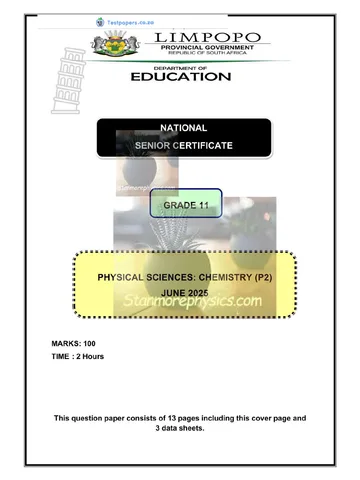
Physical Sciences Grade 11 Paper 2 Limpopo June 2025 Paper & Memo
Question paper and memo
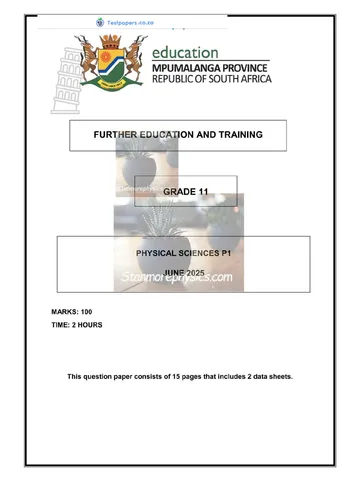
Physical Sciences Grade 11 P1 Mpumalanga June 2025 Paper & Memo
Related documents
Memorandum
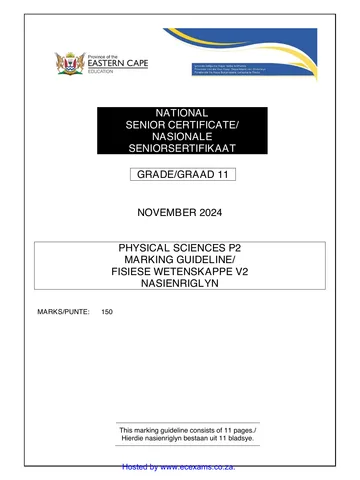
Physical Sciences Grade 11 P2 Eastern Cape November 2024 Memo
Question paper
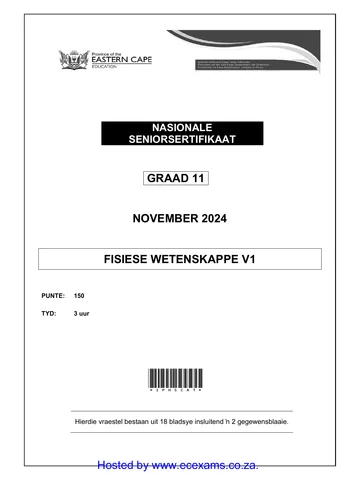
Physical Sciences Grade 11 P1 Eastern Cape November 2024 QP (Afr)
Question paper
Physical Sciences Grade 11 P2 Eastern Cape November 2024 QP (Afr)
Question paper
Physical Sciences Grade 11 P1 Gauteng June 2024 QP (Afr)
Question paper
Physical Sciences Grade 11 P1 Gauteng June 2024 QP (Eng)
Question paper
Physical Sciences Grade 11 P2 Gauteng June 2024 QP (Eng)
More from Grade 11 Physical Sciences
Memorandum
Physical Sciences Grade 11 Paper 1 KZN June 2024 Memo
Question paper
Physical Sciences Grade 11 Paper 1 KZN June 2024 Question Paper
Question paper
Physical Sciences Grade 11 Paper 2 KZN June 2024 Question Paper
Question paper and memo
Physical Sciences Grade 11 KZN March Test 2024 Paper & Memo
Memorandum
Physical Sciences Grade 11 Paper 1 Limpopo June 2024 Memo
Question paper