Technical Mathematics
Grade 11
Learner's Book
This book was developed with the participation of the Department of Basic Education of South Africa
and funding by the Sasol Inzalo Foundation
TECH_MATHS_G11_LB_Final.indb 1 2017/01/05 3:23 AM
Skip to contentTextbook 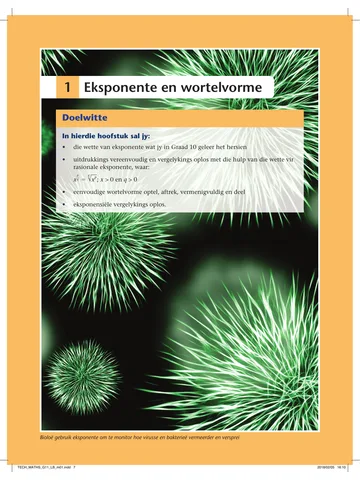
Grade 11 Tech Math (Learner Book) Eng
Grade 11 Technical Mathematics textbook (English), 348 pages. Read online or get the free PDF download.
Technical Mathematics · Grade 11 · English. Textbook, 348 pages. Read online or download the PDF.
- Subject
- Technical Mathematics
- Grade
- Grade 11
- Language
- English
- Document type
- Textbook
- Curriculum
- CAPS
- Pages
- 348
- File size
- 37.4 MB
Loading document…
Loading document…
1 of 348
Document textSearch extracted text and jump to a page.
Technical Maths Grade 11 Learner’s Book
This book was developed with the participation of the Department of Basic Education (DBE) of South Africa,
Zanokatleho Projects and ACP Project Management and Publishing Services; and funded as an ongoing project by
Sasol Inzalo Foundation.
© 2017. Copyright in the work is vested in publisher. Copyright in the text remains with the contributors.
© Illustrations and design ACP Project Management and Publishing Services, 2017
First published in 2017
Contributors from Zanokatleho Projects and Consulting
Nathi Makae, Thabo Mhlongo, Mokhulu Matshika, Makgoshi Manyatshe, Gabriel Mphuthi, Welile Simelane
Contributors from the Department of basic Education
Tiniko Trevor Dube, Leornard Gumani Mudau, Mfiki Gift Ndaba, Andrew Nkwana, Elliot Peter Simelane
Cover design by Sasol Inzalo Foundation
Cover image by Kim Stevens
Illustrations by Will Alves and Nazley Samsodien
Layout and typesetting by Nazley Samsodien in ITC Stone Serif Std 10.5 pt over 13.5 pt
Editing, Proofreading and Project Management by ACP Project Management and Publishing Services
ISBN: 978-0-620-74312-9
Your freedom to legally copy this book
This work is published under a Creative Commons Attribution-Non Commercial 4.0 Unported License (CCBY-NC 4.0)
http://creativecommon.sorg/licenses/by-nc/4.0/
You are allowed to freely copy this book subject to the following criteria:
You can photocopy, print and distribute it as you like.
You may download it onto any electronic device, distribute it via email, and upload it to your website at no charge.
You may adapt the text and illustrations.
Attribution
When doing any of the above, you should provide clear acknowledgement of the license/copyright holders.
This attribution should include the name(s) of the original book(s) and the publisher, as well as acknowledgement of SaIF
and the Department of Basic Education of South Africa. You should also provide the Creative Commons web address
(http://creative commons.org/licenses/by-nc/4.0/), which explains this type of license.
If you have made any changes to the material, you must indicate what changes you made. You may not in any way
suggest that the licensor endorses you, or uses any of your materials or your changes to the material.
Restrictions
You may not make copies of this book in part or in full – in printed or electronic or audio or video or whatever form –
for a profit seeking purpose.
Rights of other copyright holders
All reasonable efforts have been made to ensure that materials included are not already copyrighted to other entities, or in a
small number of cases, to seek permission from and acknowledge copyright holders. In some cases, this may not have been
possible. The publishers welcome the opportunity to redress this with any unacknowledged copyright holders.
TECH_MATHS_G11_LB_Final.indb 2 2017/01/05 3:23 AM
Contents
Chapter 1 Exponents and surds 7
1.1 Laws of exponents and exponential equations 8
1.2 Simplifying expressions whose bases are variables 10
1.3 Solving exponential equations 10
1.4 Rational (fractional) exponents 11
1.5 The cube root 13
1
__
1.6 Expressions of the form a
n
15
1.7 Simplifying expressions that contain surds 16
1.8 Solving exponential equations that contain rational exponents 17
1.9 Surds 18
Consolidation exercise 25
Summary 26
Chapter 2 Logarithms 27
2.1 The relationship between logarithms and exponents 28
2.2 Laws of logarithms 31
2.3 Solving exponential equations of the form: a = bx
37
2.4 Solving more equations involving logarithms 38
Consolidation exercise 41
Summary 42
Chapter 3 Equations 43
3.1 Revising factorisation of quadratic equations 44
3.2 Solving quadratic equations using factorisation 47
3.3 Solving quadratic equations using the quadratic formula 49
3.4 The discriminant: Δ = b2− 4ac 52
3.5
The relationship between the discriminant and the graph of the
quadratic equation 55
3.6 Solving inequalities graphically 55
3.7 Simultaneous equations in two unknowns 57
3.8 Word problems 58
TECH_MATHS_G11_LB_Final.indb 3 2017/01/05 3:23 AM
3.9 Changing the subject of the formula 59
Consolidation exercise 61
Summary 61
Chapter 4 Analytical geometry 65
4.1 The equation of a straight line through two points 66
4.2 The angle of inclination of a straight line 68
4.3 The equation of a line through a point and parallel to a given line 70
4.4
The equation of a line through a point and perpendicular to a
given line 72
Consolidation exercise 74
Summary 75
Chapter 5 Functions and graphs 76
5.1 Introduction 77
5.2 Revision: The graph of f(x) = x2; a = 1 77
5.3 The effect of a on the graph of f(x) = x2 79
5.4 The effect of b on the graph of f(x) = ax 2
83
5.5 The effect of c on the graph of f(x) = ax2 87
5.6 The effect of q on the graph of f(x) = a(x + p)2 + q 93
5.7 Using critical points to draw the graph of f(x) = ax + bx + c
2
99
5.8 An exponential graph: y = abx 102
5.9 The hyperbola: y = a
__; a ≠ 0
x 108
5.10 The equation of the circle with the centre at the origin: x + y = r
2 2 2
112
Consolidation exercise 117
Summary 119
Chapter 6 Euclidean geometry 121
6.1 Revision of concepts and theorems learned in earlier grades 122
6.2 An introduction to circles 128
6.3 Parts of a circle and basic terms 129
6.4 Chords and radii/radiuses 132
6.5 Angles in a circle 136
TECH_MATHS_G11_LB_Final.indb 4 2017/01/05 3:23 AM
6.6 Cyclic quadrilaterals 143
6.7 Tangents, secants and chords 147
Consolidation exercise 153
Summary 155
Chapter 7 Circles, angles and angular movement 157
7.1 Parts of a circle 158
7.2 Circular measure 158
7.3 Inscribed angle 159
7.4 Converting angle measure 160
7.5 Length of a circular arc 161
7.6 Sector area and sector length 162
7.7 Segment 164
7.8 The relationship between a segment’s height, diameter and its width 164
7.9 Angular and circumferential velocity 166
Consolidation exercise 167
Summary 169
Chapter 8 Trigonometry 170
8.1 Revision: Trigonometric ratios 171
8.2 Solving triangles 173
8.3 The sine rule 173
8.4 The cosine rule 177
8.5 The area rule 179
8.6 Trigonometric graphs 181
8.7 The graphs of y = sin(x ± p) and y = cos(x ± p) 199
8.8 Summary: The graphs 201
8.9 Solving trigonometric equations 203
8.10 Trigonometric identities 207
8.11 The reduction formula 210
Consolidation exercise 214
Summary 215
TECH_MATHS_G11_LB_Final.indb 5 2017/01/05 3:23 AM
Chapter 9 Finance, growth and decays 218
9.1 Revision: Simple and compound interest 219
9.2 Depreciation 223
9.3 Nominal and effective interest rates 228
9.4 Timelines 232
Consolidation exercise 236
Summary 237
Chapter 10 Mensuration 239
10.1 What is surface area? 240
10.2 Surface area of prisms 240
10.3 Surface area of cylinders 243
10.4 Surface area of pyramids 244
10.5 Surface area of right cones 246
10.6 Surface area of a sphere 248
10.7 Surface area of composite figures 248
10.8 The effect that changing dimensions will have on surface area 250
10.9 Volume of right prisms 251
10.10 Volume of cylinders 253
10.11 Volume of pyramids 255
10.12 Volume of cones 257
10.13 Volume of a sphere 258
10.14 Volume of composite figures 259
10.15 The effect that changing dimensions will have on volume 261
10.16 Mid-ordinate rule 263
Selected answers 266
TECH_MATHS_G11_LB_Final.indb 6 2017/01/05 3:23 AM
1 Exponents and surds
Objectives
In this chapter you will:
• revise exponential laws from Grade 10
• simplify expressions and solve equations using the laws of exponents for
rational
P q
__exponents where
x q = √xP ; x > 0 and q > 0
__
• add, subtract, multiply and divide simple surds
• solve exponential equations.
Biologists use exponents to monitor how viruses and bacteria multiply and spread
TECH_MATHS_G11_LB_m01_print_reset.indd 7 2017/01/09 1:45 PM
1.1 Laws of exponents and exponential equation
The expression, 25 is read as two to the power of five. In this expression, two is called the base and
five is called the exponent. Some people call the exponent an index; but both terms refer to the
same thing.
Laws and properties of exponents
It is important for you to remember the laws of exponents. When you work with exponents, you
will use these laws to solve various expressions and equations.
There are also two special exponential laws that you need to remember.
The first states that if any number a is raised to the power of zero, it will always equal one. For
example, 90 = 1. It does not matter how big or small the base number is, if it has an exponent of
zero, the answer will always be one.
The second law states that if any number a is raised to the power of one, it will always equal a. For
example, 121 = 12.
The following laws or principles are important for you to know:
Law or principle or property Illustration
1. For any non-zero number a and any real number m and n: –2 5 –2 + 5 3
am × an = am + n 3 ×3 =3 =3
2. For any non-zero number a and any real numbers m and n:
am 3–2 –2 –5
n = a m − n =3 = 3–7
a 35
(5 ) = 5
3 2 3×2
3. For any real numbers m and n: (am)n = amn
2 2
4. For any real number n: (ab)n = anbn (3 × 7)2 = 3 × 7
(b) (5)
a n an 3 2 32
5. For any real number n: = n =
b 52
0
6. For any non-zero real number a: a0 = 1 2 =1
1 1
7. For any real number a, and any real number n: a–n = 6–3 =
an 63
Worked example 1.1 Worked example 1.2
3 7 5
Simplify 2 × 2 . Simplify 2 ÷ 23.
Solution Solutions
23 × 27 25 ÷ 23
= 23 + 7 = 25 – 3
= 210 = 22
= 1 024 =4
8 Technical Mathematics | Grade 11
TECH_MATHS_G11_LB_m01_print_reset.indd 8 2017/01/09 1:45 PM
Worked example 1.3 Worked example 1.4
Simplify (4 ) . Simplify (6 × 7) .
4 4 3
Solution Solution
(4 ) (6 × 7)
4 4 3
4×4 3 3
=4 =6 ×7
16
=4 = 74 088
= 42 949 672 916
Worked example 1.5 Worked example 1.6
Simplify ( )
4 3
Simplify 12– 4.
2
Solution Solution
(2)
4 3
12 −4
43 1
= 3 =
2 124
64
=
8
= 8
EXERCISE 1.1
Simplify the following.
a) 2 × 25 l) 3–2(2.5)–1
m) (1 000100 × 6 013–1)
0
b) 23 × 2 × 23
9 × 125
c) 24 × 34 n)
43 × 64
d) 25 × 23 o) 33 ÷ 4–3
11
2
e) p) 23 × 2–3
24
f) 27 q) 5 + 5–1
211
r) 33 – 22
g) 2 ÷ 22
s) 44 × 183
–2 –1
h) 3 .2,5 9 × 67 × 2–1
2
i) 3–2(32.2,5) 452.12 204
t) ×
36 000 304
j) 6 – 23 3
108 u) 6–2.36 + × 23
k) 4
202. 253. 8
Chapter 1 Exponents and surds 9
TECH_MATHS_G11_LB_m01_print_reset.indd 9 2017/01/09 1:45 PM
1.2 Simplifying expressions whose bases are variables
Sometimes you will have to work with expression that have variables as their bases. A variable is
usually a letter, like a, b, c, … x, y, z, and it represents an unknown.
The same laws that you worked with in the previous section also apply to these expressions.
Worked example 1.7
(ab4)5 × a3b2
Simplify
(a2b3)5
Solution
(ab4)5 × a3b2 a5b20 × a3b2
=
(a2b3)5 a10b15
a8b22
= 10 15
a b
b7
= 2
a
EXERCISE 1.2
Simplify the following:
a) x2y × x4y5
5x – 1
g) 3 12x .812x + 1
3 +3
b) x2y–3 × x2y3 162y + 2 × 41 – y
h)
64y + 2
a – ( –2)
–1
2 –2 3
a
c) 2x – 1 –6x + 1
.a
3 i) a
a–4x
d) 23x × 8y – 2x 49a5b2c
j)
14(aybc)2
e) (3m3) + 3(2m3)
2 3
x 2x –1 1–x –3x
k) 2 .10 .25 .8
2(
16.4h )
1 22h + 10
f) ab × (2b2) × 6a9b7
l)
(2b6)2 × 8(a5b–2)2
1.3 Solving exponential equations
So far we have simplified expressions. Remember that an expression has no equality or inequality
sign, whereas an equation has an equality or inequality sign.
When solving equations, look at the base of the term with the exponent in it. Determine whether
you are able to convert the other term to a term with the same base. If you are able to do so, the
equation should be simple to solve.
10 Technical Mathematics | Grade 11
TECH_MATHS_G11_LB_m01_print_reset.indd 10 2017/01/09 1:45 PM
Worked example1.8
x
Solve the equation, 2 = 32.
Solution
x Note:
2 = 32
x 5 To check if your answer is correct, simply
2 =2
substitute it back into the original equation.
x=5
EXERCISE 1.3
Solve the equations given below:
x x a
__
a) 2 = 128 f) 2.3 = 18 k) 2 3 = 8
(3 ) = 27
n– 1 n+1 n 3
b) 2 =8 g) 2 = 64 l)
x–1 52k – 1 1
c) 7 =1 h) = 25 m) 6x =
5 216
d) (b ) = b
k 2 2 k 2 4
k+2 4 n) b .b = b
i) b =b
(2)
r
7 n n+1 n
e) 8 = 343 642m – 1 o) 2 .4 = 16
j) 0= 4
16m + 1
1.4 Rational (fractional) exponents
In this section we extend the laws of exponents to include cases where the exponents are rational
numbers. Rational numbers include integers, natural numbers, whole numbers, fractions and
decimals that can be represented as fractions.
The principal square root ____
Consider the following: What does the square root symbol represent? For example, what does √100
____
represent? Is the answer to √100 equal to 10 or is the answer equal to ±10?
In Mathematics, we define the square root of a number r to be a number x, such that x2 = r. For
example, the square root of a number 100 is 10, such that 102 = 100. So we say 10 is the square root
of 100.
But what about –10? Is it not true that (–10)2 = 100?
_
By convention, when we use the square root symbol ( √
) in Mathematics, we are ____
referring to the
positive square root only. This is called the principal square root. Thus, the √100 = 10,
because 10 is the positive square root of 100.
Chapter 1 Exponents and surds 11
TECH_MATHS_G11_LB_m01_print_reset.indd 11 2017/01/09 1:45 PM
EXERCISE 1.4
Calculate the following (without the use of a calculator).
______ ________ ___ __ ____ ___
a) √16 + 9 b) √100 − 36 c) √16 + √ 9 d) √100 − √36
Changing from surd form to exponential form
Calculating surds and converting surds to exponents are relatively common operations in algebra.
To convert from surd form to exponential form, use a fraction in the power form to indicate that it
stands for a root or a radical. We will explore this in the next section.
The square root _
It is common practice to write the square root of a number using the root symbol (√
).
However, another way of writing the square root ____ of a number, is by using rational exponents to
√ 1__2
represent the taking of a root. For example, 100 can also be written as 100 . Sometimes expressing
the square root like this makes the number easier to work with – it is easier working with exponents,
than it is to work with roots.
The table below gives a few examples of the square root of a number expressed in exponential form.
Surd form Exponential form Integer
___
√ 49
1
__
7
49 2
___
64
√ 1__ 8
64 2
___
81 2
1
__
√ 81 9
EXERCISE 1.5
1. Calculate the following.
____ ____ ____ ____
a) √225 c) √625 e) √169 + √
400
____ ____ ____
b) √289 d) √676 − √144
2. Calculate the value of each of the following by using the appropriate laws of exponents.
1
(9)
1__2
(0, 01)
1__2 1 2
a) 9 d) f)
−(25 2)
1 1
(16)
__ 1 __
−16 2
b) e) 9 2 g)
1__2 1__2
c) (−16) h) (0, 25)
3. Write each number below in surd form and then simplify.
1
(9)
1__2
(0, 01)
1__2 1 2
a) 9 d) f)
−(25 2)
1 1
(16)
__ 1 __
−16 2
b) e) 9 2 g)
1__2 1__2
c) (−16) h) (0, 25)
12 Technical Mathematics | Grade 11
TECH_MATHS_G11_LB_m01_print_reset.indd 12 2017/01/09 1:45 PM
Note:
When changing from surd form to exponential form, remember:
• The nth root of a can__ be written as a fractional exponent with a raised to the reciprocal of
n 1
__
that power, that is √a = a n.
• When the nth root of am is taken, it is raised to the power, n1__. When a power is raised to
another power, you multiply the powers ____together, and so the m (otherwise written as ___
m
1)
and
1
__ n
√
m
___
the n are multiplied together, that is a = a .
m n
1.5 The cube root
The cube of 2 is 8. Why? Because cubing a number means to raise it to the power of three. So when
we want to find the cube root of a number, we ‘undo’ what we did to the number when we raised it
to the power of 3.
We can also convert a cube root to its exponential form by using a fraction in the power to indicate
that it stands for a root or a radical. Thus, we write the cube___root of a number by using1 rational
3
exponents to represent the taking of a root, for example, √27 can also be written as 27 3.
__
The table below gives a few examples of the cube root of a number expressed in exponential form.
Surd form Exponential form Integer
3
___ 1
__
√27 27 3 3
3
___ 1
√64
__
64 3 4
3
___ 1
__
√–27 –27 3 –3
Worked example 1.9 Worked example 1.10
Use the appropriate laws of exponents to Use the appropriate laws of exponents to
1
__ 1
__
calculate the value of 64 3 . calculate the value of 8 3 .
Solution Solution
1
__ 1
__
( 4 ) 8 = (2 )
3
1
__ 1
__ 3 3
64 =
3
3
3
= 43 × = 2
= 4
Chapter 1 Exponents and surds 13
TECH_MATHS_G11_LB_m01_print_reset.indd 13 2017/01/09 1:45 PM
EXERCISE 1.6
1. Use the appropriate laws of exponents to calculate the value of the following numbers.
1
__ 3
g) (0, 001)
1
__ 1
__
a) 125 3 − 216 3
d)
1__3
1
__ 1
__
− 125 3
b) e) 729 3 h) (−0, 001)
(27)
1
c) 216 1__3
− 729
f) 31__
i) 8 3
2. Express the following to a surd form and simplify.
e) (
343)
1
(216)
1
31
__ 125 3 8x3 3
− 27 1
a) c)
b) ( )
64 3 1__3
f) (−512)
1
__
27 4 096 3
d)
In general, we have the following:
Surd form Exponential form
__ 1
__
√a a 2
3
___ 1
__
√
a a 3
4
__ 1
__
√a a 4
5
__ 1
__
√a a 5
n
__ 1
__
√a a n
Worked example 1.11 Worked example 1.12
Use the laws of exponents to calculate the value Use the laws of exponents to calculate the value
1
__ __1
of 256 4. of –243 5.
Solution Solution
41
__ 15
__
( 4 ) ( –3 5)
1
__ 4 1
__
256 4 = –243 5 =
1
__ 1
__
= 4 4 × 4 = –3 5 × 5
= 4 = –3
EXERCISE 1.7
1. Use laws of exponents to calculate the value of each of the following numbers.
1
__ 1
__ 1
__
a) 32 5 −128 7
d) g) 16 4
1
__ 1
__ 1
__
b) −32 5 e) 64 2 h) 64 6
1
__ 1
__ 1
__
c) 128 7 f) − 64 2 i) 256 8
14 Technical Mathematics | Grade 11
TECH_MATHS_G11_LB_m01_print_reset.indd 14 2017/01/09 1:45 PM
2. Use the laws of exponents to calculate the value of each of the following numbers.
( 625 )
1
41
__ 1 296 4 1
__
a) (625) c) e) (1 296) 5 1
(81) ( 243 )
1
16 4 __1 16 807 4
b) − 32 5
d) f)
Note:
• In the real number system, we can calculate:
___ 4 ___ ____
6
◦◦ even roots of only non-negative numbers: for example, √ 16 ; √16 ;√ 64
3
____ 3 ___ 5 ___ 7 _____
◦◦ odd roots of any real number: for example, √–27 ; √27 ; √32 ; √–128
1
__
1.6 Expressions of the form a n
__ m
The expression a n is equivalent to ( √a ) .
__m n
Worked example 1.13 Worked example 1.14
__23 2
Express 4 in a surd form and simplify.
__
Express (− 27) in a surd form and simplify.
3
Solution
Solution
3
__ 2
__
4
(− 27)
2 3
__ 3
= (√ ) ____ 2
= (√ − 27 )
4 3
= (2)
3
= (–3) 2
= 8
= 9
Worked example 1.15
2
__
Express 64 3 in a surd form and simplify.
Solution
2
__
64 3
___ 2
= (√ 64 )
3
= (4)
2
= 16
Chapter 1 Exponents and surds 15
TECH_MATHS_G11_LB_m01_print_reset.indd 15 2017/01/09 1:45 PM
EXERCISE 1.8
1. Write the following in a surd form and simplify.
m) (64)
1
2__3 2__3 45
__ 27 3
a) 8 e) 216 i) 16
(125)
2
2
__ 1
__ 3
__
b) 27 3 f) 343 3 j) 9 2 2 n) 64 3
k) (27)
2
__ 2
__ 8 3
− 64 3
c) g) 512 3 2
__
o) 8 −3
l) ( )
1
d) 125 3
2
__
h) 1 000 3
2
__
27 3 2
__
p) 64 −3
64
1. Use the appropriate laws of exponents to calculate the values of each of the following numbers.
m) (64)
1
2__3 2__3 45
__ 27 3
a) 8 e) 216 i) 16
(125)
2
2
__ 1
__ 3
__
b) 27 3 f) 343 3 j) 9 2 2 n) 64 3
k) (27)
2
__ 2
__ 8 3
− 64 3
c) g) 512 3 2
__
o) 8 −3
(64)
2 2 1
__ __
d) 125 3 h) 1 000 3 27 3 2
__
l) p) 64 −3
1.7 Simplifying expressions that contain surds
We can simplify expressions that contain surds by rewriting them as equivalent expressions with
rational exponents, then applying the laws of exponents.
Worked example 1.16
_______
4
Simplify √ 16 a 16; a ∈ ℝ ; a ≥ 0
Solution _______
_______
√ 16 a 16 ; a ∈ ℝ ; a ≥ 0
4
√ 16 a 16 ; a ∈ ℝ ; a ≥ 0
4
Or
______ 41__
= √ 2 4 a 16 = (16 a 16)
4
16 × __
1
4 × __
= 2 4 a
1
= 2 a 4 4
= 2 a
4
Check: ( 2 a 4) 4
= 2 4a 4 × 4 Check: (2 a 4) 4
= 16 a 16 = 2 4a 4 × 4
= 16 a 16
16 Technical Mathematics | Grade 11
TECH_MATHS_G11_LB_m01_print_reset.indd 16 2017/01/09 1:45 PM
EXERCISE 1.9
Simplify.
_____ __________ ____
6 3
a) √16x2 c) √729 m12n18 e) √8 x6
_________ _______ _____
7
b) √64x4y8z12 d) √128 a14 f) √27y9
4 3
For the expressions assume all variables to be positive real numbers.
Solving exponential equations that contain rational
1.8
exponents
To solve an exponential equation, we can use a method that is fairly simple, but requires a very
special form of the exponential equation, that is, if bx = by then x = y.
Note:
Solving equations in this way, requires the base in both exponentials to be the same.
Let’s look at an example.
Worked example 1.17
Solve for x.
2
__
x 3 = 81
Solution Check
2
__
2
__
x 3 = 81 729 3
2
__
2
__ 3
__ __3
x 3 × 2 = 3 4 × 2 = 9 3 × 3
x = 3 6 = 9 2
x = 729 = 81
EXERCISE 1.10
1. Solve for x:
5 3
d) 125 x + 1= 5
__ __
4 x 2 = 128
a) 3 x 4 = 375
g)
3 2
b) 25 2x = 5 x − 3
__ __
3 x 7 = 81
e) 7 x 3 = 343
h)
1
f) 6 x − 1= 36 −x i) 64 x − 1 = 16 x
__
c) x 3 = 27
Chapter 1 Exponents and surds 17
TECH_MATHS_G11_LB_m01_print_reset.indd 17 2017/01/09 1:45 PM
2. In a crate, each container weighs 63 kg. What is the weight of 65 containers?
3. An asteroid is 1012 kilometers away from the Earth and it is travelling at a speed of 105
kilometers per day. How many days will it take the comet to reach the Earth?
4. The weight of a newborn baby panda is 2,2 × 10⁻¹ kg. If an adult panda weighs 1,2 × 10³ times
more than a newborn panda, how much does an adult panda weigh?
1.9 Surds
The roots of some numbers can be written as rational numbers, for example:
__ _______ ___
√
9
c) ___ = 3__5
3
√
a) 4 = 2 b) √27 = 3 25
__
What about √ 8 ? Can we write the square root of 8 either as a whole number or as a fraction? The
answer is no. Roots of some numbers cannot be written either as whole numbers or as fractions. We
will refer to such roots as surds.
EXERCISE 1.11
1. Copy and complete the table in your exercise book.
Number 1 2 3 4 5 6 7 8 9 10
Perfect square of
the number
2. Without using a calculator, write down the value of each of the following. Then use your
calculator to check your answer:
__ _____ ____ ________
a) √ 9 b) √ 900 c) √ 16 d) √ 1 600
3. Copy and complete this table giving the multiples of some of the perfect squares.
Do not to use your calculator.
× 2 3 4 5 6 7 8 9 10 100
4
16 80
25
36
49 392
64
81
100 900
18 Technical Mathematics | Grade 11
TECH_MATHS_G11_LB_m01_print_reset.indd 18 2017/01/09 1:45 PM
4. Say whether the following statements are true or false.
_____ _________ __ _____
a) √ 900 = √ 9 × 100 = √ 9 × √ 100 = 30
________ ___________ ____ _____
b) √ 1 600 = √ 16 × 100 = √ 16 × √ 100 = 40
________ ___________ ____ _____
c) √ 2 500 = √ 25 × 100 = √ 25 × √ 100 = 50
________ ___________ ____ _____
d) √ 4 900 = √ 49 × 100 = √ 49 × √ 100 = 70
____ ____________ __ ____ __
e) √ 75 = √ 3 × 25 = √ 3 × √ 25 = 5 √ 3
_____ ________ __ ____ __
f) √ 486 = √ 6 × 81 = √ 6 × √ 81 = 9 √ 6
Properties of surds
The following properties will be useful in simplifying expressions involving surds.
Surd form Exponential equivalent Restriction on the variables
__ __
√ x × √ x = x
1
__ 1
__ 1
__ 1
__
x 2x 2 = x 2+ 2 = x x, y ∈ ℝ; x ≥ 0
___ __ __
√ xy = √ x × √ y
1
__ 1
__ 1
__
(xy) 2 = x 2y 2 x, y ∈ ℝ ; x, y ≥ 0
1 1
(y)
x x2 2
x, y ∈ ℝ ; y ≠ 0
= 1
y2
Worked example 1.18 Worked ____ example ____
1.19
__ __
Calculate √ 4
× √ 4 . Calculate √ 16 × √ 16 .
Solution Solution
__ __ ___ ___
√4
× √4
√16 × √16
=2×2 =4×4
= 4 = 16
Worked _____ example _____
1.20 Worked example 1.21 _____ ____
Calculate √
100 × √ 100 . Simplify the expression √
300 × √ 16 .
Solution Solution
____ ____ ____ ___
√100 × √100 √300 × √16
_______
= 10 × 10 =√ 3 × 100 × 4
__ ____
= 100
= √3 × √100 × 4
__
= 10 √3 × 4
__
= 4 × 10 √3
__
= 40 √3
Chapter 1 Exponents and surds 19
TECH_MATHS_G11_LB_m01_print_reset.indd 19 2017/01/09 1:45 PM
EXERCISE 1.12
1. Simplify: (Leave the answer in surd form.)
_____ _____ _____ __
a) √ 392 e) √ 128 i) √ 392 × √ 8
_____ ____ ____
b) √ 600 f) √ 12 j) 3 × √ 12
_____ ____ __ ____
c) √ 343 g) √ 98 k) √ 3 × √ 12
_____ _____ _____
d) √ 810 h) √ 175 l) √ 192
Note:
Know perfect squares of natural numbers as well as their multiples. It will be very useful when
you work with simplifying surds.
• If you know the perfect square of a number, you know its principal square root.
• Knowing the multiples of perfect squares allows you to write them as a product of:
____ ________
◦◦ a perfect square and a non-perfect square:(For example: √ 48 = √ 3 × 16
_____ ________
◦◦ a perfect square and a perfect square: (For example: √ 144 = √ 9 × 16
2. Simplify and leave the answer in surd form where necessary:
____ _____ __
√ 75 √ 192 √
____
a) 5 _____
c) _____ ____ × 5
e) 1 __ __ g) __ × 8 _
__ 2
___
√ 108 √ 3 √ 3 √ 8 √ 8
_____ __ __ ____
√ 125 √ 5 √ √ 25
_____
b) __
_____
d) _____ f) _ × 27
___2
__ ____
h) ____
√ 5 √ 125 √ 7 √ 75
Adding and subtracting of simple surds
In earlier grades you learned that we add or subtract only like terms.
__ __
4 √
3 and 6 √ 3 are called like surds, just like 4x and 6x are called like terms.
__ __
3 √ 2 and 7 √ 5 are called unlike surds, just like 3x and 7y are called unlike terms.
_
To decide whether the given surds are like or unlike, consider the number inside the root sign ).
( √
For surds to be like, the number inside the root sign must be the same.
20 Technical Mathematics | Grade 11
TECH_MATHS_G11_LB_m01_print_reset.indd 20 2017/01/09 1:45 PM
Worked example 1.22
__ __
Simplify 4 √ 3 + 6 √ 3
Solution
__ __
4 √ 3
+ 6 √ 3
__
= (4 + 6 ) √ 3
__
= 10 √ 3
EXERCISE 1.13
Simplify:
__ __ __ __ __ __ __ __ __ __
7√
a) 5 + 3 √ 2 + 8 √ 5 − 2 √
2 c) √ 3 + 2 √ 3 + 3 √ 3 + 4 √ 3 + 5 √ 3 + 6 √ 3
__ __ __ __ __ __
3 √ 3 − √ 2 − 4 √ 3
b) d) 10 √ 7 − 3 √ 7 − 7 √ 7
____ __ ____
Can we simplify: √ 27 + √ 8 + √ 75 ?
Note:
By just looking at the expression above, we may get the impression that there are no like terms
in the expression. Be careful when working with questions like this, first check whether the given
surds are written in their simplest form. If not, rewrite the numbers under the root sign such that
they have no factors that are perfect squares. Then simplify the expression.
Worked example 1.23
____ __ ____
Simplify: √ 27 + √ 8 + √ 75
Solution
____ __ ____
√27 + √8 + √75
______ ______ ________
= √3 × 9 + √2 × 4 + √3 × 25
__ __ __
= 3 √3 + 2 √2 + 5 √3
__ __
= 8 √3 + 2 √2
Chapter 1 Exponents and surds 21
TECH_MATHS_G11_LB_m01_print_reset.indd 21 2017/01/09 1:45 PM
EXERCISE 1.14
Simplify:
____ ____ __ __ ____ _____ __ __
a) √ 48 − √ 50 + √ 5 − 4 √ 3 f) √ 54 + 6 √ 216 + √ 6 − 2 √ 3
____ ____ __ __ _____ ____ _____
b) √ 18 + √ 12 − 2 √ 2 + 7 √ 3 g) 5 √ 180 + √ 63 − 2 √
112
____ ____ __ ____ ____ _____ _____
c) − 5 √ 20 + √ 28 − √ 5 h) − √ 18 + √ 27 + √ 147 − √ 162
_____ _____ _____ ____ _____ ____
d) √ 243 + √ 300 + √ 108 i) √ 96 + √ 180 − √ 24
_____ _____ _____ _____ _____ ____
e) √ 700 + √ 112 − √ 175 j) √ 245 + √ 147 + √ 96
Multiplying simple surds
In this section we will use the rules learnt in algebra to solve simple surds. These are:
• x2 – y2 = (x – y)(x + y)
• (x + y)2 = x2 + 2xy + y2
• (x – y)2 = x2 – 2xy + y2
• (a + b)(c + d) = ac + ad + bc + bd
• a(b + c) = ab + ac
In multiplication we can combine and split surds.
__ __ __ __
We call this grouping. So, for example, 2 √5 , can be rewritten as 2 × √5
× 3 √7 × 3 × √7
.
We can then simplify this by multiplying__the numbers
__ together
____ in one group and the surds together
____
√ √
5 × 7
in another. Thus, this becomes 2 × 3 × √ √
= 6 × 35 or 6 35 .
Worked example 1.24
__ __
Simplify the expression (3 + √2
)( 3 − √2
)
Solution Note:
__ __
( 3 + √2 )( 3 − √2 ) x2 – y2 = (x – y)(x + y) is useful
__ 2 in simplifying surds.
= (3) − (√ )
2
2
(x + y)2 = x2 + 2xy + y2
=9−2
(x – y)2 = x2 – 2xy + y2
= 7
22 Technical Mathematics | Grade 11
TECH_MATHS_G11_LB_m01_print_reset.indd 22 2017/01/09 1:45 PM
EXERCISE 1.15
Simplify the following expressions:
__ __ __ __ __ __ __ __
a) (√
3 + 3)( √ 3 − 3) c) (√
3 + √ 5 )( √
3 − √5 ) e) (√
7 − x)( √ 7 + x)
__ __ __ __ __ __
b) (3 + √ 3 )(3 − √ 3 ) d) (a − √ b )(a + √ b ) f) (1 + √ 2 )(1 − √ 2 )
Worked example 1.25
__ 2
Simplify (3 + √ 2 )
Solution
__ 2
( 3 + √2 )
__ __
= (3 + √ )
2 )(3 + √2
__ __ 2
= (3 ) 2+ 2 × 3 × √2 + (√
2 )
__
= 9 + 6 √2 + 2
__
= 11 + 6 √ 2
EXERCISE 1.16
Simplify
__ 2 __ 2 __ 2
a) (1 – √ 3 ) c) (2 √ 3 + 1) e) (− 1 −√ 5 )
__ 2 __ 2 __ __ 2 __ 2
b) (√ 3 − 1) (1 – √ 3 ) d) (√ 3 + √ 2 ) e) (3 − 3√ 7 )
Note:
(a + b)(c + d) = ac + ad + bc + bd a(b + c) = ab + ac
Worked example 1.26 Worked example 1.27
__ __ __
)( 1 + √ 3
Simplify ( 3 − √ 2 ) Simplify 2( 1 + √ 3
)
Solution Solution
__ __ __
( 3 − √2 )( 1 + √3 ) 2( 1 + √3
)
__ __ __ __ __
= 3 × 1 + 3 √3 − 1 √2 − √2 . √
3 = 2 + 2 √3
__ __ __
= 3 + 3 √3 − √2 − √6
Chapter 1 Exponents and surds 23
TECH_MATHS_G11_LB_m01_print_reset.indd 23 2017/01/09 1:45 PM
EXERCISE 1.17
Simplify.
__ __ _____ __ __
a) √ 3 (5 + √ 3 ) c) − 5(1 − √ 125 ) 2 √ 7 (1 − 2 √ 7 )
e)
__ __ __ __ __ _____
b) √ 2 (√ 2 − 7 √ 3 ) d) √ 6 (√ 2 + 1) 9(√ 27 + 1)
f)
Dividing simple surds
____ __
We can also use grouping____ for division. For example, 6 √10 ÷ 3 √2 can be written as a fraction,
____ __ __ __
√ __
10
6 × ____
= __
thus 6 √10 ÷ 3 √2 = 2 × √5
= 2 √5 .
3 √2
We can also first simplify the surds that ____ we are given.
__ Simplifying surds can help us to solve the
√ √
expressions quicker. So, for example,____ 9 28 ÷ 3 7 can be solved __ by __grouping straight away, but let’s
try and simplify the surds first. √
28 can be simplified to 2 √7 , but √ 7 cannot be simplified.
__ __ __ __ __
Our question then becomes 9 × 2 √7 ÷ 3 √7
= 18 √7 ÷ 3 √7
= 6 ÷ 1 = 6 (the √7 cancels out!).
Worked____example 1.28
√21
Simplify ____
__ .
3 √ 3
Solution
____
√21 _
___
3 √ 3
______
√ 3 ×__7
= ______
3 √ 3
__ __
√ 3 × __√ 7
______
=
3 √ 3
__
√7
= ___
3
EXERCISE 1.18
Simplify where necessary:
__ ____ __ ____
3
____ √2 √ 27
____ √ 3
___
a) __ c) 3 e) __ ÷ √ 15
√ 6 √ 2
____ __ __ __ __
√ 15 + √ 3 (√ 3 − 1)(__
√ 3 + 1) √____
b) ____________
__ ______________________
d) f) 6 7
____
√
3 √
3 √
14
24 Technical Mathematics | Grade 11
TECH_MATHS_G11_LB_m01_print_reset.indd 24 2017/01/09 1:45 PM
CONSOLIDATION EXERCISE
1. Simplify.
(216)
1
1__4
a) 81 3__4
c) 81 e) 125 3
(6)
3
__12 5
b) 81 d) 3
(81)
16 4
f)
2. Solve for x.
b) ( ) =
x
x+1 2 8 3x
a) 2 =8 c) 3 = 27
3 27
3. State whether the numbers given below are surds or not. Explain your answer.
____ __ ___
√
a) 4 16 3
_____ b) 5√3 c) 3 + √64
8
4. Simplify.
____ ___ __ 2
a) √ ___
45 c) (2√ 5 )
4
25
b) 3 √16
5. What is the side length, in simplest form, of a square with the given area? Leave the answer in
surd form where necessary.
a) 45 m2 b) 112 cm2 c) 552 cm2
6. Which of the following pairs are like terms? Give an explanation why you say so.
____ ____ ____ _____ _____ _____
a) √ 75 and √
25 b) 72 and √
3√ 378 − 3√ 363 and 7√ 847
c)
7. Simplify.
__ __ ____ __ ____ ____
a) √ 7 (1 + 2 √ 7 ) b) √ 15 × √ 3 c) (1 − √
11 )(1 + √
11 )
8. Simplify.
__ __ ____ __ ____ ____ ____
a) √ 2 + 3√ 8 − 4√ 12 + 10√ 3 c) √ 20 − 2√ 32 + 8√ 18
_____ _____
3
b) 1 + √ 125 + √ 363
9. Simplify.
_____ ____ ___
(81)
3
√ 108
a) _____ √
b) 75 _
____ c) 16 4 × √
____15 _
3 5 √ 3 2 √ 5
Chapter 1 Exponents and surds 25
TECH_MATHS_G11_LB_m01_print_reset.indd 25 2017/01/09 1:45 PM
Summary
• For any value of a, except zero, a0 = 1, for example, (–101)0 = 1
• 1n , for example, 5–2 = __
For any number a, a– n = __ 12 = 1
___
a 5 25
• Exponents can be fractions, in general:
__ 3
__
◦◦ a n = √a , for example, a 3 = √a5 ;
m
__ n 5
__
1
__ 1
__ 1
____
a or 100 2 = √
__ n __ __
◦◦ a n= √a , for example, a 2 = √ 100 = 10;
1
__ 1
__ 1 3
____
3 3
◦◦ a 3 = √a , for example, a 3 = √a or 125 3 = √125 = 5
__ __ __
• If ax = ay then x = y, for example:
◦◦ Solve for x: 3x = 81
3x = 34
x=4
• A number written exactly using square roots is called a surd.
• The two laws below can be used to simplify surds:
__ __ ___ __ __
__ √b
√a a
◦◦ √a × √b = √ab ◦◦ __ = __
√b
• When simplifying surds, one of the highest factors should be a perfect square, for example:
___
◦◦ Simplify √20
___ _____
20 = √ 4 × 5
√
__ __
= √4 × √5
__
= 2 √ 5
___
◦◦ Simplify 4 √
___ 27
__
√3
___ ___ ___ _____
4√
___
27
__
√3
√27
= 4 __
3
or 4√
___
27 4 √
__
√3
= __× 3
9
_____
√3
__ __ __
4 √9 ×
_____ √3
= 4 √9 or = __
√
3
__
= 4 × 3 or = 4 √9
= 12 or = 12
• Add or subtract like surds only, for example:
__ __ __
◦◦ 2 √3 + 8 √3 = 10 √3
__ __ __ __
◦◦ − 2 √5 + √7 + 2 √5 = √7
__ __ _____ __
◦◦ 3 √ 8 − 4 √2 = 3 √ 4 × 2 − 4 √2
__ __ __
= 3√ 4 × √2 − 4 √2
__ __
= 6 √2 − 4 √2
__
= 2 √2
26 Technical Mathematics | Grade 11
TECH_MATHS_G11_LB_m01_print_reset.indd 26 2017/01/09 1:45 PM
2 Logarithms
Objectives
In this chapter you will:
• learn how to convert an exponential equation to a logarithmic equation and
vice versa
• apply the laws of logarithms to expand and simplify expressions:
• use the laws of logarithms to solve equations of the form ax = b.
A nautilus shell with a logarithmic spiral
TECH_MATHS_G11_LB_Final.indb 27 2017/01/05 3:23 AM
2.1 The relationship between logarithms and exponents
A logarithm is the exponent to which a number must be raised to get another number. For example,
the base 10 logarithm of 100 is 2, because log10100 = 2 or 102 = 100. We call it a base 10 logarithm
because ten is the number that is raised to an exponent. So:
Exponential form Log form
102 = 100 Log10100 = 2
Note:
The logarithm of the number 100 to base 10 is 2 because 100 = 102. We write the statement ‘the
logarithm of the number 100 to base 10 is 2’. Using mathematical notation as log10100 = 2
We can use different base units when working with logarithms. For example, you could use two as a
base unit. For instance, the base two logarithm of eight is three, because 23 = 8, and log28 = 3.
In general, we write ‘log’ followed by the base number as a subscript.
Work through the following exercise, which considers the numbers given in the table below.
EXERCISE 2.1
1. Complete the table below.
Number The exponent/index to which 10 Number written as a power
must be raised to give the number of base 10
Example 1 0 100
Example 0,1 –1 10 –1
a) 0,000001
b) 0,00001
c) 0,0001
d) 0,001
e) 0,01
f) 10
g) 100
h) 1 000
i) 10 000
j) 1 00 000
k) 1 000 000
28 Technical Mathematics | Grade 11
TECH_MATHS_G11_LB_Final.indb 28 2017/01/05 3:23 AM
2. Write each of the following statements using mathematical notation:
a) The logarithm of the number 1 000 to base 10 is 3.
b) The logarithm of the number 1 000 000 to base 10 is 6.
c) The logarithm of the number 10 to base 10 is 1.
d) The logarithm of the number 1 to base 10 is 0.
e) The logarithm of the number 10 000 to base 10 is 4.
f) The logarithm of the number 0,01 to base 10 is –2.
g) The logarithm of the number 0,0001 to base 10 is –4.
h) The logarithm of the number 0,1 to base 10 is –1.
Note:
Logarithms to base 10 are commonly used perhaps because we use a decimal (base 10) system of
counting.
However, bases other than 10 are also used in many calculations in science, engineering and
related fields.
3. What is the logarithm of:
a) 32 to base 2? e) 81 to base 3? i) 125 to base 5?
b) 64 to base 2? f) 81 to base 9? j) 25 to base 5?
c) 64 to base 4? g) 7 to base 49? k) 625 to base 5?
d) 64 to base 8? h) 7 to base 7? l) 27 to base 3?
In general, the equation a = bx is equivalent to logba = x. The only restriction we put on the base is
that it must be a positive number excluding 1.
Worked example 2.1
Write the equation 8 = 23 as a logarithmic equation.
Solution
Exponential equation Logarithmic equation
8 = 23 Log28 = 3
Chapter 2 Logarithms 29
TECH_MATHS_G11_LB_Final.indb 29 2017/01/05 3:23 AM
EXERCISE 2.2
Copy the table below in your exercise book. Write the equivalent form of the given equation in the
appropriate space.
Exponential equation Logarithmic equation
729 = 9 3
a)
512 = 83 b)
c) log41024 = 5
d) log6216 = 3
1 = 90 e)
f) log121 = 0
5
3 = 243 g)
h) 2 = log25625
122 = 144 i)
j) 2 = log17289
k) 1 = log100100
Consider the number 1
____ .
100
We can write this number in different equivalent forms as shown in the table below:
1 =
____
100
0,01 1 2
___ 10–2
10
Using mathematical notation, we write: 1 1 = − 2 or
____ = 10 −2, which is equivalent to log ____
100 10 100
1 = 10 −2, which is equivalent to log 0,01 = –2.
0, 01 = ___
2
10 10
EXERCISE 2.3
1. Copy the table below in your exercise book. Write the equivalent form of the given equation in
the appropriate space.
Exponential form Logarithmic form
1 = 9 − 3
_____ a)
729
1 = 8 − 3
_____ b)
512
c) 1 = − 5
log 4 ______
1024
d) 1 = − 3
log 6 _____
216
30 Technical Mathematics | Grade 11
TECH_MATHS_G11_LB_Final.indb 30 2017/01/05 3:23 AM
Exponential form Logarithmic form
1 = 3
__ −2 e)
9
f) log 12 1
___ = − 1
12
1
3 −5 = _____ g)
243
h) 1
− 2 = log 25 _____
625
1
12 −2 = _____ i)
144
j) 1
− 2 = log 17 _____
289
1
0, 1 =___ = 10 −1
10
k)
l) log100,001 = –3
0,000 = 10– 4 m)
2. Rewrite the equations given below in exponential form:
a) log3x = 81 c) log4x = 4 e) log10y = 2
b) log2128 = x d) log2y = 10 f) log44 = x
3. Solve for the unknown in each of the cases in question 2 a) to f).
4. Solve the following by inspection:
3 x
a) y = 4 c) 216 = x3 e) 14 = 196
x 3
b) 625 = 5 d) a = 132 f) 1 000 = x
5. Write the equations in question 4 a) to f) in logarithmic form.
6. Solve the unknown value:
a) log464 = y c) logx216 = 3 e) log14196 = x
b) log5625 = x d) log13a = 2 f) logx1 000 = 3
2.2 Laws of logarithms
The laws of logarithms allow expressions involving logarithms to be rewritten in a variety
of different ways. The laws apply to logarithms of any base, but the same base must be used
throughout a calculation.
There are basic laws that we will work with. These are the: Note:
The logarithm of 1 to any
• logarithm of a product of numbers: logaxy = logax + logay base is always 0, and the
• logarithm of a quotient number: log a x_y = log a x − log a y logarithm of a number to
the same base is always 1.
• logarithm of a power: logaxn = nlogax In particular, log1010 = 1,
_____ log b and logee = 1
• base of a logarithm rule: log a b = c
log c a
Chapter 2 Logarithms 31
TECH_MATHS_G11_LB_Final.indb 31 2017/01/05 3:23 AM
The logarithm of a product of numbers: logaxy = logax + logay
When exponential expressions with the same base are multiplied, the result is an exponential
expression with the same base and an exponent equal to the sum of the exponents. That
is, am × an = am + n or aman = am + n
In section 2.1 we described an exponent as a logarithm. Thus, when we use laws governing how
we operate on logarithms, we are actually thinking about what we are supposed to do with the
exponents when we have either a product or a quotient.
Consider the expression: log2(8 × 64).
According to the property am × an = am + n, when we multiply two numbers that can be expressed in
terms of the same base, we add the exponent.
Thus, when applying this rule to logarithms and using mathematical notation, we write:
log2(8 × 64) = log28 + log264
=3+6
=9
In general, for any positive real numbers x, and y; and a not Note:
equal to 1; logaxy = logax + logay. 8 = 23 and 64 = 26
Worked example 2.2 Worked example 2.3
Write logxabc in expanded form. Evaluate log6(216 × 36) without using the
calculator.
Solution
logxabc Solution
log6(216 × 36)
= logxa + logxb + logxc
= log6216 + log636
= log663 + log662
= 3log66 + 2log66
=3+2
=5
32 Technical Mathematics | Grade 11
TECH_MATHS_G11_LB_m02_print.indd 32 2017/01/05 7:58 AM
EXERCISE 2.4
Expand and evaluate (where appropriate) each of the following expressions without using a
calculator:
a) log3(729 × 9) c) log28st e) log2100xyz
b) log5(625 × 125) d) log4(64 × 256) f) log225x
x
The logarithm of a quotient number: log a __
y = log a x − log a y
Another basic property (law) of exponents states that when exponential expressions with the same
base are divided, the result is an exponential expression with the same base and an exponent equal
a m
to the difference of the numerator and the denominator, that is: ___
a n =
a m − n
or a m÷ a n= a m − n.
Let’s apply this to logarithms.
8
Consider the expression: log 2 ___ .
64
According to the property aa
m
___= a m − n, when we divide two numbers that can be expressed in terms
n
of the same base, we subtract the exponent of the number 64 (expressed as 26) from the exponent of
the number 8 (expressed as 23).
Thus, when applying this rule to logarithms and using mathematical notation, we write:
log 2 8
___
64
= log 2 8 − log 2 64
3 6
= log 2 2 − log 2 2
Note:
=3−6 8 = 23 and 64 = 26
= − 3
Worked example 2.4
25
Rewrite log 5 ____ using the quotient property of logarithms and simplify where possible.
125
Solution
25
log 5 ___
125
= log 5 25 − log 5 125
2 3
= log 5 5 − log 5 5
=2−3
= − 1
Chapter 2 Logarithms 33
TECH_MATHS_G11_LB_Final.indb 33 2017/01/05 3:23 AM
EXERCISE 2.5
Simplify
729 625
a) log 9 ____
c) log 5 ____
e) log 1 000
_____
z
81 25
b) log 4 64
____ d) log 3 k
___ f) log 7 A
__
256 27 B
The logarithm of a power: logaxn = nlogax
The logarithm of x raised to the power of n is n times the logarithm of x. In general, we state that
logaxn = nlogax; where a and x are positive real numbers excluding 1 and n ∊ ℝ.
Worked example 2.5
x
Simplify log10100 using appropriate log properties and simplify where possible.
Solution
x
log10100
= xlog10100
2
= xlog1010
= x × 2log1010
=x×2
= 2x
EXERCISE 2.6
1. Simplify the following without the use of a calculator:
a) log5125 c) log10105 e) log8512
b) log381 d) log2128 f) log959 049
2. Use your calculator to complete the table below. For example: log2 = 0,301 and log8 = 0,903.
x 1 2 3 4 5 6 7 8 9 10
logx 0,301 0,903
3. Use the results from exercises 1 and 2 to answer the following questions without using a
calculator.
a) 3log7 c) 2log3 e) 4log5
b) 6log10 d) 3log2 f) 3log9
4. Now use your calculator to check whether the statements given below are true or false.
a) 3log7 = log343 d) 3log2 = log9 g) log2 = 3,279
1 = 0, 03
b) 6log10 = log1 000 000 e) 4log5 = log625 h) log __
2
c) 2log3 = log8 f) 3log9 = log729
34 Technical Mathematics | Grade 11
TECH_MATHS_G11_LB_Final.indb 34 2017/01/05 3:23 AM
EXERCISE 2.7
(Do not use a calculator for this exercise.)
1. Simplify each of the following using appropriate log properties:
a) log562510 c) log5x–3 e) logaa2
f) log 4 (__
14 )
x
b) logxx1 000 d) logxyz
Worked example 2.6
log 729
Simplify the expression ______
without the aid of a calculator.
log 81
Solution
log 729
______
log 81
log 9 3
= _____2
log 9
3 log 9
= _____
2 log 9
3
= __
2
1
= 1 __
2
2. Simplify without the aid of a calculator:
log 2 log 343 log 625
a) ______ c) ______ e) ______
log 64 log 49 log 25
log 32 log 216 log 512
b) ______ d) ______ f) ______
log 128 log 36 log 4
3. Simplify the log expressions given below:
log a 3 2 log xy log 27
a) _____ c) ______ e) ______
log a 2
log x y 3a
log a 3 log 8abc b log 5 625
b) _____ d) ________ f) ________
3a 3 log 2abc b
Worked example 2.7 Worked example 2.8
Write 3loga – logb + 4logc as a single logarithm. Write 7logx + 4logy as a single logarithm.
Solution Solution
3loga – logb + 4logc 7logx + 4logy
= loga3 – logb + logc4 = logx7 + logy4
= log a
____
3 4
c
= logx7y4
b
Chapter 2 Logarithms 35
TECH_MATHS_G11_LB_Final.indb 35 2017/01/05 3:23 AM
4. Simplify (without the use of a calculator).
a) loga2 – log3 + log10 f) logx64 + logx4 – logx8
log abc
b) 5logx + 3logy – logw g) _______________
2 log a + log b + log c
1 log a − __
c) __ 2 log 27 h) log2 + log3
2 3
log 4 + log 25
__________
d) i) loga – log27
log 0, 001
e) log6 + 2log20 – log3 – 3log2
log b
The base of a logarithm rule: log ab = _____
c
log c a
By convention, when the base of a logarithm is not
indicated, it is assumed to be 10. Logarithms to base 10 are Note:
called common logarithms, for example, the base for each The log button on your calculator
of the following logarithms is 10: log1 000, log8, loga, log2. is used to calculate values
As we learnt earlier, bases other than 10 are needed for
applications in science, engineering and related fields.
log b
The rule log a b = _____
c allows us to rewrite a logarithm to any base other than 10. This rule is useful
log c a
when we have to use the calculator to calculate the value of a logarithm of a number to a base other
than 10.
Worked example 2.9 Worked example 2.10
Change log25 to base 10. Change log36 to base 10.
Solution Solution
log 25 log 36
log5 log 6
= ____ = ____
log 2 log 3
EXERCISE 2.8
1. Change to base 10.
a) log1110 d) log147 g) log612
b) log1211 e) log1112 h) log49
c) log126 f) log3264 i) log25125
2. Use the calculator to evaluate the following correct to 2 decimal places.
a) log1110 d) log147 g) log612
b) log1211 e) log1112 h) log49
c) log126 f) log3264 i) log25125
36 Technical Mathematics | Grade 11
TECH_MATHS_G11_LB_Final.indb 36 2017/01/05 3:23 AM
2.3 Solving exponential equations of the form: ax = b
In previous grades you solved equations similar to these: (1) 2x – 3 = 8 and (2) 2x = 8.
The strategy we use to solve 2x = 8 is to rewrite the equation such that both sides of the equation
have the same base, that is, 2x = 23. We then ask: For what value(s) of x are the two expressions
equal? Since the bases are the same we can focus on the exponents. We conclude that the two sides
can only be equal when the bases are raised to the same exponent, that is, when x = 3.
So then how do we solve an equation like 2x = 11?
When considering this equation, we see that it is not possible to write one number in terms of the
base of the other. We have already discussed:
• that we can think of an exponent as a logarithm
• how to convert between the exponential and logarithmic forms of an equation
• how to change the base of a logarithm
We will use the above knowledge to solve the given equation.
Let’s work through an example.
Worked example 2.11
Solve for x in the equation 5x = 3. Give your answer correct to three decimal places.
Solution
5x = 3
log53 = x [Rewrite the given equation in a logarithmic form]
log 3
____ = x [Change the base of the logarithm to base 10]
log 5
0,683 = x [Calculator]
50,683 = 3 [Check]
EXERCISE 2.9
Solve for x correct to two decimal places:
a) 2x = 11 e) 5x = 27 i) 6x = 200
b) 3x = 2 f) 2x = 12 j) 8x = 90
c) 3x = 5 g) 10x = 99 k) 9x = 100
d) 7x = 5 h) 4x = 52 l) 13x = 170
Chapter 2 Logarithms 37
TECH_MATHS_G11_LB_Final.indb 37 2017/01/05 3:23 AM
2.4 Solving more equations involving logarithms
Work through the examples below and use the knowledge gained in previous grades and this
chapter to solve equations involving logarithms.
Worked example 2.12 Worked example 2.13
Solve for x: log28 = x; where x ∊ ℝ. Solve for x: 2logx + 2 = log900; where x ∊ ℝ.
Solution Solution
log28 = x 2logx + 2 = log900
2x = 8 logx2 + 2 = log9 + log100
2x = 23 logx2 – log9 = log100 – 2
log x__ = 2 − 2
2
x=3
9
x = 0
log __
2
9
x = 10 0
2
__
9
x2 = 9
x=3
Check
2
LHS: 2log3 + 2 = log3 + log100
= log(32 × 100)
= log900
LHS = RHS
∴ x = 3 is the solution
38 Technical Mathematics | Grade 11
TECH_MATHS_G11_LB_Final.indb 38 2017/01/05 3:23 AM
Worked example 2.14
Solve for x: log2(x + 2) + log2(x – 4) = 3; where x ∊ ℝ.
Solution
log2(x + 2)(x – 4) = 3
(x + 2)(x – 4) = 8
x2 – 2x – 8 = 8
x2 – 2x – 16 = 0
_______________
± √ ( − 2 ) 2 −
2_______________
4(1 ) ( − 16 )
x =
2(1 )
___ ___
2 √
+
_____ 68 2 − √ 68
_____
x = or
2 2
x = 5,1 or x = 3,1
___________________
2 ± √ ( − 2 ) 2 −
4(1 ) ( − 16 )
x = ____________________
2(1 )
___ ___
√ 68 √ 68
x = 2 +
_____ or 2 + _____
2 2
x = 5, 1 or − 3, 1
The valid value of x is 5,1
Check
log2(5,1 + 2) + log2(5,1 – 4)
= log2(7,1)(1,1)
= log2(7,81)
= 2,97 ≈3
EXERCISE 2.10
1. Solve forx : x ∊ ℝ
a) log327 = x e) log2(x + 1) = 3 i) logx + 3 = log1 000
b) logx16 = 4 f) logx = log(2 – x) 1 log x = log 10
j) __
2
c) log5x = 3 g) 2logx = 4 k) 4log2x – 1 = log28
1 = x
d) log 3 ___ 1 = x
l) log 2 __
h) log23x = log2300
27 8
Chapter 2 Logarithms 39
TECH_MATHS_G11_LB_Final.indb 39 2017/01/05 3:23 AM
Worked example 2.15 Worked example 2.16
Solve for x; where x ∊ ℤ. Solve for x; where x ∊ ℝ.
log2x + log23 = 3 2logcx = logc4 + logc(x – 1)
Solution Solution
log2x + log23 = 3 logcx2 = logc4(x – 1)
log23x = 3 logcx2 = logc(4x – 4)
3
3x = 2 ∴ x2 = 4x – 4
8
x = __ x2 – 4x + 4 = 0
3
2
= 2 __ (x – 2)(x – 2) = 0
3
∴ x = 2
Check
8 Check
LHS = log 2 __ + log 2 3
3
2logc2 = logc4 + logc(2 – 1)
= log 2 8 − log 2 3 − log 2 3
2
= log 2 8 logc2 = logc(4(2) – 4)
=3
∴ 22 = 4(2) – 4
8
x = __ is the solution
3 ∴ 4 = 4 LHS = RHS
2. Solve for x; where x ∊ ℝ.
a) log7x + log77 = log714 f) logx3 + log3x = 2
b) log3(x – 8) + log3x = 2 g) logx2 – 2 = –log2x
c) log3x – log33 = 2 1
h) log 4 (x ) − log 4 (x − 1 ) = __
2
d) log2(x – 1) = –log2x + 2 i) log(x – 3) + log(x – 2) = log(2x + 24)
e) logx + 1 = 0
3. Prove that:
log 25 − log 125
_______________ 1
a)
a
4
a
6
= __
4
2[ log a 5 − log a 5 ]
b) log981 + log91 + log216 – log250,04 = 5
6(
1 ) − log a 1 = __
1 + log 7 2 − log ____
c) log 8 __ 94
1
__
8 49 216
4. Suppose that a rapidly growing bacteria culture contains 1 000 × 20,05t bacteria after t minutes.
a) How many bacteria will be present after 20 minutes?
b) When will the size of the culture reach 7 000?
5. One thousand Rand deposited into a savings account grows to 1 000 × 20,2t rand after t years.
a) What will the balance be after 5 years?
b) When will the balance reach R7 000?
6. The world population is currently 4 billion and will be 4 × 100,0087t after t years. When will the
population reach 6 billion?
40 Technical Mathematics | Grade 11
TECH_MATHS_G11_LB_Final.indb 40 2017/01/05 3:23 AM
CONSOLIDATION EXERCISE
1. Calculate the value of each of the following:
a) log327 + log264
log 27
b) ______
3
log 2 64
c) log327 – log264
d) log327 × log264
e) log232 + log464 – log100 × log5125 + log21
2. Solve for x; where x ∊ ℝ.
a) 2x = 17
b) 7x = 100
c) 10x = 100
3. Solve for x; where x ∊ ℝ.
a) 3x = 729
b) 5x – 1 = 53
c) 4x + 1 = 256
4. Solve for x; where x ∊ ℝ.
a) logx32 = 5
b) log2x = 5
c) log232 = x
d) log(x + 1) = 0
e) log(x – 1) = 0
f) logx + log(x – 1) = log100
5. Calculate the value of:
a) log56
b) log311
c) log89
6. Write each of the following expressions in expanded form:
xy z 3
a) log ____
2
w
___ ___
√ab
___ √ab
____
b) log 3 __ log 3 __
√c √c
c) log10x
7. Write each expression as a single logarithm:
a) log(x + 1) – 3 + log(x – 1)
b) logx + 1
c) 2 – log53x
Chapter 2 Logarithms 41
TECH_MATHS_G11_LB_Final.indb 41 2017/01/05 3:23 AM
Summary
• the number logay is the exponent that a must be raised to, in order to get the number y.
• logay = x implies and is implied by ax = y
• we read logay = x as ‘the logarithm of y to base a’ is equal to x.
• the equation logay = x is called the logarithmic form of the equation.
• the equation ax = y is called the exponential form of the equation.
• in the expression logay, the number a is called the base of the logarithm. The base of a logarithm
must always be positive and not equal to 1.
• in the expression logay, y is the input and must always be a positive number.
• the laws of logarithms states:
◦◦ logaxy = logax + logay
◦◦ log a __xy = log a x − log a y
◦◦ logaxy = ylogax
• for the above laws to apply: a > 0; a Þ 1; x > 0 and y > 0.
log y
_____
• the change of base formula for logarithms states: log a y = b
log b a
• the change of base formula helps us change from any base a to any base b.
• for the change of base formula to apply, both a and b must be positive numbers not equal to 1
and y must always be a positive number.
42 Technical Mathematics | Grade 11
TECH_MATHS_G11_LB_Final.indb 42 2017/01/05 3:23 AM
3 Equations
Objectives
In this chapter you will:
• solve quadratic equations using:
◦ factorisation
◦ the quadratic formula
• solve quadratic inequalities by interpreting solutions graphically
• determine the nature of roots and determine the conditions for which roots are
real, non-real, equal, unequal, rational and irrational
• solve equations in two unknowns, in which one is linear and the other quadratic
• solve word problems
• manipulate formulae (making a variable the subject of the formula).
A skateboarding ramp rises in height and we are able to determine the slope using equations.
TECH_MATHS_G11_LB_Final.indb 43 2017/01/05 3:23 AM
3.1 Revising factorisation of quadratic equations
A quadratic equation is a polynomial of the form ax2 ± bx ± c, Note:
where a, b and c are numbers. When factoring, you will find the two
A polynomial consists of
numbers that will not only multiply to equal the constant term c,
more than two terms.
but will also add up to equal b, the coefficient of the x-term.
Factorising expressions of the form ax2 ± bx ± c
The polynomial ax2 ± bx ± c can be factorised as follows:
Factors will be: If ab is: If a + b is: If a > b:
(x + a)(x + b) positive positive not relevant
(x – a)(x – b) positive negative not relevant
(x + a)(x – b) negative positive a > b because (a + b) > 0
(x – a)(x + b) negative negative a < b because (a + b) < 0
Note:
If the sign of the last term is a ‘+’, both signs are the same. To find out what these signs are, look
at the middle sign. If the middle sign is ‘+’ both signs will be ‘+’. If the middle sign is ‘–’, both
signs will be ‘–’.
If the sign of the last term is ‘–’, the signs are different. If the middle sign is ‘+’, the sign in the
second bracket is ‘+’. If the middle sign is ‘–’, the sign in the second bracket is ‘–’.
The smallest number always goes in the first column!
Worked example 3.1 Worked example 3.2
Factorise: x2 – 3x + 2 Factorise: x2 + x – 2
Solution Solution
x2 – 3x + 2 x2 + x – 2
= (x – 2)(x – 1) = (x + 2)(x – 1)
Worked example 3.3
Factorise: x2 – x – 2
Solution
x2 – x – 2
= (x + 1)(x – 2)
44 Technical Mathematics | Grade 11
TECH_MATHS_G11_LB_Final.indb 44 2017/01/05 3:23 AM
EXERCISE 3.1
1. Factorise.
a) x2 + 7x + 12 e) x2 + 5x + 6
b) x2 – 7x + 12 f) x2 – 5x + 6
c) x2 – x – 12 g) x2 + x – 6
d) x2 + x – 12 h) x2 – x – 6
2. Check your answers to question 1 a) to h) above by expanding the factors to test whether you
get the original expression.
Factorising trinomials of the form ax2 ± bx + c2
When factorising a trinomial of the form ax2 ± bx ± c2, in which the first and the last variables are
perfect squares, put the square root of the first variable at the beginning of the brackets and the
square root of the last variable at the end of the bracket.
Worked example 3.4 Worked example 3.5
Factorise: x + 4ax + 4a
2 2
Factorise: 4x2 + 36x + 81
Solution Solution
x + 4ax + 4a
2 2
4x2 + 36x + 81
= (x + 2a)(x + 2a) = (2x + 9)(2x + 9)
= (x + 2a)2 = (2x + 9)2
EXERCISE 3.2
Factorise.
a) x2 + 14x + 49 e) p2 + 2pq + p2
b) x2 – 14x + 49 f) p2 + 8p + 16
c) x2 – 6x + 9 g) p2 + 10pq + 25q2
d) x2 + 6x + 9 h) r2 – 12r + 36
Factorising trinomials of the form ax2 + bx + c
When factorising a trinomial of the form ax2 ± bx ± c, start off by checking if there is a common
factor. Once you have considered this, take out the common factor and include it in your final
answer. Then factorise the rest of the trinomial to find the terms.
Chapter 3 Equations 45
TECH_MATHS_G11_LB_Final.indb 45 2017/01/05 3:23 AM
Worked example 3.6 Worked example 3.7
Factorise: 3x + 10x + 3
2
Factorise: 2x2 – 9x + 4
Solution Solution
3x2 + 10x + 3 2x2 – 9x + 4
= 3x2 + 9x + x + 3 = (2x2 – 8x – x + 4)
= 3x(x + 3) + x + 3 = 2x(x – 4) – (x – 4)
= (x + 3)(3x + 1) = (x – 4)(2x – 1)
= (2x – 1)(x – 4)
EXERCISE 3.3
Factorise the trinomials given below. Remember to check your answers.
a) 3m2 – 5m – 12 e) 12s2 – 13s – 35 i) –5x2 + 7x – 2
b) 6m2 – 14m – 12 f) 24s2 – 46s – 18 j) –3x2 – x + 14
c) 15b2 – 11b + 2 g) 6r2 + 23r + 7 k) –x2 – x + 2
d) 5b2 + 27b + 10 h) 20r2 + 19r + 3 l) –6x2 + x + 1
Factorising trinomials of the form a2 – b2
An expression of the form a2 – b2 is called the difference of two squares. These trinomial have factors
in the form (a + b)(a – b).
Worked example 3.8 Worked example 3.9
Factorise: x2 – 9 Factorise: 4x2 – 225
Solution Solution
x –9
2
4x2 – 225
= (x – 3)(x + 3) = (2x)2 – (15)2
= (2x – 15)(2x + 15)
EXERCISE 3.4
Factorise the expressions given below.
a) x2 – 1 e) 9x2 – 1 i) p2q2r2 – 1
b) x2 – 81 f) 9x2 – 9 j) 9x10 – 4y8
c) a2 – b2 g) 200 – 2m2 k) 5a4 – 20b2
d) x2 – 4y2 h) 64m2 – 25n2q2 m) 225b2 – 169c2
46 Technical Mathematics | Grade 11
TECH_MATHS_G11_LB_Final.indb 46 2017/01/05 3:23 AM
3.2 Solving quadratic equations using factorisation
When we solve a quadratic equation, we are calculating the value(s) of the input that makes the
quadratic equation a true mathematical statement.
There are three common techniques we use to solve quadratic equations:
• by means of factorisation
• by completing a square
• by using the quadratic formula
This year we will discuss only two techniques, namely, solving quadratic equations by means of:
• factorisation
______
the quadratic formula: x = – b ± b − 4ac
__________ √ 2
•
2a
Worked example 3.10
Solve for x: x2 – 10x – 24 = 0
Solution
Factors of –24 that add to –10 are +2 and –12.
x2 – 10x – 24 = 0
(x – 12)(x + 2) = 0
Either x – 12 = 0 or x + 2 = 0
∴ x = 12 or x = –2 are solutions
Check Check
x = 12 x = –2
x2 – 10x – 24 x2 – 10x – 24
= (12)2 – 10(12) – 24 = (2)2 – 10(–2) – 24
= 144 – 120 – 24 = 4 + 20 – 24
=0 =0
EXERCISE 3.5
Solve for x:
a) y2 – 4 = 10 d) y2 + 28y = 100 g) –y2 – 11y – 24 = 0
b) 7t2 + 14t = 0 e) y2 – 5y + 6 = 0 h) 13y – 42 = y2
y−2 2y + 1
____= _____
c) 12y2 + 24y + 12 = 0 f) y2 + 5y – 36 = 0 i)
y+1 y−7
Chapter 3 Equations 47
TECH_MATHS_G11_LB_Final.indb 47 2017/01/05 3:23 AM
Worked example 3.11
Solve for x: 8x2 + 22x + 15; x ∈ ℝ
Solution
To solve the given quadratic equation, we first have to rewrite the quadratic expression to the left of
the equal sign as a product of two linear factors (ax + b)(cx + d).
Quadratic expression Possible factors: (ax + b)(cx + d)
8x2 + 22x + 15 (2x + 3)(4x + 5) = 2x(4x + 5) + 3(4x + 5) = 8x2 + 10x + 12x + 15
(8x + 1)(x + 15) = 8x(x + 15) + 1(x + 15) = 8x2 + 120x + x + 15
(2x + 1)(4x + 15) = 2x(4x + 15) + 1(4x + 15) = 8x2 + 30x + 4x + 15
(8x + 3)(x + 5) = 8x(x + 5) + 3(x + 5) = 8x2 + 40x + 3x + 15
The only factors of 8x2 + 22x + 15 that give the middle term 22x = 10x + 12x are (2x + 3)
and (4x + 5).
So we rewrite the given quadratic equation as a product of its linear factors as shown below:
8x2 + 22x + 15 = 0
(2x + 3)(4x + 5) = 0
2x + 3 = 0 or 4x + 5 = 0
2x = –3 or 4x = –5
3 or x = − __
x = − __ 5
4
2
1 or x = –1 __
= –1 __ 1
2 4
Check
8x2 + 22x + 15 = 8(– __) + 22(– __) + 15 or 8x2 + 22x + 15 = 8(– __
4)
+ 22(– __
4)
2 2
3 3 5 5
+ 15
2 2
= 8(__
94 ) – ___
66 + 15 = 8(___
25 ) – 22(– __
4)
5
+ 15
2 16
= 18 – 33 + 15 = – 110
25 ____
___
4
+ 15
2
50 – 110 + 60
____________
=0 = 4
0
= __
4
1 or x = –1 __
So both x = –1 __ 1 are solutions
2 4
48 Technical Mathematics | Grade 11
TECH_MATHS_G11_LB_m03_print.indd 48 2017/01/05 8:04 AM
Worked example 3.12
Solve for x: 6x2 + 7x + 2; where x ∈ ℝ.
Solution
If the equation can be factorised, then it must be possible to rewrite it as a product of its linear factors.
Using trial-and-error we determine that the factors are:
(2x + 1)(3x + 2) = 0
Then we rewrite 6x2 + 7x + 2 = 0 as (2x + 1)(3x + 2) = 0
2x + 1 = 0 or 3x + 2 = 0
2x = –1 or 3x = –2
1 or x = − __
x = − __ 2
2 3
Check
6 x2+ 7x + 2 = 6 (− __
1 ) + 7(− __
1 )+ 2 6 x2+ 7x + 2 = 6(− __
2 ) + 7(− __
2 )+ 2
2 2
or
2 2 3 3
= 6(4 )− + 2
1
__ 7
__ = 6( )− + 2
4
__ 14
___
2 9 3
3
__ 7
__ 8
__ 14
___
= − + 2 = − + 2
2 2 3 3
3−7
______ +4 8 − 14
_______ +6
= =
2 3
0
= __ 0
= __
2 3
=0 =0
1 or x = − __
2 are solutions.
So both x = − __
2 3
EXERCISE 3.6
Solve the following quadratic equations using factorisation.
a) x2 – 8x + 7 = 0 f) 2x2 + 5x – 3 = 0
b) x2 + 11x + 18 = 0 g) 3x2 + 19x + 20 = 0
c) 2x2 –x – 3 = 0 h) 6x2 – 7x + 2 = 0
d) 3x2 + 13x + 4 = 0 i) 6x2 – 17x – 3 = 0
e) 14x2 – 19x – 3 = 0 j) x2 + 11x + 18 = 0
3.3 Solving quadratic equations using the quadratic formula
The perfect square
The quadratic expression a2x2 + 2axb + b2 has two identical binomial factors (ax + b). This means
that we can rewrite a2x2 + 2axb + b2 as (ax + b) (ax + b) = (ax + b)2. The expression (ax + b)2 is
called a perfect square.
Chapter 3 Equations 49
TECH_MATHS_G11_LB_Final.indb 49 2017/01/05 3:23 AM
A perfect square is a quadratic expression whose factors are identical binomials. We have already
come across expressions that are perfect squares. Some examples of quadratic expressions that can
be written as perfect squares are given below:
x2 + 8x + 4 = (x + 2)(x + 2) = (x + 2)2
x2 – 10x + 25 = (x – 5)(x – 5) = (x – 5)2
The idea of a perfect square is very useful in solving quadratic equations. If we can write a given
quadratic equation as a perfect square, then solving it becomes easier because we simply take the
square roots on both sides of the equation.
Worked example 3.13
Solve for x: (2x – 1)2 = 16; x ∈ ℝ.
Solution
_______ ___
√(2x − 1)2 = ±√16
2x − 1 = ±4
2x − 1 = 4 or 2x
− 1 = − 4
2x = 5 or 2x = − 3
5 3
x = __ or x = − __
2 2
1 or x = − 1 __
x = 2 __ 1
2 2
Check
[2(__
5 ) – 1] or [2(– __ ) –1]
2 2
3
2 2
2 2
= [5 – 1] = [–3 – 1]
2 2
= [4] = [–4]
= 16 = 16
EXERCISE 3.7
(4 x − 7) = 5
2
3
__
a) (2x + 1)2 = 1 d)
(x − ) = 9
2
b) 1
__ e) (x + 7)2 = 49
2
14
(x + 3 )2= __
c) f) (x + 5)2 = 25
_______
− b ± √
_________ b 2 − 4ac
The quadratic formula: x =
2a
One of the challenges we face when we use factorisation as a method of solving quadratic equations
is that it does not always work. Some quadratic equations are not factorable. Thus we need a method
that will always work.
Mathematicians came up with a method to help us solve quadratic equations that can be used to
calculate the roots of any quadratic equation. This method uses an equation called the quadratic
formula, which can be used to solve any quadratic equation. The quadratic formula is derived by
completing the square on the quadratic equation ax2 + bx + c = 0.
50 Technical Mathematics | Grade 11
TECH_MATHS_G11_LB_Final.indb 50 2017/01/05 3:23 AM
Let’s work through how the quadratic formula is derived.
Consider a quadratic equation in standard form: ax2 + bx + c = 0; where a ≠ 0.
x ___ 0
a bx c
2
___ __ __
a + a + a = a
b c
x 2 + __ __
a x + a = 0
a x + ( ) − ( ) + a = 0
2 2
b b b c
x 2 + __ ___ ___ __
2a 2a
b
x 2 + __ b 2 ___
___ b 2 __ c
a x + 4 a 2 − 4 a 2 + a = 0
( ) ( ) = 0
2
b − b −
x + ___ ______ 2
4ac
2a 2
4 a
2
(x + ___ )
b = b – 4ac 2
_______
2a
________
2
4a
_______
√
(x + ___
2a )
2
√b 2 − 4ac
b = 6 ______
2a
_______
b = 6 b −√ 2
4ac
x + ___ ______
2a 2a
_______
√ 2
b = 6 b −
x = − ___ ______ 4ac
2a 2a
_______ _______
− b + √b 2 − 4ac − b − √b 2 − 4ac
x = _________
or x = _________
are the roots or the solutions of the quadratic equation
2a 2a
a x 2 + bx + c = 0.
Worked example 3.14 Worked example 3.15
Solve for x using quadratic formula: Solve for x: 3x2 – 10 = 2x.
2x2 – x – 10 = 0 Give your answer correct to 2 decimal places.
Solution Solution
a = 2; b = –1; c = –10 Rewrite the quadratic equation in Standard Form:
_______
√
− b 6
b − 4ac
_________ 2 3x2 – 2x – 10 = 0
x =
2a _______________
− ( − 1 ) 6 √ ( − 1 ) 2 −
4(2 ) ( − 10 ) a = 3; b = –2; c = –10
x = __________________
_______
2(2 ) √ 2
− b 6 b
_________ − 4ac
___ x =
√ 81 2a
x = 1 6
_____ _______________
4 − ( − 2 ) 6 √ ( − 2 ) 2 −
__________________ 4(3 ) ( − 10 )
___ ___ x =
1 +
_____ √ 81 1 − √ 81
_____ ____ 2(3 )
x = 4 or x = 4 √ 124
x = 2 6
______
1+9 1−9 6____ ____
x = ____
or x = ____
√ 124
2 + √ 124
4 4 x = ______ or x = 2 −
______
6 6
10
x = ___
4
or x = −
___
4
8
Use your calculator to solve:
1
x = 2 __ or x = –2
2 x = 2,19 or x = −1,52
Chapter 3 Equations 51
TECH_MATHS_G11_LB_m03_print.indd 51 2017/01/05 8:23 AM
EXERCISE 3.8
Solve for x.
Note:
Answers must be given correct to two decimal places where necessary.
a) 2x2 – 2x – 1 = 0 d) 6x2 – 5x – 2 = 0 g) x2 – 4x – 21 = 0
b) x2 – 2x = 2(x – 1) e) x2 – 4x = 3 h) x2 – 3x = 0
c) –3x2 + 3x + 1 = 0 f) x2 + 1 = 6x i) x2 + 6x = 10
3.4 The discriminant: Δ = b2 – 4ac
_______
− b 6 √ 2
b − 4ac
_________
The discriminant, Δ = b2 – 4ac, is derived from the quadratic formula x = .
2a
By calculating the value of the discriminant we can tell: whether the roots of the equation we are
solving are real or non-real (imaginary).
But before we continue with our discussion on the discriminant, let’s do the exercise below.
EXERCISE 3.9
Copy and complete the table below in your exercise book. Make a cross for each category that
applies to each number.
Nature of the number
Number Real Non-Real Rational Irrational Integer Natural
a) 0
__
b) √ 3
c) –0,7
d) 1,234
e) –2
f) π
__
g) √
– ___
3
2
3
h) – __
2
___
i) √ 16
___
j) √
25
____
3
____
k) √ –25
52 Technical Mathematics | Grade 11
TECH_MATHS_G11_LB_Final.indb 52 2017/01/05 3:23 AM
The nature of roots
Quadratic equation can have:
• at most two real roots
• two equal roots
• no real root.
We use the value of the discriminant to determine the number and the nature of the roots of the
given quadratic equation.
A. If b2 – 4ac = 0, then ax2 + bx + c = 0 has B. If b2 – 4ac > 0 and is also a perfect square,
two real, equal, rational roots. then the quadratic equation has two real,
rational, unequal roots.
Worked example 3.16
Consider the equation 4x2 + 4x + 1 = 0. Worked example 3.17
a) Calculate the value of the discriminant. Consider the equation –3x2 + 5x + 2 = 0.
b) What is the nature of the root(s)? a) What is the nature of the roots of the
c) Solve for x; where x ∈ ℝ. equation?
b) Solve for x.
Solution c) How do you know that the values of x
a) b2 – 4ac = (4)2 – 4(4)(1) you have calculated above are indeed the
= 16 – 16 solutions?
=0 Solution
b) The value of the discriminant is 0. So the a) b2 – 4ac = (5)2 – 4(–3)(2)
equation 4x2 + 4x + 1 = 0 has 2 equal roots
= 25 + 24
that are real and rational.
= 49
c) 4x2 + 4x + 1 = 0
The discriminant is greater than zero and is a
(2x + 1)(2x + 1) = 0
perfect square, so the roots are real, unequal
2x + 1 = 0 or 2x + 1 = 0 [Repeated root] and rational.
Thus, 2x = –1 –3 x 2 + 5x +_____________
b) 2=0
1
x = − __
− 5 √
6 (
5 ) 2 − 4(
______________ − 3 ) (2 )
2 x =
2( − 3 )
___
√
x = − 5 6 49
______
−6
x = − 5
_____ +7
or x = − 5
_____−7
−6 −6
x 2
= ___ or x = − 12
____
−3 −6
x = − __ 2 or x = 2
3
c) By substituting the values of x into the
original equation and if the answer is 0 in
each case, then the values are solutions.
Chapter 3 Equations 53
TECH_MATHS_G11_LB_Final.indb 53 2017/01/05 3:23 AM
C. If b2 – 4ac = 0 and not a perfect square, then D. If b2 – 4ac < 0, then the quadratic equation
the quadratic equation has real, unequal and has no real roots.
irrational roots. Worked example 3.19
Worked example 3.18 Discuss the nature of the roots of the equation
a) Discuss the nature of the roots of the 2x2 + 3x + 5 = 0.
quadratic equation x2 + 2x – 2 = 0.
Solution
b) Solve for x: x2 + 2x – 2 = 0
b2 – 4ac = (3)2 – 4(2)(5)
Solution = 9 – 40
= –31
a) b2 – 4ac = (2)2 – 4(1)(–2) _______ ____
Since b2 – 4ac = –31 then √ b 2 − 4ac = √ − 31 ,
=4+8
is a non-real number or imaginary.
= 12
Since the discriminant has a negative value, the
The discriminant is greater than zero but is
roots of the quadratic equation are non-real or
not a perfect square, so the roots are real,
imaginary.
unequal and irrational.
b) x 2 + 2x − 2 = 0
___ ___
√ √
x = − 2 + 12
______ or x = − 2 − 12
______
2 __ 2 __
−2 +
______ 2 √ 3
−2 − 2 √ 3
______
x = or x =
2 __ 2 __
x = −1 + √
3 or x = − 1 − √ 3
EXERCISE 3.10
Copy and complete the table below in your exercise book.
Value of the discriminant:
Equation Nature of the roots
b2 – 4ac
a) 2x2 – 4x – 3 = 0
b) 9x2 – 12x + 4 = 0
c) x2 + x + 1 = 0
d) 3x2 + x + 5 = 0
e) x2 – 5x + 3 = 0
f) –2x2 + 5x – 3 = 0
g) –x2 + 1 = 0
h) 2x2 + 5x + 6 = 0
i) x2 – 4x + 4 = 0
54 Technical Mathematics | Grade 11
TECH_MATHS_G11_LB_Final.indb 54 2017/01/05 3:23 AM
The relationship between the discriminant and the graph
3.5
of the quadratic function
The relationship between the value of the discriminant and the number of x-intercepts of a parabola
is summarised in the table below.
x2 + x – 2 = 0 x2 – 2x + 1 = 0 x2 – 3x + 5 = 0
______________ _____________ _____________
− 1 6 √ (1 ) 2− 4(1
) ( − 2 ) − ( − 2 ) 6 √ ( − 2 ) 2−
4(1 ) (1 ) − ( − 3 ) 6 √ ( − 3 ) 2−
4(1 ) (5 )
x = _______________
x = ________________
x = ________________
__ 2(1 ) __ 2(1 ) ____ 2(1 )
√ 9 √ 0 √
x = − 1 6
_____ x = 2 6
____ x = 3 6
______ − 11
2 2 2
____ ____
x = − 1
____ 13
or x = –1 –3
_____ x = 2 +
____ 0
or x = 2 –0
____ x = 3 +
________√ –11
or x = 3 –
√
_______ –11
2 2 2 2 2 2
x = 1 or x = − 2 x = 1 or x = 1
Two real solutions or two real One real solution or one real No real solution or real root.
roots. root.
y y y
6 9 7
5 8
6
7
4
5
6
3
4
5
2
3
4
1
3
2
x
–4 –3 –2 –1 0 1 2 3 2 1
–1 x
1
–2 x –2 –1 0 1 2 3 4 5
–3 –2 –1 0 1 2 3 4 5
–3
–1
3.6 Solving inequalities graphically
Let’s consider the function f(x) = x2 + 7x + 12. Note:
Solving the quadratic inequality x + 7x + 12 < 0 is 2 An inequality is a relationship
equivalent to finding the values of x for which the graph between two expressions that are not
of f(x) = x2 + 7x + 12 is below the graph of g(x) = 0. equal, and uses the symbols < or >.
Follow the following steps:
• Calculate the roots of x2 + 7x + 12 ∙ 0 either using the factorisation method or by using
quadratic formula. We determine that x = –3 and x = –4 are the roots.
• Show the roots on the x-axis as shown below.
–∞ < x < –4 –4 < x < –3 –3 < x < ∞
0 0
g(x) = 0
–4 –3
Chapter 3 Equations 55
TECH_MATHS_G11_LB_Final.indb 55 2017/01/05 3:23 AM
• Observe that the roots divide the x-axis into three intervals as shown.
◦◦ Sketch graph of f(x) = x2 + 7x + 12.
• The graph opens upwards because a > 0 (that is, a = 1).
x2 + 7x + 12 x2 + 7x + 12 > 0
–∞ < x < –4 –4 < x < –3 –3 < x < ∞
0 0
x
–4 –3
In this interval
In this interval the the graph is below In this interval
graph is above the x–axis the graph is above
the x–axis. the x–axis
x² +7x +12 > 0
• Zeros are placed above the values x = –4 and x = –3 because they are the solutions, the roots or
the zeros of the equation x2 + 7x + 12 = 0.
• From the sketch we see that x2 + 7x + 12 < 0 lies in the interval –4 < x < –3 or x = (–4; –3).
EXERCISE 3.11
Solve the following inequalities.
a) x2 – 6x + 9 > 0 d) –3x2 + 4x + 4 < 0 g) 2x2 – 7x + 3 < 0
5
b) x2 – x > 0 e) –x2 + 2x – 1 < 0 x2 + __
h) x + 1 > 0
2
c) x2 – 1 < 0 f) x2 + 2x – 3 > 0 i) –5x2 – 9x + 2 < 0
Worked example 3.20
Solve the inequality x2 + 2x + 1 ≥ 0
Solution 0 y
x<–1 x>–1 x
x + 2x + 1 ≥ 0
2 8
–1
(x + 1)(x + 1) ≥ 0 7
The inequality has a repeated root, x = –1
6
5
Solve x2 + 2x + 1 ≥ 0 by looking for values of x where: 4
f(x) > 0
f(x) > 0
x2 + 2x + 1 = 0 as well as for values of x where 3
x2 + 2x + 1 > 0. When we sketch the graph of
2
f(x) = x2 + 2x + 1 we get the graph shown alongside:
1
x < –1 x > –1
The graph is always above the x-axis except at x = –1 0 x
where it lies on x-axis. Thus, the solution for –5 –4 –3 –2 –1 0 1 2
x2 + 2x + 1 ≥ 0 is x ≤ –1 or x ≥ 1.
56 Technical Mathematics | Grade 11
TECH_MATHS_G11_LB_Final.indb 56 2017/01/05 3:23 AM
EXERCISE 3.12
Solve the inequalities below; where x ∊ ℝ.
a) 4x2 + 4x + 1 ≥ 0 d) –x2 + 4x – 4 ≥ 0 g) –2x2 + x + 3 < 0
b) (x – 1)2 < 0 e) 2x2 – 50 ≥ 0 h) 7x2 + x ≤ 0
c) –x2 + 6x – 9 > 0 f) 2x2 + 5x – 12 ≤ 0 i) 4x2 – 9 < 0
3.7 Simultaneous equations in two unknowns
Simultaneous equations are pairs of equations that have the same solution(s).
We will work with simultaneous equations in two unknowns, where one equation is quadratic and
the other is linear. For example, y = x2 – 4 and y = x – 2.
Solving a system of simultaneous equations simply means calculating a value or values of x that
make(s) the two equations have the same value or values of y.
Worked example 3.21 Worked example 3.22
Solve the given system of simultaneous equations: Solve for x:
y = x2 – 4 y = x2 + xy – 4
y=x–2 y–x=2
Solution Solution
We are calculating a value or values of x that will y = x2 + xy – 4 . ............................................ (1)
give the same value of y when substituted in both y – x = 2 ....................................................... (2)
equations. y = 2 + x ...................................................... (3)
x2 – 4 = x – 2
Substitute (3) into (1)
x2 – x – 4 + 2 = 0
x + 2 = x2 + x(x + 2) – 4
x2 – x – 2 = 0
x + 2 = x2 + x2 + 2x – 4
(x – 2)(x + 1) = 0
x + 2 = 2x2 + 2x – 4
x – 2 = 0 or x + 1 = 0
2x2 + 2x – x – 4 – 2 = 0
x = 2 or x = –1
2x2 + x – 6 = 0
When x = 2: y = 22 – 4 = 4 – 4 = 0 (2x – 3)(x + 2) = 0
y=2–2=0 3
x = __ or x = − 2
If the value of x is 2 then y is zero and in 2
7
__
coordinate form (2; 0). y = or y = 0
2
( 2 2)
1 1 and (–2; 0)
1 ; 3 __
__
When x = –1: y = (–1)2 – 4 = 1 – 4 = –3
y = –1 – 2 = –3
What this means is that for the same value of x,
the two equations have the same value of y.
We write this solution in coordinate form as
(–1; –3).
Chapter 3 Equations 57
TECH_MATHS_G11_LB_m03_print.indd 57 2017/01/05 8:28 AM
EXERCISE 3.13
Solve the following systems of equations; where x, y ∊ ℝ.
a) y = x2 + 4x + 3 e) y = x2 + 2x + 5 i) y = x2 – 1,5x – 2
y=x+3 y–x=2 y = 0,5x
b) y = x2 + 2x + 5 f) y = x2 – 1 j) y = x2 – 1,3x + 0,3
y–x=5 y=x+1 y = 0,3
c) y = x2 – 6x + 8 g) y = 2x2 – 5x – 3 k) y = x2 + 5,5x – 3
y = x
__ + 2 y = –6x + 3 y = 5,5x
2
d) y = x2 h) y = 6x2 + 11x – 10 l) y = 3x2 + xy + 1
y–2=x y = 4x y + 2x = 5
3.8 Word problems
1. The angle iron shown has a cross-sectional area of 70,56 cm2. W
If the width of the angle iron is w, then the cross-sectional area is
12,6w + (18,65 – w)w.
What is the width of this angle iron? 18,65 cm
12,6 cm
2. A gutter is made by folding up the edges of a strip of metal.
If the metal is 30,5 cm wide and the cross-sectional area of the gutter must be 108,2 cm2,
what is:
a) the width of the gutter?
b) depth of the gutter?
3. A rectangular piece needs to be cut from a large flat piece of sheet metal.
The length of the cut piece is to be 18,3 cm longer than the width, and the piece is to contain
5,5 m2. Calculate:
a) the length of the cut piece.
b) the width of the cut piece.
4. The bending moment of a beam is given by the formula I = 7x2 + 4x – 3, where x is the distance
along a beam from the other end. Calculate the value of x for which I = 0
5. The perimeter of the rectangle is represented by 8y metres and the area is represented by
(6y + 3) square metres.
a) Write down the equations for the perimeter and the area of the rectangle in terms of x and y.
b) Determine the perimeter and the area.
58 Technical Mathematics | Grade 11
TECH_MATHS_G11_LB_Final.indb 58 2017/01/05 3:23 AM
6. The perimeter of the right-angled triangle is 60 m, and its area is 10y square meters.
2x
y+4
5x – 1
a) Write a simplified expression for the triangle’s perimeter in terms of x and y.
b) Write a simplified expression for the triangle’s area in terms x and y.
c) Write a system of equations and explain how it relates to this problem.
d) Solve the system of equations for x and y.
e) What are the dimensions of the triangle?
f) Verify your solution.
7. The number of centimetres in the circumference of a circle is three times the number of square
centimetres in the area of the circle.
a) Write the system of linear-quadratic equations, in two variables, that model the circle with
the given property.
b) What is the radius of the circle with this property?
c) What is the circumference of the circle with this property?
d) What is the area of the circle with this property?
8. The total surface area of a solid cone is 486,2 cm2 and its slant height is 15,3 cm. Calculate the
diameter of the base.
9. A shed is 4 metres long and 2 metres wide. A concrete path of constant width is laid all the way
around the shed. If the area of the path is 9,5 cm2, calculate its width (correct to the nearest
centimetre).
3.9 Changing the subject of the formula
A formula shows a relationship between quantities. For example, the formula A = πr2, shows the
relationship between the area of a circle and the radius. Using this formula, we can calculate the area
for circles of various radii.
But what if we, for example, have pre-determined the area a circular surface must have and want to
calculate the radii that would result in the pre-determined area?
Such a calculation would require the re-arrangement of the formula A = πr2.
Let’s look at an example of this.
Chapter 3 Equations 59
TECH_MATHS_G11_LB_Final.indb 59 2017/01/05 3:23 AM
Worked example 3.23
Given the formula for calculating the area of a circle, A = πr2, make r the subject of the formula.
Solution
A = πr2
πr2 = A
r 2 = A
__
π__
r = A
√
__ [a radius is a length and can only be a positive value]
π
EXERCISE 3.14
1. V . Make:
___
The power, P dissipated in a resistor of resistance, R, is given by the formula P =
2
R
a) R the subject of the formula.
b) V the subject of the formula.
2. R1 = __
The total resistance, R, in a circuit containing two resistors in parallel is given by __ 1 + __
1 .
R R
1 2
Make R1 the subject of the formula.
3. Newton’s law is expressed as F = ma.
Rearrange the formula such that you can calculate the acceleration of a body given its mass and
the force acting on it.
4. Given the formula PVn = C, make each of the indicated quantities the subject of the formula:
a) P b) n
5. Ohm’s Law is given by V = IR.
Rewrite the formula such that you can calculate the resistance of any conductor given the other
two quantities.
6. The circumference of a circle is given by C = 2πr.
Write a formula that will help you calculate the length of the radius of the circle given the
circumference.
7. The formula A = 2πrh + 2πr2 is used to calculate the surface area of a cylindrical object.
Write down a formula that will enable you to calculate the radius given the surface area and the
height of the object. __
8. gl
Make l, the length of a pendulum, the subject of the formula given that T = 2π __ √
9. RER
Given that V = ___ +r
make each of the indicated quantities the subject of the formula.
a) E b) R c) r
10. The velocity of a free falling body through a certain height, h, is given by v2 = 2gh.
Write down a formula that you would use to calculate the height through which the object
is falling.
60 Technical Mathematics | Grade 11
TECH_MATHS_G11_LB_Final.indb 60 2017/01/05 3:23 AM
CONSOLIDATION EXERCISE
1. Which of the quadratic equations given below can be solved by factorising?
a) x2 + 13x + 22 = 0
b) x2 – 10x + 25 = 0
c) 3x2 – 6x + 5 = 0
d) x2 + 12x + 32 = 0
e) –3x2 + 5x + 1 = 0
f) –3,1x2 + 2,5x + 3,75 = 0
2. Explain how you arrived at your decision(s) in answering question 1 above.
3. Now solve each of the equations in the question.
4. Solve for x in each of the cases below:
a) (x – 1)(x + 7) < 0
b) 3(x – 3)(x – 3) ≥ 0
c) (x – 1)(x + 2) > 0
d) 3x2 + 18x + 15 ≤ 0
e) –2x2 – 19x – 9 < 0
f) –3x2 – x + 2 < 0
5. Solve the simultaneous equations given below:
a) y = (x – 4)(x + 13)
y=x–4
b) y = x2 – 36
y – x + 34 = 0
Summary
• a quadratic equation can be solved by:
◦◦ factorisation
______
using the quadratic formula: x = − b ±
b − 4ac
_________√ 2
◦◦
2a
◦◦ completing a square (Not examinable in Grade 11)
• to decide on the nature of the roots we use the discriminant: b2 – 4ac
• the four cases of the discriminant are:
Chapter 3 Equations 61
TECH_MATHS_G11_LB_Final.indb 61 2017/01/05 3:23 AM
Value of Is Δ = b2 – 4ac Number of
Type of solution Equal/unequal
Δ = b2 – 4ac a perfect square? solutions
equal to 0 No 2 or one unique Rational Equal
solution
greater than 0 Yes 2 Rational Unequal
greater than 0 No 2 Irrational Unequal
less than 0 Imaginary
• the four cases of the discriminant shown graphically are as follows:
Value of the
Possible Graph Nature of the roots
discriminant
b2 – 4ac = 0 y The parabola There are two equal or
6 intersects the x-axis one unique root(s) that
at one rational value is (are):
5
of x.
4
• Real
The turning point is
• Rational
3 on the x-axis.
2
1
x
–3 –2 –1 0 1 2 3
–1
b2 – 4ac = 0 y The parabola There are two roots
and a perfect 5 intersects the x-axis at that are:
square two distinct rational
4
values of x. • Real
3 • Rational
2 • Unequal
1
x
–5 –4 –3 –2 –1 0 1 2
–1
–2
62 Technical Mathematics | Grade 11
TECH_MATHS_G11_LB_Final.indb 62 2017/01/05 3:23 AM
Value of the
Possible Graph Nature of the roots
discriminant
b2 – 4ac > 0 y The parabola There are two roots
and not a intersects the x-axis at that are:
2
perfect square two distinct irrational
1
values of x. • Real
x
–1 0 1 2 3 4 5 6 • Irrational
–1
–2 • Unequal
–3
–4
–5
–6
–7
–8
b2 – 4ac < 0 y The parabola does not The roots are non-real
f intersect the x-axis or imaginary
4
3
2
1
x
–1 0 1 2 3 4 5 6
–1
–2
–3
–4
–5
–6
• a mathematical statement such as x2 – 7x + 6 ≤ 0 is called an inequality. It is similar to the
equation x2 – 7x + 6 = 0. In the case of the equation x2 – 7x + 6 = 0 there are only two
values that make the equation true, (x = 1 or x = 6). However, in the case of the inequality
x2 – 7x + 6 ≤ 0 there is an infinite number of x-values that make the inequality true. The
solution of the inequality is thus not a single number, but a range of numbers between 1 and
6 and includes both 1 and 6. It can be written mathematically as 1 ≤ x ≤ 6.
• we solve inequalities in the same way as we solve equations.
Chapter 3 Equations 63
TECH_MATHS_G11_LB_Final.indb 63 2017/01/05 3:23 AM
• we can represent solutions of both equations and inequalities graphically.
Inequality: x2 – 7x + 6 ≤ 0 Equation: x2 – 7x + 6 = 0
y
3
3
2
2
1
1
x
–1 0 1 2 3 4 5 6 7
–1 0 1 2 3 4 5 6
–1
–1
–2
–2
–3
–3
–4
–4
–5
–5
–6
–6
Solution: 1 ≤ x ≤ 6 Solution: x = 1 and x = 6
• to solve simultaneous equations is to calculate solutions that satisfy all the given equations.
• in the case where one of the simultaneous equations is quadratic and the other linear, the
maximum number of possible solutions is two for both x and y.
• we change the subject of the formula to create a new formula that has the variable or unknown
whose value we want to calculate – it is similar to solving an equation.
• when changing the subject of the formula we apply the rules we apply when solving equations.
64 Technical Mathematics | Grade 11
TECH_MATHS_G11_LB_Final.indb 64 2017/01/05 3:23 AM
4 Analytical geometry
Objectives
In this chapter you will:
• revise how to find the equation of the line through two given points
• determine:
◦ the equation of the line through one point and parallel or perpendicular to
the given line
◦ the inclination (θ) of a line, where m = tan is the gradient of the line and
0˚ ≤ θ ≤ 180˚.
Scientists use analytical geometry to calculate the angle at which to launch a rocket.
TECH_MATHS_G11_LB_Final.indb 65 2017/01/05 3:24 AM
4.1 The equation of a straight line through two points
A geometric fact that you may have come across is that ‘only one straight line can be drawn through
two different points’. What this means is that if we are given two different points on a line, we can
reconstruct the line in the x-y plane by simply lining a ruler up with the two points and drawing in
a line (as illustrated below).
y y
A A
x x
B B
The gradient of a line ensures its straightness.
The gradient of the line has to be constant irrespective of the points on the line that are chosen to
calculate it.
Let’s consider a line in the x-y plane, with two points A (x1; y1) and B (x2; y2) on the line.
The gradient (m) of the line passing through the points A and B is given by the equation:
y − y
_____1 where x Þ x
= x 2
mAB − x 2 1
2 1
y − y
_____1 (x − x ) where x Þ x .
Substituting in y – y1 = m(x – x1) we get y − y1 = x 2 − x 1 2 1
2 1
We can also re-arrange the above equation and rewrite is as:
y − y
____ y − y
_____1 where x Þ x and x Þ x
x − x 1 = x 2 − x 2 1 1
1 2 1
66 Technical Mathematics | Grade 11
TECH_MATHS_G11_LB_Final.indb 66 2017/01/05 3:24 AM
Worked example 4.1
Write the equation of the straight line passing through the given points (2; 1) and (–3; 2).
Solution
Let (x1; y1) = (2; 1) and (x2; y2) = (–3; 2)
____y − y y − y 1
_____ y − y 1
_____
x − x1 = x 2 − x 1 or m = x 2 − x 1
2 2
y−1 2 − 1 = _____
____ = _____ 2 − 1
x−2 −3 − 2 −3 − 2
y − 1 1 1
____ = ___
−5
= − __
x−2 5
1 (x − 2 )
y − 1 = − __ y − y1 = m(x − x1 )
5
1 (x − 2 ) + 1
y = − __ 1 (x − 2 )
y − 1 = − __
5 5
15 x + __
y = − __ 2 + 1
5
15 (x − 2 ) + 1
y = − __
7 7
15 x + __
y = − __ 5
y = 1
__ x + __
5 5
EXERCISE 4.1
1. Write the equation of the straight line passing through the given points.
a) (5; 4) and (0; 1) d) (–1; –3) and (–4; 0)
b) (1; 3) and (2; 6) e) (–2; 3) and (0; –3)
c) (0; 3) and (2; –3) f) (0; –1) and (9; 4)
2. Write the equation of the straight line through the points A and B in each graph below.
a) b) y
5
6
4
5
3 A
4
2
3
1
2
B
–2 –1 0 1 2 3 4 5 1
–1 x
–1 0 1 2 3
–2 –1
–2
Chapter 4 Analytical geometry 67
TECH_MATHS_G11_LB_Final.indb 67 2017/01/05 3:24 AM
c) y d) y
6
6
A
5
A 5
4
4
3
3
2 90°
2
1
1
B x B x
0
–6 –5 –4 –3 –2 –1 1 2
–2 –1 0 1 2 3 4 5 6 7 8
–1 –1
–2 –2
e) f)
y y
3 5
A B
2 4
1
A 3
B x
2
–3 –2 –1 0 1 2
–1 1
–2
x
0
–5 –4 –3 –2 –1 1 2 3 4 5
–1
–2
3. Calculate p such that the points:
a) (p; –11) is on the line passing through the points (1; 1) and (5; 13).
b) (6; –14) is on the line passing through the points (4; –6) and (p; 2p).
c) (p ; __ )is on the line passing through the points (0; –6) and (–1; –13).
p
2
4.2 The angle of inclination of a straight line
When we draw any non-horizontal straight line in the x-y plane it intersects with the x-axis at a
certain angle. This is called the angle of inclination.
We use the x-axis as our point of reference in defining the angle of inclination of a line. We define
the angle of inclination of a non-horizontal line to be the positive angle u that the line or the part of
the line makes with the x-axis. It is common practice to use Greek symbols such as u to represent the
angle of inclination.
68 Technical Mathematics | Grade 11
TECH_MATHS_G11_LB_Final.indb 68 2017/01/05 3:24 AM
The angle is measured from the positive x-axis in an anti-clockwise direction. The value of measured
angle is (by convention) always given as a positive angle between 0˚ and 180˚.
Worked example 4.2 Worked example 4.3
Calculate the angle of inclination for a straight Calculate the angle of inclination for a straight
line through (1; 1) and (–5; –5) line through (–1; 1) and (5; –5)
y y
5
5
4
4
3
3
2
2
A = (–1;1) 1
1 A = (1;1) x
x
–5 –4 –3 –2 –1 0 1 2 3 4 5 6 7
–7 –6 –5 –4 –3 –2 –1 0 1 2 3 4 5 6 –1
–1
–2
–2
–3
–3
–4
–4 B = (5;–5)
–5
B = (–5;–5) –5
–6
–6
–7
Solution
m = − 5 −1
_____ = − 6
___ = 1 Solution
−5 − 1 −6
___Dy m = − 5
_______−1
= − 6
____ = − 6
___
= − 1
m = = tan u −5 − ( − 1 ) 5+1 6
Dx
tan u = − 1
tan u = 1
u = tan −1 (− 1) [calculator]
u = tan −1 (1) [calculator]
u = − 45°
u = 45°
u = 180° − 45°
u = 135°
Note:
When a gradient is negative, the
calculator gives a negative angle. We then
use this negative angle to obtain a positive
angle of inclination less than 180˚.
Chapter 4 Analytical geometry 69
TECH_MATHS_G11_LB_Final.indb 69 2017/01/05 3:24 AM
EXERCISE 4.2
1. Calculate the angle of inclination of a line passing through the given points. Give the answer
correct to two decimal places (where appropriate).
a) (4; 1) and (–4; 3) d) (0; 0) and (3; 1)
b) (7; 4) and (0; 6) e) (0; 3) and (–3; 0)
c) (1; 5) and (6; 8) f) (0,1; 1,3) and (1; 4)
2. What is the angle of inclination of a line having the given gradient?
a) m=3 d) m = – 0,6
b) m = –3 e) m = 1,67
c) m = 1.5 f) m = –2,7
The equation of a line through a point and parallel to a
4.3
given line
Before we learn how to determine the equation of a line through a point and parallel to a given line,
let’s revise some useful facts regarding parallel lines that we learnt in previous grades:
• if two non-vertical lines are parallel, then their gradients are equal
• conversely, if two non-vertical lines have equal gradients then they can be said to be parallel to
each other
• two lines that are parallel to each other are equally inclined to the x-axis.
y
θ θ x
70 Technical Mathematics | Grade 11
TECH_MATHS_G11_LB_Final.indb 70 2017/01/05 3:24 AM
Worked example 4.4
What is the equation of a straight line which passes through the point (4; 3) and is parallel to the
5
line y = − __
4
x + 2.
Solution
5
The straight line through the point (4; 3) will have the same gradient as that of the line y = − __
4
x + 2
because they are parallel. That is, the gradient of both lines is − 4 (m = − 4 ).
5
__ 5
__
This means that for the line whose equation we are to determine we know:
1. the gradient (m = − __
4)
5
2. the point through which it passes (4; 3)
So, to determine the equation of the line we can use the slope-point form: y – y1 = m(x – x1)
5
y − 4 = − __
4
(x − 3 )
5 15
y − 4 = − __
4
x + ___
4
31
54 x + ___
y = − __ 4
EXERCISE 4.3
1. What is the equation of a straight line that passes through the point:
a) (–1; 1) and is parallel to the line y = x – 2.
b) (0; –3) and is parallel to the line y = x – 2.
c) (–1; 0) and is parallel to the line y = x.
d) (–1; 1) and is parallel to the line y = –x + 2.
e) (0; –3) and is parallel to the line y = –x + 2.
f) (0,2; 3) and is parallel to the line y = –x.
g) (2,1; 10) and is parallel to the line y = –0,25x + 1.
h) (4; 3) and that is parallel to the line y = 4x + 1.
2. Are the lines in the x–y plane given by the following equations parallel to each other?
Explain your answer in each case.
a) y = 3x – 6 and y = 3x + 1 000
5
b) y = –2x + 17 and y = − ___ x = 1 003
10
c) y = 5x – 1 and y = –5x – 1
1 and y = __
y = 7x + __
d) 1 x + 7
3 3
3 8
y = __
e) x + 0, 75and y = − __ x + 13
8 3
3. Which of the lines in question 2 above have the same angles of inclination? Explain.
4. 37 x + 1 001, write the equations of two lines parallel to it.
Given the line y = __
Chapter 4 Analytical geometry 71
TECH_MATHS_G11_LB_Final.indb 71 2017/01/05 3:24 AM
5. Calculate k such that the line passing through the points.
a) (–3; k) and (2;–5) is parallel to the line passing through the points (3; 6) and (–2; 4).
b) (1; 0) and (k; 3) is parallel to the line passing through the points (3; 0) and (0; –3)
c) (2,5; 3,8) and (2,75; k) is parallel to the line y = –2,25x + 1 000 (k must be given correct to
two decimal places)
1 ; k) and (__
d) (__
4 4
3 ; __)
7 is parallel to the line y = x – 1.
2
e) (k; –1,5) and (3,1; –3,2) is parallel to the line y = –2x – 45.
6. The points (0; –5) and (0; 2) are on the straight line, l1 and the point (3; –4) is on another
straight line l2 parallel to l1. Calculate the co-ordinates of any point on l2.
7. Points A (6; 1), B (3; –1), C (–4; 2) and D (x; y) are the vertices of a parallelogram. Calculate the
coordinates of D.
8. What should the coordinates of the point B be so that quadrilateral ABCD is a parallelogram?
a) A(1; 1)
b) B(x; y)
c) C(–5; 5)
d) D(–7; 6)
The equation of a line through a point and perpendicular to
4.4
a given line
The figure below shows two non-vertical perpendicular lines drawn in the x–y plane with gradients
m 1 and m2, respectively.
y
m¹ m2
x
In previous grades you learned that two lines are perpendicular to each other if they intersect at
90˚. To determine the equation of a line through a point and perpendicular to another line we use
the following theorem: Two non-vertical lines are perpendicular if and only if the product of their
gradients is –1 (m1.m2 = –1).
72 Technical Mathematics | Grade 11
TECH_MATHS_G11_LB_Final.indb 72 2017/01/05 3:24 AM
Now consider the example below:
Worked example 4.5
Show that the lines in the x-y plane given by the following equations are perpendicular to each other:
x + 7.
y = 3x – 5 and y = __
3
Solution
The gradients of the two lines are m1 = 3 and m2 = − 1
__
3
1 = − 1
m1 × m2 = 3 × − __
3
x + 7are perpendicular to each other.
This means that the lines given by equations y = 3x – 5 and y = – __
3
EXERCISE 4.4
1. Which of the pairs of lines given by the indicated equations are perpendicular to each other?
Give an explanation in each case.
2 x + 100 and y = 2,5x – 300
y = __
a)
5
b) y = x and y = –x
c) y = 2x – 0,375 and y = –2x + 1,5
___ + 17 and y = 3x
d) y = 2x ___ − 17
3 2
___ + 17 and y = −
y = 2x
e) 3x
____ − 17
3 2
2. Calculate the value of h such that the line passing through the points:
a) (0; 1) and (8; h) is perpendicular to the line passing through the points (5; –1) and (4; 6).
b) (3; 4) and (1; –8) is perpendicular to the line passing through the points (5; 0) and (h; h).
c) (h; 0) and (–2; –5) is perpendicular to the line y = 2x – 7.
4 x + 1.
d) (h; –2) and (1; –1) is perpendicular to the line y = − __
3
3. ΔABC is a right-angled triangle with vertices A (–4; 1), B (0; y) and C (2; –1).
Calculate the value of y if angle A equals 90˚.
4. Given the points A (–2; 2), B (–7; –1) and C (x; 0) in the x-y plane, and given that AB is
perpendicular to AC, calculate the value of x.
EXERCISE 4.5
A
1. AB and CD are roof lines of a house, with A at
the centre of the house. AM and CN are vertical C
supports of the roof.
a) If AM = 2,7 m; CN = 2,4 m, and EB = 11 m,
how long should ND be if the slopes of the
roof lines, AB and CD are equal? F B
N M D
b) Does EN equal to ND?
c) How long is DB? 11 m
Chapter 4 Analytical geometry 73
TECH_MATHS_G11_LB_Final.indb 73 2017/01/05 3:24 AM
2. A ladder leans against a straight line wall defined by y = 2x – 4.
a) Determine the length of the ladder.
b) How far does the ladder reach up the wall?
c) Calculate the ladder’s inclination with the floor.
CONSOLIDATION EXERCISE
1. Given the co-ordinates for the points A, B, C and D, say whether AB and CD are parallel,
perpendicular, or neither.
A B C D
a) (3; 5) (7; –1) (–4; 4) (0; –2)
b) (4; 7) (8; –1) (0; 1) (–4; –1)
c) (–2; –3) (4; –1) (5; –2) (6; 1)
d) (5; 2) (10; 4) (–6; 2) (–4; –3)
2. In each of the cases in question 1 a) to d), write the equations of both AB and CD.
3. What is the equation of a perpendicular bisector of the line segment joining the points A (0; 3)
and B (8; –1)?
4. What is the equation of a straight line that satisfies the given condition(s)?
a) x-intercept = 1, y-intercept = 2
b) y-intercept = 3, parallel to the line 3x – 2y + 4 = 0
c) x-intercept = 2, perpendicular to the line 3x – 2y + 4 = 0
5. Write the equation of the line that contains the point (–1; 8) and is:
a) parallel to x = 2
b) perpendicular to x = –2
c) parallel to y = 3x + 6
d) perpendicular to y = 3x + 6
74 Technical Mathematics | Grade 11
TECH_MATHS_G11_LB_Final.indb 74 2017/01/05 3:24 AM
Summary
• the equation of a straight line that passes through two points can be determined by means of
y − y y − y
_____1 (x − x ) or ____1 = 2 y − y
_____1 or y − y = m(x − x )
the following formulae: y − y1 = x2
− x 1 x − x x − x 1 1
2 1 1 2 1
• the gradients of parallel lines are equal.
• the product of the gradients of perpendicular lines = –1.
• the angle of inclination of a line is the positive angle a line makes with the positive x-axis.
It is always calculated in an anti-clockwise direction.
• the angle of inclination of a line is calculated by setting the equation:
m = tanθ
θ = tan–1(m) for 0° ≤ θ ≤ 180°
Chapter 4 Analytical geometry 75
TECH_MATHS_G11_LB_Final.indb 75 2017/01/05 3:24 AM
5 Functions and graphs
Objectives
In this chapter you will:
• revise the effect of the parameters and q on a graph; where a is not restricted to 61
• investigate the effect of p on a graph of the function defined by:
◦ y = f(x) = ax2 + bx + c
◦ y = f(x) = a(x + p)2 + q
a
◦ y=_
x+q
◦ y = a.f(x) = a.b2 + q
• sketch the graphs of the above functions including:
◦ x2 + y2 = r2
_____
◦ y = 6√r 2 − x 2
_____
◦ y = +√r 2 − x 2
_____
◦ y = − √r 2 − x 2
Engineers use functions to determine a rollercoaster’s height above the ground.
TECH_MATHS_G11_LB_Final.indb 76 2017/01/05 3:24 AM
5.1 Introduction
In mathematics we often want to talk about the value of a quantity without ever calculating it.
To make it easier to work with, we use function notation such as f(x) or g(x) to refer to the rule for
calculating a quantity’s value without having to write the rule over and over again. In this chapter
we will use the function notation to express relationships between input and output values.
A function consists of:
• a set of input values – called the domain of the function
• a set of output values – called the range of the function, and
• a rule that tells us how to calculate the output values when we know the input values.
In previous grades we drew the graphs of f(x) = x2 and f(x) = –x2 by:
• completing a table of input and output values
• plotting the points on the Cartesian plane, and
• joining the points to form a continuous smooth curve.
In this chapter we will investigate the effects of a, b and c on the graph of f(x) = ax2 + bx + c.
5.2 Revision: The graph of f(x) = x2; a = 1
Remember that the simplest form of the function is f(x) = x2, which results in a parabola.
The graph is symmetrical about the y-axis, which is called the axis of symmetry of this function.
The coefficient of x2 is called a.
Let‘s work through an example to refresh our memories.
Worked example 5.1
Consider the function defined by f(x) = x2.
a) Calculate the output values of f(x) = x2 for x ∊[–4; 4].
b) Represent the function f(x) = x2 using a table of values.
c) Plot the points on a Cartesian plane and then join them to form a graph.
d) Discuss the features of the graph.
Solution
a) f(–4) = (–4)2 = 16 f(–1) = (–1)2 = 1 f(2) = (2)2 = 4
f(–3) = (–3)2 = 9 f(0) = (0)2 = 0 f(3) = (3)2 = 9
f(–2) = (–2)2 = 4 f(1) = (1)2 = 1 f(4) = (4)2 = 16
b) Table of values
x –4 –3 –2 –1 0 1 2 3 4
f(x) 16 9 4 1 0 1 4 9 16
Chapter 5 Functions and graphs 77
TECH_MATHS_G11_LB_Final.indb 77 2017/01/05 3:24 AM
c) The graph of f(x) = x2
y
10
A 9 E
8
7
6
5
B 4
D
3
2
1
x
–4 –3 –2 –1 0 1 2 4 5
d) Features (characteristics) of the graph
(i) The shape of the graph of f(x) = x2:
The graph opens upwards (a > 0).
(ii) Intercepts of the graph:
The graph cuts the x-axis at (0; 0) and the y-axis at (0; 0).
(iii) Axis of symmetry:
The graph is symmetric with respect to the y-axis.
For example, the points (2; 4) and (–2; 4) are on either side of the y-axis.
The equation of the axis of symmetry is x = 0.
(iv) The turning point (TP):
The graph has a turning point at (0; 0).
(v) Maximum or minimum value:
The graph has a minimum value of y = 0 (a < 0).
The minimum value is the y-coordinate of the turning point.
(vi) The domain:
The domain is x ∊ ℝ or (−∞; ∞).
(vii) The range:
The smallest output value for the function f(x) = x2 is 0.
The range for this function is y ≥0 or [0; ∞).
78 Technical Mathematics | Grade 11
TECH_MATHS_G11_LB_Final.indb 78 2017/01/05 3:24 AM
5.3 The effect of a on the graph of f(x) = x2
The value of a affects how the graph will be drawn. If the value of a is positive, the graph bends
upwards (like a smile), but if a is negative, the graph bends downwards (like a frown).
The effect of a > 1 on the graph of f(x) = ax2
Let‘s investigate the effect of a on the graph of f(x) = x2 when a > 1.
EXERCISE 5.1
1. a) Copy and complete the table of values for the function defined by f(x) = ax2.
x –4 –3 –2 –1 0 1 2 3 4
f(x)
b) Plot the points in the Cartesian plane and then join them.
You now have a graph of the function defined by f(x) = x2.
2. Copy and complete the tables below for the functions defined by:
a) h(x) = 2x2.
x –4 –3 –2 –1 0 1 2 3 4
h(x)
b) g(x) = 3x2
x –4 –3 –2 –1 0 1 2 3 4
g(x)
c) On the same system of axes draw the graphs of the functions f, g and h.
3. a) Use the functions and their graphs from in question 2 to complete the table below.
f(x) = x2 h(x) = 2x2 g(x) = 3x2
(i) Value of a=1 a= a=
b=0 b= b=
c=0 c= c=
(ii) x-intercepts
(iii) y-intercept
(iv) Coordinates of TP (0; 0)
(v) Axis of symmetry
(vi) Domain
(vii) Range
b) In what way are the graphs of the functions f(x) = x2, h(x) = 2x2 and g(x) = 3x2 the:
(i) same? (ii) different
4. What is the effect of a on the graph of f(x) = x2 for a > 1?
Chapter 5 Functions and graphs 79
TECH_MATHS_G11_LB_Final.indb 79 2017/01/05 3:24 AM
The effect of a on the graph of f(x) = ax2 for 0 ≤ a ≤ 1
Let‘s investigate the effect of a on the graph of f(x) = x2 when 0 ≤ a ≤ 1.
EXERCISE 5.2
1. Copy and complete the tables of values for the given functions:
a) f(x) = x2
x –4 –3 –2 –1 0 1 2 3 4
f(x)
1 x 2
b) f(x ) = __
2
x –4 –3 –2 –1 0 1 2 3 4
f(x)
1 x 2
c) f(x ) = __
3
x –4 –3 –2 –1 0 1 2 3 4
f(x)
2. a) On the same system of axes, plot and join the set of points, then draw the graphs of each
function.
b) Complete the table below.
f(x) = x2 1 x 2
f(x ) = __ 1 x 2
f(x ) = __
2 3
(i) Value of a=1 a= a=
b=0 b= b=
c=0 c= c=
(ii) x-intercepts
(iii) y-intercept
(iv) Coordinates of TP (0; 0)
(v) Axis of symmetry
(vi) Domain
(vii) Range
c) 1 x 2 and f(x ) = __
In what way are the graphs of the functions f(x) = x2, f(x ) = __ 1 x 2 the:
2 3
(i) same?
(ii) different?
3. How does the value of a for 0 ≤ a ≤ 1 affect the graph of f(x) = x2?
80 Technical Mathematics | Grade 11
TECH_MATHS_G11_LB_Final.indb 80 2017/01/05 3:24 AM
The effect of a, a < 0, on the graph of f(x) = ax2
Let‘s investigate the effect of a on the graph of f(x) = x2 when a < 0.
EXERCISE 5.3
1. Copy and complete the tables of values for the given functions:
a) f(x) = –x2
x –4 –3 –2 –1 0 1 2 3 4
f(x)
b) f(x) = –2x2
x –4 –3 –2 –1 0 1 2 3 4
f(x)
c) f(x) = –3x2
x –4 –3 –2 –1 0 1 2 3 4
f(x)
2. a) On the same system of axes, plot and join the set of points, then draw the graphs of each
function.
b) Complete the table below.
f(x) = x2 f(x) = –x2 f(x) = –2x2 f(x) = –3x2
(i) Value of a=1 a= a= a=
b=0 b= b= b=
c=0 c= c= c=
(ii) x-intercepts
(iii) y-intercept
(iv) Coordinates of TP (0; 0)
(v) Axis of symmetry
(vi) Domain
(vii) Range
3. What effect does the value of a have on the graph of:
a) f(x) = ax2 for a < 0?
b) f(x) = –x2 for a < –1?
Chapter 5 Functions and graphs 81
TECH_MATHS_G11_LB_Final.indb 81 2017/01/05 3:24 AM
The effect of a, –1 < a < 0, on the graph of f(x) = ax2
Let‘s investigate the effect of a on the graph of f(x) = x2 when –1 < a < 0.
EXERCISE 5.4
1. Copy and complete the tables of values for the given functions:
a) f(x) = –x2
x –4 –3 –2 –1 0 1 2 3 4
f(x)
1 x 2
f(x ) = – __
b)
2
x –4 –3 –2 –1 0 1 2 3 4
f(x)
c) 1 x 2
f(x ) = − __
3
x –4 –3 –2 –1 0 1 2 3 4
f(x)
2. On the same system of axes, plot and join the set of points, then draw the graphs of each function.
3. a) Complete the table below.
Features f(x) = –x2 1 x 2
f(x ) = − __ 1 x 2
f(x ) = – __
2 3
(i) Value of a=1 a= a=
b=0 b= b=
c=0 c= c=
(ii) x-intercepts
(iii) y-intercept
(iv) Coordinates of TP (0; 0)
(v) Axis of symmetry
(vi) Domain
(vii) Range
b) Using your own words, describe the effect of a on the graph f(x) = –x2 for –1 < a <0.
82 Technical Mathematics | Grade 11
TECH_MATHS_G11_LB_Final.indb 82 2017/01/05 3:24 AM
5.4 The effect of b on the graph of f(x) = ax2
The value of b affects how the graph will be drawn. The value of b moves the line of reflection, but
how it moves, still depends on the value of a.
An increasing value of b; a > 0 and c = 0
Let‘s investigate the effect of b on the graph of f(x) = x2 when a > 0 and c = 0.
EXERCISE 5.5
1. Copy and complete the tables of values for the given functions:
a) k(x) = 2x2 – 3x
x –4 –3 –2 –1 0 1 2 3 4
k(x)
b) h(x) = 2x2 – 2x
x –4 –3 –2 –1 0 1 2 3 4
h(x)
c) g(x) = 2x2 – x
x –4 –3 –2 –1 0 1 2 3 4
g(x)
d) f(x) = 2x2
x –4 –3 –2 –1 0 1 2 3 4
f(x)
e) s(x) = 2x2 + x
x –4 –3 –2 –1 0 1 2 3 4
s(x)
f) t(x) = 2x2 + 2x
x –4 –3 –2 –1 0 1 2 3 4
t(x)
g) p(x) = 2x2 + 3x
x –4 –3 –2 –1 0 1 2 3 4
p(x)
Chapter 5 Functions and graphs 83
TECH_MATHS_G11_LB_Final.indb 83 2017/01/05 3:24 AM
2. On the same system of axes, plot and join the set of points, then draw the graphs of each
function.
3. Copy and complete the table below
Features k(x) = h(x) = g(x) = f(x) = 2x2 s(x) = t(x) =
2x2 – 3x 2x2 – 2x 2x2 – x 2x2 + x 2x2 + 2x
(i) Value of a=2 a= a= a=
b = –3 b= b= b=
c=0 c= c= c=
(ii) x-intercepts
(iii) y-intercept
(iv) Coordinates (0; 0)
of TP
(v) Axis of
symmetry
(vi) Domain
(vii) Range
4. How does increasing the value of b affect the graph of f(x) = x2?
a) To answer the given question, consider the graphs given on the next three pages.
The value of b increases from b = –5 to b = 2.
b) Plot the coordinates of the turning points for the graphs above on a system of x-y axes.
What do you observe?
(i) f(x) = 1x2 + (–5)x (ii) f(x) = 1x2 + (–4)x
y y
3 4
2 3
1 2
x
1
–1 0 1 2 3 4 5 6
–1 x
–1 0 1 2 3 4 5
–2 –1
–3 –2
–4 –3
–5 –4
P = (2;–4)
–6
A = (2.5;–6.25)
–7
84 Technical Mathematics | Grade 11
TECH_MATHS_G11_LB_Final.indb 84 2017/01/05 3:24 AM
(iii) f(x) = x2 + (–3)x (iv) f(x) = x2 + (–2)x
y y
3 3
2
2
1
1
S x
0
–1 1 2 3 4 x
–1 –2 –1 0 1 2 3
–2 –1
A = (1;–1)
R = (1.5;–2.25)
(v) f(x) = x2 + (–1)x (vi) f(x) = x2 + (0)x
y y
4 4
3 3
2 2
1 1
x x
–2 –1 0 1 2 –2 –1 0 1 2
A = (0.5;–0.25) A = (0;0)
–1 –1
(vii) f(x) = x2 + x (viii) f(x) = x2 + (2)x
y y
4 4
3 3
2 2
1 1
x x
–3 –2 –1 0 1 2 –3 –2 –1 0 1 2
A = (–0.5;–0.25)
–1 –1
A = (–1;–1)
–2
Chapter 5 Functions and graphs 85
TECH_MATHS_G11_LB_m05_print.indd 85 2017/01/05 8:09 AM
(ix) f(x) = x2 + (3)x
y
4
3
2
1
x
–5 –4 –3 –2 –1 0 1 2
–1
–2
A = (–1.5;–2.25)
–3
The effect of b on the graph of f(x) = ax2, where a < 0, c = 0
Let‘s investigate the effect of b on the graph of f(x) = x2 when a < 0 and c = 0.
EXERCISE 5.6
1. Copy and complete the tables of values for the given functions:
a) s(x) = –2x2 – 3x
x –4 –3 –2 –1 0 1 2 3 4
s(x)
b) r(x) = –2x2 – 2x
x –4 –3 –2 –1 0 1 2 3 4
r(x)
c) p(x) = –2x2 – x
x –4 –3 –2 –1 0 1 2 3 4
p(x)
d) s(x) = –2x2
x –4 –3 –2 –1 0 1 2 3 4
f(x)
86 Technical Mathematics | Grade 11
TECH_MATHS_G11_LB_m05_print.indd 86 2017/01/05 8:10 AM
e) p(x) = –2x2 + x
x –4 –3 –2 –1 0 1 2 3 4
p(x)
f) r(x) = –2x2 + 2x
x –4 –3 –2 –1 0 1 2 3 4
r(x)
g) w(x) = –2x2 + 3x
x –4 –3 –2 –1 0 1 2 3 4
w(x)
2. On the same system of axes, plot and join the set of points, then draw the graphs of each
function.
3. How is the graph of f(x) = ax2 affected by an increasing value of b when a < 0?
5.5 The effect of c on the graph f(x) = ax2
If there is no b term, changing c moves the parabola up or down so that the y-intercept is (0, c).
The effect of c on the graph of f(x) = ax2, where a > 0, b = 0 and c > 0
Let‘s investigate the effect of c on the graph of f(x) = x2 when a > 0; b = 0 and c > 0.
EXERCISE 5.7
1. Copy and complete the tables of values for the given functions:
a) f(x) = 2x2
x –4 –3 –2 –1 0 1 2 3 4
f(x)
b) g(x) = 2x2 + 1
x –4 –3 –2 –1 0 1 2 3 4
g(x)
c) h(x) = 2x2 + 2
x –4 –3 –2 –1 0 1 2 3 4
h(x)
Chapter 5 Functions and graphs 87
TECH_MATHS_G11_LB_Final.indb 87 2017/01/05 3:24 AM
d) k(x) = 2x2 + 3
x –4 –3 –2 –1 0 1 2 3 4
k(x)
2. a) On the same system of axes draw the graphs of f(x) = 2x2, g(x) = 2x2 + 1, h(x) = 2x2 + 2 and
k(x) = 2x2 + 3.
b) How does a positive value of c affect the graph of f(x) = 2x2?
The effect of c on the graph of f(x) = ax2, where a > 0 and c < 0
Let‘s investigate the effect of c on the graph of f(x) = x2 when a > 0; b = 0 and c < 0.
EXERCISE 5.8
1. Copy and complete the tables of values for the given functions:
a) f(x) = 2x2
x –4 –3 –2 –1 0 1 2 3 4
f(x)
b) g(x) = 2x2 – 1
x –4 –3 –2 –1 0 1 2 3 4
g(x)
c) h(x) = 2x2 – 2
x –4 –3 –2 –1 0 1 2 3 4
h(x)
d) k(x) = 2x2 – 3
x –4 –3 –2 –1 0 1 2 3 4
k(x)
2. a) On the same system of axes draw the graphs of f(x) = 2x2, g(x) = 2x2 – 1, h(x) = 2x2 – 2 and
k(x) = 2x2 – 3.
b) How does a negative value of c affect the graph of f(x) = 2x2?
88 Technical Mathematics | Grade 11
TECH_MATHS_G11_LB_Final.indb 88 2017/01/05 3:24 AM
The effect of c: f(x) = ax2 + c, a < 0 and c > 0
Let‘s investigate the effect of c on the graph of f(x) = x2 when a < 0; b = 0 and c > 0.
EXERCISE 5.9
1. Copy and complete the tables of values for the given functions:
a) g(x) = –2x2
x –4 –3 –2 –1 0 1 2 3 4
f(x)
b) g(x) = –2x2 + 1
x –4 –3 –2 –1 0 1 2 3 4
g(x)
c) h(x) = –2x2 + 2
x –4 –3 –2 –1 0 1 2 3 4
h(x)
d) k(x) = –2x2 + 3
x –4 –3 –2 –1 0 1 2 3 4
k(x)
2. a) On the same system of axes draw the graphs of f(x) = –2x2, g(x) = –2x2 + 1, h(x) = –2x2 + 2
and k(x) = –2x2 + 3.
b) How does a positive value of c affect the graph of f(x) = –2x2?
The effect of c: f(x) = ax2, where a < 0 and c < 0
Let‘s investigate the effect of c on the graph of f(x) = x2 when a < 0; b = 0 and c < 0.
EXERCISE 5.10
1. Copy and complete the tables of values for the given functions:
a) f(x) = –2x2
x –4 –3 –2 –1 0 1 2 3 4
f(x)
b) g(x) = –2x2 – 1
x –4 –3 –2 –1 0 1 2 3 4
g(x)
Chapter 5 Functions and graphs 89
TECH_MATHS_G11_LB_Final.indb 89 2017/01/05 3:24 AM
c) h(x) = –2x2 – 2
x –4 –3 –2 –1 0 1 2 3 4
h(x)
d) k(x) = –2x2 – 3
x –4 –3 –2 –1 0 1 2 3 4
k(x)
2. a) On the same system of axes draw the graphs of f(x) = –2x2, g(x) = –2x2 – 1, h(x) = –2x2 – 2 and
k(x) = –2x2 – 3.
b) How does a negative value of c affect the graph of k(x) = –2x2 – 3?
c) How does a = –2 affect the graph of:
(i) f(x) = x2
(ii) f(x) = –x2
The effect of p: f(x) = a(x – p)2, where a > 0, p < 0
Let‘s investigate the effect of p on the graph of a(x – p)2, where a > 0, and p < 0.
EXERCISE 5.11
1. Copy and complete the tables of values for the given functions:
a) f(x) = 2x2
x –4 –3 –2 –1 0 1 2 3 4
f(x)
b) s(x) = 2(x + 1)2
x –4 –3 –2 –1 0 1 2 3 4
s(x)
c) p(x) = 2(x + 2)2
x –4 –3 –2 –1 0 1 2 3 4
p(x)
d) k(x) = 2(x + 3)2
x –4 –3 –2 –1 0 1 2 3 4
k(x)
2. On the same system of axes draw the graphs of the functions.
90 Technical Mathematics | Grade 11
TECH_MATHS_G11_LB_Final.indb 90 2017/01/05 3:24 AM
3. Use the graphs you have drawn (and any other information) to complete the table below.
f(x) = x2 f(x) = 2x2 s(x) = 2(x + 1)2 s(x) = 2(x + 2)2 s(x) = 2(x + 3)2
Value of a=1 a=2 a=2 a= a=
p=0 p=0 p = –1 p= p=
q=0 q=0 q=0 q= q=
a) x-intercept
b) y-intercept
c) Axis of p = –1
symmetry
d) Coordinates (0; 0)
of TP
e) Domain
f) Range
4. How does the value of p affect the graph of f(x) = 2x2.
Note:
The graph of f(x) = (x + 1)2 is the same as the graph of f(x) = x2 we move the graph one unit
to the left. We say that the basic graph (f(x) = x2) has been translated by –1 unit horizontally.
The axis of symmetry is now x = −1.
The effect of p: f(x) = a(x + p)2, where a < 0
Let‘s investigate the effect of p on the graph of a(x + p)2, where a < 0.
EXERCISE 5.12
1. Copy and complete the tables of values for the given functions:
a) f(x) = –2x2
x –4 –3 –2 –1 0 1 2 3 4
f(x)
b) q(x) = –2(x + 1)2
x –4 –3 –2 –1 0 1 2 3 4
q(x)
c) n(x) = –2(x – 1)2
x –4 –3 –2 –1 0 1 2 3 4
n(x)
2. On the same system of axes draw the graphs of f(x) = – 2x2, q(x) = –2(x + 1)2 and n(x) = –2(x – 1)2.
Chapter 5 Functions and graphs 91
TECH_MATHS_G11_LB_Final.indb 91 2017/01/05 3:24 AM
3. Use the graphs you have drawn (and any other information) to complete the table below.
f(x) = –x2 g(x) = –2x2 q(x) = –2(x + 1)2 n(x) = –2(x – 1)2
a) Value of a= a= a= a=
p= p= p= p=
q= q= q= q=
b) x-intercepts
c) y-intercept
d) Axis of
symmetry
e) Coordinates (0; 0)
of TP
f) Domain
g) Range
4. How does the value of p affect the graph of f(x) = –2x2?
The effect of q: f(x) = a(x + p)2 + q, where a > 0, q > 0
Let‘s investigate the effect of p on the graph of a(x + p)2 + q where a > 0 and q > 0.
EXERCISE 5.13
1. Copy and complete the tables of values for the given functions:
a) f(x) = 2x2
x –4 –3 –2 –1 0 1 2 3 4
f(x)
b) t(x) = 2(x + 1)2 + 1
x –4 –3 –2 –1 0 1 2 3 4
t(x)
c) v(x) = 2(x + 1)2 + 2
x –4 –3 –2 –1 0 1 2 3 4
v(x)
2. On the same system of axes draw the graphs of f(x) = 2x2, t(x) = 2(x + 1)2 + 1 and
v(x) = 2(x + 1)2 + 2.
92 Technical Mathematics | Grade 11
TECH_MATHS_G11_LB_Final.indb 92 2017/01/05 3:24 AM
3. Use the graphs you have drawn (and any other information) to complete the table below.
f(x) = –2x2 t(x) = 2(x + 1)2 + 1 v(x) = 2(x + 1)2 + 2
a) Value of a= a= a=
p= p= p=
q= q= q=
b) x-intercepts
c) y-intercept
d) Axis of symmetry
e) Coordinates of TP (0; 0)
f) Domain
g) Range
5.6 The effect of q on f(x) = a(x + p)2 + q
Writing a function as f(x) = a(x + p)2 + q tells us how f(x) = 2x2 is translated vertically and
horizontally, where the axis of symmetry is and where the points of intersection with the x- and
y-axes are.
The effect of q: f(x) = a(x + p)2 + q, where a > 0, p = 1, q < 0
Let‘s investigate the effect of p on the graph of a(x + p)2 + q where a > 0, p = 1, q < 0.
EXERCISE 5.14
1. Copy and complete the tables of values for the given functions:
a) f(x) = 2x2
x –4 –3 –2 –1 0 1 2 3 4
f(x)
b) g(x) = 2(x – 1)2 – 1
x –4 –3 –2 –1 0 1 2 3 4
g(x)
c) h(x) = 2(x – 1)2 – 2
x –4 –3 –2 –1 0 1 2 3 4
h(x)
2. On the same system of axes draw the graphs of f(x) = 2x2, g(x) = 2(x – 1)2 – 1 and
h(x) = 2(x – 1)2 – 2.
Chapter 5 Functions and graphs 93
TECH_MATHS_G11_LB_Final.indb 93 2017/01/05 3:24 AM
3. Use the graphs you drew in question 2 and any other information to complete the table below.
f(x) = 2x2 g(x) = 2(x – 1)2 – 1 h(x) = 2(x + 1)2 – 2
Value of a= a= a=
p= p= p=
q= q= q=
a) x-intercepts
b) y-intercept
c) Axis of symmetry
d) Coordinates of TP (0; 0)
e) Domain
f) Range
The effect of q: f(x) = a(x + p)2 + q, where a < 0, p = –1, q > 0
Let‘s investigate the effect of p on the graph of a(x + p)2 + q where a < 0, p = –1, q > 0.
EXERCISE 5.15
1. Copy and complete the tables of values for the given functions:
a) f(x) = –2x2
x –4 –3 –2 –1 0 1 2 3 4
f(x)
b) p(x) = –2(x + 1)2 + 1
x –4 –3 –2 –1 0 1 2 3 4
p(x)
c) w(x) = –2(x + 1)2 + 2
x –4 –3 –2 –1 0 1 2 3 4
w(x)
2. On the same system of axes draw the graphs of f(x) = –2x2, p(x) = –2(x + 1)2 + 1 and
w(x) = –2(x + 1)2 + 2.
94 Technical Mathematics | Grade 11
TECH_MATHS_G11_LB_Final.indb 94 2017/01/05 3:24 AM
3. Use the information from the graphs (and any other information) to complete the table below.
f(x) = –2x2 p(x) = –2(x + 1)2 + 1 w(x) = –2(x + 1)2 + 2
a) Value of a= a= a=
p= p= p=
q= q= q=
b) x-intercepts
c) y-intercept
d) Axis of symmetry
e) Coordinates of TP (0; 0)
f) Domain
g) Range
4. How does a positive value of q affect the graph of f(x) = –2x2?
The effect of q: f(x) = a(x + p)2 + q, where a < 0, p = –1, q < 0
Let‘s investigate the effect of p on the graph of a(x + p)2 + q where a < 0, p = –1, q < 0.
EXERCISE 5.16
1. Copy and complete the tables of values for the given functions:
a) f(x) = –2x2
x –4 –3 –2 –1 0 1 2 3 4
f(x)
b) g(x) = –2(x + 1)2 – 1
x –4 –3 –2 –1 0 1 2 3 4
g(x)
c) h(x) = –2(x + 1)2 – 2
x –4 –3 –2 –1 0 1 2 3 4
h(x)
2. On the same system of axes draw the graphs of f(x) = –2x2, g(x) = –2(x + 1)2 – 1 and
h(x) = –2(x + 1)2 – 2.
Chapter 5 Functions and graphs 95
TECH_MATHS_G11_LB_Final.indb 95 2017/01/05 3:24 AM
3. Use the graphs you have drawn (and any other information) to complete the table below.
f(x) = –2x2 g(x) = 2(x + 1)2 – 1 h(x) = –2(x + 1)2 – 2
Value of a= a= a=
p= p= p=
q= q= q=
a) x-intercepts
b) y-intercept
c) Axis of symmetry
d) Coordinates of TP (0; 0)
e) Domain
f) Range
4. How does a negative value of q affect the graph of f(x) = –2x2?
5. Study the following graphs then complete the table below.
Graph x-intercepts y-intercept Axis of Coordinates Domain Range Function
symmetry of the TP
a)
b)
c)
d)
e)
f)
a) b)
y
y
7
6 7
5 6
4 5
3 4
2 3
1 2
x
1
–6 –5 –4 –3 –2 –1 0 1 2 3 4 5
x
–1
–6 –5 –4 –3 –2 –1 0 1 2
–2 –1
–3 –2
96 Technical Mathematics | Grade 11
TECH_MATHS_G11_LB_m05_print.indd 96 2017/01/05 8:14 AM
c) y d) y
4
12
3
10
2
8
1 6
x 4
–5 –4 –3 –2 –1 0 1 2
2
–1 x
–3 –2 –1 0 1 2 3 4 5 6
–2 –2
A = (–1.5;–2.25)
–3
e) f) y
y
3
2
1 2
x
–3 –2 –1 0 1 2 1
–1 x
–5 –4 –3 –2 –1 0 1
–2
–1
–3
–2
–4
–5 –3
–6
–4
–7
–5
–8
–6
Note:
When we, for example, draw the graph of f(x) = (x − 2)2 − 1 and compare it to the basic graph
(f(x) = x2), we can guess that the graph has moved two units to the right and one unit down.
The axis of symmetry is now x = 2. We can also find where the graph goes over the y-axis
without drawing the graph. We do this by calculating f(0) = 3 or by multiplying out the brackets
and seeing that the constant term (the term without x) is 3. To find where the graph of
f(x) = (x − 2)2 − 1 crosses the x-axis, we put y = f(x) = 0 and then solve the equation for x.
Chapter 5 Functions and graphs 97
TECH_MATHS_G11_LB_m05_print.indd 97 2017/01/05 8:15 AM
The function also tells us how the basic graph is translated vertically and horizontally, it also tells us
where the axis of symmetry is, and what the points of intersection with the x- and y-axes are.
Worked example 5.2
The function f(x) = – (x + 1)2 – 3 is given.
1. List the sequence of steps required to draw the graph of the function.
2. Draw the graph of f(x) = – (x + 1)2 – 3.
Solution
1. Graph of f(x) = – (x + 1)2 – 3 is a transformation of the graph of f(x) = x2.
a) The graph of f(x) = x2 is translated 1 unit to the left: (x + 1)2 = (x – (–1))2.
b) It is then reflected along the x-axis: – (x + 1)2.
c) It is then translated 3 units downwards: – (x + 1)2 – 3.
2. y
2
1
x
–3 –2 –1 0 1 2
–1
–2
A = (–1;–3)
–3
–4
–5
–6
f(x) = –(x + 1)² –3
–7
The questions below are based on the transformation of the graph f(x) = x2.
EXERCISE 5.17
1. The graph of f(x) = x2 has been transformed so that its line of symmetry is x = –5.
a) What is the new equation?
b) What are the coordinates of the turning point?
c) Sketch the graph of the new equation.
98 Technical Mathematics | Grade 11
TECH_MATHS_G11_LB_Final.indb 98 2017/01/05 3:24 AM
2. The graph of f(x) = x2 is transformed so that its new line of symmetry is x = –5. It is then
translated 2 units up.
a) What is the new equation?
b) What are the coordinates of the turning point?
c) Sketch the graph of the new equation.
3. The graph of f(x) = x2 is transformed so that its new line of symmetry is x = –5. It is then
translated 0,25 units down.
a) What is the new equation?
b) What are the coordinates of the turning point?
c) Sketch the graph of the new equation.
4. The graph of f(x) = x2 is transformed so that its turning point remains (0; 0) but now it passes
through the point (–3; 2).
a) What is the new equation?
b) Sketch the graph of the new equation.
5. The graph of f(x) = x2 is transformed so that its turning point (4; –9). It is exactly 3 times as
steep as the graph of f(x) = x2.
a) What is the new equation?
b) Sketch the graph of the new equation.
5.7 Using critical points to draw the graph of f(x) = ax2 + bx + c
When drawing the graph of f(x) = ax2 + bx + c, we need to determine the following critical points:
• the x-intercept
• the y-intercept
• the axis of symmetry, and
• the coordinates of the turning point.
To determine the critical points for:
f(x) = ax2 + bx + c f(x) = a(x – p)2 + q
Critical point How it is calculated or information to look for:
The x-intercepts Let y = 0 and then solve the quadratic equation using:
a) factorisation, or
b) the quadratic formula.
The y-intercept Let x = 0 and calculate c Let x = 0 or use y = ap2 + q
The axis of symmetry x = − b
___ x=p
2a
The coordinates of the By substituting x = − b
___ in f(x) = (p; q)
2a
turning point ax2 + bx + c or by using ( 4a )
___ ; c − b
− b
2
___
2a
to calculate the coordinates.
Chapter 5 Functions and graphs 99
TECH_MATHS_G11_LB_Final.indb 99 2017/01/05 3:24 AM
Worked example 5.3
Determine the critical points for the function y = x2 – 5x + 6, then sketch the graph.
Solution
a) x-intercepts: Let y = 0
x2 – 5x + 6 = 0
(x – 3)(x – 2) = 0
x – 3 = 0 or x – 2 = 0
x = 3 or x = 2
b) y-intercept: Let x = 0
y = 02 – 5(0) + 6
y=6
b − (− 5 ) 5
c) Axis of symmetry: x = − ___ = − _____ = __
2a 2(1) 2
d) Turning point: y-coordinate
f(__
5 ) = ( 5 ) − 5(__
5 )
2
__ or ___
b
y = c − 4a
2
or y = 4ac
______− b
2
2 2 2 4a
25 25
y = 6 − 5 2
___ ___
= 4 − + 6 or ____
2 4(1 )
25 − 50
_________ + 24 25
= 4
or y = 6 − ___
4
1
= − __
4
or 24 −4
y = ______ 25
or 14
y = − __
Turning point: ( 4)
5 ; − __
__ 1
2
( 2 4)
1 ; – __
2 __ 1
e) Graph
y
6
5
4
3
2
1
x
–2 –1 0 1 2 3 4 5 6
–1
( 5
– ; – –4
2
1
)
y = x2 – 5x + 6
100 Technical Mathematics | Grade 11
TECH_MATHS_G11_LB_Final.indb 100 2017/01/05 3:24 AM
EXERCISE 5.18
Determine the critical points for each function, then sketch each graph on a separate system of
x-y axes:
a) y = x2 – x – 2 g) y = 2x2 + 5x – 3
b) y = x2 + 6x + 8 h) y = 3x2 + 5x – 2
c) y = x2 + 2x – 8 i) y = –3x2 + 7x – 2
3
d) y = –x2 + x + 2 y = – x 2 − __
j) x + 1
2
e) y = –x2 – 2x + 8 k) y = (x – 2)(x + 3)
f) y = –x2 – 7x – 6 l) y = –3(x + 1)(x – 2)
Worked example 5.4
Determine the critical points for the function y = 2(x + 1)2 – 3, then sketch the graph.
Solution
a) Axis of symmetry:
y = 2(x + 1)2 – 3
y = 2(x – (–1))2 – 3
p = –1
b) Coordinates of the turning point:
(p; q) = (–1; –3)
c) y-intercept: Let x = 0
y = 2(0 + 1)2 – 3 y
y = –1 2
d) x-intercepts: Let y = 0
2(x + 1)2 – 3 = 0 1
2(x + 1)2 = 3
3
(x + 1 ) 2 = __ x
2
__
√__2
3 –3.5 –3 –2.5 –2 –1.5 –1 –0.5 0 0.5 1 1.5 2
__
x + 1 = 6
√__32
x = 1 6 –1
–2
–3
Chapter 5 Functions and graphs 101
TECH_MATHS_G11_LB_Final.indb 101 2017/01/05 3:24 AM
EXERCISE 5.19
Determine the critical points for each function, then sketch each graph on a separate system of
x-y axes:
a) y = –(x + 2)2 + 1 1 (x + 4 ) 2
y = __
d)
4
y = 4 (x – __)
2
b) y = 3(x – 3)2 – 3 e) 1
4
c) y = –(x + 2)2 – 1 f) y = –3(x + 3)2 – 3
5.8 An exponential graph: y = abx
An exponential function with base, b is defined by the function f(x) = abx, where a Þ 0, b > 0 and
b Þ 1, and x is any real number. The base, b, is constant and the exponent, x, is a variable.
The features of an exponential graph are:
• the domain is all Real numbers
• the range is all positive Real numbers (not zero)
• the graph has a y-intercept at (0; 1).
• when b > 1, the graph increases. The greater the base, b, the faster the graph rises from left
to right
• when 0 < b < 1, the graph decreases
• has an asymptote (a line that the graph gets very, very close to, but never crosses or touches).
For this graph the asymptote is the x-axis (y = 0).
Note:
Any number to the power of zero equals 1.
Worked example 5.5
1. Draw the graph of y = 2x by:
a) completing a table of values and plotting the points on a system of axis.
b) joining the points you have plotted to form a smooth curve.
2. List the features of the graph.
Solution
1. a) x –4 –3 –2 –1 0 1 2 3 4
y = 2x 1
___ 1
__ 1
__
4
1
__ 1 2 4 8 16
16 8 2
102 Technical Mathematics | Grade 11
TECH_MATHS_G11_LB_Final.indb 102 2017/01/05 3:24 AM
b)
y
6
5
4
3
2
1
x
–3 –2 –1 0 1 2 3
–1
–2
2. Features of the graph
a) Domain: x ∊ ℝ
b) Range: y > 0
c) Intercept(s): y = 1 or (0; 1)
d) As the values of x get smaller and smaller (in the example they decrease from 4 to –4), the
values of y get closer and closer to 0.
e) As the values of x increase (from –4 to 4 in our example), the values of y also increase. We say
the function y = 2x is an increasing function.
f) The graph is asymptote to the x-axis.
Worked example 5.6
The equation for the graph alongside is in the form y = ax. Calculate the value of a and write the
equation for the graph.
y
9
Solution
8
Reading from the graph, the following is established:
when x = 0 the corresponding y value is 1, that is, 1 = a0 7
when x = 1 the corresponding y value is 3, that is 3 = a1 6
when x = 2 the corresponding y value is 9, that is 9 = a2.
5
∴ a = 3 and the equation of the graph is y = 3x
4
3
2
1
0 x
–4 –3 –2 –1 0 1 2 3 4 5
Chapter 5 Functions and graphs 103
TECH_MATHS_G11_LB_m05_print.indd 103 2017/01/05 8:22 AM
EXERCISE 5.20
1. Use the table method to draw each graph below on a separate set of axes:
a) g(x) = 3x d) f(x) = 1,25x g) y = 2,2x
b) q(x) = 4x e) h(x) = 2,5x h) y = 2,3x
c) t(x) = 5x f) y = 3,2x i) y = 2,4x
2. Copy and complete the table below in your exercise book.
Function Intercept Domain Range Asymptote
a) g(x) = 3x
b) q(x) = 4x
c) t(x) = 5x
d) f(x) = 1,25x
e) h(x) = 2,5x
f) y = 3,2x
g) y = 2,2x
h) y = 2,3x
i) y = 2,4x
The effect of a and q on the exponential graph: y = abx + q, where a > 0
Let‘s investigate the effect of a and q on the exponential graph of y = abx + q, where a > 0.
EXERCISE 5.21
1. Copy and complete the tables below.
a) g(x) = 3x + 2
x –6 –5 –4 –3 –2 1 2 3 4 5 6
g(x)
b) q(x) = 4x – 1
x –6 –5 –4 –3 –2 1 2 3 4 5 6
q(x)
c) y = 3,2x + 1,5
x –6 –5 –4 –3 –2 1 2 3 4 5 6
y
104 Technical Mathematics | Grade 11
TECH_MATHS_G11_LB_Final.indb 104 2017/01/05 3:24 AM
d) y = 2,3x – 3
x –6 –5 –4 –3 –2 1 2 3 4 5 6
y
2. On the same system of axes draw the graphs of the defined functions:
a) y = 3x and g(x) = 3x + 2
b) y = 4x and q(x) = 4x – 1
c) y = 2x; p(x) = 3,2x and r(x) = 3,2x + 1,5
d) y = 3x; t(x) = 2,3x and k(x) = 2,3x – 3
3. Complete the table below.
Function Intercepts Asymptotes Domain Range
a) y = 3x
g(x) = 3x + 2
b) y = 4x
q(x) = 4x – 1
c) y = 2x
p(x) = 3,2x
r(x) = 3,2x + 1,5
d) y = 3x
t(x) = 2,3x
k(x) = 2,3x – 3
4. Write a sentence to describe the effect of:
a) a on the graph of an exponential function; and
b) q on the graph of an exponential function.
The effect of a and q on the exponential graph: y = abx + q, where a < 0
Let‘s investigate the effect of a and q on the exponential graph of y = abx + q, where a < 0.
EXERCISE 5.22
1. Copy and complete the table below.
a) h(x) = –2x
x –6 –5 –4 –3 –2 1 2 3 4 5 6
h(x)
Chapter 5 Functions and graphs 105
TECH_MATHS_G11_LB_Final.indb 105 2017/01/05 3:24 AM
b) g(x) = –3x + 2
x –6 –5 –4 –3 –2 1 2 3 4 5 6
g(x)
c) q(x) = –4x – 1
x –6 –5 –4 –3 –2 1 2 3 4 5 6
q(x)
d) r(x) = –3,2x + 1,5
x –6 –5 –4 –3 –2 1 2 3 4 5 6
y
e) k(x) = –2,3x – 3
x –6 –5 –4 –3 –2 1 2 3 4 5 6
y
2. On the same system of axes draw the graphs of the defined functions:
a) y = 2x and h(x) = –2x
b) y = 3x and g(x) = –3x + 2
c) y = 4x and q(x) = –4x – 1
d) y = 2x, p(x) = –3,2x and r(x) = –3,2x + 1,5
e) y = 3x, t(x) = –2,3x and k(x) = –2,3x – 3
3. Complete the table below.
Function Intercepts Asymptotes Domain Range
a) y = 2x
h(x) = –2x
b) y = 3x
g(x) = –3x + 2
c) y = 4x
q(x) = –4x – 1
d) y = 2x
p(x) = –3,2x
r(x) = –3,2x + 1,5
e) y = 3x
t(x) = –2,3x
k(x) = –2,3x – 3
106 Technical Mathematics | Grade 11
TECH_MATHS_G11_LB_Final.indb 106 2017/01/05 3:24 AM
4. Consider the function given by f(x) = 7x. What should the new equation be that would result in
the graph of the given function being translated:
a) 3 units downwards?
b) 1,5 units downwards?
5. Write down the equation of the new function
a) if f(x) = 6x is reflected along the x-axis.
b) if f is translated 1,25 units up and reflected along the y-axis.
Sketching the graph of f(x) = abx + q
So far we have drawn graphs by plotting the points from the tables on a system of axes and joining
them. By doing this, we should be able to visualise what a particular graph should look like.
We can also use the guidelines below to draw a graph of an exponential function f(x) = abx + q:
• if a > 0, then the graph of f(x) = abx + q is about growth.
• basic exponential functions, f(x) = bx, pass through the point (0; 1).
◦◦ the graph of f(x) = abx + q, shifts the graph of f(x) = bx along the y-axis and the point (0; 1)
will move up by q units to the point (0; 1 + q).
◦◦ the graph of f(x) = abx – q, shifts the graph of f(x) = bx along the y-axis and the point (0; 1)
will move down by q units to the point (0; 1 – q).
◦◦ basic exponential functions, f(x) = bx, have a horizontal asymptote at y = 0.
◦◦ the graph of f(x) = abx + q shifts the horizontal asymptote q units up.
◦◦ the graph of f(x) = abx – q shifts the horizontal asymptote q units down.
◦◦ plot a few points that are on the graph of f(x) = abx + q.
EXERCISE 5.23
1. On a separate system of axes sketch the graphs of the functions defined by:
a) y = 3x + 3 d) y = 3x – 3
b) y = 2,3x + 3 e) y = 2,3x – 3
c) y = 3,2x + 3 f) y = 3,2x – 3
2. Copy and complete the table.
Function Domain Range Horizontal asymptote
a) y = 3x + 3
b) y = 2,3x + 3
c) y = 3,2x + 3
d) y = 3x – 3
e) y = 2,3x – 3
f) y = 3,2x – 3
Chapter 5 Functions and graphs 107
TECH_MATHS_G11_LB_Final.indb 107 2017/01/05 3:24 AM
5.9 The hyperbola: y = a__x ; where a Þ 0
12
Suppose we want to draw the graph of a function given by y = ___ x .
Let’s look at an example of the steps to follow.
Worked example 5.7
12 .
Draw the graph of a function given by y = ___
x
Solution
Step 1: Rewrite this function as xy = 12 and then complete a table showing the relationship between
the x- and y-values:
–6 –3 –2 –1 1
− __ 1
__ 1 2 3 6
x 2 2
y –1 –2 –3 –6 –12 12 6 3 2 1
Step 2: Use the values in the table of values to plot the graph:
y
6
5
y=x
4
3
2
1 x
–8 –7 –6 –5 –4 –3 –2 –1 0 1 2 3 4 5 6 7 8 9
–1
–2
–3
–4
–5
–6 y = –x
–7
Step 3: List the features of the hyperbola you have drawn:
a) Domain: { x : x ∊ ℝ, x ∙ 0}
b) Range: { y : y ∊ ℝ, y ∙ 0}
c) The function has a discontinuity at x = 0.
d) There are two asymptotes:
(i) a horizontal asymptote at y = 0. (ii) a vertical asymptote at x = 0.
e) The graph has axes of symmetry y = –x and y = x. About this line, one half of the hyperbola is a
mirror image of the other half.
108 Technical Mathematics | Grade 11
TECH_MATHS_G11_LB_m05_print.indd 108 2017/01/05 8:18 AM
EXERCISE 5.24
1. Use the table method to draw the graphs of the functions defined below. Use separate axes for
each graph.
y = −
a) 12
____
x
8
y = __
d) x
16
y = ___
g) x
6
y = __
b) x y = −
e) 8
___
x
20
y = ___
h) x
y = −
c) 6
___
x y = −
f) 10
____
x i) xy = 1
2. Complete the table
Function Domain Range Line of symmetry Asymptote(s)
a) y = − 12
____
x
6
b) y = __
x
c) y = − 6
___
x
d) 8x
y = __
e) y = − 8
___
x
f) y = − 10
____
x
16
g) y = ___
x
20
h) y = ___
x
i) xy = 1
The effect of q: y = a__x + q; where a ∙ 0
Let‘s investigate the effect of q on y = xa
__ + q ; where a ∙ 0.
EXERCISE 5.25
1. Copy and complete the tables for each function given below.
12
y = − ___
a) x
x
y
12 + 1
y = − ___
b) x
x
y
12 − 1
y = − ___
c) x
x
y
Chapter 5 Functions and graphs 109
TECH_MATHS_G11_LB_Final.indb 109 2017/01/05 3:24 AM
8
d) y = __
x
x
y
8x + 1
y = __
e)
x
y
8x − 1
y = __
f)
x
y
Sketching the hyperbola: y = a__x + q; where a ∙ 0
To sketch a hyperbola, we need to know (i) its shape; (ii) the intercepts and (iii) the asymptotes.
Worked example 5.8 y
4x + 2; x ∙ 0
Sketch the graph of y = __
6
Solution
(i) x-intercept:
4
Let y = 0
y = __ 4x + 2 = 0
4 = − 2
__ 2
x
− 2x = 4
x = − 2
x
–8 –6 –4 –2 0 2 4 6 8
(ii) The asymptotes:
y = 2 and x = 0 –2
(iii) Lines of symmetry:
y = –x + 2 and y = x + 2 –4
110 Technical Mathematics | Grade 11
TECH_MATHS_G11_LB_m05_print.indd 110 2017/01/05 8:18 AM
EXERCISE 5.26
1. On the same system of x-y axes draw the graphs of:
a) y = − 12
____ 12
___
x and y = − x + 1
y = −
b) 12
____ 12
___
x and y = − x − 1
8 8
c) y = __ __
x and y = x + 1
8x and y = __
y = __
d) 8
x − 1
2. Copy and complete the table below.
Function Domain Range Lines of Asymptote(s)
symmetry
Horizontal Vertical
a) y = − 12
____
x
b) 12 + 1
y = − ___
x
c) 12
y = − ___ x
− 1
d) 8
y = __
x
e) 8
y = __
x
+ 1
f) 8
y = __
x
− 1
a
3. What is the effect of q on the graph of y = __
x ; where a ∙ 0? Give examples.
4. Sketch the hyperbolas below, showing the:
(i) asymptotes (ii) intercepts, and (iii) lines of symmetry
6x + 3; where x ∙ 0
y = __
a)
4x − 1; where x ∙ 0
y = __
b)
6
y = − __
c) x + 3; where x ∙ 0
4 − 1; where x ∙ 0
y = − __
d) x
4 + 1; where x ∙ 0
y = __
e) x
Chapter 5 Functions and graphs 111
TECH_MATHS_G11_LB_Final.indb 111 2017/01/05 3:24 AM
The equation of the circle with the center at the origin:
5.10 x2 + y2 = r2
We define the circle as a set of points that are at a fixed distance from the centre.
Worked example 5.9
1. Draw the graph of x2 + y2 = 25 by first constructing a table of values and then plotting the points
on the x-y plane.
2. State the domain and range of the graph.
Solution
1.
x –5 –4 –3 0 0 3 4 5
y 0 –3 –4 –5 5 4 3 0
x2 + y2 = r2 25 25 25 25 25 25 25 25
r2 52 52 52 52 52 52 52 52
y
5
4
3
2
1
x
–6 –5 –4 –3 –2 –1 0 1 2 3 4 5 6
–1
–2
–3
–4
–5
2. The domain: –5 ≤ x ≤ 5
The range: –5 ≤ y ≤ 5
112 Technical Mathematics | Grade 11
TECH_MATHS_G11_LB_m05_print.indd 112 2017/01/05 8:19 AM
EXERCISE 5.27
1. Copy and complete the tables for the given function:
a) x2 + y2 = 16
x –4 –3 –2 –1 0 0 1 2 3 4
y
x2 + y2 = 16
b) x2 + y2 = 16
x –3 –2 –1 0 0 1 2 3
y
x2 + y2 = 9
c) x2 + y2 = 36
x –6 0 0 6
y
x2 + y2 = 36
d) x2 + y2 = 49
x –7 0 0 7
y
x2 + y2 = 49
e) x2 + y2 = 64
x –8 0 0 8
y
x2 + y2 = 64
f) x2 + y2 = 81
x –9 0 0 9
y
x2 + y2 = 81
g) x2 + y2 = 100
x –10 0 0 10
y
x2 + y2 = 100
Chapter 5 Functions and graphs 113
TECH_MATHS_G11_LB_Final.indb 113 2017/01/05 3:24 AM
2. Draw each graph on a separate systems of axes.
3. Complete the table below:
Equation Domain Range
a) x2 + y2 = 16
b) x2 + y2 = 9
c) x2 + y2 = 36
d) x2 + y2 = 49
e) x2 + y2 = 64
f) x2 + y2 = 81
g) x2 + y2 = 100
4. What is the equation of a circle whose centre is at the origin and whose diameter is:
a) 10 cm b) 12 cm c) 7 cm
5. Write down the equation of the circle with the centre at the origin and the given radii.
a) r = 4 units b) r = 13 units c) r = 17 units
Writing the equation of a circle through a point and centred at the origin
If we take a circle and place it on the Cartesian plane so that its centre is at the origin, then we
can calculate its equation. The equation of a circle placed at the centre of the Cartesian plane is
x2 + y2 = r2; where r is the radius and (x; y) is any point through which the circle passes.
Worked example 5.10
Let’s consider a circle centred at the origin, which passes through the point (3; 1).
a) What is the equation of the circle?
b) Calculate the radius of the circle.
c) Give the coordinates of another point through which the circle passes.
Solution
a) Using the equation of a circle whose origin is at the centre we have:
x2 + y2 = r2
(3)2 + (1)2 = r2
9 + 1 = r2
10 = r2
The equation of the circle is x2 ___+ y2 = 10
b) The radius of the circle is r = √ 10 .
c) Another point which is the same distance from the origin as point (1; 3).
114 Technical Mathematics | Grade 11
TECH_MATHS_G11_LB_m05_print.indd 114 2017/01/05 8:20 AM
EXERCISE 5.28
1. Write the equation of the circle that passes through the given point and is centred at the origin.
a) (1; 4) e) (2; –1) i) (0; 5)
b) (–4; –1) f) (1; 2) j) (5; 0)
c) (–1; 4) g) (–2; –1) k) (–5; 0)
d) (4; 1) h) (–2; 1) l) (0; –5)
2. Write down the equations of each of the circles drawn below:
3
y
a) y b)
5
2
4
3
1
2
1 x
x 0
–1.5 –1 –0.5 0.5 1 1.5
–6 –5 –4 –3 –2 –1 0 1 2 3 4 5 6
–1
–1
–2
–3
–2
–4
–5 –3
Sketching circles given their equations
Follow these guidelines for drawing the graph of a circle given its equation. To draw a graph of a
circle with its centre at the origin:
1. first identify and label the origin as the center of the circle
2. identify and label the two x-intercepts as (r; 0) and (–r; 0)
3. identify and label the two y-intercepts as (0; r) and (0; –r)
4. sketch the circle containing the intercepts.
EXERCISE 5.29
1. Draw the graphs of the following circles on the same system of x-y axes.
a) x2 + y2 = 1 e) x2 + y2 = 25 i) x2 + y2 = 81
b) x2 + y2 = 4 f) x2 + y2 = 36 j) x2 + y2 = 100
c) x2 + y2 = 9 g) x2 + y2 = 49 k) x2 + y2 = 17
d) x2 + y2 = 16 h) x2 + y2 = 64 l) x2 + y2 = 13
Chapter 5 Functions and graphs 115
TECH_MATHS_G11_LB_Final.indb 115 2017/01/05 3:24 AM
_____
The equation of the semi- circle with the center at the origin: y = 6√ r 2 − x 2
Consider the equation of the circle centred at the origin x2 + y2 = r2. If we make y the subject_____
_____
of the
get y = 6√r − x . We can rewrite this equation as two separate equations: y = √r − x 2
formula, we _____ 2 2 2
r 2 − x 2 . These are equations of the two halves of the circle, and each half is called a
and y = − √
semi-circle.
Worked example 5.11
1. Draw the graphs of the functions defined by:
_____
a) y = √ 9 − x 2
_____
y = − √ 9 − x 2
b)
2. State (i) the domain and (ii) the range of each function.
Solution
_____ y
1. a) The graph of y = √ 9 − x 2 4
3
2
–1
x
–3 –2 –1 0 1 2 3
–2
–3
______
b) The graph of y = − √ 9 − x 2
2
y
1
x
–3 –2 –1 0 1 2 3
–1
–2
–3
–4
_____ _____
2. y = √
9 − x 2 y = − √
9 − x 2
a) Domain –3 ≤ x ≤ 3 –3 ≤ x ≤ 3
b) Range 0 ≤ x ≤ 3 –3 ≤ x ≤ 0
116 Technical Mathematics | Grade 11
TECH_MATHS_G11_LB_m05_print.indd 116 2017/01/05 8:20 AM
EXERCISE 5.30
1. Draw the graphs for:
_________ _______
a) y = −√
121 − x2 y = − √196 − x 2
d)
_______ _______
y =
b) √225 − x 2 y = − √961 − x 2
e)
_______ _______
y =
c) √625 − x 2 y =
f) √169 − x 2
2. Copy and complete the table below.
Function Domain Range
_________
a) y = −√
121 − x2
_______
b) y =
√225 − x 2
_______
c) y =
√625 − x 2
_______
d) y = − √196 − x 2
_______
e) y = − √961 − x 2
_______
f) y =
√169 − x 2
CONSOLIDATION EXERCISE
1. Sketch the graphs of the following functions:
a) y = –2(x – 1)2 d) y = x2 – 4x + 3
b) y = –2(x – 1)2 + 3 e) y = x2 + 2x + 3
c) y = (x + 3)(x – 6) f) y = 2x2 – 4x + 1
2. Copy and complete the table below. You may refer to the graphs you have already drawn when
completing the table.
Function x-inter- y-inter- Axis of Turning Max/ Domain Range
cept(s) cept symmetry point Min
Value
a) y = –2(x – 1)2
b) y = –2(x – 1)2 + 3
c) y = (x + 3)(x – 6)
d) y = x2 – 4x + 3
e) y = x2 + 2x + 3
f) y = 2x2 – 4x + 1
Chapter 5 Functions and graphs 117
TECH_MATHS_G11_LB_Final.indb 117 2017/01/05 3:24 AM
3. Describe the transformation of f(x) = x2 represented by g. Then make a neat rough sketch of the
graph of each function.
a) g(x) = (x – 4)2 d) g(x) = –2(x – 1)2 + 1
b) g(x) = (x – 4)2 + 1 e) 1 (x – 4)2 + 1
g(x) = __
2
c) g(x) = 2(x – 4)2 + 1
4. Copy and complete the table below.
Function x-inter- y-inter- Axis of Turning Max/Min Domain Range
cept(s) cept symmetry point Value
a) g(x) = (x – 4)2
b) g(x) = (x – 4)2 + 1
c) g(x) = 2(x – 4)2 + 1
d) g(x) = –2(x – 1)2 + 1
e) 1 (x – 4)2 + 1
g(x) = __
2
5. Sketch the following graphs.
a) 1
y = 2x – __ c) 45
y = 5x – __
2
b) y = 3x + 1 d) y = –3x + 1
6. Copy and complete the table below.
Function x-intercept y-intercept Domain Range Horizontal
asymptote
a) 1
y = 2x – __
2
b) y = 3x + 1
c) 54
y = 5x – __
d) y = –3x + 1
7. Sketch the graphs of the functions.
8
y = __
a) x − 3
4 + 1
y = __
b) x
2 + 1
y = − __
c) x
8. Copy and complete the table below.
Function x-intercept y-intercept Domain Range Equation
of the
asymptote
a) 8
y = __
x
− 3
b) 4 + 1
y = __
x
c) 2 + 1
y = − __
x
118 Technical Mathematics | Grade 11
TECH_MATHS_G11_LB_Final.indb 118 2017/01/05 3:24 AM
9. 7 .
a) Write the equation of the circle centered at the origin with radius __
2
b) State the domain of the circle.
c) State the range of the circle.
d) Draw the circle.
10. a) Write the equation of the circle whose centre is (0; 0) and passes through the point (–3; 3).
b) State the domain of the circle.
c) State the range of the circle.
d) Draw the circle.
______
11. a) Sketch the function y = √25 − x 2 .
______
b) State the domain of the function y = √25 − x 2 .
______
c) State the range of the function y = √
25 − x 2 .
_______
12. a) Sketch the function y = − √169 − x 2 .
_______
b) State the domain of the function y = − √
169 − x 2 .
_______
c) State the range of the function y = − √169 − x 2 .
Summary
• the equation of a straight line that passes through two points can be determined by using the
following formula: y = mx + c
• when you sketch the graph of a quadratic function (parabola) you need to identify the
following:
◦◦ the x-intercept(s), if they exist, by solving the equation ax2 + bx + c = 0
◦◦ the y-intercept, (0; c)
◦◦ the coordinates of the turning point, are given by ( (
b ; f − ___
− ___ ))
b
2a 2a
◦◦ the vertex form of a quadratic function is given by f(x) = a(x – p)2 + q, where a ∙ 0 and the
coordinates of the turning point are (p; q).
f(x) = a(x – p)2 + q
a indicates a reflection in
the x-axis and/or a vertical p indicates a q indicates a vertical
stretch or shrink horizontal translation translation
Chapter 5 Functions and graphs 119
TECH_MATHS_G11_LB_Final.indb 119 2017/01/05 3:24 AM
• in an exponential function f(x) = abx + q, q shifts the graph of f(x) = abx, q units along the y-axis:
◦◦ the graph of f(x) = abx + q passes through the point (0; a 6 q)
◦◦ for a < 0, the graph of f(x) = abx + q is reflected about the x-axis
◦◦ the domain is the set of all real numbers
◦◦ the range is y > 0, y ∊ ℝ
◦◦ the graph has a horizontal asymptote at y = q.
• the equation y = xa
__ + qis that of a hyperbola with the following features:
◦◦ the horizontal asymptote has the equation y = q. This is the line passing through the point
(0; q) and parallel to the x-axis
◦◦ the vertical asymptote is x = 0 This is the line passing through the point (0; 0) and parallel
to the y-axis
◦◦ the domain is the set of all real numbers except x = 0
◦◦ the range is the set of all real numbers except y = q
◦◦ if a is a positive number, then the branches of the hyperbola lie in the first and third
quadrants
◦◦ if a is a negative number, then the branches of the hyperbola lie in the second and fourth
quadrants
◦◦ if q is positive the graph shifts up
◦◦ if q is negative the graph shifts down
◦◦ q also shifts the horizontal asymptote
• the equation of the circle with the centre at the origin is given by x2 + y2 = r2 and it has the
following features:
◦◦ the domain of x2 + y2 = r2 is given by –r ≤ y ≤ r
◦◦ the range of x2 + y2 = r2 is given by –r ≤ y ≤ r
◦◦ the semi-circle centred at the origin
_____
◦◦ the general form of a semi-circle whose centre is at the origin is given by y = 6√r 2 − x 2
_____
◦◦ √r 2 − x 2
the top half of the circle is represented by y =
_____
◦◦ the domain of y = √r 2 − x 2 is given by – 0 ≤ x ≤ r
_____
◦◦ the range of y = √r 2 − x 2 is given by –r ≤ y ≤ r
_____
◦◦ the bottom half of the semi-circle is represented by y = − √r 2 − x 2
_____
◦◦ the domain of y = − √r 2 − x 2 is given by –r ≤ x ≤ r
_____
◦◦ the range of y = − √r 2 − x 2 is given by –r ≤ y ≤ 0
120 Technical Mathematics | Grade 11
TECH_MATHS_G11_LB_Final.indb 120 2017/01/05 3:24 AM
6 Euclidean (Circle) Geometry
Objectives
In this chapter you will:
• Revise geometry concepts and theorems learned in earlier grades.
• Define a circle and concepts related to a circle.
• State, investigate and apply theorems of the geometry of circles:
◦ Theorem: the line drawn from the centre of a circle perpendicular to a chord
bisects the chord
◦ Corollary of Theorem: the perpendicular bisector of a chord passes through
the centre of the circle
◦ Theorem: the angle subtended by an arc at the centre of a circle is double the
size of the angle subtended by the same arc at the circle (on the same side of
the chord as the centre)
◦ Theorem: angles subtended by a chord of the circle, on the same side of the
chord, are equal
◦ Theorem: the opposite angles of a cyclic quadrilateral are supplementary
◦ Theorem: exterior angle of cyclic quad. is equal to opposite interior angle
◦ Theorem: two tangents drawn to a circle from the same point outside the cir-
cle are equal in length
◦ Theorem: the radius is perpendicular to the tangent
◦ Theorem: the angle between the tangent to a circle and the chord drawn from
the point of contact is equal to the angle in the alternate segment.
• Discuss applications of circles in real life.
A water turbine is a rotary machine that converts kinetic energy and potential energy of water.
TECH_MATHS_G11_LB_Final.indb 121 2017/01/05 3:24 AM
6.1 Revision of concepts and theorems learned in earlier grades
For you to make sense and understand circle geometry theorems and uses, you need to master
theorems learned in earlier grades.
Adjacent angles are two angles that have the same vertex and a common side.
Complementary angles are angles that have a sum of 90°.
Supplementary angles are angles that have a sum of 180°.
Theorems relating to a straight line Q
Theorem 1 3
The sum of adjacent angles on a straight line 2
is 180:
Q̂ 1 + Q̂ 2 + Q̂ 3 = 180°
Q̂ 1, Q̂ 2 and Q̂ 3 are adjacent supplementary angles.
If line segments form adjacent angles that have a sum of 180°, then the segments form a
straight line:
Theorem
Vertically opposite angles formed by intersecting
straight lines are equal:
1
P̂ 1 = P̂ 3 and P̂ 2 = P̂ 4 2 4
P
If vertically opposite angles formed by 3
intersecting lines are equal, then the intersecting
lines are straight:
Worked example 6.1
R̂ 1 and R̂ 2 form a straight line. R̂ 1 is three times R̂ 2.
Find R̂ 1 and R̂ 2 .
Solution
R̂ 1 + R̂ 2 = 180° (The sum of adjacent angles on a straight line is 180°)
3R̂ 2 + R̂ 2 = 180° 1 2
R
R̂ 2 + 3R̂ 2 = 180°
4R̂ 2 = 180°
R̂ 2 = 45°
∴ R̂ 1 = 3 × R̂ 2 = 135°
122 Technical Mathematics | Grade 11
TECH_MATHS_G11_LB_Final.indb 122 2017/01/05 3:24 AM
EXERCISE 6.1
1 Write down the complement and the supplement of each of the following angles:
Complement Supplement Difference between Supplement and
Complement
a) 17°
b) 80°
c) 29°
d) 171°
e) 5°
f) 23°
g) 37°
h) 113°
i) 90°
j) 0°
2 What is the difference between the supplement and the complement of any acute angle?
Is it always true? Why?
3 Calculate the value of x:
a) b)
x x
x 70˚ x
50˚
Theorems relating to parallel lines
In plane or Euclidian Geometry parallel lines are a constant distance apart, and do not meet
or intersect.
Chapter 6 Euclidean (Circle) Geometry 123
TECH_MATHS_G11_LB_Final.indb 123 2017/01/05 3:24 AM
A line that cuts or intersects parallel lines at two different D
positions is called a transversal. p q
t u
When parallel lines are cut by a transversal, then the
following pairs of angles are formed: F
C
r s
• alternate interior angles t and s; u and r; and alternate
v w
exterior angles p and w; q and v.
• corresponding angles q and s; u and w; p and r; t and v. E
p
• co-interior angles u and s; t and r D
t
Theorem
If two parallel lines are cut by a transversal, then
C r F
corresponding angles are equal:
v
If CD ∥ EF then p = r and t = v
If two straight lines are cut by a transversal and a pair of
E
corresponding angles are equal, then the lines are parallel:
D
Theorem p q
t u
If two parallel lines are cut by a transversal, then alternate
angles are equal: F
C
If CD ∥ EF then u = r and t = s r s
v w
If two straight lines are cut by a transversal and a pair of
alternate angles are equal, then the lines are parallel: E
D
Theorem p q
If two parallel lines are cut by a transversal, then the pair of t u
co-interior angles are supplementary:
F
C
If CD ∥ EF then u + s = 180° and t + r = 180° r s
v w
If two straight lines are cut by a transversal and a pair of co-
interior angles is supplementary, then the lines are parallel.
E
Worked example 6.2 Q
In the figure along side PQ ∥ AB, Ŷ 1 = 100° and
X̂ 2 = 55°. X 2
3
B
Calculate the value of X̂ 3. P
1
Y
Solution
Ŷ 1 = X̂ 2 + X̂ 3 (Alt ∠s are =; PQ ∥ AB) A
100° = 55° + X̂ 3 (substitution)
∴ X̂ 3 = 45°
124 Technical Mathematics | Grade 11
TECH_MATHS_G11_LB_Final.indb 124 2017/01/05 3:24 AM
Worked example 6.3
A D
In the figure along side AB ∥ CD.
Determine the value of B̂ .
Solution
B̂ = DĈ E (corresponding ∠s are =; AB ∥ CD)
6x – 10° + 3x + 20° (substitution) (6x − 10)˚ (3x + 12)˚
∴ x = 10° B C E
∴ B̂ = 50°
EXERCISE 6.2
1 Determine the value of x in each of the following problems:
a) b)
30˚
x
120˚ 125° x
c)
x − 10°
2x
2 Determine the sizes of the angles marked
with letters in the following diagram. s t
p q r
Give reasons.
u v w x y
69°
z a b c
42°
Chapter 6 Euclidean (Circle) Geometry 125
TECH_MATHS_G11_LB_Final.indb 125 2017/01/05 3:24 AM
P
Theorems relating to triangles
Angle sum theorem
The sum of interior angles of a triangle is 180°:
P̂ + Q̂ + R̂ = 180° Q
J R
P̂ , Q̂ and R̂ are supplementary angles. b
The exterior angle of a triangle is equal to the sum of
the two interior opposite angles: a = b + c
c a
K M
Congruency means equal in every respect L
Congruency theorem: Case I A F
If three sides in one triangle are respectively equal to
the three sides in another triangle, the two triangles are
congruent.
∆ABC = ∆FED (SSS) B C E D
Congruency theorem: Case II L G
If two sides and the included angle in one triangle are
respectively equal to two sides and the included angle in
another triangle, the two triangles are congruent.
∆LKJ ≡ ∆GHI (S∠S) z z
K J H I
Congruency theorem: Case III
R M
If two angles and a side in one triangle are respectively equal to
t
two angles and the corresponding side in another triangle, the
two triangles are congruent.
∆RQP ≡ ∆ONM (∠∠S)
s s t 0
Q P N
Congruency theorem: Case IV
If the hypotenuse and a side of one right-angled X S
triangle is respectively equal to the hypotenuse and the
corresponding side of another right angled triangle, the
two triangles are congruent:
∆XWV ≡ ∆STU (RHS) W V T U
Isosceles triangles theorem A
If a triangle has two sides equal, the angles opposite the equal sides are
also equal.
Base angles and opposite sides of an isosceles triangle are equal.
Angles and sides of an equilateral triangle are equal. The measure B C
of each angle of an equilateral triangle is 60°.
126 Technical Mathematics | Grade 11
TECH_MATHS_G11_LB_Final.indb 126 2017/01/05 3:24 AM
If AB = AC, then B̂ = Ĉ F
If a triangle has two angles equal, the sides opposite the equal angles
are also equal. y y
E D
If Ê = D̂ , the FE = FD
A
Pythagoras’ theorem b
c
In a right-angled triangle, the square on the hypotenuse is equal to the
sum of the squares on the other two sides.
B C
a
If B̂ = 90°, then b2 = a2 + c2
F
If the square of the longest side of a triangle is equal to the sum of the
squares on the other two sides, then the angle opposite the longest side
is a right angle.
If EF2 = FD2 + ED2, then D̂ = 90° E D
G
Midpoint theorem
The line segment joining the mid-points of two sides of a triangle is J K
parallel to the third side and equal to half its length.
1 HI
If GJ = and GK = KI, then JK ∥ HI and JK = __ I
2 H
G
The line passing through the mid-point of one side of a triangle,
parallel to a second side, bisects the third side.
J K
If ST = TR and TU ∥ RQ, then SU = UQ
H I
Worked example 6.4
A
B̂ is five times  . Determine the value of B̂ .
Solution
x + 5x = 120° (Â + B̂ = AĈ D; exterior angle of a triangle)
6x = 120°
120°
x = 20°
B C D
∴ B̂ = 100°
Chapter 6 Euclidean (Circle) Geometry 127
TECH_MATHS_G11_LB_Final.indb 127 2017/01/05 3:24 AM
EXERCISE 6.3
1. AE ∥ BD, FE = ED and AC = CB
A F E
30°
1 1 52,5°
2 85° 2
1 1
a) Calculate: B D
C
(i) Ĉ 1
(iii) B̂ (v) D̂ 2 (vii) F̂ 1
(ii) Â 1 (iv) D̂ 1 (vi) Ê
b) Show that AB is parallel to ED.
c) What is the name of quadrilateral ABDE. Justify your answer.
2. Find with reasons the value of x and y given that P̂ = x, P̂ = y, T̂ = 24° and Ŝ = 112°
1 2 2 2
P Q
1
2
1 2 2 1
S T
6.2 An introduction to circles
Circular objects around us
You can see circles and circular objects around us, in our homes, in school etc.
Properties of circles are quite important and have significant applications that
have made it possible for civilization to roll forward.
tyre
tyre
EXERCISE 6.4
1. What do you know about circles and circular objects?
2. What is the most famous and important circular invention?
3. Name two types of vehicles that use wheels.
4. Why manholes are circular?
manhole
128 Technical Mathematics | Grade 11
TECH_MATHS_G11_LB_Final.indb 128 2017/01/05 3:24 AM
6.3 Parts of a circle and basic terms
Geometry of the circle has many theorems that are used to solve problems. In the study of Euclidean
Geometry in general, it is important to know the theorems and be able to prove these theorems.
A circle is the set of all points that lie a fixed distance (the radius) from a given point (the centre).
Name (part) Description Illustration
Centre The middle point that is equidistant
from all points on the circumference;
usually it is indicated by a dot and a
label (e.g. O). A circle is named by its O
centre (e.g. ʘO)
Circumference The length of the boundary. It is the
circle’s perimeter
Radius A segment with one endpoint the
centre of the circle and the other
endpoint on the circle.
Chord A segment that joins two points on the
circle, that is, from one point on the
circumference to another.
Diameter A chord passing through the centre of
the circle
Segment in a circle The area of the circle between a chord
and the circumference, where the
smaller segment is called the minor
segment and the bigger segment is
called the major segment.
Chapter 6 Euclidean (Circle) Geometry 129
TECH_MATHS_G11_LB_Final.indb 129 2017/01/05 3:24 AM
Name (part) Description Illustration
Arc A portion of the circumference.
Sector A region formed by two radii and an
arc of a circle.
Tangent A straight line that intersect the circle
in exactly one point.
Secant A chord extended beyond the
circumference on one side
Congruent circles Circles that have equal radii. E
H
2cm
A B P
2 cm
F
I Q
Concentric circles Circles with the same centre
130 Technical Mathematics | Grade 11
TECH_MATHS_G11_LB_Final.indb 130 2017/01/05 3:24 AM
Name (part) Description Illustration
Inscribed polygon All vertices of the polygon are on the A
circle
E
B
O
C D
Circumscribed All the sides of the polygon are A
polygon tangent to the circle
D
O
C
B
T
EXERCISE 6.5
P R
S
1. Refer to the adjacent figure on the right. K
7
a) Find the length of the radius of ʘK.
b) Name two chords of ʘK that are not diameters. N M
c) Name a diameter of ʘK.
d) Find the length of a diameter of ʘK.
e) Name a tangent of ʘK.
Q
f) Name a secant of ʘK. l
2. Draw a circle and then complete the figure as as outlined below.
Draw line segment EF inside the circle that is not a chord. m
Draw a line segment GH that intersect the circle in two points, but is
not a diameter or a chord.
Draw a line segment JK that has one end point on the circle but is not
a chord.
3. A flat washer has an inside diameter of 3,2 mm and an outside diameter
of 7 mm.
a) Find the width n of the washer.
b) What do we call the two circles that form a washer?
n
Chapter 6 Euclidean (Circle) Geometry 131
TECH_MATHS_G11_LB_Final.indb 131 2017/01/05 3:24 AM
6.4 Chords and radii/radiuses
We need to explore the relationship that exists between a line segment drawn from the centre of a
circle to a chord of a circle. For that we will do the following exercise.
EXERCISE 6.6
1. Refer to the diagram on the right and answer the following
questions. You are given circle ʘA and chord DB.
a) Measure the length of line segments DB, DE and EB. What
can you say about line segments DE and EB?
A
What do we call point E?
b) Now measure AÊ D and angle AÊ B and write down the
magnitudes (i.e. the sizes of AÊ D and AÊ B). What can you
say about line segments AE and DB? D B
E
c) Write a statement that describes your discovery.
2. Do you think the same discovery about ʘK can be made as was the case with circle ʘA above
without necessarily measuring line segments LN, NM and KN̂ L?
L
K
N
From exercise above, we learn an important
statement or Theorem about chords in a
circle. We can state the theorem as follows:
M
Given a circle with centre O with points A and B on the circumference and point P on the chord
AB. Then:
Theorem Theorem
If ¯ AB then ¯
OP bisects ¯ OP ⊥ ¯
AB If ¯ AB then ¯
OP ⊥ ¯ OP bisects ¯
AB
O O
B B
P P
A A
132 Technical Mathematics | Grade 11
TECH_MATHS_G11_LB_Final.indb 132 2017/01/05 3:24 AM
Worked example 6.5
Refer to the figure below and answer the questions that follow: G 6 F 6 E
Calculate the length of AD and OE: 8
A
a) AD = _________________ O
b) OE = _________________ D
B 9
Solution C
a) AD = 9 units (OB AC means that OB bisects AC)
b) OE2 = EF2 + FO2 (OF bisects EG hence OF ⊥ EG)
= 62 + 82
= 100
____
OE = √ 100
= 10 units
N
EXERCISE 6.7
8 cm
1. In ʘO find the shortest distance between MN and PQ. O 5 cm Q
M
6 cm
P
2. The two concentric circles P have radii 10 cm and 17 cm
respectively.
TU = 12 cm P
10 cm 17 cm
Find SV.
S V
Show that ST = 9 cm. T 12 cm U
A
C
3. In ʘO, AB = 16 cm, OS = 6 cm, AS = BS, OT ⊥ CD and OT = 8 cm.
S 6 cm
Calculate: 8 cm
T
a) The radius of the circle.
b) The length of CD. B
D
(Hint: Join BO and CO)
Chapter 6 Euclidean (Circle) Geometry 133
TECH_MATHS_G11_LB_Final.indb 133 2017/01/05 3:24 AM
Now the following important statement comes from theorems above:
Corollary: For any circle, the perpendicular bisector of a chord passes through the centre of
the circle.
NB: Corollary is a theorem that follows directly from another theorem.
When a point P is the same distance from A as it is from B, we say it is equidistant from A and B.
A
EXERCISE 6.8 30 cm
B
1. Refer to the figure alongside. AB and CD are equal chords O
of ʘO. Show that AB and CD are equidistant from the C
centre given that the radius of ʘO = 17 cm.
Do you think this is true for any circle? D
M
2. Refer to the figure alongside. Chords MN and QR are Q
equidistant from the centre O. Show that the chords MN
and QR are equal given that the radius of ʘO = 13 cm and S
T
OT = 5 cm. O
Do you think this is true for any circle?
N R
3. After doing problems 1 and 2 above, Tshepiso makes the
following conclusion:
“If at least two chords of the same circle (or equal circles) are equal, then the chords are
equidistant from the centre of the circle; and if at least two chords of the same circle (or equal
circles) are equidistant from the centre of the circle, then the chords are equal.”
Do you agree with Tshepiso?
The circumcentre of a triangle
Another direct consequence of theorem 1 is that a unique circle can B
be drawn through any three points provided the points are not on a
straight line. In other words, any three points on a plane are concyclic.
In the diagram a circle passes through the vertices of ∆ABC.
∆ABC is circumscribed, and the circle is called the circumcircle of ∆ABC.
To locate the centre we perpendicularly bisect any two sides of the
triangle. The centre of the circle is called the circumcentre. There are C A
three cases to consider in determining the circumcentre:
Inside the triangle if the triangle is acute-angled
Outside the triangle if the triangle is obtuse-angled
On the hypotenuse of the triangle if the triangle is a right-angled triangle.
134 Technical Mathematics | Grade 11
TECH_MATHS_G11_LB_Final.indb 134 2017/01/05 3:24 AM
The exercise below will provide illustrations.
EXERCISE 6.9
Using compass, straight edge and a protractor, construct ∆ABC in each of the following cases and
construct the circumscribed circle of ∆ABC.
a) BC = 9 cm, AC = 7 cm, ∠C = 40°
b) BC = 9 cm, AC = 9 cm, ∠C = 110°
c) BC = 9 cm, AC = 7 cm, ∠C = 90°
Worked example 6.6
O is the centre of the circle; AC is a diameter and BM = MC. A
Given that the radius is 5 cm, BC = 8 cm and Ĉ 37°, show that:
O
a) B̂ = 90°
b) AB = 2 × MO
c) CÔ M = CÂ B A M B
Solution
a) OM ⊥ BC (OM bisects BC and O is the centre of the circle)
∴O is the circumcentre of the circumscribed ΔABC
Hence B̂ = 90° (circumcentre is on the hypotenuse)
b) MO2 = CO2 – CM2 (Pythagoras Theorem)
MO = 5 – 4
2 2 2
(CO = 5 cm is a radius and CM = 4 cm; given)
∴ MO = 3 cm
AB2 = AC2 – BC2 (Pythagoras Theorem)
AB2 = 102 – 82 (AC = 2CO and BC = 10 cm; given)
∴ AB = 6 cm
Thus AB = 2 × MO
c) OM̂ C = AB̂ C = 90°, corresponding angles =)
OM ∥ AB (
∴ CÔ M = CÂ B
(corresponding ∠s=)
Alternatively,
CÔ M = 90° − 37°
(Sum of interior angles of a triangle)
∴ CÔ M = 53°
CÂ B = 90° − 37°
(Sum of interior angles of a triangle)
∴ CÂ B = 53°
Thus CÔ M = CÂ B (Both = 53°)
Chapter 6 Euclidean (Circle) Geometry 135
TECH_MATHS_G11_LB_Final.indb 135 2017/01/05 3:24 AM
EXERCISE 6.10
1. Explain how you will determine the
radius of the arc that makes the car
wash shelter shown on the right.
2. A motor mechanic picked up a piece of a car rear brake shoe (pictured). The motor mechanic
wishes to calculate the diameter of the piece she found to see which car it might fit. Trace the
outer edge of the rear brake shoe. Determine the diameter for the motor mechanic.
6.5 Angles in a circle
In a circle, angles are related. In this section we will investigate 80 90 100
110
70 120
the relationship that exists between angles subtended at 50
60
13
0
the circumference of a circle by an arc or chord and angles 40 140
150
30
subtended at the centre of a circle by the same arc or chord.
160
20
170
10
180
Angle at the centre and angle at the circumference relationship
0
L L
M M
J K J K J
K
To illustrate, consider circle JKL and circle ʘM above. In circle JKL the angle at the circumference
is JL ̂ Kand is subtended by arc (chord) JK. In circle ʘM the angle at the centre is JM̂ Kand is
subtended by the arc (chord) JK. The two angles, L ̂ and M̂ , have a relationship and in the following
investigations we will explore and establish the relationship.
Before we start with the investigations, let us be sure that we understand the concepts under
consideration by doing the following exercise.
EXERCISE 6.11
1. Consider the diagrams below and answer the questions that follow.
L H
K
M I O
E
J F P
K G Q
a) Write down the differences between ʘM, ʘI and ʘO that you observe.
b) Compare your responses with your classmates.
136 Technical Mathematics | Grade 11
TECH_MATHS_G11_LB_Final.indb 136 2017/01/05 3:24 AM
2. Construct the following circles on a blank sheet of paper.
y
y
M x
N
x x P
y
y
y Q I O
x x
x
Using a protractor measure the angles labelled x and y in each circle and record your results in
the table on a next page.
Name of circle Angle at the centre Angle at the circumference
x y
1. ʘM
2. ʘN
3. ʘP
4. ʘQ
5. ʘI
6. ʘO
a) Is there a relationship between the values of x and y for circles 1 to 4? How is x related to y
in this case?
b) Write down a general statement describing the relationship in words and in symbolic form.
c) Does the relationship between the values of x and y for circles 5 and 6 still hold?
Formally we can state the general statement as follows:
L
Theorem
The angle subtended at the centre of a circle by an arc is two times
the angle subtended by the same arc at the circumference of a circle. M
JM̂ K = 2 × JL ̂ K.
J K
Chapter 6 Euclidean (Circle) Geometry 137
TECH_MATHS_G11_LB_Final.indb 137 2017/01/05 3:24 AM
Worked example 6.7
Calculate the value of w, x, y and z.
C C
A B z
w B
A
O x 120°
38°
O y C
120° C
A
B
Solution
w = 60° (∠ at centre = 2 × ∠ at circumference)
x = 76° (∠ at centre = 2 × ∠ at circumference)
y = 234° (y + 126° = 360°)
z = 117° (∠ at centre = 2 × ∠ at circumference)
EXERCISE 6.12
O is the centre of the circle in each case.
Find the sizes of the angles marked x and/or y, giving reasons:
a) A b) B c)
x x
A C
A
O O O
104° 228° 130°
B x
C B
C
D
d) e) B f)
A
A B
x
21°
A
O x O
52° O
C
x 42°
y
B
C
C
138 Technical Mathematics | Grade 11
TECH_MATHS_G11_LB_Final.indb 138 2017/01/05 3:24 AM
Angles in a semi-circle
EXERCISE 6.13
1. Consider the sketch below and answer the questions that follows:
Investigate if the circle that passes through point G also passes through points, A, B, D, E and F.
F
E
G
D
A B
(Hint: Construct the circumcircle of ∆ABG.
a) What is the measure of D̂ , Ê , F̂ and Ĝ ?
b) Justify your answer (Hint: Recall the
circumcentre of a triangle).
In the diagram on the right, J is the centre of circle 180°
L K
KLS. Use theorem 2 to determine the measure of J
angle a.
a
The exercise above establishes another theorem that
relates the angle subtended at the circumference of a S
circle by the circle’s diameter. In other words, you have
established information about an angle inscribed in a
semicircle. Recall that a diameter divides a circle into two equal segments.
S
Theorem
The angle subtended at the circumference of a circle by
the diameter is a right angle. J
L K
Or
An angle inscribed in a semicircle is a right angle. T
R
Chapter 6 Euclidean (Circle) Geometry 139
TECH_MATHS_G11_LB_Final.indb 139 2017/01/05 3:24 AM
Worked example 6.8
B
O is the centre of the circle in each case.
P
Find the sizes of the angles marked x and/or y, x 65° C
A
giving reasons: O
R
y 53°
Solution
B̂ = 90° (∠ in a semicircle) Q
x = 25° (Sum of angles of ∆)
Q̂ = 90° (∠ in a semicircle)
y = 37° (OQ̂ R = 90°)
EXERCISE 6.14
1. Ois the centre of the circle. Calculate the values of x, y and z in each case.
a) b)
A
C
D
35°
1 O
z 102°
60° y
x x
B Z y
12
C B
A
Angles at the circumference of a circle
EXERCISE 6.15
Refer to the diagrams below:
F I M N
G Diagram 1 H Diagram 2
L O
140 Technical Mathematics | Grade 11
TECH_MATHS_G11_LB_Final.indb 140 2017/01/05 3:24 AM
a) Use a protractor to find the measures of GF̂ H, G I ̂ H, FĜ I and FĤ Iin diagram 1.
b) What do you notice about the measures of GF̂ Hand G I ̂ H?
c) Construct the circumcircle of ∆FGH (Hint: join point G and H)
d) Does the circle that passes through F, G and H also passes through I?
e) Check if you will get the same result for diagram 2 as in diagram 1.
When you have completed exercise c) and d) above the result should look like:
N
I
X
F M Y
G L Z
H O W
Diagram 3 Diagram 4 Diagram 5
Notice the differences between diagram 3 and 4. We observe in diagram 3 that points F, G, H and I
are concyclic (lie on the circumference of a circle), whereas in diagram s 4 and 5 not all the points
are on the circumference of a circle. Furthermore, as established in exercise 34 (diagram 1).
Theorem
Angles in the same segment of a circle are equal.
or
The angles subtended by the chord or arc at the circumference of a circle are equal.
D
D C E
C
F
A B
A
AD̂ B = AĈ B = AÊ B = AF̂ B
Looking at diagram 3, we see that the two angles, that is, GF̂ Hand G I ̂ H, are on the same side of
chord or arc GH, stated differently, the two angles are in the same segment; similarly, FĜ I and FĤ I
are on the same side of arc (chord) FI, that is, the angles are in the same segment. We can generalise
these observations and express this generalisation as follows:
Chapter 6 Euclidean (Circle) Geometry 141
TECH_MATHS_G11_LB_Final.indb 141 2017/01/05 3:24 AM
Worked example 6.9
Determine the values of x and y.
a) b) Q P
T x
53°
25°
U x O
y
y M
37° N
V W
Solution
a) x = 37° (arc TR subtends = ∠s)
y = 25° (arc TR subtends = ∠s)
b) x = 53° (arc MN subtends = ∠s)
y = 106° (∠ at centre = 2 × ∠ at circumference)
EXERCISE 6.16
Calculate the values of the unknown angles. O is the centre of the circle.
a) b) c)
K N R
x R Q y Q
42°
44°
1
V
y 98°
L 35° 34° x 2 x
S S 1
M T T
d) e) F f)
G
x 34° D
y
19°
D O
x O r D
100° 1 F A D s
t H
z w
12 108° 120°
p q
E F
E
E
y x
B C
142 Technical Mathematics | Grade 11
TECH_MATHS_G11_LB_Final.indb 142 2017/01/05 3:24 AM
6.6 Cyclic quadrilaterals
Recall, a quadrilateral is a two-dimensional figure that has four sides and four vertices, for example,
MNOP on the right is a quadrilateral.
In this section we will investigate the properties of cyclic quadrilateral. The word cyclic comes from
the Greek word kyklos meaning ‘circle’.
Cyclic quadrilateral (or cyclic quad for short) is a four-sided polygon that is inscribed in a circle, that
is, all four vertices lie on the circumference of a circle.
A
D
B
C
Cyclic quadrilateral ABCD
EXERCISE 6.17
1. For each of the following figures a) to e), calculate Ô 1, Ô 2 and Ĉ . Then determine  + Ĉ .
A B
a) b) c) A D
110° A 1 134° 12
116° 2
B 2 C
B 1 1 D 1
2 2 2
2 2 1
O 1 O O 1
1
2
D
C C
A A
d) e)
x
72°
1 D
1 O 2
2
1 1 1
1 1 D O
1
B 2 2
B
C
C
Chapter 6 Euclidean (Circle) Geometry 143
TECH_MATHS_G11_LB_Final.indb 143 2017/01/05 3:24 AM
2. Copy and complete the table.
Â Ô 1 Ô 2 Ĉ  + Ĉ
(i) 110°
(ii) 116°
(iii) 134°
(iv) 72°
(v) x
a) What do you observe? Make a general statement.
b) Do you think the same observation can be made for B̂ and D̂ ? Investigate.
What is learnt from exercise 35 can be stated as:
A
Theorem
Opposite angles of a cyclic quadrilateral are supplementary.
 + Ĉ = 180° D
and B
B̂ + D̂ = 180°
C
Worked example 6.10
Calculate the value of x and y.
Q
a) b)
D
A 85°
80°
x
P
55° x
z R
58°
y y
B 78°
C S
Solution
a) x = 102° (opp ∠ of cyclic quad)
y = 100° (opp ∠ of cyclic quad)
b) x = 180° – 85° – 55° (sum of ∠s of ∆)
∴x = 40°
x + 58° + 55° + z = 180° (opp ∠ of cyclic quad)
∴z = 27°
144 Technical Mathematics | Grade 11
TECH_MATHS_G11_LB_Final.indb 144 2017/01/05 3:24 AM
EXERCISE 6.18
Find the size of each unknown angle.
a) D b) c) V
A y
76° 79° y D
A 102°
y z
C 46° U
x S x
39° C
x B 120°
B T
d) e) G f) L
y x
A D K
x 75° E x z y M
O
57°
3y 78° J
B C F G
g) h)
X E
W F D
32° x z
56°
y y
x Y
103°
Z A C
B
Worked example 6.11 D
Calculate the value of x, y and z. 76°
A x
What do you notice about the value of x and z?
y 82° z
B E
Solution C
a) z = 180° – 82° = 98° (∠ on str line)
y = 180° – 76° = 104° (opp ∠ cyclic quad)
x = 360° – (76° + 82° + 104°) = 98°
(int ∠ of cyclic quad)
b) x = z = 98°
Chapter 6 Euclidean (Circle) Geometry 145
TECH_MATHS_G11_LB_Final.indb 145 2017/01/05 3:24 AM
In the worked example above, z is called an exterior angle of the cyclic quad ABCD obtained by
extending BC to E. The following theorem generalizes the relationship between the exterior angle
and the interior opposite angle of any cyclic quadrilateral.
A
Theorem B
The exterior angle of a cyclic quadrilateral is equal to the
interior opposite angle.
AD̂ E = AB̂ D C
E D
Worked example 6.12 A
O is the centre of the circle, CDC = 122° and AD = DC.
a B
b
Calculate the value of a, b and c.
E c 122°
D
Solution C
BÂ D = 90° (∠ in a semicircle)
∴ b = 45° (AD = AB)
∴ c = 61° + 45° (ext of cyclic quad ABCD)
∴ c = 106°
Worked example 6.13
Calculate the values of the unknown angles, 85°
given that EF̂ D = 85° and ED̂ F = 20° C
E a B
d b f
Solution e
A
a = 20° (arc EF subtends = ∠s)
20° c
b = 20° (vert. opp ∠s = )
c = 20° (arc AB subtends = ∠s) D
d = 85° (chord ED subtends = ∠s)
e = 85° (ext. ∠ = int. opp. ∠ of cyclic quad. ABCD)
f = 180° (sum of ∠s of ∆)
f = 180° – (85° + 20°) = 75°
146 Technical Mathematics | Grade 11
TECH_MATHS_G11_LB_Final.indb 146 2017/01/05 3:24 AM
EXERCISE 6.19 D
C
1. ABCD is a cyclic quadrilateral such that BC | | AD. x + 68°
DÂ E = 3x and D̂ = x + 68°.
Find the value of x. 3x
B A E
2. Calculate the size of unknown angles in each of the following questions (a–f)
a) D b) c)
N H
M
C x 87° c
O a G
110° a 127° d b
B A E O
P D E F
d) D e) y
f)
N Y
77° M Z 83°
x b
C
x
115°
K
y a
103°
W 79°
B A
X
K 110°
6.7 Tangents, secants and chords
Recall, a tangent to a circle is a line that intersects the circle
at just one point. The point where the tangent touches
the circle is the point of tangency. In this section you will
learn about the tangent properties.
Line CD is a tangent to a circle A
Point B is a point of tangency C
A
An axiom is a stement that we
accept as true without proving it. B
D
Chapter 6 Euclidean (Circle) Geometry 147
TECH_MATHS_G11_LB_Final.indb 147 2017/01/05 3:24 AM
Tangent, secant and radius relationship
Axiom: A tangent to a circle is perpendicular to the radius drawn
from the point of contact.
A
We will use the axiom to establish and explain other relationships
that involves tangents to circles.
C M D
Worked example 6.14 A
Find the value of x if AB is tangent to ʘC and AC = 9 units.
9
x
D
Solution
AB ⊥ BC (tangent ⊥ radius) B
AC = AD + DC (AC is a straight line)
8
∴ AC = 9 + 8 = 17 units (DC = CB) C
AB² + BC² = AC² (Pythagoras thm)
x² + 8² = 17² (sum of ∠s of a ∆)
x2 + 64 = 289
x2 = 225
____
x = √ 225
x = 15 units
EXERCISE 6.20
1. For each ʘO, find the value of x, given that PQ is a tangent.
a) b)
P
15 O
20 30
x
x
Q P 40 40 Q
c)
O
10
8
x Q
P
148 Technical Mathematics | Grade 11
TECH_MATHS_G11_LB_Final.indb 148 2017/01/05 3:24 AM
2. Calculate the size of a, b and c. O is the centre and MN is a tangent in each case.
a) N b)
39°
Q
33°
O
x M
O
b
M P N
c)
L
O 64° N
c
M
Many theorems in geometry have relationships with one another. For example, in the above
exercise, question 2 c), we can use tangent radius axiom and congruence of triangles to find the
value of c.
From the example above we see that from congruent triangles, tangents MN and LN are equal. This
discovery can be generalised and is stated as follows:
Worked example 6.15
L
In ∆OMN and ∆OLN
ON is common
OM = OL (radii)
O 64°
OM̂ N = OL̂ N tan ⊥ radiu
Hence ∆OMN ∆OLN (90° angle,
c
hypotenuse, side [RHS])
∴ MN = LN (congruent ∆s) M
MN̂ O = LN̂ O (congruent ∆s)
thus MN̂ O = 32° (ON bisects MN̂ L; proved)
c = 58°
Chapter 6 Euclidean (Circle) Geometry 149
TECH_MATHS_G11_LB_Final.indb 149 2017/01/05 3:24 AM
V
Theorem
Two tangents drawn from the same point
outside the circle are equal in length.
O U
UT = UV
T
Worked example 6.16
A
PA and PB are tangents from P.
PO = 17, OA = 8 and AP̂ O = 28° .
Determine: PÔ Aand the length of PB P O
Solution
PÔ A = 90 – 28 = 62 (tan ⊥ rad)
OA² + PA² = PO² (Pythagoras theorem) B
8² + PA² = 17²
PA2 = 17² – 8²
∴ PA = 15 units
PA = PB (tangents drawn from the same point)
∴ PB = 15 units
EXERCISE 6.21
Calculate the value of the unknown. O is the centre in each circle.
a) D b)
3 P
1
2
O 30°
O c F
59°
E y M
b
1 a x
30° z
R
C N
150 Technical Mathematics | Grade 11
TECH_MATHS_G11_LB_Final.indb 150 2017/01/05 3:24 AM
A
EXERCISE 6.22
12
In the diagram, BC is a tangent to a circle with centre O. AD is a
diameter of the circle and AC is a straight line. E is a point on the
circle. BD bisects EB̂ C and DB̂ C = 22°
O
4 3
1 2
1 4
2 3
E B
Calculate the following with reasons: 3 2
1
a) B̂ 2 d) Â 1
b) Â 2
e) Ô 1
1 2
c) B̂ 3 + B̂ 4 f) Ĉ 2
C
Tangent and chord relationship
Consider the figure shown on the right. Line QR is a tangent
S O
to the circle at P. A chord is drawn from P to point S on the
circumference. QP̂ S defines a segment, the area shaded. The
unshaded part of the circle is called the alternate segment to
QP̂ S. Chord PS subtends equal angles in the alternate segment.
Q P R
The tangent and chord relationship theorem states that:
T
Theorem S
U
The angle between a tangent and a chord is equal to the angle in
the alternate segment.
QP̂ S = ST ̂ P and QP̂ S = SÛ P
Q P R
Worked example 6.17
O is the centre and QAR is a tangent to the circle. Calculate the values of the unknown angles
a) b)
B
y w
x
C O
z
48° 66° 62° 41°
64°
Q A R Q A R
Solution
a) x = 64° (Tan chord time) b) w = 66° (Tan chord time)
y = 48° (Tan chord thm) x = 41° (Tan chord thm)
y = 62° (tan – chord time)
z = 118° (opp ∠s of cyclic quad are supplied)
Chapter 6 Euclidean (Circle) Geometry 151
TECH_MATHS_G11_LB_Final.indb 151 2017/01/05 3:24 AM
EXERCISE 6.23
1. O is the centre of the circle and PQR is the tangent. Calculate the values of the unknown angles.
a) b)
D
B y
y
C x O E 97° O
50° 70° 50° x
Q A R Q Q R
c) d)
P
x Q J
y y
R K
H
109° F
50° x
63°
P Q R
G
e) f)
M P C
y y
K 0 O
x Q 6x
7x
N
50° 33°
R Q
P Q R
152 Technical Mathematics | Grade 11
TECH_MATHS_G11_LB_Final.indb 152 2017/01/05 3:24 AM
CONSOLIDATION EXERCISE
1. In the diagram, AB is parallel to CD. Calculate the value of a.
E B
D
a
A
5a
C
F
2. Find the values of x and y in the diagrams below.
a) b)
x 145° y
68°
3. A circle, centre O passes through points B, E D
C, D and E. EB̂ C= 34˚, EB̂ A = 80˚ and AB is x y
parallel to ED.
a) Find the values of x, y and z, giving a z C
reason for each. O
b) Explain why EB is not parallel to DC.
34°
c) Find the value of EÔ C. 80°
A B
d) Given that AB = BE, find the value of
BÂ E.
4. A, B, C and D lie on the circle; centre O. C
BD is a diameter and FAG is the tangent at A. D
35°
AB̂ D = 59˚ and CD̂ B = 35˚. Find:
a) AĈ D
O
b) AD̂ B
c) DÂ G 59°
B
d) CÂ O
F G
A
Chapter 6 Euclidean (Circle) Geometry 153
TECH_MATHS_G11_LB_Final.indb 153 2017/01/05 3:24 AM
D
5. EG is a diameter of the circle through E, C and G.
The tangent AEB is parallel to CD and AÊ C = 68˚.
B
Calculate the size of the following angles and give
a reason for each answer:
a) CÊ G
G
b) EĈ G
c) CĜ E
E
d) EĈ D 64°
C
A
6. A, B, C and D lie on a circle centre O. AC is a diameter and AĈ D = 20˚. AB = BC. Find the values
of x, y and z.
D
20° C
y x
z O
A
B
7. In the diagram, P, Q, R and S lie on a the circle, R
centre O. UP and UQ are tangents at
P and Q. The lines PR and QS cross at T. S 105°
PS = QS, RT̂ Q = 105˚. Q
a) Calculate:
O
(i) PÔ Q
(ii) OP̂ Q
(iii) QP̂ S
64°
(iv) RP̂ Q. U
P
b) Explain why OPUQ is a cyclic quadrilateral.
8. The diagram shows a circle, centre O, passing C
through A, B, C and D. AOD is a straight line,
B
BO is parallel to CD and CD̂ A = 44˚. Find:
a) BÔ A
b) BĈ A 44°
D A
c) DĈ B O
d) OB̂ C.
154 Technical Mathematics | Grade 11
TECH_MATHS_G11_LB_Final.indb 154 2017/01/05 3:24 AM
P
9. a) In the diagram, find the value of x given
that QR is a tangent, ST̂ O = 100˚ and
TR̂ Q = 20˚. S
O 100°
T
20°
R
Q
P
x
b) In the diagram, PQ is a diameter of the circle S
centre O. Express x in terms of a and b.
O a
T
b
R
Q
Summary
In this chapter we learned about:
• Circular objects around us
• Revised concepts and theorems learned in earlier grades
◦◦ The sum of adjacent angles on a straight line is 180°
◦◦ Vertically opposite angles formed by intersecting straight lines are equal
◦◦ If two parallel lines are cut by a transversal, then corresponding angles are equal
◦◦ If two parallel lines are cut by a transversal, then alternate angles are equal
◦◦ If two parallel lines are cut by a transversal, then the pair of co-interior angles are supple-
mentary
◦◦ The sum of interior angles of a triangle is 180°
◦◦ If three sides in one triangle are respectively equal to the three sides in another triangle, the
two triangles are congruent
◦◦ If two angles and a side in one triangle are respectively equal to two angles and the corre-
sponding side in another triangle, the two triangles are congruent
◦◦ If a triangle has two sides equal, the angles opposite the equal sides are also equal
Chapter 6 Euclidean (Circle) Geometry 155
TECH_MATHS_G11_LB_Final.indb 155 2017/01/05 3:24 AM
◦◦ In a right-angled triangle, the square on the hypotenuse is equal to the sum of the squares
on the other two sides
◦◦ The line segment joining the mid-points of two sides of a triangle is parallel to the third side
and equal to half its length
• Chords and radii/radiuses theorems
◦◦ The line drawn from the centre of a circle to the midpoint of a chord is perpendicular to
the chord
◦◦ The line from the centre of a circle, perpendicular to a chord, bisects the chord
• Angles in a circle theorem
◦◦ The angle subtended at the centre of a circle by an arc is two times the angle subtended by
the same arc at the circumference of a circle
◦◦ The angle subtended at the circumference of a circle by the diameter is a right angle
◦◦ The angles subtended by the chord or arc at the circumference of a circle are equal
• Cyclic quadrilaterals theorems
◦◦ Opposite angles of a cyclic quadrilateral are supplementary
◦◦ The exterior angle of a cyclic quadrilateral is equal to the interior opposite angle
• Tangents, secants and chords theorems
◦◦ Axiom: A tangent to a circle is perpendicular to the radius drawn from the point of contact
◦◦ Two tangents drawn from the same point outside the circle are equal in length
◦◦ The angle between a tangent and a chord is equal to the angle in the alternate segment
156 Technical Mathematics | Grade 11
TECH_MATHS_G11_LB_Final.indb 156 2017/01/05 3:24 AM
7 Circles, angles and angular
movement
Objectives
By the end of this chapter you should be able to:
• convert angles in degrees to radians and vice versa
• determine the radius and equation of a circle given at any point on a circle
• define the following mathematical terms: arc, central angle and inscribed angle
• use the following formulae successfully: A = πr2; C = 2πr; s = rθ; A = r2θ; A = bh
• find the area of a segment by using the area of a sector and the area of a triangle
• find the relationship between the diameter of a circle, the chord and the height
of the segment formed by the chord
• determine angular velocity
A windmill converts wind energy into rotational energy.
TECH_MATHS_G11_LB_Final.indb 157 2017/01/05 3:25 AM
7.1 Parts of a circle
When working with circles, there is some terminology (words) that help us to identify different parts
of the circle. These are:
• arc – A portion of the circumference
• centre of a circle – the point from all points on a circle that is the same distance apart
• chord – a segment whose endpoints are on the circumference of the circle
• circumference – The length of the boundary. It is the circle’s perimeter
• secant – a line that intersects the circle at two points
• diameter – a chord that passes through the centre of the circle
• radius – a line segment from the centre of a circle to the circumference of the circle
• vertex – is the point where two or more line segments (or edges) meet.
7.2 Circular measure
Let’s revise some formulae that we have used when working with circles.
To measure the area of a circle, we use the formula A = πr2, where r is the radius.
To measure the circumference of a circle, we use the formula C = 2πr, where r is the radius or
C = πd, where d is the diameter).
Worked example 7.1 Worked example 7.2
A bicycle has a rev counter on its front wheel that A circular reservoir has a diameter of 38 m.
counts the number of revolutions made from a
starting point. A cyclist resets the rev counter to
zero before a trial race of 4 km. At the end of the
trial, the rev counter reads 1 852.
What is the diameter of the front cycle wheel in
Calculate the area and the circumference of
cm? (Use the π key on your calculator).
the reservoir.
Solution
Solution
To calculate the diameter:
To calculate the radius:
4 km = 400 000 cm 38
D = ___
Radius = __ = 19 m
1 852 revolutions = 400 000 cm 2 2
Area of a circle = π r 2 = π × 19 2
400 000 cm = 215,98 cm
∴ 1 revolution = _______
1 852
1 revolution = 1 × circumference = 361π = 1 134,1 m 2
C=π×d To calculate the circumference of the reservoir:
215,98
Cπ = ______
∴ d = __ π = 69 cm Circumference = 2πr = 2 × π × 19 = 119,38 m
158 Technical Mathematics | Grade 11
TECH_MATHS_G11_LB_Final.indb 158 2017/01/05 3:25 AM
EXERCISE 7.1
1. Calculate the area and the circumference of each circle. Round your answer to two decimal
places. (Use π = 3,14).
a) b) c)
24.6 m
3.87 cm
13.12 cm
d) e) f)
3
π cm 5m
–2
2
2. The diameter of the cake is 38,72 cm.
What is the maximum area available for toppings?
7.3 Inscribed angle
An inscribed angle is an angle whose vertex is on a circle and whose C
sides contain chords of the circle.
A
An intercepted arc contains endpoints that lie on the sides on an
inscribed angle and all the points of the circle between them. O
A chord or arc subtends an angle if its endpoints lie on the sides of
the angle.
B
Arcs and their measure
B
Radian measures and arc length
G
To measure an angle, we mostly use degrees. The
E 4
circumference of the circle is divided into 360 equal 3
parts. We call each of these equal parts a degree. C 2
1
Another common measure to measure an angle is the 60°
D F H B1
radian. The radian uses the relationship between the
radius of a circle and the length of an arc of the circle.
The radian measure, θ, of a central angle is the ratio of
the arc length, s, the angle subtended by the radius of
the circle, r.
Chapter 7 Circles, angles and angular movement 159
TECH_MATHS_G11_LB_Final.indb 159 2017/01/05 3:25 AM
θ = _sr , where θ is a central angle, s is an arc length and r is the length of the radius.
If s = r, then θ = 1 radian.
The relationship between the radius and arc length is linear, 4
with a slope (gradient) of 2πr( 6 ° ) =
0 °
_____ __π
, or about 1,05.
360 3 3
arc length
The slope represents the ratio of an arc length to radius. 2
This ratio is the radian measure of the angle, so 60° is the
π
same as __ radians. 1
3
If the central angle θ of radius r intercepts an arc of 0 1 2 3 4
length r, then the measure of θ is defined as 1 radian. radius
Since the circumference of a circle of radius r is 2πr, an
angle representing one complete revolution measure is 2π radians, or 360°.
Relationship between degrees and radians
180° or 1 radian = ____
1 = ________ 180°
π
π radians
1 = π radians
________ or 1° = π radians
________
180° 180
7.4 Converting angle measure
Sometimes we may need to convert between degrees and radians.
To convert from degrees to radians:
radians
• multiply the number of degrees by π
________ .
°
180
To convert from radians to degrees:
multiply the number of radians by 1 80 °
• ________ .
π radians
Worked example 7.3 Worked example 7.4
Convert 45˚ to radians. Convert 75˚ to radians.
Solution Solution
45° × π radians
________ π4 radians
= __ 75° × π radians
________ 5 π radians
= ___
180° 180° 12
160 Technical Mathematics | Grade 11
TECH_MATHS_G11_LB_Final.indb 160 2017/01/05 3:25 AM
Worked example 7.5 Worked example 7.6
Convert π
__ to degrees. Convert 2π
___ to degrees.
6 9
Solution Solution
180º
π 3 ____
__
π = 30º
2
___ π
180º
3 ____ π = 40º
6 9
EXERCISE 7.2
1. Convert each measure to radians.
a) 30° c) 90° e) 330°
b) 60° d) 180° f) 270°
2. Convert each measure to degrees.
7π 7π 19π
a) ___ c) ___ e) ____
12 30 36
11π 7π 16π
b) ____ d) ___ f) ____
45
36 60
7.5 Length of a circular arc
An angle whose radian measure is θ is subtended by an arc that is the fraction, __ θ , of the
2r
circumference of a circle. Thus, in a circle of radius r, the length s of an arc that subtends the angle θ,
(see the diagram below) is:
θ × circumference of a circle
s = ___
2π
θ
= ___ (2πr)
2π
= rθ
Worked example 7.7
An enclosure is in the shape of a 72° sector of a circle with a radius of 80 m.
Calculate the cost of fencing the enclosure, if fencing costs R360 per metre.
Solution 72°
To calculate the cost of fencing, first calculate the perimeter. 80 m
80 m
Perimeter = twice the radius plus the arc length.
Arc length = rθ = 80 × 72° π
_______ = 100,53 m
180 °
Perimeter = 2 × 80 + 100,53 = 261 m
Cost of fencing = R360 × 261
= R93 600,00
Chapter 7 Circles, angles and angular movement 161
TECH_MATHS_G11_LB_Final.indb 161 2017/01/05 3:25 AM
EXERCISE 7.3
1. Greek mathematicians studied the salinon, which is a figure bounded by four semicircles.
What is the perimeter of this salinon to the nearest tenth of a metre?
2
2
2. The pedals of a penny-farthing bicycle are directly connected to the front wheel.
a) Suppose a penny-farthing bicycle has front wheels with
diameter of 2,5 m.
How far does the bike move when you turn the pedals
through an angle of 90°? Write your answer correct to two
decimal places.
b) Through what angle should you turn the pedals to move
forward by the distance of 4,5 m? Round your answer to
the nearest degree?
7.6 Sector area and arc length
A sector of a circle is a region bounded by two radii of the circle and their intercepted arc.
The area of a sector is a fraction of the circle containing the sector.
To find the area of a sector whose central angle θ is B
measured in radians, multiply arc length and radius
divided by two. r
Formula for calculating area is given by:
θ
__ = r ___ θ = 1 radians
A = rs
2
A r C
2 2
162 Technical Mathematics | Grade 11
TECH_MATHS_G11_LB_Final.indb 162 2017/01/05 3:25 AM
EXERCISE 7.4
1. Calculate the arc length and the area of each shaded sector.
a) b)
1
1
45°
4
c) d)
4
6
120°
2. In a circle with radius 6 cm, AÔ B = 60°. Make a sketch and calculate the area of the region
bounded by arc AB and 2 radii of the circle.
3. A circle has an area of 160π cm2. If a sector of the circle has an area of 40π cm2, calculate the
length of the arc of the sector to the nearest degree.
4. 7π cm and AÔ B = 315°. Calculate the length of the radius of circle O.
The area of sector AOB is ___
2
5. Use the given area of the sector and the angle bounded by an arc to calculate the radius of each
circle.
a) A = 15 π cm² b) A = 20 π cm²
50°
290°
c) A = 15 π cm² d) A = 20 π cm²
π
–
6
7
—π
4
Chapter 7 Circles, angles and angular movement 163
TECH_MATHS_G11_LB_Final.indb 163 2017/01/05 3:25 AM
6. Calculate the perimeter of each object.
a) 6 cm b)
6 cm
6 cm 6 cm
c) d)
π
90° 90° —
2
2 cm 6 cm π cm π cm
7—
6
90° 90°
8 cm
—π cm
7
6
7.7 Segment
A segment is a part of a circle bounded by a chord and an arc. In
the diagram on the right, the line AB is the chord, and the curve
AB is the corresponding arc.
(The chord is not a diameter, since it does not pass through the
O
centre O.)
The shaded region is a minor segment because its area is less than
half that of the circle. The unshaded region is a major segment
since its area is more than half that of the circle. B
A
The relationship between a segment’s height, diameter and
7.8
its width
It is possible to derive the relationship between the diameter, the width and the height of the
segment using the formula: 4h2 – 4dh + x2 = 0; where h is the height of the segment, d is the
diameter and x is the width of the segment.
164 Technical Mathematics | Grade 11
TECH_MATHS_G11_LB_Final.indb 164 2017/01/05 3:25 AM
Worked example 7.8
The art department was contracted to construct a wooden
moon for a play.
8 cm
One of the artists created a sketch of what it should to look
like by drawing a chord and its perpendicular bisector.
Find the diameter of the circle used to draw the outer edge
18 cm
of the moon.
Solution
The width and the height of the segments are given.
We need to apply the formula: 4h2 – 4dh + x2 = 0
Substituting h = 8 cm and x = 18 cm
We get: 4(8)2 – 4d(8) + 182 = 0
Solve for d:
–32d = –580
d = 18,13 cm
EXERCISE 7.5
1. Determine the width of the shaded segment using the dimensions below:
2 cm
0,3 cm
C
2. Calculate the height of the segment (called a sagitta) B
with a diameter of 10 m and width of 7 m. 6
Use a rough sketch to visualise the problem.
d 12
3. Determine the value of d and the length of chord AC.
A
D
Chapter 7 Circles, angles and angular movement 165
TECH_MATHS_G11_LB_m07_print.indd 165 2017/01/05 8:31 AM
4. The diagram below shows a broken plate.
Use the given information to calculate the diameter of the original plate.
2 cm
7 cm
7.9 Angular and circumferential velocity
A particle’s motion can be measured using its angular velocity (also known as its linear velocity).
When we calculate angular or linear velocity we assume that the object is moving along a circular
path at a constant speed that is neither increasing nor decreasing.
Angular velocity ω (omega) can be determined by multiplying the radians in one revolution (2πr )
with the revolutions per seconds (n). Thus we can say: ω = 2πn
The angular velocity of an object can be defined as the object’s angular displacement with respect to
time, and it is measured as revolution per unit time or radians per second.
Circumferential velocity is the linear velocity of a point on the circumference. Thus we say:
v = πDn, D is the diameter and n is the rotational frequency.
The relationship between angular velocity and circumferential (linear) velocity is given below:
ω = 2πn
ω ... (1 )
⇒ n = ___
2π
v = πDn
v
___
⇒ n =
πD
... (2 )
Equating (1) and (2):
ω = ___
∴ ___ v
2π πD
∴ ω = v ×
_____ 2π
2v
= ___ 2v
= ___ = __vr
πD D 2r
∴ v = ω × r
The unit for measuring linear velocity is metre per second.
166 Technical Mathematics | Grade 11
TECH_MATHS_G11_LB_Final.indb 166 2017/01/05 3:25 AM
Worked example 7.9 Worked example 7.10
The Earth rotates on its own axis once every A ceiling fan rotates 30 times per minute.
24 hours. Calculate the Earth’s angular velocity of Calculate the angular velocity of the fan in
rotation in degrees per hour. degrees per hour.
Solution Solution
The complete circle is 2πradians, therefore, the The angular velocity = 2πr × 30 radian
angular velocity of the Earth’s rotation equals per minute
2π
___ radians per hour.
24 = 60π radians
_________ min
× 60 × ____
min hour
( π )
180
= 2π
___ ____
radians
24 = 3 600 ______ min
× ____
min hour
= 15° per hour 3 600π
( 180
radians ____
_____________
= π )
hour
= 648° per hour
EXERCISE 7.6
1. An automobile engine is described as operating at 5 000 rpm, meaning its crankshaft completes
5 000 revolutions per minute. Express this angular velocity in radians per second.
2. The second hand of a clock is 10,2 centimetre long. Calculate the linear speed of the tip of this
second hand as it passes around the clock face.
3. A disk with a 12 cm diameter spins at the rate of 45 revolutions per minute.
Calculate the angular and linear velocities of a point at the edge of the disk in radians per
second and centimetre per second, respectively.
4. A Ferris wheel with a 50 m radius makes 1,5 revolutions per minute.
a) Calculate the angular speed of the Ferris wheel in radians per minute.
b) Calculate the linear speed of the Ferris wheel.
CONSOLIDATION EXERCISE
1. π radians in degrees.
Write the value of an angle measuring ___
15
2. Write 45° in radians. Give your answer as a multiple of π.
3. Use your calculator to calculate the value of sin(____5 )
18π
. Give your answer correct to three
decimals.
4. An arc AB of a circle, centre O and radius, r, subtends and angle x radians at O. The length of
AB is l.
3π
a) Calculate l given that r = 9 m and x = ___ 5
.
b) Calculate r given l = 14,9 cm and x = 2,98 radians.
c) 49π m and r = 7.
Calculate x given l = ____
9
Chapter 7 Circles, angles and angular movement 167
TECH_MATHS_G11_LB_m07_print.indd 167 2017/01/05 8:32 AM
5. A minor arc CD of a circle, centre O and radius 12 m, subtends an angle 3x at O.
The major arc CD subtends an angle 7x at O. Calculate, in terms of πthe length of minor arc CD.
6. A sector of a circle of radius 17 cm contains an angle x radians.
Given that the perimeter of the sector is 53 cm, calculate the value of x.
7. Calculate the area of the shaded sector in the following diagram.
Give your answer correct to three decimal places.
B
0.97 C
9 cm
A
8. In the diagram below, the area A of the shaded area and the angle are given.
Calculate the length of the radius.
B
A = 543 m²
1.46
C
rm
D
9. Find the area of the shaded segment in the following diagram.
Give your answer correct to 3 decimals places.
B
2.98 C
19 m
A
10. The arc AB of a circle, centre O and radius r m is such that the angle AOB is 2,22 radians.
Given that the perimeter of the minor sector AOB is 80 m, calculate the area of the segment
enclosed by the chord AB and minor arc AB.
11. A woman is riding a bicycle whose wheels are 66 cm in diameter.
If the wheels rotates at 125 revolutions per minute (rpm), find the speed (in km/h) at which she
is travelling.
168 Technical Mathematics | Grade 11
TECH_MATHS_G11_LB_Final.indb 168 2017/01/05 3:25 AM
Summary
• angular velocity refers to how fast an angle is changing with respect to time. It can also be
described as the change in angle over the change in time. The symbol for angular velocity is ω
(omega) and the unit of measurement is radians per minute.
Note:
For calculations radians per minute must be converted to radians per seconds (rad.s–1) since
the standard unit of time is seconds.
• the formula for calculating Angular velocity is: ω = __θt
• rotational frequency is the number of revolutions per second (rev/s). The symbol for rotational
no of revolutions
______________
frequency is n. The formula for rotational frequency is: n = t
• in one revolution per second, the angular velocity is: ω = __θt = _________
2θ radians
= 2πrad. s −1
1s
• for n number of revolution: ω = n × 2π = 2nπ, hence ω = 2nπ
• circumferential/peripheral velocity refers to how fast the object is travelling with respect to time.
s (metres)
Hence the formula for calculating circumferential velocity is v = _________ = m / s.
t (seconds)
• in one revolution per second, the Circumferential velocity is: v = _ st = ___
πD = πD m/s
1s
• for n number of revolution v = n × πD or v = πDn
• if we further explore the above formula v = πDn = π × 2r × n = 2πnr = ωr or v = ωr.
Chapter 7 Circles, angles and angular movement 169
TECH_MATHS_G11_LB_Final.indb 169 2017/01/05 3:25 AM
8 Trigonometry
Objectives
In this chapter you will:
• revise trigonometric ratios in solving right-angled triangle in all four quadrants
(Grade 10)
• apply the sine, cosine and area rules
• solve problems in two dimensions using the sine, cosine and area rules
• draw the graphs of the functions defined by:
◦ y = k sin x, y = k cos x,
◦ y = sin (kx ) , y = cos (kx ) and y = tan x
• draw the graphs of the functions defined by:
◦ y = sin (x + p ) and y = cos (x + p )
• learn about rotating vectors
• develop the sine and cosine curve
• work with trigonometric equations
• be introduced to identities and apply:
sin
____θ
◦ tan θ = cos θ
◦ sin 2 θ + cos 2 θ = 1
◦ 1 + tan 2 θ = sec 2 θ = 1
◦ cot 2 θ + 1 = cos e c 2 θ
In a bridge construction project, trigonometry is essential for determining just how long a bridge needs to be.
TECH_MATHS_G11_LB_Final.indb 170 2017/01/05 3:25 AM
8.1 Revision: Trigonometric ratios
Labelling sides of a right-angled triangle
Consider the right-angled triangle below.
A
There is an agreed upon way (convention) for naming and labelling the
parts of a right-angled triangle. A reference angle is used to decide the
position of a side in a triangle. Sides are named as being opposite to or
adjacent to the reference angle. c b
• The hypotenuse is identified by its position in relation to the 90˚
angle. It is the side opposite the right angle and it is the longest side
of the three sides of the triangle.
B a C
• The opposite side is opposite to a reference angle.
• The adjacent side is adjacent to a reference angle. A
Three trigonometric ratios a) sin Ĉ = opposite = AB
hypotenuse
For a right-angled triangle ABC, the sine, cosine and tangent ratios of AC
angle C are defined as: b) cos Ĉ = adjacent = BC
opposite hypotenuse AC
a) sinĈ = __________ = ___
AB
c) tan Ĉ = opposite = AB
hypotenuse AC
adjacent BC
adjacent
b) cosĈ = __________ = ___
BC
α = 90°
hypotenuse AC
B C
opposite
c) tanĈ = _______ = ___
AB
adjacent BC
EXERCISE 8.1
1. If sinα = t, calculate:
a) cosα b) tanα
2. For each of the figures below, calculate:
a) the length of OP
b) all three trigonometric ratios for θ. (Leave answers in simplified surd form where necessary).
y
y
(i) (ii) 5
4
4
3
3
2
2
1
1
O x x
–1 O
–3 –2 –1 0 1 2 3 –4 0
–3 –2 –1 1 2 3 4 5
–1 –2
–2 3
P = (–2;–2) –4
–3 P = (4;–3)
–5
–4
–6
Chapter 8 Trigonometry 171
TECH_MATHS_G11_LB_Final.indb 171 2017/01/05 3:25 AM
(iii) (iv)
x y
3 5
P = (4;5)
P = (–3;2)
2 4
1 3
O y 2
0
–3 –2 –1 1 2 3
–1 1
O x
–2 0
–3 –2 –1 1 2 3 4 5 6
–1
–2
3. If 25sinθ + 7 = 0, and 0˚ < θ < 270˚:
a) calculate cosθ
b) calculate tanθ
c) calculate the value of sin2θ + cos2θ (without using a calculator)
sin
____ θ
d) cos θ
4. If 5tanθ = 3, calculate the value of:
a) cosθ
b) sinθ
sin θ
c) ____
cos θ
θ
d) cos
____
sin θ
e) cosθsinθ cos θ sin θ
f) (sinθ + cosθ)(cosθ – cosθ)
g) sin2θ + cos2θ
___ y
4. If P(–2; − √12 ), without a calculator, find: 5
a) the length of OP 4
b) find 3
c) sin _ 4θ_
2
1 sin θ
d) __
4 O x
–3 –2 –1 0 1 2 3
–1
–2
–4
P
–5
172 Technical Mathematics | Grade 11
TECH_MATHS_G11_LB_Final.indb 172 2017/01/05 3:25 AM
8.2 Solving triangles
We have used trigonometric ratios (sine, cosine and tangent ratios) to solve right-angled triangles.
However, not all triangles are right-angled triangles. We also have triangles that do not have a right
angle. Such triangles are called oblique triangles.
In some oblique triangles each angle of the triangle has a value less than 90˚. We say such triangles
are acute oblique triangles. ΔABCbelow is an example of an oblique triangle that is acute.
A
a b
B C
In other cases, one of the angles of a triangle has a value that is more than 90˚. Such a triangle are
said to be an obtuse oblique triangles.
A
b
c
B a C
8.3 The sine rule
Consider the triangle given below. A
c
b
B
a
C
The sine rule states that in any triangle where a is the length of the side opposite angle A, b the
length of the side opposite angle B and c the length of the side opposite angle C
the length of any side
_________________________________ the length of any other side
= _________________________________
the sine of the angle opposite the side the sine of the angle opposite this side
Chapter 8 Trigonometry 173
TECH_MATHS_G11_LB_Final.indb 173 2017/01/05 3:25 AM
We can state the above in symbolic form as follows: In any ∆ABC:
sina A = _____
_____ _____ or sin
b = c _____ A sin
_____ B sin C
_____
sin B sin C a = b = c
The sine rule is helpful when we have the following information about a triangle:
• the lengths of the two sides of the triangle and the size of an angle opposite one of the sides or
• the values of two angles and the length of one side
Worked example 8.1 L
Solve the triangle alongside. Give answer correct to
2 decimal places.
Note:
To solve a triangle means to calculate K
the lengths of all the sides and all the M
angles of the triangle.
Solution
L̂ = 180° − (K̂ + M̂ )
= 180° − (34, 45° +32, 29°)
= 113, 26°
3, 44
LM = ________
________
sin 34, 45° sin 32, 29°
3, 44 sin 34, 45°
____________
LM =
sin 32,29°
= 3, 64 units
KM
_________ 3, 44
= ________
sin 113,26° sin 32,29°
3, 44 sin 113, 26°
____________
KM =
sin 32,29°
KM = 5, 92 units
EXERCISE 8.2
Solve the triangles given below. Give your answers correct to two decimal places.
a) B b)
B x
x 32,93°
32,93°
82,62° y
82,62° y
4,7
4,7
55,35° 3,61
55,35° C 3,61
C D z
D z
P 16,78° T
P 16,78° T 31,21°
174 Technical Mathematics | Grade 11 31,21°
3,71
3,71
5,16V
V
TECH_MATHS_G11_LB_Final.indb 174 153,18° 5,16 2017/01/05 3:25 AM
55,35°55,35° 3,61 3,61
C C
D D z z
c) P 16,78°
P 16,78° d) T
T
31,21°31,21°
3,71 3,71 V V
153,18° 5,16 5,16
153,18°
Q Q
R R U U
More than one possibility: The impossible case and the ambiguous case
You need a compass, a protractor and a ruler to do the task below.
1. Draw  = 30°, the arms forming the angle may be of any length greater than 10 cm.
2. On one of the arms of  , measure AC = 10 cm.
3. From point C draw three arcs with the following measurements:
From C draw an arc that measures 4 cm.
From C draw an arc that measures 5 cm.
From C draw an arc that measures 6 cm.
Note whether any of the arcs crosses the other arm of  . If it does, note in how many points.
The above activity demonstrates that if we are given the lengths of two sides of a triangle and a
non-included angle, we have three possibilities:
A. no triangle at all
B. one triangle possible
C. two triangles possible. This possibility is referred to as the ambiguous case.
EXERCISE 8.3
In ΔABCcalculate the value of
a) Â = 30°, b = 10 cm; a = 4 cm
b) Â = 30°, b = 10 cm; a = 5 cm
c) Â = 30°, b = 10 cm; a = 6 cm
Chapter 8 Trigonometry 175
TECH_MATHS_G11_LB_Final.indb 175 2017/01/05 3:25 AM
Worked example 8.2
We can use the sine rule to show that it is not possible to draw a triangle with the following
measurements: Â = 60°, a = 16 cm and c = 20 cm
Solution
sina
____ A
sinc
= ____ C
sin
______ 60°
= sin
____ C
16 20
sin C = _______ 20sin60°
16
sin C = 1,082531755
We know there is no angle for which the sine is greater than 1. So it is not possible to draw such
a triangle.
Worked example 8.3
Solve the triangle given the following dimensions: AB = 8 cm, BC = 10 cm and Ĉ = 50°
Solution
C
sin
____ A ____sin C
a = c
sin A sin 50°
____ = ______
10 8 8
10 sin 50°
________
sin A =
8
= 0, 9575555539 α = 50°
A 10 B
A = sin −1(0, 9575555539)
= 73, 2° or 180° − 73, 2° = 106, 8°
Worked example 8.4
Solve the triangle given the following dimensions: AB = 10 cm, BC = 8 cm and Ĉ = 50°
Solution
A
sin
____ A sin
____ C
a = c
sin
____ A
= sin 50°
______ 10 cm
8 10
8 sin
_______ 50°
sin A =
10
= 0, 6128355545 50°
B C
A = sin (0, 6128355545)
−1 8 cm
= 37, 8° or 180° − 37, 8° = 142, 2°
However, a 142,2° angle is not possible because if we add all three angles of ΔABCwe will get more
than 180° .So only one angle is possible, that is, Â = 37, 8°and there is no ambiguity in this case.
176 Technical Mathematics | Grade 11
TECH_MATHS_G11_LB_Final.indb 176 2017/01/05 3:25 AM
EXERCISE 8.4
1. If p = 51,25 cm, q = 43,8 cm and P̂ = 130°, determine the remaining side and angles of the
triangle.
2. A radio antenna, which is 25 metres high, is on top of a building. At a distance d, from the
foot of the building, the angle of elevation to the top of the antenna is 25°, and the angle of
elevation to the bottom of the antenna is 15°. How high is the building? (i.e. find h). Give the
answer correct to one correct decimal place.
3. A pole is supported by two wires on each side creating an angle of 75° between the wires. The
ends of the wires are 10 meters apart on the ground. One of the wires forms an angle of 30° with
the ground. How long are the wires? Give the answer correct to one decimal place.
4. Bongani measures the angle of elevation of the highest point of a mountain to be 38°. Amantha,
who is 750 metres closer on a level ground, measures the angle of elevation of to be 45°. How
high is the mountain?
5. One of the base angles of an isosceles triangle is 75°. The length of one of the base sides is
10 cm. Calculate the perimeter of the triangle. Give the answer correct to one decimal place.
8.4 The cosine rule
In some instances, we know the:
• lengths of all the three sides of an oblique triangle or
• lengths of two sides and the value of the angle between the two sides whose lengths are given.
In cases such as the above we use an alternative rule called the cosine rule.
The cosine rule states that:
In any triangle, the square of the length of one side of any triangle is equal to the sum of the squares
of the lengths of the other two sides minus twice the product of the lengths of these two sides,
multiplied by the cosine of the angle included between them.
A
a b
B c C
We can state the Cosine rule symbolically as follows:
a 2 = b 2 + c 2 − 2bc cos Aor b 2 = a 2 + c 2 − 2ac cos B or c 2 = a 2 + b 2 − 2ab cos C
We can rewrite the rule in terms of the angle as follows:
b + c − a
2 2 2
a + c − b
2 2 2
a + b − c
2 2 2
cos A = _______ or cos B = _______ or cos C = _______
2bc 2ac 2ab
This formula is useful when we want to calculate the measure of one of the angles when we know
the lengths of three sides of a triangle.
Chapter 8 Trigonometry 177
TECH_MATHS_G11_LB_Final.indb 177 2017/01/05 3:25 AM
Worked example 8.5
Solve the triangle given below. Give the answer correct to two decimal places.
Solution A
( 4 . 7) 2 + (6 .
___________________ 49) 2 − (3 . 61) 2
cos A =
2(4 . 7)(6 . 49)
= 0, 9288906009 b
a
A = cos −1(0, 9288906009)
A = 21 . 74°
(6, 49) 2 + (3, 61) 2 − (4, 7) 2 B c C
cos B = __________________
2(6, 49)(3, 61)
= 0,7055858363
B = cos −1(0, 7055858363)
= 45, 12°
Ĉ = 180° − (21, 74° + 45, 12°)
= 113, 14°
Worked example 8.6
Calculate the length of the third side of the triangle on the right:
x 2 = 5 2 + 8 2 − 2(5)(8)cos 70° x
5 cm
= 61 . 63838853
x = 7, 851011943
70°
= 7,85 correct to two decimal places 8 cm
EXERCISE 8.5
1. Solve the triangles below.
E
a) A b) c) K
3,61
4,84
3,7
D 60,26° L
6,17
95,65° 36,97°
4,47
B 4,14 C
M
F
2. In ΔABC, solve the triangle if:
a = 4, b = 7, c = 5
a =15,73 m, B̂ = 121° , c = 23,15 m
178 Technical Mathematics | Grade 11
TECH_MATHS_G11_LB_Final.indb 178 2017/01/05 3:25 AM
3. A paddock is in the form of a triangle as shown P
a) Calculate QR 70°
b) How much will it cost to fence the paddock at
120 m
R80,50 per metre? 90 m
Q R
4. The sides of a parallelogram are 6 cm and 10 cm, and the angle between them is 70°. How long
are the diagonals of the parallelogram?
5. The Dlamini family wants to install a solar collecting panel on the roof of their house as shown
in the figure below.
A
B 2,5 m
15°
D C
2m
AC = 2,5 m; DC = 2 m and AĈ B = 15°. Calculate the length of the vertical brace AD.
8.5 The area rule
The area rule states that if we know the lengths of two sides and the angle included between them
in any triangle, then the area of the triangle is given by half the product of the lengths of the two
sides multiplied by the sine of the angle between them.
A
B C
We can state the area rule symbolically as follows:
1 bc sin A or Area of ΔABC = __
Area of ΔABC = __ 1 ac sin B or Area of ΔABC = __
1 ab sin C
2 2 2
Chapter 8 Trigonometry 179
TECH_MATHS_G11_LB_Final.indb 179 2017/01/05 3:25 AM
Worked example 8.7
A
Calculate the area of ΔABC.
Solution 3,7
1 (3, 7)(4, 14)sin 95,65°
Area of ΔABC = __
2
= 7,61 square units
95,65°
C
B 4,14
EXERCISE 8.6
1. Calculate the area of the given triangle. The answer should be given correct to two decimal places.
a) K b) E
3,61
4,84
L
D 60,26°
36,97°
4,47
M F
2. Calculate the area of the triangle with the given measurements. Give the answer correct to two
decimal places. You may leave your answer in surd form where necessary.
a) L̂ = 80°, m = 5 cm and n = 3 cm
b) M̂ = 45°, l = 8 cm and n = 6 cm
c) N̂ = 150, m = 10 cm and n = 5 cm
3. Calculate the area of ΔLMNwith the given measurements. Give your answers rounded off to
two decimal places.
a) Ê = 127°, d = 32 cm, f = 25 cm
b) F̂ ∙ 152°, d = 6 cm, e = 5 cm
c) D̂ = 115°, e = 10 cm, f = 5 cm
180 Technical Mathematics | Grade 11
TECH_MATHS_G11_LB_Final.indb 180 2017/01/05 3:25 AM
4. Roof trusses are used to form the stability and core for a roof of a dwelling or a commercial
building. Below is a figure showing the truss that is used for the roof of a new house. The length
of rafter AB is 5,5 metres, rafter BC is 4,9 m long and rafter AC is 8,5 metres long. Calculate the
area of triangle ABC.
B
5,5 4,9
D H
A E C
8,5
5. The figure below shows the dimensions of a stand as it is drawn on a map. Calculate the area of
the stand. (The lengths are in metres.)
A 5,76 D
α = 90˚ β = 120˚
h = 5,76
13,2
B
13,65
C
8.6 Trigonometric graphs
Developing the sine and cosine curve through rotation of vectors
We will introduce this section through the context of alternating current; the most common form
of electrical current used in our homes and by industry. Alternating current is usually created by
a generator consisting of a rotating coil of wire (conductor) between two magnets. When the coil
rotates, a current is induced by the magnetic field. The amount of the electromotive force (emf) or
voltage generated is dependent on the position of the coil in relation to the magnets.
A vector is a quantity or phenomenon with two independent properties: magnitude and direction.
The magnitude of a vector is represented by the length of a line segment. Direction can be
represented by measuring the angle formed by the direction of the quantity and a reference
Chapter 8 Trigonometry 181
TECH_MATHS_G11_LB_Final.indb 181 2017/01/05 3:25 AM
axis. A coil rotating between two magnets can be considered a vector because it has both length
(magnitude) and direction (rotation).
The relationship between the electromotive force generated by a rotating coil and the angle of
rotation of the coil (conductor) can be represented using a graph. The graphs on the following
pages show 12 different positions of the coil as it rotates at intervals of 30° and the amount of emf
generated as the coil rotates. The electromotive force (emf) is plotted along the y-axes because it
depends on the angle of rotation of the coil (it is the dependent variable), and the angle of rotation
of the coil is plotted along the x-axes (it is the independent variable).
Developing the sine graph
At 0° the conductor is lying parallel to the lines of the magnetic field between the pole magnets. In
this position the conductor is generating no emf (electricity) because it is not interfering with the
lines of the magnetic field.
θ = 0˚
1 1
0,5 0,5
0 0
–0,5 –0,5
–1 –1
When the conductor is rotated through 30°, the magnitude of emf is 0,5 units. We assume that the
maximum emf generated in this case is 1 unit. The coordinates of the point on the Cartesian plane
corresponding to the magnitude of the generated emf are (30°; 0,50).
α = 30˚
1 1
0,5 0,5
0,5 0,5
30˚
0 0 30˚
–0,5 –0,5
–1 –1
182 Technical Mathematics | Grade 11
TECH_MATHS_G11_LB_Final.indb 182 2017/01/05 3:25 AM
When the vector is rotated through 60°, the magnitude of emf is 0,866 units. The coordinates of the
point on the Cartesian plane are (60°; 0,866).
α = 60˚
1 1
0,5 0,5
0,866 0,866
60˚
0 0 60˚
–0,5 –0,5
–1 –1
At 90°, the magnitude of emf reaches the maximum (1 unit). The coordinates of the point on the
Cartesian plane are (90°; 1).
θ = 90˚
1 1
0,5 1 0,5
1
90˚
0 0
90˚
–0,5 –0,5
–1 –1
At 120°, the magnitude of emf starts to decrease and is now 0,866 units. The coordinates of the
point on the Cartesian plane are (120°; 0,866).
θ = 120˚
1 1
0,5 0,5
0,866 0,866
0 0 90˚ 120˚
–0,5 –0,5
–1 –1
Chapter 8 Trigonometry 183
TECH_MATHS_G11_LB_Final.indb 183 2017/01/05 3:25 AM
At 150°, the magnitude of emf decreases by 0,5 units. The coordinates of the point on the Cartesian
plane are (150°; 0,5).
θ = 150˚
1 1
0,5 0,5
0,5 0,5
0 0 90˚ 150˚
–0,5 –0,5
–1 –1
At 180°, the magnitude of emf is 0 units, because the vector is in parallel with lines of magnetic
field. The coordinates of the point are (180°; 0).
θ = 180˚
1 1
0,5 0,5
180˚
0 0 90˚ 180˚
–0,5 –0,5
–1 –1
At 210°, the magnitude of emf rises in opposite direction to –0,5 units. The coordinates of the point
on Cartesian plane is (210°; –0,5). NB: the magnitude of emf rises in the negative direction from 0°
to 90° and decreases to zero at 180°.
θ = 220˚
1 1
0,5 0,5
220˚
220˚
0 0 90˚
–0,5 –0,5
–0,5 –0,5
–1 –1
184 Technical Mathematics | Grade 11
TECH_MATHS_G11_LB_Final.indb 184 2017/01/05 3:25 AM
At 240°, the magnitude of emf rises to –0,866 units. The coordinates of the point on the Cartesian
plane is (240°; –0,866).
θ = 240˚
1 1
0,5 0,5
240˚
240˚
0 0 90˚
–0,866 –0,866
–0,5 –0,5
–1 –1
At 270°, the magnitude of emf reaches maximum (–1 unit) in the negative direction. The
coordinates of the point on the Cartesian plane is (270°; –1).
θ = 270˚
1 1
0,5 0,5
270˚
270˚
0 0 90˚
–0,5 –0,1 –0,5 –0,1
–1 –1
At 300°, the magnitude of emf decreases to –0,866 units. The coordinates of the point on the
Cartesian plane is (300°; –0,866).
θ = 300˚
1 1
0,5 0,5
300˚
300˚
0 0 90˚ 180˚ 270˚
–0,0.866
–0,5 –0,5 –0,866
–1 –1
Chapter 8 Trigonometry 185
TECH_MATHS_G11_LB_Final.indb 185 2017/01/05 3:25 AM
At 330°, the magnitude of emf decreases further to –0,5 units. The coordinates of the point on the
Cartesian plane is (330°; –0,5).
θ = 330˚
1 1
0,5 0,5
330˚
330˚
0 0 90˚ 180˚ 270˚
–0,5 –0,5
–0,5 –0,5
–1 –1
At 360°, the magnitude of emf decreases further to zero. The coordinates of the point on the
Cartesian plane is (360°; 0).
θ = 360˚
1 1
0,5 0,5
360˚
0 0 90˚ 180˚ 270˚ 360˚
–0,5 –0,5
–1 –1
In a nutshell we have the following graph. This graph is referred to as the sine wave.
1 1
0,5 0,5
120° 90˚
150° 60°
180˚ 30°
210° 0 360˚ 0° 30° 60° 90˚ 120° 150° 180˚ 210° 240° 270˚ 300° 330° 360˚
240° 330°
270˚300°
–0,5 –0,5
–
–1 –1
186 Technical Mathematics | Grade 11
TECH_MATHS_G11_LB_Final.indb 186 2017/01/05 3:25 AM
The sine graph: Revision
y = sin x
x 0° 30° 60° 90° 120° 150° 180° 210° 240° 270° 300° 330° 360°
y 0 0,5 0,87 1 0,87 0,5 0 –0,5 –0,87 –1 –0,87 –0,5 0
y
1.5
(90°;1)
1
f(x) = sinx
0.5
x
0
30° 60° 90° 120° 150° 180° 210° 240° 270° 300 330° 360°
–0.5
–1
(270°;–1)
Properties of y = sin x; x ∈ [ 0 ∘ ; 360 ]
1. Domain: [0° ; 360°]
2. Range: [− 1; 1]
3. x-intercepts at 0°,180° and 270°
4. y-intercept at 0
5. Maximum value of 1 at 90°
6. Minimum value of –1 at 270°
7. Period: 360°
8. Amplitude: 1
The effect of k: y = k sin x and y = k cos x
We will draw the graphs of y = sinx; y = 2sinx and y = 3sinx on the same system of x-y axis.
We want to see which property of the sine function is affected by k.
EXERCISE 8.7
1. Copy and complete the table below.
y = 2 sin x
a)
x 0° 30° 60° 90° 120° 150° 180° 210° 240° 270° 300° 330° 360°
y
Chapter 8 Trigonometry 187
TECH_MATHS_G11_LB_Final.indb 187 2017/01/05 3:25 AM
b) y = 3 sin x
x 0° 30° 60° 90° 120° 150° 180° 210° 240° 270° 300° 330° 360°
y
2. Draw the graphs of y = sin x, y = 2 sin x, and y = 3 sin xon the same system of axes.
3. Copy and complete the table below.
Intercepts
Max Min
Function Domain Range x y Period Amplitude
point(s) point(s)
y = sin x
y = 2 sin x
y = 3 sin x
4. In what respects are the graphs of y = 2 sin xand y = 3 sin x different from that of y = sin x?
5. Copy and complete the table below.
Function 14 sin x
y = __ 1 sin x
y = __ y = 4 sin x y = 6 sin x y = 7, 5 sin x
3
Maximum values
Minimum Value
x-intercepts
Developing the cos graph
Consider the two vectors (coils) shown in the sketch below. The blue vector (coil) is always
displaced at 90° to the red vector (coil), and at this position it generates maximum emf (1 unit).
The co-ordinates representing the relationship between the position of the blue vector and output
voltage is (0°;1). To determine the position of generation we use the position of the red vector.
When the blue vector is positioned at 90°, the position of generation is 0°.
90°
1
120° 60°
0.8
0.6
150° 30°
0.4
0.2
180° 0° 0
30° 60° 90° 120° 150° 180° 210° 240° 270° 300 330° 360°
–0.2
–0.4
210° 330°
–0.6
240° –0.8
300
–1
270°
188 Technical Mathematics | Grade 11
TECH_MATHS_G11_LB_Final.indb 188 2017/01/05 3:25 AM
At 120°, the magnitude of emf decreases to 0,866 units.
90°
1
120° 60°
0.8
150° 0.6
30°
0.4
0.2
180° 0° 0
30° 60° 90° 120° 150° 180° 210° 240° 270° 300 330° 360°
–0.2
–0.4
210° 330°
–0.6
240° –0.8
300
–1
270°
At 150°, the magnitude of emf decreases further to 0,5 units.
90°
1
120° 60°
0.8
150° 0.6
30°
0.4
0.2
180° 0° 0
30° 60° 90° 120° 150° 180° 210° 240° 270° 300 330° 360°
–0.2
–0.4
210° 330°
–0.6
240° 300 –0.8
–1
270°
At 180°, the magnitude of emf decreases to zero.
90°
1
120° 60°
0.8
150° 0.6
30°
0.4
0.2
180° 0° 0 30° 60° 90° 120° 150° 180° 210° 240° 270° 300 330° 360°
–0.2
–0.4
210° 330°
–0.6
240° –0.8
300
–1
270°
Chapter 8 Trigonometry 189
TECH_MATHS_G11_LB_Final.indb 189 2017/01/05 3:25 AM
At 210°, the magnitude of emf increases in a negative direction to 0,5 units.
90°
1
120° 60°
0.8
150° 0.6
30°
0.4
0.2
180° 0° 0
30° 60° 90° 120° 150° 180° 210° 240° 270° 300 330° 360°
–0.2
–0.4
210° 330°
–0.6
240° –0.8
300
–1
270°
At 240°, the magnitude of emf increases further to –0,866 units.
90°
1
120° 60°
0.8
150° 0.6
30°
0.4
0.2
180° 0° 0
30° 60° 90° 120° 150° 180° 210° 240° 270° 300 330° 360°
–0.2
–0.4
210° 330°
–0.6
240° –0.8
300
–1
270°
At 270°, the magnitude of emf is maximum (–1 unit).
90°
1
120° 60°
0.8
150° 0.6
30°
0.4
0.2
180° 0° 0
30° 60° 90° 120° 150° 180° 210° 240° 270° 300 330° 360°
–0.2
–0.4
210° 330°
–0.6
240° –0.8
300
–1
270°
190 Technical Mathematics | Grade 11
TECH_MATHS_G11_LB_Final.indb 190 2017/01/05 3:25 AM
At 300°, the magnitude of emf decreases further to –0,866 units.
90°
1
120° 60°
0.8
150° 0.6
30°
0.4
0.2
180° 0° 0
30° 60° 90° 120° 150° 180° 210° 240° 270° 300 330° 360°
–0.2
–0.4
210° 330°
–0.6
240° –0.8
300
–1
270°
At 330°, the magnitude of emf decreases further to 0,5 units.
90°
1
120° 60°
0.8
150° 0.6
30°
0.4
0.2
180° 0° 0
30° 60° 90° 120° 150° 180° 210° 240° 270° 300 330° 360°
–0.2
–0.4
210° 330°
–0.6
240° –0.8
300
–1
270°
At 360°, the magnitude of emf is zero.
90°
1
120° 60°
0.8
150° 0.6
30°
0.4
0.2
180° 0° 0
30° 60° 90° 120° 150° 180° 210° 240° 270° 300 330° 360°
–0.2
–0.4
210° 330°
–0.6
240° –0.8
300
–1
270°
Chapter 8 Trigonometry 191
TECH_MATHS_G11_LB_Final.indb 191 2017/01/05 3:25 AM
The cosine graph
y = cos x
x 0° 30° 60° 90° 120° 150° 180° 210° 240° 270° 300° 330° 360°
y 1 0.87 0.5 0 –0.5 –0.87 –1 –0.87 –0.5 0 0.5 0.87 1
y
(360°;1)
1
0.5 f(x) = cosx
x
0
45° 90° 135° 180° 225° 270° 315° 360°
–0.5
–1
(270°;–1)
Properties of y = cosx, x ∈ [ 0 ∘ ; 360 ∘ ]
1. Domain: [0° ; 360°]
2. Range: [− 1; 1]
3. x-intercepts at 90°and 270°
4. y-intercept at 1
5. Maximum value of 1 at 0°and 360°.
6. Minimum value of –1 at 270°
7. Period: 360°
8. Amplitude: 1
The effect of k: y = kcosx
We will draw the graphs of y = cosx; y = 2cosx and y = 3cosx on the same system of x-y axis.
We want to see which property of the cos function is affected by k.
EXERCISE 8.8
1. Copy and complete the table below.
1 cos x
a) y = __
2
x 0° 30° 60° 90° 120° 150° 180° 210° 240° 270° 300° 330° 360°
y
192 Technical Mathematics | Grade 11
TECH_MATHS_G11_LB_Final.indb 192 2017/01/05 3:25 AM
y = 2 cos x
b)
x 0° 30° 60° 90° 120° 150° 180° 210° 240° 270° 300° 330° 360°
y
y = 3 cos x
c)
x 0° 30° 60° 90° 120° 150° 180° 210° 240° 270° 300° 330° 360°
y
2. 1 cos x, y = 2 cos x, and y = 3 cos xon the same system of axes.
Draw the graphs of y = cos x, y = __
2
3. Copy and complete the table below.
Intercepts
Max Min
Function Domain Range x y Period Amplitude
point(s) point(s)
y = cos x
1 cos x
y = __
2
y = 2 cos x
y = 3 cos x
4. 1 cos x, y = 2 cos xand y = 3 cos x different from that of
In what respects are the graphs of y = __
2
y = cos x?
A summary of the properties of the sine and cosine functions
Both sin x and cos xwill go through the same values every time the angle x completes a cycle. We
refer to such functions as periodic functions.
The cosine has its largest value at the beginning of the cycle, when x = 0 (since cos 0° = 1); the sine
function has its maximum value at x = 90° (since sin 90° = 1).
The period of the sine function y = sin xis defined as the value of x for which one whole cycle has
been completed. The periods for both the sine and cosine functions is 360°or 2πrad.
The maximum value of each function is 1 and the minimum value is –1.
y
1.5
g(x) = sinx
1
x
0
45° 90° 135° 180° 225° 270° 315° 360°
–1
f(x) = cosx
–1.5
Chapter 8 Trigonometry 193
TECH_MATHS_G11_LB_Final.indb 193 2017/01/05 3:25 AM
The effect of k: y = sin ax
y = sin 2x, x ∈ [0° ; 360°]
To complete the table, we calculate the y values:
y = sin 2(0°) y = sin 2(45°) y = sin 2(90°) y = sin 2(135°)
= sin 0° = sin 90° = sin 180° = sin 270°
= 0 =1 =0 = –1
x 0° 45° 90° 135° 180° 225° 270° 315° 360°
2x 0° 90° 180° 270° 360° 450° 540° 630° 720°
y 0 1 0 –1 0 1 0 –1 0
Properties of y = sin 2x
1. Domain: [0° ; 360°]
2. Range: [− 1; 1]
3. x-intercepts; 0° , 180° , 270°
4. y-intercept: 0
5. Maximum point(s): (90° ; 1)
6. Minimum point(s): (270° ; − 1)
7. Period: 180°
8. Amplitude: 1
y
(45°;1)
1
y = sin²x
0.5
x
0
45° 90° 135° 180° 225° 270° 315° 360°
–0.5
–1
(135°;–1) (315°;–1)
194 Technical Mathematics | Grade 11
TECH_MATHS_G11_LB_Final.indb 194 2017/01/05 3:25 AM
EXERCISE 8.9
1. Copy and complete the table below.
Intercepts
Max Min
Function Domain Range x y Period Amplitude
point(s) point(s)
y = sin x
y = sin 2x
2. Draw the graphs of y = sin xand y = sin 2xon the same set of axes.
3. In what respects are the graphs of y = sin xand y = sin 2x:
a) the same
b) different a
Formula for calculating the period of sine
The formula for calculating the period of y = sin kx is:
360°
Period = ____ , k ∈ R
k
EXERCISE 8.10
1. Copy and complete the table below.
1 x
y = sin __ 1 x
y = sin __ 1 x
y = sin __ y = sin x y = sin 2x y = sin 3x y = sin 4x
Function 2 3 4
Value of k
Period
2. Draw the graph of y = cos 2x ∈ [0° ; 360°], show the following:
a) the x-intercepts
b) the amplitude
c) the period
d) the maximum and minimum values.
3. How is the graph of y = cos 2xdifferent from that of y = cos x ?
4. Draw the following graphs on a separate system of axes.
a) y = sin 3x
y = cos 3x
b)
c) y = sin 5x
y = cos 5x
d)
Chapter 8 Trigonometry 195
TECH_MATHS_G11_LB_Final.indb 195 2017/01/05 3:25 AM
5. Consider the graphs below [Enrichment].
y
1
1
h(x) = sin (–x)
2
0.5
f(x) = sinx
x
0
30° 60° 90° 120° 150° 180° 210° 240° 270° 300 330° 360°
–0.5
–1
g(x) = sin(2x)
1 x = sin x = sin 2x?
a) For which value(s) of x is sin __
2
b) For which value(s) of x is sin x = sin 2x ?
c) 1 x? What does that mean?
What is the period of sin __
2
6. The questions below refer to the sine and cosine graphs drawn.
y
1
g(x) = sinx
0.5
x
0
45° 90° 135° 180° 225° 270° 315° 360°
–0.5
f(x) = cosx
–1
a) For which value(s) of x is sin x = cos x ?
b) What is the value of sin 360°?
c) What is the value of cos 360°?
d) Is the statement cos 360°= 1 + sin 360°, true? Explain.
7. A green line, horizontal to the x-axis, is drawn and cuts both graphs at two different points.
a) At what points does the green line cut the graph of g(x) = sin x ?Estimate your answer as
accurately as you can.
b) At what points does the green line cut graph of f(x) = cos x? g(x) = sin x ?Estimate your
answer as accurately as you can.
c) Write down the equation of the green line.
196 Technical Mathematics | Grade 11
TECH_MATHS_G11_LB_Final.indb 196 2017/01/05 3:25 AM
The tangent graph; y = tan x
Consider the function y = tan x, x ∈ [0° ; 360°]
x 0° 30° 45° 60° 90° 135° 150° 180° 225° 270° 315° 360°
y 0 0,58 1 1.73 ∞ –1 –0,58 0 1 ∞ –1 0
y
1.5
2
1 (45°;1) (225°;1)
0.5
x
0
15° 30° 45° 60° 75° 90° 105° 120° 135° 150° 165° 180° 195° 210° 225° 240° 255° 270° 285° 300 315° 330° 345° 360°
–0.5
–1
(135°;–1) (315°;–1)
–1.5
–2
Characteristics of y = tan x
1. Domain: [0° ; 360°]
2. Range: y ∈ R
3. Period: 180°
4. No maximum or minimum value
5. Asymptotes at x = 90° and 270°
The graph of y = k tan x
EXERCISE 8.11
1. a) Copy and complete the table below for y = 2 tan x
x 0° 30° 45° 60° 90° 135° 150° 180° 225° 270° 315° 360°
y
b) On the same system of axes as y = tan xdraw the graph of y = 2 tan x for [0° ; 360°].
c) How are the two graphs: (i) the same (ii) different?
d) What is the effect of 2 on the graph of y = tan x?
e) How will the graph of y = 3 tan x be different from the other two graphs?
Chapter 8 Trigonometry 197
TECH_MATHS_G11_LB_Final.indb 197 2017/01/05 3:25 AM
The graph of y = tan kx
Below is the graph of y = tan 2x
y
4
3
2
1
x
0
15° 30° 45° 60° 75° 90° 105° 120° 135° 150° 165° 180° 195° 210° 225° 240° 255° 270° 285° 300º 315°330° 345° 360° 375°390° 405°
–1
–2
f(x) = tan2x
–3
–4
–5
EXERCISE 8.12
1. Study the graph and answer the questions below.
a) Construct a table of values in intervals of 15°as shown in the graph. Read the values of y
from the graph when you complete the table. Use your calculator to check how far off your
reading may be.
b) Complete the table below.
Function Period Asymptotes The co-ordinates The co-ordinates The co-ordinates
(x; 0) (x; 1) (x; −1)
(i) y = tan x
(ii) y = tan 2x
2. Copy and complete the table below.
Function Period Asymptotes The co-ordinates The co-ordinates The co-ordinates
(x; 0) (x; 1) (x; −1)
a) y = tan 3x
b) y = tan 4x
c) y = tan 5x
198 Technical Mathematics | Grade 11
TECH_MATHS_G11_LB_Final.indb 198 2017/01/05 3:25 AM
8.7 The graphs of y = sin(x ± p) and y = cos(x ± p)
The graph of y = sin x, y = sin(x − 30°)
Consider the graphs of y = sin and y = sin(x −30°)for x ∈
[0° ; 360°] shown below.
x 0° 30° 60° 90° 120° 150° 180° 210° 240°
y = sin x 0 0.5 0.87 1 0.87 0.5 0 –0.5 –0.87
y = sin(x −30°) –0.5 0 0.5 0.87 1 0.87 0.5 0 –0.5
x 270° 300° 330° 360° 390°
y = sin x –1 –0.87 –0.5 0 0.5
y = sin(x −30°) –0.87 –1 –0.87 –0.5 0
y
1.5
(90°;1) (120°;1)
1
f(x) = sinx
0.5 g(x) = sin(x –30)
x
0
30° 60° 90° 120° 150° 180° 210° 240° 270° 300° 330° 360° 390°
–0.5
–1
(270°;–1) (300°;–1)
–1.5
The graph of y = sin (x −30°)is shifted 30°to the right along the x-axis. Note the minus sign in
y = sin ( x −30°).
The tables below summarise the key features of the two functions.
Function x-intercepts y-intercept Min value Max value Range Domain
y = sin x 0°, 180°, 360° 0 –1 at 270° 1 at 90° –1 ≤ y ≤ 1 0° ≤ x ≤ 360°
y = sin(x – 30°) 30°, 210°, 390° –0.5 –1 at 300° 1 at 120° –1 ≤ y ≤ 1 0° ≤ x ≤ 360°
Function Period Amplitude
y = sin x 360° 1
y = sin(x − 30°) 360° 1
Chapter 8 Trigonometry 199
TECH_MATHS_G11_LB_Final.indb 199 2017/01/05 3:25 AM
EXERCISE 8.13
1. a) Draw the graphs of y = sin x and y = sin (x −45°)on the same system of axis for
x ∈ [ 0° ; 360°].
0° 45° 90° 135° 180° 225° 270° 315° 360°
y = sin x
y = sin(x −45°)
b) Copy and complete the table below.
Function x-intercepts y-intercept Min value Max value Range Domain
y = sin x
y = sin(x −45°)
Function Period Amplitude
y = sin x
y = sin(x −45°)
The graph of y = cos(x + 45°)
Consider the graphs of y = cos x and y = cos(x + 45°) for x ∈ [0° ; 360°] shown below.
− 45° 0° 45° 90° 135° 180° 225° 270° 315° 360°
y = cos x 0.71 1 0.71 0 –0.71 –1 –0.71 0 0.71 1
y = cos(x −45°) 1 0.71 1 –0.71 –1 –0.71 0 0.71 1 0.71
(–45°;1) y (315°;1) (360°;1)
1
0.5 f(x) = cos(x)
x
0
–45° 45° 90° 135° 180° 225° 270° 315° 360°
g(x) = cos(x + 45°)
–0.5
–1
(135°;–1) (180°;–1)
200 Technical Mathematics | Grade 11
TECH_MATHS_G11_LB_Final.indb 200 2017/01/05 3:25 AM
EXERCISE 8.14
1. Copy the table below. Use the graphs above to complete the table.
Function x-intercepts y-intercept Min value Max value Range Domain
y = cos x
y = cos(x + 45°)
Function Period Amplitude
y = cos x
y = cos(x + 45°)
2. On the same system of axis draw the graphs of y = sin x y = sin(x + 45°) for 0° ≤ x ≤ 360°
.
− 45° 0° 45° 90° 135° 180° 225° 270° 315° 360°
y = sin x
y = sin(x + 45°)
3. Copy the table below. Use the graphs above to complete the table.
Function x-intercepts y-intercept Min value Max value Range Domain
y = sin x
y = sin(x + 45°)
Function Period Amplitude
y = sin x
y = sin(x + 45°)
8.8 Summary: The graphs
y = sin(x ± p) and y = cos(x ± p)
p determines the phase shift, or how the graph is shifted p units from left or right.
The basic functions y = sin xand y = cos x
Each graph has an amplitude of 1.
The period of each graph is 360°.
Chapter 8 Trigonometry 201
TECH_MATHS_G11_LB_Final.indb 201 2017/01/05 3:25 AM
Terminology Explanation Example
Amplitude Is half the distance of the vertical height period
from the minimum value to the maximum
value of the function. amplitude
Period Is the horizontal length of one repeating
patterns of the function? amplitude
Interval Is the domain of one cycle.
Phase shift Is the horizontal distance a function moves.
Sketching the graphs
Use key points in one period of each graph to sketch the graphs of sine and cosine functions.
These are:
• the maximum points and minimum points
• the intercepts
Calculating the phase shift
p
The number __
gives the phase shift in y = sin(kx ± p) and y = cos(kx ± p)
k
Calculating the period
360°
Period = ____ in y = sin(kx ± p) and y = cos(kx ± p)
k
EXERCISE 8.15
1. Calculate the amplitude, the period and the phase shift of:
y = 3 cos 2x
a)
b) y = 2 sin(x – 60°)
x
c) y = − 2 sin __
2
3 cos(x + 30°)
d) y = __
2
202 Technical Mathematics | Grade 11
TECH_MATHS_G11_LB_Final.indb 202 2017/01/05 3:25 AM
2. Consider the graph below given by y = k cos(bx + p)
y
5
4
3
2
1
x
0
45° 90° 135º 180°
–1
–2
–3
–4
–5
a) What is the value of each of the following parameters? Give a justification for each value
you give.
(i) k
(ii) b
(iii) p
b) What is the equation for the function whose graph is drawn above?
c) What is the range of this function?
d) What is the domain of the function?
e) State the minimum value(s) of this function. Give the answer in coordinate form.
f) State the maximum value(s) of this function. Give the answer in coordinate form.
3. Sketch the graph of each of the following functions.
y = 3 sin(x + 60°)
a)
y = 2 cos(x − 15°)
b)
c) y = cos(2x − 30°)
d) y = 3 sin(2x + 45°)
8.9 Solving trigonometric equations
We solve trigonometric equations using the algebraic techniques similar to those we use when
solving equations such as:
3x − 1 = x and/or 3 x 2 + 5x − 2 = 0
Chapter 8 Trigonometry 203
TECH_MATHS_G11_LB_Final.indb 203 2017/01/05 3:25 AM
We consider the solution of trigonometric equations. The strategy we adopt is to find one solution
using knowledge of special angles, and then use the symmetries in the graphs of the trigonometric
functions to deduce additional solutions.
In this section we look at the solutions of trigonometric equations. We will refer to the graphs we
have already drawn in solving these equations. The periodicity of the graphs is important.
Special angles
The values of the six trigonometric ratios cannot be calculated exactly for most angles. Nor can the
exact value of an angle generally be found given the value of one of the ratios.
There are, however, three special angles that lend themselves nicely to ratio calculation. They are
30˚, 45˚ and 60˚.
Notice that 30˚ and 60˚ angles are complementary and that a 45˚ angle is its own complement.
EXERCISE 8.16
Copy and complete the table below.
x 0° 30° 45° 60° 90°
sin x
cos x
tan x
The CAST diagram
Remember the CAST diagram from Grade 10? It was introduced to you as a diagram that shows the
quadrants in which the trigonometric functions are positive.
90°
sine all
2nd 1st
cosec
180° 0°
tangent cosine
3rd 4th
cotangent sec
270°
204 Technical Mathematics | Grade 11
TECH_MATHS_G11_LB_Final.indb 204 2017/01/05 3:25 AM
Worked example 8.8
1 , 0° ≤ x ≤ 360°
Solve for x: sin x = __
2
Solution
x = sin −1(__
1 )
2
x = 30°
We get the Principal value x = 30°using the calculator.
Next, using the CAST diagram, we consider the other quadrant where the sine function is also
positive.
We then consider all solutions in that fall within
0° ≤ x ≤ 360°
x = 30° or x = 180° − 30° 30° 30°
x = 150°
Or using the sine graph can also sketch a graph
of the function y = sin xover the interval
0° ≤ x ≤ 360°.
The green line (y = 0,5) intersects the graph of y = sinx at 30° and 150°. The points where the graph
1
of y = 0,5 intersect the graph of y = sinx are the solutions of the equation sinx = __
2
y
1.5
(90°;1)
1
f(x) = sinx
y = 0,5
0.5
x
0
30° 60° 90° 120° 150° 180° 210° 240° 270° 300° 330° 360°
–0.5
–1
(270°;–1)
Chapter 8 Trigonometry 205
TECH_MATHS_G11_LB_m08_print.indd 205 2017/01/05 3:43 AM
EXERCISE 8.17
1. Solve for x: x ∈ [0° ; 360°]
Equation Reference Quadrants where Cast diagram All solutions
angle the function has or graph
+/- values
a) 1
cos x = __
2
b) tan x = 1
__
√ 3
c) sinx = ___
2
d) 1__
cosx = ___
√ 2
__
e) tanx = √ 3
1
sin x = − __
f) 2
g) 1__
tanx = – ___
√
3
1
cos x = − __
h) 2
2. Solve for θ, x ∈ [0° ; 360°]. Give your answer correct to one decimal place.
a) sin x = 0, 7
b) tan x = − 0, 35
c) cos x = 0, 43
d) tan x = 0, 91
e) sin x = − 0, 80
f) cos x = − 0, 76
g) 2 sin θ + 1 = 0
1__ tan x + 1 = 0
h) __
√3
__
i) 2 cos θ + √3
= 0
__
sin θ = 1
j) √2
k) 2 sin 2 x = 1
206 Technical Mathematics | Grade 11
TECH_MATHS_G11_LB_m08_print.indd 206 2017/01/05 3:43 AM
8.10 Trigonometric identities
An equation which is true for all replacements of the variables for all the terms of the equation is
called an identity. We are going to use the definitions of trigonometric ratios below to derive two
very useful identities in trigonometry.
y
y P(x;y)
sin θ = —
r
x
cos θ = —
r r
y
y
tan θ = —
x
x x
sin
_____θ
The identity tan θ =
cos θ
θ
sin
____
Let's consider the quotient of the sine and cosine ratios: cos θ
.
θ y
sin
____
According to the definitions of the sine and cosine ratios: cos θ
= __r ÷ __xr
y
= __r × __xr
y
= __
x
y
According to one of the definitions of the trigonometric ratios __
x = tan θ
θ
sin
____
So we conclude that cos θ
= tan θ.
Since division by zero is not defined, tan θ is not defined when cos θ = 0.
Identities are useful when we have to simplify expressions.
Worked example 8.9
Simplify the expression cos 2 θ tan 2 θ
Solution
θ
cos 2 θ tan 2 θ = cos 2 θ sin
2
_____
cos θ
2
= sin 2 θ
Chapter 8 Trigonometry 207
TECH_MATHS_G11_LB_m08_print.indd 207 2017/01/05 3:43 AM
The identity sin 2 θ + cos 2 θ = 1
Copy and complete the table below. You may use your calculator.
θ 0° 30° 45° 60° 90° 180° 270° 360°
sin θ
cos θ
sin 2 θ + cos 2 θ
We have shown for a few values of θ that sin 2 θ + cos 2 θ = 1. Let's show that sin 2 θ + cos 2 θ =1is true
for any value of θ.
y
y
By definition sin θ = __ r and cos θ = __ xr . P(x;y)
Now sin 2 θ + cos 2 θ = (__ r ) + (__
y 2
xr )
2
y 2 x 2
= __2 + __ r
r r 2 y
y_____ 2 + x 2
= 2
r
r 2
= __2 [Pythagoras Theorem] x
r x
=1
Worked example 8.10
cos θ
sin θ + ____
Simplify the given expression: ____
cos θ sin θ
Solution
θ cos θ sin 2 θ + cos 2 θ
sin
____
cos θ
____
+ sin θ
__________
= cosθ sin θ
= ________ 1
cos θ sin θ
= ____ 1 × ____
cos 1
θ sin θ
= sec θ cos ecθ
The identity 1 + tan 2 θ = sec 2 θ
We will use the identities we have already proven to derive the other two identities.
θ θ
cos + sin
2
____
1 + tan 2 θ = cos _____
θ cos θ
2
os θ + sin θ
= c
2 2
__________
cos θ
2
_____ 1
= 2
cos θ
= sec 2 θ
208 Technical Mathematics | Grade 11
TECH_MATHS_G11_LB_m08_print.indd 208 2017/01/05 3:43 AM
The identity 1 + cot 2 x = cos e c 2 x
sin x cos x 2
1 + cot 2 x = ____
sin x
+ _____
2
sin x
sin x + cos x
2 2
= __________
sin x
2
1
_____
= 2
sin x
= cos e c 2 x
EXERCISE 8.18
1. Use your knowledge of identities to reduce the following to its simplest form
a) (1 + cos x)(1 − cos x)
b) sin θ
________cos θ
1 − cos θ
2
β cos β
c) cos
_______ + 1 +
_______
cos β
1 + cos β
1 (1 − sin 2 θ)
d) _____
cos 2 θ
θ
e) tan
2
_______
1 + tan 2 θ
β cos β + sin β
f) sin
_____________
cos β + 1
tan x + tan 2 x ( x )
x + tan x
g) sin x tan
______________
sin
_____
1 + cos x
h) (1 − cos 2 A)(1 + tan 2 A)
i) sin A
_______
________
1 − sin A
√ 2
__________________
j) √1 − sin A
cos A tan A
2. Prove that:
a) (1 − sin x)(1 + sin x) = cos 2 x
b) sin x sec x = tan x
c) cot 2 x tan x = cot x
d) (1 + tan 2 x) cos 2 x − 1 = 0
e) cos e c 2 x cos x = tan x cos x
f) sin 2 x(1 + cot 2 x) = 1
g) sin x cot x + sec x = cos x + sec x
θ θ
h) sin
______ + sin
______ = − 2 tan θ
1 + sin θ 1 − sin θ
Chapter 8 Trigonometry 209
TECH_MATHS_G11_LB_m08_print.indd 209 2017/01/05 8:07 AM
8.11 The reduction formula
The basic idea behind the reduction formula is that trigonometric functions of angles greater than
90°can be rewritten as functions of acute angles.
The idea behind the use of the reduction formula can be illustrated by means of a graph. Consider
the graph of y = sin x and the graph of y = 0, 5 drawn below. The two graphs intersect at the points
(30° ; 0, 5) and (150° ; 0, 5). What this means is that sin 30°and sin 150°have the same function value
which is 0,5. In other words, instead of using sin 150°in calculations we can use sin 30°. The sine
of 30° (sin 30°) is in the first quadrant where all ratios are positive, and sin 150°is in the second
quadrant where only the sine ratio is positive.
y
(90°;1)
1
f(x) = sinx
0.5 y = 0,5
x
0
30° 60° 90° 120° 150° 180° 210° 240° 270° 300 330° 360°
–0.5
0°< θ <90° 180° – θ 180° + θ 360° – θ
–1
(270°;–1)
In this unit we will discuss theorems (without proving them) that will help us to express the sine,
cosine or tangent of any angle as equal to, or the negative of, some acute angle.
Reduction formula for ( 180° − θ)
The following theorems are used to reduce trigonometric functions of angles in the second
quadrant. Angles in the second quadrant are written as (180° − θ).
a) sin(180° − θ) = sin θ; 0° ≤ θ < 90°
b) cos(180° − θ) = − cos θ; 0° ≤ θ < 90°
c) tan(180° − θ) = − tan θ; 0° ≤ θ < 90°
Worked example 8.11
Rewrite sin 168°as functions of acute angles. Leave the answer in the simplest form where possible,
without the use of a calculator. 0° ≤ θ < 90°.
Solution
sin 168° = sin(180° − 12°)
= sin 12°
210 Technical Mathematics | Grade 11
TECH_MATHS_G11_LB_m08_print.indd 210 2017/01/05 3:43 AM
Worked example 8.12
Rewrite sin 158°as functions of acute angles. Leave the answer in the simplest form where possible,
without the use of a calculator. 0° ≤ θ < 90°.
Solution
sin 158° = sin(180° − 22°)
= sin 22°
Worked example 8.13
Rewrite cos 145°as functions of acute angles. Leave the answer in the simplest form where possible,
without the use of a calculator. 0° ≤ θ < 90°.
Solution
cos 145° = cos(180° − 35°)
= − cos 35°
Only the sine ratio is positive in the second quadrant.
EXERCISE 8.19
Use the reduction formulae to write the following as functions of acute angles. Give the answer in
simplified form where necessary. Do not use a calculator. 0° ≤ θ < 90°.
a) cos(180° − β) f) cos 179° k) cos 135°
b) tan(180° − 70°) g) cos 120° l) tan 150°
c) sin(180° − 50°) h) tan 135° m) tan 120°
d) sin 145° i) sin 150° n) sin 135°
e) tan 105° j) sin 120° o) cos 150°
Reduction formula for ( 180° +θ)
The following theorems are used to reduce trigonometric functions of angles in the third quadrant.
Angles in the third quadrant are written as (180° + θ).
a) sin(180° + θ) = − sin θ; 0° ≤ θ < 90°
b) cos(180° + θ) = − cos θ; 0° ≤ θ < 90°
c) tan(180° + θ) = tan θ; 0° ≤ θ < 90°
Chapter 8 Trigonometry 211
TECH_MATHS_G11_LB_m08_print.indd 211 2017/01/05 8:08 AM
Worked example 8.14
Rewrite tan 210°as functions of acute angles. Leave the answer in the simplest form where possible,
without the use of a calculator. 0° ≤ θ < 90°.
Solution
tan 210° = tan(180° + 30°)
= tan 30°
1__
= __
√3
Worked example 8.15
Rewrite sin 192°as functions of acute angles. Leave the answer in the simplest form where possible,
without the use of a calculator. 0° ≤ θ < 90°.
Solution
sin 192° = sin(180° + 12°)
= − sin 12°
Worked example 8.16
Rewrite cos 260°as functions of acute angles. Leave the answer in the simplest form where possible,
without the use of a calculator. 0° ≤ θ < 90°.
Solution
cos 260° = cos(180° + 80°)
= − cos 80°
Only the tangent ratio is positive in the third quadrant.
EXERCISE 8.20
Use the reduction formulae to write the following as functions of acute angles. Give the answer in
simplified form where necessary. Do not use a calculator. 0° ≤ θ < 90°.
a) sin(180° +θ) f) cos 210° k) sin 240°
b) tan(180° +20°) g) sin 210° l) tan 240°
c) cos 255° h) tan 225° m) cos 240°
d) tan 198° i) sin 225°
e) sin 207° j) cos 225°
212 Technical Mathematics | Grade 11
TECH_MATHS_G11_LB_m08_print.indd 212 2017/01/05 3:43 AM
Reduction formula for ( 360° − θ)
The following theorems are used to reduce trigonometric functions of angles in the fourth quadrant.
Angles in the fourth quadrant are written as (360° − θ).
a) sin(360° − θ) = − sin θ; 0° ≤ θ < 90°
b) cos(360° − θ) = cos θ; 0° ≤ θ < 90°
c) tan(360° − θ) = tan θ; 0° ≤ θ < 90°
Worked example 8.17
Rewrite sin 330°as a function of acute angles. Leave the answer in the simplest form where possible,
without the use of a calculator. 0° ≤ θ < 90°.
Solution
sin 330° = sin(360° − 30°)
= − sin 30°
1
= − __
2
Worked example 8.18
Rewrite cos 350°as a function of acute angles. Leave the answer in the simplest form where possible,
without the use of a calculator. 0° ≤ θ < 90°.
Solution
cos 350° = cos(360° − 10°)
= cos 10°
Worked example 8.19
Rewrite tan 275°as a function of acute angles. Leave the answer in the simplest form where possible,
without the use of a calculator. 0° ≤ θ < 90°.
Solution
tan 275° = tan(360° − 85°)
= − tan 85°
Only the cosine ratio is positive in the fourth quadrant.
EXERCISE 8.21
Use the reduction formulae to write the following as functions of acute angles:
a) cos(360° –10°) f) tan 330° k) tan 300°
b) sin(360° –50°) g) sin 330° l) cos 315°
c) tan 320° h) cos 330° m) tan 315°
d) cos 305° i) sin 300° n) sin 315°
e) sin 282° j) cos 300° o) cos 275°
Chapter 8 Trigonometry 213
TECH_MATHS_G11_LB_m08_print.indd 213 2017/01/05 3:43 AM
CONSOLIDATION EXERCISE
1. Solve the following triangles.
a) ΔABC, Â = 59°, Ĉ = 75°and a = 49
ΔPQR, p = 6 cm, q = 4 cmand r = 8 cm
b)
2. Calculate the area of a triangle with sides a = 17 cm, c = 20 cm and B̂ = 50°
3. A piece of metal is in the shape of a triangle with sides of lengths 11,4 cm; 7,2 cm and 8,7 cm.
Calculate its area.
4. The Mlondo family owns a property whose boundaries appear as shown in the sketch below.
What is the total area of the property?
C
10.11
D
60.16°
6.56
7.75
122.43°
B
A
5. Grade 10 learners were given a task to calculate the height of a tall building near their school.
They first measured the angle of elevation to the top of the building as 45°. They then walked
15 metres closer to the building and measured the angle of elevation to be 70°.
a) Draw a sketch to represent the above situation.
b) Calculate the height of the building.
c) If each floor of the building is 4,7 metres in height, how many floors are in this building?
7. Consider the functions given below.
a) Draw graphs of each of the given functions on the same set of axes for the indicated values
of k.
Function k = –2 k = –1 k=1 k=2
(i) y = k sin x
(ii) y = cos kx
(iii) y = k tan x
b) Describe the change caused by changing the value of k in each of the case.
214 Technical Mathematics | Grade 11
TECH_MATHS_G11_LB_Final.indb 214 2017/01/05 3:25 AM
Summary
Solving a triangle
To solve a triangle is to calculate the lengths of each of its sides and all its angles.
The sine rule or the law of sine
• The sine rule is useful for solving triangles.
• The sine rule is used when we know the following:
◦◦ Two angles and one side of the triangle
◦◦ Two sides and a non-included angle
Statement of the sine rule
A
c
b
B
a
C
or
• ____ = b
a
sin c
____ = ____
A sin B sin C
sinA sinB sinC
• ____ ____
a = = ____
c
b
The cosine rule
• The cosine rule is also useful for solving triangles.
• We use the cosine rule when we know the following:
◦◦ Three sides of the triangles.
◦◦ Two sides and the included angle.
Chapter 8 Trigonometry 215
TECH_MATHS_G11_LB_Final.indb 215 2017/01/05 3:25 AM
Statement of the cosine rule
A
a b
B c C
a2 = b2 + c2 –2bc cos A
b2 = a2 + c2 –2bc cos B
c2 = a2 + b2 –2bc cos C
The area rule
The area rule is one way to compute the area of a triangle.
We use the area rule when we know two sides and the included angle of the triangle.
Statement of the area rule
A
a b
B C
1 ab sin C
Area of ABC = __
2
Area of ABC = 1 ac sin B
__
2
1 bc sin A
Area of ABC = __
2
Transformation of the basic trigonometric functions
Some transformations of the sine function
Function Property that is affected Property that is not affected
Amplitude, range, minimum and x-intercepts, period and domain
y = k sin x
maximum value
y = sin kx Period, x-intercepts y-intercept, amplitude, range, domain
y = sin (x + p) x-intercepts, y-intercept Amplitude, range, domain, period
216 Technical Mathematics | Grade 11
TECH_MATHS_G11_LB_Final.indb 216 2017/01/05 3:25 AM
Ampli- Max Min
Function Domain Range Period x-intercept(s) y-intercept
tude value Value
y = sin x x∊ℝ [–1; 1] 360° 1 0°; 180°; 0 1 –1
360°
y = 2 sin x x∊ℝ [–2; 2] 360° 2 0°; 180°; 0 2 –2
360°
360°
y = sin 2x x∊ℝ [–1; 1] ____ = 180° 1 0°; 90°; 180°; 0 1 –1
2
270°; 360°
[–1; 1] 360° 1 30°; 150°; 1
__ 1 –1
y = sin(x + 30°) x∊ℝ 2
330°
Some transformations of the cosine function
Function Property that is affected Property that is not affected
y = k cos x Amplitude, range, minimum and x-intercepts, period and domain
maximum value
y = cos kx Period, x-intercepts y-intercept, amplitude, range, domain
y = cos (x + p) x-intercepts, y-intercept Amplitude, range, domain, period
Ampli- Max Min
Function Domain Range Period x-intercept(s) y-intercept
tude Value Value
y = cos x x∊ℝ [–1; 1] 360° 1 90°; 270° 1 1 –1
y = 3 cos x x∊ℝ [–3; 3] 360° 3 90°; 270° 3 3 –3
y = cos 3x x∊ℝ 360°
[–1; 1] ____ = 120° 1 30°; 90°; 1 1 –1
3
150°; 210°
y = cos(x + 45°) x∊ℝ [–1; 1] 360° 1 130°; 315° 1 –1
Solving trigonometric equations
To solve trigonometric equations we use algebraic techniques such as collecting like terms and factoring.
Trigonometric identities
sinu
• tan u = ___
cosu
• sin2 u + cos2 u = 1
• 1 + tan2 u = sec2 u
Reduction formulae
Quadrant II Quadrant III Quadrant IV
(180° –u) (180° + u) (360° –u )
sin(180° – u) = sin u sin(180° + u) = sin u sin(360° –u) = sin u
cos(180° – u) = cos u cos(180° + u) = cos u cos(360° –u) = cos u
tan(180° – u) = tan u tan(180° + u) = tan u tan(360° –u) = tan u
Chapter 8 Trigonometry 217
TECH_MATHS_G11_LB_Final.indb 217 2017/01/05 3:25 AM
9 Finance, growth and decay
Objectives
In this chapter you will:
• revise simple and compound interest
• calculate straight-line and reducing balance depreciation
• use simple and compound decay formulae to solve problems
• determine the effects of nominal and effective interest rates
• use timelines to calculate interest
Finances can grow or decay exponentially.
TECH_MATHS_G11_LB_Final.indb 218 2017/01/05 3:25 AM
9.1 Revision: Simple and Compound Interest
Simple interest formula
In Grade 10 you learned that interest is the cost of borrowing money when you make a loan, or the
amount of money paid out when a sum of money is invested or saved in a financial institution.
Generally, interest is calculated in two different ways, that is, simple interest and compound
interest. In simple interest, interest is calculated on the original amount, that is, interest remains
constant over a period of time. In other words, simple interest is earned only on the amount of
money borrowed or invested and not on a balance. The hire purchase agreement is a type of loan
used as a short-term loan to buy furniture, cars and so on. With a hire purchase agreement, interest
charged is calculated as simple interest on the full amount of the loan over the repayment period.
The following formula is used to calculate simple interest A = P(1 + in) and interest earned
I = A – P, where:
A = accumulated amount, it includes the original amount plus interest
P = Principal amount, it includes the original amounts plus interest
i = interest rate
n = time period in years
Worked example 9.1
Thobeka works part-time at the supermarket. Out of her total earnings, she decides to invest R3 650
for 5 years. Trust Bank offers her a savings account which pays simple interest at a rate of 12,5% per
annum. Calculate:
a) Thobeka’s investment at the end of 5 years
b) the interest amount she earned.
Solution
a) A =?
P = R3 650
i = 12,5%
n = 5 years
I=?
A = P(1 + in)
= 3650(1 + 0,125 × 5)
= R5 931,25
b) SI = A – P
= R5 931,25 – R3 650
= R2 281,25
The problem can also be solved in the following way:
SI = P × I × n = R3 650 × 0,125 × 5 = R 2 281,25
Chapter 9 Finance, growth and decay 219
TECH_MATHS_G11_LB_Final.indb 219 2017/01/05 3:25 AM
EXERCISE 9.1
1. The inflation rate over the past two years was 5,3% and 5,9%, respectively.
What are the present prices of these articles if they cost the following amounts two years ago:
a) Music Center: R2 400
b) DVD player: R820
c) CD: R119
2. The inflation rate is about 5,7% each year. Suppose that 5 years ago a loaf of bread cost R8.
How much would you expect a loaf of bread to cost today?
3. The inflation rate is about 7,5% each year. Suppose that 10 years ago a movie ticket cost R25.
How much would you expect it to cost today?
Compound interest formula
Compound interest is calculated both on the total amount borrowed or invested and also on the
accumulated interest. In other words, interest is earned on interest.
The following formula is used to calculate compound interest: A = P(1 + i)n, where:
A = accumulated amount, it includes the original amount plus interest
P = Principal amount, it includes the original amounts plus interest
i = interest rate
n = time period in years
Worked Example 9.2
Problem revisited: Thobeka works part-time at the supermarket. Out of her total earnings, she decides
to invest R3 650 for 5 years. United Bank offers her a savings account which pays compound interest at
a rate of 12,5% per annum.
Calculate:
a) Thobeka’s investment at the end of 5 years
b) the interest amount she earned.
Solution
Note:
a) A=?
Compare these amounts to the amounts in
P = R3 650
Example 9.1.
i = 12,5%
It is advisable to do calculations on the
n = 5 years
calculator only at the end.
I=?
Calculations in this chapter are rounded off
A = P(1 + i)n to two decimal places which correspond to
= 3 650(1 + 0,125)5 the nearest cent.
= R6 577,42
b) CI = A – P
= R6 577,42 – R3 650
= R2 927,42
220 Technical Mathematics | Grade 11
TECH_MATHS_G11_LB_Final.indb 220 2017/01/05 3:25 AM
Worked Example 9.3
Siphiwe invests R38 500 in a savings investment account for a period of 9 years. The total growth of
the funds amounts to R90 781 after 9 years.
a) Calculate the interest rate per annum compounded annually that would yield the same return.
b) Calculate the simple interest rate per annum that would yield the same return.
c) What compound interest rate must the savings investment account achieve for Siphiwe to triple
his money in 9 years?
Solution
a) A = R90 781
P = R38 500
i=?
n = 9 years
A = P(1 + i)n __
√
n A
the subject of the formula and calculate: i = __
Make i_______ P − 1
√
∴ = 90 781
9
______ − 1
38 500
= 0, 10
= 10 % p.a.
b) A = R90 781
P = R38 500
i=?
n = 9 years
A = P(1 + in)
n ( P −1)
1 __
A
Make i the subject of the formula and calculate: i = __
1 ( 90
∴ = __ ______781
− 1)
9 38 500
= 0, 15
= 15 % p.a.
c) A = R115 500
P = R38 500
i=?
n = 9 years
A = P(1 + i)n __
√
n A
the subject of the formula and calculate: i = __
Make i________ P
− 1
√
= 115 500
9
_______ − 1
38 500
= 0, 13
= 13 % p.a.
Chapter 9 Finance, growth and decay 221
TECH_MATHS_G11_LB_Final.indb 221 2017/01/05 3:25 AM
EXERCISE 9.2
1. Determine the value of an investment of R8 000 at the end of 5 years if it is invested at:
a) 8% p.a. simple interest
b) 8% p.a. compound interest.
2. Nazim invested R70 000 for 7 years at 11% p.a. compounded annually.
Calculate the total amount of money that will be available at the end of 7 years.
3. Calculate the total amount of money that will be available after 3 years when Tshilidzi invests
R120 000 at 15% p.a. simple interest.
4. Nkateko deposits R4 500 into a fixed deposit account and does not touch the money for 9 years.
Calculate how much money she will have in the account at the end of 9 years if the interest is
calculated at:
a) 13,5% p.a. simple interest
b) 13,5% p.a. compound interest compounded annually.
c) Which type of interest is better? Why?
5. Calculate how much interest Sharon will earn if she invests R3 000 for 4 years when interest is
calculated at:
a) 6,7% p.a. simple interest
b) 5,4% p.a. compound interest
6. Mrs Moreki buys a new laptop, colour printer and software at a cost of R25 000 on a hire
purchase agreement. She pays 16,4% p.a. simple interest on the full amount for 3 years.
a) Calculate the total amount that she must repay over 3 years.
b) Calculate Mrs Moreki’s equal monthly instalment for 3 years.
7. Shoni deposits a lump sum into an account giving 15% p.a. compound interest. The balance in
the account is R30 591 after 8 years. What was the initial amount?
8. Shake’s investment grows from R4 400 to R7 700 with 8 years’ simple interest.
Determine the simple interest rate at which it was invested.
9. Mr Shekinah invests R150 000 into a pension fund. The fund grows to R450 000 after 10 years.
Calculate the annual interest rate if the interest was compounded annually.
10. Masello won the lottery and she decided to invest her winnings in a savings account. At the
beginning of her investment, the compound interest rate is 8,25% p.a. Three years later, the
interest rate rose to 12,5% p.a. Twelve years after the initial deposit, Masello’s investment is
worth R850 000. How much did she win on the lottery?
11. Tshivhase invests an amount, P and earns an annual compound interest. After 5 years, the
amount is R3 500 and after a total of ten years the amount grows to R12 500. Calculate P and
the annual interest rate.
222 Technical Mathematics | Grade 11
TECH_MATHS_G11_LB_Final.indb 222 2017/01/05 3:25 AM
9.2 Depreciation
It does happen in some instances that individuals or companies make costly investments, where an
investment is depreciating in value instead of appreciating. Most large companies have fixed assets
such as motor vehicles, computers, machinery and so on. The value of these assets decreases as time
passes. Each year they get older and more out of date and the price that can be obtained if they are
sold will not be the same as the price paid for them. We say that their value depreciates. For
example, a brand new car loses its value immediately when it leaves the dealership. We say the car
has depreciated in value because now it is a used or second-hand vehicle.
One reason for calculating depreciation is to establish the
value of a company’s asset. The other reason is financial, Depreciation is said to be the loss in
that is, depreciation determines how much tax a company value of an asset over a period in time.
must pay by reducing taxable income. Decay is also a term used to describe a
reduction or decline in value.
Two different kinds of depreciation are calculated,
simple depreciation (decay) also known as straight-
line depreciation (decay) and compound depreciation which is also known as reducing balance
depreciation (decay).
Simple depreciation
In simple or straight-line depreciation, the value of an asset is reduced to zero over a period of time.
Depreciation in this instance is the same every year and it is a percentage of the original value of
the asset.
Worked Example 9.4
Novena bought a brand new Alfa Romeo for R250 000. In five years’ time she would like to replace this
vehicle with a new one. However, Novena wants to know the value of the vehicle at the end of each
year over five years. She decides to work on a depreciation rate of 20% per annum on the straight-line
basis. Calculate the value of the vehicle at the end of the 1st, 2nd, 3rd, 4th and 5th year respectively.
Solution
Step 1: Calculate depreciation amount
20 = 50 000
Depreciation = 250 000 × ____
100
Therefore, the vehicle depreciates by R50 000 every year.
Step 2: Complete a table of values
Value at the beginning of
Depreciation amount Value at the end of the year
the year
1 R 250 000 R 50 000 R 200 000
2 R 200 000 R 50 000 R 150 000
3 R 150 000 R 50 000 R 100 000
4 R 100 000 R 50 000 R 50 000
5 R 50 000 R 50 000 R0
Chapter 9 Finance, growth and decay 223
TECH_MATHS_G11_LB_Final.indb 223 2017/01/05 3:25 AM
The diagram on the right shows a graph v
of the depreciation over the 5 years. 250 000
The graph represents a straight line, and 200 000
illustrates why this method of depreciation
150 000
is called straight-line depreciation.
100 000
50 000
0 1 2 3 4 5 6 t
In the worked example above, you will notice that the vehicle reduces in value by the same amount
of R50 0000 in each successive year.
The depreciation is always a percentage of the original value of the asset in straight-line
depreciation. In the worked example, the depreciation at the end of each year is 20% of R250 000.
The value of the vehicle is reduced to a zero balance after 5 years.
The depreciated value of the asset is also called the book value of the asset.
EXERCISE 9.3
1. Three years after the purchase, Fresh’s BMW motorbike was worth R75 000. Four years later it
was worth only R15 000. Given that the value of the motorbike depreciated on a straight-line
basis, calculate:
a) the annual rate of depreciation
b) the original cost of the motorbike.
2. Moshe Civil & Construction company has office furniture and drawing equipment valued at
R320 000. The value of the furniture and drawing equipment depreciates at a rate of 15% p.a. on
a straight-line basis. Calculate the value of the furniture and drawing equipment at the end of
4 years.
3. Nokuthula’s parents bought her a second hand car costing R120 000 when she started working
after graduating at university. Nokuthula expects the car to have a lifetime of at least another
8 years, then she will sell the car and use the money as a deposit on a new car. If the
depreciation rate is 5% p.a. on a straight-line basis, how much will be available as a deposit on
the new car 8 years from now?
4. A company buys computers at a cost of R400 000. They expect to replace the computers at the
end of 4 years.
a) What annual rate of depreciation will be used if the computers are discarded at the end of
4 years? You may assume that the computers have no resale value.
b) Write down the depreciated value of the computers year by year for the 4 years.
224 Technical Mathematics | Grade 11
TECH_MATHS_G11_LB_Final.indb 224 2017/01/05 3:25 AM
Compound depreciation (reducing balance)
In compound depreciation, the value of the asset decreases at a
certain annual rate, but the initial value of the asset in the current Book value is the value of an
year, is the book value of the asset at end of last year. In other asset after taking into account
words, the depreciation is based on the previous year’s value. In depreciation for a given period
reducing balance depreciation, the asset has some value at the end or number of years.
of the period as the asset devalues.
The significant difference between simple depreciation and compound depreciation is that simple
depreciation is based on the original amounts only, whereas compound depreciation is based on the
reducing balance basis.
Worked Example 9.5
Novena bought a brand new Alfa Romeo at R250 000. In five years’ time she would like to replace this
vehicle with a new one. However, Novena wants to know the value of the vehicle at the end of each
year over five years. She decides to work on a depreciation rate of 20% per annum on the reducing
balance basis. Calculate the value of the vehicle at the end of the 1st, 2nd, 3rd, 4th and 5th year
respectively.
Solution
20 = 0,2
Note: 20% = ____
100
Calculation of De- Value at the end of
Year Book Value (R) Depreciation (R)
preciation year (R)
1 250 000 250 000 × 0,2 50000 200 000
2 200 000 200 000 × 0,2 40000 160 000
3 160 000 160 000 × 0,2 32000 128 000
4 128 000 128 000 × 0,2 25600 102 400
5 102 400 102 400 × 0,2 20480 81 920
A graph to show the depreciation of v
250 000
the vehicle over 5 years:
200 000
160 000
128 000
102 400
81 920
0 1 2 3 4 5 t
0
In worked example 9.5, you will notice that the depreciation each year is 20% of the preceding
year’s value. Again, note that as the value of Novena’s vehicle decreases, the depreciation each year
is less than that of the previous year. This means that Novena’s vehicle will always have some value
and the vehicle’s value will never be reduced to zero.
Chapter 9 Finance, growth and decay 225
TECH_MATHS_G11_LB_Final.indb 225 2017/01/05 3:25 AM
Selection of the method to calculate depreciation depends largely on the type of business. But in the
business world, it is standard that for the relatively inexpensive assets, or assets that have negligible
resale value after a few years, depreciation be calculated on a straight-line basis.
Assets like vehicles, machinery, equipment and expensive durable assets have a significant resale
value. Thus, in most cases reducing balance basis is used to calculate depreciation.
EXERCISE 9.4
1. A small business enterprise wins an Eskom tender to transport coal. The company buys a used
horse-’n-trailer truck for R840 000. The company anticipates that the life span of the truck will
be five years, and it will depreciate at the rate of 15% p.a.
a) Calculate the book value of the truck at the end of 1st, 2nd, 3rd, 4th and 5th year respectively
if depreciation is calculated on a (i) straight-line basis, and (ii) reducing balance basis.
b) Draw two graphs on the same system of axes to illustrate the difference in the value of
the truck, year by year, when depreciation is calculated on a straight-line basis and on a
reducing balance basis.
Simple and compound depreciation formula
The formulae for depreciation are similar to the formulae for simple and compound interest. In
simple and compound interest, the principal amount (P) accumulates (appreciate) based on the
interest rate given, but in the simple and compound depreciation the principal amount depreciates.
The following illustrates the similarities and differences:
Increase Decrease
Simple A = P(1 + in) A = P(1 – in)
Compound A = P(1 + i)n A = P(1 – i)n
P is the original value of the asset, and A is the value of the asset after depreciation.
Worked example 9.6
A printing company buys a big photocopy-printer machine that has multiple functions valued at
R72 784. Calculate the value of the photocopy-printer machine at the end of 6 years if depreciation is
calculated at 14% p.a. on:
a) a straight-line basis
b) a reducing balance basis.
c) Which is the better option?
226 Technical Mathematics | Grade 11
TECH_MATHS_G11_LB_Final.indb 226 2017/01/05 3:25 AM
Solution
a) A=?
P = R72 784
i = 0,14
n = 6 years
A = P(1 + in)
= 72 784(1 – (0,14 × 6))
= R11 645,44
b) A = ?
P = R72 784
i = 0,14
n = 6 years
A = P(1 + i)n
= 72 784(1 – 0,14)6
= R29 446,02
c) After a period of 6 years, the value of the photocopy-printer machine calculated on the straight-
line basis is less than the value of the photocopy-printer calculated on the reducing balance basis.
This means that the value of the photocopy-printer depreciated less on the reducing balance basis
because the amount of depreciation is calculated on a smaller amount every year, whereas the
straight-line basis is calculated on the full value of the photocopy-printer every year.
EXERCISE 9.5
1. Style’s Mercedes Benz, which is worth R225 000, depreciates by 6,6% p.a. based on a reducing
balance. Determine the value of the car after 4 years.
2. Determine the original value of a company’s assets if it depreciated to R149 500, after 3 years, at
3,5% p.a. compounded.
3. A used car is worth R145 000 today. It depreciates at a rate of 14% on a straight-line
depreciation. What will the book value be in 4 years’ time?
4. Tshepo bought a computer worth R22 000 to use it as an administrator in the school’s computer
lab. The computer will depreciate after five years to R10 000 on a reducing-balance method. At
what rate will this take place?
5. Rose invested R15 400 for a period of 3 years which depreciated to an amount of R9 832.
a) Determine the flat rate at which the money depreciated.
b) Suppose the money depreciated on the reducing balance. Determine the reducing balance
rate.
6. Vosburg is a small town in the upper Karoo in the Northern Cape Province. According to 2011
census figures, Vosburg had a population of 1 259. A drought caused people to move closer to
the cities. This resulted in a loss of 8% per annum in the population. How many people are in
this town in 2016 if measured on:
a) compound depreciation
b) straight-line depreciation.
Chapter 9 Finance, growth and decay 227
TECH_MATHS_G11_LB_Final.indb 227 2017/01/05 3:25 AM
9.3 Nominal and effective interest rates
The examples examined so far all have compounding periods of one year. Compounding can,
and often do, occur more frequently. In other words, interest can be added (compounded) at any
frequency or regular period of time during the year. The standard practice, when quoting interest
rates, is to quote them as annual interest rates, irrespective of the compounding period.
When working with problems involving interest, we use the term payment period as follows:
Annually Once a year
Semi-annually Twice a year
Quarterly 4 times a year
Monthly 12 times a year
Daily 365 times a year
In the financial world, interest rates are distinguished as effective interest rate and nominal interest
rate respectively. In nominal interest rate the stated period and the compounding period are not the
same, for example 12% per annum (stated period) compounded quarterly (compounding period).
Whereas in effective interest rate the stated period and the compounding period are the same, for
example, 3% per quarter compounded quarterly.
To illustrate what we mean, consider 12% p.a. compounded quarterly on R1, the information is
summarised in the table below:
Percentage Stated Period Compounding Period
Nominal rate 12 Per annum Quarterly
Effective quarterly rate 3 Per quarter Quarterly
Effective annual rate 12.55 Per annum (correct to 2 decimal places)
Usually the symbol i is used for an effective annual interest rate, and i(m) is used for the nominal
interest rate compounded (m) times per annum. When working with nominal interest rates, the
compound interest rate formula is altered to accommodate the different time intervals at which
interest is calculated:
A = P (1 + im )
n×m
___(m)
, where:
A = Accumulated amount, it includes the original amounts plus interest.
P = Principal amount, it is the original amount that is invested or borrowed.
i(m) = nominal interest rate
n = time period in years
m = frequency at which interest is calculated
228 Technical Mathematics | Grade 11
TECH_MATHS_G11_LB_Final.indb 228 2017/01/05 3:25 AM
Worked example 9.7
R9 500 is deposited into a savings account for two years at an interest rate of 14,5% p.a. compounded
quarterly.
a) What is the nominal interest rate?
b) What is the quarterly interest rate?
c) Calculate the total amount of money accumulated in the savings account at the end of two years.
d) Calculate the effective annual interest rate.
Solution
Nominal interest rate is i(4) = 14,5% p.a.
0, 145
Quarterly interest rate is _____
4
= R9 500 (1 + _____
4 )
2×4
Total accumulated amount: A = P (1 + im )
n×m
___ (m) 0, 145
= R12 631, 06
Effective annual interest rate: A = P(1 + i)n __
A √
n
Make i the subject of the formula and calculate: i = __ P
− 1
_________
= ( _________
− 1) × 100
√ 129631,
2 06
500
= 15, 31 % p.a. (correct to two decimal places)
The example above suggests that we can establish a conversion formula to convert nominal interest
rate p.a. to effective annual interest rate and effective annual interest to nominal interest rate:
A = P (1 + im )
n×m
___ (m)
A = P (1 + i ) n
∴ P(1 + i ) n = A = P (1 + im )
n×m
___ (m)
hence 1 + i = (1 + ___
m )
m
i (m)
i = (1 + im ) − i
m
___
(m)
Worked example 9.8
a) Convert 17% p.a. compounded quarterly to the effective annual interest rate.
b) Convert an effective annual interest rate of 15.31% to a nominal interest rate compounded monthly.
Solution
a) 17 = 0,17; m = 4
i = 17% = ____
100
1 + i = (1 + im )
m
___ (m)
1 + i = (1 + __4)
4
i (4)
i = (1 + ____
4 )
4
0, 17
− 1
((1 + 4 ) )
4
0, 17
____ − 1 × 100
i =
Therefore, the effective annual interest rate is 18,11% p.a. correct to two decimal places.
Chapter 9 Finance, growth and decay 229
TECH_MATHS_G11_LB_Final.indb 229 2017/01/05 3:25 AM
15, 31
b) i = 15,31% = _____
= 0,1531; m = 12, because we are adding interest monthly (that is, 12 times
100
per year)
1 + i = (1 + im )
m
___ (m)
1 + 0, 1531 = (1 + i ___ )
(12) 12
12
i(12 ) 12
_______
____ = √ 1, 1531 − 1
12
_______
rate i (12) = ( √ 1, 1531 − 1) × 12 × 100
12
Therefore, the nominal interest rate is 14,33% p.a. compounded monthly.
EXERCISE 9.6
1. Convert the following nominal interest rates to effective annual interest rates:
a) 9% p.a. compounded quarterly
b) 11% p.a. compounded semi-annually
c) 9,5% p.a. compounded monthly
d) 12,3% p.a. compounded daily
e) 11% p.a. compounded yearly
2. a) Find i if i(12) = 0,086.
b) Find i if i(2) = 0,086
c) Convert an effective interest rate of 7,5% p.a. to a nominal interest rate per annum
compounding daily.
Worked example 9.9
Change a nominal rate of 14% per annum compounded weekly to an equivalent effective monthly
rate.
Solution
(1 + i ___ ) = (1 + i ___ )
(12) 12 (52) 52
12 52
52
___
∴ i ___ = (
1 + ____ ) − 1
(12) 0, 14 12
12 52
((1 + ) − 1) × 100
52
___
____ 0, 14 12
∴ rate =
52
Therefore, the effective rate is 1,7% per month compounded monthly.
230 Technical Mathematics | Grade 11
TECH_MATHS_G11_LB_Final.indb 230 2017/01/05 3:25 AM
Worked example 9.10
Change a nominal monthly rate of 16% p.a. compounded monthly to anequivalent effective semi-
annual rate.
Solution
(1 + i __ ) = (1 + i ___ )
(2) 2 (12) 12
2 12
12
___
∴ i __ = (1 + ____ ) − 1
(2) 0, 16 2
2 12
((1 + ) − 1) × 100
6
____ 0, 16
∴ rate =
12
Therefore, the effective rate is 8,27% per month compounded semi-annually.
EXERCISE 9.7
1. Thobile has investment opportunities listed below.
Advise her which interest rate is more favourable over a period of one year.
a) 10,3% p.a. compounded monthly
b) 10,4% p.a. compounded quarterly
c) 10% p.a. compounded daily
d) 10,2% p.a. compounded weekly
e) 10,7% p.a. compounded annually
2. Pule invests R12 000 in a savings account. The interest paid is 14,5% p.a. compounded monthly.
Calculate the value of Pule’s investment after:
a) 5 years
b) 10 years
c) 15 years
d) What do you notice about the relative increase in the investment every five years?
e) Which investment will be the best, 13% simple interest for two years or 12% p.a.
compounded monthly for two years?
3. R4 300 is deposited into a savings account. Calculate how much money is in the savings
account at the end of 18 months if the interest is 8,75% p.a. compounded half yearly.
4. For any savings account, which is the better option: 7% p.a. compounded monthly or 7,5% p.a.
compounded semi-annually?
5. R1 000 is invested at a rate of 14% p.a. compounded quarterly for three years.
Determine its value after three years.
6. It takes 12 years for R4 500 to accumulate to R25 073.
Find the effective annual rate.
7. Pearl deposits a lump sum into an account giving 1,25% compound interest per month.
If she can withdraw R15 565 after 7 years, what was the original amount?
Chapter 9 Finance, growth and decay 231
TECH_MATHS_G11_LB_Final.indb 231 2017/01/05 3:25 AM
8. R3 500 is invested at 14,4% p.a. compounded quarterly. After 6 months, R1 000 is added to the
investment, and the amount is reinvested at 16% p.a. compounded monthly.
Find the accumulated amount after five years.
9. Tintswalo buys a car for R289 900. She also invests R50 000
in a savings account that will yield interest at 13,4% per
annum compounded monthly. The rate of depreciation on
Tintswalo’s car is 10% per annum compounded and the
rate of inflation is 12% per annum. Given that Tintswalo
trades in her car after 5 years and buys a new one, also
using her savings, how much extra cash will she need?
9.4 Timelines
Timelines are used to visualise multiple deposits or withdrawals and also multiple changes in
interest rates. In other words, timelines are suitable to use when dealing with more complicated
problems that involves interest rate changes, or when several deposits are made into a savings
account, or withdrawals are made from the account.
Worked example 9.11
Mohau deposited R60 000 into a savings account. The financial institution offers interest rate of 14%
per annum compounded semi-annually for the first three years. Thereafter, the interest rate changes to
16% per annum compounded monthly. Mohau decides to leave the money in the savings account for
four more years.
Calculate how much investment money Mohau will have at the end of the seven-year savings period.
Solution
60 000 6 half 48
T0 T1 T2 T3 T4 T5 T6 T7
0,14 0,16
2 12
Note:
In this case the time line has been done in years. T4 for example, represents the end of four
years. The time line could be drawn up in months, days or quarter-years.
The way to calculate the value of the investment at T7 is to grow R60 000 through two
interest rates. First we accumulate the money for the first three years at 14% interest rate,
and then we accumulate the amount realised at the end of the third year for the next four
years at 16% interest rate.
232 Technical Mathematics | Grade 11
TECH_MATHS_G11_LB_Final.indb 232 2017/01/05 3:25 AM
At T3: A 3 = 60 000 (1 + ____)
3× 2
0, 14
Note:
2
At T7: A 7 = A 1 (1 + ____ )
4 × 12
0, 16 For a more accurate answer, it is highly
12 recommended that you do all calculations
Consider the investment over the seven years: in a single step on your calculator. In
other words, enter your computations on
A = 60 000 (1 + ____) (1 + )
6 48
0, 14____ 0, 16
your calculator and press the equal sign
2 12
once to obtain an answer.
∴ A = R170 045, 72
Therefore, the value of the investment after 7 years is R170 045,72.
Worked example 9.12
Pheello invests a certain amount of money for six years at 18% per annum compounded quarterly for
the first three years and 13% per annum compounded monthly for the remaining term. The future
value of the investment at the end of the 6-year period is R25 000. How much did Pheello originally
invest?
Solution
S quarter 48 25 000
T0 T1 T2 T3 T4 T5 T6 T7
0,18 0,13
2 12
25 000 = P 3 (1 + ____ ) P 0 (1 + ____
4 )
4 × 12 2× 4
0, 13 0, 18
P 3 =
12
= 25 000 (1 + ____ ) P 0 = ________ = P 3 (1 + ____
4 )
−48 −8
0, 13 P3 0, 18
P 3 = 25 000
_________
(1 + ____ ) (1 + ____
4 )
48
0, 13 12 8
0, 18
12
P = 25 000 (1 + ____ ) (1 + ____
4 )
−48 −8
0, 13 0, 18
12
∴ P = 10 480, 72
Therefore, the amount that was originally invested is R10 480,72.
EXERCISE 9.8
1. Rhirhanzu invest R28 000 for 10 years. The Note:
interest she receives is calculated at 9,3% p.a. For a better accurate answer, it is highly
compounded monthly for the first four years. recommended that you do all calculations
After four years the interest rate is increased to in a single step on your calculator. In
11,8% p.a. compounded quarterly. Calculate other words, enter your computations on
the value of Rhirhanzu’s investment at the end your calculator and press the equal sign
of 10 years. once to obtain an answer.
Chapter 9 Finance, growth and decay 233
TECH_MATHS_G11_LB_Final.indb 233 2017/01/05 3:25 AM
2. Thokozile invested a certain amount in the bond market for a period of 20 years. The value of
the investment at the end of the 20-year period is R1 927 713,61. Calculate the original amount
that Thokozile invested, if the interest was calculated at 9% p.a. for the first 8 years, and
11% p.a. compounded monthly for the remaining 12 years.
3. Keisha borrows R16 000. For the first 3 years, the interest is calculated at 5,5% p.a. compounded
monthly. Thereafter, for the next 4 years, interest is calculated at 6,2% p.a. compounded daily.
Determine how much Keisha owes after 7 years.
4. Jabulane invests R3 500 in a savings account. The interest rate for the first 4 years is 8% p.a.
compounded monthly, thereafter the interest rate is changed to 9% p.a. compounded semi-
annually for the next 5 years. Determine the amount of money that Jabulane had in his savings
account at the end of this period.
5. A man named Solomon invests R10 800 into an account at U-save Bank at an interest rate of
7,5% p.a. compounded monthly. After 5 years, the bank changes the interest rate to x% p.a.
compounded quarterly. Solomon have R21 546,67 in his account 9 years after the original
deposit. Find x.
Worked Example 9.13
Zukiswa invests R55 000 now and a further R50 000 in 4 years’ time. However, after two years she
withdraws R10 000 to cover for sibling’s school fees. Seven years later, she withdraws a further
R20 000 to pay off her car loan. Interest is constant at 15% p.a. compounded monthly. How much can
Zukiswa withdraw after 10 years?
Solution
55 000 55 000
0,15
12
T0 T24 T48 T84 T120
10 000 20 000
Note:
The times given on the time line are in terms of months since interest is calculated monthly.
In this case it is suitable to bring all amounts to T120, hence the total amount that Zukiswa withdraws
after 10 years is:
A = 55 000 (1 + _____) + 50 000 (1 + ) − 10 000 (1 + ) − 20 000 (1 + )
120 72 96 3
0, 015 0, 15
____ 0, 15
____ 0, 15
____
12 12 12 12
= R302 273, 73
234 Technical Mathematics | Grade 11
TECH_MATHS_G11_LB_Final.indb 234 2017/01/05 3:25 AM
Worked Example 9.14
R75 000 is invested in an account that offers interest at 8,2% p.a. compounded quarterly for the first
18 months. Thereafter the interest rate changes to 6,5% p.a. compounded monthly. Three years after
the initial investment, R5 500 is withdrawn from the account. A year later after the withdrawal, R6 000
is deposited into the account. How much will be in the account at the end of 5 years?
Solution
75 000 6 000
T0 T1 T2 T3 T4 1 T5
–5 500
0,082 0,065
4 12
18 months = 1,5 3,5 years
At T 1,5 : 75 000 (1 + _____
4 )
1 ,5 × 4
0, 082
At T 5 : 75 000 (1 + _____) 6 000 (1 + _____) − 5 500 (1 + _____)
3 ,5×12 1 × 12 2 × 12
0, 065 0, 065 0, 065
12 12 12
The total calculation:
4 )( ) − 5 000 (1 + ) + 6 000 (1 + )
A = 75 000 (1 + _____
6 42 6 12
0, 082 0, 065 0, 065 0, 065
_____
1 + _____
_____
12 12 12
= R106 995, 35
EXERCISE 9.9
1. Tobias deposits R120 000 into a savings account and, two years later, Tobias deposits R6 000 into
the same savings account. Calculate the amount of money that Tobias will have in the savings
account at the end of 6 years if the interest rate is 8% p.a. compounded monthly.
2. Mazola wants to buy a motorcycle. The cost of the motorcycle is R65 000. In 2003 Mazola
opened an account at Perm Society Bank with R18 000. Then in 2007 he added R2 500 more
into the account. In 2011 Mazola made another change: she took R3 000 from the account.
If the account pays 6% p.a. compounded half-yearly, will Mazola have enough money in the
account at the end of 2017 to buy the motorcycle?
3. Thembelihle’s lump sum investment matures to an amount of R415 550 after a 25-year period.
How much did she invest if her money earned interest at a rate of 14,65% p.a. compounded half
yearly for the first 10 years, 9,4% p.a. compounded quarterly for the next six years and 8,6% p.a.
compounded monthly for the remaining period?
4. Mr. Sobopha pays a deposit of R35 000 for a new car. He repays the remaining loan by paying
a further R24 000 in two years’ time and R120 000 six years thereafter. Interest is 18,6% p.a.
compounded monthly during the first three years and 31,5% p.a. compounded annually for the
remaining five years. What was Mr. Sobopha’s original loan amount?
5. R3 500 is invested at x% p.a. compounded quarterly. After 6 months, R1 000 is added to the
investment, and the amount is reinvested at 16% p.a. compounded monthly. The accumulated
amount after five years is R9 725,60. Find x.
Chapter 9 Finance, growth and decay 235
TECH_MATHS_G11_LB_Final.indb 235 2017/01/05 3:25 AM
CONSOLIDATION EXERCISE
1. Nomfundo take out a loan of R12 800 and the bank charges her 15% compound interest
per year. If Nomfundo does not pay off any of the loan in 5 years, how much would she owe
the bank?
2. Sthembiso deposited R8 900 into a bank account paying 7% simple interest per year. How much
interest would Sthembiso earn after 5 years?
3. If R60 000 is deposited in a bank paying 12,75% simple interest per annum. How much interest
will have been paid after 11 years?
4. R16 900 is deposited in a bank paying 7,75% compound interest per annum. What is the
balance after 5 years?
5. A bank account pays 7,3% interest on the first R3 000 and 5,2% on anything above this
amount. Keneilwe deposits R12 600. How much interest will Keneilwe earn in a year if interest is
calculated on simple interest and on compound interest?
6. Somagaxa makes an investment that has annual compound interest. After 4 years, Somagaxa’s
amount is R4 000 and after twelve years in total this amount grows to R20 000. Calculate
Somagaxa’s original investment amount and the annual interest rate.
7. Sechaba buys a Polo Vivo worth R185 000 in 2009. What will the value of Polo Vivo be at the
end of 2016 if the car:
a) depreciates at 6% p.a. straight-line depreciation.
b) depreciates at 6% p.a. reducing-balance depreciation.
8. Mopadi Projects & Consulting has office equipment valued at R950 000. The value of the
equipment depreciates to an amount of R142 500 after 5 years. Calculate the depreciation
interest rate if depreciation is calculated on a straight-line basis.
9. Suppose Bloemhof dam contains 75 billion litres of water. Each day, 5% of the volume of water
at the start of the day is released.
a) Will the dam ever become empty if 5% of water is continually released? Explain
b) Calculate the volume of the water in the dam after 15 days.
c) The dam project manager decides to change the rate of release of water after 15 days,
such that in the following 30 days, half the remaining volume of the water is lost. What
percentage of the water is being released each day?
10. Patrice invests R 45 000 in the bank for a period of 30 months. Calculate how much money he
will have at the end of the period and the effective annual interest rate if the nominal interest of
9% is compounded:
Calculation Accumulated Amount Effective annual interest rate
Daily
Weekly
Monthly
Quarterly
Semi-annually
Yearly
236 Technical Mathematics | Grade 11
TECH_MATHS_G11_LB_Final.indb 236 2017/01/05 3:25 AM
11. Botle-Buhle Senior Citizen Society has fundraised R40 000. The society decides to invest the
money for a period of not more than one year. The business consultant at Trust Bank informs
them that the following investment opportunities are available:
a) 9% p.a. compounded monthly
b) 9,2% p.a. compounded quarterly
c) 9,3% p.a. compounded annually
d) Advise Botle-Buhle Senior Citizen Society which of the three options would provide the best
return on their investment over a period of one year.
12. Mrs. Mokoena, a retired professional, invests R145 000 in an account which offers interest at
9% p.a. compounded half-yearly for the first 2 years. Then the interest rate changes to 4%p.a.
compounded quarterly. Four years after the initial investment, Mrs. Mokoena withdraws
R20 000 to supplement her savings whilst touring Africa. 6 years after the initial investment,
Mrs. Mokoena’s other investment policy matures, she then decided to take R15 000 from the
other policy’s maturity value and deposit it into her current investment account. Determine the
balance of Mrs. Mokoena’s account at the end of 8 years.
13. Mrs. Erasmus invests R6 000 now, R10 000 after 2 years and R50 000 after a further 4 years.
However, Mr. Erasmus withdraws R15 000 after three years and the remaining amount after
7 years. If Mr. Erasmus’ final withdrawal is R58 602,87, calculate the per annum interest rate
compounded quarterly.
Summary
Simple interest:
Interest is calculated on the original amount
Interest remains constant over the period of time
A = P(1 + in)
and interest earned
I=A–P
A = Accumulated amount, it includes the original amounts plus interest.
P = Principal amount, it is the original amount that is invested or borrowed.
i = interest rate
n = time period in years
Chapter 9 Finance, growth and decay 237
TECH_MATHS_G11_LB_Final.indb 237 2017/01/05 3:25 AM
Compound interest:
Interest is calculated on the original amount plus the interest added at each time interval
Effective interest rate is calculated per annum
A = P(1 + i)n
A = Accumulated amount, it includes the original amounts plus interest.
P = Principal amount, it is the original amount that is invested or borrowed.
i = interest rate
n = time period in years
Simple depreciation:
Depreciation or decay occurs based on the simple interest formula
It is also known as “Straight-line” depreciation
A = P(1 – in)
Compound depreciation:
Depreciation or decay occurs based on the compound interest formula
Also known as “Reducing-balance” depreciation
A = P(1 – i)n
Nominal and effective interest rates:
Compound interest is calculated on the original amount plus the interest added at each time
interval
Nominal interest rate is calculated at different time intervals, for example, monthly, daily, or
half-yearly – compound interest is calculated per time period
Effective interest rate, compound interest is calculated per annum
The formula to calculate effective interest is as follows:
(1 + m ) − 1
i ___
(m)
i =
Timelines:
Timelines are used to visualise multiple deposits/withdrawals and also multiple changes in
interest rates
238 Technical Mathematics | Grade 11
TECH_MATHS_G11_LB_Final.indb 238 2017/01/05 3:25 AM
10 Mensuration
Objectives
In this chapter you will:
• calculate surface area of right pyramids, right cones, spheres and combinations of
these geometric objects.
• calculate the volume of right pyramids, right cones, spheres and combinations of
these geometric objects
• determine the effect on volume and surface areas when multiplying any
dimension by a constant factor k
• determine the area of irregular figures using the mid–ordinate rule
Measurement is the assignment of a number to a characteristic of an object and in which a measuring tool is used.
TECH_MATHS_G11_LB_Final.indb 239 2017/01/05 3:25 AM
10.1 What is surface area?
The area of a 2-D shape is the amount of surface covered by the shape. A 3-D object is made up of a
number of surfaces, thus when we refer to the area of a 3-D object, we refer to the surface area.
To calculate the surface area of a 3-D object, we need to calculate the total of the areas of all the
surfaces of the object. The unit of measure for surface area is a square unit, for example, m2.
10.2 Surface area of prisms
A prism is a type of three-dimensional (3-D) object that has flat sides. It has two ends that are the
same shape and size (and look like a 2-D shape). Here are some examples of prisms:
Cube Cuboid (rectangular prism) Triangular prism
Pentagonal prism Hexagonal prism Octagonal prism
Each prism has the same cross-section all along the shape from end to end. This means that if we
cut through the prism, we would see the same 2-D shape on either end. That is why we use a special
formula to calculate surface area.
To find the surface area of a prism, use the formula:
Surface area of a prism = 2 × base area + base perimeter × length/height of prism
Worked example 10.1
Sandra wants to make a small tissue box. She designed a 4 cm
cuboid as shown below: Determine the amount of material
she will need before she opens the top part.
3 cm
Solution 10 cm
Surface area of the prism = 2 × area of the base + base perimeter × height
= 2 × (10 × 3) + (10 + 3 + 10 + 3) × 4
= 60 + 104
= 164 cm2
240 Technical Mathematics | Grade 11
TECH_MATHS_G11_LB_Final.indb 240 2017/01/05 3:25 AM
Worked example 10.2
Sandra made another tissue box with dimensions 5 m by 3 m by
7m
7 m, and she removed the top face. Determine the surface area of
the box.
3m
Solution 5m
Surface area of the prism = 2 × area of the base + base perimeter × height
= 2 × (5 × 3) + (5 + 3 + 5 + 3) × 7
= 30 + 112
= 127 cm2
Worked example 10.3
Determine the surface area of this prism with a right-angled triangle base.
Give your answer correct to the nearest cm2.
5 cm
Solution
______
Hypotenuse of the triangle = √___
72 + 52 3 cm
7 cm
= √ 74 cm
The surface area of the prism = 2 × area of the triangular face___
+ base perimeter × length of the prism
=2×( )
1 × 7 × 5 + (7 + 5 + √ 74 ) × 3
__
2 ___
= 35 + 36 ___
+ 3 √ 74
= 71 + 3 √ 74
= 96, 81 cm 2
≈ 97 cm 2
Worked example 10.4
Maggie bought chocolates packaged in a hexagonal container. If each side of the hexagonal face is
10 cm and the length of the container is 12 cm.
a) Calculate the amount of material used to make the container.
b) If 1 m2 of the material cost R15,50, how much will it cost to make 20 containers?
10 cm
a
Base of the prism Base of the prism
Chapter 10 Mensuration 241
TECH_MATHS_G11_LB_Final.indb 241 2017/01/05 3:25 AM
Solution
Each interior angle of a hexagon = 120˚.
a
To find the length of a, the height of the isosceles triangle, we have: tangent 60˚ = __
5
;
a = 5tan60˚
__
a = 5 √ 3 cm
Area of base of prism = area of the isosceles triangle × 6
__
= 6(__
1 × 10 ÷ 5 √ 3
)
2
__
= 150 √ 3 cm 2
Surface area of the prism = 2 × area of the base + base perimeter × height
__
= 2 × (150 √ 3 ) + (10 × 6 ) × 12
= 300 + 720
= 1 020 cm 2
EXERCISE 10.1 10 cm
10 cm
1. A money box looks like a cube as shown in the diagram alongside.
Determine the amount of metal needed to make the money box.
2. The surface area of this cuboid is 332 cm2. 10 cm
What is its height?
4 cm
10 cm
3. Maria wants to make sandwich containers as shown below:
5 cm
8 cm
3 cm
a) Determine the amount of material needed to make sandwich container.
4. What is the surface area of a prism where the base area is 25 m2, the base perimeter is 24 m, and
the length is 12 m.
242 Technical Mathematics | Grade 11
TECH_MATHS_G11_LB_Final.indb 242 2017/01/05 3:25 AM
10.3 Surface area of cylinders
A cylinder is made up of two congruent circles and a rectangle which forms the ‘wall’ of the cylinder.
One of the circles is taken to be the base of the cylinder.
r
r
Circumference of circle.
h h
2πr
r
Note:
The surface area of a cylinder = (2 × area of a circle) + (circumference × height)
= 2 × πr2 + 2πr × h
= 2πr (r + h)
Worked example 10.5
Calculate the surface area of the cylinder alongside.
Give your answer in cm2.
r = 10 mm
Solution h = 20 mm
Convert mm to cm: 10 mm = 1 cm and 20 mm = 2 cm
Surface area of a cylinder = 2 × πr2 + 2πr × h
= 2π(1 cm)2 + 2π×1 cm × 2 cm
= 2π.1 cm2 + 2π × 2 cm2
= 2π + 4π cm2
= 6π cm2
= 18,84955592 cm2
≈ 18,85 cm2
OR
Surface area of a cylinder
= 2πr(r + h)
= 2π(1 cm) (1 cm + 2 cm)
= 2π(1cm)(3cm)
= 6π
= 18,84955592 cm2
≈18,85 cm2
Chapter 10 Mensuration 243
TECH_MATHS_G11_LB_Final.indb 243 2017/01/05 3:25 AM
EXERCISE 10.2
1. Calculate the surface area of a sewerage pipe with a length of 23 m and a radius of 50 cm.
l = 23 mm
2. The diameter of a cool drink can is 6 cm and its height is 120 mm. Calculate the surface area of
the can. Give your answer in cm2.
3. A tin of tuna chunks is 8,5 cm in diameter and is 35 mm high. Calculate the approximate area
of the label around the tin in cm2.
4. A cylindrical dustbin with a lid has a total surface area of 9 161 cm2.
The diameter of the dustbin is 360 mm. Calculate the height of the dustbin.
10.4 Surface area of pyramids
A pyramid is another type of three-dimensional (3-D) object.
It has a polygon base and flat (triangular) faces that join at a common point, called the apex.
Here are some examples of pyramids:
Square-based pyramid Triangular-based pyramid
Square – based pyramid Triangular – based
Triangular-based pyramid
pyramid Hexagonal – based pyramid
Note:
The surface area of a pyramid = area of base + area of all the triangular faces
244 Technical Mathematics | Grade 11
TECH_MATHS_G11_LB_Final.indb 244 2017/01/05 3:25 AM
Worked example 10.6
A square-based pyramid has a base with edges of 10 mm and sloping edges of 13 cm.
Calculate the surface area of the pyramid.
h
H
b
b
h = height of triangular face (the slant height of the pyramid)
H = height of pyramid
b = length of base
1 bh
Area of a triangle = __
2
Area of a square = b2
Solution
Area of a square = 102 = 100 cm2
_______
1 × 10 × h ; h = √ 13 2 − 5 2 = 12 cm
Area of a triangle = __
2
1 × 10 × 12
= __
2
= 60 cm 2
Therefore:
Area of the pyramid = area of base + 4 × area of a triangle
= 100 + 4 × 60
= 340 cm2
EXERCISE 10.3
1. Find the surface area of a tent in the shape of a square-based
pyramid with each edge 3 m long and isosceles triangle faces of side
length 4 m.
Chapter 10 Mensuration 245
TECH_MATHS_G11_LB_Final.indb 245 2017/01/05 3:25 AM
2. The metal roof is made of two rectangular sheets of metal of length 8 m and breadth of 5 m.
The roof has a pitch of 35˚ as shown.
Calculate the total surface area of the roof correct to two
decimal places.
35°
10.5 Surface area of a right cone
Here is an example of a right cone.
s
H sector
r
circle
net
The net of a cone consists of two parts: a circle that gives the base; and a sector that gives the
curved surface.
s
H sector
r
circle
net
The area of the sector is a fraction of the area of the circle with radius s.
To find this fraction we make use of equivalence:
area sector BOA
________________ length arc BA
________________________
=
area circle centre O circumference circle centre O
2πr
= ___
2πs B
= _sr O
Thus, the area of sector BOA = area of the circle × sr_ sector s
= π s 2 × _sr A
= πrs
The area of the base of the cone = π r 2
246 Technical Mathematics | Grade 11
TECH_MATHS_G11_LB_Final.indb 246 2017/01/05 3:25 AM
Note:
The surface area of a right cone = area of the sector + area of the base
= πrs + π r 2
= πrs + π r 2
= πr(s + r )
Worked example 10.7
A model of a pine tree will be made in the shape of a right cone and be put onto a cylindrical base.
a) Calculate the surface area of the tree (correct to the nearest square metre) if it has a radius of 1 m
and a slant height of 2,4 m. Round your answer off to the nearest whole number.
b) If a 5-litre paint covers 0,1 m2, about how much paint will be needed to paint the tree?
Solution
a) surface area of the tree = πr(s + r )
= 3,14(1 m)(1 + 2,4)m
= 10,676 m2
≈ 11 m2
b) If 5 litre paint covers 0,1 m2, for 11 m2 we will need:
×5
11
_____ = 550 litre
0, 1
EXERCISE 10.4
1. Calculate the surface area of a right cone with radius = 8,2 m and slant height = 15 m.
Use π on your calculator.
8,2 M
r
15 M
2. Mapule wants to make party hats in the shape of a right cone.
The hat has a diameter of 18 cm and a height of 26 cm.
a) Calculate the amount of cardboard needed to make one party hat.
b) Determine the area of 200 party hats.
c) If the cardboard cost R109,90 per m2, how much will it cost Mapule
to buy material for 200 hats?
Chapter 10 Mensuration 247
TECH_MATHS_G11_LB_Final.indb 247 2017/01/05 3:25 AM
10.6 Surface area of a sphere
To calculate the surface area of a sphere, we use the following equation:
Surface area of a sphere = 4πr2
Worked example 10.8
Calculate the surface area of a hemisphere with diameter 3,5 m (correct to one decimal place).
Use π = 3,14.
Solution
1 × 4π r 2 Note:
The surface area of a hemisphere = __
2
A hemisphere is half a sphere.
= 2 × 3, 14 × (___
)
2
3, 5
2
= 19, 2325
≈ 19, 2 cm 2
EXERCISE 10.5
The radius of the Earth is 6 378,1 km.
a) What is the surface area of the southern hemisphere? (Assume that the Earth is spherical.)
b) If 71% of the Earth is covered by water, what is the total area of land on the Earth. Give your
answer correct to the nearest million square kilometers?
10.7 Surface area of composite figures
Some objects are made up of a combination of different objects such as prisms, pyramids, cylinders,
spheres and cones. We call these objects composite figures.
Here is an example of a composite figure:
cone (inverted)
cylinder
This composite figure is made up of a right cone placed above a right cylinder.
248 Technical Mathematics | Grade 11
TECH_MATHS_G11_LB_Final.indb 248 2017/01/05 3:25 AM
To calculate the surface area of this composite figure, we will need to calculate the surface area of
each object separately, before adding the results.
Note:
Remember to exclude the base of the cone and one base of the cylinder when adding your results!
Worked example 10.9
The slant height of the cone in this composite figure is 8 cm.
The height of the cylinder is 16 cm and the diameter of the cylinder is 9,6 cm.
Calculate the surface area of the composite figure.
8 cm
Solution
Surface area of composite figure 9,6 cm
= surface area cylinder with one base + surface area cone with no base
= π r 2 + 2πrH + πrs 16 cm
_______
= πr(r + 2H + s) s = √ 4. 8 2 + 8 2
___ ___
= π(4,8 cm)[(4,8 cm) + 2(16 cm) + ( 4 cm)]
√
____√ 34 = 4
___
5
34
5
= 695, 616 . . . cm 2
≈ 695, 62 cm 2
EXERCISE 10.6
5m
ridge 14 m
side 22 m
end 8 m
1. A house with a rectangular floor-plan measuring 22 m by 8 m, has a roof that has four faces.
Each of the two larger faces has the shape of an isosceles trapezium, and they meet in a 14 m
long ridge at the top. On the ends of the house there are two faces – each with the shape of an
isosceles triangle.
a) Write down the full calculations to show that the surface area of the roof is 220 m2.
b) The roof will be covered in concrete tiles that measure 25 cm by 35 cm.
Estimate the number of tiles (correct to the nearest 10).
c) Give two reasons that explain why the answer to b) will be an underestimate.
2. The frame of a lid that will be placed over food to keep it warm is shown below.
Chapter 10 Mensuration 249
TECH_MATHS_G11_LB_Final.indb 249 2017/01/05 3:25 AM
The lid and its handle will be made from stainless steel.
6 cm
12 cm
35 cm
35 cm
35 cm
a) What three shapes is this lid made up of?
b) Work out the amount of stainless steel needed to cover this frame. Give your answer correct
to the nearest square metre.
10.8 The effect that changing dimensions will have surface area
When changing the dimensions of an object, there is no simple numeric relationship between the
original surface area and the new surface area. However, if all the dimensions are increased by the
same factor (k), the new surface area becomes: k2 × original area.
Worked example 10.10
The prism alongside has dimensions: l = 2 cm, b = 1 cm and h = 6 cm.
What effect will a change in one of the dimensions have on the surface area of the prism?
Solution
Using the original dimensions:
Surface area of a cuboid = 2 × area of base + base perimeter × height
= 2 × (2 × 1) + (2 + 1 + 2 + 1) × 6
= 4 + 36
= 40 cm2
If the dimensions are each multiplied by a constant factor of 5:
Length becomes: 5 × 2 = 10 cm
Surface area becomes: = 2 × (10 × 1) + (10 + 1 + 10 + 1) × 6
= 20 + 132
= 152 cm2
Original surface area = 40 cm2
New surface area = 152 cm2
250 Technical Mathematics | Grade 11
TECH_MATHS_G11_LB_Final.indb 250 2017/01/05 3:25 AM
Breadth becomes: 5 × 1 = 5 cm
Surface area becomes: = 2 × (2 × 5) + (2 + 5 + 2 + 5) × 6
= 20 + 84
= 104 cm2
Original surface area = 40 cm2
New surface area = 104 cm2
Height becomes: 5 × 6 = 30 cm
Surface area becomes: = 2 × (2 × 1) + (2 + 1 + 2 + 1) × 30
= 4 + 180
= 184 cm2
Original surface area = 40 cm2
New surface area = 184 cm2
The new surface area is different each time.
EXERCISE 10.7
1. Investigate the effect on the surface area of the following objects if you multiply any one of the
given dimensions by the given constant factor.
a) Tetrahedron: side = 6 mm. Let the constant factor k = 2 then let k = 3
b) Right cylinder: r = 6,3 m, h = 2,7 m. Let the constant factor k = 8
2. Investigate the effect on the surface area of the following objects if you multiply all the given
dimensions by the given constant factor.
a) Right cone: r = 4 m, s = 5 m. Let the constant factor be k = 3
b) Sphere: r = 1,5 m. Let the constant factor be k = 6
3. Investigate the overall effect on surface area of a cuboid if you multiply the length by 5, the
breadth by 2 and the height by 6.
4. Investigate the effect on surface area of any cuboid by multiplying all the dimension by a
constant factor k.
10.9 Volume of right prisms
If you picture a right prism as of a lot of 2-D shapes piled one on top of the other, the volume of a
right prism is: (area of base) × h
Note:
Volume of any right prism = (area of base) × height
The formula for the area of the base depends on the prism.
Chapter 10 Mensuration 251
TECH_MATHS_G11_LB_Final.indb 251 2017/01/05 3:25 AM
Worked example 10.11
A water tank is in the shape of a rectangular prism with length 8 m, breadth 5 m and height 4 m.
What length of cylindrical irrigation pipe can be filled from the tank if the pipe has a diameter of
10 cm? Use π = 3,14 and round your answer to one decimal place.
Solution
Volume of the tank = area of base × height
=8×5×4
= 160 m3
Volume of pipe = area of circle × length of pipe
= πr2h
= 3,14(0,05)2h
The volume of the pipe is the same as the volume of the tank. Therefore:
160 m3 = 3,14(0,05)2h
160
h = _______
0, 00785
= 20328 m
= 20, 4 km
EXERCISE 10.8
1. The metal roof shown in the diagram is made from two rectangular sheets of metal, of length
8 m and breadth 5 m. The roof has a pitch of 35˚ as shown.
Calculate the volume of the roof, correct to two decimal places.
35° 8m
2. A 250 mℓ juice box is 13 cm high and 3,5 cm deep.
Find its width correct to the nearest cm. 13 cm
250 ml
3,5 cm
252 Technical Mathematics | Grade 11
TECH_MATHS_G11_LB_Final.indb 252 2017/01/05 3:25 AM
3. A sandwich container is 10 cm deep, 17 cm long and has a slant height of 12 cm.
12 cm
10 cm
17 cm
a) Find the height of the triangle. (Leave your answer in surd form.)
b) How much space is taken up by the container? Give your answer correct to the nearest
whole number.
c) The sandwich containers are packed into a box so that four containers form a layer as
shown below. Three layers of containers fit perfectly into the box. What are the dimensions
of the box?
10.10 Volume of cylinders
To calculate the volume of a cylinder, we need to multiply the area of the base by the height of the
cylinder. The base of a cylinder is a circle, thus, to calculate the area of a circle, we use the following
equation, Area of circle = πr2.
r
Area of base = m2
H
Height of cylinder = H
Volume of a cylinder = m2 × H
Note:
Volume of a cylinder = (area of base) × height
When using Pi, use the π key on your calculator and round your answers off to two decimal
places (unless stated otherwise).
Chapter 10 Mensuration 253
TECH_MATHS_G11_LB_Final.indb 253 2017/01/05 3:25 AM
Worked example 10.12
r=3m
Find the height of a cylindrical tank if its volume is 300 m3 and its radius is 3 m.
Round your answer off to two decimal places.
Solution
Volume of cylinder = πr2 × H
300 m3 = π(3 cm)2 × H 300 m³
300 m3
300 m3
______ = H
2
π3 m
2
H = 10,61032954 m
H ≈ 10,61 m
Height of the tank is 10,61 m
EXERCISE 10.9
1. Find the values of the missing measurement (correct to 2 decimal places).
r
5 cm
Vol = 42 cm³
2. The surface area of the water in a circular garden
pond is 6,2 m2. It is 0,45 m deep at all points.
a) What is the volume of the pond?
b) What is the capacity of the pond?
c) If the pond is filled at a rate of 30 litres per
second, how long will it take to fill the pond?
3. A round chocolate cake has a radius of 8 cm and a height of 9 cm.
It will be placed in a cardboard cake box so that there is a gap of 2 cm
on each side and below the top of the box.
a) Add suitable measurements to the diagram to show the dimensions
of the box.
b) Calculate the volume of the box.
254 Technical Mathematics | Grade 11
TECH_MATHS_G11_LB_Final.indb 254 2017/01/05 3:25 AM
10.11 Volume of pyramids
1 of the area of the base by the height of
To calculate the volume of a pyramid, we need to multiply __
3
the pyramid. Use the equations below to calculate the volume for:
• a square-based pyramid
• regular tetrahedron.
Note:
1 (area of base) × height
Volume of a pyramid = __
3
Square-based pyramid Regular tetrahedron
Here is an example of a square-based pyramid. Here is an example of a regular tetrahedron.
h
H
H h
b
b
b
Note: Note:
Height prism = H In both cases the slant height of the prism
= height of triangle = h
Height triangular side = h
To calculate the volume, first find the area
To calculate the volume, first find the area
of the base. Thus:
of the base. Thus:
1×b×h
Area base = __
Area of the base = b2 2
Then calculate the volume using the
( × b × h) × H
Then calculate the volume using the 1 × __
1
1 (b2 × H) equation, __
equation, __ 3 2
3 1
= __ × b × h × H
6
Note: __
2b
Height prism = H = __ √3 __
√3
Height triangular side = h = __ b
__ 2
1×b×h×H = √ 2 3
Thus __ ___ b
6 12
Chapter 10 Mensuration 255
TECH_MATHS_G11_LB_Final.indb 255 2017/01/05 3:25 AM
Worked example 10.13
Find the volume of this regular tetrahedron, where H = 15,5 cm, h = 16,45 cm and b = 19 cm.
Give your answer to the nearest cubic metre.
Solution
1 × area of base × H
Volume regular tetrahedron = __
3 15,5cm
16,45cm
= × ( × 19 cm × 16, 45 cm) × H
1
__ 1
__
3 2
( × 19 cm × 16, 45 cm) × 15, 5 cm
1 × __
= __ 1
3 2 H
= 807, 420 . . . cm 3 h 16,45cm
= 0, 8074 . . . m 3
≈ 1 m3
19cm
OR
Volume regular tetrahedron
__
√
2 3
= ___ b
12
__
√
2 ( )3
= ___ 19
12
= 808, 340 cm 3
≈ 1 m3
EXERCISE 10.10
1. A pyramid has a square base with sides of 4 cm and a height of 9 cm. Find its volume.
h = 9 cm
l = 4 cm
l = 4 cm
2. Calculate the height of a triangular pyramid that has a volume of 350 m3 if its base is a
right-angled triangle whose hypotenuse is 12 m and another side of the right-angled triangle
equals 7 m.
Give your answer correct to two decimal places.
256 Technical Mathematics | Grade 11
TECH_MATHS_G11_LB_Final.indb 256 2017/01/05 3:25 AM
10.12 Volume of cones
A cone is like a circular pyramid, because it has a circular base. To calculate the volume of a cone,
1 of the area of the base by the height of the cone. Use the equations below to
we need to multiply __
3
calculate the volume of a cone: Volume of a cone = __ 1 (area of base) × height, where the area of the
3
base = πr2, and the height of the cone = H.
Note:
1 (area of base) × height
Volume of a cone = __
3
Area of the base = πr2
H
Height of a cone = H
h 1 (πr2 × H)
Volume of cone = __
3
Worked example 10.14
The volume of this cone is 7,54 cm3 and its height is 50 mm. Find the radius of the cone.
Give your answer in cm and correct to one decimal place.
Solution
1 × area of base × H
Volume cone = __
3
1 × π r 2 × H
= __ h = 50 mm
3
1 × π × r 2 × 5 cm
7, 54 cm 3 = __
3
3 × 7, 54 cm 3
___________
r 2
= π × 5 cm
___________ r
√
3 × 7, 54 cm 2
___________
r = ± π×5
r = +1, 200 cm
r ≈ 1, 2 cm
EXERCISE 10.11
1. Find the volume of the cone alongside:
4 cm
3 cm
Chapter 10 Mensuration 257
TECH_MATHS_G11_LB_Final.indb 257 2017/01/05 3:25 AM
2. If the capacity of this cone is 1 056,20 kℓ and its radius is 8,2 m,
find the height of the cone correct to the nearest metre.
3. A cone of height 15 cm has a volume of 500 cm3.
Calculate the radius of the cone, correct to 8,2 m
one decimal place.
10.13 Volume of a sphere
A sphere is like a circular object. To calculate the volume of a sphere, we need use the equation:
Volume of a sphere = __ 4 π r 3.
3
Note:
4 π r 3
Volume of a sphere = __
3
Worked example 10.15
The volume of this sphere is 524 m3. Find the radius of the sphere.
Give your answer correct to the nearest metre.
Solution r
4 × π × r 3
Volume sphere = __
3
4
__
524 m = × π × r 3
3
3
3× 524 m 3
_________
r 3 = 4 × π
__________
√
r = 3 × 524 m
3 3
_________
4×π
r = 5 0012 . . . mm
r ≈ 5 m
258 Technical Mathematics | Grade 11
TECH_MATHS_G11_LB_Final.indb 258 2017/01/05 3:25 AM
EXERCISE 10.12
1. The volume of a sphere is 4 575 m3, find its radius.
2. Calculate the volume of a hemisphere with diameter 3,5 m.
3. How many spherical pellets 5 mm in diameter can be moulded from a sphere of radius 100 mm,
assuming no material is wasted?
4. A metal sphere of radius 8 mm is to be silver plated to a thickness of 1 mm. What volume of
silver is required?
10.14 Volume of composite figures
Some figures are made up of a combination of different objects such as prisms, pyramids, cylinders,
spheres and cones. These are called composite figures.
Rectangular prism
Here is an example of a composite
figure made up of a rectangular prism
with a cylindrical hollow.
Cylindrical hollow in the prism.
To calculate the volume of this shape you would work with the prism and the cylinder separately
and then subtract.
Worked example 10.16
Find the volume of cement that would be needed to make a rectangular block with dimensions of
5 m × 5 m × 0,25 m, with a cylindrical hollow that has a radius of 5 m in the middle. Give your
answer correct to the nearest cubic metre.
Solution
Volume rectangular prism = l × b × H
= 5 m × 5 m ×25 m
= 625 m3
Volume cylinder = area of base × length
= π × r 2 × l
= π × (5) 2 × l
= π (5) 2 × 5
= 125π m 3
Volume of cement needed to make a rectangular block with a cylindrical hollow
= 625 – 125π = 233,009 ≈ 232 m3
Chapter 10 Mensuration 259
TECH_MATHS_G11_LB_Final.indb 259 2017/01/05 3:25 AM
EXERCISE 10.13
1. An unused roll of toilet paper measures 10 cm high and 10 cm across.
The hole in the middle measures 2 cm across.
a) What shape(s) would make a suitable model to use when calculating
the volume of paper on the roll?
b) Calculate the volume of paper in the roll.
2. A cylindrical concrete pipe has an inner diameter of 26 cm and an outer
diameter of 30 cm. Calculate the length of the pipe (correct to two
decimal places), if the volume of the concrete
is 20 600 cm3.
3. Maria constructed a room for her son’s toys in the shape given below.
Using the sketch and dimensions given, calculate the volume of the
prism.
3m
1m
0,5 m
1,7 m
4. A square sheet of cardboard has sides of length 17 cm.
A square of side 4 cm is cut out of each corner.
The flaps remaining are turned up to form an open box.
a) Give the depth of the box.
b) Find the volume of the box.
17 cm
260 Technical Mathematics | Grade 11
TECH_MATHS_G11_LB_Final.indb 260 2017/01/05 3:25 AM
10.15 The effect that changing dimensions will have volume
When increasing any one of the dimensions of a right rectangular prism by a constant factor k, the
volume is increased by a factor of k each time.
Let’s look at an example to help us understand what this means.
Worked example 10.17
The prism below has dimensions:
l = 2 cm, b = 1 cm and H = 6 cm.
a) Calculate the volume of the prism.
b) Increase each of the following by a factor of 5.
(i) the length
(ii) the breadth
(iii) the height
c) Compare the original volume to each new volume and make a conclusion.
Solution
a) Volume rectangular prism
= l × b × H
= 2 × 1 × 6
= 12 cm3
b) (i) Increase length by a factor of 5.
V = l × b × H
= 10 × 1 × 6
= 60 cm3
(ii) Increase breadth by a factor of 5.
V = l × b × H
= 2 × 5 × 6
= 60 cm3
(iii) Increase height by a factor of 5.
V = l × b × H
= 2 × 1 × 30
= 60 cm3
c) Original volume = 12 cm3
Each new volume = 60 cm3
We know 12 × 5 = 60 cm3
So, if you multiply any one of the dimensions of this rectangular prism by 5, the volume will also be
increased 5 times.
Chapter 10 Mensuration 261
TECH_MATHS_G11_LB_Final.indb 261 2017/01/05 3:25 AM
A generalised form of this effect for a right rectangular prism, with dimensions length = l,
breadth = b and height = H; states the following:
Suppose you multiply each of the dimensions, one at a time, by a constant factor, k:
• if height = H, then V = l × b × H, thus, if height = Hk, then
V = l × b × Hk = k(l × b × H)
• if breadth = b, then V = l × b × H, thus, if breadth = bk, then
V = l × bk × H = k(l × b × H)
• if length = l, then V = l × b × H, thus if length = lk, then
V = lk × b × H = k(l × b × H)
Note:
In general, if one of the dimensions of a right rectangular prism is increased by a constant
factor k, the volume is increased by a factor of k each time.
EXERCISE 10.14
1. Investigate the effect on the volume of the following objects if you multiply any one of the
given dimensions by the given constant factor.
a) Tetrahedron: side = 5 mm. Let the constant factor k = 2
b) Right cylinder: r = 6,4 m, H = 2,8 m. Let the constant factor k = 7
c) Right cone: r = 4 m, s = 5 m. Let the constant factor k = 3
d) Sphere: r = 1,5 m. Let the constant factor k = 6 then let k = 3
2. Investigate the overall effect on the volume of a cuboid if you multiply the length by 5, the
breadth by 5 and the height by 5.
3. Investigate the overall effect on the volume of a right cylinder if you multiply the radius by 3
and the height by 5.
262 Technical Mathematics | Grade 11
TECH_MATHS_G11_LB_Final.indb 262 2017/01/05 3:25 AM
10.16 Mid-ordinate rule
To calculate areas of irregular shapes, the approximate area is given by the sum of all the ordinates
taken at midpoints of each division multiplied by the length of the base line having the ordinates.
O + O
______
In mathematical terms we say: Area of an irregular figure = a( m 1 + m 2 + m 3 + . . . m n ); m = 1 2
2
So, assume we want to find the area of this shape using the mid-ordinate method. The area has a
width of L.
o4
o3
o1
m1 m2 m3 d
L
L
Divide the shape into n equal rectangles. The width of each rectangle will equal __
n = a, where L is
the length of the baseline and n is the number of rectangles.
_____ O + O
Determine the height (m1 to mn) of each rectangle. m = 1 2
2
Find the approximate area using the formula: Area = a(m1 + m2 + m3 … mn)
Worked example 10.18
A surveyor wants to determine the area of a land. He takes perpendicular offsets at 10m interval from
a survey line to an irregular boundary line. The ordinates measured at midpoint of the division are 10,
13, 17, 16, 19, 21, 20 and 18 m. Calculate the area enclosed using the mid-ordinate rule.
Solution
Given: Ordinates: m1 = 10 m; m2 = 13 m; m3 = 17 m; m4 = 16 m; m5 = 19 m; m6 = 21 m;
m7 = 20 m; m8 = 18 m
Common distance, a = 10 m
Area = 10 m(10 + 13 + 17 + 16 + 19 + 21 + 20 + 18) m
= 10 m × 134 m
= 1340 m 2
Chapter 10 Mensuration 263
TECH_MATHS_G11_LB_Final.indb 263 2017/01/05 3:25 AM
Worked example 10.19
Sindi has a small garden in her compound. She wants to find the area of her garden so that she knows
how much vegetables she can grow in her space. She put pegs around her garden as shown below:
If the pegs mark a side of a rectangle, use the mid-ordinate rule to find the approximate area of Sindi’s
garden.
l = 3 000 m; n = 6. Therefore: a = 30 × 100
_______
= 500 m;
6
1+
____0 2, 8
_____+1 5 + 2, 8
m 1 = = 0, 5 ; m 2 = = 1, 9 ; m 3 = _____
= 3, 9
2 2 2
3, 7 + 6 0 + 3, 7
m 4 = 6 +
____5
m 5 = _____
= 5, 5 ; = 4, 85 ; m 6 = _____ = 1, 85
2 2 2
y
Approximate Area = a(m1 + m2 + m3 … mn)
= 500(0,5 + 1,9 + 3,9 + 5,5 + 4,85 + 1,85) × 10 5
= 500(185)
= 92 500 m2 4 3,7
1 unit = 10 m
3
2,8
2
1
x
0
5 10 15 20 25 30
m1 m2 m3 m4 m5 m6
1 unit = 100
EXERCISE 10.15
1. The diagram below shows a portion of land to be developed. The surveyor partitions the area
by drawing perpendicular lines at an interval of 50 m from the straight boundary line to the
irregular boundary line as shown below. Use the mid-ordinate rule to estimate the area of the
land in hectares (1 ha = 104 m2).
264 Technical Mathematics | Grade 11
TECH_MATHS_G11_LB_Final.indb 264 2017/01/05 3:25 AM
2. Mr Simelane wants to sell his property (shown in the diagram below). He consulted a land
surveyor to help him evaluate his land and buildings.
Use the graph to help Mr Simelane determine the approximate area of his land.
a) Determine the value of a, the distance from one ordinate to another.
b) Find the value of m, the height of each rectangle.
c) Determine the approximate area of mr Simelane’s land.
d) If 1 ha = 104 m2 is priced at R55 900, how much will Mr Simelane sell his property?
Chapter 10 Mensuration 265
TECH_MATHS_G11_LB_Final.indb 265 2017/01/05 3:25 AM
SELECTED ANSWERS
CHAPTER 1 Exponents and surds
o) 3 3 ÷ 4 −3 = 3
3
Exercise 1.1 ___
−3
4
a) 2 × 25 = 33 × 43
= 21 + 5 p) 2 3 × 2 −3 = 2 3−3
=2 6
=1
= 64 1
q) 5 + 5 −1 = 5 + __
5
b) 2 × 2 × 2 = 2
3 3 3+1+3
1
= 5 __
5
=2 7
r) 3 3 − 2 2 = 27 − 4
= 128
= 23
c) 2 4 × 3 4 = 16 + 81 4 4 × 18 3 2 4 . 2 4 × 9 3.2 3 × 2
s) __________ = _____________
= 97 9 2 × 6 7 × 2 −1 9 2 × 3 7.2 7
32
=2
5
__ = ____
d) 2 5 + 2 3 = 32 + 8 3
5
243
45 .12
× 20
2
= 40 t) ______ ___4
36000 30 4
e) 2 11
___ = 2 11−4 = 2 7 = 128 = 3 9 ×3 5 × 54 × 44
2 2
___________________
24
5 × 2 × 6 × 5 × 2 × 34
2 4 4
f) 2 7 = 2 7−11 = 2 −4 = __
___ 1 = ___
1
2 11 24 16 2
= ___
15
g) 2 ÷ 2 2 = 2 1−2 = __ 1
2 3
u) 6 −2.36 + __
4
× 23
h) 3 −2.2.5 −1 = ____2 = ___2
9.5 45 1 ×6 3
×2
2 3
9.2.5
= __ __ + __ __
i) 3 −2 ( 3 2.2.5 ) = _____ 6
2
1
2
2 1
9
= 10 =1+6
=7
j) 6 − 23 = 6 − 8 = −2
10 8 58 × 28
k) _________ = _______________
20 .25 .8
2 3 2 2
5 ×2 ×5 ×5 ×8
5 5
=2 Exercise 1.2
a) x 2 y × x 4 y 5 = x 2+4 y 1+5
l) 1
3 −2 (2.5 ) −1 = ______
2
3 .2.5 = x6 y6
= 1
___
90 b) x 2 y −3 × x 2 y 3 = x 2+2 y −3+3
m) (1000 100 × 6013 −1) 0 = 1 = x4
n) 9 3× 12 5
= 9 ×36 × 25
( a −2 )
5
______ ________ 3
2 a −2 − ___
__
−1
2 − 1
4 ×6
4
4 ×6
4 c) = ___ ___
3 3a2
3a2
=3 3
1
= ___
3 a2
266 Technical Mathematics | Grade 10
TECH_MATHS_G11_LB_Final.indb 266 2017/01/05 3:25 AM
ab × (2 b ) × 6 a9 b7
2 3
_______________
d) 2 3x × 8 y −2x l)
(2 b 6 ) 2 × 8 ( a 5 b −2 ) 2
= 2 3x × 8 y−2x
= ab ×122 b × 6a b
3 6 9 7
_____________
4b × 8a b
10 −4
= 2 3x × 2 3y × 2 −6x
6
= 2 3y−3x = a 1+9−10 . b 1+6+7−8 × ____
4×8
e) (3 m 3 ) 2 + 3 (2 m 2 ) 3 =3
__ b 6
2
= 3 2 m 6 + 3. 2 3 m 6
= 9 m 6 + 24 m 6
= 33 m 6 Exercise 1.3
a) 2 x = 128
2 ( 16.4 h ) 2 .16.2 2n
1 2 = 1.2 .2 9
2h+10 2n
f) __ _____ ________
2x = 27
=2 5
x=7
3 . 81
5x−1
_________ 2x+1
g) b) 2 n−1 = 8
3 12x+3
= 3 .12x
3 .3 4
5x 8x
_________ 2 n−1 = 2 3
3.3 .3 3
= 3x n−1=3
n=4
16 2y+2
× 4 1−y
__________
h)
64 y+2 c) 7 x−1 = 1
= 16 . 16 .4 2y 2
____________ 7 x−1 = 7 0
y
16 . 16 . 4 . 4
2 2y 2
x−1=0
= 16
2y
_____
2y
4 .4
x=1
1
= __
4 d) (b k) 2 = b 2
a .
2x−1
a
_________ −6x+1
b 2k = b 2
i)
a −4x
2k = 2
= a 2x−1 . a −6x+1 . a 4x
k=1
= a 2x−6x+4x−1+1
8 (__)
r
7 = 343
= a0 e)
2
=1 2 3
_____. 7r
= 73
2r
j) 49 a 5 2
________ b c __3 = 2
2 __r
14 ( a 2 bc ) 2 7 3
7r
(7) (7)
r 3
2 = __
__ 2
= 7a b c 5−4 2−2 1−2
__________
2
7a r=3
= ___
2c
f) 2. 3 x = 18
k) 2 .10x 2x−1
.25 1−x
.4 .8
3x −3x
3x = 9
= 2 x 2 2x−1 5 2x−1.5 2−2x.2 6x.2 −9x 3x = 32
=2 9x−9x−1
5 2x−2x−1+2
x=2
5
= __
2 g) 2 n+1 = 64
2 n+1 = 2 6
n+1=6
n=5
Chapter 1 | Selected Answers 267
TECH_MATHS_G11_LB_Final.indb 267 2017/01/05 3:25 AM
5
____ 2k−1
h) 5
= 25 Exercise 1.4
5 2k−1
= 5 3 _____ ___
√16 + 9 = √25
a)
2k − 1 = 3
= 5
2k = 4 ________ ___
√100 − 36 = √64
b)
k = 2
= 8
___ ___
bk+2= b4
i) √16 + √25 = 4 + 5
c)
k + 2 = 4 = 9
____ ___
k = 2 √100 − √36 = 10 − 6
d)
= 4
_____= 4
64
j)
2m−1
m+1
16
46m−3= 4
____ Exercise 1.5
42m+2
____ 1
__
4 6m−3−2m−2 = 4 1. √225 = 225 2 = 15
a)
____
4 4m−5 = 4 √289 = 289 2 = 17
b)
1
__
4m − 5 = 1 ____ 1
__
√625 = 625 2 = 25
c)
3
m = __ ____ ____
2
√676 − √144
d)
a
__
k) 2 3 = 8
= 26 − 12
a
__
2 3 = 2 3
= 14
a
__= 3
3 ____ ____
a = 9 √169 + √400
e)
= 13 + 20
l) ( 3 n) 3 = 27
= 33
3 3n= 3 3
1
__ 1
__
3n = 3 2. a) 9 2 = 3 2×2
= 3
n = 1
1
m) 6 x= ____ 1
__
− 16 2 = − ( 4) 2×2
b)
1
__
216
6 x= 6 −3 = − 4
x = − 3
1
__ 1
__
c) (− 16) 2 = (4i) 2×2
n) b k.b 2 = b 4
= 4i(imaginary solution)
b 2+k= 4
1
__ 1
2×__
( ) = ( 1 )
d) 1
__ __
2 2
2+k=4 9 3
k = 2 1
= __
3
1 1
2×__
__
( ) = ( 34 )
2n.4n+1= 16n
o) 9
___ __
2 2
e)
16
2n.22n+2= 24n 3
= __
.23n+2= 24n 4
22= 24n−3n 1
(0.01)2= (0,1) 2 × 2
f)
__ 1
__
n = 2 = 0,1
268 Technical Mathematics | Grade 10
TECH_MATHS_G11_LB_Final.indb 268 2017/01/05 3:25 AM
1
__ 1
__ 1
__ 1
__
− (25) 2 = − (52) 2
g) − 216 3 = − 6 3 × 3
d)
= − 5 = − 6
1
__ 1
__
h) (0,25) 2 = 0,5 2×2 1
__
7293= 9 3 × 3
e)
1
__
= 0, 5 = 9
1
__
__
3. a) 9 2 = √9 1
__ 1
__
− 729 3 = − 9 3 × 3
f)
= 3
= − 9
___
1
__
− 16 = − √16
b) 2
1
__ 1
__
g) (0, 001) 3 = 0, 1 3 × 3
= − 4
= 0,1
____
1
__
( −16 ) = √− 16
c) 2
____ 1
__ 1
__
(− 0,001)3= − 0, 13 × 3
h)
= √16 i2
= − 0, 1
= 4iImaginary solution
1
__
( ) = 3 × __1
1
1
__
__ 8
___ ____3
2 3 3 × __
i)
(9 ) = √9
1 2
__ __√__
1
d) 27 3 3
2
1
= __
= __ 3
3
1
__ ___ __
2. a)
1
__
− 27 3 = − 3 3 × 3
1
__
(16 ) = 16 = √16 √
9
___ 2 9
___ √
___ 9
e) ___
= − 3
3
= __ 1
__
( ) = 3 × __1
4 64
___ ____3
4 3
1
3 × __
b)
1
__ 27 3
f) (0,01 ) 2 = (____)
3
1
__ 1 2
100 4
= __
__ 3
____1
√
= ____ 1
__
( ) = 3 × __1
1
3 ×__
√100 125
____ 5 3
____ 3
c)
216 6 3
1
= ___
10 5
= __
___ 6
1
__
− ( 25 ) = − √25
g) 2
1
__ 1
__
d) 4096 3 = 16 3 × 3
= − 5
1
__
= 16
(0,25 )2 = (____
25 )
1
__ 2
100 1
__
( ) = 2 3
3 × 1
__ 1
3 ×__
___ 8× x
_____ × x 3
_________ 3 3
____
√ 25 e)
= 343 1
3 × __
7 3
100
1
= __ = 2x
___
7
2
1
__ 1
__
f) (− 512) 3 = − 8 3×3
Exercise 1.6 = − 8
1
__ 1
3 × __
1. a) 125 3 = 5 3
= 5 Exercise 1.7
1
__ 1
__
a) 32 5 = (2) 5 × 5
1
__ 1
3 × __
− 125 = − 5
b) 3 3
= 2
= − 5 1 1
__ __
− 32 5 = (− 2) 5 × 5
b)
1
__ 1
__
c) 216 3 = 6 3 × 3 = − 2
= 6
Chapter 1 | Selected Answers 269
TECH_MATHS_G11_LB_Final.indb 269 2017/01/05 3:25 AM
___ 2
5123 = (√83)
2
__ 3
1
__
c) 128 7 = (2) 7 × 7
1
__
g)
= 2 = 82
1 1
__ = 64
− 1287 = (− 2) 7 × 7
__
d)
____ 2
=− 2 10003 = (√103)
2
__ 3
h)
1
__ 1
__
e) 64 2 = (8) 2 × 2 = 102
= 2 = 100
1 1
__ ___ 5
− 642 = − (8) 2 × 2
__
f) 164 = (√24)
i)
5
__ 4
= 8i = 25
14
__ 41
4 × __
16 = (2)
g) = 32
= 2 ___ 3
92 = ( √32)
3
__
1
__ 1
__
j)
h) 64 6 = ( 2) 6 × 6
= 33
= 2
= 27
1
__ 1
__
i) 256 = ( 2) 8 × 8 ___
(27 ) = ( 3 ) = (__
8 2 2
__
2 )
2
8 3
√
___ 3 23
k) __
= 2 3 3
4
= __
9
Exercise 1.8 ___ 2 1
__
___
(64 ) = 43 √
27 3
___ 3 3
__3
l)
1. a) 8 = (√23)
3 2
__
3
3
= 22 = __
4
1 1
__
−__
= 4
( ) = ( 64 )
m) 27
___ ___
3 3
64 27
___ 2 ___
b) 27 3 = (√33)
2
__ 3
√ 3
3 43
= __
3
=3 2
4
= 9 = __
3
____ 2 ___
− 64 3 = (√− 43)
(125 ) = (64 ) = ( 43)
2
__ 3 2 2 2
−__ __
c) 64
____ 125 3
____ 53
√
3 3 __
n)
= − 42
= (__)
2
5
= 16 4
___ 2
d) 125 3 = ( √53)
25
= ___
2
__ 3
16
= 52 2
__
8−3 = ( 1 )
__
2
__ 3
o)
= 25 8
___
= ( __
13 )
2
√ 2
3
___ 2
216 = ( √63)
3
2
__
e) 3
= (__)
2
1
= 62 2
= 36 1
= __
4
1 3
___
__
f) 343 3 = √73
= 7
270 Technical Mathematics | Grade 10
TECH_MATHS_G11_LB_Final.indb 270 2017/01/05 3:25 AM
2
__
p) 64 −3 = (
1 )
___
2
__ 3 5
__ 5
__
i) 16 4 = (24) 4
64
___ 5
__
= ( __
13 )
2
= 2 4 × 4
√ 4
3
= 25
= (__
1 )
2
4 = 32
1
= ___ 3
__ 3
__
16 92 = (32)2
j)
3
__
2.
2
__
a) 8 3 = (23) 3
2
__
= 32 × 2
= 2 3 × 3
2
__ = 33
= 22 = 27
2
__ 2
3 × __
= 4
(27 ) = (3 )
8 3
___ 2
__ 3
k)
2
__ 2
3) __
273 = (3 3
b)
= (2 )
2
__
2
3×__ 3
= 3
3
4
__
=
= 32 9
1
__ 1
3 × __
( ) = (4 )
= 9 27
___ 3
__ 3 3
l)
64
2
− 64 = (− 4 ) 3 __
2
__
c) 3
2
= __
3
2
3×__
3
= − 4 3
1
−__
( )
m) 27
___ 3
= − 4 2
64
1
3 × __
= 16 = (__
4 )
3
3
2 2
__
d) 125 3 = (5 )
__ 3 3
4
= __
2 3
= (5 ) 3 × __ 3 2
−__
( )
64
____ 3
= 52 n)
125
2
3 × __
= 25 = (__
45 )
3
2
__
2
e) 216 = (6 3) 3
__
=( )
2
5
__
3
2
__ 3
= 6 3 × 3
25
= ___
= 6 2 16
2
__
= 36 o) 8 = (__
1 )
2
−__ 3
3
8
2
3 × __
1 1
f) 343 = (7 3) 3 = (__
2)
__ __
3 1 3
= 7
1
= __
4
2 2
g) 512 3 = (8 3) 3
__ __
2
__
64 = (___
1 )
3 2
−__
2
__ p) 3
= 8 3 × 3 64
2
3 × __
= (__
41 )
3
= 8 2
= 64
1
= ___
16
2 2
h) 1000 3 = (10 3) 3
__ __
2
__
= 10 3 × 3
= 102
= 100
Chapter 1 | Selected Answers 271
TECH_MATHS_G11_LB_Final.indb 271 2017/01/05 3:25 AM
Exercise 1.9 x = 19683
_____ 1
__
√16 x2 = (16 x )
a) 2 2
d) 125 x + 1= 5
1
2 × __
= (4x) 2
5 3(x + 1)= 51
= 4x
3x + 3 = 1
_________
4
√64 x4y8z12 = (44x4y4×2y4 × 3)4
b)
1
__ x = − 2
__
3
1
4 × __
= (4x y z ) 2 3 4
73
__
3 x = 81
e)
= 4x y z 2 3
81
x7= ___
3
__
3
__________ 3 7
__× __ 7
__
6
√729 m12n18 = ( 36m6×2n
c) 1
6 × 3 __
)
6 x 7 3 = 33 × 3
1
6 × __
= (3 m 2n 3) 6
x = 37
= 3 m 2n 3 x = 2187
_______
7
√128 a14 = (128 a 14) 7
d)
1
__ f) 6 x − 1= 36 −x
1 __
7 6 x − 1= 6 −2x
= (2 7a 14)
x − 1 = − 2x
= 2 a2
3x = 1
3
____ 1
__
√8 x = ( 8 x 6) 3
e) 6
1
x = __
3
1
= (2 3x 6) 3
__
3
__
3 x 4= 375
g)
= 2 x 2
3
__
x4= 125
3
_____ 1
__ 3
__ 4
__ 4
__
√27 y9 = (27 y 9) 3
f) x4× 3= 53 × 3
1
__
= (3 3y 9) 3 x = 5 4
x = 625
= 3 y3
2
__
7 x 3= 343
h)
Exercise 1.10 2
__
x 3= 49
5
__ 2
__ 3
__ 3
__
1. a) 4 x 2 = 128 x 3× 2 = 7 2 × 2
5
x = 7 3
__
x2 = 32
5
__ 2
__ 2
__
x 2× 5 = 32 5 = 2 2 x = 343
x = 4
i) 4 3(x − 1)= 4 2x
b) 25 2x = 5 x−3 3x − 3 = 2x
5 2 × 2x
= 5 x−3
x = 3
4x = x − 3
65× 6 3= 6 8= 1679616 kg = 1679, 67 tonnes
2.
3x = − 3
3. Number of days = 10 12÷ 10 5= 10 12−5
x = − 1
= 10 7days
1
__
x3= 27
c) 2, 2 × 10−1× 1, 2 × 10 3= 2, 64 × 10 2= 264kg
4.
1 3
__× __ 3
3 ×__
x 3 1 = 3 1
x = 3 9
272 Technical Mathematics | Grade 10
TECH_MATHS_G11_LB_Final.indb 272 2017/01/05 3:25 AM
Exercise 1.11
1. Number 1 2 3 4 5 6 7 8 9 10
Perfect square of 1 4 9 16 25 36 49 64 81 100
the number
__ ___
2. a) √9 = 3 √16 = 4
c)
____ _____
√900 = 30
b) √1600 = 40
d)
3.
× 2 3 4 5 6 7 8 9 10 100
4 8 12 16 20 24 28 32 36 40 400
16 32 48 64 80 96 112 128 144 160 176
25 50 75 100 125 150 175 200 225 250 275
36 72 108 144 180 216 252 288 324 360 396
49 98 147 196 245 294 343 392 441 490 539
64 128 192 256 320 384 448 512 576 640 704
81 162 243 324 405 486 567 648 729 810 891
100 200 300 400 500 600 700 800 900 1000 10000
4. a) True e) True
b) True f) True
c) True
d) True
Exercise 11.12
____ _______ ____ ______
1. 392 = √
a) √ 196 × 2 √175 = √
h) 25 × 7
__ __
= 14 √2 = 5 √7
____ _______ ____ __
√600 = √100 × 6
b) √392 × √8
i)
__ _______ _____
= 10 √6 = √196 × 2 × √4 × 2
__ __
____ ______ = 14 √2 × 2 √2
√343 = √49 × 7
c)
__ = 28 × 2
= 7 √7
= 56
____ _______
√810 = √81 × 10
d) ___ _____
___ 3 × √12 = 3 × √4 × 3
j)
= 9 √10 __
= 3 × 2 √3
____ ______ __
√128 = √64 × 2
e) = 6 √3
__
= 8 √2 __ ___ __ __
√3 × √12 = √
k) 3 × 2 √3
___ _____
√12 = √
f) 4 × 3 = 2 × 3
__
= 2 √3 = 6
___ ______ ____ ______
√98 = √49 × 2
g) √192 = √64 × 3
l)
__ __
= 7 √2 = 8 √3
Chapter 1 | Selected Answers 273
TECH_MATHS_G11_LB_Final.indb 273 2017/01/05 3:25 AM
___ ______
2. 75 25
a) ___
√ × 3
= ______
√ Exercise
__
1.13
__ __ __ __ __
5 5
5 √3
__ 7 √5 + 3 √2 + 8 √5 − 2 √2 = 15 √5 + √2
a)
= ___ __ __ __ __ __
5
b) 3 − √2 − 4 √3 = − √
3√ 3 − √2
__
= √3 __ __ __ __ __ __
c) √3 + 2 √3 + 3 √3 + 4 √3 + 5 √3 + 6 √3
2
____ ______ __
125 × 5
__ = ______
√
____
b) 25 __
√ = 22 √3
√5 √5 __ __ __
__
10 √7 − 3 √7 − 7 √7 = 0
d)
= 5
___ √5
__
√5
= 5 Exercise
___
1.14
___ __ __
____ ______
√48 − √50 + √5 − 4 √3
a)
× 3
192 √______
√____
____
c) = 64
______ ______ ______ __ __
√108 √36 × 3 = √16 × 3 − √25 × 2 + √5 − 4 √3
__ __ __ __ __
= 8 3 _
___ √
= 4 √3 − 5 √2 + √5 − 4 √3
6 √3 __ __
4 2 + √5
= −5 √
= __
3
___ ___ __ __
__ __
√5 √5 √18 + √12 − 2 √2 + 7 √3
b)
____
d) ____ = ______
______ _____ _____ __ __
√125 √25 × 5 = √9 × 2 + √4 × 3 − 2 √2 + 7 √3
__ __ __ __ __
5 _
√
= ___ = 3 √2 + 2 √3 − 2 √2 + 7 √3
5 √5 __ __
= 9 √3 + √2
= 1
__
5
___ ___ __
5__ × 5 __ c) 20 + √28 − √5
−5 √
__
e) 1__ × __ = 1__
_____ _____ _____ __
√3 √3 √3 × √3 = − 5 √4 × 5 + √4 × 7 − √5
__ __ __
5
= __ = − 10 √5 + 2 √7 − √5
3 __ __
__ __
√7 ___
= − 11 √5 + 2 √7
= 2 7 _
__2__ × __ √
f)
√7 2 2 √7 ____ ____ ____
√243 + √300 + √108
d)
= 1 ______ _______ ______
__ = √81 × 3 + √100 × 3 + √36 × 3
2__ × __
__ __
8 √ __ __ __
g) = 9 √3 + 10 √3 + 6 √3
8
√ 8
√
__
2 = 25 √3
= _____
_____
√2 × 4
____ ____ ____
2__
= ___ √700 + √112 − √175
e)
2√
2 _______ ______ ______
= √100 × 7 + √16 × 7 − √25 × 7
1__
= __ __ __ __
√2 = 10 √7 + 4 √7 − 5 √7
___ ___ __
___
25
√ 25
______ √ = 9 √7
h) ___ = ______
√75 √25 × 3
___ ____ __ __
5 _ √54 + 6 √216 + √6 − 2 √3
f)
= ___
5√
3 _____ ______ __ __
__ = √9 × 6 + 6 √36 × 6 + √6 − 2 √3
= __
3
1__ √ __ __ __ __
= __
3
√ 3 = 3 √6 + 36 √6 + √6 − 2 √3
__ __
= 40 √6 − 2 √3
274 Technical Mathematics | Grade 10
TECH_MATHS_G11_LB_Final.indb 274 2017/01/05 3:25 AM
____ ___ ____
5 √180 + √63 − 2 √112
g)
______ _____ ______
Exercise 1.16
= 5 √36 × 5 + √9 × 7 − 2 √16 × 7 __ 2
__ __ __ (1 − √3 )
a)
= 5 × 6 √5 + 3 √7 − 2 × 4 √7 __ __
__ __ = (1 − √3 )(1 − √3 )
= 30 √5 − 5 √7 __
= 1 − 2 √3 + 3
___ ___ ____ ____ __
− √18 + √27 + √147 − √162
h) = 4 − 2 √3
_____ _____ ______ ______
= − √9 × 2 + √9 × 3 + √49 × 3 − √81 × 2 __ 2
__ __ __ __ (√3 − 1)
b)
= − 3 √2 + 3 √3 + 7 √3 − 9 √2 __ __
__ __ = (√3 − 1)( √3 − 1)
= − 12 √2 + 10 √3 __
= 3 − 2 √3 + 1
___ ____ ___ __
√96 + √180 − √24
i) = 4 − 2 √3
______ ______ _____
= √16 × 6 + √36 × 5 − √4 × 6 __ 2
__ __ __ (2 √3 + 1)
c)
= 4 √6 + 6 √5 − 2 √6 __ __
__ __ = (2 √
3 + 1)( 2 √
3 + 1)
= 2 √6 + 6 √5 __ __
= 4 . 3 + 2 √3 + 2 √3 + 1
____ ____ ___ __
√245 + √147 + √96
j) = 13 + 4 √3
______ ______ ______
= √49 × 5 + √49 × 3 + √16 × 6 __ __ 2
__ __ __ (√3 + √2 )
d)
= 7 √5 + 7 √3 + 4 √6 __ __
3 + 2
= 3 + 2 √2 √
__
= 5 + 2 √6
Exercise
__
1.15
__
(√3 + 3)(√3 − 3) __ 2
a) (− 1 − √5 )
e)
__ __
__
= 3 − 3 √3 + 3 √3 − 9 = 1 + 2 √5 + 5
__
= − 6 = 6 + 2 √5
__ __
(3 + √3 ) ( 3 − √3 )
b) __ 2
__ __ (3 − 3 √3 )
f)
= 9 − 3 √3 + 3 √3 − 3 __
= 9 − 18 √3 + 9 . 3
= 6 __
= 36 − 18 √7
__ __ __ __
(√
c) 3 + √5 ) ( √
3 − √5 )
___ ___
= 3 + √15 − √15 − 5 Exercise 1.17
__ __
= − 2 √3 (5 + √3 )
a)
__
__ __ = 5 √5 + 3
(a − √b )(a + √b )
d)
__ __ __ __ __
= a2+ a √b − a √b − b √2 (√2 − 7 √3 )
b)
__
= a2− b = 2 − 7 √6
__ __ ____
(√7 − x)(√7 + x)
e) − 5(1 − √125 )
c)
__ __ __
= 7 + x √7 − x √7 − x2 = − 5 + 5 . 5 √5
__
= 7 − x2 = − 5 + 25 √5
__ __ __ __
(1 + √2 )(1 − √2 )
f) √6 (√2 + 1)
d)
__ __ ___ __
= 1 − √2 + √2 − 2 = √12 + √6
__ __
= − 1 = 2 √3 + √6
Chapter 1 | Selected Answers 275
TECH_MATHS_G11_LB_Final.indb 275 2017/01/05 3:25 AM
__ __
2 √7 (1 − 2 √7 )
e) 3
__
814 = (34)4
c)
3
__
__
= 2 √7 − 4 . 7 = 33
__
= 2 √7 − 28 = 27
___
( ) =
3
9( √27 + 1 )
f) 5
__ 125
____
d)
__ 6 216
= 9 . 3 √3 + 9 1
__ 1
__
( ) = ( 3 )
__ 125
____ __
5 3 3 3
= 27 √3 + 9 e)
216 6
5
= __
6
Exercise 1.18 34
__
( )
16
___
__ __ f)
3 81
__2 = 3__ 2__
___ √ ___ √
a) 3
__ 3
__
= (
34)
(___
81 )
√6 √2 √3 16 4 24 4
__
__ 3__
=
√3
__ = 2
__3
33
= √3
8
___ __
= ___
27
√15 + √3
_____
b) __
√3
___ __ 2. a) 2x + 1= 8
27 3
√
3
___ √
c) = ___ 2x + 1= 23
3 3
__
= √3 x+1=3
__ __ x = 2
(√3 − 1)(√3 + 1)
_________
d) __
√3
( ) =
__ 2
= __ 2
__ 8
___
x
√3 b)
3 27
__
(__) = (__)
x 3
2 2
= 2 3
___ √
3 3
3
__ ___ x = 3
__
3 √
√
e) __ ÷ 15
√2 __
____ __
3 __
√ 33x= 27
c)
= __
√2 √5 √3 33x= 33
___
___
√ 10
=1
___
___ = 3x = 3
√10 10
__
x = 1
6 ___
7
___ √
f)
√14 ___
__
a) 4 16 4 ×
√
√7
= 6__
___ __ 3. ____ 4
= ____
8 8
7 √
√ 2 __
6__ 6 √2 = 2
= __ = ___
√2 2 Not a surd
__
= 3 √2 __
b)
5 √3 a surd
Consolidation exercise 3
___ 1
3 + √64 = 3 + (4 3) 3
__
c)
1
__
14
a) 81 = (3 )
__ 4 4
1. = 3 + 4 = 7
= 3 Not a surd
1 1 ___ _____
b) 81 2 = (9 2) 2
__ __
× 5
45 = _____
√ 25 9 √
4. a) ___ _____
__ √5 × 5
= 9 3 5 √
= ___
5
276 Technical Mathematics | Grade 10
TECH_MATHS_G11_LB_Final.indb 276 2017/01/05 3:25 AM
___ 1 ___ ___
__
4
3 √16 = 3 (2 4) 4
b) (1 − √11 )(1 + √11 )
c)
= 3 × 2 = 1 − 11
= 6 = − 10
__ 2 __ __ ___ __
(2 √5 ) = 22× (5 2)
1 2
c)
__
8. a) √2 + 3 √8 − 4 √12 + 10 √3
__ __ __ __
= 4 × 5 = √2 + 3 . 2 √2 − 4 . 2 √3 + 10 √3
__ __
= 20 = 7 √2 + 2 √3
3
____ ____
5. a) 45m2 1 + √125 + √363
b)
______ _______
Side length = √45 m2 = 1 + 5 + √121 × 3
_____ __
= √
9 × 5 m = 6 + 11 √3
__
= 3 √5 m ___ ___ ___
√20 − 2 √32 + 8 √18
c)
_____ ______ _____
b)
112 c m2 = √4 × 5 − 2 √16 × 2 + 8 √9 × 2
_______ __ __ __
Side length = √112 m2 = 2 √5 − 8 √2 + 24 √2
______ __ __
= √16 × 7 m = 2 √5 + 16 √2
__
= 4 √7 m ____ ______
108 36
a) ____ × 3
√ √
9. = ______
3 __ 3
c)
552 c m2 6 √3
_______ = ___
Side length = √552 m2 3
__
_______
= √4 × 138 m = 2 √3
____ ___ ______
= 2 √138 m __ = 25
___
75
√ ×
__ 3
______ √
b)
5√
3 5√
3
___ ___ __
6. a) √75 and √25
= 5 3 _
___ √
___ __ ___
5√
3
√75 = 5 √3 and √25 = 5
= 1
Unlike terms
34
__ ___
( ) ×
___ ____ 64
___ ___
15 _ √
c)
b)
3 √72 and √378 81 2 √5
___ __ ____ ___ 34
__ ___
( ) ×
72 = 18 √
3 √ 378 = 3 √
2 and √ 42 16
___ ___
15 _ √
d)
81 2 √5
Unlike terms 3
__ __ __
= (2 4)
__ × 3 __5
4
___ 4 √ √
____ ____ 3 2 √5
c)
− 3 √363 and 7 √847 __
____ __ __ × __
= 2
3
3
√
− 3 √363 = − 33 √3 3
3 2
____ __ __
7 √847 = 77 √7 = 4
___ 3
√
27
Unlike terms
__ __
7. a) √7 (1 + 2 √7 )
__
= √7 + 2 . 7
__
= 14 + √7
___ __ __ __ __
√15 × √3 = √3 √5 × √3
b)
__
= 3 √5
Chapter 1 | Selected Answers 277
TECH_MATHS_G11_LB_Final.indb 277 2017/01/05 3:25 AM
CHAPTER 2 Logarithms
Exercise 2.1
1. Number The exponent/index to which 10 Number written as a
must be raised to give the number power of 10
Example 1 0 100
Example 0,1 − 1 100
a) 0,000001 − 6 10−6
b) 0,00001 − 5 10−5
c) 0,0001 − 4 10−4
d) 0.001 − 3 10−3
e) 0,01 − 2 10−2
f) 10 1 101
g) 100 2 102
h) 1 000 3 103
i) 10 000 4 104
j) 100 000 5 105
k) 1 000 000 6 106
2. log101000 = 3
a) log1010000 = 4
e)
log101000000 = 6
b) log100, 01 = − 2
f)
log1010 = 1
c) log100, 0001 = − 4
g)
log101 = 0
d) log100, 1 = − 1
h)
3. a) 5 1
__
f)
2
b) 6 g) 1
c) 3 h) 3
c) 2 i) 2
d) 4 j) 4
e) 2 k) 3
Exercise 2.2
Exponential equation Logarithmic equation
729 = 93 a) log9 729 = 3
512 = 83 b) log8 512 = 3
c) 1024 = 45 log41024 = 5
d) 216 = 63 log6216 = 3
1 = 90 e) log9 1 = 0
278 Technical Mathematics | Grade 10
TECH_MATHS_G11_LB_Final.indb 278 2017/01/05 3:25 AM
Exponential equation Logarithmic equation
f) 1 = 120 log121 = 0
35 = 243 g) log3 243 = 5
h) 252 = 625 2 = log25625
122 = 144 i) log12 144 = 2
j) 172 = 289 2 = log17289
k) 1001 = 100 1 = log100100
Exercise 2.3
1. Exponential form Logarithmic form
1 = 9−3
____ a) 1 = –3
log9 ____
729 729
1 = 8−3
____ 1 = –3
b) log8 ____
512 512
c) 1
_____ = 4–5 1 = − 5
log4_____
1024 1024
1 = 6–3
d) ____ 1 = − 3
216
log6____
216
1 = __
__ 1 = 3−2 e) 1 = –2
log3 __
9 32 9
f) 1
___ = 12–1 log121
___ = − 1
12 12
1
3−5 = ____ g) log12 1/12 = –1
243
1 = 1
h) 25–2 = ____ ____ 1
− 2 = log25____
625 252 625
12−2 = 1
____ i) 1 = –2
log12____
144 144
j) 1
17–2 = ____ 1
− 2 = log17____
289 289
1 = 10−1
0, 1 = ___ k) log10 0,001 = –3
10
l) 1 = 10–3
0,001 = _____ log100, 001 = − 3
1000
1 = –4
m) log10 _____
0, 0001 = 10–4 1000
2. x = 381
a)
128 = 2x
b)
x = 44
c)
d) y = 102
y = 102
e)
4 = 4x
f)
Chapter 2 | Selected Answers 279
TECH_MATHS_G11_LB_Final.indb 279 2017/01/05 3:25 AM
3. a)
x = 381 6. 64 = 4y
a)
128 = 2x
b) y = 3
2 = 2
7 x
b)
625 = 5x
x = 7
x = 4
c)
x = 44
c)
216 = x3
x = 256
x = 6
d)
y = 2 10
d)
a = 132
y = 1024
a = 169
e)
y = 102
e)
196 = 14x
y = 100
x = 2
f)
4 = 4x
f)
1000 = x3
41 = 4x
x = 10
x = 1
4. a) y = 43 = 64 Exercise 2.4
625 = 5
b) x
a)
log3(729 × 9 )= log3729 + log39
54 = 5x
= log336+ log332
x = 4
= 6 log33 + 2 log33
c)
216 = x3 = (6 + 2 )log33
63 = x3 = 8
x = 6
b)
log5(625 × 125 )
d)
a = 132 = 169 = log5625 + log5125
14x = 196
e) = log554+ log553
14x = 142 = 4 log55 + 3 log55
x = 2 = (4 + 3 )log55
= 7
f)
1000 = x3
x = 10 c)
log28st
5. a) log4y = 3 d)
log4(64 × 256 )
log5625 = x
b) = log464 + log4256
= log443+ log444
logx216 = 3
c)
= 3 log44 + 4 log44
log13a = 2
d)
= (3 + 4 )log44
log14196 = x
e)
= 7
logx1000 = 3
f)
280 Technical Mathematics | Grade 10
TECH_MATHS_G11_LB_Final.indb 280 2017/01/05 3:25 AM
1000
e)
log10(6100xyz ) log10_____
e) z
= log10100 + log10x + log10y + log10z = log101000 − log19z
= log10102+ log10x + log y + log10z = log101000 − log10z
10
= 2 log1010 + log10x + log10y + log10z = log10103− log10z
= 2 + log10x + log10y + log10z = 3 log1010 − log10z
= 3 − log10z
f)
log525x
= log525 + log5x log7A__B
f)
= log552+ log5x = log7A − log7B
= 2 log55 + log5x
= 2 + log5x Exercise 2.6
1. a)
log5125
Exercise 2.5 = log554
729
log9____
a) = 4 × log55
81
= log9729 − log981 = 4
= log993− log992 b)
log381
= 3 log99 − 2 log 9 = log334
= (3 − 2 )log99 = 4
= 1
c)
log10105
64
log4____
b) = 5
256
= log464 − log4256
d)
log2128
= log443− log444
= log227
= 3 log44 − 4 log44
= 7
= (3 − 4 )log44
= − 1 e)
log8512
= log883
625
log5____
c)
25 = 3
= log5625 − log525
= log554− log552 f)
log959049
= 4 log55 − 2 log55 = log995
= 5
= (4 − 2 )log55
= 2
log3 k
d) ___
27
= log3k − log327
= log3k − log333
= log3k − 3 log33
= log3k − 3
Chapter 2 | Selected Answers 281
TECH_MATHS_G11_LB_Final.indb 281 2017/01/05 3:25 AM
2. x 1 2 3 4 5 6 7 8 9 10
logx 0 0,301 0,477 0,602 0,699 0.788 0,845 0,903 0,954 1
3. a)
3 log 7 = 3 × 0, 845 d)
logxyz
= 2 . 535 = z logxy
b)
6 log 10 = 6 × 1 e)
logaa2
= 6 = 2 logaa
=2
c)
2 log 3 = 2 × 0 . 477
log4( 4)
k
= 0, 954 f) 1
__
1
= k log4__
4
d)
3 log 2 = 3 × 0, 301
= k (log41 − log44 )
= 0, 602
= k(0 − 1 )
e)
4 log 5 = 4 × 0, 699 = − k
= 2, 796 log 2
2. ______
a)
log 64
f)
3 log 9 = 3 × 0, 954 log 2
= _____6
= 2, 862 log 2
log 2
= ______
4. a) true 6 log 2
1
b) true = __
6
c) false log 32
______
b)
d) false log 128
log 25
e) true = _____7
log 2
f) true
5 log 2
= ______
g) false 7 log 2
5
h) false = __
7
log 343
______
c)
Exercise 2.7 log 49
1. a)
log562510 log 73
= _____2
log 7
= 10 log554
3 log 7
= 4 × 10 log55 = ______
2 log 7
= 400 3
= __
2
b)
logxx1000 log 216
______
d)
log 36
= 1000 logxx
log 63
= 1000 = _____2
log 6
3 log 6
c)
log5x−3 = ______
2 log 6
= − 3 log5x 3
= __
2
282 Technical Mathematics | Grade 10
TECH_MATHS_G11_LB_Final.indb 282 2017/01/05 3:25 AM
log 625
______ 1 log a − __
__ 2 log 27
e) c)
log 25 2 3
1
__
log 5
4
= log a
___ 2
2
= _____2 __
273
log 5 __
= log __
a
√
4 log 5
= ______ 9
2 log 5
4
= __ d)
log 6 + 2 log 20 − log 3 − 3 log 2
2
(6 × 202)
= log _______
= 2 (3 × 2
3)
log 512
______ 2400
= log _____
f) 24
log 4
log 29 = log 100
= _____2
log 2
9 log 2
=2
= ______
2 log 2 log 4 + log 25
__________
d)
9
= __ log 0, 001
2
log(4 × 25)
log a3
_____ 3 log a = _________
3. a) = _____ 1
log _____
log a log a 1000
log 100
= 3 = _______
1
log _____
1000
2
b)
log a3
_____ 3 log a
= _____ = ___ 2
= − __
3a 3a −3 3
log a
= ____ e)
logx64 + logx4 − logx8
a
2 log xy (64 × 4)
______
c) = logx_______
2
log x y 8
Is in simplified form 256
= logx____
8
log 8abc
________ = logx32
d)
3 log 2abc
log abc
_______________
log 27
______ = _____ log 33 g)
e) 2 log a + log b + log c
3a 3a
log abc
3 log 3 = _______
= ______ log a bc
2
3a
log 3 h)
log 2 + log 3
= _____
a
= log(2 × 3)
b log5625
________
f) = log 6
b
= 4
i)
log a − log 27
4. a)
log a2− log 3 + log 10 = log a
___
27
10 a 2
=log ____
3
Exercise 2.8
b)
5 log x + 3 log y − log w + log 10 log 10
1. log1110 = ______
a)
log 11
=log 10 x y
5 3
______
w log 11
log1211 = ______
b)
log 12
log 6
log126 = ______
c)
log 12
Chapter 2 | Selected Answers 283
TECH_MATHS_G11_LB_Final.indb 283 2017/01/05 3:25 AM
log 7
log147 = ______
d) Exercise 2,9
log 14
log 11 a)
2x = 11
log1211 = ______
e)
log 12
log 2x = log 11
log 6
log126 = ______
f)
log 12 x log 2 = log 11
log 64
log3264 = ______
g) log 11
x = ______
log 32 log 2
log 4
log94 = _____
h) x = 3, 46
log 9
= 0, 631
3x = 2
b)
log 125 log 3x = log 2
log25125 = ______
i)
log 25
= 1, 5 x log 3 = log 2
log 2
x = _____
log 10 log 3
2. log1110 = ______
a)
log 11 x = 0, 63
= 0, 960
3x = 5
c)
log 11
log1211 = ______
b) log 3x = log 5
log 12
= 0, 965 x log 3 = log 5
log 5
log 6 x = _____
log126 = ______
c) log 3
log 12
x = 1, 46
= 0, 721
log 7
7x = 5
d)
log147 = ______
d)
log 14 log 7x = log 5
= 0, 737 x log 7 = log 5
log 5
log 11 x = _____
log1211 = ______
e) log 7
log 12
x = 0, 83
= 0, 965
log 6 5x = 27
e)
log126 = ______
f)
log 12 log 5x = log 27
= 0, 721
x log 5 = log 27
log 64 log 27
log3264 = ______
g) x = ______
log 32 log 5
= 1, 2 x = 2, 05
log 4 2x = 12
f)
log94 = _____
h)
log 9
log 2x = log 12
= 0, 631
x log 2 = log 12
log 125 log 12
log25125 = ______
i) x = ______
log 25 log 2
= 1, 5 x = 3, 58
284 Technical Mathematics | Grade 10
TECH_MATHS_G11_LB_Final.indb 284 2017/01/05 3:25 AM
g)
10x = 99 Exercise 2.10
log 10 = log 99
x
1. a)
log327 = x
x log 10 = log 99 27 = 3x
log 99
x = ______ 33 = 3x
log 10
x = 2 x = 3
4x = 52
h) b)
logx16 = 4
log 4 = log 52
x
16 = x4
x log 4 = log 52 24 = x4
log 52
x = ______
x = 2
log 4
x = 2, 85
c)
log5x = 3
6x = 200
i) x = 53
log 6x = log 200 x = 125
x log 6 = log 200
log31
d) ___ = x
log 200 27
x = ______
1 = 3x
___
log 6
27
x = 2, 96 3−3 = 3x
x = − 3
8x = 90
j)
log 8x = log 90 e)
log2(x + 1 ) = 3
x log 8 = log 90 x + 1 = 23
log 90
x = ______
x = −1 + 8
log 8
x = 2, 16 x = 7
9x = 100
k) f)
log x = log (2 − x )
log 9x = log 100 x = 2 − x
x log 9 = log 100 2x = 2
log 100 x = 1
x = ______
log 9
x = 2, 10 g)
2 log x = 4
13x = 170
l) log x2 = 104
log 13x = log 170 x2 = (102)2
x = 100
x log 13 = log 170
log 170
x = ______
h)
log23x = log2300
log 13
x = 2, 00 3x = 300
x = 100
Chapter 2 | Selected Answers 285
TECH_MATHS_G11_LB_Final.indb 285 2017/01/05 3:25 AM
i)
log x + 3 = log 1000
log x + 3 = log 103
log x = 0
x = 1
1 log x = log 10
__
j)
2
1
__
log x2 = log 10
1
__
x2 = 10
x = 100
k)
4 log2x − 1 = log28
log2x4− log28 = 1
log2x__ = 1
4
8
x__ = 2
4
8
x4 = 16 = 24
x = 2
1 = x
log2__
l)
8
1
__ = 2x
8
2−3 = 2x
x = − 3
2. a)
log7x + log77
= log714log77x = log714
7x = 14
x = 2
b)
log3(x − 8 ) + log3x = 2log3x(x − 8 ) = 2
x(x − 8 ) = 32
x2− 8x − 9 = 0
(x + 1 ) (x − 9 ) = 0
x = − 1 or x = 8
No solution because the logarithm of a negative number does not exist. Also the logarithm
of 0 does not exist.
log3x − log33 = 2
c)
x
log3__= 2
3
x
__ = 32
3
x = 27
286 Technical Mathematics | Grade 10
TECH_MATHS_G11_LB_Final.indb 286 2017/01/05 3:25 AM
d)
log2(x − 1 ) = − log2x + 2log2(x − 1 ) + log2x = 2
log2x(x − 2) = 2
x(x − 1 ) − 4 = 0
x2− x − 4 = 0
x = 2, 56.. or x = − 1, 56 The solution is: x = 2, 56
e)
log x + 1 = 0
log x = − 1
x = 10−1
1
x = ___
10
f)
log33 + log3x = 2
log33x = 2
3x = 32
x = 3
g)
log22 − 2 = − log2x
log22x = 2
2x = 22
4
x = __
2
x = 2
1
log4( x)− log4( x − 1) = __
h)
2
x 1
log4____ = __
x−1 2
x
____ 1
__
= 42 = 2
x−1
x − 2x = − 2
x = 2
log(x − 3)+ log(x − 2) = log(2x + 24))
(x − 3)(x − 2) = 2x + 24
x2− 5x + 6 − 2x − 24 = 0
x2− 7x − 18 = 0
i) log(x − 3)( x − 2) = log(2x + 24) ( x − 9)( x + 2) = 0
x = 9; x = − 2
The solution is x = 9
log 25 − log 125 25
loga____ 1
loga__
3. ______________
a)
a a
= _______
125
= ______
5
2[loga5 − loga5 ]
4 6 58 1
__
loga___ loga 4
5
12 5
loga5−1 − 1 loga5
= ______ = _______ = 1
__= RHS
loga5−4 − 4 loga5 4
Chapter 2 | Selected Answers 287
TECH_MATHS_G11_LB_Final.indb 287 2017/01/05 3:25 AM
b)
log981 + log91 + log216 − log250, 04 5. a) After 5 years = 1000 × 20,2t
2 + 0 + 4 − 1 = 5 = 1000 × 20,2×5
= R.H.S = R2000
1 + log4972− log6____
log8__
c) 1 − loga1 (
1
__ b)
7000 = 1000 × 20,2t
8 216
log 72
1
__ 7 = 20,05t
= log88−1+ ______− log6216−1− logaa0 log 1
log 49 _____ = 0, 2t
log 2
1 log 7
__
t = 14, 1years
______+ 3 log 6 − 0 log a
= − 1 log88 + 2
2 log 7
6 a
1 6.
4 = 100,0087t
= − 1 + __+ 3 − 0
4
4 = 100,0087t
9
= __ log 4
4 ______ = 0, 0087t
log 10
= R.H.S
t = 20, 24 years
4. a) In 20 minutes = 1000 × 20,05t
= 1000 × 20,05×20
= 2000 bacteria
b)
7000 = 1000 × 20,05t
7 = 20,05t
log 1
_____
= 0, 05t
log 2
t = 56, 14 minutes
Consolidation exercise
1. a)
log327 + log264= log333+ log226
= 3 log3+ 6 log22
=3+6
= 9
log 27
______ log 33
b) 3
= ______
3
log 64 2
6
log22
3 log33
= _______
6 log22
3
= __ = 1
__
6 2
c)
log327 − log264
= log333− log226
= 3 log3− 6 log22
=3−6
= − 3
288 Technical Mathematics | Grade 10
TECH_MATHS_G11_LB_Final.indb 288 2017/01/05 3:25 AM
d)
log327 × log264
= log333× log226
= 3 log33 × 6 log22
=3×6
= 18
e)
log232 + log464 − log10100 × log5125 + log21
= log225+ log443− log10102× log553+ log220
= 5 log22 + 3 log44 − 2 log1010 × 3 log55 + 0
=5+3−2×3
=8−6
= 2
2. a)
2x = 17
log 2x = log 17
x log 2 = log 17
log 17
x = ______
log 2
x = 4, 09
b)
7x = 100
log 7x = log 100
x log 7 = log 100
log 100
x = _______
log 7
x = 2, 37
c)
10x = 300
log 10x = log 300
log 300
x = _______
log 10
x = 2, 48
3. a)
3x = 729
3x = 36
x = 6
b)
5x−1 = 53
x − 1 = 3
x = 4
Chapter 2 | Selected Answers 289
TECH_MATHS_G11_LB_Final.indb 289 2017/01/05 3:25 AM
log 11
c)
4x+1 = 256 log311= ______
b) log 3
4x+1 = 44 = 2, 18
log 9
x+1 = 4 log89= _____
c) log 8
x = 3 = 1, 06
xy z
log ____
a)
3
6.
4. a)
logx32 = 5 w
2
= log w + log y + 3 log z − 2 log w
32 = x5
___
25 = x5 log ___
b) ab
√
__
3
√c
x = 2 __ __ __
3
= log √a + log √b − log √c
b)
log2x = 5 1 1 1
= __log a + __log b − __log c
2 2 3
x = 2
5
x = 32 c)
log 10x
= log 10 + log x
c)
log232 = x
= 1 + log x
32 = 2x
25 = 2x 7. a)
log(x + 1)− 3 + log (x − 1 )
x = 5 = log(x + 1)(x − 1 ) − log 1000
= log x −1
2
_____
d)
log (x + 1 ) = 0 1000
x + 1 = 100 b)
log x + 1
x+1 = 1 = log x + log 10
x = 0 = log 10x
e)
log (x − 1 ) = 0 c)
2 − log53x
x − 1 = 100 = log525 − log53x
x−1 = 1 25
= log5___
3x
x = 2
f)
log x + log(x − 21) = log 100
log x(x − 21) = log 100
x2− 21x = 100
x2− 21x − 100 = 0
(x − 25)(x + 4) = 0
x = 25or x = − 4
Solution: x = 25
log 6
5. log56 = _____
a)
log 5
= 1, 11
290 Technical Mathematics | Grade 10
TECH_MATHS_G11_LB_Final.indb 290 2017/01/05 3:25 AM
CHAPTER 3 Equations
Exercise 3.1 p2+ 10pq + 25 q2
g)
1. and 2. = (p + 5q)(p + 5q)
x2+ 7x + 12
a) r2− 12r + 36
h)
= (x + 3)(x + 4) = (r − 6)(r − 6)
x2− 7x + 12
b)
= (x − 3)(x − 4) Exercise 3.3
a)
3 m2− 5m − 12
x − x − 12
c) 2
= 3 m2− 9m + 4m − 12
= (x + 3)(x − 4)
= 3m(m − 3)+ 4(m − 3)
x2+ x − 12
d) = ( 3m + 4)( m − 3)
= (x − 3)(x + 4)
6 m2− 14m − 12
b)
x2+ 5x + 6
e) = 6 m2− 18m + 4m − 12
= (x + 3)( x + 2) = 6m(m − 3)+ 4(m − 3)
x − 5x + 6
f) 2
= 2(3m + 2)(m − 3)
= (x − 2)( x − 3) 15 b2− 11b + 2
c)
x2+ x − 6
g) = 15 b2− 5b − 6b + 2
= (x + 3)( x − 2) = 5b(3b − 1)− 2(3b − 1)
x2− x − 6
h) = (5b − 2)(3b − 1)
= (x + 2)( x − 3) 5 b2+ 27b + 10
d)
= 5 b2+ 25b + 2b + 10
Exercise 3.2 = 5b(b + 5)+ 2(b + 5)
a)
x2+ 14x + 49 = (5b + 2)(b + 5)
= (x + 7)(x + 7) 12 s2− 13s − 35
e)
x2− 14x + 49
b) = 12 s2− 28s + 15s − 35
= (x − 7)(x − 7) = 4s(3s − 7)+ 5s(3s − 7)
x2− 6x + 9
c) = ( 4s + 5)( 3s − 7)
= (x − 3)(x − 3) 24 s2− 46s − 18
f)
x2+ 6x + 9
d) = 2(12 s2− 23s − 9)
= (x − 3)(x + 4) = 2(12 s2− 27s + 4s − 9)
= 2(3s(4s − 9)) + 1(4s − 9)
p2+ 2pq + q2
e)
= 2(3s + 1)(4s − 9)
= (p + q)(p + q)
6 r2+ 23r + 7
g)
p2+ 8p + 16
f)
= 6 r2+ 2r + 21r + 7
= (p + 4)(p + 4)
= 2r(3r + 1)+ 7(3r + 1)
= ( 2r + 7)(3r + 1)
Chapter 3 | Selected Answers 291
TECH_MATHS_G11_LB_Final.indb 291 2017/01/05 3:25 AM
h)
20 r2+ 19r + 3 64 m2− 25 n2q2
h)
= 20 r2+ 4r + 15r + 3 = (8m − 5nq)(25 + 5nq)
= 4r(5r + 1)+ 3(5r + 1) p2q2r2− 1
i)
= ( 4r + 3)( 5r + 1) = (pqr − 1)( pqr + 1)
− 5 x2+ 7x − 2
i) 9 x10− 4 y8
j)
= − 5 x2+ 5x + 2x − 2 = (3 x5− 2 y4) ( 3 x5+ 2 y4)
= − 5x(x − 1)+ 2(x − 1)
5 a4− 20 b2
k)
= (2 − 5x)( x − 1)
= 5(a2− 2b)( a2+ 2b)
− 3 x − x + 14
j) 2
225 b2− 169 c2
l)
= − 3 x + 6x − 7x + 14
2
= (15b − 13c)( 15b + 13c)
= − 3x(x − 2)− 7(x − 2)
= (− 7 − 3x)(x − 2)
Exercise 3.5
− x2− x + 2
k)
a)
y2− 3y = 10
= − x2+ x − 2x + 2
y2− 3y − 10 = 0
= − x(x − 1)− 2(x − 1)
y2− 5y + 2y − 10 = 0
= (− 2 − x)(x − 1)
y(y − 5)+ 2(y − 5) = 0
− 6 x + x + 1
l) 2
(y − 5)(y + 2) = 0
= − 6 x2+ 3x − 2x + 1
y − 5 = 0or y + 2 = 0
= − 3x(2x − 1)− 1(2x − 1)
y = 5or y = − 2
= (− 1 − 3x)(2x − 1)
7 t2+ 14t = 0
b)
Exercise 3.4 7t(t + 2) = 0
a)
x2− 1 7t = 0or t + 2 = 0
= (x − 1)( x + 1) t = 0or t = − 2
x2− 81
b) 12 y2+ 24y + 12 = 0
c)
= (x − 9)( x + 9) y2+ 2y + 1 = 0
a2− b2
c) (y + 1)(y + 1) = 0
= (a − b)( a + b) y = − 1
x2− 4 y2
d) y2+ 48y = 100
d)
= (x − 2y)( x + 2y) y2+ 48y − 100 = 0
9 x2− 1
e) y2+ 50y − 2y − 100 = 0
= (3x − 1)(3x + 1) y(y − 2)+ 50(y − 2) = 0
9 x2− 9
f) (y − 2)(y + 50) = 0
= (3x − 3)(3x + 3) y − 2 = 0or y + 50 = 0
y = 2or y = 50
200 − 2 m2
g)
= 2(10 − m)(10 + m)
292 Technical Mathematics | Grade 10
TECH_MATHS_G11_LB_Final.indb 292 2017/01/05 3:25 AM
e)
y2− 5y + 6 = 0 x2+ 11x + 18 = 0
b)
y2− 3y − 2y + 6 = 0 (x + 2)(x + 9) = 0
(y − 3)(y − 2) = 0 x + 2 = 0or x + 9 = 0
y = 3or y = 2 x = − 2or x = − 9
y2+ 5y − 36 = 0
f) 2 x2− x − 3 = 0
c)
y2+ 9y − 4y − 36 = 0 (2x − 3)(x + 1) = 0
(y − 4)( y + 9) = 0 2x − 3 = 0or x + 1 = 0
3
y − 4 = 0or y + 9 = 0 x = __or x = − 1
2
y = 4or y = − 9
3 x2+ 13x + 4 = 0
d)
− y2− 11y − 24 = 0
g) (3x + 1)(x + 4) = 0
y2− 3y − 10 = 0 3x + 1 = 0or x + 4 = 0
y − 5y + 2y − 10 = 0
2 1 or x = − 4
x = − __
3
y(y − 5)+ 2(y − 5) = 0
14 x2− 19x − 3 = 0
e)
(y − 5)(y + 2) = 0
(7x + 1)( 2x − 3) = 0
y − 5 = 0or y + 2 = 0
7x + 1 = 0or 2x − 3 = 0
y = 5or y = − 2
3
1 or x = __
x = − __
7
2
13y − 42 = y2
h)
2 x2+ 5x − 3 = 0
f)
y2− 13y + 42 = 0
(2x − 1)( x + 3) = 0
y2− 7y − 6y + 42 = 0
2x − 1 = 0or x + 3 = 0
(y − 7)(y + 6) = 0
1 or x = − 3
x = __
y = 7or y = 6 2
y − 2 = _____ 3 x2+ 19x + 20 = 0
g)
____
i) 2y
y−7
+ 1
y+1
(3x + 4)(x + 5) = 0
(y − 2)(y − 7) = (2y + 1)(y + 1)
3x + 4 = 0or x + 5 = 0
y2− 9y + 14 = 2 y2+ 3y + 1 3
x = − __
4
or x = − 5
y2+ 12y − 13 = 0
(y + 13)( y − 1) = 0 6 x2− 7x + 2 = 0
h)
y = − 13or y = 1 (3x − 2)(2x − 1) = 0
3x − 2 = 0or 2x − 1 = 0
2 or x = __
1
Exercise 3.6 x = __
3 2
a)
x2− 8x + 7 = 0 6 x2− 17x − 3 = 0
i)
(x − 7)(x − 1) = 0 (6x + 1)(x − 3) = 0
x − 7 = 0or x − 1 = 0 6x + 1 = 0or x − 3 = 0
x = 7or x = 1 1 or x = 3
x = − __
6
Chapter 3 | Selected Answers 293
TECH_MATHS_G11_LB_Final.indb 293 2017/01/05 3:25 AM
Exercise 3.7 Exercise 3.8
a)
(2x + 1)2 = 1 a)
2 x2− 2x − 1 = 0
________ _______
√(2x + 1)2 = ±1 x = − b ± b
_________ √ 2
− 4ac
a = 2; b = –2; c = –1
2a
(2x + 1) = ±1 ______________
− (− 2)± √(− 2)2−
4(2)(− 1)
x = _________________
x = 0or x = − 1 __ 2 2
( )
2 ± 2 √3
x = _____
(x − ) = 9
1
__
2 4
b) __ __
2
x = 1 + 3
or 1 − 3
____ √ ____ √
_______
2 2
√
(x − __)
2
1 = ±3
2
(b)
x2− 2x = 2(x − 1 )
(x − __
2)
1 = ±1
x2− 4x + 2 = 0
3
x = __ or x = − __1 _______
√ 2
2 2 x = − b ± b
_________ − 4ac
a = 1; b = –4; c = 2
1 2a _____________
c) (x + 3)2 = __
4 − (− 4)± √(− 4)2−
4(1)(2)
________________
x =
______ 2
(1)
√(x + 3)2 = ±__1 __
2 √2
2 x = 4 ±
_____
1 2
( x + 3) = ±__ __ __
2 x = 2 + √2 or 2 − √2
5
x = − or x = − __
__ 7
2 2
c)
− 3 x2+ 3x + 1 = 0
(4 x − 7) = 5
2
3
__
d) _______
− b ± √b2− 4ac
________
__ x = _________ a = –3; b = 3; c = 1
2a_____________
√
(__
34 x − 7) = ±√5
2
− 3 ± √ 3 − 4
( ) (
) 2 (− 3)( 1)
x = _______________
(− 3)
__ 2
( 34 x − 7) = ±√5
___
__
− 3 ± 21
√
x = ______
__ − 6___ ___
4(7 ± √5 )
x = ______ x = 3 +
_____ √21
or 3 − √21
_____
3 6 6
__ __
28 + 4 5 or x = ______
28 − 4 √5
√
x = ______
3 3 6 x2− 5x − 2 = 0
d)
_______
√ 2
− b ± b − 4ac
(x + 7)2 = 49
e) x = _________ a = 6; b = –5; c = –2
______ 2a ______________
√(x + 7)2 = ±7 − ( − 5)± √( − 5
_________________
x =
)2− 4(6)( − 2)
2(6)
___
(x + 7) = ±7 5 ± √73
x = _____
x = − 14or x = 0 12___ ___
x = 5 +
_____ √73
or 5 −
_____√73
12 12
(x + 5)2 = 25
f)
______
√(x + 5)2 = ±5 x2− 4x = 3
e)
( x + 5) = ±5 x2− 4x − 3 = 0
_______
√ 2− 4ac
x = 0or x = − 10 x = − b ± b
_________ a = 1; b = –4; c = –3
2a ______________
− (− 4)± √(− 4) −
2
4(1)(− 3)
x = _________________
__ 2(1)
x = 4 ±
_____ 2 √7
2
__ __
x = 2 + √7 or 2 − √7
294 Technical Mathematics | Grade 10
TECH_MATHS_G11_LB_Final.indb 294 2017/01/05 3:25 AM
f)
x2+ 1 = 6x x2− 3x = 0
h)
_______
x2− 6x + 1 = 0 √ 2
x = − b ± b
_________ − 4ac
a = 1; b = –3; c = 0
_______ 2a _____________
√ 2
x = − b ± b
_________ − 4ac
a = 1; b = –6; c = 1 − (
− 3) ± √(− 3)2−
________________
x =
4(1)(0)
2a
_____________ 2(1)
− (− 6)± √(− 6)2−
4(1)(1)
x = ________________
x = 3 ±
____ 3
__ 2
(1) 2
x = 6 ±
_____ 4 √2
x = 3 or x = 0
2
__ __
2 or x = 3 − 2 √2
x = 3 + 2 √
x2+ 6x = 10
i)
x2− 4x − 21 = 0
g) x2+ 6x − 10 = 0
_______ _______
√ 2 √ 2
x = − b ± b
_________ − 4ac
a = 1; b = –4; c = –21 x = − b ± b
_________ − 4ac
a = 1; b = 6; c = –10
2a 2a
_______________ ______________
− (− 4)± √(− 4 − 4
(1)(− 21)
)2 − (6)± √(6)2− 4(
1)(− 10)
x = __________________
x = ________________
( ) 2 1 ( ) 2 1
___
x = 4 ±
_____ 10
− 6 ± 2 19
x = _______
√
2 2
___ ___
x = 7 or x = − 3
− 3 + 19 or x = ______
− 3 − 19
√ √
x = ______
2 2
Exercise 3.9
Nature of the number
Number Real Non-Real Rational Irrational Integer Whole Natural
a) 0 X X X
__
b) √ 3
X X
c) − 0. 7 X X
d) 1. 234 X
e) − 2 X X X
f) π X X
__
√
g) – ___
3
X X
2
3
__
h) − X X
2
___
i) √ 16 X X X X
___
25
j) √ ___ X X
3
____
k) √ –25 X
Chapter 3 | Selected Answers 295
TECH_MATHS_G11_LB_Final.indb 295 2017/01/05 3:25 AM
Exercise 3.10
Equation Value of the discriminant: Nature of roots
a) 2x – 4x – 3 = 0
2
b – 4ac = 16 – 4(2)(–3) > 0
2
2 real rational, unequal roots
b) 9x –12x + 4 = 0
2
b – 4ac = 144 – 4(9)(4) > 0
2
2 real equal roots
c) x2 + x + 1 = 0 b2 – 4ac = 1 – 4(1)(1) < 0 No real roots
d) 3x2 + 5x + 3 = 0 b2 – 4ac = 1 – 4(3)(5) < 0 No real roots
e) x – 5x + 3 = 0
2
b – 4ac = 25 – 4(1)(3) > 0
2
2 real rational, unequal roots
f) –2x + 5x – 3 = 0
2
b – 4ac = 25 – 4(–2)(–3) > 0
2
2 real rational unequal roots
g) –x + 1 = 0
2
b – 4ac = 0 – 4(–1)(1) > 0
2
2 real rational, unequal roots
h) 2x2 + 5x + 6 = 0 b2 – 4ac = 25 – 4(2)(5) < 0 2 non real roots
i) x – 4x + 4 = 0
2
b – 4ac = 16 – 4(1)(4) = 0
2
2 real equal roots
5
Exercise 3.11 x2+ __
h) x + 1> 0
2
(x + 2)(2x + 1)> 0
a)
x2− 6x + 9> 0
1
x < − 2; x> − __
(x − 3)(x − 3)> 0 2
− 5 x2− 9x + 2< 0
x< 3; x >3
(x + 2)(− 5x + 1)< 0
x2− x > 0
b) 15
x < − 2; x> __
x(x − 1)> 0
x< 0; x >1 Exercise 3.12
x2− 1 < 0
c) a)
4 x2+ 4x + 1 ≥ 0
(x − 1)( x + 1)< 0 (2x + 1)2 ≥ 0
1 ; x ≤ − __
x ≥ − __ 1
x< 1; x > − 1 2 2
(x − 1)2< 0
b)
− 3 x2+ 4x + 4< 0
d)
no solution
(x − 2)( − 3x − 2)< 0
2 ; x >2
x<− __ − x2+ 6x − 9 > 0
c)
3
no solution
− x2+ 2x − 1 < 0
e)
d)
− x2+ 4x − 4 ≥ 0
(x − 1)(− x + 1)< 0
no solution
x< 1; x> 1
e)
2 x2− 50 ≥ 0
x2+ 2x − 3> 0
f)
2(x − 5)(x + 5) ≥ 0
(x + 3)(x − 1)> 0
x ≥ 5; x ≤ − 5
x< − 3; x> 1
f)
2 x2+ 5x − 12 ≤ 0
2 x − 7x + 3< 0
g) 2
2 x2+ 8x − 3x − 12 ≤ 0
(2x − 1)(x − 3)< 0
(x + 4)(2x − 3) ≤ 0
1
x< 3; x> __
2 3
− 4 ≤ x ≤ __
2
296 Technical Mathematics | Grade 10
TECH_MATHS_G11_LB_Final.indb 296 2017/01/05 3:25 AM
− 2 x2+ x + 3> 0
g) y = x2− 6x + 8
c)
(x + 1)(2x − 3)> 0 y = − x
__+ 2
2
3
x> __; x< − 1
2
x2+ 4x + 3 = − x
__+ 2
2
7 x2+ x ≤ 0
h) 11 x + 6 = 0
x2− ___
2
x(7x + 1) = 0 (2x − 3)( x − 4) = 0
17 ≤ x ≤ 0
− __
3
x = __
or x = 4
2
4 x2− 9< 0
i) 3
At x = __
2
5
(2x + 3)(2x − 3) y = __
4
3 < x< __
− __ 3
; at x = 4
2 2
y = 0
Exercise 3.13 The solutions are:
( 2 4)
3 ; __
5
a)
y = x2+ 4x + 3 __ and (4; 0)
y = x + 3
y = x2
d)
x2+ 4x + 3 = x + 3
y − 2 = x
x + 3x = 0
2
x2 = x + 2
x(x + 3) = 0
x2− x − 2 = 0
x = 0 or x + 3 = 0 (x − 2 ) (x + 1 ) = 0
x = − 3
x − 2 = 0or x + 1 = 0
At x = 0; x = –3
x = 2 or x = − 1
y = 3; at y = 0
y = 4 or y = 2
The solutions are:
(0; 3) and (–3; 0) The solutions are:
(2; 4) or (−1; 2)
y = x + 2x + 5
b) 2
y − x = 5 y = x2− 3x + 5
e)
y − x = 2
y = x + 5
x2+ 2x + 5 = x + 5 x2− 3x + 5 = x + 2
x2+ x = 0 x2− 4x + 3 = 0
x(x + 1) = 0 (x − 1 ) (x − 3 ) = 0
x = 0 or x + 1 = 0
x − 1 = 0or x − 3 = 0
x = − 1 x = 1 or x = 3
At x = 0; x = − 1 y = 3 or y = 5
y = 5; at y = 4 The solutions are:
The solutions are: (1; 3) or (3; 5)
(0; 5) and (−1; 4)
Chapter 3 | Selected Answers 297
TECH_MATHS_G11_LB_Final.indb 297 2017/01/05 3:25 AM
f)
y = x2− 1 y = x2− 1, 5x − 2
i)
y = x + 1 y = 0, 5x
x2− 1 = x + 1
x2− 1, 5x − 2 = 0, 5x
x2− x − 2 = 0 x2− 2x − 2 = 0
____
2 ± 4 + 8
√
x − 2 = 0or x + 1 = 0 x = ______
2__
x = 2 or x = − 1 x = 1 + √__3
1 + 3
√
y = 3 or y = 0 y = ____
2 __
or x = 1__− √3
The solutions are: 1 − 3 √
y = ____
(2; 3) or (−1; 0) 2
The solutions
__
are: __
y = 2 x2− 5x − 3
g)
(1 + √3 ; 1 +
2 )
or (
2 )
__ __
√3
____ 1 − √3 ; 1 −
____ √3
y = − 6x + 3
y = x2− 1, 3x + 0, 3
j)
2 x2− 5x − 3 = − 6x + 3
y = 0, 3
2 x2+ x − 6 = 0
(2x − 3)( x + 2) = 0 x2− 1, 3x = 0
3 x(x − 1, 3) = 0
x = __
or x = − 2
2
y = − 6 or y = 15
x = 0 or x = 1, 3
The solutions are: y = 0, 3 or y = 0
( 3 ; − 6) or (− 2; 15)
__
2 The solutions are:
(0; 0,3) or (1,3; 0,3)
y = 6 x2+ 11x − 10
h)
y = 4x y = x2+ 5, 5x − 3
k)
y = 5, 5x
6 x2+ 11x − 10 = 4x
6 x2+ 7x − 10 x2+ 5, 5 − 3 = 5, 5x
____
− 7 ± √289 x2− 3 = 0
x = _______
12 __ __
10 5 41
x = ___ = __ or x = − ___ x = √3 or x = − √3
12 6 12 __
10
y = ___ 41
or y = − ___ y = 5, 5 √3 or y = 0
3 3
The solutions are:
The solutions are: __ __
(___
12 3 )
or (− ___
3)
10 ; ___
10
41 ; − ___
41 (2; 5, 5 √3 ) or (−1; − 5, 5 √3 )
12
298 Technical Mathematics | Grade 10
TECH_MATHS_G11_LB_Final.indb 298 2017/01/05 3:25 AM
l)
y = 3 x2+ xy + 1 4.
I = 7 x2+ 4x − 3
y + 2x = 5 7 x2+ 4x − 3 = 0
(x + 1)(7x − 3) = 0
y = 3 x2+ xy + 1
37
x = − 1or x = __
y = − 2x + 5
So: x = 0,43 m indicate units of x in the
exercise, then give correct answer
3 x2+ x( − 2x + 5 ) + 1 = − 2x + 5
3 x2− 2 x2+ 5x + 1 + 2x − 5 = 0
5. a) Perimeter: 2
x + 2y = 8y
x2+ 7x − 4 = 0
x = 3y
_______
x = − 7 ± 49 + 16
_________ √ Area: xy = 6y + 3
2
___
− 7 + 65
x = ______
√
6y + 3
x = _____
2 ___ y
y = 12 − √65 6y + 3
___ 3y = _____
b) y
3 y2 = 6y + 3
or x = − 7 − √65
______
___ 2 3 y2− 6y − 3 = 0
y = 12 + √65
y2− 2y − 1 = 0
__
completing a square gives y = 1 + √2
3.8 Word problems Perimeter: = 8y
1.
A = 12, 6w + 18, 65w − w 2
= 8y
__
− w + 31, 25w − 70, 56 = 0
2
= 8 + 8 √2
_____________________
− 31, 25 ± √31, 252− 4(−
1)(− 70, 56) = 19, 3 metres
w = _________________________
−2
49 Area = 6y + 3
144
w = ____
5
= 28, 8or w = ___ = 2, 45 __
20
= 6(1 + √2 )+ 3
3. a) l = (18, 3 + w)cm = 17, 5 m2
A = 55000c m2
w2+ 18, 3w − 55000 = 0 6. a) perimeter
___________________
− b ± √18, 32− 4(1
)( − 55000) 5x − 1 + y + 14 + 2x = 607x + y + 13 = 60
w = ____________________
2 7x + y − 47 = 0
w = 225, 5or − 243, 8
∴ w = 225, 5cm b) Area
1 (5x − 1)(y + 14) = 10y
__
l = (18, 3 + w)cm
b) 2
5xy + 70x − y − 14 = 20y
l = 18, 3 + 225, 5
5xy + 70x − 21y − 14 = 0
l = 243, 8cm
Chapter 3 | Selected Answers 299
TECH_MATHS_G11_LB_Final.indb 299 2017/01/05 3:25 AM
c) Perimeter equation: 7x + y − 47 = 0
Area equation: 5xy + 70x − 21y − 14 = 0
d) 7x + y − 47 = 0
y = 47 − 7xsubstitute this in 5xy + 70x − 21y − 14 = 0
5x(47 − 7x ) + 70x − 21(47 − 7x ) − 14 = 0
235x − 35 x2+ 70x − 987 + 147x − 14 = 0
− 35 x2+ 452x − 1001 = 0
Using the quadratic formula,
x1 = 10, 08or x2 = 2, 84substituting in y = 47 − 7x, we have
We take y1 = − 23, 56or y2 = 27, 12
Therefore: x = 2, 84and y = 27, 12
e) Dimensions of the triangle are:
5x − 1 = 13, 2
y + 14 = 41, 12
2x = 5, 68
f) Perimeter: 5x − 1 + y + 14 + 2x = 60
13, 2 + 41, 12 + 5, 68 = 60
1 × 13, 2 × 41, 12 = 271, 4 ≈ 10(27, 12 )
Area: __
2
7. a)
2πr = 3π r2
3π r2− 2πr = 0
b)
πr(3r − 2 ) = 0
πr = 0or r = __2 cm
3
20 mm
∴ r = ___
3
40 πmm
C = 2πr = ___
c)
3
400
____
A = π r = πc m2
d) 2
9
8. Total surface area: πr(r + l ) = 486, 2c m2
π r2+ 15, 3πr − 468, 2 = 0 using the quadratic formula, we have:
r = 6, 8cmor r = − 22, 1cm
Therefore: r = 6, 8cm
9. NB: change the area of the path to 9,5 m2 not cm2
length of path = 400 + 2xcm
width of path = xcm
area of path =2(400 + 2x ) (x ) + 2(200 ) (x ) − 95000 = 0
800x + 4 x2+ 400x − 95000 = 0
4 x2+ 1200x − 95000 = 0
300 Technical Mathematics | Grade 10
TECH_MATHS_G11_LB_Final.indb 300 2017/01/05 3:25 AM
Using the quadratic formula, we have: 5.
V = IR.
x = 65 cm R = V__I
The width of the path is: 65 cm
6. C = 2πr
Or
r = C
___
Area of path =(4 + 2x ) (2 + 2x ) − 8 = 9, 5 2π
8 + 8x + 4x + 4 x2− 8 = 9, 5 A = 2πrh + 2π r2to r
7.
4 x2+ 12x − 95 = 0 We have 2π r2+ 2πrh − A = 0
using the quadratic formula with
Using the quadratic formula, we have:
a = 2π ;
x = 0, 6065 m = 65 cm
b = 2πh
Exercise 3.14 c = − A
_________________
− 2πh ± √(2πh )2−
4(2π)(− A)
1. a) P = V___
2
r = ____________________
2π
R __________
R = V___
2
πh ± √π2h2+ 2πA
P r = −_____________
2π
P = V___
2
b) __
R
V = +√RP
___ T = 2π __gl
8. √
l = g (T )
2
___
1 = __
__
2. R1+ __
1 . 2π
R 1
R2
+r
a) E = V R
R− R ______ ( )
1= 2
__ _____ 9. R
R
1
RR1 2
R R2 R = EVr
b) ___
−r
R1 = _____
R2− R
−V
r = R E
______ ( )
c) V
3.
F = ma
a = F__m 10. v2 = 2gh.
h = v
2
___
4. a) P Vn = C 2g
P = C
___
n
V
b)
P Vn = C
n log V = log C__
P
log C − log P
n = __________
log V
Chapter 3 | Selected Answers 301
TECH_MATHS_G11_LB_Final.indb 301 2017/01/05 3:25 AM
Consolidation Exercise
1. Equation Solved by factorising
x2+ 13x + 22 = 0 YES
x2− 10x + 25 = 0 YES
3 x2− 6x + 5 = 0 NO
x2+ 12x + 32 = 0 YES
− 3 x2+ 5x + 1 = 0 NO
− 3, 1 x2+ 2, 5x + 3, 75 = 0 NO
2. Find factors of the constant term which combine to give the middle term. If this is possible,
then the equation is factorable.
3. x2+ 13x + 22 = 0
a)
(x + 2)(x + 11) = 0
x = − 2or x = − 11
b)
x2− 10x + 25 = 0
( x − 5)( x − 1) = 0
x = 5or x = 1
c)
3 x2− 6x + 5 = 0
b2− 4ac = 36 − 4(3)(5)< 0
No real roots
d)
x2+ 12x + 32 = 0
(x + 4)(x + 8) = 0
x = − 4or x = − 8
e)
− 3 x2+ 5x + 1 = 0
_______
x = − 5 ± 25 + 12
_________√
−6
___ ___
5+ √37
_____
x = or x = 5 −
_____√37
6 6
f) − 3, 1 x2+ 2, 5x + 3, 75 = 0
__________
− 2, 5 ± √6, 25 + 46, 5
x = ______________
− 6, 2
____ ____
25 + 5 √211 25 − 5 √211
x = ________ or x = ________
62 62
(x − 1)(x + 7)< 0
x = 1or x = − 7
− 7<x<1
302 Technical Mathematics | Grade 10
TECH_MATHS_G11_LB_Final.indb 302 2017/01/05 3:25 AM
4. 3(x − 3)(x − 3) ≥ 0
b) 5. a) y = (x − 4)(x + 13)
x = 3 repeated root y = x − 4
x ≤ 3; x ≥ 3 x2+ 9x − 52 = x − 4
x2+ 8x − 48 = 0
c)
(x − 1)(x + 2) ≥ 0
(x − 4)(x + 12) = 0
x = 1or x = − 2
x = 4or x = − 12
x ≤ − 2; x ≥ 3
y = 0or y = − 16
d)
3 x2+ 18x + 15 ≤ 0
b)
y = x2− 36
(x + 5)(3x + 3) ≤ 0
y − x + 34 = 0
x = − 5or x = − 1
x2− 36 = x − 34
− 5 ≤ x ≤ − 1
x2− x − 2 = 0
e)
− 2 x2− 19x − 9< 0 (x − 2)( x + 1) = 0
( x + 9)( − 2x − 1) x = 2or x = − 1
x = − 5or x = − 1 y = − 32or y = − 35
1
x< − 9; x> − __
2
f)
− 3 x2− x + 2 < 0
(x + 1)(− 3x + 2)
x = − 1or x = 2
__
3
x< − 1; x> 2
__
3
Chapter 3 | Selected Answers 303
TECH_MATHS_G11_LB_Final.indb 303 2017/01/05 3:25 AM
CHAPTER 4 Analytical Geometry
Exercise 4.1 m = − 13
c) ______+6
= −
___7 = 7
−1 − 0 −1
y− y1
_____ y + 6 = 7(x − 0)
1. a) m = x2
− x1
2
y = 7x − 6
= 1 −
____ 4
0−5 p
__ = 7p − 6
3 2
= __ p = 14p − 12
5
b)
m = 3 − 13p = − 12
c)
m = − 3 12
p = ___
13
d)
m = − 1
e)
m = − 3 Exercise 4.2
5
m = __
f) y− y
_____1 = 3 − 1 2 = − __
9 1. a) m = x2
− x
_____
−4 − 4
= ___ 14
2 1
−8
2. a) y = − x + 3 1
∴ tan u = − __
4
5 x + 5
y = − __
b)
2 tan−1(− __
1 )
4
c)
y = x + 4
Reference angle is 14, 04°
d)
y = − x + 6
∴ u = 180° − 14, 04°
4 x + 1
y = __
e)
3 u = 165, 96°
f) y = 4
b)
u = 164, 05°
y− y1
_____
− x1(
3. a) y − y1 = x2 x − x1) u = 30, 96°
c)
2
u = 18, 43°
d)
y − 1 = 13 − 1(
_____ x − 1)
5−1
u = 45°
e)
12 (x − 1)
y − 1 = ___
4 u = 71, 57°
f)
y − 1 = 3x − 3
2. a) m = 3
y = 3x − 2
u = tan−1(3 )
− 11 = 3p − 2
u = 71, 57°
∴ p = − 3
b)
u = 108, 43°
2p + 6
m1 = _____
b) u = 56, 31°
c)
p−4
u = 149, 04°
d)
m2 = − 6 + 14
______ 8 = − 4
= ___
4−6 −2
u = 59, 09°
e)
2p + 6
_____ = − 4
p−4 u = 110, 32°
f)
2p + 6 = − 4(p − 4)
2p + 6 = − 4p + 16
6p = 10
5
p = __
3
304 Technical Mathematics | Grade 10
TECH_MATHS_G11_LB_Final.indb 304 2017/01/05 3:25 AM
Exercise 4.3
1. a) m = 1
Equation of the line through the point (− 1 ; 1)with m = 1is given by:
y = mx + c
1 = 1( − 1 ) + c
c = 2
∴ y = x + 2
b)
y = x − 3
c)
y = x + 1
d)
y = − x
e)
y = − x − 3
f)
y = − x + 3, 2
g)
y = − 0, 25x + 10, 525
h)
y = 4x − 13
2. a) Parallel; the gradients are equal
b) Not parallel; the gradients are not equal
c) Not parallel, the gradients are not equal
d) Not parallel; the gradients are not equal
e) Not parallel; the gradients are not equal
3. The lines whose equations are given by y = 3x − 6and y = 3x + 1 000because they have equal
gradients.
4. Some of the possible answers:
3 3
y = __
7
xand y = __
7
x − 1
5. Parallel lines have equal gradients:
−5 − k
_____ 4−6
a) = _____
2+3 −2 − 3
− 5 − k = __
_____ 2
5 5
2
− 5 − k = 5 × __
5
− 5 − k = 2
k = − 7
b)
k = 4
c)
k = 3, 24
3
k = __
d)
2
k = 2, 25
e)
6. The points (0 ; − 5)and (0 ; 2)are on the y-axis. The point (3 ; − 4)has to be on a line parallel
to the y-axis. Any point whose xco-ordinate is 3 will lie on the line passing through the point
(3 ; − 4).
Chapter 4 | Selected Answers 305
TECH_MATHS_G11_LB_Final.indb 305 2017/01/05 3:25 AM
7. = mDC
mAB
1 +
____ 1 = y −
____
x+4
2
6−3
2 = xy −
__ ____
+4
2
3
2x + 8 = 3y − 6
3y − 14
x = ______ ....................................................... (1)
2
mBC = mAD
− 1
_____− 2 = 1 − y
____
3+4 6−x
3 1 −
− __ y
7 = ____
6−x
− 18 + 3x = 7 − 7y ............................................ (2)
Substitute (1) in (2): − 18 + 3(3y −
______14
)
= 7 − 7y
2
− 36 + 9y − 42 = 14 − 14y
23y = 92
y = 4
3(4 ) − 14
∴ x = _______
= − 1
2
D( − 1; 4 )
8.
D (3 ; 0 )
A(1; 1 ), B(x; y ), C( − 5; 5 )and D( − 7; 6 )
Exercise 4.4
1. 25 × 2, 5 = − 1; the lines are perpendicular to each other.
a) − __
b)
1 × − 1 = − 1; the lines are perpendicular to each other.
c)
2 × − 2 = − 4; the lines are not perpendicular to each other.
3
2 × __
__
d) = 1; the lines are not perpendicular to each other.
3 2
3
2 × − __
__
e) = − 1; the lines are perpendicular to each other.
3 2
2. a) the product of the gradients of perpendicular lines is -1.
× 6 + 1 = − 1
h − 1 ____
____
8−0 4−5
1 × 7
h−
____ __ = − 1
8 1
7h − 7
_____ = − 1
8
7h − 7 = 8
7h = 15
15
h = ___
7
306 Technical Mathematics | Grade 10
TECH_MATHS_G11_LB_Final.indb 306 2017/01/05 3:25 AM
5
h = __
b) 7
c)
h = − 12
1
h = − __
d)
3
3. = − 1
mAC _____− 1 = − __
1
2+4 3
y − 1 = 3[mAB× mAC = − 1]
mAB = ____
0+4
y − 1 = 12
y = 13
5
x = − __
4.
3
Exercise 4.5
1. a) MB = ME = 5, 5 m
AB2 = AM2+ MB2
2, 72+ 5, 52
__________
AB = √2, 72+ 5, 52
1
CD = __ AB = 3, 1 mAB = 6, 1 m
2
ND2 = CD2− CN2
__________
ND = √3, 12− 2, 42
ND ≈ 2 m
b) Yes
c)
DB = 11 − 4
7 m
______
2. a) Length of the ladder = √
22+ 12
= 2, 2 m
b)
2 m
u = tan−1(2 )
c)
= 63, 43°
Consolidation exercise
3
1. a) mAB = − __
= − 2 and mCD
2
The lines AB and CD are neither parallel nor perpendicular to each other.
b) AB is perpendicular to CD
c) AB is neither parallel nor perpendicular to CD
d) AB is perpendicular to CD
Chapter 4 | Selected Answers 307
TECH_MATHS_G11_LB_Final.indb 307 2017/01/05 3:25 AM
2. a)
y = − 2x + 11 (AB)
3 x − 2 (CD)
y = − __
2
b)
y = − 2x + 11 (AB)
1 x + 1 (CD)
y = __
2
1 x − __
y = __
c) 7 (AB)
3 3
y = 3x − 17 (CD)
25 x (AB)
y = __
d)
5 x − 13(CD)
y = − __
2
3. Midpoint of AB: (____ −1 + 3
0 + 8 ; _____ )= (4; 1)
2 2
1
= − __
mAB
2
Equation of the line: y − 1 = 2(x − 4 )
y = 2x − 7
4. a) m = − 2
y − 0 = − 2(x − 1)
y = − 2x + 2
b)
3x − 2y + 4 = 0
3 x + 2
y = __
2
The line parallel to y = 3 3
__x + 2has a gradient of __
2 2
3
y = __x + c
2
3( )
__
3 = 0 + c
2
3
c = __
2
The equation of the line parallel to y = 3
__x + 2and cutting the y = axisat 3 is:
2
3 3
y = __x + __
2 2
c)
3x − 2y + 4 = 0
3 x + 2
y = __
2
The line perpendicular toy = 3 2
__x + 2has a gradient of − __
2 3
2
y = − __x + c
3
2( )
0 = − __ 2 + c
3
4
c = __
3
3 x + 2cutting the x-axis at 2 is y = − 2
So the equation the line perpendicular to y = __ 4
__x + __
2 3 3
5. a) x = − 1
b)
y = 8
c)
y = 3x + 11
23
1 x + ___
y = − __
d)
3 3
308 Technical Mathematics | Grade 10
TECH_MATHS_G11_LB_Final.indb 308 2017/01/05 3:25 AM
CHAPTER 5 Functions and Graphs
Exercise 5.1
1. a) f(x)= x2
x –4 –3 –2 –1 0 1 2 3 4
f(x) 16 9 4 1 0 1 4 9 16
3. a)
f(x) = x2 h(x) = 2 x2 g(x) = 3 x2
(i) Value of a = 1 a = 2 a = 3
b = 0 b = 0 b = 0
c = 0 c = 0 c = 0
(ii) x-intercepts (0;0) (0;0) (0;0)
(iii) y-intercept (0;0) (0;0) (0;0)
(iv) Co-ordinates of T.P (0; 0) (0;0) (0;0)
(v) Axis of symmetry x=0 x=0 x=0
(vi) Domain x ∊ R or (– `; `) x ∊ R or (– `; `) x ∊ R or (– `; `)
(vii) Range y≥0 or (0; `) y≥0 or (0; `) y≥0 or (0; `)
b) (i) The graphs are the same in the following aspects;
x-intercepts; y-intercepts; co-ordinates of the TP; Axis of symmetry; Domain and range
(ii) The graphs are different in the following aspects;
The steepness and the width of the graphs
4. Increasing the value of a makes the graph narrower and steeper
Exercise 5.2
1. a) f(x) = x2
x –4 –3 –2 –1 0 1 2 3 4
f(x) 16 9 4 1 0 1 4 9 16
b) f(x) = 1
__x2
2
x –4 –3 –2 –1 0 1 2 3 4
f(x) 8 4.5 2 0.5 0 0.5 2 4.5 8
f(x) = 1
c) __x2
3
x –4 –3 –2 –1 0 1 2 3 4
f(x) 5.33 3 1.33 0.33 0 0.33 1.33 3 5.33
3. As the value of a decreases, the graphs get wider and less steep.
Chapter 5 | Selected Answers 309
TECH_MATHS_G11_LB_Final.indb 309 2017/01/05 3:25 AM
Exercise 5.3
b) f(x) = x2 f(x) = –x2 f(x) = –2 x2 f(x) = –3 x2
(i) Value of a = 1 a = –1 a = –2 a = –3
b = 0 b = 0 b = 0 b = 0
c = 0 c = 0 c = 0 c = 0
(ii) x-intercepts (0;0) (0;0) (0;0) (0;0)
(iii) y-intercept (0;0) (0;0) (0;0) (0;0)
(iv) Co-ordinates of T.P (0; 0) (0; 0) (0;0) (0;0)
(v) Axis of symmetry x=0 x=0 x=0 x=0
(vi) Domain x ∊ R or (– `; `) x ∊ R or (– `; `) x ∊ R or (– `; `) x ∊ R or (– `; `)
(vii) Range y≥0 or (0; `) y≤0 or (0; `) y≤0 or (0; `) y≤0 or (0; `)
Exercise 5.4
1. a)
f(x) = − x2
x –4 –3 –2 –1 0 1 2 3 4
f(x) –16 –9 –4 –1 0 –1 –4 –9 –16
1 x2
b) f(x) = − __
2
x –4 –3 –2 –1 0 1 2 3 4
f(x) –8 –4.5 –2 –0.5 0 –0.5 –2 –4.5 –8
1 x2
f(x) = − __
c)
3
x –4 –3 –2 –1 0 1 2 3 4
f(x) –5.33 –3 –1.33 –0.33 0 –0.33 –1.33 –3 –5.33
3. a) f(x) = x2 1 x2
f(x) = __ 1 x2
f(x) = __
2 3
(i) Value of a = 1 1
a = __ 1
a = __
2 3
b = 0 b = 0 b = 0
c = 0 c = 0 c = 0
(ii) x-intercepts (0;0) (0;0) (0;0)
(iii) y-intercept (0;0) (0;0) (0;0)
(iv) Co-ordinates of T.P (0; 0) (0;0) (0;0)
(v) Axis of symmetry x=0 x=0 x=0
(vi) Domain x ∊ R or (– `; `) x ∊ R or (– `; `) x ∊ R or (– `; `)
(vii) Range y≤0 or (0; `) y≤0 or (0; `) y≤0 or (0; `)
310 Technical Mathematics | Grade 10
TECH_MATHS_G11_LB_Final.indb 310 2017/01/05 3:25 AM
Exercise 5.6
1. a) s(x) = − 2 x2− 3x
x –4 –3 –2 –1 0 1 2 3 4
s(x) –20 –9 –2 1 0 –5 –14 –27 –44
b) r( x) = − 2 x2− 2x
x –4 –3 –2 –1 0 1 2 3 4
r(x) –24 –12 –4 0 0 –4 –12 –24 –40
c) p(x) = − 2 x2− x
x –4 –3 –2 –1 0 1 2 3 4
p(x) –28 –15 –6 –1 0 –3 –10 –21 –36
d) f( x) = − 2 x2
x –4 –3 –2 –1 0 1 2 3 4
f(x) –32 –18 –8 –2 0 –3 –8 –18 –32
q(x) = − 2 x2+ x
e)
x –4 –3 –2 –1 0 1 2 3 4
p(x) –36 –21 –10 –3 0 –1 –6 –15 –28
f)
r(x) = − 2 x2+ 2x
x –4 –3 –2 –1 0 1 2 3 4
r(x) –40 –24 –12 –4 0 0 –4 –12 –24
g)
w(x) = − 2 x2+ 3x
x –4 –3 –2 –1 0 1 2 3 4
w(x) –44 –27 –14 –5 0 1 –2 –9 –20
Exercise 5.12
4. The value of p shifts the graph of f(x) = − 2 x2horizontally. If p is positive, the graph shifts p
units to the right and if p is negative, the graph shifts p units to the left.
Exercise 5.14
1. a) f(x) = 2 x2
x –4 –3 –2 –1 0 1 2 3 4
w(x) 32 18 8 –5 0 1 –2 –9 –20
b)
g(x) = 2 (x − 1)2− 1
x –4 –3 –2 –1 0 1 2 3 4
w(x) 49 31 17 7 1 –1 1 7 17
Chapter 5 | Selected Answers 311
TECH_MATHS_G11_LB_Final.indb 311 2017/01/05 3:25 AM
c)
h(x) = 2 (x − 1)2− 2
x –4 –3 –2 –1 0 1 2 3 4
w(x) 48 30 16 6 0 –2 0 6 16
3. f(x) = 2x2 g(x) = 2(x – 1)2 –1 h(x) = 2(x – 1)2 –2
Value of a = 1 a = 2 a = 2
p = 0 p = –1 p = –1
q = 0 q = –1 q = –2
a) x-intercepts (0;0) (1.71; 1) (0.29; 0)
b) y-intercept (0;0) (0;1) (0;0)
c) Co-ordinates of T.P (0; 0) (1; –1) (1; –2)
d) Axis of symmetry x=0 x=1 x=1
e) Domain x ∊ R or (– `; `) x ∊ R or (– `; `) x ∊ R or (– `; `)
f) Range y≥0 or (0; `) y≥–1 or (–1; `) y≥–2 or (–2; `)
Exercise 5.16
4. The negative value of q shifts the graph of f(x) = − 2 x2 downwards
5. x−intercept(s) y-intercept Axis of Co- Domain Range Function
symmetry ordinates
of the
turning
point
a) x = − 3 or x = 1 y = − 6 x = − 1 (− 1; − 2) x ∈ R y ≥ − 2 1 (x + 1 )2− 2
y = __
2
b) x = − 6or x = − 2 y = − 24 x = − 4 (− 4; 8) x ∈ R y ≤ 8 y = − 2 (x + 4)2+ 8
c) x = − 4or x = 4 y = − 16 x = 0 (0; − 16) x ∈ R y ≥ − 16 y = x2− 16
d) x = − 2or x = 5 y = 10 3
x = − __
2
(− __; 49 )
3 ___ x ∈ R 49
y ≤ ___
4
y = − x2+ 3x + 10
2 4
e) x = − 3or x = 1 y = − 6 x = − 1 (− 1; − 8) x ∈ R y ≥ − 8 y = 2 ( x + 1)2− 8
f) x = − 4or x = − 2 y = − 16 x = − 3 ( − 3; 2 ) x ∈ R y ≤ 2 y = − 2 (x + 3)2+ 2
Exercise 5.17
1. a) The new equation is:
g(x ) = (x + 5)2
b) The co-ordinates of the turning point of g are (–5;0)
2. a) The new equation is:
g(x ) = (x + 5)2+ 2
(− 5; 2)
b)
3. a) The new equation is:
g(x ) = ( x + 5)2− 0, 25
b) TP (− 5; − 0, 25)
312 Technical Mathematics | Grade 10
TECH_MATHS_G11_LB_Final.indb 312 2017/01/05 3:25 AM
Exercise 5.21
1. a) g(x ) = 3x+ 2
x –6 –5 –4 –3 –2 1 2 3 4 5 6
g(x) 2.00 2.00 2.01 2.04 2.11 5 11 29 83 245 731
b)
q(x) = 4x− 1
x –6 –5 –4 –3 –2 1 2 3 4 5 6
q(x) -0.9998 -0.999 -0.996 -0.984 -0.938 3 15 63 255 1023 4095
c)
y = 3, 2x+ 1, 5
x –6 –5 –4 –3 –2 1 2 3 4 5 6
y 1.547 1.594 1.688 1.875 2.25 7.5 13.5 25.5 49.5 97.5 193.5
d) –6 –5 –4 –3 –2 1 2 3 4 5 6
–2.997 –2.992 –2.975 –2.926 –2.778 3 15 51 159 4831455
3. Function Intercepts Asymptotes Domain Range
a) (0;1) y=0 x « R or (– `; `) y>0 or y « (0; `)
(0;3) y=2 x « R or (– `; `) y>2 or y « (2; `)
b) (0;1) y=0 x « R or (– `; `) y>0 or y « (0; `)
(0;0) y = –1 x « R or (– `; `) y>–1 or y « (–1; `)
c) (0;0) y=0 x « R or (– `; `) y>0 or y « (0; `)
(0;3) y=0 x « R or (– `; `) y>0 or y « (0; `)
(0;4.5) y = 1.5 x « R or (– `; `) y>1.5 or y « (1.5; `)
d) (0;0) y=0 x « R or (– `; `) y>0 or y « (0; `)
(0;0) y=0 x « R or (– `; `) y>0 or y « (0; `)
(0;–1) y = –3 x « R or (– `; `) y>–3 or y « (–3; `)
Exercise 5.22
1. a) –6 –5 –4 –3 –2 1 2 3 4 5 6
–1/64 –1/32 –1/16 –1/8 –1/4 –2 –4 –8 –16 –32 –64
b) –6 –5 –4 –3 –2 1 2 3 4 5 6
2.00 2.00 1.99 1.96 1.89 –1 –7 –25 –79 –241 –727
c) –6 –5 –4 –3 –2 1 2 3 4 5 6
–1.00 –1.00 –1.00 –1.02 –1.06 –5 –17 –65 –257 –1025 –4097
Chapter 5 | Selected Answers 313
TECH_MATHS_G11_LB_Final.indb 313 2017/01/05 3:25 AM
d) –6 –5 –4 –3 –2 1 2 3 4 5 6
1.45 1.41 1.31 1.13 0.75 –4.5 –10.5 –22.5 –46.5 –94.5 –190.5
e) –6 –5 –4 –3 –2 1 2 3 4 5 6
–3.00 –3.01 –3.02 –3.07 –3.22 –9 –21 –57 –165 –489 –1461
3. Function Intercepts Asymptotes Domain Range
a) (0;1) y=0 x ∊ R or (– `; `) y>0 or y ∊ (0; `)
(0;–1) y=0 x ∊ R or (– `; `) y>0 or y ∊ (0; `)
b) (0;1) y=0 x ∊ R or (– `; `) y>0 or y ∊ (0; `)
(0;1) y=2 x ∊ R or (– `; `) y<2 or y ∊ (–`; 2)
c) (0;1) y=0 x ∊ R or (– `; `) y>0 or y ∊ (0; `)
(0;–2) y = –1 x ∊ R or (– `; `) y<–1 or y ∊ (–`; 1)
(0;1) y=0 x ∊ R or (– `; `) y>0 or y ∊ (0; `)
d) (0;–3) y=0 x ∊ R or (– `; `) y<0 or y ∊ (–`; 0)
(0;1.5) y = 1,5 x ∊ R or (– `; `) y<1.5 or y ∊ (–`; 1.5)
(0;1) y=0 x ∊ R or (– `; `) y>0 or y ∊ (0; `)
e) (0;–2) y=0 x ∊ R or (– `; `) y<0 or y ∊ (–`; 0)
(0;–5) y = –3 x ∊ R or (– `; `) y<–3 or y ∊ (–`; –3)
Exercise 5.23
2. Function Domain Range Horizontal asymptote
a) y=3
x ∊ R or (–∞;∞) y>3 or y ∊ (3; `)
b) y=3
x ∊ R or (–∞;∞) y>3 or y ∊ (3; `)
c) y=3
x ∊ R or (–∞;∞) y>3 or y ∊ (3; `)
d) y = –3
x ∊ R or (–∞;∞) y>–3 or y ∊ (–3; `)
e) y = –3
x ∊ R or (–∞;∞) y>–3 or y ∊ (–3; `)
f) y = –3
x ∊ R or (–∞;∞) y>–3 or y ∊ (–3; `)
314 Technical Mathematics | Grade 10
TECH_MATHS_G11_LB_Final.indb 314 2017/01/05 3:25 AM
Exercise 5.24
2. Function Domain Range Lines of symmetry Asymptote(s)
a) x ∊ R; x ∙ 0 y ∊ R; y ∙ 0 y = x and y = –x x=0
y=0
b) x ∊ R; x ∙ 0 y ∊ R; y ∙ 0 y = x and y = –x x=0
y=0
c) x ∊ R; x ∙ 0 y ∊ R; y ∙ 0 y = x and y = –x x=0
y=0
d) x ∊ R; x ∙ 0 y ∊ R; y ∙ 0 y = x and y = –x x=0
y=0
e) x ∊ R; x ∙ 0 y ∊ R; y ∙ 0 y = x and y = –x x=0
y=0
f) x ∊ R; x ∙ 0 y ∊ R; y ∙ 0 y = x and y = –x x=0
y=0
g) x ∊ R; x ∙ 0 y ∊ R; y ∙ 0 y = x and y = –x x=0
y=0
h) x ∊ R; x ∙ 0 y ∊ R; y ∙ 0 y = x and y = –x x=0
y=0
i) x ∊ R; x ∙ 0 y ∊ R; y ∙ 0 y = x and y = –x x=0
y=0
Chapter 5 | Selected Answers 315
TECH_MATHS_G11_LB_Final.indb 315 2017/01/05 3:25 AM
CHAPTER 6 Euclidean (Circle) Geometry
Exercise 6.1
1.
Complement Supplement Difference between supplement and
complement
17˚ 73˚ 163˚ 90˚
80˚ 10˚ 100˚ 90˚
29˚ 61˚ 151˚ 90˚
171˚ –81˚ 9˚ 90˚
5˚ 85˚ 175˚ 90˚
23˚ 67˚ 157˚ 90˚
37˚ 53˚ 143˚ 90˚
113˚ –23˚ 67˚ 90˚
90˚ 0˚ 90˚ 90˚
0˚ 90˚ 180˚ 90˚
2. 90˚, the difference between them is always 90˚
3. a) x + 50°+ 70° = 180°(∠'s on a straight line)
∴ x = 60°°
3x = 180°(∠'s on a straight line)
b)
∴ x = 60°
Exercise 6.2
1. a) Construct as per diagram below
30˚
150˚
x 30˚
60˚
120˚
∴ x = 150°+ 60° = 210°
316 Technical Mathematics | Grade 10
TECH_MATHS_G11_LB_Final.indb 316 2017/01/05 3:25 AM
b) Construct as per diagram below
125°
125° x
x
x
x + 55° = 90°(complementary ∠'s)
∴ x = 35°
c) Construct as per diagram below
180° – (x – 10°)
180° – 2x
180° – (x – 10°)
180° – 2x
x − 10°
2x
180°− x + 10°+ 180°− 2x = 90°(complementary ∠'s)
− 3x = 280°
∴ x = 93, 33°
Chapter 6 | Selected Answers 317
TECH_MATHS_G11_LB_Final.indb 317 2017/01/05 3:25 AM
b = 42°(vert opp ∠'s =)
2.
c = 180°− 42° = 138°(∠'s on a straight line)
y = b = 42°(alt ∠'s =)
r = y = 42°(vert opp ∠'s =)
(r + w)+ 69° = 180°(co-interior ∠'s)
w + 42°+ 69° = 180°
∴ w = 69°
a = w = 69°(alt ∠'s =)
t = w = 69°(vert opp ∠'s =)
x = 69°(∠'s on a straight line)
s = x = 69°(vert opp ∠'s =)
z = 42°(∠'s on a straight line)
v = z = 42°(alt ∠'s =)
u = 138°(∠'s on a straight line)
q = u = 138°(vert opp ∠'s =)
Exercise 6.3
1. Ĉ1 = 30°(alt ∠'s =)
a)
 = 180 − 30°
°
b) _________ = 75°(sum of ∠' s add up to 180°)
1 2
B̂ = 75°( base ∠'s isoceles Δ =)
c)
D̂ = 52, 5°(alt ∠'s =)
d) 1
D̂2 = 52, 5°( base ∠'s isoceles Δ =)
e)
Ê = 75°(sum of ∠'s of Δ add up to 180°)
f) 1
F̂1 = 42, 8°(sum of ∠'s of Δ add up to 180°)
g)
BÂF + Ê1 = 105°+ 75° = 180°
2.
∴ AB ∥ ED(co-interior ∠'s are supplementary)
3. Parallelogram, because opposite angles are equal
4. x = 24°(alt ∠'s =)
y + 24°+ 112° = 180°( sum of ∠'s of Δ)
∴ y = 44°
Exercise 6.4
1. Circle and circular object have curved edges
2. Tyres
3. Subcompact cars, Compact cars, mid-size cars, full-size cars
4. To allow easy and smooth access.
318 Technical Mathematics | Grade 10
TECH_MATHS_G11_LB_Final.indb 318 2017/01/05 3:25 AM
Exercise 6.5
1. a) radius of circle K = 7 units
b) PM and PN
c) NKP
d) D = 2 × r =2 ×7 =14 units
e) QMR
f) ST
2. F
E
H
K
G
J
3. a) widths = l – m = 7 – 3,2 = 3,2 mm
b) concentric circles
Exercise 6.6
1. a) Learners own measurements. Learners should discover that DE = EB. Point E is called a
midpoint of DB)
b) AÊD = AÊB = 90°(The line segment AE is perpendicular to DB)
c) A line drawn from the centre of a circle to the midpoint of a chord is perpendicular to
the chord)
2. Yes. A line drawn from the centre of a circle to the midpoint of a chord is perpendicular to
the chord)
Exercise 6.7 ______ ______
1. Distance between MN and PQ = √52− 42+ √52− 32
=3+7
= 10 cm
________
2. x = √102 − 62
x = 8 cm
________
SV = 2 × √172 − 82
= 30 cm
Chapter 6 | Selected Answers 319
TECH_MATHS_G11_LB_Final.indb 319 2017/01/05 3:26 AM
ST = SV − TU
______
2
= 30 −
______12
2
= 9 cm
________
3. a) O S2+ A S2
r = √
______
r = √62+ 82
∴ r = 10 cm
_______
b) CD = 2 × √102− 82
CD = 2 × 6
CD = 12 cm
Exercise 6.8
1.
A
30 cm
x B
O
C
x
15 cm
15 cm
D
________
x = √172− 152
∴ x = 8 cm
This is true for any circle
_______
QT = MS = TR = SN = √132− 52 = 12 cm
2.
This is true for any circle
3. Yes
320 Technical Mathematics | Grade 10
TECH_MATHS_G11_LB_Final.indb 320 2017/01/05 3:26 AM
Exercise 6.9
a) b)
A
7 cm
A
40°
C B
9 cm 9 cm
110°
C B
c)
A
7 cm
C 9 cm B
Exercise 6.10
1. The radius is the same the height of the roof as measured from the horizontal length of the roof)
2.
Chapter 6 | Selected Answers 321
TECH_MATHS_G11_LB_Final.indb 321 2017/01/05 3:26 AM
Exercise 6.11
1. a)
In circle M, point M all point L, J and K lie on the circle with radii JM and MK. In circle I,
point H, F and G lie on the circle and FE ∙ EG (E is not the centre of the circle) In circle O,
point K does not lie of the circle)
b) Learners compare their responses with classmates.
2. Name of a circle Angle at the centre Angle at the circumference
1. Circle M 120˚ 60˚
2. Circle N 60˚ 30˚
3. Circle P 200˚ 100˚
4. Circle Q 88˚ 44˚
5. Circle I 120˚ 47˚
6. Circle O 120˚ 69˚
a) yes, x = 2y
b) The angle subtended at the centre of a circle by an arc is two times the angle subtended by
the same arc at the circumference of a circle)
c) No.
Exercise 6.12
x = 1 04 °
a) _____ = 52°( ∠'s at centre is 2 × ∠ at circ)
2
360°−
__________ 228°
x =
b) = 66°(∠'s at centre is 2 × ∠ at circ)
2
x = 360− 130°
°
c) __________ = 115°( ∠'s at centre is 2 × ∠ at circ)
2
x = 52°(alt ∠'s =)
d)
1 52° = 26°( ∠'s at centre is 2 × ∠ at circ)
y = BAC = __
2
x = 2BĈA = 2(2 y°) = 4 y°
e)
x = __
f) 1 (AÔC) = __
1 (180°− (2 × 42°) ) = 48°
2 2
Exercise 6.13
a)
F
E
G
D
A B
b) The vertices of a triangle are equidistant from the circumcentre)
322 Technical Mathematics | Grade 10
TECH_MATHS_G11_LB_Final.indb 322 2017/01/05 3:26 AM
Exercise 6.14
2x + 60° = 180° (sum of ∠'s of Δ)
a)
∴ x = 60°
Ĉ = 90° (angle subtended by diameter)
y = 90°− 35° = 55°(comp ∠s)
z = 2x = 120°(∠ at centre is 2 × ∠ at circ)
1 × 10²° = 51° ( ∠ at centre is 2 × ∠ at circ)
z = __
b)
2
x + y = 90°(∠ subtended by diameter)
 = 90°− 51° = 39°(comp ∠s)
x = 180°− (102°+ 39°)
x = 39°
y − z = 51° ( base ∠s of Δ)
Exercise 6.15
a) Refer to the diagram below
I
72°
F
72°
H
G
GF̂H = GÎH
b)
c) Refer to the diagram above
d) Yes
e) Should get the same results
Exercise 6.16
y = 42° (∠s subtended by the same arc MN)
a)
x = 35°(∠s subtended by the same arc KL)
b) TRQ = 34°y = 42°(∠s subtended by the same arc QT)
butx = TRQ = 34 ° y = 42°(alt ∠=)
Chapter 6 | Selected Answers 323
TECH_MATHS_G11_LB_Final.indb 323 2017/01/05 3:26 AM
x = 44°(∠s subtended by the same chord RS)
c)
y = Ŝ (∠s subtended by the same chord QT)
1
but Ŝ1+ 98°+ x = 180°(sum of ∠ of Δ)
∴ y = 38°
x = 50°( ∠s at centre is 2 × ∠ at circ)
d)
x + y = 90°(∠ subtended by diameter DF)
y = 40°
z = y = 40°(∠ subtended by chord EF)
z = w and x = y(∠s subtend by the same chord)
e)
z = w = x + 34°(ext ∠s of Δ)
w + x + 108°( sum of ∠s of Δ)
x + 34°+ x + 108° = 180°
2x = 38°
∴ x = 19°
y = 19°
z = w = 19°+ 34° = 53°
f) p = 19°(∠s subtended by the same chord)
r = 180°− (19°+ 120°) = 41°(sum of ∠s of Δ)
q = 180°− 120°+ 19° = 41°(sum of ∠s of Δ)
r + s = 90°(∠s subtended by diameter DF)
s = 49°
t = 2×s
= 2 × 49°
t = 98°
Exercise 6.17
Ô1 = 220°(∠ at centre is 2 × ∠ at circ)
a)
Ô = 128°( revolution)
2
Ĉ = 70°
Â+ Ĉ = 110°+ 70° = 180°
Ô1 = 232°(∠ at centre is 2 × ∠ at circ)
b)
Ô = 128°( revolution)
2
Ĉ = 64°
Â+ Ĉ = 116°+ 64° = 180°
Ô1 = 268°(∠ at centre is 2 × ∠ at circ)
c)
Ô = 92°( revolution)
2
Ĉ = 46°
Â+ Ĉ = 134°+ 46° = 180°
324 Technical Mathematics | Grade 10
TECH_MATHS_G11_LB_Final.indb 324 2017/01/05 3:26 AM
Ô1 = 144°(∠ at centre is 2 × ∠ at circ)
d)
Ô = 216°(revolution)
2
Ĉ = 108°
Â+ Ĉ = 72°+ 108° = 180°
e) Ô1 = 2x(∠ at centre is 2 × ∠ at circ)
Ô = 360 − 2x(revolution)
2
Ĉ = 180°− x
Â+ Ĉ = x + 180°− x = 180°
Exercise 6.18
x = 108° (opp ∠ of cyclic quad)
a)
y = 78° ( opp ∠ of cyclic quad)
x = 110° (opp ∠ of cyclic quad)
b)
y = 180°− (46°+79°) = 55° ( sum of ∠ of Δ)
y = 60° ( opp ∠ of cyclic quad)
c)
2x = 180°− 120°(base ∠s of Δ = ; sum of ∠s of Δ)
∴ x = 10°
2z = 180°− y(base ∠s of Δ = ; sum of ∠s of Δ)
2z = 120°
∴ z = 60°
B = 105°(opp ∠ of cyclic quad)
d)
x = 75°(co-int ∠s)
x = 102°(opp ∠ of cyclic quad)
e)
4y = 180°(opp ∠ of cyclic quad)
∴ y = 45°
y = 90°(given)
f)
z = 33°(complementary ∠s)
x = 123°(opp ∠s of cyclic quad)
x = 32°(∠s subtended by chord WZ)
g)
ZŴY = 56°(∠s subtended by chord ZY)
y + ZŴY + x = 180°( sum of ∠s of Δ)
y + 56°+ 32° = 180°
∴ y = 92°
x = 87°(opp ∠s of cyclic quad)
h)
EB̂C = 87°(∠s on a straight line)
∴ z = 103°(opp ∠s of cyclic quad)
DEB = 103°(alt ∠s =)
y = 87°(opp ∠s of cyclic quad)
Chapter 6 | Selected Answers 325
TECH_MATHS_G11_LB_Final.indb 325 2017/01/05 3:26 AM
Exercise 6.19
EB̂C = Ĉ(ext ∠s of cyclic quad)
1.
3x = Ĉ
but, Ĉ+ D̂ = 180°(co-int ∠s)
3x + x + 68° = 180°
4x = 112°
∴ x = 28°
2. a) x = 110°(ext ∠s of cyclic quad)
a = 87°(ext ∠s of cyclic quad)
b)
a = 27°(ext ∠s of cyclic quad)
c)
b = 90°(∠ subtended by diameter EH)
d = 180°− 127° = 53°(∠s on a straight line)
c = 90°− 53° = 37°(complementary ∠s)
x = 103°(ext ∠s of cyclic quad)
d)
y = 103°(opp ∠s of cyclic quad)
x = 110°(ext ∠s of cyclic quad)
e)
y = 115°(ext ∠s of cyclic quad)
a = 83°(ext ∠s of cyclic quad)
f)
b = 79°(ext ∠s of cyclic quad)
Exercise 6.20
1. x2 = 202+ 152 (tangent ⊥ radius)
a)
________
∴ x = √
202+ 152
∴ x = 25 units
(x + 30)2 = 402+ 302 (Pythagoras' thm, tangent ⊥ radius)
b)
x + 30 = 50
∴ x = 20 units
c) x2 = 102− 82 [ (tangent ⊥ radius); Pythagoras' thm]
________
∴ x = √100 − 64
∴ x = 6 units
2. a) x = 51°(tan ⊥ rad)
b) OP̂Q = 33°( base ∠s of Δ)
b + OP̂Q = 90°(tan ⊥ rad)
b + 33° = 90°
b = 57°
326 Technical Mathematics | Grade 10
TECH_MATHS_G11_LB_Final.indb 326 2017/01/05 3:26 AM
2c = 180°− 64°(base ∠s of Δ; sum of ∠s of Δ)
c)
c = 58°
Exercise 6.21
D̂3 = a (base ∠ of Δ)
a)
2a = 180°− 59°
∴ a = 60, 5°a + b = 90° (tangent ⊥ radius)
b = 90°− 60, 5°
∴ b = 29, 5°
c = 180°− (2 × 29, 5°)( sum of ∠s of Δ)
∴ c = 121°
x = 30°(base ∠s of Δ)
b)
y = 120°( sum of ∠s of Δ)
z = 60°(sum of ∠s of Δ)
Exercise 6.22
x = 70°(tan-chord thm)
a)
y = 50°( tan-chord thm)
x = 97°(tan-chord thm)
b)
y = 50°( tan-chord thm)
c) x = 50°(tan-chord thm)
Ĥ = 71°(opp ∠s of a cyclic quad)
y = 180°− (71 + 50°)
∴ y = 51°
K̂ = x (base ∠s of Δ)
d)
∴ x = 63°(tan-chord thm)
y = 180°− (2 × 63°)(sum of ∠s of Δ)
∴ y = 54°
x = 33° ( tan-chord thm)
e)
y = x = 33°(∠s subtended by chord QN)
y = 7x(tan-chord thm)
f)
7y
x = __
Chapter 6 | Selected Answers 327
TECH_MATHS_G11_LB_Final.indb 327 2017/01/05 3:26 AM
CHAPTER 7 Circles, angles and angular movement
Exercise 7.1
13, 12 2
1. a) A = π r2 = 3, 14 × _____ = 135, 13 cm2
2
13, 12
circumference = 2πr = 2 × 3, 14 × _____ = 41, 20 cm
2
A = π r2= 3, 14 × 3, 872 = 47, 03 cm2
b)
circumference = 2πr = 2 × 3, 14 × 3, 87 = 24, 30 cm
24, 6 2
c) A = π r2 = 3, 14 × ____ = 475, 05 cm2
2
24, 6
circumference = 2πr = 2 × 3, 14 × ____ = 77, 24 cm
2
2
3, 14
____
d) A = π r = 3, 14 × 4 = 1, 93 cm
2 2
3, 14
circumference = 2πr = 2 × 3, 14 × ____ = 4, 93
4
__ 2
e) Area = 3, 14 × (2 √5 ) = 62, 8 cm
2
__
circumference = 2 × 3, 14 × 2 √5 = 28, 09 cm
Area = 3, 14 × (__)
3
__ 2
5 √
f) = 2, 30 cm2
2 __
3
5 √
circumference = 2 × 3, 14 × __ = 5, 37 cm
2
area of topping = π (
_____) = 1176, 90 cm2
2
38, 72
2.
2
Exercise 7.2
30° × (
a) radians
π________ )
180°
π
∴ 30° = __ radians
6
b) 60° × (
radians )
π
________
180°
π radians
∴ 60° = __
3
c) 90° × (
radians )
π
________
180°
π radians
∴ 90° = __
2
180° × (
180° )
radians
d) π________
∴ 180° = π radians
330° × (
e) radians
π________ )
180°
11π
∴ 330° = ____ radians
6
270° × (
180° )
π radians
________
f)
∴ 270° = 3π
___ radians
2
328 Technical Mathematics | Grade 10
TECH_MATHS_G11_LB_Final.indb 328 2017/01/05 3:26 AM
Exercise 7.3
__ __ __ __ __
Perimeter = __
1. 1 [2π(3 √2 )]+ __
3
× (2π √2 ) = 3 √2 π + 3 √2 π = 6 √2 π
2 2
2, 5
2. a) It turns s = ru Therefore it covers = ___ × 90° × π ___= 1, 96 m
2 180
2, 5 m
_____ 180
___
b) 5 m = 2 u u = 3, 6 × π ; u = 206°
s = ru 4,
Exercise 7.4
90
_____ ×π
1. a) arc length = ru = 1 × 180 = 1, 57 units
×π
A = r u
= 12× 90
2
___ _____ = 0, 79 units2
2 360
45
_____ ×π
b) arc length = ru = 4 × 180 = 3, 14 units
×π
A = r u
= 42× 45
2
___ _____ = 6, 28 units2
2 360
120°
______ ×π
c) arc length = ru = 6 × 180 = 12, 57 units
×π
A = r u
= 62× 120°
2
___ ______ = 12 π units2
2 360
90°
______ ×π
d) arc length = ru = 4 × 180 = 2π units
×π
A = r u
= 42× 90°
2
___ ______ = 4π units2
2 360
r
___
2
u 60° ×π
______
2. A = = 6 × 2
= 6 π units2
2 360
2 ____ 2
u = 160πr = √160 r___ 40π ×2
3. A = r ___ u ______
2 = 40π cm u = 160 = 2 π radiansu = 90°
2 1
__
2
___ ___
arc length = ru = 4 √10 × π __ radians = √10 π cm
2
4. A = ___
r
2
= __ ;
u 7π u = 315 × ___ π r2 = _____ 7π × 2r = 2 units
2 2 180 2 × __ 7 π
4
r π 30π
r = 10, 4 cm
2
___ u
5. a) = 15π cm ; u = 50° × 2 ____ r = 5π
2 ___
2 180° __
18
b) ___ r2
u = 20π cm2; u = 290° × π ____ r2 = 40π ___ r ≈ 5 cm
2 180° 29π
___
18
c) = 15π cm2; u = r2 = __π r = 13, 4 cm
r π 30π
2
___ u __ ___
2 6
6
d) ___ r
2
u = 21π cm2; u = 7π __ r2 = 21π ___ r = 3, 5 cm
2 4 7π
__
4
6. a) Perimeter = 3ru + 3(6)= 3(3π)+ 18 cm= 46, 3 cm
b) Perimeter = 4ru = 4 7π = 28π cm ( )
Perimeter = 2(8 cm)+ 2(2 cm)+ 4ru = 16 cm + 4 cm + 4(1 × 90°
180 )
×π
______
c) = 26, 3 cm
Perimeter = 2(7π
6) ( 12 × 2 )= 3 + 2π + 6 = 15, 3 cm
d) __ + 2(π)+ 4 π __ π
__ 7π
__ π
__2
Chapter 7 | Selected Answers 329
TECH_MATHS_G11_LB_Final.indb 329 2017/01/05 3:26 AM
Exercise 7.6
4 h2− 4dh + x2 = 0
1.
4(0, 32)− 4(4)(0, 3)+ x2 = 0
x2 = 4, 44
x = 2, 11 cm
4 h2− 4dh + x2 = 0
2.
h + 72 = 0
4 h2− 4(10)_______________
40 ± √( − 40 )2−
4(4)(49)
h = ________________
____ 8 ____
h = 40 + √816
h = 40 − 816
_______ _______√
or
8 8
h = 17, 14 cm or h = 2, 86 cm
d = 6 + 12 = 18
3.
h = 6
4 h2− 4dh + x2 = 0
4 (6)2− 4(18)(6)+ x2 = 0
144 − 432 + x2 = 0
x2 = 288
x = 16, 97
4 h2− 4dh + x2 = 0
4.
4 (2 )2− 4d(2)+ 72 = 0
16 − 8d + 49 = 0
8d = 65
d = 8, 13 cm
Exercise 7.7
w = 2π × 5000 radians per minute= 10 000π × 60 radians pe second
1.
= 600 000 π radians per second
v = πDn = π × 20, 4 × 1 radian per minute = 20, 4π radian per minute
2.
v = 2π × 45 revolutions per minute= 90π × 60 =
3. 5 400π radians per second
v = πDn = 60π × 12 cm × 45 revolutions per minute =
32 400π cm per second
4. a)
v = 2π × 1, 5 radians per minute =
3π radians per minute
v = πDn= π × 100 m × 1, 5 revolutions per minute =
b) 150 π cm per minute
330 Technical Mathematics | Grade 10
TECH_MATHS_G11_LB_Final.indb 330 2017/01/05 3:26 AM
Consolidation exercise
180
π × ____
___
1. = 12°
15 π
45° × π
2. ____ = π
__radians
4
180
sin(____
3. 5 )
18π
= 0, 196.
4. l = ru = 9 m × 3π
a) ___ ≈ 17 m
5
l = ru14, 9 cm = 2, 98rr = 5 cm
b)
l = ru49π
c) ___ m = 7θu = 7π
___ radians
9 9
π CD = 12 m × 108° × ___ 36
π CD = ___
10x = 360° ; x = 36°CD = 12 m × 3x × ___
5. 5
π m
180 180
19
___
l = rx53 m − 34 m = 17 × x x = radians
6.
17
2× 0, 97
9_______
Area =
7. Area = 39, 285 cm2
2
r2× 4, 82
Ĉ = 2π − 1, 46 = 4, 82543 m2 = _______ r = 15 m
8.
2
9. Area of segment =area of sector –area of triangle
( π )
192× 2, 98 180
1 × 19 × 19 × sin 2, 98 × ___
= ________− __ = 537, 89 − 29, 045= 508, 85 m2
2 2
10. Perimeter of minor sector = r + r + 2, 22r = 4, 22r4, 22r = 80 mr ≈ 19 m
192× 2, 22
area of sector = _________ = 400, 71 m2
2
19 × 19 sin(2, 22 × ____
π
180
)
area of triangle = __________________
= 143, 78
2
Area of segment 400, 71 m − 143, 78 = 256, 93 m2
2
11. 66 cm = 0, 00066 kmv = πDn= π × 0, 00066 km × 125 revolutions per minute
33
= ____ π km per minute
400
Chapter 7 | Selected Answers 331
TECH_MATHS_G11_LB_Final.indb 331 2017/01/05 3:26 AM
CHAPTER 8 Trigonometry
Exercise 8.1
_____
1. cos α = √1 − t2
a)
t
tan α = ____
b) _____
2 √
1 − t
2. a) O P = (− 2)2+ (− 2)2
(i) 2
__
OP = 2 √2
O P2 = (4)2+ (− 3)2
(ii)
OP = 5
(iii) O P2 = (− 3)2+ (2)2
___
OP = √13
(iv) O P2 = (4)2+ (5)2
___
OP = √41
b) __
OP = 2 √
2 sin u = −
___ 2 _ = − __
1__ cos u = −
____ 2__ = − 1
_____ tan u = −
___2
= 1
2 √ 2 √ 2 2 √ 2 √ 2 −2
OP = 5 3
sin u = − __ cos u = 4
__ tan u = − 3
__
5 5 4
___
OP = √ 13
2
sin u = − ____
___ 3
cos u = − ____
___ tan u = − 3
__
√ 13 √ 13 2
___
OP = √ 41 sin u = 5
____
___ cos u = 4
____
___ tan u = 5
__
√ 41 √ 41 4
7
sin u = − ___
3.
25
24
cos u = − ___
a)
25
7 = ___
−
tan u = ____
b) 7
− 24 24
Exercise 8.2
C = 42, 03°, BD = 4, 91 units, CD = 4, 82 units
a)
Y = 45, 05°, Z = 102, 02°, XY = 6, 5 units
b)
R = 10, 04°, QR = 6, 14 units, PR = 9, 6 units
c)
V = 28, 16°, U = 120, 63°, TV = 8, 57 units
d)
Exercise 8.3
B = 53, 13°, C = 96, 87°, c = 7, 94 cm
a)
__
B = 90°,C = 60°, c = 5 √
b) 3 cm
B = 56, 44°, C = 93, 56°, c = 11 . 98°
c)
332 Technical Mathematics | Grade 10
TECH_MATHS_G11_LB_Final.indb 332 2017/01/05 3:26 AM
Exercise 8.4
sin Q
_____ = sin 130°
_______
1.
43, 8 51, 25
43, 8 sin 130°
sin Q = ___________
51, 25
Q = 41°;R = 1°
r = 43 , 89 cm
3. The wires are 5,18 m long.
5. BC = 5,18 cm
Perimeter = 25,18 cm
Exercise 8.5
1. a) AC2 = (3, 7)2+ (4, 14)2− 2(3, 7)(4, 14)cos 96, 65°
AC = 5, 86 units
sin 96, 65°
sin
_____A
= _________
4, 14 5, 86
4, 14 sin 96, 65°
sin A =
____________
5, 86
sin A = 0 ,70
A = 44, 43°
C = 180° − (95, 65° +44, 43° )
C = 39, 92°
2. a) C = 44, 42°, B = 78, 49°, A = 57, 09°
b = 34, 04 m, A = 23, 33°, 35, 67°
b)
BD2 = 62+ 102− 2(6 ) (10 ) cos 70°
4.
BD = AC = 9, 74 cm
AD = 1, 36 m
5.
Exercise 8.6
1 4, 84 6, 17 sin 36, 97°
Area of ΔKML = __
1. a) ( )( 2
)
= 8, 98square units.
b) 7,01 square units
a) 1 (3)( 5)sin 80°
Area of LMN = __
2
= 7, 39 cm2
__
b) 2 cm2
12 √
12, 5 m2
c)
3. a) 319, 45 cm2
7, 04 cm2
b)
22, 66 cm2
c)
Chapter 8 | Selected Answers 333
TECH_MATHS_G11_LB_Final.indb 333 2017/01/05 3:26 AM
(4, 9)2 = (5, 5)2+ (8, 5)2− 2(5, 5)(8, 5)cos A
4.
24, 01 = 30, 25 + 72, 25 − 93, 5 cos A
cos A = 32, 92°
1 5, 5 8, 5 sin 32, 92°
Area of ΔABC = __( )( ) 2
= 12, 7 cm2
5. Area of the stand = 68, 52 m2
Exercise 8.15
1. Amplitude Period Phase shift
360°
a) y = 3 cos 2x 3 ____ = 180° No phase shift.
2
360° The graph of y = sin x is shifted 60°to
b) y = 2 sin (x − 60° ) 2 ____ = 360°
1 the right along the x − axis.
c) y = − 2 sin x
__ 2 360°
____ = 720° No phase shift.
2 1
__
2
3
__ The graph of y = cos xis shifted 30°to
d) 3 cos(x + 30°)
y = __ 2
360°
____ = 360°
2 1 the left along the x − axis.
2. a) (i) k = 4 (ii) b =
2 (iii) p = 0
y = 4 cos 2x
c)
−4 ≤
y ≤ 4
d)
0° ≤ x ≤ 360°
(90° ; − 4)
e)
(0° ; 4)and (180° ; 4)
f)
Exercise 8.16
x 0° 30° 45° 60° 90°
sin x 0 1
__ 1__
___ 1__
___ 1
2 √
2 √
2
cos x 1 1__
___ 1__
___ 1
__ 0
√ 2 √ 2 2
__
tan x 0 1__
___
1 √ 3 Undefined
√ 3
334 Technical Mathematics | Grade 10
TECH_MATHS_G11_LB_Final.indb 334 2017/01/05 3:26 AM
Exercise 8.17
1. Equation Reference angle Quadrants where the function All solutions
has +/- values
a) 1
cos x = __ 60° First and fourth x = 60° ; 300°
2
b) tan x = 1 45° First and third x = 45° ; 225°
__
c) √
3 60° First and second
sinx = ___ x = 60° ; 120°
2
1__
cosx = ___
d) 45° First and fourth x = 45° ; 315°
√ 2
__
e) tanx = √ 3 60° First and third x = 60° ; 240°
f) 1
sin x = − __ 30° Third and fourth x = 210° ; 330°
2
1__
tanx = – ___
g) 30° Second and fourth 150° ; 330°
√ 3
Positive in first and second Nega- 45° ; 135°
h) 2 sin2x = 1 45°
tive in third and fourth 225° ; 315°
2. a) x = sin−1(0, 7 )
x = 44, 4°
x = 180° − 44, 4°
x = 135, 3°
x = 160, 3°or 340, 7°(reference angle is 19, 3°)
b)
x = 64, 5°or 295, 5°
c)
x = 42, 3°or 222, 3°
d)
x = 233, 1°or 306, 9°
e)
x = 139, 5°or 220, 5°
f)
sin u = − 1
g) __
2
u = 210°or 330°
x = 120°or 300°
h)
u = 150°or 210°
i)
u = 45° or 135°
j)
x = 45° or 135° or 225° or 315°
k)
Chapter 8 | Selected Answers 335
TECH_MATHS_G11_LB_Final.indb 335 2017/01/05 3:26 AM
Exercise 8.18 d)
tan 18°
1. a) sin2x e)
− sin 27°
__
cos u
____
b)
sin u
3
− cos 30° = − __
f)
√
2
1
_____
c) 1
__
sin2β − sin 30° = −
g)
2
d) 1
tan 45° = 1
h)
tan
_____ 2
u
e)
sec2u 1__
− sin 45° = − __
i)
2
√
sin β
f) 1__
− cos 45° = − __
j)
√__
2
sin x + 1
g) √
__ 3
− sin 60° = −
k)
2
cos2A
h) __
tan 60° = √3
l)
i)
tan A
1
− cos 60° = − __
m)
2
j)
cos A
Exercise 8.21
Exercise 8.19 a)
cos 10°
− cos β
a)
b)
− sin 50°
b)
− tan 70°
tan(360° − 40°) = − tan 40°
c)
c)
sin 50°
d)
cos 55°
sin(180° − 35°) = sin 35°
d)
e)
− sin 78°
tan(180° − 75°) = − tan 75°
e)
1__
− tan 30° = − __
f)
√3
cos(180° − 1°) = − cos 1°
f) 1
__
− sin 30° = −
g)
__ 2
1
− cos 60° = − __
g) √3
__
2 cos 30° =
h)
2 __
− tan 45° = − 1
h)
− sin 60° = − __
√3
i)
2
1
sin 30° = __
i)
2__ 1
cos 60° = __
j)
2
sin 60° = __
√3 __
j)
2 − tan 60° = − √3
k)
− cos 45° = − __
k) 1__
√2 1__
cos 45° = __
l)
√2
− tan 30° = − __
l) 1__
√3
__
− tan 45° = − 1
m)
m) – tan60° = –√3
1__
− sin 45° = − __
n)
1__
sin 45° = __
n) √2
√2 __
o)
cos 85°
3
√
− cos 30° = − __
o)
2
Exercise 8.20
a)
− sin u
b)
tan 20°
cos 255° = cos(180° +75°) = − cos 75°
c)
336 Technical Mathematics | Grade 10
TECH_MATHS_G11_LB_Final.indb 336 2017/01/05 3:26 AM
CHAPTER 9 Finance, growth and decay
Exercise 9.1 A = 4 500 (1 + 0, 135)9
b)
1. a) Year 1: A = R14 066, 15
A = 2 400(1 + ____) = R2 527, 20
5, 3
100 c) Compound interest is better because it
Year 2: yield more interest.
A = 2 527, 20(1 + ____) = R2 676, 30
5, 9
100 5. a) A = 3 000(1 + 0, 067 × 4)
It costs R2 676,30 A = R3 804
b) Year 1: I = A − P = R804
A = 820(1 + ____) = R863, 46
5, 3
100
A = 3 000 (1 + 0, 054)4
b)
Year 2:
A = 863, 46(1 + ____) = R914, 40
5, 9 A = R3 702, 40
100
I = A − P = R702, 40
It costs R914,40
c) Year 1: 6. a) A = 25 000(1 + 0, 164 × 3)
A = 119(1 + ____) = R125, 31
5, 3
100 A = R37 300
Year 2:
A = 125, 31(1 + ____) = R132, 70
5, 9 37 300
______
b) = R1 036, 11
100 36
It costs R132,70
P = 30
7. 591
________ = R10 000, 25
(1 + 0, 15 )
8
A = 8(
1 + ____) = R10, 56
5
5, 7
2. 7 700
_____ − 1
100
i = _______
8. 440
= 9, 34%
8
A = 25 (
1 + ___) = R51, 53
10
7, 5 ________
3.
100 i = 450 √ 150 000
000
_______
10
9. − 1 = 11, 61%
Exercise 9.2 850 000
___________________
10. P = = R232 146, 70
{ (1 + 0, 0825 ) (1 + 0, 125 )
3 9
1. A = 8 000(1 + 0, 08 × 5)
a) 11. 3 500 = P(1+i)5
A = R11 200 12 500 = P(1+i)10
Let (1+i)5 = x, then
A = 8 000 (1 + 0, 08)5
b)
3 500 = Pxand 12 500 = Px2
A = R11 754, 62
12 500 = P (3 P )
2
500
_____
A = 70 000 (1 + 0, 11)7
2.
P = 3 5 00 2
______
12 500
A = R145 331, 21
3 500 = Px
A = 120 000(1 + 0, 15 × 3)
3. So: x= 3 500
_____
P
A = R174 000 P =R980
4. a) A = 4 500(1 + 0, 135 × 9) = 3 500
_____
(1 + i)______
5
980
√ 980
i = 3 500
_____
5
A = R9 967, 50 − 1
i = 28, 99%
Chapter 9 | Selected Answers 337
TECH_MATHS_G11_LB_Final.indb 337 2017/01/05 3:26 AM
Exercise 9.3 4. a) A = 400 000 (1 −4 × i)
75 000 15 000 0 = 400 000 (1 − 4i)
1. a) P = ______; P = ______
1 − 3i 1 − 7i
400000
i = ________
1600000
i = 60 000
_______ = 0, 125
480 000 i = 0, 25
i = 12, 5% i = 25%
75 000
P = ______
b) ; b)
1 − 3i
P = 75 000
_________ Year Value at Depreciated Value at
1 − 3(0, 125 )
beginning value end of
P = R120 000
of year year
2. A = 320 000 (1 −0,15 × 4) 1 400 000 100 000 300 000
2 300 000 100 000 200 000
A = R128 000
3 200 000 100 000 100 000
3. A = 120 000 (1 −0,0 5 × 8) 4 100 000 100 000 0
A = R72 000
Exercise 9.4
1. a)
Straight line depreciation Reducing balance depreciation
Year Book value Depreciation Value end Year Book value Depreciation Value end
of year of year
1 840 000 126 000 714 000 1 840 000 126 000 714 000
2 714 000 126 000 588 000 2 714 000 107 100 606 900
3 588 000 126 000 462 000 3 606 900 91 035 515 865
4 462 000 126 000 336 000 4 515 865 77 379,95 438 485,25
5 336 000 126 000 210 000 5 438 485,25 65 772,79 372 712,46
b)
depreciation of a truck
amount at the beginning of year (R)
900 000
800 000
700 000
600 000 reducing
500 000
balance
400 000 straight
300 000
line
200 000
100 000
0
year 1 year 2 year 3 year 4 year 5
338 Technical Mathematics | Grade 10
TECH_MATHS_G11_LB_Final.indb 338 2017/01/05 3:26 AM
Exercise 9.5 2. a)
i12 = 0, 086
______
12
A = 225 000 (1 − 0, 066)4
1. i = √0, 086
A = R171 226, 12 i = 0, 82
149 500 = P (1 − 0, 035)3
2. b)
i2 = 0, 086
______
P = 149 500
_________ i = √0, 086
(1 − 0, 035)
3
P = R166 363, 96 i = 0, 29
________
i = 0, 075 + 1 − 1
365
____
c)
365
A = 145 000(1 − 0, 14 × 4)
3. 365
√
______
A = R63 800 i365 = 365( √1, 075 − 1)× 100
365
10 000 = 22 000 (1 − i)5
4. i365 = 7, 23%
_______
√ 22 000
i = 1 − 10 000
______
5
Exercise 9.7
a) ie = [(1 + _____) − 1]× 100
i = 14, 6% 0, 103
12
1.
12
5. a) A = 1 259 people; i = 0, 08; n = 5
ie = 10, 8%
A = 1 259 (1 − 0, 08)5
ie = [ (1 + _____
4 )
− 1]× 100
4
0, 104
= 829 people b)
A = 1 259(1 − 0, 08 × 5)
b) ie = 10, 81%
ie = [ (1 + ____) − 1]× 100
365
= 755 people 0, 1
c)
365
ie = 10, 52%
Exercise 9.6
a) ie = [(1 + ____ − 1]× 100 ie = [(1 + _____) − 1]× 100
52
0, 102
4 )
4
0, 09 d)
1. 52
ie = 11% ie = 10, 73%
ie = 9,31% ie = [(1 + 0, 107)− 1]× 100
e)
ie = [(1 + ____) − 1]× 100
2
0, 11 ie = 10, 7%
b)
2
10,4% p.a. compounded quarterly is best
ie = 11, 30%
because it has an effective rate of 10,81%.
ie = [ (1 + _____) − 1]× 100
12
0, 095
A = 12 000 (1 + ____)
60
c) 0, 14
12 2. a)
12
ie = 9, 92% A = R24 669, 35
ie = [ (1 + _____) − 1]× 100 A = 12 000 (1 + ____)
365 120
0, 123 0, 14
d) b)
365 12
A = R50 714, 72
ie = 13, 09%
A = 12 000 (1 + ____)
180
0, 14
c)
ie = [(1 + 0, 11)− 1]× 100
e) 12
A = R104 258, 74
ie = 11%
d) The investment approximately doubles
up every five years.
12% p.a. compounded monthly for two
years.
Chapter 9 | Selected Answers 339
TECH_MATHS_G11_LB_Final.indb 339 2017/01/05 3:26 AM
3 ×2
__
A = 4 300 (1 + ______)
0, 0875 2
3.
2
A = R4 889, 43
4. Monthly Semi-annually
ie = (1 + ____) − 1 ie = (1 + _____) − 1
12 2
0, 07 0, 075
12 2
ie = 7, 64 ie = 7, 23
7,5% compounded semi-annually is a better option
A = 1 000 ( 4 )
12
0, 14
5. 1 + ____
A = R1 511, 07
25 073 = 4 500 (1 + i)12
6.
_______
√ 4 500
i = 25 073
______
12
− 1
i = 0, 15389 × 100 = 15, 38%
15 565 = P (1 + ____)
84
0, 25
7.
12
P = 15 565
_________
(1 + ____)
84
0, 25
12
P = R2 753, 86
6
___
A = 3 500 (1 + _____
4 ) + 1 000 (1 + 0 .
×4 9
__
)
×12
0, 144 12 _____16 2
8.
12
A = R9 144, 76
Value of the car after 5 years is: A = 289 900 (1 − ___) = R171 183, 05
5
0, 1
9.
1
Value of new car after 5 years: A = 289 900 (1 + ____) = R510 902, 85
5
0, 12
1
Tintswalo’s savings after 5 years: A = 50 000 (1 + _____) = R97 349, 71
5
0, 134
12
She will need: R510 902, 85 − (R171 183, 05 + R97 349, 71 ) = R242 370, 07
Exercise 9.8
A = 28 000 (1 + _____) (1 + ____
4 )
48 24
0, 093 0, 11
1.
12
A = R77 777, 99
R1 927 713, 61 = P (1 + 0, 09)8(1 + ____)
12×12
0, 11
2.
12
R1 927 713, 61
P = _______________
= R260 000
(1, 09 )8(
1 + ____)
144
0, 11
12
A = 16 000 (1 + _____) (1 + _____)
36 4×365
0, 055 0, 062
3.
12 365
A = R24 122, 68
340 Technical Mathematics | Grade 10
TECH_MATHS_G11_LB_Final.indb 340 2017/01/05 3:26 AM
A = 3 500 (1 + ____) (1 + ____)
48 5×2
0, 08 0, 09
4.
12 2
A = R7 477, 29
21 546, 67 = 10 800 (1 + _____
4 ) (
20
4 )
16
0, 075
5. 1 + x%
____
_________________
√
21 546, 67
x%
____ = 16
_________________
− 1
(10 800 ) (1 + _____
4 )
4 0, 075
20
x = 0, 08058 = 8, 06%
Exercise 9.9
A = 120 000 (
1 + ____) + 6 000 (1 + ____)
72 48
0, 08 0, 08
1.
12 12
A = R201 874, 26
A = 18 000 (1 + ____) + 2 500 (1 + ____) − 3 000 (1 + ____)
28 20 12
0, 06 0, 06 0, 06
2.
2 2 2
A = R41 120, 69
He will still need R23 579
415 550 = P (1 + ______) (1 + _____
4 ) (
1 + _____)
20 24 108
0, 1465 0, 094 0, 086
3.
2 12
415 550
______________________________
P =
(1 + ______) (1 + _____
4 ) (
1 + _______)
20 24 108
0, 1465 0, 094 1 + 0, 086
2 12
P = 27 140, 87
4. Original loan = R24 000+ R120 000= R120 000 = 144 000
(1 + ____) + 1 000 (1 + ____)
6
___ 4,5×12 4,5×12
9 725, 60 = 3 500 (1 + ____)
×4
x% 12 0, 16 0, 16
5. 4
12 12
________________________
√ 9 725, 6 − 1 000 (1 + ____)
4,5×12
0, 5 0, 16
x%
____ =
4
________________________
12
− 1
3 500
x = 15, 26%
Consolidation Exercise
1. A = 12 800 (1 + 0, 15 )5 2. I = Pin
A = R25 745, 37 I = 8 900 × 0, 07 × 5
I = R3 115
3. A = Pin 4. A = 16 900 (1 + 0, 0775 )5
A = 60 000 × 0, 1275 × 11 A = R24 545, 57
A = R84 150
Chapter 9 | Selected Answers 341
TECH_MATHS_G11_LB_Final.indb 341 2017/01/05 3:26 AM
5. Simple interest Compound interest
I = Pin A = 3 000(1 + 0, 073 ) + 9 600(1 + 0, 052 )
I = 3 000 × 0, 073 × 1 + 9 600 × 0, 052 × 1 A = R13 318, 20
I = R219 + R499, 20 I = A − P = 13 318, 20 − 12 600
I = R718, 20 I = R718, 20
6. 400 = P(1+i)4 x= 4 000
_____
P
20 000 = P(1+i)12 P =R1 788,85
Let (1+i)4 = x, then
4000 = Pxand 20 000 = Px3 (1 + i)4 = 4 000
________
1 788, 85
________
20 000 = P ( P )
3
4 000
_____
√ 1 788, 85
i = 4 000
________
4
− 1
_______
√ 20 000
P = 4 0 00 i = 22, 3%
3
______
P = R1 788, 85
7. a)
A = P(1 − in ) A = P (1 − i )n
b)
A = 185 000(1 − 0, 06 × 7 ) A = 185 000 (1 − 0, 06 )7
A = R107 300 A = R119 968, 35
8. 142 500 = 950 000(1 − 5i )
142 500
_______ = 1 − 5i
950 000
i = (1 − 142 500
_______ )× __
1
5
950 000
i = 17%
9. a) if there is continuous drought and 5% of the water is continuously released, the dam can
eventually dry up
b) amount of water after 15 days = 17 000 000 000 – 15 × 0, 05 × 17billion litres
= 4 250 000 000 litres (4 billion 250 million litres)
c) After 30 days, half the remaining water was released.
Half 4 250 000000 = 2 125 000 000 litres lost in 30 days.
1 225 000 000
_____________
In one day: = 70 833 333, 33litres .
30
70 833 333, 33
Percentage of water released in 1 day = _____________
× 100 = 1, 7%
4 250 000 000
342 Technical Mathematics | Grade 10
TECH_MATHS_G11_LB_Final.indb 342 2017/01/05 3:26 AM
10. Effective annual
Calculation Accumulated amount
interest rate
30
365×___
A = 45 000 (1 + ____)
0, 09 12
i365= 365
[(1 + 365 ) − 1]× 100
Daily 0, 09 e
____ i = 9,41%
A = R56 352,96
30
52×___
A = 45 000 (
1 + ____)
0, 09 12
ie = [( − 1]× 100
52 )
52
0, 09 52
Weekly 1 + ____
i = 9,41%
A = R56 343,56
30
12×___
A = 45 000 (
1 + ____)
0, 09 12
ie = [( − 1]× 100
)
12
0, 09 12
Monthly 1 + ____
i = 9,38%
12
A = R56 307,23
30
4×___
A = 45 000 (1 + ____
4 )
0, 09 12
ie = [ (1 + ____
4 )
− 1]× 100
4
0, 09
Quarterly i = 9,31%
A = R56 078,19
30
2×___
A = 45 000 (1 + ____)
0, 09 12
ie = [(1 + ____) − 1]× 100
Semi- 0, 09
2
2
i = 9,20%
annually 2
A = R56 352,96
30
___
ie = [(1 + ____) − 1]× 100
0, 09
1 A = 45 000 (1 + 0, 09)12
Yearly
1
i = 9%
A = R55 818,58
b) A = 40 000 (
4 )
A = 40 000 (
1 + ____)
12 4
0, 09 0, 092
11. a) 1 + _____
12
A= R43 752,28 A = R43 808,92
A = 40 000(1 + 0, 093)
c)
A = R43 720,00
Botle-Buhle should take 9,2 % compounded quarterly as it yields better interest.
12. A = 145 000 (
1 + ____) (1 + ____) − 20 000 (1 + ____) + 15 000 (1 + ____)
4 24 16 8
0, 09 0, 04 0, 04 0, 04
2 4 4 4
A = R212 347,69
13. 6 000 (1 + __
4)
i + 10 000 (1 + __
4)
i + 50 000 (1 + __
4)
i − 15 000 (1 + __
4)
28 20 4 16
i − 58 602, 87 = 0
Let (1 + __
4)
4
i = x, then
6 000 x7+ 10 000 x5+ 50 000x − 15 000 x4− 58 602, 87 = 0
x = 1, 25984
i =
Chapter 9 | Selected Answers 343
TECH_MATHS_G11_LB_Final.indb 343 2017/01/05 3:26 AM
CHAPTER 10 Mensuration
Exercise 10.1
1. 600 cm2
2. 9 cm
3. 78 cm2
4 338 m2
Exercise 10.2
1. 7 225,67 cm2
2. 282,74 cm2
3. 93,46 cm2
4. 63 cm
Exercise 10.3
1. 31,25 m2
2. 103,49 cm2
Exercise 10.4
1. 597,66 m2
2. a) 989,60 cm2
b) 197 920 cm2
R109, 90
_______; R72 090, 50
c) 2
m
Exercise 10.5
a) 255 600 981,2 km2
b) 74 000 000 km2
Exercise 10.6
1. 1 × 8 × 5 + 2 × __
SA = 2 × __
a) 1 (14 + 22)× 5
2 2
b) 2 514 tiles
2. a) circle, square-based pyramid and cuboid
b) 6 413 cm2
Exercise 10.7 __
1. a) Original SA = 36 √3 mm2
__
3 mm2
k = 2: New SA = 144 √
__
k = 3: New SA = 324 √3 mm2
__
k = k: New SA = 36 k2√
3 mm2
344 Technical Mathematics | Grade 10
TECH_MATHS_G11_LB_Final.indb 344 2017/01/05 3:26 AM
b) Original SA = 356,27 m2
8 × r: New SA = 16 815,31 m2
8 × r: New SA = 1 104,4 m2
2. a) Original surface area = 113,097 m2
New surface area = 1 017,876 m2 = 9 × original SA
b) Original SA = 9π m2
New SA = 324π m2 = 36 × original SA
3. Original surface area = 2ab + 2(a + b)c
New surface area = 20ab + 12(5a + 2b)c
4. New surface area = k2 × [2ab +2(a + b)c]
Exercise 10.8
1. V = 188,04 m3
2. 5,5 cm
____
____
287
√
3. a) cm
2
b)
≈720 cm3
c) length = width = 17 cm; height = 30 cm
Exercise 10.9
1. 1,64 cm
2. a) 2,79 m3
b) 2,790 l
c) 0,093 s
3. a) length = 20 cm; width = 20 cm and height = 11 cm
b) 4 400 cm3
Exercise 10.10
1. 48 cm3
2. 30,78 m
Exercise 10.11
1. 37,70 cm3
2. 15 m
3. 1,5 cm
Exercise 10.12
1.
≈10 m
2. 11,22 m3
3. 64 000 pellets
4. 908,97 mm3
Chapter 10 | Selected Answers 345
TECH_MATHS_G11_LB_Final.indb 345 2017/01/05 3:26 AM
Exercise 10.13
1. a) cylinders
b) 753,98 cm3
2. 117 cm
3. 1,7 cm3
4. a) 4 cm
b) 324 cm3
Exercise 10.14
1. 125__ mm3
V (original) = ____
a)
6 √2
125
V (new) = 23× ____
__ mm3 = 23× V (original)
6 √2
V (original) = π × 6, 42× 2, 8
b)
7 × r : V(new) = 72× π × 6, 42× 2, 8 = 72× V(original)
7 × H : V(new) = 7 × V(original)
1 × 42× 5
V (original) = __
c)
3
1 × 42× 5 = 32× V(original)
3 × r : V(new) = 32× __
3
3 × H : V(new) = 3 × 1 × 42× 5 = 3 × V(original)
__
3
d) 4
__
V (original) = × π × (1, 5 )3
3
6 × r : V(new) = 63× V(original)
3 × r : V(new) = 33× V(original)
2.
V = L × B × H
V(new) = 53× V
V = π × r2× H
3.
V(new) = 32× 5 × V
Exercise 10.15
1. Area = 46 000 m2= 4,6 ha
2. a) a = 1 000 m
b) m1 = 3,5 m; m2 = 4,25 m; m3 = 4,75 m; m4 = 5,5 m; m5 – 5,75 m; m6 = 5 m; m7 = 4,75 m; m8 =
4,5 m; m9 = 3,5 m; m10 = 1,5 m
c) 385 000 000 m2 = 38 500 ha
d) R2 152 150 000,00
346 Technical Mathematics | Grade 10
TECH_MATHS_G11_LB_Final.indb 346 2017/01/05 3:26 AM
Notes
_____________________________________________________________________________________________
_____________________________________________________________________________________________
_____________________________________________________________________________________________
_____________________________________________________________________________________________
_____________________________________________________________________________________________
_____________________________________________________________________________________________
_____________________________________________________________________________________________
_____________________________________________________________________________________________
_____________________________________________________________________________________________
_____________________________________________________________________________________________
_____________________________________________________________________________________________
_____________________________________________________________________________________________
_____________________________________________________________________________________________
_____________________________________________________________________________________________
_____________________________________________________________________________________________
_____________________________________________________________________________________________
_____________________________________________________________________________________________
_____________________________________________________________________________________________
_____________________________________________________________________________________________
_____________________________________________________________________________________________
Notes 347
TECH_MATHS_G11_LB_Final.indb 347 2017/01/05 3:26 AM
_____________________________________________________________________________________________
_____________________________________________________________________________________________
_____________________________________________________________________________________________
_____________________________________________________________________________________________
_____________________________________________________________________________________________
_____________________________________________________________________________________________
_____________________________________________________________________________________________
_____________________________________________________________________________________________
_____________________________________________________________________________________________
_____________________________________________________________________________________________
_____________________________________________________________________________________________
_____________________________________________________________________________________________
_____________________________________________________________________________________________
_____________________________________________________________________________________________
_____________________________________________________________________________________________
_____________________________________________________________________________________________
_____________________________________________________________________________________________
_____________________________________________________________________________________________
_____________________________________________________________________________________________
_____________________________________________________________________________________________
348 Technical Mathematics | Grade 10
TECH_MATHS_G11_LB_Final.indb 348 2017/01/05 3:26 AM
Study this subject
Notes, quizzes and topic questions for Grade 11 Technical Mathematics.
- Grade 11 Technical Mathematics notes
CAPS revision notes with worked examples.
- Technical Mathematics questions by topic
Past exam questions sorted by CAPS topic, with memos where available.
- Grade 11 Technical Mathematics quizzes
Short topic quizzes with instant feedback.
- All Grade 11 Technical Mathematics past papers
Past papers by year, with memos where available.
- Grade 11 Study guides
More Technical Mathematics and other subjects in this collection.
Recommended for this subject
More papers and memos for this grade and subject.
Textbook
TECH MATHS G11 LB m01
Textbook
TECH MATHS G11 LB m05 AFR2
Annual teaching plan
Gr 11 Tech Math ATP 2023 24
Addendum
Technical Mathematics Grade 11 P2 2023 Addendum (Eng)
Memorandum
Technical Mathematics Grade 11 P1 Eastern Cape November 2023 Memo
Memorandum