
Downloaded from hlayiso.com
1
TOM NEWBY SCHOOL EXAMINATION
Subject Natural Science Examiner Mr Hudson, Mrs Fourie
Date 4 June 2018 Total marks 60
Grade 7 Duration 1 ½ Hours
Moderator Mrs Fourie, Ms Mpesu
Special instructions/ 1. Answer all the questions on the answer sheet provided.
Equipment 2. Read and answer ALL questions thoroughly.
3. Write neatly and legibly in blue pen.
4. Use a pencil for any drawings.
5. Good luck! Think before you INK!
This assessment has been compiled using notes and information contained in the Tom Newby School resource material.
The marking memorandum has been compiled accordingly. While alternative responses will be given due
acknowledgement, the official memorandum will be considered a priority document to ensure uniformity of marking.
Name: Surname: Class:
SECTION A – LIFE AND LIVING
QUESTION 1
Choose the correct answer from the possible answers given in each statement. Write
down only the correct letter next to the relevant number. (5)
1. All of life on Earth exists in an area known as the …..
a) Hydrosphere
b) Atmosphere
c) Biosphere
d) Litosphere
2. Soil is non-living, so we say soil is …
a) Biotic
b) A mixture of air
c) Abiotic
d) An organism
3. During respiration …
a) Food is produced
b) Growth occurs (happens)
c) Energy is released
d) Energy is needed
You're offline
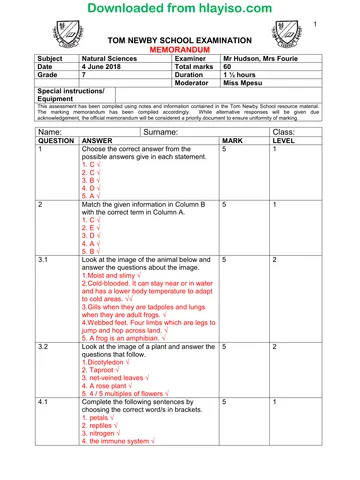
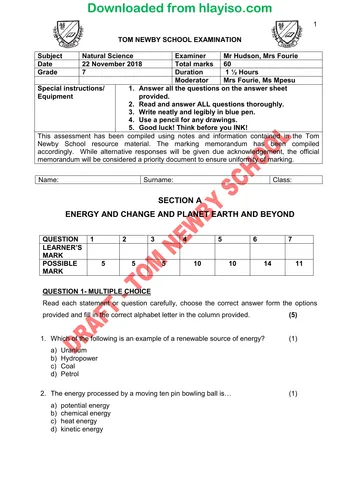
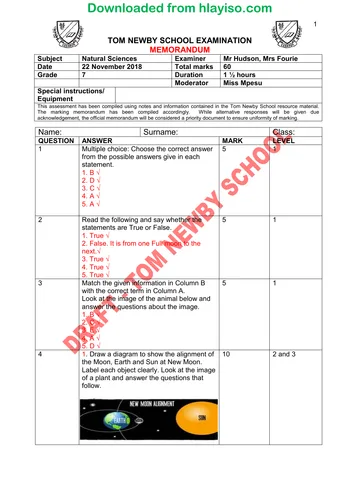
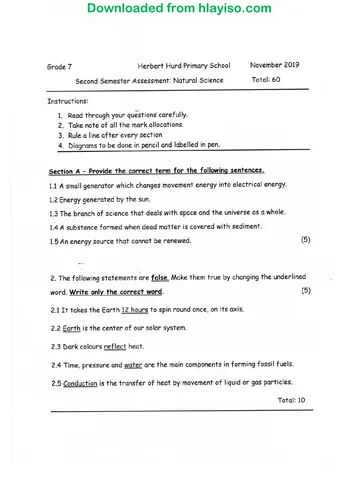
Skip to contentQuestion paper 
_hlayiso.com_--3499dce3-fa8b-451f-ae0a-592cc2b1ae6c/v1-423e0848202b038ae24e/card.webp)
_hlayiso.com_--c630c46b-d3b7-4036-a8f7-2bcf2c25d4a6/v1-8a92a1299b05b8acc15d/card.webp)
_hlayiso.com_--974a3ba1-9d87-4389-bf96-0921afae5d5e/v1-5257936134406790fe4f/card.webp)
_hlayiso.com_--34bd7e09-5642-47d7-924f-909dd536eb82/v1-d440931a75af9f6f2b17/card.webp)
View all
Grade 7 NS Exam June 2018 Mrs Fourie hlayiso.com
Natural Sciences · Grade 7 · June Exam · 2018. Question paper, 8 pages. Read online or download the PDF.
- Subject
- Natural Sciences
- Grade
- Grade 7
- Document type
- Question paper
- Year
- 2018
- Exam period
- June Exam
- Pages
- 8
- File size
- 395.7 KB
Loading document…
Loading document…
1 of 8
Document textSearch extracted text and jump to a page.
Downloaded from hlayiso.com
2
4. The stamen is the male structure of the flower. It is made up of …
a) The stigma and style
b) The receptacle and sepal
c) The ovary and the sticky stigma
d) The anther and filament
5. Crustaceans are classified to have the following body parts:
a) Four pairs of jointed legs
b) Book lungs and they produce, silk webs
c) Soft-bodied animals with a head and foot region
d) A soft exoskeleton with only an abdomen (5)
1 _______ 2 _______ 3 _______ 4 ________ 5 _______
QUESTION 2
Match the given information in Column B with the term in Column A. Write the alphabet
letter next to the given number in the space provided. (5)
COLUMN A COLUMN B
1. Gymnosperms A. Statement explaining what will happen in experiment.
2. Vertebrates B. Process of scattering seeds.
3. Variation C. Plants that produce cones.
4. Hypothesis D. Differences between living things of the same species.
5. Seed dispersal E. Animals that have a backbone.
1 _______ 2 _______ 3 _______ 4 ________ 5 _______
QUESTION 3.1
Look at the image of the animal. Answer the questions on the next page. (5)
Downloaded from hlayiso.com
3
1. What type of body covering does this animal have? (1)
__________________________________________________________________
2. Is this animal cold-blooded or warm-blooded? Why do you say so? (1)
__________________________________________________________________
__________________________________________________________________
3. What organs does this animal use for breathing ? (1)
__________________________________________________________________
4. What types and how many limbs does this animal have? (1)
_______________________________________________________________
5. What class is this animal? (1)
__________________________________________________________________
QUESTION 3.2
Take a closer look at the image of a plant. Answer the questions by filling in the missing
information or choosing the correct answer. (5)
1. What kind of plant is this?
A monocotyledon or a dicotyledon. (1)
_________________________________
2. What kind of roots does this plant have? (1)
Tap roots or Fibrous roots.
_________________________________
3. Do you think this plant has parallel leaves or net-veined leaves? (1)
________________________________________________________________
Downloaded from hlayiso.com
4
4. What is the name of this plant? (1)
________________________________________________________________
5. How many multiples of flowers will this plant have? (1)
4 / 5 multiples or 3 /6 /9 multiples.
_________________________________
QUESTION 4.1
Complete the following sentences by choosing the correct word/s in brackets. Write the
correct word/s next to the given number. (5)
1. A flower’s (petals, buds, structures) are usually brightly coloured to attract
pollinators, such as butterflies and bees. ______________________ (1)
2. Animals that are cold-blooded and also terrestrial are (mammals, fish, reptiles).
______________________ (1)
3. Plants/Plantae release a gas called (methane, carbon dioxide or nitrogen)
________________________ (1)
4. HIV or Human Immunodeficiency Virus attacks the (cells only, the immune system,
bodily fluids). ______________________ (1)
5. The seeds of gymnosperms form in (flowers, fruit, cones) of plants like cycads and
pine trees. ________________________ (1)
QUESTION 4.2
Fill in the missing words in the statements or images below. (5)
1. A female is pregnant for ______________ months. (1)
2. The process when a baby changes from immature to an adult is called the
______________. (1)
3. An unborn baby that is still developing in the uterus is called a ___________ (1)
4. Label the missing parts of the male body: (½ mark each)
Number 1: ______________
Number 2: ______________
Number 3: ______________
Number 4: ______________
Downloaded from hlayiso.com
5
SECTION B – MATTER AND MATERIALS
QUESTION 5
Identify if the following statements are TRUE or FALSE. (5)
1. Materials that are flexible can be brittle and break easily. __________
2. Metals are shiny and strong. _____________
3. The best method to separate a mixture of sugar and water is through magnetism.
_____________
4. The pH scale measures how strong an acid or a base is. ___________________
5. When we melt something it means a liquid changes into a gas. ______________
QUESTION 6
Give one word to describe the following: (5)
1. Strong _____________ will not bend, break or shatter easily.
2. A very good conductor of electricity that can be shaped into jewellery ___________.
3. Substances that taste bitter and feel soapy, are ____________.
4. Materials that cannot carry an electric current are called ___________.
5. Many fizzy cold drinks are in cans made from ___________.
QUESTION 7
Answer the following questions on mixtures/methods of physical separation:
1. List and explain two physical properties of the Colgate toothpaste seen in the image
above. (2)
__________________________________________________________________
__________________________________________________________________
2. At what temperature does water boil? (1)
__________________________________________________________________
Downloaded from hlayiso.com
6
3. What is a mixture? (1)
__________________________________________________________________
__________________________________________________________________
4. If one substance is magnetic and the other substance is not, what can be used to
separate the mixture? (2)
___________________________________________________________________
_________________________________________________________________
Look carefully at the Periodic table to answer the questions.
5. The elements in the Periodic table are arranged into three main categories, namely
metals, semi-metals and _____________ (1)
6. Look at the left side of the Periodic table. Find number 20. Give the name of the
element in number 20.___________ (1)
7. Is this element a metal/semi-metal or alkali metal? _______________ (1)
8. Give this element’s atomic number. __________ (1)
9. What is the function of this element in the human body? (1)
__________________________________________________________________
Downloaded from hlayiso.com
7
10. Give symbols / names for the following elements (2)
a) Boron = ____________ (½)
b) Iodine = ____________ (½)
c) He = _____________ (½)
d) Pb = ______________ (½)
QUESTION 8
Look at the pictures below which show us the environmental impact of mining and
pollution. Answer the questions below:
1. Air pollution is caused by... (2)
__________________________________________________________________
__________________________________________________________________
2. What do oil spills in the ocean do to sea-life? (1)
__________________________________________________________________
__________________________________________________________________
3. Give two reasons why you think plastic is harmful to our environment. (2)
__________________________________________________________________
__________________________________________________________________
Downloaded from hlayiso.com
8
__________________________________________________________________
__________________________________________________________________
4. How long does it take for bio-degradable items to break down? (1)
__________________________________________________________________
5. What is recycling? (2)
__________________________________________________________________
__________________________________________________________________
__________________________________________________________________
__________________________________________________________________
6. What can we do to help with recycling? Mention two ways. (2)
__________________________________________________________________
__________________________________________________________________
__________________________________________________________________
__________________________________________________________________
Total: 60
Recommended for this subject
Published documents with matching subject and grade metadata.
Question paper
Grade 7 NS Exam November hlayiso.com
Question paper
NW Gr. 7 (November 2021) hlayiso.com
Question paper
NW en Teg Gr 7 T4 2021 hlayiso.com
Question paper
2020 NOVEMBER EXAM PAPER GR7 NS hlayiso.com
Question paper
NW 2 Gr. 7 (Junie 2019) hlayiso.com
Question paper
gr 7 nat science June 2019 hlayiso.com
Related documents
Matched using subject, grade, language, document type and exam metadata.
Memorandum
Grade 7 NS Memorandum June 2018 hlayiso.com
Question paper
NW Gr. 7 (November 2018) hlayiso.com
Question paper
Grade 7 NS Exam November 2018 watermark hlayiso.com
Question paper
NW 1 Gr. 7 (Junie 2019) hlayiso.com
Memorandum
Grade 7 NS Memorandum November 2018 watermark hlayiso.com
Question paper
Gr7 natural Science Nov 2019 hlayiso.com
More from Grade 7 Natural Sciences
Explore more published documents in this catalogue.
_hlayiso.com_--09cd89a1-c7a6-43ea-86c4-e8cd51d3f4d6/v1-cd8e40c96bacf6c5f0d9/card.webp)