Downloaded from hlayiso.com
HOSPITALITY STUDIES GR 8 TG
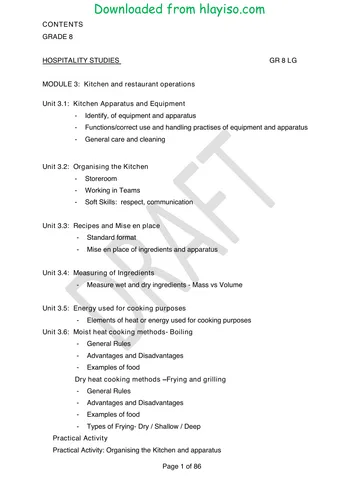
Content
MODULE 5: Food commodities
Unit 5.1: Vegetables
- Classification edible parts above ground
- Purchase
- Uses
- Garnishing: related knife skills
Unit 5.2: Eggs
- Types
- Sizes
- Uses of boiled eggs
Unit 5.3: Bread- sandwiches
- Types
- Usage
- Storage
- Sandwiches and fillings
Unit 5.4: Fruit
- Identify and classify
- How to select fruit when purchasing
- Storage of fruit
Practical lesson 1: Performance Test– Preparation of Vegetable Salad: Test Knife Skills –
Vegetables Salad
Practical lesson 3 Performance Test (Term 2): CLOSED Fashion sandwiches with egg
filling
Practical lesson 1: Performance Test: Fried Fruit Fritters
Skills Test 2: Open Fashion Sandwiches / Canapés
Page 1 of 86
Skip to contentPractical assessment task 
Grade 8 Food Commodities TG 22 NOV
Grade 8 Hospitality Studies practical assessment task, 86 pages. Read online or get the free PDF download.
Hospitality Studies · Grade 8. Practical assessment task, 86 pages. Read online or download the PDF.
- Subject
- Hospitality Studies
- Grade
- Grade 8
- Document type
- Practical assessment task
- Curriculum
- CAPS
- Pages
- 86
- File size
- 6.7 MB
Loading document…
Loading document…
1 of 86
Document textSearch extracted text and jump to a page.
Downloaded from hlayiso.com
MODULE 5: FOOD COMMODITIES
Unit 5.1: Vegetables Unit 5.2: Eggs
-classification of edible parts above the -types
ground -sizes
-purchase -uses of boiled eggs
-cleaning of vegetables
-garnishing: uses and related knife skills
ENTREPRENEURSHIP
CAREERS Self-employment – grow vegetables / sell
at local market
Vegetable Farmer
Greengrocer Making own preserves at home & sell
Botanist
Rearing chicken & eggs for sale
Home Industry
owner Home baking Business
Caterer / Chef
Artisan Bread Baker
Unit 5.3 Bread- sandwiches Unit 5.4: Fruit
-Types - Identify and classify
usage - How to select fruit when purchasing
-storage - Storage of fruit
-sandwiches & fillings
KEY CONCEPTS
edible parts boiling temperature sandwiches Halaal
garnishes commercial bread fillings allergies
knife skills classification gluten intolerance
vegans storage diabetes
SOFT SKILLS
teamwork problem-solving patience resilience stress management skills
communication multi-tasking organisational self-confidence Numeracy
creativity Cleanliness skills Attention to detail Innovation
Time Efficiency Temperature Culinary Social Skills
Management control expertise
Page 2 of 86
Downloaded from hlayiso.com
LESSON PLAN – HOSPITALITY STUDIES
GRADE 8 Planned date Date completed
TOPIC MODULE 5: FOOD COMMODITIES
Sub-topic(s) Unit 5.1: Vegetables (Week 2 Term 2)
- Classification edible parts above ground
- Purchase
- Uses
- Garnishing: related knife skills
CAPS Term 2 Week 2 (CAPS p24)
REFERENCE
DURATION 60 minutes
LESSON 1. VIDEOS FOR EXTRA RESOURCES:
RESOURCES http://youtube.com/watch?v=oRyxD_IWebQ
https://youtu.be/J4glWZ3EzIs
http://youtube.com/watch?v=K-Sk2uu_HS8
vegetable cleaning vegetables garnishes
garnishes.mp4 vegetables.mp4 2.mp4
2. Learner notes.
ACTIVITIES Activity
Comparative price and quality study use for purchasing – fresh tomato vs
economical use of overripe tomatoes (e.g., relish, jams, chutney)
PREAMBLE Discuss vegetables in respect of:
Classification – edible parts above the ground
Purchase
Cleaning of Vegetables
Garnishing: Uses/knife skills related to garnishing
EXPECTED The ability to apply basic skills to:
OUTCOMES Classify vegetables according to the edible parts above the ground.
To choosing quality products when purchasing.
Understand how to clean vegetables.
Developing safe and correct cutting techniques for garnishes.
DETERMINE What are the vegetables that you have prepared at home?
PRIOR How were the vegetables prepared?
KNOWLEDGE
Page 3 of 86
Downloaded from hlayiso.com
INTRODUCTION 1. Show learners the vegetables e.g., leave -the cabbage…
TO THE TOPIC 2. Complete the classification according to edible parts.
PRACTICAL Practical Lesson 1:
Preparation of a vegetable Salad:
WORK
• Practice different knife skills (chopped, sliced, brunoise, julienne,
wedges)
• Use cut vegetables for the salad
CONCEPTS AND TERMINOLOGY
Concept / Term Meaning in Hospitality studies context
Classification The arrangement of various elements according to their observed similarities
Garnishes Decorations used to make other dishes attractive
Ribbon strips Cutting vegetables e.g., cucumber with a vegetable peeler to make in lengthwise
direction to get thin ribbons.
Edible parts the part of the food that is usually eaten
knife skills how to hold and use a knife correctly will not only help you work more safely, but
will also enable you to work faster
LESSON Lesson Content:
PRESENTATION
Unit 6.1: Vegetables
- Classification edible parts above ground
and
- Purchase
- Cleaning of vegetables
INFORMAL
- Garnishing: uses and related knife skills
ASSESSMENT
EAC Demonstration: Visual interpretation of the washing the vegetables
INTEGRATION Practical Lesson: skills develop and recipe interpretation.
EXTENDED Entrepreneurship
OPPORTUNITIES The growing and selling of fresh vegetables to the community.
SELF-
REFLECTION
Page 4 of 86
Downloaded from hlayiso.com
MODULE 5: Food commodities
Unit 5.1: Vegetables
- Classification edible parts above ground
- Purchase
- Uses
- Garnishing: related knife skills
INTRODUCTION
Page 5 of 86
Downloaded from hlayiso.com
This unit investigates the basic commodities that learners in grade eight
must learn in order to develop the skills and knowledge for basic food
preparation. The following food commodities will be studied vegetables, eggs,
commercial bread, fruit and street vending food. These food commodities sections with
practical will enable a learner to produce a variety of garnishes to master knife skills, prepare
interesting and healthy dishes using bread and creative dishes using fruit. Learners will also be
exposed to food suitable for vegans, Halaal, allergies (gluten intolerance) and dietary concerns
(diabetic).
Source: Iowa State University Extension & Outreach
5.1.1 The classification of vegetables according to their edible parts:
Vegetables found below the ground are divided into three classes:
Roots, e.g., carrots
Bulbs, e.g., onions
Tubers, e.g., potatoes and sweet potatoes
Other: Fungi (mushrooms) s also classified as a vegetable that grows above ground. Remember
that only certain wild mushrooms are edible, and others are extremely poisonous. Never pick wild
mushrooms for consumption unless you know for certain that they are edible.
Examples of edible mushrooms
Page 6 of 86
Downloaded from hlayiso.com
5.1.2. Guidelines for purchasing vegetables:
Buy products that look fresh. Vegetables should not be wilted, bruised or damaged.
The colours of the vegetables should be bright and characteristic of the type
Be mindful not to buy overripe vegetables.
Consider buying vegetables in season.
You will pay less, and the quality will be better.
5.1.3 Uses of vegetables
Leafy vegetables such as lettuce and cabbage, outer leaves must be removed.
Green leafy vegetables are washed under cold running tap water.
A colander is used to rinse the leaves and drain in colander or salad spinner.
Use paper towel to dry the leafy vegetables.
For vegetables with a peel use a soft, clean produce brush to scrub the vegetable
under running water and dry with paper towel.
Source: www.shutterstock.com
Source: www.recipetips.com
Ideally mushrooms should be wiped with a clean damp cloth, or wash quickly
Page 7 of 86
Downloaded from hlayiso.com
In cold water and dry with paper towel because soaking too long in water causes water
absorption and mushrooms spoils quicker.
Source: betterhomesand gardens.com
The use of overripe tomatoes (non-examinable)
Overripe tomatoes are not always suitable for salads or eating raw, but they are packed with flavour,
health benefits juicy goodness. They even tend to be sweeter and juicier than its unripe counterpart.
There are endless opportunities to turn overripe tomatoes into tasty and nutritious dishes.
Source: Picture - www.vanguardngr.com
PRODUCT Tasty and ILLUSTRATION
Relish (a Tomatoes, onions, curry powder,
mustard powder, cayenne pepper,
pickle/piquant
vinegar
sauce)
Tomato sauce Tomatoes, onions, olive/sunflower
oil
Page 8 of 86
Downloaded from hlayiso.com
Chutney (a spicy Tomatoes, onions, chilli, vinegar,
sauce) brown sugar
Tomato jam Tomatoes, sugar, orange and
lemon juice
Dried tomatoes Tomatoes (seeds removed), dried
in the oven at 66° for 3-4 hours
KNIFE SKILLS
Page 9 of 86
Downloaded from hlayiso.com
5.1.4 Different vegetable cuts and garnishing: uses and related knife skills
A vegetable garnish can be used as a decoration or accompaniment to a prepared food dish.
The garnishes can be used in a variety of ways, a tray of sandwiches can be garnishes with
carrot roses or carrot star, cucumber ribbons can be used to hold vegetables on a plate.
CHOPPED
This means putting your finger and your thumb at the very back of the knife and wrapping your
fingers around the handle. It gives you a firm grip and more control when you're chopping: When
you actually start chopping, don't lay all of your fingers flat.
Page 10 of 86
Downloaded from hlayiso.com
Source: www.cnbc.com
SLICED
Slice. When you slice something, you are doing exactly as it sounds and slicing your vegetables
means to cut across the grain into thin, uniform pieces.. You are leaving them in long strips, and
some recipes will designate thin slices or wide slices. But typically, you are just cutting vertically on
the vegetables. Almost every fruit or vegetable can be sliced, as well as other ingredients like cheese
and bread.
Source: freeimageslive.co.uk & eatbydate.com
BRUNOISE (FINE DICE)
A brunoise cut, or a fine brunoise cut, is a traditional French vegetable / fruit cut that produces small,
regular cubes (1/8th inch and 1/16 inch respectively). Typically reserved for special use cases and as
an aromatic garnish, this type of cut creates exceptionally uniform pieces and provides an excellent
boost to a plate’s presentation. Foods that are commonly brunoised include turnips, onions and carrots.
Can be used in Soups and stocks, as a Garnish or to add texture in a dish
Page 11 of 86
Downloaded from hlayiso.com
Source: medium.com
CHIFFONADE (SHREDDING)
Used on leafy vegetables and herbs. Some examples include, spinach, lettuce, basil herbs
and cabbage. This is accomplished by first cutting the food into long strips, and then cross
cutting them in the preferred thickness.
Source:
www.cnbc.com
JULIENNE (MATCHSTICK CUTS)
Cut foods into long, thin matchstick like pieces. This is a cutting style used for zucchini, carrots,
celery and capsicum, but it can be used on virtually any type of vegetable.
Page 12 of 86
Downloaded from hlayiso.com
Source: www.cnbc.com
WEDGES
Wedges are irregular wedge-shaped slices of Vegetable / fruit, often large and unpeeled, that
are either baked or fried. They are sold at diners and fast-food restaurants. In Australia, potato
wedges are a common bar food, that are almost always served with sour cream and sweet chilli
sauce.
Source: Erren’s kitchen.
5.1.4 Vegetable Garnishing’s
Page 13 of 86
Downloaded from hlayiso.com
Source: pinterest.com & radacutlery.com & YouTube.com
Top 5 Vegetable Garnishes from FFJ - Most Satisfying Veggie Design Videos - YouTube
Page 14 of 86
Downloaded from hlayiso.com
The use of knife skills related to garnishing
Source: creativesafetysupply.com
Chef’s Knife: largest; serves as
an all-purpose knife for cutting
meats and for mincing, dicing
and slicing fruits & veggies; side
of blade can be used to crush
garlic cloves and ginger slices.
Utility Knife: geared toward
lighter duties such as cutting
tomatoes, carving meat or
preparing julienne slices.
Paring Knife: smaller &
shorter; used for more delicate
jobs that require close control
such as peeling fruits & veggies.
Page 15 of 86
Downloaded from hlayiso.com
INFORMAL ACTIVITY
Comparative price and quality study use for Purchasing – fresh tomato vs
economical use of overripe tomatoes (e.g., relish, jams, chutney)
VEGETABLES
Comparative price and quality study use for purchasing – fresh tomato vs
economical use of overripe tomatoes (e.g., relish, jams, chutney)
Some research was conducted at outlets located within the surrounding area where you live. A
comparative study was done on the price of tomatoes.
Study the information below and answer the questions that follow.
STORE PRICE PER PRICE PER
KILOGRAM FOR KILOGRAM FOR
FRESH HALF RIPE OVERRIPE
TOMATOES TOMATOES
Local Spaza shop in town R3.80 R1.75
Supermarket around the corner R4.20 R1.75
Hypermarket in town R5.10 R2.50
QUESTIONS:
1. Where will you buy the cheapest half-ripe tomatoes?
2. Which store would you support when buying the overripe tomatoes? Give a reason for
your answer.
3. Your friend delivers a case of overripe tomatoes at your house. Do some research and
give FOUR suitable dishes/products that you will prepare from the overripe tomatoes to
prevent that anything gets wasted.
Page 16 of 86
Downloaded from hlayiso.com
INFORMAL ACTIVITY – MARKING GUIDELINE
Comparative price and quality study use for Purchasing – fresh tomato vs
economical use of overripe tomatoes (e.g., relish, jams, chutney)
ANSWERS
1. The spaza shop sells the cheapest half-ripe tomatoes. ✓
(1)
2. The supermarket around the corner. It is the close t shop to my home. ✓
OR (2)
The spaza shop in town. I want to support a local entrepreneur/ business person
(any choice that is supplied with a good answer)
3. Tomato Jam ✓
Spaghetti sauce ✓ (2)
Page 17 of 86
Downloaded from hlayiso.com
PRACTICAL LESSON 1: PERFORMANCE TEST
Preparation of a vegetable Salad:
- Practice different knife skills (chopped, sliced, brunoise,
julienne, wedges)
- Use cut vegetables for the salad
KNIFE SKILLS AND VEGETABLE GARNISHES
Surname: _______________________ Name: ____________________ Gr.8:____
MODULE OBJECTIVES: SOFT SKILLS to
Food Commodities Learners will be able to: strengthen hard skills:
Analyse the given Analytical skills
recipe Decisiveness
Complete the mise Critical Thinking
en place form
Execute correct knife
skills
CHARACTERISTICS OF THE PRODUCT
Appearance Texture Taste
KNIFE SKILLS Crisp Distinct vegetable taste
Chopped Crunch
Sliced
Brunoise
Julienne
Wedges
Extra Options
Carrot stars
Cucumber boats,
Slice,
Discs,
Boats,
Ribbons
Squiggles
ASSESSMENT
Personal hygiene “Clean as you Prep Final product Questions TOTAL
go” shee
t
Page 18 of 86
Downloaded from hlayiso.com
5 4 5 5 5 25
Hair 2 Sink (2) Appearance 2
Nails 1 Texture 2
Station (2)
Apron 2 Taste 2
INTRODUCTION (5 minutes)
A. Perform a teacher-led demonstration on knife skills and vegetable garnishes.
The following knife skills to be demonstrated and learners to do individually
Pecan Nuts / Red Chopping
Onions
220_F_231507823_kWFY3pGUF9W1BTyYIKGLF6YahVlT5XRf.jpg (220×172) (ftcdn.net)
Source: www.cnbc.com
Cucumber / Appels Sliced
apple-453447_960_720.jpg (621×720) (pixabay.com)
Source: freeimageslive.co.uk & eatbydate.com
Cheddar Cheese Bruinoise
This Photo by Unknown Author is licensed
under CC BY-NC
Source: medium.com
Page 19 of 86
Downloaded from hlayiso.com
Spinach Chiffonade
Source: www.cnbc.com
Sweet Peppers Julienne
Source: www.cnbc.com
Avocado / Potatoes Wedges
Source: Erren’s kitchen
Study the recipe carefully and complete the mise en place form provided.
SALAD Yields: 2
PREP TIME10 mins
TOTAL TIME10 mins
SERVINGS 8
Spinach Salad Ingredients and expected Cuts
Spinach (Chiffonade cut)– fresh spinach
leaves are packed with vitamins and minerals!
The perfect base to the salad!
Apples (Sliced) – I love adding in thinly sliced
apples for sweetness and a slight crunch.
Honeycrisp are my favorite, but any variety will
work.
Avocado (Wedges)– avocado makes
everything better, including this salad!
Red onion (Chopped)– thinly sliced!
Pecans (Chopped)– you can use candied
pecans or regular pecans.
Page 20 of 86
Downloaded from hlayiso.com
Cheese (brunoise)– crumbled feta cheese or Easy Spinach Salad - Two Peas & Their Pod
goat cheese! If you need the salad to be vegan (twopeasandtheirpod.com)
or dairy-free, you can omit the cheese.
Sweet peppers (Julienne) – you can use red,
green or yellow peppers (seeds removed)
INGREDIENTS
For the salad:
250 g fresh spinach, chiffonade cut
2 large apples, cored and thinly sliced
1 large avocado, wedges
1/4 red onion, chopped
1 cup roughly chopped candied pecans or
pecans, can use walnuts or almonds
(optional)
3/4 cup crumbled cheddar cheese,
brunoise blocks
Salad Dressing
1/4 cup olive oil
2 tablespoons balsamic vinegar
1 tablespoon pure maple syrup
1 teaspoon Dijon mustard
1 clove garlic, minced
Dash of salt and ground black pepper
How to Make Spinach Salad
First, make the dressing. You can whisk all the
ingredients together in a small bowl or you can
put all the ingredients in a jar, put the lid on
tightly, and shake it up.
FYI, the dressing can be made in advance.
Keep in the refrigerator for up to one week.
Whisk or shake before using.
To assemble the salad, place the spinach,
apple slices, avocado, red onion, pecans, and
cheese in a large bowl. When ready to serve,
drizzle with dressing and toss.
Alternatively, you can plate the salads and
serve the dressing on the side.
B. Mise en place
NAME OF RECIPE:
Ingredients Quantity Mise en place - Ingredients (2)
Page 21 of 86
Downloaded from hlayiso.com
Mise en place- Apparatus (1) Cooking method
Time/Temperature
Garnish
Course
(4)
Technique: (1)
Description of Technique (2)
10÷2 = 5 (5)
C. Answer the following questions
1. Name TWO knives used in vegetable cut preparation. (2)
2. Discuss THREE points to consider on correct choices of vegetables. (3)
TOTAL: 25 MARKS
PRACTICAL LESSON 1: PERFORMANCE TEST
MARKING GUIDELINE
KNIFE SKILLS AND VEGETABLE GARNISHES
B. Mise en place
NAME OF RECIPE:
Ingredients Quantity Mise en place - Ingredients (2)
Spinach 250g Chiffonade cut
Apples 2 Sliced, cored
Avocado 1 Peeled & wedges
Red onion ¼ cup Peeled & Chopped
Pecan nuts 250 ml Chopped
Cheddar cheese ¾ cup Cubed (Brunoise)
Olive oil ¼ cup
Balsamic Vinegar 30 ml
Maple Syrup 15 ml
Dijon Mustard 5 ml
Garlic, crushed 5 ml Crushed
Salt & Pepper 0,5ml
Mise en place- Apparatus (1) Cooking method Knife skills
Washing chopping board Time/Temperature Room temperature
Garnish Flowers, dice, ribbons
Page 22 of 86
Downloaded from hlayiso.com
Course Decorating any course
(4)
Technique: , chop, chiffonade, sliced, brunoise, julienne, wedges. Extra options - dice, slice,
ribbon, boat, squiggle and disc, flower (any1) (1)
Description of Technique (2)
chop – chopping food into smaller pieces
chiffonade - cutting food into thin strips
sliced – cutting food into even slices
brunoise – cutting food into julienne strips and then into cubes equal size
julienne – cutting food into long thin strips – equal size
wedges – cutting food in equal wedges
Dice- cut into tiny cubes.
Slice cut into thin even slices.
Cutting into ribbons using a peeler.
Disc- cutting into thin round shapes.
Squiggles- producing spiral by cutting at a slant.
Cutting into flower using incisions on the vegetable. (Any1 )
1. Name TWO knives used in vegetable preparation.
Cooks knife
Paring knife
Utility knife (Any 2) (2)
2. Discuss THREE points to consider on correct choices of vegetables.
Buy products that look fresh. Vegetables should not be wilted, bruised, or damaged.
The colours of the vegetables should be bright and characteristic of the
type.
Be mindful not to buy overripe vegetables.
Consider buying vegetables in season.
You will pay less, and the quality will be better. (Any 3) (3)
TOTAL: 25 MARKS
RESOURCES
VIDEOS FOR EXTRA RESOURCES:
http://youtube.com/watch?v=oRyxD_IWebQ
https://youtu.be/J4glWZ3EzIs
http://youtube.com/watch?v=K-Sk2uu_HS8
vegetable vegetable vegetables garnishes
garnishes.mp4
Pagegarnishes.mp4
23 of 86 2.mp4
Downloaded from hlayiso.com
LESSON PLAN – HOSPITALITY STUDIES
GRADE 8 Planned date Date completed
TOPIC MODULE 5: FOOD COMMODITIES
Sub-topic(s) Unit 5.2: Eggs (Week 6 Term 2)
- Types
- Sizes
- Uses of boiled eggs
CAPS Term 2 Week 6 (CAPS p25)
REFERENCE
DURATION 60 minutes
LESSON 1. VIDEOS FOR EXTRA RESOURCES:
RESOURCES How to cook perfect eggs all the time; Ideas and recipes for using boiled eggs
Quick and Easy Egg Salad Sandwich Recipe (simplyrecipes.com)
12 Types of Eggs, Examined and Cooked | Bon Appétit - YouTube
Perfect Easy To Peel Hard Boiled Eggs - Egg Shells Practically Fall Off! - YouTube
PERFECT BOILED EGGS (EVERY TIME) | hard boiled eggs + soft boiled eggs - YouTube
2. Learner notes.
3. Pictures
ACTIVITIES Activity
Creative ways of incorporating boiled eggs in food cookery.
Cognitive level: Understanding and application
PREAMBLE Discuss vegetables in respect of:
Different types of Eggs
Page 24 of 86
Downloaded from hlayiso.com
Different sizes of eggs
Different uses in food cookery
EXPECTED The ability to apply basic skills to:
OUTCOMES Identifying different types of eggs and
Different sizes of eggs
Indicate the different uses of boiled eggs
DETERMINE -Eggs as a food commodity
PRIOR -testing knowledge on types of eggs available
KNOWLEDGE -testing knowledge on different sizes of eggs
-common uses of boiled eggs
INTRODUCTION Background to the origin of eggs and its structure.
TO THE TOPIC Purchasing of eggs
PRACTICAL Practical Lesson 3:
Fashion Sandwiches
WORK
Prepare and present fashion sandwiches with an egg filling:
Boil eggs to make filling
Prepare at least 2 different types of closed sandwiches e.g., layered,
skewered, spiral and rainbow
Include a minimum of 2 different shapes
Ribbon Sandwich recipe / Rainbow Sandwich recipe / Rainbow pinwheel / Party
recipe ideas/Kids party - YouTube
CONCEPTS AND TERMINOLOGY
Concept / Term Meaning in Hospitality studies context
Shell Seen from the outside, which is hard yet fragile.
Membrane Prevents the liquid that is inside the egg from evaporating, as well as
keep the egg protected from bacteria. The membranes are clear and soft
but have a definite egg-like shape.
Egg white If you are frying an egg, this part will be white and will surround the yellow
of the egg.
Yolk This is the yellow centre of the egg. It is circular in shape.
Chalazae The thick strands of inner thick albumen at each end of the yolk.
Size The size of an egg is dependent on the size, breed, age, and living
conditions of the hen. The size of commercial eggs includes small,
medium, large, extra-large, and jumbo.
Page 25 of 86
Downloaded from hlayiso.com
LESSON Lesson Content:
PRESENTATION
1. Testing prior knowledge on eggs
and 2. Explaining the main topic and subtopics
3. Present videos as part of the introduction to the topic
INFORMAL
ASSESSMENT 4. Defining terminology relevant to egg cookery
5. Discussion on types and sizes of eggs available in the supermarkets
6. Demonstration of various uses of boiled eggs
7. Distribute Activity and guide learners to complete.
Activity – Creative ways to incorporate boiled eggs in food cookery.
EAC Identification test: Visual interpretation of the different ways boiled eggs
INTEGRATION can be used cookery in a written response to strengthen the commodity
jargon.
Activity: Creative ways to use boiled eggs in food cookery.
EXTENDED Encouraging learners how to test the freshness of an egg.
OPPORTUNITIES
SELF-
REFLECTION
Unit 5.2: Eggs
- Types
- Sizes
- Uses of boiled eggs
FUNKY FACTS ON EGGS
5.2.1 TYPES OF EGGS
Page 26 of 86
Downloaded from hlayiso.com
Source: Unsplash & YouTube.com & safariostrich.co.za & egg-machine.com & howdypets.com
5.2.2 Sizes of Eggs
Page 27 of 86
Downloaded from hlayiso.com
[Source: www.huevosmonterde.com]
[Source: www.the englishstudent.com]
Page 28 of 86
Downloaded from hlayiso.com
5.2.3 USES OF EGGS
DID YOU KNOW?
Eggs can be served in
numerous ways
Boiled Eggs on Toast
Spring Hens
Page 29 of 86
Downloaded from hlayiso.com
Salads
Potato-Egg Salad
Page 30 of 86
Downloaded from hlayiso.com
Deviled Eggs
Pickled Eggs
Boiled egg on bread
[sourced: parentingsquad.com]
[sourced: www.vietworldkitchen.com]
Page 31 of 86
Downloaded from hlayiso.com
Garnish on Biryani
Curry dish
As a dish-Scotch Eggs
Page 32 of 86
Downloaded from hlayiso.com
INFORMAL ACTIVITY
Creative ideas with boiled eggs
Learners involved in investigating creative ideas of
incorporating boiled eggs into food preparation.
Creative ways of incorporating boiled eggs in food cookery.
Unscramble the words in the worksheet provided to discover the different ways that boiled
eggs can be included in different dishes. Finally use the correctly unscrambled letter
associated to the number sequence and complete the sentence at the end of the
worksheet
Page 33 of 86
Downloaded from hlayiso.com
INFORMAL ACTIVITY – MARKING GUIDLINE
Creative ideas with boiled eggs
ACTIVITY – Identifying uses of boiled egg in dishes
Creative ways of incorporating boiled eggs in food cookery.
NAME: _________________________________________ GRADE:___________
DATE:____________________
USES OF BOILED EGGS
4.
D S L A A S
______________________________
D E L D V I E
______________________________
1.
I C K P D E L
______________________________
2. 3.
S E G G N O O T A T S
________________________________
G N I R P S N E H
______________________________
S A L A D S
Page 34 of 86
Downloaded from hlayiso.com
D E V I L E D
P I C K L E D
E G G S O N T O A S T
S P R I N G H E N
Eggs are COOL to eat
.
PRACTICAL LESSON 3: PERFORMANCE TEST
CLOSED - Fashion Sandwiches
- Prepare and present fashion sandwiches with an egg filling:
- Boil eggs to make filling
- Prepare at least 2 different types of closed sandwiches e.g..,
layered, skewered, spiral and rainbow
- Include a minimum of 2 different shapes
Page 35 of 86
Downloaded from hlayiso.com
FASHION SANDWICHES
Surname: _______________________ Name: ____________________ Gr.8-____
MODULE OBJECTIVES: SOFT SKILLS to
Food Commodities Learners will be able to: strengthen hard skills:
Analyse the given recipe Analytical skills
Complete the mise en Decisiveness
place form Critical Thinking
CHARACTERISTICS OF THE PRODUCT
Appearance Texture Taste
Colour full Soft Savoury creamcheese
Dainty triangles Creamy filling Sweet jam and jelly
Uneven texture of layers
bread
ASSESSMENT
Personal hygiene “Clean as you Final product Questions TOTAL
Prep
go”
sheet
5 4 5 5 5 25
Hair 2 Sink (2) Appearance 2
Nails 1 Texture 2
Station (2)
Apron 2 Taste 2
INTRODUCTION (5 minutes)
A. Perform a teacher-led demonstration on preparation and serving of rainbow sandwich.
B. Study the recipe carefully and complete the mise en place form provided.
FASHION SANDWICHES Yields: 6
Ingredients
30ml cooked beetroot grated
30ml avocado with salt and pepper
30ml grated carrots with 5ml cream cheese mixed
1 egg grated with salt pepper and 15ml mayonnaise
mixed
Page 36 of 86
Downloaded from hlayiso.com
90ml Whipped cream cheese
12 slices white sandwich bread
Method
1. Lay out six slices of white sandwich bread.
2. Spread whipped cream cheese on each of the
3. slices from edge to edge.
4. Lay out the remaining six slices of bread and
spread each cooked beetroot grated, avocado
with salt and pepper, grated carrots with cream
cheese mixed and boiled egg grated with salt
pepper and mayonnaise.
5. Top each cream cheese-spread slice with a
filling.
6. Cut off the edges. Then, slice the sandwiches into
four squares each.
7. Serve laid out in rainbow or half-rainbow order.
8. Garnish with parsley.
C. Mise-en-place
NAME OF RECIPE: FASHION SANDWICHES
Ingredients Quantity Mise en place - Ingredients (2)
Mise en place- Apparatus (1) Cooking method
Time/Temperature
Garnish
Course
(4)
Technique: (1)
Description of Technique (2)
Page 37 of 86
Downloaded from hlayiso.com
10÷2 = 5 (5)
D. Answer the following questions
1. Name TWO other types of sandwiches. (2)
2. Discuss other uses of bread in food preparation. (3)
TOTAL: 25 MARKS
PRACTICAL LESSON 3: PERFORMANCE TEST MARKING
GUIDELINE
CLOSED - Fashion Sandwiches
FASHION SANDWICHES
Mise-en-place
NAME OF RECIPE: FASHION SANDWICHES
Ingredients Quantity Mise en place - Ingredients (2)
cooked beetroot grated 30ml Measuring ingredients✓
avocado with salt and 30ml Whipping cream cheese✓
pepper
grated carrots with 5ml 30ml
cream cheese mixed
egg grated with salt pepper 1
and 15ml mayonnaise
mixed
90ml Whipped cream 90
cheese
slices white sandwich bread 12
Mise en place- Apparatus (1) Cooking method Preparing sandwiches ✓
Preparing the serving tray✓ Time/Temperature Room temperature✓
Garnish Parsley ✓
Course Snack ✓
(4)
Technique: whipping ✓ (1)
Page 38 of 86
Downloaded from hlayiso.com
Description of Technique
Beating a mixture with a whisk until light and fluffy. ✓✓ (2)
10÷2 = 5
(5)
C. Answer the following questions
1. Open sandwiches✓
Closed ✓
Skewered ✓
Canapes ✓
(2)
2. Bread can be served once baked, toasted or served in a variety of interesting ways:
Bread can be dipped into liquids such as gravy, olive oil, or soup. ✓
It can be topped with various sweet and savoury spreads. ✓
Prepare sandwiches containing meats, cheeses, vegetables, and condiments.
✓
Bread is used as an ingredient in other culinary preparations, such as the use
of breadcrumbs to provide crunchy crusts or thicken sauces. ✓
Used to prepare sweet or savoury bread puddings. ✓
Serves as a binding agent in sausages and other ground meat products. ✓
(3)
TOTAL: 25 MARKS
Page 39 of 86
Downloaded from hlayiso.com
RESOURCES
Magazines and cookery books.
VIDEOS FOR EXTRA RESOURCES:
How to cook perfect eggs all the time; Ideas and recipes for using
boiled eggs
Quick and Easy Egg Salad Sandwich Recipe (simplyrecipes.com)
12 Types of Eggs, Examined and Cooked | Bon Appétit - YouTube
Perfect Easy To Peel Hard Boiled Eggs - Egg Shells Practically Fall
Off! - YouTube
PERFECT BOILED EGGS (EVERY TIME) | hard boiled eggs + soft
boiled eggs - YouTube
Page 40 of 86
Downloaded from hlayiso.com
LESSON PLAN – HOSPITALITY STUDIES
GRADE 8 Planned date Date completed
TOPIC Unit 5.3: Bread- sandwiches (Week 6 Term 2)
- Types
Sub-topic(s)
- Sandwiches and fillings
CAPS Term 2 Week 6
REFERENCE
DURATION 60 minutes
LESSON 1. Video – Tricolour Sandwich Recipes and How to make finger
RESOURCES sandwiches
Ribbon Sandwich recipe / Rainbow Sandwich recipe / Rainbow pinwheel / Party recipe
ideas/Kids party - YouTube
video on making
sandwitches.mp4
2. Pictures on types of sandwiches and the shaping of sandwiches
PREAMBLE Explain subject topic: Sandwiches
The basics required to prepare a sandwich
The type of sandwiches that learners are familiar with
The functions that sandwiches can be used at
EXPECTED The ability to apply basic skills to:
OUTCOMES Plan and prepare basic sandwiches
How to boil an egg
DETERMINE What is the understanding of a sandwich?
PRIOR Questioning the appropriate fillings that can be used in sandwiches
Different techniques that can be used to shape sandwiches
KNOWLEDGE
Know how to boil an egg and which types of eggs are edible
INTRODUCTION 1. Videos on creating rainbow sandwiches and the process of making finger
TO THE TOPIC sandwiches
2. Pictures of types and shaping of sandwiches
PRACTICAL Activity – Planning of different types of sandwiches, fillings, and shapes.
Create recycled packaging for effective delivery and optimum freshness
WORK
Practical Lesson 3: Performance Test
CLOSED - Fashion Sandwiches
- Prepare and present fashion sandwiches with an egg filling:
- Boil eggs to make filling
- Prepare at least 2 different types of closed sandwiches e.g., layered,
skewered spiral and rainbow.
- Include a minimum of 2 different shapes
CONCEPTS AND TERMINOLOGY
Page 41 of 86
Downloaded from hlayiso.com
Concept / Term Meaning in Hospitality studies context
Sandwich fillings A layer of meat, fish, cheese etc. used between the slices of bread to complete a
sandwich.
Skewered A long piece of wood or metal used for holding pieces of food, typically meat,
together during cooking.
Canapés A small piece of bread with a savoury topping.
Recycling The material can be processed and remade with commercial processes.
Packaging Materials used to wrap or protect goods.
LESSON Lesson Content:
PRESENTATION
8. Questioning prior knowledge on sandwiches
and 9. Introducing sandwiches in respect of definition/ types/ fillings and shaping
10. Present video on creating rainbow sandwiches and the process of making
finger sandwiches
11. Terminology – fillings, skewered, recycling, packaging
12. Discussion on types and ideas of appropriate fillings for sandwiches and
shapes.
13. Distribute Activity 1.1 and guide learners to complete.
INFORMAL Activity - Planning of sandwiches
ASSESSMENT
EAC Regular referral to new terminology learnt in the lesson. Question and answer
INTEGRATION opportunities for expression of thought by learners on content.
Activity: Create recycled packaging for effective delivery and optimum freshness-
creative thinking, problem solving
EXTENDED Entrepreneurship –
OPPORTUNITIES 1. Selling of different sandwiches – lunch/platters
2. Selling recycled packaging for effective delivery of sandwiches
SELF-
REFLECTION
Page 42 of 86
Downloaded from hlayiso.com
LESSON PLAN – HOSPITALITY STUDIES
GRADE 8 Planned date Date completed
TOPIC Unit 5.3: Commercial bread- sandwiches (Week 7 Term 2)
Sub-topic(s) - Usage
- Storage
CAPS Term 2 Week 7
REFERENCE
DURATION 60 minutes
LESSON 1. Video – How to store bread.
RESOURCES How to Store Bread. ✔ Tips And Nuances - Beezzly
HOW TO: Freeze & Store Bread (July 2020) - YouTube
How to Store Bread So It Stays Fresh Longer | Allrecipes
2. Pictures on storage of bread/ Steps to bread-making/ different
kinds of bread
PREAMBLE Explain subject topic: Commercial bread
- Where does bread come from – what ingredients do you think is used to prepare
a bread?
- What types of bread are you familiar with?
- What does your mother/grandmother do with old bread?
- Where is the bread stored at home? Why?
EXPECTED The ability to apply basic skills to demonstrate:
OUTCOMES Uses of commercial bread
Correct storage of commercial bread
DETERMINE - How often is a loaf of commercial bread purchased in your home?
- Describe the packaging of commercial bread
PRIOR
- How does bread become stale and ways to prevent staling
KNOWLEDGE
INTRODUCTION 1. Videos – Storage of bread
TO THE TOPIC 2. Pictures on storage of bread/ Steps to bread-making/ different kinds of bread
PRACTICAL Demonstration – Uses of commercial bread
1. Fresh – fresh sandwiches, Kota’s
WORK
2. Old –toasted sandwiches, crust for milk tart/savoury tart, breadcrumbs,
bread pudding
PAT 1.2 Skills Test 2
Prepare and present a range of different open fashion sandwiches / canapes.
Assessment of: preparation of sandwich topping / filling, knife skills (julienne, brunoise
and slices) to prepare a garnish for the sandwich, appearance of sandwich.
CONCEPTS AND TERMINOLOGY
Page 43 of 86
Downloaded from hlayiso.com
Concept / Term Meaning in Hospitality studies context
Commercial Commonly contains additives to improve flavour, texture, colour, shelf life, nutrition,
and ease of manufacturing.
Gluten Present in wheat, gluten is comprised of two proteins, glutenin and gliadin, which give
bread dough its elasticity and the baked bread chewiness.
Fermentation The leavening process in which yeast and bacteria in the dough convert carbohydrates
to carbon dioxide gas and alcohol, creating the airy texture of bread and developing
flavour in the bread.
Proof The final rise of bread dough after shaping the loaves and before baking.
Knead Refers to the process of working the dough by using the heel of your
hands.
Elasticity Refers to the ability of a dough to stretch and be moulded into shapes.
Punching down A short kneading process that deflates the dough so that it can go through
another rising cycle.
LESSON Lesson Content:
PRESENTATION
1. Tapping onto prior knowledge of bread and its related products
2. Explain the main topic and subtopics
and 3. Present videos illustrating the correct storage of commercial bread
4. Terminology discussed as related to bread
INFORMAL 5. Discussion on uses of commercial bread
ASSESSMENT
None
EAC Activity: Learners regularly asked to define bread concepts that they were introduced
INTEGRATION to during the theory taught. Strengthening vocabulary.
EXTENDED Entrepreneurship – Selling of different sandwiches e.g., as lunch, platters.
OPPORTUNITIES
SELF-
REFLECTION
Page 44 of 86
Downloaded from hlayiso.com
Unit 5.3: Commercial bread- sandwiches
- Types
- Sandwiches and fillings
- Usage
- Storage
[sourced: clipart-library.com]
5.3.1 Types of bread
Various types of bread are used to prepare sandwich.
White bread
Page 45 of 86
Downloaded from hlayiso.com
Brown bread
French loaf / Baguette
Pitta bread
Page 46 of 86
Downloaded from hlayiso.com
Seeded bread
Buns and rolls
Whole wheat bread
5.3.2 Uses of bread
A sandwich is a dish consisting of two or more slices of
bread with one or more fillings between them, or one
slice in the case of an open sandwich. Sandwiches are a
common type of lunch food often eaten as part of a
packed lunch. There are many types of sandwiches,
made from a diverse variety of ingredients.
Page 47 of 86
Downloaded from hlayiso.com
[source: clipart-library.com]
Bread can be served once baked, toasted or served in a variety of interesting ways:
Bread can be dipped into liquids such as gravy, olive oil, or soup.
It can be topped with various sweet and savoury spreads.
Prepare sandwiches containing meats, cheeses, vegetables, and condiments.
Bread is used as an ingredient in other culinary preparations, such as the use of
breadcrumbs to provide crunchy crusts or thicken sauces.
Used to prepare sweet or savoury bread puddings.
Serves as a binding agent in sausages and other ground meat products.
5.3.3 Storage of bread
Source:www.thespruceeats.com
5.3.4 Sandwich fillings
EXAMPLES OF SHAPES OF SANDWICHES
Page 48 of 86
Downloaded from hlayiso.com
[source: https://unsplash.com/s/photos/sandwich]
TYPES OF SANDWICHES
Page 49 of 86
Downloaded from hlayiso.com
Pocket Sandwich e.g., Pita
Made using a single piece of folded or
hollowed bread, such as a pita, tortilla
which is made from dough cooked with
fillings inside
Dagwood Skewered Sandwich
A thick sandwich with a variety of different
fillings
Page 50 of 86
Downloaded from hlayiso.com
Open Sandwich
A single piece of bread with a savoury
topping
Closed Sandwiches
The filling is between two slices of bread.
Bread Canape Sandwiches
An hors d'oeuvre, a bite-sized open-faced
sandwich made of thin bread or toast
topped with savoury garnish.
Page 51 of 86
Downloaded from hlayiso.com
Fashion Sandwiches
The filling, commonly consisting of
avocado and salmon or prawn/ crab, is
contained on either side, which is then
covered by a layer of rice, usually coated
in sesame seeds.
Skewered Sandwiches
A thin metal or wood stick used to hold
the sandwich together.
Rainbow Sandwiches
A variety of colourful fillings used in
between the bread to indicate the colours
of the rainbow.
Pinwheels
Crusts are removed and the filling is
smeared onto the bread are cut into thin
strips and then rolled.
[source: https://unsplash.com/s/photos/sandwich]
Page 52 of 86
Downloaded from hlayiso.com
INFORMAL ACTIVITY
Learners make a collage of bread and sandwich pictures.
Design a suitable packaging for a sandwich.
1. Design a collage of different bread fashion sandwiches. Label each picture to indicate the type of
bread used.
Page 53 of 86
Downloaded from hlayiso.com
2. Identify (through pictures) different suitable recyclable packaging for fashion sandwiches that will
keep the bread fresh.
Label each picture to indicate type of material used.
Page 54 of 86
Downloaded from hlayiso.com
INFORMAL ACTIVITY – MARKING GUIDELINE
Learners make a collage of bread and sandwich pictures.
Design a suitable packaging for a sandwich.
1. 1. Design a collage of different bread fashion sandwiches. Label each picture to indicate the type of
bread used.
.
E.g., white bread, brown bread, wholewheat bread, rye bread
Page 55 of 86
Downloaded from hlayiso.com
2. Identify (through pictures) different suitable recyclable packaging for fashion sandwiches that will
keep the bread fresh.
Label each picture to indicate type of material used and what type of bread was used for the making
of the sandwich.
PLASTIC POLYSTYRENE
CARDBOARD
PAPER WRAPPING
Page 56 of 86
Downloaded from hlayiso.com
SKILLS TEST 2
Prepare and present a range of Fashion Sandwiches, incl. OPEN
sandwiches / canapés.
Assessment of preparation of sandwich topping / filling, knife skills (julienne,
brunoise and slices) to prepare a garnish for the sandwich, appearance of
sandwich.
Measuring of ingredients
Surname, Name: GR 8:
OPEN SANDWICHES / CANAPES OBJECTIVES: SOFT SKILLS to strengthen
Learners will be able to: hard skills:
Prepare and present a range of Classification
open sandwiches. Application
Identify and name knife skills Critical Thinking
Garnish sandwiches Creativity
observation
CHARACTERISTICS OF THE PRODUCT
Appearance Texture Taste
Variety of colours Different textures Fish
Small individual Vegetables
portions Salty
Spicy
ASSESSMENT
Personal hygiene “Clean as you Final product Questions TOTAL
Prep sheet
go”
5 4 5 5 5 25
Hair 2 Sink (2) Appearance 2
Nails 1 Texture 2
Station (2)
Apron 2 Taste 2
Page 57 of 86
Downloaded from hlayiso.com
A. INTRODUCTION (5 minutes)
B. Study the recipe carefully and complete the mise en place form provided.
CANAPES 1
Portion size 4
Mussels and cucumber
INGREDIENTS:
4 2cm thick Cucumber
slices
250 ml Chives cream
cheese
8 tinned Mussels drained
1 Fresh Chive Julienned
4 Fresh Edible flower
Method:
Slice Cucumber in 2 cm thick slices.
Remove the middle with an apple corer
Pipe cream cheese into the centre.
Place 2 mussels onto.
Garnish with chives and edible flower.
CANAPES 2
Egg Mayonnaise
Portion size 4
INGREDIENTS:
2 Slices White bread 4 rounds cut out
of them
40 ml Olive oil
4 each Eggs Boiled
40 ml Mayonnaise
3 ml Salt and
pepper
3 ml Aromat
2 sprigs Parsley Finely chopped
Paprika To sprinkle over
METHOD:
1. Boil eggs, when cooked shell them and
press them fine with a fork.
2. Drizzle olive oil over cut out pieces of
bread, toast in griddle pan till lightly toasted.
3. Add salt, pepper and aromat to eggs, add
mayonnaise and mix through properly.
Page 58 of 86
Downloaded from hlayiso.com
4. Place filling on top of toasted bread pieces,
sprinkle paprika over and garnish with
parsley.
C. Mise en place
NAME OF RECIPE: OPEN Canapes
Ingredients Recipe Mise en place of ingredients [2]
Amount
Mise en place-apparatus [2] Mise en place of additional equipment not
found at your workstation [1]
Number of portions: [1]
Technique Applied: [1]
Description of dish: [1]
Oven/temperature control on stove: [1]
Cooking Method: [1]
TOTAL = 20 MARKS
D. ANSWER THE FOLLOWING QUESTIONS
1. Explain the term canapé and give an example of a topping that is not in your recipes. [3]
2. Discuss the following cooking methods:
2.1 Boiling [1]
2.2 Steaming [1]
TOTAL: 25 MARKS
Page 59 of 86
Downloaded from hlayiso.com
SKILLS TEST 2 – MARKING GUIDELINE
Prepare and present a range of Fashion Sandwiches, incl. OPEN
sandwiches / canapés.
C. Mise en place
NAME OF RECIPE: OPEN Canapes
Ingredients Recipe Amount Mise en place of ingredients [2]
White bread 22 Cut into 4 even size circles ✓
Olive oil 40 ml
Eggs 4
Boiled and shelled ✓
Mayonnaise 40 ml
Salt and 3 ml
pepper 3 ml
Aromat 2 ml
Parsley
Paprika Finely chopped ✓
4 slices
Cucumber
250 ml 2 cm thick slices, cored ✓
Chives cream cheese
8
Mussels
1 Strained ✓
Chive
4 Julienned ✓
Edible flower
Mise en place-apparatus [2] Mise en place of additional equipment
not found at your work station [1]
Cutting boards ✓ Serving platter ✓
Knives ✓
Corer ✓
Pot ✓
Piping bag ✓ Number of portions: 4 ✓ [1]
Technique Applied: Moist heat cooking methods, open sandwich fillings, knife skills ✓ [1]
Description of dish: Visual appealing open sandwiches with garnish ✓ [1]
Page 60 of 86
Downloaded from hlayiso.com
Oven/temperature control on stove: medium heat for toasting bread, high control on stove plate
for boiling. ✓ [1]
Cooking Method: Boiling and dry heat (toasting) ✓ [1]
TOTAL = 20
D. ANSWER THE FOLLOWING QUESTIONS
1. Explain the term canapé and give an example of a topping that is not in your recipes.
A canapé is a finger food✓ with a visually appealing topping on a basis
served with a garnish. ✓
Examples: Fish, seafood, vegetarian, fruits, white meat, red meat ✓
(Any appropriate example) [3]
2. Discuss the following cooking methods:
2.1 Boiling [1]
Cooking foods in a liquid, the liquid must be 100˚C and it must cover the food ✓
2.2 Steaming [1]
Cooking food over a boiling water, without the food being in direct contact with the
boiling liquid. ✓
TOTAL: 25 MARKS
RESOURCES
Recipe books and magazines
Video – Tricolour Sandwich Recipes and How to make finger sandwiches
Ribbon Sandwich recipe / Rainbow Sandwich recipe / Rainbow pinwheel / Party recipe
ideas/Kids party - YouTube
https://en.wikipedia.org/wiki/List_of_breads
Video – How to store bread.
How to Store Bread. ✔ Tips And Nuances - Beezzly
video on making
HOW TO: Freeze & Store Bread (July 2020) - YouTube sandwitches.mp4
How to Store Bread So It Stays Fresh Longer | Allrecipes
Page 61 of 86
Downloaded from hlayiso.com
LESSON PLAN – HOSPITALITY STUDIES
GRADE 8 Planned date Date completed
TOPIC Unit 5.4: Fruit (Week 1-2 Term 3)
Sub-topic(s)
- Identify and classify
- Purchase
- Storage
CAPS Term 3 Week 1
REFERENCE
DURATION 60 minutes
LESSON 1. Video – Fruit/ How to choose best fruit and veggies at the grocery store/ Fruit
RESOURCES & Vegetable Storage Ideas
2. Pictures –Classification
3. Learner notes
ACTIVITIES Identifying and classifying fruits
PREAMBLE Explain subject topic: Food Commodities-Fruit
- What do you consider important when buying fruit from a food stall
- How often do you purchase fruit?
- Where do you purchase your fruit from?
- Do you include fruit in your daily diet?
EXPECTED The ability to:
OUTCOMES Identify and classify fruit
Purchase fruit correctly
Store fruit correctly
DETERMINE - The value of fruit in the diet
PRIOR - Names of commonly known fruit by the learners
- The affordability of fruit
KNOWLEDGE
INTRODUCTION Video on Fruit and how to choose best fruit at the grocery store.
TO THE TOPIC Accompanying notes to support expected outcomes
Page 62 of 86
Downloaded from hlayiso.com
PRACTICAL Demonstration: Dry, shallow, and deep frying
WORK
Practical Lesson 1:
Prepare and present deep fried fruit fritters e.g., banana / apple / pineapple
CONCEPTS AND TERMINOLOGY
Concept / Term Meaning in Hospitality studies context
Fruit The fleshy seed-associated structures of a plant that are sweet or sour, and
edible in the raw state, such as apples, bananas, grapes, lemons, oranges, and
strawberries.
Ripening A process in fruits that causes them to become more palatable. In general, fruit
becomes sweeter, less green (typically "redder"), and softer as it ripens.
Fresh Recently obtained, in a good condition.
Bruises Flesh of the fruit is injured without breaking the skin.
Plump Well filled out or rounded in form.
In-season Seasonal fruit is that at that time of the year it is at its peak in terms of flavour.
Room A comfortable ambient temperature, generally taken as about 20°C.
temperature
Ventilation The provision of fresh air to a room or a space.
LESSON Lesson Content:
PRESENTATION
1. Testing prior knowledge on fruit
and 2. Explaining the main topic and subtopics
3. Present videos as part of the introduction to the topic
4. Defining terminology relevant to fruit as a commodity
5. Discussion on types of fruit available in the supermarkets
6. Discussion on correct purchasing/ storage techniques of fruit
INFORMAL
ASSESSMENT Practical Activity
Identify a variety of fruit
EAC Identification test: Visual presentation of the different types of fruit in a written
INTEGRATION response to strengthen the commodity jargon.
EXTENDED Visiting supermarkets and assessing the quality of fruit in stock by utilising the
OPPORTUNITIES factors to consider when purchasing fruit.
SELF-
REFLECTION
Page 63 of 86
Downloaded from hlayiso.com
Unit 5.4: Fruit
- Identify and classify
- Purchase
- Storage
INTRODUCTION
Fruits are the sweet and fleshy produce of a tree or other plant that contains seed
and can be eaten as food.
Page 64 of 86
Downloaded from hlayiso.com
[Source: www. www.slideshare.net]
Page 65 of 86
Downloaded from hlayiso.com
Basic Vocabulary
Parts of Fruit
Seed – part new fruit grows from. Some are okay to eat, some are not.
Flesh – soft part of fruit that is eaten. Usually, sweet.
FLESH
Rind – hard outside of fruit, usually don’t eat.
Skin – soft or hard outside of fruit often eaten.
Core – middle part of fruit, usually not eaten, sometimes
has seeds.
SKIN
RIND
SEEDS
CORE
Source: Alamay & The Gardener & The slide player
5.4.1 Classification of fruit
Pomes- smooth skin and an enlarged fleshy area that surrounds the core.
Page 66 of 86
Downloaded from hlayiso.com
Drupes- contain a single seed, or pit, surrounded by juicy flesh.
Berries- fragile cell structure; pulpy and juicy; tiny seeds embedded in flesh.
Melons- hard outer surface that is smooth or netted; juicy flesh.
Citrus- grow in warm regions, firm rind and pulpy flesh.
Page 67 of 86
Downloaded from hlayiso.com
Tropical- grow in very warm climates; differ in skin composition and seed.
source:www.slideshare.net
INFORMAL ACTIVITY
Identify the following types of fruit and classify them
Picture Classify Identify fruit
This Photo by
Unknown Author is
Page 68 of 86
Downloaded from hlayiso.com
This Photo by Unknown
Author is licensed under CC
BY-SA
This Photo by Unknown Author is
licensed under CC BY-NC
INFORMAL ACTIVITY
Identify the following types of fruit and classify them
Picture Classify Identify fruit
Berries √ Strawberry √
This Photo by
Unknown Author is
Citrus √ Lemon √
This Photo by Unknown
Author is licensed under CC
BY-SA
Page 69 of 86
Downloaded from hlayiso.com
Tropical √ Papaya √
This Photo by Unknown Author is
licensed under CC BY-NC
5.4.2 Top tips for purchasing fruit
Buy fruits that are: Avoid Fruits that are:
Firm to the touch Too Soft
Before selecting, give Too hard
produce a light squeeze
If it is ripe, it should give a bit under
pressure.
The right colour Green or under-ripe
Well-Shaped Damaged or bruised. It’s a great
place for bacteria to hide and
spread rapidly to the rest of the
fruit or vegetable. Damaged
produce is less nutritious and less
tasty.
Heavy for the size. Choose smaller Rotten or Mouldy
pieces of fruit. Smaller fruit is
typically, sweeter
Smell good. A sweeter fragrance Discoloured
indicates ripeness in your fruit.
In good condition
Choose vibrant, colourful produce.
Different coloured fruits have varying
Page 70 of 86
Downloaded from hlayiso.com
nutritional benefits.
Buy produce seasonally
Not all fresh produce grows year-
round. Fruits and vegetables that
are in season are both better quality
and less expensive.
Compare the price. Check the
difference in price between loose
produce and pre-packaged produce.
source:www.wikihow.com
5.4.3 Storage of fruit
Storing fruit is quick and easy! You can either freeze,
refrigerate, or even keep them on the countertop
depending on the fruit.
[Source: www. www.goodshomedesign.com]
1. IN A COOL, DRY PLACE
Keep bananas, tomatoes, lemons, and limes in a cool, dry area, not in the fridge.
2. IN THE FRIDGE
Store your apples in the fridge. They soften ten times faster at room temperature.
Most fruits and can be stored in the refrigerator.
A crisper drawer will help protect your produce and keep the moisture in to
maintain freshness for longer.
Page 71 of 86
Downloaded from hlayiso.com
Plastic bags with tiny vents help keep produce fresh longer by releasing moisture.
They are great for grapes, blueberries, cherries or strawberries.
Store berries in the fridge and wash gently before eating or using.
3. IN THE FREEZER
Freezing fruits at home is a fast and
convenient way to preserve produce at
their peak maturity and nutritional quality.
[Source: www. www.fruitsinfo.com]
4. AT ROOM TEMPERATURE
Mangoes, plums, peaches, and pears can be ripened at room temperature in a
brown paper bag and should then be refrigerated for longer storage.
Store pineapple upside down for a day or two at room temperature or in the fridge
to allow the sweetness to spread throughout the fruit.
Keep whole melons at room temperature.
General rules for preparation and cooking fruits
Remember to prepare fruits just before cooking.
Avoid discolouration cause by enzymatic browning.
Use lemon juice on fruit to prevent browning
Keep fruit pieces uniform in size for even cooking.
Page 72 of 86
Downloaded from hlayiso.com
Do not to overcook fruit.
1. Moist-heat methods: poaching
Pears, apples, peaches, nectarines, plums and apricots are commonly poached fruits.
Figs, grapes, quince and bananas will also poach nicely. Use just enough liquid to cover the fruit. Let
fruit rest in poaching liquid for 20 minutes after cooking to allow the flavour to be absorbed.
2. Dry-heat methods: Frying, grilling or broiling, roasting or baking, and sautéing.
The less time fruit is exposed to heat, the better it retains its shape. Suitable fruits include
apples, apricots, bananas, pineapples, peaches, plums, pears, cherries and figs are excellent
fruits for dry cooking.
Frying requires fruit to be covered in a protective coating from being overcooked e.g. Batter
before frying.
FRYING
GRILLING
Page 73 of 86
Downloaded from hlayiso.com
ROASTING
BROILING
BAKING SAUTÉING
[Source: driscoli’s & The spice house & Simply Recipes & Teaspoon of spice & Foodal & Life is Fare]
Some words to remember
Fruit The fleshy seed-associated structures of a plant that are sweet or
sour, and edible in the raw state, such as apples, bananas, grapes,
lemons, oranges, and strawberries.
Ripening A process in fruits that causes them to become more palatable. In
general, fruit becomes sweeter, less green (typically "redder"), and
softer as it ripens.
Fresh Recently obtained, in a good condition.
Bruises Flesh of the fruit is injured without breaking the skin.
Plump Well filled out or rounded in form.
In-season Seasonal fruit is that at that time of the year it is at its peak in terms
of flavour.
Page 74 of 86
Downloaded from hlayiso.com
RESOURCES
Recipe books and magazines
VIDEOS:
1. https://www.youtube.com/watch?v=SkapOA_AN98
2. https://www.youtube.com/watch?v=efB_OvOCISM
3. https://www.youtube.com/watch?v=5WY4kWyVS2U
4. https://www.youtube.com/watch?v=-nTVFXCnoSk
BIBLIOGRAPHY
1. https://www.foodsafetyfirst.com.au/2016/08/tips-buying-fruit-vegetables/
2. https://www.grocerycouponguide.com/guide-to-buying-fresh-fruits/
3. https://www.foodsafetyfirst.com.au/2016/08/tips-buying-fruit-vegetables/
PRACTICAL LESSON 1: PERFORMANCE TEST
Prepare and present fruit fritters e.g., banana / apple / pineapple.
Practical Demonstration: Dry; Shallow; Deep frying and Grilling
Prepare and present fruit fritters:
• Apply the rules for frying as a cooking method, keeping safety
aspects in mind
• Include a variety of fruit for the fritters e.g., banana, apple,
pineapple, berries.
• Apply correct preparation procedures for the fruit e.g., washing,
removing stalks, or peeling of fruit.
FRIED FRUIT FRITTERS
Page 75 of 86
Downloaded from hlayiso.com
Surname: _______________________ Name: ____________________ Gr.8:____
MODULE OBJECTIVES: SOFT SKILLS to strengthen
Food Commodities Learners will be able to: hard skills:
Analyse the given recipe Analytical skills
Complete the mise en Decisiveness
place form Critical Thinking
CHARACTERISTICS OF THE PRODUCT
Appearance Texture Taste
light golden Crisp batter Sweet taste.
brown Soft apple inside
crisp light
surface
ASSESSMENT
Personal hygiene “Clean as you Final product Questions TOTAL
Prep
go”
sheet
5 4 5 5 5 25
Hair 2 Sink (2) Appearance 2
Nails 1 Texture 2
Station (2)
Apron 2 Taste 2
INTRODUCTION (5 minutes)
Page 76 of 86
Downloaded from hlayiso.com
A. Perform a teacher-led demonstration on preparation of apple fritters
Study the recipe carefully and complete the mise en place form provided.
Apple Fritters Yields: 4
Ingredients
400g cooking apples
12ml apricot sauce
50ml flour for sprinkling
Batter
100g flour
1 egg
125 ml flour
12,5ml oil
Method
1. Measure out the ingredients required.
2. Sift the flour into a bowl.
3. Make a well in the centre, add the egg and milk.
4. Gradually incorporate into the flour and beat until
smooth.
5. Mix in oil and allow to rest.
6. Peel and core the apples.
7. Cut the apples into ½ cm rings.
8. Pass through flour and shake off surplus four.
9. Dip apples into the frying batter.
10. Lift with fingers and lower in hot oil.
11. Cook for 5 minutes each side.
12. Drain well, dust with sugar and glaze under the
salamander.
13. Serve with apricot sauce.
B. Mise en place
NAME OF RECIPE:
Ingredients Quantity Mise en place - Ingredients (2)
Page 77 of 86
Downloaded from hlayiso.com
Mise en place- Apparatus (1) Cooking method
Time/Temperature
Garnish
Course
(4)
Technique: (1)
Description of Technique (2)
10÷2 = 5 (5)
C. Answer the following questions
1.Identify the fruit used in the recipe according to the classification. (1)
2.Name THREE guidelines to consider when buying apples. (3)
3. Name another fruit suitable to be battered and fried (1)
TOTAL 25 MARKS
PRACTICAL LESSON 1: PERFORMANCE TEST - MARKING GUIDELINE
FRIED FRUIT FRITTERS
B. Mise en place
Page 78 of 86
Downloaded from hlayiso.com
NAME OF RECIPE:
Ingredients Quantity Mise en place – Ingredients (2)
cooking apples 400g Peel apples ✓✓
apricot sauce 12ml Core apples
flour for sprinkling 50ml Measure ingredients
Batter
flour 100g
egg 1
flour 125ml
oil 12,5ml
Mise en place- Apparatus (1) Cooking method Deep fat frying✓
Prepare deep fat fryer or frying pan Time/Temperature Hot oil✓
with oil. ✓ Garnish Apricot sauce✓
Line baking tray with absorbent paper Course dessert✓
(4)
Technique: core ✓ (1)
Description of Technique (2)
To remove the seeds and stem of the apple using an apple corer. ✓✓
10÷2 = 5 (5)
C. Answer the following questions
1 Identify the fruit classification for apples
Pomes✓ (1)
2 Name THREE guidelines to consider when buying apples.
Don’t buy produce that is bruised or damaged it’s a great place for
bacteria to hide and spread rapidly to the rest of the fruit or vegetable.
Damaged produce is less nutritious and less tasty. ✓
Before selecting, give produce a light squeeze if it is ripe, it should give
a bit under pressure. ✓
Smell your fruit sweeter fragrance indicates ripeness in your fruit. ✓
Choose smaller pieces of fruit smaller fruit is typically sweeter. ✓
Choose vibrant, colourful produce select a diverse range of colourful
produce. Different coloured fruits have varying nutritional benefits. ✓
Buy produce seasonally not all fresh produce grows year-round. Fruits
and vegetables that are in season are both better quality and less
expensive. ✓
Compare the price check the difference in price between loose produce
and pre-packaged produce. ✓ (3)
3 Name ONE other fruit that can be battered and fried.
Bananas ✓
Pineapple✓
Page 79 of 86
Downloaded from hlayiso.com
Pear✓ (1)
[5]
RESOURCES
Recipe books and magazines
VIDEOS:
5. https://www.youtube.com/watch?v=SkapOA_AN98
6. https://www.youtube.com/watch?v=efB_OvOCISM
7. https://www.youtube.com/watch?v=5WY4kWyVS2U
8. https://www.youtube.com/watch?v=-nTVFXCnoSk
BIBLIOGRAPHY
1. https://www.foodsafetyfirst.com.au/2016/08/tips-buying-fruit-
vegetables/
2. https://www.grocerycouponguide.com/guide-to-buying-fresh-fruits/
3. https://www.foodsafetyfirst.com.au/2016/08/tips-buying-fruit-
vegetables/
SUMMARIES
Content summary: The Hospitality Industry
Page 80 of 86
Downloaded from hlayiso.com
Module 5: Food Commodities
Key concepts
Unit 5.1 Vegetables
This unit investigates the classification of edible parts.
Explores the guidelines that one must follow when purchasing vegetables.
Correct procedures that need to be followed when cleaning vegetables
Basic garnishing techniques and the use of garnishes in food preparation. This is also
related to knife skills.
Unit 5.2 Eggs
The different types of eggs used in food preparation.
Eggs are graded according to the size. Most recipes use large chicken eggs.
Boiled eggs are very versatile. Boiled eggs are popular as a light snack e.g. boiled and
mayonnaise sandwich or can also be converted into a dish e.g. omelettes.
Unit 5.3 Bread- sandwiches
Bread in South Africa is our second most important staple foodstuff after maize meal
used apart from sandwiches as an ingredient in other food preparations such as binding
agents in sausage, bread puddings and thicken sauces
Bread storage correctly can extend the shelf life.
Interesting sandwiches can be prepared with a variety of fillings.
Unit 5.4 Fruits
There are different types of fruits, and they are identified and classified according to
the characteristics of the fruit.
Fruits can be an expensive commodity and one must follow correct purchasing
guidelines when buying fruits.
Buying fruit in bulk is generally cheaper and therefore correct storage practices
Must be followed to extend the shelf life.
EXAM PRACTICE QUESTIONS
EXAM PRACTICE: THE HOSPITALITY INDUSTRY
Page 81 of 86
Downloaded from hlayiso.com
MODULE 4: FOOD COMMODITIES
SECTION A: SHORT QUESTIONS
1.1 Various options are provided as possible answers to the following
questions. Choose the correct answer and write the symbol (A - D) next to
the question number (1.1.1 - 1.1.3) on the ANSWER BOOK.
1.1.1 An example of a tropical fruit is…
A strawberry
B peach
C banana
D orange (1)
1.1.2 The cabbage is classified as a ….
A stem
B leaves
C flower
D seeds (1)
1.1.3 This is a dish prepared from boiled eggs.
A Scotch eggs
B Omelette
C Souffle
D Quiche (1)
(3)
1.2 MATCH ITEMS
Choose the description of fruit in COLUMN B to match the term in COLUMN
A. Write only the symbol (A - E) next to the question number (1.2.1.1 - 1.2.1.3)
on the ANSWER BOOK.
1.2.1 COLUMN A COLUMN B
TERM DESCRIPTION
Page 82 of 86
Downloaded from hlayiso.com
1.2.1.1 Pomes A Fragile cell structure; pulpy and
juicy; tiny seeds embedded in
1.2.1.2 Citrus flesh.
B Hard outer surface that is
1.2.1.3 Berries smooth,
C netted with a juicy flesh.
Grow in a warm region, firm rind,
and pulpy flesh.
D Contains a single seed, or pit
with a smooth flesh. (3)
E Smooth skin and an enlarged
area that surrounds the core.
1.3.1 Identify knife safety procedures when cutting vegetables from the list below.
Write only the symbol
(A - F) next to the question number (1.3.1) on the ANSWER BOOK
A Never catch a falling knife.
B Use any knife for cutting.
C Store knives safely in a block or rack.
D Chopping boards are not needed when using knives.
E Hand knives over holding the handle.
F Keep knife blades sharpened. (3)
1.4 Give ONE word/term for each of the following descriptions. Write only the
word/term next to the question number (1.4.1 – 1.4.3) on the ANSWER
BOOK.
1.4.1 Eggs that are 53-63g
1.4.2 Eggs that are 63-73g
1.4.3 Eggs that are 53g (3)
Section B: Long questions
2.1 List THREE guidelines to follow when choosing vegetables to purchase. LO
(3)
2.2 Design creative ways of serving fruits at a vending stall. HO
(2)
2.3 Study the statement below and answer the questions that follow: HO
“Bread can be served in a variety of interesting ways” (3)
Motivate the above statement.
TOTAL: 20 MARKS
Page 83 of 86
Downloaded from hlayiso.com
EXAM PRACTICE QUESTIONS – MARKING GUIDELINE
EXAM PRACTICE: THE HOSPITALITY INDUSTRY
MODULE 4: FOOD COMMODITIES
SECTION A: SHORT QUESTIONS
1.1 Various options are provided as possible answers to the following
questions. Choose the correct answer and write the symbol (A - D) next to
the question number (1.1.1 - 1.1.3) on the ANSWER BOOK.
1.1.1 An example of a tropical fruit is…
C banana (1)
1.1.2 The cabbage is classified as a ….
B leaves (1)
1.1.3 This is a dish prepared from boiled eggs.
A Scotch eggs (1)
(3)
1.2 MATCH ITEMS
Choose the description of fruit in COLUMN B to match the term in COLUMN
A. Write only the symbol (A - E) next to the question number (1.2.1.1 - 1.2.1.3)
on the ANSWER BOOK.
1.2.1 COLUMN A
TERM
1.2.1.1 E
1.2.1.2 C
1.2.1.3 A (3)
Page 84 of 86
Downloaded from hlayiso.com
1.3.1 Identify knife safety procedures when cutting vegetables from the list below.
Write only the symbol
(A - F) next to the question number (1.3.1) on the ANSWER BOOK
A Never catch a falling knife.
E Hand knives over holding the handle. (3)
F Keep knife blades sharpened.
1.4 Give ONE word/term for each of the following descriptions. Write only the
word/term next to the question number (1.4.1 – 1.4.3) on the ANSWER
BOOK.
1.4.1 Medium
1.4.2 Large
1.4.3 Small (3)
SECTION B: LONG QUESTIONS
2.1 LO
Buy products that look fresh. Vegetables should not be wilted, bruised, (3)
or damaged.
The colours of the vegetables should be bright and characteristic of the
type
Be mindful not to buy overripe vegetables.
Consider buying vegetables in season.
You will pay less, and the quality will be better.
2.2 Design creative ways of serving fruits at a vending stall. HO
(2)
• Learners’ own choice of design
2.3 • Pocket sandwiches HO
• Dagwood skewered sandwiches
• Open and closed sandwiches
• Bread Canape sandwiches
• Fashion Sandwiches
• Skewered sandwiches
• Rainbow sandwiches
• Pinwheels (Any 3) (3)
TOTAL: 20 MARKS
Page 85 of 86
Downloaded from hlayiso.com
Page 86 of 86
Study this subject
Notes, quizzes and topic questions for Grade 8 Hospitality Studies.
Recommended for this subject
More papers and memos for this grade and subject.
Practical assessment task
GR 8 Kitchen and restaurant operations TG FINAL 21 NOV
Practical assessment task
Grade 8 NUTRITION MENU PLANNING TG FINAL 22 NOV
Practical assessment task
HOSPITALITY GR 8 SECTORS AND CAREERS LEARNER GUIDE
Practical assessment task
HOSPITALITY GR 8 SECTORS AND CAREERS TEATCHER GUIDE
Practical assessment task
GR 8 Kitchen and restaurant operations LG FINAL 22 NOV 2022
Practical assessment task