
Downloaded from hlayiso.com
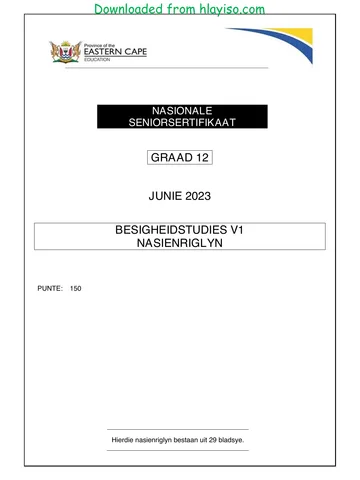
NATIONAL
SENIOR CERTIFICATE
GRADE 12
JUNE 2023
BUSINESS STUDIES P2
MARKING GUIDELINE
MARKS: 150
This marking guideline consists of 37 pages.
Skip to contentMemorandum 







View all


Business Studies Grade 12 Paper 2 Eastern Cape June 2023 Memo
Grade 12 Business Studies Paper 2 memorandum from the Eastern Cape June 2023, 37 pages. Read online or get the free PDF download, question paper linked when available.
Business Studies · Grade 12 · Eastern Cape June · 2023. Memorandum, 37 pages. Read online or download the PDF.
- Subject
- Business Studies
- Grade
- Grade 12
- Document type
- Memorandum
- Year
- 2023
- Exam period
- Eastern Cape June
- Paper
- 2
- Curriculum
- CAPS
- Pages
- 37
- File size
- 482.7 KB
Loading document…
Loading document…
1 of 37
Document textSearch extracted text and jump to a page.
Downloaded from hlayiso.com
2 BUSINESS STUDIES P2 (EC/JUNE 2023)
NOTES TO MARKERS
1. PREAMBLE
The notes to markers are provided for quality assurance purposes to ensure the
following:
(a) Fairness, consistency and reliability in the standard of marking
(b) Facilitate the moderation of candidates' scripts at the different levels
(c) Streamline the marking process considering the broad spectrum of
markers across the country
(d) Implement appropriate measures in the teaching, learning and
assessment of the subject at schools/institutions of learning
2. Candidates’ responses must be in full sentences for SECTIONS B and C.
However, this would depend on the nature of the question.
3. A comprehensive marking guideline has been provided but this is by no means
exhaustive. Due consideration should be given to an answer that is correct but:
• Uses a different expression from that which appears in the marking
guideline
• Comes from another credible source
• Original
• A different approach is used
NOTE: There is only ONE correct answer in SECTION A.
4. Take note of other relevant answers provided by candidates and allocate marks
accordingly. (In cases where the answer is unclear or indicates some
understanding, part-marks should be awarded, for example, one mark instead of
the maximum of two marks.)
5. The word ‘Sub-max.’ is used to facilitate the allocation of marks within a question
or sub-question.
6. The purpose of circling marks (guided by ‘max’ in the breakdown of marks) on the
right-hand side is to ensure consistency and accuracy in the marking of scripts as
well as for calculation and moderation purposes.
7. Subtotals to questions must be written in the right-hand margin. Circle the
subtotals as indicated by the allocation of marks. This must be guided by ‘max.’
in the marking guidelines. Only the total for each question should appear in the
left-hand margin next to the appropriate question number.
8. In an indirect question, the theory as well as the response must be relevant and
related to the question.
9. Correct numbering of answers to questions or sub questions is recommended in
SECTIONS A and B. However, if the numbering is incorrect, follow the sequence
of the candidate’s responses. Candidates will be penalised if the latter is not clear.
10. No additional credit must be given for repetition of facts. Indicate with an ‘R’.
Copyright reserved Please turn over
Downloaded from hlayiso.com
(EC/JUNE 2023) BUSINESS STUDIES P2 3
11. The differentiation between ‘evaluate’ and ‘critically evaluate’ can be
explained as follows:
11.1 When ‘evaluate’ is used, candidates are expected to respond in
either a positive/negative manner or take a neutral (positive and
negative) stance, e.g. Positive: ‘COIDA eliminates time and costs
spent √ on lengthy civil court proceedings.’ √
11.2 When ‘critically evaluate’ is used, candidates are expected to
respond in either a positive/negative manner or take a neutral
(positive and negative) stance. In this instance candidates are also
expected to support their responses with more depth, e.g. ‘COIDA
eliminates time and costs spent √ on lengthy civil court
proceedings, √ because the employer will not be liable for
compensation to the employee for injuries sustained during working
hours as long as it can be proved that the business was not
negligent.’ √
NOTE: 1. The above could apply to ‘analyse’ as well.
2. Note the placing of the tick (√) in the allocation of marks.
12. The allocation of marks must be informed by the nature of the question,
cognitive verb used, mark allocation in the marking guideline and the context
of each question.
Cognitive verbs, such as:
12.1 Advise, name, state, outline, motivate, recommend, suggest, (list
not exhaustive) do not usually require much depth in candidates’
responses. Therefore, the mark allocation for each
statement/answer appears at the end.
12.2 Define, describe, explain, discuss, elaborate, distinguish,
differentiate, compare, tabulate, analyse, evaluate, critically
evaluate (list not exhaustive) require a greater depth of
understanding, application and reasoning. Therefore, the marks
must be allocated more objectively to ensure that assessing is
conducted according to established norms so that uniformity,
consistency and fairness are achieved.
13. Mark only the FIRST answer where candidates offer more than one answer
for SECTION B and C questions that require one answer.
Copyright reserved Please turn over
Downloaded from hlayiso.com
4 BUSINESS STUDIES P2 (EC/JUNE 2023)
14. SECTION B
14.1 If for example, FIVE facts are required, mark the candidate’s FIRST
FIVE responses and ignore the rest of the responses. Indicate by
drawing a line across the unmarked portion.
NOTE: 1. This applies only to questions where the number of facts
is specified.
2. The above also applies to responses in SECTION C
(where applicable).
14.2 If two facts are written in one sentence, award the candidate FULL
credit. Point 14.1 above still applies.
14.3 If candidates are required to provide their own examples/views,
brainstorm this to finalise alternative answers.
14.4 Use of the cognitive verbs and allocation of marks:
14.4.1 If the number of facts are specified, questions that require
candidates to 'describe/discuss/explain' may be marked as
follows:
• Fact 2 marks (or as indicated in the marking guidelines)
• Explanation 1 mark (two marks will be allocated in
SECTION C)
The ‘fact’ and ‘explanation’ are given separately in the
marking guideline to facilitate mark allocation.
14.4.2 If the number of facts required is not specified, the allocation
of marks must be informed by the nature of the question and
the maximum mark allocated in the marking guideline.
14.5 ONE mark may be awarded for answers that are easy to recall,
requires one-word answers or is quoted directly from a
scenario/case study. This applies to SECTIONS B and C in
particular (where applicable).
15. SECTION C
15.1 The breakdown of the mark allocation for the essays is as follows:
Introduction
Maximum:
Content
32
Conclusion
Insight 8
TOTAL 40
Copyright reserved Please turn over
Downloaded from hlayiso.com
(EC/JUNE 2023) BUSINESS STUDIES P2 5
15.2 Insight consists of the following components:
Layout/Structur Is there an introduction, a body and a conclusion? 2
e
Analysis and Is the candidate able to break down the question into 2
interpretation headings/subheadings/interpret it correctly to show understanding
of what is being asked?
Marks to be allocated using this guide:
All headings addressed: 1 (One ‘A’)
Interpretation (16 to 32 marks): 1 (One ‘A’)
Synthesis Are there relevant decisions/facts/responses made based on the 2
questions?
Marks to be allocated using this guide:
Option 1: Only relevant facts: 2 marks (No ‘-S’)
Where a candidate answers 50% or more (two to four
sub-questions) of the question with only relevant
facts; no ‘-S’ appears in the left margin. Award the
maximum of TWO (2) marks for synthesis.
Option 2: Some relevant facts: 1 mark (One ‘-S’)
Where a candidate answers less than 50% (only one
sub-question) of the question with only OR some
relevant facts; one ‘-S’ appears in the left margin.
Award a maximum of ONE (1) mark for synthesis.
Option 3: Some relevant facts: 1 mark (One ‘-S’)
Where a candidate writes FOUR questions, but one
sub-question of the question with no relevant facts;
one ‘-S’ appears in the left margin. Award a maximum
of ONE (1) mark for synthesis.
Option 4: No relevant facts: 0 marks (Two ‘-S’)
Where a candidate answers less than 50% (only one
sub-question) of the question with no relevant facts;
two ‘-S’ appear in the left margin. Award a ZERO mark
for synthesis.
Originality Is there evidence of one or two examples, not older than two (2) 2
years that are based on recent information, current trends and
developments?
TOTAL FOR INSIGHT: 8
TOTAL MARKS FOR FACTS: 32
TOTAL MARKS FOR ESSAY (8 + 32): 40
NOTE: 1. No marks will be awarded for contents repeated from the introduction
and conclusion.
2. The candidate forfeits marks for layout if the words INTRODUCTION
and CONCLUSION are not stated.
3. No marks will be awarded for layout, if the headings INTRODUCTION
and CONCLUSION are not supported by an explanation.
Copyright reserved Please turn over
Downloaded from hlayiso.com
6 BUSINESS STUDIES P2 (EC/JUNE 2023)
15.3 Indicate insight in the left-hand margin with a symbol e.g. (‘L, A, -S and/or O’).
15.4 The breakdown of marks is indicated at the end of the suggested answer/
marking guideline to each question.
15.5 Mark all relevant facts until the SUB-MAX./MAX. mark in a subsection has
been attained. Write SUB-MAX./MAX. after maximum marks have been
obtained but continue reading for originality “O”.
15.6 At the end of each essay indicate the allocation of marks for facts and marks
for insight as follows: (L – Layout, A – Analysis, S – Synthesis, O – Originality)
as in the table below.
CONTENT MARKS
Facts 32 (max.)
L 2
A 2
S 2
O 2
TOTAL 40
15.7 When awarding marks for facts, take note of the sub-maxima indicated,
especially if candidates do not make use of the same subheadings.
Remember, headings and subheadings are encouraged and contribute to
insight (structuring/logical flow/sequencing) and indicate clarity of thought.
(See MARK BREAKDOWN at the end of each question.)
15.8 If the candidate identifies/interprets the question INCORRECTLY, then
he/she may still obtain marks for layout.
15.9 If a different approach is used by candidates, ensure that the answers are
assessed according to the mark allocation/subheadings as indicated in the
marking guideline.
15.10 15.10.1 Award TWO marks for complete sentences. Award ONE mark for
phrases, incomplete sentences and vague answers.
15.10.2 With effect from November 2015, the TWO marks will not
necessarily appear at the end of each completed sentence. The
ticks (√) will be separated and indicated next to each fact, e.g.
‘Product development is a growth strategy, √ where businesses
aim to introduce new products into existing markets.’ √
This will be informed by the nature and context of the question, as
well as the cognitive verb used.
15.11 With effect from November 2017, the maximum of TWO (2) marks for facts
shown as headings in the marking guidelines, will not necessarily apply to
each question. This would also depend on the nature of the question.
Copyright reserved Please turn over
Downloaded from hlayiso.com
(EC/JUNE 2023) BUSINESS STUDIES P2 7
SECTION A
QUESTION 1
1.1 1.1.1 A √√
1.1.2 D √√
1.1.3 B √√
1.1.4 D √√
1.1.5 C √√ (5 x 2) (10)
1.2 1.2.1 Reinstatement √√
1.2.2 RSA Retail Savings Bonds √√
1.2.3 Unfair √√
1.2.4 Force-field analysis √√
1.2.5 indecisive person √√ (5 x 2) (10)
1.3 1.3.1 H √√
1.3.2 F √√
1.3.3 G √√
1.3.4 J √√
1.3.5 I √√ (5 x 2) (10)
TOTAL SECTION A: 30
BREAKDOWN OF MARKS
QUESTION 1 MARKS
1.1 10
1.2 10
1.3 10
TOTAL 30
Copyright reserved Please turn over
Downloaded from hlayiso.com
8 BUSINESS STUDIES P2 (EC/JUNE 2023)
SECTION B
Mark the answers to the FIRST TWO questions only.
QUESTION 2: BUSINESS VENTURES
2.1 Types of investment opportunities
- Mutual funds/Stokvel √
- Managed portfolio √
- Venture capital √
- 32-day notice account √
- Debentures √
- Endowment/Retirement annuities √
- Any other relevant answer related to the types of investment opportunities.
NOTE: Mark the first FOUR (4) only. (4 x 1) (4)
2.2 Leadership styles from the scenario
2.2.1 Democratic leadership style √√
2.2.2 Charismatic leadership style √√ (4)
2.3 Situational leadership theory
- Different leadership characteristics √ are needed for different situations. √
- The task/situation dictates the leadership style that should be applied √, so
leaders are adaptable/flexible/self-assured. √
- Effective application of this theory may enable leaders √ to accomplish their
goals. √
- Relationships between leaders and employees √ are based on mutual trust/
respect/loyalty/integrity/honesty. √
- Leaders have the ability to analyse the situation √ and get the most suitable
people in the right positions to complete tasks successfully. √
- Leaders analyse group members/objectives/time constraints, √ then adopt a
suitable/relevant leadership style. √
- The success of this theory depends on the kind of relationship √ that exists
between the leader and followers/subordinates/employees. √
- May lead to conflict √ when leaders use different leadership styles/when
managing employees in different situations. √
- Any other relevant answer related to the situational leadership theory.
Max. (6)
Copyright reserved Please turn over
Downloaded from hlayiso.com
(EC/JUNE 2023) BUSINESS STUDIES P2 9
2.4 Investment
2.4.1 Types of shares from the scenario
TYPES OF SHARES MOTIVATIONS
1. Preference shares √√ Some shareholders bought shares that will
allow them to receive fixed dividends. √
2. Ordinary shares √√ Others bought shares that allowed them to
only receive dividends when profit is
made. √
Sub-max. (4) Sub-max. (2)
NOTE: 1. Mark the first TWO only.
2. The answer does not have to be in tabular format.
3. Award marks for the types of shares even if the
motivation were incomplete.
4. Do not award marks for motivations if the types of
shares were incorrectly identified.
Max. (6)
2.4.2 Functions of Johannesburg Security Exchange
- Gives opportunities to financial institutions √ such as insurance
companies to invest their funds in shares. √
- Serves as a barometer/indicator √ of economic conditions in South
Africa. √
- Keeps investors informed √ on share prices by publishing the share
prices daily. √
- Acts as a link between investors √ and public companies. √
- Shares are valued √ and assessed by experts. √
- Small investors are invited to take part in the economy of the country
√ through the buying/selling of shares. √
- Venture capital market is made possible √ on the open market. √
- Strict investment rules √ ensure a disciplined/orderly market for
securities. √
- Mobilises the funds of insurance companies √ and other
institutions. √
- Raises primary capital √ by encouraging new investments in listed
companies. √
- Regulates the market √ for dealing with shares. √
- Plans, researches and advises √ on investment possibilities. √
- Ensures that the market operates √ in a transparent manner. √
- Provides protection √ for investors through strict rules/ legislation. √
- Encourages short-term √ investment. √
- Enhance job creation √ and increases economic growth/
development. √
- Facilitates electronic trading √ of shares/STRATE. √
- Any other relevant answer related to the functions of the
Johannesburg Securities Exchange (JSE). Max. (4)
Copyright reserved Please turn over
Downloaded from hlayiso.com
10 BUSINESS STUDIES P2 (EC/JUNE 2023)
2.5 Advantage of unit trusts as a form of investment
- Managed by a fund manager √ who buys shares on Johannesburg Securities
Exchange /JSE. √
- Easy to cash in √ when an investor needs money. √
- A small amount √ can be invested per month. √
- Generally, beats inflation √ on the medium/long term. √
- Safe investment, √ as it is managed according to rules and regulations. √
- The investor has a variety to choose from/a wider range of shares √ from
lower to higher degrees of risk. √
- Easy to invest in, √ as investors simply complete a few relevant forms or
invest online. √
- Fluctuations in unit trust rates of return are often not so severe √ because of
diversity of the investment fund. √
- Offer competitive returns √ in the form of capital growth and dividend
distribution. √
- Fund managers are knowledgeable/experts/reliable/trustworthy √ as they are
required to be accredited to sell unit trusts. √
- Lowers the potential risk√ allows more people to invest in the fund. √
- Any other relevant answer related to the advantages of unit trusts as a form
of investment.
Max. (4)
2.6 Insurance
Calculation of average clause
2.6.1 Average clause √√ (2)
2.6.2 Amount insured
x Amount of damages √
Market value
R300 000
× R50 000 √
R600 000
= R25 000 √√√√
NOTE: 1. Award full marks (4) if the answer is correct and no
workings are shown.
2. If the formula and workings were shown correctly but
the final answer is wrong, award a maximum of THREE
(3) marks.
3. If the answer and workings are incorrect, award a
maximum of ONE mark for the formula.
Max. (4)
Copyright reserved Please turn over
Downloaded from hlayiso.com
(EC/JUNE 2023) BUSINESS STUDIES P2 11
2.7 Situation in which the autocratic leadership style can be applied
Autocratic leadership style can be applied when:
- There are crisis situations, such as in the case of unforeseen
challenges/accidents. √√
- All the information is available to solve the problem. √√
- There is a crisis/urgent situation, e.g. after an accident/meeting tight
deadlines. √√
- Employees are motivated and the leader has already earned the trust of the
followers. √√
- Dealing with employees who are not cooperative. √√
- Employees are new/not fully trained. √√
- Any other relevant answer related to the situations in which the autocratic
leadership style can be applied in the workplace.
Max. (6)
[40]
BREAKDOWN OF MARKS
QUESTION MARKS
2.1 4
2.2. 4
2.3. 6
2.4.1 6
2.4.2 4
2.5. 4
2.6.1 2
2.6.2 4
2.7 6
TOTAL 40
Copyright reserved Please turn over
Downloaded from hlayiso.com
12 BUSINESS STUDIES P2 (EC/JUNE 2023)
QUESTION 3: BUSINESS ROLES
3.1 Examples of ethical business practices
- Treating all employees equally. √
- Using fair advertising. √
- Paying fair wages. √
- Not using child labour. √
- Business deals are conducted openly. √
- Adopting codes of good ethical practice √
- Operating within the law. √
- Not engaging in illegal business practices √
- Ensuring that the environment is not polluted. √
- Establishing corporative social responsibility initiatives. √
- Encouraging employees to adopt ethical behaviour. √
- Clients and employees’ information is not disclosed/used for the benefit of
the business. √
- Shareholders and employees’ personal interest and business interest do
not conflict with one another. √
- Any other relevant answer related to example of ethical business
practices.
NOTE: Mark the first FOUR (4) only. (4 x 1) (4)
3.2 Difference between grievance and conflict
GRIEVANCE CONFLICT
- When an employee is unhappy/ - Clash of opinions/ideas/viewpoints
has a problem/complaint in the in the workplace. √√
workplace. √√
- It is when an/a individual/group - Disagreement between two or more
has a work-related issue. √√ parties in the workplace. √√
- It is a formal complaint which
requires employees to follow a
grievance procedure. √√
- Offers employees a channel to
express their dissatisfaction in
the workplace. √√
- Any other relevant answer - Any other relevant answer related
related to grievance. to conflict.
Sub-max. (2) Sub-max. (2)
NOTE: 1. The answer does not have to be in tabular format.
2. The differences do not have to link, but must be clear.
3. Award a maximum of TWO (2) marks if the differences are
not clear/Mark either conflict or grievance only.
Max. (4)
Copyright reserved Please turn over
Downloaded from hlayiso.com
(EC/JUNE 2023) BUSINESS STUDIES P2 13
3.3 Problem-solving
3.3.1 Problem-solving techniques from the scenario
Nominal-group technique √√ (2)
Motivation
KC requested employee to divide themselves into smaller groups and
silently generate ideas on how the product can be improved. √ (1)
NOTE: Do not award marks for the motivations if the problem-solving
technique is incorrectly identified.
Max. (3)
3.3.2 Ways in which businesses can create an environment that promotes
creative thinking in the workplace
- Encourage alternative ways √ of working/doing things. √
- Emphasise the importance of creative thinking √ to ensure that all staff
know that management wants to hear their ideas. √
- Make time for brainstorming sessions to generate new ideas, √ such
as regular workshops generate more ideas/build on one another's
ideas. √
- Place suggestion boxes around the workplace √ and keep
communication channels open for new ideas. √
- Train staff √ in innovative techniques/creative problem-solving
skills/mind-mapping/ lateral thinking. √
- Encourage job swops √ within the organisation. √/Study how other
businesses √ are doing things. √
- Reward creativity with reward schemes √ for teams/individuals that
come up with creative ideas. √
- Respond enthusiastically to all ideas√ and never let anyone feel less
important. √
- Provide a working environment to creativity, √ free from distractors. √
- Any other relevant answer related to how businesses can create an
environment that promotes creative thinking in the workplace.
Max. (4)
3.4 Advantages of brainstorming in solving complex business problems
- People get ideas from others √ and build on them. √
- Stimulates creative thinking √ in the workplace. √
- Better solutions are developed √ through collective contributions. √
- Combinations of ideas/improvements √ can be chosen after all the ideas have
been written down. √
- Employees are motivated√ as they are allowed to contribute to problem-
solving. √
- Any other relevant answer related to the advantages of brainstorming in
solving complex business problems.
Max. (6)
Copyright reserved Please turn over
Downloaded from hlayiso.com
14 BUSINESS STUDIES P2 (EC/JUNE 2023)
3.5 Stages of development
3.5.1 Stages of development from the scenario
STAGES OF MOTIVATIONS
DEVELOPMENT
1. Storming √√ Zuko always question the other member’s
ideas which causes conflict. √
2. Performing √√ However, all team members are aware of
the strategies and aims of the teams. √
Sub-max. (4) Sub-max. (2)
NOTE: 1. Mark the first TWO (2) only.
2. Award marks for the stage of development even if
the motivation is incomplete.
3. Do not award marks for motivation if the stage of
development were incorrectly identified.
4. Accept responses in any order.
Max. (6)
3.5.2 Other stages of team development
Forming √√
- Individuals gather information/impressions about each other/the
scope of the task and how to approach it. √
- This is a comfortable stage to be in as the work has not yet
started. √
- Individuals focus on being busy with routine tasks, such as team
organisation/who does what/when to meet each other. √
- Individuals are motivated by the desire/drive to be accepted by fellow
team members. √
- Team members can determine how each one, as an individual, will
respond under pressure. √
- Any other relevant answer related to forming as a stage in team
development.
Stage (2)
Explanation (1)
Sub-max. (3)
Copyright reserved Please turn over
Downloaded from hlayiso.com
(EC/JUNE 2023) BUSINESS STUDIES P2 15
Norming/Settling/Reconciliation √√
- Team members come to an agreement and reach consensus. √
- Roles and responsibilities are clear and accepted. √
- Processes/working style and respect develop amongst members. √
- Team members have the ambition to work for the success of the
team. √
- Conflict may occur, but commitment and unity are strong. √
- Any other relevant answer related to norming/settling/reconciliation
as a stage in team development.
Stage (2)
Explanation (1)
Sub-max. (3)
Adjourning/Mourning √√
- The focus is on the completion of the task/ending the project. √
- Breaking up the team may be traumatic as team members may find
it difficult to perform as individuals once again. √
- All tasks need to be completed before the team finally dissolves. √
- Any other relevant answer related to adjourning/mourning as a
stage in team development.
Stage (2)
Explanation (1)
Sub-max. (3)
NOTE: 1. Mark the FIRST stage only.
2. Do not mark storming and performing stage.
Max. (3)
Copyright reserved Please turn over
Downloaded from hlayiso.com
16 BUSINESS STUDIES P2 (EC/JUNE 2023)
3.6 Advantages of creative thinking in the workplace
- Better/Unique/Unconventional ideas/solutions √ are generated. √
- May give the business a competitive advantage √ if unusual/unique solutions/
ideas/strategies are implemented. √
- Complex business problems √ may be solved. √
- Productivity increases as management/employees may quickly generate
multiple ideas √ which utilises time and money more effectively. √
- Managers/Employees have more confidence √ as they can live up to their full
potential. √
- Managers will be better leaders √ as they will be able to handle/manage
change(s) positively and creatively. √
- Managers/Employees can develop a completely new outlook, √ which may be
applied to any task(s) they may do. √
- Leads to more positive attitudes √ as managers/employees feel that they have
contributed towards problem-solving. √
- Improves motivation√ amongst staff members. √
- Managers/Employees have a feeling of great accomplishment √ and they will
not resist/obstruct the process once they solved a problem/contributed towards
the success of the business. √
- Managers/employees may keep up with fast changing technology √ which may
lead to an increased market share. √
- Stimulates initiative from employees/managers, √ as they are continuously
pushed out of their comfort zone. √
- Creativity may lead to new inventions √ which improves the general standard
of living/attract new investors. √
- Any other relevant answer related to the advantages of creative thinking in the
workplace.
Max. (6)
Copyright reserved Please turn over
Downloaded from hlayiso.com
(EC/JUNE 2023) BUSINESS STUDIES P2 17
3.7 Ways to deal with difficult employees in the workplace
- Get perspective from others who have experienced the same kind of
situations, to be able to understand difficult employees. √√
- Act as pro-actively if possible, as a staff/personnel problem is part of a
manager’s responsibilities. √√
- Regular meetings with supervisors/departmental heads should help to
identify difficult/problem behaviour. √√
- Ask someone in authority for their input into the situation. √√
- Identify the type of personality which is creating the problem. √√
- Meet privately with difficult employees, so that there are no distractions from
other employees/issues. √√
- Make intentions and reasons for action known, so that difficult
persons/people feel at ease. √√
- Employees should be told what specific behaviours are acceptable by giving
details about what is wrong/unacceptable and also an opportunity to explain
their behaviour. √√
- A deadline should be set for improving bad/difficult behaviour. √√
- The deadline date should be discussed with the difficult employee and his/her
progress should be monitored/assessed prior to the deadline. √√
- Guidelines for improvement should be given. √√
- Do not judge the person, but try to understand him/her/Understand his/her
intentions and why he/she reacts in a certain way. √√
- Keep communication channels open/Encourage employees to communicate
their grievances to management. √√
- Build rapport/sound relations by re-establishing personal connection with
colleagues. √√
- Help difficult employees to be realistic about the task at hand √/Be supportive
of them and their issues. √√
- Remain calm and in control of the situation to get the person(s) to
- collaborate √ /Do not become difficult yourself. √√
- Treat people with respect, irrespective of whether they are capable/competent
or not/Do not try to change them, rather see where you can use them
effectively. √√
- Sometimes it may be necessary to ignore and only monitor a difficult
person/Take a step back and analyse the situation √ before you respond. √√
- Identify and provide an appropriate support programme to address areas of
weakness. √√
- Any other relevant answer related to ways in which the business could deal
with difficult employees in the workplace.
NOTE: 1. Do not accept strategies to deal with difficult personalities.
2. Do not accept punitive measures. (4)
[40]
Copyright reserved Please turn over
Downloaded from hlayiso.com
18 BUSINESS STUDIES P2 (EC/JUNE 2023)
BREAKDOWN OF MARKS
QUESTION 3 MARKS
3.1 4
3.2 4
3.3.1 3
3.3.2 4
3.4 6
3.5.1 6
3.5.2 3
3.6 6
3.7 4
TOTAL 40
Copyright reserved Please turn over
Downloaded from hlayiso.com
(EC/JUNE 2023) BUSINESS STUDIES P2 19
QUESTION 4: MISCELLANEOUS TOPICS
BUSINESS VENTURES
4.1 Factors that should be considered when making investment decision
- Return on investment √
- Risk √
- Investment term/period √
- Inflation rate √
- Taxation √
- Liquidity √
NOTE: Mark the first FOUR (4) only. (4 x 1) (4)
4.2 Compound interest calculation
Option 1
Year 1: R150 000 x 12% = R18 000 √
Year 2: R168 000 √ x 12% = R20 160 √
Total interest = R38 160 √√√√
Option 2
P x (1 + r)ⁿ √
R150 000 √ x (1+12/100)² √
R150 000 x (1,12)² =R188 160 √
Total interest = R188 160 – R150 000
= R38 160 √
NOTE: 1. Award full marks (4) if the answer is correct and no working
are shown.
2. If formula and workings are shown correctly, but the final
answer is wrong, award a maximum of THREE (3) marks.
3. If the workings and the answer are incorrect, award a
maximum of ONE mark for the correct formula.
Max. (4)
4.3 Role of personal attitude in successful leadership
- Positive attitude releases √ leadership potential for personal growth. √
- A leader’s good √ can influence the success of the business. √
- Leaders must know their strengths and weaknesses √ to apply their
leadership styles effectively. √
- Great leaders understand that the right attitude √ will set the right
atmosphere. √
- Leaders’ attitude √ may influence employees’/teams’ thoughts/behaviour. √
- Leaders should model the behaviour√ that they want to see in team
members. √
- Successful leaders consider the abilities/skills of team members√ to allocate
tasks/roles effectively. √
- Enthusiasm produces confidence in a leader √ and inspires them to work
even harder. √
- A positive attitude is critical for good leadership √ because good leaders will
stay with the task regardless of difficulties/challenges. √
Copyright reserved Please turn over
Downloaded from hlayiso.com
20 BUSINESS STUDIES P2 (EC/JUNE 2023)
- Successful employees and leaders have a constant desire to work √ and
achieve personal/professional success. √
- Leaders with a positive attitude know √ that there is always more to
learn/space to grow. √
- Any other relevant answer related to the role of personal attitude in
successful leadership. Max. (6)
4.4 Impact of Laissez-faire/Free-reign on businesses
Positives/Advantages
- Workers/Followers are allowed to make decisions √ on their own
work/methods. √
- Subordinates have maximum freedom √ and can work independently. √
- Leader motivates workers √ by trusting them to do things themselves/on their
own. √
- Authority is delegated, √ which can be motivating/empowering to competent
workers/increase productivity. √
- Subordinates are experts √ and know what they want/can take responsibility
for their actions. √
- Suitable for coaching/mentoring √ to motivate employees to achieve
more/better things. √
- It can be empowering for competent followers √ as they are completely
trusted to do their job. √
- Individual team members √ may improve/develop leadership skills. √
- Any other relevant answer related to the positive impact/advantages of a
laissez-faire/free-reign leadership style on businesses.
AND/OR
Copyright reserved Please turn over
Downloaded from hlayiso.com
(EC/JUNE 2023) BUSINESS STUDIES P2 21
Negatives/Disadvantages
- Lack of clear direction/leadership √ may be demotivating to employees. √
- Employees can be held responsible for their own work √ which may lead to
underperformance. √
- Could lead to conflict √ when some team members act as leaders/dictate to
other team members. √
- Workers are expected to solve √ their own conflict situations. √
- Productivity may be compromised √ with a lack of tight control over workers
not meeting deadlines. √
- Productivity might be low, √ if employees lack the necessary knowledge or
skills. √
- Any other relevant answer related to the negative impact/disadvantages of
laissez-faire/free-reign leadership style on businesses. Max. (6)
BUSINESS ROLES
4.5 Criteria for successful team performance
- Interpersonal attitudes and behaviour √
- Shared values / Mutual trust and support √
- Communication √
- Co-operation / Collaboration √
- Any other relevant answer related to the criteria for successful team
performance.
NOTE: Mark the first TWO (2) only. (2 x 1) (2)
4.6 Problem-solving steps
4.6.1. Problem-solving steps from the scenario
- The management of Khulula Steel Manufacturing provided a
solution to a production problem by identifying the problem first. √
- Thereafter KSM identified alternative solutions to their problem. √
NOTE: 1. Mark the first TWO (2) only.
2. Only award marks for responses that are quoted from
the scenario. (2 x 1) (2)
4.6.2 Other problem-solving steps
Define the problem √√
- Name the problem by stating exactly what the problem is. √
- Find different ways of defining the problem. √
- Define the possible causes of the problem. √
- The nature of the problem must be precise. √
- Gather as much information as possible to establish the cause of
the problem. √
- Any other relevant answer related to the definition of the problem as
a problem-solving step.
Step (2)
Description (1)
Sub-max. (3)
Copyright reserved Please turn over
Downloaded from hlayiso.com
22 BUSINESS STUDIES P2 (EC/JUNE 2023)
Evaluate alternative solutions √√
- Use critical evaluation and analytical skills to evaluate each
solution. √
- Consider the advantages and disadvantages of each alternative
solution. √
- Any other relevant answer related to evaluate alternative solutions as
a problem-solving step.
Step (2)
Description (1)
Sub-max. (3)
Choose the best solution √√
- Set criteria for the best solution, in terms of aspects such as
time/cost/risk involved. √
- Identify which solution will be used. √
- The best solution should match the size and the resources of the
business. √
- If the solution is not appropriate, the business should go back to
defining the problem. √
- Any other relevant answer related to choose the best solution as a
problem-solving step.
Step (2)
Description (1)
Sub-max. (3)
Formulate/Develop an action plan/strategy √√
- Arrange the necessary resources and delegate tasks. √
- Establish a time line for implementation and set deadlines. √
- Any other relevant answer related to formulate/develop an action
plan/strategy as a problem-solving step.
Step (2)
Description (1)
Sub-max. (3)
Implement the action plan √√
- Carry out the planned actions/solution. √
- Communicate delegated tasks/deadlines to employees. √
- Any other relevant answer related to implement the action plan as a
problem-solving step.
Step (2)
Description (1)
Sub-max. (3)
Copyright reserved Please turn over
Downloaded from hlayiso.com
(EC/JUNE 2023) BUSINESS STUDIES P2 23
Evaluate the solution/action plan √√
- Assess whether the problem has been solved partially or entirely. √
- Monitor or test the solution/action plan/strategy continuously. √
- If problems emerge, they must recognise and re-formulate the
problem for improved solutions in the future. √
- Any other relevant answer related to evaluate the solution as a
problem-solving step.
Step (2)
Description (1)
Sub-max. (3)
NOTE: 1. Mark the first TWO (2) only.
2. Do not award marks for responses that were quoted in
QUESTION 4.5.1
Max (6)
4.7 Challenges posed by pricing of goods in rural areas as a type of
unethical business practice to businesses
- Some businesses in the rural areas exploit their customers √ by adding
much more than necessary to their prices. √
- Some consumers in rural areas have little economic power √ and are
vulnerable to exploitation. √
- Business may form monopolies in rural areas √ and increase their prices
unilaterally. √
- It may be common practice to pay higher prices √ for goods of inferior
quality in rural areas. √
- Business may experience decline in sales √ due to high cost added to the
price of the final product. √
- Any other relevant answer related to on how pricing of goods in rural areas
as a type of unethical businesses practice pose challenges to businesses.
Max. (6)
4.8 Importance of team dynamic theories
- Team dynamic theories explain how effective teams work/operate. √√
- Businesses are able to allocate tasks according to the roles of team
members. √√
- Team members can maximise performance as tasks are allocated according
to their abilities/skills/attributes/personalities. √√
- Team members with similar strengths may compete for team tasks/
responsibilities that best suit their abilities/competencies. √√
- Theories assist team leaders to understand the personality types of team
members so that tasks are assigned more effectively. √√
- Conflict may be minimised when team members perform different roles. √√
- Any other relevant answer related to the importance of team dynamic
theories in improving team performance.
Max. (4)
Copyright reserved Please turn over
Downloaded from hlayiso.com
24 BUSINESS STUDIES P2 (EC/JUNE 2023)
BREAKDOWN OF MARKS
QUESTION 4 MARKS
4.1 4
4.2.1 4
4.3 6
4.4 6
4.5 2
4.6.1 2
4.6.2 6
4.7 6
4.8 4
TOTAL 40
TOTAL SECTION B: 80
Copyright reserved Please turn over
Downloaded from hlayiso.com
(EC/JUNE 2023) BUSINESS STUDIES P2 25
SECTION C
Mark the answer to the FIRST question only.
QUESTION 5: BUSINESS VENTURES (INVESTMENT: INSURANCE)
5.1 Introduction
- Businesses have a legal obligation to takeout compulsory insurance whereas
businesses have no obligation take out non-compulsory insurance. √
- Insurance can be beneficial to businesses when an unexpected event
occurs. √
- The principle of insurance can be regarded as legal and binding to both the
insured and the insurer. √
- The insurance policies are regulated/governed by basic principles that should
be applied by both the insurer and the insured. √
- UIF offers short-term financial assistance to workers when they become
unemployed or are unable to work due to illness, maternity or adoption
- leave. √
- Any other relevant introduction related to the difference between compulsory
and non-compulsory insurance/importance of insurance/principles of
insurance/types of benefit paid out by the Unemployment Insurance Fund.
(Any 2 x 1) (2)
Copyright reserved Please turn over
Downloaded from hlayiso.com
26 BUSINESS STUDIES P2 (EC/JUNE 2023)
5.2 Differences between compulsory and non-compulsory insurance
COMPULSORY INSURANCE NON-COMPULSORY INSURANCE
- Required by Law/there are legal - Is voluntary/the insured having a
obligations for it to be taken out choice whether to enter into an
and paid for. √√ insurance contract. √√
- It is regulated by Government and - Insured will enter into a legal
does not require insurance insurance contract with the
contracts/brokers. √√ insurer, who may be represented
by an insurance broker. √√
- Payment is in the form of a - Monthly/Annual
levy/contribution paid into a payments/premiums that must be
common fund from which benefits paid in order to enjoy cover for a
may be claimed under certain nominated risk. √√
conditions. √√
Examples Examples
- UIF, RAF and Compensation - Short-term insurance/Multi-peril
Fund/COIDA √√ insurance (theft, fire, etc.) Long
term insurance/Life insurance √√
- Any other relevant answer related - Any other relevant answer related
to compulsory insurance. to non- compulsory insurance.
Sub-max. (4) Sub-max. (4)
NOTE: 1. The answer does not have to be in a tabular format
2. The difference does not have to link, but must be clear.
3. Award maximum marks FOUR (4) if the difference is not
clear/Mark either compulsory or non-compulsory
insurance.
Max. (8)
Copyright reserved Please turn over
Downloaded from hlayiso.com
(EC/JUNE 2023) BUSINESS STUDIES P2 27
5.3 Importance of insurance for businesses
- Transfers the risk from the business/insured √ to an insurance company/
insurer. √
- Transfer of risk is subject to the terms and conditions √ of the insurance
contract. √
- Protects the business against theft/loss of stock and/or damages √ caused by
natural disasters such as floods, storm damage. √
- Businesses will be compensated for insurable losses, √ such as destruction of
property through fire. √
- Businesses assets, such as vehicles/equipment/buildings need to be insured √
against damage and/or theft. √
- Businesses are protected against the loss of earnings, √ such as strikes by
employees which result in losses worth millions. √
- Protects businesses √ against dishonest employees. √
- Life insurance can be taken on the life of partners in a partnership √ to prevent
unexpected loss of capital. √
- Should the services of key personnel be lost due to accidents/death, √ the
proceeds of an insurance policy can be paid out to the business/beneficiaries. √
- Replacement costs for damaged machinery/equipment are very high, √ therefore
insurance can reduce/cover such costs. √
- Protects the business from claims made by members of the public √ for damages
that the business is responsible for. √
- Protects businesses against losses √ due to death of a debtor. √
- Any other relevant answer related to the advantages of insurance for businesses.
Max. (14)
Copyright reserved Please turn over
Downloaded from hlayiso.com
28 BUSINESS STUDIES P2 (EC/JUNE 2023)
5.4 Principles of insurance
Indemnity/Indemnification √√
- Usually applies to short term insurance, √ as the insured is compensated for
specified/proven harm/loss. √
- Insurer agrees to compensate the insured for damages/losses specified in the
insurance contract, √ in return for premiums paid by the insured to the
insurer. √
- Protects the insured against the specified event√ that may occur. √
- Pay-outs from insurance companies/insurer will only be made √; if there is
proof that the specified event took place/if the insured can prove the amount
of the loss/damage. √
- The amount of compensation is limited to the amount of provable loss/
damage, √ even if the amount in the policy/insurance contract is higher. √
- The insured must be placed in the same position √ as before the occurrence
of the loss/damage/The insured may not profit from insurance. √
- Any other relevant answer related to indemnity/indemnification as a principle
of insurance.
Principle (2)
Discussion (2)
Sub-max. (4)
Security/Certainty √√
- Applies to long-term insurance √ where the insurer undertakes to pay out an
agreed upon amount in the event of loss of life. √
- A predetermined amount will be paid out √ when the insured reaches a
predetermined age/or gets injured due to a predetermined event. √
- Aims to provide financial security √ to the insured at retirement/dependents of
the deceased. √
- Any other relevant answer related to security/certainty as a principle of
insurance.
Principle (2)
Discussion (2)
Sub-max. (4)
Copyright reserved Please turn over
Downloaded from hlayiso.com
(EC/JUNE 2023) BUSINESS STUDIES P2 29
Utmost good faith √√
- Insured has to be honest in supplying details √ when entering into an insurance
contract. √
- Both parties/insurer and insured must disclose √ all relevant facts. √
- Insured must disclose everything √ that may affect the extent of the risk. √
- Details/Information supplied when claiming √ should be accurate/true. √
- Any other relevant answer related to utmost good faith as a principle of
insurance.
Principle (2)
Discussion (2)
Sub-max. (4)
Insurable interest √√
- Insured must prove that he/she will suffer a financial loss √ if the insured
object is damaged/loss/cease to exist. √
- An insurable interest must be expressed √ in financial terms. √
- Insured must have legal relationship √ with the insured object in the
contract. √
- Any other relevant answer to insurable interest as a principle of insurance.
Principle (2)
Discussion (2)
Sub-max. (4) (4)
NOTE: Mark the first THREE (3) only.
Max. (12)
Copyright reserved Please turn over
Downloaded from hlayiso.com
30 BUSINESS STUDIES P2 (EC/JUNE 2023)
5.5 Types of benefit paid out by the Unemployment Insurance Fund
Unemployment benefits √√
- Employees, who become unemployed/retrenched due to restructuring/an
expired contract, may claim within six months after becoming unemployed. √√
- Unemployed employees may only claim, if they contributed to UIF. √√
- Unemployed employees enjoy these benefits until the allocated funds are
exhausted. √√
- If a worker voluntarily terminates his/her contract, he/she may not claim. √√
- No tax is payable on unemployment benefits. √√
- The UIF Act has also been amended and extends to parents who do not
qualify for maternity leave, including fathers.
- The UIF Act pays unemployment insurance benefits up to 10 days which is in
line with the BCEA. √√
Sub-max. (4)
Illness benefits/Sickness/Disability √√
- Employees may receive these benefits if they are unable to work for more
than14 days without receiving a salary/part of the salary. √√
- Employees may not claim these benefits if they refuse medical treatment . √√
Sub-max. (4)
Maternity benefits
- Pregnant employees receive these benefits for up to 4 consecutive months. √√
- If an employee had a miscarriage, she can claim for up to six weeks/
42 days. √√
Sub-max. (4)
Adoption benefits √√
- Employees may receive these benefits if they adopt a child younger than two
years. √√
- Employees who take unpaid leave/may receive part of their salary while caring
for the child at home. √√
- Only one parent/partner may claim. √√
Sub-max. (4)
Dependants' benefits √√
- Dependants may apply for these benefits if the breadwinner, who has
contributed to UIF dies. √√
- The spouse of the deceased may claim, whether he/she is employed or
not. √√
Sub-max. (4)
Copyright reserved Please turn over
Downloaded from hlayiso.com
(EC/JUNE 2023) BUSINESS STUDIES P2 31
Temporary Employer/Employee Relief Scheme (TERS) √√
- All employers and employees who are registered with the Department of
Employment and Labour can apply for this relief. √√
- The scheme applies to employers who cannot pay their workers and
employees who will not get paid during the period of the lockdown. √√
- This also applies to employees who have been forced to take leave as a
result of the coronavirus outbreak. √√
Sub-max. (4)
- Any other relevant answer related to the types of benefits paid out by
Unemployment Insurance Fund/UIF.
Max. (12)
5.6 Conclusion
- Compulsory and non-compulsory insurance reduces the financial risk of
businesses when they comply with the requirements. √√
- Insurance allows businesses to recover from losses suffered after an
unexpected event took place. √√
- Businesses that are well conversant with the principles of insurance are able
to renew their insurance contracts. √√
- The principles of insurance enable businesses to understand the importance
of honesty to avoid claims being rejected. √√
- Employers and employees must ensure that contributions are paid to the
Unemployment Insurance Fund (UIF) or the South African Revenue Services
(SARS). √√
- Any other relevant conclusion to the difference between compulsory and non-
compulsory insurance/ importance of insurance/ principles of insurance/
types of benefit paid out by the Unemployment Insurance Fund.
(Any 1 x 2) (2)
[40]
Copyright reserved Please turn over
Downloaded from hlayiso.com
32 BUSINESS STUDIES P2 (EC/JUNE 2023)
QUESTION 5: BREAKDOWN OF MARK ALLOCATION
DETAILS MAXIMUM TOTAL
Introduction 2
Differences between
compulsory and non- 8
compulsory insurance Max.
Importance of insurance 14 32
Principles of insurance 12
Types of benefit paid out by
12
the UIF
Conclusion 2
INSIGHT
Layout 2
Analysis/Interpretation 2 8
Synthesis 2
Originality 2
TOTAL MARKS 40
LASO – For each component
Allocate 2 marks if all requirements are met.
Allocate 1 mark if only some of the requirements are met.
Allocate 0 marks where requirements are not met at all.
Copyright reserved Please turn over
Downloaded from hlayiso.com
(EC/JUNE 2023) BUSINESS STUDIES P2 33
QUESTION 6: BUSINESS ROLES (ETHICS AND PROFESSIONALISM)
6.1 Introduction
- Ethical and professional behaviour means that the highest legal and moral
standards are upheld when dealing with stakeholders. √
- Many businesses have a Code of Conduct that outlines the expected
behaviour for their employees to avoid unprofessional business
practices. √
- Professional, responsible, ethical and effective business practice ensures
good corporate governance and attract investors. √
- The King Code principles serve as a guideline on how businesses can
conduct themselves ethically and professionally. √
- Any other relevant introduction related to the differences between ethical
and professional behaviour/challenges pose by types of unprofessional
business practices/ways in which professional, responsible, ethical and
effective business practice should be conducted/application of transparency
as a King Code principle.
(Any 2 x 1) (2)
6.2 Differences between ethical and professional behaviour
ETHICAL BEHAVIOUR PROFESSIONAL BEHAVIOUR
- Refers to the principles of right and -
Refers to what is
wrong/acceptable in society. √√ right/wrong/acceptable in a
business. √√
- Conforms to a set of values that are - Set of standards of expected
morally acceptable. √√ behaviour. √√
- Forms part of a code of conduct to - Applying a code of conduct of a
guide employees to act ethically. √√ profession or business. √√
- Focuses on developing a moral - Focuses on upholding the
compass for decision making. √√ reputation of a
business/profession. √√
- Involves following the principles of - Includes guidelines on
right and wrong in business employees’
activities/practices/dealings.√√ appearance/communication/
attitude/responsibility. √√
- Any other relevant answer related - Any other relevant answer
to ethical behaviour. related to professional
behaviour.
Sub-max. (6) Sub-max. (6)
NOTE: 1. The answer does not have to be in a tabular format.
2. The difference does not have to link, but must be clear.
3. Award maximum marks SIX (6) if the difference is not
clear/Mark either ethical or professional behaviour.
Max. (12)
Copyright reserved Please turn over
Downloaded from hlayiso.com
34 BUSINESS STUDIES P2 (EC/JUNE 2023)
6.3 Challenges posed by types of unprofessional business practices to
businesses
6.3.1 Sexual harassment
- A victim may be severely traumatised √ and this may affect other
employees’ emotionally. √
- The affected party is normally reluctant to report the incident √ due
to fear of victimisation which can reduce productivity. √
- Businesses could lose female employees √ and attract/retain less
female applicants. √
- Sexual harassment causes discomfort/humiliation √ and negatively
affects work relations in the workplace. √
- The affected party may stay away √ regularly from work. √
- Any other relevant answer related to how sexual harassment as a
type of unprofessional business practice can pose challenges to
businesses.
Sub-max. (4)
6.3.2 Unauthorised use of workplace funds and resources
- Fraud increases the cost of doing business √ and undermine the
competitiveness of a business. √
- Discourages investors as fraud √ and corruption increases the risk of
investment. √
- The business can experience substantial loss √ if it goes
unchecked. √
- Any other relevant answer related to how unauthorised use of
workplace funds and resources as a type of unprofessional business
practice can pose challenges to businesses.
Sub-max. (4)
6.3.3 Abuse of work time
- It may result in employees’ often √ abusing work time. √
- Abuse of work time could result in losing customers √ or not
meeting deadlines. √
- Wasting time costs the business money √ and affects productivity. √
- Abuse of work time results in a decline in profits √ which could
damage the financial wealth of the business. √
- Any other relevant answer related to how abuse of work time as a
type of unprofessional business practice can pose challenges to
businesses.
Sub-max. (4)
Max. (12)
Copyright reserved Please turn over
Downloaded from hlayiso.com
(EC/JUNE 2023) BUSINESS STUDIES P2 35
6.4 Ways in which professional, responsible, ethical and effective business
practice should be conducted
- Mission statement √ should include the values of equality/respect. √
- Businesses should develop equity programmes √/promote strategies to
ensure that all employees are treated equally regardless of
status/rank/power. √
- Treat workers with respect/dignity √ by recognising work well done/the value
of human capital. √
- Plan properly √ and put preventative measures in place. √
- Pay fair wages/salaries √ which are in line with the minimum requirements
of the BCEA √/Remunerate employees √ for working overtime/during public
holidays. √
- Engage in environmental awareness programmes √/refrain from polluting
the environment, e.g. by legally disposing of toxic waste. √
- Refrain from starting a venture using other businesses' ideas √ that are
protected by law. √
- Business decisions √ and actions must be clear/transparent to all
stakeholders. √
- Businesses should be accountable/responsible √ for their decisions and
actions/ patent rights. √
- Hire honest/trustworthy accountants/financial officers √ with good
credentials. √
- Regular/Timeous payment √ of taxes. √
- All workers should have access to equal √ opportunities/positions/
resources. √
- Ensure that employees work in a work environment that is conducive √ to
safety/fairness/free from embarrassment. √
- Employers and employees need to comply with legislation √ with regard to
equal opportunities/human right in the workplace. √
- Training/Information/Business policies √ should include issues such as
diversity/discrimination/harassment. √
- Employers should respond swiftly √ and fairly to reported incidents of
discrimination in the workplace. √
- Orders/Tasks should be given respectfully √ and allow the recipient/
employee to have a say in the way the task should be performed. √
- Draw up √ a code of ethics/conduct. √
- On-going development √ and training for all employees. √
- Performance management systems √/appraisals should be in place. √
- Adequate internal √ controls/monitoring/evaluation. √
- Any other relevant answer related to ways in which professional,
responsible, ethical and effective business practice should be conducted.
Max. (14)
Copyright reserved Please turn over
Downloaded from hlayiso.com
36 BUSINESS STUDIES P2 (EC/JUNE 2023)
6.5 Application of transparency as a King Code principle
- Decisions/Actions must be clear to all stakeholders. √√
- Staffing and other processes should be open and transparent. √√
- Employees/Shareholders/Directors should be aware of the employment
policies of the business. √√
- Auditing and other reports must be accurate/available to shareholders/
employees. √√
- Regular audits should be done to determine the effectiveness of the
business. √√
- Business deals should be conducted openly so that there is no hint/sign of
dishonesty/corruption. √√
- Businesses should give details of shareholders’ voting rights to them
before/at the Annual General Meeting (AGM). √√
- The board of directors must report on both the negative and positive impact
of the business on the community/environment. √√
- The board should ensure that the company's ethics are effectively
implemented. √√
- Any other relevant answer related to how businesses can apply
transparency as a King Code principle for good corporate governance.
Max. (8)
6.6 Conclusion
- A business code of ethics/conduct will improve relationships and eliminate
unethical business practices. √√
- Employees who do not adhere to the code of ethics/conduct should face
disciplinary actions. √√
- Awareness of the types of unprofessional business practices may enable
businesses to take precautionary measures and prevent negative
publicity. √√
- Businesses must continuously conduct research on how they could act
professionally, responsibly, ethically and effectively. √√
- The King Code principles can be applied to all entities, private and public
sectors. √√
- Any other relevant conclusion related to the differences between ethical and
professional behaviour/challenges pose by types of unprofessional
business practices/ways in which professional, responsible, ethical and
effective business practice should be conducted/application of transparency
as a King Code principle.
(Any 1 x 2) (2)
[40]
Copyright reserved Please turn over
Downloaded from hlayiso.com
(EC/JUNE 2023) BUSINESS STUDIES P2 37
QUESTION 6: BREAKDOWN OF MARK ALLOCATION
DETAILS MAXIMUM TOTAL
Introduction 2
Differences between ethical and
12
professional behaviour
Challenges posed by types unprofessional
business practices to businesses:
o Sexual harassment 12 Max.
o Unauthorised use of workplace funds
and resources. 32
o Abuse of work time
Ways in which professional, responsible,
ethical and effective business practice 14
should be conducted
Application of transparency as a King Code
8
principle
Conclusion 2
INSIGHT
Layout 2
Analysis/Interpretation 2 8
Synthesis 2
Originality 2
TOTAL MARKS 40
LASO- For each component
Allocate 2 marks if all requirements are met
Allocate 1 mark if only some of the requirements are met.
Allocate 0 marks where requirements are not met at all.
TOTAL SECTION C: 40
GRAND TOTAL: 150
Copyright reserved Please turn over
Study this subject
Revise the topics in this paper, then practise them question by question.
- Grade 12 Business Studies notes
CAPS revision notes with worked examples.
- Business Studies questions by topic
Past exam questions sorted by CAPS topic, with memos where available.
- Grade 12 Business Studies quizzes
Short topic quizzes with instant feedback.
- All Grade 12 Business Studies past papers
Past papers by year, with memos where available.
- Grade 12 past papers
More Business Studies and other subjects in this collection.
Recommended for this subject
More papers and memos for this grade and subject.
Memorandum
Business Studies Grade 12 P1 Gauteng June 2025 Memo (Afrikaans)
Memorandum
Business Studies Grade 12 KZN March Test 2025 Memo
Memorandum
Business Studies Grade 12 Paper 1 KZN Mock 2025 Memo
Memorandum
Business Studies Grade 12 Paper 1 Mpumalanga Mock 2025 Memo
Memorandum
Business Studies Grade 12 Paper 2 Mpumalanga Mock 2025 Memo
Memorandum
Business Studies Grade 12 Paper 2 KZN Prelim 2024 Memo
Related documents
Memorandum
Business Studies Grade 12 P1 Eastern Cape June 2023 Memo (Afr)
Memorandum
Business Studies Grade 12 P1 Eastern Cape June 2023 Memo (Eng)
Memorandum
Business Studies Grade 12 P2 Eastern Cape Mock 2023 Memo (Eng)
Memorandum
Business Studies Grade 12 Paper 2 EC Prelim 2023 Memo (English)
Question paper
Business Studies Grade 12 P2 GP Prelim 2023 Question Paper (Eng)
Question paper
Business Studies Grade 12 P2 NSC November 2023 Question Paper
More from Grade 12 Business Studies
Question paper
Business Studies Grade 12 P1 Eastern Cape June 2025 QP (Eng)
Question paper
Business Studies Grade 12 P1 Free State Mock 2025 Question Paper
Question paper
Business Studies Grade 12 P2 Gauteng June 2025 QP (Afr)
Question paper
Business Studies Grade 12 P1 NSC June 2025 Question Paper (Eng)
Question paper
Business Studies Grade 12 P1 NSC November 2025 Question Paper
Question paper