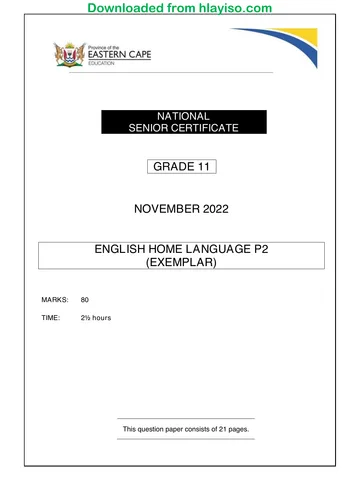
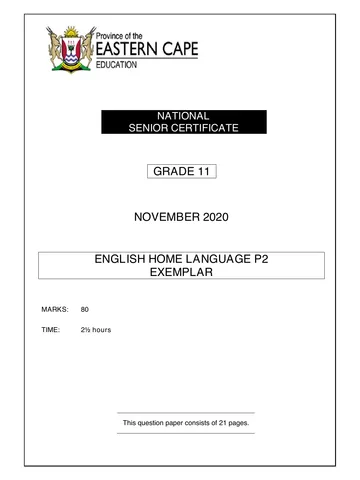
NATIONAL
SENIOR CERTIFICATE
GRADE 11
NOVEMBER 2020
ENGLISH HOME LANGUAGE P2
EXEMPLAR
MARKS: 80
TIME: 2½ hours
This question paper consists of 21 pages.
You're offline
Skip to contentQuestion paper View all
ENGHL P2 GR11 QP NOV2020 D
English Hl · Grade 11 · National Exemplar November Exam · 2020. Question paper, 21 pages. Read online or download the PDF.
- Subject
- English Hl
- Grade
- Grade 11
- Document type
- Question paper
- Year
- 2020
- Exam period
- National Exemplar November Exam
- Paper
- 2
- Pages
- 21
- File size
- 295.9 KB
Loading document…
Loading document…
1 of 21
Document textSearch extracted text and jump to a page.
2 ENGLISH HOME LANGUAGE P2 (EC/NOVEMBER 2020)
INSTRUCTIONS AND INFORMATION
1. Read these instructions carefully before you begin to answer the
questions.
2. Do not attempt to read the entire question paper. Consult the table of
contents on page 4 and mark the numbers of the questions set on texts you
have studied this year. Thereafter, read these questions and choose the
ones you wish to answer.
3. This question paper consists of THREE sections.
SECTION A: POETRY (30)
SECTION B: NOVEL (25)
SECTION C: DRAMA (25)
4. Answer FIVE questions in all: THREE in SECTION A, ONE in SECTION
B and ONE in SECTION C as follows:
SECTION A: POETRY
PRESCRIBED POETRY – Answer TWO questions.
UNSEEN POEM – COMPULSORY question
SECTION B: NOVEL
Answer ONE question.
SECTION C: DRAMA
Answer ONE question.
5. CHOICE OF ANSWERS FOR SECTIONS B (NOVEL) AND C (DRAMA):
x Answer questions ONLY on the novel and the drama you have studied.
x Answer ONE ESSAY QUESTION and ONE CONTEXTUAL
QUESTION. If you answer the essay question in SECTION B, you must
answer the contextual question in SECTION C.
If you answer the contextual question in SECTION B, you must answer
the essay question in SECTION C.
x Use the checklist to assist you.
6. LENGTH OF ANSWERS:
x The essay question on Poetry should be answered in about 200–250
words.
x Essay questions on the Novel and Drama sections should be answered
in 300–350 words.
x The length of answers to contextual questions should be determined by
the mark allocation. Candidates should aim for conciseness and
relevance.
7. Follow the instructions at the beginning of each section carefully.
Copyright reserved Please turn over
(EC/NOVEMBER 2020) ENGLISH HOME LANGUAGE P2 3
8. Number your answers correctly according to the numbering system used
in this question paper.
9. Start EACH section on a NEW page.
10. Suggested time management:
SECTION A: approximately 40 minutes
SECTION B: approximately 55 minutes
SECTION C: approximately 55 minutes
11. Write neatly and legibly.
Copyright reserved Please turn over
4 ENGLISH HOME LANGUAGE P2 (EC/NOVEMBER 2020)
TABLE OF CONTENTS
SECTION A: POETRY
Prescribed Poetry: Answer any TWO questions.
QUESTION NO. QUESTION MARKS PAGE NO.
1. The Second Coming ─ W.B.
10 6
Yeats Essay question
2. The Woman ─ Kristina
10 7
Rungano Contextual question
3. African Poem ─ Augustinho
10 8
Neto Contextual question
4. The Author to her Book ─
10 9
Anne Bradstreet Contextual question
AND
Unseen Poem: COMPULSORY question
5. I Love the Look of Words ─
10 10
Maya Angelou Contextual question
SECTION B: NOVEL
Answer ONE question.*
6. Things fall apart Essay question 25 11
OR
7. Things fall apart Contextual question 25 11
OR
8. Tsotsi Essay question 25 13
OR
9. Tsotsi Contextual question 25 13
SECTION C: DRAMA
Answer ONE question.*
ANSWER ANY ONE OF THE FOLLOWING FOUR QUESTIONS.
10. Macbeth Essay question 25 16
OR
11. Macbeth Contextual question 25 17
OR
12. The Merchant of Venice Essay question 25 18
OR
13. The Merchant of Venice Contextual question 25 19
NOTE: In SECTIONS B and C, answer ONE ESSAY and ONE CONTEXTUAL
question.
You may NOT answer TWO essay questions or TWO contextual questions.
Copyright reserved Please turn over
(EC/NOVEMBER 2020) ENGLISH HOME LANGUAGE P2 5
CHECKLIST
Use this checklist to ensure that you have answered the correct number of questions.
SECTION QUESTION NO. OF QUESTIONS TICK (√)
NUMBERS TO ANSWER
A: POETRY
1–4 2
(Prescribed Poetry)
A: POETRY
5 1
(Unseen Poem)
B: NOVEL
6–9 1
(Essay or Contextual)
C: DRAMA
10–11 1
(Essay or Contextual)
NOTE: In SECTIONS B and C, answer ONE ESSAY and ONE CONTEXTUAL
question.
You may NOT answer TWO essay questions or TWO contextual questions.
Copyright reserved Please turn over
6 ENGLISH HOME LANGUAGE P2 (EC/NOVEMBER 2020)
SECTION A: POETRY
PRESCRIBED POETRY
Answer ANY TWO of the following questions.
QUESTION 1: POETRY – ESSAY QUESTION
Read the poem below and then answer the question that follows.
THE SECOND COMING – W.B. Yeats
1 Turning and turning in the widening gyre
2 The falcon cannot hear the falconer;
3 Things fall apart; the centre cannot hold;
4 Mere anarchy is loosed upon the world,
5 The blood-dimmed tide is loosed, and everywhere
6 The ceremony of innocence is drowned;
7 The best lack all conviction, while the worst
8 Are full of passionate intensity.
9 Surely some revelation is at hand;
10 Surely the Second Coming is at hand;
11 The Second Coming! Hardly are those words out
12 When a vast image out of Spiritus Mundi
13 Troubles my sight: somewhere in sands of the desert
14 A shape with lion body and the head of a man,
15 A gaze blank and pitiless as the sun,
16 Is moving its slow thighs, while all about it
17 Reel shadows of the indignant desert birds.
18 The darkness drops again; but now I know
19 That twenty centuries of stony sleep
20 Were vexed to nightmare by a rocking cradle,
21 And what rough beast, its hour come round at last,
22 Slouches towards Bethlehem to be born?
In a carefully planned essay, critically discuss how the poet uses diction, imagery
and tone to suggest a future world characterised by violence and chaos.
Your essay must be 200–250 words (about ONE page) in length. [10]
OR
Copyright reserved Please turn over
(EC/NOVEMBER 2020) ENGLISH HOME LANGUAGE P2 7
QUESTION 2: POETRY – CONTEXTUAL QUESTION
Read the poem below and then answer the questions that follow.
THE WOMAN – Kristina Rungano
1 A minute ago I came from the well
2 Where young women drew water like myself
3 My body was weary and my heart tired.
4 For a moment I watched the stream that rushed before me;
5 And thought how fresh the smell of flowers,
6 How young the grass around it.
7 And yet again I heard the sound of duty
8 Which ground on me – made me feel aged
9 As I bore the great big mud container on my head
10 Like a big painful umbrella.
11 Then I got home and cooked your meal
12 For you had been out drinking the pleasures of the flesh
13 While I toiled in the fields.
14 Under the angry vigilance of the sun
15 A labour shared only by the bearings of my womb.
16 I washed the dishes – yours –
17 And swept the room we shared
18 Before I set forth to prepare your bedding
19 In the finest corner of the hut
20 Which was bathed by the sweet smell of dung
21 I had this morning applied to the floors
22 Then you came in,
23 In your drunken lust
24 And you made your demands
25 When I explained how I was tired
26 And how I feared for the child – yours – I carried
27 You beat me and had your way
28 At that moment
29 You left me unhappy and bitter
30 And I hated you;
31 Yet tomorrow I shall again wake up to you
32 Milk the cow, plough the land and cook your food,
33 You shall again be my Lord
34 For isn’t it right that woman should obey,
35 Love, serve and honour her man?
36 For are you not the fruit of the land?
2.1 Suggest a reason for the inclusion of the woman’s surroundings in lines 4–6. (2)
2.2 Comment on the repetition of ‘And’ throughout the poem. (2)
2.3 Critically discuss the change in tone in the poem. (3)
2.4 Consider the poem as a whole. To what extent is this poem a commentary
on the traditional roles of women in rural Africa? Refer to diction in support of
your answer. (3)
[10]
Copyright reserved Please turn over
8 ENGLISH HOME LANGUAGE P2 (EC/NOVEMBER 2020)
OR
QUESTION 3: POETRY – CONTEXTUAL QUESTION
Read the poem below and then answer the questions that follow.
AFRICAN POEM – Augustinho Neto
(translated by Gerald Moore)
1 There on the horizon
2 the fire
3 and the dark silhouettes of the imbondeiro trees
4 with their arms raised
5 in the air the green smell of burnt palm trees
6 On the road
7 the line of Bailundo porters
8 groaning under their loads of crueira
9 in the room
10 the sweet sweet-eyed mulatress
11 retouching her face with rouge and rice-powder
12 the woman under her many clothes moving her hips
13 on the bed
14 the sleepless man thinking
15 of buying knives and forks to eat with at a table
16 On the sky the reflections
17 of the fire
18 and the silhouette of the blacks at the drums
19 with their arms raised
20 in the air the warm tune of marimbas
21 On the road the porters
22 in the room the mulatress
23 on the bed the sleepless man
24 The burning coals consuming
25 consuming with fire
26 the warm country of the horizons.
3.1 Suggest a reason for the inclusion of the foreign words in the poem. (2)
3.2 Comment on the effect of the personification used in lines 3–4. (3)
3.3 What impression is created by the inclusion of the man and woman in
stanza 3? (3)
3.4 Consider the poem as a whole. Discuss to what extent this poem shows
the poet’s affection for Africa. Refer to the tone in your answer. (2)
[10]
OR
Copyright reserved Please turn over
(EC/NOVEMBER 2020) ENGLISH HOME LANGUAGE P2 9
QUESTION 4: PRESCRIBED POETRY – CONTEXTUAL QUESTION
Read the poem below and then answer the questions that follow.
THE AUTHOR TO HER BOOK – Anne Bradstreet
1 Thou ill-formed offspring of my feeble brain,
2 Who after birth didst by my side remain,
3 Till snatched from thence by friends, less wise than true,
4 Who thee abroad, exposed to public view,
5 Made thee in rags, halting to th’ press to trudge,
6 Where errors were not lessened (all may judge).
7 At thy return my blushing was not small,
8 My rambling brat (in print) should mother call,
9 I cast thee by as one unfit for light,
10 Thy visage was so irksome in my sight,
11 Yet being mine own, at length affection would
12 Thy blemishes amend, if so I could:
13 I washed thy face, but more defects I saw,
14 And rubbing off a spot still made a flaw,
15 is I stretched thy joints to make thee even feet,
16 Yet still thou run’st more hobbling than is meet;
17 In better dress to trim thee was my mind,
18 But nought save homespun cloth i’ th’ house I find.
19 In this array ’mongst vulgars may’st thou roam.
20 In critic’s hands beware thou dost not come,
21 And take thy way where yet thou art not known;
22 If for thy father asked, say thou hadst none;
23 And for thy mother, she alas is poor,
24 Which caused her thus to send thee out of door.
4.1 Suggest a reason for the speaker choosing to keep her ‘offspring by her
side’ (line 2). (2)
4.2 Comment on the speaker referring to her friends as ‘less wise than true’
(lines 3–4). (2)
4.3 Show how the speaker’s efforts are exaggerated in lines 15–16. How
does this contribute to the tone? (3)
4.4 Consider the poem as a whole and comment on the effectiveness of the
extended metaphor. (3)
[10]
AND
Copyright reserved Please turn over
10 ENGLISH HOME LANGUAGE P2 (EC/NOVEMBER 2020)
UNSEEN POETRY (COMPULSORY)
QUESTION 5: UNSEEN POETRY – CONTEXTUAL QUESTION
Read the poem below and then answer the questions that follow.
I LOVE THE LOOK OF WORDS – Maya Angelou
1 Popcorn leaps, popping from the floor
2 of a hot black skillet
3 and into my mouth.
4 Black words leap,
5 snapping from the white
6 page. Rushing into my eyes. Sliding
7 into my brain which gobbles them
8 the way my tongue and teeth
9 chomp the buttered popcorn.
10 When I have stopped reading,
11 ideas from the words stay stuck
12 in my mind, like the sweet
13 smell of butter perfuming my
14 fingers long after the popcorn
15 is finished.
16 I love the book and the look of words
17 the weight of ideas that popped into my mind
18 I love the tracks of
19 New thinking in my mind.
5.1 How is a sense of movement created in stanza 1? (2)
5.2 Why could the title of the poem be considered ironic? (2)
5.3 How does the simile in lines 11–15 contribute to the mood in the poem? (3)
5.4 Explain how the comparison used in lines 18–19 contributes to your
overall understanding of the poem. (3)
[10]
TOTAL SECTION A: 30
AND
Copyright reserved Please turn over
(EC/NOVEMBER 2020) ENGLISH HOME LANGUAGE P2 11
SECTION B: NOVEL
Answer ONLY on the novel you have studied.
THINGS FALL APART – CHINUA ACHEBE
Answer EITHER QUESTION 6 (essay question) OR QUESTION 7 (contextual
question).
QUESTION 6: THINGS FALL APART – ESSAY QUESTION
In a carefully planned essay of 300–350 words (1–1 ½ pages) in length, critically
discuss to what extent ‘things fall apart’ because of the conflict between tradition
and change. [25]
OR
QUESTION 7: THINGS FALL APART – CONTEXTUAL QUESTIONS
Read the extracts below and then answer the questions that follow.
EXTRACT A
The land of the living was not far removed from the domain of the ancestors. There
was coming and going between them, especially at festivals and also when an old
man died, because an old man was very close to the ancestors. A man’s life from
birth to death was a series of transition rites which brought him nearer and nearer
to his ancestors. Ezeudu had been the oldest man in his village, and at his death 5
there were only three men in the whole clan who were older, and four or five others
in his own age group. Whenever one of these ancient men appeared in the crowd
to dance unsteadily the funeral steps of the tribe, younger men gave way and the
tumult subsided.
It was a great funeral, such as befitted a noble warrior. As the evening drew near, 10
the shouting and the firing of guns, the beating of drums and the brandishing and
clanging of matchets increased.
Ezeudu had taken three titles in his life. It was a rare achievement. There were
only four titles in the clan, and only one or two men in any generation ever achieved
the fourth and highest. When they did, they became the lords of the land. Because 15
he had taken titles, Ezeudu was to be buried after dark with only glowing brand to
light the sacred ceremony.
But before this quiet and final rite, the tumult increased tenfold. Drums beat
violently and men leaped up and down in frenzy. Guns were fired on all sides and
sparks flew out as matchets clanged together in warriors’ salutes. The air was full 20
of dust and the smell of gunpowder.
[Chapter 13]
7.1 How is the unique character of the Igbo tribe established in this extract?
Mention THREE things. (3)
7.2 Discuss the significance of the role that Ezeudu has played in Okonkwo’s
life. (3)
Copyright reserved Please turn over
12 ENGLISH HOME LANGUAGE P2 (EC/NOVEMBER 2020)
7.3 Refer to lines 10–12 and show how the rising tension is created. (3)
7.4 How does this funeral ritual contrast with that of Okonkwo’s later in the
novel? (3)
7.5 The laws of the Igbo clan are inflexible. How is this shown when even a
great man like Okonkwo is subjected to it after this funeral? (3)
AND
EXTRACT B
At this point there was a sudden stir in the crowd and every eye was turned in
one direction. There was a sharp bend in the road that led from the marketplace
to the white man’s court, and to the stream beyond it. And so no one had seen
the approach of the messengers until they had come round the bend, a few paces
from the edge of the crowd. Okonkwo was sitting at the edge. 5
He sprang to his feet as soon as he saw who it was. He confronted the head
messenger, trembling with hate, unable to utter a word. The man was fearless
and stood his ground, his four men lined up behind him.
In that brief moment the world seemed to stand still, waiting. There was utter
silence. The men of Umuofia were merged into the mute backcloth of trees and 10
giant creepers, waiting.
The spell was broken by the head messenger. ‘Let me pass!’ he ordered.
‘What do you want here?’
‘The white man whose power you know too well has ordered this meeting to stop.’
In a flash Okonkwo drew his matchet. The messenger crouched to avoid the 15
blow. It was useless. Okonkwo’s matchet descended twice and the man’s head
lay beside his uniformed body.
The waiting backcloth jumped into tumultuous life and the meeting was stopped.
Okonkwo stood looking at the dead man. He knew that Umuofia would not go to
war. He knew because they had let the other messengers escape. They had 20
broken into tumult instead of action. He discerned fright in that tumult. He heard
voices asking: ‘Why did he do it?’
He wiped his matchet on the sand and went away.
[Chapter 24]
7.6 Refer to line 5: ‘Okonkwo was sitting at the edge’. Explain how this image
illustrates Okonkwo’s position in the clan at this point in the novel. (3)
7.7 Account for the presence of the messengers. (3)
7.8 Refer to both extracts A and B. Critically comment on how ‘things fall apart’. (4)
[25]
Copyright reserved Please turn over
(EC/NOVEMBER 2020) ENGLISH HOME LANGUAGE P2 13
OR
TSOTSI – ATHOL FUGARD
Answer EITHER QUESTION 8 (essay question) OR QUESTION 9 (contextual
question).
QUESTION 8: TSOTSI – ESSAY QUESTION
‘It is a person’s identity that shapes and defines him and gives his life meaning’.
In a carefully planned essay of 300–350 words (1–1½ pages) in length, discuss
to what extent this statement is true of the protagonist, Tsotsi. [25]
OR
QUESTION 9: TSOTSI – CONTEXTUAL QUESTIONS
Read the extracts below and then answer the questions that follow.
EXTRACT C
It was the Saturday street. The street had as many names as there were days
in the week, as many as there were hours in a day. Saturday had one profound
meaning. You had got past Friday. You were still alive. After this came the
other meanings. You had money in your pocket. Tomorrow was Sunday, and
that meant no work. You could live late today, and sleep late tomorrow. So you 5
put on your best, you jingled your coins and you lounged about the corners
watching the girls arm in arm flaunting their skirts the length of the street. That
was the Saturday street. Lots of people, come today gone tomorrow, very hot,
making up now for the banshee time around midnight when Saturday night
would reach its climax. 10
Tsotsi saw it very quickly and closed his mind to it. He had seen it before. Free
of the embarrassment and humiliation he had felt in buying the milk, he was free
now to hurry without a loss of pride. He slipped the tin into his coat pocket and
pushed forward. People felt safe in the daylight and that made it harder to move
through the crowds on the pavement. On Fridays they opened up and made a 15
path for him.
When he reached his room he was sweating. He closed the door behind him,
putting a chair against it so that no one could enter unexpectedly. The window,
or rather the hole in the wall since there was no glass, he covered up with a thin
square of wood which he used for that purpose when it was cold or raining and 20
the wind blew. Only then, feeling safe from inquisitive eyes or interruption, did
he take the shoebox from its hiding place under the bed. He put it carefully on
the table, pulled up a chair, sat down, and then took off the lid to examine its
contents.
[Chapter 4]
9.1 How does the ‘Saturday street’ (line 1) illustrate life for the people in the
townships in the context of the novel? (3)
Copyright reserved Please turn over
14 ENGLISH HOME LANGUAGE P2 (EC/NOVEMBER 2020)
9.2 Why is the image of ‘banshee time’ (line 9) effective in establishing the
mood? (3)
9.3 Account for Tsotsi’s feelings of ‘embarrassment and humiliation’ (line 12). (3)
9.4 Refer to lines 15–16: ‘On Fridays they opened up and made a path for
him’. Critically comment on whether this reaction to Tsotsi is justified by
referring to earlier events in the novel. (3)
9.5 How is the socio-political context of the novel implied in this extract? (3)
AND
EXTRACT D
First of all, he told him about the baby, and Boston listened for a long time, piecing
together the broken sentences, the half-thoughts of the other man, until he had
the picture. Tsotsi and a baby, that was a strange thought – could it be true?
Why not, Tsotsi was telling him and Tsotsi in all the time he had known him had
been totally without imagination. It must have happened. Why did it happen? 5
What did it mean? Will it happen again, why do things happen? He no longer
heard the other’s voice, his mind lost in the labyrinth of questions; until suddenly,
like the image that rises cool and clear out of the concentric ripples widening
away where the pebble has fallen in the water, rising cooler and clearer than ever
before, came the thought and phrase again, so he said it aloud: ‘The fields of my 10
youth.’
Tsotsi stopped and considered what Boston had said. What did it mean? What
was he trying to say? What relevance was there between that sentence and the
baby? He broke out into a sweat. I know so little, he thought. I know so little I
know nothing. 15
‘And then Boston man, there was the beggar.’
The man on the bed didn’t move.
‘Boston man.’ He waited. ‘Hey Boston. The beggar.’ Boston looked at him.
‘Help me there man. I had him. I had him right, but I let him go.’
Boston continued to watch him, so he told that story as well. 20
Boston concentrated hard, and listened. He heard that story right through to the
end. In its way it was as surprising as the other. Why was it strange to find
mercy? What a tremendous thought mercy is! The word itself is like the sigh of
the wind. Where had he heard it like that? Then it came to him; the long, lonely
wind that swept through the long grass in the fields of his youth. 25
[Chapter 11]
9.6 Comment on the irony of Tsotsi opening up to Boston in this extract. (3)
Copyright reserved Please turn over
(EC/NOVEMBER 2020) ENGLISH HOME LANGUAGE P2 15
9.7 Critically comment on the role of Boston in the novel by referring to the
image of the ‘long grass in the fields of his youth’ (line 25). (3)
9.8 Refer to both extracts C and D. Critically comment on the paradoxical
nature of Tsotsi’s character that evokes both fear and sympathy from the
reader. (4)
[25]
TOTAL SECTION B: 25
Copyright reserved Please turn over
16 ENGLISH HOME LANGUAGE P2 (EC/NOVEMBER 2020)
SECTION C: DRAMA
Answer ONLY on the drama you have studied.
MACBETH – WILLIAM SHAKESPEARE
Answer EITHER QUESTION 10 (essay question) OR QUESTION 11 (contextual
question).
QUESTION 10: MACBETH – ESSAY QUESTION
Malcolm describes Lady Macbeth as a ‘fiend-like queen’.
In a carefully planned essay of 300–350 words (1–1½ pages) in length, discuss to
what extent this is an accurate assessment of Lady Macbeth. [25]
OR
QUESTION 11: MACBETH – CONTEXTUAL QUESTION
Read the extracts below and answer the questions that follow.
EXTRACT E
MACBETH This is a sorry sight. 1
LADY MACBETH A foolish thought, to say a sorry sight.
MACBETH There’s one did laugh in’s sleep, and one cried ‘Murder!’
That they did wake each other; I stood, and heard them,
But they did say their prayers and address’d them 5
Again to sleep.
LADY MACBETH There are two lodg’d together.
MACBETH One cried ‘God bless us! And ‘Amen’ the other,
As they had seen me with these hangman’s hands,
List’ning their fear, I could not say ‘Amen’ 10
When they did say ‘God bless us.’
LADY MACBETH Consider it not so deeply.
MACBETH But wherefore could not I pronounce ‘Amen’?
I had most need of blessing and ‘Amen’
Stuck in my throat. 15
LADY MACBETH These deeds must not be thought
After these ways; so, it will make us mad.
Copyright reserved Please turn over
(EC/NOVEMBER 2020) ENGLISH HOME LANGUAGE P2 17
MACBETH Methought I heard a voice cry, ‘Sleep no more:
Macbeth does murder sleep’, the innocent sleep,
Sleep that knits up the ravell’d sleeve of care, 20
The death of each day’s life, sore labour’s bath,
Balm of hurt minds, great nature’s second course,
Chief nourisher in life’s feast.
LADY MACBETH What do you mean?
[Act 2, Scene 2]
11.1 What is the ‘sorry sight’ that Macbeth refers to in line 1? (3)
11.2 Why is Macbeth obsessed with his inability to say ‘Amen’ (lines 10 and 13)? (3)
11.3 Explain the dramatic irony of Lady Macbeth’s response in lines 16–17:
‘These deeds must not be thought
After these ways; so, it will make us mad.’ (3)
11.4 Comment on the metaphor: ‘Sleep … Balm of hurt minds’ (lines 20–22) in
the context of the play. (3)
11.5 Refer to line 13: ‘But wherefore could not I pronounce ‘Amen’?’ If you were
the director of the play, how would you instruct the actor playing the role of
Macbeth? Pay attention to body language and tone and explain your
answer. (3)
AND
EXTRACT F
DOCTOR This disease is beyond my practice; yet I have known those
which have walked in their sleep who have died holily in their
beds.
LADY MACBETH Wash your hands, put on your night-gown, look not so pale. I
tell you yet again, Banquo’s buried; he cannot come out on’s 5
grave.
DOCTOR Even so?
LADY MACBETH To bed, to bed; there’s knocking at the gate. Come, come,
come, come, give me your hand; what’s done cannot be
undone. To bed, to bed, to bed. [Exit] 10
DOCTOR Will she go now to bed?
GENTLEWOMAN Directly.
Copyright reserved Please turn over
18 ENGLISH HOME LANGUAGE P2 (EC/NOVEMBER 2020)
DOCTOR Foul whisp’rings are abroad; unnatural deeds
Do breed unnatural troubles; infected minds
To their deaf pillows will discharge their secrets. 15
More needs she the divine than the physician.
God, God forgive us all. Look after her;
Remove from her the means of all annoyance,
And still keep eyes upon her. So, good night,
My mind she has mated, and amaz’d my sight, 20
I think, but dare not speak.
GENTLEWOMAN Good night, good doctor.
[Exeunt
[Act 5, Scene 1]
11.6 Critically comment on the doctor’s reference to ‘Foul whisp’rings are
abroad’ (line 13) and how this ultimately leads to a cure for disease. (3)
11.7 Consider the doctor’s utterance: ‘I think, but dare not speak.’ (line 21) What
does this suggest about the way in which Macbeth rules Scotland? (3)
11.8 Compare Lady Macbeth’s state of mind in Extract E to that in Extract F. (4)
[25]
OR
THE MERCHANT OF VENICE – WILLIAM SHAKESPEARE
Answer EITHER QUESTION 12 (essay question) OR QUESTION 13 (contextual
question).
QUESTION 12: THE MERCHANT OF VENICE – ESSAY QUESTION
Portia is the strong character of this drama and not the ‘merchant’ as implied by
the title.
In a carefully planned essay of 300–350 words (1–1½ pages) in length, discuss to
what extent you agree with this statement. [25]
OR
Copyright reserved Please turn over
(EC/NOVEMBER 2020) ENGLISH HOME LANGUAGE P2 19
QUESTION 13: THE MERCHANT OF VENICE – CONTEXTUAL QUESTION
Read the extracts below and answer the questions that follow.
EXTRACT G
TUBAL Yes, other men have ill luck too. Antonio as I heard in Genoa ─
SHYLOCK What, what, what? Ill luck, ill luck?
TUBAL Hath an argosy cast away coming from Tripolis.
SHYLOCK I thank God, I thank God. Is it true? Is it true?
TUBAL I spoke with some of the sailors that escaped the wreck. 5
SHYLOCK I thank thee good Tubal, good news, good news! Ha, ha!
Heard in Genoa?
TUBAL Your daughter spent in Genoa, as I heard, one night fourscore
ducats.
SHYLOCK Thou stick’st a dagger in me. I shall never see my gold again. 10
Fourscore ducats at a sitting, fourscore ducats.
TUBAL There came divers of Antonio’s creditors in my company to Venice,
that swear he cannot choose but break.
SHYLOCK I am very glad of it, I’ll plague him, I’ll torture him. I am glad of it.
TUBAL One of them showed me a ring that he had of your daughter for a 15
monkey.
SHYLOCK Out upon her, thou torturest me Tubal. It was my turquoise, I had
it of Leah when I was a bachelor. I would not have given it for a
wilderness of monkeys.
TUBAL But Antonio is certainly undone. 20
[Act 3, Scene 1]
13.1 Why is Shylock meeting with Tubal? (3)
13.2 Why would Shylock be keen to hear news of Antonio? (3)
13.3 Shylock calls the report of a shipwreck ‘good news, good news’ (line 6).
What does this suggest about his character? Mention and discuss two
things. (3)
13.4 What is revealed about Jessica’s relationship with her father in this extract? (3)
Copyright reserved Please turn over
20 ENGLISH HOME LANGUAGE P2 (EC/NOVEMBER 2020)
13.5 Refer to the extract. If you were the director of the play, how would you
instruct the actor playing the role of Shylock? Pay attention to body
language and tone and explain your answer. (3)
AND
EXTRACT H
DUKE That thou shall see the difference of our spirit,
I pardon thee thy life before thou ask it.
For half thy wealth, it is Antonio’s,
The other half comes to the general state,
Which humbleness may drive unto a fine. 5
PORTIA Ay, for the state, not for Antonio.
SHYLOCK Nay, take my life and all, pardon not that.
You take my house, when you do take the prop
That doth sustain my house; you take my life,
When you do take the means whereby I live. 10
PORTIA What mercy can you render him Antonio?
GRATIANO A halter gratis, nothing else for God’s sake.
ANTONIO So it please my lord the duke and all the court
To quit the fine for one half of his goods,
I am content – so he will let me have 15
The other half in use – to render it
Upon his death unto the gentleman
That lately stole his daughter.
Two things provided more, that for this favour,
He presently become a Christian; 20
The other, that he do record a gift
Here in the court of all he dies possessed
Unto his son Lorenzo and his daughter.
DUKE He shall do this, or else I do recant
The pardon that I late pronounced here. 25
PORTIA Art thou contented Jew? What dost thou say?
SHYLOCK I am content.
DUKE Clerk, draw a deed of gift.
SHYLOCK I pray you give me leave from hence,
I am not well. Send the deed after me, 30
And I will sign it.
[Act 4, Scene 1]
Copyright reserved Please turn over
(EC/NOVEMBER 2020) ENGLISH HOME LANGUAGE P2 21
13.6 Critically comment on how the Duke’s words in lines 1–5 set the tone. (3)
13.7 Consider Shylock’s utterance in line 27: ‘I am content.’ and discuss why it
is ironic. (3)
13.8 Compare and explain Shylock’s state of mind in Extract G to his state of
mind in Extract H. (4)
[25]
TOTAL SECTION C: 25
GRAND TOTAL: 80
Copyright reserved Please turn over
Recommended for this subject
Published documents with matching subject and grade metadata.
Related documents
Matched using subject, grade, language, document type and exam metadata.


More from Grade 11 English Hl
Explore more published documents in this catalogue.