Downloaded from hlayiso.com
NATIONAL SENIOR CERTIFICATE EXAMINATION
NOVEMBER 2018
MARITIME ECONOMICS
Time: 3 hours 300 marks
PLEASE READ THE FOLLOWING INSTRUCTIONS CAREFULLY
1. This question paper consists of 15 pages, an Answer Sheet of 1 page (i) and an
Addendum of 1 page (i). Please check that your question paper is complete.
2. Please write your examination number in the blocks provided on the Answer Sheet.
Remember to hand in this sheet.
3. Answer all the questions.
4. Read the questions carefully before answering.
5. It is in your own interest to write legibly and to present your work neatly.
6. When doing calculations, all working detail must be shown.
IEB Copyright © 2018 PLEASE TURN OVER
Skip to contentQuestion paper 
Maritime Economics Grade 12 IEB 2018 Question Paper
IEB Grade 12 Maritime Economics question paper from the 2018, 15 pages. Read online or get the free PDF download, memo linked when available.
Publisher: IEB
Maritime Economics · Grade 12 · 2018. Question paper, 15 pages. Read online or download the PDF.
- Subject
- Maritime Economics
- Grade
- Grade 12
- Document type
- Question paper
- Year
- 2018
- Publisher
- IEB
- Curriculum
- IEB
- Pages
- 15
- File size
- 225.2 KB
Loading document…
Loading document…
1 of 15
Document textSearch extracted text and jump to a page.
Downloaded from hlayiso.com
NATIONAL SENIOR CERTIFICATE: MARITIME ECONOMICS Page 2 of 15
QUESTION 1 MULTIPLE-CHOICE QUESTIONS
Answer these questions on the Answer Sheet provided. Place an X in the block
next to the letter that is the answer to the question, or is the term described. YOU
MUST ANSWER THE QUESTIONS IN THE SAME ORDER IN WHICH THEY
APPEAR ON THIS QUESTION PAPER.
1.1 Shipowners are being forced to ensure that the following devices are fitted
to their ships' exhaust flues:
A exhaust brooms
B exhaust scrubbers
C exhaust trimmers
D exhaust refiners
1.2 How many engineering officers are usually assigned to a large tanker with
an engine of about 45 000 break horsepower?
A two
B three
C four
D five
1.3 The country providing most of the world's merchant seafarers is …
A Liberia
B China
C Norway
D Philippines
1.4 A ship is registered in Singapore but is owned by a British company. The
term for this practice is …
A cross-registering
B trans-registering
C flagging away
D flagging out
1.5 The organisation that will declare a ship seaworthy after an accident is …
A Classification Society
B Shipping Society
C Lloyd's Association
D Lloyd's Convention
1.6 A handysize bulk carrier sails from Newcastle (south-east coast of Australia)
to Shanghai (China). Through which of the following seas or oceans will she
pass?
A Indian Ocean
B Pacific Ocean
C Arabian Sea
D South China Sea
IEB Copyright © 2018
Downloaded from hlayiso.com
NATIONAL SENIOR CERTIFICATE: MARITIME ECONOMICS Page 3 of 15
1.7 What type of insurance would cover damage to a buoy that was hit by a
ship?
A TT Club
B FFO
C P&I Club
D Hull & Machinery
1.8 What type of insurance would cover damage to a ship resulting from a
severe storm?
A TT Club
B FFO
C P&I Club
D Hull & Machinery
1.9 What type of insurance would cover a ship needing to divert to land an
injured crewmember?
A TT Club
B FFO
C P&I Club
D Hull & Machinery
1.10 What type of insurance would cover injury to a stevedore when cargo fell
following the breaking of the cable on a ship's crane?
A TT Club
B FFO
C P&I Club
D Hull & Machinery
1.11 The term that applies to the process of settling a dispute between a salvage
tug owner and a shipowner whose ship was the subject of a salvage claim
is known as …
A resolution
B salvage review
C legal opinion
D arbitration
1.12 A severe revolving storm encountered off the coast of Florida (USA) where
wind speeds reached 195 kmph is known as a …
A hurricane
B typhoon
C mid-latitude cyclone
D monsoon
IEB Copyright © 2018 PLEASE TURN OVER
Downloaded from hlayiso.com
NATIONAL SENIOR CERTIFICATE: MARITIME ECONOMICS Page 4 of 15
1.13 Between the Gulf of Aden and the Red Sea lies …
A Strait of Hormuz
B Strait of Malacca
C Bab-el-Mandeb
D Torres Straits
1.14 The Incoterm that indicates that the costs of carrying the cargo (from before
it crosses over the ship's gunwale) until it reaches the consignee's premises
will be paid by the consignee.
A FOB
B FAS
C CIF
D DDP
1.15 The Incoterm that indicates that the costs of shipping cargo from the
shipper's premises to the consignee's premises will be paid by the
consignor.
A FOB
B FAS
C EXW
D DDP
1.16 Who bears the shipping freight charges on the ocean leg of the transport
chain if cargo is shipped DDP (Delivered Duty Paid)?
A the shipper
B the consignee
C the carrier
D the forwarding agent
1.17 The document that sets out the conditions of the carriage of goods by sea is
called the …
A charter party
B bill of lading
C cargo manifest
D mate's receipt
1.18 A passenger is injured aboard a cruise ship. Who pays the medical bills
when he is treated in hospital?
A the cruise ship owner
B the travel agent who booked his passage aboard the ship
C the ship's P&I Club
D the Classification Society
IEB Copyright © 2018
Downloaded from hlayiso.com
NATIONAL SENIOR CERTIFICATE: MARITIME ECONOMICS Page 5 of 15
1.19 The primary cause of rough seas off the south-western coast of southern
Africa in winter is …
A mid-latitude cyclone
B tropical cyclone
C shape of the coastline
D north-east monsoon
1.20 The apex predator in the marine food chain is …
A blue whale
B great white shark
C leopard seal
D orca
1.21 The term for an area where the river widens near its mouth is …
A riviera
B atoll
C estuary
D bay
1.22 An international code in terms of which ships must have regular fire drills
aboard is ….
A SOLAS
B STCW 95/2010
C ISM
D ISPS
1.23 The distance that a ship can steam without refuelling is called the …
A fuel capacity
B fuel consumption
C range
D log
1.24 A vessel that carries liquefied natural gas is called a …
A LNG FPSO
B LNG bulker
C LNG carrier
D LNG terminal
1.25 The country in which a ship is flagged is known as the …
A port state
B flag state
C ship state
D ship register
IEB Copyright © 2018 PLEASE TURN OVER
Downloaded from hlayiso.com
NATIONAL SENIOR CERTIFICATE: MARITIME ECONOMICS Page 6 of 15
1.26 The African country with the largest ships' register is …
A South Africa
B Nigeria
C Egypt
D Liberia
1.27 If a country has a system of cabotage, it means that the country …
A allows ships of any nationality to move cargoes between its ports.
B allows only foreign ships to move its export cargoes to foreign ports.
C allows only foreign ships to move cargoes between its ports.
D allows only ships registered in its ports to move cargoes between its
ports.
1.28 A ship steaming from Cape Town to Walvis Bay (Namibia) will …
A steam against the Benguela Current.
B steam against the Agulhas Current.
C steam with the Agulhas Current.
D steam with the Benguela Current.
1.29 Conditions associated with a monsoon may affect shipping in the …
A Arabian Sea
B Caribbean Sea
C Tasman Sea
D Baltic Sea
1.30 Conditions associated with a typhoon may affect shipping near …
A Lagos (Nigeria)
B Rio de Janeiro (Brazil)
C Manila (Philippines)
D Fremantle (Australia)
[60]
IEB Copyright © 2018
Downloaded from hlayiso.com
NATIONAL SENIOR CERTIFICATE: MARITIME ECONOMICS Page 7 of 15
QUESTION 2 THE MARITIME WORLD
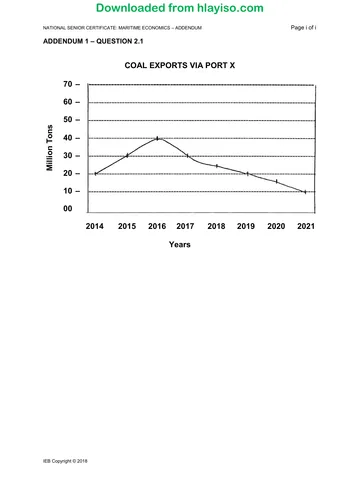
2.1 Study the graph of coal exports from Port X, given as Addendum 1 to this
question paper. Note that the figures for Years 2018 to 2021 are estimates
only. Now answer the questions set.
2.1.1 What was the greatest tonnage of coal exported in a single year via
Port X? (2)
2.1.2 In which year was the greatest tonnage of coal exported via Port X? (2)
2.1.3 The graph shows a steady decline in coal exports through Port X.
(a) In terms of global energy trends, suggest two reasons for this
decline in coal exports. (4)
(b) How will the decline in coal exports affect Port X? (8)
2.1.4 Look at the tonnage of coal exported in 2015.
(a) If the average cargo capacity of bulk carriers moving that coal
was 150 000 tons, how many bulk carriers would have called
at Port X in that year to load coal? (4)
(b) How many bulk carriers would have arrived each week to load
coal at Port X in 2015? (4)
(c) From the figures below, choose the approximate deadweight
of a bulk carrier that can carry 150 000 tons of cargo when
fully loaded.
190 000 dwt; 180 000 dwt; 170 000 dwt; 160 000 dwt;
150 000 dwt (2)
2.2 A large modern bulk carrier capable of carrying 150 000 tons of cargo has a
powerful main engine.
2.2.1 What type of fuel does her main engine use? (2)
2.2.2 On a large bulk carrier, what are generators used for? (2)
2.2.3 The type of propulsion used in a modern bulk carrier does not cause
as much air pollution as the propulsion system in a coal-fired steam
ship of similar power in 1920. Give four other advantages of the type
of propulsion used in a modern bulk carrier. (8)
2.2.4 Give two ways in which shipowners are trying to reduce air pollution
from a ship's exhaust gases. (4)
IEB Copyright © 2018 PLEASE TURN OVER
Downloaded from hlayiso.com
NATIONAL SENIOR CERTIFICATE: MARITIME ECONOMICS Page 8 of 15
2.3 Read the following comment that was made after President Cyril
Ramaphosa had delivered his first speech to the South African parliament
earlier this year. Then answer the question set.
The president's positive stance on many issues is good news for the shipping
industry that is calling for favourable economic conditions in which it can
operate and grow. This is especially important because around 93 per cent of
South African trade is carried by ships, presenting opportunities for local
shipowning and chartering with local companies providing brokerage work,
insurance and other services for South African ships.
– Cape Times 21 February 2018
Explain why the South African shipping industry needs favourable economic
conditions (in South Africa) in which it can operate and grow. (8)
[50]
IEB Copyright © 2018
Downloaded from hlayiso.com
NATIONAL SENIOR CERTIFICATE: MARITIME ECONOMICS Page 9 of 15
QUESTION 3 SHIPPING OPERATIONS
3.1 Here are some details about the bulk carrier Penguin.
Length 223 metres
Loaded Draught 14 metres
Freeboard when loaded 5 metres
Owner Penguin Shipping, Hong Kong
Port of Registry Hong Kong
Origin of the Cargo Oz Coal Exporting Company, Newcastle
Charterer Yangtze Coal Company, Shanghai, China
(The company has bought the consignment of coal
that will be delivered over 12 months by Penguin.)
She is on a time charter for 12 months.
Insurers H&M HK Insurers, Hong Kong
P&I North of England P&I Club
Deadweight 84 300 dwt
Usual cargo distribution during her charter voyages
No 1 Hold 7 500 tons
No 2 Hold 10 500 tons
No 3 Hold 11 500 tons
No 4 Hold 13 000 tons
No 5 Hold 12 500 tons
No 6 Hold 12 500 tons
No 7 Hold 12 500 tons
3.1.1 Refer to the ship's details given above. What type of bulk carrier is
Penguin? (2)
3.1.2 She will move coal from Newcastle (Australia) to Shanghai (China).
• It is expected that she will carry about 80 000 tons of coal per
voyage.
• Loading in Newcastle will be done by two shiploaders at a rate of
2 000 tons an hour each.
• Loading on her first voyage from Newcastle is scheduled to begin
at 08:00 on 4 December.
• Breaks (tea breaks, change of shift, etc.) will total four hours for
the duration of the loading process.
• Before she can sail, various clearance procedures and other
procedures will take four hours once cargo work has been
completed.
(a) How many hours will it take to complete the loading of the
cargo, including breaks? If necessary, round off to the NEXT
hour, e.g. 16,3 becomes 17 hours. (6)
(b) When will the loading of the cargo be finished? (6)
IEB Copyright © 2018 PLEASE TURN OVER
Downloaded from hlayiso.com
NATIONAL SENIOR CERTIFICATE: MARITIME ECONOMICS Page 10 of 15
(c) When will she sail from Newcastle? (4)
(d) Name three of the procedures that have to be completed
before the ship can sail. (6)
3.1.3 Refer to your answer to Question 3.1.2 (a). The charter party
required that cargo loading should be completed in 38 hours.
(a) Did she take a longer or a shorter period of time to load this
cargo? Choose your answer from LONGER or SHORTER or
THE SAME. (2)
(b) Will demurrage or dispatch be payable in this case? (2)
3.1.4 In his calculations prior to the charter, Penguin's owner worked on
the following information for the voyages to move the coal from
Newcastle to Shanghai and return to Newcastle:
• A round voyage begins on the ship's arrival in Newcastle and
ends on the ship's arrival back in Newcastle.
• Time allowed for stay in Newcastle on each voyage: 3 days.
• Time allowed for anchoring during one round voyage: 5 days.
• Time allowed for voyage from Newcastle to Shanghai: 14 days.
• Time allowed for discharging in Shanghai: 7 days.
(a) Draw a sketch to show one round voyage of Penguin from
arrival at Newcastle, her voyage to Shanghai, her stay in
Shanghai, and her return voyage to Newcastle. Indicate the
number of days spent on each part of the voyage. (8)
(b) How many days will one round voyage take? (6)
(c) How many round voyages will she be able to complete during
the year that she is on time charter? (6)
(d) Assuming she carries a similar amount of coal per voyage,
how much coal will she have carried during all those
completed round voyages? (6)
3.1.5 The contract to carry the coal indicates that it will be carried CIF, the
INCOTERM for Cost of Insurance and Freight.
Choosing your answers from CONSIGNOR (SHIPPER) or
CONSIGNEE or CARRIER, who pays for each of the following
costs?
(a) The shipping costs from Newcastle to Shanghai. (2)
(b) Insurance on the coal cargo. (2)
IEB Copyright © 2018
Downloaded from hlayiso.com
NATIONAL SENIOR CERTIFICATE: MARITIME ECONOMICS Page 11 of 15
3.2 During a voyage from Newcastle to Shanghai, a fire breaks out in the coal
cargo in number 3 hold. Carbon dioxide is released into the hold, but the
fire is not extinguished and increases in intensity. The master decides to
flood the hold with seawater, but realises that the heat from the fire has
been so intense that the coal in number 4 hold has also caught fire. He also
floods number 4 hold with seawater. He turns the ship to return to
Newcastle (672 nautical miles away) and transmits an "all ships" radio call.
The containership Australian Hawk and the salvage tug Kangaroo respond.
Three hours later, Australian Hawk arrives abeam of Penguin, and
Kangaroo arrives later in the day. The fire is extinguished by Penguin's
crew and the flooding of the two holds. Australian Hawk continues her
voyage and Kangaroo accompanies Penguin back to Newcastle where
surveyors board the ship before she enters the port. After a formal
inspection of the damage she is allowed into port where the partly burnt
coal in numbers 3 and 4 holds is discharged. It is discovered that the ship
has suffered fire damage to plating and to some of her frames, which need
to be repaired. The rest of her cargo is also discharged and she sails for
Sydney where the nearest available dry-dock is situated.
Three weeks later, she returns to Newcastle to load a new cargo for
Shanghai and to resume her charter.
3.2.1 Look at the details of the ship and the cargo distribution as given in
Question 3.1. Draw a general arrangement plan of the ship (as
viewed from the port side) and indicate the following on the plan:
the holds where the fire was located; her actual draught; her actual
freeboard; her actual length; her bow; her stern; her funnel; her
accommodation; her main mast. (12)
3.2.2 Can the tug claim salvage associated with this incident? Answer
YES or NO. (2)
3.2.3 Give two reasons for your answer to Question 3.2.2. (4)
3.2.4 When she arrived at Newcastle, surveyors representing three
organisations were waiting to assess the damage to the ship and the
cargo. Which organisations do they represent? (6)
3.2.5 What is the term that will apply to a ship that cannot fulfil the
requirements of the charter party, as happened in this case? (The
ship is … ….) (2)
3.2.6 What type of insurance will cover each of the following?
(a) The loss of some of the coal cargo. (Remember that the fire
began aboard the ship.) (2)
(b) The fact that the ship was out of service for more than three
weeks. (2)
IEB Copyright © 2018 PLEASE TURN OVER
Downloaded from hlayiso.com
NATIONAL SENIOR CERTIFICATE: MARITIME ECONOMICS Page 12 of 15
3.2.7 In some instances, General average can be declared after an
accident or damage to a ship. Who declares General average when
the ship is operating on a liner service? Choose your answer from:
SHIP'S MASTER or SHIPOWNER or CHARTERER or SHIPPER. (2)
3.2.8 You are a maritime journalist. Write a short article (about 50 words)
on the fire aboard Penguin. Be sure to include quotes from the
master of the ship and from the port captain of Newcastle harbour
that tell the reader something about the fire on board. (10)
[100]
IEB Copyright © 2018
Downloaded from hlayiso.com
NATIONAL SENIOR CERTIFICATE: MARITIME ECONOMICS Page 13 of 15
QUESTION 4 INTERNATIONAL TRADE
4.1 How many bills of lading are required for the cargo of coal being carried by
Penguin? Choose your answer from: ONE PER VOYAGE or ONE PER
HOLD or ONE PER TON or ONE FOR THE ENTIRE SHIPMENT OVER
THE YEAR. (2)
4.2 Refer to the details of the ship as provided in Question 3.1. In the case of
the coal cargoes being moved from Newcastle to China, what is the name
of …
(a) the consignor (shipper)? (2)
(b) the consignee? (2)
4.3 Look at your answers to Questions 3.1.4 (c) and 3.1.4 (d).
4.3.1 If a Capesize bulk carrier with a cargo capacity of 160 000 tons of
coal had to be used instead of Penguin for this charter, how many
round voyages would she have had to make to carry the same total
amount of cargo? (6)
4.3.2 What might have been the possible advantages to the charterer if a
Capesize vessel had been used? (4)
4.3.3 Despite the possible advantages to the charterer of using a Capesize
ship, give two possible reasons why the charterer chose a ship like
Penguin to move the coal from Newcastle to China, rather than a
Capesize vessel. (4)
4.4 The government of Country X wants to stimulate the shipbuilding industry
because it is labour intensive (i.e. it provides jobs for lots of people).
However, a shipyard was established in Port A, but it is struggling to
compete with foreign shipyards that are able to build ships more cheaply
than the shipyard at Port A. One of the main reasons that the shipyard in
Port A is struggling is because it needs to import vital parts (e.g. engines,
generators and major electronic equipment) for the ships it builds. In
addition, customs duty on these imports is very high.
4.4.1 Explain what Country X should do to ensure that the shipbuilding
industry can grow in size and in profitability. (6)
4.4.2 Apart from providing jobs, explain why a shipbuilding industry will be
important for Port A and Country X as a whole. (8)
4.4.3 What type of ship will be used to bring clothing from China to Port A? (2)
IEB Copyright © 2018 PLEASE TURN OVER
Downloaded from hlayiso.com
NATIONAL SENIOR CERTIFICATE: MARITIME ECONOMICS Page 14 of 15
4.5 The Strait of Hormuz is a very important convergence zone in world
shipping.
4.5.1 Describe the position of this convergence zone. (4)
4.5.2 Explain its economic importance in terms of world trade. In your
answer include reference to important cargoes that pass through the
strait. (10)
4.6 Explain why maritime law needs to be similar in all countries. (6)
4.7 Name the organisation that …
4.7.1 is the international controlling body for shipping. (2)
4.7.2 would act against a ship that has stopped five miles south of Cape
Agulhas without informing the authorities. (2)
4.8 Look at your answer to Question 4.7.2. What action would that organisation
take against the ship described in that question? (4)
4.9 Marine pollution gains international attention, especially in cases of oil
pollution or plastic (in its many forms) being found in the sea. Much of the
plastic is washed into the sea from rivers.
4.9.1 What is the actual source of much of the plastic found in the sea? (2)
4.9.2 What are some of the results of plastic pollution in the sea? (4)
[70]
IEB Copyright © 2018
Downloaded from hlayiso.com
NATIONAL SENIOR CERTIFICATE: MARITIME ECONOMICS Page 15 of 15
QUESTION 5 MARINE ENVIRONMENTAL CHALLENGES
5.1 The following is the shipping weather forecast for the area around Port
Elizabeth, i.e. for the period 00:01 to 12:00 on 24 November.
WIND SPEED 28 KNOTS, GUSTING 35 KNOTS AT TIMES
STRENGTHENING LATER
WIND DIRECTION SOUTH-EASTERLY
WEATHER CLEAR
SEA STATE SWELL 2 METRES, BECOMING 3 METRES LATER
VISIBILITY MODERATE
How will the weather during the forecast period affect each of the following
operations in Port Elizabeth harbour?
5.1.1 Container operations. (4)
5.1.2 Loading vehicles onto a car carrier. (4)
5.1.3 The sailing of a full containership that is 300 metres long. (4)
5.2 Explain why fishing quotas are applied to companies engaged in fishing in
South African waters. (8)
[20]
Total: 300 marks
IEB Copyright © 2018
Study this subject
Revise the topics in this paper, then practise them question by question.
Recommended for this subject
More papers and memos for this grade and subject.
Question paperIEB
Maritime Economics Grade 12 IEB 2019 Question Paper
Question paperIEB
Maritime Economics Grade 12 IEB 2017 Question Paper
AddendumIEB
Maritime Economics Grade 12 IEB 2019 Addendum
MemorandumIEB
Maritime Economics Grade 12 IEB 2019 Memo
AddendumIEB
Maritime Economics Grade 12 IEB 2018 Addendum
MemorandumIEB