Downloaded from hlayiso.com
NATIONAL SENIOR CERTIFICATE EXAMINATION
NOVEMBER 2019
MARITIME ECONOMICS
MARKING GUIDELINES
Time: 3 hours 300 marks
These marking guidelines are prepared for use by examiners and sub-examiners,
all of whom are required to attend a standardisation meeting to ensure that the
guidelines are consistently interpreted and applied in the marking of candidates'
scripts.
The IEB will not enter into any discussions or correspondence about any marking
guidelines. It is acknowledged that there may be different views about some
matters of emphasis or detail in the guidelines. It is also recognised that,
without the benefit of attendance at a standardisation meeting, there may be
different interpretations of the application of the marking guidelines.
IEB Copyright © 2019 PLEASE TURN OVER
Skip to contentMemorandum 
Maritime Economics Grade 12 IEB 2019 Memo
IEB Grade 12 Maritime Economics memorandum from the 2019, 7 pages. Read online or get the free PDF download, question paper linked when available.
Publisher: IEB
Maritime Economics · Grade 12 · 2019. Memorandum, 7 pages. Read online or download the PDF.
- Subject
- Maritime Economics
- Grade
- Grade 12
- Document type
- Memorandum
- Year
- 2019
- Publisher
- IEB
- Curriculum
- IEB
- Pages
- 7
- File size
- 355.0 KB
Loading document…
Loading document…
1 of 7
Document textSearch extracted text and jump to a page.
Downloaded from hlayiso.com
NATIONAL SENIOR CERTIFICATE: MARITIME ECONOMICS – MARKING GUIDELINES Page 2 of 7
QUESTION 1 MULTIPLE CHOICE QUESTIONS
1.1 C
1.2 C
1.3 B
1.4 B
1.5 D
1.6 B
1.7 A
1.8 D
1.9 C
1.10 C
1.11 D
1.12 D
1.13 C
1.14 A
1.15 C
1.16 B
1.17 B
1.18 C
1.19 B
1.20 D
1.21 B
1.22 C
1.23 C
1.24 B
1.25 B
1.26 C
1.27 C
1.28 B
1.29 A
1.30 D
IEB Copyright © 2019 PLEASE TURN OVER
Downloaded from hlayiso.com
NATIONAL SENIOR CERTIFICATE: MARITIME ECONOMICS – MARKING GUIDELINES Page 3 of 7
QUESTION 2 THE MARITIME WORLD
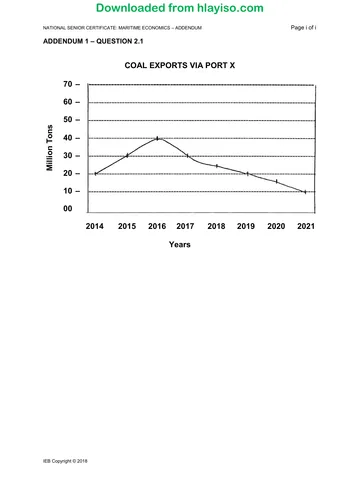
2.1. Gas oil produces fewer atmospheric pollutants / Polar areas are pristine and
must not be polluted)
2.2 Expensive / needs highly trained personnel / security / any other)
2.3 2.3.1 Multi-directional propulsion
2.3.2 Conventional propeller
2.3.3 Azipods
2.3.4 Dynamic positioning system
2.4 2.4.1 Norway (or Norwegian)
2.4.2 Distress call (or similar answer)
2.4.3 Helicopters available / tugs available / vessel close to shore / any other
plausible reason
2.4.4 Out of helicopter range / may not be able to launch lifeboats in rough
weather / unable to evacuate large numbers of elderly people / may
not be other ships nearby / other plausible answer
2.4.5 (a) High freeboard / passengers unable to climb ladders / other
plausible answer
(b) Helicopter
(c) Helicopter from warship could ferry passengers to bulk carrier /
large bulk carrier presents a stable platform
2.5 Higher cost of Norwegian crews / flagged elsewhere, ships can use foreign
crews / more friendly taxation regime / cheaper registration fees elsewhere /
other plausible answer
IEB Copyright © 2019 PLEASE TURN OVER
Downloaded from hlayiso.com
NATIONAL SENIOR CERTIFICATE: MARITIME ECONOMICS – MARKING GUIDELINES Page 4 of 7
QUESTION 3 SHIPPING OPERATIONS
3.1 3.1.1 Using two discharging units / stability & stress of the ship / easier to land
the cargo being discharged (accessibility of discharging units to
holds)
3.1.2 Cargo owner / charterer
3.1.3 Manifest
3.1.4. 10
3.1.5 ISPS Code
3.1.6 Time to start discharge = 06:00 on 13/06 + (3 + 1 + 1 + 1 + 6)
= 18:00 on 13/06
9 900
Time to discharge Hold 4 = = 11 hours
900
9 000
Time to discharge Hold 3 = = 10 hours
900
6 300
Time to discharge Hold 1 = = 7 hours
900
Time to finish discharging 18:00 on 13/06 + 28 hours = 22:00 on 14/06
3.1.7 22:00 on 14/06 + (1 + 3 + 26 + 4) = 08:00 on 16/06
3.1.8 Ship's agent / Travel company / Doctor / Port Authority / Bunker
company
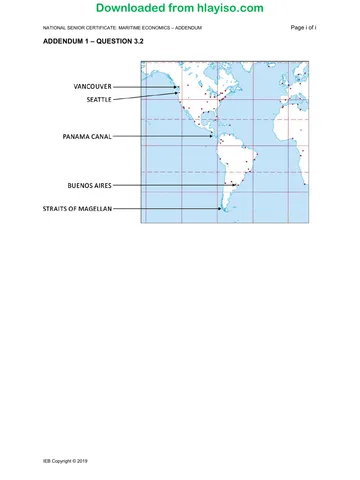
3.2 3.2.1 Longer via Panama / More fuel / More expensive canal fees
3.2.2 (a) 3 days × 10 knots × 24 hours = 720 nautical miles
7 920 M 528 hours
(b) 8 640 M – 720 M = = = 22 Days +
15 knots 24 hours
3 Days = 25 Days
(c) 25 days × 42 tons = 1 050 tons
(d) 1 050 tons × $321 = $337 050
(e) 2 710 tons – 1 050 tons = 1 660 tons
(f) Bunker
3.3 3.3.1 Four
IEB Copyright © 2019 PLEASE TURN OVER
Downloaded from hlayiso.com
NATIONAL SENIOR CERTIFICATE: MARITIME ECONOMICS – MARKING GUIDELINES Page 5 of 7
3.3.2 Any TWO pieces of information that will appear on the front of the Bill
of Lading
3.3.3 (a) 20:00 on 26/07
(b) Lloyds Open Form (or LOF)
3.3.4 (a) Surveyors representing the following:
Cargo Insurers / P&I Club / Hull & Machinery
(b) Yes
(c) Ship was in imminent danger / possibility of oil pollution if she
had not refloated the ship / weather would deteriorate / Any
other plausible reason
3.3.5 Total value ship & cargo = $52 000 000 + $2 750 200 = $54 750 200
Value of Angelos Construczione = $230 000 + 360 000 + 550 000 =
$1 140 000
$1140 000
Share of Angelos Construczione = × $7 320 000 =
$54 750 200
$152 415.88
QUESTION 4 INTERNATIONAL MARITIME TRADE
4.1 More containers of car parts being landed / More containers of tyres being
landed / More ro-ro ships arriving to load export cars / More container trucks
will be moving to and from the harbour / Container terminal will become
busier / Any other plausible answer
4.2 4.2.1 3 000 × 5 = 15 000 tyres
OR (also allowed)
3 000 × 4 = 12 000 tyres
15 000
4.2.2 = 50 containers
300
OR (also allowed)
12 000
= 40 containers
300
4.2.3 NO
IEB Copyright © 2019 PLEASE TURN OVER
Downloaded from hlayiso.com
NATIONAL SENIOR CERTIFICATE: MARITIME ECONOMICS – MARKING GUIDELINES Page 6 of 7
4.2.4 Only 50 containers a month / Too few to warrant the chartering of a
ship
4.2.5 More jobs / Boost spending power of people / Boost normal commerce /
Require sufficient services for workers (e.g. housing, schools, utility
services) / Satellite industries will develop (e.g. seat manufacturing,
paint distributors, etc.) Any other plausible spin-off for the area
4.2.6 Build car export terminal / ensure container terminal can accommodate
additional containers
Ensure road network can support the number of container trucks
moving to and from the port / Ensure that sufficient tugs (and sufficiently
powerful tugs) are available to handle containerships / Harbour has
sufficient workers at the various levels
4.3 4.3.1 Singapore with its oil refining, container hub, etc. is close by / Part of
a major container & bulk trade route between Europe and India, and
Far East / Part of major oil route from Gulf to Far East / Any other
plausible reason for the route being important
4.3.2 (a) Singapore
(b) Indian Ocean (or Bay of Bengal)
(c) South China Sea
(d) Oil
(e) Meat
4.4 4.4.1 Plastic does not break down quickly / devoured by sea creatures
4.4.2 Land activities (or washed into the sea by rivers)
4.5 4.5.1 MARPOL
4.5.2 STCW 95/2010
4.5.3 SOLAS
4.5.4 ISPS
4.5.5 MARPOL
IEB Copyright © 2019 PLEASE TURN OVER
Downloaded from hlayiso.com
NATIONAL SENIOR CERTIFICATE: MARITIME ECONOMICS – MARKING GUIDELINES Page 7 of 7
QUESTION 5 MARITIME ENVIRONMENTAL CHALLENGES
5.1 Ballast water was taken in Shanghai / That water contains local organisms /
If those are discharged in Vancouver, they could upset the marine
ecosystem / Therefore ballast water needs either to be treated or ballast
tanks need to be emptied and refilled during the passage to Vancouver
5.2 5.2.1 Wind will strengthen
5.2.2 Swell will increase in height
5.2.3 If wind increases, container operations may have to stop
5.3 Marine food chain should not be disturbed / Overfishing of one species will
upset the food chain / Breeding stock will be taken out / Numbers of some
species may be depleted / Future fish stocks will not be sustainable
Total: 300 marks
IEB Copyright © 2019
Study this subject
Revise the topics in this paper, then practise them question by question.
Recommended for this subject
More papers and memos for this grade and subject.
MemorandumIEB
Maritime Economics Grade 12 IEB 2018 Memo
MemorandumIEB
Maritime Economics Grade 12 IEB 2017 Memo
AddendumIEB
Maritime Economics Grade 12 IEB 2019 Addendum
Question paperIEB
Maritime Economics Grade 12 IEB 2019 Question Paper
AddendumIEB
Maritime Economics Grade 12 IEB 2018 Addendum
Question paperIEB