Downloaded from hlayiso.com
NATIONAL SENIOR CERTIFICATE EXAMINATION
NOVEMBER 2019
MARITIME ECONOMICS
Time: 3 hours 300 marks
PLEASE READ THE FOLLOWING INSTRUCTIONS CAREFULLY
1. This question paper consists of 15 pages, an Answer Sheet of 1 page, and an
Addendum of 1 page (i). Please check that your question paper is complete.
2. Please write your examination number in the blocks provided on the Answer Sheet.
Remember to hand in this sheet.
3. Read the questions carefully before answering.
4. Answer all questions.
5. Answer the questions in the order that they appear on the question paper.
6. Show all working where calculations are involved.
7. It is in your own interests to write legibly and to present your work neatly.
IEB Copyright © 2019 PLEASE TURN OVER
Skip to contentQuestion paper 
Maritime Economics Grade 12 IEB 2019 Question Paper
IEB Grade 12 Maritime Economics question paper from the 2019, 15 pages. Read online or get the free PDF download, memo linked when available.
Publisher: IEB
Maritime Economics · Grade 12 · 2019. Question paper, 15 pages. Read online or download the PDF.
- Subject
- Maritime Economics
- Grade
- Grade 12
- Document type
- Question paper
- Year
- 2019
- Publisher
- IEB
- Curriculum
- IEB
- Pages
- 15
- File size
- 347.5 KB
Loading document…
Loading document…
1 of 15
Document textSearch extracted text and jump to a page.
Downloaded from hlayiso.com
NATIONAL SENIOR CERTIFICATE: MARITIME ECONOMICS Page 2 of 15
QUESTION 1 MULTIPLE CHOICE QUESTIONS
Answer these questions on the Answer Sheet provided by marking the block
corresponding to your answer with an "X".
1.1 Shipowners are being forced to ensure that devices are fitted to their ships'
exhaust flues to reduce …
A exhaust fumes being emitted
B exhaust smells being emitted
C carbon being emitted
D nitrogen being emitted
1.2 How many navigating officers are usually assigned to a large containership?
A Two
B Three
C Four
D Five
1.3 From the list below, the country providing most merchant seafarers is …
A South Africa
B India
C Norway
D Brazil
1.4 A ship is registered in Malta but is owned by a Norwegian company. The
term for Malta in this situation is …
A an out-flag
B a flag of convenience
C a hub flag
D a flag of influence
1.5 The organisation that will declare a ship seaworthy after an accident is …
A Shipowners' Association
B P & I Club
C Lloyd's Association
D Flag State Control
1.6 A tanker sails from Kuwait in the north-western part of the Arabian Gulf to
Saldanha Bay. Through which of the following will she pass?
A Southern Ocean
B Straits of Hormuz
C Straits of Gibraltar
D Straits of Malacca
IEB Copyright © 2019
Downloaded from hlayiso.com
NATIONAL SENIOR CERTIFICATE: MARITIME ECONOMICS Page 3 of 15
1.7 What type of insurance would cover the loss of a container at sea?
A TT Club
B FFO
C P & I Club
D Hull & Machinery
1.8 What type of insurance would cover damage to a ship resulting from a fire?
A TT Club
B FFO
C P & I Club
D Hull & Machinery
1.9 A ship has suffered a serious breakdown in her main engine. What type of
insurance would cover the costs of chartering a tug to tow her into port?
A TT Club
B FFO
C P & I Club
D Hull & Machinery
1.10 What type of insurance would cover water damage to a cargo of grain when
it is found that the ship's hatch cover was leaking?
A Cargo Insurance
B FFO
C P & I Club
D Hull & Machinery
1.11 The term that applies to the process of settling a dispute between a
charterer and a shipowner is known as …
A litigation
B Charter Party Review
C jurisdiction
D arbitration
1.12 A south-westerly wind of constant speed and blowing in the north-western
part of the Indian Ocean in the northern hemisphere's summer months is
known as a …
A hurricane
B typhoon
C mid-latitude cyclone
D monsoon
1.13 Between the Gulf of Aden and the Suez Canal lies the …
A Strait of Hormuz
B Strait of Malacca
C Red Sea
D Arabian Sea
IEB Copyright © 2019 PLEASE TURN OVER
Downloaded from hlayiso.com
NATIONAL SENIOR CERTIFICATE: MARITIME ECONOMICS Page 4 of 15
1.14 The Incoterm that indicates that the costs of carrying the cargo (from after it
crosses over the ship's gunwale) until it reaches the consignee's premises
will be paid by the consignee.
A FOB
B FAS
C CIF
D DDP
1.15 The Incoterm that indicates that the costs of shipping cargo from the
shipper's (consignor's) premises to the consignee's premises will be paid by
the consignee.
A FOB
B FAS
C EXW
D DDP
1.16 Who bears the shipping freight charges on the ocean leg of the transport
chain if cargo is shipped EXW (Ex Works)?
A The shipper
B The consignee
C The carrier
D The forwarding agent
1.17 The document that sets out the conditions of the carriage of goods by sea is
called the …
A Charter Party
B Bill of Lading
C Cargo Manifest
D Mate's Receipt
1.18 A cruise ship was delayed by heavy weather and a number of passengers
missed their flights from the next port where the ship called. Who would have
paid the cancellation fees and the rebooking fees for new flights for these
passengers?
A The cruise ship owner
B The travel agent who booked the passengers' passage aboard the
ship
C The ship's P & I Club
D The Classification Society
1.19 The primary cause of occasionally very rough seas off Mauritius for a few days
in March is a …
A mid-latitude cyclone
B tropical cyclone
C south-west monsoon
D north-east monsoon
IEB Copyright © 2019
Downloaded from hlayiso.com
NATIONAL SENIOR CERTIFICATE: MARITIME ECONOMICS Page 5 of 15
1.20 The apex predator in the marine food chain is the …
A blue whale
B great white shark
C leopard seal
D orca
1.21 The main problem caused by an oil spill in mid-ocean is that …
A it kills dolphins
B it kills phytoplankton
C it kills seabirds
D it might destroy the fishing industry
1.22 An international code in terms of which ships must be crewed properly is …
A SOLAS
B STCW 95/2010
C ISM
D ISPS
1.23 If a ship loads 180 400 tons of iron ore, her deadweight is likely to be …
A 180 400 tons
B 174 400 tons
C 187 400 tons
D 197 400 tons
1.24 The label that will appear on a ship's crane that can lift 40 tons is …
A SLW 40
B SWL 40
C SWL 40 tons
D SLW 40 tons
1.25 The country in which a ship is registered is known as the …
A Port State
B Flag State
C Ship State
D Home State
1.26 The country with the largest ships' register is …
A China
B Philippines
C Panama
D Liberia
IEB Copyright © 2019 PLEASE TURN OVER
Downloaded from hlayiso.com
NATIONAL SENIOR CERTIFICATE: MARITIME ECONOMICS Page 6 of 15
1.27 A country that allows only ships registered in its ports to move cargoes
between its ports has a policy that is known as …
A local portage
B lighterage
C cabotage
D local carriage
1.28 A ship steaming from East London to Maputo will …
A steam against the Benguela Current
B steam against the Agulhas Current
C steam with the Agulhas Current
D steam with the Benguela Current
1.29 Conditions associated with a monsoon may affect shipping in the …
A Arabian Sea
B Caribbean Sea
C Tasman Sea
D Red Sea
1.30 Conditions associated with a mid-latitude cyclone may affect shipping near …
A Trinidad (Caribbean Sea)
B New Orleans (US Gulf)
C Shanghai (China)
D Tasmania (Australia)
[60]
IEB Copyright © 2019
Downloaded from hlayiso.com
NATIONAL SENIOR CERTIFICATE: MARITIME ECONOMICS Page 7 of 15
QUESTION 2 THE MARITIME WORLD
2.1 Give two reasons for ships operating within polar areas having to use gas
oil for their man engines, rather than heavy fuel oil. (4)
2.2 Why is nuclear fuel not a viable option for the propulsion of commercial
ships? (4)
2.3 Give the best form of propulsion (azipods or conventional propeller or multi-
directional propulsion or dynamic positioning system or wind propulsion) for
the following vessels:
2.3.1 a harbour tug. (2)
2.3.2 a large, deep-draughted tanker requiring a service speed of around
13 knots. (2)
2.3.3 a large cruise ship calling regularly in small harbours and anchorages
around the Caribbean islands. (2)
2.3.4 a drill ship that must remain in a particular position for a long time. (2)
2.4 Read the following extract from the Cape Times and answer the questions
set:
While nearing the end of a cruise along the Norwegian coast and with 1 373
people on board, the ship, Viking Sky, simply had something go terribly wrong –
perhaps a main-board electrical failure in her diesel-electric power system, or
perhaps fuel issues – the details of which were not to hand at the time of
writing.
Several factors contributed to the happy ending for what could have been an
awful disaster. The well-found vessel was fairly new, and was owned and
operated by a reputable company. From the brief footage on television and,
despite the violence of the eight-metre swell that caused furniture to be flung
across the deck of the public rooms, the passengers seemed to have been
mustered in an orderly way, something that would only have been possible with
experienced and well-trained officers and crew on board.
Fortunately, her complement was nowhere near the 6 000 passengers and some
2 500 crew who could be aboard some of the mega-ships that are now entering
service. Many point to the dire risk of mass casualties posed by these huge ships
and their extensive passenger lists when a problem arises.
That the incident occurred within the jurisdiction of a highly competent and
well-equipped coastguard was reassuring. Within minutes of the mayday call
being issued, five helicopters were being scrambled; medical teams were
rushing to various locations to treat the injured, while tugs were putting to sea
to assist. Other vessels were diverting to stand by in case they were needed as
landing platforms for those being evacuated by helicopter.
IEB Copyright © 2019 PLEASE TURN OVER
Downloaded from hlayiso.com
NATIONAL SENIOR CERTIFICATE: MARITIME ECONOMICS Page 8 of 15
The experience and skill of the intrepid helicopter pilots and the flight crews in
operating their aircraft and personnel winches, with the wind gusting at about
40 knots and the vessel rolling violently, were noteworthy, and the helicopters
managed to lift hundreds of passengers to safety.
This was a maritime drama in the extreme – highly dangerous conditions, a ship
in trouble, and an inhospitable coast to leeward. In the end, the experience,
training and frenetic work by the vessel's engineers restored power – we need
some of those folks here! – enabling the ship to get underway and edge away
from the coast and finally to enter harbour.
A different but very possible scenario would certainly have had a different
ending. Imagine a large ship with thousands of people aboard – too many to be
hauled off by helicopter – being disabled along a coast without the resources
that were available to the Norwegians. The weather may have deteriorated
further.
Worse, she could have been disabled in heavy weather in mid-Atlantic – with a
fire on board, necessitating the evacuation of passengers and crew. While
maritime authorities continue to allow the construction of these huge ships, a
mid-Atlantic evacuation is a real-life horror story that can easily happen.
2.4.1 Off which coast did this incident happen? (2)
2.4.2 What is a mayday call? (2)
2.4.3 Why were the local authorities able to manage this incident well, with
no casualties? (6)
2.4.4 Explain why it would be far more serious if a larger cruise ship had to
be abandoned in mid-ocean in rough seas? (6)
2.4.5 Assume that 4 200 passengers and crew need to be evacuated from
a cruise ship Sunrise in mid-ocean. Two ships arrive at the scene to
give assistance:
Ocean Pilot 300-metre Capesize bulk carrier in ballast
President Mandela Frigate (warship of 130 metres) with a helicopter
on board and a helicopter landing pad on the
after deck
(a) Explain the difficulties that Ocean Pilot would encounter
rescuing passengers from Sunrise. (4)
(b) What is the main advantage that President Mandela offers to
the rescue efforts? (2)
(c) Working together, how could the bulk carrier and the warship
manage to rescue many of the passengers? (Think of the size
of the bulker and your answer to Question 2.4.5 (b).) (6)
2.5 Most Norwegian-owned ships used to have Norwegian crews. Nowadays,
few Norwegian-owned ships are flagged in Norway and few carry Norwegian
crews. Explain why few Norwegian-owned ships are flagged in Norway these
days. (6)
[50]
IEB Copyright © 2019
Downloaded from hlayiso.com
NATIONAL SENIOR CERTIFICATE: MARITIME ECONOMICS Page 9 of 15
QUESTION 3 SHIPPING OPERATIONS
3.1 The following message was received by Cedar Shipping Agency (in
Vancouver on the west coast of Canada), the port agents for the Pacific
Trader:
ETA PILOT STATION VANCOUVER 06:00 13/06. LAST PORT SHANGHAI, CHINA.
PREVIOUS PORTS: AUCKLAND, SINGAPORE, KUWAIT, ROTTERDAM, SAFI,
TARRAGONA, LA PLATA, ANTWERP, MONTREAL. DRAUGHT FORWARD 12 METRES
AFT 12,5 METRES. BALLAST WATER EXCHANGED AS REQUIRED. THIRD MATE
GONSALVES SIGNING OFF LEAVE. REPATRIATION TO MANILA, PHILIPPINES. ASSUME
REPLACEMENT JOINING ON ARRIVAL. PLEASE ARRANGE DOCTOR FOR STEWARD
GOMEZ – SUSPECTED BROKEN FINGER. REQUIRE BUNKERS AS FOLLOWS: 850 TONS
HFO AND 130 TONS GASOIL. NEXT PORT: SEATTLE, USA, TO LOAD STEEL FOR BUENOS
ARGENTINA
CARGO MANIFEST AS FOLLOWS :
1 HATCH: 6 300 TONS RICE
2 HATCH: 8 100 TONS RICE
3 HATCH: 9 000 TONS RICE
4 HATCH: 9 900 TONS RICE
5 HATCH: 8 100 TONS RICE
DISCHARGING ROTATION (SEQUENCE) ASSUMING THAT 2 DISCHARGING UNITS ARE
TO BE USED:
4 HATCH 9 900 TONS SIMULTANEOUSLY* WITH 2 HATCH 8 100 TONS
THEN
5 HATCH 8 100 TONS SIMULTANEOUSLY WITH 3 HATCH 9 000 TONS
THEN
1 HATCH 6 300 TONS USING ONE DISCHARGING UNIT AFTER COMPLETION OF
CARGO IN HATCH 3.
PLEASE ENSURE THAT THE VARIOUS SURVEYORS MEET THE SHIP ON ARRIVAL.
MENDOZA, MASTER PACIFIC TRADER
*simultaneously – at the same time.
3.1.1 Explain the reasons for the sequence of discharging the cargo as
given by the ship's master. (6)
3.1.2 Whom will the surveyors represent? (4)
3.1.3 What is the term for the list of cargo aboard a ship? (2)
3.1.4 How many previous ports has the master given in this message? (2)
3.1.5 In terms of which IMO Code has this list of ports been provided? (2)
IEB Copyright © 2019 PLEASE TURN OVER
Downloaded from hlayiso.com
NATIONAL SENIOR CERTIFICATE: MARITIME ECONOMICS Page 10 of 15
3.1.6 Pacific Trader berths three hours after arrival at the pilot station.
Customs and immigration clearances of the ship take one hour and a
meeting regarding the discharging of the ship takes one hour. She
begins discharging one hour after the meeting ends. The rate of
discharge of the rice cargo is 900 tons per hour per discharging unit.
During the entire discharging operation, breaks (tea, meals, changes
of shift) total six hours. When is the discharge of the entire rice cargo
scheduled to end? (Note the sequence of discharge.) (8)
3.1.7 While discharging No 1 Hatch, the discharging unit breaks down. The
second one replaces it. The change-over takes one hour. She shifts
to another berth (the manoeuvre takes three hours) where hold-
cleaning takes place and takes 26 hours. She is expected to sail four
hours after hold-cleaning has finished. What is Pacific Trader's ETD
from Vancouver? (Note details given in Question 3.1.6.) (6)
3.1.8 List three companies or organisations that will appear on the
disbursement account that will be compiled by the agent after Pacific
Trader has sailed from Vancouver. (6)
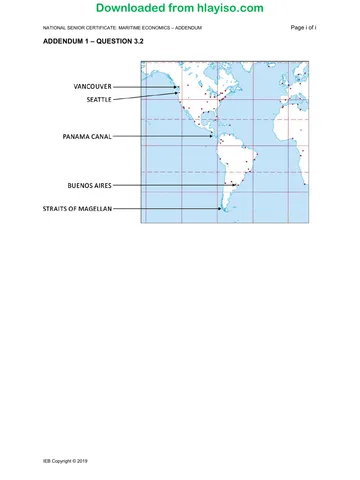
3.2 On leaving Vancouver, Pacific Trader will steam to Seattle (USA) to load steel
for Buenos Aires, Argentina, at an expected average speed of 15 knots. Study
the voyage distances provided below, and the map that is Addendum 1.
• The Magellan Straits has to be navigated very carefully and fog is often
encountered, forcing ships to reduce speed. Pilotage is compulsory for ships
passing through the straits and pilotage fees have to be paid.
• A ship wishing to transit the Panama Canal will need to allocate an extra day
for the passage and the canal tariff will have to be paid.
Route Distance
Via Magellan Straits 8 640 nautical miles (including the passage through the
Magellan Straits)
Via Panama Canal 9 360 nautical miles (including the passage through the
Panama Canal)
Now answer the following questions.
3.2.1 Why will the charterer want Pacific Trader to steam via the Magellan
Straits? (4)
3.2.2 As Pacific Trader approaches the Straits of Magellan, she
encounters thick fog and for three days, including the passage
through the straits, she steams at 10 knots. (N.B. Check EACH
answer THOROUGHLY as each answer provides an important
figure for the next calculation.)
(a) How many nautical miles will she steam during those three
days while she is steaming at 10 knots? (6)
IEB Copyright © 2019
Downloaded from hlayiso.com
NATIONAL SENIOR CERTIFICATE: MARITIME ECONOMICS Page 11 of 15
(b) How many days is the voyage from Seattle to Buenos Aires
expected to take? (Remember to include the time she was
steaming more slowly in fog.) (6)
(c) She is expected to use 42 tons of heavy fuel a day at sea.
How much heavy fuel is she expected to consume during the
voyage from Seattle to Buenos Aires? (6)
(d) If heavy fuel costs $321 per ton, what is the expected cost of
the heavy fuel used during the voyage from Seattle to Buenos
Aires? (6)
(e) If Pacific Trader had taken a full stem of heavy fuel in Seattle
(2710 tons), how much fuel is she expected to have left when
she arrives in Buenos Aires? (6)
(f) What is one word for the term ship's fuel? (2)
3.3 Study the details given below, including the ship's cargo manifest for the
voyage from Seattle to Buenos Aires. All the steel was produced by the
Bethlehem Steel Corporation, Seattle, but the rolled steel is owned by and
destined for BA Stelios Companhia, Buenos Aires; the steel plating, the
steel rods and the steel girders are owned by and destined for Angelos
Construczione, Buenos Aires.
CARGO MANIFEST: PACIFIC TRADER
VOYAGE SEATTLE (USA) – BUENOS AIRES (ARGENTINA)
HOLD CARGO TONNAGE VALUE (US$)
No 1 Steel Plating 2 600 230 000
No 2 Rolled Steel 4 200 610 000
No 3 Steel Rods 5 100 360 000
No 4 Steel Girders 4 900 550 000
No 5 Rolled Steel 4 800 440 000
Bunkers on board: 1 200 tons HVF (Value $385 200); 350 tons MDO (Value
$175 000).
NB: All bunkers on board are owned by the shipowner.
3.3.1 How many Bills of Lading will be issued for this voyage? (2)
3.3.2 Referring to this voyage, give two pieces of information that will be
shown on the front of a Bill of Lading. (4)
IEB Copyright © 2019 PLEASE TURN OVER
Downloaded from hlayiso.com
NATIONAL SENIOR CERTIFICATE: MARITIME ECONOMICS Page 12 of 15
3.3.3 As Pacific Trader clears through the eastern end of the Magellan
Straits at 10:00 on 25 July, she grounds on a reef, and is holed.
Water enters Number 1 Hold. The vessel is stuck on the reef and tug
assistance is required. The salvage tug Gaucho arrives four hours
later, and the salvors decide to wait for the spring high-tide the
following day before attempting to refloat the ship. To lighten the
ship, they also decide to jettison the steel plating cargo in Number 1
Hold, i.e. the steel plating cargo was thrown overboard.
EXTRACTS FROM TIDE TABLE – MAGELLAN STRAITS (PILOT STATION –
EASTERN END)
WATER WATER WATER
TIME DEPTH TIME DEPTH TIME DEPTH
(m) (m) (m)
25/07 0800 27.09 26/07 0001 25.01 1600 26.23
1000 26.34 0200 23.24 1800 28.15
1200 25.62 0400 25.10 2000 29.43
1400 24.23 0600 26.29 2200 27.45
1600 25.43 0800 28.42 2359 26.02
1800 26.65 1000 26.54
2000 27.94 1200 24.41
2200 26.23 1400 25.03
EXTRACT FROM WEATHER REPORT FOR THE PERIOD OF THE SALVAGE
OPERATION
WIND WESTERLY TO SOUTH-WEST, 15 KNOTS,
STRENGTHENING LATER TO 30 KNOTS
GUSTING TO 45 KNOTS
SEA STATE WESTERLY TO SW SWELL, 2 TO 3 METRES,
BECOMING 5 TO 8 METRES LATER
VISIBILITY POOR IN THE FOG, CLEARING LATER
WEATHER OCCASIONAL LIGHT RAIN, BECOMING
HEAVIER LATER
(a) What will be the best time to attempt to refloat the ship? (2)
(b) What agreement would the salvage tug owner have negotiated
with the ship's owners for this operation? (2)
3.3.4 The refloating attempt was successful. Surveyors inspected the
vessel and decided that she could continue her voyage to Buenos
Aires (at reduced speed) but that the tug would have to escort her.
(a) Which insurers would have sent surveyors to inspect the
vessel? (6)
(b) The tug owners submit a claim for salvage. Do you think that
claim will be successful? Answer YES or NO. (2)
(c) Give two reasons for your answer to Question 3.3.4 (b). (4)
IEB Copyright © 2019
Downloaded from hlayiso.com
NATIONAL SENIOR CERTIFICATE: MARITIME ECONOMICS Page 13 of 15
3.3.5 General Average is declared following the grounding of Pacific
Trader whose value is $52 000 000. All the costs (including the loss
of the cargo in Number 1 Hold, repairs, and tug's charges) total
$7 320 000. What was the contribution that Angelos Construczione
will need to make in terms of General Average? (You will need to use
information given in the introduction to Question 3.3.) (6)
[100]
QUESTION 4 IS ON THE NEXT PAGE
IEB Copyright © 2019 PLEASE TURN OVER
Downloaded from hlayiso.com
NATIONAL SENIOR CERTIFICATE: MARITIME ECONOMICS Page 14 of 15
QUESTION 4 INTERNATIONAL MARITIME TRADE
A motor car manufacturer decided to establish a large motor car assembly plant at
Port A. They estimate that about 3 000 cars will be manufactured every month,
and large numbers of containers with car parts will be landed in Port A from Korea.
Tyres will be made at an existing tyre factory in Port B, 450 nautical miles along
the coast from Port A and will be brought to Port A by containerships. Steel for the
cars will be made at an inland steel mill 320 kilometres from Port A and will be
railed to the new car assembly plant. The manufacturer expects that about 2 000
cars will be exported by ship via Port A every month.
4.1 Explain how shipping operations in Port A will be affected by the development
of the new car assembly plant. (10)
4.2 Tyres will come from Port B.
4.2.1 If 3 000 cars are built at the new plant every month, how many tyres
will need to be brought to Port A every month? (Be careful and
remember how many tyres every car will need.) (6)
4.2.2 If 300 tyres can fit into one 40-foot container, how many containers
will be needed to transport these tyres every month? (6)
4.2.3 Would you charter a ship to move these tyres from Port B to Port A?
Answer YES or NO. (2)
4.2.4 Explain your answer to Question 4.2.3. (4)
4.2.5 List the two most important contributions – apart from its influence on
shipping – that the new motor assembly plant will make to the
economy of the area around Port A. (4)
4.2.6 List three important changes the port will need to make before the
car assembly plant begins operation. (6)
4.3 The Korean car parts will be brought by containerships that will pass
through the Straits of Malacca.
4.3.1 Explain why the Straits of Malacca is so important in global shipping. (6)
4.3.2 Give the term or place described in each of the questions below:
(a) The large port that is situated at the southern end of the
straits. (2)
(b) The sea or ocean into which a ship will steam if she passes
through the straits in a north-westerly direction. (2)
(c) The sea or ocean into which a ship will steam once she has
passed the large port (referred to in Question 4.3.2 (a)) and
continues towards Japan. (2)
(d) The important bulk liquid commodity that passes through the
Straits of Malacca every day. (2)
IEB Copyright © 2019
Downloaded from hlayiso.com
NATIONAL SENIOR CERTIFICATE: MARITIME ECONOMICS Page 15 of 15
(e) A frozen commodity that would be in a reefer container aboard
a ship that is passing through the straits and on a service
between Australia and Europe. (2)
4.4 Plastic pollution of the sea is a major issue.
4.4.1 Give two reasons for plastic being a major pollutant of the sea. (4)
4.4.2 What is the major source of the plastic that is found in the sea? (2)
4.5 Which International Maritime Code or Convention deals with each of the
following?
4.5.1 The regulations that govern dumping of waste from ships. (2)
4.5.2 The content of the syllabus that has to be taught to navigating cadets
before they go to sea. (2)
4.5.3 The regulations governing lifejackets used on ships. (2)
4.5.4 The regulations that govern security systems being applied to ports
and ships. (2)
4.5.5 The regulations that apply to marine oil pollution. (2)
[70]
QUESTION 5 MARITIME ENVIRONMENTAL CHALLENGES
5.1 Before his ship arrived in Vancouver, the master of Pacific Trader indicated
that ballast water had been exchanged as required. Explain the term ballast
water exchange, and explain why this process is necessary in terms of
where this ship has come from. (See the introduction to Question 3.1.) (6)
5.2 When his ship was off the coast of Chile and heading for the Magellan
Straits, the Master of Pacific Trader notes from the synoptic chart that a
mid-latitude cyclone (a depression) and its associated cold front are
approaching from the west and will affect the passage of the ship within the
next 24 hours. What effect will this have on each of the following:
5.2.1 the wind strength in the area? (2)
5.2.2 the swell? (2)
5.2.3 container operations in a nearby port? (2)
5.3 Explain why fishing quotas have been introduced for South African
commercial fishing companies. (8)
[20]
Total: 300 marks
IEB Copyright © 2019
Study this subject
Revise the topics in this paper, then practise them question by question.
Recommended for this subject
More papers and memos for this grade and subject.
Question paperIEB
Maritime Economics Grade 12 IEB 2018 Question Paper
Question paperIEB
Maritime Economics Grade 12 IEB 2017 Question Paper
AddendumIEB
Maritime Economics Grade 12 IEB 2019 Addendum
MemorandumIEB
Maritime Economics Grade 12 IEB 2019 Memo
AddendumIEB
Maritime Economics Grade 12 IEB 2018 Addendum
MemorandumIEB