Downloaded from hlayiso.com
NATIONAL SENIOR CERTIFICATE EXAMINATION
NOVEMBER 2018
MARITIME ECONOMICS
MARKING GUIDELINES
Time: 3 hours 300 marks
These marking guidelines are prepared for use by examiners and sub-examiners,
all of whom are required to attend a standardisation meeting to ensure that the
guidelines are consistently interpreted and applied in the marking of candidates'
scripts.
The IEB will not enter into any discussions or correspondence about any marking
guidelines. It is acknowledged that there may be different views about some
matters of emphasis or detail in the guidelines. It is also recognised that,
without the benefit of attendance at a standardisation meeting, there may be
different interpretations of the application of the marking guidelines.
IEB Copyright © 2018 PLEASE TURN OVER
Skip to contentMemorandum 
Maritime Economics Grade 12 IEB 2018 Memo
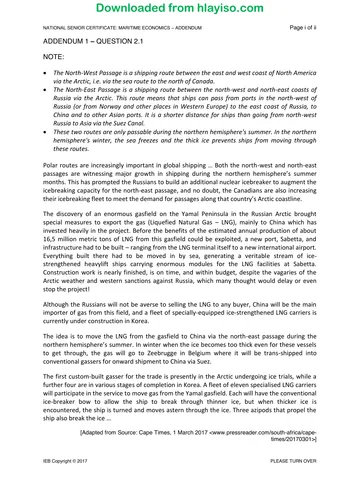
IEB Grade 12 Maritime Economics memorandum from the 2018, 7 pages. Read online or get the free PDF download, question paper linked when available.
Publisher: IEB
Maritime Economics · Grade 12 · 2018. Memorandum, 7 pages. Read online or download the PDF.
- Subject
- Maritime Economics
- Grade
- Grade 12
- Document type
- Memorandum
- Year
- 2018
- Publisher
- IEB
- Curriculum
- IEB
- Pages
- 7
- File size
- 110.2 KB
Loading document…
Loading document…
1 of 7
Document textSearch extracted text and jump to a page.
Downloaded from hlayiso.com
NATIONAL SENIOR CERTIFICATE: MARITIME ECONOMICS – MARKING GUIDELINES Page 2 of 7
QUESTION 1 MULTIPLE-CHOICE QUESTIONS
1.1 B
1.2 C
1.3 D
1.4 D
1.5 A
1.6 B
1.7 B
1.8 D
1.9 C
1.10 C
1.11 D
1.12 A
1.13 C
1.14 B
1.15 C
1.16 A
1.17 B
1.18 C
1.19 A
1.20 D
1.21 C
1.22 A
1.23 C
1.24 C
1.25 B
1.26 D
1.27 D
1.28 D
1.29 A
1.30 C
IEB Copyright © 2018 PLEASE TURN OVER
Downloaded from hlayiso.com
NATIONAL SENIOR CERTIFICATE: MARITIME ECONOMICS – MARKING GUIDELINES Page 3 of 7
QUESTION 2 THE MARITIME WORLD
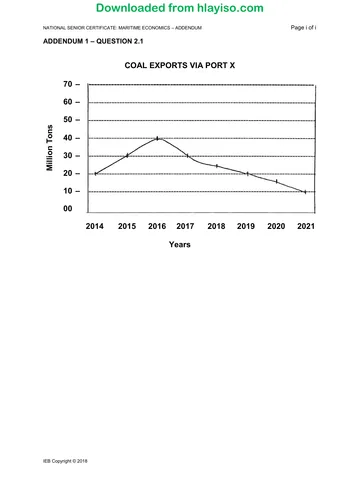
2.1 2.1.1 40 million tons
2.1.2 2016
2.1.3 (a) • Fewer coal-fired power stations.
• Less demand for coal for industrial use.
Any other plausible reason for a decrease in coal usage.
(b) • Fewer ships calling.
• Fewer jobs in the shipping sector.
• Less demand for fuel and stores.
• Less activity in the shipping sector.
30 000 000 t
2.1.4 (a) Number of bulk carriers = = 200 bulk carriers
150 000 t
200
(b) Number of bulk carriers weekly = = 3 (accept 4)
52
(c) 160 000 dwt
2.2 2.2.1 Heavy fuel oil (or HFO or HVF)
2.2.2 Generate electricity
2.2.3 • Increases the range of the ship.
• Fewer bunker stops needed.
• HFO takes less stowage space on the ship.
• More space for cargo.
2.2.4 • Using cleaner fuels.
• Installing scrubbers in exhaust flues.
2.3 Explanation of why the shipping sector needs a positive economic climate in
which to operate. Give credit for clear and reasonable argument.
IEB Copyright © 2018 PLEASE TURN OVER
Downloaded from hlayiso.com
NATIONAL SENIOR CERTIFICATE: MARITIME ECONOMICS – MARKING GUIDELINES Page 4 of 7
QUESTION 3 SHIPPING OPERATIONS
3.1 3.1.1 Panamax Bulker
80 000 t
3.1.2 (a) Hours to load = = 20 hrs + 4 hrs = 24 hours
4 000 t/h
(b) Time finished loading = 08:00 on 4 Dec + 24 hours
= 08:00 on 5 Dec
(c) 08:00 on 5 Dec + 4 hours = 12:00 on 5 Dec
(d) • Draught survey.
• Immigration clearance.
• Customs clearance.
• Cargo documentation completed.
• Other ship's documents completed.
3.1.3 (a) Shorter
(b) Dispatch
3.1.4 (a) NEWCASTLE (3d) ------- (14d) ------- SHANGHAI (7d) +
(5d) (ANCHOR)
SHANGHAI ------- (14d) -------- NEWCASTLE
(b) 3 + 5 + 14 + 7 + 14 days = 43 days
365 days
(c) = 8 voyages
43 days
(d) 8 × 80 000 t = 640 000 t
3.1.5 (a) Consignor (or Shipper)
(b) Consignor (or Shipper)
3.2 3.2.1 General arrangement plan (port side)
Plan must show:
Holds on fire (holds 3 & 4)/draught (14 m)/freeboard (5 m)
Length (223 m)/bow/stern/funnel/accommodation/keel
3.2.2 No
3.2.3 • No assistance needed.
• Ship arrived in port under her own power.
• Ship not in immediate danger.
IEB Copyright © 2018 PLEASE TURN OVER
Downloaded from hlayiso.com
NATIONAL SENIOR CERTIFICATE: MARITIME ECONOMICS – MARKING GUIDELINES Page 5 of 7
3.2.4 • Port State Control
• Flag State Control
• Classification Society
• Port of Newcastle
• Salvage Association (Hull Underwriters)
• P&I Club (correspondents)
3.2.5 off hire
3.2.6 (a) P&I Club
(b) P&I Club
3.2.7 Shipowner
3.2.8 Article on the fire aboard the ship. Award marks for concise, yet
complete and clear reporting of the incident.
IEB Copyright © 2018 PLEASE TURN OVER
Downloaded from hlayiso.com
NATIONAL SENIOR CERTIFICATE: MARITIME ECONOMICS – MARKING GUIDELINES Page 6 of 7
QUESTION 4 INTERNATIONAL TRADE
4.1 One per voyage
4.2 (a) Oz Coal Exporting Company
(b) Yangtze Coal Company
640 000 tons
4.3 4.3.1 No. of round voyages = = 4 voyages
160 000 tons
4.3.2 • Fewer voyages.
• Lower costs.
• Quicker completion of the export operation.
4.3.3 • Cargo not required in larger consignments.
• Depth of water at one of the ports.
• Air draught at one of the ports.
Any other plausible reason.
4.4 4.4.1 • Reduce import duty on parts for the ship.
• Reduce tax.
• Grant concessions for numbers of people employed.
• Subsidise some costs.
Any other plausible concession.
4.4.2 • Local suppliers of steel will benefit.
• Local suppliers of other parts will benefit.
• Local taxes are paid.
• Training of people.
• Shipyard can build more ships of a similar type.
4.4.3 Container ship
4.5 4.5.1 • At the entrance to Arabian Gulf (or Persian Gulf) (or between
Oman and Iran).
• Only sea passage between Persian Gulf and the open ocean.
• Strait of Hormuz is a strait between the Persian Gulf and the Gulf
of Oman.
4.5.2 • Arabian Gulf is largest oil-producing area.
• Most of the world's oil passes through this strait.
• Oil is the most important commodity.
• Area is arid; therefore most food has to be imported via the strait.
• Rich area – a lot of consumer goods pass through the strait.
4.6 • Shipping is an international business.
• Each voyage can involve several countries.
• Need for legal matters to be resolved amid uniform legal framework.
IEB Copyright © 2018 PLEASE TURN OVER
Downloaded from hlayiso.com
NATIONAL SENIOR CERTIFICATE: MARITIME ECONOMICS – MARKING GUIDELINES Page 7 of 7
4.7 4.7.1 International Maritime Organisation (IMO)
4.7.2 SAMSA (South African Maritime Safety Authority)
4.8 • Ask why the ship had stopped.
• Order a tug to take her in tow if necessary.
4.9 4.9.1 Land-based sources
4.9.2 • Ingested by marine animals.
• Pollutes beaches.
• Can enter river estuaries.
QUESTION 5 MARINE ENVIRONMENTAL CHALLENGES
5.1 5.1.1 Wind delays
5.1.2 No effect
5.1.3 Sailing will be delayed until the wind strength drops (vessel is high-
sided).
5.2 Fishing quotas limit the catch; an unlimited catch = destruction of number of
fish = number of breeding stock is reduced = fewer fish available for future
catch.
Total: 300 marks
IEB Copyright © 2018
Study this subject
Revise the topics in this paper, then practise them question by question.
Recommended for this subject
More papers and memos for this grade and subject.
MemorandumIEB
Maritime Economics Grade 12 IEB 2019 Memo
MemorandumIEB
Maritime Economics Grade 12 IEB 2017 Memo
AddendumIEB
Maritime Economics Grade 12 IEB 2019 Addendum
Question paperIEB
Maritime Economics Grade 12 IEB 2019 Question Paper
AddendumIEB
Maritime Economics Grade 12 IEB 2018 Addendum
Question paperIEB