
Downloaded from hlayiso.com
NATIONAL SENIOR CERTIFICATE EXAMINATION
NOVEMBER 2019
MECHANICAL TECHNOLOGY: WELDING AND METALWORK
Time: 3 hours 200 marks
PLEASE READ THE FOLLOWING INSTRUCTIONS CAREFULLY
1. This question paper consists of 12 pages and a Formula Sheet of 1 page. Please
check that your question paper is complete.
2. Read the questions carefully.
3. Answer ALL the questions.
4. Number your answers exactly as the questions are numbered.
5. Start EACH question on a NEW page.
6. Show ALL calculations and units. Round off final answers to TWO decimal places.
7. Candidates may use non-programmable, scientific calculators and drawing instruments.
8. Take the value of gravity to be 10 m/s2.
9. All dimensions are in millimetres, unless stated otherwise in the question.
10. It is in your own interest to write legibly and to present your work neatly.
11. Use the criteria below to help you manage your time.
QUESTION CONTENT MARKS TIME (minutes)
GENERIC QUESTIONS
1 Multiple-choice questions 6 6
2 Safety 10 10
3 Materials 14 14
SPECIFIC QUESTIONS
4 Mutiple-choice questions 14 10
5 Terminology (Templates) 23 20
6 Tools and Equipment 18 10
7 Forces 45 40
Joining Methods (Inspection of
8 23 20
welds)
Joining Methods (Stress and
9 18 20
distortion)
10 Maintenance 8 10
11 Terminology (Development) 21 20
TOTAL 200 180
IEB Copyright © 2019 PLEASE TURN OVER
Skip to contentQuestion paper 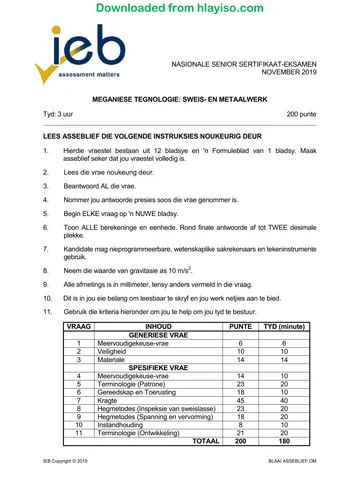
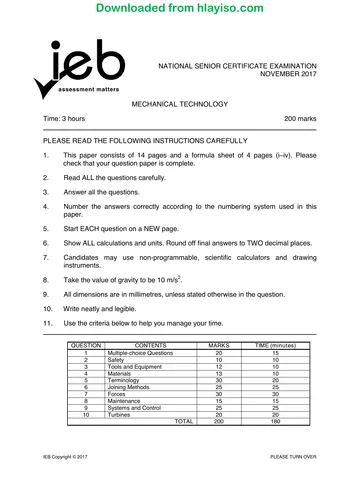
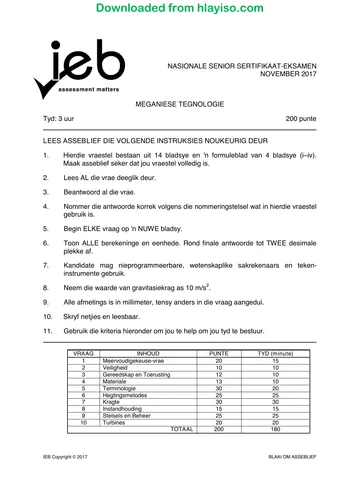
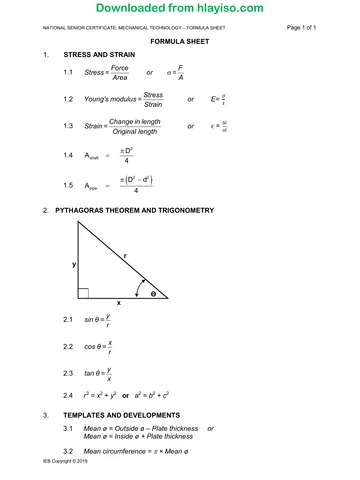
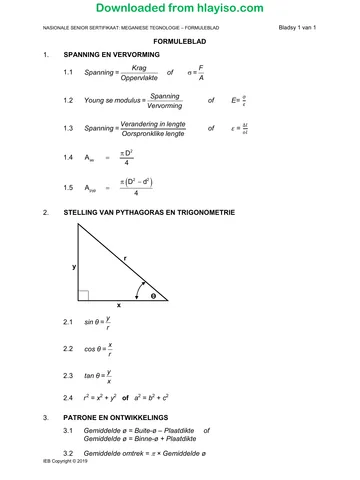
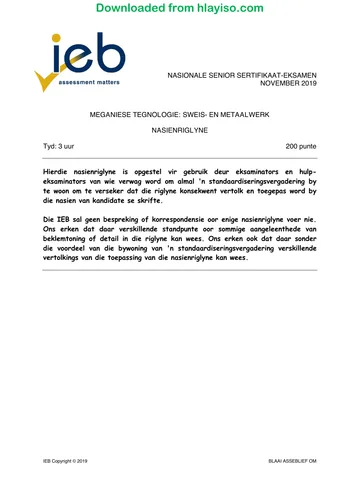
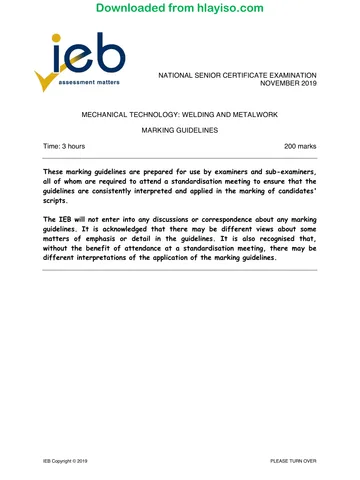
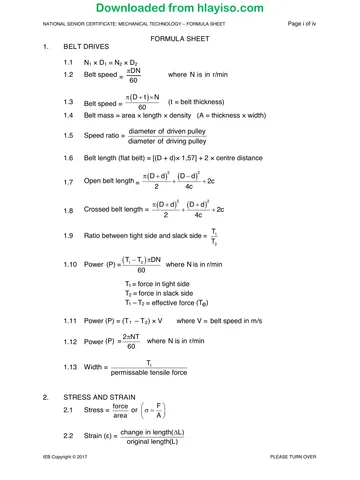
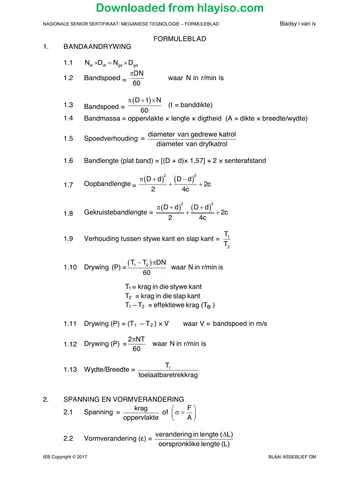
Mechanical Technology Grade 12 IEB 2019 Question Paper
IEB Grade 12 Mechanical Technology question paper from the 2019, 12 pages. Read online or get the free PDF download, memo linked when available.
Publisher: IEB
Mechanical Technology · Grade 12 · 2019. Question paper, 12 pages. Read online or download the PDF.
- Subject
- Mechanical Technology
- Grade
- Grade 12
- Document type
- Question paper
- Year
- 2019
- Publisher
- IEB
- Curriculum
- IEB
- Pages
- 12
- File size
- 404.3 KB
Loading document…
Loading document…
1 of 12
Document textSearch extracted text and jump to a page.
Downloaded from hlayiso.com
NATIONAL SENIOR CERTIFICATE: MECHANICAL TECHNOLOGY WELDING AND METALWORK Page 2 of 12
QUESTION 1 MULTIPLE-CHOICE QUESTIONS (Generic)
Various options are provided as possible answers to the following questions.
Choose a correct answer and write the letter (A–D) next to the question number
(1.1–1.6) in your ANSWER BOOK, for example: 1.7 A.
1.1 Which of the following is a basic rule for the safe handling of oxy-acetylene
equipment?
A Keep heat and flames away from flammable liquids.
B Open the cylinder valves fast.
C Make provision for acetylene and oxygen leaks.
D Strike an arc on oxygen bottles. (1)
1.2 The definition of the term pour point, in terms of lubricating oil, is as follows:
A Resistance of a fluid to deform under linear stress.
B Resistance of a fluid to deform under tensile stress.
C Lowest temperature at which the fluid can flow.
D Resistance of a fluid to deform under shear stress. (1)
1.3 Which ONE of the following safety measures applies to a tensile tester?
A Apply excessive pressure on the tester.
B Use a hammer to remove a test piece.
C Lower the fluid level of the tester.
D Wear eye protection. (1)
1.4 Which safety measure is applicable to the hydraulic press in terms of the
Occupational Health and Safety Act?
A Do not exceed the safe pressure limit.
B Work at a safe speed.
C Lubricate the work piece before mounting it on the press.
D Use the maximum pressure for thicker materials. (1)
1.5 Which heat treatment process is used to decrease the brittleness in hardened
steel?
A Annealing.
B Tempering.
C Hardening.
D Normalising. (1)
1.6 During the workshop layout, which statement below is a disadvantage of
product layout of machines?
A Handling of material is limited to a minimum.
B Less total inspection is required.
C Production control is almost automatic.
D Optimum use of equipment is not possible. (1)
[6]
IEB Copyright © 2019
Downloaded from hlayiso.com
NATIONAL SENIOR CERTIFICATE: MECHANICAL TECHNOLOGY WELDING AND METALWORK Page 3 of 12
QUESTION 2 SAFETY (Generic)
2.1 Name THREE safety rules to be remembered when using a manual guillotine. (3)
2.2 Explain the difference between an act and a condition. (4)
2.3 Name TWO advantages of a process layout. (2)
2.4 What is the maximum distance that the tool rest should be set from the
grinding wheel of a bench grinder? (1)
[10]
QUESTION 3 MATERIALS (Generic)
3.1 List THREE factors that must be considered when hardening steel through
heat treatment. (3)
3.2 Name TWO testing machines used to check the resistance to bending,
scratching, and abrasion of steel. (2)
3.3 What is the reason for doing the following heat-treatment processes?
3.3.1 Tempering (2)
3.3.2 Annealing (2)
3.3.3 Normalising (2)
3.4 What sound do the following materials make when tapped with a hammer?
3.4.1 Cast iron (1)
3.4.2 Cast steel (1)
3.4.3 Mild steel (1)
[14]
IEB Copyright © 2019 PLEASE TURN OVER
Downloaded from hlayiso.com
NATIONAL SENIOR CERTIFICATE: MECHANICAL TECHNOLOGY WELDING AND METALWORK Page 4 of 12
QUESTION 4 MULTIPLE-CHOICE QUESTIONS (Specific)
Various options are provided as possible answers to the following questions.
Choose a correct answer and write the letter (A–D) next to the question number
(4.1–4.14) in your ANSWER BOOK, for example: 4.15 A.
4.1 How are defects shown when using an X-ray machine?
A Defects visible on the weld joint
B Defects visible on film
C Defects visible by sound
D Defects visible on an oscilloscope – grain structure will be on it (1)
4.2 What does the abbreviation TSU stand for?
A Template Side Up
B Truss Side Up
C This Side Up
D Top Side Up (1)
4.3 The following tool(s) is/are used by a template maker:
A Hand saw
B Plane
C Steel tape
D All of the above (1)
4.4 The crest of a screw thread is …
A the distance from crest to crest.
B the distance between the crown and root.
C the distance travelled axially by a screw thread in one revolution.
D the highest point of the screw thread. (1)
4.5 What does the abbreviation HAZ stand for?
A Helium and Zinc
B Halogen and Zinc
C Heat-affected zone
D Holding-article zone (1)
4.6 Tensile stress can be defined or described as an internal force in a material
resisting …
A a shearing load.
B a tensile load.
C a compressive load.
D any load. (1)
IEB Copyright © 2019
Downloaded from hlayiso.com
NATIONAL SENIOR CERTIFICATE: MECHANICAL TECHNOLOGY WELDING AND METALWORK Page 5 of 12
4.7 The ultrasonic sound-wave test on welding joints will indicate the following:
A External cracks.
B External flaws.
C Internal flaws.
D Surface cracks. (1)
4.8 Porosity in welding joints can be characterised by:
A Small pinholes in the weld metal.
B A cavity at the end of the weld.
C Holes which occur in the weld metal due to trapped gases.
D A groove melted into the base metal adjacent to the edge of the
weld. (1)
4.9 What does point A in the stress/strain diagram, shown in Figure 1 below,
denote?
Figure 1
A Maximum stress
B Limit of proportionality
C Yield point
D Elastic limit (1)
4.10 Select the reason for visually inspecting welds that have been tested to
certain standards.
A To check for size of the weld.
B To train welders.
C To approve welders and welds.
D To test the skill of the welder. (1)
4.11 What type of procedure is locking out and tagging?
A Safety.
B Locking machine after work.
C To lock a machine for lunch time.
D Locking a tool in place. (1)
IEB Copyright © 2019 PLEASE TURN OVER
Downloaded from hlayiso.com
NATIONAL SENIOR CERTIFICATE: MECHANICAL TECHNOLOGY WELDING AND METALWORK Page 6 of 12
4.12 What does the term overloading mean when working on a guillotine?
A Stacking to much material on top of the guillotine.
B Cutting material exceeding the guillotine's specifications.
C Cutting heavy sheet metal.
D When two people cut at the same time. (1)
4.13 What is the main contributing factor to distortion?
A Welding current
B Heat
C Operator skill
D Type of welding rods (1)
4.14 The units of bending moments are …
A N.
B M.
C Nm.
D m. (1)
[14]
QUESTION 5 TERMINOLOGY (Templates) (Specific)
5.1 What is a flange template used for? (2)
5.2 What is a lattice girder and what is it used for? (3)
5.3 Calculate the dimensions of a 10 mm × 10 mm steel square bar that is to be
rolled into a cylindrical form with an external diameter of 700 mm. (8)
5.4 Resistance welding refers to a group of processes and uses symbols to
indicate the type of weld to be used on the joint. Name FIVE resistance
symbols used. (5)
5.5 What is the purpose of supplementary symbols? Give THREE examples. (5)
[23]
IEB Copyright © 2019
Downloaded from hlayiso.com
NATIONAL SENIOR CERTIFICATE: MECHANICAL TECHNOLOGY WELDING AND METALWORK Page 7 of 12
QUESTION 6 TOOLS AND EQUIPMENT (Specific)
6.1 Explain the principle of operation of the following equipment utilised in a
welding workshop:
6.1.1 Spot welder. (4)
6.1.2 Plasma cutter. (4)
6.2 What is the primary task of the regulators that are attached to the gas
cylinders? (2)
6.3 Name the parts of the screw thread labelled A–H in Figure 2.
Figure 2
(8)
[18]
IEB Copyright © 2019 PLEASE TURN OVER
Downloaded from hlayiso.com
NATIONAL SENIOR CERTIFICATE: MECHANICAL TECHNOLOGY WELDING AND METALWORK Page 8 of 12
QUESTION 7 FORCES (Specific)
7.1 Determine graphically the magnitude and nature of the forces in all the
members in Figure 3.
SCALE: 1 cm = 10 N
Figure 3
(15)
7.2 Figure 4 shows a simply supported beam subjected to TWO point loads.
Figure 4
7.2.1 Calculate the reactions at the supports RL and RR. (6)
7.2.2 Calculate the bending moments at points A and B. (6)
7.2.3 Draw a shear force diagram of the beam.
SCALE: 1 cm = 2 kN (5)
7.2.4 Draw a bending moment diagram of the beam.
SCALE: 1 cm = 2 Nm (4)
IEB Copyright © 2019
Downloaded from hlayiso.com
NATIONAL SENIOR CERTIFICATE: MECHANICAL TECHNOLOGY WELDING AND METALWORK Page 9 of 12
7.3 A compressive force causes internal stress of 20 MPa in a round bar made of
an unknown metal. The resistance area of the round bar is 0.0009621127 m²
and the original length is 400 mm. The force causes the round bar to shorten
by 0.005 mm. Calculate the following:
7.3.1 The strain in the metal. (3)
7.3.2 Young's modulus of elasticity for the metal. (3)
7.3.3 The diameter of the round bar in mm. (3)
[45]
QUESTION 8 JOINING METHODS (Inspection of Weld) (Specific)
8.1 It is important to observe the weld whilst welding. Observation can improve the
standard and ensure that the settings and material are correct. Name TWO
inspections for each of the following:
8.1.1 Inspection during arc welding. (2)
8.1.2 Inspection during oxy-acetylene welding. (2)
8.2 Weld gauges can be used to rapidly check a welded joint for quality. Figure 5
shows a sketch of a welded joint. Name labels A–E.
Figure 5
(5)
8.3 List the steps to be taken to do a liquid-dye penetrant test. (7)
IEB Copyright © 2019 PLEASE TURN OVER
Downloaded from hlayiso.com
NATIONAL SENIOR CERTIFICATE: MECHANICAL TECHNOLOGY WELDING AND METALWORK Page 10 of 12
8.4 The diagrams in 8.4.1 and 8.4.2 show TWO defects in welded joints. Name
the defect, the causes of the defect and the remedy. (Tabulate your
answers.)
8.4.1
(3)
8.4.2
(3)
8.5 What test is done with high-frequency sound waves? (1)
[23]
QUESTION 9 JOINING METHODS (Stresses and Distortion) (Specific)
9.1 Which FOUR factors affect shrinkage whilst welding? (4)
9.2 Name FOUR methods that can be applied to reduce distortion. (4)
9.3 Name the THREE classes of carbon steel and each class's percentage
carbon. (6)
9.4 Name FOUR factors that affect the grain size of steel when it is cold worked. (4)
[18]
QUESTION 10 MAINTENANCE (Specific)
10.1 After routine service maintenance of machinery is complete, a final inspection
of the machinery must be done. Name FOUR conditions that should be
observed before starting up machines. (4)
10.2 What will overloading of the hydraulic guillotine do to the machine? (2)
10.3 List TWO factors to be considered when choosing the cutting speed of a
drilling machine. (2)
[8]
IEB Copyright © 2019
Downloaded from hlayiso.com
NATIONAL SENIOR CERTIFICATE: MECHANICAL TECHNOLOGY WELDING AND METALWORK Page 11 of 12
QUESTION 11 TERMINOLOGY (Development) (Specific)
11.1 Figure 6 indicates a conical hopper with a height of 60 mm, a base of 70 mm,
and a top of 40 mm.
Figure 6
Calculate the following by referring to the diagram of the hopper above:
11.1.1 The angle E (3)
11.1.2 The length AC (2)
11.1.3 The circumference of the top AB (2)
11.1.4 The circumference of the base CD (2)
IEB Copyright © 2019 PLEASE TURN OVER
Downloaded from hlayiso.com
NATIONAL SENIOR CERTIFICATE: MECHANICAL TECHNOLOGY WELDING AND METALWORK Page 12 of 12
11.2 Figure 7 shows a square-to-square transition piece. In order to develop the
transition, the true lengths must be calculated.
Figure 7
Determine the following true lengths with the help of calculations:
11.2.1 True length A1 (3)
11.2.2 True length X1–X2 (3)
11.2.3 True length A2 (3)
11.2.4 True length A–X2 (3)
[21]
Total: 200 marks
IEB Copyright © 2019
Study this subject
Revise the topics in this paper, then practise them question by question.
Recommended for this subject
More papers and memos for this grade and subject.
Question paperIEB
Mechanical Technology Grade 12 IEB 2019 Question Paper (Afr)
Question paperIEB
Mechanical Technology Grade 12 IEB 2017 Question Paper
Question paperIEB
Mechanical Technology Grade 12 IEB 2017 Question Paper (Afr)
Information sheetIEB
Mechanical Technology Grade 12 IEB 2019 Information Sheet
Information sheetIEB
Mechanical Technology Grade 12 IEB 2019 Information Sheet (Afr)
MemorandumIEB
Mechanical Technology Grade 12 IEB 2019 Memo (Afrikaans)
Related documents
MemorandumIEB
Mechanical Technology Grade 12 IEB 2019 Memo
Information sheetIEB
Mechanical Technology Grade 12 IEB 2017 Information Sheet
Information sheetIEB
Mechanical Technology Grade 12 IEB 2017 Information Sheet (Afr)
MemorandumIEB
Mechanical Technology Grade 12 IEB 2017 Memo (Afrikaans)
MemorandumIEB