
Downloaded from hlayiso.com
DRAMATIC ARTS
GUIDELINES FOR
PRACTICAL ASSESSMENT TASKS
2018
These guidelines consist of 41 pages.
Copyright reserved Please turn over
You're offline
Skip to contentDocument 
View all
Dramatic Arts PAT GR 12 2018 Eng hlayiso.com
Dramatic Arts · Grade 12 · 2018 · English. Practical assessment task, 41 pages. Read online or download the PDF.
- Subject
- Dramatic Arts
- Grade
- Grade 12
- Language
- English
- Document type
- Document
- Year
- 2018
- Pages
- 41
- File size
- 708.6 KB
Loading document…
Loading document…
1 of 41
Document textSearch extracted text and jump to a page.
Downloaded from hlayiso.com
Dramatic Arts 2 DBE/PAT 2018
NSC
TABLE OF CONTENTS
1. INTRODUCTION 3
2. TEACHER GUIDELINES 3
General 3
Aims 4
Some ideas and approaches 4
How to administer the PATs 6
How to mark/assess the PATs 6
Moderation of PATs 7
3. LEARNER GUIDELINES 7
Instructions to learners 7
Practical assessment tasks 8
Assessment/Moderation rubrics/tools 9
Absence or non-submission of tasks 10
Requirements for presentation 10
Timeframes 10
Declaration of authenticity 10
4. LIST OF RESOURCES 12
5. CONCLUSION 13
STANDARDISATION/ASSESSMENT/DEBRIEFING/MODERATION TOOLS:
ANNEXURES A–R 14–41
Copyright reserved Please turn over
Downloaded from hlayiso.com
Dramatic Arts 3 DBE/PAT 2018
NSC
1. INTRODUCTION
The 16 Curriculum and Assessment Policy Statement subjects which contain a practical
component all include a practical assessment task (PAT). These subjects are:
• AGRICULTURE: Agricultural Management Practices, Agricultural Technology
• ARTS: Dance Studies, Design, Dramatic Arts, Music, Visual Arts
• SCIENCES: Computer Applications Technology, Information Technology
• SERVICES: Consumer Studies, Hospitality Studies, Tourism
• TECHNOLOGY: Civil Technology, Electrical Technology, Mechanical
Technology and Engineering Graphics and Design
A practical assessment task (PAT) mark is a compulsory component of the final promotion
mark for all candidates offering subjects that have a practical component and counts 25%
(100 marks) of the end-of-year examination mark. The PAT is implemented across the first
three terms of the school year. This is broken down into different phases or a series of
smaller activities that make-up the PAT. The PAT allows for learners to be assessed on a
regular basis during the school year and it also allows for the assessment of skills that cannot
be assessed in a written format, e.g. test or examination. It is therefore important that schools
ensure that all learners complete the practical assessment tasks within the stipulated period
to ensure that learners are resulted at the end of the school year. The planning and execution
of the PAT differs from subject to subject.
2. TEACHER GUIDELINES
GENERAL
The Annual Programme of Assessment for the subject Dramatic Arts stipulates that THREE
PATs should be completed for the School Based Assessment component. This means ONE
PAT per term for terms 1, 2 and 3. Ensure that you, as the teacher, have a clear
understanding of all four Broad Topics and their related Topics when you prepare, set,
implement and mark the PATs. All three PATs contain two sections:
SECTION 1: WRITTEN SECTION
The Written Section consists of an Assignment, an Essay and Research. The learners are
required to demonstrate cognitive and conceptual understanding of the concepts of the CAPS
Broad Topics and Topics, on which the Written Section is based, as well as planning,
reflection and record-keeping skills. The Essay, Research and Assignment may be done in
any of the three terms, and, according to a school's specific planning, in any order.
The Written Section serves to prepare learners for the Performance Sections of the PATs.
SECTION 2: PERFORMANCE SECTION
The focus of this Performance Section is to develop the practical skills and techniques
prescribed in the CAPS Broad Topics and Topics incrementally and cyclically. Learners
should demonstrate Applied Competence in the form of Dramatic Items such as a poem,
monologue, prose, scene/extract, physical theatre, film, design, directing, stage management,
etc. A variation in Dramatic Form, Style and Dramatic Movement needs to be demonstrated –
as prescribed for the end-of year examination.
Copyright reserved Please turn over
Downloaded from hlayiso.com
Dramatic Arts 4 DBE/PAT 2018
NSC
AIMS
Both the Written and the Performance Sections aim to:
• Guide learners through an academic, theoretical, conceptual, technical and practical
skills process to enable them to integrate theory and practice in a meaningful manner.
• Deepen and consolidate the learners' understanding of the classroom teaching.
• Provide the opportunity to build a varied theoretical and practical repertoire in terms of
process and product.
• Integrate theory and performance concepts, skills, knowledge and content.
• Prepare the learners for the complex cognitive and abstract theoretical and performance
demands of the mid-year, trial and end-of-year examinations:
o Paper 1: Written Examinations
o Paper 2: Performance Examinations: Theme/Audition or Technical Programme
SOME IDEAS AND APPROACHES
Theoretical, academic, technical skills:
• The subject Dramatic Arts requires a minimum of three years of rigorous, continuous
teaching, learning, development and maturation of conceptual and practical skills and
techniques. The development of voice modulation techniques, for example, should occur
over the three-year period and not only in Grade 12. (Ensure every period or moment of
teaching is focused.)
• Consciously develop learners' content knowledge as well as the academic and technical
rigour of the subject. At the end of Grade 12 learners should demonstrate applied
competence of the Curriculum Assessment Policy Statement from grade 10 to 11 to 12.
• Ensure that the integrity of technical skills, style, genres, principles etc. of the dramatic
forms are maintained and demonstrated at all times. (E.g. an Elizabethan poem may be
interpreted creatively, but the form and style of the Iambic rhythm, the phrasing, the
heightened poetry, the vocal and physical delivery, etc. of the Elizabethan genre must be
mastered and demonstrated.)
Process, meaning, creative voice and product:
• Very few learners can complete a brief on their own. You, as the teacher, have to guide
the creative process from inception to completion.
• Be open-minded about divergent ideas, creative inferences, innovation and offered
solutions.
• Remember; you must guide the aesthetic qualities and skills of any tasks.
• It is the task of the teacher to enable the learner to find his/her own creative voice.
• Try to lead the learners to find individual and innovative approaches/solutions.
• Guide them to develop ideas by working from first-hand observation, e.g. attending and
discussing plays, critiquing TV programmes and films.
• Guide learners to eliminate source material that lacks aesthetic appeal. Dramatic forms
should be selected from a credible published source or recognised oral tradition rooted in
indigenous knowledge systems.
Learners' styles and creativity:
• Learners should be confident and calculated risk takers, try out new ideas and
processes without fear of failure.
• It is important that confidence is encouraged and nurtured to ensure learners feel
comfortable about taking risks and learning from their mistakes (high risk, low threat/safe
environment).
• As far as possible know your learners in order to develop their particular
strengths. Some will be careful planners, while others work more intuitively. Some will
exhibit their work process outwardly; others work quietly, slowly and in private.
Appreciate, nurture and most of all respect all work styles.
• Extrovert learners may readily offer a solution to another learner's mistakes. Encourage
the extrovert to rather focus on their own process and encourage the introverted learner
to offer and communicate their own solution. Extroverts are not necessary leaders. Often
the introverted learner is more conscious of detail, process and meaning. Encouraging
these learners' voices and opinions may enrich discussions.
Copyright reserved Please turn over
Downloaded from hlayiso.com
Dramatic Arts 5 DBE/PAT 2018
NSC
• Creative activity may proceed from a number of different levels, from the lower end, such
as producing a written framework for a Theme Programme; or the upper level,
developing an entirely fresh and individualised process and/or outcome. Both are valid
and will reach the same product.
• There are many ways of creating. Be flexible enough to allow learners to find and use
their unique ways. One expects a stronger individual interpretation and style in Grade 12
learners. Resources or the lack thereof does not determine the level of creativity but
rather what the learner does with the resources available. The focus is on innovation and
the ability to re-imagine, re-frame or re-present a process or product from their unique
view of the world.
Assessment, Feedback, Listening And Communication Skills:
• Continuously do informal assessment. Discuss the progress of learners' work with them
individually. Guide learners to find their own solutions, rather than imposing your ideas
on them.
• Have regular 'critique sessions' during which the teacher facilitates learners to talk and
discuss their own and their classmates' processes/work in an informed and constructive
way. Base this discussion on the content in the CAPS.
• Be skilled at listening. Dramatic Arts is about effective and skilled communication.
Practice and promote a culture of 'listening to understand' and not only 'listening to
dispute 'or 'disagree'. Be careful not to enforce a simplistic understanding of 'listening' to
ensure learners do not 'talk back' or express their points of view or the construct from
which they have worked. You may even have to change your well thought out position
based on knowledge you have as a teacher. There is not only one way of doing things,
but multiple ways.
• It is important to view and discuss the body of work by a learner continuously throughout
the year. It helps to identify their strengths and improvement points. Teach learners to
record their experiences and feelings in a reflective manner in their individual process
journal. Apply the principle of: 'what is not documented did not happen'. This will help to
develop critical and creative thinking and will make the selection and ordering of ideas
more transparent and conscious.
• Beware of damaging criticism. It is advisable to start with the positive and then move to
areas that can be improved. Enter into dialogue with a learner, e.g. 'I think it will be more
effective if you change this … What do you think?' This makes them feel part of the
process and makes them think about their work. Use coaching and de-briefing skills.
Create a space in which learners may disagree with you.
• Guide learners to be effective, independent, critical, creative and reflective thinkers.
• Do not under-estimate learners; challenge them, as they often rise to the occasion. Use
a range of questions that extend and deepen learners' ability to re-consider their creative
choices. This should lead them to ask: 'If this is how it is now, how else can it be?'
Reflection:
• As a starting point; reflection is best done against the agreed upon rubric criteria.
Reflective practices include reflection before, during and after a task. Teachers may also,
as a learning tool, use the rubric criteria as questions to debrief and reflect on the
evidence produced by the learner. At the end of each PAT (Written and Performance
Sections) there should be reflection/feedback on the work presented. Teachers need to
share comments on the strengths and the weaknesses. This will provide learning and
improvement points for the learner to implement for continuous development and
mastery.
• This may be either written or verbal feedback and it could take the form of:
self-reflection, class/teacher reflection and marking, peer reflection, open critique
session guided by the TEACHER as well as the learner.
Copyright reserved Please turn over
Downloaded from hlayiso.com
Dramatic Arts 6 DBE/PAT 2018
NSC
HOW TO ADMINISTER THE PATs
Teachers must:
• Ensure all resources, required to do the PATs, are available. See the DBE Catalogue for
Learning and Teaching Support Materials (LTSM).
• Timetable sufficient time for learners' to complete the PATs (select contact time during and/or
after school).
• Use the 'Guidelines for Standardisation for an Assessment, Essay and Research'.
• Monitor that PATs are on schedule during the process.
• Conduct informal continuous assessment.
• Complete formal assessment; use the rubrics provided in this document.
• Complete the Excel mark sheets/spread sheets provided by the province.
• Follow school policy regarding submission of marks.
• File the Lesson Plans, based on the CAPS Topics as well as the Assessment Tasks' briefs
and instructions for the PATS, in your TEACHER FILE: Lesson Planning and Assessment
Tasks. This file must be available for cluster/provincial moderation.
• Record, on an ordinary cellphone, the Performance Sections' of learners' PATs and
down load onto a DVD. This DVD must be available for cluster/provincial moderation
• File the learners' written evidence of the Written Sections of the PATs in the 'Learner File:
Assessment Evidence'. This file must be available for cluster/provincial moderation. All
learners' Written Section' and 'Performance Section' evidence should be available at all
times and remains the property of the Department of Education until the final results are
released. Keep these written pieces and DVD-saved performances locked up in your
classroom. This is a school responsibility.
HOW TO MARK/ASSESS THE PATs
Teachers should ensure the assessment/marking of PATs:
• Measures the achievement of the CAPS Broad Topics and Topics content: Concepts/Skills/
Knowledge as well as the theoretical and performance components of each topic.
• Determines whether the Guideline for Standardisation of the Written Sections was followed.
• Uses the relevant rubrics for the:
o Theory Section: rubrics for the assignment, essay and research
o Performance Section: rubrics for a poem, monologue, prose, movement and extract as
well as the rubrics for the design, directing, film and stage management
• Measures the learners' evidence and performance against the criteria and level descriptors of
the rubrics.
• Adhere to the following principles of:
o Fairness: An assessment should allow for learners of both genders and all
backgrounds to do equally well and for all to have an equal opportunity to demonstrate
the skills and knowledge being assessed'. Fairness is jeopardized if bias exists in the
task or in the marker. For a task to be fair, its content, context, and performance
expectations should: reflect knowledge, skills, and experiences that are equally familiar
and appropriate to all learners. This should include access to research resources.
o Reliability: An assessment is considered reliable when the same results occur
regardless of when the assessment occurs or who does the marking.
o Validity: An indication of how well an assessment actually measures what it is
supposed to measure. A valid task should :
Reflect actual knowledge or performance, not test-taking skills and memorised
facts
Engage and motivate students to perform to the best of their ability
Be consistent with current educational theory and practice
Be rigorous in lesson plan design and teaching. This includes the design of
detailed instructions, activities and exercises. This promotes scaffolding of
thinking, planning for thinking, assessing thinking about content, recognising the
level of thinking students demonstrate.
Be relevant in Lesson Plan design and teaching. This enhances the learners'
ability to evaluate, justify, infer, predict, conclude, revise, recommend, argue,
prioritise, formulate, etc. A relevant task is when learners recognise the
connection between classroom knowledge and situations outside the classroom.
Copyright reserved Please turn over
Downloaded from hlayiso.com
Dramatic Arts 7 DBE/PAT 2018
NSC
MODERATION OF PATs
Moderation is a shared understanding of quality assurance, standard setting and
standardisation. It is done to ensure tasks are fair, valid and reliable.
Moderation:
• Should take place each time a PAT is completed.
• Checks that assessment tasks and activities provide learners with fair and valid
opportunities to meet the standards and expectations of the CAPS.
• Agrees on strengths in learners' performances and plans to improve skills and
knowledge.
• Provides feedback on teacher judgments (setting and marking of PATs) to improve
teaching.
• Raises standards and expectations and levels of consistency.
• Ensures learning is at the appropriate level and that learners develop skills for learning,
life and work.
• Should be conducted internally at school level, by a peer teacher/HOD/principal before
the cluster/provincial moderation.
• Should involve teachers in the moderation process to ensure professional development.
• Should ensure inter-rated reliability in the awarding of marks.
3. LEARNER GUIDELINES
INSTRUCTIONS TO LEARNERS
Three PATs have to be completed during the year, one per term. Each of the three PATs
consists of a Written Section as well as a Performance Section. You have to complete both
and at all times integrate the theoretical and practical concepts, skills and content. Use these
three PATs to:
Select and prepare your three contrasting drama items for your end-of-year performance
examination. NOTE: To select an item a month before your final examination is not a good
idea, the reason being that emotional and physical integration takes time. You need months
to grow into a poem, etc.
Writing and theoretical conceptualisations, as well as higher-order thinking skills, take
practice. Use the three writing/theoretical sections to ensure you know how to write down
your thoughts, learning and experiences in a form that will achieve the aims, structure and
form of a written examination.
Copyright reserved Please turn over
Downloaded from hlayiso.com
Dramatic Arts 8 DBE/PAT 2018
NSC
PRACTICAL ASSESSMENT TASKS
ANNUAL PROGRAMME OF ASSESSMENT GRADES 10 AND 11
TERM 1 TERM 2 TERM 3 TERM 4
Task 1: Task 3: Task 5:
Practical Assessment Practical Assessment Practical Assessment
Task (Group) Task (Individual) Task (Group)
• Written Section (25) • Written Section (25) • Written Section (25)
• Performance Section • Performance Section • Performance Section
(25) (25) (25)
Task 7:
Grade 10 and 11
Task 2: Task 4: Task 6:
end-of-year examinations
Test (50) Grade 10 Test (50)
• Written Examinations
Mid-year examinations
(150)
• Written examinations
• Performance
(100)
Examinations (150)
• Performance examinations
(100)
Grade 11
Mid-year examinations
• Written examinations (150)
• Performance examinations
(150)
ANNUAL PROGRAMME OF ASSESSMENT GRADE 12
TERM 1 TERM 2 TERM 3 TERM 4
Task 1: Task 3: Task 5:
Practical Assessment Practical Assessment Practical Assessment
Task (Group) Task (Individual) Task (Group)
External Examinations
• Written Section (25) • Written Section (25) • Written Section (25)
• Written Examinations
• Performance Section • Performance Section • Performance Section
(150)
(25) (25) (25)
• Performance Examinations
(150)
Task 2: Task 4: Task 6:
Test (50) Mid-year examinations Test (50)
• Written examinations(150)
• Performance examinations
(150)
Copyright reserved Please turn over
Downloaded from hlayiso.com
Dramatic Arts 9 DBE/PAT 2018
NSC
WRITTEN SECTIONS
ASSIGNMENT: ESSAY: RESEARCH:
Learners: Learners: Learners:
This PAT section may be in Use the theoretical support Collect additional outside
the form of a journal, collage, material given to you by your source material to do
etc. Make sure you know teacher (textbook, classroom independent research to
exactly what your teacher notes) to write the essay. enrich your understanding of
has briefed and instructed Make sure you follow the the research brief and
you to present. You should guidelines and brief instructions. Make sure that
follow the following instructions set by your you look at as many different
processes when you write an teacher. Use this PAT sources as possible. The
assignment: section to practise your Internet is only one option
1. Collect essay-writing skills in and is not always reliable.
2. Analyse preparation for the essays in At all times be ethical in your
3. Interpret the written examination. research. Research requires:
4. Reflect Ensure your essay follows 1. Use of a variety of
5. Present the basic format of an essay: sources
information on your own 1. Introduction 2. Comparing
personal practical skills 2. Body of knowledge 3. Contrasting
development journey. 3. Conclusion 4. Highlighting
5. Finding
6. Presenting
PERFORMANCE SECTIONS
Each of the three Performance Sections of the PATs should be used by you to select,
prepare and present your items for your end-of-year final external performance examination:
• Theme Programme OR
• Audition Programme OR
• Technical Theatre Programme.
Once you have performed your drama item, keep on developing and improving it throughout
the year.
Theme/Audition Programme: (Any THREE of the drama forms below)
Monologue, poem, extract, prose, dramatised prose, storytelling, choral verse, indigenous
drama, satirical revue, physical theatre, movement, mime
Technical Theatre Programme
• Design (scenery/properties/lighting/sound/costume/make-up)
• Directing
• Film
• Stage management
ASSESSMENT/MODERATION RUBRICS/TOOLS
WRITTEN SECTION:
An assessment tool/rubric is provided for the assignment, essay and research tasks.
PERFORMANCE SECTION: (Acting and Technical candidates)
An assessment tool/rubric is provided for the extract, poetry, prose, monologue, movement,
design, directing, film and stage management
Teachers should provide each learner with a copy of the relevant rubric and facilitate
understanding of the criteria and levels of achievement with the learners prior to the
execution of tasks. As part of the practice of assessment for learning (AfL) samples of good
practice with a clear indication on 'where, why, how and what' marks were awarded could be
provided.
Copyright reserved Please turn over
Downloaded from hlayiso.com
Dramatic Arts 10 DBE/PAT 2018
NSC
ABSENCE OR NON-SUBMISSION OF TASKS
Absence or non-submission of PATs will result in an INCOMPLETE mark.
Only if a valid medical certificate is presented the day the learner returns to school, can
another deadline for handing in or performing the PAT be decided on by both the teacher and
the learner.
REQUIREMENTS FOR PRESENTATION
See the list of Minimum Resources; Facilities, Equipment, LTSM, Timetabling, etc. that
should be in place before the PATs are taught, implemented and assessed. These resources
should be available to the teacher and the learners to complete the three PATs.
The teacher should draw up a Lesson Plan for ALL of the Topics being covered by a specific
PAT. In addition, a clear assessment brief with detailed Instructions should be facilitated with
the learners.
TIMEFRAMES
Teachers:
Teach, administer, assess and record and report on one PAT per term 1, 2 and 3.
Communicate in writing, exact, non-negotiable dates for handing in or performing the PATs.
Learners:
Ensure you follow the assessment brief and instruction. Hand in, or perform your PAT on time
to ensure you achieve a mark.
DECLARATION OF AUTHENTICITY
Practical tasks are not limited to a performance. The PAT tasks (1, 3, and 5) are a
preparation for your mid-year, trial and end-of-year written and performance exams.
Integrate the theory aspect of the PAT with the practical aspect.
Engage in planning, preparation, research, skills building and reflection before you hand in
your essay, research task or assignment.
Rehearse your performance items until you can perform fluently and with confidence. Use
these smaller opportunities to lay a foundation for your later theoretical and practical exam
work.
Learners will be required to answer practical-based questions, using a theoretical framework
in their final written paper.
Copyright reserved Please turn over
Downloaded from hlayiso.com
Dramatic Arts 11 DBE/PAT 2018
NSC
DECLARATION OF AUTHENTICITY
This declaration must be completed and signed by the learner and countersigned by the
teacher and covers all evidence submitted.
Learner name and surname: Date:
I declare that the attached PRACTICAL ASSESSMENT TASK is all my own work and does
not include any work completed by anyone other than myself. I have completed this Task in
accordance with instructions and within the stipulated time limits
Learner signature: Date:
Teacher confirmation
On behalf of …………………………………………………………... (centre name),
I confirm that the above-mentioned learner, to the best of my knowledge, is the sole author of
the completed assignment attached and the assessment has been completed under the
required conditions.
Teacher signature: Date:
Principal signature: Date:
Copyright reserved Please turn over
Downloaded from hlayiso.com
Dramatic Arts 12 DBE/PAT 2018
NSC
4. LIST OF RESOURCES
The subject Dramatic Arts, like other subjects, requires specific resources for effective
teaching, learning, presentations and performances to be achieved. Due to the fact that the
subject is included on the designated list for higher education, officials from the Department
of Basic Education have a responsibility to ensure that there is an informed and committed
approach and that the minimum requirements are in place to ensure integrity in the teaching
and learning of the subject.
It is important to note that these resources need not be expensive or elaborate. It is equally
important that if a school is not able to provide these subject-specific resources, the subject
should preferably not be offered. Learners will be disadvantaged if resources such as the
DBE-screened textbook, the prescribed play texts, chairs, a reasonably functional
space/room for practical work are not available. (The DBE, through the annual norms and
standards, makes provision for minimum resources to be purchased for all the subjects
offered by a school. The school management committee or the equivalent of this body is
tasked to ensure every subject's needs are met.) In November/December of the previous
year teachers should ensure that the following basic resources are in evidence in the
Dramatic Arts classroom for a functional start to the new year.
HUMAN RESOURCES
A teacher with a drama qualification should teach and assess the CAPS and its respective
annual programme of assessment which includes the three PATs. A suitably qualified teacher
for this subject could have the following background:
• Bachelor of Arts (Drama)
• Bachelor of Education (Drama)
• Licentiate in Drama Teaching, Trinity College
• Diploma from LAMDA
• Or any other officially accredited, 360-credit qualification in Drama
• In addition to all of the above, a one-year post graduate certificate in teaching or diploma
in training.
Note the following is not an appropriate or sufficient QUALIFICATION to teach Dramatic Arts:
• The creative arts teacher
• An actor/actress
• A drama enthusiast
• The English language teacher
• The dance teacher
LTSM: EQUIPMENT AND FACILITIES
Learners have to experiment with the use of space, levels, entrances and exits. The following
basic items will provide opportunity to fill the empty space creatively with set pieces etc.:
• A double classroom, or an open space
• 4 x wooden blocks/cubes/plastic crates/chairs or an alternative affordable equivalent
• 4 x flat screens/hanging cloths/cardboard boxes or an alternative affordable alternative
• 4 x stage steps or an alternative affordable alternative
• Tables and chairs serve as décor pieces
• The following are not prerequisites, but would be advantageous; a stage, lighting and
sound facilities
Copyright reserved Please turn over
Downloaded from hlayiso.com
Dramatic Arts 13 DBE/PAT 2018
NSC
LTSM: REFERENCE
• 1 x DBE screened textbook per learner
• 1 x DBE screened textbook per Dramatic Arts teacher
• 3 x play texts, 1 for each of the selected genres; 3 x per learner
Photo copies of any of the above are illegal and can subject the school to lawsuits by
publishers, textbook writers and playwrights
• 1 x workbook per learner
• 1 x file/box for the teacher to safe keep planning and administration for moderation
• 1 x file/box for the teacher to safe keep learner assessment evidence for moderation
• 1 x black T-shirt/comfortable top + black long pants + shoes for learners' practical work
• Field trips. 1 x per term to a professional play/drama
• The following is not a prerequisite, but would be beneficial: A DVD of a professionally
staged performance of a play text in each of the genres and dramatic movements. The
learners have to demonstrate understanding and applied competence in e.g.
o Commedia dell' arte Scapino by Moliere
o African Drama Forms
o Greek Theatre: Antigone by Sophocles
o South African Theatre; any works/workshop play
o Elizabethan Theatre: Romeo and Juliet by William Shakespeare
o Realism: Have you seen Zandile by Gina Hlope
o Epic Theatre: Caucasian Chalk Circle by Bertolt Brecht
o Theatre of the Absurd: Waiting for Godot by Samuel Beckett
o Post-Modern Theatre: Top girls by Carol Churchill
o South African Theatre. Pre-1994: Woza Albert! by M Ngema, P Mtwa,
B Simon
o South African Theatre. Post-1994 Missing by Reza de Wet
ARTICULATION WITH GET
The teacher teaching drama in creative arts should ensure learners in Grades 8 and 9 receive
a solid foundation in the concepts: skills, knowledge and content of Drama. At the end of
Grade 9 it is suggested that interviews and auditions be held to ensure only learners who are
disciplined, hardworking, interested, committed and have potential are selected for FET
Dramatic Arts. Ensure that the class ratio for Grade 10 is as per the provincial set norm. If
Drama classes are too full injuries may occur and the interested and hardworking drama
learners may be disadvantaged because they will not receive the dedicated one on one
teaching required for drama.
TIMETABLING
Timetabling for Dramatic Arts requires a minimum of 4 hours per week during school time
and one hour after school. This hour ration is applicable to Grades 10, 11 and 12
respectively. Additional time is essential after school hours for completion of the PATs,
remediation, enrichment, rehearsals, performances and field trips to view drama
performances.
5. CONCLUSION
On completion of the practical assessment task learners should be able to demonstrate their
understanding of the industry, enhance their knowledge, skills, values and reasoning abilities
as well as establish connections to life outside the classroom and address real-world
challenges. The PAT furthermore develops learners' life skills and provides opportunities for
learners to engage in their own learning.
Copyright reserved Please turn over
Downloaded from hlayiso.com
Dramatic Arts 14 DBE/PAT 2018
NSC
STANDARDISATION/ASSESSMENT/DEBRIEFING/MODERATION TOOLS
WRITTEN TASKS: GUIDELINES FOR STANDARDISATION
ANNEXURE A: ASSIGNMENT
ANNEXURE B: ESSAY
ANNEXURE C: RESEARCH
WRITTEN TASKS: ASSESSMENT TOOLS: RUBRICS
ANNEXURE D: ASSIGNMENT
ANNEXURE E: ESSAY
ANNEXURE F: RESEARCH
THEME/AUDITION PROGRAMME : ASSESSMENT TOOLS: RUBRICS
ANNEXURE G: EXTRACT
ANNEXURE H: MONOLOGUE
ANNEXURE I: MOVEMENT
ANNEXURE J: POETRY
ANNEXURE K: PROSE
TECHNICAL THEATRE PROGRAMME: ASSESSMENT TOOLS: RUBRICS
ANNEXURE L: DESIGN
ANNEXURE M: DIRECTING/THEATRE MAKING
ANNEXURE N: FILM MAKING
ANNEXURE O: STAGE MANAGEMENT
DEBRIEF OF THE PATs PERFORMANCE SECTIONS
ANNEXURE P: QUESTION STEMS
ASSESSMENT/MARKING AND MODERATION: GOOD PRACTICE
ANNEXURE Q: PRINCIPLES
MODERATION TOOL
ANNEXURE R: TEMPLATE FOR INTERNAL SCHOOL AND PROVINCIAL MODERATION
Copyright reserved Please turn over
Downloaded from hlayiso.com
Dramatic Arts 15 DBE/PAT 2018
NSC
ANNEXURE A:
GUIDELINES STANDARDISATION ASSIGNMENT
TEACHERS:
• Use these guidelines to ensure national standardisation of the PATs
• Attach these guidelines to the Assessment section of each respective Lesson Plan
• Use these guidelines to ensure the following is covered
1 BRIEF WITH INSTRUCTIONS TO THE LEARNER
• Provide a written brief with detailed instructions underpinned by a 'learning–how-to-learn' and a
'learning-by-doing' focus on how to deliver on the task .State the supporting conceptual scaffolding
underpinned by a triple loop learning focus on the 'what, why and how' of the deliverables to be
achieved and evidence to be generated.
• Base the brief and instructions on the relevant CAPS Broad Topic and Topics taught to the learner
• Use clear and unambiguous instructions; suitable terminology e.g. analyse/describe/compare/
evaluate/predict/own opinion and what is the quality and quantity of evidence the learner has to
generate for that command verb
• Clarify the:
o Format
o Purpose
o Content
o Sources available,
o Scope and limitations
o Criteria against which the PAT will be assessed by alluding to the rubric criteria with a focus
on the high end of quality
• Demonstrate sensitivity and respect for gender, inclusivity, culture, class, race and religion
• Provide an exact, non-negotiable date for the deadline of submission of the PAT
2 FORMAT
May be any one of the following options:
• Journal entry
• Design Note Book entry
• Director Note Book entry
• Film Note Book entry
• Stage Manager Prompt Book entry
• Collage
• Montage
• Visual imagery (e.g. photos, video, DVD, audio recording, etc.)
• Worksheet designed by teacher
• Reflection on excursions, field trips, community spaces/sites
• Film analysis, Theatre reviews
• (Any other method that the teacher has found to be useful such as teach backs)
3 PURPOSE AND CONTENT:
The Assignment should:
• Integrate and conceptualise the classroom teaching of the CAPS Broad Topic(s) and Topic(s)
• Reflect, in a meaningful manner, on classroom teaching and provide proof of the continuous
development of the learner
• Demonstrate the learners' level of cognitive understanding and application of concepts (content,
knowledge, skills and attitudes)
• Integrate practical experience and theoretical support material (exercises, activities,
rehearsals classroom notes and other source material)
• Use Dramatic Arts terminology (the language of drama) in all written presentations
• Adhere to, and explain, specialised language in the case of Indigenous Knowledge Systems
• Prepare for the Performance component of the PAT
4 SOURCES
• Base the content of the Assignment on the CAPS Broad Topic(s) and their respective Topic(s)
• Use, critically reflect on, and creatively apply the Textbook, Play Texts, classroom note and
practical work
Copyright reserved Please turn over
Downloaded from hlayiso.com
Dramatic Arts 16 DBE/PAT 2018
NSC
ANNEXURE B:
GUIDELINES STANDARDISATION ESSAY
TEACHERS:
• Use these guidelines to ensure national standardisation of the PATs.
• Attach these guidelines to the Assessment section of each respective Lesson Plan.
• Use these guidelines to ensure the following is covered:
1 BRIEF WITH INSTRUCTIONS TO THE LEARNER
• Provide a written brief with detailed instructions underpinned by a 'learning-how-to-learn' and a
'learning-by-doing' focus on how to deliver on the task .State the supporting conceptual
scaffolding underpinned by a triple loop learning focus on the 'what, why and how' of the
deliverables to be achieved and evidence to be generated.
• Base the brief and instructions on the relevant CAPS Broad Topic and Topics taught to the learner
• Use clear and unambiguous instructions; suitable terminology e.g. analyse/describe/compare/
evaluate/predict/own opinion and what is the quality and quantity of evidence the learner has to
generate for that command verb
• Ensure the essay topic gives direction and guidelines to scaffold learner understanding and
interpretation.
• Clarify the:
o Format
o Purpose and content
o Sources available
o Scope and limitations
o Criteria against which the PAT will be assessed by alluding to the rubric criteria with a focus
on the high end of quality
• Demonstrate sensitivity and respect for gender, inclusivity, culture, class, race and religion
• Provide an exact, non-negotiable date for the deadline of submission of the PAT
2 FORMAT
• Should be a formal structure, e.g. write in paragraphs, use core ideas
• Should consist of an Introduction, Main body of knowledge and a Conclusion/Summary
• The length and weighting may be guided by the following: ± 1 page; approximately ± 250 words
3 PURPOSE AND CONTENT
The Essay should:
• Integrate and conceptualise the classroom teaching of the CAPS Broad Topic(s) and Topic(s)
• Reflect in a meaningful manner, on classroom teaching and provide proof of the continuous
development of the learner
• Demonstrate the learner's level of cognitive understanding and application of concepts (content,
knowledge, skills and attitudes)
• Integrate practical experience and theoretical support material (exercises, activities, rehearsals
classroom notes and other source material)
• Use Dramatic Arts terminology (the language of drama) in all written presentations
• Adhere to, and explain, specialised language in the case of indigenous knowledge systems
• Prepare for the Performance component of the PAT
4 SOURCES
• Base the content of the essay on the CAPS Broad Topic(s) and their respective Topic(s)
• Use, critically reflect on, and creatively apply the textbook, play texts, classroom notes and
practical work
Copyright reserved Please turn over
Downloaded from hlayiso.com
Dramatic Arts 17 DBE/PAT 2018
NSC
ANNEXURE C:
GUIDELINES STANDARDISATION RESEARCH
TEACHERS:
• Use these guidelines to ensure national standardisation of the PATs.
• Attach these guidelines to the Assessment section of each respective Lesson Plan.
• Use these guidelines to ensure the following is covered:
1 BRIEF WITH INSTRUCTIONS TO THE LEARNER
• Provide a written brief with detailed instructions underpinned by a 'learning-how-to-learn' and a 'learning-by-
doing' focus on how to deliver on the task. State the supporting conceptual scaffolding underpinned by a triple
loop learning focus on the 'what, why and how' of the deliverables to be achieved and evidence to be
generated.
• Base the brief and instructions on the relevant CAPS Broad Topic and Topics taught to the learner
• Use clear and unambiguous instruction; suitable terminology e.g. analyse/describe/ compare/evaluate/
predict/own opinion and what is the quality and quantity of evidence the learner has to generate for that
command verb
Clarify the:
o Format, Purpose and Content
o Sources available
o Scope and limitations
o Criteria against which the PAT will be assessed by alluding to the rubric criteria with a focus on the high
end of quality
• Demonstrate sensitivity and respect for gender, inclusivity, culture, class, race and religion
• Provide an exact, non-negotiable date for the deadline of submission of the PAT
2 FORMAT
May be any of the following options:
• Written presentation (i.e. research essay with introduction, main body of knowledge,
• Conclusion/Summary). A minimum of ± 300 words which is approximately 2 pages
• Oral presentation, substantiated by written material (notes, brainstorming, etc.), 3–5 minutes per learner
• Forum discussion/debate and accompanying script (15 minutes per group of 5)
• Media: Film clips/video/TV inserts/radio/newspaper clips: 3–5 minutes
• PowerPoint presentations: 3–5 minutes per learner
• Interviews and accompanying scripts (5 minutes per pair/group)
• Models [of stage types, set designs, décor, props, costumes] with accompanying written evidence
• Collage, mixed media or montage
3 PURPOSE AND CONTENT
The Research should:
• Integrate and conceptualise the classroom teaching of the CAPS Broad Topic(s) and Topic(s)
• Reflect, in a meaningful manner, on the teaching and provides proof of the continuous development of the
learner
• Demonstrate the learner's level of cognitive understanding and application of concepts (content, knowledge,
skills and attitudes). By extension focus on not just providing a range of questions with cognitive levels of
difficulty and complexity, but show, in a transparent way, to learners the ways of thinking and 'Habits of Mind'
behind the construction of questions and their narrative.
• Integrate practical experience and theoretical support material (exercises, activities, rehearsals classroom
notes and other source material)
• Use Dramatic Arts terminology (the language of drama) in all presentations
• Adhere to and explain specialised language in the case of indigenous knowledge systems
• Prepare for the Performance component of the PAT
4 SOURCES
• Base the content of the Research on the CAPS Broad Topic(s) and their respective Topic(s)
• Use, critically reflect on, and creatively apply the Textbook, Play Texts, classroom note and practical work
• Investigate a wide variety of sources (interviews, field testing, human resources, books, newspapers,
television, film, Internet, etc.)
• Select and use a minimum of two sources (not more than one Internet source)
• Reference all the sources investigated and used
• Use the Oxford reference system
• Do not plagiarise
• Apply ethical use of sources including oral interviews from ethnographic studies and 'insider views' arising from
indigenous knowledge systems.
• Teachers investigate the Internet addresses and hard copy sources provided by the learners, to ensure all
sources were applied ethically
Copyright reserved Please turn over
Downloaded from hlayiso.com
Dramatic Arts 18 DBE/PAT 2018
NSC
ANNEXURE D:
ASSIGNMENT ASSESSMENT TOOL RUBRIC
CRITERIA NOT ACHIEVED MODERATELY ADEQUATE SUBSTANTIAL MERITORIOUS
0–29 ACHIEVED ACHIEVEMENT ACHIEVEMENT ACHIEVEMENT
30–49 50–69 70–89 90–100
Planning The learner The learner The learner is The learner is able The learner
skills struggles with demonstrates able to solve to effectively solve demonstrates
problem solving some ability to problems problems through creative and
and shows poor solve problems creatively through planning that is cognitive skills
planning skills. and provides effective workable and showing thorough
elementary planning. suitable for the planning.
planning. process. A wide range of
imaginative
processes is used to
provide an
opportunity for
exploration.
Applied The learner has The learner The learner The learner can The learner
skills difficulty in experiences executes plans execute plans and imaginatively
applying skills difficulty and integrates a has the ability to manages and
and executing and variety of skills integrate conceptual/ executes thorough
demonstrates implementing contribute performance / leadership. Shows
poor planning and towards meeting design and process an independent
management of integration of the requirements. skills which initiative in
the process. skills. contribute towards integrating an
Some meeting the extensive range of
requirements are requirements. skills which
met. contribute towards
meeting the
requirements
Recording The learner The learner has The learner is The learner uses The learner is able
and shows an difficulty using able to use a relevant vocabulary to demonstrate
reflection elementary use of vocabulary. limited range of effectively and specialised use of
skills vocabulary Demonstrates a vocabulary and shows awareness of vocabulary (e.g.
without showing limited knowledge can incorporate incorporating styles, dramatic terminology
an awareness of of the styles, styles, forms, forms, processes /genre/world view
styles, forms and forms and conventions and and conventions in including
conventions in conventions processes in end- final product. representation of
the end-product. required for the product. race, class, gender
process and and culture) and is
product. able to critically
evaluate and
compare human
commonality,
diversity and
experience. Uses
relevant forms,
styles, conventions
and processes in the
final presentation.
Copyright reserved Please turn over
Downloaded from hlayiso.com
Dramatic Arts 19 DBE/PAT 2018
NSC
ANNEXURE E:
ESSAY ASSESSMENT TOOL RUBRIC
CATEGORY MARK % LEVEL DESCRIPTORS
Well organised, comprehensive and coherent, polished structure. Supported by an
exceptionally high level of competence. Able to process information into original
Outstanding
23–25 interpretation and thoughtful selection of facts. Uses a variety of original and/or
achievement
relevant dramatic references. Insightful, fluent, observation and knowledge
powerfully expressed.
Well organised, detailed and coherent, polished structure. Supported by a high
Meritorious level of competence to process information with an original interpretation and
20–22
achievement careful selection of facts. Using original or unusual selection of relevant dramatic
references. Shows insight, observation and knowledge well expressed.
Organised, detailed, some level of competence, some slight flaws evident in
structure. Interesting reading, clear statements, convincing, simple direct language.
Substantial
17–19 Supported by a selection of relevant dramatic references. Shows good grasp of the
achievement
theme/task, some insightful statements. Obvious care and effort taken with
presentation.
Structure not always logical or organised, reasonable effort with presentation.
Displays a basic understanding but tends towards mechanistic and stereotyped
Adequate
13–16 responses at times. Adequate selection of relevant 'dramatic' references. Adequate
achievement
reading but appears memorised. Not always a high level of insight, sometimes
unimaginative but has some ability to justify discussion.
Not always organised or logically constructed. Not always enough information,
Moderate
10–12 some flashes of insight. Limited selection of information. Poor language skills.
achievement
Argument lacks supporting discussion.
Rambling – no structure, limited vocabulary, little attempt to present information in
Elementary
6–9 an acceptable manner. Very little information, jumbled, not easy to follow, often
achievement
irrelevant. Poor language skills. Argument lacks supporting discussion.
Incoherent, very little work, limited skills. Irrelevant information provided, lacking
Not achieved 0–5
any supporting discussion.
Copyright reserved Please turn over
Downloaded from hlayiso.com
Dramatic Arts 20 DBE/PAT 2018
NSC
ANNEXURE F:
RESEARCH ASSESSMENT TOOL RUBRIC
CATEGORY MARK % LEVEL DESCRIPTORS
Well organised, comprehensive and coherent, polished structure.
Supported by an exceptionally high level of competence. Able to process
information into original interpretation and thoughtful selection of facts.
Outstanding
23–25 Uses a variety of original and/or relevant dramatic references and/or film
achievement
clips. Insightful, fluent, observation and knowledge powerfully expressed.
If models or mixed media are used they are well executed and compliment
the research.
Well organised, detailed and coherent, polished structure. Supported by a
high level of competence to process information with an original
Meritorious interpretation and careful selection of facts. Using original or unusual
20–22
achievement selection of relevant dramatic references and/or film clips. Shows insight,
observation and knowledge well expressed. If models or mixed media are
used they complement to the research.
Organised, detailed, some level of competence, some slight flaws evident
in structure. Interesting reading, clear statements, convincing, simple
Substantial direct language. Supported by a selection of relevant dramatic references
17–19
achievement and/or film clips. Shows good grasp of the theme/task, some insightful
statements. Obvious care and effort taken with presentation. If models or
mixed media are used they link to the research.
Structure not always logical or organised, reasonable effort with
presentation. Displays a basic understanding but tends towards
mechanistic and stereotyped responses at times. Adequate selection of
Adequate
13–16 relevant dramatic references and/or film. Adequate reading but appears
achievement
memorised. Not always a high level of insight, sometimes unimaginative
but has some ability to justify discussion. If models or mixed media are
used they are not always supported by the research.
Not always organised or logically constructed. Not always enough
Moderate information, some flashes of insight. Limited selection of information. Poor
10–12
achievement language skills. Argument lacks supporting discussion. Any models or
mixed media used are not well executed or particularly relevant.
Rambling – no structure, limited vocabulary, little attempt to present
information in an acceptable manner. Very little information, jumbled, not
Elementary
6–9 easy to follow, often irrelevant. Poor language skills. Argument lacks
achievement
supporting discussion. Unlikely to have a supporting model, any mixed
media will be poorly executed.
Incoherent, very little work, limited skills. Irrelevant information provided,
Not achieved 0–5
lacking any supporting discussion.
Copyright reserved Please turn over
Downloaded from hlayiso.com
Dramatic Arts 21 DBE/PAT 2018
NSC
ANNEXURE G:
EXTRACT ASSESSMENT TOOL RUBRIC
CRITERIA ACHIEVED WITH MERIT ACHIEVED PARTIALLY ACHIEVED
Preparation The learner knows the words of the The learner knows the words, but The learner does not know the
scene and shows evidence of there is some evidence of words of the scene and does not
thought, planning and rehearsal. uncertainty or lack of rehearsal. show evidence of thought, planning
and rehearsal.
Under- The learner demonstrates an There is evidence of some The learner demonstrates little or
standing of understanding of the scene as it understanding of the scene, but no understanding of the scene as it
scene stands within the context of the certain aspects have been stands within the context of the
play as a whole. S/he understands overlooked, or this is not consistent play as a whole. S/he does not
the basic dilemma/conflict of the throughout. There may be a understand the basic
scene and the characters and their possible misinterpretation on the dilemma/conflict of the scene,
motivations. basis of the given circumstances. his/her character and their
motivations. There is complete
misinterpretation of the given
circumstances.
Vocal The learner demonstrates an The learner is partially successful The learner is unsuccessful in
character- understanding of the elements of in creating and sustaining vocal creating and sustaining vocal
isation voice work and to communicate the characterisation, or there may be characterisation, or there is vocal
personality, background, class, indications of vocal strain. Certain strain throughout the performance.
age, education and status of the aspects of the characterisation The vocal characterisation is
speaker. S/he is able to interpret a may be inappropriate for the inappropriate for the particular
text, make appropriate choices for particular character or context. character or context.
characterisation and use these
chosen characteristics without
vocal strain. These characteristics
may include pitch, intonation,
range, rhythm, accent, tone and
quality in order to successfully and
appropriately convey the voice of
their character.
Vocal clarity The learner is able to speak The learner is partially successful The learner is unsuccessful in
distinctly and audibly. S/he is able in speaking distinctly and audibly. speaking distinctly and audibly.
to use the appropriate volume for a There are momentary lapses, or Volume can only be attained with
space, without vocal strain. there are moments of strain. vocal strain.
Physical The learner demonstrates an ability The learner is partially successful The learner is unsuccessful in
character- to adapt their body in terms of in creating and sustaining a creating and sustaining a physical
isation posture, energy, weight, size and physical characterisation, or there characterisation, or there is
quality of gestures, physical may be indications of unnecessary excessive unnecessary tension
rhythms and habits in order to tension. Certain aspects of the displayed throughout the
successfully and appropriately characterisation may be performance. The physical
convey the physicality of his/her inappropriate for the particular characterisation is inappropriate for
character. character or context. the particular character or context.
Stage sense The learner demonstrates an ability The learner is partially successful The learner is unsuccessful in
– use of to use the stage space in using the stage space using the stage space
space appropriately and interestingly, in a appropriately and interestingly. appropriately and interestingly.
way that the performance This may be due to self- He/She is consistently self-
communicates clearly to the consciousness, upstaging of conscious, upstages others,
audience and indicates others, and uncertainty in moments uncertain and moves often without
understanding of the changing or unmotivated movements at motivation.
dynamics of the relationship being times.
explored. All movement is
motivated.
Emotional The learner demonstrates an ability The learner is partially successful in The learner is unsuccessful in
connection to connect with the emotions of terms of connecting with the terms of connecting with the
his/her character appropriately and emotions of his/her character emotions of his/her character
effectively in such a way as to appropriately and effectively; he/she appropriately and effectively;
convince the audience of the truth may not be totally convincing at all he/she is not at all convincing, or
of these emotions. moments, or may react their emotional choices are entirely
inappropriately in some moments. inappropriate.
Copyright reserved Please turn over
Downloaded from hlayiso.com
Dramatic Arts 22 DBE/PAT 2018
NSC
EXTRACT ASSESSMENT TOOL RUBRIC
CRITERIA ACHIEVED WITH MERIT ACHIEVED PARTIALLY ACHIEVED
Playing of The learner demonstrates an The learner is partially successful The learner is unsuccessful in
subtext understanding of subtext and in terms of playing subtext and terms of playing subtext and
intention, in order to make a intentions, and making the intentions. Lines and actions seem
character's lines and actions character's lines and actions unmotivated, there is little evidence
understandable to an audience. understandable to an audience. of thinking through the subtext,
The character's inner life is The character's inner life is not fully lines are recited by rote and the
explored and sustained throughout sustained throughout the character's inner life is not
the performance. performance. sustained throughout the
performance.
Interaction – The learner demonstrates the The learner is inconsistent in terms There is little or no evidence of
listening ability to stay in character when of staying in character when not staying in character when not
not speaking or not being the speaking or not being the focus of speaking or not being the focus of
focus of attention and continues to attention; reactions to the other attention; there is little reaction to
react and listen to the other characters and listening are not the other characters and little or no
characters on stage at all times. sustained throughout the scene. listening.
Development The learner demonstrates an The learner is inconsistent in The learner is unaware of their
of understanding of his/her demonstrating his/her character's character's status in relation to the
relationship character's status in relation to the status in relation to the other other characters in the scene; the
other characters in the scene and characters in the scene; the relationship between the
he/she allows the relationship relationship between the characters does not grow, develop
between the characters to grow, characters does not grow, develop and change through the course of
develop and change appropriately. and change appropriately. the scene.
Believability The learner is believable at all The learner is believable in some The learner is seldom believable
times within the context of the moments within the context of the within the context of the scene or
scene or play. scene or play. play.
Structure of The learner demonstrates an The scene does not have a There is little evidence of structure,
scene understanding of how the sufficiently clear beginning, middle no real sense of a beginning,
playwright has structured the and end. The climax is not middle and end, and the climax is
scene. The scene has a clear completely realised. not realised.
beginning, middle and end. There
is a climax or high point to the
scene.
Creation of The learner demonstrates the There is some attempt to interpret There is little or no attempt to
appropriate ability to interpret genre and style genre and style appropriately but interpret genre and style
genre/style appropriately and to fulfill the the demands of the genre/style are appropriately and the demands of
demands of the genre/style in not fully realised throughout the the genre/style are not realised
such aspects as relationship to the scene. throughout the scene.
audience, believability within style,
timing, appropriate physical action
etc.
Impact of The scene is memorable, effective The scene has some memorable, The scene has few or no
scene and engaging. effective, engaging moments, but memorable, effective, engaging
these are inconsistent. moments.
Copyright reserved Please turn over
Downloaded from hlayiso.com
Dramatic Arts 23 DBE/PAT 2018
NSC
ANNEXURE H:
MONOLOGUE ASSESSMENT TOOL RUBRIC
CRITERIA ACHIEVED WITH MERIT ACHIEVED PARTIALLY ACHIEVED
Preparation The learner knows the words of The learner knows the words, but The learner does not know the
the monologue and shows there is some evidence of words of the monologue and does
evidence of thought, planning and uncertainty or lack of rehearsal. not show evidence of thought,
rehearsal. planning and rehearsal.
Understanding The learner demonstrates an There is evidence of some The learner demonstrates little or
of monologue exceptional understanding of the understanding of the monologue, no understanding of the
monologue as it stands within the but certain aspects have been monologue as it stands within the
context of the play as a whole. overlooked, or this is not consistent context of the play as a whole.
S/he understands the basic throughout. There may be a S/he does not understand the
dilemma/conflict of the possible misinterpretation on the basic dilemma/conflict of the
monologue, his/her character and basis of the given circumstances. monologue, his/her character and
motivation. motivation. There is complete
misinterpretation on the basis of
the given circumstances.
Vocal The learner demonstrates a clear The learner is partially successful in The learner is unsuccessful in
character- understanding of how all the creating and sustaining a vocal creating and sustaining a vocal
isation elements of voice work come characterisation, or there may be characterisation, or there is vocal
together to communicate the indications of vocal strain. Certain strain throughout the performance.
personality, background, class, aspects of the characterisation may The vocal characterisation is
age, education and status of the be inappropriate for the particular inappropriate for the particular
speaker. S/he is able to interpret character or context. character or context.
a text, make appropriate choices
for characterisation and use these
chosen characteristics without
vocal strain. These characteristics
may include: pitch, intonation,
range, rhythm, accent, tone and
quality in order to successfully and
appropriately convey the
character.
Vocal clarity The learner speaks distinctly and The learner is partially successful in The learner is unsuccessful in
audibly. S/he is able to use the speaking distinctly and audibly. speaking distinctly and audibly.
appropriate volume for a space, There are momentary lapses, or Volume can only be attained with
without vocal strain. there are moments of strain. vocal strain.
Physical The learner demonstrates an The learner is partially successful in The learner is unsuccessful in
character- ability to adapt his/her body in creating and sustaining a physical creating and sustaining a physical
isation terms of posture, energy, weight, characterisation, or there may be characterisation, or there is
size and quality of gestures, indications of unnecessary tension. excessive unnecessary tension
physical rhythms and habits in Certain aspects of the displayed throughout the
order to successfully and characterisation may be performance. The physical
appropriately convey the inappropriate for the particular characterisation is inappropriate
physicality of his/her character. character or context. for the character
Stage sense — The learner demonstrates an The learner is partially successful in The learner is unsuccessful in
use of space ability to use the stage space using the stage space appropriately using the stage space
appropriately and interestingly, in and interestingly. This may be due appropriately and interestingly.
such a way that the performance to self-consciousness and He/she is consistently self-
communicates clearly to the uncertainty in moments or conscious is uncertain and moves
audience. All movement is unmotivated movements at times. often without motivation.
motivated. (Note: In a monologue,
stillness may be appropriate;
however, then the focus should be
on how the size of the playing
space needs to be filled in order
for the audience to be affected by
the performance.)
Emotional The learner demonstrates an The learner is partially successful in The learner is unsuccessful in
connection ability to connect with the terms of connecting with the terms of connecting with the
emotions of his/her character emotions of his/her character emotions of his/her character
appropriately and effectively in appropriately and effectively; appropriately and effectively;
such a way as to convince the he/she may not be totally he/she is unconvincing, or his/her
audience of the truth of these convincing at all moments, or emotional choices are entirely
emotions. she/he may react inappropriately at inappropriate.
certain moments.
Copyright reserved Please turn over
Downloaded from hlayiso.com
Dramatic Arts 24 DBE/PAT 2018
NSC
MONOLOGUE ASSESSMENT TOOL RUBRIC
CRITERIA ACHIEVED WITH MERIT ACHIEVED PARTIALLY ACHIEVED
Playing of The learner demonstrates an The learner is partially successful in The learner is unsuccessful in
subtext understanding of subtext and terms of playing subtext and playing subtext and intentions.
intention, in order to convey the intentions, and conveying the Lines and actions seem
character meaningfully to an character meaningfully to an unmotivated, there is little
audience. The character's inner audience. The character's inner life evidence of thinking through the
life is explored and sustained is not fully sustained throughout the subtext, lines are recited by rote
throughout the performance. performance. and the character's inner life is not
sustained throughout the
performance.
Interpretation The learner interprets the The learner is partially successful in The learner is unsuccessful in
of character character intelligently, making interpreting the character; certain interpreting the character, he/she
choices which are effective and choices are not as effective or makes completely inappropriate
appropriate, based on his/her appropriate as is desirable, or there choices, which are not effective
knowledge of the play from which is evidence of a lack of and there is evidence of
the monologue comes. understanding of the given misunderstanding of the given
circumstances of the play. circumstances of the play.
Relationship The learner demonstrates the The learner is partially successful in The learner is unsuccessful in
to listener ability to create the invisible creating the invisible listener creating the invisible listener
listener through visualisation or, if through visualisation or through through visualisation. There is little
appropriate, through using the using the audience as the listener. understanding of his/her
audience as this listener. S/He There is some understanding of character's status in relation to the
demonstrates an understanding of his/her character's status in relation listener or what their possible
his/her character's status in to the listener, but little sense of responses may be.
relation to the listener and his/her what responses there are.
possible responses to what is
being said throughout the
monologue.
Believability The learner is believable at all The learner is believable in some The learner is seldom believable
times within the context of the moments within the context of the within the context of the
monologue. monologue. monologue.
Structure of The learner demonstrates an The learner does not have a There is little evidence of structure,
monologue understanding of how the sufficiently clear beginning, middle no real sense of a beginning,
playwright has structured the and end. The climax is not middle and end, and the climax is
monologue. The monologue has a completely realised. not realised.
clear beginning, middle and end.
Rhythms/ The learner demonstrates an The learner does not consistently There is little or no variety within
Shape of understanding of the ebb and flow create sufficient variety within the the monologue, pace is too regular
monologue of the monologue, the use of pace monologue, pace is at times too or monotonous and there is no
to highlight or build to a climax, regular or monotonous and there is evidence of different beats within
the shifting rhythms of different little evidence of different beats the monologue.
beats within the monologue. within the monologue.
Creation of The learner demonstrates the There is some attempt to interpret There is little or no attempt to
appropriate ability to interpret genre and style genre and style appropriately but interpret genre and style
genre/style appropriately and then fulfill the the demands of the genre/style are appropriately and the demands of
demands of the genre/style in not fully realised throughout the the genre/style are not realised
terms of such aspects as monologue. throughout the monologue.
relationship to the audience,
believability within style, timing,
appropriate physical action etc.
Impact of The monologue is memorable, The monologue has some The monologue has few or no
monologue effective and engaging. memorable, effective, engaging memorable, effective, engaging
moments, but these are moments.
inconsistent.
Copyright reserved Please turn over
Downloaded from hlayiso.com
Dramatic Arts 25 DBE/PAT 2018
NSC
ANNEXURE I:
MOVEMENT ASSESSMENT TOOL RUBRIC
ASSESSMENT ACHIEVED WITH MERIT ACHIEVED PARTIALLY ACHIEVED
CRITERIA
Practical/ The learner uses a wide range of The learner is able to use a good The learner is able to use a limited
Performance Skills movements to create sequences range of movements to create range of movements to create
1. The ability to and is able to understand and use sequences and shows an sequences and shows little
understand and use a various styles and processes. The understanding of styles and understanding of the use of space,
range of movements, learner shows a good processes of movement forms. time and movement dynamics.
choreographic styles understanding of the use of space,
and processes. time and dynamics.
2. The ability to show The learner performs clearly and The learner is able to perform The learner is able to perform
competence and confidently so that the movement ideas quite well so that his/her some movement ideas clearly and
confidence in ideas are understood by those movement ideas are understood. now needs to develop more
movement watching. confidence when showing his/her
performance so that work to others.
ideas are understood.
Experimentation The learner uses a wide range of The learner is beginning to use With help the learner can use
(Development and stimuli and accompaniments with some stimuli and accompaniments some stimuli and accompaniments
realisation of ideas) confidence to create complex with confidence to create simple to create simple sequences. The
1. The ability to use a sequences and show excellent sequences and is developing a learner is able to use simple
variety of stimuli, use of various movement styles. range of movement styles. movement styles to complete an
accompaniments and item.
movement styles to
create sequences.
2. The ability to extend The learner is able to develop a With increasing confidence the With help and encouragement the
and develop an idea simple idea into a complex learner is able to develop an idea, learner is able to develop a simple
from the original sequence making clear decision trying out and choosing idea trying out and choosing
stimulus and to try out about his/her work. The learner movements in order to complete movements that he/she feels fit
ideas and select and can explain his/her reasons for the item. the item.
reject them with selecting certain movements with
reason and confidence confidence and use movement
in order to complete a vocabulary to explain what he/she
task. means.
Critical Awareness The learner is able to make The learner is able to make When prompted the learner can
1. The ability to make detailed and analytical comments comments that help to improve make comments on movement
analytical comments about movement work that lead to his/her own and other people's work his/she has done to help
which helps improve improvements in structure and work. improve the work.
the structure and performance.
performance of own
and others' work.
2. The ability to The learner can see and make The learner is able to make The learner is able to see obvious
compare and contrast subtle connections and connections between different connections between different
the work of different comparisons between a variety of movement works and styles movement works with help and
movement styles. movement styles and is able to encouragement from the teacher.
describe clearly what he/she
means.
3. The ability to The learner shows a clear The learner is able to talk about With prompting the learner can
understand the understanding of movement forms movement using appropriate talk about why he/she likes a
difference between and structure through the words and is beginning to be movement item using words to
objective judgments comments and vocabulary he/she aware of his/her own movement describe the movement content
and personal uses. The learner is aware of preferences. (e.g. line, shape, rhythm,
preference when his/her own preferences in dynamics, etc.)
creating, using and movement and is able to withhold
watching movement them or use them appropriately.
forms.
Personal and Social The learner works co-operatively The learner usually works co- The learner can sometimes work
Skills as a member of a group and operatively with other people co-operatively with other people
1. The ability to work contributes and shares many contributing some ideas to the sharing some ideas in order to
co-operatively as a ideas with the group. work of the group. help complete a group task.
member of a group,
sharing ideas so that
the task is completed.
2. The ability to work The learner is very well organised The learner is able to organise The learner can develop and
at developing an idea and is able to develop ideas his/her work and can develop complete some items of work on
and organising work successfully on his/her own simple ideas on his/her own. his/her own with help and
independently. encouragement from the teacher.
3. The ability to The learner remains interested in The learner is usually able to keep The learner is sometimes able to
sustain focus and the task through all the stages of working on an idea from beginning keep working on an idea from
effort through all development and works hard even to end. beginning to end when helped and
stages and kinds of when the task is challenging. encouraged.
work.
Copyright reserved Please turn over
Downloaded from hlayiso.com
Dramatic Arts 26 DBE/PAT 2018
NSC
ANNEXURE J:
POETRY ASSESSMENT TOOL RUBRIC
CRITERIA ACHIEVED WITH MERIT ACHIEVED PARTIALLY ACHIEVED
Preparation The learner knows the words of the The learner knows the words, but The learner does not know the words
poem and shows evidence of there is some evidence of uncertainty of the poem and does not show
thought, planning and rehearsal. or lack of rehearsal. evidence of thought, planning and
rehearsal.
Under- The learner demonstrates an The learner demonstrates some The learner does not demonstrate an
standing understanding of the poem and the understanding of the poem and understanding of the poem and
poem interpretation is appropriate and his/her interpretation should be his/her interpretation is not
justified. appropriate and justified. appropriate or justified.
Expression of The learner has an understanding of The learner is only partially The learner is not successful in
meaning how to convey meaning through the successful in conveying the meaning conveying the meaning of the poem.
use of such elements as phrasing, of the poem. The meaning is not The meaning is not unclear or
pause, emphasis, intonation and always fully clear or expressive. inexpressively conveyed.
tone. S/he is able to interpret a text
using these elements and
communicates the meaning of the
text clearly and expressively.
Vocal The learner is able to create a The learner's voice is not consistently The learner's voice is not balanced or
expressive- balanced, pleasant voice quality, balanced or pleasant to listen to, or pleasant to listen to, or there is
ness which is unique, appropriate to them there is some evidence of vocal evidence of excessive vocal strain.
and shows no signs of strain. S/he strain. S/he is not completely S/he is unsuccessful in exploring and
explores and utilises the expressive, successful in exploring and utilising utilising the expressive, interpretative
interpretative and musical aspects of the expressive, interpretative and and musical aspects of speech
speech sounds in order to express musical aspects of speech sounds in sounds in order to express subtleties
subtleties of meaning, and convey order to express subtleties of of meaning, and convey
mood/atmosphere. meaning, and convey mood/atmosphere.
mood/atmosphere.
Vocal clarity The learner is able to speak distinctly The learner is partially successful in The learner is unsuccessful in
and audibly. S/he is able to use the speaking distinctly and audibly. speaking distinctly and audibly.
appropriate volume for a space, There are momentary lapses, or Volume can only be attained with
without vocal strain. there are moments of strain. vocal strain.
Physical work The learner chooses movement or The learner's choices in terms of The learner chooses movement or
stillness appropriate to the poem and movement or stillness are not always stillness which is inappropriate to the
to their interpretation of it. S/he appropriate to the poem OR there is poem OR there is little or no control
demonstrates control over his/her a lack of control over his/her over his/her physicality OR there is
body in order to release unnecessary physicality in moments OR there is evidence of excessive unnecessary
tension and establish optimal evidence of unnecessary tension at tension OR the body is not integrated
alignment and balance. The body times OR the body is not fully into the poem at all.
supports the voice and is integrated integrated into the poem.
with it.
Emotional The learner is able to connect with The learner is partially successful in The learner is unsuccessful in terms
connection the emotions of the persona in the terms of connecting with the of connecting with the emotions of
poem appropriately and effectively in emotions of the persona of the poem the persona of the poem
such a way as to convince the appropriately and effectively; they appropriately and effectively; he/she
audience of the truth of these may not be totally convincing at all is not at all convincing, or his/her
emotions. moments, or they may react emotional choices are entirely
inappropriately in certain moments. inappropriate.
Creation of The learner uses vocal and physical The creation of mood is inconsistent, There is little or no evidence of
appropriate expressiveness in order to create a inappropriate or not fully sustained understanding of the mood, or the
mood mood/atmosphere appropriate to the through the poem. ability to create it effectively using
poem. voice and body.
Use of poetic The learner demonstrates a mastery Not all poetic devices are handled Poetic devices are not well handled.
devices of the poetic devices inherent in their with mastery.
poem, including utilisation of pause,
line and verse lengths, rhythm,
meter, rhyme, imagery, register, tone.
Impact of The learner's presentation is The poem has some memorable, The poem has few or no memorable,
poem memorable, effective and engaging. effective, engaging moments, but effective, engaging moments.
these are inconsistent.
Copyright reserved Please turn over
Downloaded from hlayiso.com
Dramatic Arts 27 DBE/PAT 2018
NSC
ANNEXURE K:
PROSE ASSESSMENT TOOL RUBRIC
CRITERIA ACHIEVED WITH MERIT ACHIEVED PARTIALLY ACHIEVED
Preparation The learner knows the words of the The learner knows the words, but The learner does not know the
piece of prose and shows evidence there is some evidence of words of the piece of prose and
of thought, planning and rehearsal. uncertainty or lack of rehearsal. does not show evidence of thought,
planning and rehearsal.
Understanding The learner demonstrates an The learner must demonstrate The learner does not demonstrate
of piece of prose understanding of the piece of prose some understanding of the piece an understanding of the piece of
and his/her interpretation is of prose and his/her interpretation prose and his/her interpretation is
appropriate and justified. should be appropriate and not appropriate or justified.
justified.
Expression of The learner conveys meaning The learner is only partially The learner is not successful in
meaning successfully through the use of such successful in conveying the conveying the meaning of the piece
elements as phrasing, pause, meaning of the piece of prose. of prose. The meaning is unclear
emphasis, intonation and tone. S/he The meaning is not always fully and lacks expression.
is able to interpret a text using these clear or expressive.
elements and communicates the
meaning of the text clearly and
expressively.
Vocal The learner uses a balanced, The learner's voice is not The learner's voice is not balanced
expressiveness pleasant voice quality, which is consistently balanced or pleasant or pleasant to listen to, or there is
unique, appropriate to him/her and to listen to, or there is some evidence of excessive vocal strain.
shows no signs of strain. S/he evidence of vocal strain. S/he is S/he is not at all successful in
explores and utilises the expressive, not completely successful in exploring and utilising the
interpretative and musical aspects of exploring and utilising the expressive, interpretative and
speech sounds in order to express expressive, interpretative and musical aspects of speech sounds in
subtleties of meaning, and convey musical aspects of speech sounds order to express subtleties of
mood/atmosphere. in order to express subtleties of meaning, and convey
meaning, and convey mood/atmosphere.
mood/atmosphere.
Vocal clarity The learner is able to speak The learner is partially successful The learner is unsuccessful in
distinctly and audibly. S/he is able to in speaking distinctly and audibly. speaking distinctly and audibly.
use the appropriate volume for a There are momentary lapses, or Volume can only be attained with
space, without vocal strain. there are moments of strain. vocal strain.
Physical work The learner chooses movement or The learner's choices in terms of The learner chooses movement or
stillness appropriate to the piece of movement or stillness are not stillness which is inappropriate to the
prose and to his/her interpretation of always appropriate to the piece of piece of prose OR there is little or no
it. S/he demonstrates control over prose OR there is a lack of control control over their physicality OR
his/her body in order to release over his/her physicality in there is evidence of excessive
unnecessary tension and establish moments OR there is evidence of unnecessary tension. There is little
optimal alignment and balance. unnecessary tension at times. or no evidence of creativity and
The body is used creatively and There is only some evidence of expressiveness in the use of body.
expressively to assist in the creativity and expressiveness in
dramatisation of the piece of prose. the use of body.
Dramatisation as The learner uses original, effective The learner is partially effective or The learner is unsuccessful in terms
performance theatrical means to dramatise the original in terms of using theatrical of using theatrical means to
piece piece of prose so that it works as a means to dramatise the piece of dramatise the piece of prose so that
piece of performance. prose so that it works as a piece of it works as a piece of performance.
performance.
Use of The learner is aware of the style of The learner is partially successful The learner is unsuccessful in using
appropriate their story and the narrative in using the appropriate narrative appropriate narrative techniques or
narrative techniques inherent in it. (e.g. techniques, or uses some but not uses completely inappropriate
techniques intsomi telling, fairy tales or myths) others, or uses some inappropriate narrative techniques, which do not
S/He uses appropriate techniques in narrative techniques, which do not work with the style of his/her story.
his/her performance, including: third- work with the style of their story.
person narration, character creation,
use of song or chant etc.
Creation of The learner demonstrates an ability There is some attempt to interpret There is little or no attempt to
appropriate to use vocal and physical genre and style appropriately but interpret genre and style
mood/style/ expressiveness in order to create a the demands of the genre/style are appropriately and the demands of
genre mood/style/genre appropriate to the not fully realised throughout the the genre/style are not realised
piece of prose. prose piece. throughout the prose piece.
Impact of prose The learner's presentation is The prose piece has some The prose piece has few or no
piece memorable, effective and engaging. memorable, effective, engaging memorable, effective, engaging
moments, but these are moments.
inconsistent.
Copyright reserved Please turn over
Downloaded from hlayiso.com
Dramatic Arts 28 DBE/PAT 2018
NSC
ANNEXURE L:
DESIGN ASSESSMENT TOOL RUBRIC
SET, COSTUME, MUSIC, SOUND EFFECTS, SET PIECES, SPECIAL EFFECTS, PROPERTIES, LIGHTING, MAKE-UP
LEVEL 1 2 3 4 5
DESCRIP- 1–34 % 35–49 % 50–69 % 70–79 % 80–100 %
TOR
Role of the The candidate fails The candidate The candidate The candidate The candidate
designer to demonstrate demonstrates demonstrates demonstrates complete demonstrates outstanding
understanding that limited adequate understanding that the and insightful
the role of the understanding that understanding that the role of the Designer is to understanding that the
designer is to the role of the role of the Designer is research, conceptualise role of the Designer is to
research, Designer is to to research, and actualise the world of research, conceptualise
conceptualise and research, conceptualise and the play through design and actualise the world of
actualise the world conceptualise and actualise the world of elements e.g. set, the play through design
of the play through actualise the world the play through costume, music, sound elements e.g. set,
design elements of the play through design elements e.g. effects, set pieces, costume, music, sound
e.g. set, costume, design elements set, costume, music, special effects, effects, set pieces,
music, sound e.g. set, costume, sound effects, set properties, lighting, make- special effects,
effects, set pieces, music, sound pieces, special effects, up. properties, lighting, make-
special effects, effects, set pieces, properties, lighting, up.
properties, special effects, make-up.
lighting, make-up. properties,
lighting, make-up.
Given The candidate fails The candidate The candidate The candidate The candidate
circum- to demonstrate demonstrates demonstrates demonstrates complete demonstrates
stances understanding of limited adequate and highly effective outstanding, insightful
how to interpret understanding of understanding of how understanding of how to and highly effective
and realise in how to interpret to interpret and realise interpret and realise in understanding of how to
her/his design the and realise in in her/his design the her/his design the given interpret and realise in
given circum- her/his design the given circumstances circumstances e.g. plot, her/his design the given
stances e.g. plot, given e.g. plot, the facts, the the facts, the incidents, circumstances e.g. plot,
the facts, the circumstances incidents, the period, the period, the time and the facts, the incidents,
incidents, the e.g. plot, the facts, the time and place of place of the action and the period, the time and
period, the time the incidents, the the action and the way the way of life in the play. place of the action and
and place of the period, the time of life in the play. the way of life in the play.
action and the way and place of the
of life in the play. action and the
way of life in the
play.
Background The candidate fails The candidate The candidate The candidate The candidate
and context to demonstrate demonstrates demonstrates demonstrates complete demonstrates
understanding of limited adequate and highly effective outstanding, insightful
how to interpret understanding of understanding of how understanding of how to and highly effective
and realise in how to interpret to interpret and realise interpret and realise in understanding of how to
her/his design the and realise in in her/his design the her/his design the interpret and realise in
background and her/his design the background and background and context her/his design the
context of the play: background and context of the play: of the play: social, background and context
social, political, context of the social, political, political, religious, of the play: social,
religious, play: social, religious, economic, economic, artistic, political, religious,
economic, artistic, political, religious, artistic, historical, historical, theatrical. economic, artistic,
historical, economic, artistic, theatrical. historical, theatrical.
theatrical. historical,
theatrical.
Theatre The candidate fails The candidate The candidate The candidate The candidate
spaces to demonstrate demonstrates demonstrates demonstrates complete demonstrates
understanding of limited adequate and highly effective outstanding, insightful
how to create understanding of understanding of how understanding of how to and highly effective
appropriate how to create to create appropriate create appropriate understanding of how to
designs for the appropriate designs for the designs for the different create appropriate
different stage designs for the different stage spaces stage spaces e.g. designs for the different
spaces e.g. different stage e.g. proscenium , proscenium , arena, stage spaces e.g.
proscenium , spaces e.g. arena, thrust, etc. thrust, etc. proscenium , arena,
arena, thrust, etc. proscenium , thrust, etc.
arena, thrust, etc.
Copyright reserved Please turn over
Downloaded from hlayiso.com
Dramatic Arts 29 DBE/PAT 2018
NSC
DESIGN ASSESSMENT TOOL RUBRIC
SET, COSTUME, MUSIC, SOUND EFFECTS, SET PIECES, SPECIAL EFFECTS, PROPERTIES, LIGHTING, MAKE-UP
LEVEL 1 2 3 4 5
DESCRIP- 1–34% 35–49% 50–69% 70–79% 80–100%
TOR
Gene-rating The candidate fails The candidate The candidate The candidate The candidate shows
ideas for to explore ideas for demonstrates demonstrates adequate demonstrates good evidence of excellent
design possible design moderate generation generation of ideas for generation of ideas idea-generation and
conceptuali elements in any of ideas for possible possible design for possible design brainstorming, with a
sation detail or does so in design elements in elements, with some elements, with a good range of visual and
only one design at least two of the selection of visual and selection of visual sensory material
category. design categories. sensory material and sensory material collected for use in the
collected for use in the collected for use in final design
final design, in at least the final design, in at conceptualisation in at
two of the design least three of the least three of the design
categories. design categories, categories,
demonstrating some demonstrating excellent
original thinking. original thinking and
creativity.
Design The candidate fails The candidate The candidate The candidate The candidate
elements; to demonstrate demonstrates demonstrates adequate demonstrates good demonstrates exceptional
visual and understanding, moderate understanding, selection understanding, understanding, selection
aural selection and understanding, and creation of selection and creation and creation of
creation of selection and appropriate and relevant of appropriate and appropriate and relevant
appropriate and creation of design elements in at relevant design design elements in at
relevant design appropriate and least two of the design elements in at least least three of the design
elements, or does so relevant design categories. three of the design categories.
in only one design elements in at least categories.
category. two of the design
categories.
Realisation The candidate fails The candidate The candidate realises The candidate The candidate realizes
of design to realise his/her realises his/her his/her ideas practically realises his/her ideas his/her ideas practically
elements ideas practically in ideas practically in in the final design of the practically in the final in the final design of the
the final design of the final design of piece, in at least two design of the piece, in piece, in at least three
the piece. This may the piece, in one or design categories to at least three design design categories, to
be due to the use of two of the design some extent. Some categories, to good exceptional effect. All
inappropriate categories. Some design elements may be effect. The majority of design and technical
materials, design elements stronger than others, design elements work elements work
insufficient care may be stronger with some technical seamlessly and there seamlessly, supporting
taken, equipment than others, with glitches in realisation. are few, if any, the final performance and
malfunctioning etc. noticeable technical technical glitches in its reception by the
glitches in realisation. audience.
realisation.
Creating a The candidate fails The candidate The candidate brings The candidate brings The candidate brings
cohesive to bring the different brings different different design different design design elements together
theatrical design elements design elements elements together in at elements together in seamlessly and to
whole together so that they together in one or least two design at least three design exceptional effect so that
work cohesively and two design cate- categories but there is categories, to good they together contribute
together contribute gories but there are something missing or at effect contributing to to a cohesive theatrical
to a cohesive some elements odds which prevent the the creation of a whole of considerable
theatrical whole. missing or at odds, creation of a cohesive cohesive theatrical impact and power.
which prevent the theatrical whole. whole. Design elements are
creation of a found across three or
cohesive theatrical more design categories.
whole.
Director/ The candidate fails The candidate The candidate submits The candidate The candidate submits a
Theatre to submit a *D/TMN submits a *D/TMN a *D/TMN with adequate submits a *D/TMN *D/TMN with outstanding,
Maker with evidence of with limited and evidence of research, with complete and insightful and highly
Notebook research, incomplete evidence preliminary and final insightful evidence of effective evidence of
*(D/TMN) preliminary and final of research, prelimi- technical plans and research, preliminary research, preliminary and
technical plans and nary and final sketches such as and final technical final technical plans and
sketches such as technical plans and lighting, sound, etc. with plans and sketches sketches such as lighting,
lighting, sound, etc. sketches such as artistic motivations and such as lighting, sound, etc. with artistic
with artistic lighting, sound, etc. execution of the plan. sound, etc. with motivations and
motivations and with artistic artistic motivations execution of the plan.
execution of the motivations and and execution of the
plan. execution of the plan.
plan.
Interview The candidate fails The candidate The candidate's The candidate's The candidate's
to arrive for the arrives for the responses to the responses to the responses to the
interview or fails to interview; responses interview panel's interview panel's interview panel's
provide satisfactory to the interview questions and enquiries questions and questions and enquiries
answers posed by panel's questions are adequately and enquiries are are outstanding, insightful
the interview panel. are limited and often partly satisfactorily insightful and well- and highly effectively
not satisfactorily motivated. motivated. motivated.
motivated.
Copyright reserved Please turn over
Downloaded from hlayiso.com
Dramatic Arts 30 DBE/PAT 2018
NSC
ANNEXURE M:
DIRECTING/THEATRE MAKING ASSESSMENT TOOL RUBRIC
LEVEL 1 2 3 4 5
DESCRIP- 1–34% 35–49% 50–69% 70–79% 80–100%
TOR
The role of the The candidate fails to The candidate partially The candidate The candidate has a The candidate has an
director/ understand that the understands that the adequately understands complete understanding exceptional insightful
theatre maker role of the director/ role of the *D/TM is to that the role of the *D/TM of the role of the *D/TM to understanding of the role
*(D/TM) theatre maker is to be responsible for the is to be responsible for be responsible for the of the *D/TM to be
be responsible for overall aural and visual the overall aural and overall aural and visual responsible for the overall
the overall aural and world of the play. e.g. visual world of the play. world of the play. e.g. aural and visual world of
visual world of the creating a vision, e.g. creating a vision, creating a vision, the play. e.g. creating a
play. e.g. creating a applying appropriate applying appropriate applying appropriate vision, applying
vision, applying styles and genres, styles and genres, styles and genres, appropriate styles and
appropriate styles technical aspects, technical aspects, design technical aspects, design genres, technical
and genres, technical design elements elements (lighting, sound, elements (lighting, sound, aspects, design elements
aspects, design (lighting, sound, costume, make-up, set), costume, make-up, set), (lighting, sound, costume,
elements (lighting, costume, make-up, the publicity (poster, the publicity (poster, make-up, set), the
sound, costume, set), the publicity programme and programme and publicity (poster,
make-up, set), the (poster, programme marketing) and finally marketing) and finally programme and
publicity (poster, and marketing) and directing the actors and directing the actors and marketing) and finally
programme and finally directing the their performances. their performances. directing the actors and
marketing) and finally actors and their their performances.
directing the actors performances.
and their
performances.
Script The candidate fails to The candidate provides The candidate provides a The candidate provides a The candidate provides a
analysis: provide an an incomplete and complete list of given complete list of given complete list of given
Given appropriate list of limited list of given circumstances which is circumstances and circumstances and
circum- given circumstances. circumstances which is wholly appropriate to the describes all of the describes all of the
stances appropriate to the assigned play. flexible circumstances. flexible circumstances
assigned play. with insight and creativity.
Script The candidate fails to The candidate provides The candidate provides The candidate provides The candidate provides
analysis: submit character incomplete character appropriate character insightful character insightful and creative
Character objectives, thus objectives and objectives and obstacles objectives and obstacles character objectives and
objectives & demonstrating a lack obstacles demonstrating an demonstrating a mastery obstacles demonstrating
obstacles of understanding of demonstrating a limited understanding of the of the assigned play. mastery and creative
the assigned play. understanding of the assigned play. understanding of the
assigned play. assigned play.
Script The candidate fails to The candidate submits The candidate submits an The candidate submits an The candidate submits an
analysis: submit a script a limited script analysis adequate script analysis insightful script analysis insightful and creative
Character analysis and and description of the and description of the and description of the script analysis and
relation-ships description of character relationships character relationships character relationships description of the
character which demonstrates a which demonstrates an which demonstrates a character relationships
relationships thus limited understanding adequate understanding mastery of the assigned which demonstrates a
demonstrating a lack of the assigned play. of the assigned play. play. complete and creative
of understanding of mastery of the assigned
the assigned play. play.
Script The candidate fails to The candidate submits The candidate submits an The candidate submits an The candidate submits an
analysis: submit an analysis of a limited analysis of the adequate analysis of the insightful analysis of the exceptionally creative
Theme the themes in the themes in the play. themes in the play. themes in the play. and insightful analysis of
analysis play. the themes in the play.
Script The candidate fails to The candidate creates The candidate creates an The candidate creates a The candidate creates an
analysis: create a director's a limited director's adequate but predictable unique director's vision in exceptionally unique and
Director's/ vision in terms of the vision in terms of the and conventional terms of the aural and creative director's vision
theatre aural and visual aural and visual world director's vision in terms visual world of the play. in terms of the aural and
maker's world of the play. of the play. of the aural and visual visual world of the play.
vision world of the play.
Copyright reserved Please turn over
Downloaded from hlayiso.com
Dramatic Arts 31 DBE/PAT 2018
NSC
DIRECTING/THEATRE MAKING ASSESSMENT TOOL RUBRIC
LEVEL 1 2 3 4 5
DESCRIP- 1–34% 35–49% 50–69% 70–79% 80–100%
TOR
Script The candidate fails to The candidate The candidate The candidate creatively
The candidate, creatively,
Analysis: translate the vision translates, but limitedly, adequately, but translates the vision for
uniquely and with insight,
Director/ for the play into the the vision for the play predictably, translates the the play into the concrete
translates the vision for
Theatre concrete aspects into the concrete vision for the play into the aspects required for a
the play into the concrete
maker's required for a play in aspects required for a concrete aspects play in the form of aspects required for a
designs the form of sketches play in the form of required for a play in the sketches and or notesplay in the form of
and or notes e.g. set, sketches and or notes form of sketches and or e.g. set, costume, sketches and or notes
costume, lighting, e.g. set, costume, notes e.g. set, costume, lighting, sound, staging,
e.g. set, costume,
sound, staging, lighting, sound, lighting, sound, staging, movement, blocking, lighting, sound, staging,
movement, blocking, staging, movement, movement, blocking, acting style and genre
movement, blocking,
acting style and blocking, acting style acting style and genre. acting style and genre in
genre. and genre. an exceptionally creative
manner.
Rehearsal The candidate fails to The candidate arrives The candidate arrives on The candidate arrives The candidate arrives
process: arrive on time for on time for most time for all scheduled sufficiently early to sufficiently early to
Punctuality many rehearsals rehearsals and/or rehearsals and conduct warm-ups, conduct warm ups,
and/or performances. performances. performances. physically and vocally, for physically and vocally, for
all scheduled rehearsals all scheduled rehearsals
and performances. and performances.
Focus exercises and
motivational sessions are
conducted with the cast.
Rehearsal The candidate fails to The candidate only at The candidate The candidate explores The candidate, with skill
process: facilitate choices the times facilitates adequately facilitates and facilitates many and insight, explores and
Character- actor has to make for choices the actor has choices the actor has to creative options in order facilitates many creative
isation characterisation to make for make for characterisation to assist the actor in options in order to assist
appropriate to the characterisation appropriate to the script determining the best the actor in determining
script and director's appropriate to the and director's choices of the best choices of
interpretation. script and director's interpretation. characterisation for the characterisation for the
interpretation. script and director's script and director's
interpretation. interpretation.
Rehearsal The candidate fails to The candidate stays The candidate actively The candidate actively The candidate actively
process: stay focused on focused on her/his concentrates during concentrates during concentrates during
Concen- her/his work during work during rehearsals rehearsals and rehearsals and rehearsals and
tration rehearsals and/or and/or performances. performances. performances and offers performances and offers
performances. insights to the actors. creative and insightful
options and insights to
the actors.
Rehearsal The candidate fails to The candidate The candidate uses The candidate uses The candidate uses
process: use appropriate sometimes uses appropriate acting and appropriate acting and appropriate acting and
Directing and acting and directing appropriate acting and directing terminology, e.g. directing terminology with directing terminology with
acting terminology, e.g. directing terminology, Directing: blocking, cross confidence, e.g. confidence and effective
(Stanis- Directing: blocking, e.g. over, masking, etc. Directing: blocking, cross and clear communication
lavski) cross over, masking, Directing: blocking, Acting: magic if, over, masking, etc. skills, e.g.
terminology etc. cross over, masking, concentration, given Acting: magic if, Directing: blocking, cross
Acting: magic if, etc. circumstances, units and concentration, given over, masking, etc.
concentration, given Acting: magic if, objectives, emotion circumstances, units and Acting: magic if,
circumstances, units concentration, given memory, tempo-rhythm, objectives, emotion concentration, given
and objectives, circumstances, units relaxation. memory, tempo-rhythm, circumstances, units and
emotion memory, and objectives, relaxation. objectives, emotion
tempo-rhythm, emotion memory, memory, tempo-rhythm,
relaxation. tempo-rhythm, relaxation.
relaxation.
Copyright reserved Please turn over
Downloaded from hlayiso.com
Dramatic Arts 32 DBE/PAT 2018
NSC
DIRECTING/THEATRE MAKING ASSESSMENT TOOL RUBRIC
LEVEL 1 2 3 4 5
DESCRIP- 1–34% 35–49% 50–69% 70–79% 80–100%
TOR
Rehearsal The candidate fails to The candidate The candidate The candidate The candidate
process: understand the adequately understands the understands the understands the
Performance differences, uses and understands the differences, uses and differences, uses and differences, uses and
space conventions of differences, uses and conventions of various conventions of variousconventions of various
various performance conventions of various performance spaces and performance spaces andperformance spaces and
spaces and is not performance spaces is able to select an is able to select an is able to select a
able to select an and is able to select an appropriate performance appropriate and creative
creative and dynamic
appropriate adequate performance space for the selected performance space for performance space for
performance space space for the selected play and has utilised it in the selected play and has
the selected play and has
for the selected play. play.. a manner appropriate to utilised it in a creative
utilised it in an insightful,
the selected play. manner for the selected
creative and unique
play. manner for the selected
play.
Rehearsal The candidate fails to The candidate The candidate effectively The candidate effectively, The candidate creatively
process: implement adequately implements and uniquely implements creatively and uniquely and dynamically, with
Staging appropriate and appropriate and appropriate and effective implements appropriate unique insight,
conventions effective staging effective staging staging conventions such and effective staging implements appropriate
conventions such as conventions such as as up-stage, centre conventions such as up- and effective staging
up-stage, centre up-stage, centre stage, stage, down stage, stage stage, centre stage, down conventions such as up-
stage, down stage, down stage, stage left, left, stage right, prompt stage, stage left, stage stage, centre stage,
stage left, stage right, stage right, prompt and and opposite prompt. right, prompt and down stage, stage left,
prompt and opposite opposite prompt. opposite prompt. stage right, prompt and
prompt. opposite prompt.
Interview The candidate fails to The candidate arrives The candidate submits a The candidate submits a The candidate submits a
arrive for the for the interview but complete and adequate complete DTHN complete DTHN
interview or fails to submits an incomplete DTHN or fails to containing creative containing creative and
submit a or limited DTHN or fails adequately provide evidence and provides unique evidence and
director/theatre- to provide satisfactory satisfactory answers thoughtful and motivated provides thoughtful,
maker notebook answers posed by the posed by the examination responses to the answers insightful and motivated
(DTHN) or fails to examination panel. panel. posed by the examination responses to the answers
provide satisfactory panel. posed by the examination
answers posed by panel.
the examination
panel.
Copyright reserved Please turn over
Downloaded from hlayiso.com
Dramatic Arts 33 DBE/PAT 2018
NSC
ANNEXURE N:
FILM MAKING ASSESSMENT TOOL RUBRIC
LEVEL 1 2 3 4 5
DESCRIP- 1–34% 35–49% 50–69% 70–79% 80–100%
TOR
The role of The candidate fails to The candidate partially The candidate The candidate has a The candidate has an
the director/ understand that the understands that the adequately understands complete understanding exceptional insightful
film-maker role of the director/ role of the *D/FM is to that the role of the *D/FM of the role of the *D/FM to understanding of the role
*(D/FM) film-maker is to be be responsible for the is to be responsible for be responsible for the of the *D/FM to be
responsible for the overall aural and visual the overall aural and overall aural and visual responsible for the
overall aural and world of the film. e.g. visual world of the film. world of the film. e.g. overall aural and visual
visual world of the creating a vision, e.g. creating a vision, creating a vision, world of the film, e.g.
film. e.g. creating a applying appropriate applying appropriate applying appropriate creating a vision,
vision, applying styles and genres, styles and genres, styles and genres, applying appropriate
appropriate styles technical aspects, technical aspects, design technical aspects, design styles and genres,
and genres, technical design elements elements (lighting, sound, elements (lighting, sound, technical aspects, design
aspects, design (lighting, sound, costume, make-up, set), costume, make-up, set), elements (lighting, sound,
elements (lighting, costume, make-up, the publicity (poster, the publicity (poster, costume, make-up, set),
sound, costume, set), the publicity programme and programme and the publicity (poster,
make-up, set), the (poster, programme marketing) and finally marketing) and finally programme and
publicity (poster, and marketing) and directing the actors and directing the actors and marketing) and finally
programme and finally directing the their performances. their performances. directing the actors and
marketing) and finally actors and their their performances.
directing the actors performances.
and their
performances.
Script The candidate fails to The candidate provides The candidate provides a The candidate provides a The candidate provides a
analysis: provide an an incomplete and complete list of given complete list of given complete list of given
Given appropriate list of limited list of given circumstances which is circumstances and circumstances and
circum- given circumstances. circumstances which is wholly appropriate to the describes all of the describes all of the
stances appropriate to the assigned film. flexible circumstances. flexible circumstances
assigned film. with insight and creativity.
Script The candidate fails to The candidate provides The candidate provides The candidate provides The candidate provides
analysis: submit character incomplete character appropriate character insightful character insightful and creative
Character objectives, thus objectives and objectives and obstacles objectives and obstacles character objectives and
objectives & demonstrating a lack obstacles demonstrating an demonstrating a mastery obstacles demonstrating
obstacles of understanding of demonstrating a limited understanding of the of the assigned film. a mastering and creative
the assigned film. understanding of the assigned film. understanding of the
assigned film. assigned film.
Script The candidate fails to The candidate submits The candidate submits an The candidate submits an The candidate submits
analysis: submit a script a limited script analysis adequate script analysis insightful script analysis an insightful and creative
Character analysis and and description of the and description of the and description of the script analysis and
relationships description of character relationships character relationships character relationships description of the
character which demonstrates a which demonstrates an which demonstrates a character relationships
relationships thus limited understanding adequate understanding mastery of the assigned which demonstrates a
demonstrating a lack of the assigned film. of the assigned film. film. complete and creative
of understanding of mastery of the assigned
the assigned film. film.
Script The candidate fails to The candidate submits The candidate submits an The candidate submits an The candidate submits
analysis: submit an analysis of a limited analysis of the adequate analysis of the insightful analysis of the an exceptionally creative
Theme the themes in the themes in the film. themes in the film. themes in the film. and insightful analysis of
analysis film. the themes in the film.
Script The candidate fails to The candidate creates The candidate creates an The candidate creates a The candidate creates an
analysis: create a director's a limited director's adequate but predictable unique director's vision in exceptionally unique and
Director's/ vision in terms of the vision in terms of the and conventional terms of the aural and creative director's vision
film-maker's aural and visual aural and visual world director's vision in terms visual world of the film. in terms of the aural and
vision world of the film. of the film. of the aural and visual visual world of the film.
world of the film.
Copyright reserved Please turn over
Downloaded from hlayiso.com
Dramatic Arts 34 DBE/PAT 2018
NSC
FILM MAKING ASSESSMENT TOOL RUBRIC
LEVEL 1 2 3 4 5
DESCRIP- 1–34% 35–49% 50–69% 70–79% 80–100%
TOR
Script The candidate fails to The candidate The candidate The candidate creatively The candidate, creatively,
Analysis: translate the vision for
translates, but adequately, but translates the vision for uniquely and with insight,
Director/ the film into the limitedly, the vision for predictably, translates the film into the concrete translates the vision for
Film-maker's concrete aspects the film into the the vision for the film aspects required for a film the film into the concrete
designs required for a film in concrete aspects into the concrete in the form of sketches aspects required for a film
the form of sketches required for a film in aspects required for a and or notes e.g. set, in the form of sketches
and or notes e.g. set, the form of sketches film in the form of costume, lighting, sound, and or notes e.g. set,
costume, lighting, and or notes e.g. set, sketches and or notes staging, movement, costume, lighting, sound,
sound, staging, costume, lighting, e.g. set, costume, blocking, acting style and staging, movement,
movement, blocking, sound, staging, lighting, sound, staging, genre blocking, acting style and
acting style and movement, blocking, movement, blocking, genre in an exceptionally
genre. acting style and acting style and genre. creative manner.
genre.
Editing The candidate fails to The candidate is able The candidate The candidate The candidate
provide details of the to provide superficial demonstrates an demonstrates very good demonstrates excellent,
editing process/ details of the editing adequate knowledge of knowledge of the editing in depth knowledge of
programme used. process/programme the editing process/ process/programme the editing
used. programme used. used. process/programme
used.
Continuity The candidate has no The candidate has The candidate has The candidate has a very The candidate has an
understanding of basic understanding adequate good understanding of excellent understanding
continuity – no of continuity – very understanding of continuity – satisfactory of continuity – knowledge
evidence in film. little evidence in film. continuity – some evidence in film justified in film.
evidence in film
Cinema- The candidate has no The candidate has The candidate has The candidate has a very The candidate has an
tography: understanding of basic understanding adequate under- good understanding of excellent understanding
Camera work cinematography/ of cinematography/ standing of cinematography/camera of cinematography/
camera work – no camera work – very cinematography/ work – numerous camera work –
evidence of camera little evidence of camera work – some examples of camera comprehensive use of
angles/scenic work to camera evidence of camera angles/scenic work camera angles/scenic
support narrative and angles/scenic work to angles/scenic work to supporting the narrative work to support the
mood. support narrative and support narrative and and mood. narrative and mood.
mood. mood.
Filming/ The candidate The candidate The candidate provides The candidate provides a The candidate provides a
Shooting provides no provides a rough a rough filming/ filming/shooting schedule clear and detailed
schedule filming/shooting filming/ shooting shooting schedule with with comprehensive filming/shooting schedule
schedule. schedule with no some detail. detail. with insight and evidence
detail. of excellent preparation.
Film – The candidate fails to The candidate The candidate presents The candidate presents a The candidate presents a
product present a final presents a a film/product that is film/product that is film/product that has the
film/product. film/product that has engaging at times but engaging with very good 'wow' factor – could be
no narrative/vision lacking in technical technical skills and very seen again – with
and is very basic in skills and adequate in clear in terms of excellent technical skills
its execution. terms of narrative/ narrative/vision. that comprehensively
vision. support the narrative/
vision of the film.
Interview The candidate fails to The candidate arrives The candidate submits The candidate submits a The candidate submits a
arrive for the for the interview, but a complete but complete DFMN complete DFMN
interview, or fails to submits an adequate DFMN or containing creative containing creative and
submit a director/film- incomplete or limited fails to adequately evidence and provides unique evidence and
maker notebook DFMN or fails to provide satisfactory thoughtful and motivated provides thoughtful,
(DFMN) or fails to provide satisfactory answers posed by the responses to the answers insightful and motivated
provide satisfactory answers posed by examination panel. posed by the examination responses to the
answers posed by the examination panel. answers posed by the
the examination panel. examination panel.
panel.
Copyright reserved Please turn over
Downloaded from hlayiso.com
Dramatic Arts 35 DBE/PAT 2018
NSC
ANNEXURE O:
STAGE MANAGEMENT ASSESSMENT TOOL RUBRIC
LEVEL 1 2 3 4 5
CRITERIA 1–34% 35–49% 50–69% 70–79% 80–100%
Prop list The candidate fails The candidate The candidate The candidate provides The candidate provides a props
(where to provide a props provides a props list provides a props list a props list with list with evidence of all props and
applicable) list or provides an with evidence of with evidence of all evidence of all props all scenes are included. The
extremely limited only some props. props; most scenes and all scenes are functions of the props are also
list. are included. included. Research included. Research around
around suitable props is suitable props is extensive and
provided. the best selections have been
made.
Costume list The candidate fails The candidate The candidate The candidate provides The candidate provides a list of all
(where to provide a provides a limited provides a list of all a list of all costumes costumes and all scenes for use
applicable) costume list or and incomplete list costumes and some and all scenes for use are indicated. Detail is provided
extremely limited list of costumes. No scenes for use are are indicated but list and the list is easy to navigate.
in evidence and scenes for use are indicated. lacks detail. Research Research around suitable
scenes for use are indicated. around suitable costumes is extensive and the
not indicated. costumes is provided. best selections have been made.
Furniture list The candidate fails The candidate The candidate The candidate provides The candidate provides a
(where to provide a provides a furniture provides a furniture a complete furniture list, complete furniture list, scenes for
applicable) furniture list. list. Some furniture list of most furniture scenes for use are use are indicated and the function
is listed and scenes as well as most indicated and most of each piece of furniture. The list
for use are not scenes for use is functions are indicated. is easy to navigate. Research
indicated. indicated. Research around around suitable furniture is
suitable furniture is extensive and the best selections
provided. have been made
Cast list with The candidate fails The candidate The candidate Complete cast list is Complete cast list is supplied for
contact numbers to provide a cast list. provides evidence provides a complete supplied for each scene each scene with full contact
of some cast cast list but not for with contact details in at details via different mediums of
members listed for each scene with least 1 medium of communication.
some scene(s) with most contact details. communication.
some contact
details.
Sound cues The candidate fails The candidate The candidate The candidate provides The candidate provides evidence
(where to provide evidence provides evidence provides evidence evidence of indicated of indicated sound cues with
applicable) of sound cues of some sound cues of indicated sound sound cues with impulse, reflecting speaker
indicated. with sound levels cues with impulse impulse, reflecting selection and sound level, with
indicated. reflecting speaker speaker selection and appropriate anticipation markers.
selection and sound sound level but sound The sound level is appropriate to
level. level not always for the performance space.
appropriate to for the Placement of speakers has been
performance space. considered and is effective.
Light cues The candidate fails The candidate The candidate The candidate provides The candidate provides evidence
(where to provide evidence provides evidence provides evidence evidence indicated in indicated in the stage manager
applicable) indicated in the indicated in the indicated in the the stage manager prompt book, of all LX cues
(consider stage manager stage manager stage manager prompt book, of LX correctly indicated, with impulse
equipment prompt book, of LX prompt book, of prompt book, of LX cues, with impulse and appropriate anticipation
available) cues indicated. some LX cues cues reflecting light indicated, reflecting light
markings, reflecting light area and
reflecting light area and light area and light intensity light intensity appropriate to the
intensity. intensity as well as as well as timing. performance space as well as
timing. timing.
Movements The candidate fails The candidate The candidate The candidate provides The candidate provides evidence
noted to provide notes of provides evidence provides evidence evidence of all of all movements noted with the
movements of some movements of all movements movements noted with use of appropriate abbreviations
indicated in the noted indicated in noted indicated in the use of appropriate and reference to furniture and
stage manager the stage manager the stage manager abbreviations, indicated décor indicated in the stage
prompt book. prompt book. prompt book. in the stage manager manager prompt book.
prompt book.
Copyright reserved Please turn over
Downloaded from hlayiso.com
Dramatic Arts 36 DBE/PAT 2018
NSC
STAGE MANAGEMENT ASSESSMENT TOOL RUBRIC
LEVEL 1 2 3 4 5
CRITERIA 1–34% 35–49% 50–69% 70–79% 80–100%
Scene changes The candidate fails The candidate The candidate The candidate provides The candidate provides evidence,
to provide evidence provides evidence, provides evidence, evidence, in the stage in the stage manager prompt
of indicated scene in the stage in the stage manager prompt book, book, of all scene changes
changes in the manager prompt manager prompt of all scene changes indicated with notes of actions that
stage manager book, of some book, of all scene with notes of actions should be executed with
prompt book. scene changes with changes with notes that should be executed appropriate call indications, timing
some actions that of actions that and crew/actors and crew/actors involved.
should be taken. should be executed. involved.
Calls The candidate fails The candidate The candidate The candidate provides The candidate provides evidence,
to provide evidence, provides evidence, provides evidence, evidence, in the stage in the stage manager prompt
in the stage in the stage in the stage manager prompt book, book, of all calls noted with time
manager prompt manager prompt manager prompt of all calls, time indications as well as impulses
book, of calls. book, of some calls book, of all calls indications as well as and, where needed, anticipation
with some impulses. with impulses. impulses. markings with clear indications of
time.
Opening and The candidate fails The candidate The candidate The candidate provides, The candidate provides, in the
closing to indicate, in the provides, in the provides, in the in the stage manager stage manager prompt book,
procedures stage manager stage manager stage manager prompt book, appropriate protocol for opening
prompt book, the list prompt book, only prompt book, a appropriate protocol for and closing procedures with calls
of opening and brief opening and protocol for opening opening and closing and timing as well as the impulses
closing procedures. closing procedures. and closing procedures including required. Relevant crew/actors are
procedures. calls and the impulses listed with calls.
required.
Map of layout of The candidate fails The candidate The candidate The candidate provides The candidate provides a clearly
props table to do a layout of provides a map of provides a map a marked map marked map indicating a
props. evidence of a layout indicating the layout indicating the layout of thoughtful layout of all props used
of some props. of props on a prop all props on a prop on a prop table. Differentiating
table. table. order of props according to
scenes and/or other appropriate
criteria.
Floor plan of The candidate fails The candidate The candidate The candidate submits The candidate submits a clearly
stage setup to submit a stage submits a basic submits a functional a clearly labelled stage labelled stage map indicating
map, or a form stage map stage map map indicating all props, accurate placement of all props,
thereof, indicating indicating props, indicating all props, furniture and décor with furniture and décor for each scene
some aspects of furniture and décor. furniture and décor. some degree of detail. with a high degree of detail.
props, furniture and
décor.
Stage manager The candidate fails The candidate The candidate The candidate The candidate submitted a stage
prompt script to submit a stage submitted a stage submitted a stage submitted a stage manager script with evidence of
manager script with manager script with manager script with manager script with exceptional and clear detail of
evidence of some evidence of evidence of evidence of technical technical aspects such as a floor
technical aspects technical aspects technical aspects aspects such as a floor plan, position of set and set
such as a floor plan, such as a floor plan, such as a floor plan, plan, position of set and pieces, doors, windows, blocking,
position of set and position of set and position of set and set pieces, doors, entrances and exits, sound cues,
set pieces, doors, set pieces, doors, set pieces, doors, windows, blocking, light cues and special effects.
windows, blocking, windows, blocking, windows, blocking, entrances and exits,
entrances and exits, entrances and exits, entrances and exits, sound cues, light cues
sound cues, light sound cues, light sound cues, light and special effects.
cues and special cues and special cues and special
effects. effects effects but not
always clear or
correct.
Interview The candidate fails The candidate The candidate The candidate arrives The candidate arrives for the
to arrive for the arrives for the arrives for the for the interview, interview, submits a complete
interview or to interview, submits interview, submits a submits a complete stage manager prompt script and
submit a stage an incomplete stage complete stage stage manager prompt provides insightful, well-motivated
manager prompt manager prompt manager prompt script and provides and thoughtful answers posed by
script or fails to script and provides script and provides satisfactory and well- the examination panel.
provide satisfactory brief and satisfactory answers motivated answers
answers posed by unsatisfactory posed by the posed by the
the examination answers posed by examination panel. examination panel.
panel. the examination
panel.
Copyright reserved Please turn over
Downloaded from hlayiso.com
Dramatic Arts 37 DBE/PAT 2018
NSC
ANNEXURE P:
DEBRIEF OF THE PATs PERFORMANCE SECTIONS
SAMPLE GENERIC QUESTION STEMS FOR CRITICAL THINKING
Generic Question Stems Thinking Domain
What do we already know about …..? Activation of prior knowledge
How does … tie in with what we learned before? Activation of prior knowledge
How does … affect …? Cause/effect analysis of relationship
What do you think causes …? Why? Cause/effect analysis of relationship
What is a new example of …? Application
How could … be used to …? Application
How does …apply to everyday life? Application – to the world
How does the phrase … help you to understand the Application
meaning of …
How is … a metaphor for …? Application
What are strengths and weaknesses of …? Analysis/Inference
What is the difference between … and …? Analysis/Compare/Contrast
Explain why … Explain how …? Analysis
What is the nature of …? Analysis
What are the implications of …? Analysis/Inference
What does … mean? Analysis
Why is … important? Analysis
How are … and … similar? Analysis/Compare/Contrast
Compare … and … with regard to …? Analysis/Compare/Contrast
What is a counterargument for …? Analysis/Identification/Rebuttal to
Argument
What is a solution to the problem of …? Synthesis of Ideas
What would happen if …? Prediction/Hypothesizing
What is another way to look at …? Synthesis/Differing Point of View
What is … analogous to? Synthesis/Identification and
Creation of Analogies and
Metaphors
What is the best … and why? Evaluation/Provision of Evidence
Do you agree or disagree with this statement …? Evaluation/Provision of Evidence
What evidence is there to support your answer?
Copyright reserved Please turn over
Downloaded from hlayiso.com
Dramatic Arts 38 DBE/PAT 2018
NSC
ANNEXURE Q:
ASSESSMENT/MARKING/MODERATION: GOOD PRACTICE
• Do the procedures used to ensure that marking is carried out accurately include
training and monitoring of the examiners?
• Are procedures in place and used to check accuracy of marking?
• Are routine training or coordination procedures provided for markers and
examiners?
• Is this carried out to ensure standardisation?
• Are single- or double-rating methods used, as opposed to 'shadow marking'?
• Are checking methods used to detect possible human error?
• Are procedures used and in place when differences between raters occur?
• Are procedures used to establish pass marks and/or grades and cut scores?
• Is the standard set and maintained?
• Are assessment scales set and linked to CAPS?
• Are cut scores set for pass/fail and other boundaries?
• Are the different grade boundaries decided by samples and consensus?
• Do moderators ensure that differences in performance are related primarily to skills
under assessment rather than to irrelevant factors?
• Are procedures used to detect test bias introduced by factors such as home
language, country of origin (xenophobic bias), gender, religion, culture, age and
race/ethnic origin?
• Is standardisation of marks achieved?
ANNEXURE R:
MODERATION TOOL
See the Moderation Tool on the following page. It is only an example that may be used
by subject advisors to moderate teachers' and learners' PAT Lesson Planning and
Assessment evidence.
NOTE: The Department of Basic Education expects the PATs to be provincially
moderated by the subject advisors and lead teachers in each province. Subject
advisors in each of the nine provinces will, in consultation with the subject teachers,
decide on a timetable for the moderation of the PATs.
Copyright reserved Please turn over
Downloaded from hlayiso.com
Dramatic Arts 39 DBE/PAT 2018
NSC
SCHOOL
QUALITY ASSURANCE AND STANDARD MODERATION OF PATS. TEACHER PLANNING AND LEARNER
SETTING EVIDENCE
FOCUS PRACTICAL ASSESSMENT TASKS 1, 2 AND 3
SUBJECT DRAMATIC ARTS
GRADE
TEACHER NAME AND SURNAME
YEAR 2016
DATE
NOTES TO THE MODERATOR: There is a relationship between the CAPS Topics, the Lesson Plans and the Assessment Brief. Ensure
there is a Lesson Plan for each CAPS Topic filed in the TEACHER PLANNING AND ADMINISTRATION FILE. The design of the Lesson
Plan will be determined by the respective provinces. Moderate each Lesson Plan to ensure the teaching of content was based on the
CAPS Topics. Moderate the Assessment Briefs for each of the three PATs, to ensure the content being taught in the above Lesson Plans is
covered by the relevant Assessment Brief. Ensure the rubric criteria are integrated in the Lesson Plans.
Please tick with a P or X in the blocks below MODERATOR'S COMMENTS ON THE
CONTENT AND STANDARD
TASK 1: PRACTICAL ASSESSMENT TASK
WRITTEN SECTION. Assignment or Research or Essay (Circle the relevant one)
Lesson Plans
Are the Lesson Plans based on the CAPS Topics?
Is there a Lesson Plan for each of the CAPS Topics being assessed by this
task?
Do the Lesson Plans contain detailed instructions and activities for teaching?
Assessment Brief
Are the Lesson Plans/Topics being assessed by this PAT indicated on the
brief?
Does the Assessment Brief contain detailed instructions to the learner?
Rubric
Is the relevant rubric attached to the PAT Brief and the Lesson Plans for this
brief?
TASK 1: PRACTICAL ASSESSMENT TASK
PERFORMANCE SECTION. Poem or Extract or Prose, etc. (Circle the relevant one)
Lesson Plans
Are the Lesson Plans based on the CAPS Topics?
Is there a Lesson Plan for each of the CAPS Topics being assessed by this
Task?
Do the Lesson Plans contain detailed instructions and activities for teaching?
Assessment Brief
Are the Lesson Plans / Topics being assessed by this PAT indicated on the
brief?
Does the Assessment Brief contain detailed instructions to the learner?
Rubric
Is the relevant rubric attached to the PAT Brief and the Lesson Plans for this
Brief?
TASK 3: PRACTICAL ASSESSMENT TASK
WRITTEN SECTION. Journal or Research or Essay (Circle the relevant one)
Lesson Plans
Are the Lesson Plans based on the CAPS Topics?
Is there a Lesson Plan for each of the CAPS Topics being assessed by this
Task?
Do the Lesson Plans contain detailed instructions and activities for teaching?
Assessment Brief
Are the Lesson Plans /Topics being assessed by this PAT indicated on the
brief?
Does the Assessment Brief contain detailed instructions to the learner?
Rubric
Is the relevant rubric attached to the PAT Brief and the Lesson Plans for this
Brief?
TASK 3: PRACTICAL ASSESSMENT TASK
PERFORMANCE SECTION. Poem or Extract or Prose etc. (Circle the relevant one)
Lesson Plans
Are the Lesson Plans based on the CAPS Topics?
Is there a Lesson Plan for each of the CAPS Topics being assessed by this
Task?
Do the Lesson Plans contain detailed instructions and activities for teaching?
Assessment Brief
Are the Lesson Plans /Topics being assessed by this PAT indicated on the
brief?
Does the Assessment Brief contain detailed Instructions to the learner?
Rubric
Is the relevant rubric attached to the PAT Brief and the Lesson Plans for this
Brief?
Copyright reserved Please turn over
Downloaded from hlayiso.com
Dramatic Arts 40 DBE/PAT 2018
NSC
TASK 5: PRACTICAL ASSESSMENT TASK
WRITTEN SECTION. Journal or Research or Essay. (Circle the relevant one)
Lesson Plans
Are the Lesson Plans based on the CAPS Topics?
Is there a Lesson Plan for each of the CAPS Topics being assessed by this
Task?
Do the Lesson Plans contain detailed instructions and activities for teaching?
Assessment Brief
Are the Lesson Plans/Topics being assessed by this PAT indicated on the
brief?
Does the Assessment Brief contain detailed instructions to the learner?
Rubric
Is the relevant Rubric attached to the PAT Brief and the Lesson Plans for this
Brief?
TASK 5: PRACTICAL ASSESSMENT TASK
PERFORMANCE SECTION. Poem or Extract or Prose etc. (Circle the relevant one)
Lesson Plans
Are the Lesson Plans based on the CAPS Topics?
Is there a Lesson Plan for each of the CAPS Topics being assessed by this
Task?
Do the Lesson Plans contain detailed instructions and activities for teaching?
Assessment Brief
Are the Lesson Plans/Topics being assessed by this PAT indicated on the
brief?
Does the Assessment Brief contain detailed instructions to the learner?
Rubric
Is the relevant rubric attached to the PAT Brief and the Lesson Plans for this
Brief?
Copyright reserved Please turn over
Downloaded from hlayiso.com
Dramatic Arts 41 DBE/PAT 2018
NSC
MODERATION TOOL: DESIGN ELEMENTS
Each provincial education department may design their own individual MODERATION TOOL to
moderate the three PATs.
However ensure that the following headings/aspects have headings/columns/space for moderation and
comments on the design of Moderation Tool.
• Name of the school being moderated
• Status of the moderation
• Focus
• Subject
• Grade
• Name and Surname of the teacher being moderated
• Name and Surname of the subject advisor responsible for the moderation
• Year, date, day
• Lesson Plans 1–8, underpinning the teaching towards the content being assessed in the
Assessment Tasks.
List as:
o Lesson Plan 1 for Topic 1,
o Lesson Plan 2 for Topic 2 etc. until Lesson Plan 8 for Topic 8
• The following aspects should be in evidence for each Lesson Plan and should be rigorously
moderated
o Term
o CAPS Broad Topics
o CAPS Topic
o Duration of the lesson
o Learning and Teaching Support materials
o CAPS concepts: Skills, knowledge and content
o CAPS: Theory with cross referencing to the DBE Textbook chapter and number
o CAPS Practical with cross referencing to the DBE Textbook chapter and number
o Detailed instructions with cross referencing to the DBE Textbook chapter and number
o Detailed activities with cross referencing to the DBE Textbook chapter and number
o Detailed exercises' with cross referencing to the DBE Textbook chapter and number
o Detail support materials with cross referencing to the DBE Textbook chapter and number
o Detailed support aids, e.g. DVD/photos/illustrations/field trip, etc.
o Assessment task number
• Assessment Tasks 1–7, designed by the teacher to assess the CAPS Broad Topics and Topics
• Assessment evidence as presented by each learner in both the required Written/Performance
formats
List as:
o Assessment Task 1
o Assessment Task 2 etc. until Assessment Task 7
• The following aspects should be in evidence for each Assessment Task and should be rigorously
moderated:
o Term
o CAPS Broad Topics
o CAPS Topic
o Type of Assessment Task: Performance Assessment task: Written Section: Essay
o Duration of the Assessment Task
o Marks allocated to the task
o Assessment Instruction/Brief. Detailed description must be given to the learner
o List of CAPS Topics that will be assesses
o List of CAPS Theory aspects that will be assessed
o List of CAPS Practical aspects that will be assessed
o Assessment Tool – Rubric
Copyright reserved
Recommended for this subject
Published documents with matching subject and grade metadata.
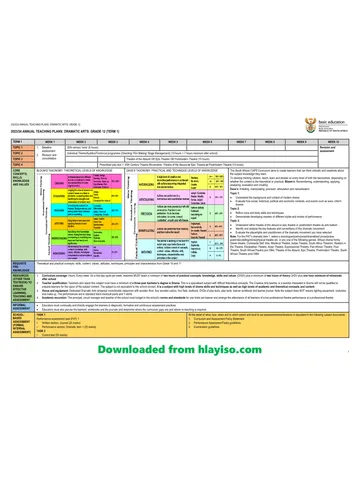
--75e178c5-f96e-43f8-8078-84ce1d3d0082/v1-f945cc30348cd5009930/card.webp)
Related documents
Matched using subject, grade, language, document type and exam metadata.
Memorandum
DRAMATIC ARTS GR12 MEMO SEPT2018 English hlayiso.com
Question paper
DRAMATIC ARTS GR12 QP SEPT2018 English hlayiso.com
Question paper
Dramatic Arts May June 2024 Eng
Question paper
DRAMATIC ARTS GR12 QP SEPT2018 Afr D hlayiso.com
Question paper
DRAMATIC ARTS GR12 QP SEPT2018 Eng D hlayiso.com
Memorandum
Dramatic Arts June 2018 Memo Eng hlayiso.com
More from Grade 12 Dramatic Arts
Explore more published documents in this catalogue.
Question paper
Dramatic Arts Nov 2024 MG Afr
Question paper
Dramatic Arts Nov 2024 MG Eng
Question paper
Dramatic Arts May June 2023 Afr hlayiso.com
Question paper
Dramatic Arts May June 2023 Eng hlayiso.com
Question paper
Dramatic Arts P1 May June 2023 MG Eng hlayiso.com
Question paper