
Download ed fr om hlayiso.com
SENIOR CERTIFICATE EXAMINATIONS
NATIONAL SENIOR CERTIFICATE EXAMINATIONS
DRAMATIC ARTS
2023
MARKS: 150
TIME: 3 hours
This question paper consists of 14 pages.
This question paper must be printed in full colour.
Copyright reserved Please turn over
Skip to contentAll 2023 papers 
View all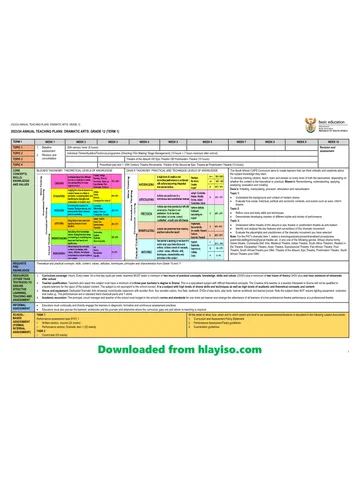
Dramatic Arts Grade 12 NSC June 2023 Question Paper (Eng)
Grade 12 Dramatic Arts question paper from the NSC June Exam 2023 (English), 14 pages. Read online or get the free PDF download, memo linked when available.
Dramatic Arts · Grade 12 · NSC June Exam · 2023. Question paper, 14 pages. Read online or download the PDF.
- Subject
- Dramatic Arts
- Grade
- Grade 12
- Document type
- Question paper
- Year
- 2023
- Exam period
- NSC June Exam
- Curriculum
- CAPS
- Pages
- 14
- File size
- 1.1 MB
Free to read online, no sign-up needed
Loading document…
Loading document…
1 of 14
This exam
NSC June Exam 2023
- Paper 1Memo · EngMemo · Afr
- Other filesQuestion paper · EngQuestion paper · Afr
Document textSearch extracted text and jump to a page.
Download ed fr om hlayiso.com
Dramatic Arts 2 DBE/2023
SC/NSC
INSTRUCTIONS AND INFORMATION
1. This question paper consists of FOUR sections:
SECTION A: 20th Century Theatre Movements (30)
SECTION B: South African Theatre: 1960–1994 (40)
SECTION C: South African Theatre: Post-1994–Contemporary (40)
SECTION D: The History of Theatre, Practical Concepts, Content and Skills (40)
2. SECTION A
QUESTION 1 is COMPULSORY.
Refer to the play text you have studied and its relevant 20 th Century Theatre
Movement.
EPIC THEATRE
Caucasian Chalk Circle Bertolt Brecht
Kaukasiese Krytsirkel Translation of Bertolt Brecht play text
Mother Courage Bertolt Brecht
Moeder Courage Translation of Bertolt Brecht play text
The Good Person of Szechwan Bertolt Brecht
Kanna Hy Kô Hystoe Adam Small
OR
THEATRE OF THE ABSURD
Waiting for Godot Samuel Beckett
Afspraak met Godot Translation of Samuel Beckett play text
Bagasie André P Brink
The Bald Primadonna Eugene Ionesco
Die Kaalkop Primadonna Translation of Eugene Ionesco play text
OR
POSTMODERN THEATRE
Skrapnel Willem Anker
Top Girls Carol Churchill
Popcorn Ben Elton
Buried Child Sam Shepard
3. SECTION B
This section consists of THREE questions. Answer only ONE question in this
section.
QUESTION 2: Woza Albert! Percy Mtwa, Mbongeni Ngema and
Barney Simon OR
QUESTION 3: Sophiatown Junction Avenue Theatre Company OR
QUESTION 4: Siener in die Suburbs PG du Plessis
4. SECTION C
This section consists of THREE questions. Answer only ONE question in this
section.
QUESTION 5: Nothing but the Truth John Kani OR
QUESTION 6: Groundswell Ian Bruce OR
QUESTION 7: Missing Reza de Wet
5. SECTION D
This section is COMPULSORY. Answer QUESTIONS 8 and 9.
Copyright reserved Please turn over
Download ed fr om hlayiso.com
Dramatic Arts 3 DBE/2023
SC/NSC
SECTION A: 20th CENTURY THEATRE MOVEMENTS
This question is COMPULSORY.
QUESTION 1
Refer to SOURCE A below and answer the question that follows.
SOURCE A
[Source: Google.com]
Theatre shines a light on life, society
and, more importantly, on yourself.
– Anastasia Roberts
Create and write an essay in which you discuss the lessons theatre teaches you about
life, society and yourself through the characters and themes of the play you studied.
Reflect and integrate SOURCE A, the play text and the 20th Century Theatre
Movement you have studied this year.
Write the title of the play text and the 20th Century Theatre Movement (Theatre of the
Absurd OR Epic Theatre OR Postmodern Theatre) you studied, at the beginning of
your essay.
TOTAL SECTION A: 30
Copyright reserved Please turn over
Download ed fr om hlayiso.com
Dramatic Arts 4 DBE/2023
SC/NSC
SECTION B: SOUTH AFRICAN THEATRE: 1960–1994
Answer only ONE question in this section.
QUESTION 2: WOZA ALBERT! BY PERCY MTWA, MBONGENI NGEMA AND
BARNEY SIMON
Study SOURCE B below and answer the questions that follow.
SOURCE B: A THEATRE CRITIC'S REVIEW OF WOZA ALBERT!
Recently I saw a production of Woza Albert! that was both uninspired and boring.
It was little more than a reading of the play. Indeed, the complete lack of theatrical
elements such as characterisation, ideophones, singing, mime, physical theatre and
dance displayed a complete misunderstanding of the original theatrical style and
impact of the play. The actors merely sat and spoke their lines, giving no life to the 5
many characters they should have portrayed.
However, Woza Albert! still has a great deal to say about the current sociopolitical and
economic situation in South Africa. When Woza Albert! was created, its main aim was
to expose the injustices of apartheid and mobilise change outside of the theatre.
The central idea of the play, what Morena, Jesus Christ, would do if the second coming 10
were to take place in apartheid-era South Africa, is brought to a thrilling conclusion
when Morena brings struggle heroes back from the dead. By standing on the shoulders
of our heroes and using what they taught us, we can make South Africa a better place.
Even today, this play has the power to inspire solidarity, outrage and action.
– Bradley Adams
2.1 Name the 'original theatrical style' of the play (line 4). (2)
2.2 State TWO aims of the theatrical style named in QUESTION 2.1. (2)
2.3 Identify the theatrical elements of the production of Woza Albert! that were
criticised by Bradley Adams. (4)
2.4 Explain how the 'injustices of apartheid' (line 9) are presented in Woza Albert! (6)
2.5 Describe how the steps/phases of the workshop process of Woza Albert!
began with the 'central idea of the play' (line 10) and developed from that. (6)
2.6 Motivate why Morena is such an important character, although he only
appears in the final scene of the play. (4)
2.7 Evaluate how the play still 'has the power to inspire solidarity, outrage and
action' (line 14). (6)
2.8 Suggest how you would create a production of Woza Albert! to make it
theatrically more exciting than the description in SOURCE B. (10)
[40]
Copyright reserved Please turn over
Download ed fr om hlayiso.com
Dramatic Arts 5 DBE/2023
SC/NSC
QUESTION 3: SOPHIATOWN BY THE JUNCTION AVENUE THEATRE COMPANY
Study SOURCE C below and answer the questions that follow.
SOURCE C: A THEATRE CRITIC'S REVIEW OF SOPHIATOWN
Recently I saw a production of Sophiatown that was both uninspired and boring. It was
little more than a reading of the play. Indeed, the complete lack of theatrical elements
such as narration, music, dancing, banners and slogans displayed a complete
misunderstanding of the original theatrical style and impact of the play. The actors
merely sat and spoke their lines, giving no life to the characters they should have 5
portrayed.
However, Sophiatown still has a great deal to say about the current sociopolitical and
economic situation in South Africa. When the play was created, its main aim was to
expose the injustices of apartheid, document the history of the country and mobilise
change outside of the theatre. 10
The initial idea was what would happen if a white Jewish girl answered an
advertisement to stay in Sophiatown in apartheid South Africa, but the main aim of the
play was to show the systematic demolition of the spirit and place that was Sophia,
Kofifi. The play is brought to a devastating conclusion after Sophiatown is destroyed.
We could learn much from watching a production true to the original style in which it 15
was made, produced and performed.
Even today, this play has the power to inspire solidarity, outrage and action.
– Lebo Ntshingila
3.1 Name the 'original theatrical style' of the play (line 4). (2)
3.2 State TWO aims of the theatrical style named in QUESTION 3.1. (2)
3.3 Identify the theatrical elements of the production of Sophiatown which were
criticised by Lebo Ntshingila. (4)
3.4 Explain how the 'injustices of apartheid' (line 9) are presented in Sophiatown. (6)
3.5 Describe how the steps/phases of the workshop process of Sophiatown
began with the 'initial idea' of the play (line 11) and developed from that. (6)
3.6 Motivate why Charlie might be an important character although he hardly ever
speaks in the play. (4)
3.7 Evaluate how the play still 'has the power to inspire solidarity, outrage and
action' (line 17). (6)
3.8 Suggest how you would create a production of Sophiatown to make it
theatrically more exciting than the description in SOURCE C. (10)
[40]
Copyright reserved Please turn over
Download ed fr om hlayiso.com
Dramatic Arts 6 DBE/2023
SC/NSC
QUESTION 4: SIENER IN DIE SUBURBS BY PG DU PLESSIS
Study SOURCE D below and answer the questions that follow.
SOURCE D: A THEATRE CRITIC'S REVIEW OF SIENER IN DIE SUBURBS
A few years ago I watched a performance of Siener in die Suburbs that was totally
different from the original theatrical style of the play. The theatrical elements bothered
me the most; it was performed on an almost empty stage with rostra (black boxes)
which were used to indicate the black Buick. Door frames served as the entrance to
the house. A chicken coop was painted on the back wall and the sound effects of 5
chains and tools indicated Tjokkie working on the car. Jakes entered miming his bike
with pre-recorded sounds of it blasting over the speakers. Already then a warning
signal sounded. When the characters appeared in black costume, it was clear that the
producers had misunderstood the original theatrical style of the play.
However, Siener in die Suburbs presents the socio-economic situation in South Africa 10
during apartheid and still has a great deal to say about the current sociopolitical and
economic situation. We empathise with characters who long to break free from
injustices in society.
These problems include poverty, addiction, verbal and emotional abuse, violence,
discrimination and alcoholism. The play still has the power to inspire solidarity, outrage 15
and action.
– Sanet du Plessis
4.1 Name the 'original theatrical style' of the play (line 2). (2)
4.2 Identify FOUR characteristics of the theatrical style named in QUESTION 4.1. (4)
4.3 Analyse the theatrical elements of the production of Siener in die Suburbs
which were criticised by Sanet du Plessis. (4)
4.4 Discuss how 'the socio-economic situation in South Africa during apartheid'
(lines 10–11) is presented in Siener in die Suburbs. (8)
4.5 Motivate why Pa is such an important character although he is never on
stage. (6)
4.6 Evaluate how the play still 'has the power to inspire solidarity, outrage and
action' (lines 15–16). (6)
4.7 Suggest how you would create a production of Siener in die Suburbs to make
it theatrically more exciting than the description in SOURCE D. (10)
[40]
TOTAL SECTION B: 40
Copyright reserved Please turn over
Download ed fr om hlayiso.com
Dramatic Arts 7 DBE/2023
SC/NSC
SECTION C: SOUTH AFRICAN THEATRE: POST-1994–CONTEMPORARY
Answer only ONE question in this section.
QUESTION 5: NOTHING BUT THE TRUTH BY JOHN KANI
Study SOURCE E below and answer the questions that follow.
SOURCE E: NOTES WRITTEN BY THE DIRECTOR OF NOTHING BUT THE
TRUTH
DIRECTOR'S NOTEBOOK
MY TO-DO LIST
SET DESIGN: REALISTIC. 46 MADALA STREET, NEW BRIGHTON.
3,6 m x 7,2 m BOX SET.
HIGHLIGHT:
AUDITION FOR SIPHO, THANDO AND MANDISA
DESIGN THE LIGHTING, SOUND AND COSTUMES
The significance of the play's
title
CREATE A REHEARSAL SCHEDULE
BOOK A SUITABLE THEATRE FOR PERFORMANCE How personal stories tell the
SET PERFORMANCE DATES story of South Africans
Copyright reserved Please turn over
Download ed fr om hlayiso.com
Dramatic Arts 8 DBE/2023
SC/NSC
Imagine you are directing the play Nothing but the Truth and in your preparation you
have created the notes in SOURCE E.
5.1 State why it is useful for you to have director's notes. (2)
5.2 Suggest the skills you might expect from an actor auditioning for the part of
Sipho. (4)
5.3 Explain why it is helpful for you to have a sketch/photograph/model of the set
design. (4)
5.4 Describe the set of the play to your cast. (4)
5.5 Motivate your choice of costume for Mandisa's character. (4)
5.6 Analyse how you might apply Stanislavski's system/method when working
with your actors during rehearsals. (6)
5.7 Evaluate the importance of the play's title and relate it to the themes of the
play. (6)
5.8 Discuss how the personal story of the Makhaya family tells the stories of
many South Africans. (10)
[40]
Copyright reserved Please turn over
Download ed fr om hlayiso.com
Dramatic Arts 9 DBE/2023
SC/NSC
QUESTION 6: GROUNDSWELL BY IAN BRUCE
Study SOURCE F below and answer the questions that follow.
SOURCE F: NOTES WRITTEN BY THE DIRECTOR OF GROUNDSWELL
DIRECTOR'S NOTEBOOK
MY TO-DO LIST
DESIGN THE SET:
Garnet Lodge. A remote West Coast guesthouse. In a small diamond-mining
fishing village.
[Source: Backstage.com]
HIGHLIGHT:
AUDITION FOR JOHAN, THAMI AND SMITH
DESIGN THE LIGHTING, SOUND AND COSTUMES The significance of the
FIND A SUITABLE THEATRE FOR PERFORMANCE AND
play's title
BOOK IT How personal stories tell
CREATE A REHEARSAL SCHEDULE the story of South
SET PERFORMANCE DATES Africans
Copyright reserved Please turn over
Download ed fr om hlayiso.com
Dramatic Arts 10 DBE/2023
SC/NSC
Imagine you are directing the play Groundswell and in your preparation you have
created the notes in SOURCE F.
6.1 State why it is useful for you to have director's notes. (2)
6.2 Suggest the skills you might expect from an actor auditioning for the part of
Johan. (4)
6.3 Explain why it is helpful for you to have a sketch/photograph/model of the set
design. (4)
6.4 Describe the set of the play to your cast. (4)
6.5 Motivate your choice of costume for Thami's character. (4)
6.6 Analyse how you might apply Stanislavski's system/method when working
with your actors during rehearsals. (6)
6.7 Evaluate the importance of the play's title and relate it to the themes of the
play. (6)
6.8 Discuss how the personal stories of the three characters in the play tell the
political story of South Africa. (10)
[40]
Copyright reserved Please turn over
Download ed fr om hlayiso.com
Dramatic Arts 11 DBE/2023
SC/NSC
QUESTION 7: MISSING BY REZA DE WET
Study SOURCE G below and answer the questions that follow.
SOURCE G: NOTES WRITTEN BY THE DIRECTOR OF MISSING
DIRECTOR'S NOTEBOOK
MY TO-DO LIST
DESIGN THE SET:
The kitchen of an old house on a remote smallholding in South Africa.
[Source: Beverley Brommert]
HIGHLIGHT:
AUDITION FOR MIEM, MEISIE, GERTIE AND CONSTABLE
DESIGN THE LIGHTING, SOUND AND COSTUMES The significance of the
FIND A SUITABLE THEATRE
play's title
CREATE A REHEARSAL SCHEDULE How personal stories tell
SET PERFORMANCE DATES the story of South Africans
Copyright reserved Please turn over
Download ed fr om hlayiso.com
Dramatic Arts 12 DBE/2023
SC/NSC
Imagine you are directing the play Missing and in your preparation you have created
the notes in SOURCE G.
7.1 State why it is useful for you to have director's notes. (2)
7.2 Suggest the skills you might expect from an actor auditioning for the part of
Miem. (4)
7.3 Explain why it is helpful for you to have a sketch/photograph/model of the set
design. (4)
7.4 Describe the set of the play to your cast. (4)
7.5 Motivate your choice of costume for Meisie's character. (4)
7.6 Analyse how you might apply Stanislavski's system/method when working
with your actors during rehearsals. (6)
7.7 Evaluate the significance of the play's title and relate it to the themes of the
play. (6)
7.8 Discuss how the personal stories of the characters in the play tell the story of
many South Africans. (10)
[40]
TOTAL SECTION C: 40
Copyright reserved Please turn over
Download ed fr om hlayiso.com
Dramatic Arts 13 DBE/2023
SC/NSC
SECTION D: THE HISTORY OF THEATRE, PRACTICAL CONCEPTS, CONTENT
AND SKILLS
QUESTIONS 8 and 9 are COMPULSORY.
QUESTION 8
Study SOURCE H below and answer the questions that follow.
SOURCE H: IMAGES OF AN ARENA STAGE
[Source: Google.com]
Imagine you have been tasked to stage a Poor Theatre production on the stage in
SOURCE H.
8.1 Give another name for an arena stage. (2)
8.2 State TWO disadvantages when staging a play on an arena stage. (2)
Copyright reserved Please turn over
Download ed fr om hlayiso.com
Dramatic Arts 14 DBE/2023
SC/NSC
8.3 Motivate why a Poor Theatre production could be effective on this stage type. (6)
8.4 Describe the actor-audience relationship you would like to create using an
arena stage. (4)
8.5 Explain the following characteristics of Poor Theatre:
Via Negativia
The Holy Actor (6)
[20]
QUESTION 9
Study SOURCE I below and answer the questions that follow.
SOURCE I: A COMMENT BY A DRAMATIC ARTS INFLUENCER
NOTE: An influencer is someone who uses social media to set trends and influences
those who follow them.
Plays have power. Power to affect the hearts and minds of those who watch.
As an influencer, I use TikTok* video clips to encourage my followers to go and watch
live theatre because the theatrical elements in a live production such as singing,
dancing, sound, lighting, set, costumes and special effects make it fun and exciting to
watch. Watching plays can change the way we think about the world we live in.
(*TikTok is a social media application (app) that allows users to make short videos.)
9.1 Define the term Dramatic Arts. (2)
9.2 Imagine you are a Dramatic Arts influencer. You want to promote any play
you have studied in Dramatic Arts.
9.2.1 Name the play you have studied in Dramatic Arts that would inspire
you to create your TikTok video. (2)
9.2.2 Describe what theatrical elements you might include in your TikTok
video to make your followers want to watch the play selected in
QUESTION 9.2.1. (6)
9.2.3 Explain how the play you selected has the power to change the way
we think about the world we live in. (6)
9.2.4 Debate whether or not TikTok should be included in the teaching of
Dramatic Arts. (4)
[20]
TOTAL SECTION D: 40
GRAND TOTAL: 150
Copyright reserved
Study this subject
Recommended for this subject
Question paper
Dramatic Arts Grade 12 NSC November 2023 QP (Afr)
Question paper
Dramatic Arts Grade 12 NSC November 2023 QP (Eng)
Question paper
Dramatic Arts Grade 12 NSC June 2022 Question Paper (Afr)
Question paper
Dramatic Arts Grade 12 NSC June 2022 Question Paper (Eng)
Question paper
Dramatic Arts Grade 12 NSC June 2021 Question Paper (Eng)
Question paper
Dramatic Arts Grade 12 NSC June 2019 Question Paper (Afr)
More from Grade 12 Dramatic Arts
Annual teaching plan
Gr 12 Dram Art ATP 2023 24
Memorandum
Dramatic Arts Grade 12 NSC June 2025 Memo (English)
Memorandum
Dramatic Arts Grade 12 NSC November 2025 Memo (English)
Memorandum
Dramatic Arts Grade 12 NSC November 2025 Memo (Afrikaans)
Memorandum
Dramatic Arts Grade 12 NSC November 2025 Memo (Afrikaans)
Memorandum