Downloaded from hlayiso.com
NATIONAL SENIOR CERTIFICATE EXAMINATION
NOVEMBER 2017
ENGLISH FIRST ADDITIONAL LANGUAGE: PAPER I
Time: 2½ hours 100 marks
PLEASE READ THE FOLLOWING INSTRUCTIONS CAREFULLY
1. This question paper consists of 11 pages and an Insert of 8 pages (i–viii). Detach
the Insert from the middle of the question paper. Please check that your paper is
complete.
2. Answer ALL the questions.
3. Read the questions carefully.
4. Number your answers exactly as the questions are numbered in the question
paper.
5. Do not write in the margin.
6. It is in your own interest to write legibly and to present your work neatly.
IEB Copyright © 2017 PLEASE TURN OVER
Skip to contentQuestion paper 
View all
English FAL Grade 12 IEB Paper 1 2017 Question Paper
IEB Grade 12 English FAL Paper 1 question paper from the 2017, 11 pages. Read online or get the free PDF download, memo linked when available.
Publisher: IEB
English FAL · Grade 12 · 2017. Question paper, 11 pages. Read online or download the PDF.
- Subject
- English FAL
- Grade
- Grade 12
- Document type
- Question paper
- Year
- 2017
- Paper
- 1
- Publisher
- IEB
- Curriculum
- IEB
- Pages
- 11
- File size
- 506.7 KB
Loading document…
Loading document…
1 of 11
Document textSearch extracted text and jump to a page.
Downloaded from hlayiso.com
NATIONAL SENIOR CERTIFICATE: ENGLISH FIRST ADDITIONAL LANGUAGE: PAPER I Page 2 of 11
SECTION A COMPREHENSION
QUESTION 1 MAKING MEANING OF TEXTS
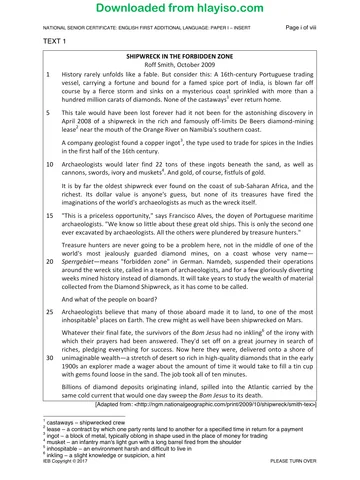
Read the passages (Text 1 and Text 2) on page (i–ii) of the Insert and answer
the following questions.
Questions 1.1 to 1.9 refer to Text 1
1.1 Read the following quotations before answering the questions that follow:
'None of the castaways ever return home.' (line 4)
1.1.1 Select the correct option by only writing down the question number
and corresponding letter.
The introductory paragraph of Text 1 reads like a fable. When the
quotation above concludes the paragraph it creates a/an
A anti-climax.
B climax. (1)
1.1.2 Explain your choice in Question 1.1.1 by referring to the content of
Text 1. (1)
1.2 Select the correct option by only writing down the question number and
corresponding letter. Consider the context of the text when answering this
question.
The word 'fired', as used in line 13, means
A discharged.
B pardoned.
C inspired.
D absolved. (1)
1.3 Quote FIVE CONSECUTIVE words from Text 1 that support the following
statement:
There are some things money can't buy, like the chance to learn more
about the past. (1)
1.4 Explain in your own words why it has been difficult for archaeologists to
learn more about old shipwrecks they have found. (2)
1.5 Consider the word 'Sperrgebiet' (line 20) before answering the following
questions:
1.5.1 Write down the denotative meaning of the word 'Sperrgebiet'
(line 20). (1)
1.5.2 Where is the 'Sperrgebiet' mentioned in Text 1, located? (1)
IEB Copyright © 2017
Downloaded from hlayiso.com
NATIONAL SENIOR CERTIFICATE: ENGLISH FIRST ADDITIONAL LANGUAGE: PAPER I Page 3 of 11
1.6 Read the following quotation before answering the questions that follow:
'for a few gloriously diverting weeks [a team of archaeologists] mined
history instead of diamonds.' (Lines 21 to 22)
1.6.1 Is the underlined phrase in the quotation above meant literally or
figuratively? (1)
1.6.2 Explain what the author means by the quotation above in the context
of the passage. You are required to take the entire quotation into
account in answering this question. (2)
1.6.3 Does the connotative meaning of the word 'gloriously' in the
quotation above reflect the author's mindset as neutral, positive or
negative? You are only required to write down the correct option. (1)
1.7 Select the correct option by only writing down the question number and
corresponding letter. Consider the context of the text when answering this
question.
The MOST APPROPRIATE synonym for the word 'inhospitable' (line 26), in
the context of the passage, is:
A unpleasant
B uninhabitable
C unlikeable
D boring (1)
1.8 Provide a quotation of not more than five words from the text to prove that
the fate of the ship's crew is not really known. (1)
1.9 Explain the irony of the situation referred to in the quotation below. Use
your own words as far as possible.
'the survivors of the Bom Jesus had no inkling of the irony with which their
prayers had been answered.' (lines 27 and 28) (2)
Questions 1.10 to 1.13 refer to Text 2
1.10 How old would the Bom Jesus ship be if it were sailing? (1)
1.11 Why was this coastline called 'The Gates of Hell'? (line 8) Clearly support
your answer with proof from Text 2. (2)
1.12 How does the reader know that the man-made lagoon is a temporary
feature? Provide and explain a quotation from Text 2. (2)
IEB Copyright © 2017 PLEASE TURN OVER
Downloaded from hlayiso.com
NATIONAL SENIOR CERTIFICATE: ENGLISH FIRST ADDITIONAL LANGUAGE: PAPER I Page 4 of 11
1.13 Read the following quotation before answering the questions that follow:
"While there are plenty of shipwrecks in the area, almost all of them are
'recent'." (line 10)
1.13.1 Why is the archaeological term 'recent' as the descriptor for the
120-year-old shipwrecks found in the area, appropriate? (1)
1.13.2 Select the correct option by only writing down the question number
and corresponding letter, e.g. 1.13.2 D.
The archaeological term 'recent', as used in the quotation, is an
example of:
A colloquialism
B slang
C jargon (1)
Questions 1.14 to 1.16 refer to Text 1 and Text 2
1.14 Read the following lines from Text 1 and Text 2.
Hint: Study the footnotes on page (i) of the Insert.
Text 1: 'A company geologist found a copper ingot, the type used to
trade for spices in the Indies in the first half of the 16th century.' (lines 8
and 9)
Text 2: 'The sunken ship was loaded down with treasure including
44,000 pounds of copper ingots. These ingots played a key role in the
wreck's preservation.' (lines 17 and 18)
Explain how the information provided in these lines (or any other relevant
information from Text 1 and Text 2) validates the following:
'Money bought the archaeologists some time.' (3)
1.15 Who benefitted most from the discovery of the shipwreck? Explain your
answer by referring to information from Text 1 and/or Text 2. (2)
1.16 Consider the style in which Text 1 and Text 2 are written before answering
the questions that follow:
1.16.1 Complete the sentence below by selecting the correct option
provided in brackets.
The style in which Text 1 is written is more (formal/informal) than the
style in Text 2. (1)
1.16.2 Offer proof from Text 1 and/or Text 2 to support your answer in
Question 1.16.1. (1)
30 marks
IEB Copyright © 2017
Downloaded from hlayiso.com
NATIONAL SENIOR CERTIFICATE: ENGLISH FIRST ADDITIONAL LANGUAGE: PAPER I Page 5 of 11
SECTION B SUMMARY
QUESTION 2 SHOW UNDERSTANDING BY SUMMARISING
Study Text 3, the blog entry, on page (iii) of the Insert carefully before
answering this question.
INSTRUCTIONS:
You came across this blog about the Forrest Fenn hidden treasure chest. You
decide to embark on an adventure and ask your friends to join you in this hunt by
introducing the Forrest Fenn treasure to them.
Summarise the blog entry by introducing Forrest Fenn, his adventure and listing
three AUTHENTIC1 ways to find the treasure.
Your summary must be presented in point form, listing the five required points of
discussion.
Your summary will have a total of 5 points, counting two marks each. Your
summary must not exceed 70 words.
REMEMBER:
You must use full sentences.
Your register must be formal.
Summarise all five points in your own words as far as possible.
Each point will count two marks.
Write the number of words used in brackets at the end of the summary.
Pay attention to grammar, spelling, punctuation and sentence construction.
10 marks
1
Authentic – genuine, original, real, actual, trustworthy
IEB Copyright © 2017 PLEASE TURN OVER
Downloaded from hlayiso.com
NATIONAL SENIOR CERTIFICATE: ENGLISH FIRST ADDITIONAL LANGUAGE: PAPER I Page 6 of 11
SECTION C POETRY
QUESTION 3 MAKING MEANING OF POETRY
SEEN POEMS
Read the two poems (Text 4 and Text 5) that you have studied in class on
page (iv) of the Insert before answering the questions.
Refer to TEXT 4: the night train
3.1 What does the use of lower case imply about the status of the speaker and
how does this assist in helping the reader understand the poem? (2)
3.2 Consider the following quotation before answering this question:
"… i turn to stare/through the window/into the darkness outside/(or is it my
reflection i stare at)' (lines 8 to 11)
Explain the figurative meaning of this quotation in the context of the poem. (1)
3.3 Why is the word, 'out' (line 14), written in italics? (1)
3.4 Study the following quote:
'not the smell of stale man' (line 18).
3.4.1 Identify the figure of speech used in the underlined phrase in the
quotation. (1)
3.4.2 Explain the meaning of the figure of speech in the context of the rest
of the poem. (1)
3.5 3.5.1 Select the correct option by only writing down the question number
and corresponding letter.
The underlying tone of the poem creates a/an _________________
feeling.
A ominous (the impression is given that something bad is going
to happen)
B hopeless (the idea exists that the situation is filled with
despair)
C auspicious (the situation is filled with the potential for success) (1)
3.5.2 Support your choice in Question 3.5.1 by either offering a relevant
quote from the poem or explaining your choice with supporting
information from the text. (1)
3.6 Briefly explain what this poem is about. Ensure that your explanation
includes the deeper meaning of the poem. (2)
IEB Copyright © 2017
Downloaded from hlayiso.com
NATIONAL SENIOR CERTIFICATE: ENGLISH FIRST ADDITIONAL LANGUAGE: PAPER I Page 7 of 11
AND
TEXT 5: Let me not to the marriage of true minds
3.7 Consider the meaning of lines 1 to 3 before answering this question.
'Let me not to the marriage of true minds/Admit impediments. Love is not
love/Which alters when it alteration finds.' (Lines 1 to 3)
Select ONLY ONE of the images below and explain how your selected
image symbolises the meaning portrayed in lines 1 to 3.
Image A Image B
[Source: <http://saibharathi.com/
parinaya/imped2.jpg>]
[Source: <http://agilepainrelief.com/
wp-content/uploads/2015/08/
road-44143_640.png>]
(2)
3.8 Read the following quotation before answering this question:
'O, no, it is an ever-fixed mark' (line 5)
3.8.1 Select the correct option by only writing down the question number
and corresponding letter.
The figure of speech in this quotation is an example of:
A personification
B a metaphor
C onomatopoeia
D a simile (1)
3.8.2 With reference to the time in which the poem was written, explain the
meaning or purpose of the figure speech selected in Question 3.8.1. (2)
3.9 Explain the meaning of the following two quotations in the context of the
poem.
3.9.1 'That looks on tempest and is never shaken;' (line 6) (1)
3.9.2 'Love's not Time's fool, though rosy lips and cheeks/Within his
bending sickle's compass come;' (lines 9 and 10) (1)
IEB Copyright © 2017 PLEASE TURN OVER
Downloaded from hlayiso.com
NATIONAL SENIOR CERTIFICATE: ENGLISH FIRST ADDITIONAL LANGUAGE: PAPER I Page 8 of 11
3.10 Offer a word of your own which means the same as the phrase 'the edge of
doom' (line 12). (1)
3.11 Explain, in your own words, Shakespeare's conclusion in the couplet (lines
13 and 14) of this poem. (2)
[20]
QUESTION 4 MAKING MEANING OF POETRY
UNSEEN POEM
Read the unseen poem (Text 6) at least twice on page (v) of the Insert before
attempting to answer the questions set on it.
4.1 Read the following quotation before answering the questions.
'flipped the entire globe upside down' (lines 5 and 6)
4.1.1 Select the correct option by only writing down the question number
and corresponding letter. The figure of speech in lines 5 and 6 is an
example of:
A personification
B hyperbole
C onomatopoeia
D a simile (1)
4.1.2 What does this quotation reveal about the speaker's background? (1)
4.2 The poem speaks of 'searching'. What may the speaker be searching for?
You may give any relevant example. (1)
4.3 The ellipses help set the poem's tone.
4.3.1 Identify the tone in lines 1 to 8 from the options below:
A sadness
B gratitude
C contentment
D restlessness (1)
4.3.2 Explain how the ellipses help to establish the tone. (2)
IEB Copyright © 2017
Downloaded from hlayiso.com
NATIONAL SENIOR CERTIFICATE: ENGLISH FIRST ADDITIONAL LANGUAGE: PAPER I Page 9 of 11
4.4 Read the following observation made by e.e. cummings, a well-known poet
who bears some similarity to r.m. drake, before answering this question.
"The three saddest things are the ill wanting to be well, the poor wanting to
be rich, and the constant traveler saying 'anywhere but here'."
4.4.1 Both e.e. cummings and r.m drake have a tendency to sign their
names in the lower case. Both poets humble themselves to be
observers of life.
Select one word from the options below that best summarises the
feeling observed by both poets in the quotation and the poem.
You are only required to write down the question number and
corresponding letter.
A grief
B discontentment
C gratefulness
D peace (1)
4.4.2 Suggest a reason for your answer in Question 4.4.1. (1)
4.5 Explain the conclusion (lines 10–12) of the poem in your own words. (2)
[10]
30 marks
IEB Copyright © 2017 PLEASE TURN OVER
Downloaded from hlayiso.com
NATIONAL SENIOR CERTIFICATE: ENGLISH FIRST ADDITIONAL LANGUAGE: PAPER I Page 10 of 11
SECTION D COMMUNICATIVE LANGUAGE
QUESTION 5 ADVERTISEMENTS
Study the following two vintage advertisements (Texts 7 and 8) on pages (vi–
vii) of the Insert before answering the questions.
TEXT 7
Questions 5.1 and 5.2 relate to Text 7: The World Environment Day
Advertisement.
5.1 What is the aim of this advertising campaign? (1)
5.2 Explain how the advertiser uses visual and verbal techniques to achieve the
aim of the campaign. (2)
TEXT 8
Questions 5.3 to 5.6 relate to Text 8: The India Tourism Advertisement.
5.3 The intention of this advertisement is to promote a product. What does the
advertiser want to promote in Text 8? (1)
5.4 Consider the printed caption of this advertisement.
"Adventure Down Under In India"
How does the advertiser use wordplay to promote this product? (2)
5.5 Offer your opinion as to why it is appropriate that the advertiser has opted
to use wordplay as an advertising technique. (2)
5.6 Why could the advertisement for India potentially fail in its purpose? (1)
TEXTS 7 AND 8
The following question relates to Text 7 and Text 8.
5.7 Which advertisement would you regard as more successful – Text 7 or
Text 8? Explain your choice. (1)
[10]
QUESTION 6 CARTOONS
Study the cartoon (Text 9) on page (viii) of the Insert before answering the
questions.
6.1 What techniques did the cartoonist use to show the mother's annoyance? (1)
6.2 Is the cartoonist successful in creating humour in this cartoon? Explain your
answer. (1)
6.3 What is the cartoonist commenting on in this cartoon? (2)
6.4 Judge whether the mother's comment is a fact or an opinion. Explain your
answer. (2)
IEB Copyright © 2017
Downloaded from hlayiso.com
NATIONAL SENIOR CERTIFICATE: ENGLISH FIRST ADDITIONAL LANGUAGE: PAPER I Page 11 of 11
6.5 Explain how this cartoon stereotypes children. (1)
6.6 Correct the punctuation error(s) in Text 9 by rewriting the sentence. (1)
6.7 Report the mother's words in Text 9 by completing the following:
The mother complained that in (6.7.1) days cave art (6.7.2) all violence. (1)
6.8 Write down a sentence in which you demonstrate the homophone for the
word, 'violence' in Text 9. (1)
[10]
QUESTION 7 TEXTUAL EDITING
Refer to the review (Text 10) on page (viii) of the Insert before answering the
questions.
The movie, Raiders of the Lost Ark, is recommended to you. You find the following
review about the movie, but it contains many language errors. Correct the errors
by completing the questions.
The following questions are based on Text 10.
7.1 Correct the concord error in line 1 by writing down the correct word. (1)
7.2 Change the word 'jungle' (line 2) to the plural. (1)
7.3 Change the first adjective in line 2 to another relevant adjective of your
choice. (1)
7.4 Correct the spelling error in line 5. Write down only the correct spelling. (1)
7.5 Select the correct option by only writing down the question number and
corresponding letter. The function of the apostrophe in line 5 indicates:
A contraction
B possession (1)
7.6 Complete the sentences (lines 6, 7 and 8) by providing the correct form of
the word given in brackets (7.6.1, 7.6.2 and 7.6.3). You only need to write
down the question number and correct answer. (3)
7.7 Complete the sentence below by providing a question tag.
'You will be amazed' … (line 8) (1)
7.8 Rewrite the sentence below in the passive voice. Start your sentence with
the underlined words.
I am editing many reviews at the moment. (1)
[10]
30 marks
Total: 100 marks
IEB Copyright © 2017
Study this subject
Revise the topics in this paper, then practise them question by question.
- Grade 12 English Fal notes
CAPS revision notes with worked examples.
- English Fal questions by topic
Past exam questions sorted by CAPS topic, with memos where available.
- Grade 12 English Fal quizzes
Short topic quizzes with instant feedback.
- All Grade 12 English Fal past papers
Past papers by year, with memos where available.
- Grade 12 IEB past papers
More English FAL and other subjects in this collection.
Recommended for this subject
More papers and memos for this grade and subject.
Question paperIEB
English FAL Grade 12 IEB Paper 1 2019 Question Paper
Question paperIEB
English FAL Grade 12 IEB Paper 2 2019 Question Paper
Question paperIEB
English FAL Grade 12 IEB Paper 1 2018 Question Paper
Question paperIEB
English FAL Grade 12 IEB Paper 2 2018 Question Paper
Question paperIEB
English FAL Grade 12 IEB Paper 2 2017 Question Paper
AddendumIEB
English FAL Grade 12 IEB Paper 1 2019 Addendum
Related documents
AddendumIEB
English FAL Grade 12 IEB Paper 1 2017 Addendum
MemorandumIEB
English FAL Grade 12 IEB Paper 1 2017 Memo
MemorandumIEB
English FAL Grade 12 IEB Paper 2 2017 Memo
MemorandumIEB
English FAL Grade 12 IEB Paper 1 2019 Memo
AddendumIEB
English FAL Grade 12 IEB Paper 1 2018 Addendum
MemorandumIEB