Downloaded from hlayiso.com
NATIONAL SENIOR CERTIFICATE EXAMINATION
NOVEMBER 2018
ENGLISH FIRST ADDITIONAL LANGUAGE: PAPER I
Time: 2½ hours 100 marks
PLEASE READ THE FOLLOWING INSTRUCTIONS CAREFULLY
1. This question paper consists of 8 pages and an Insert of 7 pages (i–vii). Detach the
Insert from the middle of the question paper. Please check that your paper is
complete.
2. Read the questions carefully.
3. Answer ALL the questions.
4. Please start each question on a new page of your Answer Book.
5. Number your answers exactly as the questions are numbered in the question
paper.
6. Do not write in the margin.
7. It is in your own interest to write legibly and to present your work neatly.
IEB Copyright © 2018 PLEASE TURN OVER
Skip to contentQuestion paper 
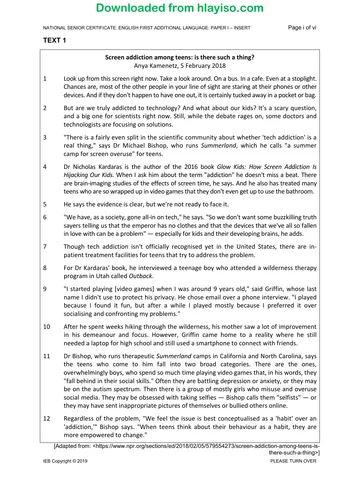
View all
English FAL Grade 12 IEB Paper 1 2018 Question Paper
IEB Grade 12 English FAL Paper 1 question paper from the 2018, 8 pages. Read online or get the free PDF download, memo linked when available.
Publisher: IEB
English FAL · Grade 12 · 2018. Question paper, 8 pages. Read online or download the PDF.
- Subject
- English FAL
- Grade
- Grade 12
- Document type
- Question paper
- Year
- 2018
- Paper
- 1
- Publisher
- IEB
- Curriculum
- IEB
- Pages
- 8
- File size
- 156.9 KB
Loading document…
Loading document…
1 of 8
Document textSearch extracted text and jump to a page.
Downloaded from hlayiso.com
NATIONAL SENIOR CERTIFICATE: ENGLISH FIRST ADDITIONAL LANGUAGE: PAPER I Page 2 of 8
SECTION A COMPREHENSION
QUESTION 1 MAKING MEANING OF TEXTS
Read the passages (Text 1, Text 2 and Text 3) on page i–ii of the Insert and
then answer the following questions.
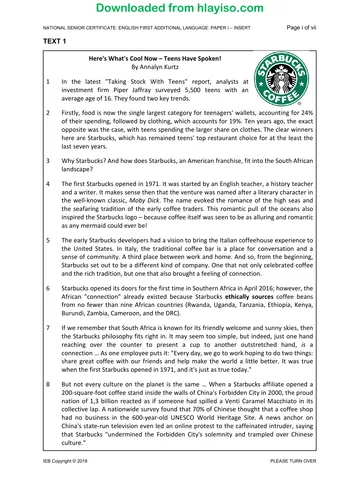
Questions 1.1 to 1.15 refer to Text 1.
1.1 How does the title establish the informal register of the text? Mention two
observations. (2)
1.2 Is the informal register appropriate? Give a reason for your answer. (1)
1.3 "Teen spending trends have changed in recent years." Using your own
words, show how the text supports this statement. (2)
1.4 What is the function of the rhetorical question, "Why Starbucks?", in
paragraph 3? (1)
1.5 Starbucks was first launched in 1971. Write this date out in words, as you
would say it. (1)
1.6 According to paragraph 4, it "makes sense then that the venture was
named after a literary character …". Do you agree? Justify your answer. (2)
1.7 Re-read paragraph 4. What is the image of the Starbucks logo? (1)
1.8 Based on paragraph 5, which two human experiences appear to be
universally important? Use your own words. (2)
1.9 Refer to paragraph 6. What does "ethically sources" mean? Select the
correct option by writing down the question number and the corresponding
letter, e.g. 1.9 D.
Starbucks
A obtains coffee from religious organisations in each country.
B produces coffee for free, without getting involved in money issues.
C obtains coffee through free, fair and sustainable trade with local
farmers. (1)
1.10 DRC (paragraph 6) is an abbreviation. Quote an example of an acronym
from Text 1. (1)
1.11 How do we know that the Starbucks brand is successful in South Africa?
Quote three consecutive words from paragraph 7. (1)
1.12 Refer to paragraph 7: "... outstretched hand, is a connection ..."
Suggest a reason why the writer has written is in italics. (1)
IEB Copyright © 2018
Downloaded from hlayiso.com
NATIONAL SENIOR CERTIFICATE: ENGLISH FIRST ADDITIONAL LANGUAGE: PAPER I Page 3 of 8
1.13 Refer to paragraph 8. When Starbucks was opened in China, "… the proud
nation of 1,3 billion reacted as if someone had spilled a Venti Caramel
Macchiato in its collective lap."
• What does this tell us about how Chinese people felt about Starbucks
• AND why did they feel this way?
Support your reason with close reference to any of the three texts. (3)
1.14 Explain the idiom, "testing the waters" (paragraph 9). (1)
1.15 Refer to paragraph 9. Explain the metaphor in "coffee-hating Chinese
sharks". (2)
Question 1.16 refers to Text 2 in the Insert.
1.16 Based on the information provided in Text 2, what advice would you have
given to Starbucks before the expansion of their brand across different
countries and cultures?
Explain fully, in your own words. (2)
Questions 1.17 to 1.20 refer to Text 3 in the Insert.
1.17 Select ONE of the options below to complete the sentence. You only need
to write down the question number and corresponding letter, e.g. 1.17 D.
The overall tone of Text 3 is ...
A entertaining and nonsensical.
B factual and informative.
C linguistic and historical. (1)
1.18 Which fact in Text 3 can best be described as statistical in style? Only write
down the question number and letter. (1)
1.19 Refer to point (d): "Most coffees are a blend of Arabica and Robusta
beans." Write a synonym for the word "blend". (1)
1.20 "Coffee was one of the first ever freeze-dried foods". Change this sentence
into a tag question. (1)
Question 1.21 refers to Text 1 and Text 3 in the Insert.
1.21 What sentiment is shared by both the Chinese and early Muslim leaders?
Refer to both texts in your answer. (2)
30 marks
IEB Copyright © 2018 PLEASE TURN OVER
Downloaded from hlayiso.com
NATIONAL SENIOR CERTIFICATE: ENGLISH FIRST ADDITIONAL LANGUAGE: PAPER I Page 4 of 8
SECTION B SUMMARY
QUESTION 2 SHOW UNDERSTANDING BY SUMMARISING
Your matric peers have not been happy lately, possibly due to examination
pressure. You decide to create a card for them to refer to when they need a laugh.
You decide to summarise the article Laughter is the Best Medicine (Text 4) in the
insert on page (iii), into Five Ideas to Get Your Smile On.
Your summary should be presented in five main points.
Your summary should not exceed 65 words.
REMEMBER:
• You must use full sentences.
• Summarise all five points/ideas in your own words as far as possible.
• Each point will count for two marks.
• Write the number of words used in brackets at the end of the summary.
• Pay attention to grammar, spelling, punctuation and sentence construction.
10 marks
IEB Copyright © 2018
Downloaded from hlayiso.com
NATIONAL SENIOR CERTIFICATE: ENGLISH FIRST ADDITIONAL LANGUAGE: PAPER I Page 5 of 8
SECTION C POETRY
QUESTION 3 MAKING MEANING OF POETRY
SEEN POEMS
Read the two poems (Text 5 and Text 6) that you have studied in class on
page (iv) of the Insert before answering the questions.
Questions 3.1 to 3.5 are based on Sonnet 116.
3.1 Provide TWO characteristics of this poem that identify it as a
Shakespearean sonnet. (2)
3.2 Quote four consecutive words from the sonnet that warn us that what
seems to be love, is not always really so. (1)
3.3 According to Shakespeare, what does true love NOT do? Answer in detail,
using your own words with reference to the poem. (3)
3.4 Re-read line 7 of the sonnet. What does the metaphor tell us about the
value of love in an often difficult world? (2)
3.5 Many wedding ceremonies include a promise made by the couple to love
each other "until death do us part". Do you think this is a realistic
expectation? Give a reason for your answer. (2)
AND
Questions 3.6 to 3.11 are based on Refugee Mother and Child.
3.6 Why do you think the poet alludes to the religious artwork (of Mary and
Jesus) in the opening line of the poem? Explain this with reference to the
poem's central message. (2)
3.7 The poem is written in free verse. How does this create a contrast to the
human experience captured in this poem? (1)
3.8 How does the poet's diction in lines 5–9 convey the suffering of the
refugees? Quote and explain one example. (2)
3.9 What does the phrase "In another life" (line 16) tell the reader about what
the life of the mother and the child used to be like? (1)
3.10 What does the simile in the closing lines of the poem, "... like putting flowers
on a tiny grave", tell us about how the mother parts her child's hair? (2)
3.11 Consider the central messages of BOTH the seen poems examined here,
i.e. Text 5 and Text 6. Show how these two poems relate to each other. (2)
[20]
IEB Copyright © 2018 PLEASE TURN OVER
Downloaded from hlayiso.com
NATIONAL SENIOR CERTIFICATE: ENGLISH FIRST ADDITIONAL LANGUAGE: PAPER I Page 6 of 8
QUESTION 4 MAKING MEANING OF POETRY
UNSEEN POEM
Refer to page (v) of the Insert. Read the unseen poem (Text 7) at least twice
before attempting to answer the questions set on it.
4.1 In this poem, a teacher (the speaker) encourages students to approach
their experience of poetry in a certain way. Choose the best approach to
poetry as suggested by the speaker. You are only required to write down
the question number and the correct letter.
A Approach poetry as a serious study of its many and varied formal
elements.
B Approach poetry as an enjoyable and exciting exploration of open
possibilities. (1)
4.2 Quote a single word from stanza 5 to support your answer in 4.1. (1)
4.3 Re-read stanza 1. Bearing the poet's central message in mind, what
difference would it make if the adjective "colour" were left out of the simile? (2)
4.4 Stanza 2 consists of a single line: "or press an ear against its hive".
(a) What is a poem metaphorically compared to in this line? (1)
(b) Write down the missing word to complete the following sentence:
This image appeals to our sense of ... (1)
4.5 What is the effect of the word "But" at the start of stanza 6? (1)
4.6 If the teacher/speaker wishes for poetry to be an exciting, fun-filled
exploration by students, has (he) been successful? Refer closely to the text
to support your answer. (3)
[10]
30 marks
IEB Copyright © 2018
Downloaded from hlayiso.com
NATIONAL SENIOR CERTIFICATE: ENGLISH FIRST ADDITIONAL LANGUAGE: PAPER I Page 7 of 8
SECTION D COMMUNICATIVE LANGUAGE
QUESTION 5 ADVERTISEMENT
Study the advertisement (Text 8) on page (vi) of the Insert.
5.1 List everything that is being advertised. (2)
5.2 Who is the target market? Quote from the advertisement to support your
answer. (2)
5.3 Write down the slogan of the advertisement and explain why you think it
would appeal to the target audience. (2)
5.4 Fully explain the gender stereotyping of males in the advertisement. Your
response should include reference to ONE visual clue and ONE verbal clue. (2)
5.5 What makes this advertisement funny or amusing? Provide an example
from the advertisement to support your view. (2)
[10]
QUESTION 6 CARTOON
Study the cartoon (Text 9) on page (vii) of the Insert.
6.1 Refer to the caption of the cartoon. What is the function of the ellipsis after
"again"? (1)
6.2 Why has the cartoonist written the word "not " in italics? (1)
6.3 Explain how the cartoonist's use of IRONY in the question, contributes to
the humour in the cartoon. (2)
6.4 What feeling does the teacher's body language convey? Support your
answer by referring to a VISUAL clue from the cartoon. (2)
6.5 Report the teacher's words in Text 9 by completing the following:
The teacher asked whether anyone (6.5.1) had not (6.5.2) his or her
homework on the way to school. (2)
[8]
IEB Copyright © 2018 PLEASE TURN OVER
Downloaded from hlayiso.com
NATIONAL SENIOR CERTIFICATE: ENGLISH FIRST ADDITIONAL LANGUAGE: PAPER I Page 8 of 8
QUESTION 7 TEXTUAL EDITING
Read Text 10 on page (vii) of the Insert and answer the questions that follow.
7.1 Complete the sentence (see line 1) by selecting the correct preposition from
the options given in brackets. Write only the question number and the
correct answer.
I helped (by/at) parents' evening. (1)
7.2 Explain why the apostrophe appears after the "s" in parents' evening (line 1). (1)
7.3 Identify and state the function of the punctuation mark in the word that's
(line 2). (2)
7.4 Find and correct the spelling error in line 5. You only need to write down the
correct word. (1)
7.5 Re-write the following sentence, starting with the correct form of the
underlined word:
They got their cups filled by me. (1)
7.6 Consider the underlined part of speech in the following quotation:
"But the joke was on me."
Select the correct answer from the options below. Write only the question
number and the correct letter. The part of speech of the underlined word is
a/an:
A indefinite article
B adjective
C definite article (1)
7.7 Write a sentence in which you use a homophone for the word "knew"
(line 11). Your sentence must reflect your understanding of the homophone
you have used. (1)
7.8 Correct the concord error in line 7. Write only the correct word. (1)
7.9 "Toffee or Clea?" is an example of a spoonerism. Explain the spoonerism in
the contexts of this example. (1)
7.10 Read the funny one-liner joke below.
What's It Called When You Steal Someone's Coffee?
Mugging!
(a) Identify the language device used in the punchline of this joke. (1)
(b) Explain why the punchline is funny. (1)
[12]
30 marks
Total: 100 marks
IEB Copyright © 2018
Study this subject
Revise the topics in this paper, then practise them question by question.
- Grade 12 English Fal notes
CAPS revision notes with worked examples.
- English Fal questions by topic
Past exam questions sorted by CAPS topic, with memos where available.
- Grade 12 English Fal quizzes
Short topic quizzes with instant feedback.
- All Grade 12 English Fal past papers
Past papers by year, with memos where available.
- Grade 12 IEB past papers
More English FAL and other subjects in this collection.
Recommended for this subject
More papers and memos for this grade and subject.
Question paperIEB
English FAL Grade 12 IEB Paper 1 2019 Question Paper
Question paperIEB
English FAL Grade 12 IEB Paper 2 2019 Question Paper
Question paperIEB
English FAL Grade 12 IEB Paper 2 2018 Question Paper
Question paperIEB
English FAL Grade 12 IEB Paper 1 2017 Question Paper
Question paperIEB
English FAL Grade 12 IEB Paper 2 2017 Question Paper
AddendumIEB
English FAL Grade 12 IEB Paper 1 2019 Addendum
Related documents
AddendumIEB
English FAL Grade 12 IEB Paper 1 2018 Addendum
MemorandumIEB
English FAL Grade 12 IEB Paper 1 2018 Memo
MemorandumIEB
English FAL Grade 12 IEB Paper 2 2018 Memo
MemorandumIEB
English FAL Grade 12 IEB Paper 1 2019 Memo
AddendumIEB
English FAL Grade 12 IEB Paper 1 2017 Addendum
MemorandumIEB