Downloaded from hlayiso.com
NATIONAL SENIOR CERTIFICATE EXAMINATION
NOVEMBER 2018
ENGLISH FIRST ADDITIONAL LANGUAGE: PAPER I
MARKING GUIDELINES
Time: 2½ hours 100 marks
These marking guidelines are prepared for use by examiners and sub-examiners,
all of whom are required to attend a standardisation meeting to ensure that the
guidelines are consistently interpreted and applied in the marking of candidates'
scripts.
The IEB will not enter into any discussions or correspondence about any marking
guidelines. It is acknowledged that there may be different views about some
matters of emphasis or detail in the guidelines. It is also recognised that,
without the benefit of attendance at a standardisation meeting, there may be
different interpretations of the application of the marking guidelines.
IEB Copyright © 2018 PLEASE TURN OVER
Skip to contentMemorandum 
View all
English FAL Grade 12 IEB Paper 1 2018 Memo
IEB Grade 12 English FAL Paper 1 memorandum from the 2018, 8 pages. Read online or get the free PDF download, question paper linked when available.
Publisher: IEB
English FAL · Grade 12 · 2018. Memorandum, 8 pages. Read online or download the PDF.
- Subject
- English FAL
- Grade
- Grade 12
- Document type
- Memorandum
- Year
- 2018
- Paper
- 1
- Publisher
- IEB
- Curriculum
- IEB
- Pages
- 8
- File size
- 170.6 KB
Loading document…
Loading document…
1 of 8
Document textSearch extracted text and jump to a page.
Downloaded from hlayiso.com
NATIONAL SENIOR CERTIFICATE: ENGLISH FIRST ADDITIONAL LANGUAGE: PAPER I Page 2 of 8
MARKING GUIDELINES
SECTION A COMPREHENSION
QUESTION 1 MAKING MEANING OF TEXTS
TEXT 1
1.1 1 mark for each required observation from the following:
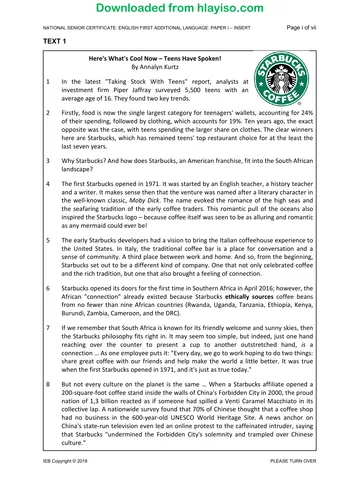
• use of contractions, i.e. "Here's" and "What's"
• use of teen-speak/colloquial expression, i.e. "cool"
• use of an/the exclamation mark
(Any TWO)
1.2 Yes – the text is about teens, and teen trends; the informal register is thus
appropriate/suited to the intended audience, and to the subject matter.
OR
No – possible responses (especially since this article is about teens and
not necessarily for them.)
No mark to be awarded for YES/NO – only reason.
1.3 The survey cited in the text shows that teens used to spend most of their
money on clothes, but now their biggest spend is on food.
1.4 The rhetorical question makes the reader ask the same question in the
mind – indeed, why Starbucks, of all other brands./Makes the reader
think./To emphasise.
1.5 Nineteen (hundred and) seventy one.
1.6 Given the professions of the founders of the venture, all of whom are
connected in some way to history and literature, it makes sense that it was
named after a literary figure./... in the well-known classic, Moby Dick."
1.7 A mermaid.
1.8 People everywhere want to feel connected to other people/feel that they
belong ("community"). They also value being able to talk to one another/
discuss ("conversation") their experience with other people.
One mark for reference to conversation and community; the other mark
for explaining these in own words.
1.9 C – obtained through free, fair and sustainable trade with local farmers.
1.10 UNESCO OR OK
1.11 "fits right in"
1.12 This is to show that the simple, seemingly insignificant action of handing a
cup to another person, does indeed connect them even if for a split
second./To emphasise that there is definitely a connection.
IEB Copyright © 2018 PLEASE TURN OVER
Downloaded from hlayiso.com
NATIONAL SENIOR CERTIFICATE: ENGLISH FIRST ADDITIONAL LANGUAGE: PAPER I Page 3 of 8
MARKING GUIDELINES
1.13 Example: The Chinese disapproved of Starbucks. This modern, western
brand was seen as a "caffeinated intruder" which had no place in the
ancient setting of the Great Wall of China, and their rejection of it was in
favour of preserving a "solemn" symbol of "Chinese culture". /They are
mostly tea-lovers. (words to this effect)
Award 1 mark for noting Chinese disapproval
Award a second mark for the reason for Chinese disapproval
Award third mark for meaningful inclusion of reference to the text in
support of answer.
1.14 Testing the waters = a trial run/experiment to see if the initiative would work.
1.15 Chinese are compared to sharks; implies that they strongly resisted the new
western brand coming into their space. Accept any sensible explanation.
TEXT 2
1.16 Open. For reasonable suggestion of advice; for reference to Text 2, not
necessarily quoted, e.g. do sound research on what the cultural norms/
traditions are, i.e. what is the local history regarding tea?
TEXT 3
1.17 B factual and informative
1.18 f – 40% of the world's coffee is produced by Columbia and Brazil.
1.19 mix/mixture
1.20 Coffee was one of the first ever freeze-dried foods, wasn't it?
wasn't it = (spelling correct)
?=½
TEXT 1 AND TEXT 3
1.21 Neither the Chinese nor early Muslim leaders were in favour of coffee: the
former for cultural reasons, and the latter because of coffee's impact on the
body.
The second mark may only be awarded if both texts are referred to, as per
instructions in the question.
IEB Copyright © 2018 PLEASE TURN OVER
Downloaded from hlayiso.com
NATIONAL SENIOR CERTIFICATE: ENGLISH FIRST ADDITIONAL LANGUAGE: PAPER I Page 4 of 8
MARKING GUIDELINES
SECTION B SUMMARY
QUESTION 2 SHOW UNDERSTANDING BY SUMMARISING
Learners should provide 5 main points, such as the suggested content
points below:
SUMMARY
ORIGINAL QUOTE OWN WORDS
1. "... a good laugh ... improve your mental 1. Laughter is good for one's health (and/or
and physical health, and your relationships) in general.
relationships?"
2. "... look up and smile at people you pass in 2. Practise smiling at people, even if they are
the street ... in the traffic ..." strangers.
3. "We can all choose what to focus on: the 3. Look beyond life's problems to see the
glass half full or half empty ..." upside which exists for most things.
4. "When you hear laughter, seek it out and 4. Choose to socialise with positive people/
ask, "What's funny?" deliberately seek out the funny side of life.
5. "There are always books, films, shows that 5. Regularly expose oneself to some of the
stimulate laughter ..." many laughter-inducing experiences that
surround one.
6. "... don't forget to play with your pet; ..." 6. Take some time to interact/play with your
pet.
MARKING
• Sub-examiner will draw a double oblique stroke after 70 words. Nothing
beyond 70 words will be marked.
• Each CORRECT CONTENT point is worth 2 marks, i.e. 5 × 2 = 10.
• Mark only one relevant content summary per point – ignore any other content
in the same point.
PENALTIES
• Indicate all errors (grammar, spelling, punctuation), including incomplete
sentences.
• 0–3 errors: no penalty; 4–6 errors: –1 mark; 7 or more errors: –2 marks
Indicate lifted phrases/sentences with Q (quotes) in the margin. (Included in
language penalty)
IEB Copyright © 2018 PLEASE TURN OVER
Downloaded from hlayiso.com
NATIONAL SENIOR CERTIFICATE: ENGLISH FIRST ADDITIONAL LANGUAGE: PAPER I Page 5 of 8
MARKING GUIDELINES
SECTION C POETRY
QUESTION 3 MAKING MEANING OF POETRY
SEEN POEMS
SONNET 116
3.1 Any TWO of the following (for example):
• Rhyme scheme: ABAB CDCD EFEF GG
• Three quatrains (followed by a)
• rhyming couplet.
NOT: 14 lines
3.2 "Love is not love …"
3.3 True love does NOT change or "alter", nor does it end: "… bears it out even
to the edge of doom". It also does not quit when there are problems: "looks
on tempests … never shaken".
i.e. does not change
each of these with reference to text (poem) for full
does not end
does not quit mark
Accept any relevant answer that is clearly explained in response to the
question.
3.4 Love is compared to a star (metaphor) that guides a little boat ("bark") at
sea (on its journey). When life gets difficult, when our boats seem to be
sinking, love can give us direction and hope, (explanation) or words to this
effect.
There is much to say in response to this question; not all of what is
suggested in this marking guideline is necessary for 2 marks.
3.5 OPEN. Award marks for a clear opinion that is relevant to the question
posed, and for which a reason is provided, as instructed.
Possible answers: Yes: if people truly love, as in the sonnet, it will
continue past death.
OR No: people change, and life is complicated. Look at the
divorce rate!
REFUGEE MOTHER AND CHILD
3.6 Mary, the mother of Jesus, cannot prevent her son's death. Nor can the
refugee mother. The poem's central message is that no matter who you are,
it is painful to lose a beloved child.
3.7 It creates a sharp contrast with the lack of all basic freedoms experienced
by refugees./Free verse vs no freedom for refugees (words to this effect).
IEB Copyright © 2018 PLEASE TURN OVER
Downloaded from hlayiso.com
NATIONAL SENIOR CERTIFICATE: ENGLISH FIRST ADDITIONAL LANGUAGE: PAPER I Page 6 of 8
MARKING GUIDELINES
3.8 Possible answers: The refugees illness is conveyed in "diarrhoea"; their
lack of an hygienic environment "unwashed bodies"; their starvation in
"washed-out ribs", "dried up bottoms" and "empty bellies"; their physical
weakness in "struggling … laboured steps". Any one example explained.
One mark for quote/example, one mark for explanation.
3.9 This suggests that this mother touched her son's hair often and naturally
when she greeted him before he went to school. They had a normal life
before./Before they became refugees./Before her son became ill/weak.
3.10 Flowers are carefully arranged on a grave; the mother is as careful with her
son's hair now, since he is close to death/to his grave.
3.11 Both poems are about love. Both touch on the way that true love lasts,
through very tough circumstances (refugee camp/death of a child/"doom");
in both, love provides something of value in an otherwise (nasty/hard/cruel/
difficult) life.
Reward any reasonable, relevant response that shows thought beneath the
obvious.
QUESTION 4 MAKING MEANING OF POETRY
UNSEEN POEM
4.1 B
4.2 "waterski"
4.3 The poet's desire that poetry be seen as less of a hard, dull, forced and flat
chore is supported by the word "colour", since it has connotations of joy,
fun, pleasure and life.
4.4 Focus on stanza 2:
4.4.1 The poem is compared to a (bee)hive.
4.4.2 hearing
4.5 The word "but" heralds the opposite side of the poem's message: it turns
the reader's attention away from what the speaker wishes for his students,
to what they actually do …/Indicates that a contrast is going to be
introduced.
4.6 Unfortunately not./It is as if the students cannot imagine that poetry could
possibly bring any joy. They seem so trapped (by years of formal
education?) that they end up forcing "the" particular "meaning" out if it: they
"tie it to a chair" (restrict its possibilities of interpretation), and even "beat it
with a hose"./"Killing" of creativity.
IEB Copyright © 2018 PLEASE TURN OVER
Downloaded from hlayiso.com
NATIONAL SENIOR CERTIFICATE: ENGLISH FIRST ADDITIONAL LANGUAGE: PAPER I Page 7 of 8
MARKING GUIDELINES
SECTION D COMMUNICATIVE LANGUAGE
QUESTION 5 ADVERTISEMENTS
5.1 Car, home, business and life insurance.
5.2 The target market is women. "… we insure women".
5.3 Slogan: Cover with Care. The "care" ethic is traditionally linked to women.
5.4 The male gender is stereotypically seen as those who take foolish risks for
fun, such as dangling from a cliff (visual clue) They foolishly accept risky
dares: "Jump … Whoopsie daisy" (verbal clue) .
5.5 Open. Example: The language: "Whoopsie daisy" is a huge understatement
of the danger the man is really in; this creates humour. The image is the
man dangling with his friend above him creates humour too – how exactly
CAN his friend "catch him"?
Award 1 mark for a humour-creating example ; another mark for explaining
its humorous effect.
QUESTION 6 CARTOON
6.1 It (humorously) expresses the teacher's agitation/frustration about repeated
stories from the students./Pause indicated by the ellipsis creates
anticipation.
6.2 It indicates just how many of the "students" neglect their homework.
6.3 Usually school children make the excuse that the dog has eaten/destroyed
their homework; here, dogs unexpectedly use the same excuse, thus
creating humour and/or irony.
6.4 Annoyed/agitated/frustration/exasperation (accept any similar/valid); hands
on hips
6.5 The teacher asked whether anyone there had not eaten his or her
homework on the way to school.
IEB Copyright © 2018 PLEASE TURN OVER
Downloaded from hlayiso.com
NATIONAL SENIOR CERTIFICATE: ENGLISH FIRST ADDITIONAL LANGUAGE: PAPER I Page 8 of 8
MARKING GUIDELINES
QUESTION 7 TEXTUAL EDITING
7.1 at
7.2 It shows that the evening was for many parents. /To indicate a possessive
plural noun.
7.3 apostrophe for contraction/omission, i.e. in the place of a missing letter
7.4 totally (added –ly suffix)
7.5 I filled their cups for them.
7.6 C – definite article
7.7 Any complete sentence with the word NEW used meaningfully.
7.8 is
7.9 The sounds of the initial letters of the words are switched around.
7.10 (a) PUN or WORD PLAY.
(b) Mugging has to do with coffee drinking mugs, but also with being
held up by a thief.
Total: 100 marks
IEB Copyright © 2018
Study this subject
Revise the topics in this paper, then practise them question by question.
- Grade 12 English Fal notes
CAPS revision notes with worked examples.
- English Fal questions by topic
Past exam questions sorted by CAPS topic, with memos where available.
- Grade 12 English Fal quizzes
Short topic quizzes with instant feedback.
- All Grade 12 English Fal past papers
Past papers by year, with memos where available.
- Grade 12 IEB past papers
More English FAL and other subjects in this collection.
Recommended for this subject
More papers and memos for this grade and subject.
MemorandumIEB
English FAL Grade 12 IEB Paper 1 2019 Memo
MemorandumIEB
English FAL Grade 12 IEB Paper 2 2019 Memo
MemorandumIEB
English FAL Grade 12 IEB Paper 2 2018 Memo
MemorandumIEB
English FAL Grade 12 IEB Paper 1 2017 Memo
MemorandumIEB
English FAL Grade 12 IEB Paper 2 2017 Memo
Question paperIEB
English FAL Grade 12 IEB Paper 1 2019 Question Paper
Related documents
Question paperIEB
English FAL Grade 12 IEB Paper 1 2018 Question Paper
AddendumIEB
English FAL Grade 12 IEB Paper 1 2018 Addendum
Question paperIEB
English FAL Grade 12 IEB Paper 2 2018 Question Paper
AddendumIEB
English FAL Grade 12 IEB Paper 1 2019 Addendum
Question paperIEB
English FAL Grade 12 IEB Paper 1 2017 Question Paper
AddendumIEB