
Study & Master
Support Pack | Grade 11
CAPS
Accounting
Exemplar examination: June (Paper 2)
This revision pack for Accounting Grade 11 provides support for
learners revising the most important concepts and principles covered
in the CAPS curriculum, by providing practice exams. This pack offers a
sample of the June examination (Paper 2).
You have permission to print or photocopy this document, and to
distribute it electronically via email or WhatsApp.
For more information on our Study & Master CAPS-approved
textbooks and valuable resource materials, visit
www.cambridge.org
Brighter Thinking | Better Learning
i
Skip to contentStudy guide 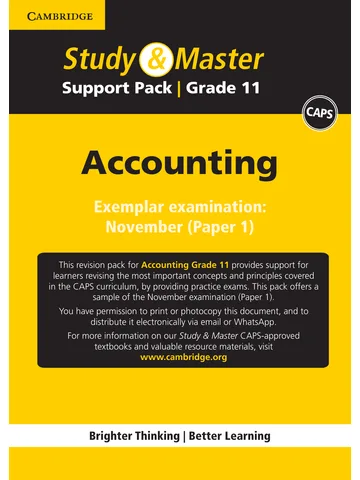
%20June%202024%20Question%20Paper_hlayiso.com_--cf529c01-0786-4680-b8b1-b401167df69c/v1-a74b50fe4b45802a59cb/card.webp)
%20June%202024%20Question%20Paper_hlayiso.com_--6f46b4c9-08af-40d5-bbfc-8e5e70b68734/v1-da1045ec841611dced33/card.webp)
%20June%202024%20Question%20Paper_hlayiso.com_--b649cfc1-b72f-4e45-b621-502673440d1c/v1-f3f273b92fb9f447e93e/card.webp)
View all
--49899c38-504c-42fb-972e-2181fa910731/v1-a1bcb14b453000d507d6/card.webp)
GR11 Accounting Practice exam June Paper 2
Grade 11 Accounting study guide, 8 pages. Read online or get the free PDF download.
Publisher: Study & Master
Accounting · Grade 11. Study guide, 8 pages. Read online or download the PDF.
- Subject
- Accounting
- Grade
- Grade 11
- Document type
- Study guide
- Publisher
- Study & Master
- Curriculum
- CAPS
- Pages
- 8
- File size
- 188.5 KB
Loading document…
Loading document…
1 of 8
Document textSearch extracted text and jump to a page.
Grade 11 JUNE Time: 2 hours
PAPER 2 EXAMINATION Marks: 150
INSTRUCTIONS AND INFORMATION
Read the following instructions carefully and follow them precisely.
1. Answer ALL the questions.
2. Show workings in order to achieve part-marks.
3. You may use a non-programmable calculator.
4. Always answer questions using dark pencil or blue/black ink.
5. Where applicable, show all calculations to ONE decimal point.
6. Write neatly and legibly.
7. Use the information in the table below as a guide when answering the question
paper. Try NOT to deviate from it.
QUESTION 1: 56 marks; 45 minutes
Topic of the question: This question integrates:
Financial Statements of a Partnership GAAP principles
Statement of comprehensive income (Income
Statement)
QUESTION 2: 66 marks; 53 minutes
Topic of the question: This question integrates:
Financial Statements of a Partnership Statement of financial position (Balance Sheet)
Notes to the financial statements
QUESTION 3: 28 marks; 22 minutes
Topic of the question: This question integrates:
Interpretation of Financial Statements Calculating financial indicators and ratios
Commenting on calculations
QUESTION 4: 24 marks; 20 minutes
Topic of the question: This question integrates:
Interpretation of Financial Statements Calculating financial indicators and ratios
Commenting on calculations
1
QUESTION 1 [38 marks; 30 minutes]
BANK RECONCILIATION
The following information relates to Buzy Bee Traders. The owner is Linge Pete.
They sell honey to local stores.
REQUIRED
1.1 Calculate the correct bank totals in the CRJ and CPJ on 30 November 2018. (17)
1.2 Prepare the Bank Reconciliation Statement on 30 November 2018. (13)
1.3 Linge suspects that the cashier is not entering all the cash received for
cash sales on the receipts, but that she is taking it for herself.
Why will this not be picked up by the Bank reconciliation and what can
Linge do to prevent this from happening? (4)
1.4 What should Linge do if the cashier is found guilty of unethical behaviour?(4)
INFORMATION
1. Bank Reconciliation Statement on 31 October 2018
Overdraft as per bank statement 37 200
Outstanding deposits 21 049
Cheques not presented for payment
No 2134 (dated 10 May 2018) 550
No 3002 (dated 24 October 2018) 3 600
No 3013 (dated 1 December 2018) 12 348
Credit balance as per bank account 32 649
2. Cash Journals
The Cash Journals reflected the following totals on 30 November 2018:
CRJ R154 890
CPJ R139 769
3. The balance on the bank statement is R11 105 (overdraft) on 30 November 2018.
4. Additional information
The following were noted when the bank statement, received from XY Bank on
29 November 2018, was compared with the Cash Journals for November 2018
and the Bank Reconciliation Statement for 31 October 2018.
4.1 From the Bank Reconciliation Statement for October 2018 only the out-
standing deposit of R21 049 and cheque no. 3002 appeared on the Novem-
ber bank statement.
4.2 Entries on the bank statement but not in the Cash Journals for November 2018:
• A deposit of R4 400 from the tenant for rent for November 2018.
• A debit order for insurance to Allsure Insurers, R980.
• A dishonoured cheque for R266, received from a debtor during October
2018 in settlement of his account of R280.
• The following charges were made by the bank:
Service fees, R521
Cash handling fee, R322
Interest on overdraft, R651
• A deposit of R5 800 appeared on the bank statement but not in the CRJ.
On investigation it was found that the owner made the deposit into
her personal account, but the bank credited the business’s account
by mistake.
• A cheque, number 3116 issued to Venter Stationers, was entered as
R1 227 in the CPJ. The bank statement reflects the correct amount
as R1 772.
2
4.3 The following entries appeared in the Cash Journals for November 2018, but
not on the bank statement:
• Cheque number 3102 for R3 230 and cheque number 3111 for R890.
• A deposit of R19 870 made on 30 November 2018.
• Cheque no 3121 was issued to CJ Motors for repairs done to the vehicle,
R2 360. This cheque was lost by the payee and payment of the cheque
was stopped at the bank. A new cheque (number 3132) was issued, but
has not been presented for payment by CJ Motors. No entry was made
in the business’s books for the stop payment and the new cheque issued.
QUESTION 2 [48 marks; 38 minutes]
ASSET MANAGEMENT
The given information relates to the fixed assets of Hop-On-Hop-Off, a shuttle
service that takes passengers to and from the Cape Town train station. The owner of
the business is Micaela Groenewald. She runs the business from her home.
The financial period is from 1 March 2017 to 28 February 2018.
REQUIRED
2.1 Prepare the following accounts in the General Ledger of Hop-On-Hop-Off:
2.1.1 Accumulated depreciation on vehicles (15)
2.1.2 Asset disposal (10)
2.2 Complete the note for fixed assets for the year ended 28 February 2018.
Some of the amounts have already been entered in the answer book. (17)
2.3 Name two risks with regard to vehicles and two internal control measures to
prevent these risks. (6)
INFORMATION
Vehicles
1. Micaela started the business on 1 January 2015. On this day, she bought
two identical vehicles costing R120 000 each and she employed two drivers.
By 1 March 2017, she has already written off depreciation of R91 520 on both
these vehicles.
2. In order to accommodate more people, Micaela traded in one of the vehicles for
R55 000 on a new, bigger vehicle of R250 000 on 1 December 2017.
3. Vehicles are depreciated by 20% p.a. on the diminished balance.
Equipment
1. Since she started the business Micaela bought equipment to the value of
R60 000. By 1 March 2017, she has already written off depreciation of R28 800
on this equipment.
2. Micaela decided to upgrade her telecommunication-system in order to pro-
vide a better service and gain more clients. On 1October 2017, the installation
was complete and Micaela made an EFT (payment) to Matello Computers for
R18 000.
3. Equipment is depreciated at 25% p.a. on the cost price.
3
QUESTION 3 [40 marks; 32 minutes]
COST ACCOUNTING (MANUFACTURING)
3.1 COST ACCOUNTS
Choose a category from COLUMN B that matches a description in COLUMN
A. Write only the letter (A – E) next to the question number (3.1.1 – 3.1.4) in
the ANSWER BOOK. One letter can be used more than once. (4)
COLUMN A COLUMN B
3.1.1 Advertising expenses A Direct material cost
3.1.2 Office telephone account B Direct labour cost
3.1.3 Bad debts C Factory overhead cost
3.1.4 Salary of the factory foreman D Administration cost
E Selling and distribution cost
3.2 LEDGER ACCOUNTS
You are provided with information relating to ZOOP Bag manufacturers. The
information was extracted from the accounting records on 28 February 2018,
the end of the financial year.
REQUIRED
3.2.1 Prepare the Raw Material Stock account in the General Ledger.
Balance the account on 28 February 2018. (8)
3.2.2 Calculate the factory overhead costs for the year. (9)
3.2.3 Prepare the Work-in-process stock account in the General Ledger.
Balance the account on 28 February 2018. (9)
3.2.4 Calculate the Cost of Sales for the year ended 28 February 2018. (4)
INFORMATION
Balances at the end of the financial year 2017 2018
Raw material stock 21 300 15 600
Work-in-process stock 13 100 18 200
Finished goods stock 21 100 23 400
Indirect material stock 2 900 2 350
4
Summary of transactions for the year ended 28 February 2018 R
Raw materials bought on credit 321 000
Raw materials bought cash 98 700
Wages of production labour 420 000
Salary – factory foreman 68 000
Salary of receptionist 120 000
Motor vehicle expenses (to be shared between factory and selling and distribution cost in the
42 000
ratio 1:1)
Water and electricity (80% of water and electricity is used up in the factory) 36 000
Indirect materials bought during the year 17 600
Sundry factory expenses 45 200
3.3 BREAK-EVEN ANALYSIS
Bella Litchfield makes fabric stationery bags which she sells to learners.
REQUIRED
3.3.1 Calculate the number of units that Bella needed to produce in order to
break even in 2018. (4)
3.3.2 Comment on the number of bags she is producing. Quote figures and
refer to the break-even calculation in your answer. (2)
INFORMATION
1. During the year, 10 288 units were produced and sold.
2. The selling price per unit was R24.
3. Variable and fixed costs.
2018 2017
Variable costs: TOTAL PER UNIT PER UNIT
Direct material R102 880 R8,00 R10,00
Direct labour R82 304 R6,40 R5,60
Selling and distribution R41 152 R3,20 R3,00
R226 336 R17,60 R18,60
Fixed costs:
Factory overheads R61 728 R4,80
Administration cost R15 432 R1,20
R77 160 R6,00
5
QUESTION 4 [24 marks; 20 minutes]
ANALYSIS AND INTERPRETATION
You are provided with information relating to PopKidz Boutique for the year ended
31 December 2018, together with comparative figures for 2018. The business is
owned by two partners, Siswe and Nande.
REQUIRED
4.1 Calculate the following financial indicators for 2018. Show all workings.
4.1.1 % Gross profit on cost of sales. (3)
4.1.2 Number of days stock is on hand (stock holding period). (4)
4.1.3 % Operating expenses on sales. (3)
4.2 Using the financial indicators below:
4.2.1 The business changed their policy with regard to profit mark-up from
2017 to 2018. What was the change in policy? What are the risks with
regard to this and what effect did this change have on the business
income?(6)
4.2.2 Discuss TWO reasons why a business should not have too much stock
on hand. (4)
4.2.3 Does the business have good control over their expenses? Quote
financial indicators to support your answer. (4)
2018 2017
Statement of comprehensive income (Income Statement)
Sales 3 213 000 3 004 400
Cost of sales (2 142 000) (2 146 000)
Gross profit 1 071 000 858 400
Operating expenses (512 640) (509 024)
Interest on loans (14% p.a.) (53 200) (70 000)
Net profit for the year 505 160 279 376
Statement of financial position (Balance Sheet)
Current assets 430 560 262 300
Inventory 357 660 175 600
Debtors 31 700 29 800
Cash and cash equivalents 41 200 56 900
Financial indicators
2018 2017
% Gross profit on cost of sales ? 40%
Stock holding period ? 30 days
% Operating expenses on sales ? 16,9%
6
ANNEXURE A
ACCOUNTING – FORMULA SHEET
Gross profit 100 Gross profit 100 Net profit 100
× × ×
Sales 1 Cost of sales 1 Sales 1
Operating expenses 100 Operating profit 100
× ×
Sales 1 Sales 1
Total earnings by partner 100 Net profit 100
× ×
Partners average equity 1 Average owners ’ equity 1
(Current assets – Inventories) : Current
Current assets : Current liabilities
liabilities
(Trade and other receivables + Cash and cash equivalents) : Current liabilities
Average debtors 365 or 12 Average creditors 365 or 12
× ×
Credit sales 1 Credit purchases 1
Average inventories 365 or 12 Cost of sales
×
Cost of sales 1 Average inventories
Non-current liabilities : Owners’ equity Total assets : Total liabilities
7
Study this subject
Notes, quizzes and topic questions for Grade 11 Accounting.
- Grade 11 Accounting notes
CAPS revision notes with worked examples.
- Accounting questions by topic
Past exam questions sorted by CAPS topic, with memos where available.
- Grade 11 Accounting quizzes
Short topic quizzes with instant feedback.
- All Grade 11 Accounting past papers
Past papers by year, with memos where available.
- Grade 11 Study guides
More Accounting and other subjects in this collection.
Recommended for this subject
More papers and memos for this grade and subject.
Study guide
GR11 Accounting Practice exam November Paper 1
Addendum
Accounting Grade 11 P1 Eastern Cape November 2025 Addendum (Afr)
Memorandum
Accounting Grade 11 Paper 2 Eastern Cape November 2025 Memo
Memorandum
Accounting Grade 11 Paper 2 Eastern Cape November 2025 Memo
Question paper
Accounting Grade 11 Eastern Cape November 2025 Question Paper
Question paper
Accounting Grade 11 P1 Eastern Cape November 2025 QP (Afr)
Related documents
Question paper
Accounting Grade 11 P2 Eastern Cape November 2025 Question Paper
Question paper and memo
Accounting Grade 11 Limpopo March Test 2025 Paper & Memo
Memorandum
Accounting Grade 11 Paper 2 Eastern Cape November 2024 Memo
Question paper
Accounting Grade 11 P1 Gauteng June 2024 Question Paper (Afr)
Question paper
Accounting Grade 11 P1 Gauteng June 2024 Question Paper (English)
Question paper
Accounting Grade 11 P2 Gauteng June 2024 Question Paper (English)
More from Grade 11 Accounting
Addendum
Accounting Grade 11 P1 Eastern Cape November 2023 Addendum (Afr)
Memorandum
Accounting Grade 11 P1 Eastern Cape November 2023 Memo (English)
Memorandum
Accounting Grade 11 P2 Eastern Cape November 2023 Memo (Afr)
Question paper
Accounting Grade 11 P1 Eastern Cape November 2023 QP (Eng)
Question paper
Accounting Grade 11 P1 Eastern Cape November 2023 QP (Eng)
Question paper