
Downloaded from hlayiso.com
NATIONAL SENIOR CERTIFICATE: LIFE SCIENCES: PAPER III – INFORMATION SHEET Page i of ii
INFORMATION SHEET
Vibrio cholerae is a small bacterium (1,4–2,6 µm in length) with a flagellum. The natural habitat of
the bacterium is in brackish or saltwater. Rivers, streams and lakes are also home to the
bacterium, particularly if there is human activity nearby. When ingested, the bacterium can cause
diarrhoea and vomiting within several hours to 2–3 days after ingestion. When visiting areas
known to have an outbreak of cholera, it is advised to: drink and use bottled water; frequently
wash hands with soap and safe water; use chemical toilets or bury faeces if no restroom is
available; or treat water.
The bacterium has been extensively studied using electron microscopy. A transmission electron
microscope is used to look at 2D specimens in ultrathin sections less than 100 nm thick. An image
is formed from the electron beam being transmitted through the specimen. A scanning electron
microscope focuses a beam of electrons onto the surface of the sample and results in a 3D image
of the surface of the sample.
[Adapted: <https://www.mrc-lmb.cam.ac.uk> and <https://www.fei.com/>]
Potable water, also known as drinking water, is water that is considered
safe to drink or to use in preparing food. In developed countries, tap water
meets drinking water quality standards. In less developed countries, water
may not meet the water quality standards, and so should be treated
before use.
Treatment of water: this can be done by boiling water, adding
disinfectants such as bleach, or by filtering. Boiling water is the surest
method to kill disease-causing organisms, including viruses, bacteria, and
waterborne parasites. The addition of bleach to water at a concentration of 1 ml/litre will be
sufficient to sterilise water. Filtration of water that is cloudy or has particulate matter in it is
advised.
[Adapted: <https://www.thespruce.com/tap-water-safety-1907904>]
Cholera testing can be done in a number of ways for water samples. This investigation makes use
of a colour test using Activated Solution A, which is a dark blue-purple colour. In the presence of
large amounts of V. cholerae, the Activated Solution A will become clear. If no V. cholerae is
present, the Activated Solution A will remain a blue-purple colour. Very small amounts of
V. cholerae in water samples result in Activated Solution A changing to a blue-grey colour.
IEB Copyright © 2018 PLEASE TURN OVER
You're offline
Skip to contentInformation sheet 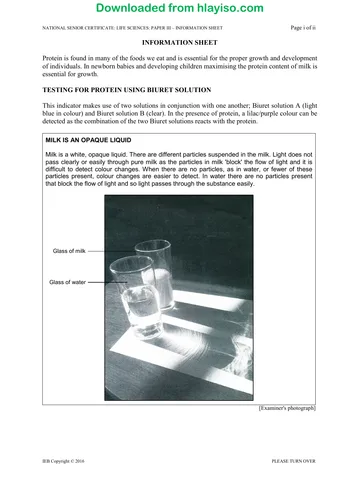
%20%20Preparatory%202018%20Possible%20Answer_hlayiso.com_--47d1fae5-b964-4653-aaa6-a3b2ad4a2512/v1-c12e41683d7a4be332af/card.webp)
View all
P3 Info Sheet 2018 hlayiso.com
Life Sciences · Grade 12 · 2018. Information sheet, 2 pages. Read online or download the PDF.
- Subject
- Life Sciences
- Grade
- Grade 12
- Document type
- Information sheet
- Year
- 2018
- Paper
- 3
- Publisher
- IEB
- Pages
- 2
- File size
- 558.0 KB
Loading document…
Loading document…
1 of 2
Document textSearch extracted text and jump to a page.
Downloaded from hlayiso.com
NATIONAL SENIOR CERTIFICATE: LIFE SCIENCES: PAPER III – INFORMATION SHEET Page ii of ii
Map of River – to be referred to in Question 1.20
[Adapted: <http://clipartmag.com/river-clipart-black-and-white>]
IEB Copyright © 2018
Recommended for this subject
Published documents with matching subject and grade metadata.
Information sheet
P3 InfoSheet 2016 hlayiso.com
Question paper
LIFE SCIENCES QP GR12 JUNE 2025 ENG D
Memorandum
LIFE SCIENCES P2 MEMO GR12 SEPT 2025 AFR
Memorandum
Life Sciences Grade 12 NSC P1 MEMO September 2025 Free State
Memorandum
Life Sciences Grade 12 NSC P2 MEMO September 2025 Free State
Memorandum
Life Sciences Grade 12 NSC P2 MEMO September 2025 Gauteng
Related documents
Matched using subject, grade, language, document type and exam metadata.
Question paper
LIFE SCIENCES P2 GR12 QP SEPT2018 English hlayiso.com
Memorandum
Grade 12 NSC Life Science P1 Preparatory 2018 Possible Answer hlayiso.com
Memorandum
Grade 12 NSC Life Science P1 (Afrikaans) Preparatory 2018 Possible Answer hlayiso.com
Memorandum
Life Sciences P1 May June 2018 Memo Eng hlayiso.com
Question paper
Life Sciences P1 Nov 2018 Afr hlayiso.com
Question paper
Life Sciences P1 Nov 2018 Eng hlayiso.com
More from Grade 12 Life Sciences
Explore more published documents in this catalogue.
Question paper
Life Sciences Grade 12 NSC QP March 2025 KZN
Memorandum
Life Sciences Grade 12 NSC P2 MEMO September 2025 KZN
Memorandum
Life Sciences Grade 12 NSC P2 MEMO September 2025 Mpumalanga
Question paper
Life Sciences Grade 12 NSC P1 QP September 2025 Mpumalanga
Question paper
Life Sciences Grade 12 NSC P1 QP September 2025 North West
Question paper