
Downloaded from hlayiso.com
NATIONAL SENIOR CERTIFICATE EXAMINATION
NOVEMBER 2017
PHYSICAL SCIENCES: PAPER I
Time: 3 hours 200 marks
PLEASE READ THE FOLLOWING INSTRUCTIONS CAREFULLY
1. This question paper consists of 15 pages, an answer sheet of 2 pages and a data
sheet of 2 pages (i–ii). Please make sure that your question paper is complete.
2. Answer ALL the questions.
3. Read the questions carefully.
4. Use the data and formulae whenever necessary.
5. Start each question on a new page.
6. Show your working in all calculations.
7. Units need not be included in the working of calculations, but appropriate units
should be shown in the answer.
8. Where appropriate express answers to TWO decimal places.
9. It is in your own interest to write legibly and to present your work neatly.
IEB Copyright © 2017 PLEASE TURN OVER
Skip to contentQuestion paper 
_hlayiso.com_--02ee4df7-1da4-4d41-a14b-a0b2b2d781f5/v1-591f24580dfb16122386/card.webp)
View all
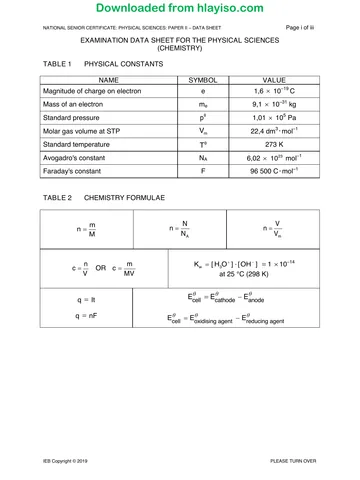
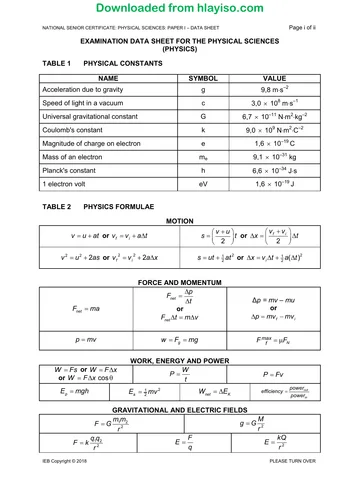
Physical Sciences Grade 12 IEB Paper 1 2017 Question Paper
IEB Grade 12 Physical Sciences Paper 1 question paper from the 2017, 15 pages. Read online or get the free PDF download, memo linked when available.
Publisher: IEB
Physical Sciences · Grade 12 · 2017. Question paper, 15 pages. Read online or download the PDF.
- Subject
- Physical Sciences
- Grade
- Grade 12
- Document type
- Question paper
- Year
- 2017
- Paper
- 1
- Publisher
- IEB
- Curriculum
- IEB
- Pages
- 15
- File size
- 875.3 KB
Loading document…
Loading document…
1 of 15
Document textSearch extracted text and jump to a page.
Downloaded from hlayiso.com
NATIONAL SENIOR CERTIFICATE: PHYSICAL SCIENCES: PAPER I Page 2 of 15
QUESTION 1 MULTIPLE CHOICE
Answer these questions on the multiple-choice Answer Sheet on the inside
front cover of your Answer Book. Make a cross (X) in the box corresponding
to the letter that you consider to be correct.
1.1 Which set of physical quantities consists only of vector quantities?
A velocity, time
B momentum, electric field
C acceleration, speed
D work, impulse
1.2 The velocity vs time graph for the motion of a car on a straight road is
shown in the diagram. Assume that the car starts at the origin x = 0 at time
t = 0.
10
8
6
velocity (m⋅s-1)
4
2
0 1 2 3 4 5 6 7 8 9 10
–2
–4
–6
time (s)
At which time is the car the greatest distance from the origin?
A 10 s
B 6s
C 5s
D 3s
1.3 An object moves along a horizontal line with increasing speed. Which one
of the following choices could be the best description of the velocity and the
acceleration for the object to achieve this motion?
Velocity Acceleration
A Positive Zero
B Positive Negative
C Negative Positive
D Negative Negative
IEB Copyright © 2017
Downloaded from hlayiso.com
NATIONAL SENIOR CERTIFICATE: PHYSICAL SCIENCES: PAPER I Page 3 of 15
1.4 A student weighing 500 N stands on a scale in an elevator (lift) moving
down. When the scale reads 520 N, the elevator must be
A increasing in speed
B decreasing in speed
C moving at a constant speed
D accelerating down
1.5 A block rests on an inclined rough surface that makes an angle 𝜃with the
horizontal.
𝜃
The block remains at rest as is slowly increased. Which is the best
description of how the magnitudes of the normal force and the static
frictional force of the rough surface on the block change as is slowly
increased?
Normal Force Static Frictional Force
A Increase No change
B Decrease Decrease
C Increase Increase
D Decrease Increase
1.6 A collision of two blocks takes place along a frictionless horizontal surface.
A block of mass M1 3 kg moves to the right with a speed of 5 m s1 and
collides with a block of mass M2 5 kg which was initially moving to the left
with a speed of 2 m s 1.
After colliding, the block of mass M1 moves to the left with a speed of
1 m s 1.
Which of the blocks experienced a larger magnitude of acceleration during
the collision?
A The block with mass M1.
B The block with mass M2 .
C The magnitude of the acceleration was the same for both blocks.
D The answer depends on whether the collision was elastic.
IEB Copyright © 2017 PLEASE TURN OVER
Downloaded from hlayiso.com
NATIONAL SENIOR CERTIFICATE: PHYSICAL SCIENCES: PAPER I Page 4 of 15
1.7 A person throws an object of mass M straight up with an initial speed v.
The object rises to a maximum height H above the launch point. The person
1
now throws an object of mass M straight up with a speed of 2v. In terms
2
1
of H, to what maximum height does the object of mass M rise above the
2
launch point? Ignore air resistance.
A 4H
B 2H
C 2H
D H
1.8 Two point charges +3Q and –Q are fixed on the x-axis in otherwise empty
space as shown below.
Region I Region II Region III
In which Region(s) is there a point on the x-axis at which the electric field is
equal to zero?
A Region I
B Region II
C Region III
D Region I and Region III
1.9 In the circuit diagram below, all of the bulbs are identical. Which bulb will be
the brightest?
IEB Copyright © 2017
Downloaded from hlayiso.com
NATIONAL SENIOR CERTIFICATE: PHYSICAL SCIENCES: PAPER I Page 5 of 15
1.10 Two circuits are shown in the diagram.
P
X Y
V
The resistance in the outside circuit, Routside is decreasing at a constant
rate. In which direction is the magnetic field at point P pointing and in which
direction is the conventional current through the resistor, Rinside , in the
smaller inside circuit?
Magnetic field at P Current through Rinside
A Into the page From X to Y
B Into the page From Y to X
C Out of the page From X to Y
D Out of the page From Y to X
[20]
IEB Copyright © 2017 PLEASE TURN OVER
Downloaded from hlayiso.com
NATIONAL SENIOR CERTIFICATE: PHYSICAL SCIENCES: PAPER I Page 6 of 15
QUESTION 2 KINEMATICS
A cyclist is riding north at 2 m s1 along a long straight road. A velocity vs time
graph of the motion of the cyclist for 10 s is shown below.
2.1 Define velocity. (2)
2.2 During which time interval(s) is the cyclist's velocity constant? (3)
2.3 During which time interval(s) is the cyclist slowing down? (2)
2.4 During which time interval(s) is the cyclist travelling south? (2)
2.5 Define acceleration. (2)
2.6 Calculate the acceleration of the cyclist between 3 s and 7 s. (4)
2.7 Sketch a position vs time graph for the cyclist on the axes provided on the
answer sheet. Values are not required but you must use the labels A–G.
The cyclist's position is zero at t 0 s. (6)
[21]
IEB Copyright © 2017
Downloaded from hlayiso.com
NATIONAL SENIOR CERTIFICATE: PHYSICAL SCIENCES: PAPER I Page 7 of 15
QUESTION 3 KINEMATICS
3.1 A child is holding a red ball and a blue ball over the edge of a roof. The
child throws the red ball vertically up in the air and, at the same moment
drops the blue ball over the edge. On the same set of axes, sketch the
velocity vs time graph for both balls. Label the two lines red and blue.
Choose up as the positive direction for your graph. (3)
3.2 A cat is 6 m from a mouse and walking slowly.
6m
[Images from: <http://www.clipartqueen.com/cat-clip-art.html> and
https://img.clipartfest.com/18ff66cc649f8ea29e418f6cfa8c811f_mouse-clip-art-house-for-a-
mouse-clipart-black-and-white_698-548.png
The cat hunts the mouse for 10 s in two stages. For the first 8 s the cat
stalks the mouse slowly at a constant 0,25 m s1 and for the last 2 s runs
at a constant faster speed and catches the mouse. The mouse did not see
the cat coming and sat still.
3.2.1 Calculate how far the cat is from the mouse after 8 s. (3)
3.2.2 Draw a position vs time graph for the cat for 0–10 s. Relevant values
of position and time must be shown on the axes. Consider the
mouse's position as position zero. (3)
3.2.3 Calculate how fast the cat ran for the last 2 s of the hunt. (2)
3.3 A model rocket is fired vertically upwards from rest at ground level. The
rocket accelerates upwards at 20 m s2 for 15 s and then runs out of fuel.
Air resistance is negligible.
3.3.1 Calculate the rocket's maximum height above the ground. (6)
3.3.2 Calculate the time the rocket is in the air from launch to crashing on
the ground. (5)
3.3.3 At which position will the rocket experience a maximum velocity? (2)
[24]
IEB Copyright © 2017 PLEASE TURN OVER
Downloaded from hlayiso.com
NATIONAL SENIOR CERTIFICATE: PHYSICAL SCIENCES: PAPER I Page 8 of 15
QUESTION 4 NEWTON'S LAWS
4.1 An experiment was conducted to investigate the relationship between the
force exerted on an object and the object's acceleration. An electric fan is
mounted on a zero-friction cart to accelerate the cart along a smooth track.
The speed of the fan and hence the force exerted on the cart is adjusted
and the acceleration of the cart determined.
Fan
Cart Frictionless track
[Image from: <http://serc.carleton.edu/dmvideos/videos/fan_cart_lab.html>]
4.1.1 Name and state the Newton's Law that is under investigation. (3)
4.1.2 State the dependent variable in the investigation. (2)
The experimental results are recorded in the table.
Force (mN) Acceleration m s 2
due to fan
25 0,09
80 0,30
135 0,52
190 0,68
245 0,92
300 1,05
4.1.3 Plot a graph of acceleration (on the y-axis) against force due to fan
(on the x-axis) on the graph paper provided in the answer sheet. (6)
4.1.4 Calculate the gradient of the graph. Include the appropriate unit in
your answer. (4)
4.1.5 Use your answer for Question 4.1.4 to determine the mass of the
cart. (3)
The experiment is conducted again, but on a track with friction. The cart
experiences a frictional force of 50 mN.
4.1.6 On the same set of axes used for Queston 4.1.3, sketch a line that
you would expect to obtain for the experiment conducted with friction.
Label your predicted line P. (2)
IEB Copyright © 2017
Downloaded from hlayiso.com
NATIONAL SENIOR CERTIFICATE: PHYSICAL SCIENCES: PAPER I Page 9 of 15
4.2 A box of mass 150 kg is prevented from sliding down the slope by a force,
F, of 100 N acting at 40° to the rough inclined plane as shown. The plane is
inclined at 35° to the horizontal and the coefficient of static friction between
the box and the surface is 0,7.
F = 100 N
35°
4.2.1 Draw a labelled free-body diagram showing all the forces acting on
the box. (4)
4.2.2 Calculate the component of the weight parallel to the inclined plane. (3)
4.2.3 Calculate the magnitude of the frictional force that is acting on the
box. (4)
The size of force F is slowly reduced from 100 N until the box is about to
slide.
4.2.4 Calculate the minimum value of the force F for the box to remain at
rest. (4)
[35]
IEB Copyright © 2017 PLEASE TURN OVER
Downloaded from hlayiso.com
NATIONAL SENIOR CERTIFICATE: PHYSICAL SCIENCES: PAPER I Page 10 of 15
QUESTION 5 MOMENTUM, WORK, ENERGY & POWER
5.1 A box of mass 2 kg has an initial speed of v1. The box travels across a
rough surface and has a speed of 1,5 m s1 after it has travelled 0,7 m. The
frictional force acting on the box is 26 N.
2 kg
0,7 m
5.1.1 Define frictional force. (2)
5.1.2 Calculate the kinetic energy of the box while it is travelling at
1,5 m s1. (3)
5.1.3 Calculate the work done on the box by the frictional force. (3)
5.1.4 State the work-energy theorem. (2)
5.1.5 Calculate the initial speed v 1 of the box. (4)
5.2 A 1,2 kg crate is attached to a long string as shown in the diagram. A block
of mass 0,4 kg collides with the stationary crate with a velocity v b and
rebounds with a velocity of 0,36 m s1 causing the crate to swing up
through a vertical height of 65 cm. (Frictional forces are negligible)
crate
65 cm
block crate
0,4 kg 1,2 kg
5.2.1 State the principle of conservation of mechanical energy. (2)
5.2.2 Calculate the magnitude of the velocity of the crate immediately
after the block collided with the crate. (4)
5.2.3 State the law of conservation of linear momentum. (2)
5.2.4 Calculate the magnitude of the velocity of the block, v b , just before
it collides with the crate. (4)
[26]
IEB Copyright © 2017
Downloaded from hlayiso.com
NATIONAL SENIOR CERTIFICATE: PHYSICAL SCIENCES: PAPER I Page 11 of 15
QUESTION 6 FIELDS
6.1 A satellite of mass m 700 kg is in orbit around a planet of mass
5,8 1024 kg at a distance r 7,4 106 m. The planet is treated as a point
mass.
6.1.1 State Newton's Law of Universal Gravitation. (2)
6.1.2 Calculate the magnitude of the gravitational force, F1 , that the planet
exerts on the satellite. (3)
1
A second satellite of half the mass m is in a different orbit at a distance
2
of 1,8 times the distance of the 700 kg satellite and experiences a force F2 .
r m
F2
6.1.3 Calculate the ratio of the forces . (3)
F1
6.2 A small test charge of mass 20 g and charge 1 nC, is released from rest
0,6 m from a charge Q in empty space. The test charge takes 3,3 s to reach
charge Q.
Q 1 nC, 20 g
0,6 m
6.2.1 Calculate the magnitude of the average acceleration experienced by
the test charge. (3)
6.2.2 Calculate the magnitude of charge Q. Assume the acceleration
calculated in Question 6.2.1 is the acceleration 0,6 m from charge Q. (4)
6.2.3 Why was it necessary in Question 6.2.2 to specify the acceleration at
0,6 m from the charge Q? Briefly explain your answer. (3)
[18]
IEB Copyright © 2017 PLEASE TURN OVER
Downloaded from hlayiso.com
NATIONAL SENIOR CERTIFICATE: PHYSICAL SCIENCES: PAPER I Page 12 of 15
QUESTION 7 ELECTRIC CIRCUITS
7.1 A circuit consists of a battery with an emf of 16,5 V and an unknown internal
resistance, three resistors, an ammeter and a voltmeter. The circuit is
connected as shown in the diagram below. The voltmeter measures a
potential difference of 12 V.
7.1.1 State Ohm's Law. (2)
7.1.2 Calculate the current in the 8 Ω resistor. (3)
7.1.3 Calculate the effective resistance of the resistors connected in
parallel. (3)
7.1.4 Calculate the current measured by the ammeter. (3)
7.1.5 Calculate the internal resistance of the battery. (3)
7.2 An electrical heater which has a resistance of 50 Ω is operated by
connecting the heater to a potential difference of 220 V.
7.2.1 Define power. (2)
7.2.2 Calculate the power output of the heater. (3)
Electricity costs R1,24 per kWh.
7.2.3 For how long can you operate the heater with R80 of prepaid
electricity? (4)
[23]
IEB Copyright © 2017
Downloaded from hlayiso.com
NATIONAL SENIOR CERTIFICATE: PHYSICAL SCIENCES: PAPER I Page 13 of 15
QUESTION 8 ELECTRODYNAMICS
8.1 A loudspeaker operates as a force is exerted on a current carrying
conductor in a magnetic field.
The diagram below illustrates a cross-section of a simple design of a
loudspeaker. It consists of a permanent magnet with a coil of wire, called
the voice coil, surrounding the north pole of the magnet. When an electrical
signal is sent to the voice coil, a force is experienced by the voice coil. The
speaker cone is connected to the voice coil and moves with the voice coil.
S
Position P
Voice coil
N
Magnet S Speaker cone
8.1.1 Use a sketch to show the direction of the magnetic field around a
single current carrying conductor where the current is directed into
the page. The direction of the current must also be shown. At least
three field lines must be shown. (3)
8.1.2 In order for the speaker cone to move to the right in the diagram
above, in which direction must the current in the coil be directed at
position P? (2)
8.1.3 A loudspeaker needs the speaker cone to vibrate. How is this
achieved? Briefly explain your answer in point form. (3)
IEB Copyright © 2017 PLEASE TURN OVER
Downloaded from hlayiso.com
NATIONAL SENIOR CERTIFICATE: PHYSICAL SCIENCES: PAPER I Page 14 of 15
8.2 The diagrams illustrate an electrical generator with a rotating coil shown in a
number of different positions labelled A–E between magnetic poles.
North South
pole pole N S N S N S N S
A B C D E
[Images from: <http://micro.magnet.fsu.edu/electromag/electricity/generators/index.html>]
8.2.1 State the energy conversion that takes place during the operation of
the generator. (2)
8.2.2 A student states that the diagrams illustrate an a.c. generator. Is this
statement correct? Give a reason for your answer. (2)
8.2.3 State Faraday's Law of electromagnetic induction. (2)
8.2.4 Draw a sketch graph of the emf output from this generator as a
function of time. Position A occurs at 0 s. Label points A–E to
correspond to the diagrams. (3)
8.2.5 Briefly explain why you labelled point C in the position shown in your
answer to Question 8.2.4. (2)
[19]
IEB Copyright © 2017
Downloaded from hlayiso.com
NATIONAL SENIOR CERTIFICATE: PHYSICAL SCIENCES: PAPER I Page 15 of 15
QUESTION 9 PHOTONS & ELECTRONS
The energy levels for a hydrogen atom are represented on the diagram below.
-0,85 eV n=4
-1,51 eV n=3
-3,40 eV n=2
-13,60 eV n = 1 (ground state)
An excited electron is in the 3rd energy level as indicated.
9.1 How many unique frequencies will be in the emission spectrum as the
excited electron returns to the ground state? (2)
9.2 Calculate the frequency of the photon emitted when the electron transition
is from the n 2 level to the ground state. (4)
9.3 Hydrogen gas in a discharge tube emits light of wavelength 655 nm.
9.3.1 Calculate the energy (in eV) that corresponds to this wavelength of
light. (4)
9.3.2 On the diagram on the answer sheet, draw an arrow for the
transition that will result in a wavelength of 655 nm. (2)
9.4 Why are the energy levels stated as negative values? (2)
[14]
Total: 200 marks
IEB Copyright © 2017
Study this subject
Revise the topics in this paper, then practise them question by question.
- Grade 12 Physical Sciences notes
CAPS revision notes with worked examples.
- Physical Sciences questions by topic
Past exam questions sorted by CAPS topic, with memos where available.
- Grade 12 Physical Sciences quizzes
Short topic quizzes with instant feedback.
- All Grade 12 Physical Sciences past papers
Past papers by year, with memos where available.
- Grade 12 IEB past papers
More Physical Sciences and other subjects in this collection.
Recommended for this subject
More papers and memos for this grade and subject.
Question paperIEB
Physical Sciences Grade 12 IEB Paper 1 2019 Question Paper
Question paperIEB
Physical Sciences Grade 12 IEB P1 2019 Question Paper (Afrikaans)
Question paperIEB
Physical Sciences Grade 12 IEB P1 2019 Question Paper (Afrikaans)
Question paperIEB
Physical Sciences Grade 12 IEB Paper 2 2019 Question Paper
Question paperIEB
Physical Sciences Grade 12 IEB P2 2019 Question Paper (Afrikaans)
Question paperIEB
Physical Sciences Grade 12 IEB P2 2019 Question Paper (Afrikaans)
Related documents
Data sheetIEB
Physical Sciences Grade 12 IEB Paper 1 2017 Data Sheet
MemorandumIEB
Physical Sciences Grade 12 IEB Paper 1 2017 Memo
Question paperIEB
Physical Sciences Grade 12 IEB Paper 2 2017 Question Paper
Question paperIEB
Physical Sciences Grade 12 IEB Paper 2 2017 Question Paper
Question paperIEB
Physical Sciences Grade 12 IEB Paper 1 2018 Question Paper
Question paperIEB
Physical Sciences Grade 12 IEB Paper 1 2016 Question Paper
More from Grade 12 Physical Sciences
Data sheetIEB
Physical Sciences Grade 12 IEB Paper 1 2019 Data Sheet
Data sheetIEB
Physical Sciences Grade 12 IEB Paper 2 2019 Data Sheet
MemorandumIEB
Physical Sciences Grade 12 IEB Paper 1 2019 Memo
MemorandumIEB
Physical Sciences Grade 12 IEB Paper 2 2019 Memo
Data sheetIEB
Physical Sciences Grade 12 IEB Paper 1 2018 Data Sheet
Data sheetIEB