
Downloaded from hlayiso.com
NATIONAL SENIOR CERTIFICATE EXAMINATION
NOVEMBER 2019
PHYSICAL SCIENCES: PAPER II
Time: 3 hours 200 marks
PLEASE READ THE FOLLOWING INSTRUCTIONS CAREFULLY
1. This question paper consists of 15 pages, a yellow ANSWER SHEET of
2 pages (i–ii) and a green DATA SHEET of 3 pages (i–iii). Please make sure that
your question paper is complete.
2. Answer ALL the questions.
3. Read the questions carefully.
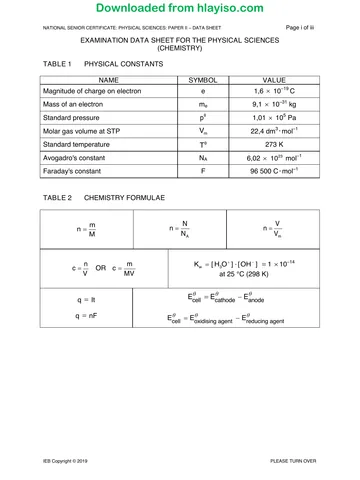
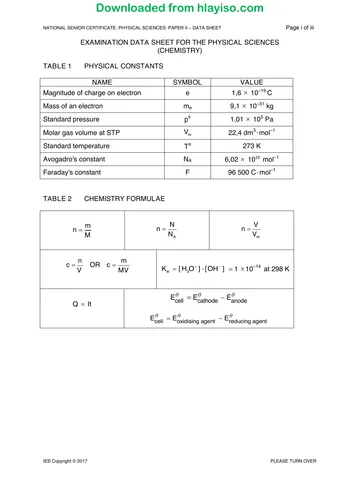
4. Use the data and formulae whenever necessary.
5. START EACH QUESTION ON A NEW PAGE.
6. Please ensure that you number your answers as the questions are numbered.
7. Unless instructed otherwise, it is NOT necessary to give state symbols (phase
indicators) when asked to write a balanced chemical equation.
8. Show all the necessary steps in calculations.
9. Where appropriate, express final answers correct to TWO decimal places.
10. It is in your interest to write legibly and to present your work neatly.
IEB Copyright © 2019 PLEASE TURN OVER
Skip to contentQuestion paper 
_hlayiso.com_--02ee4df7-1da4-4d41-a14b-a0b2b2d781f5/v1-591f24580dfb16122386/card.webp)
_hlayiso.com_--02eb6021-d358-4621-adb1-711aa366a16c/v1-4e4bef49752be5087d73/card.webp)
View all
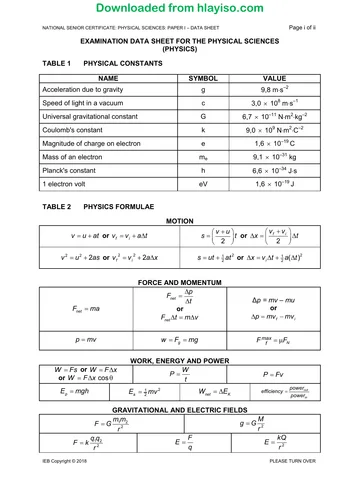
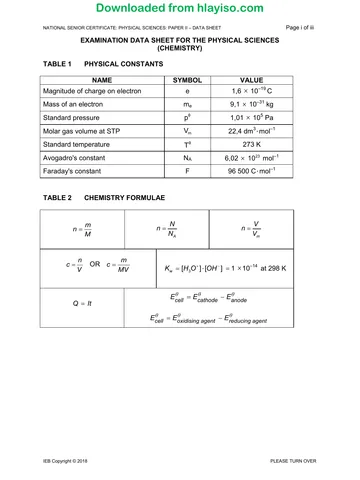
Physical Sciences Grade 12 IEB Paper 2 2019 Question Paper
IEB Grade 12 Physical Sciences Paper 2 question paper from the 2019, 15 pages. Read online or get the free PDF download, memo linked when available.
Publisher: IEB
Physical Sciences · Grade 12 · 2019. Question paper, 15 pages. Read online or download the PDF.
- Subject
- Physical Sciences
- Grade
- Grade 12
- Document type
- Question paper
- Year
- 2019
- Paper
- 2
- Publisher
- IEB
- Curriculum
- IEB
- Pages
- 15
- File size
- 774.0 KB
Loading document…
Loading document…
1 of 15
Document textSearch extracted text and jump to a page.
Downloaded from hlayiso.com
NATIONAL SENIOR CERTIFICATE: PHYSICAL SCIENCES: PAPER II Page 2 of 15
QUESTION 1 MULTIPLE CHOICE
Answer these questions on the multiple-choice Answer Sheet on the inside
front cover of your Answer Book. Make a cross (X) in the box corresponding
to the letter of the option that you consider to be most correct. Every
question has only one correct answer.
A B C D Here the answer C has been marked.
1.1 Which of the following covalent bonds is the most polar?
A C−F
B S−Br
C O−H
D Cℓ−Cℓ
1.2 Identify the predominant intermolecular force in pure liquid carbon
tetrafluoride, CF4.
A London forces
B dipole-dipole interactions
C hydrogen bonds
D ionic bonds
1.3 The reaction represented by the balanced chemical equation below was
used to investigate how certain factors affect the reaction rate.
MgCO3(s) + 2HCℓ(aq) MgCℓ2(aq) + H2O(ℓ) + CO2(g)
The amount of carbon dioxide produced from the reaction vessel was
monitored. Graph G (the solid line) below was obtained for the reaction of
100 cm3 of a 0,2 mol·dm−3 HCℓ solution with a SINGLE LUMP of excess
MgCO3.
Which graph (A, B, C, or D) represents the reaction of 100 cm3 of a
0,1 mol·dm−3 HCℓ solution with excess MgCO3 POWDER?
A
Amount of CO2 (mol)
B
G
C
D
IEB Copyright © 2019 Time (s)
Downloaded from hlayiso.com
NATIONAL SENIOR CERTIFICATE: PHYSICAL SCIENCES: PAPER II Page 3 of 15
1.4 Consider the reaction represented by the following balanced chemical
equation. The system is initially at equilibrium.
H2(g) + Br2(g) ⇌ 2HBr(g)
The pressure is increased by decreasing the volume of the container at
constant temperature. How will the amount of HBr and the concentration
of HBr change due to this increase in pressure?
CONCENTRATION of
AMOUNT of HBr HBr
A Increase Increase
B Decrease Decrease
C Remain the same Increase
D Remain the same Decrease
1.5 Hydrated iron(II) ions react with hydroxide ions in aqueous solution as
represented by the following balanced chemical equation:
− 2-
Fe(H2 O)2+
6 (aq) + 4OH (aq) ⇌ Fe(OH)4 (aq) + 6H2O(ℓ)
Water is added to this system at equilibrium. Which one of the following
correctly identifies the stress and the system's response to the stress?
Stress Response
Increase in the concentration of Forward reaction favoured to
A water use up the water
Increase in the concentration of Reverse reaction favoured to
B water use up the water
Decrease in the concentration of Forward reaction favoured to
C all ions produce more ions
Decrease in the concentration of Reverse reaction favoured to
D all ions produce more ions
1.6 Water is added to a 0,01 mol·dm−3 solution of hydrochloric acid. Which one
of the following describes the change in strength and concentration of the
acid as water is added?
Strength Concentration
A Remains the same Remains the same
B Remains the same Decreases
C Decreases Decreases
D Decreases Remains the same
IEB Copyright © 2019 PLEASE TURN OVER
Downloaded from hlayiso.com
NATIONAL SENIOR CERTIFICATE: PHYSICAL SCIENCES: PAPER II Page 4 of 15
1.7 Which of the following statements is/are TRUE regarding the neutralisation
point of a reaction between ammonia and hydrochloric acid?
i It is the point where the acid and base have reacted so that neither is
in excess
ii [H3O+] = [OH−]
iii pH = 7
A i only
B i and ii
C i, ii and iii
D ii and iii
1.8 Which one of the half-reactions below will be predominant at the POSITIVE
electrode during the electrolysis of concentrated CuCℓ2(aq)?
A Cu2+ + 2e− → Cu
B 2H2O + 2e− → H2 + 2OH−
C 2H2O → O2 + 4H+ + 4e−
D 2Cℓ− → Cℓ2 + 2e−
1.9 Which one of the following statements is TRUE regarding the cathode in the
electrorefining of copper?
A It is made of impure copper.
B Zinc metal deposits onto the cathode.
C It is the electrode where reduction occurs.
D It is the positive electrode.
1.10 Consider the following sequence of reactions. Compound X is an unknown
organic compound, and Reactions 1 and 2 are organic reactions.
H H H H H H H H H H
Heat / Pt / H2
H C C C C C H → X → H C C C C C H
Reaction 1 Reaction 2
H H H H H Br Br H
Which one of the following is the correct SPECIFIC type and GENERAL
type for Reaction 2?
SPECIFIC TYPE GENERAL TYPE
A Halogenation Substitution
B Hydrolysis Substitution
C Halogenation Addition
D Hydrohalogenation Addition
[20]
IEB Copyright © 2019
Downloaded from hlayiso.com
NATIONAL SENIOR CERTIFICATE: PHYSICAL SCIENCES: PAPER II Page 5 of 15
THIS PAGE HAS DELIBERATELY BEEN LEFT BLANK
IEB Copyright © 2019 PLEASE TURN OVER
Downloaded from hlayiso.com
NATIONAL SENIOR CERTIFICATE: PHYSICAL SCIENCES: PAPER II Page 6 of 15
QUESTION 2
A single 6,5 g piece of aluminium metal reacts with 400 cm3 of a 2,6 mol·dm−3
sodium hydroxide solution to produce sodium aluminate and hydrogen gas as
represented by the following balanced chemical equation:
2Aℓ(s) + 6NaOH(aq) 2Na3AℓO3(aq) + 3H2(g) ΔH < 0
2.1 Determine the amount (in moles) of aluminium metal present at the
beginning of the reaction. (3)
2.2 Use suitable calculations to show that the sodium hydroxide is in excess. (4)
2.3 The percentage yield of the sodium aluminate is 92%. Calculate the final
concentration of the sodium aluminate solution. (Assume the volume of the
solution remains constant at 400 cm3.) (5)
2.4 2.4.1 Define exothermic reaction. (2)
2.4.2 Referring to the energies absorbed and released, describe why this
reaction is considered to be exothermic. Marks will not be awarded
for restating the definition. (2)
2.5 2.5.1 Other than correct orientation of reacting particles, state ONE
condition for an effective collision. (1)
2.5.2 Using the collision theory, explain the effect of using a LESS-
concentrated sodium hydroxide solution on the rate of its reaction
with aluminium. (4)
2.6 How would an increase in pressure (at constant temperature) affect the rate
of this reaction? State only INCREASE, DECREASE, or REMAIN THE
SAME. (2)
[23]
IEB Copyright © 2019
Downloaded from hlayiso.com
NATIONAL SENIOR CERTIFICATE: PHYSICAL SCIENCES: PAPER II Page 7 of 15
QUESTION 3
Consider the reaction of aluminium with sodium hydroxide:
2Aℓ(s) + 6NaOH(aq) 2Na3AℓO3(aq) + 3H2(g)
3.1 Under high pressure and very low temperature, hydrogen gas may be
condensed into a liquid, giving evidence for London forces between the
molecules of hydrogen. Explain how these London forces originate. (3)
3.2 The hydrogen gas produced is collected by the downward displacement of
water. Data collected in this experiment is given in the table below.
Time (s) Volume of H2 gas (dm3)
0 0
20 3,0
40 4,7
60 5,7
80 5,9
100 5,9
120 5,9
3.2.1 Using the information given in the table, state the time at which the
reaction ended. (1)
3.2.2 Hence, calculate the average rate of formation of hydrogen in units
of dm3·s−1. Express your answer in scientific notation. (2)
3.2.3 A graph showing the relationship between the volume of H 2 gas and
time has been partially plotted on the axes provided in your
ANSWER SHEET. Complete this graph by providing all the missing
information and drawing a line of best fit. (6)
3.3 If sulfur powder is added to an aqueous sodium hydroxide solution, a
spontaneous reaction will occur, producing a sodium sulfite solution, a
precipitate of sodium sulfide and water. Write a balanced chemical equation
for this reaction, including state symbols (phase indicators). (4)
[16]
IEB Copyright © 2019 PLEASE TURN OVER
Downloaded from hlayiso.com
NATIONAL SENIOR CERTIFICATE: PHYSICAL SCIENCES: PAPER II Page 8 of 15
QUESTION 4
Nitrogen monoxide gas reacts with oxygen gas in a closed container according to
the balanced chemical equation below.
2NO(g) + O2(g) ⇌ 2NO2(g)
The volume of the container remains constant at 3 dm 3. The amounts of each gas
were tracked over time and the following graph (NOT TO SCALE) was obtained.
At t = 0 min, the temperature is 25 °C and the equilibrium constant is 256.
NO2
Amount (mol)
5
O2
3
NO
0 20 40 60 80 100
Time (min)
4.1 Identify the stress that occurred at 20 min. (1)
4.2 Use Le Châtelier's principle to explain the changes seen in the graph
between 20 min and 40 min. (3)
4.3 How does the value of the equilibrium constant at t = 50 min compare to
that at t = 0 min? State only LARGER, SMALLER, or THE SAME. (1)
4.4 Write down the expression for the equilibrium constant (Kc) for this reaction. (2)
4.5 Calculate the amount (in moles) of NO2 that was in the container at
t = 0 min. (4)
4.6 At t = 60 min the temperature was increased. Explain, using Le Châtelier's
principle, whether the reverse reaction is EXOTHERMIC or
ENDOTHERMIC. (5)
4.7 A partial graph of reaction rate vs time is provided on your ANSWER
SHEET. Complete this graph for the full 100 min time period. Use the solid
line for the forward reaction rate and the dotted line for the reverse
reaction rate. (5)
4.8 Define intramolecular bond. (2)
4.9 Classify the specific type of intramolecular bond that is found in O2. (2)
[25]
IEB Copyright © 2019
Downloaded from hlayiso.com
NATIONAL SENIOR CERTIFICATE: PHYSICAL SCIENCES: PAPER II Page 9 of 15
QUESTION 5
Consider the hypothetical strong base Z(OH)2. 0,4 dm3 of a 0,12 mol·dm−3 solution
of this base is prepared at 30 °C.
5.1 What does it mean that Z(OH)2 is a strong base? (2)
5.2 Define standard solution. (2)
5.3 Determine the amount (in moles) of Z(OH)2 needed to prepare the solution. (3)
The autoionisation of water is shown by the following balanced chemical equation.
Note that Kw at 30 °C is 1,44 × 10⁻¹⁴.
2H2O ⇌ H3O+ + OH−
5.4 Classify the autoionisation of water as EXOTHERMIC or ENDOTHERMIC.
Give a reason for your answer. (2)
5.5 Calculate the concentration of hydronium ions in the Z(OH)2 solution at
30 °C. (4)
The Z(OH)2 solution is now titrated with a solution of hydrofluoric acid.
5.6 Classify hydrofluoric acid as WEAK or STRONG. (1)
5.7 Write down the formula of the salt formed in this reaction. (2)
5.8 Define hydrolysis of a salt. (2)
5.9 Rewrite and complete the following protolytic reaction, showing the hydrolysis
of F −:
F − + H2O ⇌ (2)
5.10 Refer to the table of indicators below and state which indicator would be
most suitable for this titration.
pH range where
Colour in Colour in
Indicator colour change
lower pH higher pH
is observed
congo red 3–5 blue red
bromothymol blue 6–8 yellow blue
alizarin yellow 10–12 yellow orange
(2)
[22]
IEB Copyright © 2019 PLEASE TURN OVER
Downloaded from hlayiso.com
NATIONAL SENIOR CERTIFICATE: PHYSICAL SCIENCES: PAPER II Page 10 of 15
QUESTION 6
Kwazi sets up a standard galvanic cell that is represented by the cell notation
below.
Zn(s) | Zn2+(aq) || Sn4+(aq), Sn2+(aq) | Pt(s)
6.1 NAME the component of the cell represented by the two vertical lines (||) in
the cell notation above. (1)
6.2 State TWO standard conditions that are applicable to the tin half-cell. (2)
6.3 Give ONE property of platinum that makes it suitable for use as the
electrode for the tin half-cell. (1)
6.4 Define cathode. (2)
6.5 Write down the SYMBOL for the cathode. (1)
6.6 Write the chemical equation that represents the reduction half-reaction. (2)
6.7 Define reducing agent. (1)
6.8 Write down the SYMBOL for the reducing agent. (1)
6.9 Determine the initial cell emf. (4)
6.10 How will the initial cell emf be affected if the concentration of Zn2+ ions in
the Zn | Zn2+ half-cell was increased? Write down only INCREASES,
DECREASES, or NO EFFECT. (2)
IEB Copyright © 2019
Downloaded from hlayiso.com
NATIONAL SENIOR CERTIFICATE: PHYSICAL SCIENCES: PAPER II Page 11 of 15
6.11 Kwazi now sets up the following electrolytic cell with the aim of coating a
key with silver metal:
Electrode X
Key
Ag+(aq)
6.11.1 What is this electrolytic process called? (1)
6.11.2 Is the key the ANODE or the CATHODE? (1)
6.11.3 With reference to the relative strengths of the reacting substances
(relative strengths of agents), explain why silver will be the
predominant substance formed at the key. (3)
6.11.4 What is electrode X usually made from? (1)
6.11.5 With reference to the bonding in electrode X, give a reason why
this substance is a suitable conductive material. (2)
6.11.6 A constant current of 3,2 A is run through the cell for 6 hours.
Calculate the total charge (in C) that is transferred through the cell. (3)
6.11.7 Determine the amount (in mol) of electrons transferred through the
cell in this time. (2)
6.11.8 Determine the mass of silver that would be deposited onto the key
in this time. (3)
[33]
IEB Copyright © 2019 PLEASE TURN OVER
Downloaded from hlayiso.com
NATIONAL SENIOR CERTIFICATE: PHYSICAL SCIENCES: PAPER II Page 12 of 15
QUESTION 7
The diagram below shows a representation of a membrane cell used in the Chlor-
Alkali Industry. Electrode P is made from titanium, which is inert.
A B
33 %
NaOH (aq)
P Q
Saturated
brine
C
7.1 What is brine? (3)
7.2 Identify which electrode is the cathode. Write down only P or Q. (1)
7.3 Chlorine gas is produced at electrode P and collected at A.
7.3.1 Write down the equation for the half-reaction that produces the
chlorine gas. (2)
7.3.2 At C, brine enters the cell. FULLY explain why chlorine is produced
predominantly at electrode P. In your answer, you should refer to
the following:
the inherent reactivities of the reacting species (with reference to
the standard electrode potentials)
the concentration of the ions present (3)
7.3.3 What substance will the chlorine gas be contaminated with? (1)
7.4 In terms of the purity of the sodium hydroxide solution produced, explain the
benefits of using a membrane instead of a diaphragm (2)
7.5 7.5.1 Write the formula of the product collected at B. (1)
7.5.2 State one change that could be made to electrode Q to increase the
rate of production of this product collected at B. (1)
7.6 With reference to intermolecular forces, compare the boiling points of
chlorine and hydrogen and FULLY explain this difference. (6)
[20]
IEB Copyright © 2019
Downloaded from hlayiso.com
NATIONAL SENIOR CERTIFICATE: PHYSICAL SCIENCES: PAPER II Page 13 of 15
QUESTION 8
Consider the two hydrocarbons, compounds X and Y, shown below.
H
CH3
H H H C H
H3C CH CH CH2 CH3
CH2 H C C C C C C H
CH3 H H H H H
Compound X Compound Y
8.1 Define homologous series. (2)
8.2 Write down the general formula for the homologous series to which
compound X belongs. (1)
8.3 NAME the homologous series to which compound Y belongs. (1)
8.4 Classify compound X as SATURATED or UNSATURATED. (1)
8.5 Draw the structural formula for the POSITIONAL ISOMER of compound X. (2)
8.6 Describe the functional group of compound Y. (1)
8.7 Write the IUPAC name for compound Y. (3)
8.8 Write down the name of the homologous series of the organic product that
would result if compound Y were hydrogenated fully. (2)
[13]
IEB Copyright © 2019 PLEASE TURN OVER
Downloaded from hlayiso.com
NATIONAL SENIOR CERTIFICATE: PHYSICAL SCIENCES: PAPER II Page 14 of 15
QUESTION 9
Consider the following organic reactions I to IV involving organic compounds
A to E.
UV
light
I A + Br2 → B + HBr
II B + concentrated alcoholic KOH → C + KBr + H2O
Dilute
H3PO4
III C + H2O →
D
600 °C
Zeolite
catalyst
IV A → C4H10 + E
9.1 Name the GENERAL TYPE of reaction for each of the following:
9.1.1 Reaction I (1)
9.1.2 Reaction III (1)
9.2 Name the SPECIFIC TYPE of reaction for each of the following:
9.2.1 Reaction II (1)
9.2.2 Reaction III (1)
9.3 Write down the IUPAC name for compound D. (3)
9.4 Write the molecular formula for each of the following:
9.4.1 Compound A (2)
9.4.2 Compound E (2)
9.5 Draw the structural formula of compound B. (2)
9.6 Draw the structural formula of compound C. (2)
IEB Copyright © 2019
Downloaded from hlayiso.com
NATIONAL SENIOR CERTIFICATE: PHYSICAL SCIENCES: PAPER II Page 15 of 15
9.7 Arielle sets up an experiment to perform an esterification reaction using
ethanol (CH3CH2OH) and butanoic acid. She uses an experimental setup
as shown below:
test tube containing
ethanol, butanoic acid
and a few drops of
concentrated H2SO4
beaker
water
wire gauze
tripod
Bunsen burner
9.7.1 Using molecular formulae, write a balanced chemical equation for
the complete combustion of ethanol. (3)
9.7.2 Hence, fully explain why a water bath is the preferred method
used to heat the mixture. (2)
9.7.3 Using condensed-structural formulae, write a balanced chemical
equation for the esterification reaction represented in this experiment. (4)
9.7.4 Write the IUPAC name for the ester formed. (2)
9.7.5 State TWO purposes of the H2SO4. (2)
[28]
Total: 200 marks
IEB Copyright © 2019
Study this subject
Revise the topics in this paper, then practise them question by question.
- Grade 12 Physical Sciences notes
CAPS revision notes with worked examples.
- Physical Sciences questions by topic
Past exam questions sorted by CAPS topic, with memos where available.
- Grade 12 Physical Sciences quizzes
Short topic quizzes with instant feedback.
- All Grade 12 Physical Sciences past papers
Past papers by year, with memos where available.
- Grade 12 IEB past papers
More Physical Sciences and other subjects in this collection.
Recommended for this subject
More papers and memos for this grade and subject.
Question paperIEB
Physical Sciences Grade 12 IEB Paper 1 2019 Question Paper
Question paperIEB
Physical Sciences Grade 12 IEB P1 2019 Question Paper (Afrikaans)
Question paperIEB
Physical Sciences Grade 12 IEB P1 2019 Question Paper (Afrikaans)
Question paperIEB
Physical Sciences Grade 12 IEB P2 2019 Question Paper (Afrikaans)
Question paperIEB
Physical Sciences Grade 12 IEB P2 2019 Question Paper (Afrikaans)
Question paperIEB
Physical Sciences Grade 12 IEB Paper 1 2018 Question Paper
Related documents
Data sheetIEB
Physical Sciences Grade 12 IEB Paper 2 2019 Data Sheet
MemorandumIEB
Physical Sciences Grade 12 IEB Paper 2 2019 Memo
Question paperIEB
Physical Sciences Grade 12 IEB Paper 2 2018 Question Paper
Question paperIEB
Physical Sciences Grade 12 IEB Paper 2 2017 Question Paper
Question paperIEB
Physical Sciences Grade 12 IEB Paper 2 2017 Question Paper
Question paperIEB
Physical Sciences Grade 12 IEB Paper 2 2016 Question Paper
More from Grade 12 Physical Sciences
Data sheetIEB
Physical Sciences Grade 12 IEB Paper 1 2019 Data Sheet
MemorandumIEB
Physical Sciences Grade 12 IEB Paper 1 2019 Memo
Data sheetIEB
Physical Sciences Grade 12 IEB Paper 1 2018 Data Sheet
Data sheetIEB
Physical Sciences Grade 12 IEB Paper 2 2018 Data Sheet
MemorandumIEB
Physical Sciences Grade 12 IEB Paper 1 2018 Memo
MemorandumIEB