
Downloaded from hlayiso.com
NATIONAL SENIOR CERTIFICATE EXAMINATION
NOVEMBER 2018
PHYSICAL SCIENCES: PAPER II
Time: 3 hours 200 marks
PLEASE READ THE FOLLOWING INSTRUCTIONS CAREFULLY
1. This question paper consists of 18 pages, a yellow ANSWER SHEET of
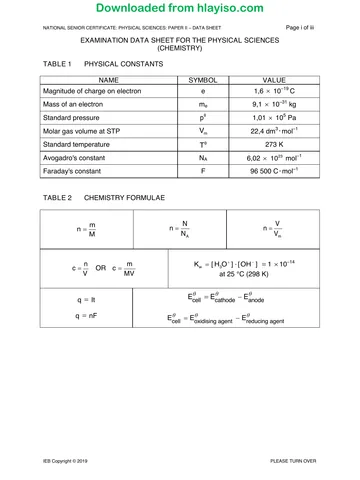
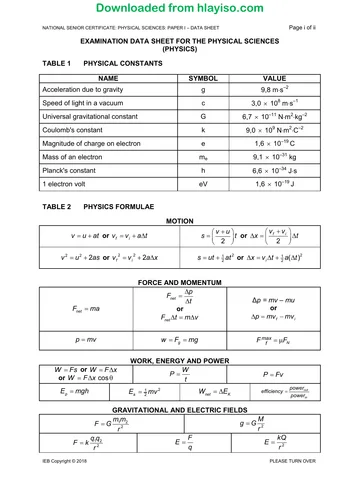
2 pages (i–ii) and a green DATA SHEET of 3 pages (i–iii). Please check that your
question paper is complete.
2. Remove the DATA SHEET and ANSWER SHEET from the middle of this question
paper. Write your examination number on the yellow ANSWER SHEET.
3. Read the questions carefully.
4. Answer ALL the questions.
5. Question 1 consists of 10 multiple-choice questions. There is only one correct
answer to each question. The questions are to be answered on the answer sheet
provided on the inside cover on your answer book. The letter that corresponds with
your choice of the correct answer must be marked with a cross as shown in the
example below.
A B C D Here the answer C has been marked.
6. START EACH QUESTION ON A NEW PAGE.
7. Please ensure that you number your answers as the questions are numbered.
8. Unless instructed otherwise it is NOT necessary to give state symbols (phase
indicators) when asked to write a balanced chemical equation.
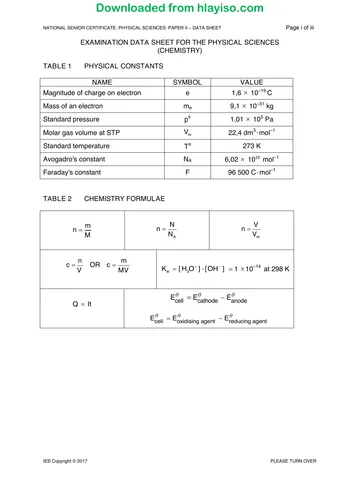
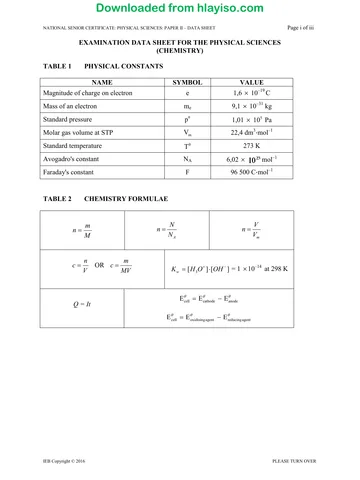
9. Use the data and formulae whenever necessary.
10. Show all the necessary steps in calculations.
11. Where appropriate, take your answers to 2 decimal places.
12. It is in your interest to write legibly and to present your work neatly.
IEB Copyright © 2018 PLEASE TURN OVER
Skip to contentQuestion paper 
_hlayiso.com_--02ee4df7-1da4-4d41-a14b-a0b2b2d781f5/v1-591f24580dfb16122386/card.webp)
View all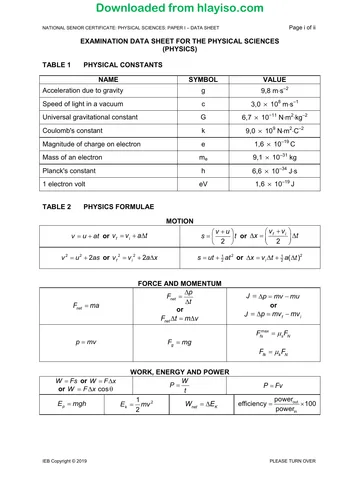
Physical Sciences Grade 12 IEB Paper 2 2018 Question Paper
IEB Grade 12 Physical Sciences Paper 2 question paper from the 2018, 18 pages. Read online or get the free PDF download, memo linked when available.
Publisher: IEB
Physical Sciences · Grade 12 · 2018. Question paper, 18 pages. Read online or download the PDF.
- Subject
- Physical Sciences
- Grade
- Grade 12
- Document type
- Question paper
- Year
- 2018
- Paper
- 2
- Publisher
- IEB
- Curriculum
- IEB
- Pages
- 18
- File size
- 446.5 KB
Loading document…
Loading document…
1 of 18
Document textSearch extracted text and jump to a page.
Downloaded from hlayiso.com
NATIONAL SENIOR CERTIFICATE: PHYSICAL SCIENCES: PAPER II Page 2 of 18
QUESTION 1 MULTIPLE CHOICE
Answer these questions on the multiple-choice answer sheet on the inside
front cover of your Answer Book. Make a cross (X) in the box corresponding
to the letter that you consider to be most correct.
1.1 The chemical formula for dinitrogen tetroxide is:
A NO
B N2O4
C N4O2
D N2O5
1.2 An exothermic reaction is one in which:
A there is an increase in temperature of the reaction mixture.
B there is a conversion from thermal energy into potential energy.
C there is a low activation energy.
D there is a high number of effective collisions per second.
1.3 A container is filled with H2 and Br2 gases and sealed at a particular
temperature. The gases react as shown in the following balanced chemical
equation:
H2(g) + Br2(g) ⇌ 2HBr(g) ΔH < 0
The changes in the amounts of H2 and HBr are shown by the solid lines in
the graph below.
H2
H2
Amount (mol)
HBr
HBr
Time
The reaction is then repeated under different conditions. Which one of the
following changes to the original conditions would result in the dashed
lines (- - - -) shown on the graph?
A A higher pressure
B A higher temperature
C A higher concentration of Br2
D Addition of a suitable catalyst
IEB Copyright © 2018
Downloaded from hlayiso.com
NATIONAL SENIOR CERTIFICATE: PHYSICAL SCIENCES: PAPER II Page 3 of 18
1.4 The average rate of formation of CO2 in the following reaction
is 0,5 mol·min−1.
CaCO3(s) + 2HCℓ(aq) CaCℓ2(aq) + CO2(g) + H2O(ℓ)
The average rate of consumption (disappearance) of HCℓ for this same
reaction is:
A 0,25 mol·min−1
B 0,5 mol·min−1
C 1 mol·min−1
D 2 mol·min−1
1.5 Which one of the following will behave as a weak, polyprotic acid when
dissolved in water?
A NH3
B HNO2
C H2SO3
D (NH4)2SO4
1.6 Water is added to a 0,01 mol·dm−3 solution of nitric acid. Which one of the
following describes the change in concentration of hydronium ions and pH
in this solution as water is added?
[H3O+] pH
A Remains the same Remains the same
B Increases Decreases
C Increases Increases
D Decreases Increases
1.7 A small amount of a salt with the formula XZ is dissolved in distilled water at
25 °C. The Kb value for XOH is 3,2 × 10⁶ at 25 °C and the Ka value for HZ is
1,6 × 10⁻⁵ at 25 °C. What is the approximate pH of the solution of XZ at
25 °C?
A 5
B 7
C 9
D 14
1.8 A galvanic cell is constructed under standard conditions. The spontaneous
reaction that occurs is represented by the following balanced chemical
equation:
2Aℓ + 3Co2+ 2Aℓ3+ + 3Co
Which one of the following is the standard potential for this cell?
A +1,38 V
B −1,38 V
C +2,48 V
D −2,48 V
IEB Copyright © 2018 PLEASE TURN OVER
Downloaded from hlayiso.com
NATIONAL SENIOR CERTIFICATE: PHYSICAL SCIENCES: PAPER II Page 4 of 18
1.9 The process used to deposit a metal onto a conductive object is called:
A Electrolysis
B Electrorefining
C Electroextraction
D Electroplating
1.10 Which one of the following is NOT a property of carbon that enables it to be
the building block of organic chemistry?
A It forms strong covalent bonds to other atoms.
B It forms weak induced dipole forces with other atoms.
C It has a valency of four in a tetrahedral arrangement.
D It can form bonds to itself.
[20]
IEB Copyright © 2018
Downloaded from hlayiso.com
NATIONAL SENIOR CERTIFICATE: PHYSICAL SCIENCES: PAPER II Page 5 of 18
THIS PAGE HAS DELIBERATELY BEEN LEFT BLANK
IEB Copyright © 2018 PLEASE TURN OVER
Downloaded from hlayiso.com
NATIONAL SENIOR CERTIFICATE: PHYSICAL SCIENCES: PAPER II Page 6 of 18
QUESTION 2
Chromium metal reacts with hydrochloric acid to produce a green solution of
chromium(III) chloride and hydrogen gas, as shown in the following balanced
chemical equation.
2Cr(s) + 6HCℓ(aq) → 2CrCℓ3(aq) + 3H2(g) ΔH < 0
2.1 A partially drawn potential energy profile for this reaction is provided on
your ANSWER SHEET.
2.1.1 Complete this energy profile. (1)
2.1.2 Write the relevant labels in the boxes provided. (3)
Dana performs a series of experiments to test the effect of certain factors on the
average rate of reaction between chromium metal and hydrochloric acid. In each
of the experiments, Dana ensures that chromium is the limiting reagent and is
always completely covered by the same volume of hydrochloric acid of the same
concentration. The reaction conditions for each of the experiments are tabulated
below.
Experiment State of Mass of Temperature (°C)
chromium chromium (g)
1 Single lump 6,0 25
2 Single lump 6,0 15
3 Fine powder 4,5 25
Dana observes that in all three experiments, all of the chromium fully reacts in less
than 80 s. Dana collects the hydrogen gas produced at STP at set time intervals.
Dana's results for experiment 1 are shown on the graph below.
4,5
Volume of H2 gas (dm3)
3,0
1,5
0
0 20 40 60 80
Time (s)
IEB Copyright © 2018
Downloaded from hlayiso.com
NATIONAL SENIOR CERTIFICATE: PHYSICAL SCIENCES: PAPER II Page 7 of 18
2.2 Dana's graph has been reproduced on your ANSWER SHEET. On the axes
provided, redraw the graph that would result for:
2.2.1 Experiment 2 (2)
2.2.2 Experiment 3 (3)
2.3 Other than measuring the volume of collected hydrogen gas produced over
time, briefly describe ONE alternative method that could have been used to
measure the rate of this reaction. In your answer, specify what equipment
should be used and what measurements should be made. (3)
2.4 Consider the reaction conditions and the graph given for Experiment 1.
2.4.1 Determine the total amount (in moles) of hydrogen gas collected at
STP. Round your answer to 3 decimal places. (3)
2.4.2 Considering that the chromium metal is the limiting reagent,
calculate the percentage yield of hydrogen gas in this reaction. (5)
2.4.3 Calculate the average rate of formation of H2 (during the first 40 s)
in units of dm3·s−1. Round your answer to 3 decimal places. (2)
2.5 According to the collision theory, when reacting particles collide, not all of
these collisions result in a reaction occurring, i.e. not all of these collisions
are effective. State TWO conditions necessary for an effective collision. (2)
2.6 Explain fully, in terms of the collision theory, how the reaction rate would be
affected if a higher concentration of HCℓ were used. (4)
2.7 Consider pure hydrogen chloride, HCℓ(g).
2.7.1 Define covalent bond. (2)
2.7.2 Define electronegativity. (2)
2.7.3 With reference to the difference in electronegativity between
hydrogen and chlorine, explain why the covalent bond in hydrogen
chloride is considered to be polar. (3)
[35]
IEB Copyright © 2018 PLEASE TURN OVER
Downloaded from hlayiso.com
NATIONAL SENIOR CERTIFICATE: PHYSICAL SCIENCES: PAPER II Page 8 of 18
QUESTION 3
The reaction represented by the following balanced chemical equation is important
in the Contact Process for the industrial production of sulfuric acid:
2SO2(g) + O2(g) ⇌ 2SO3(g)
Dikeledi adds some sulfur dioxide and oxygen to a container and then seals the
container. He monitors the rates of the forward and reverse reactions over time
and the following graph is obtained:
Reaction Rate
0 5 10 15 20
Time (min)
3.1 After what time was dynamic equilibrium reached for the first time? (1)
3.2 Write down the equation for the reaction represented by the solid line. (2)
3.3 State Le Châtelier's principle. (2)
3.4 At 8 minutes, more oxygen gas was added to the container whilst
maintaining a constant temperature and volume of container. With
reference to Le Châtelier's principle, fully explain how the amount of sulfur
dioxide was affected when the equilibrium was re-established. (3)
3.5 At 15 minutes, the temperature of the reaction mixture was suddenly
decreased.
3.5.1 From the graph, determine and write down which reaction
(FORWARD or REVERSE) was initially favoured. (1)
3.5.2 Is the forward reaction EXOTHERMIC or ENDOTHERMIC? No
explanation is necessary. (2)
IEB Copyright © 2018
Downloaded from hlayiso.com
NATIONAL SENIOR CERTIFICATE: PHYSICAL SCIENCES: PAPER II Page 9 of 18
3.6 The following equations may be used to represent the rates of the forward
and the reverse reaction:
Rate of forward reaction = k1[SO2]2[O2]
Rate of reverse reaction = k2[SO3]2
where k1 and k2 are constants.
If the pressure of the system is decreased by increasing the volume of the
container, both the forward and reverse reaction rates will decrease, but the
forward rate will decrease more than the reverse.
3.6.1 Consider the rate equations provided and state why a decrease in
pressure causes both reaction rates to decrease. (1)
3.6.2 With reference to the rate equations provided, explain why a
decrease in pressure causes the forward reaction rate to decrease
more than the reverse. (2)
[14]
IEB Copyright © 2018 PLEASE TURN OVER
Downloaded from hlayiso.com
NATIONAL SENIOR CERTIFICATE: PHYSICAL SCIENCES: PAPER II Page 10 of 18
QUESTION 4
The balanced chemical equation below shows a hydrated copper(II) ion, which is
blue in colour, reacting with chloride ions to form the complex copper tetrachloride
ion, which is green in colour.
An aqueous equilibrium mixture is prepared in order to obtain a mixture that is
initially blue-green in colour at 25 °C.
− 2–
Cu(H2 O)2+
6 (aq) + 4Cℓ (aq) ⇌ CuCℓ 4 (aq) + 6H2O(ℓ) ΔH > 0
BLUE GREEN
4.1 What would happen to the equilibrium concentration of Cℓ− ions if the
reaction mixture were cooled? State only INCREASES, DECREASES or
REMAINS THE SAME. (2)
2–
4.2 Which reaction will be favoured by the addition of CuCℓ 4 ions to the
reaction mixture? State only FORWARD or REVERSE. (2)
4.3 What would happen to the colour of the mixture if crystals of sodium
chloride were dissolved in the reaction mixture? State only TURNS BLUE,
TURNS GREEN or REMAINS THE SAME. (2)
2–
4.4 A new solution is prepared by dissolving 4 mol of CuCℓ 4 completely in
water to make up a solution of volume 2 dm3. When equilibrium is
established, there are 2,2 mol of Cu(H2 O)2+
6 ions present at 25 °C.
− 2–
Cu(H2 O)2+
6 (aq) + 4Cℓ (aq) ⇌ CuCℓ 4 (aq) + 6H2O(ℓ)
4.4.1 Write an expression for the equilibrium constant for this reaction. (2)
4.4.2 Determine the value of the equilibrium constant, Kc, for this reaction
at 25 °C. (6)
[14]
IEB Copyright © 2018
Downloaded from hlayiso.com
NATIONAL SENIOR CERTIFICATE: PHYSICAL SCIENCES: PAPER II Page 11 of 18
QUESTION 5
Consider sodium hydroxide (NaOH), a strong base, and butanoic acid, a weak
organic acid with the molecular formula C4H8O2.
5.1 Define a base in terms of the Lowry-Brønsted model. (1)
5.2 Why is NaOH considered to be a strong base? (2)
5.3 Write down the formula of another strong base. (1)
5.4 Write a reaction equation for the dissociation of NaOH in water. (2)
5.5 Consider aqueous solutions of NaOH and butanoic acid of equal
concentrations. Which solution will have a greater conductivity? FULLY
explain the answer. (4)
5.6 Draw the structural formula of butanoic acid. (2)
5.7 Give the IUPAC name of a FUNCTIONAL isomer of butanoic acid. (2)
[14]
IEB Copyright © 2018 PLEASE TURN OVER
Downloaded from hlayiso.com
NATIONAL SENIOR CERTIFICATE: PHYSICAL SCIENCES: PAPER II Page 12 of 18
QUESTION 6
Latif performs a titration by slowly adding a dilute standard solution of NaOH by
burette to an unknown volume of a standard solution of butanoic acid that has
been placed in an Erlenmeyer flask. A simplified diagram of this experimental
setup is shown below.
Burette containing NaOH
Erlenmeyer flask with acid
White tile
Latif monitors the concentration of hydronium ions as the base is added to the
flask, and he arrives at the table of selected results below:
[H3O+] in flask Volume of NaOH added
(mol·dm−3) (cm3)
1 × 10⁻³ 0
6,31 × 10⁻⁵ 10
3,16 × 10⁻⁹ 30
1 × 10⁻¹² 50
6.1 How does the pH of the solution in the flask change on addition of NaOH?
State only INCREASES, DECREASES, or REMAINS THE SAME. (1)
6.2 Calculate the concentration of hydroxide ions in the solution after the
addition of 10 cm3 of NaOH at 25 °C. (4)
IEB Copyright © 2018
Downloaded from hlayiso.com
NATIONAL SENIOR CERTIFICATE: PHYSICAL SCIENCES: PAPER II Page 13 of 18
6.3 The concentration of the butanoic acid solution used was 0,21 mol·dm−3,
and the neutralisation point was reached after the addition of 0,0165 mol of
NaOH. The neutralisation reaction is represented by the balanced chemical
equation below.
NaOH(aq) + C3H7COOH(aq) → C3H7COONa(aq) + H2O(ℓ)
6.3.1 Define the term neutralisation or equivalence point. (2)
6.3.2 Determine the number of moles of butanoic acid that was
neutralised. Use 4 decimal places in your answer. (1)
6.3.3 Calculate the original volume (in cm3) of the butanoic acid solution
that was placed in the flask. (4)
6.4 At the neutralisation point, the solution in the flask is basic. This is due to
the following hydrolysis reaction:
C3H7COO−(aq) + H2O(ℓ) ⇌ C3H7COOH(aq) + OH−(aq)
6.4.1 Define the term hydrolysis. (2)
6.4.2 With reference to this hydrolysis equation, explain why the solution
in the flask is basic at the neutralisation point. (2)
6.5 Latif states: "Because NaOH is a strong base, a solution of NaOH will
ALWAYS have a higher pH than a solution of a weak base such as NH3."
Evaluate Latif's statement. (3)
[19]
IEB Copyright © 2018 PLEASE TURN OVER
Downloaded from hlayiso.com
NATIONAL SENIOR CERTIFICATE: PHYSICAL SCIENCES: PAPER II Page 14 of 18
QUESTION 7
A galvanic cell is constructed using a standard Cℓ2|Cℓ− half-cell and a standard
Ni|Ni2+ half-cell, as shown in the diagram below. The solution in the nickel half-cell
is initially pale green.
V
Ni(s)
Cℓ2 (g)
Pt(s)
HCℓ(aq) Ni(NO3)2(aq)
7.1 The reduction half-reaction that occurs in this cell is shown below:
Cℓ2 + 2e− → 2Cℓ−
7.1.1 Define oxidising agent. (1)
7.1.2 With reference to the strengths of oxidising agents, explain why Cℓ2
is reduced instead of Ni2+. (2)
7.2 7.2.1 Define anode. (2)
7.2.2 Identify the anode in this cell. (1)
7.3 Identify the positive electrode in this cell. (1)
7.4 Write the cell notation for this cell, including relevant conditions. State
symbols need not be shown. (5)
7.5 The voltmeter is now replaced with a light bulb so that current flows.
7.5.1 Write down the half-reaction that occurs in the nickel half-cell. (2)
7.5.2 Hence, state TWO changes that will be observed in the nickel half-
cell after a significant amount of time has passed. (2)
7.5.3 One of the functions of the salt bridge is to maintain electrical
neutrality. State ONE other function of the salt bridge. (1)
7.5.4 Explain how the salt bridge maintains electrical neutrality with
reference to the changing ionic conditions in the nickel half-cell. (2)
7.6 Lerusha accidentally drops some concentrated AgNO3 solution into the
chlorine half-cell, causing a white precipitate of AgCℓ to form.
How would this affect the initial cell emf? State only INCREASES,
DECREASES or REMAINS THE SAME. (2)
[21]
IEB Copyright © 2018
Downloaded from hlayiso.com
NATIONAL SENIOR CERTIFICATE: PHYSICAL SCIENCES: PAPER II Page 15 of 18
QUESTION 8
Aluminium is produced in modern times through the Hall-Héroult process, whereby
a molten aluminium oxide electrolyte is electrolysed between graphite electrodes.
A simplified diagram of the cell used in the Hall-Héroult process is shown below.
Graphite
ANODES
Steel
container
lined with
graphite
Aluminium oxide
(CATHODE)
and Cryolite
Aℓ(ℓ)
Although the production of aluminium is expensive, it is worth the cost. Aluminium
is light, so it is useful in the manufacture of aircrafts and cars. It protects itself from
corrosion by producing a layer of aluminium oxide on its surface, which is very
tough and therefore difficult to remove.
8.1 From the information given above, write down ONE physical property of
aluminium that makes it a useful metal. (1)
8.2 From the information given above, write down ONE chemical property of
aluminium that makes it a useful metal. (1)
8.3 Identify the positive electrode in the above cell. State only ANODE or
CATHODE. (1)
8.4 Write down the ionic equation for the half-reaction that occurs at the
cathode. (2)
8.5 Explain briefly how the use of cryolite to decrease the melting point of the
electrolyte is:
8.5.1 economically beneficial. (2)
8.5.2 environmentally harmful. (2)
IEB Copyright © 2018 PLEASE TURN OVER
Downloaded from hlayiso.com
NATIONAL SENIOR CERTIFICATE: PHYSICAL SCIENCES: PAPER II Page 16 of 18
8.6 Explain why the carbon anodes need regular replacing. Give a relevant
chemical reaction equation to support your answer. (4)
8.7 One of the reasons aluminium is so difficult to electrolyse is that aluminium
oxide has a very high melting point. With reference to the forces holding its
particles together, explain why aluminium oxide has such a high melting
point. (4)
8.8 Aluminium can also be produced on a small scale by the reduction of
aluminium chloride by sodium metal, shown in the UNBALANCED chemical
equation below.
AℓCℓ3 + Na → Aℓ + NaCℓ
8.8.1 Balance the above equation. (2)
8.8.2 A chemical engineer wants to test what mass of sodium metal is
needed to react completely in order to make 7,56 mol of pure
aluminium metal, using this reaction. Calculate the mass of sodium
metal needed to do this. (3)
[22]
IEB Copyright © 2018
Downloaded from hlayiso.com
NATIONAL SENIOR CERTIFICATE: PHYSICAL SCIENCES: PAPER II Page 17 of 18
QUESTION 9
Consider the compounds, labelled A, B, and C, below and answer the questions
that follow.
H
H C H
H H Br H H H H H
H C C C C C H H C C C C C C H
pentan−2−ol
H H H H H H H
H C H H C H
H C H H
H
A B C
9.1 9.1.1 Write down the IUPAC name for compound A. (4)
9.1.2 Draw the condensed-structural formula for compound A. (2)
9.2 9.2.1 NAME the homologous series to which compound B belongs. (1)
9.2.2 Draw the structural formula for the unbranched CHAIN isomer of
compound B. (2)
9.3 9.3.1 NAME the functional group present in compound C. (1)
9.3.2 State what is meant by the term positional isomers. (2)
9.3.3 Draw the structural formula for a POSITIONAL isomer of
compound C. (2)
9.4 9.4.1 Define intermolecular force. (2)
9.4.2 Compound C has a significantly higher viscosity than compound
B. Account for this difference with reference to the relevant
intermolecular forces in each of these compounds. (4)
9.5 Using molecular formulae, write a balanced chemical equation for the
complete combustion of compound B. (4)
[24]
IEB Copyright © 2018 PLEASE TURN OVER
Downloaded from hlayiso.com
NATIONAL SENIOR CERTIFICATE: PHYSICAL SCIENCES: PAPER II Page 18 of 18
QUESTION 10
Consider the flow chart below showing the interconversion of organic molecules
through organic reactions, and answer the questions that follow. W to Z are
organic compounds, and 1 to 7 are organic reactions.
W pentyl ethanoate
7
1 Z
6
H H H H H 4
5
H C C C C C H
2
Cl H H H H CH2CHCH2CH2CH3
X Y
3
The conditions for reactions 1, 5 and 7 are tabulated below.
Reaction Conditions
1 Cℓ2 gas is bubbled through compound W in the presence of UV light.
5 Compound Y is treated with steam and H3PO4(aq).
Compound Z is heated gently with a carboxylic acid, together with a
7
few drops of concentrated H2SO4(aq).
10.1 Define hydrocarbon. (2)
10.2 Write down the IUPAC name for hydrocarbon W. (2)
10.3 Identify the general TYPE of reaction for each of the following:
10.3.1 Reaction 1 (1)
10.3.2 Reaction 5 (1)
10.3.3 Reaction 7 (1)
10.4 NAME the specific type of addition reaction represented by reaction 3. (1)
10.5 Write down the IUPAC name of compound Y. (2)
10.6 Classify compound Y as SATURATED or UNSATURATED. (1)
10.7 Consider reactions 5, 6 and 7 and write down the IUPAC NAME of
compound Z. (3)
10.8 Draw the structural formula of pentyl ethanoate. (2)
10.9 Write down the NUMBER of the reaction that would take place if the
relevant organic compound were heated strongly in the presence of
concentrated alcoholic potassium hydroxide. (1)
[17]
Total: 200 marks
IEB Copyright © 2018
Study this subject
Revise the topics in this paper, then practise them question by question.
- Grade 12 Physical Sciences notes
CAPS revision notes with worked examples.
- Physical Sciences questions by topic
Past exam questions sorted by CAPS topic, with memos where available.
- Grade 12 Physical Sciences quizzes
Short topic quizzes with instant feedback.
- All Grade 12 Physical Sciences past papers
Past papers by year, with memos where available.
- Grade 12 IEB past papers
More Physical Sciences and other subjects in this collection.
Recommended for this subject
More papers and memos for this grade and subject.
Question paperIEB
Physical Sciences Grade 12 IEB Paper 1 2019 Question Paper
Question paperIEB
Physical Sciences Grade 12 IEB P1 2019 Question Paper (Afrikaans)
Question paperIEB
Physical Sciences Grade 12 IEB P1 2019 Question Paper (Afrikaans)
Question paperIEB
Physical Sciences Grade 12 IEB Paper 2 2019 Question Paper
Question paperIEB
Physical Sciences Grade 12 IEB P2 2019 Question Paper (Afrikaans)
Question paperIEB
Physical Sciences Grade 12 IEB P2 2019 Question Paper (Afrikaans)
Related documents
Data sheetIEB
Physical Sciences Grade 12 IEB Paper 2 2018 Data Sheet
MemorandumIEB
Physical Sciences Grade 12 IEB Paper 2 2018 Memo
Question paperIEB
Physical Sciences Grade 12 IEB Paper 1 2018 Question Paper
Question paperIEB
Physical Sciences Grade 12 IEB Paper 2 2017 Question Paper
Question paperIEB
Physical Sciences Grade 12 IEB Paper 2 2017 Question Paper
Question paperIEB
Physical Sciences Grade 12 IEB Paper 2 2016 Question Paper
More from Grade 12 Physical Sciences
Data sheetIEB
Physical Sciences Grade 12 IEB Paper 1 2019 Data Sheet
Data sheetIEB
Physical Sciences Grade 12 IEB Paper 2 2019 Data Sheet
MemorandumIEB
Physical Sciences Grade 12 IEB Paper 1 2019 Memo
MemorandumIEB
Physical Sciences Grade 12 IEB Paper 2 2019 Memo
Data sheetIEB
Physical Sciences Grade 12 IEB Paper 1 2018 Data Sheet
MemorandumIEB