
Downloaded from hlayiso.com
NATIONAL SENIOR CERTIFICATE EXAMINATION
NOVEMBER 2018
PHYSICAL SCIENCES: PAPER II
MARKING GUIDELINES
Time: 3 hours 200 marks
These marking guidelines are prepared for use by examiners and sub-examiners,
all of whom are required to attend a standardisation meeting to ensure that the
guidelines are consistently interpreted and applied in the marking of candidates'
scripts.
The IEB will not enter into any discussions or correspondence about any marking
guidelines. It is acknowledged that there may be different views about some
matters of emphasis or detail in the guidelines. It is also recognised that,
without the benefit of attendance at a standardisation meeting, there may be
different interpretations of the application of the marking guidelines.
IEB Copyright © 2018 PLEASE TURN OVER
Skip to contentMemorandum 
_hlayiso.com_--02eb6021-d358-4621-adb1-711aa366a16c/v1-4e4bef49752be5087d73/card.webp)
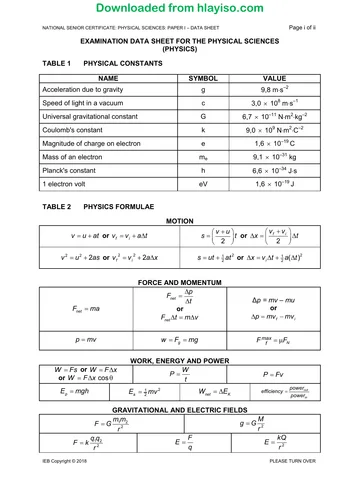
_hlayiso.com_--02ee4df7-1da4-4d41-a14b-a0b2b2d781f5/v1-591f24580dfb16122386/card.webp)
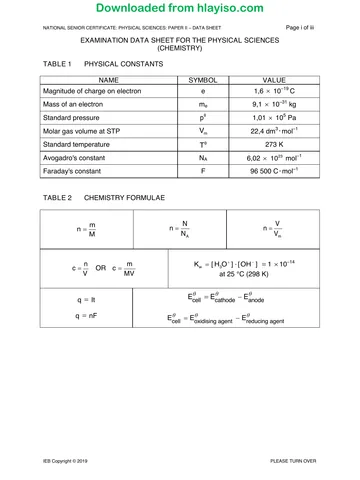
View all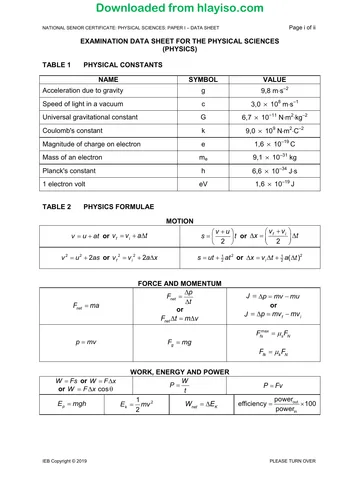
Physical Sciences Grade 12 IEB Paper 2 2018 Memo
IEB Grade 12 Physical Sciences Paper 2 memorandum from the 2018, 13 pages. Read online or get the free PDF download, question paper linked when available.
Publisher: IEB
Physical Sciences · Grade 12 · 2018. Memorandum, 13 pages. Read online or download the PDF.
- Subject
- Physical Sciences
- Grade
- Grade 12
- Document type
- Memorandum
- Year
- 2018
- Paper
- 2
- Publisher
- IEB
- Curriculum
- IEB
- Pages
- 13
- File size
- 345.8 KB
Loading document…
Loading document…
1 of 13
Document textSearch extracted text and jump to a page.
Downloaded from hlayiso.com
NATIONAL SENIOR CERTIFICATE: PHYSICAL SCIENCES: PAPER II – MARKING GUIDELINES Page 2 of 13
QUESTION 1 MULTIPLE CHOICE
1.1 B
1.2 A
1.3 B
1.4 C
1.5 C
1.6 D
1.7 C
1.8 A
1.9 D
1.10 B
QUESTION 2
2.1
Activated (Transition
State) Complex
Potential Energy
Reactants
(products lower
(OR Cr + HCℓ)
than reactants)
Reaction Coordinate/
Course of Reaction
IEB Copyright © 2018 PLEASE TURN OVER
Downloaded from hlayiso.com
NATIONAL SENIOR CERTIFICATE: PHYSICAL SCIENCES: PAPER II – MARKING GUIDELINES Page 3 of 13
2.2 2.2.1
4,5
Volume of H2 gas (dm3)
3,0
1,5 Graph must have:
Shallower gradient
Same end volume
0
0 20 40 60 80
Time (s)
2.2.2 4,5
Volume of H2 gas (dm3)
3,0
1,5 Graph must have:
Steeper gradient
End volume at
approximately 2,25 dm3
0
0 20 40 60 80
Time (s)
2.3 • The reaction could be done using a colorimeter/light meter.
• which would measure the colour intensity of the green solution as a
measure of concentration of chromium chloride (Cr3+)
• at specific time intervals OR over a period of time.
IEB Copyright © 2018 PLEASE TURN OVER
Downloaded from hlayiso.com
NATIONAL SENIOR CERTIFICATE: PHYSICAL SCIENCES: PAPER II – MARKING GUIDELINES Page 4 of 13
V
2.4 2.4.1 n=
Vm
(3)
n=
( 22,4 )
n = 0,134 mol
m ( 6,0 )
2.4.2 • nCr = = = 0,1154 mol
M ( 52 )
3
• nH2 = (0,1154) × = 0,1731 mol
2
actual yield ( 0,134 )
• % Yield = × 100 = × 100
theoretical yield ( 0,1731)
• % Yield = 77,41%
Alternative:
V(H2 ) = 0,1731 × 22,4
= 3,877 dm3
3
% Yield = × 100
3,877
= 77,37%
=
∆V
=
(3 − 0)
2.4.3 Average Rate = 0,075 dm3 ⋅s−1
∆t ( 40 )
2.5 • Correct orientation of the colliding reactant particles
• The sum of the kinetic energy (of the reacting particles) is greater
than/equal to the activation energy.
2.6 • A higher concentration means that there is a greater number of
particles per unit volume.
• This increases the number of collisions that occur per unit time.
• This therefore leads to an increase in the number of effective collisions
per unit time,
• leading to a higher reaction rate.
IEB Copyright © 2018 PLEASE TURN OVER
Downloaded from hlayiso.com
NATIONAL SENIOR CERTIFICATE: PHYSICAL SCIENCES: PAPER II – MARKING GUIDELINES Page 5 of 13
2.7 2.7.1 The sharing of at least one pair of electrons by two atoms.
2.7.2 A measure of the tendency of an atom to attract a bonding pair of
electrons.
2.7.3 • The difference in electronegativity between hydrogen and
chlorine is greater than zero.
• This results in unequal sharing of electrons, i.e. a polar covalent
bond.
IEB Copyright © 2018 PLEASE TURN OVER
Downloaded from hlayiso.com
NATIONAL SENIOR CERTIFICATE: PHYSICAL SCIENCES: PAPER II – MARKING GUIDELINES Page 6 of 13
QUESTION 3
3.1 5 minutes
3.2 2SO3 2SO2 + O2
3.3 When an external stress (change in pressure, temperature or
concentration) is applied to a system in chemical equilibrium, the
equilibrium point will change in such a way as to counteract the stress.
3.4 • Stress: increase in concentration of O2
• Le Châtelier's principle predicts the system will respond in order to
decrease the concentration of O2
• Therefore, the forward reaction is (initially) favoured as it consumes O2
• Decreasing the amount of SO2
3.5 3.5.1 Forward
3.5.2 Exothermic
n
3.6 3.6.1 All the concentrations decrease (since c = and V has increased).
v
3.6.2 • From the rate equations we see that the rate of the forward
reaction is proportional to cube of concentration (OR forward
1
rate 𝛼𝛼 3 ) whereas the rate of the reverse reaction is
V
proportional to the square of concentration (OR reverse
1
rate α 2 ) .
V
• Therefore the change in pressure has a greater effect on the
forward reaction rate than the reverse.
IEB Copyright © 2018 PLEASE TURN OVER
Downloaded from hlayiso.com
NATIONAL SENIOR CERTIFICATE: PHYSICAL SCIENCES: PAPER II – MARKING GUIDELINES Page 7 of 13
QUESTION 4
4.1 Increases
4.2 Reverse
4.3 Turns green
CuC 24−
4.4 4.4.1 Kc =
Cu (H2O )2+ C −
4
6
4.4.2 Concentrations:
Cu (H2O )6
2+ 2−
Reaction + 4C − ⇌ CuC 4 + 6H2O
Initial
0 0 2
concentration
Change in
+1,1 +4,4 −1,1
concentration
Equilibrium
1,1 4,4 0,9
concentration
OR
Moles:
Cu (H2O )6
2+ 2−
Reaction + 4C − ⇌ CuC 4 + 6H2O
Initial moles 0 0 4
Change in
+2,2 +8,8 −2,2
moles
Equilibrium
2,2 8,8 1,8
moles
Equilibrium
1,1 4,4 0,9
concentration
Then:
CuC 24−
Kc =
Cu (H2O )2+ C −
4
6
Kc =
( 0,9 )
(1,1)( 4,4 )
4
−3
Kc = 2,18 × 10
IEB Copyright © 2018 PLEASE TURN OVER
Downloaded from hlayiso.com
NATIONAL SENIOR CERTIFICATE: PHYSICAL SCIENCES: PAPER II – MARKING GUIDELINES Page 8 of 13
QUESTION 5
5.1 A proton acceptor.
5.2 It dissociates (almost) completely in water/solution.
5.3 KOH (OR LiOH/RbOH/CsOH)
H2O
5.4 NaOH Na+ + OH−
5.5 • The NaOH solution is more conductive.
• NaOH is strong whilst butanoic acid is weak (OR NaOH dissociates
completely, whilst butanoic acid ionises partially)
• It forms a higher concentration of ions in solution (at equal
concentrations).
5.6 H H H O
H C C C C O H
H H H
5.7 methyl propanoate OR ethyl ethanoate OR propyl methanoate
IEB Copyright © 2018 PLEASE TURN OVER
Downloaded from hlayiso.com
NATIONAL SENIOR CERTIFICATE: PHYSICAL SCIENCES: PAPER II – MARKING GUIDELINES Page 9 of 13
QUESTION 6
6.1 Increases
Kw = �H3 O �[OH− ]
+
6.2
−14 −5 −
�10 � = �6,31 × 10 � [OH ]
[OH− ] = 1,58 × 10⁻¹⁰ mol⋅dm−3
6.3 6.3.1 The point where an acid and base have reacted so neither is in
excess.
6.3.2 nacid = 0,0165 mol
n 0,0165
6.3.3 Vacid = = 0,21
c
Vacid = 0,07857 dm3
Vacid = 78,57 cm3
6.4 6.4.1 A reaction with water where water itself is decomposed.
6.4.2 There is an increase in concentration of OH−.
OR
The production of OH− ions results in a decrease in the
concentration of H3O+ (due to the upsetting of the equilibrium
involving H3O+ and OH− ions in water)
6.5 • This statement is incorrect
• pH depends on the concentration of hydronium ions (or hydroxide ions)
• which is determined by both strength and concentration of the base
IEB Copyright © 2018 PLEASE TURN OVER
Downloaded from hlayiso.com
NATIONAL SENIOR CERTIFICATE: PHYSICAL SCIENCES: PAPER II – MARKING GUIDELINES Page 10 of 13
QUESTION 7
7.1 7.1.1 The substance that accepts electrons.
7.1.2 • Cℓ2 is a stronger oxidising agent (than Ni2+).
• Therefore Cℓ2 is more likely to be reduced and thus accept
electrons.
7.2 7.2.1 The electrode where oxidation takes place.
7.2.2 Ni OR nickel
7.3 Pt OR platinum
7.4 Ni | Ni2+(1 mol·dm−3) || Cℓ2(1 atm) | Cℓ−(1 mol·dm−3) | Pt at 25 °C
7.5 7.5.1 Ni Ni2+ + 2e−
7.5.2 • The Ni electrode corrodes (loses mass).
• The green colour of the Ni2+ electrolyte intensifies.
7.5.3 To complete the circuit.
7.5.4 • Ni2+ ions are being produced in this half-cell.
• Anions enter the electrolyte from the salt bridge.
• and Ni2+ cations exit the electrolyte into the salt bridge.
7.6 Increases
IEB Copyright © 2018 PLEASE TURN OVER
Downloaded from hlayiso.com
NATIONAL SENIOR CERTIFICATE: PHYSICAL SCIENCES: PAPER II – MARKING GUIDELINES Page 11 of 13
QUESTION 8
8.1 It is light.
8.2 It protects itself from corrosion.
8.3 Anode
8.4 Aℓ3+ + 3e− Aℓ
8.5 8.5.1 • Less energy (OR electricity) is used to melt the electrolyte.
• This saves money (cost is less).
8.5.2 • The cryolite is also electrolysed/decomposed.
• This produces perfluorocarbons (PFCs) which are greenhouse
gases
8.6 • O2 is produced at the anode.
• This reacts with the carbon electrode (to produce CO2), causing the
electrode to corrode (OR the carbon anode is continually oxidised)
• C + O2 CO2 OR 2O2− + C CO2 + 4e−
8.7 In order to melt aluminium oxide,
• Many
• Strong
• ionic (electrostatic) forces/bonds need to be broken/overcome,
• which requires much energy to separate the ions from the crystal
lattice.
8.8 8.8.1 AℓCℓ3 + 3 Na → Aℓ + 3 NaCℓ
8.8.2 • nNa =3 × nA =3 × ( 7,56 ) =22,68 mol
• m=
Na =
nM ( 22,68 )( 23
= ) 521,64 g
IEB Copyright © 2018 PLEASE TURN OVER
Downloaded from hlayiso.com
NATIONAL SENIOR CERTIFICATE: PHYSICAL SCIENCES: PAPER II – MARKING GUIDELINES Page 12 of 13
QUESTION 9
9.1 9.1.1 3−bromo−2,4−dimethylhexane
9.1.2 CH3CH2CH(CH3)CHBrCH(CH3)CH3
OR
Br CH3
CH3 CH CH CH CH3
CH2
CH3
9.2 9.2.1 Alkenes
9.2.2
9.3 9.3.1 Hydroxyl group
9.3.2 Molecules with the same molecular formula but different positions of
their same functional group OR same substituents.
9.3.3 Any one of the following:
H H H H H H H H H H
H C C C C C O H OR H C C C C C H
H H H H H H H O H H
H
9.4 9.4.1 A weak force of attraction between molecules or between atoms of
noble gases.
9.4.2 • Compound B has London forces (only)
• Compound C has hydrogen bonding
• Hydrogen bonds are stronger than London forces (OR
compound C has stronger intermolecular forces)
• It is more difficult for the particles in compound C to flow past
one another
• resulting in compound C having a higher viscosity
9.5 C7H12 + 10O2 7CO2 + 6H2O
IEB Copyright © 2018 PLEASE TURN OVER
Downloaded from hlayiso.com
NATIONAL SENIOR CERTIFICATE: PHYSICAL SCIENCES: PAPER II – MARKING GUIDELINES Page 13 of 13
QUESTION 10
10.1 A compound/molecule containing only carbon and hydrogen atoms.
10.2 Pentane
10.3 10.3.1 Substitution
10.3.2 Addition
10.3.3 Condensation
10.4 Hydrohalogenation
10.5 Pent−1−ene
10.6 Unsaturated
10.7 Pentan−1−ol
10.8 H O H H H H H
H C C O C C C C C H
H H H H H H
10.9 2
Total: 200 marks
IEB Copyright © 2018 PLEASE TURN OVER
Study this subject
Revise the topics in this paper, then practise them question by question.
- Grade 12 Physical Sciences notes
CAPS revision notes with worked examples.
- Physical Sciences questions by topic
Past exam questions sorted by CAPS topic, with memos where available.
- Grade 12 Physical Sciences quizzes
Short topic quizzes with instant feedback.
- All Grade 12 Physical Sciences past papers
Past papers by year, with memos where available.
- Grade 12 IEB past papers
More Physical Sciences and other subjects in this collection.
Recommended for this subject
More papers and memos for this grade and subject.
MemorandumIEB
Physical Sciences Grade 12 IEB Paper 1 2019 Memo
MemorandumIEB
Physical Sciences Grade 12 IEB Paper 2 2019 Memo
MemorandumIEB
Physical Sciences Grade 12 IEB Paper 1 2018 Memo
MemorandumIEB
Physical Sciences Grade 12 IEB Paper 1 2017 Memo
MemorandumIEB
Physical Sciences Grade 12 IEB Paper 2 2017 Memo
MemorandumIEB
Physical Sciences Grade 12 IEB Paper 1 2016 Memo
Related documents
Data sheetIEB
Physical Sciences Grade 12 IEB Paper 2 2018 Data Sheet
Question paperIEB
Physical Sciences Grade 12 IEB Paper 2 2018 Question Paper
MemorandumIEB
Physical Sciences Grade 12 IEB Paper 2 2016 Memo
Data sheetIEB
Physical Sciences Grade 12 IEB Paper 1 2018 Data Sheet
Question paperIEB
Physical Sciences Grade 12 IEB Paper 1 2018 Question Paper
Data sheetIEB
Physical Sciences Grade 12 IEB Paper 2 2019 Data Sheet
More from Grade 12 Physical Sciences
Data sheetIEB
Physical Sciences Grade 12 IEB Paper 1 2019 Data Sheet
Question paperIEB
Physical Sciences Grade 12 IEB Paper 1 2019 Question Paper
Question paperIEB
Physical Sciences Grade 12 IEB P1 2019 Question Paper (Afrikaans)
Question paperIEB
Physical Sciences Grade 12 IEB P1 2019 Question Paper (Afrikaans)
Question paperIEB
Physical Sciences Grade 12 IEB Paper 2 2019 Question Paper
Question paperIEB