
Downloaded from hlayiso.com
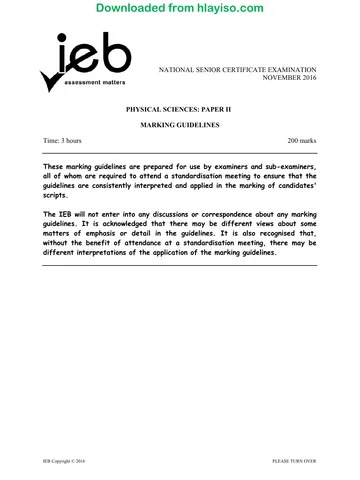
NATIONAL SENIOR CERTIFICATE EXAMINATION
NOVEMBER 2017
PHYSICAL SCIENCES: PAPER II
MARKING GUIDELINES
Time: 3 hours 200 marks
These marking guidelines are prepared for use by examiners and sub-examiners,
all of whom are required to attend a standardisation meeting to ensure that the
guidelines are consistently interpreted and applied in the marking of candidates'
scripts.
The IEB will not enter into any discussions or correspondence about any marking
guidelines. It is acknowledged that there may be different views about some
matters of emphasis or detail in the guidelines. It is also recognised that,
without the benefit of attendance at a standardisation meeting, there may be
different interpretations of the application of the marking guidelines.
IEB Copyright © 2017 PLEASE TURN OVER
Skip to contentMemorandum 
View all
Physical Sciences Grade 12 IEB Paper 2 2017 Memo
IEB Grade 12 Physical Sciences Paper 2 memorandum from the 2017, 12 pages. Read online or get the free PDF download, question paper linked when available.
Publisher: IEB
Physical Sciences · Grade 12 · 2017. Memorandum, 12 pages. Read online or download the PDF.
- Subject
- Physical Sciences
- Grade
- Grade 12
- Document type
- Memorandum
- Year
- 2017
- Paper
- 2
- Publisher
- IEB
- Curriculum
- IEB
- Pages
- 12
- File size
- 621.5 KB
Loading document…
Loading document…
1 of 12
Document textSearch extracted text and jump to a page.
Downloaded from hlayiso.com
NATIONAL SENIOR CERTIFICATE: PHYSICAL SCIENCES: PAPER II – MARKING GUIDELINES Page 2 of 12
QUESTION 1 MULTIPLE CHOICE
1.1 A
1.2 D
1.3 B
1.4 C
1.5 B
1.6 C
1.7 B
1.8 C
1.9 A
1.10 D
QUESTION 2 CHEMICAL BONDING
2.1 A covalent bond is a sharing of at least one pair of electrons by two (non-
metal) atoms.
2.2 A non-polar covalent bond is an EQUAL sharing of electrons.
A polar covalent bond is an UNEQUAL sharing of electrons.
2.3
2.3.1 hydrogen OR chlorine
2.3.2 hydrogen chloride OR hydrogen fluoride
2.3.3 aluminium oxide
2.3.4 hydrogen fluoride
2.3.5 hydrogen chloride
2.3.6 argon
2.3.7 magnesium
2.3.8 graphite
IEB Copyright © 2017 PLEASE TURN OVER
Downloaded from hlayiso.com
NATIONAL SENIOR CERTIFICATE: PHYSICAL SCIENCES: PAPER II – MARKING GUIDELINES Page 3 of 12
QUESTION 3 ENERGY CHANGE
3.1.1 Activation energy is the MINIMUM energy required to start a chemical
reaction.
3.1.2 A catalyst is a (chemical) substance that increases the rate of a chemical
reaction but remains unchanged at the end of the reaction
3.2 EA = (242,6 + 92,4) = 335 kJmol–1 (-1 if no unit)
3.3 Error: There will NOT be more collisions taking place per second (per unit
time).
The number of EFFECTIVE (successful) collisions (per second) increases
(since more of the molecules will have the required activation energy).
3.4 Platinum. It lowers the activation energy the most, (has the lowest
activation energy) which means that more of the molecules will have the
activation energy required for an effective collision, therefore there will be
a greater number of effective collisions per unit time, therefore a faster
reaction rate. or more product formed per unit time. Give mark for EITHER
point NOT both.
IEB Copyright © 2017 PLEASE TURN OVER
Downloaded from hlayiso.com
NATIONAL SENIOR CERTIFICATE: PHYSICAL SCIENCES: PAPER II – MARKING GUIDELINES Page 4 of 12
QUESTION 4 RATES OF REACTION
4.1 Various options each out of 3 marks … (apparatus measure time)
Place the flask on a scale/weighing apparatus/digital balance and measure
the loss in mass over a set time period.
Attach a syringe/gas measuring apparatus to the flask and measure the
volume/amount/how much (of) gas produced in a set time period.
Collect the gas (by the downward displacement of water) using an inverted
measuring cylinder (or a burette) filled with water and measure the
volume/amount/how much (of) gas produced in a set time period.
4.2 The particle size/physical state (lump vs granules)/surface area of the
calcium carbonate.
4.3 Flask X. The smaller the particle size, the greater the surface area
exposed to the acid. There will be more effective (correct orientation and
Ek ≥ Ea) collisions per unit time (frequency/chance) and therefore a faster
reaction rate. No marks for flask W (Apply principle of negative marking.)
4.4 n = c.V (c = n/V)
= 0,1 × 0,1 (conversion)
= 0,01 mol of HCℓ
Mol ratio HCℓ : CO2
2: 1
0,01 : 0,005
V = n.Vm
= 0,005 × 22,4
= 0,11 dm3 of CO2 (or 112 cm3)
Award marks for the following skills:
Method to calculate mols of HCℓ (n = c.V)
Unit conversion (cm3 to dm3)
Applying mol ratio (HCℓ : CO2 = 2 : 1)
Multiplying mols of CO2 × 22,4 dm3
Answer (0,11 dm3)
4.5 4.5.1 Equal to
4.5.2 There are more molecules /moles/quantity of acid to react with the
excess calcium carbonate therefore producing more carbon
dioxide.
OR More (or bigger volume of) (molecules/moles/quantity) acid
which is the limiting reactant/reagent.
IEB Copyright © 2017 PLEASE TURN OVER
Downloaded from hlayiso.com
NATIONAL SENIOR CERTIFICATE: PHYSICAL SCIENCES: PAPER II – MARKING GUIDELINES Page 5 of 12
QUESTION 5 CHEMICAL EQUILIBRIUM
5.1 The reaction is in (dynamic chemical) equilibrium or the rates of the forward
and reverse reactions are equal or the rate of formation of products is equal
to the rate of formation of reactants.
5.2 1,6
Number of moles
1,2 H2(g)
H2O(g)
0,8 CH4(g
)
0,4 CO(g
)
Time
t0 t1 t2
5.2.1 Graph levels out at t1 at 1,2 moles
Between t0 and t1 line must be curved (decreasing gradient) as
shown. (-1 if H2 not started at zero)
5.2.2 Graph levels out BEFORE t1 at 0,8 moles
Between t0 and t1 line must be curved (decreasing gradient) as
shown (–1) if not. (Allow c.o.e. from 5.2.1.) (-1 if not started at 1,2 mol)
CO × H2
3
5.3 Kc = (–1 for use of round brackets)
CH4 × H2O
Correct moles for reactants
0,4 / 2 × 1,2 / 2
3
Kc = Correct moles for products (c.o.e. from 5.2.1 if
0,8 / 2 × 1/ 2 incorrect number of moles used for H2)
= 0,22 Divide by volume
5.4 Low yield of products (c.o.e. from 5.3) (Answer MUST link to 5.3)
5.5 When an external stress is applied to a system in chemical equilibrium, the
equilibrium point will change in such a way as to counteract the stress
5.6 Explanation using Le Chatelier’s Principle
Decrease or low yield of hydrogen. High pressures favours the reverse
reaction which produces less moles of gas and relieves the stress of
high pressure or reduces the pressure).
OR Explanation using rates
Decrease or low yield of hydrogen. A high pressure increases the rates of
both the forward and reverse reactions but the reverse rate increases more
as it involves more gas particles, therefore favours the reverse
reaction.
5.7 No change
5.8 Faster reaction rate. (Products produced faster.) Higher yield of products.
IEB Copyright © 2017 PLEASE TURN OVER
Downloaded from hlayiso.com
NATIONAL SENIOR CERTIFICATE: PHYSICAL SCIENCES: PAPER II – MARKING GUIDELINES Page 6 of 12
QUESTION 6 EXPERIMENTAL SKILLS AND THE AUTO-IONISATION OF
WATER
6.1 Kw = (1,71 × 10⁻⁷)2 = 2,92 × 10⁻¹⁴
6.2 ENDOTHERMIC since Kw or [H3O+] increases (or forward reaction is
favoured) with an increase in temperature.
Award marks for the following skills:
Linking temperature change to correct shift in equilibrium (either increase
temperature favours forward or decrease temperature favours reverse)
No marks for EXOTHERMIC.
6.3 Graph to show the relationship between [H3O+] and the temperature
(of water) (order of [H3O+] and temperature not important)
OR Graph of [H3O+] vs temperature (of water) (order of [H3O+] and
temperature IS important)
Heading
Label x-axis with unit
2,50
Suitable scale x-axis Must use > ½ blocks
1st point at 0 °C correct
2,25 Points at 30 °C and 50 °C both correct
Smooth curve (6)
2,00
1,75
[H3O+] (x 10–7) (moldm–3)
1,50
1,25
1,00
0,75
0,50
0,25
0
5 10 15 20 25 30 35 40 45 50
0 o
Temperature ( C)
6.4 [H3O+] at 45 oC = 2 (+ 0,05) × 10–7 moldm–3 (c.o.e. from graph)
IEB Copyright © 2017 PLEASE TURN OVER
Downloaded from hlayiso.com
NATIONAL SENIOR CERTIFICATE: PHYSICAL SCIENCES: PAPER II – MARKING GUIDELINES Page 7 of 12
If lines indicating where graph was read are not shown (−1)
6.5 It is not a straight line or it does not have a constant gradient (y/x ≠ k) or it is
a curve or it is exponential. It does not pass through the origin.
6.6 6.6.1 Remains the same
6.6.2 Decreases
6.7 Decreases
IEB Copyright © 2017 PLEASE TURN OVER
Downloaded from hlayiso.com
NATIONAL SENIOR CERTIFICATE: PHYSICAL SCIENCES: PAPER II – MARKING GUIDELINES Page 8 of 12
QUESTION 7 ACIDS & BASES
7.1 An acid is a proton (H+) donor.
7.2 A concentrated acid has a large amount of acid per unit volume of water.
(High proportion of acid to water.) A strong acid ionises (almost) completely
in water
7.3 7.3.1 LiOH
7.3.2 H3PO4
7.3.3 HNO3
7.3.4 HCOOH
7.3.5 NaHCO3
7.4 H2SO4 + 2H2O 2H3O+ + SO42- Reactants Products Balanced
OR H2SO4 + H2O H3O+ + HSO4-
7.5 7.5.1 n = c.V (c=n/V)
= 0,8 × 0,05
= 0,04 mol of HCℓ
7.5.2 n = c.V
= 0,5 × 0,02
= 0,01 mol of NaOH
Therefore 0,01 mol of HCℓ neutralised (excess).
Mols of HCℓ that reacted with MgO = (0,04 – 0,01) (c.o.e from 7.5.1)
= 0,03 mol of HCℓ
Mol ratio: MgO : HCℓ
1 : 2
0,015 : 0,03
Mass of MgO m=n×M
= 0,015 × 40,3
= 0,6045 g of MgO
% of MgO in tablet = 0,6045/0,96 × 100
= 62,97%
OR Assume 100% purity
n= m/M
= 0,96/40,3
= 0,02382134 mol of MgO
But only 0,015 mol of MgO in tablet
% of MgO in tablet = 0,015/0,02382134 × 100
= 62,97%
IEB Copyright © 2017 PLEASE TURN OVER
Downloaded from hlayiso.com
NATIONAL SENIOR CERTIFICATE: PHYSICAL SCIENCES: PAPER II – MARKING GUIDELINES Page 9 of 12
QUESTION 8 GALVANIC CELLS
8.1 8.1.1 The electrode where oxidation takes place.
8.1.2 A substance that donates electrons (electron donor)
8.2 Chemical (potential) energy to electrical energy.
8.3 Temperature = 25 oC (298 K)
Concentration of electrolyte = 1 moldm–3
If give 1 atm pressure then give a maximum of 1 mark for either one or both
of the other 2 conditions correct.
8.4 3X + 2Y3+ 3X2+ + 2Y Reactants Products Balanced
(–1 for double arrow)
8.5 Y3+
8.6 Z|Z+||X2+|X Anode Salt bridge Cathode Ignore balancing numbers.
8.7 X2+
8.8 8.8.1 Z strongest
8.8.2 Y weakest
8.9 Cell C: EoCell = Eo cathode – Eo anode
Cell A: EoCell A = EoY – EoX
0,84 = EoY – EoX (1)
Cell B: EoCell B = EoX – EoZ
0,68 = EoX – EoZ (2)
(1) + (2) 0,84 + 0,68 = EoY – EoX + EoX – EoZ
1,52 V = EoY – EoZ
Cell C: EoCell C = EoY – EoZ
EoCell C = 1,52 V
IEB Copyright © 2017 PLEASE TURN OVER
Downloaded from hlayiso.com
NATIONAL SENIOR CERTIFICATE: PHYSICAL SCIENCES: PAPER II – MARKING GUIDELINES Page 10 of 12
QUESTION 9 ELECTROLYTIC CELLS
9.1 In order to free the ions from the crystal lattice so that it would conduct
electricity.
9.2 Good electrical conductor
Inert/unreactive/not readily oxidised or reduced ANY 2
High melting point (OR solid at high temp)
9.3 9.3.1 2Cℓ– Cℓ2 +2e–
9.3.2 Na+ + e– Na
9.3.3 2H2O + 2e– H2 + 2OH–
9.4 Na+
9.5 NaOH or sodium hydroxide or caustic soda
9.6 In the dilute solution there is relatively more water.
Either of these points
Water is a stronger reducing agent than chloride ions.
Water is oxidised to oxygen.
2H2O O2 + 4H+ + 4e–
No marks for showing oxidation of OH− ions / H2O2
IEB Copyright © 2017 PLEASE TURN OVER
Downloaded from hlayiso.com
NATIONAL SENIOR CERTIFICATE: PHYSICAL SCIENCES: PAPER II – MARKING GUIDELINES Page 11 of 12
QUESTION 10 ORGANIC CHEMISTRY (1)
10.1 10.1.1 Esters
10.1.2 butyl ethanoate
10.1.3 ethanoic acid c.o.e. from 10.1.2 (must make link)
10.1.4 C6H12O2 + 8O2 6CO2 + 6H2O Reactants Products Balancing
10.1.5 Isomers are compounds having the same molecular formula but
different structural formulae.
10.1.6 (a) ethyl butanoate or propyl propanoate or methyl pentanoate or
pentyl methanoate
(b) hexanoic acid hex anoic acid no c.o.e. from 10.1.2
10.2 10.2.1 substitution (hydrolysis)
10.2.2 CH3CHCℓCH3 + NaOH CH3CHOHCH3 + NaCℓ
(structural or molecular formulae –1)
Award marks for the following:
2-chloropropane 3C's rest of formula correct
Propan-2-ol OH group (knowing it's an alcohol)
rest of formula
NaCℓ
10.2.3 H
H
C=C–C–H C = C rest of formula correct
H
H H -1 if use condensed structural formula
IEB Copyright © 2017 PLEASE TURN OVER
Downloaded from hlayiso.com
NATIONAL SENIOR CERTIFICATE: PHYSICAL SCIENCES: PAPER II – MARKING GUIDELINES Page 12 of 12
QUESTION 11 ORGANIC CHEMISTRY (2)
11.1 Cracking
11.2 A saturated hydrocarbon is a compound containing only carbon and
hydrogen atoms in which all of the bonds between carbon atoms are
single bonds.
11.3 Alkanes
11.4 The hydrocarbons have induced dipole forces or London forces
between their molecules.
Water has hydrogen bonds between its molecules.
Hydrogen bonds are STRONGER than London forces or the
intermolecular forces of the hydrocarbons are not similar in STRENGTH to
those of water. (either point for 1 mark) therefore insoluble.
OR Dipole induced-dipole forces between the hydrocarbon molecules
and the water solvent are weaker than the hydrogen bonds between the
water molecules therefore insoluble.
11.5 11.5.1 Ethene
11.5.2 Addition (halogenation, bromination)
11.6 2,2–dimethylbutane 2,2 – dimethyl but ane
11.7
11.7.1 2 molecules of X = (12C + 26H) – (4C + 10H) – (2C + 4H)
(OR C12H26 – C4H10 – C2H4)
= 6C + 12H or C6H12 Award marks for the following
(÷ 2) skills:
1 molecule of X = 3C and 6H Subtraction (from 12C + 26H or
Compound X = C3H6 C12H26 ) to get C6H12 (award
subtraction mark if candidate
OR C12H26
– C4H10 arrived at C6H12 without explicitly
– C2H4 showing the subtraction)
C6H12 ÷ 2 = C3H6 Dividing by 2
Correct final answer (C3H6)
11.7.2 All hydrocarbons have induced dipole forces or London forces
between their molecules.
The larger kerosene molecules have a greater interactive
surface and have a greater electron density.
Bigger temporary dipoles are set up or easier dispersion of
electrons therefore longer lasting dipoles.
These factors result in STRONGER London forces.
More energy is needed to overcome the stronger intermolecular
forces (NOT bonds) or to separate the molecules therefore
kerosene is a liquid at room temperature (higher b.pt.).
Total: 200 marks
IEB Copyright © 2017
Study this subject
Revise the topics in this paper, then practise them question by question.
- Grade 12 Physical Sciences notes
CAPS revision notes with worked examples.
- Physical Sciences questions by topic
Past exam questions sorted by CAPS topic, with memos where available.
- Grade 12 Physical Sciences quizzes
Short topic quizzes with instant feedback.
- All Grade 12 Physical Sciences past papers
Past papers by year, with memos where available.
- Grade 12 IEB past papers
More Physical Sciences and other subjects in this collection.
Recommended for this subject
More papers and memos for this grade and subject.
MemorandumIEB
Physical Sciences Grade 12 IEB Paper 1 2019 Memo
MemorandumIEB
Physical Sciences Grade 12 IEB Paper 2 2019 Memo
MemorandumIEB
Physical Sciences Grade 12 IEB Paper 1 2018 Memo
MemorandumIEB
Physical Sciences Grade 12 IEB Paper 2 2018 Memo
MemorandumIEB
Physical Sciences Grade 12 IEB Paper 1 2017 Memo
MemorandumIEB
Physical Sciences Grade 12 IEB Paper 1 2016 Memo
Related documents
Question paperIEB
Physical Sciences Grade 12 IEB Paper 2 2017 Question Paper
Question paperIEB
Physical Sciences Grade 12 IEB Paper 2 2017 Question Paper
MemorandumIEB
Physical Sciences Grade 12 IEB Paper 2 2016 Memo
Data sheetIEB
Physical Sciences Grade 12 IEB Paper 1 2017 Data Sheet
Question paperIEB
Physical Sciences Grade 12 IEB Paper 1 2017 Question Paper
Data sheetIEB
Physical Sciences Grade 12 IEB Paper 2 2019 Data Sheet
More from Grade 12 Physical Sciences
Data sheetIEB
Physical Sciences Grade 12 IEB Paper 1 2019 Data Sheet
Question paperIEB
Physical Sciences Grade 12 IEB Paper 1 2019 Question Paper
Question paperIEB
Physical Sciences Grade 12 IEB P1 2019 Question Paper (Afrikaans)
Question paperIEB
Physical Sciences Grade 12 IEB P1 2019 Question Paper (Afrikaans)
Question paperIEB
Physical Sciences Grade 12 IEB Paper 2 2019 Question Paper
Question paperIEB