
Downloaded from hlayiso.com
NATIONAL SENIOR CERTIFICATE EXAMINATION
NOVEMBER 2016
PHYSICAL SCIENCES: PAPER II
MARKING GUIDELINES
Time: 3 hours 200 marks
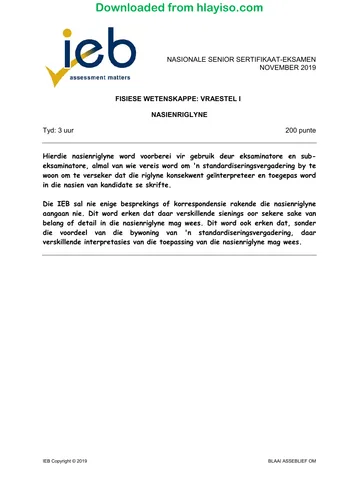
These marking guidelines are prepared for use by examiners and sub-examiners,
all of whom are required to attend a standardisation meeting to ensure that the
guidelines are consistently interpreted and applied in the marking of candidates'
scripts.
The IEB will not enter into any discussions or correspondence about any marking
guidelines. It is acknowledged that there may be different views about some
matters of emphasis or detail in the guidelines. It is also recognised that,
without the benefit of attendance at a standardisation meeting, there may be
different interpretations of the application of the marking guidelines.
IEB Copyright © 2016 PLEASE TURN OVER
Skip to contentMemorandum 
View all
Physical Sciences Grade 12 IEB Paper 2 2016 Memo
IEB Grade 12 Physical Sciences Paper 2 memorandum from the 2016, 9 pages. Read online or get the free PDF download, question paper linked when available.
Publisher: IEB
Physical Sciences · Grade 12 · 2016. Memorandum. Read online or download the PDF.
- Subject
- Physical Sciences
- Grade
- Grade 12
- Document type
- Memorandum
- Year
- 2016
- Paper
- 2
- Publisher
- IEB
- Curriculum
- IEB
- Pages
- 9
- File size
- 447.1 KB
Loading document…
Loading document…
1 of 9
Document textSearch extracted text and jump to a page.
Downloaded from hlayiso.com
NATIONAL SENIOR CERTIFICATE: PHYSICAL SCIENCES: PAPER II – MARKING GUIDELINES Page 2 of 9
QUESTION 1 MULTIPLE-CHOICE
1.1 D
1.2 B
1.3 C
1.4 D
1.5 B
1.6 A
1.7 C
1.8 A
1.9 D
1.10 B
QUESTION 2 CHEMICAL BONDING
2.1 2.1.1 It is a bond occurring between atoms within molecules.
2.1.2 Polar/covalent/bond.
2.1.3 A (weak) force of attraction between molecules or between atoms of noble
gases.
2.1.4 Hydrogen bond (Hydrogen bonding intermolecular force).
2.1.5 It is a (small) atom with a high electronegativity and it has at least one lone
pair of electrons.
2.1.6 δ+ (allow positive; +; α+)
2.2 2.2.1 A transfer of electrons and subsequent electrostatic attraction.
2.2.2* • Large number of STRONG electrostatic forces (ionic bonds, coulombic
forces) of attraction between ions in giant network structure.
• Large amount of energy required to break/overcome these forces.
2.2.3 Ion-dipole force
2.2.4 Sodium ion (Na+). The water molecules are orientated in such a way that
the (slightly) negative oxygen atoms (δ − ) are closest to the positive ion.
c.o.e. from 2.1.6
Cℓ- The water molecules are orientated in such a way that the (slightly)
positive oxygen atoms are closest to the positive ion.
If 2.1.6 is wrong no mark is given in 2.2.4 for either Na+ or Cℓ- without
justification.
2.2.5* The electrostatic forces (ionic bonds) holding the ions in the crystal lattice
are much stronger than the ion-dipole forces between the ions and the
water molecules. Large numbers of water molecules need to surround each
ion in order to overcome the strong electrostatic forces and "pull" the ion
out of the lattice.
* Penalise wrong use of terminology (e.g. atoms instead of ions) once in total in
Question 2.2.2 and Question 2.2.5
IEB Copyright © 2016 PLEASE TURN OVER
Downloaded from hlayiso.com
NATIONAL SENIOR CERTIFICATE: PHYSICAL SCIENCES: PAPER II – MARKING GUIDELINES Page 3 of 9
QUESTION 3 ENERGY CHANGE AND REACTION RATES
3.1 (Sulphur) is insoluble/solid/precipitate/murky/opaque/turbid and blocks the light.
Don't give a mark for saying there is a decrease in light intensity as that is stated in
the question.
3.2
3.2.2 Scale • If scale is wrong no marks
can be awarded for plotting
180 points.
• No marks for best-fit line
which is 'dot-to-dot/line
160 segments' or 'sketched/hairy'
but a wobbly curve is
acceptable.
140 3.2.4 best-fit line
120
Time (s)
100
3.2.3 plot point
80
60
40 3.2.3 plot point
20
0
0 0,2 0,4 0,6 0,8 1,0 1,2 1,4
3.2.1 label concentration mol dm–3 or M
Graph
3.3 Time is the dependent variable OR time depends on concentration.
No marks for stating 'time is measured'.
3.4 Straight line, which passes through the origin (0). Correct sketch of graph (one
mark only). Ignore reference to positive or negative slope.
3.5 The reaction rate increases as there are more particles (of Na2S2O3) per unit
volume therefore more effective (correct orientation and sufficient activation
energy) collisions per unit time.
IEB Copyright © 2016 PLEASE TURN OVER
Downloaded from hlayiso.com
NATIONAL SENIOR CERTIFICATE: PHYSICAL SCIENCES: PAPER II – MARKING GUIDELINES Page 4 of 9
3.6 Place the flask containing the sodium thiosulphate solution on top of a large black
cross drawn on a piece of white paper. Carry out step 2 of the original method but
stop the watch when the cross is no longer visible when viewed through the
solution from above. OR Measure change in mass/pressure/volume of gas
collected/pH with time.
m
OR 3.7.1* nsulphur =
3.7 3.7.1 n = c.V M
= 0,2 × 0,1 (conversion) 0,18
= 0,02 mol of HCℓ =
32
= 0,005625 mol
3.7.2 mol ratio HCℓ : S mol ratio HCℓ : S
2:1 2 :1
0,02 : 0,01 0,01 mol (2d.p.) 0,01125 : 0,005625
OR 3.7.2* If do alternative given above then
m= n × M n = c.V
IF one error = 0,01 × (32) = 0,2 × 0,1 (conversion)
= 0,02 mol of HCℓ
only (eg = 0,32 g
0 , 01125
wrong molar % yield = × 100
0 ,18 0 , 02
mass of S or
% yield = × 100 (method) = 56,25%
wrong ratio) 0 ,32
OR n = m/M = 0,18/32 = 0,005625 mol of S
gets 3/5 = 56,25%
0 , 005625
% yield = × 100 (method)= 56,25%
0 , 01
QUESTION 4 CHEMICAL EQUILIBRIUM
4.1 As A2B decomposes in the forward reaction, the concentration of A2 and B2 (or
product) increases OR more particles of A2and B2.
4.2 4.2.1 There has been an increase in concentration (or pressure) of both
reactants and products.
4.2.2 Reverse
4.2.3 The reverse reaction is favoured since it leads to the formation of fewer
moles of gas, which relieves the stress of high pressure (or lowers the
pressure). (NO c.o.e. from 4.2.2)
4.3 Exothermic.
• Stress: Decrease in temperature.
• Response: Reverse reaction rate decreases more than forward reaction rate,
therefore forward reaction favoured.
• Reason: Forward reaction produces heat (exothermic) in order to relieve the
stress (raise the temperature).
4.4 A catalyst is added.
4.5 No change in [A2B]. The rates of BOTH forward and reverse reactions have
increased. EQUALLY or whilst remaining in equilibrium OR A2B being broken
down and produced at the same rate.
4.6 4.6.1 No effect.
4.6.2 Increases.
Must be consistent with 4.3 If state ENDO in 4.3 then must state decrease in 4.6.2
IEB Copyright © 2016 PLEASE TURN OVER
Downloaded from hlayiso.com
NATIONAL SENIOR CERTIFICATE: PHYSICAL SCIENCES: PAPER II – MARKING GUIDELINES Page 5 of 9
n
4.7 4.7.1 V=
c
3, 6
=
1, 2
= 3 dm3
[A 2 ]2 ⋅ [B2 ] ( ) -1 mark
4.7.2 Kc =
[A 2 B]2
4.7.3 [A2B] = n/V [B2] = n/V c.o.e.
(5,1 − 3, 6) method 1,5 1,8 volume from
= or =
3 3 3 Question 4.7.1
= 0,5 mol ⋅ dm–3 ÷ volume = 0,6 mol ⋅ dm–3
OR TABLE
MOLE table 2A2B(g) 2A2(g) + B2(g)
*Mole ratio 2 2 1
Moles at start 5,1 0 0
*Moles used/formed 3,6 3,6 1,8
Moles at equilibrium (5,1 – 3,6) = 1,5 3,6 1,8
Conc. at equilibrium (mol ⋅ dm–3) ÷ vol
(1,5/3) = 0,5 1,2 1,8/3 = 0,6
(c = n/V) (V = 3 dm3)
CONC table 2A2B(g) 2A2(g) + B2(g)
*Mole ratio 2 2 1
Conc at start 5,1/3 = 1,7 0 0
*Conc change 1,2 1,2 0,6
Conc. at equilibrium (mol ⋅ dm–3)
(1,7 – 1,2) = 0,5 1,2 0,6
(c = n/V) (V = 3 dm3)
[A 2 ]2 ⋅ [B2 ] c.o.e.
Kc = Kc from
[A 2 B]2
Question 4.7.2
1, 22 × 0, 6 subst
=
0,52
= 3,46
QUESTION 5 QUANTITATIVE CHEMISTRY AND ACIDS AND BASES
5.1 5.1.1 A solution of known concentration.
5.1.2 Error & correction (any TWO of the following)
• Use of tap water. She should have used distilled water.
• Use of a beaker. She should have used a volumetric flask.
• Use of a glass rod to stir (as could transfer solute to rod). Mix by
shaking the solution (in a sealed volumetric flask).
• She did not weigh the filter paper before and after transferring the solute
to the beaker in order to ascertain (by subtraction) exactly how much
solute was transferred. She should have done this (implied).
IEB Copyright © 2016 PLEASE TURN OVER
Downloaded from hlayiso.com
NATIONAL SENIOR CERTIFICATE: PHYSICAL SCIENCES: PAPER II – MARKING GUIDELINES Page 6 of 9
• She added the solute to 250 cm3 of water, which would have resulted in
a greater total volume than 250 cm3. She should have added water to the
solute to make up the total volume to 250 cm3.
5.1.3 sodium carbonate (Na2CO3)
5.2 5.2.1 It is the point where an acid and base have reacted, so neither is in excess OR
where equivalent (NOT same or equal) number of moles of acid and base
have reacted.
5.2.2 Colour: Orange since more HIn is formed.
Stress: Increase [H3O+]
Response: Favour reverse reaction
Reason: Reverse reaction uses up H3O+ or decreases [H3O+] therefore
relieves stress.
V
5.3 5.3.1 n=
Vm
= 0,56 ÷ 22,4
= 0,025 mol of CO2 (OR 0,03 mol to 2 dp)
5.3.2 Mol ratio HCℓ : CO2
2:1
0,05 : 0,025 (OR 0,06 : 0,03)
n
V=
c
0 , 05 0,06
= 0,25
0 , 25
V = 0,2 dm3 of HCℓ = 0,24 dm3
5.4 5.4.1 CH3COOH + H2O H3O+ + CH3COO– Don't penalise single arrow.
Reactants/Products.
5.4.2 GREATER THAN
Nitric acid is a stronger acid than ethanoic acid therefore it will ionise
more/produce more ions/donates H+ more readily OR stronger acids
have higher Ka values.
5.4.3 Nitric acid (c.o.e.) (Allow ethanoic acid if they have identified it as the
stronger acid in Question 5.4.2.)
It would have a higher concentration of ions (more ions) as it is a stronger
acid.
5.4.4 Ethanoic acid (Allow HNO3 if c.o.e. from Question 5.4.2.)
It is a weaker acid, therefore it would have a lower concentration of H3O+
ions.
Kw = [H3O+] i [OH–] = constant OR [OH-] inversely proportional to [H3O+]
+ –
∴ if [H3O ] is lower, then [OH ] must be higher.
IEB Copyright © 2016 PLEASE TURN OVER
Downloaded from hlayiso.com
NATIONAL SENIOR CERTIFICATE: PHYSICAL SCIENCES: PAPER II – MARKING GUIDELINES Page 7 of 9
5.5 5.5.1 A salt is a substance in which the hydrogen of an acid has been replaced by
a cation.
5.5.2 pH=7,1 – 11 It is a weak base/basic salt/salt of a strong base and a weak
acid as it causes an increase in [OH–].
5.5.3 2CH3COOH + Na2O 2CH3COONa + H2O
Reactants/Products/Balanced
QUESTION 6 GALVANIC CELLS
Diagram
6.1 Electrons
Salt bridge
V
If identify Pb as cathode then (anode to cathode) Electrodes in solutions
coe for rest of diagram, Voltmeter & wires
Cu(NO3)2 as electrolyte in
If show symbol for cell
anode half-cell and electron
instead on voltmeter give
from Cu to Pb
- Don't penalise + max of 4/6 if rest of Q
(Anode half-cell) no cotton wool, correct
ripples on
Allow any lead salt or Copper cathode
surface of
Pb2+ solution.
electrolytes.
Lead nitrate or
Pb(NO3)2(aq)
State symbols not
6.2 Pb(s)|Pb2+ (aq, 1 mol ⋅ dm–3)||Cu2+ (aq, 1 mol ⋅ dm–3)|Cu(s) at 25º C required.
Anode/Salt bridge/Cathode/Standard conditions NO c.o.e from 6.1
6.3 Eº cell = Eº cathode – Eº anode NO c.o.e from 6.1
= 0,34 – (–0,13)
= 0,47 V
6.4 6.4.1 Completes circuit/allows ions through maintains electrical neutrality/
neutralises electrolyte/acts as an ion pump.
6.4.2 As a result of oxidation of the lead anode the concentration of positive
lead ions (cations) in the lead half-cell increases therefore the negative
iodide ions move into the lead half-cell in order to maintain electrical
neutrality (maintain balance between positive and negative ions).
6.4.3 Increases emf.
6.5 6.5.1 Increases
6.5.2 No effect
IEB Copyright © 2016 PLEASE TURN OVER
Downloaded from hlayiso.com
NATIONAL SENIOR CERTIFICATE: PHYSICAL SCIENCES: PAPER II – MARKING GUIDELINES Page 8 of 9
QUESTION 7 ELECTROLYTIC CELLS
7.1 Electrical energy to chemical (potential) energy.
7.2 Aℓ3+ + 3e– Aℓ (–1 per error)
–1 in total for double arrows
7.3 2O2– O2 + 4e– (–1 per error)
C + 2O2– CO2 + 4e– (–1 per error)
7.4 The oxygen gas produced at the anode reacts with the graphite (carbon) to form
carbon dioxide.
C + O2 CO2 Reactants/Product
2Aℓ2O3 + 3C 3CO2 + 4Aℓ
7.5 Less coal is burnt to produce electricity therefore fewer CO2 (greenhouse gas)
emissions OR conserving non-renewable fossil fuel OR less poisonous gas
emissions (from burning coal to make electricity). (ONE reason only which links
to the environment.) Do NOT accept reduces electricity/energy consumption
without a link to the environment.
7.6 Cryolite is poisonous or toxic fluoride (PFC) emissions (ONE reason only)
Cryolite is mined which damages environment.
7.7 Aℓ3+ ions are a weaker oxidising agent (have a more negative Eo) than H2O molecules,
therefore H2O will be reduced at the cathode in preference to Aℓ3+ ions.
2H2O + 2e– H2 + 2OH– (–1 per error)
QUESTION 8 ORGANIC
8.1 8.1.1 A compound containing only carbon and hydrogen atoms in which there is
at least one double and/or triple bond between carbon atoms.
8.1.2 2-methylbut-2-ene Mark allocation: 2-methyl but -2- ene
The first 2- is redundant and need not be shown.
-1 if formatting error (gap between methyl and but- or no hyphens)
8.2 8.2.1 An atom or group of atoms that forms the centre of chemical activity in the
molecule OR an atom or group of atoms that gives a compound its physical
and chemical properties.
8.2.2 3 C's
Structure correct
Functional group correctly identified
If give semi-structural or condensed structural
formula –1 per question.
8.2.3 If give molecular formula then give 0
Ethyl & methyl correct
IEB Copyright © 2016 PLEASE TURN OVER
Downloaded from hlayiso.com
NATIONAL SENIOR CERTIFICATE: PHYSICAL SCIENCES: PAPER II – MARKING GUIDELINES Page 9 of 9
8.2.4 They have the same molecular formula (but different structural formulae)
and different functional groups/homologous series.
8.2.5 Methanol
8.2.6 Ethyl methanoate
8.2.7 Propanoic acid
8.2.8 • Propanoic acid has hydrogen bonds between molecules.
• Methyl ethanoate has dipole-dipole forces between molecules.
• Hydrogen bonds are stronger than dipole-dipole forces.
• More energy needed to overcome the stronger intermolecular forces.
Do NOT give final mark if they say more energy …. to break bonds.
Wrong format of formula -1
8.3 8.3.1 (a) CH3CH3 or CH3-CH3 2C 6H
(structural or molecular)
Gap between CH3 and CH3 -1
(a) and (b) penalise each error once only
(b) CH3CH2OH CH3CH2 OH
8.3.2 (a) chloroethane chloro ethane
Don't penalise gap in name if already
(b) ethene eth ene penalised in 8.1.2 (c.o.e.)
Don't penalise redundancy unless wrong
8.3.3 haloalkane (alkyl halide) eg take off a mark for 2-chloroethane and
eth-2-ene
8.3.4 alkene
8.3.5 (a) substitution (free radical substitution/halogenation/chlorination)
(b) substitution (hydrolysis)
(c) elimination (dehydration)
Mark first answer if more
than one is given.
(d) addition (hydrogenation)
(e) combustion (redox/oxidation)
Total: 200 marks
IEB Copyright © 2016
Study this subject
Revise the topics in this paper, then practise them question by question.
- Grade 12 Physical Sciences notes
CAPS revision notes with worked examples.
- Physical Sciences questions by topic
Past exam questions sorted by CAPS topic, with memos where available.
- Grade 12 Physical Sciences quizzes
Short topic quizzes with instant feedback.
- All Grade 12 Physical Sciences past papers
Past papers by year, with memos where available.
- Grade 12 IEB past papers
More Physical Sciences and other subjects in this collection.
Recommended for this subject
More papers and memos for this grade and subject.
MemorandumIEB
Physical Sciences Grade 12 IEB Paper 1 2019 Memo
MemorandumIEB
Physical Sciences Grade 12 IEB Paper 2 2019 Memo
MemorandumIEB
Physical Sciences Grade 12 IEB Paper 1 2018 Memo
MemorandumIEB
Physical Sciences Grade 12 IEB Paper 2 2018 Memo
MemorandumIEB
Physical Sciences Grade 12 IEB Paper 1 2017 Memo
MemorandumIEB
Physical Sciences Grade 12 IEB Paper 2 2017 Memo
Related documents
Question paperIEB
Physical Sciences Grade 12 IEB Paper 2 2016 Question Paper
Question paperIEB
Physical Sciences Grade 12 IEB Paper 2 2016 Question Paper
MemorandumIEB
Physical Sciences Grade 12 IEB Paper 1 2016 Memo
Data sheetIEB
Physical Sciences Grade 12 IEB Paper 1 2016 Data Sheet
Question paperIEB
Physical Sciences Grade 12 IEB Paper 1 2016 Question Paper
Data sheetIEB
Physical Sciences Grade 12 IEB Paper 2 2019 Data Sheet
More from Grade 12 Physical Sciences
Data sheetIEB
Physical Sciences Grade 12 IEB Paper 1 2019 Data Sheet
Question paperIEB
Physical Sciences Grade 12 IEB Paper 1 2019 Question Paper
Question paperIEB
Physical Sciences Grade 12 IEB P1 2019 Question Paper (Afrikaans)
Question paperIEB
Physical Sciences Grade 12 IEB P1 2019 Question Paper (Afrikaans)
Question paperIEB
Physical Sciences Grade 12 IEB Paper 2 2019 Question Paper
Question paperIEB