
Downloaded from hlayiso.com
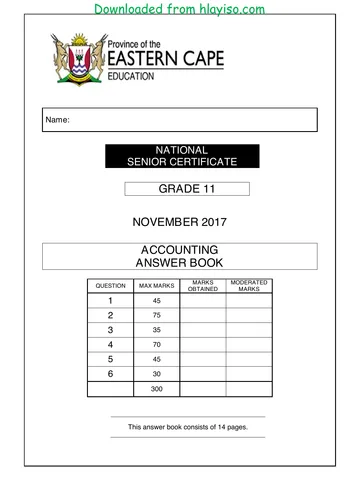
NATIONAL
SENIOR CERTIFICATE
GRADE 11
NOVEMBER 2017
ACCOUNTING
MARKS: 300
TIME: 3 hours
This question paper consists of 17 pages and a 14 page answer book.
Skip to contentQuestion paper 
%20June%202024%20Question%20Paper_hlayiso.com_--cf529c01-0786-4680-b8b1-b401167df69c/v1-a74b50fe4b45802a59cb/card.webp)
%20June%202024%20Question%20Paper_hlayiso.com_--6f46b4c9-08af-40d5-bbfc-8e5e70b68734/v1-da1045ec841611dced33/card.webp)
%20June%202024%20Question%20Paper_hlayiso.com_--b649cfc1-b72f-4e45-b621-502673440d1c/v1-f3f273b92fb9f447e93e/card.webp)
View all
Accounting Grade 11 Eastern Cape November 2017 Question Paper
Grade 11 Accounting question paper from the Eastern Cape November 2017, 17 pages. Read online or get the free PDF download, memo linked when available.
Accounting · Grade 11 · Eastern Cape November · 2017. Question paper, 17 pages. Read online or download the PDF.
- Subject
- Accounting
- Grade
- Grade 11
- Document type
- Question paper
- Year
- 2017
- Exam period
- Eastern Cape November
- Curriculum
- CAPS
- Pages
- 17
- File size
- 1.1 MB
Loading document…
Loading document…
1 of 17
Document textSearch extracted text and jump to a page.
Downloaded from hlayiso.com
2 ACCOUNTING (EC/NOVEMBER 2017)
INSTRUCTIONS AND INFORMATION
1. Answer ALL the questions in the answer book provided.
2. Where applicable, calculations must be shown in order to achieve part-marks.
3. Non-programmable calculators may be used.
4. You may use a dark pencil or black/blue ink to answer the questions.
5. Where applicable, all calculations must be rounded off to ONE decimal place.
6. A breakdown of the questions is provided below. You must attempt to comply
with the suggested time allocation for each question. To exercise good time
management, try NOT to deviate from it.
QUESTION 1: 45 marks; 30 minutes
Main topic: This question integrates:
Financial accounting
Reconciliations and Internal Concepts, Bank Reconciliation and Debtors Reconciliation
control Managing resources
Internal control and ethics
QUESTION 2: 75 marks; 45 minutes
Main topic: This question integrates:
Partnerships – Financial Financial accounting
Statements Concepts, Income Statement, Balance Sheet and notes
QUESTION 3: 35 marks; 20 minutes
Main topic: This question integrates:
Financial accounting
Partnerships – Financial
Concepts, Notes to the Balance Sheet
Statements and Interpretation
Calculating and interpreting financial information
QUESTION 4: 70 marks; 40 minutes
Main topic: This question integrates:
Managerial accounting
Concepts, cash budget and interpretation of budget information
Budgeting; Financial accounting
Clubs Sports clubs transactions and ledger accounts
Managing resources
Internal control processes
QUESTION 5: 45 marks; 25 minutes
Main topic: This question integrates:
Managerial accounting
Concepts, General Ledger and calculations relevant to a
Cost Accounting
manufacturing business
Managing resources
Stock systems and Internal control processes
QUESTION 6: 30 marks; 20 minutes
Main topic: This question integrates:
Managing resources
Fixed assets;
Fixed asset management, depreciation, and note
Problem Solving
Problem solving
Copyright reserved Please turn over
Downloaded from hlayiso.com
(EC/NOVEMBER 2017) ACCOUNTING 3
QUESTION 1: RECONCILIATIONS AND INTERNAL CONTROL (45 marks; 30 minutes)
1.1 Indicate whether the following statements are TRUE or FALSE. Write your answer
next to each number (1.1.1–1.1.4) in the ANSWER BOOK.
1.1.1 A credit balance on the bank statement is a favourable balance.
1.1.2 A post-dated cheque received from a debtor will be recorded in the CRJ
and reflected as an outstanding deposit in the Reconciliation Statement.
1.1.3 Service fees, deposit fees and bank levies are grouped and called bank
charges because of the prudence concept of GAAP.
1.1.4 A stale cheque must be cancelled in the CRJ. (4)
1.2 Bank Reconciliation
The information below is from the records of Algoa Stores for September 2017.
REQUIRED:
1.2.1 Identify the items (with amounts) that must be recorded in the CRJ. (7)
1.2.2 Identify the items (with amounts) that must be recorded in the CPJ. (6)
1.2.3 Prepare the Bank Reconciliation Statement on 30 September 2017. (10)
INFORMATION:
A. Information from the Bank Reconciliation Statement on 31 August 2017:
Debit balance as per bank statement R84 000
Credit balance as per bank account 53 000
Outstanding deposits 56 000
Outstanding cheques:
No 8040 (1 March 2017) 5 000
No 8440 8 500
No 8447 (1 October 2017) 11 500
Copyright reserved Please turn over
Downloaded from hlayiso.com
4 ACCOUNTING (EC/NOVEMBER 2017)
B. A comparison of the bank statement with the business records revealed
the following:
ITEM TRANSACTION
A A deposit of R56 000 was on the bank statement but not in the
September 2017 journals.
B A deposit of R29 000 appeared in the September 2017 CRJ but
not on the bank statement.
C Cheque No. 8040 issued in favour of the owner’s membership
fees does not appear on the current bank statement.
D A direct deposit for R8 000 by the tenant, Gel Hairdressers,
appeared on the bank statement and not in the journals.
E Service fees of R540 appeared on the bank statement but not in
the journals.
F Interest of R200 was debited on the bank statement, and not
recorded in the journals.
G The bank statement reflected a dishonoured cheque of R2 000
received from debtor J Joseph due to insufficient funds. This must
still be recorded by the business.
H Cheque No. 9020 in favour of creditor RR Manufacturers,
appeared as R5 400 in the CPJ but correctly as R4 500 on the
bank statement.
I Cheque No. 8440 for R8 500 was on the September bank
statement but not in the September Journals.
J Cheque No. 8520 for R19 000 appeared in the September CPJ
but not on the September bank statement.
K Cheque No. 8524 for R15 000, post-dated for 31 December 2017,
was not recorded. It was issued in favour of Seconds - Car Sales
as a deposit for a vehicle. This cheque does not appear on the
bank statement.
L A cheque for R3 000, dated 16 September 2017, was received
from debtor, B Best, during August 2017. The cheque was
deposited on 30 September 2017 but no entries were made to
record the transaction. This deposit also did not appear on the
bank statement.
M The bank statement showed a favourable balance of R45 000 on
30 September 2017.
Copyright reserved Please turn over
Downloaded from hlayiso.com
(EC/NOVEMBER 2017) ACCOUNTING 5
1.3 Debtors Reconciliation
The information relates to Jasmine Traders for July 2017.
REQUIRED:
1.3.1 Explain why the Debtors Control Account balance and the Debtors’ List
total should be the same. (2)
1.3.2 Show the corrections to each debtor’s account to record the errors and
omissions noted. (10)
1.3.3 The owner is concerned that debtors do not comply with the 30 days
credit terms.
Explain 30 days credit terms. (2)
What should the credit - manager do to ensure that only reliable
persons are allowed to buy goods on credit? Provide TWO points. (4)
INFORMATION:
A. Debtors Control balance on 31 July 2017, R38 940.
B. Debtors List on 31 July 2017:
A. Santos DL1 12 560
B. Deepak DL2 9 840
C. Mellissa DL3 7 660
D. Rossie DL4 11 400
C. The following errors and omissions were noted and must be recorded:
(i) A cheque received from Mellissa for R3 500 was recorded in the
debtor’s ledger account of Rossie in error.
(ii) Goods returned by Santos, R780, was posted to the wrong side of
her account.
(iii) A cheque received from Deepak, R4 000, was returned by the bank
marked “R/D – post-dated”.
(iv) The Debtors’ Journal was overcast by R290.
(v) Goods sold for cash, R1 250, to Rossie was entered as a credit sale
to his account.
45
Copyright reserved Please turn over
Downloaded from hlayiso.com
6 ACCOUNTING (EC/NOVEMBER 2017)
QUESTION 2: PARTNERSHIPS – FINANCIAL STATEMENTS (75 marks; 45 minutes)
The information below, appeared in the books of PB Stores (with partners Pinky and
Brian) on 28 February 2017, at the end of the current financial year.
REQUIRED:
2.1 Complete the Income Statement for the financial year ended 28 February 2017.
Some amounts are provided in the answer book. (33)
2.2 Complete the following notes to the Balance Sheet:
2.2.1 Capital (8)
2.2.2 Current Account (28)
2.3 Pinky is unhappy with the way Brian is managing his investment in the
partnership.
2.3.1 Provide TWO reasons to justify why he feels this way. In each case
provide relevant figures to support your comments. (4)
2.3.2 Give ONE suggestion that the partnership can use to address the concern
expressed by Pinky. (2)
INFORMATION:
A. Balances on 28 February 2017 (unless otherwise indicated):
Capital: Pinky R 280 000
Capital: Brian 350 000
Drawings: Pinky 26 409
Drawings: Brian 57 403
Current Account: Pinky (1 March 2016) 22 369
Current Account: Brian (1 March 2016) 32 412 (Dr)
B. Pre-Adjustment amounts (amongst others) from the General Ledger
on 28 February 2017:
Loan: Rode Bank ?
Fixed Deposit (9% p.a) 220 000
Debtors Control 97 200
Provision for bad debts (1 March 2016) 5 440
Trading stock 133 390
Sales 993 250
Cost of sales 685 000
Rent income 117 250
Insurance 25 665
Commission income 58 545
Packing material 19 710
Water and electricity 32 180
Salaries and wages 45 000
Depreciation 17 150
Interest on investment 14 850
Sundry expenses ?
Copyright reserved Please turn over
Downloaded from hlayiso.com
(EC/NOVEMBER 2017) ACCOUNTING 7
C. Adjustments:
(i) The annual stock take revealed the following stock on hand:
Trading stock, R130 540
Packing material unused, R3 600.
(ii) Adjust the Provision for Bad Debts to 5% of debtors.
(iii) Interest on loan is capitalised. The loan statement received from Biltong Bank
showed the following:
Loan balance on 1 March 2016 R 374 600
Repayments for the year (including interest) 86 400
Interest capitalised ?
Loan balance on 28 February 2017 327 000
(iv) The rent for March 2017 was received. Note that the rent increased by R875 per
month from 1 December 2016.
(v) Insurance includes an annual policy for R5 820 taken out on 1 June 2016.
(vi) The water and electricity account for February 2017 was not yet paid, R2 150.
(vii) Interest on investment is not capitalised. Interest for the last quarter of this financial
year was not received.
D. The Profit and Loss Account reflected a net profit of R311 135 after taking into account
all the adjustments.
E. Transactions relating to partners to be reflected in the partners’ accounts only:
(i) Pinky took goods from stock for her personal use at a selling price of R9 590. Goods
are sold at a mark-up of 75% on cost.
(ii) Brian used a business cheque for R5 100 for his personal telephone account.
(iii) The partnership agreement provided for the following salary allowances :
Pinky, R113 400 p.a.
Brian, R7 800 per month.
The partners are entitled to an annual increase of 10% effective on the 1 December
each year. This was not taken into account.
(iv) Interest on capital is calculated at 8% of the capital balances.
On 1 June 2016, Pinky increased her capital by R40 000, and Brian decreased his
capital by R10 000. These changes were recorded.
(v) Pinky is entitled to a production bonus equal to 2% of total sales.
(vi) The remaining profit or loss is shared in the ratio of the partners’ capital balances
at the end of the financial year.
75
Copyright reserved Please turn over
Downloaded from hlayiso.com
8 ACCOUNTING (EC/NOVEMBER 2017)
QUESTION 3: PARTNERSHIPS – FINANCIAL STATEMENTS AND INTERPRETATION
(35 marks; 20 minutes)
3.1 Match the concept in COLUMN A with the statement in COLUMN B. Write only
the letter (A–E), next to the numbers (3.1.1–3.1.4) in the ANSWER BOOK.
COLUMN A COLUMN B
3.1.1 Return A The effective management of expenses
The extent to which the business makes use of long-
3.1.2 Solvency B
term debt (loans)
The ability of the business to settle short term debts
3.1.3 Profitability C
in the next financial period
3.1.4 Liquidity D Partners’ earnings from the net profit
The relationship between total assets and total
E
liabilities (4)
3.2 MP TRADERS
Information from the records of MP Traders (partners Monty and Python) for the
financial year ended 30 April 2017 is presented.
REQUIRED:
3.2.1 Calculate the following:
Percentage mark-up on cost (4)
Percentage operating expenses on sales (3)
Total earnings of Monty (4)
The percentage return earned by Python (5)
The debt/equity ratio for 2017 (3)
3.2.2 Comment on the liquidity of the business. Quote and explain TWO
financial indicators (with figures) in your answer. (4)
3.2.3 Were the partners justified in increasing the loan? Explain. Quote TWO
financial indicators, with figures, in your explanation. (4)
3.2.4 Monty is not happy with his return on investment. Explain why you think
he feels this way. Quote figures. (4)
Copyright reserved Please turn over
Downloaded from hlayiso.com
(EC/NOVEMBER 2017) ACCOUNTING 9
INFORMATION:
A. Extracts from the Income Statement on 30 April 2017:
Sales R 4 257 000
Gross profit 1 677 000
Operating expenses 1 064 250
Net profit for the year 720 000
B. Extracts from the partners’ Current Accounts on 30 April 2017:
MONTY PYTHON
Total primary distribution ? 279 570
Share in the remaining profit 118 020 59 010
Drawings 198 000 210 000
C. Extracts from the Balance Sheet on 30 April:
2017 2016
Partners’ Equity 1 237 300 838 300
Capital 975 000 885 000
Current Account 262 300 (46 700)
Loan: Simi Bank 742 380 85 000
Current Assets 598 080 441 600
Trading stock 276 400 200 800
Trade and other receivables 288 880 220 600
Cash and cash equivalents 32 800 20 200
Current liabilities 427 200 368 000
Trade and other payables 328 360 339 240
Short-term portion of loan 98 840 28 760
D. Details of the partners’ equity on 30 April:
MONTY PYTHON
2017 2016 2017 2016
Capital 650 000 535 000 325 000 350 000
Current Accounts 202 720 22 300 59 580 (69 000)
852 720 557 300 384 580 281 000
E. Financial indicators on 30 April:
2017 2016
Current ratio 1,4 : 1 1,2 : 1
Acid test ratio 0,8 : 1 0,7 : 1
Debt/equity ratio ? 0,1 : 1
Return on investment : Monty 54% 46%
Return on investment : Python ? 81%
Return on capital employed 69% 43%
Interest rate on loans 13% 13%
35
Copyright reserved Please turn over
Downloaded from hlayiso.com
10 ACCOUNTING (EC/NOVEMBER 2017)
QUESTION 4: BUDGETING AND CLUBS (70 marks; 40 minutes)
4.1 Budgets and Projected Income Statement
4.1.1 State ONE difference between a Cash Budget and a Projected Income
Statement. (2)
4.1.2 List TWO items that would not appear in a Cash Budget. (2)
4.1.3 Explain why a business would compare the actual amounts received or
paid against the budgeted figures. (2)
4.2 Thabo’s Gymnasium
Thabo’s Gymnasium offers training facilities. He also operates a gym shop that
sells refreshments and training gear to the public.
REQUIRED:
4.2.1 Complete the Debtors Collection Schedule for the budget period. (10)
4.2.2 Fill in the missing amounts to complete the Cash Budget provided. (28)
4.2.3 Calculate the percentage increase in salaries and wages. (3)
Explain why the workers should/should not be satisfied with this
increase. (2)
4.2.4 Thabo is concerned about the following items for November 2017:
BUDGETED ACTUAL
ITEMS
AMOUNT AMOUNT
Fee income 33 600 23 520
Telephone 5 000 8 460
Maintenance: training equipment 13 000 8 200
Provide a reason for his concern for each of the items listed. (3)
In each case, give Thabo practical advice to address the concern. (3)
INFORMATION:
A. Monthly gymnasium fees are R420 per member.
On 31 October 2017, there were 80 registered members. Thabo expects
the membership to increase by 25% during December 2017.
B. 30% of all sales in the Gym Shop is on credit.
60% of debtors pay in the month of sale
38% pay in the following month
The balance is written off thereafter.
C. All goods are purchased on credit. Creditors are paid within 30 days to
receive a 10% early settlement discount.
Copyright reserved Please turn over
Downloaded from hlayiso.com
(EC/NOVEMBER 2017) ACCOUNTING 11
D. Sales and Purchases figures for the budget period:
OCTOBER NOVEMBER DECEMBER
Actual and budgeted sales 95 000 100 000 150 000
Actual and budgeted purchased 58 000 62 000 94 000
E. Cash Budget for the budget period ended 31 December 2017.
RECEIPTS NOVEMBER DECEMBER
Cash sales 70 000
Cash from debtors
Fee income (gym members) 33 600
Rent income 10 638
Loan: Thabo Snr 80 000 0
TOTAL RECEIPTS 196 038
PAYMENTS
Payment to creditors (for stock)
Salaries and wages 24 000 25 800
Personal trainers (fees) 21 400
Cleaning detergents 4 500 4 500
Telephone 5 000 5 000
Maintenance of equipment 13 000 16 280
Purchase of new equipment 0
Loan instalment (including interest) 0
Sundry expenses 18 375
TOTAL PAYMENTS
SURPLUS/DEFICIT
OPENING BALANCE IN BANK (6 930)
CLOSING BALANCE IN BANK
F. Rent will increase by 8% with effect from 1 December 2017.
G. Thabo employs 5 personal trainers during November. They receive the
same monthly fee. He will employ 2 additional trainers during December
at the same monthly fee as the other five trainers.
H. Maintenance of equipment is estimated at 4% of the cost of equipment,
spread evenly throughout the year. Additional equipment will be
purchased on 30 November 2017.
I Thabo plans to take a loan from his father on 1 November 2017 at 15%
p.a. interest. He agreed to pay a monthly instalment of R5 000 and the
interest, commencing on 1 December 2017.
J Sundry expenses for December is expected to be 1,5 times the November
amount, due to the greater turnout expected during the holidays.
Copyright reserved Please turn over
Downloaded from hlayiso.com
12 ACCOUNTING (EC/NOVEMBER 2017)
4.3 SPORTS CLUBS
Membership records of Mbizana Social Club for the year ended 31 December
2016 is presented below.
REQUIRED:
Prepare the Membership Fees account in the General Ledger. (15)
INFORMATION:
A. Balances on 31 December 2015:
Accrued income (Membership Fees) 4 800
Deferred Income (Membership Fees) 1 800
B. Extract from the Receipts and Payments Statement on 31 December 2016.
Membership fees received for 2015 1 200
for 2016 42 100
for 2017 600
Membership fees refunded 900
C. The club had 87 members on 31 December 2015.
Membership fees are R600 per member per year.
New members only pay for the months remaining in the year of joining.
New members:
o 7 new members joined on 30 April 2016.
o 9 members joined on 1 November 2016.
o They paid the fees due.
The outstanding fees of 2015 must be written off. The defaulting
members must be excluded from the club register.
3 members resigned from the club during July 2016. They were
refunded half their annual fees.
2 members offset their membership fees by undertaking the repairs
and maintenance to the clubhouse.
Some members did not pay their fees for 2016.
70
Copyright reserved Please turn over
Downloaded from hlayiso.com
(EC/NOVEMBER 2017) ACCOUNTING 13
QUESTION 5: COST ACCOUNTING (45 marks; 25 minutes)
5.1 Match the examples provided in COLUMN B with a cost category provided in
COLUMN A. Write only the letter (A–E) next to each number (5.1.1 – 5.1.4) in the
ANSWER BOOK.
COLUMN A COLUMN B
5.1.1 Direct material cost A Depreciation on factory equipment
5.1.2 Direct labour cost B Stationery purchased for office use
5.1.3 Selling and distribution cost C Transport cost of raw materials
5.1.4 Administration cost D Advertisements in the Daily Dispatch
Pension fund contributions of workers in
E
production (4)
5.2 Pefferville Manufacturers
The following information relates to Pefferville Manufacturers for the financial year
ended 30 April 2017.
REQUIRED:
5.2.1 Calculate the Factory Overhead Cost. (16)
5.2.2 Prepare the following General Ledger accounts:
Work-in process stock (8)
Finished goods stock (5)
Copyright reserved Please turn over
Downloaded from hlayiso.com
14 ACCOUNTING (EC/NOVEMBER 2017)
INFORMATION:
A. Stock records:
28 February 2017 1 March 2016
Raw material 27 420 32 110
Work-in-process 25 000 24 270
Finished goods 58 000 38 000
Factory consumables 2 300 0
B. Transactions for the year ended 30 April 2017 (amongst others):
R
Raw material:
Raw material issued to the factory for production 562 000
Salaries and wages in the factory:
Factory foreman 148 800
Factory cleaners 62 200
Workers in production (only normal time) 643 000
Employer’s contributions 93 940
Purchases of factory consumables 45 300
Rent expense 92 400
Water and electricity 83 280
Insurance 15 400
Sundry expenses 17 776
Depreciation on factory equipment 51 840
Advertising 7 350
Sales 2 752 000
The business applies a profit mark-up of 60% on cost.
C. Additional information:
Employer’s contributes on behalf of each employee:
Pension Fund 9%
Unemployment Insurance Fund 1%
Skills Development 1%
The business does not offer overtime hours.
The rent expense must be split according to the floor space occupied by
each department. The factory currently occupies 2 600 square metres
of the total business premises of 3 640 square metres.
65% of the water and electricity account is allocated to the factory.
10% of the insurance is for the office. The balance is divided equally
between the factory and the sales department.
Half the sundry expenses relate to the factory.
Copyright reserved Please turn over
Downloaded from hlayiso.com
(EC/NOVEMBER 2017) ACCOUNTING 15
5.3 SaSa Furnishers
The information relates to the production of plastic bar-stools. There is no work-in-
process stock at the end of a financial year.
REQUIRED:
5.3.1 Provide ONE difference between a fixed cost and a variable cost. (2)
5.3.2 Calculate the number of plastic bar-stools that the business needed to
produce to break - even. (5)
5.3.3 Comment on the break-even point calculated in QUESTION 5.3.2 and
the level of production achieved. (3)
What advice would you offer SaSa for the future? Provide ONE point. (2)
INFORMATION:
A. Cost structure for the financial year ended 31 December 2016:
TOTAL UNIT COST
AMOUNT (R) (R)
Direct material cost (VARIABLE COST) 1 576 800 54,00
Direct labour cost (VARIABLE COST) 1 314 000 45,00
Factory overhead cost (FIXED COST) 817 600 28,00
Selling and distribution cost (VARIABLE COST) 467 200 16,00
Administration cost (FIXED COST) 262 800 9,00
B. Selling price of chairs: R155 each.
C. 29 200 chairs were produced and sold during the current financial year.
45
Copyright reserved Please turn over
Downloaded from hlayiso.com
16 ACCOUNTING (EC/NOVEMBER 2017)
QUESTION 6: FIXED ASSETS AND PROBLEM SOLVING (30 marks; 20 minutes)
6.1 FIXED ASSET MANAGEMENT
The information relates to Pitt Traders for the financial year ended 28 February
2017.
REQUIRED:
6.1.1 Prepare the Asset Disposal account for the trade-in on 1 December 2016. (9)
6.1.2 Calculate the amounts denoted by (i) to (iv) on the Fixed Asset note. (12)
INFORMATION:
A. Fixed Asset note
LAND AND
VEHICLES EQUIPMENT
BUILDINGS
Carrying value on 1 March 2016 1 500 000 250 000
Cost 740 000 520 000
Accumulated depreciation 0 (ii) (210 000)
Movements
Additions (i) (iii) 160 000
Disposals 0 0 (77 248)
Depreciation 0 (iv)
Carrying value on 28 February 2017 1 860 000
Cost 1 070 000
Accumulated depreciation
B. Extensions to the warehouse were done.
C. A new vehicle was purchased on 1 November 2016.
D. On 1 December 2016, equipment with a cost of R142 000 was traded-in for
new equipment. This trade-in resulted in a loss on disposal of R20 948.
E. Depreciation policy:
Vehicles: 15% on cost
Equipment: 20% on carrying value
Copyright reserved Please turn over
Downloaded from hlayiso.com
(EC/NOVEMBER 2017) ACCOUNTING 17
6.2 PROBLEM SOLVING
Marie Jonker owns three minibus taxis. She is concerned about the performance
of the business.
REQUIRED:
6.2.1 Identify ONE major problem related to each taxi. Quote figures. (6)
6.2.2 Provide a solution to the problems identified in QUESTION 6.2.1. (3)
INFORMATION:
Information from the business records on 30 June 2017, the financial year
end.
TAXI 1 TAXI 2 TAXI 3
Date purchased 1 July 1997 1 April 2013 1 May 2016
Cost of vehicle R94 500 R230 000 R360 000
Accumulated depreciation R94 449 R195 500 R84 000
Total revenue from taxi fares R975 000 R600 000 R320 640
Kilometres covered 81 250 km 52 500 km 26 720 km
Fare per kilometre R12 R12 R12
Fuel and repair cost R585 000 R270 000 R65 000
Fuel and repair cost per kilometre R7,20 R5,15 R2,45
Budgeted revenue from fares (total) R2 500 000
Fuel and repair budget (total) R875 000
30
TOTAL: 300
Copyright reserved Please turn over
Study this subject
Revise the topics in this paper, then practise them question by question.
- Grade 11 Accounting notes
CAPS revision notes with worked examples.
- Accounting questions by topic
Past exam questions sorted by CAPS topic, with memos where available.
- Grade 11 Accounting quizzes
Short topic quizzes with instant feedback.
- All Grade 11 Accounting past papers
Past papers by year, with memos where available.
- Grade 11 past papers
More Accounting and other subjects in this collection.
Recommended for this subject
More papers and memos for this grade and subject.
Question paper
Accounting Grade 11 Eastern Cape November 2025 Question Paper
Question paper
Accounting Grade 11 P1 Eastern Cape November 2025 QP (Afr)
Question paper
Accounting Grade 11 P2 Eastern Cape November 2025 Question Paper
Question paper
Accounting Grade 11 P1 Gauteng June 2024 Question Paper (Afr)
Question paper
Accounting Grade 11 P1 Gauteng June 2024 Question Paper (English)
Question paper
Accounting Grade 11 P2 Gauteng June 2024 Question Paper (English)
Related documents
Addendum
Accounting Grade 11 Eastern Cape November 2017 Addendum
Question paper
Accounting Grade 11 Gauteng November 2017 Question Paper
Question paper
Accounting Grade 11 P1 Eastern Cape November 2022 QP (Afr)
Question paper
Accounting Grade 11 P2 Eastern Cape November 2022 QP (Eng)
Question paper
Accounting Grade 11 P2 Eastern Cape November 2022 QP (Eng)
Question paper
Accounting Grade 11 P2 Eastern Cape November 2020 Question Paper
More from Grade 11 Accounting
Study guide
GR11 Accounting Practice exam November Paper 1
Addendum
Accounting Grade 11 P1 Eastern Cape November 2025 Addendum (Afr)
Memorandum
Accounting Grade 11 Paper 2 Eastern Cape November 2025 Memo
Memorandum
Accounting Grade 11 Paper 2 Eastern Cape November 2025 Memo
Question paper and memo
Accounting Grade 11 Limpopo March Test 2025 Paper & Memo
Memorandum