
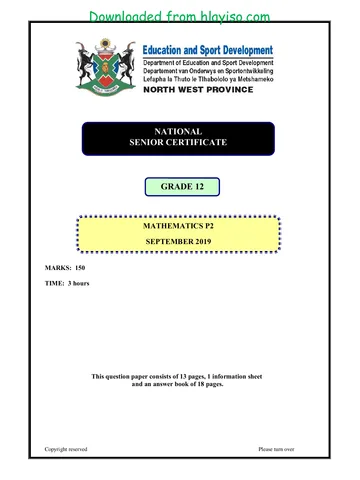
Downloaded from hlayiso.com
Mathematics P1 1 ons
NSC
NATIONAL
SENIOR CERTIFICATE
GRADE 12
MATHEMATICS P1
SEPTEMBER 2019
PREPARATORY EXAMINATIONS
MARKS: 150
TIME: 3 hours
N.B. This question paper consists of 10 pages and an information sheet.
Copyright Reserved Please Turn Over
Skip to contentAll 2019 papers 
View all
Mathematics Grade 12 P1 KwaZulu Natal Mock 2019 QP
Grade 12 Mathematics Paper 1 question paper from the KwaZulu Natal Mock Exam 2019, 10 pages. Read online or download the free PDF.
Mathematics · Grade 12 · KwaZulu Natal Mock Exam · 2019. Question paper, 10 pages. Read online or download the PDF.
- Subject
- Mathematics
- Grade
- Grade 12
- Document type
- Question paper
- Year
- 2019
- Exam period
- KwaZulu Natal Mock Exam
- Paper
- 1
- Curriculum
- CAPS
- Pages
- 10
- File size
- 412.2 KB
Free to read online, no sign-up needed
Loading document…
Loading document…
1 of 10
This exam
KwaZulu Natal Mock Exam 2019
- Paper 1Question paperMemo
- Paper 2Question paperMemo
Questions in this paper
- Question 1Algebraic expressions, equations and inequalities24 marks
- Question 2Number patterns5 marks
- Question 3Number patterns12 marks
- Question 4Number patterns4 marks
- Question 5Functions and graphs9 marks
- Question 6Functions and graphs18 marks
Show all 13 questions
- Question 7Functions and graphs7 marks
- Question 8Finance, growth and decay15 marks
- Question 9Differential Calculus12 marks
- Question 10Differential Calculus17 marks
- Question 11Analytical Geometry10 marks
- Question 12Counting principle and probability6 marks
- Question 13Counting principle and probability6 marks
Document textSearch extracted text and jump to a page.
Downloaded from hlayiso.com
Mathematics P1 2 September 2019 Preparatory Examinations
NSC
INSTRUCTIONS AND INFORMATION
Read the following instructions carefully before answering the questions.
1. This question paper consists of 13 questions.
2. Answer ALL questions.
3. Clearly show ALL calculations, diagrams, graphs, et cetera that you have used in
determining your answers.
4. Answers only will not necessarily be awarded full marks.
5. An approved scientific calculator (non-programmable and non-graphical) may be
used, unless stated otherwise.
6. If necessary, answers should be rounded off to TWO decimal places, unless stated
otherwise.
7. Diagrams are NOT necessarily drawn to scale.
8. Number the answers correctly according to the numbering system used in this
question paper. Write neatly and legibly.
Copyright Reserved Please Turn Over
Downloaded from hlayiso.com
Mathematics P1 3 September 2019 Preparatory Examinations
NSC
QUESTION 1
1.1 Solve for x:
1.1.1 x(4 − x ) = 0 (2)
1.1.2 2x2 + 5x = 1 (rounded off to 2 decimal places) (4)
1.2 Given: x−2 = 2− x
1.2.1 Solve for x. (4)
1.2.2 Hence, or otherwise, determine the value(s) of p if p2 − p − 2 = 2 + p − p2 (4)
1.3 Solve: −2𝑥 2 + 5𝑥 ≤ 0 (4)
1.4 If 2𝑥+1 + 2𝑥 = 3𝑦+2 − 3𝑦 , and x and y are integers, (6)
calculate the value of x + y.
[24]
QUESTION 2
The first four terms of a quadratic sequence are 8 ; 15 ; 24 ; 35 ;...
2.1 Write down the next TWO terms of the quadratic sequence. (1)
2.2 Determine the nth term of the sequence. (4)
[5]
Copyright Reserved Please Turn Over
Downloaded from hlayiso.com
Mathematics P1 4 September 2019 Preparatory Examinations
NSC
QUESTION 3
The first three terms of an arithmetic sequence are 2𝑝 − 3 ; 𝑝 + 5 ; 2𝑝 + 7.
3.1 Determine the value(s) of p. (3)
3.2 Calculate the sum of the first 120 terms. (3)
3.3 The following pattern is true for the arithmetic sequence above:
𝑇1 + 𝑇4 = 𝑇2 + 𝑇3
𝑇5 + 𝑇8 = 𝑇6 + 𝑇7
𝑇9 + 𝑇12 = 𝑇10 + 𝑇11
∴ 𝑇𝑘 + 𝑇𝑘+3 = 𝑇𝑥 + 𝑇𝑦
3.3.1 Write down the values of x and y in terms of k. (2)
3.3.2 Hence, calculate the value of 𝑇𝑥 + 𝑇𝑦 in terms of k in simplest form. (4)
[12]
QUESTION 4
4.1 Given: 5(32 − k )
k =1
4.1.1 Write down the value of the first TWO terms of the infinite geometric series. (2)
4.1.2 Calculate the sum to infinity of the series. (2)
4.2 Consider the following geometric sequence:
3 81√3
sin 3 0∘ ; cos 3 0∘ ; ; … ;
2 2
Determine the number of terms in the sequence. (5)
[9]
Copyright Reserved Please Turn Over
Downloaded from hlayiso.com
Mathematics P1 5 September 2019 Preparatory Examinations
NSC
QUESTION 5
−4
Given f ( x) = −1
2− x
5.1 Write down the equations of the vertical and horizontal asymptotes of f. (2)
5.2 Determine the intercepts of the graph of f with the axes. (3)
5.3 Draw the graph of f. Show all intercepts with the axes as well as the asymptotes of the
graph. (4)
[9]
QUESTION 6
In the diagram, the graphs of f ( x) = − x2 + 5x + 6 and g ( x) = x + 1 are drawn below.
The graph of f intersects the x – axis at B and C and the y – axis at A.
The graph of g intersects the graph of f at B and S. PQR is perpendicular to the x – axis
with points P and Q on f and g respectively. M is the turning point of f.
y
M
P g
A S
Q
f
B C
O R x
6.1 Write down the co-ordinates of A. (1)
6.2 S is the reflection of A about the axis of symmetry of f. Calculate the coordinates of S. (2)
6.3 Calculate the coordinates of B and C. (3)
6.4 If PQ = 5 units, calculate the length of OR. (4)
6.5 Calculate the:
6.5.1 Coordinates of M. (4)
6.5.2 Maximum length of PQ between B and S. (4)
[18]
Copyright Reserved Please Turn Over
Downloaded from hlayiso.com
Mathematics P1 6 September 2019 Preparatory Examinations
NSC
QUESTION 7
In the diagram, the graph of g ( x) = log5 x is drawn.
7.1 Write down the equation of 𝑔−1 , the inverse of g, in the form y = … (2)
7.2 Write down the range of 𝑔−1 . (1)
7.3 Calculate the value(s) of x for which g ( x) −4. (4)
[7]
QUESTION 8
8.1 A car depreciated at the rate of 13,5 % p.a. to R250 000 over 5 years according to the (3)
reducing balance method. Determine the original price of the car, to the nearest rand.
8.2 Melissa takes a loan of R950 000 to buy a house. The interest is 14,25 % p.a.
compounded monthly. His first instalment will commence one month after taking out the
loan.
8.2.1 Calculate the monthly repayments over a period of 20 years. (4)
8.2.2 Determine the balance on the loan after the 100th instalment. (4)
8.2.3 If Melissa failed to pay the 101st, 102nd, 103rd and 104th instalments, calculate the
(4)
value of the new instalment that will settle the loan in the same time period.
[15]
Copyright Reserved Please Turn Over
Downloaded from hlayiso.com
Mathematics P1 7 September 2019 Preparatory Examinations
NSC
QUESTION 9
1
9.1 Determine f /(x) from first principles given f ( x) = x 2 − x. (5)
2
9.2 Determine:
9.2.1 𝑑 5
[3𝑥 4 + √𝑥 + 𝑎2 ] (3)
𝑑𝑥
9.2.2 𝑑𝑦
, if 𝑥𝑦 = 𝑥 + 𝑥 2 − 1. (4)
𝑑𝑥
[12]
QUESTION 10
In the diagram, the graph of 𝑓(𝑥) = 𝑥 3 + 5𝑥 2 − 8𝑥 − 12 is drawn. A and B are the
turning points and C the y - intercept of f. 𝑔(𝑥) = 𝑚𝑥 + 𝑐 is a tangent to the graph of f at C.
D is the intersection of f and g.
10.1 Calculate the:
10.1.1 co-ordinates of the x-intercepts of f. (6)
10.1.2 co-ordinates of B. (4)
10.1.3 x – coordinate of the point of inflection of f. (2)
10.2 Determine the:
10.2.1 equation of the g. (2)
10.2.2 values of x for which f /(x). g /(x) > 0. (3)
[17]
Copyright Reserved Please Turn Over
Downloaded from hlayiso.com
Mathematics P1 8 September 2019 Preparatory Examinations
NSC
QUESTION 11
In the diagram below, ∆ABC is an equilateral triangle with sides d units long. P and S are points on sides
AB and AC respectively. Q and R are points on BC such that PQRS is a rectangle. BQ = RC = 2y units.
A
d
P S
B 2y Q R 2y C
11.1 Show that the area of the rectangle PQRS is given by A = 2 3 y(d − 4 y). (4)
11.2 Determine the maximum area of the rectangle in terms of d. (6)
[10]
QUESTION 12
A bag contains 12 blue balls, 10 red balls and 18 green balls. 2 balls are chosen at random
without replacement.
Determine the probability:
12.1 if the two balls chosen at random are green. (3)
12.2 if the two balls chosen at random are blue and red. (3)
[6]
Copyright Reserved Please Turn Over
Downloaded from hlayiso.com
Mathematics P1 9 September 2019 Preparatory Examinations
NSC
QUESTION 13
The digits 1, 2, 3, 4, 5, 6, 7, 8, 9 are used to form 3 - digit codes, eg. 567, 218, etc.
Determine the number of different codes that can be formed:
13.1 if repetition is allowed. (2)
13.2 such that the code is greater than 500 and repetition is NOT allowed. (2)
13.3 such that the middle digit is 5 and repetition is allowed. (2)
[6]
TOTAL: 150
Copyright Reserved Please Turn Over
Downloaded from hlayiso.com
Mathematics P1 10 September 2019 Preparatory Examinations
NSC
INFORMATION SHEET: MATHEMATICS
− b b 2 − 4ac
x=
2a
A = P(1 + ni) A = P(1 − ni) A = P(1 − i) n A = P(1 + i) n
Tn = a + (n − 1)d Sn =
n
(2a + (n − 1)d )
2
Tn = ar n −1 Sn =
(
a r n −1 ) ; r 1 S =
a
; −1 r 1
r −1 1− r
F=
x (1 + i ) − 1
n
P=
x[1 − (1 + i)−n ]
i i
f ( x + h) − f ( x )
f ' ( x) = lim
h→ 0 h
x + x2 y1 + y 2
d = ( x 2 − x1 ) 2 + ( y 2 − y1 ) 2 M 1 ;
2 2
y 2 − y1
y = mx + c y − y1 = m( x − x1 ) m= m = tan
x 2 − x1
(x − a )2 + ( y − b)2 = r 2
a b c 1
In ABC: = = a 2 = b 2 + c 2 − 2bc. cos A area ABC = ab. sin C
sin A sin B sin C 2
sin( + ) = sin . cos + cos . sin sin( − ) = sin . cos − cos . sin
cos( + ) = cos . cos − sin . sin cos( − ) = cos . cos + sin . sin
cos2 − sin 2
cos 2 = 1 − 2 sin 2 sin 2 = 2 sin . cos
2 cos2 − 1
n 2
f .x (x − x )
i
x= = i =1
2
n n
n( A )
P( A) = P(A or B) = P(A) + P(B) − P(A and B)
n(S)
yˆ = a + bx b=
(x − x )( y − y )
(x − x) 2
Copyright Reserved Please Turn Over
Study this subject
Recommended for this subject
Question paper
Mathematics Grade 12 P1 Gauteng Mock 2019 Question Paper
Question paper
Mathematics Grade 12 P1 Limpopo November 2019 Question Paper
Question paper
Mathematics Grade 12 P1 NSC June 2019 Question Paper (Eng)
Memorandum
Mathematics Grade 12 Paper 1 NSC November 2019 Memo
Memorandum
Mathematics Grade 12 Paper 1 KwaZulu Natal Mock 2020 Memo
Question paper
Mathematics Grade 12 P2 North West Mock 2019 QP (Eng)
More from Grade 12 Mathematics
Addendum
Mathematics Grade 12 P1 Eastern Cape Mock 2025 Addendum
Memorandum
Mathematics Grade 12 Paper 2 Eastern Cape Mock 2025 Memo
Memorandum
Mathematics Grade 12 P2 Northern Cape Mock 2025 Memo (Eng)
Addendum
Mathematics Grade 12 P2 Eastern Cape June 2024 Addendum
Memorandum
Mathematics Grade 12 P2 Eastern Cape June 2024 Memo (Eng)
Memorandum