
Downloaded from hlayiso.com
GRADE 12 EXAMINATION
NOVEMBER 2017
ADVANCED PROGRAMME MATHEMATICS: PAPER II
Time: 1 hour 100 marks
1. This question paper consists of 14 pages, an Answer Sheet (Module 4) of 2 pages
(i–ii) and an Information Booklet of 4 pages (i–iv). Please check that your question
paper is complete.
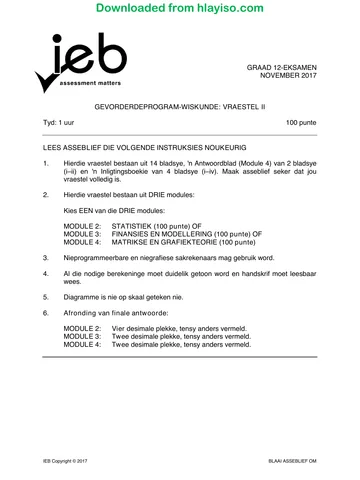
2. This question paper consists of THREE modules:
Choose ONE of the THREE modules:
MODULE 2: STATISTICS (100 marks) OR
MODULE 3: FINANCE AND MODELLING (100 marks) OR
MODULE 4: MATRICES AND GRAPH THEORY (100 marks)
3. Non-programmable and non-graphical calculators may be used.
4. All necessary calculations must be clearly shown and writing should be legible.
5. Diagrams have not been drawn to scale.
6. Rounding of final answers.
MODULE 2: Four decimal places, unless otherwise stated.
MODULE 3: Two decimal places, unless otherwise stated.
MODULE 4: Two decimal places, unless otherwise stated.
IEB Copyright © 2017 PLEASE TURN OVER
You're offline
Skip to contentQuestion paper 
View all
AP Maths P2 2017 hlayiso.com
Advanced Programme Mathematics · Grade 12 · 2017. Question paper, 14 pages. Read online or download the PDF.
- Subject
- Advanced Programme Mathematics
- Grade
- Grade 12
- Document type
- Question paper
- Year
- 2017
- Paper
- 2
- Publisher
- IEB
- Pages
- 14
- File size
- 986.4 KB
Loading document…
Loading document…
1 of 14
Document textSearch extracted text and jump to a page.
Downloaded from hlayiso.com
GRADE 12 EXAMINATION: ADVANCED PROGRAMME MATHEMATICS: PAPER II Page 2 of 14
MODULE 2 STATISTICS
QUESTION 1
1.1 James has 12 friends, seven girls and five boys. He is only allowed to invite
five friends to his birthday party. What is the probability that three of the
friends he randomly invites to his party are boys? (6)
1.2 Arieb notes that in his suburb, 70% of households have an electric fence on
the perimeter of their property. Find the probability that in a random sample
of 10 households in his suburb, 7 of them have an electric fence. (5)
1.3 Three identical cups of coffee, two identical cups of latte and two identical
cups of hot chocolate are arranged in a row. Calculate the number of
arrangements of the seven cups of hot drinks if:
(a) the first and last cups in the row are the same type of hot drink. (6)
(b) the three cups of coffee are all next to one another and no other hot
drink is next to the same type of hot drink. (6)
[23]
QUESTION 2
2.1 A random variable X has a probability mass function
0,3 × 0,7 x for x 1, 2, 3, 4
PX = x C for x = 5
0 otherwise
(a) Determine the value of C. (6)
(b) Find P(X > 3). (3)
2.2 (a) Which formula should be used to determine a confidence interval for
the population proportion? (A or B)
p 1 p
(A) p z (B) x z (1)
n n
(b) Carla conducted a survey on the preference of dark chocolate over
milk chocolate. Her findings are as follows:
Using a sample of 500 people, the α% confidence limits for the
proportion of people preferring dark chocolate are 0,2278 and
0,2922.
(i) Show that the number of people in the sample of 500 who
preferred dark chocolate is 130. (4)
(ii) Hence, using the correct confidence interval formula, find α. (6)
[20]
IEB Copyright © 2017
Downloaded from hlayiso.com
GRADE 12 EXAMINATION: ADVANCED PROGRAMME MATHEMATICS: PAPER II Page 3 of 14
QUESTION 3
The lengths of new crayons are normally distributed with a mean of 9 cm, and a
standard deviation 0,1 cm.
3.1 Find the probability that a crayon chosen at random has a length greater
than 8,9 cm. (6)
3.2 Find the probability that, in a random sample of six crayons, at least two
have lengths greater than 8,9 cm. (8)
3.3 4% of the crayons are considered too short and cannot be sold. What is the
minimum length of a crayon that can be sold? (6)
[20]
QUESTION 4
4.1 Five pairs of values for the variables x and y are given in the table below.
x 1 m m+1 4 5
y 5 t–1 4 3 t
Given that Σx 2 = 55 and y =3
(a) Show that m = t = 2. (8)
(b) Hence, determine the correlation coefficient for the set of data. (1)
(c) (i) Find the equation of the least squares regression line. (3)
(ii) Estimate the y value if x = 6 and comment on the reliability of
this estimation. (3)
4.2 The number of hours Basi spends on her new business in a week is
normally distributed with a standard deviation of 4,8 hours. In the past, the
average working hours per week were 49,5 hours. Due to a change in her
schedule, Basi wishes to test whether the average working hours per week
has decreased. She chooses a random sample of 40 weeks and notes the
total number of hours she spent on her business during these weeks is
1 920 hours.
Test Basi's hypothesis at the 7% level of significance. Ensure you state a
conclusion based on your test. (10)
[25]
IEB Copyright © 2017 PLEASE TURN OVER
Downloaded from hlayiso.com
GRADE 12 EXAMINATION: ADVANCED PROGRAMME MATHEMATICS: PAPER II Page 4 of 14
QUESTION 5
Sachin is attempting the Who Wants To Be A Millionaire TV quiz. He has to
answer questions one after another. The quiz ends when a question is answered
incorrectly.
The probability that Sachin, himself, gives the correct answer to any question is
0,8.
The probability that Sachin, himself, gives a wrong answer to any question is
0,05.
The probability that Sachin decides to ask for help for any question is 0,15.
On the first occasion that Sachin decides to ask for help, he asks the audience.
The probability that the audience gives the correct answer to any question is 0,9.
The information is shown in the tree diagram below.
5.1 Find the probability that the first question asked is correctly answered. (4)
5.2 On the second occasion that Sachin decides to ask for help, he phones a
friend. The probability that his friend gives the correct answer to any
question is 0,7.
Looking at all the possible options, calculate the probability of getting the
first two questions correct. (8)
[12]
Total for Module 2: 100 marks
IEB Copyright © 2017
Downloaded from hlayiso.com
GRADE 12 EXAMINATION: ADVANCED PROGRAMME MATHEMATICS: PAPER II Page 5 of 14
MODULE 3 FINANCE AND MODELLING
QUESTION 1
Ntsiko has taken out a home loan. In the graph below, the solid curve represents
her outstanding balance on the loan over the agreed time period. The
accumulation of her corresponding equal monthly payments over the same time
period is represented by the broken line.
Repayments
2500000
2 500 000
MONEY IN RANDS
2 000 000
2000000
1 500 000
1500000
1 000 000
1000000
500 000
500000
0
0 20 40 60 80 100 120 140 160 180
TIME IN MONTHS
1.1 Write down the value of Ntsiko's initial home loan. (1)
1.2 After how many monthly payments is R1 000 000 of Ntsiko's loan still
outstanding? (1)
1.3 Approximately how much interest will Ntsiko have paid by the time she has
amortised the loan? (2)
1.4 What is the balance outstanding, when she has paid as much as she still
owes? (2)
1.5 At 120 months, clearly the initial conditions of the loan were changed.
(a) How do we know Ntsiko's monthly payment was not changed? (2)
(b) What was changed? And how was it changed? (2)
[10]
IEB Copyright © 2017 PLEASE TURN OVER
Downloaded from hlayiso.com
GRADE 12 EXAMINATION: ADVANCED PROGRAMME MATHEMATICS: PAPER II Page 6 of 14
QUESTION 2
Jude obtained a loan at an annual interest rate of 5,68%, compounded monthly.
He will amortise the loan with equal monthly instalments of R5 154,26, starting in
three months' time and completing the repayment within three years of the date of
the loan being granted.
2.1 Calculate the value of the loan, correct to the nearest rand. (6)
2.2 Calculate the balance outstanding on the loan, two years after it was
approved. (5)
2.3 Calculate how much interest Jude paid during the second year, if
R116 674,09 was the balance outstanding, one year after the loan was
approved. (5)
[16]
QUESTION 3
Eight years ago a company bought office equipment for R3 400 000. The
equipment is now valued at R2 000 000. This figure is calculated using reducing-
balance depreciation, and takes into account the increased value of the equipment
due to inflation.
3.1 Calculate the depreciated value of the equipment, without inflation being
taken into account. Assume that the rate of inflation has been constant at
6,8% per annum, compounded annually. (4)
3.2 Calculate the annual rate of reducing-balance depreciation on the value of
the equipment (that is, without inflation being taken into account), as a
percentage, correct to two decimals. (4)
3.3 The company decides to create a sinking fund (to replace the equipment)
that accrues to R5 500 000 over the next six years. Bi-annual payments
(that is, every six months) will be made into the fund, starting immediately
and ending two years before the fund matures. A once-off withdrawal of
R300 000, for maintenance of the current equipment is to be made three
years after the fund is started. Calculate the value of the bi-annual
payments, if the fund earns interest at a rate of 7,64% per annum,
compounded monthly. (18)
[26]
IEB Copyright © 2017
Downloaded from hlayiso.com
GRADE 12 EXAMINATION: ADVANCED PROGRAMME MATHEMATICS: PAPER II Page 7 of 14
QUESTION 4
In the Augrabies Game Reserve (Northern Cape), quiver trees are self-
propagating with about 5% of new trees surviving each year. However, game
rangers have noted that the older trees are dying at a rate of 50 per year. There
are currently about 6 500 quiver trees in the reserve.
Rangers found that aardvarks were scratching themselves against the older trees,
thus damaging the bark, making the trees more prone to infection. There are
currently about 1 300 aardvarks in the reserve, with no real predators.
The rangers have calculated that, as long as the aardvark population remains less
than 25% of the quiver tree population, no permanent ecological damage will be
done. The table below incompletely records the population of quiver trees and
aardvarks:
Quiver trees Aardvarks
P0 6 500 1 300
P1 6 775 1 396
P2 7 064 1 500
P3 7 367 1 610
P4 7 685 1 730
P5 A 1 858
P6 B 1 995
P7 C 2 143
P8 D 2 301
P9 E 2 472
P10 F 2 655
4.1 Using information from the table, calculate the annual intrinsic growth rate
for the aardvarks, as a percentage, correct to one decimal place. (4)
4.2 Give a recursive formula that models the quiver tree population. (4)
4.3 Complete the table by calculating the values A to F for the quiver tree
population. Round off to the nearest whole value. (3)
4.4 According to these figures, during which year will the aardvarks start
causing permanent ecological damage to the quiver tree population? (2)
4.5 From the given aardvark population figures, explain how it is evident that a
Malthusian model, rather than a Logistic model, has been used. (3)
[16]
IEB Copyright © 2017 PLEASE TURN OVER
Downloaded from hlayiso.com
GRADE 12 EXAMINATION: ADVANCED PROGRAMME MATHEMATICS: PAPER II Page 8 of 14
QUESTION 5
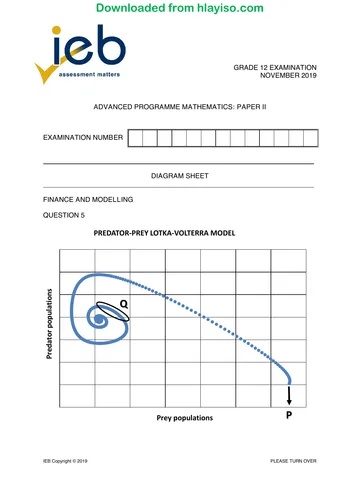
Gifberg is a popular hikers' destination in the isolated mountains near Van Rhynsdorp,
in the Western Cape. The phase plot below records the populations of snakes and
rodents at one-year intervals over a century, according to the Lotka-Volterra model.
Two out of every three rodents are female, and each bears a litter of about eight
young every four months. The survival rate of the young is rather low at 5% per
annum. The population of rodents is estimated to be about 500 000 and 533 300 in
Year 0 and Year 1 respectively.
The life expectancy of snakes is five years, and their initial population is about 4 000.
GIFBERG FARM
44700
700
44600
600 B
44500
D
SNAKE POPULATION
500
44400
400
C
44300
300
44200
200
44100
100
44000
000
A
33900
900
490 000 500 000 510 000 520 000 530 000 540 000 550 000 560 000 570 000 580 000 590 000
RODENT POPULATION
5.1 Use the phase plot to answer the following questions:
(a) Read off the equilibrium points for the predator and prey populations. (2)
(b) Give the snake population when the rodent population is at its
maximum. (2)
(c) Give the region (A, B, C or D) on the phase plot where both populations
are decreasing. (2)
5.2 If 760 snakes were born in the first year, calculate the snake population at the
end of the first year. (5)
5.3 Calculate the annual intrinsic growth rate of the rodents. (5)
5.4 About 40% of the rodent population was killed within the first year. Calculate, to
the nearest thousand, the carrying capacity of the farm for rodents. (6)
[22]
IEB Copyright © 2017
Downloaded from hlayiso.com
GRADE 12 EXAMINATION: ADVANCED PROGRAMME MATHEMATICS: PAPER II Page 9 of 14
QUESTION 6
Theos was a Greek mathematician of the second century, BC. He dabbled with
irrational numbers and came up with some fascinating conjectures, among them:
a a + 2b
Conjecture 1: If Tn = approximates 2, then is a better approximation.
b a+ b
a 2a + 3b
Conjecture 2: If Tn = approximates 3, then is a better approximation.
b a + 2b
1
6.1 Theos wrote Conjecture 1 as a first order recursive formula: Tn + 1 = 1 +
1 + Tn
Conjecture 1: 2 1,414 214 (correct to six decimal places)
(a) Using T0 = 1,5: Which iteration is the first to accurately approximate
the value of 2 correct to six decimal places? (2)
(b) Which graph below best describes the iteration process as it
converges to 2?
(2)
6.2 Design a first order recursive formula for Theos to generate the value of 3. (6)
[10]
Total for Module 3: 100 marks
IEB Copyright © 2017 PLEASE TURN OVER
Downloaded from hlayiso.com
GRADE 12 EXAMINATION: ADVANCED PROGRAMME MATHEMATICS: PAPER II Page 10 of 14
MODULE 4 MATRICES AND GRAPH THEORY
QUESTION 1
1 1 0 k
1.1 Consider the matrix equation k 1 1 3 0 2 3 = M.
0 2 1 1
(a) Give the dimension of matrix M. (2)
(b) Calculate the value of k, if M is the zero matrix. Show relevant working. (8)
1.2 Three 3 × 3 matrices are given, such that: det(A) = p, det(B) = q, det(C) = r.
Express the following as a numerical value, or in terms of p, q and/or r:
(a) det(B.B – 1) (2)
(b) det(A.C) (2)
(c) det(3A) (2)
(d) det(AB – 1 C T) (2)
[18]
QUESTION 2
Draco (D), Jinny (J), Luna (L) and Neville (N) have each been given a different set
of three equations to solve simultaneously. By using Gaussian reduction, they
obtain the following augmented matrices:
1 2 0 4 1 2 3 2
D = 0 2 5 1 J = 0 1 3 2
0 0 0 0 0
0 0 1
1 2 0 4 1 3 6 4
L = 0 1 4 2 N = 0 3 1 1
0 0 0 1 0 2 2 18
2.1 Neville realises that his set of equations will produce a unique solution.
Complete his row reduction, and state the solution to his set of simultaneous
equations. (6)
2.2 Whose set of equations produces no solutions? Justify your choice. (3)
2.3 Whose set of equations produces infinite solutions? Justify your choice. (3)
[12]
IEB Copyright © 2017
Downloaded from hlayiso.com
GRADE 12 EXAMINATION: ADVANCED PROGRAMME MATHEMATICS: PAPER II Page 11 of 14
QUESTION 3
In the sketch below, P and T are two parallelograms in a Cartesian plane.
The coordinates of the vertices of P are (–2; 5), (0; 5), (6; 1) and (4; 1).
T
P
x
3.1 Sketch and label the following transformations of P on the ANSWER
SHEET:
(a) A, which is P transformed by the matrix 01 01. (3)
(b) R, which is P transformed by the matrix 3 0 . (3)
0 3
(c) M, which is P transformed by the matrix 1 0 . (4)
0 2
(d) S, which is P transformed by the matrix 1 2 . (4)
0 1
3.2 T is an image of P, after P has been rotated about the origin through an
acute angle of Ɵ, and then translated 10 units left and 1 unit up. The point
on P with coordinates (6; 1) now lies on T at (–5,55; 5,15). Calculate the
angle Ɵ through which P was rotated, correct to one decimal place. (12)
[26]
IEB Copyright © 2017 PLEASE TURN OVER
Downloaded from hlayiso.com
GRADE 12 EXAMINATION: ADVANCED PROGRAMME MATHEMATICS: PAPER II Page 12 of 14
QUESTION 4
The four adjacency matrices P, Q, R and S given below represent four graphs.
A '1' in the matrix indicates the two vertices are directly connected to each other by
an edge.
A '0' indicates the two vertices are not directly connected to each other by an edge.
A B C D E A B C D E
A 0 1 1 1 0 A 0 1 0 1 0
B 1 0 0 1 1 B 1 0 0 1 1
P= Q=
C 1 0 0 0 1 C 0 0 0 0 1
D 1 1 0 0 0 D 1 1 0 0 0
E 0 1 1 0 0 E 0 0 0 0 0
A B C D E A B C D E
A 1 1 0 1 0 A 0 0 0 1 1
B 1 1 0 1 1 B 0 0 1 0 0
R= S=
C 0 0 1 0 1 C 0 1 0 0 0
D 1 1 0 1 0 D 1 0 0 0 1
E 0 0 0 0 1 E 1 0 0 1 0
4.1 How many edges does Graph P have? (2)
4.2 How do we know from the adjacency matrix that Graph Q is a directed
graph? (2)
4.3 How do we know from the adjacency matrix that Graph R is a multi-graph? (2)
4.4 Draw Graph S to show that it is not a connected graph. (4)
[10]
IEB Copyright © 2017
Downloaded from hlayiso.com
GRADE 12 EXAMINATION: ADVANCED PROGRAMME MATHEMATICS: PAPER II Page 13 of 14
QUESTION 5
Cave diving has become a popular sport, especially in provinces that are not close
to the sea. Divac decides to visit the Komati Springs in Mpumalanga, with its eight
submerged caves.
In the graph below, vertices A to H represent the eight caves, with the entrance
and exit to the network indicated as N and X respectively. The weight of the edges
represents the time taken in minutes for an average diver to swim from one cave
to the next, allowing for some exploration time at each cave visited.
A 31 F
24
15 11
17 8
D G X
21 13
21
23
N
B 35 24 18
E
18
25
33 H
28
C
5.1 Divac wants to estimate the minimum time it will take to visit all eight caves,
starting from when he enters the network until he exits it. Use Prim's
algorithm to determine a lower bound, starting at N, by initially leaving out E. (10)
5.2 Answer this question on the ANSWER SHEET, showing evidence of your
thought processes.
Divac can only take enough oxygen for 90 minutes, but wants to visit at
least half the caves. Use Dijkstra's algorithm to find an optimal time route
for him, starting at N and visiting at least half the caves before ending at X.
Clearly state the optimal route, as well as its time. (12)
[22]
IEB Copyright © 2017 PLEASE TURN OVER
Downloaded from hlayiso.com
GRADE 12 EXAMINATION: ADVANCED PROGRAMME MATHEMATICS: PAPER II Page 14 of 14
QUESTION 6
In a complete graph every vertex is directly connected to every other vertex.
A complete graph is notated by Kn, where n is the number of vertices in the graph.
Some examples of complete graphs are given below:
6.1 Answer in terms of n:
(a) State the degree of Kn. (2)
(b) State the sum of the degrees of the vertices of Kn. (2)
6.2 Starting at A, it can be seen that:
K2 has one Hamiltonian circuit, namely, A B A.
K3 has two Hamiltonian circuits, namely, A B C A and A C B A.
K4 has six Hamiltonian circuits, two of which are A B C D A and A D C B A.
(a) Name the remaining four Hamiltonian circuits in K4. (5)
(b) If it is known that K5 and K6 have 24 and 120 Hamiltonian circuits
respectively, express the number of Hamiltonian circuits of the
complete graph Kn in terms of n. (3)
[12]
Total for Module 4: 100 marks
IEB Copyright © 2017
Recommended for this subject
Published documents with matching subject and grade metadata.
Question paper
Advanced Programme Maths P1 2019 hlayiso.com
Question paper
Advanced Programme Maths P1 2019 Afr hlayiso.com
Question paper
Advanced Programme Maths P2 2019 hlayiso.com
Question paper
Advanced Programme Maths P2 2019 Afr hlayiso.com
Question paper
Advanced Programme Maths P2 Diagram Sheet 2019 hlayiso.com
Question paper
Advanced Programme Maths P2 Diagram Sheet 2019 Afr hlayiso.com
Related documents
Matched using subject, grade, language, document type and exam metadata.
More from Grade 12 Advanced Programme Mathematics
Explore more published documents in this catalogue.
Information sheet
Advanced Programme Maths P1 Info Booklet 2019 Afr hlayiso.com
Memorandum
Advanced Programme Maths P1 Memo 2019 hlayiso.com
Memorandum
Advanced Programme Maths P1 Memo 2019 Afr hlayiso.com
Information sheet
Advanced Programme Maths P2 Info Booklet 2019 hlayiso.com
Information sheet
Advanced Programme Maths P2 Info Booklet 2019 Afr hlayiso.com
Memorandum