
Downloaded from hlayiso.com
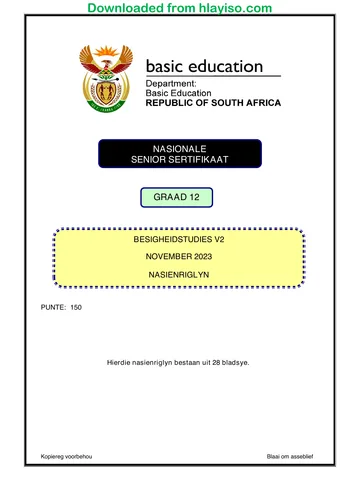
NATIONAL
SENIOR CERTIFICATE
GRADE 12
BUSINESS STUDIES P1
NOVEMBER 2023
MARKING GUIDELINE
MARKS: 150
This marking guideline consist of 28 pages.
Copyright reserved Please turn over
Skip to contentQuestion paper 






View all



Business Studies Grade 12 P1 NSC November 2023 Question Paper
Grade 12 Business Studies Paper 1 question paper from the NSC November Exam 2023, 28 pages. Read online or get the free PDF download, memo linked when available.
Business Studies · Grade 12 · NSC November Exam · 2023. Question paper, 28 pages. Read online or download the PDF.
- Subject
- Business Studies
- Grade
- Grade 12
- Document type
- Question paper
- Year
- 2023
- Exam period
- NSC November Exam
- Paper
- 1
- Curriculum
- CAPS
- Pages
- 28
- File size
- 870.2 KB
Loading document…
Loading document…
1 of 28
Document textSearch extracted text and jump to a page.
Downloaded from hlayiso.com
Business Studies/P1 2 DBE/November 2023
NSC – Marking Guidelines
NOTES TO MARKERS
PREAMBLE
The notes to markers are provided for quality assurance purposes to ensure the following:
(a) Fairness, consistency and reliability in the standard of marking
(b) Facilitate the moderation of candidates' scripts at the different levels
(c) Streamline the marking process considering the broad spectrum of markers across
the country
(d) Implement appropriate measures in the teaching, learning and assessment of the subject
at schools/institutions of learning
1. For marking and moderation purposes, the following colours are recommended:
Marker: Red
Senior Marker: Green
Deputy Chief Marker: Orange
Chief Marker: Pink
Internal Moderator: Black/Blue
DBE Moderator: Turquoise
2. Candidates' responses must be in full sentences for SECTIONS B and C.
However, this would depend on the nature of the question.
3. A comprehensive marking guideline has been provided but this is by no means
exhaustive. Due consideration should be given to an answer that is correct but:
Uses a different expression from that which appears in the marking
guideline
Comes from another credible source
Original
A different approach is used
NOTE: There is only ONE correct answer in SECTION A.
4. Take note of other relevant answers provided by candidates and allocate marks
accordingly. (In cases where the answer is unclear or indicates some
understanding, part-marks should be awarded, for example, one mark instead of
the maximum of two marks.)
5. The word 'Sub-max' is used to facilitate the allocation of marks within a question
or sub-question.
6. The purpose of circling marks (guided by 'max' in the breakdown of marks) on
the right-hand side is to ensure consistency and accuracy in the marking of
scripts as well as for calculation and moderation purposes.
7. Subtotals to questions must be written in the right-hand margin. Circle the
subtotals as indicated by the allocation of marks. This must be guided by 'max'
in the marking guidelines. Only the total for each question should appear in the
left-hand margin next to the appropriate question number.
8. In an indirect question, the theory as well as the response must be relevant and
related to the question.
Copyright reserved Please turn over
Downloaded from hlayiso.com
Business Studies/P1 3 DBE/November 2023
NSC – Marking Guideline
9. Correct numbering of answers to questions or sub questions is recommended in
SECTIONS A and B. However, if the numbering is incorrect, follow the sequence
of the candidate's responses. Candidates will be penalised if the latter is not
clear.
10. No additional credit must be given for repetition of facts. Indicate with an 'R'.
11. The differentiation between 'evaluate' and 'critically evaluate' can be explained
as follows:
11.1 When 'evaluate' is used, candidates are expected to respond in either a
positive/negative manner or take a neutral (positive and negative)
stance, e.g., Positive: 'COIDA eliminates time and costs spent√ on
lengthy civil court proceedings.'√
11.2 When 'critically evaluate' is used, candidates are expected to respond
in either a positive/negative manner or take a neutral (positive and
negative) stance. In this instance candidates are also expected to
support their responses with more depth, e.g., 'COIDA eliminates time
and costs spent√ on lengthy civil court proceedings√, because the
employer will not be liable for compensation to the employee for injuries
sustained during working hours as long as it can be proved that the
business was not negligent.'√
NOTE: 1. The above could apply to 'analyse' as well.
2. Note the placing of the tick (√) in the allocation of marks.
12. The allocation of marks must be informed by the nature of the question, cognitive
verb used, mark allocation in the marking guideline and the context of each
question.
Cognitive verbs, such as:
12.1 Advise, name, state, outline, motivate, recommend, suggest, (list not
exhaustive) do not usually require much depth in candidates' responses.
Therefore, the mark allocation for each statement/answer appears at the
end.
12.2 Define, describe, explain, discuss, elaborate, distinguish, differentiate,
compare, tabulate, analyse, evaluate, critically evaluate (list not
exhaustive) require a greater depth of understanding, application and
reasoning. Therefore, the marks must be allocated more objectively to
ensure that assessing is conducted according to established norms so
that uniformity, consistency and fairness are achieved.
13. Mark only the FIRST answer where candidates offer more than one answer for
SECTION B and C questions that require one answer.
Copyright reserved Please turn over
Downloaded from hlayiso.com
Business Studies/P1 4 DBE/November 2023
NSC – Marking Guideline
14. SECTION B
14.1 If for example, FIVE facts are required, mark the candidate's FIRST FIVE
responses and ignore the rest of the responses. Indicate by drawing a line across
the unmarked portion.
NOTE: 1. This applies only to questions where the number of facts is
specified.
2. The above also applies to responses in SECTION C (where
applicable)
14.2 If two facts are written in one sentence, award the candidate FULL credit. Point
14.1 above still applies.
14.3 If candidates are required to provide their own examples/views, brainstorm this
at the marking centre to finalise alternative answers and consult with the Internal
Moderator at the DBE for approval.
14.4 Use of the cognitive verbs and allocation of marks:
14.4.1 If the number of facts are specified, questions that require candidates to
'describe/discuss/explain' may be marked as follows:
Fact 2 marks (or as indicated in the marking guidelines)
Explanation 1 mark (two marks will be allocated in Section C)
The 'fact' and 'explanation' are given separately in the marking guideline
to facilitate mark allocation.
14.4.2 If the number of facts required is not specified, the allocation of marks
must be informed by the nature of the question and the maximum mark
allocated in the marking guideline.
14.5 ONE mark may be awarded for answers that are easy to recall, requires one
word answers or is quoted directly from a scenario/case study. This
applies to SECTIONS B and C in particular (where applicable).
15. SECTION C
15.1 The breakdown of the mark allocation for the essays is as follows:
Introduction
Maximum:
Content
32
Conclusion
Insight 8
TOTAL 40
Copyright reserved Please turn over
Downloaded from hlayiso.com
Business Studies/P1 5 DBE/November 2023
NSC – Marking Guideline
15.2 Insight consists of the following components:
Layout/Structure Is there an introduction, paragraphs and a conclusion? 2
Analysis and Is the candidate able to break down the question into 2
interpretation headings/subheadings/interpret it correctly to show
understanding of what is being asked?
Marks to be allocated using this guide:
All headings addressed: 1 (One 'A')
Interpretation (16 to 32 marks): 1 (One 'A')
Synthesis Are there relevant decisions/facts/responses made based 2
on the questions?
Option 1: Only relevant facts: 2 marks (No '-S')
Where a candidate answers 50% or more (two
to four sub-questions) of the question with only
relevant facts; no '-S' appears in the left
margin. Award the maximum of TWO (2)
marks for synthesis.
Option 2: Some relevant facts: 1 mark (One '-S')
Where a candidate answers less than 50%
(only one sub-question) of the question with
only OR some relevant facts; one '-S' appears
in the left margin. Award a maximum of ONE
(1) mark for synthesis.
Option 3: Some relevant facts: 1 mark (One '-S')
Where a candidate answers FOUR sub-
questions, but one/two/three sub-questions
with no relevant facts; one '-S' appears in the
left margin. Award a maximum of ONE (1)
mark for synthesis.
Option 4: No relevant facts: 0 mark (Two '-S')
Where a candidate answers less than 50%
(only one sub-question) of the questions with
no relevant facts; two '-S' appears in the left
margin. Award a ZERO mark for synthesis.
Originality Is there evidence of one example in any TWO of the four 2
sub-questions, not older than two (2) years that are based
on recent information, current trends and developments?
TOTAL FOR INSIGHT: 8
TOTAL MARKS FOR FACTS: 32
TOTAL MARKS FOR ESSAY (8 + 32): 40
NOTE: 1. No marks will be awarded for contents repeated from the
introduction and conclusion.
2. The candidate forfeits marks for layout if the words
INTRODUCTION and CONCLUSION are not stated.
3. No marks will be awarded for layout, if the headings
INTRODUCTION and CONCLUSION are not supported by an
explanation.
Copyright reserved Please turn over
Downloaded from hlayiso.com
Business Studies/P1 6 DBE/November 2023
NSC – Marking Guideline
15.3 Indicate insight in the left-hand margin with a symbol e.g. ('L, A, -S and/or O').
15.4 The breakdown of marks is indicated at the end of the suggested answer/
marking guideline to each question.
15.5 Mark all relevant facts until the SUB MAX/MAX mark in a subsection has been
attained. Write SUB MAX/MAX after maximum marks have been obtained but
continue reading for originality “O”.
15.6 At the end of each essay indicate the allocation of marks for facts and marks
for insight as follows: (L – Layout, A – Analysis, S – Synthesis, O – Originality)
as in the table below.
CONTENT MARKS
Facts 32 (max.)
L 2
A 2
S 2
O 2
TOTAL 40
15.7 When awarding marks for facts, take note of the sub-maxima indicated,
especially if candidates do not make use of the same subheadings. Remember,
headings and subheadings are encouraged and contribute to insight
(structuring/logical flow/sequencing) and indicate clarity of thought. (See
MARK BREAKDOWN at the end of each question.)
15.8 If the candidate identifies/interprets the question INCORRECTLY, then he/she
may still obtain marks for layout.
15.9 If a different approach is used by candidates, ensure that the answers are
assessed according to the mark allocation/subheadings as indicated in the
marking guideline.
15.10 15.10.1 Award TWO marks for complete sentences. Award ONE mark for
phrases, incomplete sentences and vague answers.
15.10.2 With effect from November 2015, the TWO marks will not
necessarily appear at the end of each completed sentence. The ticks
(√) will be separated and indicated next to each fact, e.g. 'Product
development is a growth strategy √, where businesses aim to
introduce new products into existing markets.'√
This will be informed by the nature and context of the question, as
well as the cognitive verb used.
15.11 With effect from November 2017, the maximum of TWO (2) marks for facts
shown as headings in the marking guidelines, will not necessarily apply to each
question. This would also depend on the nature of the question.
Copyright reserved Please turn over
Downloaded from hlayiso.com
Business Studies/P1 7 DBE/November 2023
NSC – Marking Guideline
SECTION A
QUESTION 1
1.1 1.1.1 C√√
1.1.2 B√√
1.1.3 A√√
1.1.4 D√√
1.1.5 B√√
(5 x 2) (10)
1.2 1.2.1 learnerships√√
1.2.2 threat√√
1.2.3 BEE√√
1.2.4 selection√√
1.2.5 public relations√√
(5 x 2) (10)
1.3 1.3.1 D√√
1.3.2 H√√
1.3.3 B√√
1.3.4 I√√
1.3.5 C√√
(5 x 2) (10)
TOTAL SECTION A: 30
BREAKDOWN OF MARKS
QUESTION 1 MARKS
1.1 10
1.2 10
1.3 10
TOTAL 30
Copyright reserved Please turn over
Downloaded from hlayiso.com
Business Studies/P1 8 DBE/November 2023
NSC – Marking Guideline
SECTION B
Mark the answers to the FIRST TWO questions only.
QUESTION 2: BUSINESS ENVIRONMENTS
2.1 Consumer rights as stipulated in the Consumer Protection Act/CPA
- Right to choose √
- Right to privacy √
- Right to fair and honest dealings √
- Right to disclosure and information √
- Right to fair and responsible marketing√
- Right to fair value/good quality and safety √
- Right to accountability by suppliers √
- Right to fair/just and reasonable terms and conditions √
- Right of equality in the consumer market √
NOTE: Mark the first FOUR (4) only.
(4 x 1) (4)
2.2 Challenges of business environments and the extent of control
BUSINESS EXTENT OF
CHALLENGES ENVIRONMENTS CONTROL
(2.2.1) (2.2.2) (2.2.3)
1. BC lost customers to Damian Market environment √ Partial/Some/
Canning because their products Limited/Less/Little
are of a high quality. √ control √
2. The profitability of BC decreased Micro environment √ Full/Complete
due to poor management skills.√ control √
3. Best Canning borrowed money Macro environment √ No control √
from the bank at a high interest
rate. √
Max (3) Max (3) Max (3)
NOTE: 1. Mark the first THREE (3) challenges only.
2. If the business environment is not linked to the challenge,
mark the challenge only.
3. Award marks for the business environments even if the
extent of control is not indicated/incorrect.
4. The extent of control must be linked to the business
environment.
5. Do not award marks for the extent of control if the business
environment is not mentioned.
6. Accept responses in any order.
Copyright reserved Please turn over
Downloaded from hlayiso.com
Business Studies/P1 9 DBE/November 2023
NSC – Marking Guideline
2.3 Rights of employers in terms of the Labour Relations Act/LRA
Employers have the right to:
- form employer organisations √ to represent them in labour related matters. √
- form bargaining councils √ for collective bargaining purposes. √
- lockout employees √ who engage in unprotected/illegal strike/labour action. √
- dismiss employees who engage in an unprotected strike/misconduct √ such as
intimidation/violence during a strike action. √
- not pay/remunerate an employee who has participated in a protected strike √ for
services/work they did not do during the strike. √
- Any other relevant answer related to the rights of employers in terms of the LRA.
Max (4)
2.4 Purpose of the Employment Equity Act/EEA
- The EEA allows employees who do the same work √ to be paid equally. √
- Eliminates discrimination √ on grounds of gender/race/disability in the
workplace. √
- Promotes equal opportunity √ and fair treatment in the workplace. √
- Promotes diversity in the workplace √ by ensuring that people of diverse
backgrounds are appointed. √
- Protects employees from victimisation √ if they exercise the rights given to them
by the EEA. √
- Ensures equal representation in the workplace √ through the implementation of
affirmative action. √
- Any other relevant answer related to the purpose of the EEA.
Max (6)
2.5 Business strategies
2.5.1 Defensive strategy from the scenario
Divestiture√√
(2)
Motivation
They sold some unproductive assets to pay off debts. √ (1)
NOTE: Do not award marks for the motivation if the defensive
strategy was incorrectly identified.
Max (3)
2.5.2 Steps in strategy evaluation
- Examine the underlying basis of a business strategy. √√
- Look forward and backwards into the implementation process. √√
- Compare the expected performance with the actual performance. √√
- Determine the reasons for deviations and analyse these reasons. √√
- Take corrective action so that deviations may be corrected. √√
- Set specific dates for control and follow up. √√
- Draw up a table of the advantages and disadvantages of a strategy. √√
- Decide on the desired outcome as envisaged when strategies were
implemented. √√
- Consider the impact of the strategic implementation in the internal and
external environments of the business. √√
- Any other relevant answer related to the steps in strategy evaluation.
NOTE: Accept steps in any order.
Max (4)
Copyright reserved Please turn over
Downloaded from hlayiso.com
Business Studies/P1 10 DBE/November 2023
NSC – Marking Guideline
2.6 Implications of the Broad-Based Black Economic Empowerment Act/BBBEE
pillars
2.6.1 Management control√√
- Businesses must ensure that transformation is implemented at all levels. √
- Appoint black people in senior executive positions/to management. √
- Involve black people in the strategic decision-making processes. √
- Ensure that black females are represented in management. √
- Businesses score points in management when selling more than 25 % of their
shares to black investors so that some of them can become directors. √
- Due to a shortage of skilled black managers/directors, some businesses find it
difficult to make appointments.√
- Businesses are directly penalised for not implementing this pillar. √
- Any other relevant answer related to the implications of management control as
a BBBEE pillar on businesses.
Pillar (2)
Explanation (1)
Submax (3)
2.6.2 Ownership√√
- Businesses should include black people in shareholding/partnerships/
franchises. √
- Encourage small black investors to invest in big companies and share
ownership. √
- Exempted Micro Enterprises (EMEs) with an ownership of 50% or more of black
people are promoted to level 3 of the BEE scorecard. √
- More opportunities are created for black people to become owners/
entrepreneurs. √
- Large businesses should form joint ventures with small black owned businesses
and share business risks. √
- Businesses sometimes find it difficult to locate suitable black business partners/
shareholders.√
- Many black people cannot afford shares in companies/contributions to
partnerships.√
- Any other relevant answer related to the implications of ownership as a BBBEE
pillar on businesses.
Pillar (2)
Explanation (1)
Submax (3)
2.6.3 Enterprise and supplier development/ESD √√
- Businesses must create jobs as ESD promotes local manufacturing. √
- Identify black owned suppliers that are able to supply goods and services. √
- Outsource services to suppliers that are BBBEE compliant. √
- Invest/Support black owned SMMEs by contributing loans/donations/consulting
services/advice/entrepreneurial programmes. √
- Develop the business skills of small/black owned suppliers, such as sales
techniques/legal advice. √
- Support the cash flow of small suppliers by offering them preferential terms of
payment.√
- Businesses should invest in/support black owned SMMEs to make them more
sustainable.√
- Develop and implement a supplier development plan/supply chain.√
Copyright reserved Please turn over
Downloaded from hlayiso.com
Business Studies/P1 11 DBE/November 2023
NSC – Marking Guideline
- Small/Large businesses may not be able to afford enterprise development
investment/support.
- Black owned SMMEs may become too reliant on support from other
businesses/unable to take their own initiatives.√
- BBBEE suppliers may be without good workmanship.√
- Smaller businesses that are not BBBEE compliant lose business.√
- Businesses are forced to choose from a smaller pool of suppliers.√
- Any other relevant answer related to the implications of ESD as a BBBEE pillar
on businesses.
Pillar (2)
Explanation (1)
Submax (3)
2.6.4 Skills development√√
- Businesses must engage black employees in skills development initiatives. √
- Provide learnerships/Learning programmes to black employees. √
- Businesses must contribute 1% of their payroll to fund the skills development
programmes. √
- Businesses could benefit from the increased pool of skilled/trained workers. √
- Businesses must go the extra mile to train staff where learnerships are not
offered.√
- Productivity is compromised as mentors/coaches have to find the time to
participate in learnerships/training.√
- Any other relevant answer related to the implications of skills development as a
BBBEE pillar on businesses.
Pillar (2)
Explanation (1)
Submax (3)
2.6.5 Socio-economic development/Social responsibility√√
- Businesses should focus on critical areas which can affect growth and
development in the country such as environmental awareness/education/
housing/poverty/unemployment. √
- They should distribute scarce CSI resources to selected beneficiaries in the
community. √
- Businesses may not be knowledgeable about societal issues resulting in
wasting financial resources on meaningless community projects.√
- Contribute towards √ social investment/community projects√
- Any other relevant answer related to the implications of socio-economic
development/social responsibility as a BBBEE pillar on businesses.
Pillar (2)
Explanation (1)
Submax (3)
NOTE: Mark the first TWO (2) only.
Max (6)
Copyright reserved Please turn over
Downloaded from hlayiso.com
Business Studies/P1 12 DBE/November 2023
NSC – Marking Guideline
2.7 Dealing with the challenges that are posed by the economic factors of PESTLE
analysis
- Borrow money from financial institutions when interest rates are favourable. √√
- Businesses should consider decreasing their profit margin rather than increasing
the price of their products. √√
- Consider exchange rates when trading with other countries. √√
- Negotiate favourable interest rates with creditors. √√
- Negotiate payment terms with suppliers. √√
- Sell/Dispose parts of assets that are no longer profitable. √√
- Sell shares at competitive/lower prices to attract more foreign direct
investments. √√
- Any other relevant answer related to the ways in which businesses can deal with
the challenges that are posed by economic factors of the PESTLE analysis.
Max (4)
[40]
BREAKDOWN OF MARKS
QUESTION 2 MARKS
2.1 4
2.2 9
2.3 4
2.4 6
2.5.1 3
2.5.2 4
2.6 6
2.7 4
TOTAL 40
Copyright reserved Please turn over
Downloaded from hlayiso.com
Business Studies/P1 13 DBE/November 2023
NSC – Marking Guideline
QUESTION 3: BUSINESS OPERATIONS
3.1 Aspects that should be included in an employment contract
- Personal details of the employee. √
- Details of the business/employer such as the name and address. √
- Job title/Position. √
- Job description such as duties/responsibilities and working conditions. √
- Job specification such as formal qualifications and willingness to travel. √
- Date of employment/Commencement of employment. √
- Place where employee will spend most of his/her working time. √
- Hours of work such as normal time and overtime. √
- Remuneration such as weekly or monthly pay. √
- Benefits/Fringe benefits/Perks/Allowances. √
- Leave such as sick/maternity/annual/adoption leave. √
- Employee deductions such as compulsory/non-compulsory. √
- Duration/Period of employment contract/Details of termination/Expiry date of
employment contract. √
- Probation period. √
- Signatures of both the employer and employee. √
- List of documents that form part of the contract such as appointment letter/code
of conduct/ethics. √
- Disciplinary policy such as rules/disciplinary procedure for unacceptable
behaviour. √
- Any other relevant answer related to aspects that should be included in an
employment contract.
NOTE: Mark the first FOUR (4) only.
(4 x 1) (4)
3.2 Difference between piecemeal and time-related salary determination methods
PIECEMEAL TIME-RELATED
- Workers are paid according to the - Workers are paid according to the
number of items/units produced/ amount of time/hours they spend at
action performed. √√ work/on a task. √√
- Workers are not remunerated for the - Workers with the same
number of hours worked, regardless of experience/qualifications are paid
how long it takes them to make the on salary scales regardless of the
items. √√ amount of work done. √√
- Mostly used in factories particularly in - Many private and public sector
the textile/technology industries. √√ businesses use this method. √√
- Any other relevant answer related to - Any other relevant answer related to
piecemeal as a salary determination time-related as a salary
method. determination method.
Submax (2) Submax (2)
NOTE: 1. The answer does not have to be in tabular format.
2. The difference does not have to link but must be clear.
3. Award a maximum of TWO (2) marks if the difference is not
clear/Mark either piecemeal or time-related only.
Max (4)
Copyright reserved Please turn over
Downloaded from hlayiso.com
Business Studies/P1 14 DBE/November 2023
NSC – Marking Guideline
3.3 Recruitment and selection
3.3.1 Method of recruitment from scenario
External recruitment √√ (2)
3.3.2 Role of the interviewee during the interview
- Greet the interviewer by name √ with a solid handshake and a friendly smile. √
- Listen carefully to the questions √ before responding. √
- Make eye contact √ and have good posture/body language. √
- Show confidence √ and have a positive attitude/be assertive. √
- Be inquisitive √ and show interest in the business. √
- Show respect √ and treat the interview with its due importance. √
- Be honest about mistakes √ and explain how you dealt with them. √
- Know your strengths and weaknesses √ and be prepared to explain them. √
- Ask clarity seeking questions, √ about the job/position offered. √
- Thank the interviewer for the opportunity given √ to be part of the interview. √
- Any other relevant answer related to the role of the interviewee during the
interview.
Max (4)
3.4 Impact of fringe benefits
Positives/Advantages
- Attractive fringe benefit packages √ may result in higher employee
retention/reduces employee turnover. √
- Attracts qualified/skilled/experienced employees √ who may positively
contribute towards the business goals/objectives. √
- Improves productivity √ resulting in higher profitability. √
- It increases employee satisfaction/loyalty, √ as they may be willing to go the
extra mile. √
- Businesses save money √ as benefits are tax deductible. √
- Fringe benefits can be used as leverage √ for salary negotiations. √
- Any other relevant answer related to the positive impact/advantages of fringe
benefits on businesses.
AND/OR
Negatives/Disadvantages
- Businesses which cannot offer fringe benefits, √ fail to attract skilled workers. √
- Businesses which offer employees different benefit plans √ may create
resentment√/Employees who receive less benefit may not be motivated√
resulting in lower productivity. √
- It can create conflict/lead to corruption √ if allocated unfairly. √
- Fringe benefits are additional costs √ that may result in cash flow problems. √
- Decreases business profits, √ as incentive/package/remuneration costs are
higher. √
- Administrative costs increase, √ as benefits need to be correctly recorded for
tax purposes. √
- Workers only stay with the business for fringe benefits, √ and may not be
committed/loyal to the tasks/business. √
- Businesses have to pay advisors/attorneys √ to help them create benefit plans
that comply with legislation. √
- Errors in benefit plans √ may lead to costly lawsuits/regulatory fines. √
- Any other relevant answer related to the negative impact/disadvantages of
fringe benefits on businesses. Max (6)
Copyright reserved Please turn over
Downloaded from hlayiso.com
Business Studies/P1 15 DBE/November 2023
NSC – Marking Guideline
3.5 Meaning of quality control
- A system that ensures the desired quality is met √ by inspecting the final product.√
- Ensures that finished products √ meet the required standards. √
- Quality control processes ensure that products are consistently manufactured √
to high standards. √
- Checking raw materials/employees/machinery/workmanship/production √ to
ensure that high quality standards are maintained. √
- Includes setting targets/measuring performance √ and taking corrective
measures. √
- Any other relevant answer related to the meaning of quality control.
Max (4)
3.6 Contribution of the production function to the success of the business
- Provide high quality services/products √ according to specifications. √
- The production/operating processes of a business should be done
correctly √ through proper production planning and control. √
- Products and services should be produced at the lowest possible cost √ to
allow for profit maximisation. √
- The business should clearly communicate the roles and responsibilities √ to the
production workforce. √
- Products must meet customers' requirements √ by being safe, reliable and
durable. √
- The business should have good after-sales services √ and warrantees. √
- Empower workers √ so that they can take pride in their workmanship. √
- Obtain accreditation from the SABS/ISO 9001 √ to ensure that quality products
are being produced. √
- Specify the product/service standards √ and take note of the factors that
consumers use to judge quality. √
- Monitor processes √ and find the root causes of production problems. √
- Implement quality control systems √ to ensure that quality products are
consistently being produced. √
- Utilise machines √ and equipment optimally. √
- Accurately calculate √ the production costs. √
- Select the appropriate production system √ such as mass/batch/jobbing. √
- Any other relevant answer related to how the quality of performance of the
production function can contribute to the success of the business.
Max (4)
3.7 Total quality management/TQM elements from the scenario
TQM ELEMENTS MOTIVATIONS
1. Adequate financing and VL can afford to purchase quality
capacity √√ raw materials and equipment to
avoid faulty products. √
2. Total client/customer They also promote a positive
satisfaction √√ business image by fulfilling the
needs of their buyers.√
Submax (4) Submax (2)
NOTE: 1. Mark the first TWO (2) only.
2. Award marks for TQM elements even if the quotes are
incomplete.
3. Do not award marks for motivations if the TQM elements
were incorrectly identified.
4. Accept responses in any order.
Max (6)
Copyright reserved Please turn over
Downloaded from hlayiso.com
Business Studies/P1 16 DBE/November 2023
NSC – Marking Guideline
3.8 Role of quality circles as part of continuous improvement to processes and
systems
- Solve problems related to quality and implement improvements. √√
- Investigate problems and suggest solutions to management. √√
- Ensure that there is no duplication of activities/tasks in the workplace. √√
- Make suggestions for improving processes and systems in the workplace. √√
- Improve the quality of products/services/productivity through regular reviews of
quality processes. √√
- Monitor/Reinforce strategies to improve the smooth running of business
operations. √√
- Increase employees' morale/motivation to boost the team spirit in achieving
organisational goals. √√
- Contribute towards the improvement and development of the organisation. √√
- Reduce costs of redundancy and wasteful efforts in the long run. √√
- Increase the demand for products/services of the business. √√
- Create harmony and high performance in the workplace. √√
- Build a healthy workplace relationship between the employer and employee. √√
- Improve employees' loyalty/commitment to the organisational goals. √√
- Improve employees' communication at all levels of the business. √√
- Develop a positive attitude/sense of involvement in decision making processes
of the services offered. √√
- Any other relevant answer related to the role of quality circles as part of
continuous improvement to processes and systems.
Max (6)
[40]
BREAKDOWN OF MARKS
QUESTION 3 MARKS
3.1 4
3.2 4
3.3.1 2
3.3.2 4
3.4 6
3.5 4
3.6 4
3.7 6
3.8 6
TOTAL 40
Copyright reserved Please turn over
Downloaded from hlayiso.com
Business Studies/P1 17 DBE/November 2023
NSC – Marking Guideline
QUESTION 4: MISCELLANEOUS TOPICS
BUSINESS ENVIRONMENTS
4.1 Types of business sectors
- Primary √
- Secondary √
- Tertiary √
NOTE: Mark the first TWO (2) only.
(2 x 1) (2)
4.2 Leave provision as stipulated in the BCEA from statements
4.2.1 Family responsibility leave √√
4.2.2 Sick leave √√
Max (4)
4.3 Funding of Sector Education and Training Authorities/SETAs
- Skills Development levies are paid by employers √ to SARS as a collecting
agency for the government. √
- Employers who have a salary bill that exceeds R500 000 per annum, √ should
pay one percent (1%) of their annual salaries as a levy. √
- The different SETAs receive eighty percent (80%) of the levy for organisational
expenses √ and the remaining twenty percent (20%) is paid to the National Skills
Fund. √
- Donations/Grants received √ from the public/businesses/CSI programmes. √
- Surplus funds received √ from government institutions. √
- Funds received √ from rendering their services. √
- Any other relevant answer related to how SETAs are funded.
Max (4)
4.4 Types of integration strategies
Forward vertical integration √√
- A business combines with or takes over its distributors down the supply
chain/production chain/The business merges with businesses that were once
their customers, while still maintaining control of the initial/primary business
activity. √
- Involves expansion of business activities to gain control over the direct
distribution of the products/services. √
- The business takes over the distribution system and sells products/services
directly to consumers/customers. √
- Increases profitability as the intermediary/distributor/middleman is excluded. √
- Any other relevant answer related to forward vertical integration as a type of
integration strategy.
Strategy (2)
Discussion (1)
Submax (3)
Backward vertical integration √√
- The business combines with/merges/takes over its suppliers up the supply
chain/production chain/The business expands its role to fulfil activities/tasks that
were formerly/previously completed by suppliers. √
- Aims at decreasing the business's dependency on the supplier. √
Copyright reserved Please turn over
Downloaded from hlayiso.com
Business Studies/P1 18 DBE/November 2023
NSC – Marking Guideline
- Enables businesses to cut costs and have influence over the prices/quality/
quantity of raw materials. √
- Any other relevant answer related to backward vertical integration as a type of
integration strategy.
Strategy (2)
Discussion (1)
Submax (3)
Horizontal integration √√
- A business takes control of/incorporates other businesses in the same
industry/which produce/sell the same/similar goods/services./It is the acquisition
/takeover of a related business that operates at the same level of supply chain in
the industry √
- The aim is to reduce the threat of competition/substitute products/services. √
- Increases the market share/sales/profits and enhance production/distribution. √
- Suitable for businesses that operate in multiple geographical areas through joint
ventures/licencing/franchising. √
- Any other relevant answer related to horizontal integration as a type of
integration strategy.
Strategy (2)
Discussion (1)
Submax (3)
NOTE: Mark the first TWO (2) only.
Max (6)
4.5 Ways in which businesses can comply with the National Credit Act/NCA
- Offer applicants pre-agreement statements. √√
- Disclose all costs of the loan/No hidden costs should be charged/added. √√
- Obtain credit records/checks of clients before granting loans. √√
- Businesses should be registered with the National Credit Regulator. √√
- Submit an annual compliance report to the National Credit Regulator. √√
- Conduct affordability assessment to ensure that consumers have the ability to
meet their obligations. √√
- Conduct credit checks with a registered credit bureau and consult the National
Credit Register. √√
- Businesses must have procedures in place to comply with the provision of the
Financial Intelligence Centre Act (FICA). √√
- Verify the identity of clients and report suspicious transactions/train staff on their
obligations in terms of FICA. √√
- Any other relevant answer related to ways in which businesses can comply with
the NCA.
Max (4)
BUSINESS OPERATIONS
4.6 Purpose of induction
- Introduce new employees to management/colleagues to establish relationships
with fellow colleagues at different levels. √√
- Give new employees a tour/information about the layout of the building/office. √√
- Make new employees feel welcome by introducing them to their physical
workspace. √√
- Improve skills through in-service training. √√
Copyright reserved Please turn over
Downloaded from hlayiso.com
Business Studies/P1 19 DBE/November 2023
NSC – Marking Guideline
- Familiarise new employees with the organisational structure/their supervisors. √√
- Allow new employees the opportunity to ask questions that will put them at
ease/reduce insecurity/anxiety/fear. √√
- Create opportunities for new employees to experience/explore different
departments. √√
- Explain safety regulations and rules, so that new employees will understand their
roles/responsibilities in this regard. √√
- Ensure that employees understand their roles/responsibilities so that they will be
more efficient/productive. √√
- Communicate information about the products/services offered by the business. √√
- Communicate business policies regarding ethical/professional conduct/
procedures/employment contract/conditions of employment. √√
- Any other relevant answer related to the purpose of induction.
Max (6)
4.7 Placement procedure
- Businesses should outline the specific responsibilities/expectations/skills √ of the
new position. √
- Determine the successful candidate's strengths/weaknesses/interests/skills √ by
subjecting him/her to a range of psychometric tests. √
- Determine the relationship between the position √ and the competencies of the
new candidate. √
- Any other relevant answer related to the placement procedure as a human
resources activity.
Max (4)
4.8 Benefits of a good quality management system
4.8.1 Benefits of a good quality management system from the scenario
- UB increases their productivity through proper time management.√
- They conduct regular training to improve the quality of employees' skills. √
NOTE: 1. Mark the first TWO (2) only.
2. Only award marks for responses that are quoted from the
scenario.
(2 x 1) (2)
4.8.2 Other benefits of a good quality management system
- Effective customer services are rendered, √ resulting in increased customer
satisfaction. √
- Time and resources √ are used efficiently. √
- Products/Services are constantly improved √ resulting in increased levels of
customer satisfaction. √
- Vision/Mission/Business goals √ may be achieved. √
- A business has a competitive advantage √ over its competitors. √
- Employers and employees will have a healthy working relationship √ resulting in
happy/productive workers. √
- Increased market share/More customers √ improves profitability/financial
sustainability. √
- Improves business image √ as there are less defects/returns. √
- Any other relevant answer related to other benefits of a good quality management
system.
NOTE: Do not award marks for responses that were quoted in
QUESTION 4.8.1
Max (4)
Copyright reserved Please turn over
Downloaded from hlayiso.com
Business Studies/P1 20 DBE/November 2023
NSC – Marking Guideline
4.9 Ways in which total quality management/TQM can reduce the cost of quality
- Introduce quality circles/small teams of five to ten employees, who meets
regularly to discuss ways of improving the quality of their work. √√
- Schedule activities to eliminate duplication of tasks/activities. √√
- Share responsibility for quality output between management and workers. √√
- Develop work systems that empower employees to find new ways of improving
quality. √√
- Train employees at all levels, so that everyone understands their role in quality
management. √√
- Work closely with suppliers to improve the quality of raw materials/inputs. √√
- Improve communication about the quality challenges/deviations, so that
everyone can learn from past experiences. √√
- Reduce investment on expensive, but ineffective inspection procedures in the
production process. √√
- Implement pro-active maintenance programmes for equipment/machinery to
reduce/eliminate breakdowns. √√
- Any other relevant answer related to ways in which TQM can reduce the cost of
quality. Max (4)
[40]
BREAKDOWN OF MARKS
QUESTION 4 MARKS
4.1 2
4.2 4
4.3 4
4.4 6
4.5 4
4.6 6
4.7 4
4.8.1 2
4.8.2 4
4.9 4
TOTAL 40
TOTAL SECTION B: 80
Copyright reserved Please turn over
Downloaded from hlayiso.com
Business Studies/P1 21 DBE/November 2023
NSC – Marking Guideline
SECTION C
Mark the answers to the FIRST question only.
QUESTION 5: BUSINESS ENVIRONMENTS (BUSINESS STRATEGIES)
5.1 Introduction
- The strategic management process allows businesses to develop turnaround
strategies to enhance/improve their operations. √
- A critical analysis of Porter's Five Forces model requires businesses to conduct
continuous research on latest developments in the market. √
- The effective implementation of intensive strategies enables businesses to gain
a competitive advantage in the market. √
- Diversification strategies provides growth opportunities for businesses as they
can identify the strengths and weaknesses of each product line. √
- Any other relevant introduction related to the strategic management
process/Porter's Five Forces model/intensive strategies/advantages of
diversification strategies.
Any (2 x 1) (2)
5.2 Strategic management process
OPTION 1
- Have a clear vision/mission statement/measurable/realistic objective
in place. √√
- Identify opportunities/weaknesses/strengths/threats by conducting
environmental scanning/situational analysis. √√
- Tools available for environmental scanning may include a SWOT
analysis/Porter's Five Forces model/PESTLE analysis/industrial analysis
tools. √√
- Formulate alternative strategies to respond to the challenges. √√
- Develop (an) action plan(s), including the tasks to be done/deadlines to be met/
resources to be procured. √√
- Implement selected strategies by communicating it to all stakeholders/
organising business resources/motivating staff. √√
- Continuously evaluate/monitor/measure strategies in order to take corrective
action. √√
- Any other relevant answer related to the strategic management process.
OR
OPTION 2
- Review/Analyse/Re-examine their vision/mission statement. √√
- Conduct an environmental analysis using models such as
SWOT/PESTLE/Porter's Five Forces. √√
- Formulate a strategy, such as a defensive/retrenchment strategy. √√
- Implement a strategy, using a template such as an action plan. √√
- Control/Evaluate/Monitor the implemented strategy to identify gaps/deviations
in implementation. √√
- Take corrective action to ensure goals/objectives are met. √√
- Any other relevant answer related to the strategic management process.
Max (12)
Copyright reserved Please turn over
Downloaded from hlayiso.com
Business Studies/P1 22 DBE/November 2023
NSC – Marking Guideline
5.3 Application of Porter's Five Forces model
5.3.1 Power of buyers
- Assess how easy it is for buyers/customers √ to drive prices down. √
- Determine the number of buyers/the importance of each buyer to the business √
and the cost of switching to other products. √
- A few powerful buyers are often able to dictate √ their terms to the business. √
- Buyers buying in bulk can bargain √ for prices in their favour. √
- If buyers can do without the business's products √ then they have more power
to determine the prices and terms of sale. √
- Conduct market research √ to gather more information about
buyers/customers.√
- Any other relevant answer related to how businesses could apply the power of
buyers as a force of Porter's Five Forces model to analyse their position in the
market environment.
Submax (8)
5.3.2 Power of competitors/Competitive rivalry
- Competitors selling the same/similar products/services may have a greater
impact √ on the market of the business. √
- If competitors have a unique product/service, √ then they will have greater
power. √
- A business with many competitors in the same market √ has very little power in
their market. √
- Some businesses have the necessary resources to start a price war √ and to
continue selling at a loss until some/all competitors leave the market. √
- Competitors using various pricing and marketing strategies, √ are likely to have
power over the business. √
- Any other relevant answer related to how businesses could apply power of
competitors/competitive rivalry as a force of Porter's Five Forces model to
analyse their position in the market environment.
Submax (8)
Max (14)
5.4 Types of intensive strategies
5.4.1 Market penetration √√
- New products penetrate an existing market at a low price, √ until it is well known
to the customers and then the price increases. √
- Businesses focus on selling existing products into existing markets √ to increase
their market share. √
- Businesses use market research on existing clients √ to decide on how to
improve their marketing mix. √
- Aggressive marketing campaigns such as lowering/reducing prices √ are used to
attract potential/existing clients. √
- Embark on an intensive advertising campaign √ to increase awareness and
customer loyalty. √
- Employ more sales staff √ to improve sales/services. √
- Any other relevant answer related to market penetration as a type of intensive
strategy.
Strategy (2)
Discussion (2)
Submax (4)
Copyright reserved Please turn over
Downloaded from hlayiso.com
Business Studies/P1 23 DBE/November 2023
NSC – Marking Guideline
5.4.2 Market Development √√
- It is a growth strategy where businesses aim to sell their existing products √ in
new markets. √
- Businesses target consumers in a potential market √ that is outside of its
normal target market. √
- Increasing sales of existing products √ by finding new ways to develop new
markets. √
- Prices are restructured/reviewed to cater for customers/consumers √ of all
income levels. √
- Any other relevant answer related to market development as a type of intensive
strategy.
Strategy (2)
Discussion (2)
Submax (4)
5.4.3 Product development √√
- It is a growth strategy where businesses aim to introduce new products √ into
existing markets/modifies an existing product. √
- Businesses generate new ideas/develop new products/services√ for
existing/current markets. √
- Businesses conduct test marketing/market research √ to establish whether new
products will be accepted by existing customers. √
- New products may be different/of a higher quality √ than those of competitors. √
- Any other relevant answer related to product development as a type of intensive
strategy.
Strategy (2)
Discussion (2)
Submax (4)
Max (12)
5.5 Advantages of diversification strategies
- Increases sales and business growth. √√
- Improves the business brand and image. √√
- Reduces the risk of relying only on one product for sales/revenue/income. √√
- More products can be sold to existing customers and additional more new
markets can be established. √√
- Businesses gain more technological capabilities through product
modification. √√
- Diversification into a number of several industries or product lines can help
create a balance during economic fluctuations. √√
- Businesses produce more output using less inputs as one factory may be used
to manufacture more products. √√
- Any other relevant answer related to the advantages of diversification strategies.
Max (8)
Copyright reserved Please turn over
Downloaded from hlayiso.com
Business Studies/P1 24 DBE/November 2023
NSC – Marking Guideline
5.6 Conclusion
- Businesses should always assess their strategic management process to be
able to respond effectively to new trends in the market. √√
- The correct application of Porter's Five Forces model allows businesses to
develop relevant business strategies that may yield fruitful results. √√
- It is important for businesses to conduct comprehensive marketing campaigns
when implementing various types of intensive strategies. √√
- The financial sustainability of businesses is significantly improved through the
correct application of diversification strategies. √√
- The effective implementation of diversification strategies may result in financial
stability and future business prospects. √√
- Any other relevant conclusion related to strategic management process/Porter's
Five Forces model/types of intensive strategies/advantages of diversification
strategies.
Any (1 x 2) (2)
[40]
QUESTION 5: BREAKDOWN OF MARK ALLOCATION
DETAILS MAXIMUM TOTAL
Introduction 2
Strategic management process 12
Application of the Porter's Five
Forces model:
o Power of buyers
o Power of 14 Max
competitors/Competitive 32
rivalry
Types of intensive strategies 12
Advantages of diversification 8
strategies
Conclusion 2
INSIGHT
Layout 2
Analysis, interpretation 2
Synthesis 2 8
Originality/Examples 2
TOTAL MARKS 40
LASO - For each component:
Allocate 2 marks if all requirements are met.
Allocate 1 mark if only some of the requirements are met.
Allocate 0 marks where requirements are not met at all.
Copyright reserved Please turn over
Downloaded from hlayiso.com
Business Studies/P1 25 DBE/November 2023
NSC – Marking Guideline
QUESTION 6: BUSINESS OPERATIONS (QUALITY OF PERFORMANCE)
6.1 Introduction
- Quality management provides guidelines on how business functions should put
quality systems in place in order to achieve business goals/objectives. √
- Quality performance assesses the effectiveness of each business function in
producing high quality products/services. √
- The PDCA model enables business to analyse each step of the model and
eliminate duplication of activities. √
- Effective implementation of TQM elements may prevent the negative
consequences of financial cost caused by poor implementation of TQM. √
- The marketing function plays an important role in identifying game changers
necessary to develop suitable turn around strategies. √
- The administration function enables businesses to keep abreast with latest
developments related to information management. √
- Any other relevant introduction related to quality management and quality
performance/steps of PDCA model/impact of TQM if poorly implemented/quality
indicators of the marketing function/administration function.
Any (2 x 1) (2)
6.2 Differences between quality management and quality performance
QUALITY MANAGEMENT QUALITY PERFORMANCE
- Techniques/tools used to design/ - Total performance of each
improve the quality of a product. √√ department measured against the
specified standards. √√
- Can be used for accountability - Can be obtained if all departments
within each of the business work together towards the same
functions. √√ quality standards. √√
- Aims to ensure that the quality of - Quality is measured through
goods/services is consistent/ physical product/statistical output of
Focuses on the means to achieve processes/surveys of the users
consistency. √√ and/or buyers of goods/services. √√
- Any other relevant answer related - Any other relevant answer related to
to quality management. quality performance.
Submax (4) Submax (4)
NOTE: 1. The answer does not have to be in tabular format.
2. The differences do not have to link but must be clear.
3. Award a maximum of FOUR (4) marks if the differences are
not clear/Mark either quality management or quality
performance only.
Max (8)
Copyright reserved Please turn over
Downloaded from hlayiso.com
Business Studies/P1 26 DBE/November 2023
NSC – Marking Guideline
6.3 Application of PDCA model/steps
Plan √√
- The business should identify the problem √ and develop a plan for improvement
to processes and systems. √
- Answer questions √ such as 'what to do' and 'how to do it'. √
- Plan the new method and approach √ to improve the quality of their products. √
- The plan must be logical/sequential √ for implementers to understand it. √
Step (2)
Explanation (2)
Submax (4)
Do √√
- Businesses should implement √ the change on a small scale. √
- Implement the processes and systems √ as planned. √
- During this step, the implementers aim to effectively/accurately √ execute the
change based on the plan/method. √
- This step is essential in determining √ whether the change has viability/potential. √
Step (2)
Explanation (2)
Submax (4)
Check/Analyse √√
- Use data to analyse √ the results of change. √
- Determine whether it made a difference √ and what needs to be improved. √
- Check whether the processes √ are working effectively. √
- Businesses should assess, plan and establish √ if it is working/if things are going
according to plan. √
Step (2)
Explanation (2)
Submax (4)
Act√√
- Institutionalise the improvement √ to meet the needs of the business. √
- Devise strategies √ on how to continually improve. √
- If the change was successful, √ implement it on a wider scale. √
- The business should continuously revise √ the process until they get it right. √
Step (2)
Explanation (2)
Submax (4)
- Any other relevant answer related to how businesses can apply the PDCA
model/steps to improve the quality of their products.
Max (16)
6.4 Impact of total quality management/TQM if poorly implemented
- Setting unrealistic deadlines √ that may not be achieved. √
- Employees may not be adequately trained √ resulting in poor quality products. √
- Decline in productivity, √ because of stoppages. √
- Businesses may not be able to make necessary changes to products/services√
to satisfy the needs of customers. √
- Businesses' reputation/image may suffer √ because of poor quality/defective goods. √
- Customers will have many alternatives to choose from √ and the impact could be
devastating to businesses. √
- Investors might withdraw investment, √ if there is a decline in profits. √
- Decline in sales √ as more goods are returned by unhappy customers. √
Copyright reserved Please turn over
Downloaded from hlayiso.com
Business Studies/P1 27 DBE/November 2023
NSC – Marking Guideline
- High staff turnover √ because of poor skills development. √
- Undocumented/Uncontrolled quality control processes/systems √ could result in
errors/deviations from pre-set quality standards. √
- Any other relevant answer related to the impact of TQM if poorly implemented by
businesses.
Max (12)
6.5 Quality indicators of business functions
6.5.1 Marketing function
- Winning customers by satisfying their needs/wants/building positive
relationships. √√
- Adhering to ethical advertising practices when promoting products/services. √√
- Identifying a competitive advantage to focus/improve on marketing strengths. √√
- Differentiating products in order to attract more customers. √√
- Constantly reviewing value issues. √√
- Communicating effectively with customers to get feedback about their
experience of products sold/services rendered. √√
- Co-ordinating distribution with production and advertising strategies. √√
- Using pricing techniques to ensure a competitive advantage. √√
- Determining gaps between customer expectations and actual experiences, so
that problems/unhappiness may be diagnosed and addressed. √√
- Making adjustments and changes to products/services based on feedback from
customers/results of market research. √√
- Using aggressive advertising campaigns to sustain/increase the market
share. √√
- Any other relevant answer related to the quality indicators of the marketing
function.
Submax (6)
6.5.2 Administration function
- Fast and reliable data capturing and processing systems. √√
- Make reliable information available to management on time. √√
- Make relevant information available for quick decision-making. √√
- Handle complaints quickly and effectively. √√
- Use modern technology efficiently. √√
- Implement effective risk management policies to minimise business losses. √√
- Quality assurance/Control/Evaluation is recorded accurately. √√
- All documentation is kept neatly and orderly in a safe place. √√
- Easy to recall and find information/documentation. √√
- Financial documents are kept up to date and recorded accurately. √√
- All systems and processes are documented. √√
- Any other relevant answer related to the quality indicators of the administration
function. Submax (6)
Max (10)
Copyright reserved Please turn over
Downloaded from hlayiso.com
Business Studies/P1 28 DBE/November 2023
NSC – Marking Guideline
6.6 Conclusion
- Quality management requires sound business knowledge and skills necessary
to achieve economies of scale in the business. √√
- Quality performance strives to implement good practices aimed at satisfying the
needs of consumers. √√
- The PDCA model enables businesses to reflect on their processes and systems
in order to satisfy the needs of customers beyond their expectations. √√
- Businesses should identify key performance areas that are affected by poor
implementation of TQM and find ways to overcome this challenge. √√
- The quality indicators of the administration and marketing function can be used
to evaluate the extent to which these functions contribute to the success of the
business. √√
- Effective communication of expected quality indicators of the marketing and
administration function may enable employees to achieve set targets/
objectives. √√
- Any other relevant conclusion related to quality management and quality
performance/steps of PDCA model/impact of TQM if poorly implemented/quality
indicators of the marketing function/administration function.
Any (1 x 2) (2)
QUESTION 6: BREAKDOWN OF MARK ALLOCATION
DETAILS MAXIMUM TOTAL
Introduction 2
Differences between quality
management and quality 8
performance
Application of PDCA model 16
Max
Impact of TQM elements if poorly
12 32
implemented
Quality indicators:
o Marketing function 10
o Administration function
Conclusion 2
INSIGHT
Layout 2
Analysis/Interpretation 2 8
Synthesis 2
Originality/Examples 2
TOTAL MARKS 40
LASO – For each component:
Allocate 2 marks if all requirements are met.
Allocate 1 mark if some requirements are met.
Allocate 0 marks where requirements are not met at all
TOTAL SECTION C: 40
GRAND TOTAL: 150
Copyright reserved
Study this subject
Revise the topics in this paper, then practise them question by question.
- Grade 12 Business Studies notes
CAPS revision notes with worked examples.
- Business Studies questions by topic
Past exam questions sorted by CAPS topic, with memos where available.
- Grade 12 Business Studies quizzes
Short topic quizzes with instant feedback.
- All Grade 12 Business Studies past papers
Past papers by year, with memos where available.
- Grade 12 past papers
More Business Studies and other subjects in this collection.
Recommended for this subject
More papers and memos for this grade and subject.
Question paper
Business Studies Grade 12 P1 Eastern Cape June 2025 QP (Eng)
Question paper
Business Studies Grade 12 P1 Free State Mock 2025 Question Paper
Question paper
Business Studies Grade 12 P2 Gauteng June 2025 QP (Afr)
Question paper
Business Studies Grade 12 P1 NSC June 2025 Question Paper (Eng)
Question paper
Business Studies Grade 12 P1 NSC November 2025 Question Paper
Question paper
Business Studies Grade 12 P1 Eastern Cape June 2024 QP (Eng)
Related documents
Question paper
Business Studies Grade 12 P2 NSC November 2023 Question Paper
Question paper
Business Studies Grade 12 P2 NSC November 2023 Question Paper
Question paper
Business Studies Grade 12 P1 Eastern Cape June 2023 QP (Afr)
Question paper
Business Studies Grade 12 P1 Eastern Cape June 2023 QP (Eng)
Question paper
Business Studies Grade 12 P1 Eastern Cape Mock 2023 QP (Eng)
Question paper
Business Studies Grade 12 Paper 1 NSC June 2023 Question Paper
More from Grade 12 Business Studies
Memorandum
Business Studies Grade 12 P1 Gauteng June 2025 Memo (Afrikaans)
Memorandum
Business Studies Grade 12 KZN March Test 2025 Memo
Memorandum
Business Studies Grade 12 Paper 1 KZN Mock 2025 Memo
Memorandum
Business Studies Grade 12 Paper 1 Mpumalanga Mock 2025 Memo
Memorandum
Business Studies Grade 12 Paper 2 Mpumalanga Mock 2025 Memo
Question paper