
Downloaded from hlayiso.com
CONSUMER STUDIES
(FOOD PRODUCTION)
GUIDELINES FOR
PRACTICAL ASSESSMENT TASKS
GRADE 12
2021
These guidelines consist of 30 pages.
Copyright reserved Please turn over
Skip to contentPractical assessment task %20Eng_hlayiso.com_--04467b26-4707-482c-8dcd-623dc7ad981e/v1-a35f435d0339be79b2ac/card.webp)
View all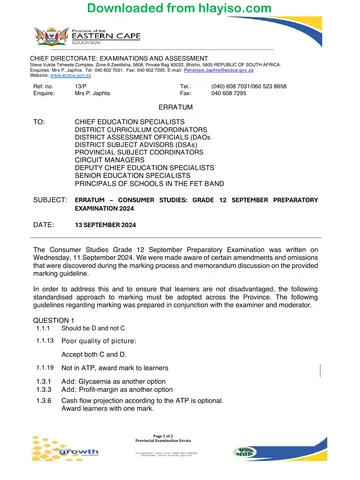
Consumer Studies PAT GR 12 2021 (Food Production) Eng
Grade 12 Consumer Studies practical assessment task from the 2021 (English), 30 pages. Read online or get the free PDF download.
Consumer Studies · Grade 12 · 2021 · English. Practical assessment task, 30 pages. Read online or download the PDF.
- Subject
- Consumer Studies
- Grade
- Grade 12
- Language
- English
- Document type
- Practical assessment task
- Year
- 2021
- Curriculum
- CAPS
- Pages
- 30
- File size
- 971.5 KB
Loading document…
Loading document…
1 of 30
Document textSearch extracted text and jump to a page.
Downloaded from hlayiso.com
Consumer Studies 2 DBE/PAT 2021
NSC (Food Production)
THE PRACTICAL ASSESSMENT TASK FOR CONSUMER STUDIES
FOOD PRODUCTION
1. INTRODUCTION
The 18 Curriculum and Assessment Policy Statement subjects which consists of a
practical component all include a practical assessment task (PAT). These subjects
are:
AGRICULTURE: Agricultural Management Practices, Agricultural Technology
ARTS: Dance Studies, Design, Dramatic Arts, Music, Visual Arts
SCIENCES: Computer Applications Technology, Information Technology;
Technical Sciences; Technical Mathematics
SERVICES: Consumer Studies, Hospitality Studies, Tourism
TECHNOLOGY: Civil Technology, Electrical Technology, Mechanical
Technology and Engineering Graphics and Design
A practical assessment task (PAT) mark is a compulsory component of the final
promotion mark for all candidates offering subjects that have a practical component
and counts 25% (100 marks) of the end-of-the-year examination mark. The PAT is
implemented up to the end of September and also allows for learners to be assessed
on skills they have acquired during the weekly practical lessons and practical
examinations in Grades 10 to 12. It also allows for the assessment of skills that
cannot be assessed in a written format, e.g. test or examination. It is therefore
important that schools ensure that all learners complete the practical assessment
tasks within the stipulated period to ensure that learners are resulted at the end of
the school year. The planning and execution of the PAT differs from subject to
subject.
During the practical assessment task the learner must demonstrate his/her
knowledge and practical ability/skills to produce a variety of quality food
products focusing on suitability for selling.
The practical assessment task for Grade 12 for Consumer Studies, with the
Food Production practical option, consists of ONE practical examination of
THREE (3) HOURS.
Breakdown of the THREE (3) HOURS:
o Two hours and 15 minutes to prepare the products.
o 45 minutes for evaluation, clearing and cleaning.
Learners will perform the practical examination for the PAT individually.
The practical examination for the PAT takes place in Term 3.
2. MARK ALLOCATION
The total allocation of marks for the PAT is 100 marks.
The marks for the PAT form part of the end-of-year assessment in Term 4.
The province will provide separate computerised mark sheets, one for SBA and
one for PAT.
Practical Examination 100
Final mark for PAT 100
Copyright reserved Please turn over
Downloaded from hlayiso.com
Consumer Studies 3 DBE/PAT 2021
NSC (Food Production)
3. REQUIREMENTS FOR THE PRACTICAL EXAMINATIONS
Consumer Studies is an elective subject with five different practical options. If the
school chooses to offer Consumer Studies as a subject and selects the Food
Production practical option, the equipment and funds necessary to conduct the PAT,
as well as the specified number of weekly practical lessons are the responsibility of
the school, as specified in the CAPS document on page 10.
The school has the responsibility to ensure the availability of the following for the
PAT examination:
A suitable training kitchen with the necessary equipment must be available:
a minimum of six stoves (gas/electric); a refrigerator; electricity/gas; sinks with
running hot and cold water and equipment and utensils for preparation and
cooking.
A minimum of R80 to a maximum of R150 per learner for the practical
examination is required to purchase ingredients to make the prescribed
products, besides the funding required for the SBA weekly practical lessons.
One learner per stove.
It is important to adhere to the Covid-19 protocol of social distancing.
A maximum of 6–12 learners are allowed per session, depending on the number
of stoves available in the training kitchen.
Two groups of 6–12 learners can perform the practical examination on the same
day, e.g. from 08:00 to 11:00 and from 12:30 to 15:30.
The teacher needs time between the two sessions to prepare the classroom for
the following group.
Schools with large numbers of learners will need more than one day to complete
this practical examination.
4. REQUIRED TIME FRAME
A time frame of THREE (3) HOURS in total is allocated for the practical examination.
The THREE hours should be allocated as follows:
5 minutes for orientation and settling down.
5 minutes for sanitising the workstation and washing hands.
5 minutes to proceed with the measuring of ingredients.
2 hours for the preparation of the products under examination conditions.
45 minutes for the teacher to do evaluation, to check each workstation to
complete the assessment tools.
5. SETTING THE PRACTICAL EXAMINATIONS
This examination will take place on a date agreed upon with the moderator.
The production process and saleability of products are important assessment
criteria of this practical examination.
Learners should be able to demonstrate all culinary skills and techniques
identified for Grade 12.
The teacher must set a minimum of FOUR different tests that are suitable for
the available budget and resources of the school.
Each test must:
o Include at least TWO dishes
o Have a minimum skills-code weighting of 20 points
o Include a variety of culinary skills and techniques
Copyright reserved Please turn over
Downloaded from hlayiso.com
Consumer Studies 4 DBE/PAT 2021
NSC (Food Production)
Include ONE of the following PER TEST. A product selected for one test may
not be repeated in another test to ensure that a variety of skills and techniques
are tested in each test.
o Yeast product (baked or deep-fried)
o Choux paste
o A gelatine dish (not commercial jelly)
o Home-made short crust pastry for tarts, pies or quiche
o Swiss roll
o Soft meringue, such as lemon meringue pie or queen of bread pudding
o Sugar cookery
The second product may include any appropriate skill or technique as long as
the total skills-code weighting adds up to a minimum of 20 points. The weighting
of the two products will be equal or as near to equal as possible.
A skill may only be allocated a weighting once in the test.
All recipes must:
o Be neatly typed in standard or action format
o Have clear instructions in short sentences and easy language
o Be small, 2–3 portions
o Be suitable for the available budget and other resources
o Include the expected criteria: flavour, texture, appearance
o Be clearly illustrated
NOTE:
Learners choose to either package or plate their final products. The packaging and
label needs to be completed within the seven days after the learners have drawn the
test, before they perform the practical examination.
Learners must bring the label and packaging on the day of the practical examination.
6. PREPARING FOR THE EXAMINATIONS
The teacher is responsible for the following:
Set the dates for the practical examination. Communicate the date to the SMT of
the school to ensure that it does not clash with other school activities.
All the equipment must be in working order and the stoves have to be serviced
and repaired before the start of the practical examination.
Photocopy the tests (recipes and work order) for each learner. It is compulsory
for each learner to work from a recipe.
Prepare the assessment tool provided with the learners' names.
Learners will draw a test ONE week (7 school days) before the date of the
practical examination so that they can prepare.
Calculate the quantities to be purchased according to the number of learners in
Grade 12.
Plan the final shopping list with the estimated prices.
Purchase the ingredients.
Clean, tidy up and sanitise the training kitchen.
Put out the necessary equipment and ingredients for examination.
Learners should not run around during the examination looking for
equipment in the storeroom. All equipment must be readily available at
their workstations.
Prepare a name tag for the last group of learners to assist the moderator with
the identification of candidates.
Copyright reserved Please turn over
Downloaded from hlayiso.com
Consumer Studies 5 DBE/PAT 2021
NSC (Food Production)
7. PERFORMING THE EXAMINATIONS
Practical examination in Term 3: THREE (3) hours
When learners enter the training kitchen (examination room), they will have
5 minutes for orientation and settling down, 5 minutes for sanitising the
workstation and washing their hands and then to proceed with the measuring of
ingredients, before commencing with the practical examination.
Learners performing the same test must be placed at different workstations.
The products should be ready for assessment after 2 hours and 15 minutes.
Learners will lose 2 marks for every 5 minutes late up to a maximum of
20 marks.
Only the teacher, the moderator and the learners may be in the room during the
practical examination.
The teacher must invigilate and assess the learners while they are performing
the practical examination and NO other work may be done in this time.
NO learner may be assisted in any way.
On completion of both products, learners may serve. Learners do not have to
wait until the end of the 2 hours and 15 minutes' period.
Learners are allowed to do final clean-up while the teacher is assessing their
products.
The teacher must complete the assessment tool.
8. EVALUATION
The teacher and external moderator have 45 minutes to evaluate the final
products, inspect the learners' workstations and complete the assessment tool.
While their products are being evaluated on completion of the practical
examination, the learners should tidy and sanitise their workstations and
equipment so that the teacher/moderator may inspect the workstations for the
final allocation of marks.
9. MODERATION OF THE PRACTICAL EXAMINATIONS
9.1 BEFORE the practical examination
The teacher must submit the following to the subject advisor for approval by the end
of March, or earlier, to ensure that the practical examination is of an appropriate
standard:
The tests and relevant recipes indicating the weighting of the techniques
according to the skills code
The proposed date for external on-site moderation for the last group of learners
This date should be negotiated with the subject advisor
The sequence of work of each test
The marking guidelines with the desirable qualities of each product for each test
The planning for the purchases
The checklist signed by the principal
The PAT cannot be done unless it has been approved by the subject advisor.
Copyright reserved Please turn over
Downloaded from hlayiso.com
Consumer Studies 6 DBE/PAT 2021
NSC (Food Production)
9.2 ON THE DAY of the practical examination:
Ensure that learners wash their hands with soap and water, wear their masks
and sanitise their workstations. Adhere to the protocol of social distancing
(1,5 m apart from each other). Always keep extra masks.
During Term 3, a group of 6–12 learners will be externally moderated by the
relevant subject advisor while they are performing the practical examination at
the school.
The teacher must have the following available for the moderator on the day of
moderation:
o The assessment tool of all the learners who finished the practical
examination
o A copy of the completed mark sheet for the weekly practical lessons
o A copy of the four tests the learners will be performing
o A separate set of assessment tools for the moderator to use, with the
names of the learners already written on the assessment tool
Each learner must sign the attendance register before the examination
proceeds.
The moderator will select six (6) candidates at random. These candidates will be
assessed independently from the teacher, while they are performing the
examination. The items produced by these learners are assessed after the
examination for the final PAT mark.
After completing the assessment and consolidation of marks, the moderator will
compare his/her assessment with the assessment of the teacher. If the
moderator finds that the marks of the teacher differ more than 10% from his/her
marks, a block adjustment upwards or downwards should be made based on
the difference.
The table below demonstrates how to determine the difference between the
moderator's marks and teacher's marks to establish whether adjustment is
needed and the margin of adjustment required:
PAT 2
100
Learner's Name *T *M
Learner A 84 69
Learner B 83 70
Learner C 68 53
Learner D 59 44
Learner E 49 40
Learner F 45 40
TOTAL 388 316
AVERAGE MARK = TOTAL ÷ 6 (number of learners) 66 53
DIFFERENCE = 66 (*T) – 53 (*M) 13
ADJUSTMENT DOWNWARDS UPWARDS –3
*T = Teacher; *M = Moderator
Copyright reserved Please turn over
Downloaded from hlayiso.com
Consumer Studies 7 DBE/PAT 2021
NSC (Food Production)
A block adjustment can also be made based on the professional judgement of
the moderator if the practical examination of the school is not of the expected
standard.
The moderator will discuss the outcome and any adjustments with the teacher.
The final moderated marks should then be entered on the computerised mark
sheet.
The marks of all learners will be affected if an adjustment is made.
Copyright reserved Please turn over
Downloaded from hlayiso.com
Consumer Studies 8 DBE/PAT 2021
NSC (Food Production)
SKILLS-CODE WEIGHTING OF TECHNIQUES USED IN FOOD PRODUCTION
Use the following skills-code weighting to choose recipes for the PAT as well as for the
weekly practical lessons.
The skills code indicates the weighting for the techniques and NOT the mark allocation.
The weighting for a specific technique should only be allocated ONCE.
The teacher could add a technique not listed below, after discussing it with the subject
advisor. The teacher and subject advisor should then decide on the weighting for the new
technique.
The weighting is allocated according to the degree of difficulty of the technique.
The total weighting of the techniques for both chosen recipes for the practical examination
in Grade 12 should add up to a minimum of 20 points.
1. Cooking Methods
1.1 Baking: Baking in an unlined tin (e.g. cake) 3
Baking in a lined tin (e.g. cake) 4
Preheating oven and setting correct temperature.
Position of oven rack correct, baking for desired time.
1.2 Baking in a pan of hot water (bain-marie), e.g. baked custard, soufflé, bobotie. 4
1.3 Blind-baking 4
1.4 Blanching 2
1.5 Boiling on stove-top (e.g. rice, pasta, vegetables) 2
1.6 Deep-frying (e.g. chips, doughnuts, vetkoek) 4
1.7 Grilling (e.g. hamburger patties, steak) 3
1.8 Roasting (e.g. vegetables, meat) 3
1.9 Cooking in microwave oven (e.g. custard sauce, white sauce, pasta) (not for heating up 3
milk, food, water)
1.10 Poaching (e.g. eggs) 3
1.11 Pressure cooker used, (e.g. meat and vegetable stew, bean soup) 3
1.12 Sautéing (e.g. onions, green peppers, etc.) 2
1.13 Sealing and browning meat/mince/dry frying bacon 2
1.14 Shallow-frying (e.g. pancakes, crumpets, hamburger patties, fish cakes) 3
1.15 Simmering/Stewing meat/poultry dish with vegetables, dried fruit 3
1.16 Steaming: Double boiler or mixing bowl on saucepan (e.g. fish, egg custard sauce, 3
melting chocolate) (not rice)
2. Gelatine
2.1 Gelatine dish (e.g. moulded salad or dessert) 3
2.2 Gelatine dish made with commercial jelly 2
2.3 Fold in other ingredients, such as whipped cream or grated cucumber, at correct stage 2
2.4 Unmoulding gelatine dish 2
3. Eggs
3.1 Soft meringue (e.g. lemon meringue tart) 3
3.2 Hard meringue (meringues) 3
3.3 Custard base with eggs, (e.g. quiche/milk tart) 2
3.4 Beating and folding in egg whites (e.g. soufflé, milk tart, roulade) 3
4. Yeast
4.1 Preparing yeast batter or yeast dough 4
5 Mixing methods
5.1 Batter (e.g. pancakes, crumpets, fritters, cake, muffins, etc.) 3
5.2 Choux paste 5
5.3 Dough/Pastry, rubbing-in method (e.g. short crust pastry, scones) 3
Copyright reserved Please turn over
Downloaded from hlayiso.com
Consumer Studies 9 DBE/PAT 2021
NSC (Food Production)
6 Preparing ingredients
6.1 Peeling, cutting, slicing, dicing vegetables, (e.g. julienne carrots) 2
6.2 Deboning chicken/chicken breast 2
7 Ready-made food
7.1 Preparing a biscuit crust, (e.g. using Marie biscuits/Tennis biscuits and melted butter) 2
7.2 Using ready-made pastry/phyllo pastry/bread dough 2
8 Sauces and salad dressings
8.1 Cooked sauces (e.g. gravy, custard, coulis, orange sauce, sauce thickened with flour) 2
8.2 Mayonnaise (home-made) 4
8.3 Uncooked home-made salad dressing 2
8.4 Cooked salad dressing 4
8.5 White sauce/cheese sauce, roux method 3
8.6 Hollandaise sauce 3
9 Sugar cookery and home-made sweets
9.1 Caramelisation of sugar (e.g. caramel sauce) 4
9.2 Boiling sugar syrup to soft-ball stage, firm-ball stage, etc. 4
9.3 Manipulating sugar syrup (e.g. beating fudge) 2
9.4 Manipulating sugar syrup to make spun sugar 4
9.5 Cutting sweets (e.g. fudge, marshmallows) into shapes 2
10 Techniques
10.1 Whipping and folding in cream 2
10.2 Butter icing/cream cheese icing – preparing and decorating cupcakes and cakes 3
10.3 Garnishing, advanced (e.g. tomato-/potato-/radish flowers/tuiles/chocolate curls/chocolate 2
leaves/chocolate cups/shaping and decorating with fondant icing/marzipan and other
decorations, etc.)
10.4 Piping/Using a piping bag, piping even shapes 3
10.5 Royal icing (icing sugar and water/lemon juice/egg white – glazing): preparation and use 2
10.6 Preparing and using chocolate ganache (chocolate and cream) 3
10.7 Purée 2
10.8 Shaping of soft dough (e.g. scones, biscuits, doughnuts, bread rolls, koeksisters, 3
croquettes)
10.9 Shaping of stiff dough (e.g. rolling pastry, biscuit dough) 3
10.10 Rolling of Swiss roll/Roulade/Chelsea buns/Swedish tea ring 3
10.11 Lamingtons – making chocolate sauce and dipping, rolling in coconut 3
10.12 Using specialised equipment, (e.g. food processor, blender, pasta machine not electric 2
beater or deep fryer)
11 Any other skills not mentioned (to be used only twice in the same test) 1
Measuring of ingredients can be added here.
Copyright reserved Please turn over
Downloaded from hlayiso.com
Consumer Studies 10 DBE/PAT 2021
NSC (Food Production)
TEACHER PLANNING: GRADE 12 PRACTICAL EXAMINATION
(To be submitted to the subject advisor for moderation at the end of March, or earlier.)
Name:
Name of teacher:
Date(s) and time(s) of examination sessions:
TESTS FOR PAT: GRADE 12 (attach all recipes including the criteria for evaluation and an
illustration of the desired product).
The choice of the illustrations must be clear enough for reproduction for the learners.
Test 1: Total:
Recipe 1: Name: Recipe 2: Name:
Techniques Weighting Techniques Weighting
Total recipe 1: Total recipe 2:
Test 2: Total:
Recipe 1: Name: Recipe 2: Name:
Techniques Weighting Techniques Weighting
Total recipe 1: Total recipe 2:
Test 3: Total:
Recipe 1: Name: Recipe 2: Name:
Techniques Weighting Techniques Weighting
Total recipe 1: Total recipe 2:
Test 4: Total:
Recipe 1: Name: Recipe 2: Name:
Techniques Weighting Techniques Weighting
Total recipe 1: Total recipe 2:
Copyright reserved Please turn over
Downloaded from hlayiso.com
Consumer Studies 11 DBE/PAT 2021
NSC (Food Production)
EXEMPLAR TEACHER PLANNING FOR PURCHASES
(To be submitted to subject advisor for moderation at the end of March or earlier)
Total Groups Number of Number of Number Dates Time
learners learners tests of
per group learners
per test
1 6 4 2 10/09/21 08:00–11:00
19 2 6 4 2 10/09/21 12:30–15:30
3 7 4 2 11/09/21 08:00–11:00
Test Recipe 1: Quiche Lorraine Recipe 2: Queen Fritters
1 Ingredients 1 x6 Ingredients 1 x6
Salticrax biscuits ¾ pack 5 pk Cake flour 125 mℓ 750 mℓ
Margarine 50 mℓ/g 300 g Margarine 62,5 mℓ (60 360 g
g)
Bacon 100 g 600 g Castor sugar 50 mℓ 300 mℓ
Cheddar cheese, 250 mℓ 1 500 mℓ Salt pinch Packet
grated
Eggs 4 24 Eggs 2 12
Cream, long-life 125 mℓ 750 mℓ Whipped cream 100 mℓ 600 mℓ
Milk 175 mℓ 1050 mℓ Paper towels 1 roll
Chicken stock cube ½ 3 Oil for deep frying 5 litres
Spray & Cook 1 tin
Copyright reserved Please turn over
Downloaded from hlayiso.com
Consumer Studies 12 DBE/PAT 2021
NSC (Food Production)
TEACHER PLANNING FOR PURCHASES
(To be submitted to subject advisor for moderation at the end of March or earlier.)
Total Groups Number of learners Number Number of learners Dates Time
learners per group of tests per test
,
Test Recipe 1: Recipe 2:
1 Ingredients 1 x Ingredients 1 x
Test Recipe 1: Recipe 2:
2 Ingredients 1 x Ingredients 1 x
Test Recipe 1: Recipe 2:
3 Ingredients 1 x Ingredients 1 x
Test Recipe 1: Recipe 2:
4 Ingredients 1 x Ingredients 1 x
Copyright reserved Please turn over
Downloaded from hlayiso.com
Consumer Studies 13 DBE/PAT 2021
NSC (Food Production)
TEACHER'S SHOPPING LIST
Ingredients Test 1 Test 2 Test 3 Test 4 Total Approximate
(purchase in cost of
g/kg) quantities
needed
Copyright reserved Please turn over
Downloaded from hlayiso.com
Consumer Studies 14 DBE/PAT 2021
NSC (Food Production)
CONSUMER STUDIES
PRACTICAL ASSESSMENT TASK
FOOD PRODUCTION
CHECKLIST FOR PLANNING (TO BE HANDED IN FOR MODERATION)
SCHOOL
TEACHER
PRINCIPAL
DATE SUBMITTED
Dates of all PAT sessions Proposed moderation date Approved moderation date
CRITERIA YES/NO COMMENTS BY MODERATOR
Four tests
Each test consists of at least 2 products
Each test includes a variety of techniques and has a
skills-code weighting of 20 points
All recipes attached/included, neatly typed in the
correct format
All recipes are in metric form
All recipes are for a maximum of 2–3 portions
Recipes clearly illustrated
(Illustrations are clear for printing)
Marking guidelines with the desirable qualities for
each product/recipe is included
Order of work/time schedule developed for each
of the four tests
Planning for purchases of consumables is attached
Include ONE of the following per test:
Yeast product (baked/deep fried), choux paste,
a gelatine dish (not commercial jelly), home-made
short crust pastry for tarts, pies or quiche,
Swiss roll, soft meringue, such as lemon meringue
pie or queen of bread pudding, sugar cookery
APPROVED/NOT APPROVED RESUBMISSION DATE: _________________
Signatures:
TEACHER: _______________________ DATE: _____________________
PRINCIPAL: _______________________ DATE: _____________________
MODERATOR: _______________________ DATE: _____________________
Copyright reserved Please turn over
Downloaded from hlayiso.com
Consumer Studies 15 DBE/PAT 2021
NSC (Food Production)
ASSESSMENT TOOL FOR FOOD PRACTICAL ASSESSMENT TASK GRADE 12
NAMES AND SURNAMES OF LEARNERS
NAME OF SCHOOL____________________________________
DATE _________________
TEACHER ____________________________
MODERATOR____________________________
PRACTICAL EXAMINATION
1. PRACTICAL SKILLS AND TECHNIQUES
1.1 Interpretation of the recipe 4
Follow recipe instructions accurately 2
Understand terminology for implementation 2
1.2 Accurate implementation of techniques 20
Correct measuring of quantities for both recipes 4
Correct techniques applied for production of recipe 1 8
Correct techniques applied for production of recipe 2 8
1.3 Correct handling of utensils and equipment 8
Using correct utensils/equipment to prepare and cook food 3
Correct time and temperatures for preparation/cooking 2
Safe use of utensils, equipment/stove 3
1.4 Economical production of the product(s) 8
Regular quality control checkpoints (during measuring and 2
production)
Economical use of ingredients, no wastage of ingredients, bowls
scraped clean 2
Works independently, silently, not distracting others, without asking
any questions 2
Efficient use and management of time 2
2. HYGIENE AND NEATNESS
2.1 Workstation and equipment during practical examination 8
Workstation neat and well organised 2
Water for dishwashing replaced regularly (warm water, rinse) 2
Dishcloths clean, available and not lying around 2
Works hygienically and safely 2
2.2 Personal appearance 3
Appropriately dressed with protective clothing (school uniform and 1
apron)
Nails clean and short, hair completely covered 1
Hands washed and sanitised on entry of class and at regular 1
intervals
2.3 Neatness of work station after practical examination 4
Work station, sink and stove clean 1
Utensils cleaned and packed away in correct storage space 2
Waste removed, bins clean 1
Copyright reserved Please turn over
Downloaded from hlayiso.com
Consumer Studies 16 DBE/PAT 2021
NSC (Food Production)
ASSESSMENT TOOL FOR FOOD PRACTICAL ASSESSMENT TASK GRADE 12 (cont.)
NAMES AND SURNAMES OF LEARNERS
3. SUITABILITY FOR SELLING
3.1 Packaging Plating 4
Protecting the product Appropriate for the type of product 1
Suitable for product Correct size of plate for the products 1
Cost effective Creativity 1
Consumer appeal Consumer appeal 1
3.2 Label 5
List of ingredients used 1
Shows creativity 1
Manufacturer's name/physical address/contact details 1
Mass or volume/Price 1
Allergens/Warnings 1
3.3 Products created adhere to specifications 36
All portions/products in batch the same size (Product 1) 2
All portions/products in batch the same size (Product 2) 2
Appearance of final products (Product 1) (use the scale below) 5
Appearance of final products (Product 2) (use the scale below) 5
Texture of final products (Product 1) 3
Texture of final products (Product 2) 3
Flavour of final products (Product 1) 3
Flavour of final products (Product 2) 3
Suitability for selling (Product 1) (use the scale below) 5
Suitability for selling (Product 2) (use the scale below) 5
TOTAL 100
Late penalties: subtract 2 marks for every 5 minutes late up to a
maximum of 20 marks
TOTAL 100
APPEARANCE OF FINAL PRODUCT/SUITABILITY FOR SELLING:
0–1 Unacceptable, does not meet the requirements, cannot sell
2 Poor, meets some requirements, will not sell
3 Average, meets most requirements, should sell
4 Good, meets all requirements, should sell well
5 Excellent, exceeds all requirements, will sell very well
NOTE:
Learners choose to either package or plate their final products. The packaging and label needs
to be completed within the seven days after the learners have drawn before they do the
practical examination. Learners must bring the label and packaging on the day of the practical
examination.
Copyright reserved Please turn over
Downloaded from hlayiso.com
Consumer Studies 17 DBE/PAT 2021
NSC (Food Production)
EXAMPLES OF TESTS FOR THE PRACTICAL ASSESSMENT TASK
SWISS ROLL
Ingredients:
Serves: 6
100 mℓ cake flour
½ mℓ salt
4 eggs
100 mℓ castor sugar
5 mℓ vanilla essence
100 mℓ apricot jam
Method:
1. Prepare a pan covered with wax paper/paper case (17 cm x 23 cm) beforehand.
2. Preheat the oven to 180 °C.
3. Sieve the cake flour and the salt together.
4. Whisk eggs and castor sugar till pale and thick (over warm water).
5. Add the vanilla essence.
6. Fold the sifted dry ingredients lightly into the egg mixture.
7. Spread the mixture into the pan covered with wax paper/paper case.
8. Bake in preheated oven for 7–10 minutes.
9. Sprinkle a damp, clean tea towel with granulated sugar.
10. When the cake is ready, turn immediately on sugared cloth, trim edges ½ cm from the edge.
11. Roll by using the cloth.
12. Leave to cool.
13. Unroll and spread jam on. Roll up again and leave to cool completely.
IDEAL CHARACTERISTICS:
APPEARANCE TEXTURE FLAVOUR
Swiss Roll Light brown colour Fine crumb, small Delicate pleasant flavour
Cake layer 10 mm cells No raw egg taste
Tightly rolled Delicate crumb
Neat, round shape Not sticky
Not cracked/broken
(5) (3) (3)
Copyright reserved Please turn over
Downloaded from hlayiso.com
Consumer Studies 18 DBE/PAT 2021
NSC (Food Production)
FUDGE
Ingredients:
Yield: 12 blocks
375 mℓ sugar
125 mℓ (1/2 can) condensed milk
62,5 mℓ margarine
62,5 mℓ water
10 mℓ golden syrup
1 mℓ cream of tartar
3 mℓ vanilla essence
Method:
1. Add all the ingredients, except the condensed milk and vanilla essence, in a heavy based
saucepan and stir over low heat. (Make sure all the sugar has dissolved before the mixture boils.)
2. Boil for 2 minutes, remove from the heat and add the condensed milk.
3. Brush the sides of the saucepan with hot water to dissolve sugar crystals.
4. Turn down the heat and stir occasionally (every 2 minutes) to prevent the mixture from burning.
5. Let the fudge boil until it reaches the soft ball stage (112 °C).
6. Remove the mixture from the heat and place on a damp cloth to stop the cooking process.
7. Whisk the mixture until it shows signs of setting.
8. Pour into a greased pan (17 cm x 15 cm) (an ice-cream dish works well).
9. Allow to set partly and mark into equal blocks.
10. Break into pieces once completely set.
IDEAL CHARACTERISTICS:
APPEARANCE TEXTURE FLAVOUR
Fudge Caramel brown colour Smooth, fine granules Fine delicate flavour
Smooth surface No undissolved/large Smooth on the palate
Well set sugar crystals present
All blocks the same size
(5) (3) (3)
Copyright reserved Please turn over
Downloaded from hlayiso.com
Consumer Studies 19 DBE/PAT 2021
NSC (Food Production)
QUEEN OF BREAD PUDDING
Ingredients:
Serves: 2
4 slices white bread
±80 mℓ butter/jam
2 eggs separated
30 mℓ castor sugar
250 mℓ milk
2 mℓ cinnamon
2 mℓ vanilla essence
25 mℓ raisins (optional)
Method:
1. Preheat the oven to 180 °C.
2. Spread the bread with butter and jam.
3. Cut the bread into quarters and pack tightly into an oven-proof dish. (±10 cm x 15 cm).
4. Beat the egg yolks, cinnamon, vanilla essence and milk together and pour over bread.
5. Bake for 10–15 minutes.
6. Meanwhile, whisk the egg whites while adding the castor sugar little by little until the stiff peak
stage.
7. Pipe/Spoon the meringue on top of the bread mixture.
8. Bake until the meringue has a beautiful brown colour (approximately 10 minutes).
IDEAL CHARACTERISTICS:
APPEARANCE TEXTURE FLAVOUR
Queen of bread Soft meringue on top Light meringue, not Light cinnamon
pudding Lightly browned granular, crisp outer flavour
Meringue covers the Custard set Meringue not too
entire top of the dish sweet
(5) (3) (3)
Copyright reserved Please turn over
Downloaded from hlayiso.com
Consumer Studies 20 DBE/PAT 2021
NSC (Food Production)
DOUGHNUTS
Ingredients:
Yield: 6–8
30 mℓ lukewarm water
30 mℓ lukewarm milk
20 mℓ oil
30 mℓ beaten egg
0,5 mℓ salt
12,5 mℓ sugar
10 g instant yeast
250 mℓ cake flour
± 500 mℓ oil for deep frying
Glacé Icing
100 mℓ sifted icing sugar
25 mℓ cocoa (optional) or chocolate
Food colouring as needed
12,5 mℓ boiling water
Method:
1. Mix the lukewarm water, milk and oil together.
2. Beat the egg and sugar together and add to the above liquid.
3. Sift the flour and salt in a large bowl and sprinkle over the yeast.
4. Add the liquid to the flour mixture to form a soft, kneadable dough. (Do not add all the liquid at
the same time to prevent the dough from being too wet.)
5. Knead the dough for 10 minutes until it is soft and elastic.
6. Place the dough in a bowl that has been greased with oil, and cover with cling wrap.
7. Allow the dough to double in size in a warm place (± 20–30 minutes).
8. Knock down, form the doughnuts or roll out the dough 1 cm thick and cut the doughnuts with a
doughnut cutter.
9. Place the doughnuts on wax paper and allow to rise (cover with greased cling wrap) in a warm
place until double the volume (± 20–30 minutes).
10. Fry in deep oil until golden brown (use a small to medium saucepan to save oil).
11. Drain on absorbent paper.
12. Once cooled, coat/drizzle with the glacé icing.
IDEAL CHARACTERISTICS:
APPEARANCE TEXTURE FLAVOUR
Doughnuts Well risen and light in mass in Light in mass Pleasant nutty
relation to size Elastic crumb flavour
Golden brown Moist but not doughy No strong yeast
Neatly shaped/same size flavour
Cells are small, regular Delicate, and not
(5) (3) greasy (3)
Copyright reserved Please turn over
Downloaded from hlayiso.com
Consumer Studies 21 DBE/PAT 2021
NSC (Food Production)
PANNACOTTA
Ingredients:
Serves: 2
125 mℓ cream
125 mℓ milk
50 mℓ sugar
5 mℓ gelatine
25 mℓ water
5 mℓ vanilla essence
Fruit to decorate
Method:
1. Combine the cream, milk and sugar in a heavy bottom saucepan and bring to the boil.
2. Boil for 4-5 minutes.
3. Turn off the heat, add the vanilla essence and set aside.
4. In a small glass bowl mix the gelatine and cold water.
5. Allow to hydrate.
6. Melt hydrated gelatine over a pot of hot water or place in microwave for 20 seconds to dissolve.
Do not allow to boil.
7. Stir the gelatine liquid into the vanilla cream mixture. Stir gently.
8. Pour prepared mixture into small dessert bowl (ramekins), or a small pannacotta mould or tall
dessert glass.
9. Cool down until it reaches room temperature.
10. Refrigerate for at least an hour until set.
11. Decorate with fresh fruit.
IDEAL CHARACTERISTICS:
APPEARANCE TEXTURE FLAVOUR
Pannacotta Well set, but wobbly Smooth, creamy, velvety Delicate creamy
Attractively/appropriately texture. vanilla flavour
decorated No gelatine strings Characteristic of fruit
evident used to decorate
(5) (3) (3)
Copyright reserved Please turn over
Downloaded from hlayiso.com
Consumer Studies 22 DBE/PAT 2021
NSC (Food Production)
CHOCOLATE ÉCLAIRS
Ingredients:
Yield: 4
Choux Paste:
65 mℓ water
30 mℓ margarine
65 mℓ cake flour
1 mℓ salt
1 jumbo/extra-large egg
Filling:
100 mℓ cream
10 mℓ castor sugar
Glaze:
100 mℓ icing sugar
25 mℓ cocoa
12,5 mℓ boiling water
Method:
Choux Paste:
1. Preheat the oven to 200 °C.
2. Prepare the baking tray (lightly splatter some water drops on the baking tray).
3. Place the butter and the water in a saucepan and heat, with the lid on, until the butter has melted
and the mixture starts to boil. Keep the lid on and boil for a few seconds (more or less
60 seconds).
4. Keep on the heat, add all the sifted flour at once, beat with a wooden spoon and mix until the
mixture leaves the sides of the saucepan and forms a ball.
5. Keep on the heat for another 30 seconds until all the starch has cooked.
6. Remove from the heat.
7. Allow to cool to lukewarm/60 °C.
8. Gradually beat in the egg, beat well after each addition. It should be glossy and the consistency of
a dropping batter.
9. Shape the éclairs onto a baking tray (use a piping bag).
10. Bake in the oven at 220 °C for 10 minutes or until the éclairs have risen sufficiently. Turn down the
heat to 180 °C and bake for another ±10 to 15 minutes until crisp and with a light golden brown
colour. Éclairs must sound hollow when tapped.
11. After removing from the oven, immediately make a small hole at the base of each éclairs. This will
allow the steam to escape and prevent the éclairs from becoming soggy. Place back in a turned
off oven to dry out.
12. Allow to cool on a cooling rack.
Filling and Glazing:
1. Beat the cream to soft peak stage, add the castor sugar and mix well.
2. Fill éclairs with whipped cream and place on a cooling rack.
3. Mix the ingredients for the glaze and drop/spread over the éclairs. Leave to set.
Copyright reserved Please turn over
Downloaded from hlayiso.com
Consumer Studies 23 DBE/PAT 2021
NSC (Food Production)
IDEAL CHARACTERISTICS:
APPEARANCE TEXTURE FLAVOUR
Chocolate Éclairs Well risen Crust: Crisp but not Crust: Pleasant
Golden brown crust hard flavour
All the same size Not soggy Filling: Pleasant,
Chocolate set and Filling: Soft and moist sweet
glossy on inside
(5) (3) (3)
Copyright reserved Please turn over
Downloaded from hlayiso.com
Consumer Studies 24 DBE/PAT 2021
NSC (Food Production)
BUTTERNUT AND FETA QUICHE
Ingredients:
Yield: 6
Short Crust Pastry:
250 mℓ cake flour
125 mℓ margarine, cubed
1 mℓ salt
10 mℓ cold water
1 egg yolk
5 mℓ lemon juice
Filling:
¼ onion sliced
125 mℓ cubed butternut
5 mℓ oil
5 mℓ brown sugar
2 mℓ cumin seeds
25 g feta cheese
10 mℓ castor sugar
Egg Custard:
125 mℓ cream (or 75 mℓ cream and 50 mℓ milk for a lighter option)
2 whole eggs
Salt and pepper for seasoning
Method:
Short Crust Pastry:
1. Preheat the oven to 180 °C.
2. Prepare 6 small quiche tins/disposable aluminium pie cases.
3. Prepare wax paper and baking weights to blind bake the pastry.
4. Sift the flour and salt together and rub the margarine into the flour mixture until it resembles
bread crumbs.
5. Mix the egg, water and lemon juice together.
6. Add the egg mixture a little at a time to flour mixture. Stop adding more liquid as soon as the
pastry is formed.
7. Cover the pastry with cling wrap.
8. Place the dough in the refrigerator for at least 15–30 minutes.
9. Roll out the pastry and line the tins/cases.
10. Prick the base with a fork.
11. Place in the refrigerator for 15 minutes.
12. Bake blind for 10 minutes.
13. Remove baking weights and bake until base is cooked through.
14. Cool down in baking tin on a cooling rack.
Copyright reserved Please turn over
Downloaded from hlayiso.com
Consumer Studies 25 DBE/PAT 2021
NSC (Food Production)
Filling:
1. Sauté the onion in the oil and set aside.
2. Place the butternut on a roasting tray.
3. Sprinkle the sugar and cumin seeds over. Sprinkle with oil.
4. Roast until al dente at 180 °C for approximately 10 minutes.
5. Spread the onion on the baked pastry crusts.
6. Place the roasted butternut and feta cubes on top of the onion.
7. Whisk the eggs and cream/milk together and season.
8. Pour the egg mixture over the vegetable filling.
9. Bake in a preheated oven at 180 °C on a preheated baking tray until the custard is just set
IDEAL CHARACTERISTICS:
APPEARANCE TEXTURE FLAVOUR
Butternut and Feta Golden brown crust, Crust: Crisp but not Crust: Pleasant
Quiche Crust not broken at hard flavour
the edges, even Not soggy Filling: characteristic
throughout Filling: Soft and moist of the butternut and
All the filling evenly on inside not runny cumin
distributed throughout
(5) (3) (3)
Copyright reserved Please turn over
Downloaded from hlayiso.com
Consumer Studies 26 DBE/PAT 2021
NSC (Food Production)
PANCAKES WITH SAVOURY FILLING
Ingredients:
Yield: 4–6
Pancakes:
125 mℓ cake flour
1 mℓ baking powder
200 mℓ milk
1 large egg
15 mℓ sunflower oil
Method:
1. Sift the dry ingredients together.
2. Whisk the egg, milk and oil together.
3. Mix the liquid mixture with the dry ingredients to form a smooth batter.
4. Allow the batter to stand for at least 30 minutes (pour batter into a jug).
5. Heat a frying pan over medium heat.
6. Pour a little oil into the frying pan (just enough to coat the base of the pan).
7. Pour enough batter into the frying pan to coat the base of the pan.
8. Fry until bubbles form on the surface of the pancake. The pancake pulls away from the side of
the pan and the edges become dry and start to curl.
9. Turn over with a spatula or egg lifter and fry the other side (approximately 1 minute).
10. Place the pancakes on a plate. Keep the pancakes warm by placing the plate over a saucepan
with boiling water on the stove.
Filling:
½ onion
3 spinach leaves
4 mushrooms
2 rashers of bacon/macon/1 Vienna
30 mℓ (30 g) margarine
30 mℓ cake flour
250 mℓ milk
30 g cheddar cheese (grated)
Salt and pepper to taste
Copyright reserved Please turn over
Downloaded from hlayiso.com
Consumer Studies 27 DBE/PAT 2021
NSC (Food Production)
Method:
1. Chop the onion, spinach leaves and mushrooms.
2. Sauté the onion.
3. Add the spinach leaves and mushrooms and fry until cooked.
4. Place aside.
5. Slice the bacon/macon/Vienna.
6. Melt the margarine in a saucepan.
7. Stir the cake flour into the melted margarine until all the cake flour is covered with the margarine.
8. Remove the saucepan from the heat, add the milk gradually and stir with a wooden spoon to mix
well.
9. Return the saucepan to the heat and continue stirring over moderate heat until the white sauce
reaches boiling point.
10. Simmer gently for 2–3 minutes to ensure that the sauce is well-cooked and does not have a raw
and floury flavour.
11. Remove the saucepan from the heat.
12. Season with salt and pepper.
13. Stir the cheese into the white sauce.
14. Add the onion, spinach, mushrooms and bacon/macon/Vienna to the white sauce.
15. Spoon the filling into the pancakes.
16. Roll or fold the pancakes.
17. Serve warm.
IDEAL CHARACTERISTICS:
APPEARANCE TEXTURE FLAVOUR
Pancakes with a Thin, flat and round Pancakes: Savoury flavour
savoury filling with same thickness Soft and not doughy Pleasant blend of
throughout No dry edges ingredients used in the
Even golden brown No lumps present filling
colour, no dark spots Filling:
No cracked edges No lumps
Neatly folded or rolled All ingredients cooked
and tender
(5) (3) (3)
Copyright reserved Please turn over
Downloaded from hlayiso.com
Consumer Studies 28 DBE/PAT 2021
NSC (Food Production)
SKILLS-CODE WEIGHTING OF TECHNIQUES USED IN THE TESTS FOR THE PAT
Swiss Roll and Fudge
Recipe 1: Name: Swiss roll Recipe 2: Name: Fudge
Techniques Weighting Techniques Weighting
5.1 Swiss roll batter 3 9.2 Boiling sugar syrup 4
1.1 Baking in a lined tin 4 9.3 Manipulating sugar syrup 2
10.10 Rolling Swiss roll 3 9.5 Cutting squares 2
11 Spreading jam 1 11 Measuring 1
Total recipe 1 11 Total recipe 2 9
Total 20
Queen of Bread Puddings and Doughnuts
Recipe 1: Name: Queen of Bread Pudding Recipe 2: Name: Doughnuts
Techniques Weighting Techniques Weighting
3.3 Egg custard 2 4.1 Yeast dough 4
3.1 Soft meringue 3 10.8 Shaping the dough 3
10.4 Using a piping bag/tube 3 1.6 Deep-frying 4
1.1 Baking in an unlined tin 3 10.5 Glacé icing 2
Total recipe 1 11 Total recipe 2 13
Total 24
Pannacotta and Chocolate Éclairs
Recipe 1: Name: Pannacotta Recipe 2: Name: Chocolate Éclairs
Techniques Weighting Techniques Weighting
1.5 Boiling 2 5.2 Choux paste 5
2.1 Gelatine 3 10.4 Shaping/piping 3
10.1 Beating and folding-in 2 1.1 Baking in an unlined tin 3
cream
10.7 Puree 2 10.5 Glaze 2
Total recipe 1 9 Total recipe 2 13
Total 22
Butternut and Feta Quiche and Pancakes with Savoury Filling
Recipe 1: Name: Butternut Quiche Recipe 2: Name: Pancakes with Savoury Filling
Techniques Weighting Techniques Weighting
5.3 Rubbing in 3 5.1 Batter 3
1.3 Baking blind 4 8.5 White sauce (roux method) 3
1.8 Roasting 3 1.14 Shallow frying 3
3.3 Egg custard 2 1.12 Sauté 2
Total recipe 1 12 Total recipe 2 11
Total 23
Copyright reserved Please turn over
Downloaded from hlayiso.com
Consumer Studies 29 DBE/PAT 2021
NSC (Food Production)
ORDER OF WORK AND TIME ALLOCATION
Time Allocation Swiss Roll and Fudge
Time Minutes Order of work
08:00–08:25 25 min Prepare the fudge.
Allow to boil.
Stir every 2 minutes.
08:25–08:35 10 min Clean up.
08:35–08:50 15 min Beat the fudge mixture off the heat.
Pour into the pan.
Allow to set.
08:50–09:10 20 min Preheat the oven to 180 °C.
Prepare the Swiss roll batter.
Bake.
09:10–09:20 10 min Prepare the cloth for rolling.
Roll the Swiss roll.
Leave to cool.
09:20–09:30 10 min Mark the fudge into squares.
09:30–09:40 10 min Clean up.
09:40–09:55 15 min Unroll the Swiss Roll.
Spread with jam and roll up again
Cut the fudge into squares
09:55–10:00 5 min Serve both products.
TOTAL TIME: TOTAL TIME:
2 hours 120 minutes
Time Allocation Queen of Bread Pudding and Doughnuts
Time Minutes Order of work
08:00–08:30 30 min Prepare the doughnut dough.
Cover the dough and leave to rise/proof.
08:30–08:35 5 min Clean up.
08:35–08:50 15 min Preheat the oven to 180 °C.
Prepare the queen of bread pudding and bake without the
meringue.
08:50–09:05 15 min Knock down the doughnut dough.
Shape the doughnuts and allow to rise until double its
size.
09:05–09:15 10 min Clean up.
09:15–09:25 10 min Prepare the meringue, spread over the pudding and bake.
09:25–09:40 15 min Fry the doughnuts, allow to cool.
09:40–09:50 10 min Prepare glacé icing and decorate the doughnuts.
09:50–10:00 10 min Serve both products
TOTAL TIME: TOTAL TIME:
2 hours 120 minutes
Copyright reserved Please turn over
Downloaded from hlayiso.com
Consumer Studies 30 DBE/PAT 2021
NSC (Food Production)
Time Allocation Pannacotta and Chocolate Éclairs
Time Minutes Order of work
08:00–08:25 25 min Hydrate gelatine, prepare the pannacotta and place in the
fridge to set.
08:25–08:35 10 min Clean up.
08:35–08:45 10 min Preheat the oven to 200 °C.
Prepare choux paste and allow to cool.
08:45–08:55 10 min Clean up.
08:55–09:10 15 min Complete the choux paste and shape the éclairs.
Place in oven to bake.
09:10–09:25 15 min Prepare decoration for the pannacotta.
Beat the cream and prepare the chocolate glaze.
09:25–09:30 5 min Clean up.
09:30–09:45 15 min Fill the éclairs with cream and decorate with chocolate glaze.
09:45–09:50 5 min Remove pannacotta from fridge and decorate.
09:50–10:00 10 min Serve both products.
TOTAL TIME: TOTAL TIME:
2 hours 120 minutes
Time Allocation Butternut Quiche and Pancakes with Savoury Filling
Time Minutes Order of work
08:00–08:25 25 min Prepare the pastry and refrigerate.
08:25–08:35 10 min Clean up.
08:35–08:50 15 min Prepare pancake batter and set aside.
08:50–09:05 15 min Roll out pastry, line pans with the pastry and allow pastry to
rest in refrigerator.
09:05–09:20 15 min Roast butternut and prepare quiche filling.
09:20–09:30 10 min Complete the quiche and bake.
09:30–09:40 10 min Clean up.
09:40-09:50 10 min Prepare pancake filling.
09:50–09:55 5 min Fill the pancakes and roll or fold.
09:55–10:00 5 min Serve both products warm.
TOTAL TIME: TOTAL TIME:
2 hours 120 minutes
Copyright reserved
Study this subject
Notes, quizzes and topic questions for Grade 12 Consumer Studies.
- Grade 12 Consumer Studies notes
CAPS revision notes with worked examples.
- Consumer Studies questions by topic
Past exam questions sorted by CAPS topic, with memos where available.
- All Grade 12 Consumer Studies past papers
Past papers by year, with memos where available.
- Grade 12 Practical assessment tasks
More Consumer Studies and other subjects in this collection.
Recommended for this subject
More papers and memos for this grade and subject.
Practical assessment task
Consumer Studies PAT GR 12 2022 (Food Production) Eng
Annual teaching plan
Gr 12 Con Stu ATP 2023 24
Memorandum
Consumer Studies Grade 12 Eastern Cape Mock 2025 Memo
Question paper
Consumer Studies Grade 12 Eastern Cape Mock 2025 Question Paper
Memorandum
Consumer Studies Grade 12 NSC June 2025 Memo (English)
Question paper
Consumer Studies Grade 12 NSC November 2025 Question Paper
Related documents
Memorandum
Consumer Studies Grade 12 Eastern Cape Mock 2021 Memo (English)
Question paper
Consumer Studies Grade 12 Eastern Cape Mock 2021 QP (Eng)
Memorandum
Consumer Studies Grade 12 Eastern Cape Prelim 2024 Memo (English)
Question paper
Consumer Studies Grade 12 Eastern Cape Prelim 2024 QP (Eng)
Memorandum
Consumer Studies Grade 12 Eastern Cape Mock 2023 Memo (English)
Question paper
Consumer Studies Grade 12 Eastern Cape Mock 2023 QP (Eng)
More from Grade 12 Consumer Studies
Errata
Consumer Studies Grade 12 Eastern Cape Prelim 2024 Errata
Question paper
Consumer Studies Grade 12 November 2024 NSC Question Paper
Question paper
Consumer Studies Grade 12 November 2024 NSC Question Paper
Question paper
Consumer Studies Grade 12 November 2024 NSC MG Question Paper
Question paper
Consumer Studies Grade 12 NSC June 2023 Question Paper
Question paper