
GRAAD 12
SENIOR CERTIFICATE EXAMINATIONS/
NATIONAL SENIOR CERTIFICATE EXAMINATIONS
CONSUMER STUDIES
MAY/JUNE 2025
MARKING GUIDELINES
MARKS: 200
These marking guidelines consist of 19 pages.
Copyright reserved Please turn over
Skip to contentAll 2025 papers 
View all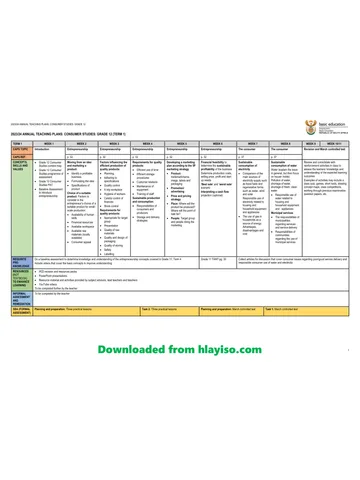
Consumer Studies Grade 12 NSC June 2025 Memo (English)
Grade 12 Consumer Studies memorandum from the NSC June Exam 2025 (English), 19 pages. Read online or download the free PDF.
Consumer Studies · Grade 12 · NSC June Exam · 2025 · English. Memorandum, 19 pages. Read online or download the PDF.
- Subject
- Consumer Studies
- Grade
- Grade 12
- Language
- English
- Document type
- Memorandum
- Year
- 2025
- Exam period
- NSC June Exam
- Curriculum
- CAPS
- Pages
- 19
- File size
- 584.6 KB
Free to read online, no sign-up needed
Loading document…
Loading document…
1 of 19
This exam
NSC June Exam 2025
- Other filesQuestion paper · AfrMemo · Eng
Document textSearch extracted text and jump to a page.
Consumer Studies 2 DBE/May/June 2025
SC/NSC Marking Guidelines
SECTION A: SHORT QUESTIONS
QUESTION 1
1.1 1.1.1 C Remembering, easy (Focus, p.156; Successful, p.173) (1)
1.1.2 D Remembering, easy (Focus, p.163; Successful, p.180) (1)
1.1.3 B Understanding, moderate (Focus, p.162; Successful,
p.179) (1)
1.1.4 C Remembering, easy (Focus, p.171; Successful, p.191) (1)
1.1.5 D Understanding, moderate (Focus, p.157; Successful,
p.174) (1)
1.1.6 D Remembering, easy (Focus, p.93; Successful, p.113) (1)
1.1.7 B Understanding, moderate (Focus, p.104; Successful, (1)
p.126)
1.1.8 C Understanding, easy (Focus, p.76; Successful, p.90) (1)
1.1.9 C Understanding, moderate (Focus, p.89; Successful, p.103) (1)
1.1.10 A Applying, moderate (Focus, p.73; Successful, p.82) (1)
1.1.11 D Applying, moderate (Focus, p.49; Successful, p.51) (1)
1.1.12 B Understanding, easy (Grade 11) (1)
1.1.13 C Applying, easy (Focus, p.64; Successful, p.72) (1)
1.1.14 A Understanding, moderate (Focus, p.136; Successful,
p.154) (1)
1.1.15 C Understanding, easy (Focus, p.122; Successful, p.140) (1)
1.1.16 D Remembering, moderate (Focus, p.25; Successful,
p.25) (1)
1.1.17 B Understanding, moderate (Focus, p.18; Successful,
p.22) (1)
1.1.18 C Understanding, easy (Focus, p.19; Successful, p.23) (1)
1.1.19 D Understanding, moderate (Focus, p.21; Successful,
p.24) (1)
1.1.20 B Understanding, moderate (Focus, p.27; Successful,
p.26) (1)
Copyright reserved Please turn over
Consumer Studies 3 DBE/May/June 2025
SC/NSC Marking Guidelines
1.2 1.2.1 Cooling off (period) (1)
1.2.2 Contract (1)
1.2.3 Guarantee (1)
1.2.4 Grey goods/ parallel imports (1)
Remembering, easy (Focus, p.155, 157-158; Successful, p.169, 173, 175-176)
1.3 A
C
E
H (Any order) (4)
Remembering, moderate (Focus, p.103; Successful, p.123-124)
1.4 1.4.1 C
1.4.2 F
1.4.3 A
1.4.4 B (4)
Remembering, moderate (Focus, p.117, 122; Successful, p.137, 139 -140)
1.5 B
C
E (Any order) (3)
Understanding, moderate (Focus, p.54-55; Successful, p.62)
1.6 1.6.1 D
1.6.2 G
1.6.3 F
1.6.4 A
1.6.5 B (5)
Understanding, moderate (Focus, p.29-34; Successful, p.28-33)
TOTAL SECTION A: 40
Copyright reserved Please turn over
Consumer Studies 4 DBE/May/June 2025
SC/NSC Marking Guidelines
SECTION B: LONG QUESTIONS
QUESTION 2: THE CONSUMER
2.1 Name the tool/ instrument used to measure changes in the cost of goods
and services over a specific period of time.
Consumer Price index/ CPI (1)
Remembering, easy (Focus, p.167; Successful, p.185)
2.2 Give TWO examples of EACH of the following taxes paid by consumers.
2.2.1 Direct tax
• Income tax1
• Pay as you earn (PAYE)2
• Provisional tax3
• Property/ rates and taxes4
• Capital gains tax5
• Donations tax6 (Any 2) (2)
Remembering, easy (Focus, p.164; Successful, p.181)
NOTE: A description of the type of tax must be allocated a mark.
2.2.2 Indirect tax
• VAT1
• Excise duty/ Sin tax2
• Fuel levy3
• Licenses (Motor vehicle/ fishing/ hunting/ TV)4
• Air passenger tax5
• Environmental levy6
• Estate duty7
• Dividends tax8
• Import duty9
• Sugar tax10 (Any 2) (2)
Remembering, easy (Focus, p.164; Successful, p.181)
2.3 Explain what the inflation rate is.
It is the percentage1 at which the price of goods and services increases over
a specific period of time.2
OR
It is the annual percentage3 change in the consumer price index.4 (2)
Remembering, easy (Focus, p.168; Successful, p.185)
Copyright reserved Please turn over
Consumer Studies 5 DBE/May/June 2025
SC/NSC Marking Guidelines
2.4 List THREE ways to save water when washing dishes by hand and/ or
using a dishwasher.
• Use the appropriate water level.1
• Wash full loads of dishes.2
• Use a water efficient dishwasher.3
• Use shorter cycles/ half load cycle4 when appropriate.
• Avoid the pre-washing.5
• Do not wash dishes under running water.6
• Wash the cleanest dishes first.7
• Scrape extra food off the dishes before washing them.8
• Select eco-cycle9 to save water. (Any 3) (3)
Remembering, easy (Focus, p.147, 181; Successful, p.158, 199)
2.5 Name TWO services that municipalities supply to communities for
recreation.
• Libraries1
• Municipal parks2
• Municipal swimming pools/ sports facilities3
• Community centres4 (Any 2) (2)
Understanding, easy (Focus, p.184; Successful, p.202)
2.6 State FOUR characteristics of an illegal pyramid scheme.
There is no product that is being sold.1
•
Emphasis is on the promotion of the scheme.2
•
They offer unusually high returns on investments.3
•
Members are paid by recruiting other members.4
•
Only members at the top/ initiators who joined in the beginning gets
•
paid.5
• Many people who join at the end will lose their money.6 (Any 4) (4)
Remembering, moderate (Focus, p.162; Successful, p.179)
2.7 Differentiate between a work from home scam and a lottery scam.
Work from home scam
• A work from home scam targets people seeking extra income1 and trick
them to pay to receive information.2
• In some cases, a purchase needs to be made3 before work can
begin.4
• A deposit of a registration fee can be requested.5 (Any 2)
Lottery scam
•In a lottery scam a person receives an SMS/ email/ WhatsApp1 stating
that they have won a prize/ money/ lottery/ jackpot2 and a payment is
needed to make a claim/ banking details are requested.3 (Any 2) (4)
Understanding, moderate (Focus, p.159, 161; Successful, p.177)
Copyright reserved Please turn over
Consumer Studies 6 DBE/May/June 2025
SC/NSC Marking Guidelines
2.8 Discuss the advantages of cooking with gas.
•Gas is cheaper/ more affordable1 than electricity therefore energy/
cooking costs will be less/ reduced.2
• Using gas lightens the load on the national grid.3
• Gas appliances/ stoves are almost maintenance free4 and therefore do
not have to be serviced regularly.5
• Gas provides instant heat,6 which saves gas and reduces cooking
time/ faster.7
• Many gas appliances are cheaper than electrical appliances8 so less
money will be spent on new gas stoves.9
• Gas is the cleanest fossil fuel.10 It is environmentally friendly/ produces
low carbon emissions/ it causes less air pollution/ has a low carbon
footprint.11
• Cooking can take place when there is load shedding.12 (Any 4) (4)
Understanding, moderate (Focus, p.176; Successful, p.194-195)
2.9 Discuss the benefits of using solar power when heating water.
• The sun1 is used to heat water therefore no/ little electricity is used.2
• Energy from the sun is renewable3 so it will never run out and it's readily
available4 which reduces the need for electricity.
• There is hot water available even during load shedding.5
• The sun is free6 to heat water whereas electricity costs money, therefore
consumers will buy less electricity/ save money.7
• More environmentally friendly than using electricity/ does not cause air
pollution.8 (Any 4) (4)
Applying, easy (Focus, p.170; Successful, p.191)
2.10 Write a paragraph to discuss the advantages and disadvantages of a
decrease in the repo rate for consumers who pay interest on loans and
for consumers who receive interest on savings.
Consumers with loans/ debt will pay less interest on their debts/ loans1
therefore saving money.2 They will have more disposable income to buy
goods and services.3 Consumers with savings will receive less interest.4
They may have less disposable income/ money to spend.5 (Any 4) (4)
Applying, moderate (Focus, p.166; Successful, p.184)
Copyright reserved Please turn over
Consumer Studies 7 DBE/May/June 2025
SC/NSC Marking Guidelines
2.11 Discuss the positive impact that building plastic infused roads will have
on municipal service delivery and the community.
• Municipalities are responsible for the removal of refuse.1 Therefore less
plastic waste will need to be removed.2
• Less plastic waste will end up in rivers/ landfill sites/ streets,3 reducing
plastic waste to process/ clean up.4
• Municipalities will have less damaged roads/ not have to fix the same roads
over and over again/ potholes to fix/ repairs of roads/ roads will last longer/
more durable5 thus saving money for other municipal services.6
• There will be less plastic lying around/ the environment will be clean7
because the municipality distribute recycling bins8 and the plastics will be
used to build the roads.
• Roads will be safer9 to use if there are fewer potholes.
• Communities will be more conscious of recycling10 which will keep the
community clean.11
• Communities will make money12 by collecting used plastic packaging
and selling them in recycling centres.
• The project may lead to job creation for community members.13 (Any 8) (8)
Analysing, difficult (Focus, p.182; Successful, p.203-204)
[40]
Copyright reserved Please turn over
Consumer Studies 8 DBE/May/June 2025
SC/NSC Marking Guidelines
QUESTION 3: FOOD AND NUTRITION
3.1 Explain the term hyperglycaemia.
• It is a condition in which glucose levels in the blood1 becomes abnormally
high.2
OR
It is a condition where sugar builds up in the blood3 instead of being
•
converted to energy.4 (Any 2) (2)
Remembering, easy (Focus, p.71; Successful, p.80)
3.2 Explain the function of the hormone insulin.
• It stimulates the enzymes in the muscle and fat tissue1 to remove sugar
from the blood2 to break down glucose to energy.3
OR
It transports glucose4 from the blood stream into the cells5 of the body
•
for energy.6 (Any 2) (2)
Remembering, easy (Focus, p.71; Successful, p.77)
3.3 Discuss why John is likely to suffer from hypoglycaemia.
•Hypoglycaemia is caused when people skip meals or do not eat enough1
which will cause blood glucose level to drop drastically.2
• If he exercises hard for a long time without food3 this will cause low blood
glucose levels.
• Eating of high GI foods will cause a sharp increase4 in blood glucose
levels which will trigger the release of insulin5 to stimulate the removal of
glucose from the bloodstream.6
• The sudden removal of glucose from the bloodstream will cause a drastic
drop in blood glucose levels.7 (Any 3) (3)
Understanding, moderate (Focus, p.71; Successful, p.79)
NOTE: Information that is stated in the scenario cannot be awarded a mark.
3.4 Discuss how food irradiation improves food safety.
• Food is treated with very short light or radio waves.1
• Irradiated herbs and spices will not contaminate2 the food to which they
are added.
• Kills/ reduces/ destroys micro-organisms3 that can cause food spoilage4
making food safer to eat.
• Reduces the pathogenic bacteria/ harmful organisms5 in food, preventing
food borne diseases.6
• Destroys insects on tropical fruits/ in cereals7 that is imported/ exported.
• Irradiated processed meats require fewer preservatives which will reduce
the risk of developing cancer.8 (Any 4) (4)
Understanding, moderate (Focus, p.105; Successful, p.127-128)
Copyright reserved Please turn over
Consumer Studies 9 DBE/May/June 2025
SC/NSC Marking Guidelines
3.5 Explain how water shortages may contribute to food-borne diseases.
•There may be insufficient/ contaminated water1 for infected people2 to
wash hands after using the toilet/ changing nappies3 and before preparing
food.4
• No/ less water available to wash fruits/ vegetables that are contaminated.5
• No/ less water available to wash dirty cooking utensils thoroughly after
use.6
• People may drink/ cook/ eat food prepared with contaminated water.7
• Contaminated water may be used to clean food preparation surfaces.8
• Slaughtered animals may have drank contaminated water9 and the meat
may contribute to food borne disease. (Any 6) (6)
Understanding, moderate (Focus, p.86-89; Successful, p.103,106,108)
3.6 Describe how the following factors contribute to food insecurity in South
Africa.
3.6.1 Increase in food prices
•Most consumers may not be able to afford healthy nutritious food
on a daily basis.1
• They cannot afford to buy enough/ sufficient food to live a healthy
life.2
• Consumers may buy food that is beyond the use by date.3
These foods may be affordable4 but unsafe for consumption.5
• Consumers will spend money on food that is not nutritious/
energy dense6 because they may be able to buy more/ a lot of
these foods.7 (Any 3) (3)
Applying, moderate (Consumer Issue)
3.6.2 Increase in electricity prices
• The increase in electricity prices will cause food prices to
rise.1
• Consumers cannot afford to buy electricity to prepare food.2
• Electricity is expensive and consumers spend a lot of money on
electricity and have less money3 to spend on food.4
(Any 3) (3)
Applying, difficult (Consumer Issue)
Copyright reserved Please turn over
Consumer Studies 10 DBE/May/June 2025
SC/NSC Marking Guidelines
3.7 Give Mary dietary advice to prevent developing osteoporosis later in life.
•Mary must not skip meals/ breakfast1 because this will assist with
enough kilojoule intake.2
• Mary needs to take calcium supplements3 to increase bone density/ slow
down bone loss4 later in life.
• She also needs to eat canned fish with bones/ legumes/ dark green leafy
vegetables/ nuts (almonds/ brazilian)5 because they are also rich in
calcium.6
• She must consume foods high in phosphorus7 and vitamin D8 which
helps with the absorption of calcium.9
• She needs to take fluoride10 which needs to be absorbed11 into the
bone to make the bones stronger.12
• She must not consume too much protein rich foods.13 Although protein is
required for collagen synthesis, acid is released into the bloodstream
when protein14 is digested and draws calcium15 from the bones to
neutralise the acid.16 Too much protein will weaken the bones in the long
run.17
• She must consume food rich in vitamin C/ ascorbic acid18 as it assists
with collagen synthesis.19
• She must limit her coffee/ tea/ alcohol intake20 because it can cause
bone loss.21 (Any 6) (6)
Applying, moderate (Focus, p.76; Successful, p.90)
3.8 3.8.1 Identify the ingredients, which perform the following functions
from the list of ingredients:
(a) Stabilises the ingredients
Corn starch/ wheat flour. (1)
(b) Improves the nutritional value
Riboflavin/ wheat flour may be enriched with Vitamin B. (1)
(c) Enhances the flavour
Monosodium glutamate (MSG)/ garlic powder/ citric acid/ brown
sugar/ herbs/ potassium salt. (1)
Understanding, easy (Focus, p.93-94; Successful, p.113-114)
Copyright reserved Please turn over
Consumer Studies 11 DBE/May/June 2025
SC/NSC Marking Guidelines
3.8.2 2 minute noodles is not suitable for a person who has diabetes.
Justify the statement above.
• Noodles are high in salt1 (724 mg/ 100g) that will increase
blood pressure2 and may contribute to heart disease/
stroke.3Diabetics have a high risk4 of developing heart
disease.
• Noodles are low in fibre (2.4g/ 100g)/ have insufficient fibre.5
Fibre decreases6 the blood glucose levels and prevent
fluctuations in blood glucose levels.7
• They have a high glycaemic index8 which can cause a rapid
increase9 in blood glucose levels.
• They have a high fat content10 (15.0g/ 100g), which increases
the risk for heart disease/ stroke.11
• The noodles may contribute towards obesity12 which is
detrimental to diabetics as they are high in kilojoules/
carbohydrates/ fat.13 (Any 8) (8)
Analysing, difficult (Focus, p.72-73; Successful, p.82-83)
NOTE: High fat content can only be awarded a mark once.
[40]
Copyright reserved Please turn over
Consumer Studies 12 DBE/May/June 2025
SC/NSC Marking Guidelines
QUESTION 4: CLOTHING
4.1 Name the stage in the fashion cycle where a fashion:
4.1.1 Is accepted
Introduction/ Launch/ Beginning/ Risestage (1)
4.1.2 Has reached its popularity
Peak stage (1)
4.1.3 Disappears
Obsolete/ Obsolescence (1)
Remembering, easy (Focus, p.49-50; Successful, p.50)
4.2 Name TWO economic factors that influence fashion changes.
• Income/ wealth/ poverty1
• Affordability2
• Inflation3
• Recession/ depression4 (Any 2) (2)
Remembering, easy (Focus, p.49; Successful, p.53)
4.3 Explain FOUR advantages of having classic mix-and-match clothing
items in a wardrobe for the world of work.
•Many outfits can be created1 from the basic items by mixing different tops
and bottoms.
• Items can be dressed up or dressed down for a professional/ formal and
casual/ informal occasion.2
• It could be cheaper/ affordable because fewer clothing items will be
bought.3
• Items in neutral/ basic colours can be paired with different accessories/
shoes/ belts/ handbags.4
• Classic items are timeless, therefore will not go out of fashion quickly/ will
last for many seasons.5 (Any 4) (4)
Understanding, easy (Focus, p.54-55; Successful, p.63-65)
Copyright reserved Please turn over
Consumer Studies 13 DBE/May/June 2025
SC/NSC Marking Guidelines
4.4 Eco-fashion can help to sustain the natural environment.
Motivate the statement above.
•Eco-friendly fabrics have a low carbon footprint1 because they cause
less air pollution2 which causes less harm to the natural environment.
• They use less water which is already a scarce resource.3
• Less energy/ electricity is used which reduces the need of fossil fuels.4
• They are produced from crops that do not require any pesticides/
herbicides/ fewer chemicals/ dyes.5
• They may be produced organically6 and may be biodegradable7 thus
reducing waste.8
• They are made from renewable resources9 which can be replenished/
cannot be depleted.10 (Any 5) (5)
Understanding, moderate (Focus, p.61; Successful, p.67)
4.5 Evaluate the suitability of the outfit above for the professional world of
work.
•The outfit is mostly suitable1 for the professional world of work. (1)
•The style/ colour will suit most body types. 2
•The simple clean lines make the dress classic3 and it could be worn for
many seasons.4
• The outfit is formal/ smart.5
• A different blouse/ shoes can be worn for casual occasions.6
• It can be worn with/ without a blouse.7
• It is not revealing/ not too tight.8
• It is not short/ it is below the knees.9
• It is suitable for different seasons/ can be worn with a jacket/ jersey.10
• It can be worn with different shoes/ accessories.11
• The neutral colour of the shoes is suitable for the outfit.12
• The mid heel of the shoes makes it comfortable to wear at work.13
• The diamond detail on the shoes may be too glamorous for work.14
(Any 5) (6)
Evaluating, moderate (Focus, p.55-57; Successful, p.61-63)
[20]
Copyright reserved Please turn over
Consumer Studies 14 DBE/May/June 2025
SC/NSC Marking Guidelines
QUESTION 5: HOUSING AND INTERIOR
5.1 State TWO financial responsibilities of a tenant.
• Deposit.1
• Monthly rent.2
• Water/ electricity/ waste removal,3 depending on the lease agreement.
• Any damages caused by the tenant.4
• Household contents insurance.5 (Any 2) (2)
Remembering, easy (Focus, p.117,128; Successful, p.137)
5.2 List THREE financial responsibilities of the owner of a full-title property.
• Monthly bond repayments/ mortgage.1
• Maintenance/ repairs.2
• Rates and taxes.3
• Water/ electricity/ waste removal.4
• Security5
• Homeowner's comprehensive insurance.6
• Bond/ mortgage protection insurance.7
• Household contents insurance8
• Gardening.9 (Any 3) (3)
Remembering, easy (Focus, p.121,127,128; Successful, p.139,140,145)
5.3 Household appliances can be bought through an instalment sales
transaction. State the following:
5.3.1 TWO advantages of using an instalment sales transaction
• An appliance can be bought even if you do not have cash.1
• An appliance can be taken home and used immediately.2
• The appliance can be paid off over a long period of time.3
• It helps consumers build their credit record/ score.4 (Any 2) (2)
5.3.2 TWO disadvantages of using an instalment sales transaction
•A deposit must be paid.1
•The payment is more than the cash price.2
•There are charges involved like bank charges/ interest/
administration charges.3
• Appliances can be repossessed by the seller if there is non-
payment.4
• Non-payment can negatively affect the credit record/ score of
consumers/ can lead to blacklisting.5
• If the appliance is broken/ stolen the consumer must still pay
for it.6 (Any 2) (2)
Understanding, moderate (Focus, p.148; Successful, p.162)
Copyright reserved Please turn over
Consumer Studies 15 DBE/May/June 2025
SC/NSC Marking Guidelines
5.4 Discuss sectional-title ownership regarding safety and security.
•Complexes often come with security features (e.g. gates, security guards,
surveillance cameras) providing a secure living environment.1
• It provides greater security than to live in a free-standing property.2
• The gate at the entrance has controlled access to control who enters the
complex.3
• Most complexes have safety boundary walls4 which provide safety and
limit access to the complex.
• It offers flexibility to 'lock up and go' and the unit will remain safe because
of the security available.5
• Neighbours are close and could see or hear if there are intruders.6
(Any 4) (4)
Applying, moderate (Focus, p.123; Successful, p.141)
5.5 Explain how the EcoBOOST washing machine assists with the following:
5.5.1 Saving human energy and time
• It has an increased spin speed which saves time.1
• It has a smart feature which will save consumers time.2
as it can be switched on and off remotely/ from a distance.3
• It is suitable for large loads which will allow consumers to wash
fewer loads.4 (Any 3) (3)
5.5.2 Contributing positively to the natural environment
• The increased spin speed makes it faster to operate thus uses
less electricity/ non-human energy.1
• Washing large loads uses less electricity/ non-human
energy.2
• It uses less water per load/ uses water optimally thus reducing
water consumption.3
• It uses less/ conserves electricity by reducing water
temperature.4
• It also has a load sensor so that it can use the correct amount
of water and electricity.5
•
Using less electricity will reduce the carbon footprint/ limit air
pollution/ conserve fossil fuel.6 (Any 4) (4)
Analysing, moderate (Focus, p.143-144; Successful, p.158)
[20]
Copyright reserved Please turn over
Consumer Studies 16 DBE/May/June 2025
SC/NSC Marking Guidelines
QUESTION 6: ENTREPRENEURSHIP
6.1 Explain EACH of the following terms:
6.1.1 Quality control
It is the process of inspecting1 products to make sure they meet
the required standards2 that have been set.3
OR
It is a measure of excellence.4 It is the procedure of making sure
that the quality of the product is maintained.5 It includes
inspection.6 (Any 2) (2)
Remembering, easy (Focus, p.16; Successful, p.22)
6.1.2 Product specification
It is a written description of an item.1 It includes everything about
the product or service.2 It ensures that the product is always the
same/ of a consistent quality.3 (Any 2) (2)
Remembering, easy (Focus, p.16; Successful, p.15,21)
6.1.3 Financial feasibility study
An analysis/ evaluation1 of a proposed project/ idea/ business to
determine if it is possible/ likely to be successful2 after taking into
consideration its total costs and probable revenue.3 A study to
discover the strengths4 and weaknesses5 of a business. (Any 2) (2)
Remembering, easy (Focus, p.35; Successful, p.35)
Copyright reserved Please turn over
Consumer Studies 17 DBE/May/June 2025
SC/NSC Marking Guidelines
6.2 Name and discuss TWO pricing strategies that a business can choose to
price their products and services.
In premium pricing1 the product is priced above the average market
•
price.2 The higher price will indicate to customers that the product is of a
high quality.3
• In value for money pricing4 a standard product compares well with
similar products in its category5 and the price will not be much higher or
lower than that of the competitors.6
• In undercut pricing7 the aim is to be the cheapest in the market.8
Businesses must have a very high turnover to generate a satisfactory
income.9
• In market skimming10 a high price is set for a new high end/ exclusive
product.11 When competitors enter the market, prices must be
dropped.12
• In cost-based pricing13 the entrepreneur calculates the selling price of a
product by adding up all the costs involved in its production and adding a
mark-up,14 different products have different mark-ups.15
• In demand-based pricing16 it is the entrepreneur who establishes the
price that the target market is prepared to pay for the product17 by
making sure that the costs are kept as low as possible and profit can still
be made.18
• Competition based pricing19 is based on the selling price that
competitors are charging.20 It is when an entrepreneur decides to set the
price higher, lower or same than the price of the competitors.21
(Any 2 x 2) (4)
Remembering, moderate (Focus, p.32; Successful, p.31)
6.3 Explain why the hygiene of workers is important in a workplace.
It is to ensure that workers are safe1 and healthy/ not getting sick2
•
whilst at work.
• It ensures that the products that are manufactured are healthy/ safe for
consumers.3
• It ensures that no cross-contamination can take place.4
• To avoid affecting other colleagues, because of body odours/ poor
personal hygiene.5
• To ensure that the products are kept clean.6 (Any 3) (3)
Remembering, easy (Focus, p.18; Successful, p.22)
Copyright reserved Please turn over
Consumer Studies 18 DBE/May/June 2025
SC/NSC Marking Guidelines
6.4 Discuss TWO advantages for an entrepreneur of having trained staff
members.
• It improves the quality of the products/ work1 because the staff will know
exactly what to do.2
• It increases productivity/ more products will be produced3 because
workers will not make many mistakes4 and waste time.5 This may
increase sales/ profitability.6
• It will reduce waste7 and limit the loss of raw materials,8 thus money
caught up in raw materials will not be wasted/ lost.9
• It will improve the morale/ motivation of workers10 because they will have
the skills11 and know exactly what to do/ have confidence in their
jobs.12
• It will reduce maintenance/ repair costs of equipment13 because the
workers will know how to use it correctly.14 (Any 2 x 2) (4)
Understanding, moderate (Focus, p.25; Successful, p.26)
NOTE: Two advantages must be discussed. Four marks cannot be allocated for giving
four advantages.
6.5 6.5.1 Identify how Norris's business was promoted.
•His family distributed pamphlets1 that contained information.
•Word of mouth/ neighbours/ family could have told other
people.2 (Any 1) (1)
Understanding, easy (Focus, p.31; Successful, p.30)
6.5.2 Explain why the packaging is suitable for Norris's products.
•It makes it easy to identify1 and select the products.2
•It keeps the product clean, fresh and safe.3
•It is easy to handle.4
•It is strong enough for transportation.5
•Protects the products.6
•It is affordable/ cheap for the type of products.7
•Convenient for distribution/ handling/ stacking/ display.8
•Plastic bags are airtight9 and products will not lose moisture/
wilt quickly.10 (Any 4) (4)
Understanding, easy (Focus, p.22; Successful, p.29)
6.5.3 Explain TWO factors that influenced Norris to start his small-
scale business.
• His need/ passion1 to assist/provide for his family.2
• Availability of financial resources:3 He had R1000 which he
saved.4
• Availability of raw materials:5 Bananas were easily available6
from a nearby farm.7 (Any 2 x 2) (4)
Applying, moderate (Focus, p.10-13; Successful, p.16-20)
NOTE: Two factors must be explained for four marks.
Copyright reserved Please turn over
Consumer Studies 19 DBE/May/June 2025
SC/NSC Marking Guidelines
6.5.4 Calculate the selling price of FIVE bananas.
Show ALL calculations.
100 ÷ 80 = R1.251 (one banana)
R1.25 x 5 = R 6.252
R 6.25 x 55% 3 = R 3.444 OR R6.25 x 55/1003 = R3.444
R6.25 + R 3.44 = R 9.695
R 9.70 (selling price for five bananas)
OR
55%6 x R100 = R557
R100 + R55 = R1558
R155 ÷ 80 = R1.949 for one banana
R1.94 x 5 = R9.7010 for five bananas (5)
Applying, moderate (Focus, p.38; Successful, p.38-39)
6.5.5 Norris's business is likely to continue to be profitable.
Justify this statement.
• Bananas are easily available1 from a nearby farm2 and this
allows him to save on transport costs.3
• He reinvests his profit in his business.4
• He is passionate5 about his business because he supports
his family with the income.6
• He sells a variety of products,7 meaning that some products
will be in season when others may not be.8
• He has a wide customer base9 because his employees sell
in different areas.10
• He offers delivery services11 to his customers who order
products.12
• His family advertises his business by using pamphlets.13
• His products are good value for money.14
• The packaging is cheap/ affordable/ simple15 and will not
increase his overhead costs drastically.16
• The mark-up provides sufficient profit17 because the
business has low running/ operating costs.18 (Any 9) (9)
Analysing, difficult (Focus, p.35; Successful, p.34)
[40]
TOTAL SECTION B: 160
GRAND TOTAL: 200
Copyright reserved
Study this subject
Recommended for this subject
Memorandum
Consumer Studies Grade 12 Eastern Cape Mock 2019 Memo (Eng)
Memorandum
Consumer Studies Grade 12 Eastern Cape Mock 2018 Memo (Eng)
Memorandum
Consumer Studies Grade 12 NSC June 2018 Memo (English)
Memorandum
Consumer Studies Grade 12 NSC June 2018 Memo (Afrikaans)
Question paper
Consumer Studies Grade 12 Eastern Cape Prelim 2024 QP (Eng)
Question paper
Consumer Studies Grade 12 Eastern Cape Mock 2023 QP (Eng)
More from Grade 12 Consumer Studies
Annual teaching plan
Gr 12 Con Stu ATP 2023 24
Question paper
Consumer Studies Grade 12 Eastern Cape Mock 2025 QP (Eng)
Question paper
Consumer Studies Grade 12 NSC November 2025 QP (Eng)
Errata
Consumer Studies Grade 12 Eastern Cape Prelim 2024 Errata
Question paper
Consumer Studies Grade 12 November 2024 NSC QP (Eng)
Question paper