
Downloaded from hlayiso.com
NATIONAL
SENIOR CERTIFICATE
GRADE 12
SEPTEMBER 2018
CONSUMER STUDIES
MARKING GUIDELINE
MARKS: 200
This marking guideline consists of 15 pages.
You're offline
Skip to contentMemorandum 

View all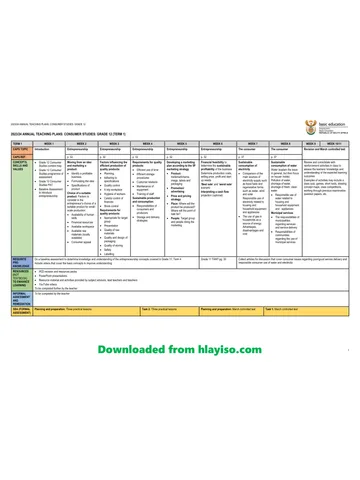
CONSUMER STUDIES GR12 MEMO SEPT 2018 English hlayiso.com
Consumer Studies · Grade 12 · Eastern Cape Mock Exam · 2018 · English. Memorandum, 15 pages. Read online or download the PDF.
- Subject
- Consumer Studies
- Grade
- Grade 12
- Language
- English
- Document type
- Memorandum
- Year
- 2018
- Exam period
- Eastern Cape Mock Exam
- Pages
- 15
- File size
- 362.8 KB
Loading document…
Loading document…
1 of 15
Document textSearch extracted text and jump to a page.
Downloaded from hlayiso.com
2 CONSUMER STUDIES (EC/SEPTEMBER 2018)
QUESTION 1: SHORT QUESTIONS
1.1 MULTIPLE-CHOICE QUESTIONS
1.1.1 D (1) Remembering Easy
1.1.2 C (1) Understanding Moderate
1.1.3 D (1) Remembering Easy
1.1.4 C (1) Remembering Easy
1.1.5 B (1) Remembering Easy
1.1.6 B (1) Understanding Moderate
1.1.7 A (1) Remembering Easy
1.1.8 D (1) Remembering Easy
1.1.9 B (1) Remembering Moderate
1.1.10 D (1) Remembering Moderate
1.1.11 D (1) Remembering Easy
1.1.12 A (1) Understanding Moderate
1.1.13 B (1) Remembering Easy
1.1.14 C (1) Remembering Easy
1.1.15 B (1) Remembering Easy
1.1.16 C (1) Understanding Moderate
1.1.17 D (1) Remembering Easy
1.1.18 A (1) Remembering Easy
1.1.19 D (1) Understanding Moderate
1.1.20 C (1) Remembering Easy (20 x 1) (20)
1.2 1.2.1 G ii (2)
1.2.2 F iii (2)
1.2.3 B v (2)
1.2.4 D vii (2)
1.2.5 C i (2)
Remembering, Easy (5 x 2) (10)
1.3 1.3.1 low
1.3.2 flea market
1.3.3 renewable
1.3.4 eco-friendly
1.3.5 upcycling
1.3.6 classic
Remembering, easy (6 x 1) (6)
1.4 1.4.1 C
1.4.2 D
1.4.3 E
1.4.4 H
Remembering, Moderate (4 x 1) (4)
[40]
Copyright reserved Please turn over
Downloaded from hlayiso.com
(EC/SEPTEMBER 2018) CONSUMER STUDIES 3
QUESTION 2: THE CONSUMER
2.1 Explain the term exemption clause.
An exemption clause is a clause included in contracts that clears a party from
any liability, should he/she fail to honour the agreement/when the agreed
product or service does not serve the purpose for which it was required.
OR
Part of the contract that frees the supplier from blame or responsibility.
Understanding, easy (2)
2.2 State THREE basic services that municipalities should offer to
residences in their municipal areas.
Electricity
Water
Sanitation/sewerage collection
Refuse removal (Any 3 x 1) (3)
Understanding, easy
2.3 Table non-provisional tax and provisional tax.
Non-provisional tax Provisional tax
Regularity/type of Employed by an employer / Income is not fixed /
income earned full-time employed / regular/ irregular income /
Monthly income / fixed people with income
money income / earning a other than salaries
salary
(Any 1) (1) (Any 1) (1)
How often the tax Every month / monthly Twice a year
is paid (Any 1) (1) (1)
Understanding, moderate (4)
Copyright reserved Please turn over
Downloaded from hlayiso.com
4 CONSUMER STUDIES (EC/SEPTEMBER 2018)
2.4 Give THREE advantages of solar power to provide us with electricity.
Solar energy is clean and does not cause pollution.
Solar energy systems can function well in almost any climate.
The systems can operate without being connected to electricity or gas.
There is no noise pollution when power is generated.
Manufacturers of solar equipment now offer warranties up to 20 years on
their products.
The government gives financial incentives that aim to reduce the cost of
installation. (Any 3 x 1) (3)
Applying, moderate
2.5 Explain TWO ways in which consumers can save tap water in their homes.
Fix dripping/leaking taps as they waste a lot of water
Fit tap aerators that reduce water flow
Turn off water while brushing teeth
Do not use running water when washing dishes. (Any 2 x 1) (2)
Understanding, easy
2.6 Advertisement
2.6.1 Scam
Remembering, easy (1)
2.6.2 Paragraph
The advertisement looked genuine/because it was placed in the local
newspaper. Lusindiso was attracted by the flat with a sea view / near
the beach. It was an easy payment method – the money market. The
accommodation would have been arranged by Zukie. The contact
person (Zukie) was not available just before the holiday.
Analysis, moderate (5)
[20]
Copyright reserved Please turn over
Downloaded from hlayiso.com
(EC/SEPTEMBER 2018) CONSUMER STUDIES 5
QUESTION 3: FOOD AND NUTRITION
3.1 Give THREE reasons why antioxidants are used as food additives.
Antioxidants preserve the quality of food/lengthen the shelf life of food.
Prevent rancidity and unpleasant taste and smell in margarine, cooking
oil, biscuits, potato chips, soup mixtures.
Preserve the colour of fresh cut fruit and vegetables, delay enzymatic
browning, discolouration in fruit and vegetables, fruit juice/soft drinks,
canned vegetables, frozen fruit. (Any 3 x 1) (3)
Remembering, moderate
3.2 FIVE factors that will increase the developing of osteoporosis.
Low oestrogen levels
Body shape
Family history of osteoporosis
Diseases of hormone-producing glands such as overactive thyroid gland
Smoking
Long-term use of certain medications
Excessive alcohol intake (Any 5 x 1) (5)
Remembering, easy
3.3 Obese people have a higher risk of health problems.
3.3.1 TWO heart-related health risks that may occur during obesity.
Coronary heart disease
Hypertension/high-blood pressure
Remembering, moderate (2)
3.3.2 Discuss THREE eating habits to manage obesity.
Control the amount and types of food you eat and physical activities.
Adopt a healthy lifestyle, maintain good eating habits. Avoid junk
food/large portions, choose healthier options such as salad or grilled
foods. Reduce the total number of kilojoules you consume per day
by eating fewer fatty and sugar foods. Eat more vegetables/fruit.
Eat more whole grains/low GI carbohydrates as this may assist in
weight loss. Increase the intake of legumes as they have a low GI
are filling and are low in fat. Eat more fibre-rich food as this fills you
up and delays the feeling of hunger. Eat more chicken, fish and nuts
than red meat as it contains less fat and cholesterol. Drink enough
water during the day. Eat a good breakfast to give you enough
energy for the day. Chew the food thoroughly. Grill, bake, steam
food instead of frying. Consume alcohol in moderation.
Remembering, moderate (Any 3 x 1) (3)
Copyright reserved Please turn over
Downloaded from hlayiso.com
6 CONSUMER STUDIES (EC/SEPTEMBER 2018)
3.4 Explain why consuming whole grains are beneficial to a person suffering
from diabetes.
The fibre/soluble fibre in whole-grain helps to control blood sugar/glucose
levels as they digest slower and helps to prevent large fluctuations in
the blood glucose level this may help to reduce the developing of type 2
diabetes.
Understanding, easy (4)
3.5 State THREE benefits that organically grown food may have for the
natural environment.
Organic farmers use natural pesticides to protect the environment
They concentrate on the sustainable use of resources
It improves the soil quality/prevent soil pollution
It reduces air pollution as very little or no fuel is used to manufacture
organic fertilisers
Protects the waste supply
Water remains cleaner because there is no runoff of poisonous chemicals
into the water
Understanding, easy (Any 3 x 1) (3)
3.6 3.6.1 Identify the food related disease that will result due to the plaque
build-up in the arteries.
Atherosclerosis
Remembering, easy (1)
3.6.2 Give a reason why the plaque build-up occurs in the arteries.
Fatty deposits/cholesterol build up inside the inner walls of the
arteries due to an increased intake of saturated fat/low density
lipoproteins.
Understanding, easy (2)
3.6.3 List THREE risk factors for the above-mentioned health disease.
Family history of coronary heart disease
Age
Gender
Ethnic groups (Any 3 x 1) (3)
3.6.4 Explain the following dietary guidelines to prevent or manage the
disease in QUESTION 3.6.1
(a) Eat fatty fish such as sardines at least twice a week.
Fatty fish contains unsaturated fat which will not cause
plaque build-up. (2)
(b) Increase the intake of legumes.
Legumes are low in fat and high in soluble fibre which has
a lowering effect. (2)
Applying, moderate
Copyright reserved Please turn over
Downloaded from hlayiso.com
(EC/SEPTEMBER 2018) CONSUMER STUDIES 7
3.7 Scenario
One protein Two
One bread type One spread
filling accompaniments
Whole-wheat Lite-margarine Smoked Lettuce
bread (1) chicken Tomato
(1) Tuna Cucumber
mayonnaise Low-fat cheese
(1) wedges (2)
Reasons Reasons Reasons Reasons
High in fibre Will lower the High in Tomato/cucumber
Low GI total fat protein /lettuce is rich in
Will reduce content Chicken vitamins/mineral/
the blood Protects the heart without the fibre/low in fat
cholesterol as most contains skin has a that reduces the
level the heart and lower fat risk of coronary
(1) stroke foundation content heart disease
logo Tuna is rich in Low-fat cheese
(1) Omega-3 has a reduced
Fatty acids fat content which
that protect reduces the risk
the heart of coronary heart
and blood disease
vessels (2)
(1)
NOTE: ONE mark for each choice and one mark for a reason.
Analysing, difficult (10)
[40]
Copyright reserved Please turn over
Downloaded from hlayiso.com
8 CONSUMER STUDIES (EC/SEPTEMBER 2018)
QUESTION 4: CLOTHING
4.1 Explain the following terms:
4.1.1 Classic style
Not trends but last for many seasons with occasional subtle
updates. Styles design, colours and fabrics that remain popular
over a long period of time. (2)
4.1.2 Retrospective fashion
It refers to clothes that imitate the style of a previous era. Designers
look to the past for inspiration, but interpret it with a modern twist.
Styles never come back in exactly the same form / they are adapted to
suit the needs and lifestyle of the present era, time and place.
Remembering, easy (Any 2 x 1) (2)
4.2 Explain the following stages of the fashion cycle:
4.2.1 Introduction/launch
The fashion is first introduced; celebrities are photographed wearing the
trend. Fashion leaders adopt or accept or reject the fashion.
Remembering, easy (2)
4.2.2 Peak
The fashion reaches the height of popularity/many people wear it. / It
is mass produced / Advertised by clothing stores and in window
displays.
Remembering, easy (2)
4.2.3 Obsolescence/end
Garments are out of fashion/disappear/go on sale/become obsolete.
Fashion cycle is completed. A new fashion trend has already
established itself.
Remembering, easy (2)
4.3 Brand piracy has a definitive impact on the sales of legally protected
brand names. Justify this statement.
The image of the protected brand names will be affected and can lead to
less sales.
The clients will lose ‘faith’ in the brand name.
Manufacturers of the original brand name lose millions of sales.
Popular brand names been put off by low prices of fake clothes – thus less
sales are made. (4)
Understand, moderate
Copyright reserved Please turn over
Downloaded from hlayiso.com
(EC/SEPTEMBER 2018) CONSUMER STUDIES 9
4.4 Joyce – clothing items
Black blazer (1)
Professional/formal/smart look/appearance
Will keep her warm
Will match the black pants/white shirt/other items
Classic style, can be worn for a long time (Any 1) (1)
Long black pants (1)
Professional/formal/smart look/appearance
Plain/neutral colour, can be mixed-and-matched with other clothes
Classic style, can be kept for a long time (Any 1) (1)
White long-sleeved shirt (1)
Professional/formal/smart look/appearance
Classic style, can be kept for long time
Plain/neutral colour, can be mixed and matched with other clothes
(Any 1) (1)
Evaluating, moderate (6)
[20]
Copyright reserved Please turn over
Downloaded from hlayiso.com
10 CONSUMER STUDIES (EC/SEPTEMBER 2018)
QUESTION 5: HOUSING
5.1 Explain the following terms:
5.1.1 Transfer duties
Government tax on properties to transfer it into your name and is
based on the home loan amount of the property.
OR
Tax collected by the receiver of revenue on behalf of the
government. The tax is paid to SARS every time the property changes
hands. It is based on the value of the property.
Remembering, easy (2)
5.1.2 Occupational rent
An amount paid by the person occupying the property to the party in
whose name the property is registered
OR
If the buyer occupies the property before the bond is registered
he/she must pay occupational rent to the seller.
Remembering, easy (2)
5.1.3 Deed of sale
It is a signed offer to purchase that binds the buyer by law to
purchase the property / binds a buyer and seller by law to obey the
terms and conditions set out in the contract.
Remembering, moderate (2)
5.2 List the financial implications for a consumer to consider when
purchasing household appliances by means of instalment sales.
Take item home once a deposit has been paid and a contract signed.
Pay instalments over a period of time.
Extra costs include a deposit, admin fees, insurance charges, bank
charges and interest.
Retailer and consumer must sign a written contract. Minimum deposit
and maximum period or repayments are prescribed by law. (Any 4 x 1) (4)
Remembering, moderate
5.3 Case study
5.3.1 Explain what a housing subsidy is.
An individual housing subsidy is a grant of money available to
people from low-income groups who want to buy a residential
property for the first time.
OR
A government grant to qualifying low-income consumers to help
them to acquire housing.
Remembering, easy (3)
Copyright reserved Please turn over
Downloaded from hlayiso.com
(EC/SEPTEMBER 2018) CONSUMER STUDIES 11
5.3.2 Explain whether Vivie will qualify for a government housing
subsidy
Vivie is a South African citizen. She is 35 years old/older than 21
years old. She is a widow with dependants/children.
Vivie earns less than R3 500 per month (R3 200).
Vivie qualifies for the housing subsidy as she meets all the criteria for
applying for a housing subsidy. (5)
5.3.3 State FOUR advantages of providing government housing
subsidies to low income, first-time home owners.
Providing housing to low income families will make sure less
people live on the street.
When people have a house, they will have more pride so that they
will work harder and grow their own personal wealth.
Shacks are unsafe for children paraffin lamps can cause
burns/risk of collapse.
Houses have plumbing and clean water safer for children and
less chance of diseases to spread.
Safe areas for children to play outside.
Closer to developed areas and transport to work.
The ego of the housing receiver will be boosted.
The subsidised house can be used as collateral security.
Evaluating, difficult (Any 4 x 1) (4)
5.4 Discuss why buying is not always financially better than renting.
Buying a property is very expensive as there are transfer costs /transfer
duties, transfer fees hidden costs bond registration fees deed office
fees/interim rates/initiation fees/property valuation fees/occupational
rent/administration fees/service connection fees.
Renting is cheaper in the short term/initially cheaper and this enables a
tenant to save for a deposit. The larger the deposit, the easier it will be to
meet the financial responsibilities of owning a property.
A tenant pays a fixed amount over a specific period and it is not affected
by increases in the interest rate.
A tenant does not pay municipal rates/property tax/Owners pay for
municipal rates/property tax.
A tenant does not pay for maintenance of the property. Owners pay for
maintenance.
A tenant does not pay bond insurance/home owner’s insurance. Owners
pay bond insurance/home owner’s insurance.
It is easy to move after giving due notice. It is thus easier to rent if you
are not going to stay for long in a city/town/know you are going to move
soon. (8 x 1) (8)
Applying, moderate
Copyright reserved Please turn over
Downloaded from hlayiso.com
12 CONSUMER STUDIES (EC/SEPTEMBER 2018)
5.5 Washing machine
5.5.1 Explain the term contract.
A contract is an agreement between two or more people whereby the
one person offers to do something and the other person accepts.
Remembering, easy (Any 2) (2)
5.5.2 Discuss the following criteria a prospective buyer should consider
before buying a washing machine:
(a) Consumption of human energy
Choose the correct size according to the family’s needs. That
will ensure that the family does not spend too much time
doing laundry.
It should be easy to reach and clean lint filters will save
energy.
Control panels should be easy to use to save energy.
(Any 2 x 1) (2)
(b) Possible environmental impact
Front loaders use less water thus saving water
Check rating for water and energy consumption to ensure
that the machine saves water and electricity
Some manufacturers indicate how the packaging should be
disposed off in an environmentally friendly manner, thus
preventing litter/waste.
Understanding, moderate (Any 2 x 1) (2)
5.5.3 Analyse the suitability of this washing machine for a large family.
The washing machine can handle 10 kg so it will be suitable for a
large family
Easy to operate – children will be able to operate the washing
machine
The washing machine has different cycles and programmes which
will make washing different types of clothing/textiles easier.
Analyse, difficult (Any 2 x 2) (4)
[40]
Copyright reserved Please turn over
Downloaded from hlayiso.com
(EC/SEPTEMBER 2018) CONSUMER STUDIES 13
QUESTION 6: ENTREPRENEURSHIPS
6.1 Explain the following terms:
6.1.1 Quality control
Is product inspection process to ensure that the product meets the
standard. Quality control is to ensure that the product maintains the
quality.
Is a measure of excellence ‒ a quality product is free from defects.
Remembering, easy (2)
6.1.2 Sustainable profitability
To ensure that you are able to produce products for a long time without
running out of cash, making a profit for a business.
Remembering, easy (2)
6.1.3 Best sales scenario
It is when the business reaches its target /goal / a prediction of what
will happen if the product sells well.
Remembering, easy (2)
6.2 Case study
6.2.1 Target market
Students
Factory workers
Industrial workers (Any 2 x 1) (2)
Applying, easy
6.2.2 TWO start-up needs
Washing machine
Iron/equipment
Cleaning materials
Money that she saved (Any 2 x 1) (2)
Applying, easy
6.2.3 TWO overhead costs
Electricity
Water
Rent (Any 2 x 1) (2)
Applying, easy
Copyright reserved Please turn over
Downloaded from hlayiso.com
14 CONSUMER STUDIES (EC/SEPTEMBER 2018)
6.2.4 Requirements for the packaging material
Packaging must be suitable for the clean and washed clothes
Easy to handle (laundry trolleys)
Must protect the clothes against getting dirty/must be kept clean
Crease resistant – to prevent clothes from creases (Any 3 x 1) (3)
Remembering, moderate
6.2.5 FOUR P’s of the marketing mix
Product – (service) washing and ironing of clothes
Promotion – Zelda gave out flyers
People – the students, factory workers made use of her clothing
cleaning services
Place – Zelda’s sister’s vacant backroom/laundry in an industrial
area (4 x 1) (4)
Applying, moderate
6.2.6 FOUR factors Zelda had to consider in the choice of her business
Availability of human skills/workers Zelda had the knowledge of
the equipment and textiles. She took two friends in service.
Using the knowledge, she received in Consumer Studies.
Financial resources she saved money to buy equipment and
cleaning materials
Availability of workspace. She converted her sister’s vacant
backroom into her own laundry.
Availability of raw material. Cleaning materials can be bought at
any shop. (4 x 2) (8)
Applying, easy
6.2.7 (a) Production costs
R14,00 + R6,60
= R20,60 x 18 kg = R370,80 (3)
(b) Profit
R370,80 x 60% / 60 ÷ 100
= R222,48 (3)
Applying, difficult
NOTE: Minus (-) 1 mark if the R monetary value is not
written to the final answer.
Copyright reserved Please turn over
Downloaded from hlayiso.com
(EC/SEPTEMBER 2018) CONSUMER STUDIES 15
6.3 Reasons for the inconsistent income and expenses.
In September and October, students go home for a short holiday.
Factories do not close for this period, so she will still have factory clients,
but her income will be less.
During October and November, the students prepare for the exam, and
have little time to do their washing. Factory workers still work and that
keeps the income increasing.
During November and December, the students write their final exams and
the students do not have time to do their own washing.
Factory workers may work overtime to complete the work or production,
before the holiday starts, thus they will have more dirty clothes to be
washed – increase in Zelda’s income.
During December and January, the colleges and factories are closed.
Students and factory workers that live the area go home for the festive
season, fewer clothes to wash cause a drastic decrease in the income of
Zelda’s business.
During January and February colleges reopen, students come back/new
students come to register and new factory workers start working.
Existing and new clients start making use of laundry services that cause an
increase in income in the business.
Analysis, difficult (Any 7 x 1) (7)
[40]
TOTAL: 200
Copyright reserved Please turn over
Recommended for this subject
Published documents with matching subject and grade metadata.
Memorandum
CONSUMER STUDIES GR12 MEMO SEPT 2025 AFR
Memorandum
Consumer Studies May June 2025 MG Eng
Memorandum
Consumer Studies Nov 2025 MG Afr
Memorandum
CONSUMER STUDIES GR12 MEMO SEPT2024 English hlayiso.com
Memorandum
CONSUMER STUDIES GR12 MEMO SEPT2023 English hlayiso.com
Memorandum
CONSUMER STUDIES GR12 MEMO SEPT2022 English hlayiso.com
Related documents
Matched using subject, grade, language, document type and exam metadata.
Question paper
CONSUMER STUDIES GR12 QP SEPT 2018 English hlayiso.com
Memorandum
CONSUMER STUDIES GR12 MEMO SEPT2021 English hlayiso.com
Memorandum
CONSUMER STUDIES GR12 MEMO SEPT 2019 English hlayiso.com
Question paper
CONSUMER STUDIES GR12 QP SEPT2023 English hlayiso.com
Question paper
CONSUMER STUDIES GR12 QP SEPT2022 English hlayiso.com
Question paper
CONSUMER STUDIES GR12 QP SEPT2021 English hlayiso.com
More from Grade 12 Consumer Studies
Explore more published documents in this catalogue.
Annual teaching plan
Gr 12 Con Stu ATP 2023 24
Question paper
CONSUMER STUDIES GR12 QP SEPT 2025 ENG
Question paper
Consumer Studies Nov 2025 Eng
Errata
Consumer Studies Erratum Sept 2024 hlayiso.com
Question paper
CONSUMER STUDIES GR12 QP SEPT2024 English hlayiso.com
Question paper